Holding an Effective
Press Conference
May 6, 2014
Overview
• A Quick Intro
• What is a Press Conference?
• 2 Examples and Their Lessons
• Recap and Key Takeaways
• Q&A
2
WHAT IS A PRESS
CONFERENCE?
Before we get started
3
A Press Conference is a Media Event
• Q&A or Statement
– Typical press conference
• Groundbreaking
– Start construction on a project
• Grand Opening or Ribbon Cutting
– A new business or location
• Announcement or Unveiling
– Sharing something new, like an event, product, service, etc.
• Donation or Check Presentation
– Celebrate a major gift
4
TWO EXAMPLES
Press Conferences
5
AD COUNCIL OF ROCHESTER
Example 1
6
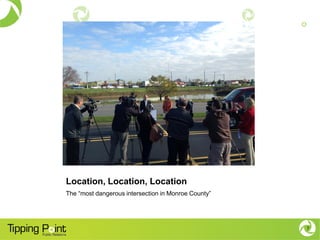
Location, Location, Location
The “most dangerous intersection in Monroe County”
7
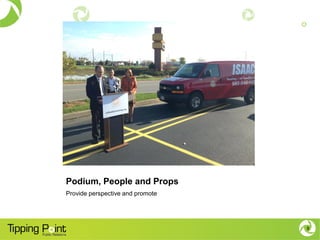
Podium, People and Props
Provide perspective and promote
8
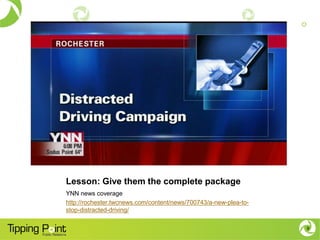
Lesson: Give them the complete package
YNN news coverage
http://rochester.twcnews.com/content/news/700743/a-new-plea-to-
stop-distracted-driving/
9
Pro Tip: Say It & Display It
• News stories won’t always print, say or display your
website
– Bonus: Monitor coverage and ask them to add links to the
online version of stories
• Put your website on a podium sign, poster or other
visual
• Shirts, hats and other items with your logo help add
emphasis
10
ESL, MCC AND PATHSTONE
Example 2
11
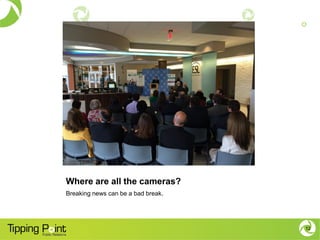
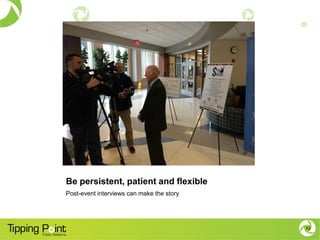
Where are all the cameras?
Breaking news can be a bad break.
12
Be persistent, patient and flexible
Post-event interviews can make the story
13
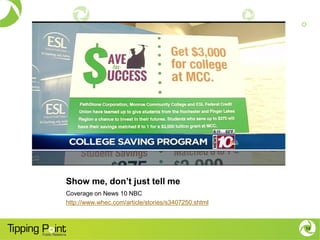
Show me, don’t just tell me
Coverage on News 10 NBC
http://www.whec.com/article/stories/s3407250.shtml
14
Pro Tip: Use Politicians and VIPs
• It’s easy to involve local, state or federal officials
– Bonus: Ask for Citation, Resolution or Proclamation
• Presidents & CEOs from partners are a natural fit
• Invite an expert or celebrity to participate
15
WHAT YOU NEED TO KNOW
Recap and Key Takeaways
16
Why should you hold a press conference?
• Limited availability of key participants
– When there’s a narrow window of opportunity
• Significant or breaking news
– When everyone will start calling
• Control an announcement or respond to a crisis
– When you only want to do it once
17
Who do you invite?
• The media: reporters covering you and outlets
reaching your target audience
– Follow up before and after
• Key participants: elected officials, partner agencies,
experts, testimonials
– Provide different perspectives, but limit speakers
• Stakeholders: community partners, board members,
senior leadership, donors, volunteers
– An audience is nice but not necessary
18
Where should it be?
• Visual location
– Always visit the location in advance, around the same time
• Convenient location
– Make it easy for the media and others to attend
• Backup location
– Be prepared in case of rain or other delays
19
When should it be?
• Sometimes, you don’t have a choice
– Availability or moments in time might dictate it
• Weekdays are best, crews are limited on weekends
– Tuesdays, Wednesdays and Thursdays are good choices
• Be aware of news deadlines
– Between 10 a.m. and 2 p.m. is often best
20
How do you get your message out?
• Before
– Identify partners and roles, prepare and rehearse remarks
– Send a media alert in advance and follow up
• During
– Use visuals and participants to provide a complete story
– Deliver key messages in one-on-one standup interviews
• After
– Follow up with those who didn’t attend, offer interviews
– Send a press release, photos and video to media
• Pro Tip: Instead of bulky attachments, send a link to a
Dropbox folder with all the media kit materials
21
And keep your message out!
• Share coverage across all channels
– Social media, website, newsletters
– Ask partners and participants to share too
• Repurpose content and materials
– Turn a press release into a blog post or a fact sheet into
infographic
– Use posters, podium signs and visuals for future events
• Try different tactics and approaches
– Write a guest essay for a print outlet that didn’t cover it
– Pitch a different angle or update story on progress or success
22
DID WE MISS ANYTHING?
Additional Q&A
23
Contact Me
Mike Kennerknecht, PR Manager
Tipping Point Public Relations
mike@tippingpointmedia.com
585-340-1119, ext. 34
www.tippingpointmedia.com
@Kennerknecht
@TippingPointPR
24

Holding an Effective Press Conference

  • 1.
    Holding an Effective PressConference May 6, 2014
  • 2.
    Overview • A QuickIntro • What is a Press Conference? • 2 Examples and Their Lessons • Recap and Key Takeaways • Q&A 2
  • 3.
    WHAT IS APRESS CONFERENCE? Before we get started 3
  • 4.
    A Press Conferenceis a Media Event • Q&A or Statement – Typical press conference • Groundbreaking – Start construction on a project • Grand Opening or Ribbon Cutting – A new business or location • Announcement or Unveiling – Sharing something new, like an event, product, service, etc. • Donation or Check Presentation – Celebrate a major gift 4
  • 5.
  • 6.
    AD COUNCIL OFROCHESTER Example 1 6
  • 7.
    Location, Location, Location The“most dangerous intersection in Monroe County” 7
  • 8.
    Podium, People andProps Provide perspective and promote 8
  • 9.
    Lesson: Give themthe complete package YNN news coverage http://rochester.twcnews.com/content/news/700743/a-new-plea-to- stop-distracted-driving/ 9
  • 10.
    Pro Tip: SayIt & Display It • News stories won’t always print, say or display your website – Bonus: Monitor coverage and ask them to add links to the online version of stories • Put your website on a podium sign, poster or other visual • Shirts, hats and other items with your logo help add emphasis 10
  • 11.
    ESL, MCC ANDPATHSTONE Example 2 11
  • 12.
    Where are allthe cameras? Breaking news can be a bad break. 12
  • 13.
    Be persistent, patientand flexible Post-event interviews can make the story 13
  • 14.
    Show me, don’tjust tell me Coverage on News 10 NBC http://www.whec.com/article/stories/s3407250.shtml 14
  • 15.
    Pro Tip: UsePoliticians and VIPs • It’s easy to involve local, state or federal officials – Bonus: Ask for Citation, Resolution or Proclamation • Presidents & CEOs from partners are a natural fit • Invite an expert or celebrity to participate 15
  • 16.
    WHAT YOU NEEDTO KNOW Recap and Key Takeaways 16
  • 17.
    Why should youhold a press conference? • Limited availability of key participants – When there’s a narrow window of opportunity • Significant or breaking news – When everyone will start calling • Control an announcement or respond to a crisis – When you only want to do it once 17
  • 18.
    Who do youinvite? • The media: reporters covering you and outlets reaching your target audience – Follow up before and after • Key participants: elected officials, partner agencies, experts, testimonials – Provide different perspectives, but limit speakers • Stakeholders: community partners, board members, senior leadership, donors, volunteers – An audience is nice but not necessary 18
  • 19.
    Where should itbe? • Visual location – Always visit the location in advance, around the same time • Convenient location – Make it easy for the media and others to attend • Backup location – Be prepared in case of rain or other delays 19
  • 20.
    When should itbe? • Sometimes, you don’t have a choice – Availability or moments in time might dictate it • Weekdays are best, crews are limited on weekends – Tuesdays, Wednesdays and Thursdays are good choices • Be aware of news deadlines – Between 10 a.m. and 2 p.m. is often best 20
  • 21.
    How do youget your message out? • Before – Identify partners and roles, prepare and rehearse remarks – Send a media alert in advance and follow up • During – Use visuals and participants to provide a complete story – Deliver key messages in one-on-one standup interviews • After – Follow up with those who didn’t attend, offer interviews – Send a press release, photos and video to media • Pro Tip: Instead of bulky attachments, send a link to a Dropbox folder with all the media kit materials 21
  • 22.
    And keep yourmessage out! • Share coverage across all channels – Social media, website, newsletters – Ask partners and participants to share too • Repurpose content and materials – Turn a press release into a blog post or a fact sheet into infographic – Use posters, podium signs and visuals for future events • Try different tactics and approaches – Write a guest essay for a print outlet that didn’t cover it – Pitch a different angle or update story on progress or success 22
  • 23.
    DID WE MISSANYTHING? Additional Q&A 23
  • 24.
    Contact Me Mike Kennerknecht,PR Manager Tipping Point Public Relations mike@tippingpointmedia.com 585-340-1119, ext. 34 www.tippingpointmedia.com @Kennerknecht @TippingPointPR 24