28.12.2016 Note byBala
Corporate Ethics, Corporate Governance &
Corporate Social Responsibility
Note: To be read in conjunction with PPT slides and other material provided
Background:
The word ‘Ethics’evolvesfromthe Greek word, ‘Ethos’. ‘Ethos’ means ‘Character’ or ‘Custom’. As a
corollary, ethical behaviour means ‘socially and morally’ acceptable behaviour. The experience of
unethical behaviour is not new to human civilization. It has been in existence right from ancient
civilizations.Inthe 6th
centuryB.C. the philosopher Anacharsis once said, “The market is a place set
apart where men may deceive one another.” History is replete with examples of unethical
behaviour, unethical practices inconsistent with common good for society, for people at large, for
government etc. out of selfish interests and aggrandisement. We are familiar with the expression
“Powercorruptsultimately”. Powerreferredtointhisstatementcouldmean one or more of these:
Political,Economic,Social, Religious,Financial or Organizational.Powerisvestedinanindividual or
a group of individualslike‘Boardof directors’inabusinessorganization by the authority they enjoy
and the position they come to occupy in their respective areas.
Power makes individuals or a group of individuals ‘heady like a drunken man’. Once an individual
rises to a high position in politics or business, one tends to think that one is above law. This
perception could lead one to questionable actions and behaviour. This is unethical behaviour.
Business ethics is about:
 Decision-Making
 By People in Business
 According to Moral Principles or Standards
In an organization,decisionsare beingtakenregularly. Conflictingduties,loyaltiesorinterestscreate
moral dilemmas requiring decisions to be made. Ethical decision-making involves the ability to
discern right from wrong along with the commitment to do what is right. In a highly competitive
environment of business, principles are being compromised with frequently. The ultimate goal of
any business is growth through profits. CEOs and Presidents and Managing Directors (may be the
entire board of directors) achieve growth and market leadership, but at what cost?
Modern business had become conscious of the need for ethical behaviour due to a series of
corporate fraudsin the 70’s and80’s of the twentiethcentury. Asaresult,takingthe initiative in the
international community, U.K. hadappointedthe CadburyCommittee toevolve the firstcodified set
of ‘business ethics’. The committee had come out with the very first report that modern business
knows as ‘Corporate governance’ (CG) report. ‘Corporate governance’ is nothing but codified
corporate ethical practices expected to be followed by organizations globally. This is the very first
steptowards establishing code of conduct for business on a universal dimension. As we will see in
the followingparagraphs,the firststepof businessethicsledto‘Corporate governance’. This in turn
ledto the ‘Corporate Social Responsibility’asisbeingpracticed today. Today, in terms of provisions
of The Companies Act, 2013, Indian limited companies are required to publish as a part of their
annual reports, a section on ‘Corporate governance’ report on ethical practices being followed in
their respective organizations. Corporate social responsibility obligation is not on all limited
companies.The norms have beenprescribedforthose of the limited companies that are listed. The
CSR spendingismandatoryforsuchlimitedcompanies.Otherlimitedcompanies can do voluntarily.
Indiancorporate historyhasadequate numberof examplesof limited companies undertaking ‘CSR’
initiatives on their own much before the mandatory ‘CSR’ rules came into existence.
What is the importance of ‘morals’?
Let us see what some great personalities had to say about ‘morals’.
• “The most important human endeavor is the striving for morality in our actions. Our inner
balance andevenour veryexistence depend on it. Only morality in our actions can give beauty
and dignity to life. - Albert Einstein (in a letter 11/20/50)
• The historian Arnold Toynbee observed: "Out of 21 notable civilizations, 19 perished not by
conquest from without but by moral decay from within."
In sharp contrast, let us also see what modern young generation feels about ‘ethical standards’.
According to a recent poll of college seniors, 73% agreed with the statement that “What is right or
wrongdependsondifferencesinindividualvaluesand cultural diversity.” Only 25% agreed with the
statementthat“There are clearand uniformstandardsof rightandwrong bywhicheveryone should
be judged."
Relative and absolute standards of morals:
Relative iswhatis suitable for the circumstances and could vary from situation to situation or from
time to time;absolute standardsremainthe same,standingthe testof time well. Itisthe absence of
absolute standardsthatleadstocorruptionof moral standardsthroughtheirdilution. The following
lines explain the effect of relative standards.
Relativism allows for oppression of those with minority views by allowing the majority in any
particular circumstance to define what is morally right or wrong.
– “In Germany they first came for the Communists, and I didn't speak up because I wasn't a
Communist.
– Then they came for the Jews, and I didn't speak up because I wasn't a Jew.
– Thentheycame forthe trade unionists, and I didn't speak up because I wasn't a trade unionist.
– Then they came for the Catholics, and I didn't speak up because I was a Protestant.
– Then they came for me — and by that time no one was left to speak up.”
German anti-Nazi activist, Pastor Martin Niemöller
Relativists never need bother to examine why something is moral or immoral, they merely
accept/tolerate alternative determinations, so that none are held to account.
Let us learn something fundamental about the three, corporate ethics, corporate governance and
corporate social responsibility.
Business ethics
1.
a. Examplesof ethical practicesbyemployees:
i. Work habits
ii. Ethicsin sales
iii. Ethicsin advertisement
iv. Ethicsin purchase function
b. Unethical practicesusuallydone byemployeesetc.
 Paddingof labourchargesand expense accounts
 Personal longdistance phone callsoncompanyaccounts
 Untidyworkareas, breakareasand restrooms
 Takingoffice supplieshome
 Excessive breaksorsickdays
 Improperuse of copy machinesandcomputerequipment
 Cheatingthe companyinthe matterof leave,absence,advance etc.
 Notconformingtoexpectedbusinessetiquette whiledealingwithexternal customersof
the organization
 Abusive behaviour
 Undue creditfor anywork,result,achievementetc.
 dishonesty, withholding information, distortion of facts
 misleadingorconfusingcommunicationsorpositioningoradvertising
 manipulationof people'sfeelings
 deception,trickery,kidology,rule-bending,foolingpeople
 exploitationof weaknessandvulnerability
 excessiveprofit
 greed
 anythingliable toharmor endangerpeople
 breachof the Psychological Contract - the Psychological Contractrepresentstrustand
expectationsbetweenpeople inarelationship - notablywithinemployer/employee
relationships,extendingtootherorganizational relationshipstoo - (aside from
Psychological Contract theory,specialisedtheorywithin TransactionalAnalysis helps
explainthisaspectof trustandexpectationsinhumanrelationships)
 avoidance of blame orpenaltyorpaymentof compensationforwrong-doing
 inertia-based'approvals'and'agreements'(inwhichactionproceedsunlessobjectedto)
 failingtoconsultandnotifypeople affectedbychange
 secrecyand lackof transparencyandresistance toreasonable investigation
 coercionor inducement
 harmingthe environment orplanet
 unnecessarywaste orconsumption
 invasionof privacyoranythingcausingprivacyto be compromised
 recklessnessorirresponsible use of authority,power,reputation
 nepotism(the appointmentorpreferenceof familymembers)
 favouritismordecision-makingbasedonulteriormotives(e.g.,secretaffiliations,deals,
memberships,etc)
 alienationormarginalisationof peopleorgroups
 conflictof interests(havingafootintwo or more competingcamps)
 neglectof dutyof care
 betrayal of trust
 breakingconfidentiality
 causingsufferingof animals
 'by standing'- failingtointervene orreportwrong-doingwithinareaof responsibility
(thisdoesnotgive licence tointerfere anywhere andeverywhere,whichisitself
unethical forvariousreasons)
 unfairness
 Unkindness
 lack of compassionandhumanity
2. Casesin2012 – Unethical corporate behaviour
a. ReebokIndiaLimited,asubsidiaryof AdidasAG – 870 crores fraud – MD & COO
b. Seriesof technicallybadordersplacedbyEmkayGlobal onNSE– 59 tradesworth more
than US $ 125 millionwere haltedbythe system –NIFT fiftyindex came downbymore
than 900 points
c. Kingfisherairlinesloseslicence tofly
d. Adani group – 1800 croresmarketcapitalizationlostoveronline rumour
e. Sahara toldto pay US $ 3 billiontoitsbondholders
3. Casesin2013 – Unethical corporate behaviour
a. Ranbaxy – criminal guiltypleaof US $ 500 millioninfinesandpenalties
i. Fuzzeddatasubmittedtoregulatorsabroad,the FDA,USA
ii. SimilaritybetweenSatyam fraudandRanbaxycase
iii. Notto holdindependentdirectorsonthe boardresponsible
iv. Independentdirector'sresponsibilityislimitedtoensuringthathe/she
understandsthe businessmodel,bestcorporate governancespractices(e.g.
board process,riskmanagementsystem, internal auditandstatutoryaudit,
whistle-blowerpolicy,andtransparencywithinandoutsidethe Board) are in
place and operatingeffectively,analysinginformationavailable throughthe
Board processesorotherwise andactingproactivelybasedonthatanalysisfor
the benefitof the companyasa whole.If independentdirectorsare held
responsible forfraudsperpetratedbyorwiththe supportof the top
management,whichhasthe abilitytooverrideinternalcontrols,itwillbe
difficultto induce professionalstojoinBoardsof companiesasindependent
directors.
4. How to be preparedforhandlinganyunethical issues?
a. Determine areasof possiblenegative ethics
i. Employeesbeinghighlystressedout
ii. International corporate relationships
b. Promote positive workplacebehaviourethics
i. Strongcorporate image
ii. Professionalism
iii. Honesty
iv. Trust
v. Responsibility
c. Continuousethicstraining
5. Four fundamental ethical principles(averysimple introduction)
a. The Principle of Respectforautonomy
Autonomyis Latinfor "self-rule"We have anobligationtorespectthe autonomyof
otherpersons,whichistorespectthe decisionsmade byotherpeople concerningtheir
ownlives.Thisisalsocalledthe principleof humandignity. Itgivesusanegative duty
not to interfere withthe decisionsof competentadults,andapositive dutytoempower
othersforwhomwe’re responsible.
Corollaryprinciples:honestyinourdealingswithothers&obligationtokeeppromises.
b. The Principle of Beneficence
We have an obligationtobringaboutgoodinall our actions.
Corollaryprinciple?We musttake positive stepstopreventharm. However,adopting
thiscorollaryprinciple frequentlyplacesusindirectconflictwithrespectingthe
autonomyof otherpersons.
c. The Principle of nonmaleficence
(Itis not"non-malfeasance,"whichisatechnical legal term&it isnot
"nonmalevolence,"whichmeansthatone didnotintendtoharm.)
We have an obligationnottoharmothers:"First,do noharm."
Corollaryprinciple:Where harmcannotbe avoided,we are obligatedtominimizethe
harm we do.
Corollaryprinciple:Don'tincrease the riskof harmto others.
Corollaryprinciple:Itiswrongto waste resourcesthatcouldbe usedfor good.
Combiningbeneficence andnonmaleficence:Eachactionmust produce more goodthan
harm.
d. The Principle of justice
We have an obligationtoprovide otherswithwhatevertheyare owedordeserve.In
publiclife,we have anobligationtotreatall people equally,fairly,andimpartially.
Corollary principle:Impose nounfairburdens.Combiningbeneficenceandjustice:We
are obligatedtoworkforthe benefitof those whoare unfairlytreated.
6. Ethical dilemmas:
1. A topemployee atyoursmall companytellsyouhe needssome time off because he has
AIDS.You knowthe employeeneedsthe jobaswell asthe healthinsurance benefits.
Providinghealthinsurance hasalreadystretchedthe company’sbudget,andthiswill send
premiumsthroughthe roof.Youknow the federal courtshave upheldthe rightof an
employertomodifyhealthplansbyputtingacap on AIDSbenefits.
Shouldyouinvestigatewhetherthisisalegal possibilityforyourcompany?
2. As a salesmanagerfora majorpharmaceuticalscompany,youhave beenaskedtopromote
a newdrug that costs$2,500 perdose.Youhave read the reportssayingthe drug isonly1
percentmore effective thananalternative drugthatcostslessthanone-fourthasmuch.Can
youin goodconscience aggressivelypromote the $2,500-per-dose drug?
If you do not,couldlivesbe lostthatmighthave beensavedwiththat1 percentincrease in
effectiveness?
3. Your companyis hopingtobuildanew overseasmanufacturingplant.Youcouldsave about
$5 millionbynotinstallingstandardpollutioncontrol equipmentthatisrequiredinthe
UnitedStates.The plantwill employmanylocal workersinapoor countrywhere jobsare
scarce. Your researchshowsthatpollutantsfromthe factorycouldpotentiallydamage the
local fishingindustry.Yetbuildingthe factorywiththe pollution control equipmentwill likely
make the planttoo expensive tobuild.
4. You are the accountingmanagerof a divisionthatis$15,000 below profittargets.
Approximately$20,000 of office suppliesweredeliveredonDecember.The accountingrule
isto pay expenseswhenincurred.The divisiongeneral managerasksyounotto recordthe
invoice until February.
5. You have beencollaboratingwithafellow manageronanimportantproject.One afternoon,
youwalkintohisoffice a bitearlierthanscheduledandsee sexuallyexplicitimagesonhis
computermonitor.The companyhasa zero-tolerance sexual harassmentpolicy,aswell as
strict guidelinesregardingpersonal use of the Internet.However,yourcolleague wasinhis
ownoffice andnot botheringanyone else.
7. Three stepsto solve ethical dilemmas:theyflowupwardsinvolvingutility(valuedeliveredtothe
stakeholders),Rights&Justice
a. Knowyourvaluesstrongly
b. Selectamodel of ethicssuitable forthe organization
c. Use a problemsolvingprocess
8. Three pillarsof anethical organization:
Pillar1 – Ethical individuals
a. Integrity
b. Honesty
c. Inspire trust
d. Treat people right
e. Playfair
f. Highlevel of moral development
Pillar2 – Ethical leadership
a. Role modelling
b. Upholdethical valuesinorganization
c. Communicate aboutethicsandvalues
d. Rewardethical behaviour
e. Swiftdisciplineof unethical behaviour
Pillar3 – Organization’sstructuresandsystems
a. Corporate culture
b. Code of ethics
c. Ethicscommittee
d. Chief ethicsofficer
e. Ethicstraining
f. Whistle-blowingmechanisms
9. Ethical leadership:
a. ‘Ethics’originatesfromthe Greekword‘Ethos’.Itmeanscharacter,conduct or customs
b. Withrespectto leadership,ethicsisaboutwholeadersare—theircharacterandwhat
theydo,theiractionsand behaviours.
c. Ethical leaderstreattheirfollowerswithrespectanddignity
d. Theirpersonal valuesdetermine whatkindof ethical climate will developintheir
respective organizations
e. Ethical leadershipprinciples:
i. Respectforothers
ii. Service toothers
iii. Justice toothers
iv. Honesty/integritytoothers
v. Buildingcommunitywithothers
f. Ethical leaderwouldaskthe followingquestionstohimself/herself:
i. Is thisthe rightand fairthingto do?
ii. Is thiswhata goodpersonwoulddo?
iii. Am I respectful toothers?
iv. Do I treat othersgenerously?
v. Am I honesttowardsothers?
vi. Am I servingthe community?
g. Principledleadership:
Principledleadersmake aconscientiousefforttogetall the relevantinformationto
make an informeddecisionandtosee thattheirdecisionsare consistentwiththeirval-
uesand those of the organization.
h. How to getprincipledleadership?
i. Upbringingandlife experiences
ii. Reflection
iii. Role models
iv. Code of ethicsand communication
i. The challengesof principledleadership:
i. Theyshouldbe model citizens
ii. Stickto what youare goodat
iii. Establishinganinclusive corporate culture
iv. Have soundwhistleblowerprotectionorprocessesforinformationflow
v. Boards of directorsshouldencourage CEOstospeakoutresponsiblyoncritical
issuesinsteadof scuttlingthem
j. Table 1:
The ethical leader
Is humble
The Unethical leader
Is arrogant andself-serving
Is concernedforthe greatergood Excessivelypromotesself-interest
Is honestandstraightforward Practicesdeception
Fulfilscommitments Breachesagreements
Strivesforfairness Dealsunfairly
Takesresponsibility Shiftsblame toothers
Showsrespectforeach individual Diminishesothers’dignity
Encouragesand developsothers Neglectsfollowerdevelopment
Servesothers Withholdshelpandsupport
Showscourage to standup for whatis
right
Lacks courage to confrontunjustacts
Table 2: Examplesof final (personal and
ethical-social) andinstrumentalvalues
(ethical-moral andvaluesof competition)
Personal values:
What are the mostimportantthingsin
your life?
Happiness,health,salvation,family,
personal success,recognition,status,
material goods,friendship,successat
work,love.
Ethical-social values:
What do youwant to dofor the world?
Peace,planetecology,socialjustice
Ethical-moral values:
How doyou thinkyoushouldbehave
towardspeople thatsurroundyou?
Valuesof competition:
What do youbelieveisnecessaryto
compete
In life?
Honesty,sincerity,responsibility,loyalty,
solidarity,mutual confidence,respectfor
humanrights
Money, imagination,logic,beauty,
intelligence,positive thinking,flexibility,
k. One theorybasedonvirtue (value) –traitsof ethical leaders:
i. Pride
ii. Patience
iii. Prudence
iv. Persistence
v. Perspective
vi. Integrity
l. Table 3: Criteriafor
evaluationof ethical
leadership
Ethical Leadership Unethical Leadership
Use of leader power and
influence
Servesfollowersandthe
organization
Satisfiespersonal needsandcareer
objectives
Handlingdiverseinterests of
multiplestakeholders
Attemptstobalance and
integrate them
Favourscoalitionpartnerswhooffer
the mostbenefits
Development ofa visionfor
the organization
Developsavisionbasedon
followerinputabouttheir
needs,valuesandideas
Attemptstosell apersonal visionas
the onlywayfor the organizationto
succeed
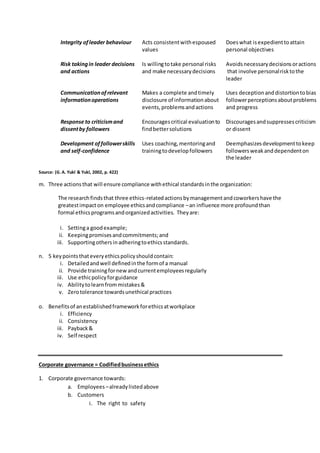
Integrity ofleader behaviour Acts consistentwithespoused
values
Doeswhat isexpedienttoattain
personal objectives
Risk takingin leader decisions
and actions
Is willingtotake personal risks
and make necessarydecisions
Avoidsnecessarydecisionsoractions
that involve personalrisktothe
leader
Communicationofrelevant
informationoperations
Makes a complete andtimely
disclosure of informationabout
events,problemsandactions
Uses deceptionanddistortiontobias
followerperceptionsaboutproblems
and progress
Response to criticismand
dissentby followers
Encouragescritical evaluationto
findbettersolutions
Discouragesandsuppressescriticism
or dissent
Development offollowerskills
and self-confidence
Uses coaching,mentoringand
trainingtodevelopfollowers
Deemphasizesdevelopmenttokeep
followersweakanddependenton
the leader
Source: (G.A. Yukl & Yukl, 2002, p. 422)
m. Three actionsthat will ensure compliance withethical standardsinthe organization:
The researchfindsthat three ethics-relatedactionsbymanagementandcoworkershave the
greatestimpacton employee ethicsandcompliance –an influence more profoundthan
formal ethicsprogramsandorganizedactivities. Theyare:
i. Settinga goodexample;
ii. Keepingpromisesandcommitments;and
iii. Supportingothersinadheringtoethicsstandards.
n. 5 keypointsthateveryethicspolicyshouldcontain:
i. Detailedandwell definedinthe formof a manual
ii. Provide trainingfornewandcurrentemployeesregularly
iii. Use ethicpolicyforguidance
iv. Abilitytolearnfrommistakes&
v. Zerotolerance towardsunethical practices
o. Benefitsof anestablishedframeworkforethicsatworkplace
i. Efficiency
ii. Consistency
iii. Payback&
iv. Self respect
Corporate governance = Codifiedbusinessethics
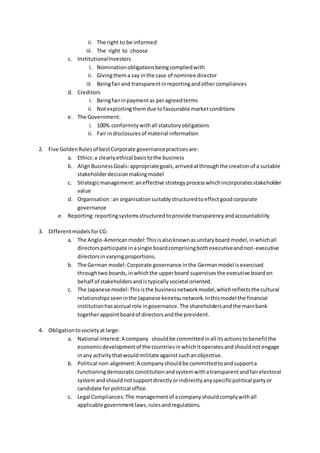
1. Corporate governance towards:
a. Employees –alreadylistedabove
b. Customers
i. The right to safety
ii. The right to be informed
iii. The right to choose
c. InstitutionalInvestors
i. Nominationobligationsbeingcompliedwith
ii. Givingthema say inthe case of nominee director
iii. Beingfairand transparentinreportingandothercompliances
d. Creditors
i. Beingfairinpaymentas peragreedterms
ii. Notexploitingthemdue tofavourable marketconditions
e. The Government:
i. 100% conformitywithall statutoryobligations
ii. Fair indisclosuresof material information
2. Five GoldenRulesof bestCorporate governancepracticesare:
a. Ethics:a clearlyethical basistothe business
b. AlignBusinessGoals:appropriategoals,arrivedatthroughthe creationof a suitable
stakeholderdecisionmakingmodel
c. Strategicmanagement:aneffective strategyprocesswhichincorporatesstakeholder
value
d. Organisation :an organisationsuitablystructuredtoeffectgoodcorporate
governance
e. Reporting:reportingsystemsstructuredtoprovide transparencyandaccountability
3. Differentmodels forCG:
a. The Anglo-Americanmodel:Thisisalsoknownasunitaryboard model,inwhichall
directorsparticipate inasingle boardcomprisingbothexecutiveandnon-executive
directorsinvaryingproportions.
b. The German model:Corporate governance inthe Germanmodel isexercised
throughtwo boards,inwhichthe upperboard supervisesthe executive boardon
behalf of stakeholdersandistypicallysocietal oriented.
c. The Japanese model:Thisisthe businessnetworkmodel,whichreflectsthe cultural
relationshipsseeninthe Japanese keiretsunetwork.Inthismodel the financial
institutionhasaccrual role ingovernance.The shareholdersandthe mainbank
togetherappointboardof directorsandthe president.
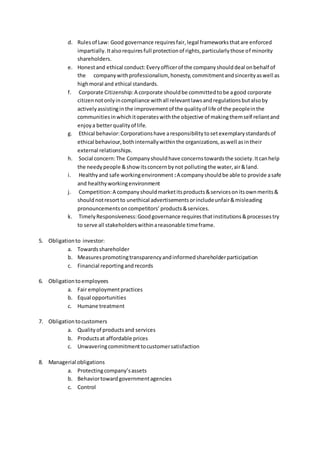
4. Obligationtosocietyatlarge:
a. National interest:A company shouldbe committedinall itsactionstobenefitthe
economicdevelopmentof the countriesinwhichitoperatesandshouldnotengage
inany activitythatwouldmilitate againstsuchanobjective.
b. Political non-alignment:A companyshouldbe committedtoandsupporta
functioningdemocraticconstitutionandsystemwithatransparentandfairelectoral
systemandshouldnotsupportdirectlyorindirectlyanyspecificpolitical partyor
candidate forpolitical office.
c. Legal Compliances:The managementof acompanyshouldcomplywithall
applicable governmentlaws,rulesandregulations.
d. Rulesof Law: Good governance requiresfair,legal frameworksthatare enforced
impartially.Italsorequiresfull protectionof rights,particularlythose of minority
shareholders.
e. Honestand ethical conduct:Everyofficerof the companyshoulddeal onbehalf of
the companywithprofessionalism, honesty,commitmentandsincerityaswell as
highmoral and ethical standards.
f. Corporate Citizenship:A corporate shouldbe committedtobe agood corporate
citizennotonlyincompliance withall relevantlawsandregulationsbutalsoby
activelyassistinginthe improvementof the qualityof life of the peopleinthe
communitiesinwhichitoperateswiththe objective of makingthemself reliantand
enjoya betterqualityof life.
g. Ethical behavior:Corporationshave aresponsibilitytosetexemplarystandardsof
ethical behaviour,bothinternallywithinthe organizations,aswell asintheir
external relationships.
h. Social concern:The Companyshouldhave concernstowardsthe society.Itcanhelp
the needypeople &show itsconcernbynot pollutingthe water,air&land.
i. Healthyand safe workingenvironment :A companyshouldbe able to provide asafe
and healthyworkingenvironment
j. Competition:A companyshouldmarketitsproducts&servicesonitsownmerits&
shouldnotresortto unethical advertisementsorincludeunfair&misleading
pronouncementsoncompetitors’products&services.
k. TimelyResponsiveness:Goodgovernance requiresthatinstitutions&processestry
to serve all stakeholderswithinareasonable timeframe.
5. Obligationto investor:
a. Towardsshareholder
b. Measurespromotingtransparencyandinformedshareholderparticipation
c. Financial reportingandrecords
6. Obligationtoemployees
a. Fair employmentpractices
b. Equal opportunities
c. Humane treatment
7. Obligationtocustomers
a. Qualityof productsand services
b. Productsat affordable prices
c. Unwaveringcommitmenttocustomersatisfaction
8. Managerial obligations
a. Protectingcompany’sassets
b. Behaviortowardgovernmentagencies
c. Control
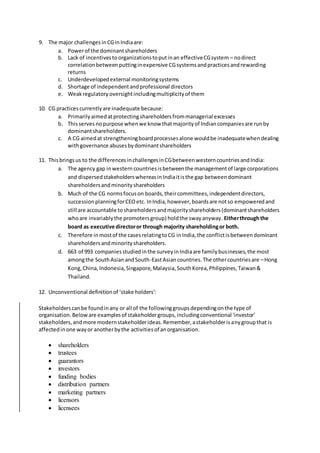
9. The major challengesinCGinIndiaare:
a. Powerof the dominantshareholders
b. Lack of incentivesto organizationstoputinan effectiveCGsystem – nodirect
correlationbetweenputtinginexpensive CGsystemsandpracticesandrewarding
returns
c. Underdevelopedexternal monitoringsystems
d. Shortage of independentandprofessional directors
e. Weakregulatory oversightincludingmultiplicityof them
10. CG practicescurrentlyare inadequate because:
a. Primarilyaimedatprotectingshareholdersfrommanagerial excesses
b. Thisserves nopurpose whenwe know thatmajorityof Indiancompaniesare runby
dominantshareholders.
c. A CG aimedat strengtheningboardprocessesalone wouldbe inadequatewhendealing
withgovernance abusesbydominantshareholders
11. Thisbringsus to the differencesinchallengesinCGbetweenwesterncountriesandIndia:
a. The agency gap inwestern countriesisbetweenthe managementof large corporations
and dispersedstakeholderswhereasinIndiaitisthe gap betweendominant
shareholdersandminorityshareholders
b. Much of the CG normsfocuson boards,theircommittees,independentdirectors,
successionplanningforCEOetc. InIndia,however,boardsare notso empoweredand
still are accountable toshareholdersandmajorityshareholders(dominantshareholders
whoare invariablythe promotersgroup) holdthe swayanyway. Eitherthroughthe
board as executive directoror through majority shareholdingor both.
c. Therefore inmostof the casesrelatingtoCG inIndia,the conflictisbetweendominant
shareholdersandminorityshareholders.
d. 663 of 993 companiesstudiedinthe surveyinIndiaare familybusinesses,the most
amongthe SouthAsianandSouth-EastAsiancountries.The othercountriesare –Hong
Kong,China,Indonesia,Singapore,Malaysia,SouthKorea,Philippines,Taiwan&
Thailand.
12. Unconventional definitionof ‘stake holders’:
Stakeholderscanbe foundinany or all of the followinggroupsdependingonthe type of
organisation.Below are examplesof stakeholdergroups,includingconventional 'investor'
stakeholders,andmore modernstakeholderideas.Remember,astakeholderisanygroupthat is
affectedinone wayor anotherbythe activitiesof anorganisation.
 shareholders
 trustees
 guarantors
 investors
 funding bodies
 distribution partners
 marketing partners
 licensors
 licensees
 approving bodies
 regulatory authorities
 endorsers and 'recommenders'
 advisors and consultants (yes, these people have something at stake too)
 employees - staff, managers, directors, non-executive directors
 customers
 suppliers
 the local population (community)
 the regional general public
 national general public
 international communities
 humankind
 Many of these groups would not conventionally be considered to be stakeholders, but
think about it: each of these groups could have an interest in and could be affected by
the activities of an organisation. If a connection is not easy to see and understand it
doesn't mean the connection doesn't exist.
 Given that this sort of modern stakeholder perspective produces such a wide-ranging
and extensive list of stakeholder groups, it's essential to apply (for any given
situation) some method of evaluating and expressing relative stakeholder interests and
needs, and also to measure and show the varying significance of the stakeholder
relationships; the degree of impact or dependence.
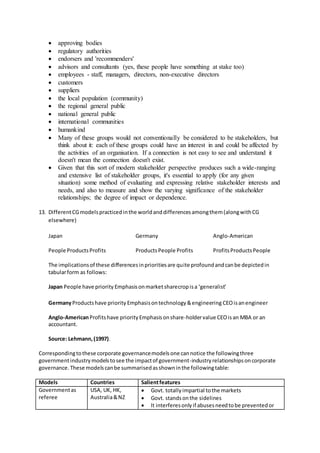
13. DifferentCGmodelspracticedinthe worldanddifferencesamongthem(alongwithCG
elsewhere)
Japan Germany Anglo-American
People ProductsProfits ProductsPeople Profits ProfitsProductsPeople
The implicationsof these differencesinprioritiesare quite profoundandcanbe depictedin
tabularform as follows:
Japan People have priority Emphasisonmarketsharecropisa ‘generalist’
GermanyProductshave priority Emphasisontechnology&engineering CEOisanengineer
Anglo-AmericanProfitshave priority Emphasisonshare-holdervalue CEOisan MBA or an
accountant.
Source: Lehmann,(1997).
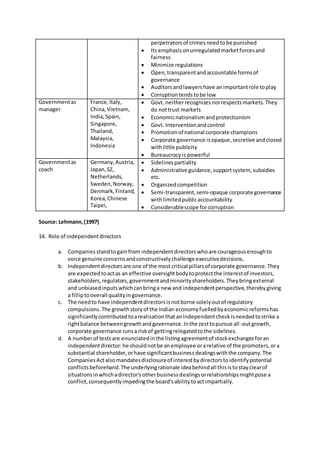
Correspondingtothese corporate governancemodelsone cannotice the followingthree
governmentindustrymodelstosee the impactof government-industry relationshipsoncorporate
governance.These modelscanbe summarisedasshowninthe followingtable:
Models Countries Salientfeatures
Governmentas
referee
USA, UK, HK,
Australia&NZ
 Govt. totallyimpartial tothe markets
 Govt. standsonthe sidelines
 It interferesonlyif abusesneedtobe preventedor
perpetratorsof crimesneedtobe punished
 Its emphasisonunregulatedmarketforcesand
fairness
 Minimize regulations
 Open,transparentandaccountable formsof
governance
 Auditorsandlawyershave animportantrole toplay
 Corruptiontendstobe low
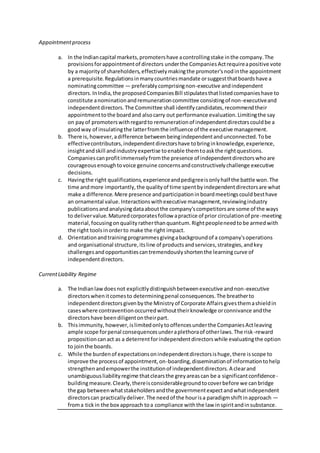
Governmentas
manager
France,Italy,
China,Vietnam,
India,Spain,
Singapore,
Thailand,
Malaysia,
Indonesia
 Govt. neitherrecognizesnorrespectsmarkets.They
do nottrust markets
 Economicnationalism andprotectionism
 Govt. Interventionandcontrol
 Promotionof national corporate champions
 Corporate governance isopaque,secretive andclosed
withlittle publicity
 Bureaucracyis powerful
Governmentas
coach
Germany,Austria,
Japan,SZ,
Netherlands,
Sweden,Norway,
Denmark,Finland,
Korea,Chinese
Taipei,
 Sidelinespartiality
 Administrative guidance,supportsystem, subsidies
etc.
 Organizedcompetition
 Semi-transparent,semi-opaque corporate governance
withlimitedpublicaccountability
 Considerablescope forcorruption
Source: Lehmann,(1997)
14. Role of independentdirectors
a. Companiesstandtogainfrom independentdirectorswhoare courageousenoughto
voice genuine concernsandconstructivelychallenge executivedecisions.
b. Independentdirectorsare one of the most critical pillarsof corporate governance.They
are expectedtoactas an effective oversightbodytoprotectthe interestof investors,
stakeholders,regulators,governmentandminorityshareholders.Theybringexternal
and unbiasedinputswhichcanbringa new and independentperspective,therebygiving
a filliptooverall qualityingovernance.
c. The needto have independentdirectorsisnotborne solelyoutof regulatory
compulsions.The growthstoryof the Indian economyfuelledbyeconomicreformshas
significantlycontributedtoarealisationthatanindependentcheckisneededtostrike a
rightbalance betweengrowthandgovernance.Inthe zesttopursue all-outgrowth,
corporate governance runsa riskof gettingrelegatedtothe sidelines.
d. A numberof testsare enunciatedinthe listingagreementof stockexchangesforan
independentdirector:he shouldnotbe anemployee orarelative of the promoters,ora
substantial shareholder,orhave significantbusinessdealingswiththe company.The
CompaniesActalsomandatesdisclosureof interestbydirectorstoidentifypotential
conflictsbeforehand.The underlyingrationale ideabehindall thisistostayclearof
situationsinwhichadirector'sotherbusinessdealingsorrelationshipsmightpose a
conflict,consequentlyimpedingthe board'sabilitytoactimpartially.
Appointmentprocess
a. In the Indiancapital markets,promotershave acontrollingstake inthe company.The
provisionsforappointmentof directors underthe CompaniesActrequireapositive vote
by a majorityof shareholders,effectivelymakingthe promoter'snodinthe appointment
a prerequisite.Regulationsinmanycountriesmandate orsuggestthatboardshave a
nominatingcommittee — preferablycomprisingnon-executive andindependent
directors.InIndia,the proposedCompaniesBill stipulatesthatlistedcompanieshave to
constitute anominationandremunerationcommittee consistingof non-executiveand
independentdirectors.The Committee shall identifycandidates,recommendtheir
appointmenttothe boardand alsocarry out performance evaluation.Limitingthe say
on payof promoterswithregardto remunerationof independentdirectorscouldbe a
goodway of insulatingthe latterfromthe influence of the executive management.
b. There is,however,adifference betweenbeingindependentandunconnected.Tobe
effectivecontributors,independentdirectorshave tobringinknowledge,experience,
insightandskill andindustryexpertise toenable themtoaskthe rightquestions.
Companiescanprofitimmenselyfromthe presence of independentdirectorswhoare
courageousenoughtovoice genuine concernsandconstructivelychallenge executive
decisions.
c. Havingthe right qualifications,experienceandpedigreeisonlyhalf the battle won.The
time andmore importantly,the qualityof time spentbyindependentdirectorsare what
make a difference.Mere presence andparticipationinboardmeetingscouldbesthave
an ornamental value.Interactionswithexecutive management,reviewingindustry
publicationsandanalysingdataaboutthe company'scompetitorsare some of the ways
to delivervalue.Maturedcorporatesfollow apractice of prior circulationof pre-meeting
material,focusingonqualityratherthanquantum.Rightpeopleneedtobe armedwith
the right toolsinorderto make the right impact.
d. Orientationandtrainingprogrammesgivingabackgroundof a company'soperations
and organisational structure,itsline of productsandservices,strategies,andkey
challengesandopportunitiescantremendouslyshortenthe learningcurve of
independentdirectors.
CurrentLiability Regime
a. The Indianlawdoesnot explicitlydistinguishbetweenexecutive andnon-executive
directorswhenitcomesto determiningpenal consequences.The breatherto
independentdirectorsgivenbythe Ministryof Corporate Affairsgivesthemashieldin
caseswhere contraventionoccurredwithouttheirknowledge orconnivance andthe
directorshave beendiligentontheirpart.
b. Thisimmunity, however,islimitedonlytooffencesunderthe CompaniesActleaving
ample scope forpenal consequencesunderaplethoraof otherlaws.The risk-reward
propositioncanact as a deterrentforindependentdirectorswhile evaluatingthe option
to jointhe boards.
c. While the burdenof expectationsonindependentdirectorsishuge,there isscope to
improve the processof appointment,on-boarding,disseminationof informationtohelp
strengthenandempowerthe institutionof independentdirectors.A clearand
unambiguousliabilityregime thatclearsthe greyareascan be a significantconfidence-
buildingmeasure.Clearly,thereisconsiderablegroundtocoverbefore we canbridge
the gap betweenwhatstakeholdersandthe governmentexpectandwhatindependent
directorscan practicallydeliver.The needof the hourisa paradigmshiftinapproach —
froma tickin the box approach toa compliance withthe law inspiritandinsubstance.
Corporate social responsibility(CSR)
CSR isessentiallymeantformakingcorporate entitiesspendacertainspecificsumforthe benefitof
the societyinthe formof programsfor promotingliteracy,social health,protectingenvironmentetc.
It isthe ultimate stepbywhichbusinessorganizationsare requiredtopayback the societyinwhich
theyoperate.Organizationsfunctionbydrawingonresourcesfromenvironmentincludinglabour.It
ishightime that theytookinitiativestopayback to societyif notfully,atleasta part of theirprofits.
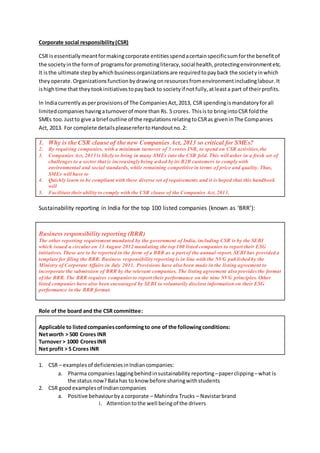
In Indiacurrently asperprovisionsof The CompaniesAct,2013, CSR spendingismandatoryforall
limitedcompanies havingaturnoverof more than Rs. 5 crores. Thisisto bringintoCSR foldthe
SMEs too.Justto give a brief outline of the regulationsrelatingtoCSRas giveninThe Companies
Act, 2013. For complete detailspleaserefertoHandoutno.2:
1. Why is the CSR clause of the new Companies Act, 2013 so critical for SMEs?
2. By requiring companies, with a minimum turnover of 5 crores INR, to spend on CSR activities,the
3. Companies Act, 2013 is likely to bring in many SMEs into the CSR fold. This will usher in a fresh set of
challenges to a sector that is increasingly being asked by its B2B customers to comply with
environmental and social standards, while remaining competitive in terms of price and quality. Thus,
SMEs will have to
4. Quickly learn to be compliant with these diverse set of requirements and it is hoped that this handbook
will
5. Facilitate theirability to comply with the CSR clause of the Companies Act, 2013.
Sustainability reporting in India for the top 100 listed companies (known as ‘BRR’):
Business responsibility reporting (BRR)
The other reporting requirement mandated by the government of India, including CSR is by the SEBI
which issued a circular on 13 August 2012 mandating the top 100 listed companies to report their ESG
initiatives.These are to be reported in the form of a BRR as a part of the annual report. SEBI has provided a
template for filing the BRR. Business responsibility reporting is in line with the NVG published by the
Ministry of Corporate Affairs in July 2011. Provisions have also been made in the listing agreement to
incorporate the submission of BRR by the relevant companies. The listing agreement also provides the format
of the BRR. The BRR requires companiesto report their performance on the nine NVG principles. Other
listed companies have also been encouraged by SEBI to voluntarily disclose information on their ESG
performance in the BRR format.
Role of the board and the CSR committee:
Applicable to listedcompaniesconformingto one of the followingconditions:
Networth > 500 Crores INR
Turnover > 1000 CroresINR
Net profit > 5 Crores INR
1. CSR – examplesof deficienciesinIndiancompanies:
a. Pharma companieslaggingbehindinsustainability reporting–paperclipping–what is
the status now?Balahas to know before sharingwithstudents
2. CSR goodexamplesof Indiancompanies
a. Positive behaviourbya corporate – Mahindra Trucks – Navistarbrand
i. Attentiontothe well beingof the drivers
ii. Multilingual call centre forhelpwhileonthe roads
iii. Promotesunderstandingof theirrightsandliabilitiesalongwithbasic
groundrulesincludinghow todeal withaccidentsetc.
iv. Drivinglessonsinclude how todeal withsmall mechanical problems
v. Introductionof awardssystemnotonlyfordriversbutalsofor the
dhabaswhichserve as lifeline todrivingcommunity
vi. Anotherinitiative,‘Outperformersleague’thatinvitesindustrycaptains,
legal experts,autoexpertsanddriverstoo.
b. Anotherexampleof averygood CSR initiative byITC – Waste managementengagedin
recyclingwaste – nearly8 lacspeople are employeddirectlyandindirectlyinTamil Nadu
alone byITC’s program – recyclingmore than5000 tonnesa month.
3. CSR wouldinclude the following:
a. the environment
b. sustainability
c. globalization effects - e.g., exploitation, child-labour, social and environmental
damage anywhere in the world
d. corruption, armed conflict and political issues
e. staff and customers relations - for instance education and training, health and
safety, duty of care, etc
f. local community and other social impacts on people's health and well-being
***End of document***

Handout 1 - CE, CG & CSR

  • 1.
    28.12.2016 Note byBala CorporateEthics, Corporate Governance & Corporate Social Responsibility Note: To be read in conjunction with PPT slides and other material provided Background: The word ‘Ethics’evolvesfromthe Greek word, ‘Ethos’. ‘Ethos’ means ‘Character’ or ‘Custom’. As a corollary, ethical behaviour means ‘socially and morally’ acceptable behaviour. The experience of unethical behaviour is not new to human civilization. It has been in existence right from ancient civilizations.Inthe 6th centuryB.C. the philosopher Anacharsis once said, “The market is a place set apart where men may deceive one another.” History is replete with examples of unethical behaviour, unethical practices inconsistent with common good for society, for people at large, for government etc. out of selfish interests and aggrandisement. We are familiar with the expression “Powercorruptsultimately”. Powerreferredtointhisstatementcouldmean one or more of these: Political,Economic,Social, Religious,Financial or Organizational.Powerisvestedinanindividual or a group of individualslike‘Boardof directors’inabusinessorganization by the authority they enjoy and the position they come to occupy in their respective areas. Power makes individuals or a group of individuals ‘heady like a drunken man’. Once an individual rises to a high position in politics or business, one tends to think that one is above law. This perception could lead one to questionable actions and behaviour. This is unethical behaviour. Business ethics is about:  Decision-Making  By People in Business  According to Moral Principles or Standards In an organization,decisionsare beingtakenregularly. Conflictingduties,loyaltiesorinterestscreate moral dilemmas requiring decisions to be made. Ethical decision-making involves the ability to discern right from wrong along with the commitment to do what is right. In a highly competitive environment of business, principles are being compromised with frequently. The ultimate goal of any business is growth through profits. CEOs and Presidents and Managing Directors (may be the entire board of directors) achieve growth and market leadership, but at what cost? Modern business had become conscious of the need for ethical behaviour due to a series of corporate fraudsin the 70’s and80’s of the twentiethcentury. Asaresult,takingthe initiative in the international community, U.K. hadappointedthe CadburyCommittee toevolve the firstcodified set of ‘business ethics’. The committee had come out with the very first report that modern business knows as ‘Corporate governance’ (CG) report. ‘Corporate governance’ is nothing but codified corporate ethical practices expected to be followed by organizations globally. This is the very first steptowards establishing code of conduct for business on a universal dimension. As we will see in the followingparagraphs,the firststepof businessethicsledto‘Corporate governance’. This in turn ledto the ‘Corporate Social Responsibility’asisbeingpracticed today. Today, in terms of provisions of The Companies Act, 2013, Indian limited companies are required to publish as a part of their
  • 2.
    annual reports, asection on ‘Corporate governance’ report on ethical practices being followed in their respective organizations. Corporate social responsibility obligation is not on all limited companies.The norms have beenprescribedforthose of the limited companies that are listed. The CSR spendingismandatoryforsuchlimitedcompanies.Otherlimitedcompanies can do voluntarily. Indiancorporate historyhasadequate numberof examplesof limited companies undertaking ‘CSR’ initiatives on their own much before the mandatory ‘CSR’ rules came into existence. What is the importance of ‘morals’? Let us see what some great personalities had to say about ‘morals’. • “The most important human endeavor is the striving for morality in our actions. Our inner balance andevenour veryexistence depend on it. Only morality in our actions can give beauty and dignity to life. - Albert Einstein (in a letter 11/20/50) • The historian Arnold Toynbee observed: "Out of 21 notable civilizations, 19 perished not by conquest from without but by moral decay from within." In sharp contrast, let us also see what modern young generation feels about ‘ethical standards’. According to a recent poll of college seniors, 73% agreed with the statement that “What is right or wrongdependsondifferencesinindividualvaluesand cultural diversity.” Only 25% agreed with the statementthat“There are clearand uniformstandardsof rightandwrong bywhicheveryone should be judged." Relative and absolute standards of morals: Relative iswhatis suitable for the circumstances and could vary from situation to situation or from time to time;absolute standardsremainthe same,standingthe testof time well. Itisthe absence of absolute standardsthatleadstocorruptionof moral standardsthroughtheirdilution. The following lines explain the effect of relative standards. Relativism allows for oppression of those with minority views by allowing the majority in any particular circumstance to define what is morally right or wrong. – “In Germany they first came for the Communists, and I didn't speak up because I wasn't a Communist. – Then they came for the Jews, and I didn't speak up because I wasn't a Jew. – Thentheycame forthe trade unionists, and I didn't speak up because I wasn't a trade unionist. – Then they came for the Catholics, and I didn't speak up because I was a Protestant. – Then they came for me — and by that time no one was left to speak up.” German anti-Nazi activist, Pastor Martin Niemöller Relativists never need bother to examine why something is moral or immoral, they merely accept/tolerate alternative determinations, so that none are held to account. Let us learn something fundamental about the three, corporate ethics, corporate governance and corporate social responsibility.
  • 3.
    Business ethics 1. a. Examplesofethical practicesbyemployees: i. Work habits ii. Ethicsin sales iii. Ethicsin advertisement iv. Ethicsin purchase function b. Unethical practicesusuallydone byemployeesetc.  Paddingof labourchargesand expense accounts  Personal longdistance phone callsoncompanyaccounts  Untidyworkareas, breakareasand restrooms  Takingoffice supplieshome  Excessive breaksorsickdays  Improperuse of copy machinesandcomputerequipment  Cheatingthe companyinthe matterof leave,absence,advance etc.  Notconformingtoexpectedbusinessetiquette whiledealingwithexternal customersof the organization  Abusive behaviour  Undue creditfor anywork,result,achievementetc.  dishonesty, withholding information, distortion of facts  misleadingorconfusingcommunicationsorpositioningoradvertising  manipulationof people'sfeelings  deception,trickery,kidology,rule-bending,foolingpeople  exploitationof weaknessandvulnerability  excessiveprofit  greed  anythingliable toharmor endangerpeople  breachof the Psychological Contract - the Psychological Contractrepresentstrustand expectationsbetweenpeople inarelationship - notablywithinemployer/employee relationships,extendingtootherorganizational relationshipstoo - (aside from Psychological Contract theory,specialisedtheorywithin TransactionalAnalysis helps explainthisaspectof trustandexpectationsinhumanrelationships)  avoidance of blame orpenaltyorpaymentof compensationforwrong-doing  inertia-based'approvals'and'agreements'(inwhichactionproceedsunlessobjectedto)  failingtoconsultandnotifypeople affectedbychange  secrecyand lackof transparencyandresistance toreasonable investigation  coercionor inducement  harmingthe environment orplanet  unnecessarywaste orconsumption  invasionof privacyoranythingcausingprivacyto be compromised  recklessnessorirresponsible use of authority,power,reputation  nepotism(the appointmentorpreferenceof familymembers)  favouritismordecision-makingbasedonulteriormotives(e.g.,secretaffiliations,deals, memberships,etc)  alienationormarginalisationof peopleorgroups  conflictof interests(havingafootintwo or more competingcamps)  neglectof dutyof care  betrayal of trust  breakingconfidentiality
  • 4.
     causingsufferingof animals 'by standing'- failingtointervene orreportwrong-doingwithinareaof responsibility (thisdoesnotgive licence tointerfere anywhere andeverywhere,whichisitself unethical forvariousreasons)  unfairness  Unkindness  lack of compassionandhumanity 2. Casesin2012 – Unethical corporate behaviour a. ReebokIndiaLimited,asubsidiaryof AdidasAG – 870 crores fraud – MD & COO b. Seriesof technicallybadordersplacedbyEmkayGlobal onNSE– 59 tradesworth more than US $ 125 millionwere haltedbythe system –NIFT fiftyindex came downbymore than 900 points c. Kingfisherairlinesloseslicence tofly d. Adani group – 1800 croresmarketcapitalizationlostoveronline rumour e. Sahara toldto pay US $ 3 billiontoitsbondholders 3. Casesin2013 – Unethical corporate behaviour a. Ranbaxy – criminal guiltypleaof US $ 500 millioninfinesandpenalties i. Fuzzeddatasubmittedtoregulatorsabroad,the FDA,USA ii. SimilaritybetweenSatyam fraudandRanbaxycase iii. Notto holdindependentdirectorsonthe boardresponsible iv. Independentdirector'sresponsibilityislimitedtoensuringthathe/she understandsthe businessmodel,bestcorporate governancespractices(e.g. board process,riskmanagementsystem, internal auditandstatutoryaudit, whistle-blowerpolicy,andtransparencywithinandoutsidethe Board) are in place and operatingeffectively,analysinginformationavailable throughthe Board processesorotherwise andactingproactivelybasedonthatanalysisfor the benefitof the companyasa whole.If independentdirectorsare held responsible forfraudsperpetratedbyorwiththe supportof the top management,whichhasthe abilitytooverrideinternalcontrols,itwillbe difficultto induce professionalstojoinBoardsof companiesasindependent directors. 4. How to be preparedforhandlinganyunethical issues? a. Determine areasof possiblenegative ethics i. Employeesbeinghighlystressedout ii. International corporate relationships b. Promote positive workplacebehaviourethics i. Strongcorporate image ii. Professionalism iii. Honesty iv. Trust v. Responsibility c. Continuousethicstraining
  • 5.
    5. Four fundamentalethical principles(averysimple introduction) a. The Principle of Respectforautonomy Autonomyis Latinfor "self-rule"We have anobligationtorespectthe autonomyof otherpersons,whichistorespectthe decisionsmade byotherpeople concerningtheir ownlives.Thisisalsocalledthe principleof humandignity. Itgivesusanegative duty not to interfere withthe decisionsof competentadults,andapositive dutytoempower othersforwhomwe’re responsible. Corollaryprinciples:honestyinourdealingswithothers&obligationtokeeppromises. b. The Principle of Beneficence We have an obligationtobringaboutgoodinall our actions. Corollaryprinciple?We musttake positive stepstopreventharm. However,adopting thiscorollaryprinciple frequentlyplacesusindirectconflictwithrespectingthe autonomyof otherpersons. c. The Principle of nonmaleficence (Itis not"non-malfeasance,"whichisatechnical legal term&it isnot "nonmalevolence,"whichmeansthatone didnotintendtoharm.) We have an obligationnottoharmothers:"First,do noharm." Corollaryprinciple:Where harmcannotbe avoided,we are obligatedtominimizethe harm we do. Corollaryprinciple:Don'tincrease the riskof harmto others. Corollaryprinciple:Itiswrongto waste resourcesthatcouldbe usedfor good. Combiningbeneficence andnonmaleficence:Eachactionmust produce more goodthan harm. d. The Principle of justice We have an obligationtoprovide otherswithwhatevertheyare owedordeserve.In publiclife,we have anobligationtotreatall people equally,fairly,andimpartially. Corollary principle:Impose nounfairburdens.Combiningbeneficenceandjustice:We are obligatedtoworkforthe benefitof those whoare unfairlytreated. 6. Ethical dilemmas: 1. A topemployee atyoursmall companytellsyouhe needssome time off because he has AIDS.You knowthe employeeneedsthe jobaswell asthe healthinsurance benefits. Providinghealthinsurance hasalreadystretchedthe company’sbudget,andthiswill send premiumsthroughthe roof.Youknow the federal courtshave upheldthe rightof an employertomodifyhealthplansbyputtingacap on AIDSbenefits. Shouldyouinvestigatewhetherthisisalegal possibilityforyourcompany? 2. As a salesmanagerfora majorpharmaceuticalscompany,youhave beenaskedtopromote a newdrug that costs$2,500 perdose.Youhave read the reportssayingthe drug isonly1 percentmore effective thananalternative drugthatcostslessthanone-fourthasmuch.Can youin goodconscience aggressivelypromote the $2,500-per-dose drug?
  • 6.
    If you donot,couldlivesbe lostthatmighthave beensavedwiththat1 percentincrease in effectiveness? 3. Your companyis hopingtobuildanew overseasmanufacturingplant.Youcouldsave about $5 millionbynotinstallingstandardpollutioncontrol equipmentthatisrequiredinthe UnitedStates.The plantwill employmanylocal workersinapoor countrywhere jobsare scarce. Your researchshowsthatpollutantsfromthe factorycouldpotentiallydamage the local fishingindustry.Yetbuildingthe factorywiththe pollution control equipmentwill likely make the planttoo expensive tobuild. 4. You are the accountingmanagerof a divisionthatis$15,000 below profittargets. Approximately$20,000 of office suppliesweredeliveredonDecember.The accountingrule isto pay expenseswhenincurred.The divisiongeneral managerasksyounotto recordthe invoice until February. 5. You have beencollaboratingwithafellow manageronanimportantproject.One afternoon, youwalkintohisoffice a bitearlierthanscheduledandsee sexuallyexplicitimagesonhis computermonitor.The companyhasa zero-tolerance sexual harassmentpolicy,aswell as strict guidelinesregardingpersonal use of the Internet.However,yourcolleague wasinhis ownoffice andnot botheringanyone else. 7. Three stepsto solve ethical dilemmas:theyflowupwardsinvolvingutility(valuedeliveredtothe stakeholders),Rights&Justice a. Knowyourvaluesstrongly b. Selectamodel of ethicssuitable forthe organization c. Use a problemsolvingprocess 8. Three pillarsof anethical organization: Pillar1 – Ethical individuals a. Integrity b. Honesty c. Inspire trust d. Treat people right e. Playfair f. Highlevel of moral development Pillar2 – Ethical leadership a. Role modelling b. Upholdethical valuesinorganization c. Communicate aboutethicsandvalues d. Rewardethical behaviour e. Swiftdisciplineof unethical behaviour Pillar3 – Organization’sstructuresandsystems a. Corporate culture b. Code of ethics c. Ethicscommittee d. Chief ethicsofficer e. Ethicstraining f. Whistle-blowingmechanisms
  • 7.
    9. Ethical leadership: a.‘Ethics’originatesfromthe Greekword‘Ethos’.Itmeanscharacter,conduct or customs b. Withrespectto leadership,ethicsisaboutwholeadersare—theircharacterandwhat theydo,theiractionsand behaviours. c. Ethical leaderstreattheirfollowerswithrespectanddignity d. Theirpersonal valuesdetermine whatkindof ethical climate will developintheir respective organizations e. Ethical leadershipprinciples: i. Respectforothers ii. Service toothers iii. Justice toothers iv. Honesty/integritytoothers v. Buildingcommunitywithothers f. Ethical leaderwouldaskthe followingquestionstohimself/herself: i. Is thisthe rightand fairthingto do? ii. Is thiswhata goodpersonwoulddo? iii. Am I respectful toothers? iv. Do I treat othersgenerously? v. Am I honesttowardsothers? vi. Am I servingthe community? g. Principledleadership: Principledleadersmake aconscientiousefforttogetall the relevantinformationto make an informeddecisionandtosee thattheirdecisionsare consistentwiththeirval- uesand those of the organization. h. How to getprincipledleadership? i. Upbringingandlife experiences ii. Reflection iii. Role models iv. Code of ethicsand communication i. The challengesof principledleadership: i. Theyshouldbe model citizens ii. Stickto what youare goodat iii. Establishinganinclusive corporate culture iv. Have soundwhistleblowerprotectionorprocessesforinformationflow v. Boards of directorsshouldencourage CEOstospeakoutresponsiblyoncritical issuesinsteadof scuttlingthem j. Table 1: The ethical leader Is humble The Unethical leader Is arrogant andself-serving Is concernedforthe greatergood Excessivelypromotesself-interest Is honestandstraightforward Practicesdeception Fulfilscommitments Breachesagreements Strivesforfairness Dealsunfairly Takesresponsibility Shiftsblame toothers Showsrespectforeach individual Diminishesothers’dignity
  • 8.
    Encouragesand developsothers Neglectsfollowerdevelopment ServesothersWithholdshelpandsupport Showscourage to standup for whatis right Lacks courage to confrontunjustacts Table 2: Examplesof final (personal and ethical-social) andinstrumentalvalues (ethical-moral andvaluesof competition) Personal values: What are the mostimportantthingsin your life? Happiness,health,salvation,family, personal success,recognition,status, material goods,friendship,successat work,love. Ethical-social values: What do youwant to dofor the world? Peace,planetecology,socialjustice Ethical-moral values: How doyou thinkyoushouldbehave towardspeople thatsurroundyou? Valuesof competition: What do youbelieveisnecessaryto compete In life? Honesty,sincerity,responsibility,loyalty, solidarity,mutual confidence,respectfor humanrights Money, imagination,logic,beauty, intelligence,positive thinking,flexibility, k. One theorybasedonvirtue (value) –traitsof ethical leaders: i. Pride ii. Patience iii. Prudence iv. Persistence v. Perspective vi. Integrity l. Table 3: Criteriafor evaluationof ethical leadership Ethical Leadership Unethical Leadership Use of leader power and influence Servesfollowersandthe organization Satisfiespersonal needsandcareer objectives Handlingdiverseinterests of multiplestakeholders Attemptstobalance and integrate them Favourscoalitionpartnerswhooffer the mostbenefits Development ofa visionfor the organization Developsavisionbasedon followerinputabouttheir needs,valuesandideas Attemptstosell apersonal visionas the onlywayfor the organizationto succeed
  • 9.
    Integrity ofleader behaviourActs consistentwithespoused values Doeswhat isexpedienttoattain personal objectives Risk takingin leader decisions and actions Is willingtotake personal risks and make necessarydecisions Avoidsnecessarydecisionsoractions that involve personalrisktothe leader Communicationofrelevant informationoperations Makes a complete andtimely disclosure of informationabout events,problemsandactions Uses deceptionanddistortiontobias followerperceptionsaboutproblems and progress Response to criticismand dissentby followers Encouragescritical evaluationto findbettersolutions Discouragesandsuppressescriticism or dissent Development offollowerskills and self-confidence Uses coaching,mentoringand trainingtodevelopfollowers Deemphasizesdevelopmenttokeep followersweakanddependenton the leader Source: (G.A. Yukl & Yukl, 2002, p. 422) m. Three actionsthat will ensure compliance withethical standardsinthe organization: The researchfindsthat three ethics-relatedactionsbymanagementandcoworkershave the greatestimpacton employee ethicsandcompliance –an influence more profoundthan formal ethicsprogramsandorganizedactivities. Theyare: i. Settinga goodexample; ii. Keepingpromisesandcommitments;and iii. Supportingothersinadheringtoethicsstandards. n. 5 keypointsthateveryethicspolicyshouldcontain: i. Detailedandwell definedinthe formof a manual ii. Provide trainingfornewandcurrentemployeesregularly iii. Use ethicpolicyforguidance iv. Abilitytolearnfrommistakes& v. Zerotolerance towardsunethical practices o. Benefitsof anestablishedframeworkforethicsatworkplace i. Efficiency ii. Consistency iii. Payback& iv. Self respect Corporate governance = Codifiedbusinessethics 1. Corporate governance towards: a. Employees –alreadylistedabove b. Customers i. The right to safety
  • 10.
    ii. The rightto be informed iii. The right to choose c. InstitutionalInvestors i. Nominationobligationsbeingcompliedwith ii. Givingthema say inthe case of nominee director iii. Beingfairand transparentinreportingandothercompliances d. Creditors i. Beingfairinpaymentas peragreedterms ii. Notexploitingthemdue tofavourable marketconditions e. The Government: i. 100% conformitywithall statutoryobligations ii. Fair indisclosuresof material information 2. Five GoldenRulesof bestCorporate governancepracticesare: a. Ethics:a clearlyethical basistothe business b. AlignBusinessGoals:appropriategoals,arrivedatthroughthe creationof a suitable stakeholderdecisionmakingmodel c. Strategicmanagement:aneffective strategyprocesswhichincorporatesstakeholder value d. Organisation :an organisationsuitablystructuredtoeffectgoodcorporate governance e. Reporting:reportingsystemsstructuredtoprovide transparencyandaccountability 3. Differentmodels forCG: a. The Anglo-Americanmodel:Thisisalsoknownasunitaryboard model,inwhichall directorsparticipate inasingle boardcomprisingbothexecutiveandnon-executive directorsinvaryingproportions. b. The German model:Corporate governance inthe Germanmodel isexercised throughtwo boards,inwhichthe upperboard supervisesthe executive boardon behalf of stakeholdersandistypicallysocietal oriented. c. The Japanese model:Thisisthe businessnetworkmodel,whichreflectsthe cultural relationshipsseeninthe Japanese keiretsunetwork.Inthismodel the financial institutionhasaccrual role ingovernance.The shareholdersandthe mainbank togetherappointboardof directorsandthe president. 4. Obligationtosocietyatlarge: a. National interest:A company shouldbe committedinall itsactionstobenefitthe economicdevelopmentof the countriesinwhichitoperatesandshouldnotengage inany activitythatwouldmilitate againstsuchanobjective. b. Political non-alignment:A companyshouldbe committedtoandsupporta functioningdemocraticconstitutionandsystemwithatransparentandfairelectoral systemandshouldnotsupportdirectlyorindirectlyanyspecificpolitical partyor candidate forpolitical office. c. Legal Compliances:The managementof acompanyshouldcomplywithall applicable governmentlaws,rulesandregulations.
  • 11.
    d. Rulesof Law:Good governance requiresfair,legal frameworksthatare enforced impartially.Italsorequiresfull protectionof rights,particularlythose of minority shareholders. e. Honestand ethical conduct:Everyofficerof the companyshoulddeal onbehalf of the companywithprofessionalism, honesty,commitmentandsincerityaswell as highmoral and ethical standards. f. Corporate Citizenship:A corporate shouldbe committedtobe agood corporate citizennotonlyincompliance withall relevantlawsandregulationsbutalsoby activelyassistinginthe improvementof the qualityof life of the peopleinthe communitiesinwhichitoperateswiththe objective of makingthemself reliantand enjoya betterqualityof life. g. Ethical behavior:Corporationshave aresponsibilitytosetexemplarystandardsof ethical behaviour,bothinternallywithinthe organizations,aswell asintheir external relationships. h. Social concern:The Companyshouldhave concernstowardsthe society.Itcanhelp the needypeople &show itsconcernbynot pollutingthe water,air&land. i. Healthyand safe workingenvironment :A companyshouldbe able to provide asafe and healthyworkingenvironment j. Competition:A companyshouldmarketitsproducts&servicesonitsownmerits& shouldnotresortto unethical advertisementsorincludeunfair&misleading pronouncementsoncompetitors’products&services. k. TimelyResponsiveness:Goodgovernance requiresthatinstitutions&processestry to serve all stakeholderswithinareasonable timeframe. 5. Obligationto investor: a. Towardsshareholder b. Measurespromotingtransparencyandinformedshareholderparticipation c. Financial reportingandrecords 6. Obligationtoemployees a. Fair employmentpractices b. Equal opportunities c. Humane treatment 7. Obligationtocustomers a. Qualityof productsand services b. Productsat affordable prices c. Unwaveringcommitmenttocustomersatisfaction 8. Managerial obligations a. Protectingcompany’sassets b. Behaviortowardgovernmentagencies c. Control
  • 12.
    9. The majorchallengesinCGinIndiaare: a. Powerof the dominantshareholders b. Lack of incentivesto organizationstoputinan effectiveCGsystem – nodirect correlationbetweenputtinginexpensive CGsystemsandpracticesandrewarding returns c. Underdevelopedexternal monitoringsystems d. Shortage of independentandprofessional directors e. Weakregulatory oversightincludingmultiplicityof them 10. CG practicescurrentlyare inadequate because: a. Primarilyaimedatprotectingshareholdersfrommanagerial excesses b. Thisserves nopurpose whenwe know thatmajorityof Indiancompaniesare runby dominantshareholders. c. A CG aimedat strengtheningboardprocessesalone wouldbe inadequatewhendealing withgovernance abusesbydominantshareholders 11. Thisbringsus to the differencesinchallengesinCGbetweenwesterncountriesandIndia: a. The agency gap inwestern countriesisbetweenthe managementof large corporations and dispersedstakeholderswhereasinIndiaitisthe gap betweendominant shareholdersandminorityshareholders b. Much of the CG normsfocuson boards,theircommittees,independentdirectors, successionplanningforCEOetc. InIndia,however,boardsare notso empoweredand still are accountable toshareholdersandmajorityshareholders(dominantshareholders whoare invariablythe promotersgroup) holdthe swayanyway. Eitherthroughthe board as executive directoror through majority shareholdingor both. c. Therefore inmostof the casesrelatingtoCG inIndia,the conflictisbetweendominant shareholdersandminorityshareholders. d. 663 of 993 companiesstudiedinthe surveyinIndiaare familybusinesses,the most amongthe SouthAsianandSouth-EastAsiancountries.The othercountriesare –Hong Kong,China,Indonesia,Singapore,Malaysia,SouthKorea,Philippines,Taiwan& Thailand. 12. Unconventional definitionof ‘stake holders’: Stakeholderscanbe foundinany or all of the followinggroupsdependingonthe type of organisation.Below are examplesof stakeholdergroups,includingconventional 'investor' stakeholders,andmore modernstakeholderideas.Remember,astakeholderisanygroupthat is affectedinone wayor anotherbythe activitiesof anorganisation.  shareholders  trustees  guarantors  investors  funding bodies  distribution partners  marketing partners  licensors  licensees
  • 13.
     approving bodies regulatory authorities  endorsers and 'recommenders'  advisors and consultants (yes, these people have something at stake too)  employees - staff, managers, directors, non-executive directors  customers  suppliers  the local population (community)  the regional general public  national general public  international communities  humankind  Many of these groups would not conventionally be considered to be stakeholders, but think about it: each of these groups could have an interest in and could be affected by the activities of an organisation. If a connection is not easy to see and understand it doesn't mean the connection doesn't exist.  Given that this sort of modern stakeholder perspective produces such a wide-ranging and extensive list of stakeholder groups, it's essential to apply (for any given situation) some method of evaluating and expressing relative stakeholder interests and needs, and also to measure and show the varying significance of the stakeholder relationships; the degree of impact or dependence. 13. DifferentCGmodelspracticedinthe worldanddifferencesamongthem(alongwithCG elsewhere) Japan Germany Anglo-American People ProductsProfits ProductsPeople Profits ProfitsProductsPeople The implicationsof these differencesinprioritiesare quite profoundandcanbe depictedin tabularform as follows: Japan People have priority Emphasisonmarketsharecropisa ‘generalist’ GermanyProductshave priority Emphasisontechnology&engineering CEOisanengineer Anglo-AmericanProfitshave priority Emphasisonshare-holdervalue CEOisan MBA or an accountant. Source: Lehmann,(1997). Correspondingtothese corporate governancemodelsone cannotice the followingthree governmentindustrymodelstosee the impactof government-industry relationshipsoncorporate governance.These modelscanbe summarisedasshowninthe followingtable: Models Countries Salientfeatures Governmentas referee USA, UK, HK, Australia&NZ  Govt. totallyimpartial tothe markets  Govt. standsonthe sidelines  It interferesonlyif abusesneedtobe preventedor
  • 14.
    perpetratorsof crimesneedtobe punished Its emphasisonunregulatedmarketforcesand fairness  Minimize regulations  Open,transparentandaccountable formsof governance  Auditorsandlawyershave animportantrole toplay  Corruptiontendstobe low Governmentas manager France,Italy, China,Vietnam, India,Spain, Singapore, Thailand, Malaysia, Indonesia  Govt. neitherrecognizesnorrespectsmarkets.They do nottrust markets  Economicnationalism andprotectionism  Govt. Interventionandcontrol  Promotionof national corporate champions  Corporate governance isopaque,secretive andclosed withlittle publicity  Bureaucracyis powerful Governmentas coach Germany,Austria, Japan,SZ, Netherlands, Sweden,Norway, Denmark,Finland, Korea,Chinese Taipei,  Sidelinespartiality  Administrative guidance,supportsystem, subsidies etc.  Organizedcompetition  Semi-transparent,semi-opaque corporate governance withlimitedpublicaccountability  Considerablescope forcorruption Source: Lehmann,(1997) 14. Role of independentdirectors a. Companiesstandtogainfrom independentdirectorswhoare courageousenoughto voice genuine concernsandconstructivelychallenge executivedecisions. b. Independentdirectorsare one of the most critical pillarsof corporate governance.They are expectedtoactas an effective oversightbodytoprotectthe interestof investors, stakeholders,regulators,governmentandminorityshareholders.Theybringexternal and unbiasedinputswhichcanbringa new and independentperspective,therebygiving a filliptooverall qualityingovernance. c. The needto have independentdirectorsisnotborne solelyoutof regulatory compulsions.The growthstoryof the Indian economyfuelledbyeconomicreformshas significantlycontributedtoarealisationthatanindependentcheckisneededtostrike a rightbalance betweengrowthandgovernance.Inthe zesttopursue all-outgrowth, corporate governance runsa riskof gettingrelegatedtothe sidelines. d. A numberof testsare enunciatedinthe listingagreementof stockexchangesforan independentdirector:he shouldnotbe anemployee orarelative of the promoters,ora substantial shareholder,orhave significantbusinessdealingswiththe company.The CompaniesActalsomandatesdisclosureof interestbydirectorstoidentifypotential conflictsbeforehand.The underlyingrationale ideabehindall thisistostayclearof situationsinwhichadirector'sotherbusinessdealingsorrelationshipsmightpose a conflict,consequentlyimpedingthe board'sabilitytoactimpartially.
  • 15.
    Appointmentprocess a. In theIndiancapital markets,promotershave acontrollingstake inthe company.The provisionsforappointmentof directors underthe CompaniesActrequireapositive vote by a majorityof shareholders,effectivelymakingthe promoter'snodinthe appointment a prerequisite.Regulationsinmanycountriesmandate orsuggestthatboardshave a nominatingcommittee — preferablycomprisingnon-executive andindependent directors.InIndia,the proposedCompaniesBill stipulatesthatlistedcompanieshave to constitute anominationandremunerationcommittee consistingof non-executiveand independentdirectors.The Committee shall identifycandidates,recommendtheir appointmenttothe boardand alsocarry out performance evaluation.Limitingthe say on payof promoterswithregardto remunerationof independentdirectorscouldbe a goodway of insulatingthe latterfromthe influence of the executive management. b. There is,however,adifference betweenbeingindependentandunconnected.Tobe effectivecontributors,independentdirectorshave tobringinknowledge,experience, insightandskill andindustryexpertise toenable themtoaskthe rightquestions. Companiescanprofitimmenselyfromthe presence of independentdirectorswhoare courageousenoughtovoice genuine concernsandconstructivelychallenge executive decisions. c. Havingthe right qualifications,experienceandpedigreeisonlyhalf the battle won.The time andmore importantly,the qualityof time spentbyindependentdirectorsare what make a difference.Mere presence andparticipationinboardmeetingscouldbesthave an ornamental value.Interactionswithexecutive management,reviewingindustry publicationsandanalysingdataaboutthe company'scompetitorsare some of the ways to delivervalue.Maturedcorporatesfollow apractice of prior circulationof pre-meeting material,focusingonqualityratherthanquantum.Rightpeopleneedtobe armedwith the right toolsinorderto make the right impact. d. Orientationandtrainingprogrammesgivingabackgroundof a company'soperations and organisational structure,itsline of productsandservices,strategies,andkey challengesandopportunitiescantremendouslyshortenthe learningcurve of independentdirectors. CurrentLiability Regime a. The Indianlawdoesnot explicitlydistinguishbetweenexecutive andnon-executive directorswhenitcomesto determiningpenal consequences.The breatherto independentdirectorsgivenbythe Ministryof Corporate Affairsgivesthemashieldin caseswhere contraventionoccurredwithouttheirknowledge orconnivance andthe directorshave beendiligentontheirpart. b. Thisimmunity, however,islimitedonlytooffencesunderthe CompaniesActleaving ample scope forpenal consequencesunderaplethoraof otherlaws.The risk-reward propositioncanact as a deterrentforindependentdirectorswhile evaluatingthe option to jointhe boards. c. While the burdenof expectationsonindependentdirectorsishuge,there isscope to improve the processof appointment,on-boarding,disseminationof informationtohelp strengthenandempowerthe institutionof independentdirectors.A clearand unambiguousliabilityregime thatclearsthe greyareascan be a significantconfidence- buildingmeasure.Clearly,thereisconsiderablegroundtocoverbefore we canbridge the gap betweenwhatstakeholdersandthe governmentexpectandwhatindependent directorscan practicallydeliver.The needof the hourisa paradigmshiftinapproach — froma tickin the box approach toa compliance withthe law inspiritandinsubstance.
  • 16.
    Corporate social responsibility(CSR) CSRisessentiallymeantformakingcorporate entitiesspendacertainspecificsumforthe benefitof the societyinthe formof programsfor promotingliteracy,social health,protectingenvironmentetc. It isthe ultimate stepbywhichbusinessorganizationsare requiredtopayback the societyinwhich theyoperate.Organizationsfunctionbydrawingonresourcesfromenvironmentincludinglabour.It ishightime that theytookinitiativestopayback to societyif notfully,atleasta part of theirprofits. In Indiacurrently asperprovisionsof The CompaniesAct,2013, CSR spendingismandatoryforall limitedcompanies havingaturnoverof more than Rs. 5 crores. Thisisto bringintoCSR foldthe SMEs too.Justto give a brief outline of the regulationsrelatingtoCSRas giveninThe Companies Act, 2013. For complete detailspleaserefertoHandoutno.2: 1. Why is the CSR clause of the new Companies Act, 2013 so critical for SMEs? 2. By requiring companies, with a minimum turnover of 5 crores INR, to spend on CSR activities,the 3. Companies Act, 2013 is likely to bring in many SMEs into the CSR fold. This will usher in a fresh set of challenges to a sector that is increasingly being asked by its B2B customers to comply with environmental and social standards, while remaining competitive in terms of price and quality. Thus, SMEs will have to 4. Quickly learn to be compliant with these diverse set of requirements and it is hoped that this handbook will 5. Facilitate theirability to comply with the CSR clause of the Companies Act, 2013. Sustainability reporting in India for the top 100 listed companies (known as ‘BRR’): Business responsibility reporting (BRR) The other reporting requirement mandated by the government of India, including CSR is by the SEBI which issued a circular on 13 August 2012 mandating the top 100 listed companies to report their ESG initiatives.These are to be reported in the form of a BRR as a part of the annual report. SEBI has provided a template for filing the BRR. Business responsibility reporting is in line with the NVG published by the Ministry of Corporate Affairs in July 2011. Provisions have also been made in the listing agreement to incorporate the submission of BRR by the relevant companies. The listing agreement also provides the format of the BRR. The BRR requires companiesto report their performance on the nine NVG principles. Other listed companies have also been encouraged by SEBI to voluntarily disclose information on their ESG performance in the BRR format. Role of the board and the CSR committee: Applicable to listedcompaniesconformingto one of the followingconditions: Networth > 500 Crores INR Turnover > 1000 CroresINR Net profit > 5 Crores INR 1. CSR – examplesof deficienciesinIndiancompanies: a. Pharma companieslaggingbehindinsustainability reporting–paperclipping–what is the status now?Balahas to know before sharingwithstudents 2. CSR goodexamplesof Indiancompanies a. Positive behaviourbya corporate – Mahindra Trucks – Navistarbrand i. Attentiontothe well beingof the drivers
  • 17.
    ii. Multilingual callcentre forhelpwhileonthe roads iii. Promotesunderstandingof theirrightsandliabilitiesalongwithbasic groundrulesincludinghow todeal withaccidentsetc. iv. Drivinglessonsinclude how todeal withsmall mechanical problems v. Introductionof awardssystemnotonlyfordriversbutalsofor the dhabaswhichserve as lifeline todrivingcommunity vi. Anotherinitiative,‘Outperformersleague’thatinvitesindustrycaptains, legal experts,autoexpertsanddriverstoo. b. Anotherexampleof averygood CSR initiative byITC – Waste managementengagedin recyclingwaste – nearly8 lacspeople are employeddirectlyandindirectlyinTamil Nadu alone byITC’s program – recyclingmore than5000 tonnesa month. 3. CSR wouldinclude the following: a. the environment b. sustainability c. globalization effects - e.g., exploitation, child-labour, social and environmental damage anywhere in the world d. corruption, armed conflict and political issues e. staff and customers relations - for instance education and training, health and safety, duty of care, etc f. local community and other social impacts on people's health and well-being ***End of document***