The UAE restaurant market is set to grow 30 percent in the
next four years to USD 780 million and will be dominated by
American-style fast food brands. Chadi Chidiac, managing
partner of PROTOCOL hospitality management consultancy
shares exclusive insight on this growing trend and the factors
that will influence your investment strategy
Branded table-service restaurants generate
about USD 600 million a year in the UAE,
a number set to swell to USD 780 million
by 2018. In a poll of dining outlets in the
Gulf state, PROTOCOL found that about
19,000 extra F&B outlets are expected
in the UAE by 2019, bearing in mind that
there are currently 6,021 outlets in the
Emirates. American brands comprised up
to 47 percent of F&B offers in Dubai malls.
Homegrown restaurants, by comparison,
made up between 8-17 percent.
The U.S. takeover
As profits slow in their domestic markets,
U.S.-based chains are set to open some
250 outlets across the Middle East over the
next decade. Brands including Shake Shack,
Red Lobster and Texas Roadhouse have
all debuted in the UAE market in recent
months under tie-ups with local firms.
TGI Friday’s, PF Chang’s, China Bistro
and Applebee’s, owned by DineEquity,
are growing in the region by putting new
spins on their menu options, while rivals
Smashburger and Darden Restaurants are
just getting started; braving the Arab Spring
political turmoil to open locations in Egypt,
Saudi Arabia and the UAE. Friday’s, owned
by Carlson Cos, opened in Dubai in 1996
and has grown to 31 restaurants in the
region. The company said last year it plans
to open an additional 30 locations in the
Middle East in the next five years. Darden,
the biggest casual-dining operator in the
U.S., opened its first Red Lobster in the
Dubai Mall in July and will open two more
restaurants in Kuwait City in 2012. Last
year, the company committed to opening
at least 60 Red Lobster, Olive Garden and
Long Horn Steakhouse chains in the region
in five years. Smashburger, with about
120 locations in the U.S., will open its first
international store in Kuwait next year. The
Denver-based chain has agreed to open
37 stores in the Middle East after regional
specific menu tweaks.
Tapping into the food culture
The growth in restaurant brands has spilled
over into other areas of the F&B market.
Franchise brands from Europe were
virtually non-existent in the GCC before
the launch of Costa Coffee in the market
in 1999. “I have found that Dubai has a
serious food culture and that is what we
are tapping into,” said three-star Michelin
chef Heinz Beck.
B U S INE S S r e s t a ur a n t s
UAE: Identifying
key opportunities
at a granular level
Chef Heinz Beck
Three-Star Michelin Chef
Mark Walsh
Portfolio Director
Reed Travel Exhibitions
Compiled by
PROTOCOL
76
Beck recently opened his fine dining
restaurant Social in the Hilton’s Waldorf
Astoria on The Palm Jumeirah.
Between 2000 and 2007, the region
saw the arrival of brands like Yo!Sushi,
Gourmet Burger Kitchen, Wagamamas
and Wrapid, among others. The Far East,
Australia and South Africa can also take
credit for Jones the Grocer, Social House,
Paparoti, Mango Tree, Sumo Salads, Meat
Co and Butcher Grill. The number of
homegrown restaurant brands was set to
increase, as larger retailers look to bolster
their F&B offerings. On the other hand,
the full-service restaurants landscape
retained its diverse nature throughout
2014, covering various price ranges and
cuisines to serve the demands of all
different consumer segments present in
the UAE. However, the increasing influx
of tourists and western expatriates, with a
high-income, boosted demand for higher
priced fine dining or casual dining options
further. The country’s F&B sector will
need to more than quadruple in size over
the next five years to meet demand from
hotel and retail projects currently under
development in Dubai.
71%Are willing
to experiment with new
cuisines and restaurants
58%Have tried
a new restaurant in the
past six months
said Mark Walsh, portfolio director, Reed
Travel Exhibitions. Last year 11 million
tourists, a rise of 10.6 percent over 2012,
checked into Dubai’s 611 hotels and hotel
apartments. By 2016, Dubai is expected
to add 139 properties, including 91 hotels
and 48 hotel apartments, according to the
Department of Tourism and Commerce
Marketing. “The UAE’s tourism map is
now incredibly diverse. Sharjah and Ras Al
Khaimah are building on their own cultural
foundations to present a series of unique
individual products that, together with
Dubai and Abu Dhabi, position the country
as a cohesive hospitality hub, with varied
appeal,” says Walsh.
Due to the positive economic outlook
and the expected increase in tourism,
strongly supported by the upcoming
EXPO in 2020, large investments in the
retail and hospitality industry are expected
over the forecast period. This is likely to
boost the presence of international chains
further, as their local partners are usually
local brand management conglomerates,
which operate high numbers of retail and
foodservice outlets for different brands.
These companies usually have a significant
influence on the management teams
of leading shopping centers and newly
established outdoor retail areas, such as
The City Walk in Dubai, and can negotiate
relatively favorable rent agreements and
locations for their clients.
Hilton Worldwide has eight properties
under development in the UAE with about
34 new F&B concepts being developed
for its upcoming hotels. Marka, the group
that was listed on the Dubai Financial
Market this year, is tapping into this growing
segment with its own brand, Taste of
Italy, using the name and expertise of the
aforementioned Chef Beck as a celebrity
endorser and menu creator for its new
concept. “We are opening five outlets, Taste
of Italy by Heinz Beck, in the short term and
will see 50 open in the medium term,” says
Ravi Chandran, the managing director of
Marka Hospitality. “There are a lot of food
choices in Dubai, but very good outlets
don’t really exist unless you go to a luxury
hotel — these will be in your neighborhood
and be more than affordable.
Survey says...
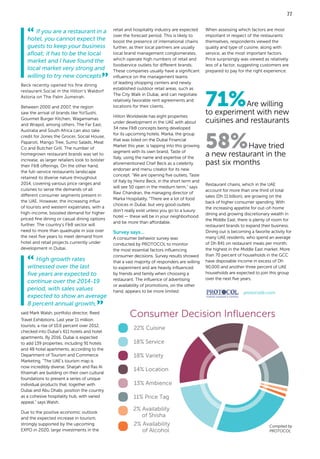
A consumer behavior survey was
conducted by PROTOCOL to monitor
the most essential factors influencing
consumer decisions. Survey results showed
that a vast majority of responders are willing
to experiment and are heavily influenced
by friends and family when choosing a
restaurant. The influence of advertising
or availability of promotions, on the other
hand, appears to be more limited.
When assessing which factors are most
important in respect of the restaurants
themselves, respondents viewed the
quality and type of cuisine, along with
service, as the most important factors.
Price surprisingly was viewed as relatively
less of a factor, suggesting customers are
prepared to pay for the right experience.
Compiled by
PROTOCOL
If you are a restaurant in a
hotel, you cannot expect the
guests to keep your business
afloat; it has to be the local
market and I have found the
local market very strong and
willing to try new concepts.
High growth rates
witnessed over the last
five years are expected to
continue over the 2014-19
period, with sales values
expected to show an average
8 percent annual growth,
Restaurant chains, which in the UAE
account for more than one third of total
sales (Dh 11 billion), are growing on the
back of higher consumer spending. With
the increasing appetite for out-of-home
dining and growing discretionary wealth in
the Middle East, there is plenty of room for
restaurant brands to expand their business.
Dining out is becoming a favorite activity for
many UAE residents, who spend an average
of Dh 841 on restaurant meals per month,
the highest in the Middle East market. More
than 70 percent of households in the GCC
have disposable income in excess of Dh
90,000 and another three percent of UAE
households are expected to join this group
over the next five years.
protocollb.com
77

HN102 Restaurants-UAE

  • 2.
    The UAE restaurantmarket is set to grow 30 percent in the next four years to USD 780 million and will be dominated by American-style fast food brands. Chadi Chidiac, managing partner of PROTOCOL hospitality management consultancy shares exclusive insight on this growing trend and the factors that will influence your investment strategy Branded table-service restaurants generate about USD 600 million a year in the UAE, a number set to swell to USD 780 million by 2018. In a poll of dining outlets in the Gulf state, PROTOCOL found that about 19,000 extra F&B outlets are expected in the UAE by 2019, bearing in mind that there are currently 6,021 outlets in the Emirates. American brands comprised up to 47 percent of F&B offers in Dubai malls. Homegrown restaurants, by comparison, made up between 8-17 percent. The U.S. takeover As profits slow in their domestic markets, U.S.-based chains are set to open some 250 outlets across the Middle East over the next decade. Brands including Shake Shack, Red Lobster and Texas Roadhouse have all debuted in the UAE market in recent months under tie-ups with local firms. TGI Friday’s, PF Chang’s, China Bistro and Applebee’s, owned by DineEquity, are growing in the region by putting new spins on their menu options, while rivals Smashburger and Darden Restaurants are just getting started; braving the Arab Spring political turmoil to open locations in Egypt, Saudi Arabia and the UAE. Friday’s, owned by Carlson Cos, opened in Dubai in 1996 and has grown to 31 restaurants in the region. The company said last year it plans to open an additional 30 locations in the Middle East in the next five years. Darden, the biggest casual-dining operator in the U.S., opened its first Red Lobster in the Dubai Mall in July and will open two more restaurants in Kuwait City in 2012. Last year, the company committed to opening at least 60 Red Lobster, Olive Garden and Long Horn Steakhouse chains in the region in five years. Smashburger, with about 120 locations in the U.S., will open its first international store in Kuwait next year. The Denver-based chain has agreed to open 37 stores in the Middle East after regional specific menu tweaks. Tapping into the food culture The growth in restaurant brands has spilled over into other areas of the F&B market. Franchise brands from Europe were virtually non-existent in the GCC before the launch of Costa Coffee in the market in 1999. “I have found that Dubai has a serious food culture and that is what we are tapping into,” said three-star Michelin chef Heinz Beck. B U S INE S S r e s t a ur a n t s UAE: Identifying key opportunities at a granular level Chef Heinz Beck Three-Star Michelin Chef Mark Walsh Portfolio Director Reed Travel Exhibitions Compiled by PROTOCOL 76
  • 3.
    Beck recently openedhis fine dining restaurant Social in the Hilton’s Waldorf Astoria on The Palm Jumeirah. Between 2000 and 2007, the region saw the arrival of brands like Yo!Sushi, Gourmet Burger Kitchen, Wagamamas and Wrapid, among others. The Far East, Australia and South Africa can also take credit for Jones the Grocer, Social House, Paparoti, Mango Tree, Sumo Salads, Meat Co and Butcher Grill. The number of homegrown restaurant brands was set to increase, as larger retailers look to bolster their F&B offerings. On the other hand, the full-service restaurants landscape retained its diverse nature throughout 2014, covering various price ranges and cuisines to serve the demands of all different consumer segments present in the UAE. However, the increasing influx of tourists and western expatriates, with a high-income, boosted demand for higher priced fine dining or casual dining options further. The country’s F&B sector will need to more than quadruple in size over the next five years to meet demand from hotel and retail projects currently under development in Dubai. 71%Are willing to experiment with new cuisines and restaurants 58%Have tried a new restaurant in the past six months said Mark Walsh, portfolio director, Reed Travel Exhibitions. Last year 11 million tourists, a rise of 10.6 percent over 2012, checked into Dubai’s 611 hotels and hotel apartments. By 2016, Dubai is expected to add 139 properties, including 91 hotels and 48 hotel apartments, according to the Department of Tourism and Commerce Marketing. “The UAE’s tourism map is now incredibly diverse. Sharjah and Ras Al Khaimah are building on their own cultural foundations to present a series of unique individual products that, together with Dubai and Abu Dhabi, position the country as a cohesive hospitality hub, with varied appeal,” says Walsh. Due to the positive economic outlook and the expected increase in tourism, strongly supported by the upcoming EXPO in 2020, large investments in the retail and hospitality industry are expected over the forecast period. This is likely to boost the presence of international chains further, as their local partners are usually local brand management conglomerates, which operate high numbers of retail and foodservice outlets for different brands. These companies usually have a significant influence on the management teams of leading shopping centers and newly established outdoor retail areas, such as The City Walk in Dubai, and can negotiate relatively favorable rent agreements and locations for their clients. Hilton Worldwide has eight properties under development in the UAE with about 34 new F&B concepts being developed for its upcoming hotels. Marka, the group that was listed on the Dubai Financial Market this year, is tapping into this growing segment with its own brand, Taste of Italy, using the name and expertise of the aforementioned Chef Beck as a celebrity endorser and menu creator for its new concept. “We are opening five outlets, Taste of Italy by Heinz Beck, in the short term and will see 50 open in the medium term,” says Ravi Chandran, the managing director of Marka Hospitality. “There are a lot of food choices in Dubai, but very good outlets don’t really exist unless you go to a luxury hotel — these will be in your neighborhood and be more than affordable. Survey says... A consumer behavior survey was conducted by PROTOCOL to monitor the most essential factors influencing consumer decisions. Survey results showed that a vast majority of responders are willing to experiment and are heavily influenced by friends and family when choosing a restaurant. The influence of advertising or availability of promotions, on the other hand, appears to be more limited. When assessing which factors are most important in respect of the restaurants themselves, respondents viewed the quality and type of cuisine, along with service, as the most important factors. Price surprisingly was viewed as relatively less of a factor, suggesting customers are prepared to pay for the right experience. Compiled by PROTOCOL If you are a restaurant in a hotel, you cannot expect the guests to keep your business afloat; it has to be the local market and I have found the local market very strong and willing to try new concepts. High growth rates witnessed over the last five years are expected to continue over the 2014-19 period, with sales values expected to show an average 8 percent annual growth, Restaurant chains, which in the UAE account for more than one third of total sales (Dh 11 billion), are growing on the back of higher consumer spending. With the increasing appetite for out-of-home dining and growing discretionary wealth in the Middle East, there is plenty of room for restaurant brands to expand their business. Dining out is becoming a favorite activity for many UAE residents, who spend an average of Dh 841 on restaurant meals per month, the highest in the Middle East market. More than 70 percent of households in the GCC have disposable income in excess of Dh 90,000 and another three percent of UAE households are expected to join this group over the next five years. protocollb.com 77