HMS COVID-19
Health and
Safety Module
#2
Infection Control & Prevention
Module Outline
I. Hand Hygiene
II. Respiratory Etiquette
III. Social/Physical Distancing
IV. PPE Identification and Use
Goals for Module #2
● Understand proper hand hygiene and and safe hand sanitizing technique
● Understand appropriate respiratory etiquette including covering
coughs/sneezes, facial coverings 101 (proper wear, contamination and
disposal).
● Understand importance of physical distancing and how infection spreads.
● Be able to identify proper Personal Protective Equipment (PPE) and
understand proper use, storage and disposal).
I. Hand Hygiene
https://www.youtube.com/watch?time_continue=6&v=XnJ1wvlIcbs&feature=emb_logo
How COVID-19 Spreads
COVID-19 and other Germs can spread from other people or surfaces
when you:
● Touch your eyes, nose, and mouth with unwashed hands
● Prepare or eat food and drinks with unwashed hands
● Touch a contaminated surface or objects
● Blow your nose, cough, or sneeze into hands and then touch other
people’s hands or common objects
● Are in close contact with one another (within about 6 feet)
Some recent studies have suggested that COVID-19 may be spread by people who
are not showing symptoms. https://www.cdc.gov/handwashing/when-how-handwashing.html
Key Times to Wash Your Hands
● Before, During & After preparing food
● Before eating food
● Before touching your face
● After using the restroom
● After leaving a public place
● After blowing your nose, coughing, or sneezing
● After handling your cloth face covering
● After changing a diaper
● Before & After caring for someone sick
● After touching animals or pets https://www.cdc.gov/coronavirus/2019-
ncov/prevent-getting-sick/prevention.html
Wash Your Hands Often!
● Wash hands often with soap and water for at least 20 seconds
especially after you have been in a public place, or after blowing your
nose, coughing, or sneezing
● If soap and water are not readily available, use a hand sanitizer
that contains at least 60% alcohol. Cover all surfaces of your
hands and rub them together until they feel dry.
● Avoid touching your eyes, nose, and mouth with unwashed hands.
https://www.cdc.gov/coronavirus/2019-ncov/prevent-getting-sick/prevention.html
Knowledge Check
True or False?
Per the “Hand Hygiene” Video, Surgeon General Jerome Adams
states that it is only necessary to wash the palms of your hands to
effectively clean them.
Answer
False!!
Per Surgeon General Jerome Adams, Proper hand-washing
includes lathering your hands with bar or liquid soap and washing
the front & backs of your hands, between your fingers and
under your nails.
Knowledge Check
If soap and water are not available you can use a hand sanitizer that contains at
least what percentage of alcohol?
a. 40%
b. 80%
c. 60%
d. 100%
Answer
If soap and water are not available you can
use a hand sanitizer that contains at least
what percentage of alcohol?
a. 40%
b. 80%
c. 60%
d. 100%
II. Respiratory Etiquette
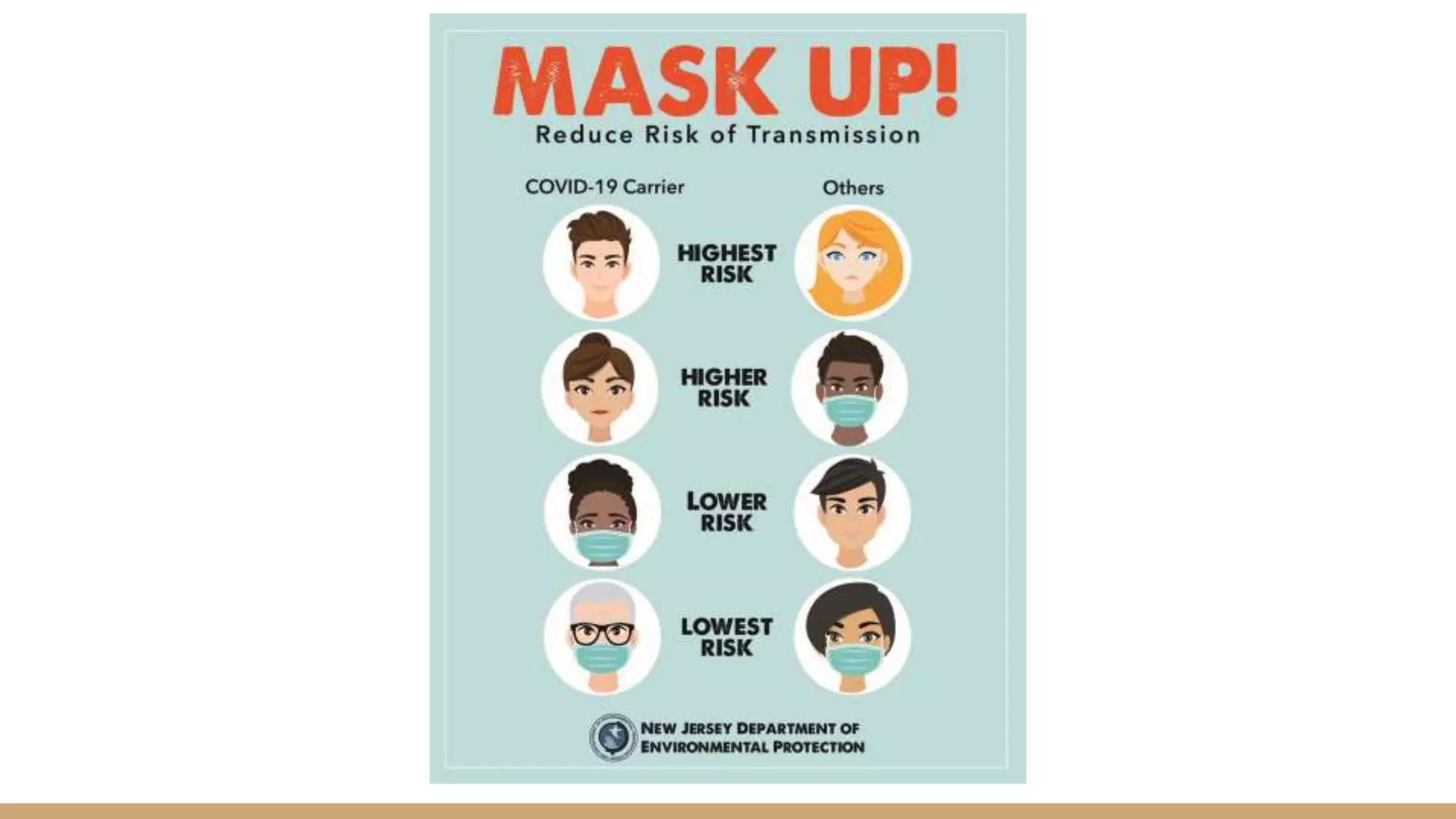
● Cover your nose and mouth with a face covering when around
others
● Cover your Cough and Sneezes!
○ Always cover your mouth and nose with a tissue when you
cough or sneeze or use the inside of your elbow and do not spit.
○ Throw used tissues in the trash.
○ Immediately wash your hands with soap and water or >60%
Alcohol containing Hand Sanitizer for at least 20 seconds.
https://www.cdc.gov/coronavirus/2019-ncov/prevent-getting-sick/prevention.html
Cover Your Cough & Sneeze Please!
https://www.youtube.com/watch?v=VgwSfNDPDsc&feature=emb_logo
How Properly Wear a Fabric Mask
https://www.youtube.com/watch?v=9Tv2BVN_WTk&feature=emb_logo
Knowledge Check
True or False?
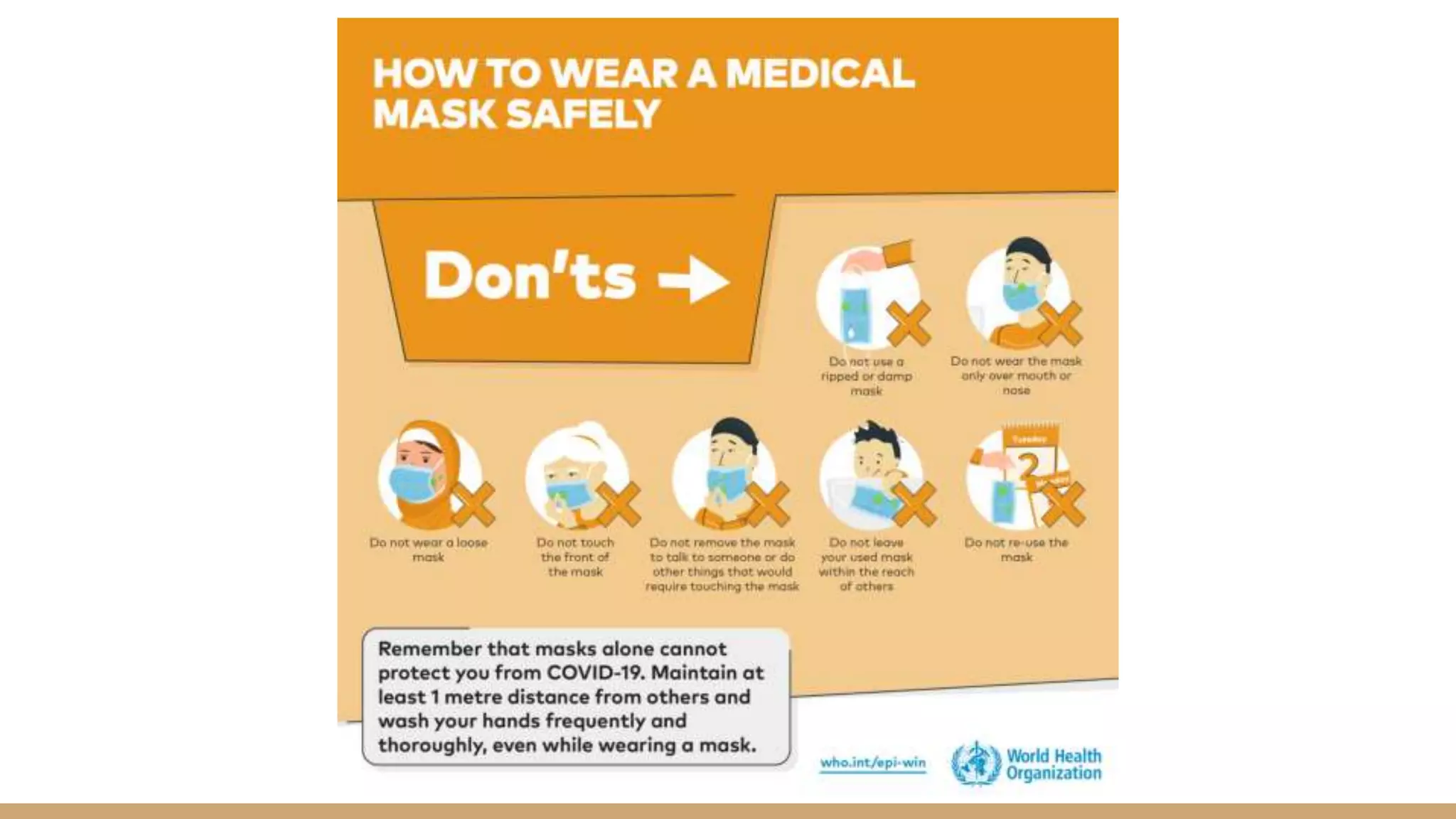
The colored side of medical masks should always face outward
Answer
True!
The colored side of medical masks should always face outward
and fully cover your nose and mouth!
III. Social/Physical Distancing
Social distancing, also called “physical distancing,” means keeping a safe
space between yourself and other people who are not from your
household.
To practice social or physical distancing, stay at least 6 feet (about 2 arms
length) from other people who are not from your household in both indoor and
outdoor spaces.
Social or physical distancing should be practiced in combination with other
everyday preventive actions to reduce the spread of COVID-19.
https://www.cdc.gov/coronavirus/2019-ncov/prevent-getting-sick/social-distancing.html
Tips for Social/Physical Distancing
● Know Before You Go: Before going out, know and follow the guidance from local
public health authorities where you live.
● Prepare for Transportation: Consider social distancing options to travel safely when
running errands or commuting to and from work
● Limit Contact When Running Errands: Only visit stores selling essentials when you
absolutely need to, and stay at least 6 feet away from others who are not from your
household while shopping and in lines. If possible, use drive-thru, curbside pick-up, or
delivery services to limit face-to-face contact with others.
Continued...
● Choose Safe Social Activities: Stay connected by calling, using video chat, and social media. If
meeting others in person (e.g., at small outdoor gatherings, yard or driveway gathering with a
small group of friends or family members), stay at least 6 feet from others not in household.
● Keep Distance at Events and Gatherings: Try to avoid crowded places where it may be difficult
to stay at least 6 feet away from others. Pay attention to any physical guides, such as tape
markings on floors or signs on walls, directing attendees to physically distance. Allow other people
6 feet of space when you pass by them in both indoor and outdoor settings.
● Stay Distanced While Being Active: Consider going for a walk, bike ride, or wheelchair roll in
your neighborhood or in another safe location where you can maintain at least 6 feet of distance.
If you decide to visit a nearby park, trail, or recreational facility, consider how many other people
might be there and choose a location where it will be possible to stay physically distanced.
IV. PPE Identification & Use
● PPE stands for personal protective equipment and is specialized clothing
or equipment worn by an employee for protection against infectious
materials
● Types of PPE:
○ Gloves -- protect hands
○ Gowns -- protect skin/clothing
○ Masks -- protect nose/mouth
○ Goggles -- protect eyes
○ Face shields -- protect face, mouth, nose, and eyes
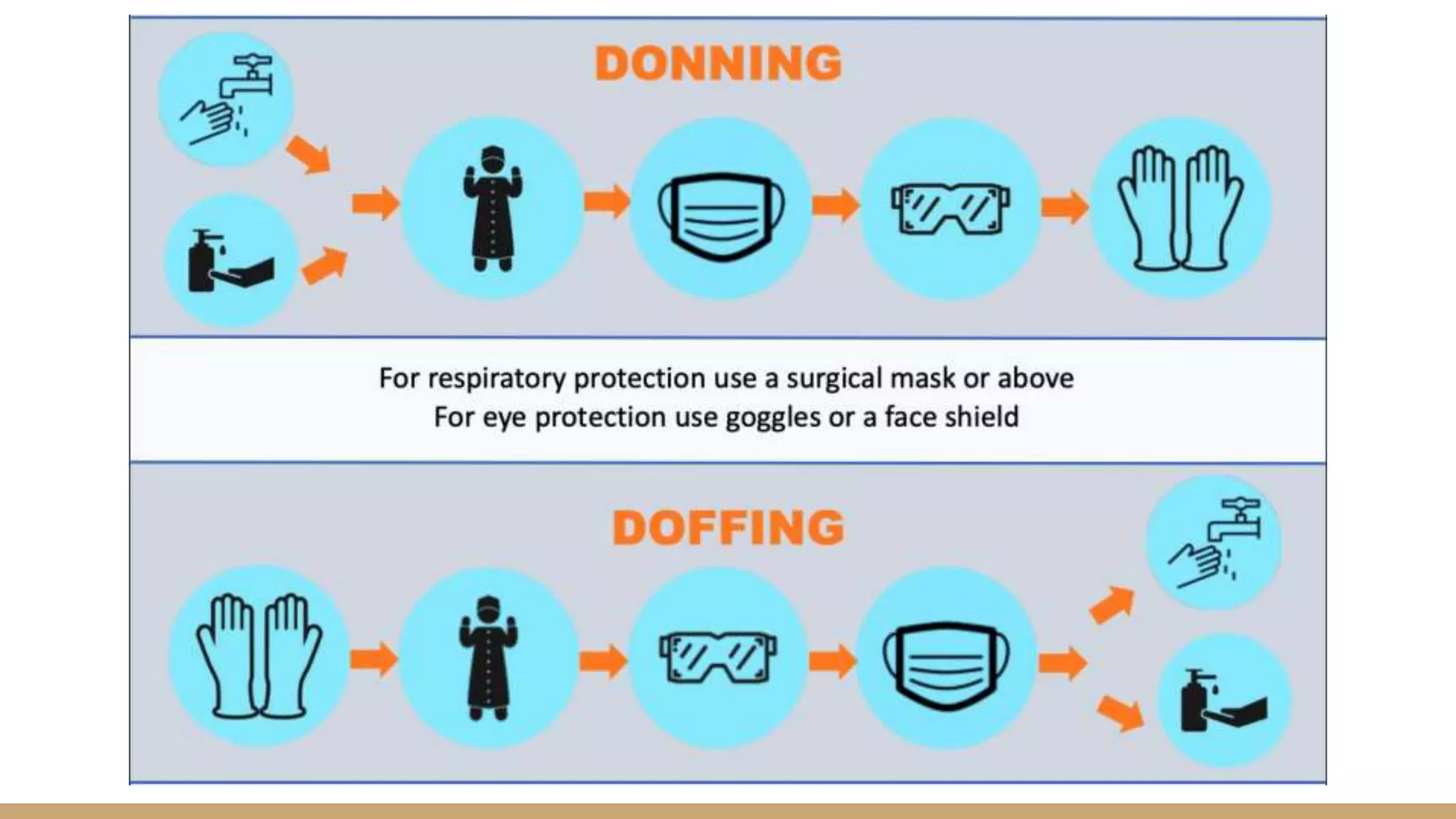
How to Put On (Don) PPE
1. Identify and gather the proper PPE to don.
2. Perform hand hygiene using hand sanitizer.
3. Put on isolation gown. Tie all of the ties on the gown.
4. Put on facemask.
○ Should be extended under your chin and both your mouth and nose should be
protected. Ties should be secured on crown of head (top tie) and base of neck (bottom
tie). If mask has loops, hook them appropriately around your ears.
5. Put on face shield or goggles.
○ Face shields provide full face coverage. Goggles also provide excellent protection for
eyes, but fogging is common.
6. Put on gloves. Gloves should cover the cuff (wrist) of gown.
How to Take Off (Doff) PPE
1. Remove gloves. Ensure glove removal does not cause additional contamination of hands.
2. Remove gown. Untie all ties (or unsnap all buttons). Some gown ties can be broken rather
than untied. Do so in gentle manner, avoiding a forceful movement. Reach up to the
shoulders and carefully pull gown down and away from the body. Rolling the gown down is an
acceptable approach. Dispose in trash receptacle. *
3. Perform hand hygiene.
4. Remove face shield or goggles. Carefully remove face shield or goggles by grabbing the
strap and pulling upwards and away from head. Do not touch the front of face shield or
goggles.
5. Remove facemask. Carefully untie (or unhook from the ears) and pull away from face
without touching the front.
6. Place facemask in designated brown paper bag between use or discard if soiled or worn.
7. Perform hand hygiene.
Knowledge Check
When removing PPE it is important to know what areas of the PPE are considered
"clean" vs "contaminated". Select ALL the areas on PPE that are considered
"clean":
A. Ties on the gown
B. Outside of the mask
C. Sleeves of the gown
D. Back of the gown
E. Inside of the gloves
F. Straps on the goggles
Answer
A. Ties on the gown
D. Back of the gown
E. Inside of the gloves
F. Straps on the goggles
Questions or Comments? Please fill out the form below:
https://docs.google.com/forms/d/e/1FAIpQLSdIJbs15IyZWWfgBD0H5tN
USAJGXEDDRm_xWQSK51z-gIy3KA/viewform?usp=pp_url
Thanks for your Participation!

Hms covid 19 health and safety module 2-final

  • 1.
    HMS COVID-19 Health and SafetyModule #2 Infection Control & Prevention
  • 2.
    Module Outline I. HandHygiene II. Respiratory Etiquette III. Social/Physical Distancing IV. PPE Identification and Use
  • 3.
    Goals for Module#2 ● Understand proper hand hygiene and and safe hand sanitizing technique ● Understand appropriate respiratory etiquette including covering coughs/sneezes, facial coverings 101 (proper wear, contamination and disposal). ● Understand importance of physical distancing and how infection spreads. ● Be able to identify proper Personal Protective Equipment (PPE) and understand proper use, storage and disposal).
  • 4.
  • 5.
    How COVID-19 Spreads COVID-19and other Germs can spread from other people or surfaces when you: ● Touch your eyes, nose, and mouth with unwashed hands ● Prepare or eat food and drinks with unwashed hands ● Touch a contaminated surface or objects ● Blow your nose, cough, or sneeze into hands and then touch other people’s hands or common objects ● Are in close contact with one another (within about 6 feet) Some recent studies have suggested that COVID-19 may be spread by people who are not showing symptoms. https://www.cdc.gov/handwashing/when-how-handwashing.html
  • 6.
    Key Times toWash Your Hands ● Before, During & After preparing food ● Before eating food ● Before touching your face ● After using the restroom ● After leaving a public place ● After blowing your nose, coughing, or sneezing ● After handling your cloth face covering ● After changing a diaper ● Before & After caring for someone sick ● After touching animals or pets https://www.cdc.gov/coronavirus/2019- ncov/prevent-getting-sick/prevention.html
  • 7.
    Wash Your HandsOften! ● Wash hands often with soap and water for at least 20 seconds especially after you have been in a public place, or after blowing your nose, coughing, or sneezing ● If soap and water are not readily available, use a hand sanitizer that contains at least 60% alcohol. Cover all surfaces of your hands and rub them together until they feel dry. ● Avoid touching your eyes, nose, and mouth with unwashed hands. https://www.cdc.gov/coronavirus/2019-ncov/prevent-getting-sick/prevention.html
  • 9.
    Knowledge Check True orFalse? Per the “Hand Hygiene” Video, Surgeon General Jerome Adams states that it is only necessary to wash the palms of your hands to effectively clean them.
  • 10.
    Answer False!! Per Surgeon GeneralJerome Adams, Proper hand-washing includes lathering your hands with bar or liquid soap and washing the front & backs of your hands, between your fingers and under your nails.
  • 11.
    Knowledge Check If soapand water are not available you can use a hand sanitizer that contains at least what percentage of alcohol? a. 40% b. 80% c. 60% d. 100%
  • 12.
    Answer If soap andwater are not available you can use a hand sanitizer that contains at least what percentage of alcohol? a. 40% b. 80% c. 60% d. 100%
  • 13.
    II. Respiratory Etiquette ●Cover your nose and mouth with a face covering when around others ● Cover your Cough and Sneezes! ○ Always cover your mouth and nose with a tissue when you cough or sneeze or use the inside of your elbow and do not spit. ○ Throw used tissues in the trash. ○ Immediately wash your hands with soap and water or >60% Alcohol containing Hand Sanitizer for at least 20 seconds. https://www.cdc.gov/coronavirus/2019-ncov/prevent-getting-sick/prevention.html
  • 14.
    Cover Your Cough& Sneeze Please! https://www.youtube.com/watch?v=VgwSfNDPDsc&feature=emb_logo
  • 16.
    How Properly Weara Fabric Mask https://www.youtube.com/watch?v=9Tv2BVN_WTk&feature=emb_logo
  • 19.
    Knowledge Check True orFalse? The colored side of medical masks should always face outward
  • 20.
    Answer True! The colored sideof medical masks should always face outward and fully cover your nose and mouth!
  • 21.
    III. Social/Physical Distancing Socialdistancing, also called “physical distancing,” means keeping a safe space between yourself and other people who are not from your household. To practice social or physical distancing, stay at least 6 feet (about 2 arms length) from other people who are not from your household in both indoor and outdoor spaces. Social or physical distancing should be practiced in combination with other everyday preventive actions to reduce the spread of COVID-19. https://www.cdc.gov/coronavirus/2019-ncov/prevent-getting-sick/social-distancing.html
  • 23.
    Tips for Social/PhysicalDistancing ● Know Before You Go: Before going out, know and follow the guidance from local public health authorities where you live. ● Prepare for Transportation: Consider social distancing options to travel safely when running errands or commuting to and from work ● Limit Contact When Running Errands: Only visit stores selling essentials when you absolutely need to, and stay at least 6 feet away from others who are not from your household while shopping and in lines. If possible, use drive-thru, curbside pick-up, or delivery services to limit face-to-face contact with others.
  • 24.
    Continued... ● Choose SafeSocial Activities: Stay connected by calling, using video chat, and social media. If meeting others in person (e.g., at small outdoor gatherings, yard or driveway gathering with a small group of friends or family members), stay at least 6 feet from others not in household. ● Keep Distance at Events and Gatherings: Try to avoid crowded places where it may be difficult to stay at least 6 feet away from others. Pay attention to any physical guides, such as tape markings on floors or signs on walls, directing attendees to physically distance. Allow other people 6 feet of space when you pass by them in both indoor and outdoor settings. ● Stay Distanced While Being Active: Consider going for a walk, bike ride, or wheelchair roll in your neighborhood or in another safe location where you can maintain at least 6 feet of distance. If you decide to visit a nearby park, trail, or recreational facility, consider how many other people might be there and choose a location where it will be possible to stay physically distanced.
  • 25.
    IV. PPE Identification& Use ● PPE stands for personal protective equipment and is specialized clothing or equipment worn by an employee for protection against infectious materials ● Types of PPE: ○ Gloves -- protect hands ○ Gowns -- protect skin/clothing ○ Masks -- protect nose/mouth ○ Goggles -- protect eyes ○ Face shields -- protect face, mouth, nose, and eyes
  • 26.
    How to PutOn (Don) PPE 1. Identify and gather the proper PPE to don. 2. Perform hand hygiene using hand sanitizer. 3. Put on isolation gown. Tie all of the ties on the gown. 4. Put on facemask. ○ Should be extended under your chin and both your mouth and nose should be protected. Ties should be secured on crown of head (top tie) and base of neck (bottom tie). If mask has loops, hook them appropriately around your ears. 5. Put on face shield or goggles. ○ Face shields provide full face coverage. Goggles also provide excellent protection for eyes, but fogging is common. 6. Put on gloves. Gloves should cover the cuff (wrist) of gown.
  • 27.
    How to TakeOff (Doff) PPE 1. Remove gloves. Ensure glove removal does not cause additional contamination of hands. 2. Remove gown. Untie all ties (or unsnap all buttons). Some gown ties can be broken rather than untied. Do so in gentle manner, avoiding a forceful movement. Reach up to the shoulders and carefully pull gown down and away from the body. Rolling the gown down is an acceptable approach. Dispose in trash receptacle. * 3. Perform hand hygiene. 4. Remove face shield or goggles. Carefully remove face shield or goggles by grabbing the strap and pulling upwards and away from head. Do not touch the front of face shield or goggles. 5. Remove facemask. Carefully untie (or unhook from the ears) and pull away from face without touching the front. 6. Place facemask in designated brown paper bag between use or discard if soiled or worn. 7. Perform hand hygiene.
  • 29.
    Knowledge Check When removingPPE it is important to know what areas of the PPE are considered "clean" vs "contaminated". Select ALL the areas on PPE that are considered "clean": A. Ties on the gown B. Outside of the mask C. Sleeves of the gown D. Back of the gown E. Inside of the gloves F. Straps on the goggles
  • 30.
    Answer A. Ties onthe gown D. Back of the gown E. Inside of the gloves F. Straps on the goggles
  • 31.
    Questions or Comments?Please fill out the form below: https://docs.google.com/forms/d/e/1FAIpQLSdIJbs15IyZWWfgBD0H5tN USAJGXEDDRm_xWQSK51z-gIy3KA/viewform?usp=pp_url Thanks for your Participation!

Editor's Notes

  • #23 https://medcom.uiowa.edu/theloop/announcements/social-distancing-why-a-few-steps-makes-a-big-difference
  • #26 https://www.cdc.gov/coronavirus/2019-ncov/hcp/using-ppe.html https://www.cdc.gov/hai/pdfs/ppe/PPEslides6-29-04.pdf