HIVAIDSAdapted from GEP website
ObjectivesStudents will be able to describe the global distribution of known cases of people who are HIV-positive, and the spatial association between HIV/AIDS and other factors such as income and the status of women.Students will identify and classify responses to the phenomenon of HIV/AIDS, at a range of scales.Students will develop criteria to evaluate the effectiveness of responses to HIV/AIDS.Students will examine options for present and future action regarding HIV/AIDS and people whose lives are affected by it.
Introduction"Tatu is 40 years old and the mother of seven children, the youngest only four years old. Her husband, a fisherman, died two years ago from AIDS. She has learned that she is HIV-positive and is very worried about her children's future." (Kagera HIV/AIDS Project, Tanzania)Being HIV-positive means a person like Tatu has been infected with the Human-Immuno-deficiency Virus (HIV) which progressively prevents the body from protecting itself against infection. In between two and ten years she is likely to develop more severe symptoms associated with AIDS (Acquired Immuno-Deficiency Syndrome). Although anti-retroviral drugs and treatment to prolong life have been developed, no cure (or preventive vaccine) is yet available. Tatu's life will probably be cut short.
Some numbers…Tatu is not alone. By the beginning of the year 2000, more than 34 million people were living with HIV/AIDS (and 2.8 million dying each year). Ninety-five per cent of these live in developing countries.
Where is HIV/AIDS prevalent?It occurs everywhere in the world!However…
People living with HIV/AIDSSource:
Epidemic update June 2000, UNAIDS http://www.unaids.orgKey:H – heterosexualIDU - injecting drug useMSM - men who have sex with menGlobally, the people most vulnerable to HIV/AIDS include:the poor women and girls people with multiple sex partnersinjecting drug userschildren of infected mothers
The human impacts of HIV/AIDSwide variety of physical health problemsemotional/social affects ranging from shame to social isolationaltered family responsibilities (e.g. grandparents caring for children, orphans living alone)loss of income, farmland left unused, homes in disrepair, children withdrawn from schoolloss of skills and knowledge (e.g. due to significant death rates among professionally trained people)burden on health services and government budgets
Global Responses to AIDS/HIVFrom 1986, the World Health Organization (WHO) had the lead responsibility on HIV/AIDS in the United Nationshelped countries to set up national HIV /AIDS programs.In 1996 the United Nations drew six organisations together in the Joint UN Programme on HIV/AIDS (UNAIDS). United Nations Children Fund (UNICEF) United Nations Development Programme (UNDP) United Nations Population Fund (UNFPA)United Nations Education Scientific and Cultural Organisation (UNESCO)WHOWorld Bank
Global Responses to HIV/AIDSApril 1999 by United Nations Drug Control Programme (UNDCP) joined UNAIDS
UNAIDS supports and cooperates with governments and non-government organisations in developing and implementing strategies to reduce the rate and risk of HIV/AIDS globally.
By 1999, UNAIDS estimated that US$2-3 billion annually would be needed to combat the disease.
Developing countries' health budgets are severely limited, and, in 1998, total aid from developed countries given to combat HIV/AIDS was only $302 million ($9 per person living with HIV/AIDS or one tenth of the estimated requirement). PrioritiesThe XIII International AIDS Conference in Durban in July 2000 discussed responses such as:investment in research to develop an AIDS vaccineprovision at low-cost of anti-retroviral drugs (which prolong life of HIV-positive people, but currently cost US$10-15 thousand per person per year)provision of anti-retroviral drugs to women in late pregnancy (to reduce transmission to babies)continuing information/education/communication campaigns to reduce high-risk behaviourcommunity-based care for people living with HIV/AIDSprograms to increase people's skills and incomes, in order to reduce their vulnerability to HIV/AIDS and to help HIV-positive people support their families
Australian Aid in VietnamThe Australian aid program's objectives in the area of HIV/AIDS are to help:prevent the spread of HIVreduce the impact of HIV/AIDS on individuals and societyaddress the social and economic needs created by HIV/AIDS
Australian Aid in VietnamMany countries have found that major transmission of HIV first occurred along major transport routes before spreading throughout the country. For example:AfricaIndia Thailand VietnamSome truck-drivers, away from their families for long periods, have multiple sex partners at different truck stops along the highway. Poor women (and young girls) living near truck stops resort to commercial sex for income and are therefore vulnerable to HIV infection. In turn the infection spreads to the families of both drivers and sex workers.
Australian Aid in VietnamThe spatial association between truck routes and HIV infection has led to the National Highway One Project in Vietnam, funded by the Australian Government's overseas aid program and implemented by World Vision. The project aims to prevent the spread of infection by increasing awareness of HIV infection and prevention among truck drivers and communities and by encouraging a change in behaviour. Due to the nature of their work, mobile groups such as truck drivers have limited access to health services and to health care information and this make them a vulnerable risk group for HIV/AIDS infection.
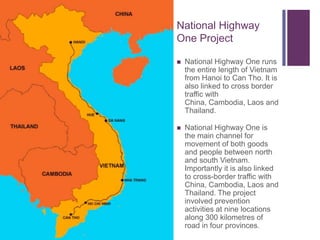
National Highway One ProjectNational Highway One runs the entire length of Vietnam from Hanoi to Can Tho. It is also linked to cross border traffic with China, Cambodia, Laos and Thailand.National Highway One is the main channel for movement of both goods and people between north and south Vietnam. Importantly it is also linked to cross-border traffic with China, Cambodia, Laos and Thailand. The project involved prevention activities at nine locations along 300 kilometres of road in four provinces.
National Highway One ProjectThe project aimed to spread the message about preventing HIV/AIDS along major transport route.
National Highway One ProjectCommunity members, such as restaurant workers and other service workers who are in frequent contact with truck drivers, were trained to: distribute information and educational materialsleafletskey-ringsaudio-cassettes containing songs interspersed with conversations between truck-driverssupply condoms The aim was to convince drivers to change their sexual behaviour in order to reduce the risk of HIV infection.
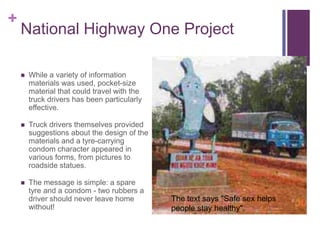
National Highway One ProjectWhile a variety of information materials was used, pocket-size material that could travel with the truck drivers has been particularly effective. Truck drivers themselves provided suggestions about the design of the materials and a tyre-carrying condom character appeared in various forms, from pictures to roadside statues. The message is simple: a spare tyre and a condom - two rubbers a driver should never leave home without!The text says "Safe sex helps people stay healthy".
National Highway One ProjectChoosing to contact the drivers at small truck stops meant there was more opportunity for conversation, without the distractions provided by larger towns.Young men and women in roadside locations took part in education sessions and produced colourful murals and billboards which reinforced the message that HIV/AIDS threatens everyone, not just 'high-risk groups'. By educating the wider community, and urging sex workers to insist on the use of condoms and to seek treatment for STDs, the project aimed to create an environment that would encourage a change in behaviour.
EvaluationA survey of truck drivers passing through the project locations found that the educational materials have been distributed as far away as Ho Chi Minh City and Hanoi.The demand for condoms is increasing and condoms are becoming more available and more acceptable locally. One villager commented, "Sex without condoms is like walking barefoot.”Since this project began in 1998, interest in the link between HIV and mobility has increased and other projects are being implemented within Vietnam and in the greater Mekong region.

HIV/AIDS brief

  • 1.
  • 2.
    ObjectivesStudents will beable to describe the global distribution of known cases of people who are HIV-positive, and the spatial association between HIV/AIDS and other factors such as income and the status of women.Students will identify and classify responses to the phenomenon of HIV/AIDS, at a range of scales.Students will develop criteria to evaluate the effectiveness of responses to HIV/AIDS.Students will examine options for present and future action regarding HIV/AIDS and people whose lives are affected by it.
  • 3.
    Introduction"Tatu is 40years old and the mother of seven children, the youngest only four years old. Her husband, a fisherman, died two years ago from AIDS. She has learned that she is HIV-positive and is very worried about her children's future." (Kagera HIV/AIDS Project, Tanzania)Being HIV-positive means a person like Tatu has been infected with the Human-Immuno-deficiency Virus (HIV) which progressively prevents the body from protecting itself against infection. In between two and ten years she is likely to develop more severe symptoms associated with AIDS (Acquired Immuno-Deficiency Syndrome). Although anti-retroviral drugs and treatment to prolong life have been developed, no cure (or preventive vaccine) is yet available. Tatu's life will probably be cut short.
  • 4.
    Some numbers…Tatu isnot alone. By the beginning of the year 2000, more than 34 million people were living with HIV/AIDS (and 2.8 million dying each year). Ninety-five per cent of these live in developing countries.
  • 5.
    Where is HIV/AIDSprevalent?It occurs everywhere in the world!However…
  • 6.
    People living withHIV/AIDSSource:
Epidemic update June 2000, UNAIDS http://www.unaids.orgKey:H – heterosexualIDU - injecting drug useMSM - men who have sex with menGlobally, the people most vulnerable to HIV/AIDS include:the poor women and girls people with multiple sex partnersinjecting drug userschildren of infected mothers
  • 7.
    The human impactsof HIV/AIDSwide variety of physical health problemsemotional/social affects ranging from shame to social isolationaltered family responsibilities (e.g. grandparents caring for children, orphans living alone)loss of income, farmland left unused, homes in disrepair, children withdrawn from schoolloss of skills and knowledge (e.g. due to significant death rates among professionally trained people)burden on health services and government budgets
  • 8.
    Global Responses toAIDS/HIVFrom 1986, the World Health Organization (WHO) had the lead responsibility on HIV/AIDS in the United Nationshelped countries to set up national HIV /AIDS programs.In 1996 the United Nations drew six organisations together in the Joint UN Programme on HIV/AIDS (UNAIDS). United Nations Children Fund (UNICEF) United Nations Development Programme (UNDP) United Nations Population Fund (UNFPA)United Nations Education Scientific and Cultural Organisation (UNESCO)WHOWorld Bank
  • 9.
    Global Responses toHIV/AIDSApril 1999 by United Nations Drug Control Programme (UNDCP) joined UNAIDS
  • 10.
    UNAIDS supports andcooperates with governments and non-government organisations in developing and implementing strategies to reduce the rate and risk of HIV/AIDS globally.
  • 11.
    By 1999, UNAIDSestimated that US$2-3 billion annually would be needed to combat the disease.
  • 12.
    Developing countries' healthbudgets are severely limited, and, in 1998, total aid from developed countries given to combat HIV/AIDS was only $302 million ($9 per person living with HIV/AIDS or one tenth of the estimated requirement). PrioritiesThe XIII International AIDS Conference in Durban in July 2000 discussed responses such as:investment in research to develop an AIDS vaccineprovision at low-cost of anti-retroviral drugs (which prolong life of HIV-positive people, but currently cost US$10-15 thousand per person per year)provision of anti-retroviral drugs to women in late pregnancy (to reduce transmission to babies)continuing information/education/communication campaigns to reduce high-risk behaviourcommunity-based care for people living with HIV/AIDSprograms to increase people's skills and incomes, in order to reduce their vulnerability to HIV/AIDS and to help HIV-positive people support their families
  • 13.
    Australian Aid inVietnamThe Australian aid program's objectives in the area of HIV/AIDS are to help:prevent the spread of HIVreduce the impact of HIV/AIDS on individuals and societyaddress the social and economic needs created by HIV/AIDS
  • 14.
    Australian Aid inVietnamMany countries have found that major transmission of HIV first occurred along major transport routes before spreading throughout the country. For example:AfricaIndia Thailand VietnamSome truck-drivers, away from their families for long periods, have multiple sex partners at different truck stops along the highway. Poor women (and young girls) living near truck stops resort to commercial sex for income and are therefore vulnerable to HIV infection. In turn the infection spreads to the families of both drivers and sex workers.
  • 15.
    Australian Aid inVietnamThe spatial association between truck routes and HIV infection has led to the National Highway One Project in Vietnam, funded by the Australian Government's overseas aid program and implemented by World Vision. The project aims to prevent the spread of infection by increasing awareness of HIV infection and prevention among truck drivers and communities and by encouraging a change in behaviour. Due to the nature of their work, mobile groups such as truck drivers have limited access to health services and to health care information and this make them a vulnerable risk group for HIV/AIDS infection.
  • 16.
    National Highway OneProjectNational Highway One runs the entire length of Vietnam from Hanoi to Can Tho. It is also linked to cross border traffic with China, Cambodia, Laos and Thailand.National Highway One is the main channel for movement of both goods and people between north and south Vietnam. Importantly it is also linked to cross-border traffic with China, Cambodia, Laos and Thailand. The project involved prevention activities at nine locations along 300 kilometres of road in four provinces.
  • 17.
    National Highway OneProjectThe project aimed to spread the message about preventing HIV/AIDS along major transport route.
  • 18.
    National Highway OneProjectCommunity members, such as restaurant workers and other service workers who are in frequent contact with truck drivers, were trained to: distribute information and educational materialsleafletskey-ringsaudio-cassettes containing songs interspersed with conversations between truck-driverssupply condoms The aim was to convince drivers to change their sexual behaviour in order to reduce the risk of HIV infection.
  • 19.
    National Highway OneProjectWhile a variety of information materials was used, pocket-size material that could travel with the truck drivers has been particularly effective. Truck drivers themselves provided suggestions about the design of the materials and a tyre-carrying condom character appeared in various forms, from pictures to roadside statues. The message is simple: a spare tyre and a condom - two rubbers a driver should never leave home without!The text says "Safe sex helps people stay healthy".
  • 20.
    National Highway OneProjectChoosing to contact the drivers at small truck stops meant there was more opportunity for conversation, without the distractions provided by larger towns.Young men and women in roadside locations took part in education sessions and produced colourful murals and billboards which reinforced the message that HIV/AIDS threatens everyone, not just 'high-risk groups'. By educating the wider community, and urging sex workers to insist on the use of condoms and to seek treatment for STDs, the project aimed to create an environment that would encourage a change in behaviour.
  • 22.
    EvaluationA survey oftruck drivers passing through the project locations found that the educational materials have been distributed as far away as Ho Chi Minh City and Hanoi.The demand for condoms is increasing and condoms are becoming more available and more acceptable locally. One villager commented, "Sex without condoms is like walking barefoot.”Since this project began in 1998, interest in the link between HIV and mobility has increased and other projects are being implemented within Vietnam and in the greater Mekong region.