Seminar On HIV/AIDS
Moderator
Ms.Sarita Ahwal
Lecturer
CON,ILBS
Presenter
Manglam Kumari
M.Sc (N) 1st year
CON,ILBS
Pre Test
• Earlier name of aids?
• Who coined the term AIDS?
• What are the major 3 gene of HIV?
• Ora Quick is______?
• TLE in HIV therapy stands for____?
Introduction
# Dr Gottlieb in the Centers for Disease
Control and Prevention (CDC) Morbidity
and Mortality Weekly Report (MMWR) of
5th June 1981, described a syndrome
of unusual illness that was termed as
"gay-related immune deficiency"
(GRID), as most of initial cases were
reported among gay people.
• Later, similar cases were reported
among drug addicts, people who
received blood transfusions and other
persons, indicating that the syndrome
was not just limited to gay men. In
1982, the CDC formally coined the term
“Acquired Immunodeficiency
Syndrome” (AIDS) for these group of
illnesses.
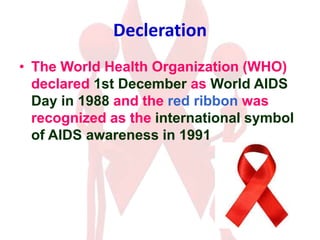
Decleration
• The World Health Organization (WHO)
declared 1st December as World AIDS
Day in 1988 and the red ribbon was
recognized as the international symbol
of AIDS awareness in 1991
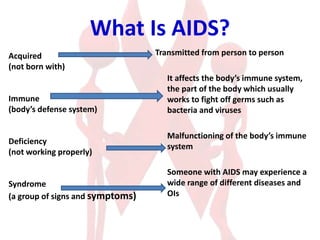
What Is AIDS?
Acquired
(not born with)
Immune
(body’s defense system)
Deficiency
(not working properly)
Syndrome
(a group of signs and symptoms)
Transmitted from person to person
It affects the body’s immune system,
the part of the body which usually
works to fight off germs such as
bacteria and viruses
Malfunctioning of the body’s immune
system
Someone with AIDS may experience a
wide range of different diseases and
OIs
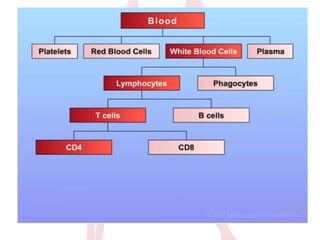
CD4 CELL
Epidemiology
HIV IN WORLD:
• HIV/AIDS has killed more than 20 million people globally
so far, and nearly 34 million are estimated to be living
with HIV currently.
HIV IN INDIA:
• There are an estimated 4.2 million people living with HIV
in Asia, 90% of them are in India, China and Thailand.
India contributes 49% of it (2.4 million people).
• The first few cases of HIV in India were detected in 1986
among sex workers in Chennai and the first AIDS case
was reported in 1987 in Mumbai
Risk factor
• Having unprotected anal or vaginal sex;
• Having another sexually transmitted
infections (STI) such as syphilis,
herpes,chlamydia,gonorrhoea and
bacterial vaginosis.
• Sharing contaminated needles,
syringes and other injecting equipment
and drug solutions when injecting
drugs;
• Receiving unsafe injections, blood
transfusions and tissue
transplantation, and medical
procedures that involve unsterile
cutting or piercing; and
• Experiencing accidental needle stick
injuries, including among health
workers
Virus HIV
• Retrovirus in nature
• Types – HIV-1 & HIV-2
• STRUCTURE
• Size : 100 nanometer in diameter
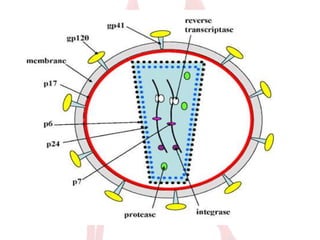
• Have lipid envelope, in which are
embedded the trimeric transmembrane
glycoprotein gp41 to which the surface
glycoprotein gp120 is attached
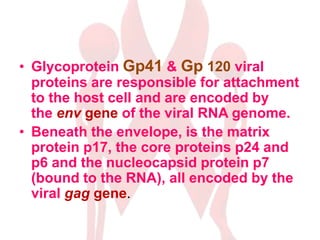
• Glycoprotein Gp41 & Gp 120 viral
proteins are responsible for attachment
to the host cell and are encoded by
the env gene of the viral RNA genome.
• Beneath the envelope, is the matrix
protein p17, the core proteins p24 and
p6 and the nucleocapsid protein p7
(bound to the RNA), all encoded by the
viral gag gene.
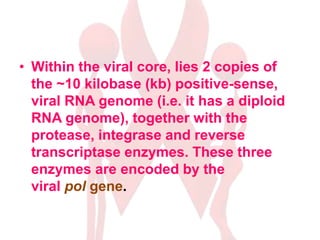
• Within the viral core, lies 2 copies of
the ~10 kilobase (kb) positive-sense,
viral RNA genome (i.e. it has a diploid
RNA genome), together with the
protease, integrase and reverse
transcriptase enzymes. These three
enzymes are encoded by the
viral pol gene.
PATHOPHYSIOLOGY
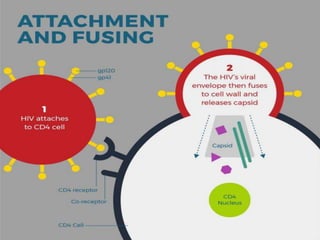
• Attachment of the HIV virus to CD4+ receptor
Continue...
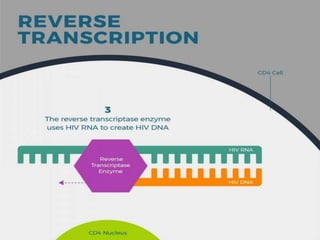
• Internalization and uncoating of the virus with
viral RNA and reverse transcriptase;
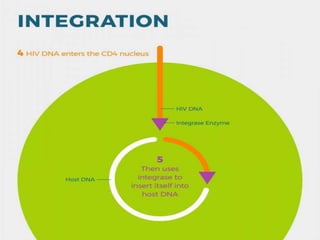
• Integration of viral DNA into host DNA using
the integrase enzyme
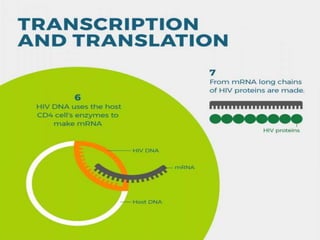
• Transcription of the inserted viral DNA to
produce viral messenger RNA
• translation of viral messenger RNA to create
viral polyprotein
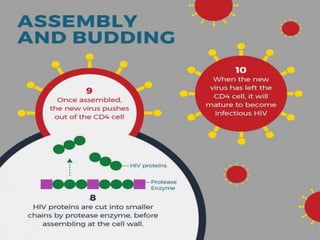
• cleavage of viral polyprotein into individual
viral proteins that make up the new virus
• Assembly and release of the new virus from
the host cell.
STAGES OF HIV
• On the basis of clinical conditions
associated with HIV infection and CD4+
T-cell counts. The classification system
groups clinical conditions into one of
three categories denoted as A, B, or C
PRIMARY INFECTION
• Also known as acute HIV infection or
acute HIV syndrome.
• The period from infection with HIV to the
development of antibodies to HIV is known
as primary infection.
• During this period,there is intense viral
replication and widespread dissemination
of HIV throughout the body.
• During the primary infection period, the window
period occurs because a person is infected with
HIV but tests negative on the HIV antibody blood
test.
• About 3 weeks into this acute phase, individuals
may display symptoms reminiscent of
mononucleosis, such as fever,enlarged lymph
nodes, rash, muscle aches, and headaches.
• These symptoms resolve within another 1 to 3
weeks as the immune system begins to gain some
control over the virus.
HIV ASYMPTOMATIC (CDC
CATEGORY(A )
• More than 500 CD4 +T Lymphocytes/mm3
of blood.
• By about 6 months, the rate of viral
replication reaches a lower but relatively
steady state that is reflected in the
maintenance of viral levels at a kind of “set
point.”
• Apparent good health continues because
CD4 T-cell levels remain high enough to
preserve defensive responses to other
pathogens.
Clinical Symptoms CAT A
• Moderate unexplained weight loss (<10% of
presumed or measured body weight)
• Recurrent respiratory tract infections
(Sinusitis, Tonsillitis, Otitis Media,
Pharyngitis)
• Herpes Zoster
• Angular Cheilitis
HIV SYMPTOMATIC (CDC
CATEGORY)(B)
• 200 to 499 CD4+ T Lymphocytes/mm3
• Over time, the number of CD4 T cells gradually falls.
• Category B consists of symptomatic conditions in HIV-
infected patients that are not included in the conditions
listed in category C.
• If an individual was once treated for a category B
condition and has not developed a category C disease but
is now symptom free, that person’s illness would be
considered category B
Clinical presentation
• Unexplained severe weight loss (>10% of the
presumed or measured body weight)
• Unexplained chronic diarrhoea for more than 1
month
• Unexplained persistent fever (intermittent or
constant for longer than 1 month)
• Persistent Oral Candidiasis
• Pulmonary Tuberculosis
• Severe bacterial infections (such as Pneumonia,
Empyema, Pyomyositis, bone or joint infection,
Meningitis, bacteraemia)
AIDS (CDC CATEGORY)(C)
• Less than 200 CD4 + T Lymphocyte/mm3
• When CD4 T-cell levels drop below 200
cells/mm3 of blood, patients are said to
have AIDS. As levels fall below 100, the
immune system is significantly impaired,.
• Once a patient has had a category C
condition, he or she remains in category
C.
Clinical Presentation
• HIV wasting syndrome
• Pneumocystis (jiroveci) Pneumonia
• Recurrent severe bacterial Pneumonia
• Chronic Herpes Simplex infection (orolabial, genital or anorectal of
more than 1 month duration or visceral at any site)
• Oesophageal Candidiasis (or Candidiasis of trachea, bronchi or
lungs)
• Extra pulmonary Tuberculosis
• Kaposi sarcoma
• Cytomegalovirus infection (retinitis or infection of other organs)
• Central nervous system Toxoplasmosis
• HIV encephalopathy
Diagnostic evaluation
• HIV Antibody Test
• Viral Load Test
HIV Antibody test
• In 1985, the FDA licensed an HIV-1
antibody assay, which is used to screen
all blood and plasma donations. When an
individual is infected with HIV, the immune
system responds by producing antibodies
against the virus, usually within 3 to 12
weeks after infection. This delay in the
production of antibody helps to explain
why a person may be infected but not test
antibodypositive during primary infection.
• Blood samples are tested with two
different blood tests to determine the
presence of antibodies to HIV.
• ELISA (enzymelinked immunosorbent
assay) test, identifies antibodies directed
specifically against HIV.
• The Western blot assay is used to confirm
seropositivity when the ELISA is positive.
Ora quick HIV test
• It is first kit for HIV home testing which test
for antibodies.
VIRAL LOAD TEST
• Target amplification methods quantify HIV
RNA or DNA levels in the plasma and have
replaced p24 antigen capture assays.
• Target amplification methods include reverse
transcriptase polymerase chain reaction (RT-
PCR) or nucleic acid sequence based
amplification (NASBA)..
• RT-PCR is also used to detect HIV in high-
risk seronegative people before the
development of antibodies, to confirm a
positive ELISA, and to screen neonates.
• HIV culture or quantitative plasma culture
and plasma viremia are additional tests
that measure viral burden, but they are
used infrequently.
• Viral load is a better predictor of the risk
of HIV disease progression than the CD4
count. The lower the viral load, the longer
the time to AIDS diagnosis and the longer
the survival time.
Treatment
• Treatment decisions for an individual patient
are based on three factors:
• HIV RNA (viral load);
• CD4 T-cell count; and
• the clinical condition of the patient
(Panel,2000).
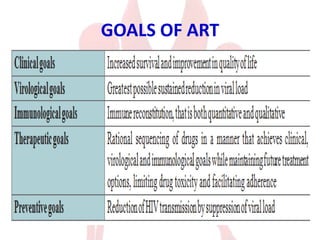
GOALS OF ART
Principles of ART
• Block binding of HIV to the target cell (Fusion
Inhibitors and CCR 5 co-receptor blockers)
• Block the viral RNA cleavage and one that
inhibits reverse transcriptase (Reverse
Transcriptase Inhibitors)
• Block the enzyme integrase, which helps in
the proviral DNA being incorporated into the
host cell chromosome (Integrase Inhibitors)
• Block the RNA to prevent viral protein
production
• Block enzyme protease (Protease Inhibitors)
• Inhibit the budding of virus from host cells
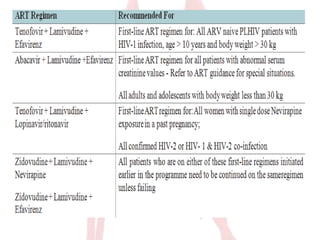
FIRST LINE ART DRUGS
• TENOFOVIR (TDF 300 mg) + LAMIVUDINE
(3TC 300 mg) + EFAVIRENZ (EFV 600 mg) (TLE)
as Fixed Dose Combination (FDC) in a single
pill once a day
ADVERSE EFFECT
• Jaundice
• Vomiting
• Diarrhoea
• Acute hepatitis
• Acute pancreatitis
• Hyper sensitivity
COUNSEL FOR
• Disclosure
• Adherence issues
• Psychosocial support needs
• Physical and sexual issues
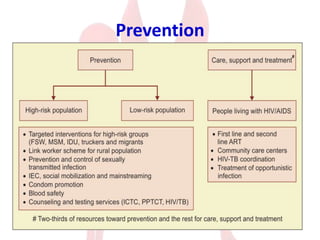
Prevention
PALLIATIVE CARE
• Pain management
• Symptomatic management
• Nutritional support
• Psycho-social support
• Spiritual support
• End of life care
• Bereavement counselling
Government Body
• National Aids Control Programme
• National AIDS Control Board (NACB) was
constituted and an autonomous National
AIDS Control Organization (NACO) was
set up to implement the project.
• Hiv Act
Transmission to health care provider
• STANDARD PRECAUTIONS
• POSTEXPOSURE PROPHYLAXIS FOR
HEALTH CARE PROVIDERS
The CDC (1998) recommends that all health
care providers who have sustained a
significant exposure to HIV be counseled
and offered anti-HIV postexposure
prophylaxis, if appropriate.
Nursing management
• Nursing assessment
• Opportunistic infections
• Impaired breathing or respiratory failure
• Wasting syndrome and fluid and electrolyte
imbalance
• Adverse reaction to medications
• Nursing diagnosis
• Impaired skin integrity related to cutaneous
manifestations of HIV infection, excoriation, and diarrhea
• Diarrhea related to enteric pathogens or HIV infection
• Risk for infection related to immunodeficiency
• Activity intolerance related to weakness, fatigue,
malnutrition,impaired fluid and electrolyte balance, and
hypoxia associated with pulmonary infections
• •Disturbed thought processes related to shortened
attention span, impaired memory, confusion, and
disorientation associated with HIV encephalopathy
• Social isolation related to stigma of the
disease, withdrawal of support systems,
isolation procedures, and fear of infecting
others
• Anticipatory grieving related to changes in
lifestyle and roles and unfavorable prognosis
• Deficient knowledge related to HIV infection,
means ofpreventing HIV transmission, and
self-care
Research input
Nurses knowledge, attitudes and practices towards patients with HIV and
AIDS in Kumasi, Ghana
Dorothy Serwaa Boakyeab1Azwihangwisi HelenMavhandu-Mudzusi (1stmay
2019)
• Knowledge on HIV and AIDS was satisfactory but some still hold erroneous
beliefs and misconception about HIV transmission.
• A majority demonstrated favourable attitudes. Nurses had fears of
contracting the virus, which resulted in the display of negative attitudes by
some.
• Their practice of universal precautions was satisfactory; however there
was evidence of non-compliance among some of them.
• The need for continuous in-service training of nurses on HIV and AIDS is a
key contributing factor to promoting knowledge, correcting a
misconception, favourable attitude and improve compliance to universal
precautions and other preventive practices such as uptake of PEP.
•
Summary
Conclusion
• AIDS has had a high mortality rate, but advances in
antiretroviral and multidrug therapy have
demonstrated promise in slowing or controlling disease
progression.
• Interdisciplinary meetings allow participants to support
one another and provide comprehensive patient care.
Staff support groups give nurses an opportunity to
solve problems and explore values and feelings about
caring for AIDS patients and their families; they also
provide a forum for grieving.
hiv and aids

hiv and aids

  • 1.
    Seminar On HIV/AIDS Moderator Ms.SaritaAhwal Lecturer CON,ILBS Presenter Manglam Kumari M.Sc (N) 1st year CON,ILBS
  • 2.
    Pre Test • Earliername of aids? • Who coined the term AIDS? • What are the major 3 gene of HIV? • Ora Quick is______? • TLE in HIV therapy stands for____?
  • 3.
    Introduction # Dr Gottliebin the Centers for Disease Control and Prevention (CDC) Morbidity and Mortality Weekly Report (MMWR) of 5th June 1981, described a syndrome of unusual illness that was termed as "gay-related immune deficiency" (GRID), as most of initial cases were reported among gay people.
  • 4.
    • Later, similarcases were reported among drug addicts, people who received blood transfusions and other persons, indicating that the syndrome was not just limited to gay men. In 1982, the CDC formally coined the term “Acquired Immunodeficiency Syndrome” (AIDS) for these group of illnesses.
  • 5.
    Decleration • The WorldHealth Organization (WHO) declared 1st December as World AIDS Day in 1988 and the red ribbon was recognized as the international symbol of AIDS awareness in 1991
  • 6.
    What Is AIDS? Acquired (notborn with) Immune (body’s defense system) Deficiency (not working properly) Syndrome (a group of signs and symptoms) Transmitted from person to person It affects the body’s immune system, the part of the body which usually works to fight off germs such as bacteria and viruses Malfunctioning of the body’s immune system Someone with AIDS may experience a wide range of different diseases and OIs
  • 7.
  • 8.
    Epidemiology HIV IN WORLD: •HIV/AIDS has killed more than 20 million people globally so far, and nearly 34 million are estimated to be living with HIV currently. HIV IN INDIA: • There are an estimated 4.2 million people living with HIV in Asia, 90% of them are in India, China and Thailand. India contributes 49% of it (2.4 million people). • The first few cases of HIV in India were detected in 1986 among sex workers in Chennai and the first AIDS case was reported in 1987 in Mumbai
  • 9.
    Risk factor • Havingunprotected anal or vaginal sex; • Having another sexually transmitted infections (STI) such as syphilis, herpes,chlamydia,gonorrhoea and bacterial vaginosis. • Sharing contaminated needles, syringes and other injecting equipment and drug solutions when injecting drugs;
  • 10.
    • Receiving unsafeinjections, blood transfusions and tissue transplantation, and medical procedures that involve unsterile cutting or piercing; and • Experiencing accidental needle stick injuries, including among health workers
  • 11.
    Virus HIV • Retrovirusin nature • Types – HIV-1 & HIV-2 • STRUCTURE • Size : 100 nanometer in diameter • Have lipid envelope, in which are embedded the trimeric transmembrane glycoprotein gp41 to which the surface glycoprotein gp120 is attached
  • 13.
    • Glycoprotein Gp41& Gp 120 viral proteins are responsible for attachment to the host cell and are encoded by the env gene of the viral RNA genome. • Beneath the envelope, is the matrix protein p17, the core proteins p24 and p6 and the nucleocapsid protein p7 (bound to the RNA), all encoded by the viral gag gene.
  • 14.
    • Within theviral core, lies 2 copies of the ~10 kilobase (kb) positive-sense, viral RNA genome (i.e. it has a diploid RNA genome), together with the protease, integrase and reverse transcriptase enzymes. These three enzymes are encoded by the viral pol gene.
  • 15.
    PATHOPHYSIOLOGY • Attachment ofthe HIV virus to CD4+ receptor
  • 16.
    Continue... • Internalization anduncoating of the virus with viral RNA and reverse transcriptase;
  • 17.
    • Integration ofviral DNA into host DNA using the integrase enzyme
  • 18.
    • Transcription ofthe inserted viral DNA to produce viral messenger RNA • translation of viral messenger RNA to create viral polyprotein • cleavage of viral polyprotein into individual viral proteins that make up the new virus
  • 19.
    • Assembly andrelease of the new virus from the host cell.
  • 20.
    STAGES OF HIV •On the basis of clinical conditions associated with HIV infection and CD4+ T-cell counts. The classification system groups clinical conditions into one of three categories denoted as A, B, or C
  • 21.
    PRIMARY INFECTION • Alsoknown as acute HIV infection or acute HIV syndrome. • The period from infection with HIV to the development of antibodies to HIV is known as primary infection. • During this period,there is intense viral replication and widespread dissemination of HIV throughout the body.
  • 22.
    • During theprimary infection period, the window period occurs because a person is infected with HIV but tests negative on the HIV antibody blood test. • About 3 weeks into this acute phase, individuals may display symptoms reminiscent of mononucleosis, such as fever,enlarged lymph nodes, rash, muscle aches, and headaches. • These symptoms resolve within another 1 to 3 weeks as the immune system begins to gain some control over the virus.
  • 23.
    HIV ASYMPTOMATIC (CDC CATEGORY(A) • More than 500 CD4 +T Lymphocytes/mm3 of blood. • By about 6 months, the rate of viral replication reaches a lower but relatively steady state that is reflected in the maintenance of viral levels at a kind of “set point.”
  • 24.
    • Apparent goodhealth continues because CD4 T-cell levels remain high enough to preserve defensive responses to other pathogens.
  • 25.
    Clinical Symptoms CATA • Moderate unexplained weight loss (<10% of presumed or measured body weight) • Recurrent respiratory tract infections (Sinusitis, Tonsillitis, Otitis Media, Pharyngitis) • Herpes Zoster • Angular Cheilitis
  • 26.
    HIV SYMPTOMATIC (CDC CATEGORY)(B) •200 to 499 CD4+ T Lymphocytes/mm3 • Over time, the number of CD4 T cells gradually falls. • Category B consists of symptomatic conditions in HIV- infected patients that are not included in the conditions listed in category C. • If an individual was once treated for a category B condition and has not developed a category C disease but is now symptom free, that person’s illness would be considered category B
  • 27.
    Clinical presentation • Unexplainedsevere weight loss (>10% of the presumed or measured body weight) • Unexplained chronic diarrhoea for more than 1 month • Unexplained persistent fever (intermittent or constant for longer than 1 month) • Persistent Oral Candidiasis • Pulmonary Tuberculosis • Severe bacterial infections (such as Pneumonia, Empyema, Pyomyositis, bone or joint infection, Meningitis, bacteraemia)
  • 28.
    AIDS (CDC CATEGORY)(C) •Less than 200 CD4 + T Lymphocyte/mm3 • When CD4 T-cell levels drop below 200 cells/mm3 of blood, patients are said to have AIDS. As levels fall below 100, the immune system is significantly impaired,. • Once a patient has had a category C condition, he or she remains in category C.
  • 29.
    Clinical Presentation • HIVwasting syndrome • Pneumocystis (jiroveci) Pneumonia • Recurrent severe bacterial Pneumonia • Chronic Herpes Simplex infection (orolabial, genital or anorectal of more than 1 month duration or visceral at any site) • Oesophageal Candidiasis (or Candidiasis of trachea, bronchi or lungs) • Extra pulmonary Tuberculosis • Kaposi sarcoma • Cytomegalovirus infection (retinitis or infection of other organs) • Central nervous system Toxoplasmosis • HIV encephalopathy
  • 30.
    Diagnostic evaluation • HIVAntibody Test • Viral Load Test
  • 31.
    HIV Antibody test •In 1985, the FDA licensed an HIV-1 antibody assay, which is used to screen all blood and plasma donations. When an individual is infected with HIV, the immune system responds by producing antibodies against the virus, usually within 3 to 12 weeks after infection. This delay in the production of antibody helps to explain why a person may be infected but not test antibodypositive during primary infection.
  • 32.
    • Blood samplesare tested with two different blood tests to determine the presence of antibodies to HIV. • ELISA (enzymelinked immunosorbent assay) test, identifies antibodies directed specifically against HIV. • The Western blot assay is used to confirm seropositivity when the ELISA is positive.
  • 33.
    Ora quick HIVtest • It is first kit for HIV home testing which test for antibodies.
  • 35.
    VIRAL LOAD TEST •Target amplification methods quantify HIV RNA or DNA levels in the plasma and have replaced p24 antigen capture assays. • Target amplification methods include reverse transcriptase polymerase chain reaction (RT- PCR) or nucleic acid sequence based amplification (NASBA).. • RT-PCR is also used to detect HIV in high- risk seronegative people before the development of antibodies, to confirm a positive ELISA, and to screen neonates.
  • 36.
    • HIV cultureor quantitative plasma culture and plasma viremia are additional tests that measure viral burden, but they are used infrequently. • Viral load is a better predictor of the risk of HIV disease progression than the CD4 count. The lower the viral load, the longer the time to AIDS diagnosis and the longer the survival time.
  • 37.
    Treatment • Treatment decisionsfor an individual patient are based on three factors: • HIV RNA (viral load); • CD4 T-cell count; and • the clinical condition of the patient (Panel,2000).
  • 38.
  • 39.
    Principles of ART •Block binding of HIV to the target cell (Fusion Inhibitors and CCR 5 co-receptor blockers) • Block the viral RNA cleavage and one that inhibits reverse transcriptase (Reverse Transcriptase Inhibitors) • Block the enzyme integrase, which helps in the proviral DNA being incorporated into the host cell chromosome (Integrase Inhibitors)
  • 40.
    • Block theRNA to prevent viral protein production • Block enzyme protease (Protease Inhibitors) • Inhibit the budding of virus from host cells
  • 41.
    FIRST LINE ARTDRUGS • TENOFOVIR (TDF 300 mg) + LAMIVUDINE (3TC 300 mg) + EFAVIRENZ (EFV 600 mg) (TLE) as Fixed Dose Combination (FDC) in a single pill once a day
  • 43.
    ADVERSE EFFECT • Jaundice •Vomiting • Diarrhoea • Acute hepatitis • Acute pancreatitis • Hyper sensitivity
  • 44.
    COUNSEL FOR • Disclosure •Adherence issues • Psychosocial support needs • Physical and sexual issues
  • 45.
  • 46.
    PALLIATIVE CARE • Painmanagement • Symptomatic management • Nutritional support • Psycho-social support • Spiritual support • End of life care • Bereavement counselling
  • 47.
    Government Body • NationalAids Control Programme • National AIDS Control Board (NACB) was constituted and an autonomous National AIDS Control Organization (NACO) was set up to implement the project. • Hiv Act
  • 48.
    Transmission to healthcare provider • STANDARD PRECAUTIONS • POSTEXPOSURE PROPHYLAXIS FOR HEALTH CARE PROVIDERS The CDC (1998) recommends that all health care providers who have sustained a significant exposure to HIV be counseled and offered anti-HIV postexposure prophylaxis, if appropriate.
  • 49.
    Nursing management • Nursingassessment • Opportunistic infections • Impaired breathing or respiratory failure • Wasting syndrome and fluid and electrolyte imbalance • Adverse reaction to medications
  • 50.
    • Nursing diagnosis •Impaired skin integrity related to cutaneous manifestations of HIV infection, excoriation, and diarrhea • Diarrhea related to enteric pathogens or HIV infection • Risk for infection related to immunodeficiency • Activity intolerance related to weakness, fatigue, malnutrition,impaired fluid and electrolyte balance, and hypoxia associated with pulmonary infections • •Disturbed thought processes related to shortened attention span, impaired memory, confusion, and disorientation associated with HIV encephalopathy
  • 51.
    • Social isolationrelated to stigma of the disease, withdrawal of support systems, isolation procedures, and fear of infecting others • Anticipatory grieving related to changes in lifestyle and roles and unfavorable prognosis • Deficient knowledge related to HIV infection, means ofpreventing HIV transmission, and self-care
  • 52.
    Research input Nurses knowledge,attitudes and practices towards patients with HIV and AIDS in Kumasi, Ghana Dorothy Serwaa Boakyeab1Azwihangwisi HelenMavhandu-Mudzusi (1stmay 2019) • Knowledge on HIV and AIDS was satisfactory but some still hold erroneous beliefs and misconception about HIV transmission. • A majority demonstrated favourable attitudes. Nurses had fears of contracting the virus, which resulted in the display of negative attitudes by some. • Their practice of universal precautions was satisfactory; however there was evidence of non-compliance among some of them. • The need for continuous in-service training of nurses on HIV and AIDS is a key contributing factor to promoting knowledge, correcting a misconception, favourable attitude and improve compliance to universal precautions and other preventive practices such as uptake of PEP. •
  • 53.
  • 54.
    Conclusion • AIDS hashad a high mortality rate, but advances in antiretroviral and multidrug therapy have demonstrated promise in slowing or controlling disease progression. • Interdisciplinary meetings allow participants to support one another and provide comprehensive patient care. Staff support groups give nurses an opportunity to solve problems and explore values and feelings about caring for AIDS patients and their families; they also provide a forum for grieving.