HIV/AIDS  An overview of HIV/AIDS, how it affects our community, and ways for you to get involved
HIV Basics  Human Only humans get it and pass it to other humans Immunodeficiency The virus attacks the immune system and can make it weak Virus Can be passed from one person to another No virus is curable
AIDS  Acquired You have to get it from someone else Immune Affects the immune system Deficiency It weakens the immune system Syndrome A syndrome is a set of characteristics that suggest the presence of a disease
What is the Difference HIV is the virus that causes AIDS A person can never have AIDS without being infected with HIV HIV can be transmitted from person to person AIDS is a set of conditions A person who has AIDS must Be HIV positive  Have a CD4 count less than 200 or Be diagnosed with one of 26 opportunistic infections
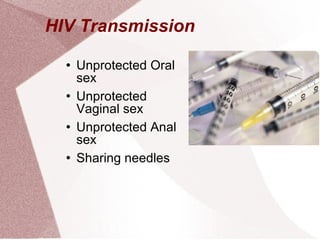
HIV Transmission  Unprotected Oral sex Unprotected Vaginal sex Unprotected Anal sex Sharing needles
Fluids that Transmit HIV Blood  Semen  Breast Milk  Vaginal Fluids
HIV Testing  3 different types of testing: Blood, OraSure, and OraQuick  Testing by state law should take at least 20 minutes and in that time the test counselor will discuss risk behavior and prevention plan  The test looks for HIV antibodies present in the body NOT HIV itself
HIV Testing Cont.  Window period If exposed, on average people test positive by 4 weeks (25 days)‏ If exposed, most people will test positive by 3 months Anonymous versus Confidential Anonymous gives an individual an identification number,  confidential requires identifying information
Michigan Laws regarding HIV/AIDS The disclosure law states that once you know your HIV status, if you test positive, you have to notify future sexual or needle sharing partners before having sex or share needles with them.
Michigan Laws Regarding HIV/AIDS cont. Since 1988, Michigan law has required health care workers who  attend pregnant women to perform HIV testing, unless the woman does not consent to testing, or if the test is deemed medically inadvisable.  HIV testing is required at the initial prenatal care visit and is strongly recommended to be performed again in the third trimester Treating pregnant women protects infants with appropriate treatment and intervention perinatal transmission rates can be reduced to less than 2%
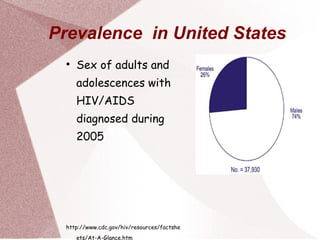
Prevalence  in United States  Sex of adults and adolescences with HIV/AIDS diagnosed during 2005 http://www.cdc.gov/hiv/resources/factsheets/At-A-Glance.htm
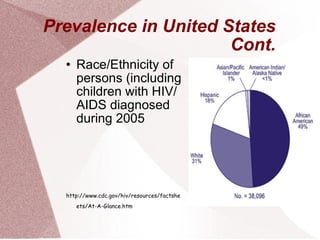
Prevalence in United States Cont. Race/Ethnicity of persons (including children with HIV/AIDS diagnosed during 2005 http://www.cdc.gov/hiv/resources/factsheets/At-A-Glance.htm
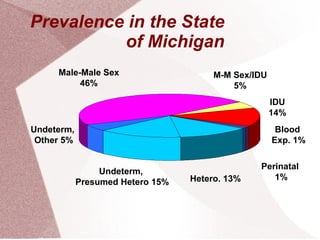
Prevalence in the State of Michigan Male-Male Sex 46% M-M Sex/IDU 5% IDU 14% Blood  Exp. 1% Perinatal  1% Hetero. 13% Undeterm,  Presumed Hetero 15% Undeterm,  Other 5%
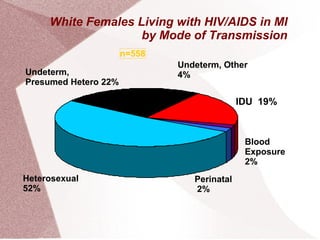
White Females Living with HIV/AIDS in MI by Mode of Transmission n=558 IDU  19% Heterosexual  52% Blood  Exposure 2% Perinatal 2% Undeterm,  Presumed Hetero 22% Undeterm, Other 4%
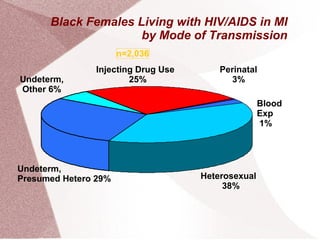
Black Females Living with HIV/AIDS in MI by Mode of Transmission n=2,036 Heterosexual  38% Injecting Drug Use  25% Perinatal 3%   Undeterm,  Presumed Hetero 29% Undeterm, Other 6% Blood  Exp 1%
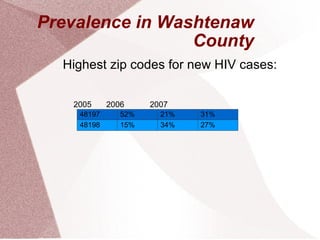
Prevalence in Washtenaw County Highest zip codes for new HIV cases: 2005 2006 2007 48197 52% 21% 31% 48198 15% 34% 27%
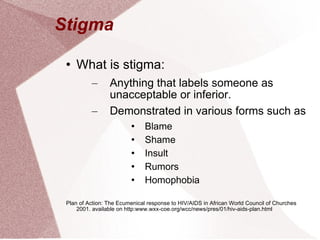
Stigma  What is stigma: Anything that labels someone as unacceptable or inferior.  Demonstrated in various forms such as Blame Shame Insult Rumors Homophobia Plan of Action: The Ecumenical response to HIV/AIDS in African World Council of Churches 2001. available on http:www.wxx-coe.org/wcc/news/pres/01/hiv-aids-plan.html
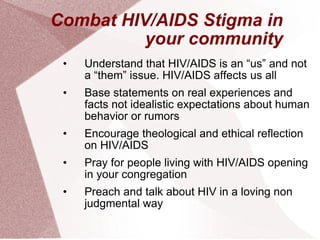
Combat HIV/AIDS Stigma in your community Understand that HIV/AIDS is an “us” and not a “them” issue. HIV/AIDS affects us all Base statements on real experiences and facts not idealistic expectations about human behavior or rumors Encourage theological and ethical reflection on HIV/AIDS Pray for people living with HIV/AIDS opening in your congregation Preach and talk about HIV in a loving non judgmental way
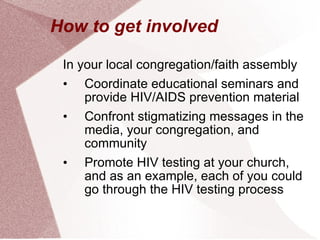
How to get involved In your local congregation/faith assembly Coordinate educational seminars and provide HIV/AIDS prevention material Confront stigmatizing messages in the media, your congregation, and community Promote HIV testing at your church, and as an example, each of you could go through the HIV testing process
How to get involved cont. Partner with other AIDS organizations and become a community advocate for those living with HIV/AIDS Collaborate with other faith-based organizations and leaders from the community to promote HIV/AIDS education, advocacy, and awareness Stay committed and remember to work as a team
WIHAN  Washtenaw Interfaith HIV/AIDS Network We are committed to gathering spiritual people interested in bringing comfort to those with HIV/AIDS and increasing awareness about HIV/AIDS
WIHAN  Services we provide: Pastoral Care- we collaborate with humanitarian organizations to provide food, clothing, transportation, home cleaning, cooking, and friendly presence for people living with HIV/AIDS Awareness- we provide forums to the faith based community to educate about HIV/AIDS and to identify ways of helping those suffering from HIV/AIDS Advocacy- we advocate for local, state, national, and international government interventions to solve the HIV/AIDS crisis
For Additional Information Please visit www.wihan.org as well as www.mihivnews.com

HIV 101 Wihan

  • 1.
    HIV/AIDS Anoverview of HIV/AIDS, how it affects our community, and ways for you to get involved
  • 2.
    HIV Basics Human Only humans get it and pass it to other humans Immunodeficiency The virus attacks the immune system and can make it weak Virus Can be passed from one person to another No virus is curable
  • 3.
    AIDS AcquiredYou have to get it from someone else Immune Affects the immune system Deficiency It weakens the immune system Syndrome A syndrome is a set of characteristics that suggest the presence of a disease
  • 4.
    What is theDifference HIV is the virus that causes AIDS A person can never have AIDS without being infected with HIV HIV can be transmitted from person to person AIDS is a set of conditions A person who has AIDS must Be HIV positive Have a CD4 count less than 200 or Be diagnosed with one of 26 opportunistic infections
  • 5.
    HIV Transmission Unprotected Oral sex Unprotected Vaginal sex Unprotected Anal sex Sharing needles
  • 6.
    Fluids that TransmitHIV Blood Semen Breast Milk Vaginal Fluids
  • 7.
    HIV Testing 3 different types of testing: Blood, OraSure, and OraQuick Testing by state law should take at least 20 minutes and in that time the test counselor will discuss risk behavior and prevention plan The test looks for HIV antibodies present in the body NOT HIV itself
  • 8.
    HIV Testing Cont. Window period If exposed, on average people test positive by 4 weeks (25 days)‏ If exposed, most people will test positive by 3 months Anonymous versus Confidential Anonymous gives an individual an identification number, confidential requires identifying information
  • 9.
    Michigan Laws regardingHIV/AIDS The disclosure law states that once you know your HIV status, if you test positive, you have to notify future sexual or needle sharing partners before having sex or share needles with them.
  • 10.
    Michigan Laws RegardingHIV/AIDS cont. Since 1988, Michigan law has required health care workers who attend pregnant women to perform HIV testing, unless the woman does not consent to testing, or if the test is deemed medically inadvisable. HIV testing is required at the initial prenatal care visit and is strongly recommended to be performed again in the third trimester Treating pregnant women protects infants with appropriate treatment and intervention perinatal transmission rates can be reduced to less than 2%
  • 11.
    Prevalence inUnited States Sex of adults and adolescences with HIV/AIDS diagnosed during 2005 http://www.cdc.gov/hiv/resources/factsheets/At-A-Glance.htm
  • 12.
    Prevalence in UnitedStates Cont. Race/Ethnicity of persons (including children with HIV/AIDS diagnosed during 2005 http://www.cdc.gov/hiv/resources/factsheets/At-A-Glance.htm
  • 13.
    Prevalence in theState of Michigan Male-Male Sex 46% M-M Sex/IDU 5% IDU 14% Blood Exp. 1% Perinatal 1% Hetero. 13% Undeterm, Presumed Hetero 15% Undeterm, Other 5%
  • 14.
    White Females Livingwith HIV/AIDS in MI by Mode of Transmission n=558 IDU 19% Heterosexual 52% Blood Exposure 2% Perinatal 2% Undeterm, Presumed Hetero 22% Undeterm, Other 4%
  • 15.
    Black Females Livingwith HIV/AIDS in MI by Mode of Transmission n=2,036 Heterosexual 38% Injecting Drug Use 25% Perinatal 3% Undeterm, Presumed Hetero 29% Undeterm, Other 6% Blood Exp 1%
  • 16.
    Prevalence in WashtenawCounty Highest zip codes for new HIV cases: 2005 2006 2007 48197 52% 21% 31% 48198 15% 34% 27%
  • 17.
    Stigma Whatis stigma: Anything that labels someone as unacceptable or inferior. Demonstrated in various forms such as Blame Shame Insult Rumors Homophobia Plan of Action: The Ecumenical response to HIV/AIDS in African World Council of Churches 2001. available on http:www.wxx-coe.org/wcc/news/pres/01/hiv-aids-plan.html
  • 18.
    Combat HIV/AIDS Stigmain your community Understand that HIV/AIDS is an “us” and not a “them” issue. HIV/AIDS affects us all Base statements on real experiences and facts not idealistic expectations about human behavior or rumors Encourage theological and ethical reflection on HIV/AIDS Pray for people living with HIV/AIDS opening in your congregation Preach and talk about HIV in a loving non judgmental way
  • 19.
    How to getinvolved In your local congregation/faith assembly Coordinate educational seminars and provide HIV/AIDS prevention material Confront stigmatizing messages in the media, your congregation, and community Promote HIV testing at your church, and as an example, each of you could go through the HIV testing process
  • 20.
    How to getinvolved cont. Partner with other AIDS organizations and become a community advocate for those living with HIV/AIDS Collaborate with other faith-based organizations and leaders from the community to promote HIV/AIDS education, advocacy, and awareness Stay committed and remember to work as a team
  • 21.
    WIHAN WashtenawInterfaith HIV/AIDS Network We are committed to gathering spiritual people interested in bringing comfort to those with HIV/AIDS and increasing awareness about HIV/AIDS
  • 22.
    WIHAN Serviceswe provide: Pastoral Care- we collaborate with humanitarian organizations to provide food, clothing, transportation, home cleaning, cooking, and friendly presence for people living with HIV/AIDS Awareness- we provide forums to the faith based community to educate about HIV/AIDS and to identify ways of helping those suffering from HIV/AIDS Advocacy- we advocate for local, state, national, and international government interventions to solve the HIV/AIDS crisis
  • 23.
    For Additional InformationPlease visit www.wihan.org as well as www.mihivnews.com