“We live in a completely interdependent
world, which simply means we can not
escape each other. How we respond to AIDS
depends, in part, on whether we understand
this interdependence. It is not someone else's
problem. This is everybody's problem.”
- Bill Clinton
AIDS Education and Prevention
Learning Goals
Provide the tools to think critically about AIDS
transmission and prevention
Reduce ignorance-related stigma surrounding
HIV/AIDS diagnosis
Encourage individuals to get tested
Provide resources for students to educate
themselves and seek help if they’re worried about
exposure
B Y : D E N I A A B R E U A N D K A R I N A T A M B U R I
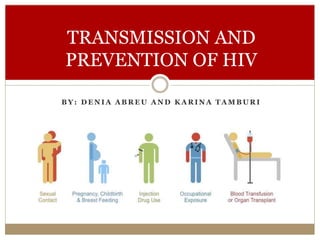
TRANSMISSION AND
PREVENTION OF HIV
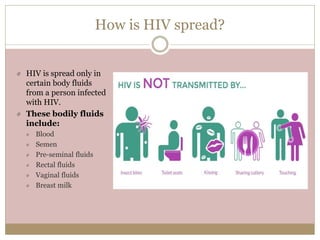
How is HIV spread?
HIV is spread only in
certain body fluids
from a person infected
with HIV.
These bodily fluids
include:
Blood
Semen
Pre-seminal fluids
Rectal fluids
Vaginal fluids
Breast milk
Prevention Methods:
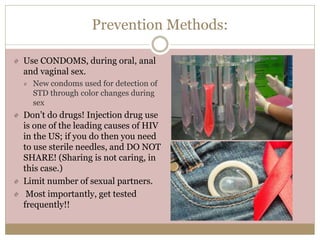
Use CONDOMS, during oral, anal
and vaginal sex.
New condoms used for detection of
STD through color changes during
sex
Don’t do drugs! Injection drug use
is one of the leading causes of HIV
in the US; if you do then you need
to use sterile needles, and DO NOT
SHARE! (Sharing is not caring, in
this case.)
Limit number of sexual partners.
Most importantly, get tested
frequently!!
Needle Exchange Programs
In 2013, 7% of new HIV infections were accounted for among
people who inject drugs (PWIDs)
Allowing users the opportunity to exchange possibly infected
needles and syringes for new clean needles at little or no cost
Mobile sites, fixed sites, outreach programs, pharmacies
Presenting PWIDs with lessons on precautious behaviors and tactics to
prevent further spread and referrals
Locations: Western and Central Europe (allotting 200 pp/year), North
America (limited Coverage); Latin America, Caribbean, Middle East and
North Africa (<2% access)
Stigma and access to NEPs slowly changing globally as there is a more
positive effect on limiting drug use
University of Miami new site (IDEA)
Types of Condoms
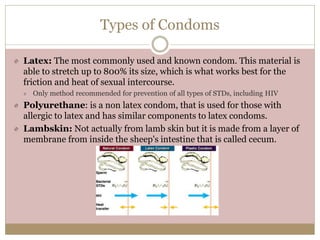
Latex: The most commonly used and known condom. This material is
able to stretch up to 800% its size, which is what works best for the
friction and heat of sexual intercourse.
Only method recommended for prevention of all types of STDs, including HIV
Polyurethane: is a non latex condom, that is used for those with
allergic to latex and has similar components to latex condoms.
Lambskin: Not actually from lamb skin but it is made from a layer of
membrane from inside the sheep's intestine that is called cecum.
What if I am HIV positive?
There are many ways for you to avoid trasnimitting HIV to your partner, one of
the easiest way is by taking a medication that is called pre-exposure
prophylaxis or PrEP (TRUVADA).
PrEP is a medication that needs to be taken on a daily basis if you are at high
risk of getting HIV. This medication does need to be used with condoms and
other preventatives as well. The good thing about this medication is that there
has been results showing that it has worked. The CDC states that by taking
PrEP every day, it can lower the risk of getting HIV from sexual intercourse by
more than 90% and from people who inject drugs by more than 70%.
If this is not taken on a daily basis then there wont be enough medicine in a
persons body to blood HIV.
How to use condoms?
Use a new condom for every act of vaginal, anal and oral sex—throughout the
entire sex act (from start to finish).
Before any genital contact, put the condom on the tip of the erect penis with the
rolled side out.
If the condom does not have a reservoir tip, pinch the tip enough to leave a
half-inch space for semen to collect. Holding the tip, unroll the condom all the
way to the base of the erect penis.
After ejaculation and before the penis gets soft, grip the rim of the condom and
carefully withdraw. Then gently pull the condom off the penis, making sure that
semen doesn’t spill out.
Wrap the condom in a piece of paper and throw it in the trash where others
won’t handle it.
If you feel the condom break at any point during sexual activity, stop
immediately and take off the condom, and put on a new condom.
References
https://aidsinfo.nih.gov/education-materials/fact-
sheets/20/48/the-basics-of-hiv-prevention
http://www.avert.org/professionals/hiv-
programming/prevention/needle-syringe-
programmes
http://www.miamiherald.com/news/health-
care/article92499987.html
B Y: J E A N N E T T E G I L A N D K AT H E R I N E P E R E Z
HIV AND GETTING TESTED
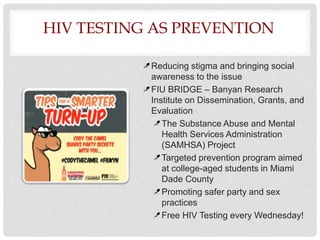
HIV TESTING AS PREVENTION
Reducing stigma and bringing social
awareness to the issue
FIU BRIDGE – Banyan Research
Institute on Dissemination, Grants, and
Evaluation
The Substance Abuse and Mental
Health Services Administration
(SAMHSA) Project
Targeted prevention program aimed
at college-aged students in Miami
Dade County
Promoting safer party and sex
practices
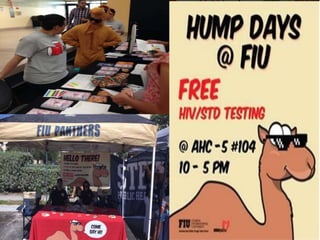
Free HIV Testing every Wednesday!
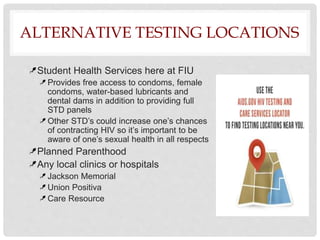
ALTERNATIVE TESTING LOCATIONS
Student Health Services here at FIU
Provides free access to condoms, female
condoms, water-based lubricants and
dental dams in addition to providing full
STD panels
Other STD’s could increase one’s chances
of contracting HIV so it’s important to be
aware of one’s sexual health in all respects
Planned Parenthood
Any local clinics or hospitals
Jackson Memorial
Union Positiva
Care Resource
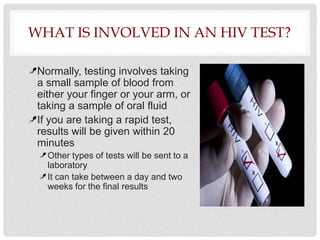
WHAT IS INVOLVED IN AN HIV TEST?
Normally, testing involves taking
a small sample of blood from
either your finger or your arm, or
taking a sample of oral fluid
If you are taking a rapid test,
results will be given within 20
minutes
Other types of tests will be sent to a
laboratory
It can take between a day and two
weeks for the final results
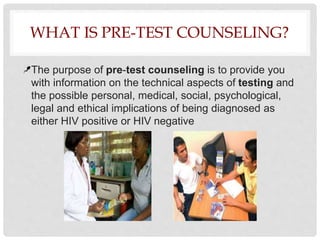
WHAT IS PRE-TEST COUNSELING?
The purpose of pre-test counseling is to provide you
with information on the technical aspects of testing and
the possible personal, medical, social, psychological,
legal and ethical implications of being diagnosed as
either HIV positive or HIV negative
PRE-TEST COUNSELING:
1. Reason for Testing.
2. Assessment of Risk.
3. Belief and Knowledge
about HIV infection and
safer sex.
4. Information about the
test.
5. Implication of an HIV test
result.
6. Results.
7. Confidentiality of test
results.
8. Informed consent.
WHAT IS THE WINDOW PERIOD?
The window period is time between potential exposure to
HIV infection and the point when the test will give an
accurate result.
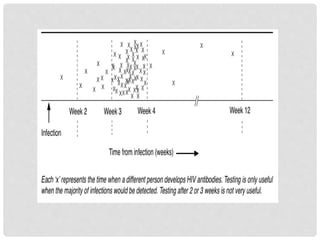
During the window period a person can be infected with
HIV and infectious but still have a negative HIV test.
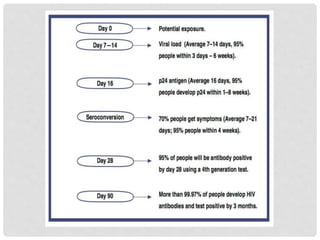
The window period for a 4th generation antigen/antibody
test is four weeks.
Antibody testing at 4 weeks can give you a good
indication of your HIV status, but you need a test at 12
weeks after the exposure to be considered HIV negative.
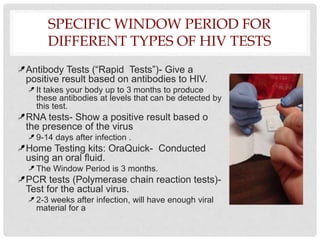
SPECIFIC WINDOW PERIOD FOR
DIFFERENT TYPES OF HIV TESTS
Antibody Tests (“Rapid Tests”)- Give a
positive result based on antibodies to HIV.
It takes your body up to 3 months to produce
these antibodies at levels that can be detected by
this test.
RNA tests- Show a positive result based o
the presence of the virus
9-14 days after infection .
Home Testing kits: OraQuick- Conducted
using an oral fluid.
The Window Period is 3 months.
PCR tests (Polymerase chain reaction tests)-
Test for the actual virus.
2-3 weeks after infection, will have enough viral
material for a
SOURCES
http://www.avert.org/hiv-testing
http://i-base.info/guides/testing/what-is-the-window-
period
http://www.health24.com/Medical/HIV-
AIDS/Counselling/Pre-HIV-test-counselling-20120721
http://www.sfaf.org/hiv-info/testing/hiv-test-window-
periods.html?referrer=https://www.google.com/
http://bridge.fiu.edu/txt4teenhlth/
https://studentaffairs.fiu.edu/wellness/student-
health/services-and-fees/sexual-health/index.php
By:
Annelis G Rivera
and
Randee Viena
REMOVING THE STIGMA
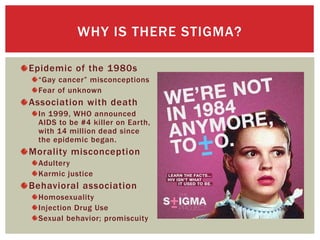
Epidemic of the 1980s
“Gay cancer” misconceptions
Fear of unknown
Association with death
In 1999, WHO announced
AIDS to be #4 killer on Earth,
with 14 million dead since
the epidemic began.
Morality misconception
Adultery
Karmic justice
Behavioral association
Homosexuality
Injection Drug Use
Sexual behavior; promiscuity
WHY IS THERE STIGMA?
Discrimination takes many
forms
Governmental
Internalized/ Self-Directed
Workplace/ Educational
Ryan White (1985)
Relationships
Healthcare
Discrimination depends on the
main mode of transmission in
a country/region.
United States of America
Homosexuality
Drug Use
Sub-Saharan Africa
Sex work
Infidelity
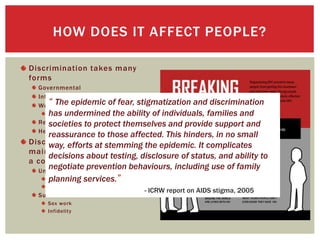
HOW DOES IT AFFECT PEOPLE?
“ The epidemic of fear, stigmatization and discrimination
has undermined the ability of individuals, families and
societies to protect themselves and provide support and
reassurance to those affected. This hinders, in no small
way, efforts at stemming the epidemic. It complicates
decisions about testing, disclosure of status, and ability to
negotiate prevention behaviours, including use of family
planning services.”
- ICRW report on AIDS stigma, 2005
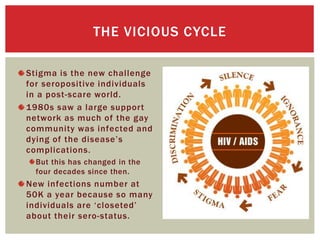
Stigma is the new challenge
for seropositive individuals
in a post-scare world.
1980s saw a large support
network as much of the gay
community was infected and
dying of the disease’s
complications.
But this has changed in the
four decades since then.
New infections number at
50K a year because so many
individuals are ‘closeted’
about their sero-status.
THE VICIOUS CYCLE
“ Now that you can take your pills and hide it, and now that
we've had at least one generation of gay men who never
witnessed AIDS, the sense that we're all living with HIV is
long gone. A culture of safe sex, where you always
presume the person you're sleeping with is positive, has
been replaced with a culture of bare-backing, where risk is
magically reduced by deeply flawed attempts at sero-
sorting. The flaws are hidden because HIV is now hidden,
by inadequate testing, or the very crowded HIV closet in
which many now choose to live. ”
- Peter Staley, Activist
THE VICIOUS CYCLE
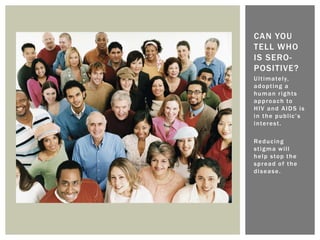
Go on… guess.
You can’t, can
you?
CAN YOU
TELL WHO
IS SERO-
POSITIVE?
Ultimately,
adopting a
human rights
approach to
HIV and AIDS is
in the public’s
interest.
Reducing
stigma will
help stop the
spread of the
disease.
CAN YOU
TELL WHO
IS SERO-
POSITIVE?
The use of specific programs that emphasize the rights of people living
with HIV is a well-documented way of eradicating stigma. As well as
being made aware of their rights, people living with HIV can be
empowered in order to take action if these rights are violated.
Stigma-reduction programs and trainings
Engender Health has developed Reducing Stigma and Discrimination Related to
HIV and AIDS: Training for Health Care Workers, a two -volume curriculum
offering a unique training opportunity for health workers in countries hardest hit
by the AIDS pandemic.
The Let’s Stop HIV Together campaign, launched by the Centers for Disease
Control and Prevention (CDC).
"Pop the Question“
Outreach project designed to increase the knowledge of HIV/AIDS by using
social media to connect Black and Hispanic women to National Library of
Medicine (NLM) online resources and testing services offered by a local health
clinic
Both the US White House and UNAIDS reports recommend focusing on
Key affected populations
Reducing stigma
Commitment to civil rights enforcement with regards to status disclosure
HOW TO TACKLE STIGMA
"HIV/AIDS Basics eLearning &
Assessment Project“
d'Vinci Interactive proposes to
create an interactive eLearning
and assessment module. They will
use content from a previously
developed HIV/AIDS Basics online
document created by their
secondary partner, POZ Magazine.
El Centro de Educación de
Trabajadores
Creates interactive Spanish
language educational modules
The Stigma Project
HIV Equal
Online resources
The Body
Avert.org
HIV Plus
Hookup Apps
MISTER
In collaboration with
Michigan’s Mr. Friendly HIV
nonprofit, allows members
to declare a commitment
to “Live Stigma-Free” and
date individuals of any HIV
status on their profiles.
MORE PROGRAMS
"HIV Stigma. Check out How to Stop HIV Discrimination." HIV
Stigma. Check out How to Stop HIV Discrimination. N.p., 2008.
Web. 22 Oct. 2016.
<http://www.hivstigma.com/stop_the_stigma.php>.
"Publications." Reducing Stigma and Discrimination Related to
HIV and AIDS : EngenderHealth. N.p., n.d. Web. 21 Oct. 2016.
<https://www.engenderhealth.org/pubs/hiv-aids-sti/reducing-
stigma.php>.
"Reduction of HIV-related Stigma and
Discrimination." UNAIDS. N.p., n.d. Web. 21 Oct. 2016.
<http://www.unaids.org/en/resources/documents/2014/Red
uctionofHIV-relatedstigmaanddiscrimination>.
"Stigma, Discrimination and HIV." AVERT. N.p., 07 Sept. 2016.
Web. 22 Oct. 2016. <http://www.avert.org/professionals/hiv -
social-issues/stigma-discrimination#footnote12_e5ioy2l>.
BIBLIOGRAPHY
Living With Your
Diagnosis
Helpful Tips for those with HIV/AIDS
By Carolina Formoso and Elizabeth
Medina
Introduction
 Once an individual is diagnosed with HIV/AIDS, their life
changes drastically.
 All of a sudden, they must be conscious of their health and
maintain a healthy diet and exercise in order to not further
compromise their health status.
 Along with radical lifestyle changes, they must deal with the
consequences of their diagnosis on their relationships. It is
important to find ways to communicate to those around them in
order to protect their own health by preventing further
transmission of the virus and to also have a support group to
help them deal with their diagnosis.
 Furthermore, many HIV/AIDS patients also suffer from
depression. In order to improve their quality of life, different
counseling services and treatments are available.
Lifestyle Changes
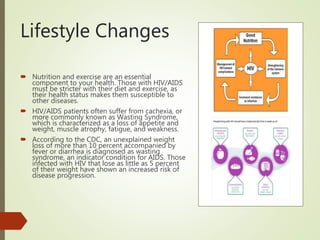
 Nutrition and exercise are an essential
component to your health. Those with HIV/AIDS
must be stricter with their diet and exercise, as
their health status makes them susceptible to
other diseases.
 HIV/AIDS patients often suffer from cachexia, or
more commonly known as Wasting Syndrome,
which is characterized as a loss of appetite and
weight, muscle atrophy, fatigue, and weakness.
 According to the CDC, an unexplained weight
loss of more than 10 percent accompanied by
fever or diarrhea is diagnosed as wasting
syndrome, an indicator condition for AIDS. Those
infected with HIV that lose as little as 5 percent
of their weight have shown an increased risk of
disease progression.
Lifestyle Changes
 Those with HIV/AIDS need a higher calorie
intake to compensate for the wasting
syndrome.
 One diagnosed, those with HIV/AIDS become
more conscious of who and how they choose
to have sexual encounters to not further
transmit their disease.
 Furthermore, once HIV has progressed to its
later stage of AIDS, individuals have a
compromised immune system, and therefore
have to be very careful to avoid catching any
other diseases, including the seasonal flu.
Who and How to Tell
 It is important to decide who you want to tell
about your diagnosis, and how you will tell
them.
 Those diagnosed with HIV/AIDS go through
the fear of rejection due to the stigma of this
disease.
 Before beginning the process of disclosing
your diagnosis to others, you should first
seek counseling if experiencing denial or
trouble accepting your diagnosis. By
removing the stigma within yourself, and
becoming more knowledgeable of the virus
and the effects it has on the body, you will be
more prepared to educate others (including
loved ones who you choose to disclose your
diagnosis to) on your diagnosis.
 The AIDS Healthcare Foundation (AHF)
provide medical services specifically for
HIV/AIDS patients through their healthcare
centers across the nation. Their website
(http://hivcare.org/) shows healthcare centers
near you.
 By telling others, you can get love and
support to help you deal with your health.
This will allow you to keep your close friends
and loved ones informed about issues that
are important to you. This will also give you a
liberating feeling as they will be aware of
your diagnosis.
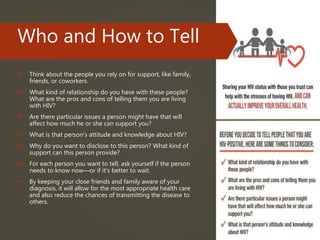
Who and How to Tell
 Think about the people you rely on for support, like family,
friends, or coworkers.
 What kind of relationship do you have with these people?
What are the pros and cons of telling them you are living
with HIV?
 Are there particular issues a person might have that will
affect how much he or she can support you?
 What is that person's attitude and knowledge about HIV?
 Why do you want to disclose to this person? What kind of
support can this person provide?
 For each person you want to tell, ask yourself if the person
needs to know now—or if it’s better to wait.
 By keeping your close friends and family aware of your
diagnosis, it will allow for the most appropriate health care
and also reduce the chances of transmitting the disease to
others.
Who and How to Tell
 Here are some things to think about when you’re
considering telling someone that you’re HIV-positive:
 Know why you want to tell them. What do you want
from them?
 Anticipate their reaction. What’s the best you can hope
for? The worst you might have to deal with?
 Prepare by informing yourself about HIV disease. You
may want to leave articles or a hotline phone number
for the person you tell.
 Get support. Talk it over with someone you trust, and
come up with a plan.
 Accept the reaction. You can’t control how others will
deal with your news.
Who and How to Tell
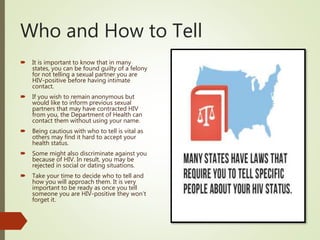
 It is important to know that in many
states, you can be found guilty of a felony
for not telling a sexual partner you are
HIV-positive before having intimate
contact.
 If you wish to remain anonymous but
would like to inform previous sexual
partners that may have contracted HIV
from you, the Department of Health can
contact them without using your name.
 Being cautious with who to tell is vital as
others may find it hard to accept your
health status.
 Some might also discriminate against you
because of HIV. In result, you may be
rejected in social or dating situations.
 Take your time to decide who to tell and
how you will approach them. It is very
important to be ready as once you tell
someone you are HIV-positive they won’t
forget it.
Who and How to Tell
 Due to the widespread fear and overall lack of knowledge of the virus, the HIV
epidemic induced a discrimination epidemic across the world in the 1980s.
 Individuals with HIV/AIDS were often victims of discrimination, and were fired
from their jobs, evicted from their homes, and even denied medical care.
 1990: Americans with Disabilities Act (ADA) was an expansion of the
Rehabilitation Act of 1973, making discrimination on the basis of diability
unlawful.
 Bragdon v. Abbot, 1998: Dentist (Randon Bragdon) refused to fill in a cavity for a
patient (Sidney Abbott), unless the procedure was performed at a hospital (and she
would have to pay for the extra costs). Abbott argued that HIV was a disability and
that she was being discriminated against. The Supreme Court ruled in her favor.
 1996: Health Insurance Portability and Accountability Act of 1996 (HIPAA) was
enacted to protect the privacy of patients’ medical records and other health
information, and also provides the patients access to their medical records
and gives them control over how their health information is used and
disclosed.
 By being more informed on who you are and are not required to disclose your
health information to, this protects your rights and will be able to better
combat discrimination.
Who and How to
Tell
 https://www.youtube.com/watc
h?v=wHSH-NpCQOw
 Philadelphia (1993) is a film
inspired by the AIDS
discrimination lawsuit against
Baker & McKenzie in 1987 filed
by Geoffrey Bowers for wrongful
dismissal.
 The film highlighted the stigma
surrounding HIV/AIDS and the
discrimination associated with it.
Improving
Your Health
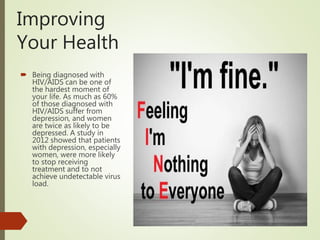
 Being diagnosed with
HIV/AIDS can be one of
the hardest moment of
your life. As much as 60%
of those diagnosed with
HIV/AIDS suffer from
depression, and women
are twice as likely to be
depressed. A study in
2012 showed that patients
with depression, especially
women, were more likely
to stop receiving
treatment and to not
achieve undetectable virus
load.
What causes
depression?
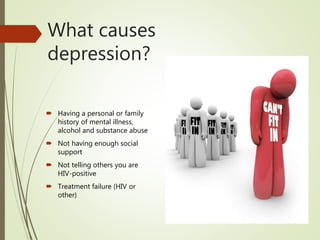
 Having a personal or family
history of mental illness,
alcohol and substance abuse
 Not having enough social
support
 Not telling others you are
HIV-positive
 Treatment failure (HIV or
other)
Lifestyle changes can improve
depression for some people
 Regular exercise
 Increased exposure to sunlight
 Stress management
 Counseling
 Improved sleep habits
 Apart from life changes,
antidepressants can be prescribed to
alleviate the symptoms of
depression. However, it is important
to find a health care provider who is
familiar with HIV treatment as
antidepressants can interact with
some ARVs.
 Antiretrovirals is the multiple drug
agents that act on different stages of
the HIV life-cycle which is known as
highly active antiretroviral therapy
(HAART)
Bibliography
 http://www.hiv.va.gov/patient/daily/diet/single-page.asp
 http://www.aidsinfonet.org/fact_sheets/view/802
 https://www.aids.gov/hiv-aids-basics/staying-healthy-with-hiv-
aids/taking-care-of-yourself/mental-health/index.html
 https://aidsinfo.nih.gov/education-materials/fact-sheets/print/21/54/0/0
 https://www.aids.gov/hiv-aids-basics/staying-healthy-with-hiv-
aids/discrimination/legal-issues/
 https://www.aids.gov/hiv-aids-basics/just-diagnosed-with-hiv-
aids/talking-about-your-status/do-you-have-to-tell/
 http://hivcare.org/
 https://medlineplus.gov/livingwithhivaids.html
 https://www.youtube.com/watch?v=wHSH-NpCQOw

Final bio of aids presentation

  • 1.
    “We live ina completely interdependent world, which simply means we can not escape each other. How we respond to AIDS depends, in part, on whether we understand this interdependence. It is not someone else's problem. This is everybody's problem.” - Bill Clinton AIDS Education and Prevention
  • 2.
    Learning Goals Provide thetools to think critically about AIDS transmission and prevention Reduce ignorance-related stigma surrounding HIV/AIDS diagnosis Encourage individuals to get tested Provide resources for students to educate themselves and seek help if they’re worried about exposure
  • 3.
    B Y :D E N I A A B R E U A N D K A R I N A T A M B U R I TRANSMISSION AND PREVENTION OF HIV
  • 4.
    How is HIVspread? HIV is spread only in certain body fluids from a person infected with HIV. These bodily fluids include: Blood Semen Pre-seminal fluids Rectal fluids Vaginal fluids Breast milk
  • 5.
    Prevention Methods: Use CONDOMS,during oral, anal and vaginal sex. New condoms used for detection of STD through color changes during sex Don’t do drugs! Injection drug use is one of the leading causes of HIV in the US; if you do then you need to use sterile needles, and DO NOT SHARE! (Sharing is not caring, in this case.) Limit number of sexual partners. Most importantly, get tested frequently!!
  • 6.
    Needle Exchange Programs In2013, 7% of new HIV infections were accounted for among people who inject drugs (PWIDs) Allowing users the opportunity to exchange possibly infected needles and syringes for new clean needles at little or no cost Mobile sites, fixed sites, outreach programs, pharmacies Presenting PWIDs with lessons on precautious behaviors and tactics to prevent further spread and referrals Locations: Western and Central Europe (allotting 200 pp/year), North America (limited Coverage); Latin America, Caribbean, Middle East and North Africa (<2% access) Stigma and access to NEPs slowly changing globally as there is a more positive effect on limiting drug use University of Miami new site (IDEA)
  • 7.
    Types of Condoms Latex:The most commonly used and known condom. This material is able to stretch up to 800% its size, which is what works best for the friction and heat of sexual intercourse. Only method recommended for prevention of all types of STDs, including HIV Polyurethane: is a non latex condom, that is used for those with allergic to latex and has similar components to latex condoms. Lambskin: Not actually from lamb skin but it is made from a layer of membrane from inside the sheep's intestine that is called cecum.
  • 8.
    What if Iam HIV positive? There are many ways for you to avoid trasnimitting HIV to your partner, one of the easiest way is by taking a medication that is called pre-exposure prophylaxis or PrEP (TRUVADA). PrEP is a medication that needs to be taken on a daily basis if you are at high risk of getting HIV. This medication does need to be used with condoms and other preventatives as well. The good thing about this medication is that there has been results showing that it has worked. The CDC states that by taking PrEP every day, it can lower the risk of getting HIV from sexual intercourse by more than 90% and from people who inject drugs by more than 70%. If this is not taken on a daily basis then there wont be enough medicine in a persons body to blood HIV.
  • 9.
    How to usecondoms? Use a new condom for every act of vaginal, anal and oral sex—throughout the entire sex act (from start to finish). Before any genital contact, put the condom on the tip of the erect penis with the rolled side out. If the condom does not have a reservoir tip, pinch the tip enough to leave a half-inch space for semen to collect. Holding the tip, unroll the condom all the way to the base of the erect penis. After ejaculation and before the penis gets soft, grip the rim of the condom and carefully withdraw. Then gently pull the condom off the penis, making sure that semen doesn’t spill out. Wrap the condom in a piece of paper and throw it in the trash where others won’t handle it. If you feel the condom break at any point during sexual activity, stop immediately and take off the condom, and put on a new condom.
  • 10.
  • 11.
    B Y: JE A N N E T T E G I L A N D K AT H E R I N E P E R E Z HIV AND GETTING TESTED
  • 12.
    HIV TESTING ASPREVENTION Reducing stigma and bringing social awareness to the issue FIU BRIDGE – Banyan Research Institute on Dissemination, Grants, and Evaluation The Substance Abuse and Mental Health Services Administration (SAMHSA) Project Targeted prevention program aimed at college-aged students in Miami Dade County Promoting safer party and sex practices Free HIV Testing every Wednesday!
  • 14.
    ALTERNATIVE TESTING LOCATIONS StudentHealth Services here at FIU Provides free access to condoms, female condoms, water-based lubricants and dental dams in addition to providing full STD panels Other STD’s could increase one’s chances of contracting HIV so it’s important to be aware of one’s sexual health in all respects Planned Parenthood Any local clinics or hospitals Jackson Memorial Union Positiva Care Resource
  • 15.
    WHAT IS INVOLVEDIN AN HIV TEST? Normally, testing involves taking a small sample of blood from either your finger or your arm, or taking a sample of oral fluid If you are taking a rapid test, results will be given within 20 minutes Other types of tests will be sent to a laboratory It can take between a day and two weeks for the final results
  • 16.
    WHAT IS PRE-TESTCOUNSELING? The purpose of pre-test counseling is to provide you with information on the technical aspects of testing and the possible personal, medical, social, psychological, legal and ethical implications of being diagnosed as either HIV positive or HIV negative
  • 17.
    PRE-TEST COUNSELING: 1. Reasonfor Testing. 2. Assessment of Risk. 3. Belief and Knowledge about HIV infection and safer sex. 4. Information about the test. 5. Implication of an HIV test result. 6. Results. 7. Confidentiality of test results. 8. Informed consent.
  • 18.
    WHAT IS THEWINDOW PERIOD? The window period is time between potential exposure to HIV infection and the point when the test will give an accurate result. During the window period a person can be infected with HIV and infectious but still have a negative HIV test. The window period for a 4th generation antigen/antibody test is four weeks. Antibody testing at 4 weeks can give you a good indication of your HIV status, but you need a test at 12 weeks after the exposure to be considered HIV negative.
  • 19.
    SPECIFIC WINDOW PERIODFOR DIFFERENT TYPES OF HIV TESTS Antibody Tests (“Rapid Tests”)- Give a positive result based on antibodies to HIV. It takes your body up to 3 months to produce these antibodies at levels that can be detected by this test. RNA tests- Show a positive result based o the presence of the virus 9-14 days after infection . Home Testing kits: OraQuick- Conducted using an oral fluid. The Window Period is 3 months. PCR tests (Polymerase chain reaction tests)- Test for the actual virus. 2-3 weeks after infection, will have enough viral material for a
  • 22.
  • 23.
    By: Annelis G Rivera and RandeeViena REMOVING THE STIGMA
  • 24.
    Epidemic of the1980s “Gay cancer” misconceptions Fear of unknown Association with death In 1999, WHO announced AIDS to be #4 killer on Earth, with 14 million dead since the epidemic began. Morality misconception Adultery Karmic justice Behavioral association Homosexuality Injection Drug Use Sexual behavior; promiscuity WHY IS THERE STIGMA?
  • 25.
    Discrimination takes many forms Governmental Internalized/Self-Directed Workplace/ Educational Ryan White (1985) Relationships Healthcare Discrimination depends on the main mode of transmission in a country/region. United States of America Homosexuality Drug Use Sub-Saharan Africa Sex work Infidelity HOW DOES IT AFFECT PEOPLE? “ The epidemic of fear, stigmatization and discrimination has undermined the ability of individuals, families and societies to protect themselves and provide support and reassurance to those affected. This hinders, in no small way, efforts at stemming the epidemic. It complicates decisions about testing, disclosure of status, and ability to negotiate prevention behaviours, including use of family planning services.” - ICRW report on AIDS stigma, 2005
  • 26.
    Stigma is thenew challenge for seropositive individuals in a post-scare world. 1980s saw a large support network as much of the gay community was infected and dying of the disease’s complications. But this has changed in the four decades since then. New infections number at 50K a year because so many individuals are ‘closeted’ about their sero-status. THE VICIOUS CYCLE
  • 27.
    “ Now thatyou can take your pills and hide it, and now that we've had at least one generation of gay men who never witnessed AIDS, the sense that we're all living with HIV is long gone. A culture of safe sex, where you always presume the person you're sleeping with is positive, has been replaced with a culture of bare-backing, where risk is magically reduced by deeply flawed attempts at sero- sorting. The flaws are hidden because HIV is now hidden, by inadequate testing, or the very crowded HIV closet in which many now choose to live. ” - Peter Staley, Activist THE VICIOUS CYCLE
  • 28.
    Go on… guess. Youcan’t, can you? CAN YOU TELL WHO IS SERO- POSITIVE?
  • 29.
    Ultimately, adopting a human rights approachto HIV and AIDS is in the public’s interest. Reducing stigma will help stop the spread of the disease. CAN YOU TELL WHO IS SERO- POSITIVE?
  • 30.
    The use ofspecific programs that emphasize the rights of people living with HIV is a well-documented way of eradicating stigma. As well as being made aware of their rights, people living with HIV can be empowered in order to take action if these rights are violated. Stigma-reduction programs and trainings Engender Health has developed Reducing Stigma and Discrimination Related to HIV and AIDS: Training for Health Care Workers, a two -volume curriculum offering a unique training opportunity for health workers in countries hardest hit by the AIDS pandemic. The Let’s Stop HIV Together campaign, launched by the Centers for Disease Control and Prevention (CDC). "Pop the Question“ Outreach project designed to increase the knowledge of HIV/AIDS by using social media to connect Black and Hispanic women to National Library of Medicine (NLM) online resources and testing services offered by a local health clinic Both the US White House and UNAIDS reports recommend focusing on Key affected populations Reducing stigma Commitment to civil rights enforcement with regards to status disclosure HOW TO TACKLE STIGMA
  • 31.
    "HIV/AIDS Basics eLearning& Assessment Project“ d'Vinci Interactive proposes to create an interactive eLearning and assessment module. They will use content from a previously developed HIV/AIDS Basics online document created by their secondary partner, POZ Magazine. El Centro de Educación de Trabajadores Creates interactive Spanish language educational modules The Stigma Project HIV Equal Online resources The Body Avert.org HIV Plus Hookup Apps MISTER In collaboration with Michigan’s Mr. Friendly HIV nonprofit, allows members to declare a commitment to “Live Stigma-Free” and date individuals of any HIV status on their profiles. MORE PROGRAMS
  • 32.
    "HIV Stigma. Checkout How to Stop HIV Discrimination." HIV Stigma. Check out How to Stop HIV Discrimination. N.p., 2008. Web. 22 Oct. 2016. <http://www.hivstigma.com/stop_the_stigma.php>. "Publications." Reducing Stigma and Discrimination Related to HIV and AIDS : EngenderHealth. N.p., n.d. Web. 21 Oct. 2016. <https://www.engenderhealth.org/pubs/hiv-aids-sti/reducing- stigma.php>. "Reduction of HIV-related Stigma and Discrimination." UNAIDS. N.p., n.d. Web. 21 Oct. 2016. <http://www.unaids.org/en/resources/documents/2014/Red uctionofHIV-relatedstigmaanddiscrimination>. "Stigma, Discrimination and HIV." AVERT. N.p., 07 Sept. 2016. Web. 22 Oct. 2016. <http://www.avert.org/professionals/hiv - social-issues/stigma-discrimination#footnote12_e5ioy2l>. BIBLIOGRAPHY
  • 33.
    Living With Your Diagnosis HelpfulTips for those with HIV/AIDS By Carolina Formoso and Elizabeth Medina
  • 34.
    Introduction  Once anindividual is diagnosed with HIV/AIDS, their life changes drastically.  All of a sudden, they must be conscious of their health and maintain a healthy diet and exercise in order to not further compromise their health status.  Along with radical lifestyle changes, they must deal with the consequences of their diagnosis on their relationships. It is important to find ways to communicate to those around them in order to protect their own health by preventing further transmission of the virus and to also have a support group to help them deal with their diagnosis.  Furthermore, many HIV/AIDS patients also suffer from depression. In order to improve their quality of life, different counseling services and treatments are available.
  • 35.
    Lifestyle Changes  Nutritionand exercise are an essential component to your health. Those with HIV/AIDS must be stricter with their diet and exercise, as their health status makes them susceptible to other diseases.  HIV/AIDS patients often suffer from cachexia, or more commonly known as Wasting Syndrome, which is characterized as a loss of appetite and weight, muscle atrophy, fatigue, and weakness.  According to the CDC, an unexplained weight loss of more than 10 percent accompanied by fever or diarrhea is diagnosed as wasting syndrome, an indicator condition for AIDS. Those infected with HIV that lose as little as 5 percent of their weight have shown an increased risk of disease progression.
  • 36.
    Lifestyle Changes  Thosewith HIV/AIDS need a higher calorie intake to compensate for the wasting syndrome.  One diagnosed, those with HIV/AIDS become more conscious of who and how they choose to have sexual encounters to not further transmit their disease.  Furthermore, once HIV has progressed to its later stage of AIDS, individuals have a compromised immune system, and therefore have to be very careful to avoid catching any other diseases, including the seasonal flu.
  • 37.
    Who and Howto Tell  It is important to decide who you want to tell about your diagnosis, and how you will tell them.  Those diagnosed with HIV/AIDS go through the fear of rejection due to the stigma of this disease.  Before beginning the process of disclosing your diagnosis to others, you should first seek counseling if experiencing denial or trouble accepting your diagnosis. By removing the stigma within yourself, and becoming more knowledgeable of the virus and the effects it has on the body, you will be more prepared to educate others (including loved ones who you choose to disclose your diagnosis to) on your diagnosis.  The AIDS Healthcare Foundation (AHF) provide medical services specifically for HIV/AIDS patients through their healthcare centers across the nation. Their website (http://hivcare.org/) shows healthcare centers near you.  By telling others, you can get love and support to help you deal with your health. This will allow you to keep your close friends and loved ones informed about issues that are important to you. This will also give you a liberating feeling as they will be aware of your diagnosis.
  • 38.
    Who and Howto Tell  Think about the people you rely on for support, like family, friends, or coworkers.  What kind of relationship do you have with these people? What are the pros and cons of telling them you are living with HIV?  Are there particular issues a person might have that will affect how much he or she can support you?  What is that person's attitude and knowledge about HIV?  Why do you want to disclose to this person? What kind of support can this person provide?  For each person you want to tell, ask yourself if the person needs to know now—or if it’s better to wait.  By keeping your close friends and family aware of your diagnosis, it will allow for the most appropriate health care and also reduce the chances of transmitting the disease to others.
  • 39.
    Who and Howto Tell  Here are some things to think about when you’re considering telling someone that you’re HIV-positive:  Know why you want to tell them. What do you want from them?  Anticipate their reaction. What’s the best you can hope for? The worst you might have to deal with?  Prepare by informing yourself about HIV disease. You may want to leave articles or a hotline phone number for the person you tell.  Get support. Talk it over with someone you trust, and come up with a plan.  Accept the reaction. You can’t control how others will deal with your news.
  • 40.
    Who and Howto Tell  It is important to know that in many states, you can be found guilty of a felony for not telling a sexual partner you are HIV-positive before having intimate contact.  If you wish to remain anonymous but would like to inform previous sexual partners that may have contracted HIV from you, the Department of Health can contact them without using your name.  Being cautious with who to tell is vital as others may find it hard to accept your health status.  Some might also discriminate against you because of HIV. In result, you may be rejected in social or dating situations.  Take your time to decide who to tell and how you will approach them. It is very important to be ready as once you tell someone you are HIV-positive they won’t forget it.
  • 41.
    Who and Howto Tell  Due to the widespread fear and overall lack of knowledge of the virus, the HIV epidemic induced a discrimination epidemic across the world in the 1980s.  Individuals with HIV/AIDS were often victims of discrimination, and were fired from their jobs, evicted from their homes, and even denied medical care.  1990: Americans with Disabilities Act (ADA) was an expansion of the Rehabilitation Act of 1973, making discrimination on the basis of diability unlawful.  Bragdon v. Abbot, 1998: Dentist (Randon Bragdon) refused to fill in a cavity for a patient (Sidney Abbott), unless the procedure was performed at a hospital (and she would have to pay for the extra costs). Abbott argued that HIV was a disability and that she was being discriminated against. The Supreme Court ruled in her favor.  1996: Health Insurance Portability and Accountability Act of 1996 (HIPAA) was enacted to protect the privacy of patients’ medical records and other health information, and also provides the patients access to their medical records and gives them control over how their health information is used and disclosed.  By being more informed on who you are and are not required to disclose your health information to, this protects your rights and will be able to better combat discrimination.
  • 42.
    Who and Howto Tell  https://www.youtube.com/watc h?v=wHSH-NpCQOw  Philadelphia (1993) is a film inspired by the AIDS discrimination lawsuit against Baker & McKenzie in 1987 filed by Geoffrey Bowers for wrongful dismissal.  The film highlighted the stigma surrounding HIV/AIDS and the discrimination associated with it.
  • 43.
    Improving Your Health  Beingdiagnosed with HIV/AIDS can be one of the hardest moment of your life. As much as 60% of those diagnosed with HIV/AIDS suffer from depression, and women are twice as likely to be depressed. A study in 2012 showed that patients with depression, especially women, were more likely to stop receiving treatment and to not achieve undetectable virus load.
  • 44.
    What causes depression?  Havinga personal or family history of mental illness, alcohol and substance abuse  Not having enough social support  Not telling others you are HIV-positive  Treatment failure (HIV or other)
  • 45.
    Lifestyle changes canimprove depression for some people  Regular exercise  Increased exposure to sunlight  Stress management  Counseling  Improved sleep habits  Apart from life changes, antidepressants can be prescribed to alleviate the symptoms of depression. However, it is important to find a health care provider who is familiar with HIV treatment as antidepressants can interact with some ARVs.  Antiretrovirals is the multiple drug agents that act on different stages of the HIV life-cycle which is known as highly active antiretroviral therapy (HAART)
  • 46.
    Bibliography  http://www.hiv.va.gov/patient/daily/diet/single-page.asp  http://www.aidsinfonet.org/fact_sheets/view/802 https://www.aids.gov/hiv-aids-basics/staying-healthy-with-hiv- aids/taking-care-of-yourself/mental-health/index.html  https://aidsinfo.nih.gov/education-materials/fact-sheets/print/21/54/0/0  https://www.aids.gov/hiv-aids-basics/staying-healthy-with-hiv- aids/discrimination/legal-issues/  https://www.aids.gov/hiv-aids-basics/just-diagnosed-with-hiv- aids/talking-about-your-status/do-you-have-to-tell/  http://hivcare.org/  https://medlineplus.gov/livingwithhivaids.html  https://www.youtube.com/watch?v=wHSH-NpCQOw

Editor's Notes

  • #7 Advice: on safer injection tactics, how to handle an overdose, the safe handling and disposal of drugs, and referrals to drug treatment like opioid substitution therapy. Some locations have more limited access in providing better coverage in needle exchange programs due to political factors and too limited government involvement such as the lack of NGOs in North and Sub Saharan Africa IDEA= Infectious Disease Elimination Act
  • #9 Advice: on safer injection tactics, how to handle an overdose, the safe handling and disposal of drugs, and referrals to drug treatment like opioid substitution therapy. Some locations have more limited access in providing better coverage in needle exchange programs due to political factors and too limited government involvement such as the lack of NGOs in North and Sub Saharan Africa IDEA= Infectious Disease Elimination Act
  • #18 Im going to go into more detail during the presentation.
  • #20 I don’t know if you want to just leave the window period? That way you can go over the different types of test for HIV and put this slide right after yours?
  • #36 Add that you need a higher calorie intake to compensate for the wasting syndrome, it is essential to maintain your weight. Also that since the diagnosis, those individuals become more conscious of who and how they choose to have their sexual encounters, and that they must be careful to not further spread their virus. Furthermore, those with full blown AIDS have a compromised immune system, and therefore have to be very careful to avoid catching any other diseases, including the seasonal flu.
  • #40 Add resources and counseling services of how to “come out” to those around you, and how to deal with your diagnosis. Also, include Philadelphia case as example that you do not need to disclose your diagnosis to your employer. Include states where you need to disclose your diagnosis to your sexual partner.
  • #46 Include the definition of antiretrovirals, and clean up the notes FIND PICTURES FOR EVERYTHING