History of Atom Model
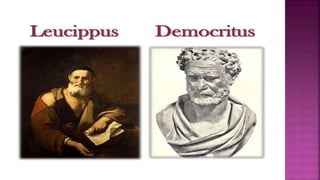
The first proponents of an atomic theory were the Greek
philosophers Leucippus and Democritus who proposed the
following model in the fifth century B.C.
1. Matter is composed of atoms separated by empty space through
which the atoms move.
2. Atoms are solid, homogeneous, indivisible, and unchangeable.
3. All apparent changes in matter result from changes in the
groupings of atoms.
4. There are different kinds of atoms that differ in size and shape.
5. The properties of matter reflect the properties of the atoms the
matter contains.
According to Leucippus and Democritus, the
basis for the atomic model is that the universe is
made up of two fundamental elements: atoms
and the void. Atoms are the smallest division of
matter, making them indestructible and
composing all physical objects.
Matter is discontinuous. It is made up of tiny,
indivisible particles called atoms.
John Dalton
Atoms are indivisible and indestructible. They
do not change during a chemical reaction.
Atoms of elements have all the same
properties, atoms of different element have
different properties.
Dalton's atomic theory was the first complete
attempt to describe all matter in terms of
atoms and their properties.
Joseph John Thomsom
In 1897, J. J. Thomson discovered the first
subatomic particle, the electron, while researching
cathode rays.
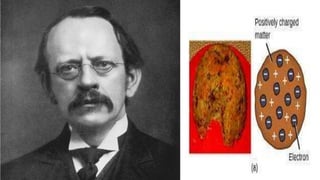
To explain the neutrality of atoms, Thomson
proposed a model of the atom in which negative
electrons are scattered throughout a sphere of
positive charge. He called his atom the plum
pudding model.
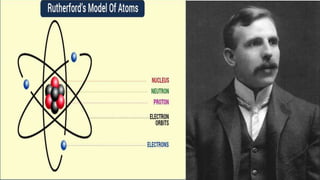
Ernest Rutherford
Ernest Rutherford postulated the nuclear
structure of the atom, discovered alpha and
beta rays, and proposed the laws of radioactive
decay. He received the Nobel Prize in
Chemistry in 1908.
the atom is like a solar system. Its mass is
concentrated in the nucleus. Electrons are
particles moving around the nucleus in circular
orbits.
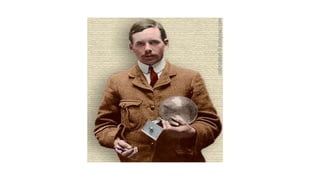
Henry Mosely
Henry Moseley carried out a systematic series
of experiments which showed that the
frequencies of the X-rays emitted from an
elemental target under bombardment by
cathode rays were characteristic of that
element and could be used to identify the
charge on its atomic nucleus.
All atoms of one element have the same
number of protons.
History-of-Atom-Model.pptx

History-of-Atom-Model.pptx

  • 1.
  • 2.
    The first proponentsof an atomic theory were the Greek philosophers Leucippus and Democritus who proposed the following model in the fifth century B.C. 1. Matter is composed of atoms separated by empty space through which the atoms move. 2. Atoms are solid, homogeneous, indivisible, and unchangeable. 3. All apparent changes in matter result from changes in the groupings of atoms. 4. There are different kinds of atoms that differ in size and shape. 5. The properties of matter reflect the properties of the atoms the matter contains.
  • 3.
    According to Leucippusand Democritus, the basis for the atomic model is that the universe is made up of two fundamental elements: atoms and the void. Atoms are the smallest division of matter, making them indestructible and composing all physical objects. Matter is discontinuous. It is made up of tiny, indivisible particles called atoms.
  • 5.
    John Dalton Atoms areindivisible and indestructible. They do not change during a chemical reaction. Atoms of elements have all the same properties, atoms of different element have different properties. Dalton's atomic theory was the first complete attempt to describe all matter in terms of atoms and their properties.
  • 7.
    Joseph John Thomsom In1897, J. J. Thomson discovered the first subatomic particle, the electron, while researching cathode rays. To explain the neutrality of atoms, Thomson proposed a model of the atom in which negative electrons are scattered throughout a sphere of positive charge. He called his atom the plum pudding model.
  • 9.
    Ernest Rutherford Ernest Rutherfordpostulated the nuclear structure of the atom, discovered alpha and beta rays, and proposed the laws of radioactive decay. He received the Nobel Prize in Chemistry in 1908. the atom is like a solar system. Its mass is concentrated in the nucleus. Electrons are particles moving around the nucleus in circular orbits.
  • 11.
    Henry Mosely Henry Moseleycarried out a systematic series of experiments which showed that the frequencies of the X-rays emitted from an elemental target under bombardment by cathode rays were characteristic of that element and could be used to identify the charge on its atomic nucleus. All atoms of one element have the same number of protons.