The History of Imaging
Conventional/Silver ProcessesConventional/Silver Processes
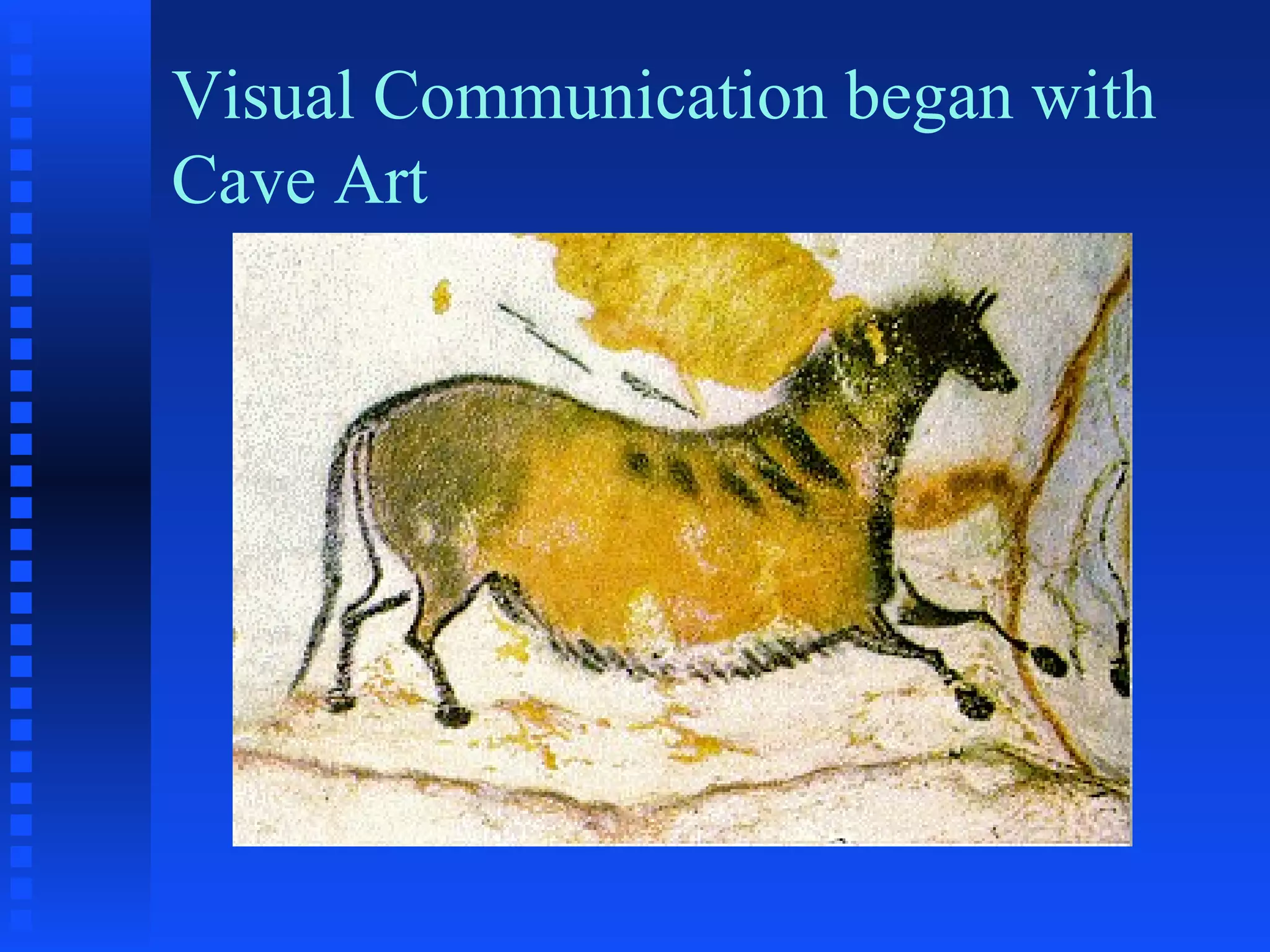
Visual Communication began with
Cave Art
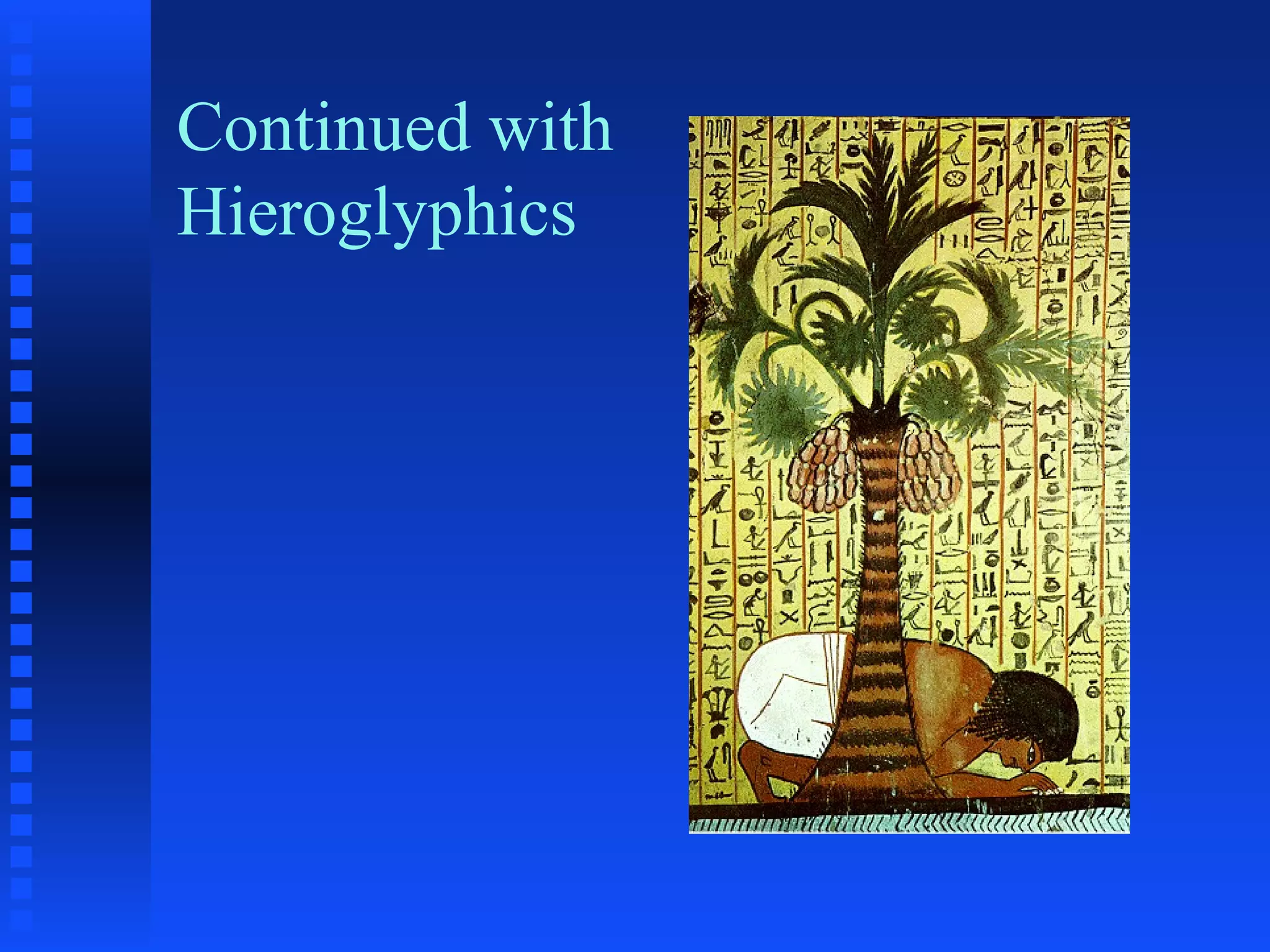
Continued with
Hieroglyphics
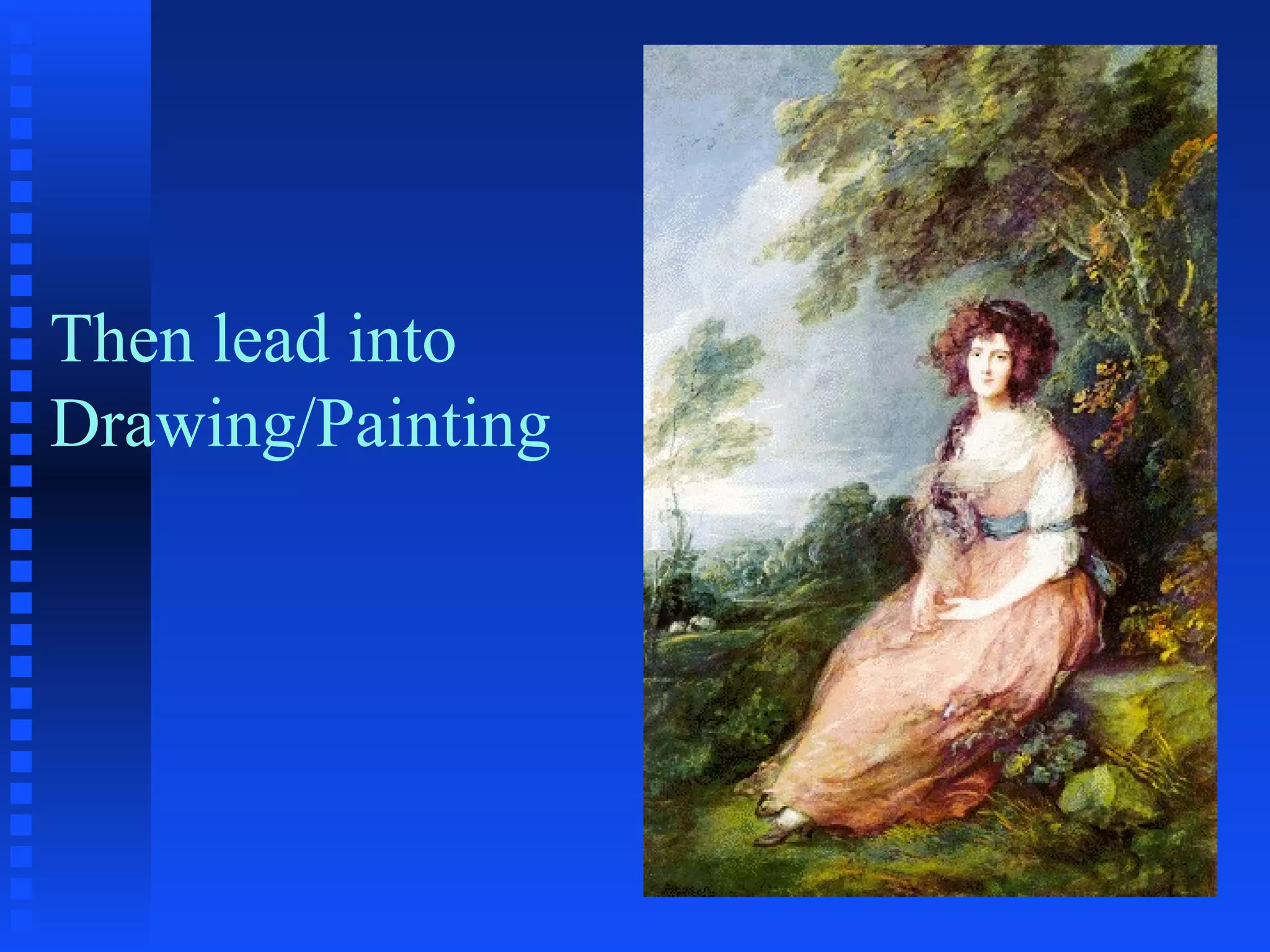
Then lead into
Drawing/Painting
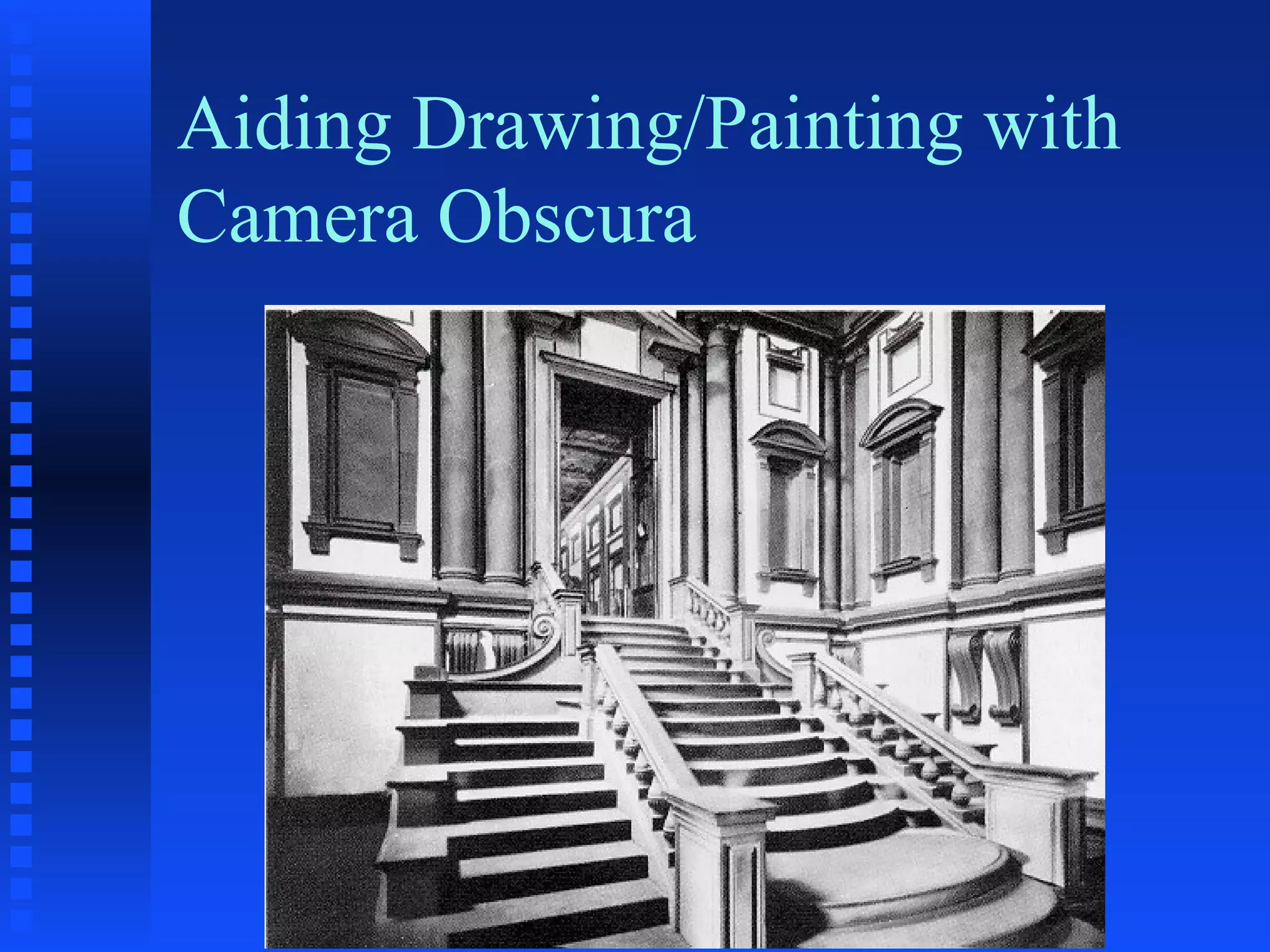
Aiding Drawing/Painting with
Camera Obscura
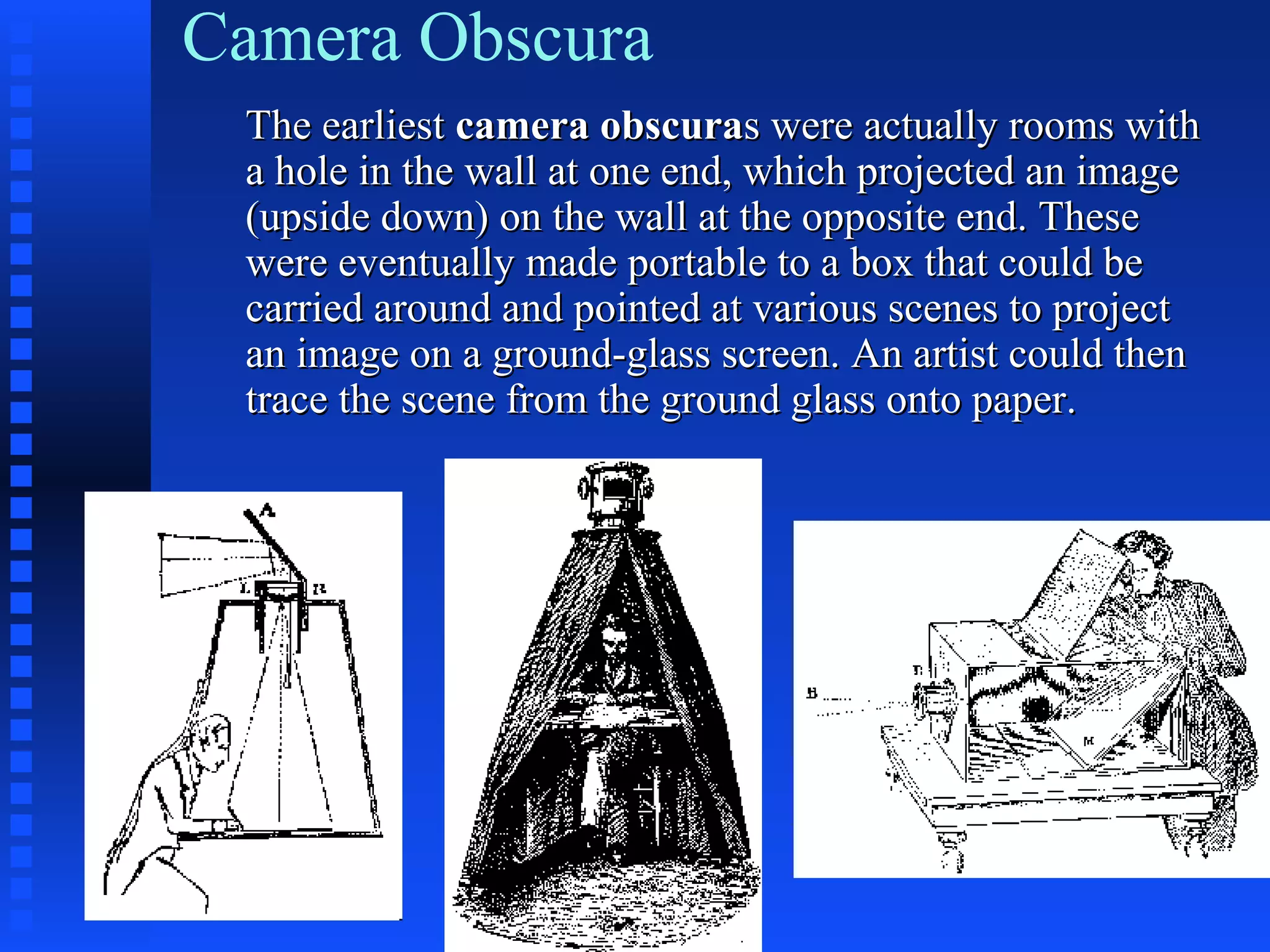
Camera Obscura
The earliestThe earliest camera obscuracamera obscurass were actually rooms withwere actually rooms with
a hole in the wall at one end, which projected an imagea hole in the wall at one end, which projected an image
(upside down) on the wall at the opposite end. These(upside down) on the wall at the opposite end. These
were eventually made portable to a box that could bewere eventually made portable to a box that could be
carried around and pointed at various scenes to projectcarried around and pointed at various scenes to project
an image on a ground-glass screen. An artist could thenan image on a ground-glass screen. An artist could then
trace the scene from the ground glass onto paper.trace the scene from the ground glass onto paper.
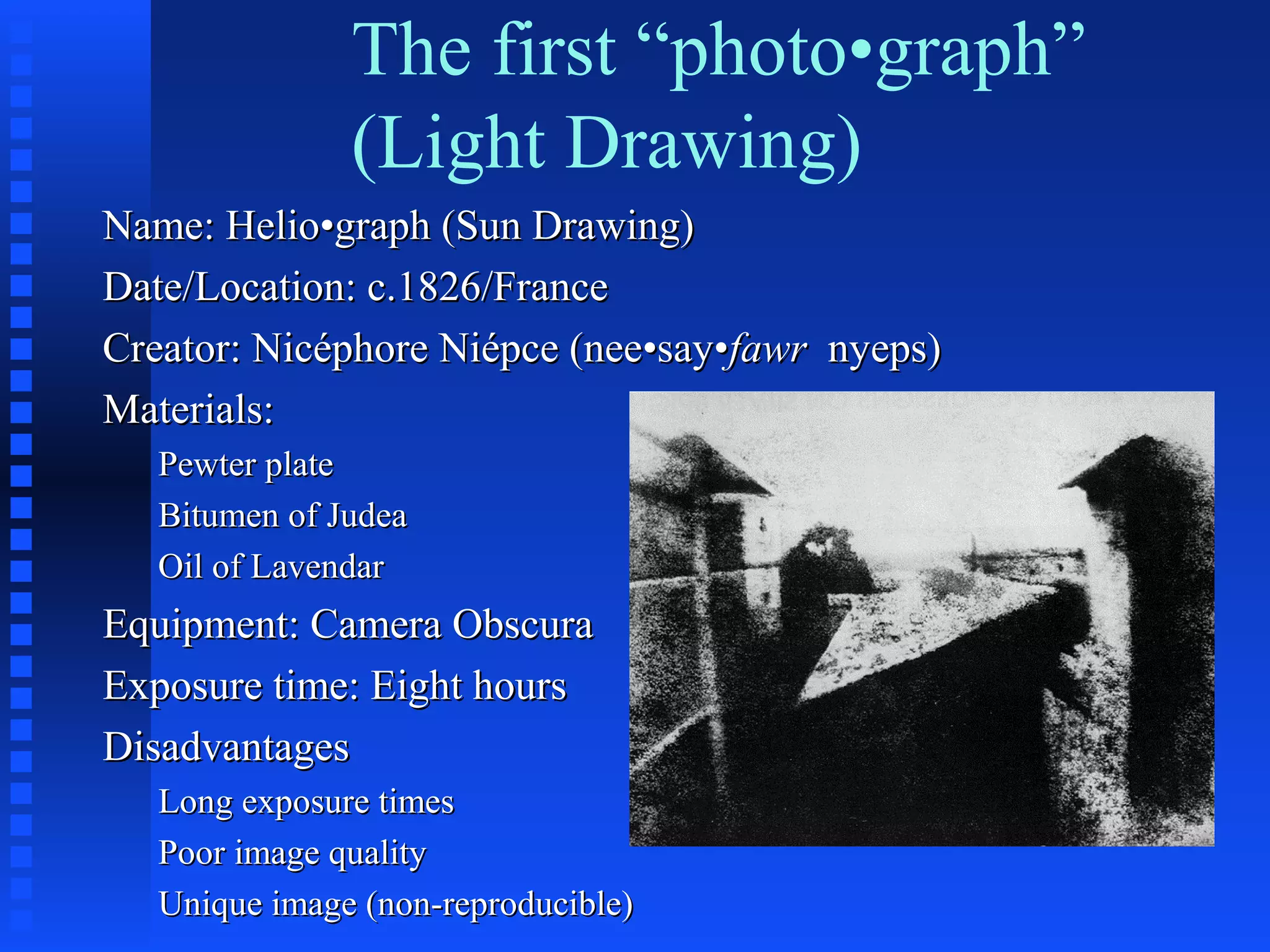
The first “photo•graph”
(Light Drawing)
Name: Helio•graph (Sun Drawing)Name: Helio•graph (Sun Drawing)
Date/Location: c.1826/FranceDate/Location: c.1826/France
Creator: Nicéphore Niépce (nee•say•Creator: Nicéphore Niépce (nee•say•fawrfawr nyeps)nyeps)
Materials:Materials:
Pewter platePewter plate
Bitumen of JudeaBitumen of Judea
Oil of LavendarOil of Lavendar
Equipment: Camera ObscuraEquipment: Camera Obscura
Exposure time: Eight hoursExposure time: Eight hours
DisadvantagesDisadvantages
Long exposure timesLong exposure times
Poor image qualityPoor image quality
Unique image (non-reproducible)Unique image (non-reproducible)
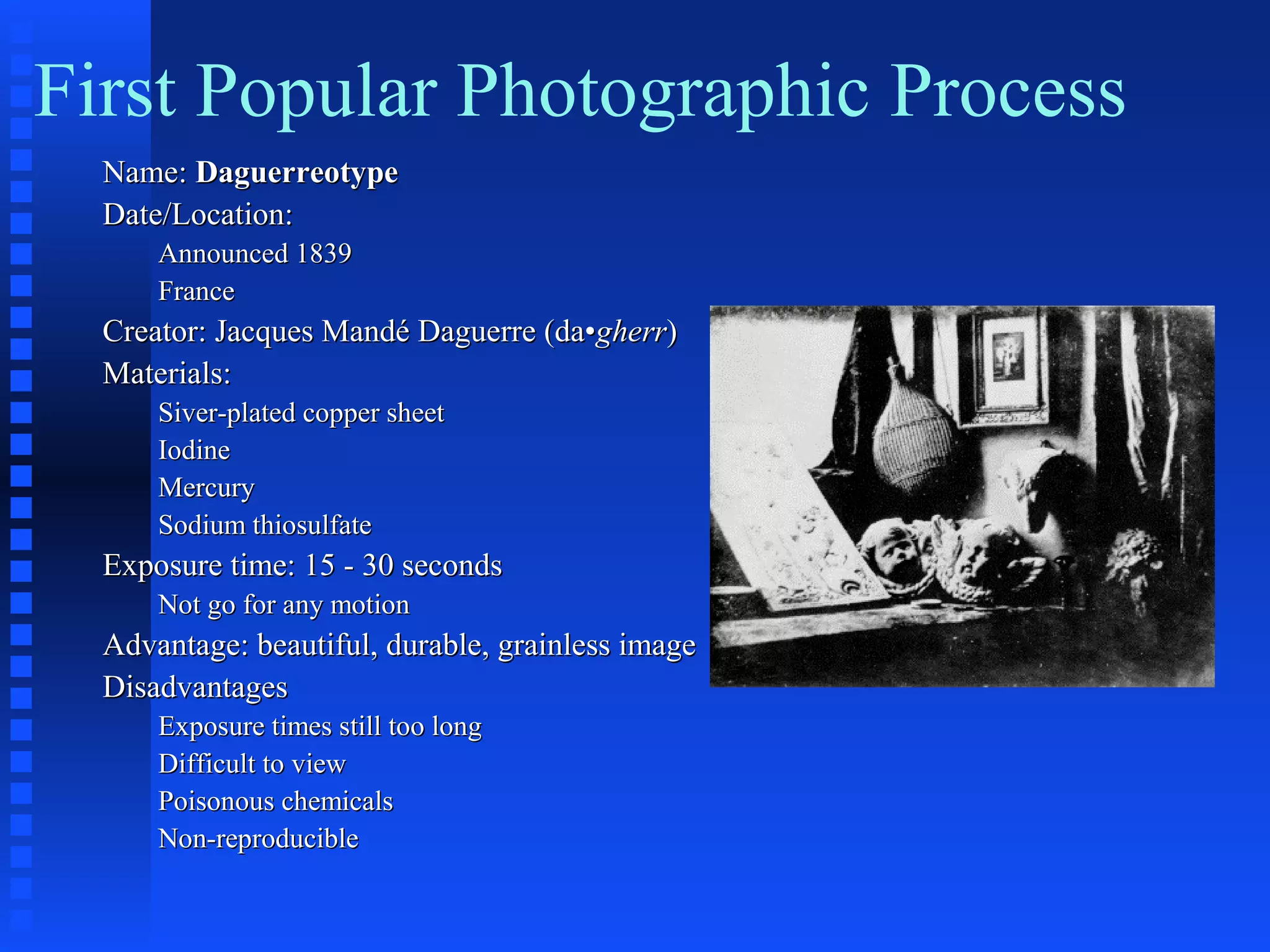
First Popular Photographic Process
Name:Name: DaguerreotypeDaguerreotype
Date/Location:Date/Location:
Announced 1839Announced 1839
FranceFrance
Creator: Jacques Mandé Daguerre (da•Creator: Jacques Mandé Daguerre (da•gherrgherr))
Materials:Materials:
Siver-plated copper sheetSiver-plated copper sheet
IodineIodine
MercuryMercury
Sodium thiosulfateSodium thiosulfate
Exposure time: 15 - 30 secondsExposure time: 15 - 30 seconds
Not go for any motionNot go for any motion
Advantage: beautiful, durable, grainless imageAdvantage: beautiful, durable, grainless image
DisadvantagesDisadvantages
Exposure times still too longExposure times still too long
Difficult to viewDifficult to view
Poisonous chemicalsPoisonous chemicals
Non-reproducibleNon-reproducible
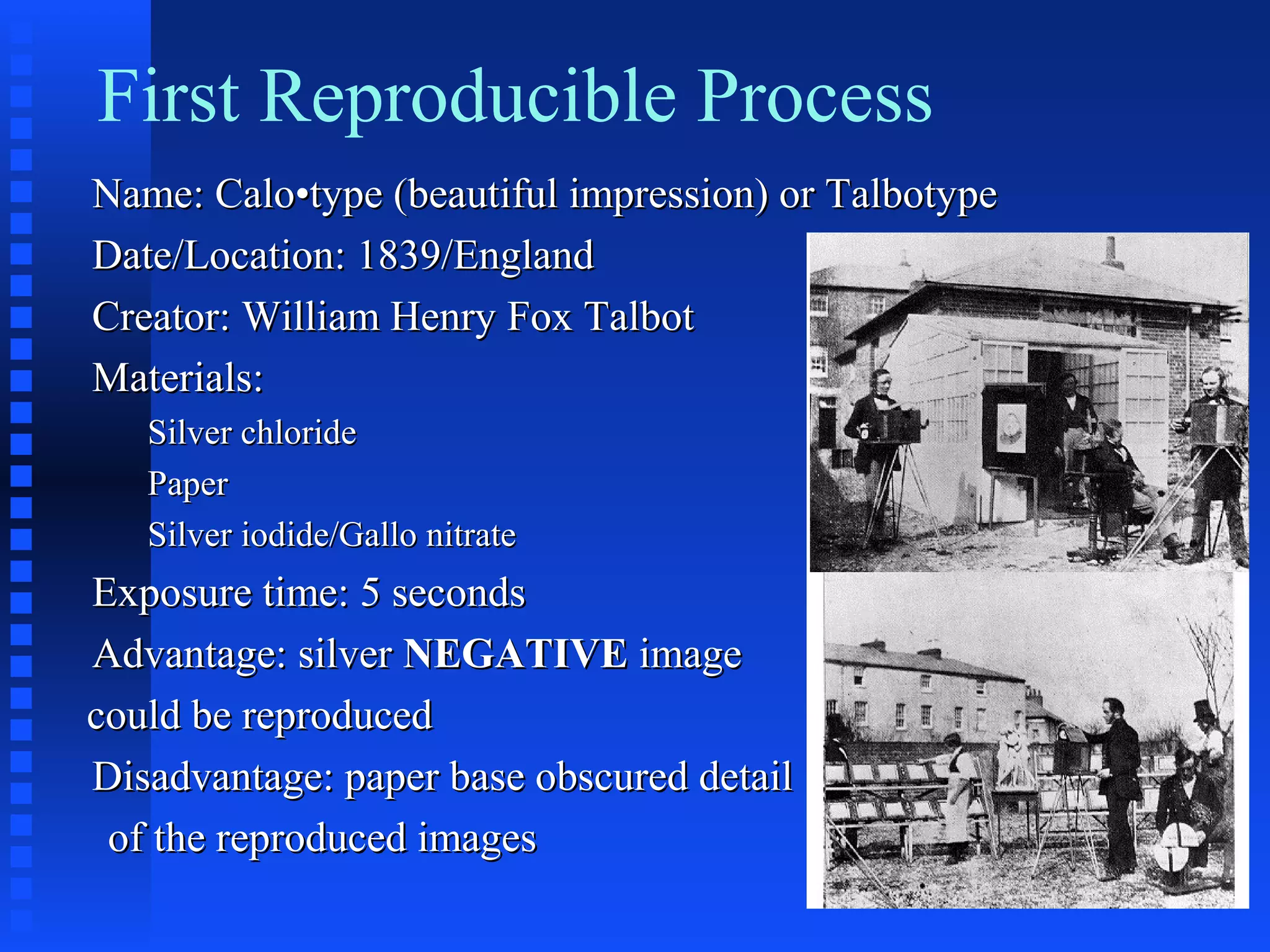
First Reproducible Process
Name: Calo•type (beautiful impression) or TalbotypeName: Calo•type (beautiful impression) or Talbotype
Date/Location: 1839/EnglandDate/Location: 1839/England
Creator: William Henry Fox TalbotCreator: William Henry Fox Talbot
Materials:Materials:
Silver chlorideSilver chloride
PaperPaper
Silver iodide/Gallo nitrateSilver iodide/Gallo nitrate
Exposure time: 5 secondsExposure time: 5 seconds
Advantage: silverAdvantage: silver NEGATIVENEGATIVE imageimage
could be reproducedcould be reproduced
Disadvantage: paper base obscured detailDisadvantage: paper base obscured detail
of the reproduced imagesof the reproduced images
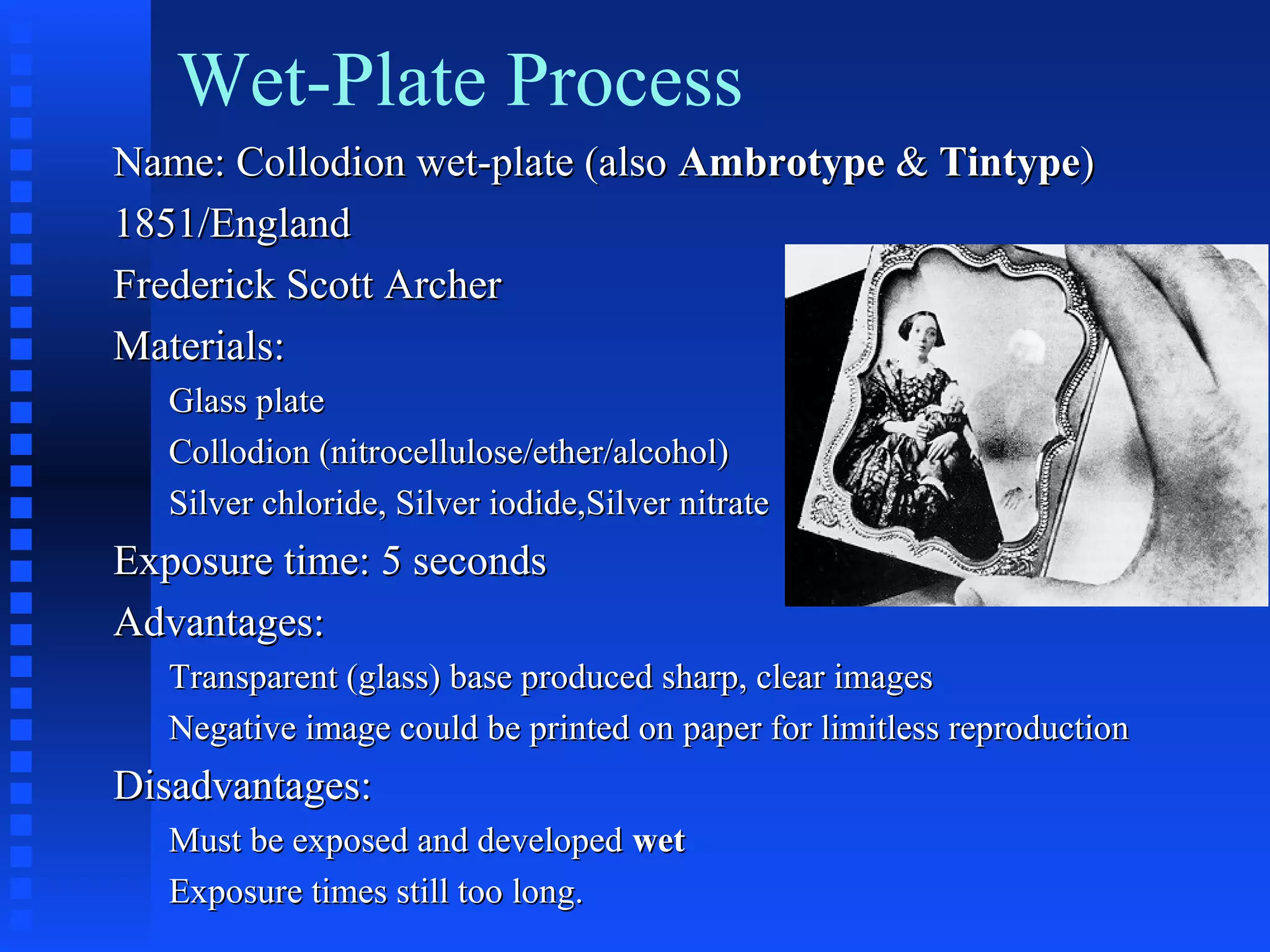
Wet-Plate Process
Name: Collodion wet-plate (alsoName: Collodion wet-plate (also AmbrotypeAmbrotype && TintypeTintype))
1851/England1851/England
Frederick Scott ArcherFrederick Scott Archer
Materials:Materials:
Glass plateGlass plate
Collodion (nitrocellulose/ether/alcohol)Collodion (nitrocellulose/ether/alcohol)
Silver chloride, Silver iodide,Silver nitrateSilver chloride, Silver iodide,Silver nitrate
Exposure time: 5 secondsExposure time: 5 seconds
Advantages:Advantages:
Transparent (glass) base produced sharp, clear imagesTransparent (glass) base produced sharp, clear images
Negative image could be printed on paper for limitless reproductionNegative image could be printed on paper for limitless reproduction
Disadvantages:Disadvantages:
Must be exposed and developedMust be exposed and developed wetwet
Exposure times still too long.Exposure times still too long.
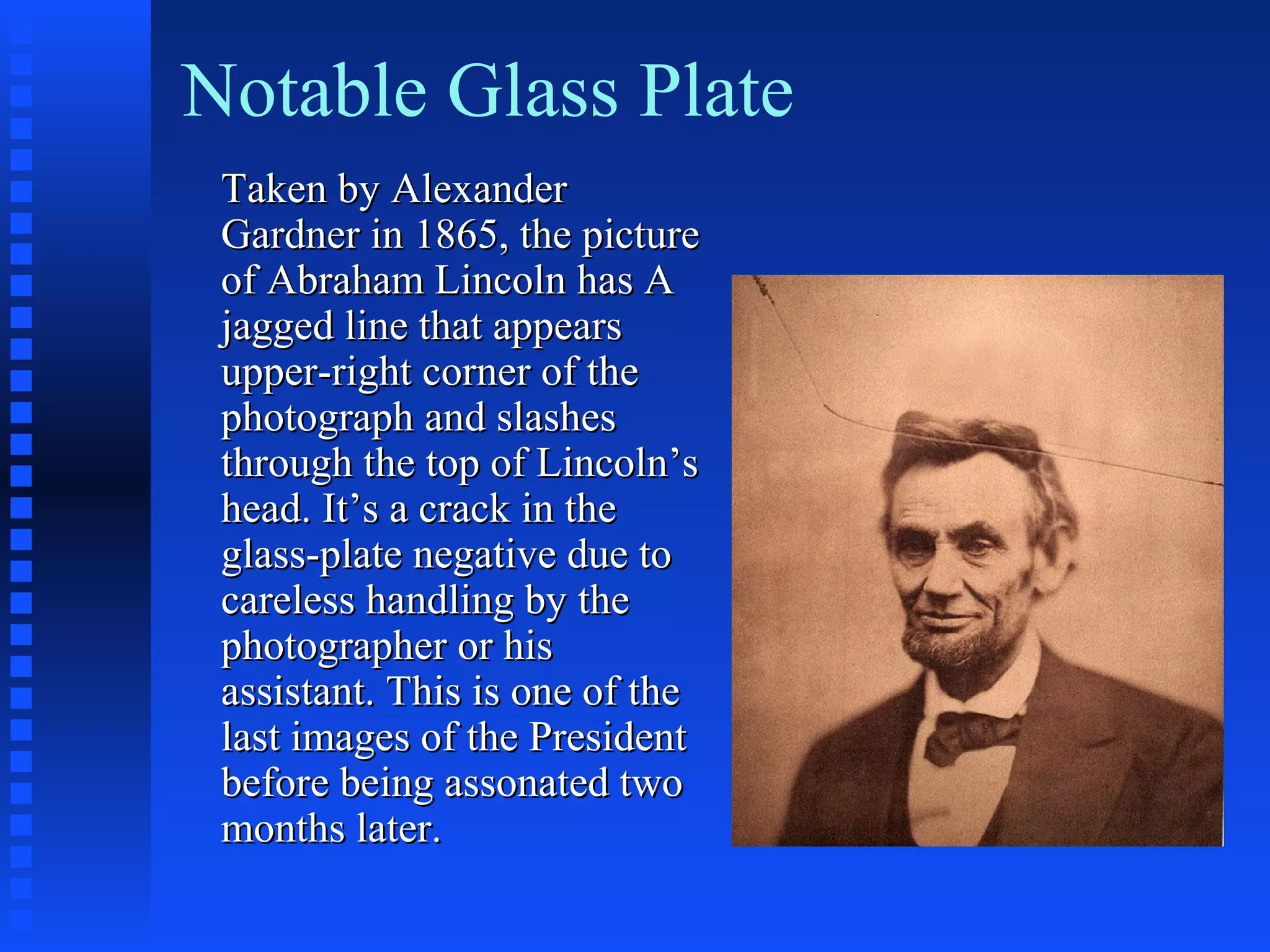
Notable Glass Plate
Taken by AlexanderTaken by Alexander
Gardner in 1865, the pictureGardner in 1865, the picture
of Abraham Lincoln has Aof Abraham Lincoln has A
jagged line that appearsjagged line that appears
upper-right corner of theupper-right corner of the
photograph and slashesphotograph and slashes
through the top of Lincoln’sthrough the top of Lincoln’s
head. It’s a crack in thehead. It’s a crack in the
glass-plate negative due toglass-plate negative due to
careless handling by thecareless handling by the
photographer or hisphotographer or his
assistant. This is one of theassistant. This is one of the
last images of the Presidentlast images of the President
before being assonated twobefore being assonated two
months later.months later.
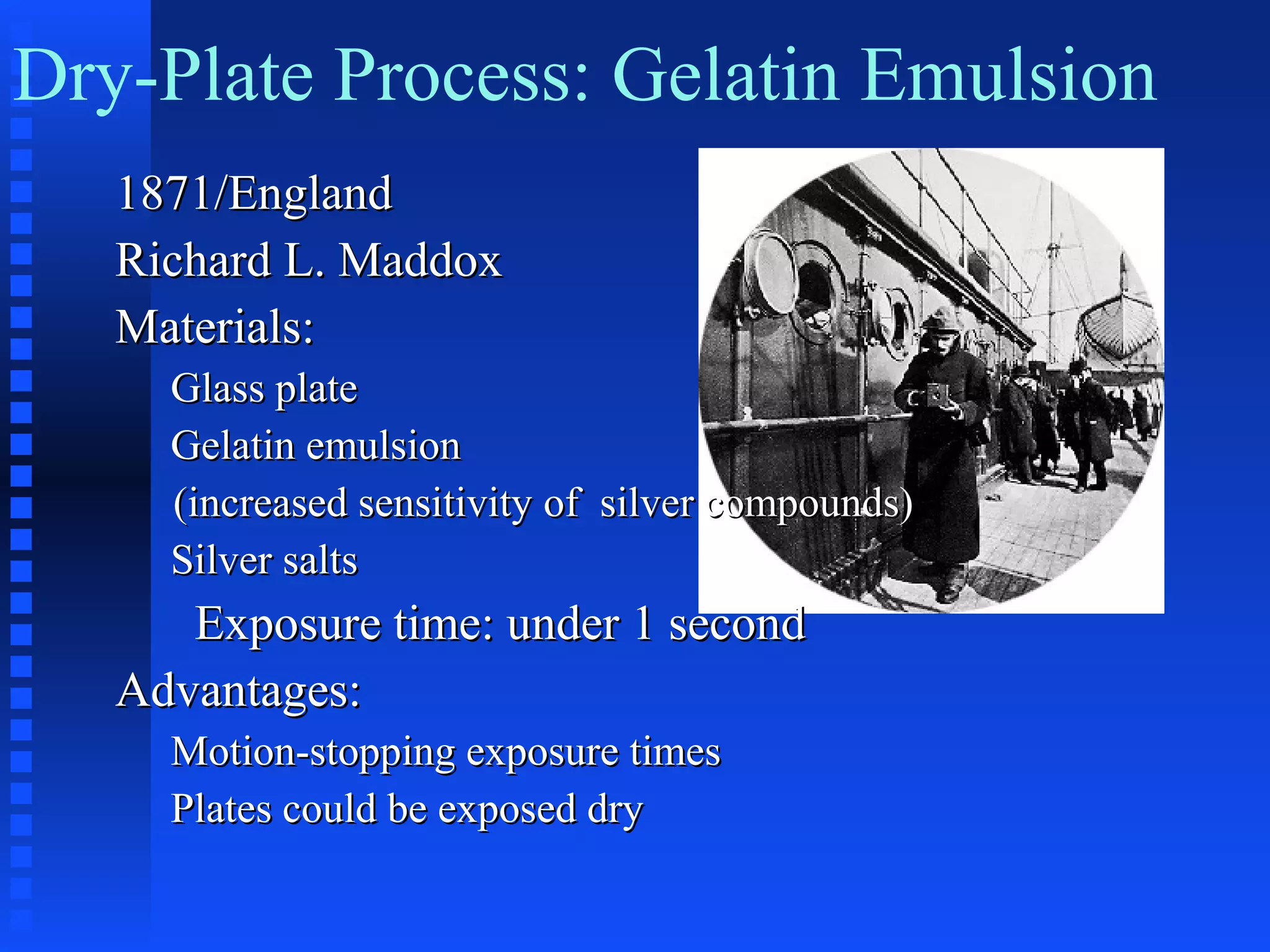
1871/England1871/England
Richard L. MaddoxRichard L. Maddox
Materials:Materials:
Glass plateGlass plate
Gelatin emulsionGelatin emulsion
(increased sensitivity of silver compounds)(increased sensitivity of silver compounds)
Silver saltsSilver salts
Exposure time: under 1 secondExposure time: under 1 second
Advantages:Advantages:
Motion-stopping exposure timesMotion-stopping exposure times
Plates could be exposed dryPlates could be exposed dry
Dry-Plate Process: Gelatin Emulsion
Other Improvements to
Conventional Photography
Projection printingProjection printing (enlarging) allowed use(enlarging) allowed use
of smaller negatives/smaller camerasof smaller negatives/smaller cameras
Emulsion coated ontoEmulsion coated onto flexible filmflexible film allowedallowed
roll-filmroll-film (George Eastman of Eastman Kodak)(George Eastman of Eastman Kodak)
Color ImagesColor Images
1861 an1861 an additiveadditive color processcolor process
18691869 subtractivesubtractive color theory developedcolor theory developed
19071907 AutochromeAutochrome processprocess
19351935 KodachromeKodachrome film introducedfilm introduced
19361936: Development of Kodachrome, the: Development of Kodachrome, the
first color multi-layered color film;first color multi-layered color film;
development of Exakta, pioneering 35mmdevelopment of Exakta, pioneering 35mm
single-lens reflex (SLR) camerasingle-lens reflex (SLR) camera
19631963: First color instant film developed by: First color instant film developed by
Polaroid; Instamatic released by Kodak;Polaroid; Instamatic released by Kodak;
19731973: C-41 color negative process: C-41 color negative process
introduced. (That’s what we still use todayintroduced. (That’s what we still use today
for color neg. film.)for color neg. film.)
19901990: Adobe Photoshop released.: Adobe Photoshop released.
19911991: Kodak DCS-100, first digital SLR: Kodak DCS-100, first digital SLR
20002000: Camera phone introduced in Japan by: Camera phone introduced in Japan by
Sharp/J-PhoneSharp/J-Phone
20012001: Polaroid goes bankrupt: Polaroid goes bankrupt
20042004: Kodak ceases production of film: Kodak ceases production of film
camerascameras

History ofimaging

  • 1.
    The History ofImaging Conventional/Silver ProcessesConventional/Silver Processes
  • 2.
  • 3.
  • 4.
  • 5.
  • 6.
    Camera Obscura The earliestTheearliest camera obscuracamera obscurass were actually rooms withwere actually rooms with a hole in the wall at one end, which projected an imagea hole in the wall at one end, which projected an image (upside down) on the wall at the opposite end. These(upside down) on the wall at the opposite end. These were eventually made portable to a box that could bewere eventually made portable to a box that could be carried around and pointed at various scenes to projectcarried around and pointed at various scenes to project an image on a ground-glass screen. An artist could thenan image on a ground-glass screen. An artist could then trace the scene from the ground glass onto paper.trace the scene from the ground glass onto paper.
  • 7.
    The first “photo•graph” (LightDrawing) Name: Helio•graph (Sun Drawing)Name: Helio•graph (Sun Drawing) Date/Location: c.1826/FranceDate/Location: c.1826/France Creator: Nicéphore Niépce (nee•say•Creator: Nicéphore Niépce (nee•say•fawrfawr nyeps)nyeps) Materials:Materials: Pewter platePewter plate Bitumen of JudeaBitumen of Judea Oil of LavendarOil of Lavendar Equipment: Camera ObscuraEquipment: Camera Obscura Exposure time: Eight hoursExposure time: Eight hours DisadvantagesDisadvantages Long exposure timesLong exposure times Poor image qualityPoor image quality Unique image (non-reproducible)Unique image (non-reproducible)
  • 8.
    First Popular PhotographicProcess Name:Name: DaguerreotypeDaguerreotype Date/Location:Date/Location: Announced 1839Announced 1839 FranceFrance Creator: Jacques Mandé Daguerre (da•Creator: Jacques Mandé Daguerre (da•gherrgherr)) Materials:Materials: Siver-plated copper sheetSiver-plated copper sheet IodineIodine MercuryMercury Sodium thiosulfateSodium thiosulfate Exposure time: 15 - 30 secondsExposure time: 15 - 30 seconds Not go for any motionNot go for any motion Advantage: beautiful, durable, grainless imageAdvantage: beautiful, durable, grainless image DisadvantagesDisadvantages Exposure times still too longExposure times still too long Difficult to viewDifficult to view Poisonous chemicalsPoisonous chemicals Non-reproducibleNon-reproducible
  • 9.
    First Reproducible Process Name:Calo•type (beautiful impression) or TalbotypeName: Calo•type (beautiful impression) or Talbotype Date/Location: 1839/EnglandDate/Location: 1839/England Creator: William Henry Fox TalbotCreator: William Henry Fox Talbot Materials:Materials: Silver chlorideSilver chloride PaperPaper Silver iodide/Gallo nitrateSilver iodide/Gallo nitrate Exposure time: 5 secondsExposure time: 5 seconds Advantage: silverAdvantage: silver NEGATIVENEGATIVE imageimage could be reproducedcould be reproduced Disadvantage: paper base obscured detailDisadvantage: paper base obscured detail of the reproduced imagesof the reproduced images
  • 10.
    Wet-Plate Process Name: Collodionwet-plate (alsoName: Collodion wet-plate (also AmbrotypeAmbrotype && TintypeTintype)) 1851/England1851/England Frederick Scott ArcherFrederick Scott Archer Materials:Materials: Glass plateGlass plate Collodion (nitrocellulose/ether/alcohol)Collodion (nitrocellulose/ether/alcohol) Silver chloride, Silver iodide,Silver nitrateSilver chloride, Silver iodide,Silver nitrate Exposure time: 5 secondsExposure time: 5 seconds Advantages:Advantages: Transparent (glass) base produced sharp, clear imagesTransparent (glass) base produced sharp, clear images Negative image could be printed on paper for limitless reproductionNegative image could be printed on paper for limitless reproduction Disadvantages:Disadvantages: Must be exposed and developedMust be exposed and developed wetwet Exposure times still too long.Exposure times still too long.
  • 11.
    Notable Glass Plate Takenby AlexanderTaken by Alexander Gardner in 1865, the pictureGardner in 1865, the picture of Abraham Lincoln has Aof Abraham Lincoln has A jagged line that appearsjagged line that appears upper-right corner of theupper-right corner of the photograph and slashesphotograph and slashes through the top of Lincoln’sthrough the top of Lincoln’s head. It’s a crack in thehead. It’s a crack in the glass-plate negative due toglass-plate negative due to careless handling by thecareless handling by the photographer or hisphotographer or his assistant. This is one of theassistant. This is one of the last images of the Presidentlast images of the President before being assonated twobefore being assonated two months later.months later.
  • 12.
    1871/England1871/England Richard L. MaddoxRichardL. Maddox Materials:Materials: Glass plateGlass plate Gelatin emulsionGelatin emulsion (increased sensitivity of silver compounds)(increased sensitivity of silver compounds) Silver saltsSilver salts Exposure time: under 1 secondExposure time: under 1 second Advantages:Advantages: Motion-stopping exposure timesMotion-stopping exposure times Plates could be exposed dryPlates could be exposed dry Dry-Plate Process: Gelatin Emulsion
  • 13.
    Other Improvements to ConventionalPhotography Projection printingProjection printing (enlarging) allowed use(enlarging) allowed use of smaller negatives/smaller camerasof smaller negatives/smaller cameras Emulsion coated ontoEmulsion coated onto flexible filmflexible film allowedallowed roll-filmroll-film (George Eastman of Eastman Kodak)(George Eastman of Eastman Kodak) Color ImagesColor Images 1861 an1861 an additiveadditive color processcolor process 18691869 subtractivesubtractive color theory developedcolor theory developed 19071907 AutochromeAutochrome processprocess 19351935 KodachromeKodachrome film introducedfilm introduced
  • 14.
    19361936: Development ofKodachrome, the: Development of Kodachrome, the first color multi-layered color film;first color multi-layered color film; development of Exakta, pioneering 35mmdevelopment of Exakta, pioneering 35mm single-lens reflex (SLR) camerasingle-lens reflex (SLR) camera 19631963: First color instant film developed by: First color instant film developed by Polaroid; Instamatic released by Kodak;Polaroid; Instamatic released by Kodak; 19731973: C-41 color negative process: C-41 color negative process introduced. (That’s what we still use todayintroduced. (That’s what we still use today for color neg. film.)for color neg. film.) 19901990: Adobe Photoshop released.: Adobe Photoshop released.
  • 15.
    19911991: Kodak DCS-100,first digital SLR: Kodak DCS-100, first digital SLR 20002000: Camera phone introduced in Japan by: Camera phone introduced in Japan by Sharp/J-PhoneSharp/J-Phone 20012001: Polaroid goes bankrupt: Polaroid goes bankrupt 20042004: Kodak ceases production of film: Kodak ceases production of film camerascameras