The History of Imaging Conventional/Silver Processes
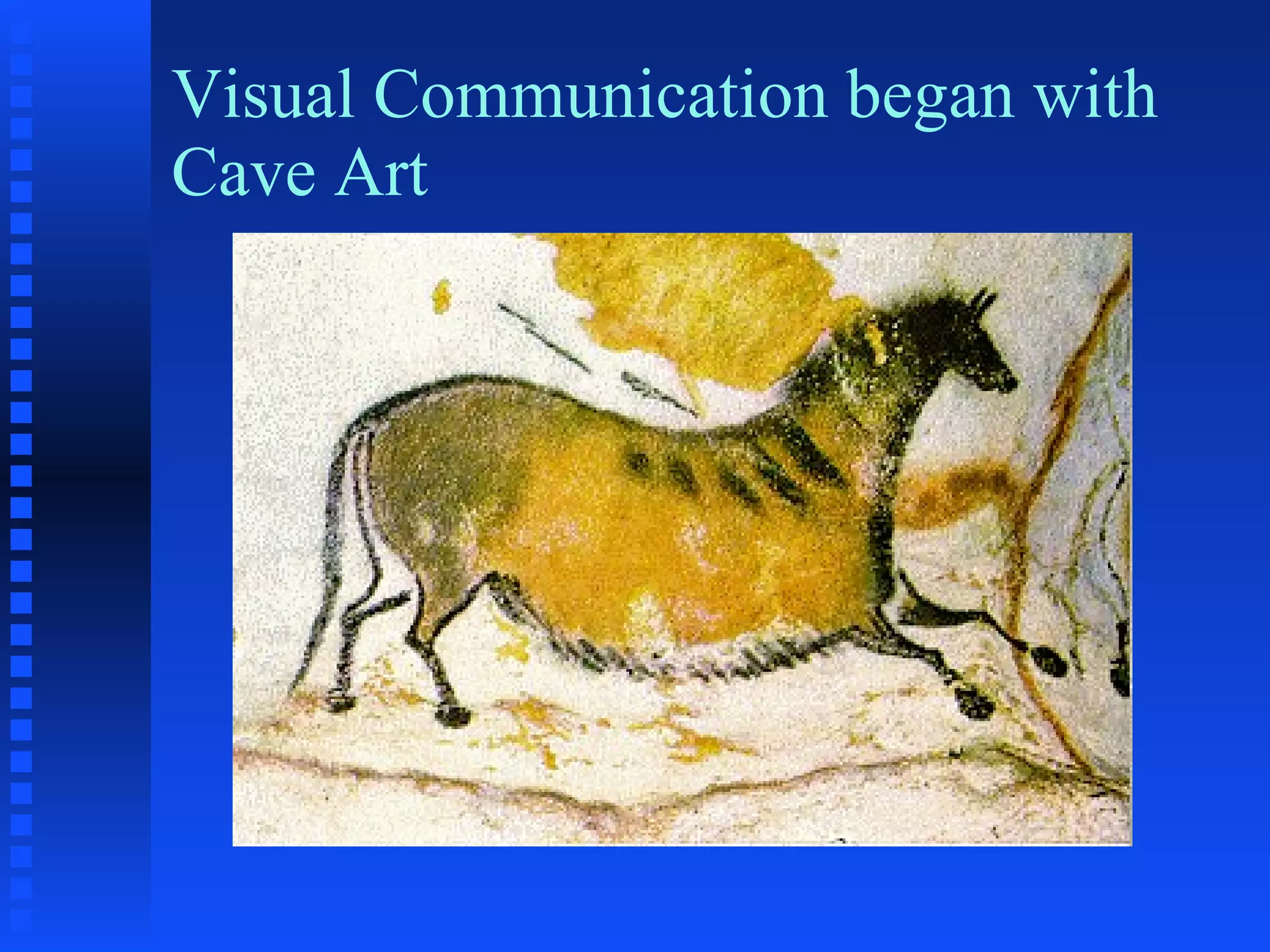
Visual Communication began with Cave Art
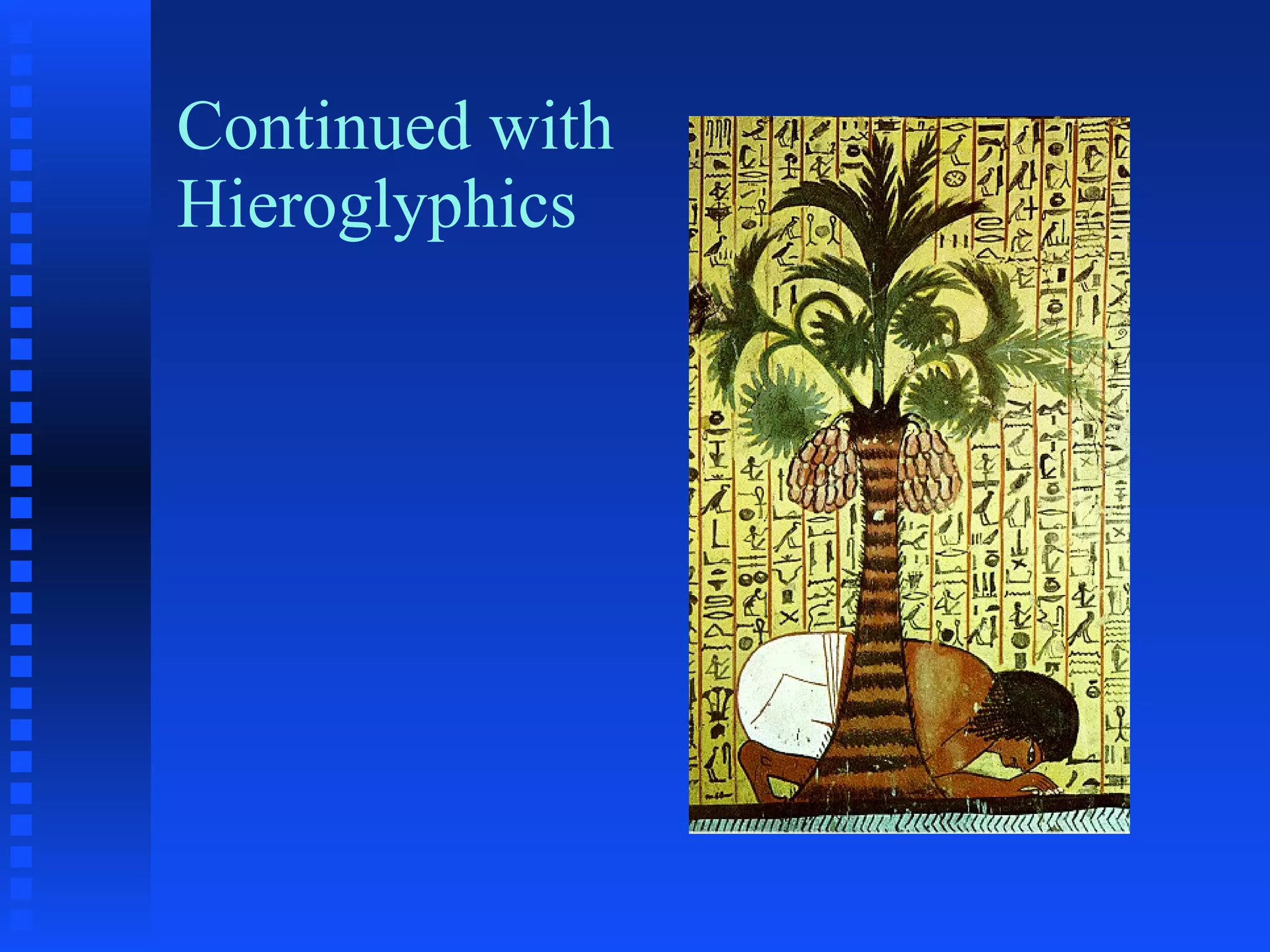
Continued with Hieroglyphics
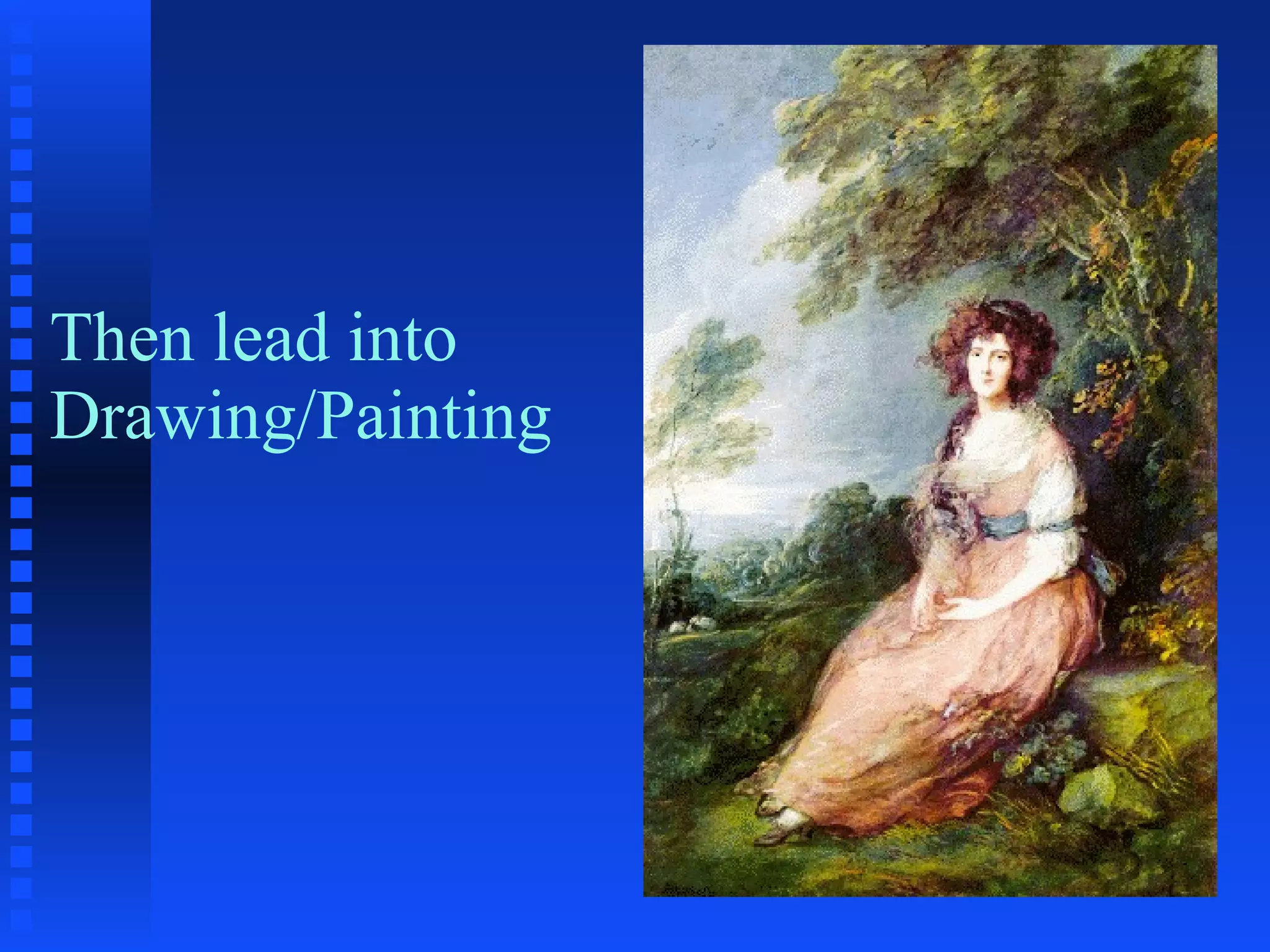
Then lead into Drawing/Painting
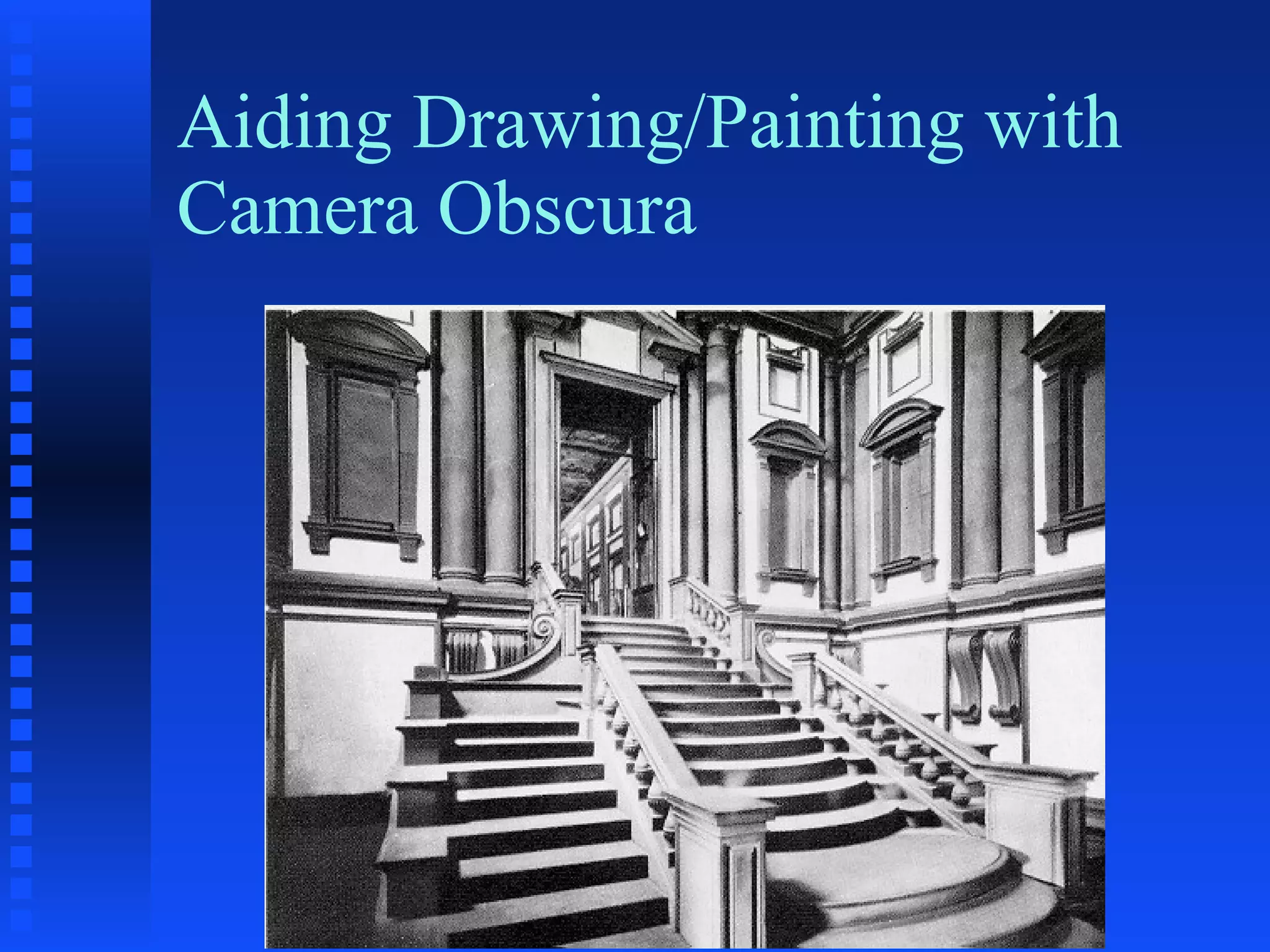
Aiding Drawing/Painting with  Camera Obscura
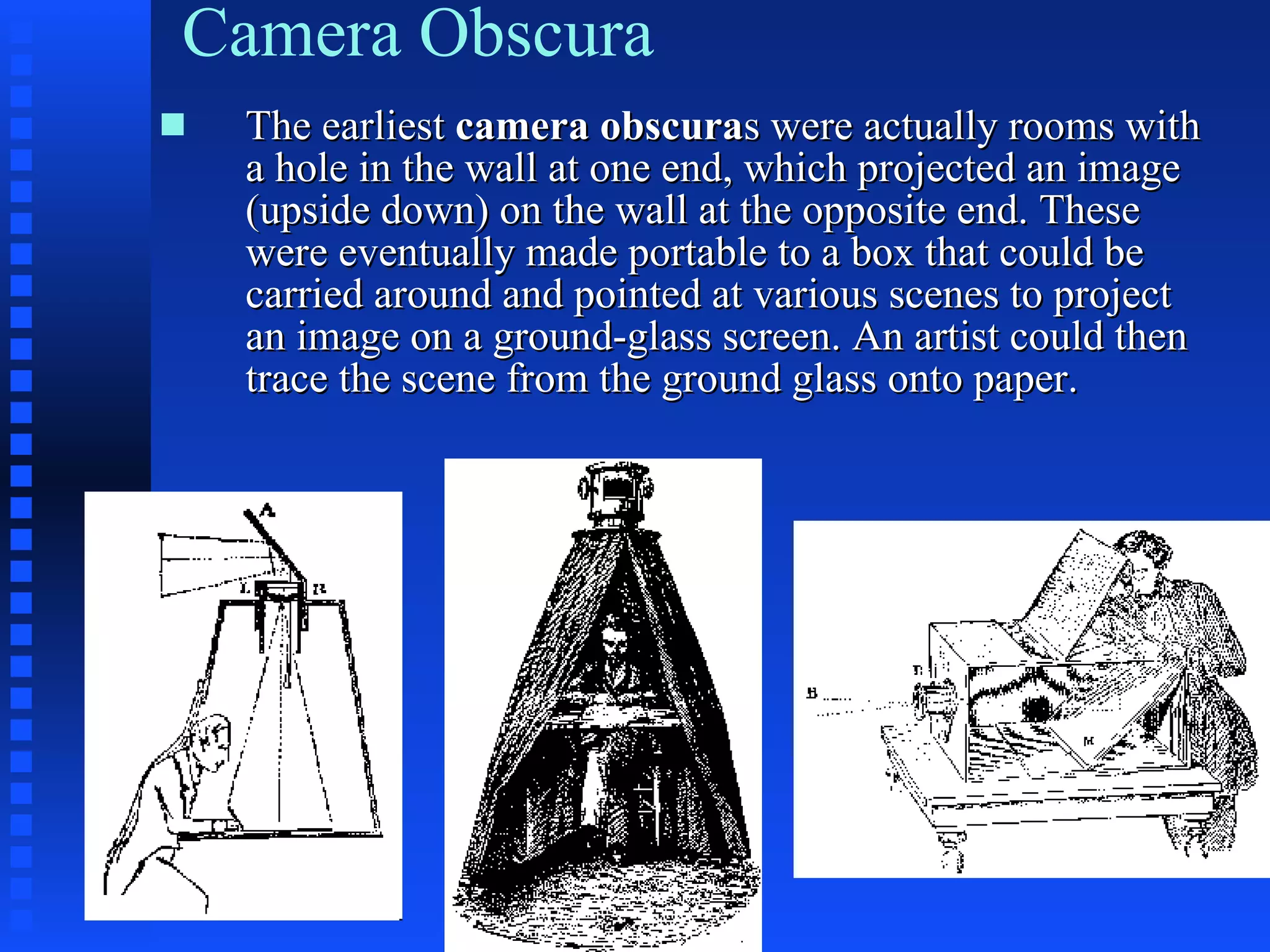
Camera Obscura The earliest  camera obscura s   were actually rooms with a hole in the wall at one end, which projected an image (upside down) on the wall at the opposite end. These were eventually made portable to a box that could be carried around and pointed at various scenes to project an image on a ground-glass screen. An artist could then trace the scene from the ground glass onto paper.
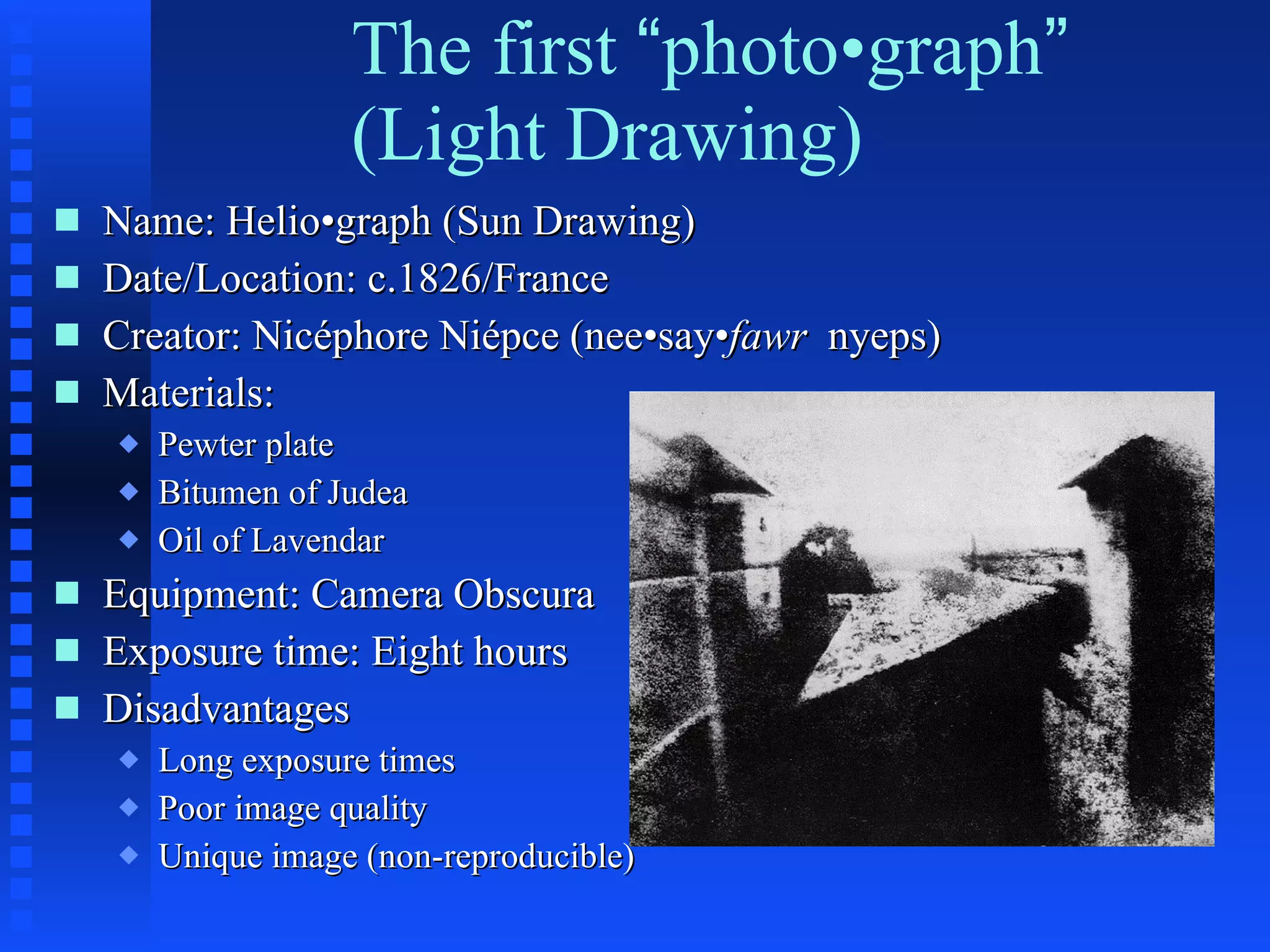
The first  “ photo•graph ” (Light Drawing) Name: Helio•graph (Sun Drawing) Date/Location: c.1826/France Creator: Nicéphore Niépce (nee•say• fawr  nyeps) Materials: Pewter plate Bitumen of Judea Oil of Lavendar Equipment: Camera Obscura Exposure time: Eight hours Disadvantages Long exposure times Poor image quality Unique image (non-reproducible)
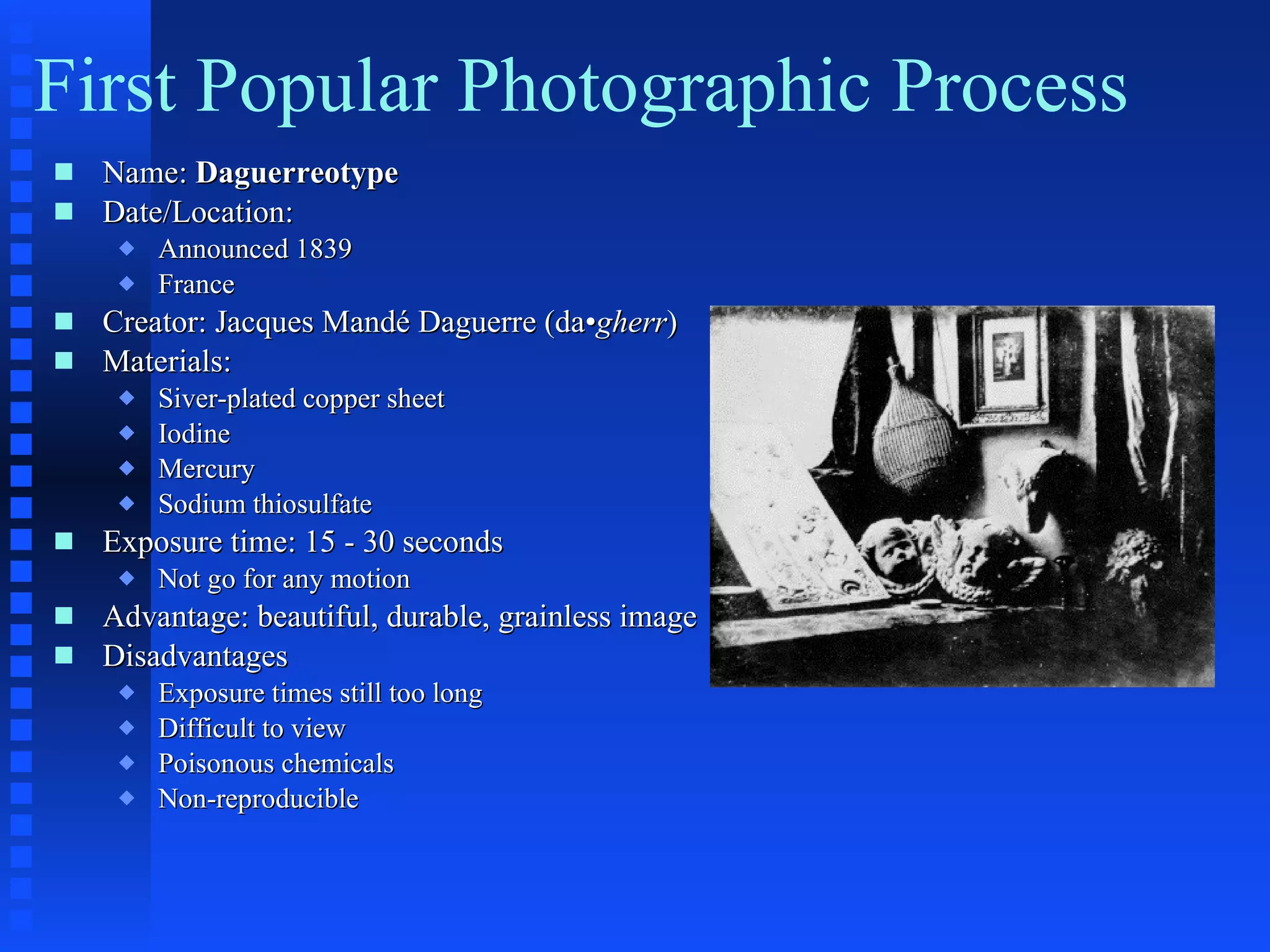
First Popular Photographic Process Name:  Daguerreotype   Date/Location:  Announced 1839 France Creator: Jacques Mandé Daguerre (da• gherr ) Materials: Siver-plated copper sheet Iodine Mercury Sodium thiosulfate Exposure time: 15 - 30 seconds Not go for any motion Advantage: beautiful, durable, grainless image Disadvantages Exposure times still too long Difficult to view Poisonous chemicals Non-reproducible
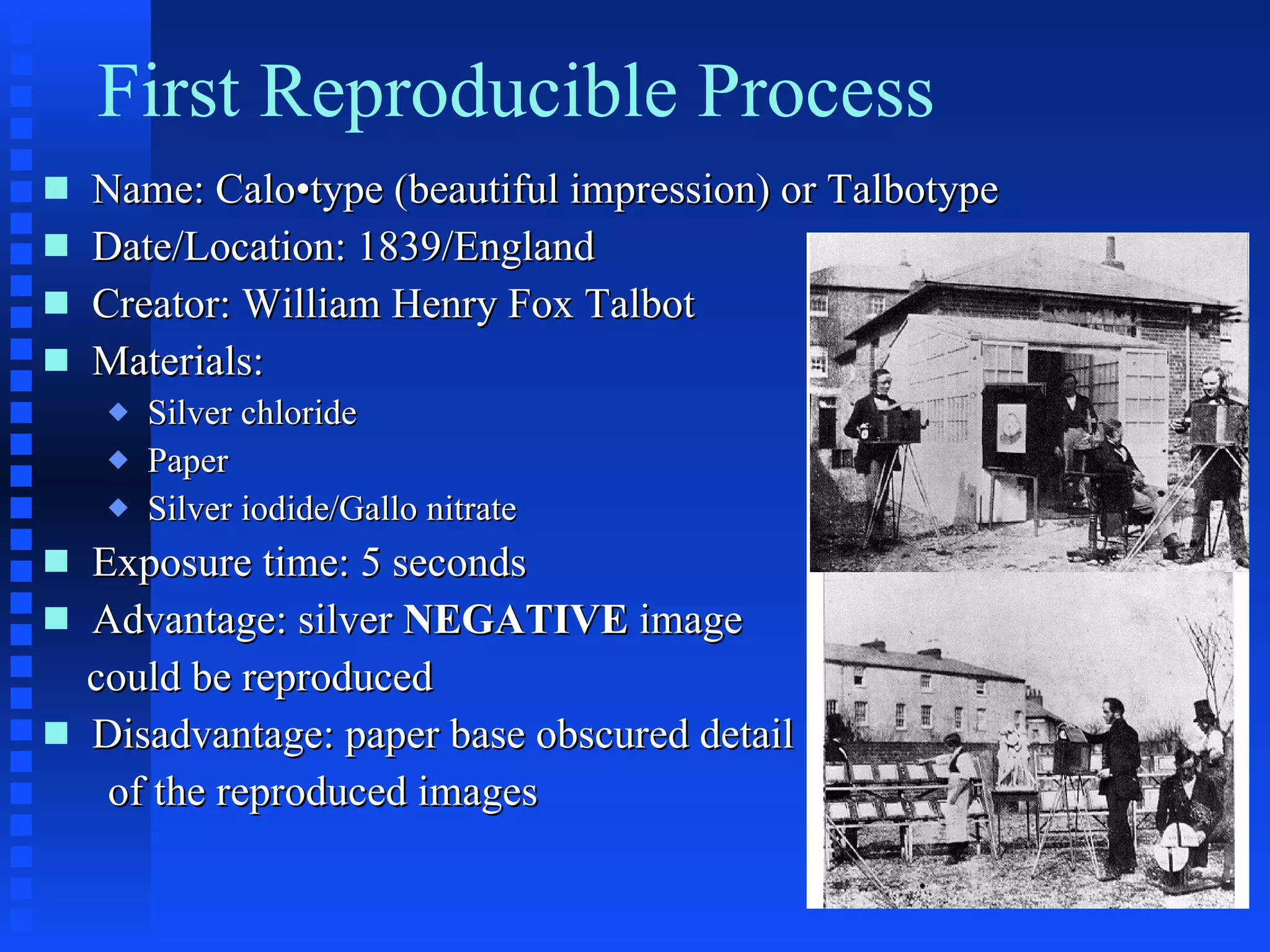
First Reproducible Process Name: Calo•type (beautiful impression) or Talbotype Date/Location: 1839/England Creator: William Henry Fox Talbot Materials: Silver chloride Paper Silver iodide/Gallo nitrate Exposure time: 5 seconds Advantage: silver  NEGATIVE  image  could be reproduced Disadvantage: paper base obscured detail of the reproduced images
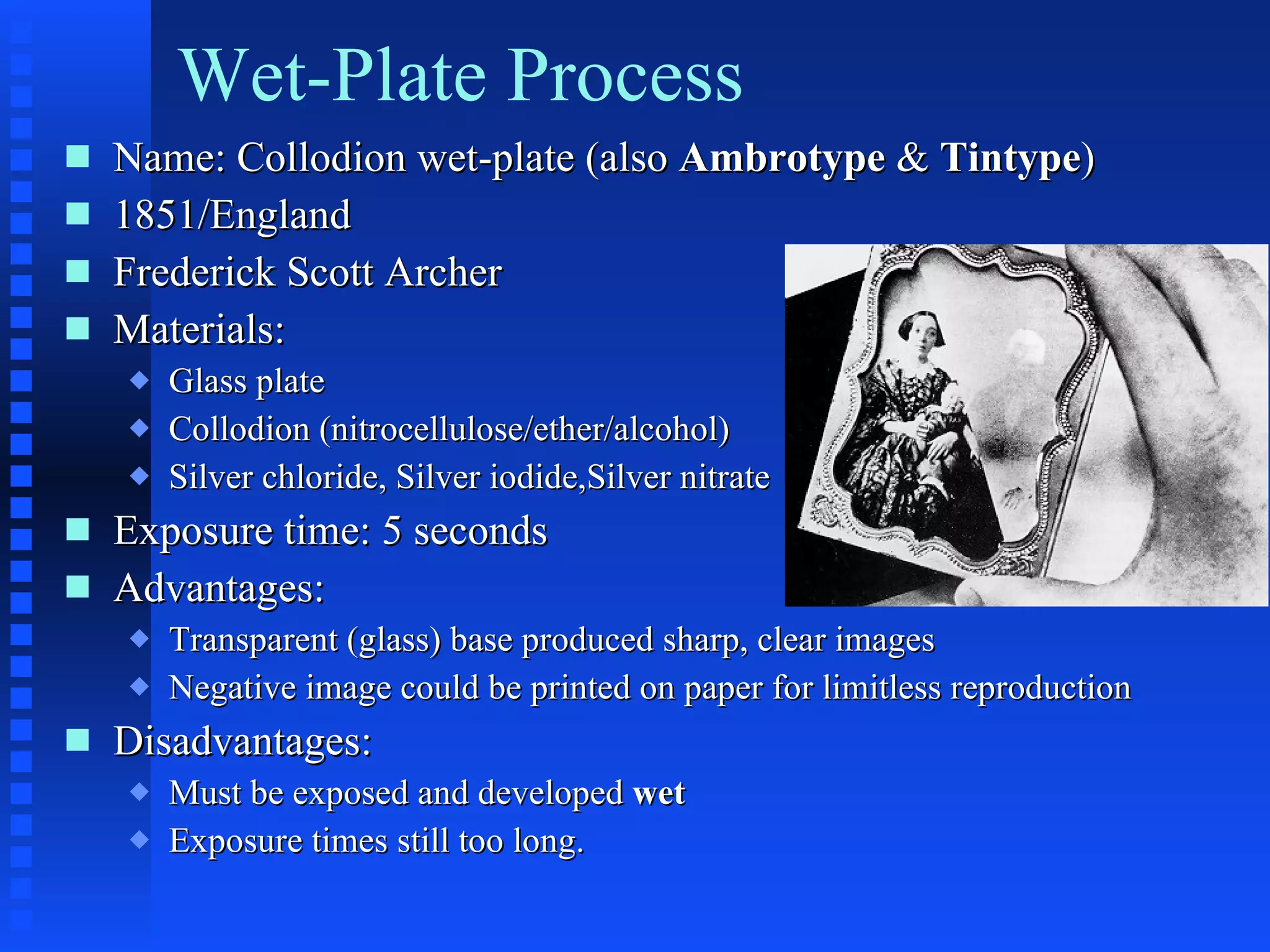
Wet-Plate Process Name: Collodion wet-plate (also  Ambrotype  &  Tintype ) 1851/England Frederick Scott Archer Materials: Glass plate Collodion (nitrocellulose/ether/alcohol) Silver chloride, Silver iodide,Silver nitrate Exposure time: 5 seconds Advantages:  Transparent (glass) base produced sharp, clear images Negative image could be printed on paper for limitless reproduction Disadvantages: Must be exposed and developed  wet Exposure times still too long.
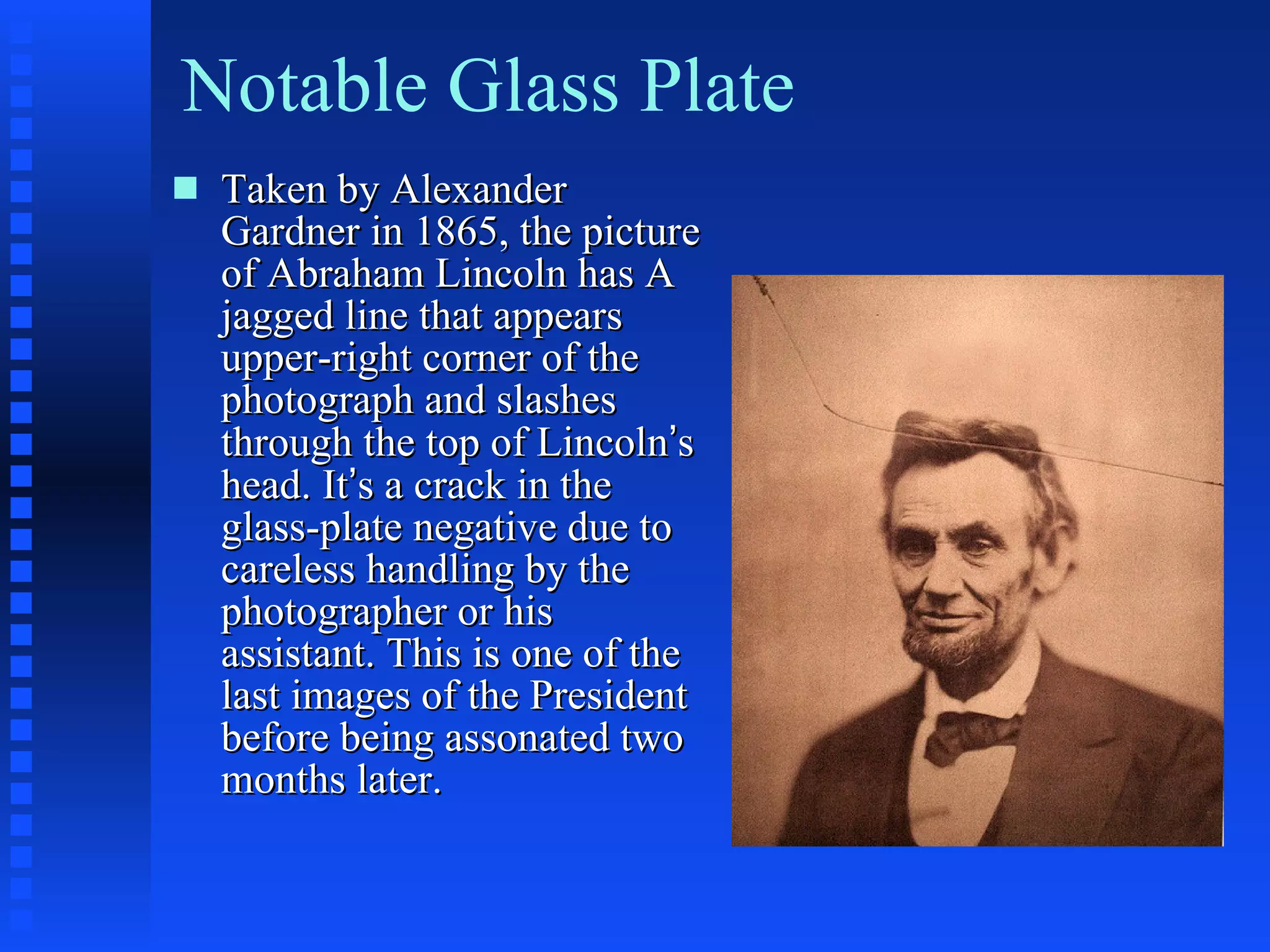
Notable Glass Plate Taken by Alexander Gardner in 1865, the picture of Abraham Lincoln has A jagged line that appears upper-right corner of the photograph and slashes through the top of Lincoln ’ s head. It ’ s a crack in the glass-plate negative due to careless handling by the photographer or his assistant. This is one of the last images of the President before being assonated two months later.
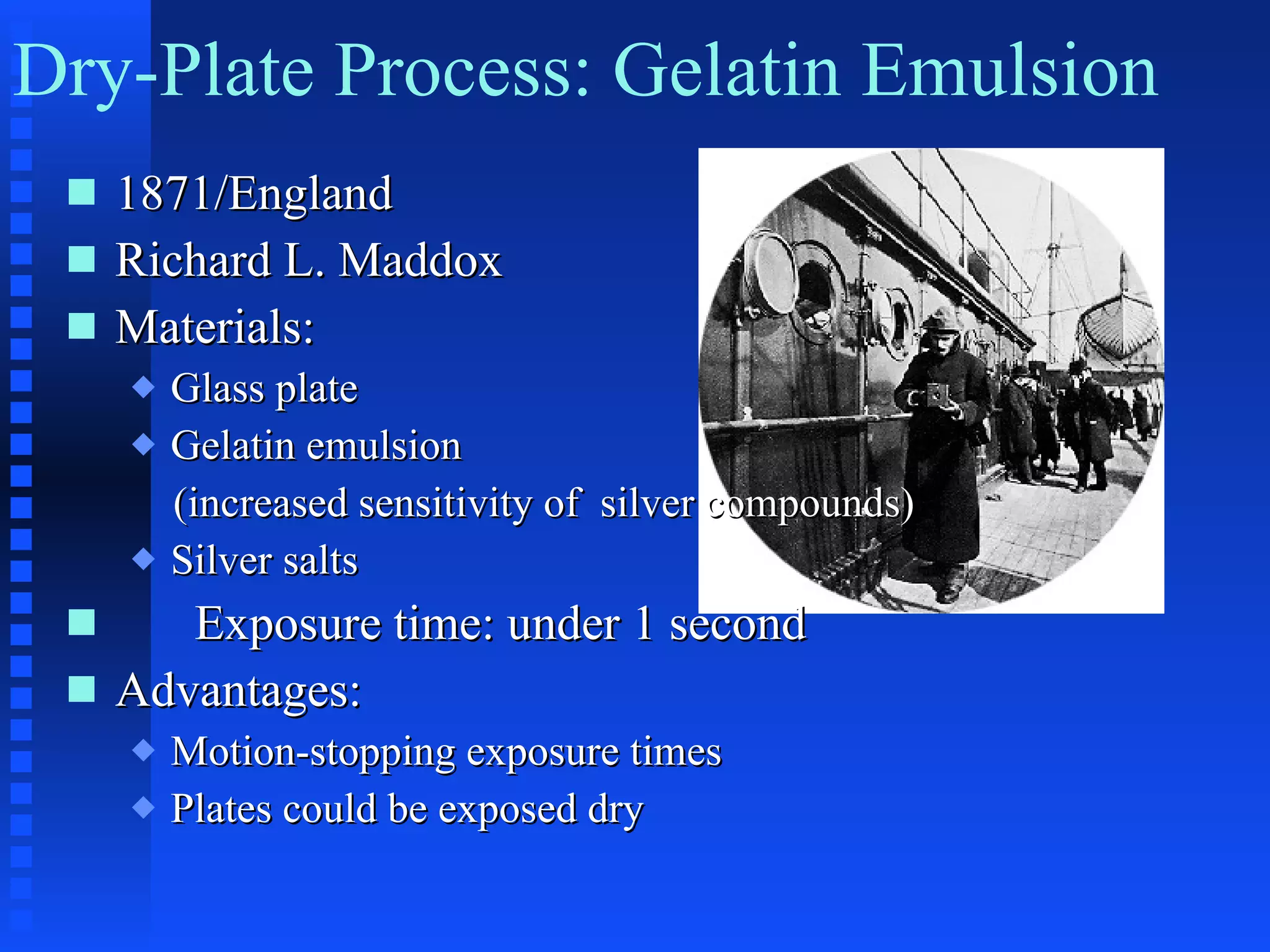
1871/England Richard L. Maddox Materials: Glass plate Gelatin emulsion  (increased sensitivity of  silver compounds) Silver salts Exposure time: under 1 second Advantages: Motion-stopping exposure times Plates could be exposed dry Dry-Plate Process: Gelatin Emulsion
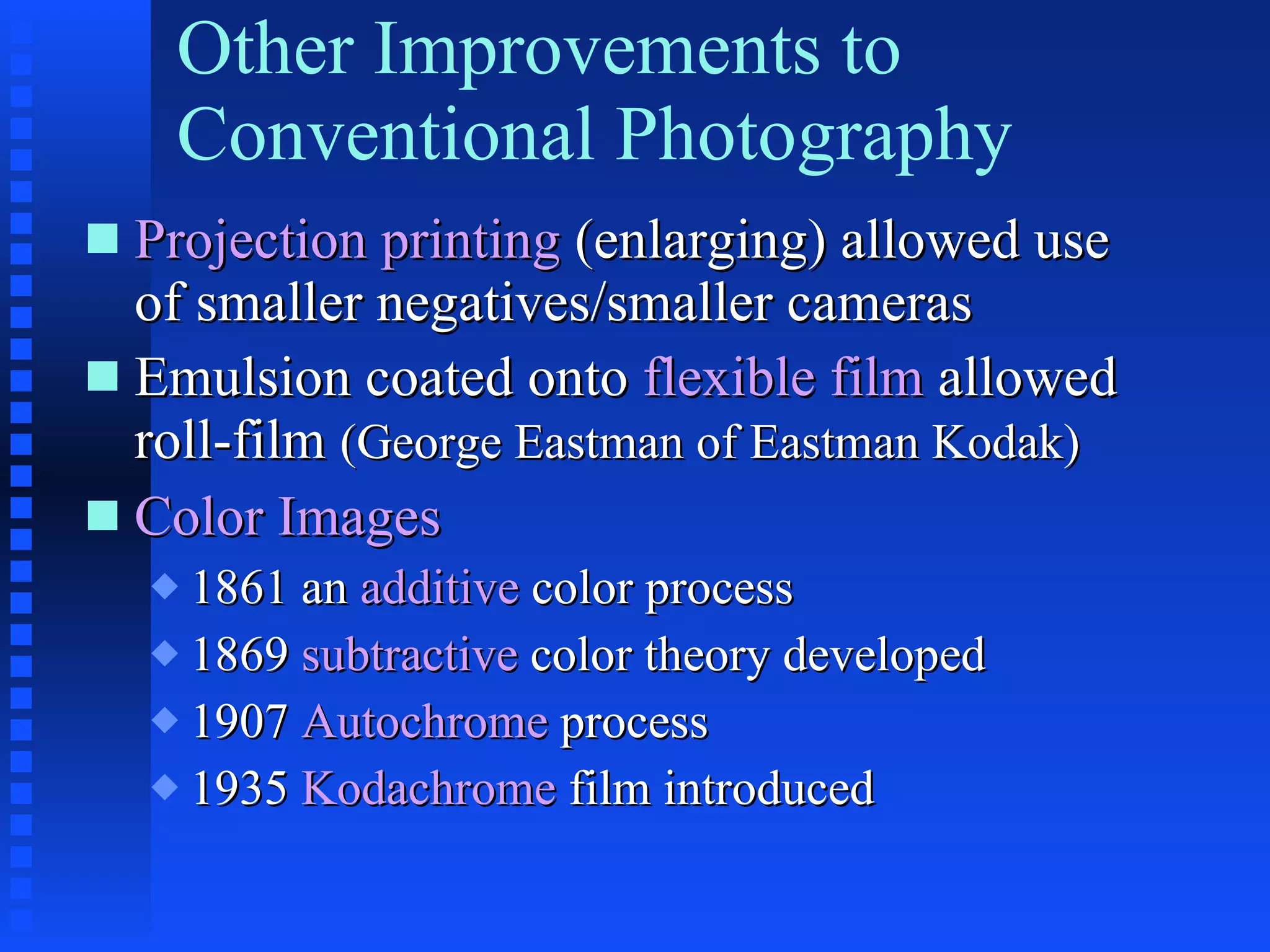
Other Improvements to Conventional Photography Projection printing  (enlarging) allowed use of smaller negatives/smaller cameras Emulsion coated onto  flexible film  allowed roll-film  (George Eastman of Eastman Kodak) Color Images 1861 an  additive  color process 1869  subtractive  color theory developed 1907  Autochrome  process 1935  Kodachrome  film introduced
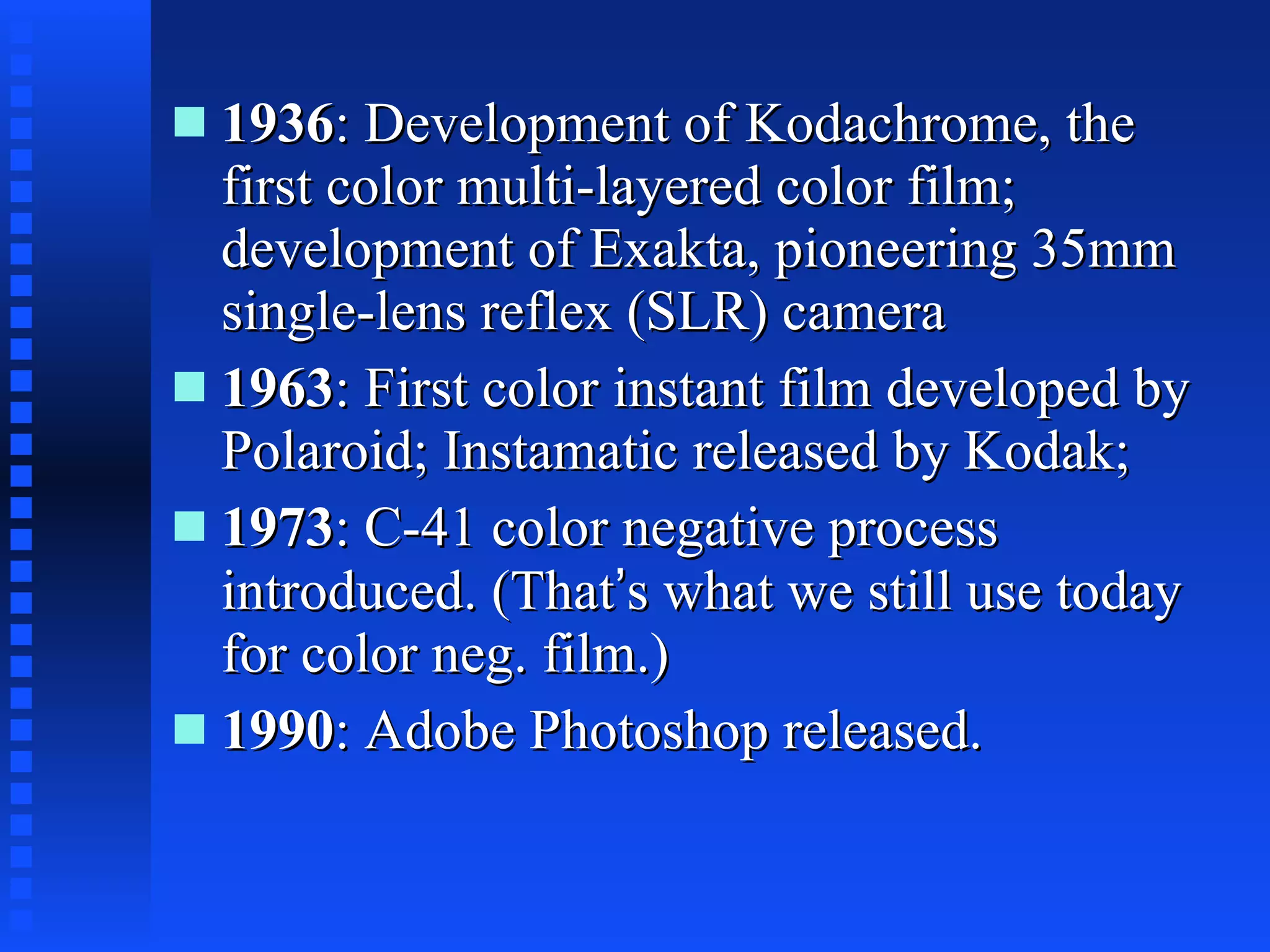
1936 : Development of Kodachrome, the first color multi-layered color film; development of Exakta, pioneering 35mm single-lens reflex (SLR) camera  1963 : First color instant film developed by Polaroid; Instamatic released by Kodak;  1973 : C-41 color negative process introduced. (That ’ s what we still use today for color neg. film.) 1990 : Adobe Photoshop released.
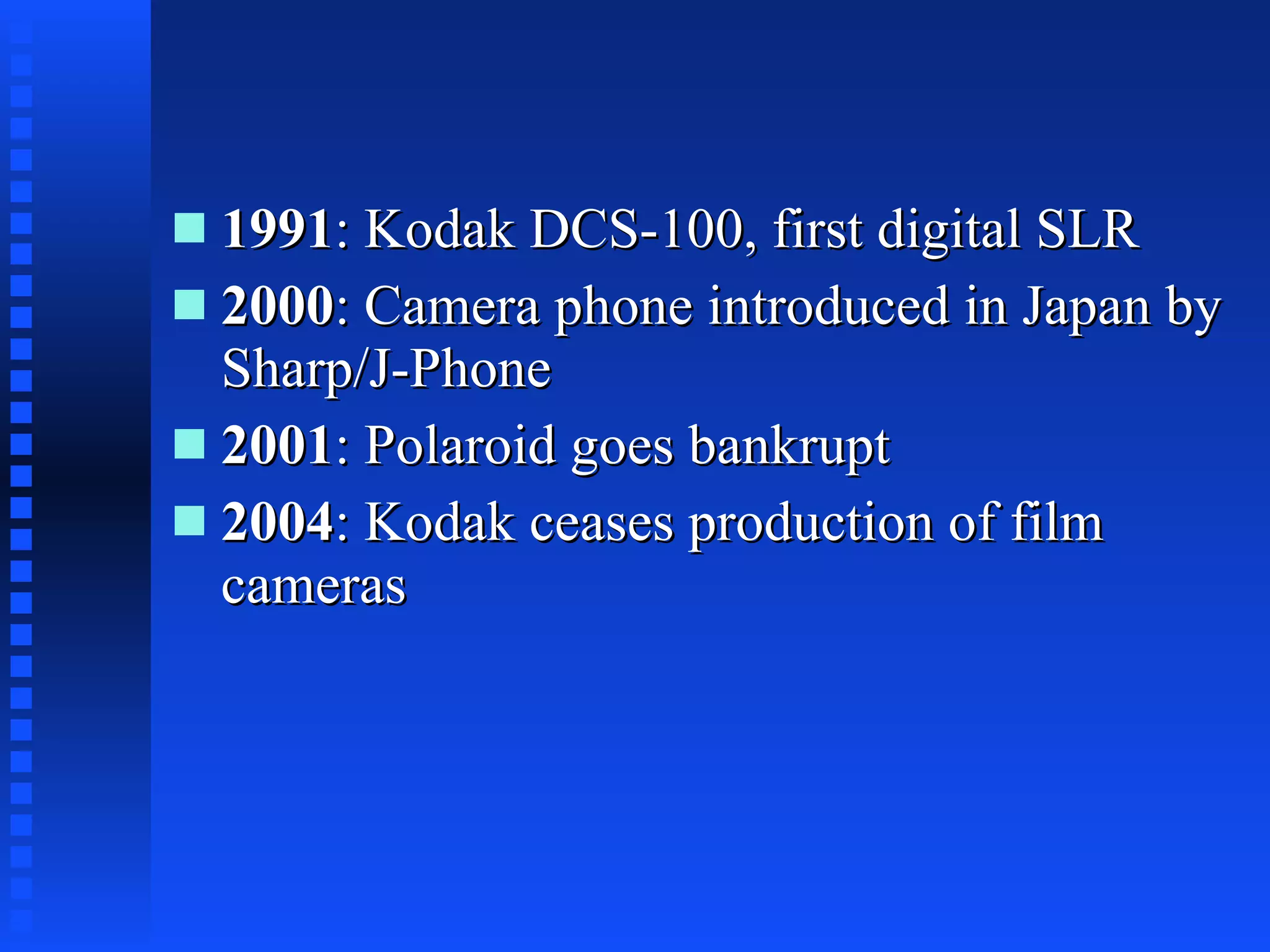
1991 : Kodak DCS-100, first digital SLR  2000 : Camera phone introduced in Japan by Sharp/J-Phone  2001 : Polaroid goes bankrupt  2004 : Kodak ceases production of film cameras

History of Imaging

  • 1.
    The History ofImaging Conventional/Silver Processes
  • 2.
  • 3.
  • 4.
    Then lead intoDrawing/Painting
  • 5.
  • 6.
    Camera Obscura Theearliest camera obscura s were actually rooms with a hole in the wall at one end, which projected an image (upside down) on the wall at the opposite end. These were eventually made portable to a box that could be carried around and pointed at various scenes to project an image on a ground-glass screen. An artist could then trace the scene from the ground glass onto paper.
  • 7.
    The first “ photo•graph ” (Light Drawing) Name: Helio•graph (Sun Drawing) Date/Location: c.1826/France Creator: Nicéphore Niépce (nee•say• fawr nyeps) Materials: Pewter plate Bitumen of Judea Oil of Lavendar Equipment: Camera Obscura Exposure time: Eight hours Disadvantages Long exposure times Poor image quality Unique image (non-reproducible)
  • 8.
    First Popular PhotographicProcess Name: Daguerreotype Date/Location: Announced 1839 France Creator: Jacques Mandé Daguerre (da• gherr ) Materials: Siver-plated copper sheet Iodine Mercury Sodium thiosulfate Exposure time: 15 - 30 seconds Not go for any motion Advantage: beautiful, durable, grainless image Disadvantages Exposure times still too long Difficult to view Poisonous chemicals Non-reproducible
  • 9.
    First Reproducible ProcessName: Calo•type (beautiful impression) or Talbotype Date/Location: 1839/England Creator: William Henry Fox Talbot Materials: Silver chloride Paper Silver iodide/Gallo nitrate Exposure time: 5 seconds Advantage: silver NEGATIVE image could be reproduced Disadvantage: paper base obscured detail of the reproduced images
  • 10.
    Wet-Plate Process Name:Collodion wet-plate (also Ambrotype & Tintype ) 1851/England Frederick Scott Archer Materials: Glass plate Collodion (nitrocellulose/ether/alcohol) Silver chloride, Silver iodide,Silver nitrate Exposure time: 5 seconds Advantages: Transparent (glass) base produced sharp, clear images Negative image could be printed on paper for limitless reproduction Disadvantages: Must be exposed and developed wet Exposure times still too long.
  • 11.
    Notable Glass PlateTaken by Alexander Gardner in 1865, the picture of Abraham Lincoln has A jagged line that appears upper-right corner of the photograph and slashes through the top of Lincoln ’ s head. It ’ s a crack in the glass-plate negative due to careless handling by the photographer or his assistant. This is one of the last images of the President before being assonated two months later.
  • 12.
    1871/England Richard L.Maddox Materials: Glass plate Gelatin emulsion (increased sensitivity of silver compounds) Silver salts Exposure time: under 1 second Advantages: Motion-stopping exposure times Plates could be exposed dry Dry-Plate Process: Gelatin Emulsion
  • 13.
    Other Improvements toConventional Photography Projection printing (enlarging) allowed use of smaller negatives/smaller cameras Emulsion coated onto flexible film allowed roll-film (George Eastman of Eastman Kodak) Color Images 1861 an additive color process 1869 subtractive color theory developed 1907 Autochrome process 1935 Kodachrome film introduced
  • 14.
    1936 : Developmentof Kodachrome, the first color multi-layered color film; development of Exakta, pioneering 35mm single-lens reflex (SLR) camera 1963 : First color instant film developed by Polaroid; Instamatic released by Kodak; 1973 : C-41 color negative process introduced. (That ’ s what we still use today for color neg. film.) 1990 : Adobe Photoshop released.
  • 15.
    1991 : KodakDCS-100, first digital SLR 2000 : Camera phone introduced in Japan by Sharp/J-Phone 2001 : Polaroid goes bankrupt 2004 : Kodak ceases production of film cameras