Prepared By:
Yousif Ismail
1
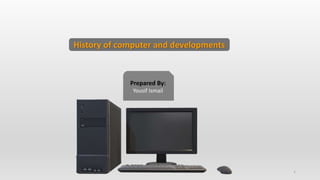
History of computer and developments
The Idea of first computer
• The idea of the first
computer came from
calculator to facilitate
mathematical actions
, and then gradually
developed into this
current advanced
device .
2
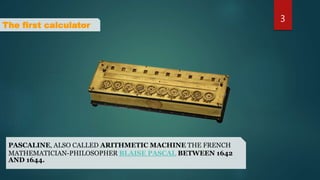
The first calculator
PASCALINE, ALSO CALLED ARITHMETIC MACHINE THE FRENCH
MATHEMATICIAN-PHILOSOPHER BLAISE PASCAL BETWEEN 1642
AND 1644.
3
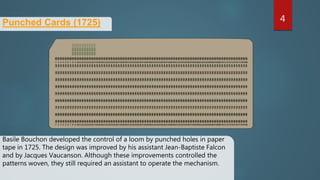
Punched Cards (1725)
Basile Bouchon developed the control of a loom by punched holes in paper
tape in 1725. The design was improved by his assistant Jean-Baptiste Falcon
and by Jacques Vaucanson. Although these improvements controlled the
patterns woven, they still required an assistant to operate the mechanism.
4
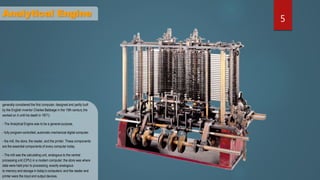
Analytical Engine
generally considered the first computer, designed and partly built
by the English inventor Charles Babbage in the 19th century (he
worked on it until his death in 1871).
- The Analytical Engine was to be a general-purpose,
- fully program-controlled, automatic mechanical digital computer.
- the mill, the store, the reader, and the printer. These components
are the essential components of every computer today.
- The mill was the calculating unit, analogous to the central
processing unit (CPU) in a modern computer; the store was where
data were held prior to processing, exactly analogous
to memory and storage in today’s computers; and the reader and
printer were the input and output devices.
5
Hewlett-Packard Founded (HP) in 1939
 Hewlett-Packard Company, American manufacturer of software and computer
services. The company split in 2015 into two companies: HP Inc. and Hewlett Packard
Enterprise. Headquarters were in Palo Alto, California.
6
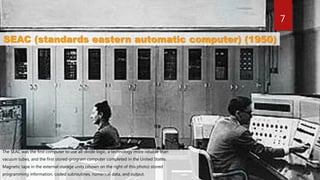
SEAC (standards eastern automatic computer) (1950)
The SEAC was the first computer to use all-diode logic, a technology more reliable than
vacuum tubes, and the first stored-program computer completed in the United States.
Magnetic tape in the external storage units (shown on the right of this photo) stored
programming information, coded subroutines, numerical data, and output.
7
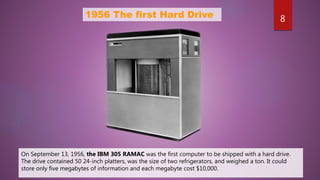
1956 The first Hard Drive
On September 13, 1956, the IBM 305 RAMAC was the first computer to be shipped with a hard drive.
The drive contained 50 24-inch platters, was the size of two refrigerators, and weighed a ton. It could
store only five megabytes of information and each megabyte cost $10,000.
8
1961-Storage IBM 1301 Disk Storage Unit
The 1301 leased for $2,100 per month or could be purchased for $115,500. The drive had
one read/write arm for each disk as well as flying heads, both of which are still used in
today's disk drives.
9
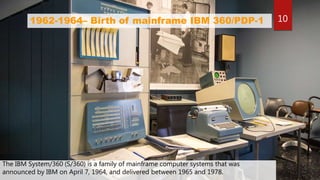
1962-1964– Birth of mainframe IBM 360/PDP-1
The IBM System/360 (S/360) is a family of mainframe computer systems that was
announced by IBM on April 7, 1964, and delivered between 1965 and 1978.
10
1966-Pong the first video game by “Ralph Baer” who
is considered the father of Video Game
Pong would revolutionize the arcade industry and launch the modern video game era.
Nolan Bushnell introduced Pong and his new company, Atari video games!
11
1974 – the alto
the first work station with a built-in mouse for input. The Alto stored several
files simultaneously in windows, offered menus and icons, and could link to a
local area network,
12
1977 – Apple ii
The Apple II became an instant success when released in 1977
13
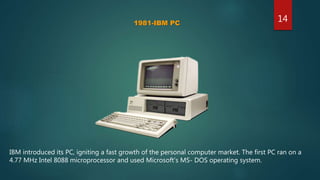
1981-IBM PC
IBM introduced its PC, igniting a fast growth of the personal computer market. The first PC ran on a
4.77 MHz Intel 8088 microprocessor and used Microsoft's MS- DOS operating system.
14
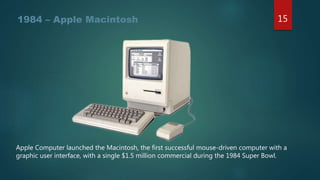
1984 – Apple Macintosh
Apple Computer launched the Macintosh, the first successful mouse-driven computer with a
graphic user interface, with a single $1.5 million commercial during the 1984 Super Bowl.
15
1987 – IBM PS/2
IBM introduced its PS/2 machines, which made the 3 1/2-inch floppy disk drive and video graphics
array standard for IBM computers
16
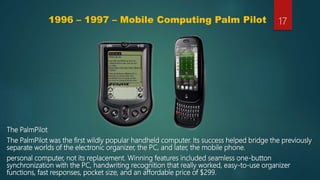
1996 – 1997 – Mobile Computing Palm Pilot
The PalmPilot
The PalmPilot was the first wildly popular handheld computer. Its success helped bridge the previously
separate worlds of the electronic organizer, the PC, and later, the mobile phone.
personal computer, not its replacement. Winning features included seamless one-button
synchronization with the PC, handwriting recognition that really worked, easy-to-use organizer
functions, fast responses, pocket size, and an affordable price of $299.
17
Computer evolution with Microsoft Windows OS
after 1998
18
19
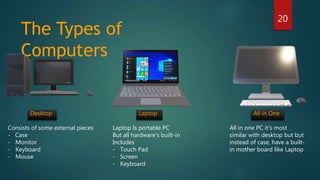
The Types of
Computers
20
Desktop
Consists of some external pieces
- Case
- Monitor
- Keyboard
- Mouse
Laptop All in One
Laptop Is portable PC
But all hardware's built-in
Includes
- Touch Pad
- Screen
- Keyboard
All in one PC it’s most
similar with desktop but but
instead of case, have a built-
in mother board like Laptop
Computer Hardware’s
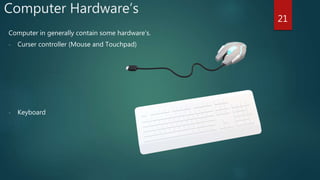
Computer in generally contain some hardware’s.
- Curser controller (Mouse and Touchpad)
- Keyboard
21
Monitor or Screen
22
Case
How does the computer work internally? What are the pieces and how do they
work together? 23
Mother Board 24
Processor (CPU) 25
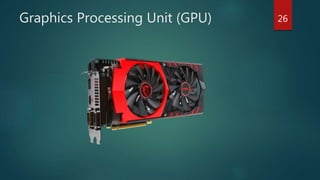
Graphics Processing Unit (GPU) 26
Random Access Memory (RAM) 27
Storage 28
SSD 2.5 HDD 2.5 HDD 3.5
Power Supply 29
Modern or today PC 30
Thanks 31

History of computer and developments

  • 1.
    Prepared By: Yousif Ismail 1 Historyof computer and developments
  • 2.
    The Idea offirst computer • The idea of the first computer came from calculator to facilitate mathematical actions , and then gradually developed into this current advanced device . 2
  • 3.
    The first calculator PASCALINE,ALSO CALLED ARITHMETIC MACHINE THE FRENCH MATHEMATICIAN-PHILOSOPHER BLAISE PASCAL BETWEEN 1642 AND 1644. 3
  • 4.
    Punched Cards (1725) BasileBouchon developed the control of a loom by punched holes in paper tape in 1725. The design was improved by his assistant Jean-Baptiste Falcon and by Jacques Vaucanson. Although these improvements controlled the patterns woven, they still required an assistant to operate the mechanism. 4
  • 5.
    Analytical Engine generally consideredthe first computer, designed and partly built by the English inventor Charles Babbage in the 19th century (he worked on it until his death in 1871). - The Analytical Engine was to be a general-purpose, - fully program-controlled, automatic mechanical digital computer. - the mill, the store, the reader, and the printer. These components are the essential components of every computer today. - The mill was the calculating unit, analogous to the central processing unit (CPU) in a modern computer; the store was where data were held prior to processing, exactly analogous to memory and storage in today’s computers; and the reader and printer were the input and output devices. 5
  • 6.
    Hewlett-Packard Founded (HP)in 1939  Hewlett-Packard Company, American manufacturer of software and computer services. The company split in 2015 into two companies: HP Inc. and Hewlett Packard Enterprise. Headquarters were in Palo Alto, California. 6
  • 7.
    SEAC (standards easternautomatic computer) (1950) The SEAC was the first computer to use all-diode logic, a technology more reliable than vacuum tubes, and the first stored-program computer completed in the United States. Magnetic tape in the external storage units (shown on the right of this photo) stored programming information, coded subroutines, numerical data, and output. 7
  • 8.
    1956 The firstHard Drive On September 13, 1956, the IBM 305 RAMAC was the first computer to be shipped with a hard drive. The drive contained 50 24-inch platters, was the size of two refrigerators, and weighed a ton. It could store only five megabytes of information and each megabyte cost $10,000. 8
  • 9.
    1961-Storage IBM 1301Disk Storage Unit The 1301 leased for $2,100 per month or could be purchased for $115,500. The drive had one read/write arm for each disk as well as flying heads, both of which are still used in today's disk drives. 9
  • 10.
    1962-1964– Birth ofmainframe IBM 360/PDP-1 The IBM System/360 (S/360) is a family of mainframe computer systems that was announced by IBM on April 7, 1964, and delivered between 1965 and 1978. 10
  • 11.
    1966-Pong the firstvideo game by “Ralph Baer” who is considered the father of Video Game Pong would revolutionize the arcade industry and launch the modern video game era. Nolan Bushnell introduced Pong and his new company, Atari video games! 11
  • 12.
    1974 – thealto the first work station with a built-in mouse for input. The Alto stored several files simultaneously in windows, offered menus and icons, and could link to a local area network, 12
  • 13.
    1977 – Appleii The Apple II became an instant success when released in 1977 13
  • 14.
    1981-IBM PC IBM introducedits PC, igniting a fast growth of the personal computer market. The first PC ran on a 4.77 MHz Intel 8088 microprocessor and used Microsoft's MS- DOS operating system. 14
  • 15.
    1984 – AppleMacintosh Apple Computer launched the Macintosh, the first successful mouse-driven computer with a graphic user interface, with a single $1.5 million commercial during the 1984 Super Bowl. 15
  • 16.
    1987 – IBMPS/2 IBM introduced its PS/2 machines, which made the 3 1/2-inch floppy disk drive and video graphics array standard for IBM computers 16
  • 17.
    1996 – 1997– Mobile Computing Palm Pilot The PalmPilot The PalmPilot was the first wildly popular handheld computer. Its success helped bridge the previously separate worlds of the electronic organizer, the PC, and later, the mobile phone. personal computer, not its replacement. Winning features included seamless one-button synchronization with the PC, handwriting recognition that really worked, easy-to-use organizer functions, fast responses, pocket size, and an affordable price of $299. 17
  • 18.
    Computer evolution withMicrosoft Windows OS after 1998 18
  • 19.
  • 20.
    The Types of Computers 20 Desktop Consistsof some external pieces - Case - Monitor - Keyboard - Mouse Laptop All in One Laptop Is portable PC But all hardware's built-in Includes - Touch Pad - Screen - Keyboard All in one PC it’s most similar with desktop but but instead of case, have a built- in mother board like Laptop
  • 21.
    Computer Hardware’s Computer ingenerally contain some hardware’s. - Curser controller (Mouse and Touchpad) - Keyboard 21
  • 22.
  • 23.
    How does thecomputer work internally? What are the pieces and how do they work together? 23
  • 24.
  • 25.
  • 26.
  • 27.
  • 28.
    Storage 28 SSD 2.5HDD 2.5 HDD 3.5
  • 29.
  • 30.
  • 31.