Self-Advocacy and HIV
Dee Yavor
Employment Specialist
Employment Services
Positive Resource Center
415-777-0333
www.positiveresource.org
What is Self-Advocacy?
Self-Advocacy is:








Learning how to speak up for yourself
Making your own decisions about your own life
Learning how to get information
Finding out who will support you in your journey
Knowing your rights and responsibilities
Problem solving
Reaching out to others when you need help and
friendship
Self-Advocacy Movement




The self-advocacy movement began
in the broader civil rights movements
of the 1960s and 1970s.
The self advocacy movement focused
on supplying people with disabilities
with the tools and experience to take
greater control over their own lives.
Self-Advocacy in Action


Assertiveness:
 Those who feel free to express their
feelings, thoughts, and desires.
 Those who know their rights.
 Those who have control over their
emotions. It does not mean that they
repress their feelings. It means that they
control it for a moment and then talk
about it later in a reasonable manner.
What is Self-Efficacy?


Self-efficacy is the belief in your ability
to complete tasks and reach goals (high
vs. low).



The concept of self-efficacy lies at the
center of Albert Bandura’s theory of
socialization, which emphasizes the role
of observational learning and social
experience in the development of
personality.
Factors affecting self-Advocacy


Experience – “Mastery Experience” Having done it before.



Modeling - “If they can do it, I can
do it.”



Social Persuasions –
Encouragement & Discouragement
At the Doctor’s Office or Clinic









Write down questions before going to a
medical appointment.
If you don’t understand something, or if
you would like more information, speak
up!
Ask for information in writing if needed.
Bring a friend with you to the
appointment. (Modeling)
Expect Resistance
Encountering Resistance


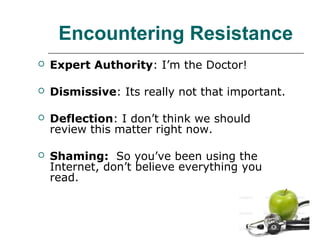
Expert Authority: I’m the Doctor!



Dismissive: Its really not that important.



Deflection: I don’t think we should
review this matter right now.



Shaming: So you’ve been using the
Internet, don’t believe everything you
read.
5 P’s of Self Advocacy
 Patient

Bill of Rights
 Patient Safety
 Prepared
 Positive
 Persistent
5 P’s of Self Advocacy


Patent Bill of Rights: I have the right to
make informed decisions about my
healthcare, to refuse or request services.



Patient Safety: Is this medication,
procedure, test, safe for me??



Prepared: I can articulate my concern or
indentify a problem and discuss solutions.
5 P’s of Self Advocacy ( con’t)


Positive: I know you care about
my well being and safety, how can
we solve this together?



Persistent: Can I check back with
you to review my meds in 2 weeks.
The Role of Information and
Social Networks.


Access to information and social
networks allows support for people to
embark on greater self-advocacy and
increase their since of self-efficacy.



Who and What are your supports?
Information and Networks that
Support Self-Advocacy
Friend
 Internet
 Telephone Hotline
Community Based Organization
 Library
 Media
 Support Group
 Family Member
 Health Care Worker



SF Community Examples of
Activism and Self-Advocacy


Project Open Hand (http://www.openhand.org/
) - In 1985 in San Francisco, Ruth Brinker, a
retired grandmother, watched a dear friend die of
AIDS. She realized that for many people with
HIV/AIDS, malnutrition was causing death as
much as the illness itself. At that time, no social
service agency was providing meals to those too
weak from AIDS or too impoverished to feed
themselves. Using her experience as a manager
with another food program, Ruth enlisted the help
of her friends, secured a basement kitchen at a
local church and began to serve meals to seven
clients, Project Open Hand was born.
SF Community Examples of
Activism and Self-advocacy


Project Inform (http://www.projectinform.org/)
- In 1985, a group of concerned community
members joined together to start a short-term
"project" at a time when reliable information
about HIV/AIDS and its treatment was nearly
impossible to obtain. Since then Project Inform
has worked to accelerate and facilitate advances
in treatment, recognizing that therapeutic
breakthroughs are only effective if people living
with HIV have access to them. The hope this
philosophy inspires is the core of Project Inform's
integrated approach to treatment education and
advocacy.
Resources
www.projectinform.org
 www.Thebody.com
 www.cdc.gov
 www.aidsmeds.com
 www.cdph.ca.gov/programs/AIDS


Advocacy and HIV

  • 1.
    Self-Advocacy and HIV DeeYavor Employment Specialist Employment Services Positive Resource Center 415-777-0333 www.positiveresource.org
  • 2.
    What is Self-Advocacy? Self-Advocacyis:        Learning how to speak up for yourself Making your own decisions about your own life Learning how to get information Finding out who will support you in your journey Knowing your rights and responsibilities Problem solving Reaching out to others when you need help and friendship
  • 3.
    Self-Advocacy Movement   The self-advocacymovement began in the broader civil rights movements of the 1960s and 1970s. The self advocacy movement focused on supplying people with disabilities with the tools and experience to take greater control over their own lives.
  • 4.
    Self-Advocacy in Action  Assertiveness: Those who feel free to express their feelings, thoughts, and desires.  Those who know their rights.  Those who have control over their emotions. It does not mean that they repress their feelings. It means that they control it for a moment and then talk about it later in a reasonable manner.
  • 5.
    What is Self-Efficacy?  Self-efficacyis the belief in your ability to complete tasks and reach goals (high vs. low).  The concept of self-efficacy lies at the center of Albert Bandura’s theory of socialization, which emphasizes the role of observational learning and social experience in the development of personality.
  • 6.
    Factors affecting self-Advocacy  Experience– “Mastery Experience” Having done it before.  Modeling - “If they can do it, I can do it.”  Social Persuasions – Encouragement & Discouragement
  • 7.
    At the Doctor’sOffice or Clinic      Write down questions before going to a medical appointment. If you don’t understand something, or if you would like more information, speak up! Ask for information in writing if needed. Bring a friend with you to the appointment. (Modeling) Expect Resistance
  • 8.
    Encountering Resistance  Expert Authority:I’m the Doctor!  Dismissive: Its really not that important.  Deflection: I don’t think we should review this matter right now.  Shaming: So you’ve been using the Internet, don’t believe everything you read.
  • 9.
    5 P’s ofSelf Advocacy  Patient Bill of Rights  Patient Safety  Prepared  Positive  Persistent
  • 10.
    5 P’s ofSelf Advocacy  Patent Bill of Rights: I have the right to make informed decisions about my healthcare, to refuse or request services.  Patient Safety: Is this medication, procedure, test, safe for me??  Prepared: I can articulate my concern or indentify a problem and discuss solutions.
  • 11.
    5 P’s ofSelf Advocacy ( con’t)  Positive: I know you care about my well being and safety, how can we solve this together?  Persistent: Can I check back with you to review my meds in 2 weeks.
  • 12.
    The Role ofInformation and Social Networks.  Access to information and social networks allows support for people to embark on greater self-advocacy and increase their since of self-efficacy.  Who and What are your supports?
  • 13.
    Information and Networksthat Support Self-Advocacy Friend  Internet  Telephone Hotline Community Based Organization  Library  Media  Support Group  Family Member  Health Care Worker  
  • 14.
    SF Community Examplesof Activism and Self-Advocacy  Project Open Hand (http://www.openhand.org/ ) - In 1985 in San Francisco, Ruth Brinker, a retired grandmother, watched a dear friend die of AIDS. She realized that for many people with HIV/AIDS, malnutrition was causing death as much as the illness itself. At that time, no social service agency was providing meals to those too weak from AIDS or too impoverished to feed themselves. Using her experience as a manager with another food program, Ruth enlisted the help of her friends, secured a basement kitchen at a local church and began to serve meals to seven clients, Project Open Hand was born.
  • 15.
    SF Community Examplesof Activism and Self-advocacy  Project Inform (http://www.projectinform.org/) - In 1985, a group of concerned community members joined together to start a short-term "project" at a time when reliable information about HIV/AIDS and its treatment was nearly impossible to obtain. Since then Project Inform has worked to accelerate and facilitate advances in treatment, recognizing that therapeutic breakthroughs are only effective if people living with HIV have access to them. The hope this philosophy inspires is the core of Project Inform's integrated approach to treatment education and advocacy.
  • 16.
    Resources www.projectinform.org  www.Thebody.com  www.cdc.gov www.aidsmeds.com  www.cdph.ca.gov/programs/AIDS 