UNIT1: COLLECTING
AND ANALYZING
HISTORICAL SOURCES
Complementarities of historical sources
Oral traditional sources
Oral tradition is defined as any information
passed by word of mouth (verbally) from one
generation to another. This is done through
socialisation, especially between the young and
the old (poems, songs, proverbs, recites etc…).
The complementarities of oral historical sources include:
a) Written sources: traditional music, poetry, stories, legends,
poems and proverbs can be written to serve the future
generations.
b) Linguistic sources: this involves studying and analyzing
languages, their sound, formation and relationship with
other languages, the findings are then narrated to other
generations.
c) Archaeological sources: It involves the digging of the
ground to discover of long ago fossils for research purpose.
Archeological sites include temples, caves, places, rocks,
shelters, etc. the findings are narrated to other
generations.
Written sources
These are recorded information found in books, bibles,
magazines, newspapers, diaries, journals and other written
records.
The following are example of complementarities between
written sources and other sources
a) Oral sources: narratives from eye witnesses and testimonies
are usually written down in diaries and books which are later
used as written sources of information.
b) Archeology: It involves the digging of the ground to discover
of long ago fossils for research purpose. It complements
written sources because after carbon dating the results and
findings made are written down.
ANTHROPOLOGY
Anthropology involves the study of existing social institutions
and relationship of people’s culture, tradition, norms, values
and attitudes.
The following are examples of other sources which are
complementary to anthropology:
a) Written sources: after studying and analyzing values,
norms and attitudes of people, findings are written down
for helping current and future generations.
b) Oral tradition: through narration about the past,
anthropologists acquire relevant information about
people’s cultures. Therefore, anthropologist study how
cultures and different societies were established.
ARCHAEOLOGY
This is the study of dug up materials remains of the people’s
past. This source is complementary with other sources of
History in the following ways:
a) Oral sources: Narrative and stories can help in the location
where fossils can be found.
b) Written sources: a person can study about fossils from
books and articles on archaeology.
c) Audio-visual sources: Activities of archaeologists can be
watched on television and videos, and listened to radios.
LINGUISTIC SOURCES
This involves studying and analyzing languages, their sound structure,
formation and relationship with other languages.
Linguistic source is well complimented by other historical sources such as:
a) Written sources: some books provide information on how some words
should be pronounced, this helps in language analysis, sound and
structure.
b) Anthropology: the study of the existing social institutions and culture
involves people’s languages
c) Oral sources: oral sources provide to linguistic sources the
pronunciation of some words in given language. It also helps to explain
the origin of some languages that are used in oral traditional sources.
ELECTRONIC OR AUDIO-VISUAL SOURCES
This source deals with obtaining information by listening to or watching other
devices by using modern technology like mobile phones, radios, televisions and
internet.
The following are complementarities of electronic sources with other sources of
history:
a) Oral sources: for example a journalist broadcasts historical information on
TV in a way of narration
b) Archaeological sources: once archaeological source is discovered, a video
recording can be done, recording maybe posted on internet for people to
watch and listen to, it may also be broadcasted on a television station
c) Written sources: various written documents are required in aiding the
recording and arrangement of information before being put in electronic
form
Challenges faced when using, material,
immaterial and electronic sources
Material sources: These include the use of
important historical sources that can be
considered while collecting historical information.
For example: written and archaeology sources
Immaterial sources: These are historical sources
that are less used today in a particular situation.
They include oral traditional and anthropology
sources.
Challenges faced in using material sources
The following are challenges faced when using material
sources
Written records cannot be used by illiterate people. It is
only limited to those who can read and write.
Some material sources such as archaeology and
linguistics require skills. This explains why archaeologists
and linguists are very rare in developing countries.
Material sources are also time consuming. For example,
archaeology may require a lot of time to identify the place where
historical evidence can be dug up. It also requires time to correctly
analyse the materials.
Material sources such as archaeology are expensive to invest in.
This is because they require professionals and special equipment
to participate in the digging up and interpreting the findings.
Material sources such as written records can be easily destroyed
by fire or water.
Challenges faced in using immaterial sources
The use of immaterial sources is associated with the
following challenges:
The use of oral traditional sources is not always accurate.
Some information may be highly exaggerated to include
few or no failures and weaknesses but more successes and
achievements.
Immaterial sources such as oral traditional are affected by the death
of an eye witness. Once he or she dies, information can never be
recovered.
Anthropology requires skilled people and experts. These experts are
very few.
Immaterial sources are affected by language barrier. Information
may be collected in a local language which might be not easy to
translate into other languages.
Challenges faced in using Electronic or audio-
visual sources
These include the use of modern technology such as mobile
phones, radios, television, cinemas and the Internet.
The challenges faced when using electronic sources include
the following:
They require reliable power supply such as solar or electric
power.
Without power supply, they cannot be used.
In remote areas without network coverage, television, mobile
phones and internet cannot be used.
They may be costly to acquire. Radios, mobile phones, television
and cinemas require money to buy. This is a real challenge to low
income earners, especially in developing countries.
Electronic sources such as radios cannot be used by people with
hearing impairment. Television cannot be used by those with visual
impairment.
The use of internet requires one to have knowledge about
information and communication technology. He or she must know
how to use the computer. A person who is not computer literate
may not access information from it.
Usefulness of different sources of history
Learning objectives:
1) Explain the validity of different sources of
History.
2) Assess the validity of different sources of
history in order to determine the most
appropriate source to use.
3) Appreciate how different methods are used.
Oral sources
❖Easy access (they can be found easily since it is sourced
from people)
❖They are the cheapest sources , there is no monetary
expense involved as they are passed down by words of the
mouth
❖They give first-hand information (it is given by people who
were present at event)
❖They are easy to verify as they involves interviewing living
people
❖They are most of time given by a witness
❖They facilitate the verification of the
other sources.
❖They are more detailed
❖The illiterate can also attain to
information.
❖They provide a lot of information in a
short time.
Archaeological source (records)
❖It gives true information since it is backed by
evidences.
❖It gives information about the past on which we have
no written records or oral information.
❖It helped in discovering pre-historic information in
different parts of the world.
❖It tells us about the life, culture and evolution of
technology of ancient people.
LINGUISTIC SOURCE
❖It has helped in identifying and classifying languages.
❖It is cheap since there is no payment for the study of
languages spoken.
❖It helps to determine origin, migration and settlement of
people.
❖The source of information is not easily destroyed since it
cannot die.
❖Linguistics helped to classify people of Africa into various
language groups like the Bantu and the Nilotes(people from
Sudan, Uganda, Kenya and Tanzania who speak Nilotic)
GERMAN AND BELGIAN COLONISATION
Learning objectives:
a) Explain the causes of German and Belgian colonisations,
b) Identify the effects of German colonisation,
c) Identify the political, economic, judicial, socio-cultural
transformations introduced by Belgians.
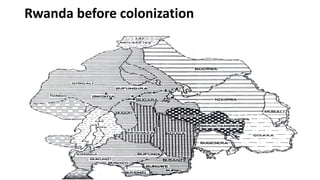
Rwanda before colonization
Introduction
By Berlin conference 1884-1885, Rwanda was placed in
Deutsche Ostafrica meaning German East Africa composed by
Rwanda, Burundi and Tanganyika. Rwanda remained a
German protectorate until 1916 (failure of German in the
World War I) and it was given as a Mandate by the League of
Nations to Belgium.
After the WWII, Rwanda was placed under UN Trusteeship
until 1962; date of independence. All over this period, there
have been many transformations that greatly influenced the
socio- political and economic evolution of Rwandan society.
Causes of Germany and Belgian colonization of
Rwanda
Colonization: is the process through which a powerful country takes
over control on a weak country. German and Belgian colonization to
Rwanda was due to the following reasons:
The need for raw materials: Germans and Belgians need raw materials
to feed their home industries which had grown as result of industrial
revolution. These raw materials were minerals like tin, etc. which were
available in Rwanda.
The growing demand of tea, coffee, sugar and cacao: those cash crops
were at high demand in German and Belgium while Rwanda had fertile
land for tea, coffee and sugar cane plantation.
The desires for new markets for their manufactured products: this is
because factories were producing more goods than that people at
home were ready to consume.
The need to invest the surplus capital: Factory owner in German
and Belgium had grown rich; they needed new area to invest their
money.
The need to civilize uncivilized Rwandans: For westerns people
whose way of life and religion were different from that of
Rwandans. They wanted to introduce their civilization to
Rwandans.
The need for more land to settle their growing population: during
industrial revolution discoveries in heath domain were made, this
had reduced the mortality rate in European countries including
German and Belgium; this led to high population growth and land
scarcity.
Nationalism (pride in one’s country); Europeans including
Germans and Belgians thought that having colonies would
increase their countries’ strength, this pushed them to colonize
Rwanda.
The need to spread Christianity in Rwanda: Germans
and Belgians were Christians (catholic especially) while
Rwandans were practicing the traditional religion.
The need to decrease the unemployment rate: the
industrial revolution caused unemployment in Europe,
they came in order to create new jobs in their colonies
The role played by mass media which exaggerated the
economic potential of Africa.
The Berlin conference of 1884-1885 and its effects also
led to the partitioning of the African continent.
Rwanda under German colonization
In Rwanda, Germans used indirect rule. This form
of administration used traditional leaders to
administer on behalf of the Germans. It also
respected and maintained local culture.
The implementation of the German rule was to be
attained through the Military Phase and Civil
Administration Phase.
Military Phase (1897-1907)
This phase was characterised by occupation of Rwanda
between 1897 and 1907. At the same time, the German
government gave support to the local leaders to stop
several revolts.
Therefore, the military post at Shangi and Gisenyi were
only meant to bring people in those areas under
German rule and under the local Rwandan regime ruled
by King Yuhi V Musinga.
Civil Administration Phase (1907-1916)
This phase was characterised by the following events:
❖Services were transferred from Usumbura to Kigali the capital of Rwanda,
❖The government was headed by Richard Kandt and his residence was at Kigali.
❖Establishment of civil administration, conducting census, collecting taxes, and
creating of police force worked for Germans.
❖Germany provided military support to local leaders against rebellion of
Ndungutse whose real name BIRASISENGE, and Basebya.
❖The fighting and killing of rebellions such as Ndungutse, Basebya, and Rukara
rwa Bishingwe.
❖The comig of Christian missionaries in Rwanda such as Catholics, and
protestants.
Causes of Ndungutse rebellion
The following were the causes of the Ndungutse rebellion in northern
Rwanda:
1. There was need to recover lost glory by the people which had been
taken over by the royal court of Rwanda.
2. They were also subjected to forced labour introduced by the
Germans during the fixing of frontiers in 1910. To them, this was
unfair, and therefore made them to revolt.
3. The Germans forced people to supply them with food. This annoyed
them, causing a revolt not only against the German rule, but also to
the central authority headed by the king.
The First World War in Rwanda
The First World War that occured between 1914 and 1918
was mainly fought among European nations. However, its
impact was indirectly felt in other continents including
America, Asia and Africa.
In Rwanda Germans fought Belgians colonizer of Congo. The
war was mainly fought in Bugoyi and Cyagungu in west of
Rwanda.
It was Germans that began the war by attacking Belgians at
Idjwi island in September 1914.
Belgians were supported by British troops. The troops were deployed in two
directions.
a) On the side of Gisenyi, Colonel Molitor (a Belgian) crossed the volcanoes
through Uganda and proceeded from Gasabo to Kigali which was finally
captured on 6th May 1916. Nyanza collapsed on 19th May 1916.
b) Later, the Belgians moved on with the war through the Rwandan territory
towards Burundi.
During the war, Rwanda did all she could to support Germany. This support
ranged from providing armed warriors called Indugaruga as well as supplying
food.
For that reason therefore, there was an agreement and collaboration between
King Musinga and on the side of Dr Kandt and Captain Max Wingtens. Bwana
Tembasi commanded German troops in Rwanda between 1914 and 1916.
Impact of German colonisation
The effects of German colonization to Rwanda are discussed as follow:
Rwanda had lost her sovereignty: by colonization, Rwanda lost her
political independence for the profit of German.
Loss of lives: some Rwandans lost their lives while helping German
colonialists against Belgians during the first world war.
Reduction of the size of Rwanda: Rwanda lost its big part due to the
agreement between Germany, Britain, and Belgium to fixe borders of
African countries.
Decline of Traditional religion: German had been able to Protect catholic and
protestant Lutheran missionaries who came to Rwanda, this led to the spread of
Christianity.
Open Rwanda to worldwide: Germany managed to open the country to the
international trade through export of cow hides.
Abolition of barter trade: Germans introduced cash economy which replaced barter
trade.
Introduction of cash crops: Forced Coffee plantations were introduced.
Forced labor: Rwandans were forced to provide free labor for roads construction
and coffee plantation.
Kigali became a centre between the west of Rwanda and Urundi on one hand and
Bukoba on the other hand
Abolition of Rwandan traditional school (Itorero): They built a school at Nyanza in
1907, but this school was admitted children of chiefs learning Kiswahili, reading,
writing and arithmetic, this led to the decline of traditional school.
Introduction of head tax: German colonisation of Rwanda led to the
introduction of the head tax on male adult Rwandans.
Coming of European missionaries: such as Roman Catholic
missionaries, led by the White Fathers, came to Rwanda in 1900. They
were followed by the Presbyterian missionaries in 1907. This promoted
Christianity in Rwanda.
Integration of Rwanda in world economy: German colonisation of
Rwanda led to the export of large quantities of hides and skins and
livestock. The exportation was mainly to European countries. This
initiated a market economy in Rwanda.
Reforms introduced by Belgians
The Belgian administration in Rwanda began from 1916 up to the
independence after defeat Germans. It therefore led to a total
change in Rwanda’s political, social, economic, cultural and religious
sectors. It is important to distinguish the reforms introduced by
Belgians in Rwanda into three stages of the entire Belgian rule.
These are:
i) Reforms introduced during the Military Administration (1916-1924)
ii) ii) Reforms introduced during the Belgian Mandate (1926-1946)
iii) Reforms introduced during the Trusteeship (1946-1962)
Reforms introduced during the Military
Administration (1916 - 1924)
Rwanda under Belgian military leadership, was divided
into military sectors namely: Ruhengeri, Gisenyi,
Nyanza and Cyangugu. These military sectors were later
transformed into territories. They include:
1) The western territory (Rubengera territory capital)
2) Northern territory (Ruhengeri territory capital)
3) The territory of Nyanza (Nyanza territory capital)
4) The Eastern territory (Kigali territory capital)
Reforms introduced by Belgian military administration
Systematic disintegration of the monarchy: this was replaced by
Belgian military leadership that works for their benefits.
Undermining the Mwami’s (king’s) legal power: this reduced the king’s
authority he had before colonialism such right to decide whether
criminal could be sentenced to death.
Reduction of the Mwami’s (king’s) political power: the king had no
longer right to appoint chiefs who assisted him in giving order,
collecting taxes, etc..
Abolition of ubwiru and umuganura: this was done in order to weaken
the traditional institution that played a big role in maintaining order in
the country.
Declaration of religious freedom: this had reduced the
king’s religious power that assisted him to connect
Rwandans to God (Nyagasani). Thus tradition religion was
replaced by Christianity.
Abolition of imponoke and indabukirano:This was aimed at
weakening the influence of the king over his subjects. It was
also to help the Belgians remain with monopoly of power.
In fact, the occupation of Belgian military administration in
Rwanda, had undermined and abolished Rwanda’s
monarchy in terms of their own benefits.
Concept of Indabukirano in traditional
rwanda.
Indabukirano were gifts given to the chief after
being nominated and coronated to the position.
The gifts included items like cows and beer
(indabukirano).
Such was meant to show loyalty to him by his
subjects. It was also to enable the new chief cope
with the new lifestyle, to show happiness and to
congratulate the new chief
Concept of Imponoke in traditional Rwanda
Imponoke was a sign of compensation to the chief usually
after a heavy loss of cows, especially due to diseases or being
struck by lightening.
This was a sign of active by standership to the chief by his
subjects. Generally, to the chief, it was a way of compensating
him for the loss of cows and to enable him continue living
within the lifestyle he was used to before the loss.
It was one of the ways Rwandans used to show concern for
others in the society.
Importance of Indabukirano and Imponoke
❖They were ways of demonstrating loyalty and humility to the chief.
❖They were meant to show love and respect for the chieftaincy.
❖They enabled the chief to rule his subjects happily.
❖They helped to improve the status of the chief (to make him different
from ordinary people).
❖ They enabled the chief to solve some of the problems that befell his
subjects such as famine.
❖They were ways of ensuring sufficient food supply to him and his
family.
❖They were ways of showing happiness and congratulating the king.
Reforms introduced during the Belgian Mandate
(1926-1946)
A mandated territory is a country or territory
that is governed by another country based on
the authority given by the League of Nations.
The mandate may imply different forms of
government varying from direct
administration by the other country to being
self governing.
Reforms in administration 1926-1931
Belgian mandate in Rwanda was approved
October 20. 1924 by the Belgian parliament.
Its mission was to stop slavery trade, and
promote religious freedom. It therefore
brought many reforms in political, economic
and socio-cultural aspects.
Political reforms
There was Mortehan reforms that put an end of three-tier in
their various regions.
❖Chiefs were in turn replaced by their sons who worked for
Belgian benefits.
❖The king and chiefs were no longer leaders of the kingdom
that later led to the Deposition of King Yuhi V Musinga in
1931.
❖ the King Yuhi V musinga was replaced by Rudahigwa under
the royal name of Mutara III.
Reasons for the deportation of King Musinga in 1931
King Musinga was deported due to the following reasons:
❖He collaborated with the German administrators in order to
support him to defeat the northern rebellions.
❖He was opposed to the missionary activities, especially those of
the Catholic Church. He considered Christianity as one way for
weakening his position.
❖King Musinga had been accused of being opposed to moral,
social and economic activities of the colonial administration.
❖He is at the same time accused of being hostile to the work of
the missionaries.
Therefore, On July 12, 1931, Governor General Voisin
announced the deposition of King Yuhi V Musinga.
The king was asked to leave Nyanza royal court to Kamembe in
Kinyaga. Musinga left for Kamembe on July 14, 1931.
Later, Rudahigwa, the son of the chief of Nduga-Marangara,
was proclaimed King by Vice-Governor General Voisin under
the royal name of Mutara III.
King Musinga was moved from Kamembe to Moba near
Bukavu in Democratic Republic of Congo (D.R.C.) in 1940. He
spent the last bitter years of his life here, eventually dying on
October 25, 1944.
Socio-cultural reforms
Belgian mandate in Rwanda had socially brought the
following reforms:
❖Abolition of traditional education (Itorero): this was
replaced by formal education. Young Rwandans were no
longer taught Rwandan cultural values. Thus they have been
taught about science and Christianity.
❖Establishment of teacher training schools in various
regions in Rwanda. For instance teacher training school in
Zaza, Ruhengeri etc..
❖Establishment and construction of health centres and
hospitals to serve colonists and their followers. For
example Kabgayi, Kigali, Shyira hospitals.
❖Religion (Christianity): This introduced catholics, Anglican,
and Presbyterians churches in Rwanda. Thus, it led to the
abolition of traditional religion of Rwandans.
❖ Introduction of identity cards: Rwandan was first
identified by his clan. Being Hutu, Twa or Tutsi was a mere
social category. The identity cards which were introduced
by the Belgians in 1935 classified Rwandans as belonging to
Tutsi, Hutu and Twa as ethnic groups.
Economic reforms
Some of the economic reforms introduced in Rwanda during
the Belgian Mandate include the following:
❖Forced labour policy: Rwandans forcedly went to work in
construction of road and offices that could facilitate Belgian
colonialists. Otherwise Rwandans got nothing in return.
❖Agriculture and animal husbandry: there were
establishment of agricultural research centres in various
parts of the country to ensure the best harvests. For example
Rubona, Rwerere, Karama etc…
❖Mining activities: there was establishment of mining companies that
work for colonialists. For example (SOMUKI: Société Minière de Muhinga-
Kigali) in1934. Some other mining companies such as GEORWANDA was
established in 1945 while Compagne de Recherche et d’Exploitation
Minière (COREM) was established in 1948
❖Taxation policy: Belgians introduced poll tax in 1917 to finance their
administration and projetcs. This was compulsory for all adult male
Rwandans.
❖ Trade and commerce: there was introduction of monetary based
economy. Rwandans started grow cash crops for Belgian factors.
❖ Infrastructural development: there was construction of main roads that
facilitated Belgians to bring agricultural products to the sea ports.
Mining societies (companies)
❖MINETAIN: Société de Mine d’ Etain founded in 1926 worked at
Gatumba and Musha.
❖SOMUKI: Société Minierè de Muhinga et de Kigali: worked at
Rutongo.
❖COREM: Companie de Recherche et d’exploitation Miniere worked at
Gifurwe
❖GEORWANDA: worked at Rwinkavu
Reforms introduced during the Trusteeship
(1946-1962)
A trustee in a person to whom property is legally commuted in
trust, to be applied either for the benefit of specified
individuals, or for public uses.
It was in this way the United Nation trusted its administration
of colonies to some countries after the 2nd world war.
Trusteeship was aimed at preparing colonies for self rule. But
In during this period the colonialists used all means to divide
Rwandans to the extent that for the first time in its history
hundreds of thousands of its people were exiled from their
motherland.
Political reforms
❖ Formation of the government council for Rwanda-Burundi by May
4,1947 joined by the kings of Rwanda and Burundi in 1949
❖By 1952 government council was abolished and replaced by general
council for Rwanda-Burundi made up of 53 members
These councils played a consultative role
• By decree of 14th July, 1952, Belgium established the following organs to
represent the population:
• Conseil de sous-chefferie
• Conseil de chefferie
• Conseil de territoire
• Conseil superieur du Pays
❖The formation of political parties: from 1959, Belgians encouraged
the creation of political parties which were based on the ethnic
groups. For example: APRSOMA, UNAR, RADER, PARMEHUTU and
AREDETWA.
❖More than 300 Hutu chiefs and sub-chiefs were appointed to replace
Tutsi leaders who had been deposed, killed or fled during the initial
stages of uprising (1959 political crisis).
❖ By 1960, sub- chiefdoms were reduced from 544 to 229 and they
were called communes, the chiefdoms were abolished, the 10
territories became prefectures,
❖ At the same time, the Conseil Superieur du pay was dissolve and
replaced by a Special provisional council made of 8 members; six
from 4 main political parties (APROSOMA, PARMEHUTU, RADER and
UNAR), plus two members one representing Belgian colonial
government and other one representing the king (Ndahindurwa),
❖Formation of national assembly: the National assembly was
constituted replacing the special provisional council, it was
composed of 48 members (32 from PARMEHUTU, 6 from
APROSOMA, 9from RADER and 1 from AREDETWA).
❖ Establishment of first provisional Rwandan government (made of
10 ministers and 9 Belgian state secretaries): On October 20, 1960,
the Belgian government established the first government in Rwanda.
❖Abolition of monarchy: On October 1, 1961, Jean Paul Harroi
(resident of Rwanda-Urundi), based on referendum confirmed the
abolition of monarch. (In referendum of September 25, 1961,
people who wanted the kingship were 253,963 while 1,004,339
were against it).
❖Formation of the republic of Rwanda: On October 26,1961,
national assembly declared Rwanda a republic and elected
Geregoire Kayibanda the new republican leader on October
26,1961.
❖Belgians gave Rwanda its independence: On July 1, 1962, Rwanda
got its independence from Belgians.
Economic reforms
❖Belgian government elaborated a ten year social and
economic development plan for Rwanda –Burundi in 1951,
this was financed by:
• Fund raised from increasing taxes on natives
• External funds from the Belgian Native Well Being Fund
❖ Belgians promoted electricity, from 1958 dams were
constructed to produce hydro-electric power. These were:
• Mururu on Rusizi river
• Ntaruka between Burera and Ruhondo Lakes
• Sebeya
❖They promoted infrastructures: there was the
construction of schools, hospitals, dispensaries,
roads, development of marshland and planting
forests
❖They also promoted tourism, Belgians set up
the Akagera and Virunga parks.
❖Abolition of the socio-economic and political
dependence (Ubuhake) systems based on cows
Effects of Belgian colonisation
Belgian colonization had
effected political, economic
and social aspects of Rwanda.
Some of the effects are
discussed below:
Political effects
Change in the traditional administration: Belgians used
indirect rule and abolished tradition leadership which
undermined the King’s position.
Formation of councils: there was formation of councils. These
were mainly to prepare Rwandans for autonomy that was to
enable them gain total independence.
Formation of political parties: formation of political parties
which were to compete for power during the transition to
democracy. However, this was not achieved at all.
Economic effects
Improvement in agriculture: there was introduction of
new food crops and cash crops, and introduction of
research centers and animal breeding centres.
Generation of electricity: from 1958, the dams were
constructed to produce hydro-electric power. These
included Mururu on Rusizi River and Ntaruka HEP
stations
Establishment of industries: Belgians were
instrumental in the setting up of industries in Rwanda.
Examples of such industries include BRALIRWA.
Introduction of commercial mining: Belgians established mining
companies in Rwanda. For example (MINETAIN: Société des Mines
d’étain du Ruanda-Urundi) and Muhinga-Kigali mining company.
Construction of roads: In the 1920s and 1930s, Belgians constructed
various roads to facilitate trade.
Decline of traditional crafts: The traditional manufacturing sector was
harshly discouraged and total removed, they introduced imported
goods like hoes, saucepans, clothes, salt and knives.
Forced labor was introduced: men and women were forced to work
long hours in Belgian plantations and road construction works
Introduction of taxes: Belgians also introduced the collection of taxes.
The introduction of cash taxes instead of agricultural produce was
intended to increase cultivation of coffee as a cash crop in their favour.
Social effects
Abolition of traditional education: The
Belgian colonialists abolished traditional
education through itorero and replaced it
with colonial education. They established
schools like G.S Astrida, teacher training
schools and seminaries
Establishment of health centres: Belgians also set up
health centres to take care of the people. The
government hospitals established during the Belgian
rule included the hospitals at Kigali, Butare, Nyanza,
Kibuye, Gisenyi, Ruhengeri, Byumba, Kibungo and
Rwamagana. Gishari.
Construction of churches: They also constructed
churches in different parts of the country like in
Kabgayi, Ngoma-Mugonero and Gahini. This was to
facilitate the spread of Christianity.
Unit 3: CAUSES AND
COURSE OF THE 1994
GENOCIDE AGAINST
THE TUTSI
Meaning and definition of Genocide
Genocide is the mass killing of innocent people based on their
tribe, race, religion, political ideas, among other reasons, with
an intention of completely wiping them out.
The 1994 Genocide against the Tutsi was the mass killing of
innocent Tutsi based on racism. The Genocide against the
Tutsi began on the night of April 7, 1994, only a few hours
after the death of President Habyarimana.
Causes of Genocide against the Tutsi
Division ideology: which was supported by German and
Belgian colonialists that had led to Long term hatred of the
Tutsi by the Hutu.
Bad leadership during the first and the second Republics:
they were characterized by genocide ideology, murder which
increased hatred instead of developing unity among
Rwandans.
The culture of impunity: criminals who committed crimes
against humanity were rewarded by being promoted to
important administrative positions instead of being
punished which favoured the majority Hutu. This increased
the killing of the Tutsi.
Role played by local media: which incited the killing of
Tutsi through their notorious publications and
broadcasts.
Role of international media: which denied informing
internationally what was happening in Rwanda. This
caused little public pressure in the west for government
to intervene.
Role played by French government: which helped the
government of second republic to train militias groups
such as Interahamwe and Impuzamugambi to be used
in implementing genocide against Tutsi.
Planning and execution of Genocide against the
Tutsi
Genocide ideology began from 1959. it continued in
the first and second republics. There were trails of
killing innocent Tutsis in schools, and other sectors of
the country. Thereafter, the Genocide against Tutsis
began on 7th April, 1994 after few hours of the death of
President Habyarimana.
Therefore, Genocide was planed for long term and
implanted as follow:
Identification of the enemy: The enemy to be eliminated was
any Tutsi within the country. Enemies also included moderate
Hutu who were seen as sympathisers.
Preparation and establishment of lists: As part of the
conspiracy to exterminate the Tutsi, civilian and military
authorities and militia prepared lists of persons to be
eliminated. This was done by establishing a list of the people
to kill especially the Tutsis. It also included politicians,
intellectuals, businessmen and ordinary people in Kigali and
elsewhere in the country. As early as in October 1990, lists
were used for arrests.
Creation of civilian militia: Militias comprised of
organised groups, armed individuals and army troops
(Garde présidentielle, Interahamwe and
impuzamugambi militias). These were trained and
served as a complementary force to Rwandan army to
ensure that all enemies were killed.
Setting up road blocks: Day and night patrols
(Amarondo) were set up in different corners of the
country to prevent any attempt to escape
Course of the 1994 Genocide against the Tutsi
❖ Mass killings started in the night of 6th April 1994, immediately
after the crash of the presidential airplane, following the
incitement from the media and genocidal planners, soldiers of
presidential guard and interahamwe militias started systematic
elimination of Tutsi and Hutu political figures in opposition.
❖ On April 8th, 1994, Dr. Sindikubwabo Theodore was nominated
president of the republic and Kambanda Jean as prime minister,
this government gave orders to execute genocide.
❖ From the night of April 6th -11th, 1994, the horror spread
throughout the entire country except Gitarama and Butare
where killings began respectively on 15th and 19th April after the
sensitization of the government
❖ At the beginning the assailant in small groups killed the victims
at their homes, on the roads or arrested them at road blocks.
❖ The local authorities encouraged the victims to look asylum at
public offices like churches, commune offices, hospitals, schools,
stadium, etc with the plan of facilitating and accelerating mass
killings as assailants found them in big number in one place.
❖ Killers used many forms of extreme violence like burning people
alive, throwing people into pit latrines, forcing family members to kill
each other, using tools like machetes, grenades, bullets, impiri,
among others.
❖ On 12th April 1994, the interim government (called Abatabazi) fled
the capital Kigali due to advance of RPF-Inkotanyi and settled in
Gitarama at Murambi. Later on it moved to Gisenyi and in refugee
camps in Goma (Zaire)
❖Finally, RPF Inkotanyi soldiers stopped the mass killings and scored
victory over genocidal forces, on 4th July, 1994 Kigali city and Butare
were liberated; this marked the end of genocide.
Note: from April to July (3mothns), more than a million of people
(Tutis, and moderate Hutu) were killed.
Actors of genocide against the Tutsi
The Genocide against the Tutsi in Rwanda had different categories of
actors: organisers, executors, accomplices of killers and those who
killed observers:
❖ Government of Rwanda under Habyarimana
❖ Militias: Interahamwe and Impuzamugambi
❖ Forces of Garde présidentielle (Republican forces): They actively
participated in the killings all over the country as from 19th April
1994.
❖ Civil servants and the military: These include prefecture and
commune civil servants and commune police. They organised militias
and Hutu citizens to track and kill the victims hiding in many places
including hills and houses.
❖Local actors: These included businessmen, MRND local representatives and
local opinion leaders (such as teachers and entrepreneurs). They worked hand
in hand with local authorities to implement government directives and to
execute the genocide against the Tutsi.
❖Citizens: They played the role of being observers, executors and accomplices
to the killing of innocent relatives, brothers, sisters, colleagues and friends. The
targeted group to be exterminated was the Tutsi population without any
distinction of age, religion, region and sex.
Note: One could assert that among all these categories, there were a few
numbers that were reluctant to act as they were expected. Some accepted to
die instead of killing their brothers, sisters, neighbours and friends while others
used all means to save those who were being killed by providing them refuge or
helping them escape the danger before RPF forces arrived. Some testimonies of
genocide survivors proved this fact.
Role played by RPF/RPA to stop the genocide against the Tutsi
The role of RPF forces in stopping the Genocide is of major
importance. From the onset of the 1990 Liberation War, RPF
forces worked to liberate the country from the hands of
dictator Juvenal Habyarimana and his clique among the Akazu.
When the mass killings started from 7th April 1994 (though it
had taken place sporadically since 1959) to July 1994, RPF
forces doubled their mission.
They fought to liberate the country at the same time stopping
genocide and saving victims.
Below are the ways RPF forces laboured to save lives:
❖ On 7th April 1994, the chairman of RPA High
command, General Paul Kagame, convened an
emergency meeting of RPA High command at Mulindi
Headquarters. From that meeting, General Kagame
gave orders to stop the genocide, defeat the genocidal
forces (F.A.R and Militias) and rescue genocide
survivors.
❖ During the 100 days of the genocide against the Tutsi,
the RPA saved thousands of people through rescue
operations conducted across the country.
❖ Rescuing civilians was the main objective of the campaign
against the genocide.
The genocide was stopped on 4th July 1994 when the
genocidal forces and F.A.R (Forces Armées Rwandaises) were
defeated and Kigali liberated. The struggle for liberation and
stopping the genocide continued countrywide until 17th July
1994.
Finally, areas that were controlled by the French forces under
zone Turquoise (Gikongoro, Cyangugu and Kibuye) were also
liberated at a later stage, leading to the total liberation of
Rwanda.
Unit 4: KINGDOMS OF
EAST AND CENTRAL
AFRICA
BUGANDA KINGDOM
This was one of the most developed and
highly centralised states in the interlacustrine
region in the middle of 19th Century. It
covered the area between Lake Kyoga and
Lake Victoria in the north and south
respectively. To the west she was boarded by
Bunyoro and extended as far as River Nile to
the east.
Factors for the rise of Buganda kingdom
Weak neighbors: Buganda had weak neighbors at that time eg: Bunyoro
Participation in long distance trade: Buganda involved in the long distance
trade with coastal Arab traders who brought guns to exchange for ivory and
slaves. Those guns were used to conquer her weak neighbors
Lack of succession conflicts: before Kabaka died, he had to name his
successor, if he did not, the Katikilo and clan heads were responsible for
choosing capable Kabaka. This promoted political stability and peace, hence
the expansion
Buganda was inhabited by the homogeneous population: its population
had the same language, culture, value, this created unity and respect of
leaders, hence the expansion.
Fertile soil and good climate: this favored crops growing to feed
the population and the army, Baganda also kept livestock, sheep
and goats.
Strong army: her army was well organized, equipped with good
weapons, trained and disciplined, this army easily defeated weak
neighbors hence the expansion.
Strong, able and ambitious leaders: her leaders like Kabaka
Jjunju, Kabaka Ssuna, Kabaka Kateregga, etc enabled Buganda to
expand her sphere of influence.
Strategic location: Buganda was strategically positioned with
physical features which provided defense against her enemies.
These were Lake Kyoga in the North, Lake Victoria in the south
and River Nile in the East.
Small size: the kingdom of Buganda was too small, this made
it easy to administrate and control, hence its expansion.
Her good relationship with the outside world: Buganda had
good relations with Europe , the coming of explorers,
missionaries and colonialists enabled her to benefit her
neighbors expense.
Centralized administration: the top leader of Buganda was
Kabaka who ruled with the help of the traditional parliament
called Lukiiko, he was also assisted by three important
officials; Katikiro (prime minister), Omuwanika (treasurer) and
Omulamuzi (chief justice).
Political organization of Buganda kingdom
❖The kingdom was headed by Kabaka (king) on whose hands the
political authority of the kingdom restrictively rested
❖ The Kabaka’s position was hereditary and he had absolute powers to
appoint and dismiss the chief, give or withdraw land which was the
king’s property
❖Kabaka was the head of the army and final judge of cases whose
power was over life and death of his subjects
❖The king married from different clans to promote harmony in the
kingdom
❖At the king’s palace, there was a queen mother who had much
influence over the king (she was the advisor of the king)
❖The kingdom was divided into countries (Amasaza), sub-countries
(Gombolola), Parishes (Muluka) and sub-parishes for easy
administration
❖In his administration, the king was assisted by the palace officials
(the Lukiiko), these were: the head of administration (Katikkiro), the
head of justice (Omulamuzi), and the head of finance (Omuwanika)
❖Below this, there was clan leaders (Abataka) chosen from great
families, they were responsible for road construction and
maintenance of land fertility
❖Below the Bataka, there were the Batongole whose main duty was
the maintenance of law and order in the villages
❖They were also to also to accompany the warriors (Abajjasi) to war
where they served as food suppliers and dealt with the wounded
soldiers
❖Next in strata; there were peasants (Bakopi) whose role was
to cultivate crops like millet and bananas
❖Below the Bakopi were people to look after cattle
❖Then came slaves (they were war captives) who were the
property of the king and other prominent people in the
kingdom like Katikilo, Omulamuzi and Omuwanika.
The administration of districts and sub-districts was left in
hands of their heads although they were subordinates to the
king and paid tributes to the central authority, the conquered
states were equally administrated in the same way.
Social organization
❖The kingdom was organized on clan basis, she had 52
clans each with its own clan leader
❖Each family belonged to specific clan, each with its
own shrine where sacrifices were offered to the
ancestors of the family and clan
❖Buganda had a common religion known as Lubaale
and believed in many gods like the god of Lake
Victoria (Nalubale), god of sun and the Almighty
(Katonda)
❖ During the time of sacrifices the king and other
important priests led the prayers
❖ Budanda society was made up of three classes; royal
class (Abambejja and Abalangila), chiefs and clan
heads (Bataka) and peasants (Abakopi)
❖Baganda were great musicians usually drumming was
done by men while women danced by shaking their
buttocks
❖They built houses with clay, reeds and banana leaves
❖ Women and children did agricultural activities while
men engaged in defense, trade and hunting
Economic organization
❖ The Baganda were agriculturists growing crops
like banana, maize, millet, etc…
❖Cattle were kept for meat, milk and hides
❖ Buganda traded with their neighbors like
Bunyoro where they marketed bark clothes,
coffee, beans and blacksmith products such as
hoes, arrows, spears and knives
❖Baganda also participated in Long Distance
Trade with Arabs where they marketed ivory,
skins and hides, slaves in exchange for fire arms
and ammunition, Clothes and salt.
❖Fishing also was carried out on lakes, rivers and
swamps to supplement on the diet
❖Art and craft: Baganda people made mats,
ceramics, pottery, bags, jewelry, clothes, toys,
beads and woodcrafts
Factors for the decline of Buganda kingdom
The coming of Europeans: colonialists stopped slave trade
that Baganda traders benefited from, they also abolished
traditional religion which united the Baganda, that weakened
the power of Kabaka.
Big size of Buganda kingdom: the kingdom was grown big
which made it difficult to control; due to this distant territories
broke away leading to the decline of the kingdom
Death of strong leaders: Buganda lost capable, brave and
strong leaders like Kabaka Mutesa and Kabaka Mwanga
leading to its decline.
Disunity: due to religious differences and divisions, Baganda
people started hating and fighting themselves leading to the
decline of their kingdom.
Weak army: due to many expansion wars, the army was no
longer able to defend the kingdom, it had no standing army to
defend the kingdom leading to its decline.
Religious conflicts: there were religious among Catholics,
protestants and Muslims, those conflicts caused disunity
leading to the decline of the kingdom.
Decline of trade: colonialists stopped long distance trade with
its main item, slaves, this reduced kingdom’s revenue leading
to its downfall.
Succession disputes: there were disputes between
brothers who wanted to become Kabaka these were
Mutebi and Kamanya, this ended when Kamanya killed
his brother
Rise of dispute: when Kabaka Mwanga was exiled to
Seychelles islands. All those caused disunity among
Baganda people leading to its decline.
External attacks: Buganda declined due to external
attacks from neighboring kingdoms like Bunyoro, those
attacks caused damages and losses leading to the
decline of the kingdom.
KONGO KINGDOM
Kongo kingdom was located in southwest Africa, it existed
from 1390 until 1891 as an independent state. It is now
northern Angola, Cabinda, the Republic of the Congo, and the
western portion of the Democratic Republic of the Congo.
At its greatest extent, it reached from the Atlantic Ocean in the
west to the Kwango River in the east, and from the Congo
River in the north to the Kwanza River in the south. The
kingdom consisted of several core provinces ruled by the
Manikongo. The first king of Kongo kingdom was Lukeni Lua
Nimi.
Factors for the rise of Kong kingdom
Strong and able leaders: Kongo had strong and brave leaders
like Afonso I and king Alvaro who organized the kingdom
under effective control.
Strong army: Kongo kingdom had an army equipped with iron
weapons such as arrows, bows and spears; this army was able
to protect and expand the kingdom.
Trade: Bakongo traded among them and neighboring states.
They traded iron materials, agricultural products, handcrafts
products, ivory and minerals like copper and iron. The income
got was used to expand the kingdom.
Contribution from vassal states: vassal states paid tributes in form of
fish, ivory, minerals and meat, this favored the kingdom to grow and
expand.
Agriculture: Kongo had fertile soil and favorable climate; they
cultivated cassava, maize, beans, yams and sweet potatoes. The
kingdom didn’t experience serious famine.
Absence of external and internal attacks: Kongo kingdom had weak
neighbors, the king had strong army even king Afonso I used
Portuguese mercenaries. This made the kingdom strong; hence its
expansion.
Availability of minerals: Kongo kingdom was rich in minerals like
iron and copper which were traded with the Portuguese from which
the kingdom got much income.
Good geographical location: Kongo had congo river
which was the fishing ground, fishes were used as food
and trading item.
Art and crafts: many of Bakongo had skills in pottery
and weaving, they made pipes, pots and clothes that
they traded with the Atlantic ocean in exchange for
seashells and salt leading to the rise of the kingdom.
Foreign relation: Kongo kingdom had good relations
with foreigners especially Portugal. This provided wide
market for minerals, ivory and slaves from which the
kingdom got much income hence its rise.
Political organization
❖Kongo kingdom was ruled by a king who had
absolute power, he had the title Mani kongo
❖Below the king was the royal council composed of
1020 friends and brothers of the king
❖The kingdom was subdivided into six main provinces
(Matamba, Nenta, Namba, Nsundi, Sovo and
Mpemba) led by provincial governors called Mani who
took the name of province they ruled eg: Mani
Mpemba
❖Below provincial governors were village chiefs
called Nkulufu.
❖The king of Kongo also held several kingdoms
(vassal states: Kakongo, Ngoyo, Vungu, Ndongo,
Kisama, and Matamba).
❖The capital of Kongo was called Mbanza Kongo
later named Sao Salvador at the coming of the
Portuguese.
Economic organization
❖Agriculture and livestock: kongo kingdom produced
palm oil, cassava, bananas, yams and raised cattle,
goats, sheep and hens.
❖Mining: Kongo was rich in iron ore, there were large
copper deposits, they mined iron, copper and gold.
Possession of Iron meant military power, trade
dominance and increased agricultural output.
❖Trade: Kongo was the centre of an extensive trading
network, the trade flourished not only between Africans but
also across the sea with the Portuguese who came with silk,
glass, guns and other manufactured goods to be exchanged
with ivory, animal skins and hides, copper and iron from
Bakongo. The system of exchange was barter trade and the
use of their currency called Unzimbu.
❖Art and craft: the population of Kongo carried out iron
working, weaving, wood working and pottery.
❖Hunting and gathering: hunting wild animals provided meat
and hides which could be used for trade; elephants were
hunted in order to get ivory which was expensive at that
time.
Social organization
❖The society of kongo was based on clans, everyone was supposed to
belong to a particular clan
❖Each clan was headed by clan head who settled disputed on behalf of
the king
❖The society of Kongo kingdom was divided into three classes
• The Bakongo: the descendants of Ntinu Mene and the Mishikongo
• The People: this was the population conquered during the conquests
done by Ntinu Mene. There were Ovimbundu, Ambwela and the
Batwa
• The slaves: these were the war captives or prisoners of the war
❖Religion: the people of Kongo worshiped the
spirits of their ancestors, religious cult were
under leadership of regional religious leaders
❖Christianity reached Kongo under the reign of
Nzinga Ankuru who became Christian in 1491
and took the name of Joao I.
❖Language: Kongo people spoke the Kikongo
language
❖People respected their culture and it was a
source of pride
Factors for the decline of Kongo kingdom
Internal conflicts: there were struggles over succession
after Afonso’s death in 1542. This caused desunity and
fights among the Bakongo leading to its decline.
External attacks: Kongo was temporary attacked and
conquered by rival warriors from East known as Jagas.
Civil war in the kingdom: after the death of king
Afonso, the Portuguese shifted their interest southward
to the kingdom of Ndongo and helped them to defeat
Kongo in 1556.
Death of able leaders: Kongo kingdom rose up due to the influence
able leaders like Afonso and Alvaro, after their deaths conflicts among
the Bakongo and Portuguese colony of Angola, leading to the decline of
Kongo.
The Mbwila battle between 1665: this war was between Kongo
kingdom and Portuguese over copper mines in Mbwila district, at this
battle Kongo was defeated, King Antonio I was killed, most of nobles,
court officials and 5,000 troops of Kongo were killed, Kongo was
dissolved into small chiefdoms and never recovered.
Slave trade: Kongo kingdom has been one of the major channel where
slaves were picked from for four centuries, this made the kingdom
depopulated, lack of manpower which led to the decline of agriculture,
weakened its army and undermined the social structure of Kongo, all
those led to the decline of Kongo
Integration of Kongo kingdom into the Portuguese colony: in 1641,
Manikongo Garcia allied himself with the Dutch in attempt to control
Portuguese slave traders. However, the army of Kongo was defeated leading to
its decline.
Weak army: due to many civil wars against Portuguese and neighbors, the army
of Bakongo became weak, making it easy to be defeated and invaded by Jaga;
leading to its decline
Big size: Kongo Kingdom had become too big to be administrated by weak
leaders while at that time the army was not so strong enough to protect and
defend the kingdom.
European conquest in the 19th century: the Berlin conference of 1884-1885
decided to share the kingdom of Kongo between three European countries
these were France, Belgium and Portugal. This marked the end of Kongo
kingdom.
Conclusion
The kingdom of Kongo as other kingdoms in east-
central of Africa, was politically organized in form of
absolute monarchy. Its economy was based on
agriculture, cattle keeping, trade, etc. The Bakongo
were socially organized based on norms and values that
governed them. The development of Kongo kingdom
was due natural resources, trade, geographical location
while its collapse was due to internal conflicts, natural
disasters and external attacks.
UNIT 5: LONG
DISTANCE
TRADE
Introduction
LDT was the commercial transaction that took place between trade
that took place central and east Africa. As the name suggest, this trade
involved traders moving long distances hence the name long distance
trade.
In most cases, it involved traders travelling thousands of miles from one
region to another through hostile environment. This trade was well
organized with sophisticated means of trade and well prepared people.
The traders were armed with fire arms in case of danger. It was led by
experienced men who knew the routes and territories where traders
passed.
Rise and Organisation of Long Distance Trade
Learning objectives;
By the end of this lesson, learners will be able to:
1. Explain the causes for the rise and expansion of long
distance trade.
2. Identify and describe the organization of Long Distance
Trade.
Factors for the rise and development of LDT
Availability of goods in the interior of both East and Central
Africa: such as gold, ivory, animal skins, slaves and feathers.
Ivory was needed in India for making bangles. In Europe and
America, the goods were used for making piano key and
ornaments.
Increased penetration into the interior by coastal people: From
1840, Sayyid Said moved his capital from Muscat to Zanzibar at
the coast of East Africa. This led various people to move deep in
the interior of East Africa for channeling slaves and ivory.
Increased demand for slaves in Europe and America: Slaves were
selling like a hot cake in Europe and America. This led various dealers in
the trade to move all over places in the interior for slaves, market and
exportation.
Introduction and availability of fire arms: Availability of fire arms made
it easier for Chokwe, Bisa and Nyamwezi people to acquire captives.
Introduction of cowrie shells as a medium of exchange: This solved
such as cheating and divisibility of some goods experienced during
barter trade. This led to rise and growth of long distance trade.
Division of labour: Communities such as Chokwe and Nyamwezi
practiced division of labour. After preparing the land for planting, men
were busy in trade and then, they would leave the work of harvesting
to women.
The hospitality of interior societies: Some African societies such as the
Baganda warmly welcomed the traders. The Yao guided and offered
food and shelter to the traders.
The introduction of Kiswahili: Kiswahili was used as a medium of
communication by traders while exchanging goods. It initially started at
the Coast. Later on, it spread to the interior parts of East Africa.
Political stability in the interior of East Africa: This was characterised
by a period of peace brought about by the rise of empires such as
Nyamwezi. The kings such as Nyungu ya Mawe, Mirambo, Seyyid Said
and Mutesa provided security and accommodation to traders. They
also collected trade items and organized caravans.
Mutual understanding between the coastal people and the interior
tribes: Tribes such as the Yao, Akamba, Nyamwezi and Buganda related
well with coastal people. This good relationship helped the trade to
develop because it promoted trustworthy among the traders.
The French sugar industries: The French sugar industries on the Islands
of Mauritius, Madagascar and Re-union also played a big role in the
expansion of slave trade.
Regular and favorable climate: East African climate was favorable
providing period of agriculture (rainy season) and period of trade.
Trading culture: Some African societies had trading culture by trading
with their neighbors and with Portuguese earlier, this led to the rise of
long distance trade
Organisation of long distance trade
The organization of the trade involved:
❖Participants (Africans, Europeans, and Asians)
❖ Trade items (products)
❖ Means of Transport and Communication,
❖ Means of exchange, and
❖ Major Routes used in the trade
Participants
Traders of long distance trade came from the interior and
outside. They include:
The interior African tribes such as the Yao, Akamba,
Nyamwezi, Baganda, Bisa, Banyoro, Ganda and Kikuyu. These
tribes provided commodities, and commodities.
There were Arabs, Indians from Asia, and Portuguese, British,
and French people from Europe bringing the manufactured
products such as guns, beads, bracelets, gunpowder,
sugarcane.
Trade items
The following are the commodities needed in the traders. They
include
Export items from the interior of Africa: such asivory, gold,
slaves, ostrich feathers, leopard and zebra skins, copper and
rubber.
The import items from Asia and Europe: such as guns, gun
powder, clothes, iron products, knives, beads, plates, sugar,
saucepans and mirrors.
Means of transport and communication
Originally, traders used to move on foot from the East
African Coast to the interior of East Africa.
Later on, donkeys were introduced from Saudi Arabia,
hence making transportation of goods easier.
Mode of communication at first was a problem. Later
on, Swahili-Arabs introduced Kiswahili language that
was commonly used in the business.
Means of exchange
At the beginning of this trade, barter
system was used. This was associated
with transaction problems.
Later on, cowrie shells were introduced
and started to be used as a medium of
exchange.
Major trade routes
The southern route: This began from coastal port in towns of Kilwa, Malindi
and Sofala. It ran through southern Tanganyika, modern Mozambique and
south of Lake Malawi. It extended to corridors of Yao and Biza region. Slave
trade was a dominant activity carried out along this route. The Yao tribe
dominated the trade.
The central route: It began from port of Bagamoyo and penetrated the interior
across Tanganyika to Ujiji on Lake Tanganyika. It crossed the Lake to reach the
resourceful Congo basin. From Tabora, the route diverted northwards to link
the kingdoms of Karagwe, Buganda, Ankole and Bunyoro. Again, this central
route branched southwards to enter the corridors of Lake Tanganyika, Lake
Rukwa and Lake Malawi. The Nyamwezi people dominated this route and the
main trading item was ivory.
The northern route: This started from ports of Pangani, Mombasa, and
Tanga. It passed through north east Tanganyika and Nyika plateau of
Kenya on its way to western Kenya, Lake Rudolf, and eastern shores of
Lake Victoria. The Akamba, Kikuyu and Mrima people were prominent
traders along this route. They dealt in goods such as ivory, slaves,
traditional medicine and poisoned arrows.
The Khartoum route: This route followed the present day Nile River up
to Sudan in the Nile valley. It crossed the Mediterranean Sea. It was
mainly dominated by Khartoumers from Sudan. The Khartoumers
traded with segmentary societies of northern Kenya and northern
Uganda. This route mainly dealt in slaves and ivory.
Reasons for the decline of long distance
trade
Learning objectives
By the end this lesson, the learner will be able to:
1) Explain reasons for the decline of long distance
trade.
2) Examine the reasons for the decline of long
distance trade.
Reasons for the decline of Long Distance Trade were discussed as
fellow:
Long distance trade became less profitable: It attracted many people
which resulted into competition for market. This led to the flooding of
goods forcing traders to lower prices. By the end of the day, their goods
fetched low profits.
Constant interstate wars: These resulted into insecurity, for example,
wars caused by the Nyamwezi who were using the Ruga-Ruga warriors.
This made many traders to abandon this trade for fear of being killed.
The death of some trade tycoons: Rich and prominent people in this
trade such as Mutesa I and Mirambo died in 1884. Seyyid Said died in
1846. These kings controlled, financed and provided security on the
trade. Their death had led to its downfall.
Poor means of transport: This deterred the transportation of
goods from the interior to the coast. This was partly caused by
harsh relief hence providing an obstacle in the transportation
of goods to East African Coast.
Over-taxation: African chiefs and kings charged a lot taxes
because they wanted to get rich in a short time. This led to
reduced profits in the trade and consequently discouraging
traders from the trade leading to its collapse.
The role played by Seyyid Bargash: this had led to the conflict
between the groups of Seyyid Said and Bargash causing the
closure of Zanzibar market hence the downfall of LDT.
Scramble for and partition of Africa: The colonisation had changed the
political, social and economic life of the Africans. This change resulted
into final collapse of long distance trade.
Flooding of European cheap goods in the African market: Industrial
revolution in Europe led to mass production of goods. These cheap
quality products sold more than the African goods, leading to the
collapse of long distance trade.
The abolition of slave trade by Britain and Belgium parliament in
1820: This resulted into reduced slaves in the market. Since many
traders were interested in the slaves, abolition of slave trade
culminated into the collapse long distance trade.
Effects of the Long Distance Trade
Learning objectives
By the end of this lesson, the learner will be able to:
1) Explain effects of long-distance trade
2) Examine the effects of long distance trade
3) Appreciate the effects of long distance trade
The effects of Long Distance Trade had affected social, economic and political
life conditions of people as follow:
a) Social effects
The rise of Kiswahili and Islam in East and Central Africa: this was
due to the interaction and intermarriage of African with foreigners
(Arabs, Indians, Portuguese etc..
Improvement of relationship between African societies: For
example, the Akamba and the Nandi tribes that had been enemies
before in Kenya had to trade freely
Depopulation in many places: When people were killed as they tried to
defend themselves against the slave traders. Others were captured, enslaved
and sold.
❖The trade depopulated many places: Many people were killed as
they were trying to defend themselves against the slave traders.
Others were captured, enslaved and sold.
❖As trade expanded in East and Central Africa, the old trading
centres developed into major towns. These towns included Kilwa,
Tabora, Ujiji and Zanzibar.
❖Famine was experienced in some areas. This was as a result of
slave raid which forced people to flee their homes looking for safer
areas. This disorganised the agricultural activities and earlier
economic ventures set up by East and Central African people.
Development of towns: the expansion of the trade in
the region had developed the old trading centres into
major towns. For example, Kilwa, Tabora, Ujiji and
Zanzibar.
Famine outbreak: This was as a result of slave raid
which forced people to flee their homes looking for
safer areas. This disorganised the agricultural activities
and earlier economic ventures set up by East and
Central African people.
Economic effects
Long Distance Trade affected economic sectors in the following ways:
Introduction of new commodities: Such commodities included guns,
beads, porcelain materials and clothes were brought in the interior of
East and Central Africa.
Exploitation of resources in the region: such as ivory, copper, gold,
tortoise shells and rhino horns were exploited in the interest of
foreigners.
Undermining of old system of barter trade: this was due top the
introduction of cowries shell, and Indian Rupees in East and Central
Africa.
Increasing of local foodstuffs production: it was increased to serve
the food stuffs demands by traders and their caravans because they
did not carry a lot food. This increased income of local people.
Depletion of elephants in East Africa: this was due to the increase
demand and sale ivory. though the trade, there was the misuse and
exploitation of people and animal resources in the region.
The rise and growth of people: such as Mirambo, Nyungu ya Mawe
and Tippu Tip made names as traders and pioneers in large economic
activities of East Africa.
Political effects
Long Distance Trade had affected political aspect in East and Central
Africa in the following was:
The rise of African societies: weak African societies raised and became
strong due the firearms, guns, and other weapons bought from what
they gained from the trade.
Resistance: some Africans such as Hehe, Nandi, and Banyoro were able
to resist to colonialists during and after LTD.
State formation of East Africa: This came about as a result of
individuals who acquired wealth and other opportunities from the
trade. For example, Nyugu ya Mawe, Mutesa I, Mirambo and Misri to
build lager political kingdoms.
Collapse of some weak African societies: For example, Ngindo
and Tonga of southern Tanganyika declined as a result of long
distance trade activities.
Establishment of large armies: communities involved in the
trade built large armies that helped them to expand their
territories. For example, Ruga Ruga (Nyamwezi), Abalusura
(Bunyoro), and Mviti (Nyungu Ya Mawe).
Discourage the production of local commodities: such as
beans, iron implements, bark clothes because they proved
less profitable than slaves and ivory. More so, imported
commodities such as clothes, shoes and saucepans proved
quite superior to local ones.
Unit 6: NGONI
MIGRATION
Introduction
It is normal that people move from place to place due
to different reasons. That is an aspect of migration.
Therefore, migration is the movement of people from
one place to another.
Ngoni migration was the movement or displacement of
Ngoni people from Southeast to central and East of
Africa in 19th century.
Origin and different groups of Ngoni
Learning objectives
By the end of this lesson, the learner will be able to:
Identify the origin and different groups of the Ngoni people
Recognise the origin of the Ngoni in order to understand the
relationship between the people of South Africa and east and
central Africa
Origin of Ngoni
❖The Ngoni belong to the Nguni, the Bantu people of Northern
Zulu land in South Africa. They had settled to the south east of
the Drakensburg Mountains.
❖They were the last group of Bantu speakers to settle in East
Africa in 1840s.
❖They were originally Ndwandwe people under Zwide’s
leadership.
❖When Shaka defeated Zwide, they fled northwards from their
home areas under Zwangendaba. This was due to the Mfecane (a
period of trouble) upheavals brought about by Shakas’ tyrannical
rule and expansionist policy.
The Ngoni were close relatives of the Zulu, Swazi,
Pondo, Thembu and Xhosa. They were warriors and
cattle rustlers. Due to this, they never were in good
terms with their neighbouring ethnic groups which
partly forced them to move away in 1820s towards the
north of South Africa. Slowly, some reached Malawi
and Zambia while others (Maseko, Ngoni and Tuta
Ngoni) went to Tanzania.
Different groups of Ngoni
Ngoni began their movement from south-East Africa in Northern
Zululand under the leadership of Zwangendaba in 1820.
Ngoni were in three groups: Tuta Ngoni, Gwangara Ngoni and Maseko
Ngoni
Later in 1835, they divided themselves into two groups:
❖ One group led by Zwangendaba passed west through Malawi and
Zambia and settled at Ufipa in 1840
❖ Another group led by Nduna Maputo(Maseko Ngoni) passed East of
lake Malawi and settled at Songea.
When Zwangendaba died in 1845, the Ufipa Ngoni disagreed and split
into five groups:
❖ Two groups remained in East Africa, these were the Tuta and
Gwangara Ngoni
❖ Other three groups moved out of East Africa (one group moved to
Malawi while other two groups moved back to Zambia)
The Tuta Ngoni moved northwards fighting and clashing with the
Holoholo near Lake Tanganyika.
In 1850’s Tuta Ngoni invaded Nyamwezi and finally settled at Kahama
south of Lake Victoria.
The Gwangara Ngoni led by Zulugama moved Eastwards to Songea and
met with Maseko Ngoni, two groups fought but Maseko were defeated
and pushed out of songea in 1860’s.
Some of the Maseko moved back to Mozambique
while others moved to Kilombero valley.
From Songea the Ngoni raided widely finally
settling in southern Tanzania among the Bena,
Hehe and Sangu.
Thus the Ngoni migration started around 1820’s
was ended by 1860s.
Reasons for Ngoni migration
Fear of being under Shaka’s leadership: Ngoni had fear of
being absorbed into the empire of Shaka who was a tyrant.
Ngoni were heated by their neighbors: Ngoni were full time
warriors and cattle plunders which made them to be disliked
by other tribes and forced them to move.
Over population in Zululand: Ngoni migration was due to
over population which caused land shortage and land
disputes, thus they moved to other areas in search for land.
Ngoni were searching pasture and water for their cattle:
Some Ngoni people had large herds of cattle, they moved
northwards looking for pasture and water for their animals
which was scarce in Zululand
Epidemic diseases: Ngoni people moved because of
epidemic diseases that affected them in south Africa. These
diseases were like small pox and sleeping sickness
Good leaders: Ngoni migrated due to the influence of their
leaders who provided good leadership. These leaders were
for instance: Zwangendaba, Maputo and Zulugama.
The spirit of adventure: Ngoni people also
migrated due to the spirit for adventure(need to
see what was happening beyond them).
Bad political system: Ngoni people migrated
because they were fed up of the old traditional
political system which encouraged dictatorship.
Absolute monarchy: Ngoni people migrated
because they were fed up of the old traditional
political system which encouraged dictatorship
Consequences of the Ngoni migration
The Ngoni migration had effected east African societies in both
positive and negative ways. They include the following:
a) Positive effects
Rise and growth of empires/kingdoms: The invasion gave rise to
the formation of bigger political units for defensive purposes.
Introduction of new weapons and military system: It led to
introduction of new weapons such as the assegai spear in East
Africa. They also introduced military skills which they learnt from
king Shaka.
Acculturation: this was due to intermarriages between the Ngoni
and Nyamwezi.
Unite east African people: Many small Ntemi chiefdoms united and
formed large political units under strong leaders to fight the Ngoni.
Formation of military groups: The Ngoni led to emergence of new
strong states led by groups known as Ruga-Ruga.
United small states: The Ngoni contributed to the growth of
nationalism in Tanganyika.
Population growth: They contributed to population increase in
Tanganyika.
Negative effects of Ngoni migration
Invasion of small states: The invasion gave rise to the
‘Ruga-Ruga’ mercenaries who lived only to steal, plunder
and destroy property.
The rise of new culture in the region: There was spread
of Ngoni customs and culture as well as detribalization in
places where they settled.
Depopulation: this was due to loss of lives leading to
depopulation in some areas where they passed and
settled.
Displacement of people: This was due to fear of Ngoni
raids and attacks.
Economic decline: They destroyed the economy of the people
of southern Tanzania, due to cattle rustling
Decline of different cities: As the Tuta Ngoni were moving
northwards, they disrupted the long-distance trade between
Tabora and Ujiji.
Outbreak of famine and hunger in the region: The Ngoni raids
led to disturbance and disruption of normal cultivation for
food hence decline in agriculture, leading to famine in the
region.
Insecurity and instabilities: this was due to the new weapons
and military tack ticks that increased warfare and aggression
in the regions that were previously peaceful.
EXPLORATION OF
AFRICA (15th and
19th century)
Introduction
In 15th and 19th centuries, the European explorers were scientists and
geographers who came to Africa for some purposes like research, study and
travel. They came from different countries, for example: Portugal, Spain,
Britain, France, etc.
Therefore, exploration means to have the spirit of adventure, it is also an act
of travelling thought a space in order to find out about it or find something.
The main points to be covered in this unit are:
❖ Different European explorers and their routes.
❖ Different causes of exploration
❖ Consequences of exploration of Africa.
❖ Problems faced by explorers in Africa.
Different European explorers and their routes
Learning Objectives
By the end of this session, the learner will be able to:
1) Identify different Europeans who explored Africa.
2) Compare the achievements of different explorers in
Africa.
3) Appreciate the importance of the activities of
different explorers in Africa.
Main explores in 15th century
The main explorers in 15th century and their discoveries are the
following:
Ibn Battuta (1304-1377): he travelled over 100,000km from his home
in Morocco, he travelled as far as Beijing and the Volga River.
Diego Cao (1460-1524): he was a Portuguese explorer; he is well
known in Angola, and because of him this country became a
Portuguese colony. He discovered the mouth and estuary of river
Congo and opened communication with Bakongo kingdom.
Bartholomew Diaz: he was a Portuguese, he discovered Cape
of storms in 1488, which later renamed the Cape of Good
Hope by King John II of Portugal because of the opening of a
route to the East.
Vasco Da Gama: he was a Portuguese. By rounding the Africa’s
Cape of Good Hope, he discovered an ocean route from
Portugal to the east; he reached Calicut (India) on May 20,
1498.
These explorers were mostly from Portugal. They came to
Africa using by sailing alongside the west coast of Africa.
Main explorers in 19th century.
The explorers who came to Africa in 19th century, and their discoveries
are discussed as follow:
1. Oscar Bauman
He was an Austrian explorer well known for his exploration in German
East African presently Rwanda, Burundi and Tanzania and producing
maps of the region in 1885.
He was the first explorer to enter Rwanda in 1892,
He was also the first European to visit Lake Eyasi, Manyara and
Ngorongoro Crater.
2. Count Gustav Adolf von Götzen
He was a German explorer and a governor of
German East Africa.
He was also the second explorer to reach in
Rwanda after Dr. Bauman.
He made his first trip to Africa in a hunting
expedition to Mount Kilimanjaro.
3. Doctor David Livingston
He was a Scottish congregationist pioneer medical
missionary with the London missionary society and an
explorer in Africa.
He was the first European to see the Victoria Falls
which he later named Victoria, an English name in
honour of Queen Victoria of England.
He discovered numerous geographical features for
western science such as Lake Ngami, Lake Malawi,
Lake Bangweulu and Victoria falls as earlier
mentioned.
4. Sir Henry Morton Stanley
His original name was John Rowlands, also a Congolese
by name Bula Matari meaning “Breaker of rocks”.
Stanley was a Welsh journalist and explorer famous for
his explorations in Africa as well as his search for Dr.
David Livingstone.
5. John Hanning Speke
He was an officer in the British Indian army well known
for his search for the source of the Nile.
Speke and Burton were the first Europeans to reach Lake
Tanganyika in February 1858.
He was also the first European to reach Lake Victoria
which he proved to be the source of the Nile and to map
it making him the discover of the source of the Nile on
30th July 1858.
6. Mungo Park
He was a Scottish explorer of West Africa and he was
the first westerner known to have travelled to the
central portion of the Niger River. He is believed to be
the first European to reach the long sought Niger River
at Ségou, on 21st July 1796.
He died in an ambush of natives because he was
betrayed when he was trying to make his own
discoveries.
7. Johannes Rebmann
He was a German missionary and explorer credited
with feasts including being the first European along
with Johann Ludwig Krapf to enter Africa from the
Indian Ocean coast.
He also was the first European to find Mount
Kilimanjaro in 1848, the following year he saw Mount
Kenya together with his colleague Krapf.
8. Sir Richard Francis Burton
He was a British explorer. He was known for his travels
and explorations in Asia, Africa and America as well as
his extra ordinary knowledge of languages and cultures,
he spoke 29 European, Asian and African languages.
Burton together with John Hannington were the first
Europeans to visit the great lakes region of Africa in
search of the source of the Nile.
9. Sir Samuel Baker
He was the British explorer. He served as a governor of
General of the Equatorial Nile Basin (Today’s northern
Uganda and South Sudan), between April 1869-August
1873 which he established as the province of
Equatorial.
He is most remembered as the discoverer of Lake
Albert.
10. Mary Henrietta Kingsley
She was the first female explorer on the African
continent. Whose work helped to shape European
perceptions of African cultures and British
imperialism.
Mary landed in sierra Leon on 17th August 1893
and passed into Luanda in Angola.
11. Carl Peters
He was a German explorer, colonial ruler,
politician and author.
The major reason for the foundation of German
colony of East Africa in today’s Tanzania.
Carl Peters was a strong supporter of social
Darwinism and his attitude towards the
indigenous people made him one of the most
controversial colonisers during his time.
12. James Augustus Grant
He was British Royal Navy officer and a navigator
in the early nineteenth century. He sailed into
Table Cape, South Africa on 8th July 1800.
Different causes of exploration
The following were some of the reasons why Europeans
wanted to explore Africa:
The desire for respect and prestige: this drove many
European into Africa because they expected to be given titles
like Sir, and other many rewards for those who would discover
new things.
Geostrategic interests: European countries sent explorers to
Africa to gain more colonies because countries that have
colonies were respected and pride in Europe.
To find new trade route: this is because northern route was
blocked by thieves and Muslims of Ottoman empire
Need of conquest: this was done in order to make their trade
easier (uncomplicated or trouble-free), For example the
conquest of east African coastal city states made Portuguese
trade uncomplicated
Need to spread Christianity: In the rate 1400s, there was only
one religion in Europe which was Christianity, European rulers
were very religious, and they wanted everyone to be
converted into Christianity while by this time Africans
practiced traditional religion while others were Muslims
Civilize Africans: by this time African were taken as
uncivilized, while Europeans thought that their way of
life was good, their came in order to spread their
civilization
The need of gold and other spices: these raw materials
were at high demand in Europe due to the
development of industries in Europe.
The desire of adventure: explorers went in a spirit of
enquiry or for excitement of the experience. They
wanted to explore Africa which was not known in
Europe.
To discover the source of African rivers: The source of this
longest African river was unknown to all, this created the need
to come and find its source hence the coming of explorers like
Richard Burton and Speke.
Humanitarian reasons: Some of the explorers had
humanitarian reasons and feelings like stopping slave trade
and cure various diseases that were affecting lives of Africans.
Agents of colonialism: Explorers are also believed to have
been sent by their home countries to prepare Africa for
colonisation the more reason as to why they did the mapping,
tracing minerals and fertile soils.
Improvements in technology: Europeans began to build
stronger, faster sailing ships like caravel, a ship with two sails
one each for running with the wind and for sailing into the
wind, better navigational instruments (astrolabe, could tell
north and south of the equator by the position of the stars,
magnetic compass, told direction accurately and more
accurate maps with the discovery of how to find the longitude
all this led to exploration of Africa.
To sum up: European explorers came to Africa for spreading
Christianity (brought the salivation to Africans), trade (market
for their industrial proud cuts), and preparing colonization.
Consequences of exploration
The European explorers in Africa had a great impact both
negative and positive on the social, political and religious
sectors of Africa. The impacts of exploration of Africa were as
follows:
➢Creation of commercial places (trading stations), trading
routes and industries.
➢Exploration of Africa resulted in the introduction of new
products from the European factories which flooded
European markets.
➢Exploration led to the improvement of the European
economic conditions and increase in population.
➢It led to the drawing of the map of Africa as explorers drew
more accurate maps of Africa which eased the coming of
many more Europeans in Africa.
➢It led to the discovery of the sea route to India by Vasco da
Gama 1497-1499 which increased trade links between
Europe and the East.
➢It led to the production of a new race of people known as
the Mulattos. These came as a result of intermarriages
between Africa and European explorers.
➢It led to introduction of plantation agriculture. For example,
the Portuguese had maize plantations wherever they settled.
➢It led to the rise of triangular trade, which was a
network of trading between Europe, Africa and the
America.
➢Exploration opened the interior of Africa to the
Europeans.
➢It contributed to the stopping of slave trade as some
of the explorers reported evils of slave trade in Europe
and argued that slave trade should be replaced with
legitimate trade.
➢It led to imposition of European cultures in Africa.
➢Spread of Christianity: explorers were followed by Christian
missionaries; because of their works many Africans are
Christians.
➢Exploration contributed to the improvement of geographic
information on Africa, for example the sighting of African
rivers, lakes and mountains by Europeans.
➢Discovery of raw materials of Africa and Indies, by this Africa
lost its natural resources.
➢Sharing of Africa between European powers, this was done
in Berlin conference because of disputes among European
powers on African continent due to information provided by
explorers.
Problems faced by explorers in Africa
Language barrier: explorers didn’t know African languages, thus it took
them quite substantial time first to learn the local languages in order to
be able to carry on their work. Hence this hindered their works.
Poor means of transport: In Africa, there were no roads, railways,
canals, bridges and telephones. Thus explorers moved on foot through
thick forests and climbed hills and mountains while pushing their
bicycles and currying heavy loads. Indeed lakes and rivers hindered
transport and communication means.
Wild animals; example lions, hyenas, snakes, leopards in African
tropical forests which threatened their lives as they travelled through
thick forests of Africa.
Opposition from both hostile tribes and African chiefs who
had been benefiting from African trade: example tribes like
Nandi of East Africa and the Yuruba of West Africa refused the
explorers thinking that they were to take their land and
disrupt their trade.
Unhealthy climate plus pests and diseases: diseases like
malaria, yellow fever and sleeping sickness attacked explores
and hindered their works; example malaria killed Dr. David
Livingstone in 1873.
Thick penetrable forests: it was a problem to pass through
thick tropical forests of Africa. This was a big problem for
explorers.
Rough relief: i.e. Africa is full of mountains, rivers and lakes. It was
difficult for them to travel this variety of relief of the continent.
Poverty / inadequate resources: explorers didn’t have enough food,
water, medicine and money; and thus, lack of enough resources
delayed explorers’ work and progress on the continent.
Thieves and unfaithful porters: explorers met with African thieves,
even porters run away with explorers’ luggage of clothes, food, water,
drugs etc. Also, this limited their works.
Political problems and insecurity of Africa: it was impossible to work
full time in Africa and to cover many African societies due to insecurity
caused by the expansion wars.
Opposition from Africa chiefs: some African chiefs attacked explorers
because they saw them as a threat to their traditional authority.
Remember:
Touring new places is indeed very important. It enables one to
discover, have fun and be exposed to new areas. However,
travelling without taking precaution is risky. Remember the
following:
❖ Do not travel alone to places you do not know very well.
❖ Avoid walking on foot in national parks for animals can
easily kill you.
❖ Travel once in awhile but not always to minimise costs and
to avoid bankruptcy.
Unit 8: EUROPEAN
COLONIZATION OF
AFRICA
Introduction
The scramble and partition of African countries among European
powers began in the beginning of 19th century.
Scramble: means rushing or struggling for something while
Partition means to divide.
Therefore, the scramble for and partition of Africa began as a result of
reports given by explorers, traders (chartered companies) and
missionaries about Africa. This period was referred to as colonization.
Colonization: refers to the process by which a powerful country rules
or controls a weak country by establishing political, socio-cultural and
economic principles on it.
Colonizers of African countries
France: Senegal, Ivory Coast, Mali, Mauritania, Burkina Faso, Morocco,
Algeria, Tunisia, Chad, Niger, Congo Brazzaville, Chad, Madagascar,
Central African Republic and Guinea Conakry.
Britain: Uganda, Kenya, Sudan, Egypt, Ghana, Nigeria, Gambia, South
Africa, Botswana, Zambia and Zimbabwe.
Germany: Tanzania, Togo, Cameroon, Namibia, Rwanda and Burundi.
Belgium: The Congo (The Democratic Republic of Congo).
Portugal: Mozambique, Angola and Equatorial Guinea.
Italy: Libya, Somalia, Djibouti and Eritrea.
Spain: Western Sahara and Equatorial Guinea
NOTE: Ethiopia and Liberia were the only African
countries that were not colonised. Ethiopia was too
strong for Italy at the Battle of Adowa in Ethiopia in
1896.
Liberia had just been founded by United States of
America as a home for the freed slaves. This happened
after the abolition of slave trade in the late 19th
Century. United States of America could not allow any
European power to colonise Liberia.
Learning objectives
By the end of this session, the learner will be able to:
1. State the different causes of European of Africa
2. Evaluate the causes of European colonisation of Africa and
show whether they were justified
3. Acknowledge the similarities and differences between
methods used by European colonialist to acquire colonies
in Africa.
Different causes of colonization of Africa
Africa is a very beautiful continent. It has physical features that people
make people from other continents travel to see. Take Rwanda as an
example. It has beautiful hills, rivers and lakes. It also has mineral
resources. These are some of the things, which made Europeans to
come to colonise Africa. Let us now discuss them in finer details.
❖There was need for raw materials for their home industries.
This was due to exhaustion of raw materials in their home
areas due to industrial revolution.
❖ There was need for market for their finished goods because
the European markets were not enough to consume
whatever was being produced by their industries.
❖ They also wanted cheap labour for their industries and
farms in the New Lands.
❖ They also wanted areas where they could invest their
surplus capital. This was because investment was not
profitable in Europe due to competition.
❖ There was need for raw materials for their home industries.
This was due to exhaustion of raw materials in their home
areas due to industrial revolution.
❖ There was need for market for their finished goods because
the European markets were not enough to consume
whatever was being produced by their industries.
❖ They also wanted cheap labour for their
industries and farms in the New Lands.
❖ They also wanted areas where they could
invest their surplus capital. This was because
investment was not profitable in Europe due to
competition.
❖ They also wanted land to settle the excess
population which had grown due to population
pressure in their countries medical care.
❖ They wanted to spread Christianity so as to save the
Africans from hell.
❖ The Europeans also wanted to stop slave trade and
slavery, thereby promoting respect for human rights.
❖ They also wanted to civilise Africans by teaching
them how to read and write. They also wanted to
introduce European cultures for, example, dressing
and eating feeding habits. They believed that
European culture was the best.
Methods and Agents of colonial conquest in Africa
In life, some people will do anything to achieve what
they want. Likewise, the colonialists used various
methods to colonise Africa. The methods are discussed
below.
Use of explorers: Explorers drew maps showing fertile
areas and rich mineral areas. They shared information
about how rich Africa was. This attracted their home
governments to come and take over African areas.
Use of missionaries: European missionaries
encouraged their governments to establish
colonial rule in Africa so that they could put an
end to the wars between African states, stop the
slave trade and protect them from attacks by the
locals and Muslims. They also softened African
hearts by preaching to them and persuading them
to accept Europeans and support their goals.
Use of traders (chartered companies)
Companies such as IBEACo and GEACo facilitated the
colonisation of Africa.
The trading companies through their agents signed
treaties with the African rulers. Carl Peters of Imperial
Germany East Africa Company for example, signed
treaties with Sultan Sakwa of Kavirondo, William
Mackinnon of Imperial British East Africa Company
signed treaties with various Kenyan chiefs.
Treaty signing
Europeans also signed treaties with African Chiefs to take over
African areas. For example, Moffat Treaty, Rudd Concession
and the Buganda Agreement.
Use of gifts and presents
Some African rulers were lured into accepting Europeans
through presents such as beads, clothes, weapons and
intoxicating drinks. Others were made chiefs while some were
promised western education, for example, Semei Kakungulu of
Uganda.
Use of tricks
This is where Europeans deceived African chiefs and took over
their areas. For example, Jaja of Opobo was convinced to board a
war ship in 1887 by Johnston and deported to the West Indies.
Divide and rule tactics
Europeans used the divide and rule tactics by playing off one
community against another. They encouraged warfare between
African communities. Once weak, the European powers occupied
it. This was the case with Nupe against the Fulani, the Baganda
against the Banyoro and the Maasai against the Nandi.
Force or military force: this was used in societies where
there was resistance or opposition to the establishment
of colonial rule.
Settlers schemes: as a Europe was overpopulated,
Europeans started settler schemes in Africa; example
South Africa, Zimbabwe and Kenya, Namibia. Thus,
European protection of these schemes meant
establishment of colonial rule.
Use of collaborators: collaborators helped colonialists
to establish their rules in Africa. Example the BAGANDA
helped the British to defeat the BANYORO.
Colonial systems of administration
There were several systems of administration
used by colonialists after successfully
colonising Africans. These were:
1. Indirect rule by the British
2. Assimilation by the French
3. Direct rule by the Germans
The indirect rule
It was a system under which the Europeans recognised the
existing African political system and used it to rule over the
colonies.
In this system of administration, African local kings and chiefs
were allowed to maintain their positions as administrators.
However, they were under the supervision of the British.
The British made new policies and decisions which were
implemented by African local leaders. It should be noted that
under indirect rule, African political and social institutions
were retained by the colonial masters.
Reasons why the British used indirect rule
It was economically cheap: The British wanted to avoid
payment of high salaries to white staff and administrators in
their colonies. In addition to that, the staff and administrators
required good accommodation, troops to provide security.
The British lacked enough manpower: The number of British
citizens in Africa was small compared to their colonies. The
British had no alternative but to use African chiefs.
The British feared resistance and hostilities from Africans: The
British wanted to avoid resistances and rebellions that would
come after overthrowing the local African kings from power.
There was language barrier. The British did not understand the
languages and customs of Africans. Letting African leaders to rule was a
better choice to solve the language problem.
The African kings and chiefs would act as ‘shock absorbers’ in case of
any conflicts and wars. The African kings and chiefs would be blamed in
case the British policies became unpopular among Africans.
It was a way of deliberately preparing Africans for self-government.
The British wanted to train future African leaders for their colonies in
Africa.
Indirect rule was favourable for the exploitation of African resources.
It would create peaceful conditions and give the colonialists enough
time to engage in activities such as mining and trade.
The success of indirect rule in other parts of the world such as
India also encouraged the British to apply it in Africa. This was
because they had seen its good results. This forced the British
officers to adopt it in Northern Nigeria and Uganda.
The British used indirect rule because they expected African
loyalty. They expected African leaders to work hard in order to
please their masters. This would bring good results to the British
government.
There was existence of well established centralised system of
administration in Africa. This encouraged the British to rely on such
existing systems of administration to implement their policies.
Indirect system was applied successfully in Buganda, Rwanda and
Northern Nigeria.
The French assimilation policy
Assimilation was a system of administration in which French
colonies were given a culture and civilisation similar to that of
France. It was intended to make Africans be like the French
citizens.
That is to say, the Africans were to substitute their indigenous
culture, religion and customs with French culture, language,
laws, religion and civilisation.
NOTE: The Africans were to resemble the French citizens in all
spheres of life except colour. African colonies were to
resemble provinces of France.
Reasons why the French adopted assimilation policy
The French believed in superiority of their culture and
civilisation. They considered it to be more developed. Therefore,
they felt it was their duty to spread it among people with
backward cultures through assimilation policy.
The influence of the French revolutionary ideas of liberty,
equality and fraternity also made the French to use assimilation
policy. They had a feeling that all people are equal.
The French wanted to create a policy that would support France
in future conflicts and international issues. This policy would
create friendship between France and her African colonies.
The French expected this policy to be economically cheap
because the process of assimilating Africans was simple and easy.
The French regarded their colonies as overseas French
territories. Therefore, assimilation policy was the best alternative
system for changing territories to resemble the French provinces
in Europe.
The French wanted to create a class of African French men who
would help in the administration of their colonies.
The early contacts between the French coastal areas of West
Africa especially Senegal made it easy for assimilation. This is
because Africans had already adopted French cultures and
language.
The Germany direct rule
In this system, indigenous and political administrative
institutions are replaced with those of colonisers.
The Germans used direct rule to administer some of
their colonies in Africa (German South West Africa
(Namibia) and German East Africa (Tanzania).
It involved use of soldiers to directly control their
colonies. They would bring in new chiefs where they
had no chiefs. They replaced the old chiefs with new
ones.
Why the Germans applied direct rule
Good system of administration: It was used because the
Germans believed that it was the only system through which
they could effectively administer their colonies.
Exploitation of African resources: They also believed the
system would enable them to exploit and benefit from African
resources. For example, they believed that they could raise
enough revenue through taxation.
Raw materials for their factors: With direct rule, the Germans
would ensure that the Africans grow enough cash crops to
feed their home industries.
Forced military policy: The Germans had used force to take
over many parts of Tanganyika. Soldiers had to be used;
otherwise Africans could revolt at the slightest opportunity.
Experience: The Germans had suffered early revolts and
therefore had to bring in the harsh leaders to avoid more
riots.
Culture of Superiority: The Germans wanted to promote their
superior culture over Africans. This would involve imposing
their culture on them.
Mistrust: In many societies, there were no chiefs. Where the
chiefs existed, they were not faithful or powerful enough. The
Germans therefore had no one to entrust authority with.
Enough manpower: They opted for this system because they
had enough manpower to man all departments. There was no
need of recruiting or using Africans.
Fear: They feared the expense of training Africans before they
could take over administration. They thought that it could
strain their budget.
Competition: Like other powers, the Germans did not want to
use a system that was used by their rivals (British). This would
intensify competition and rivalry among them.
Belgian paternalism
Paternalism: the treatment of people in a fatherly
manner especially by caring for them and sometimes
being stern with them.
This is a system of controlling people or organizations in
which people are protected, and their needs are
satisfied, but they do not have any freedom or
responsibility. This was used by Belgium in its colonies.
Portuguese assimilation (Assimilado)
This was a policy applied by the Portuguese in their colonies. It was
similar to the French assimilation policy in Principle. A small number of
selected individuals who had adopted Portuguese language and culture
were classified as Civilisado (later named Assimilado) and were
exempted the tax and labor demands made of their fellow African
subjects.
But they were never allowed the kind of voting rights in local or central
government enjoyed by French assimilated citizens in Senegal.
The Civilisados were only a very small minority. They lived in towns and
worked as clerks, teachers and petty traders totally divorced in culture
and outlook from the majority indigenous population.
Consequences of European colonisation
The colonisation of Africa started after
1870 and ended in 1960s when many
African countries got their
independence. It had far reaching
consequences which were both positive
and negative as discussed below.
Positive consequences
Colonisation led to creation of bigger African states: This was
as a result of combining small African societies which were
combined by the colonialists.
European colonisation led to abolition of slavery and slave
trade among African societies: For example, the Europeans
stopped the Yao, Nyamwezi and Akamba who participated in
slave trade.
There was introduction of Western education in the colonies:
This brought new scientific knowledge and new languages
such as English and French into Africa.
There was establishment of communication networks and
infrastructures: such as roads and railways in African
colonies. A case in point is the Uganda railway and Tanzania
railway.
Colonisation led to the development of agriculture in
Africa: through introduction of new crops. The new crops
included coffee, cotton, cocoa, rubber and sugar cane in
addition to plantations agriculture.
Colonisation led to the spread of Christianity in Africa:
Many Africans dropped their traditional religion and were
converted to Christianity. Today there are many Christians
especially in central, eastern and southern parts of Africa.
Western cultures: such as ways of dressing, dancing, eating and
marriage were introduced in Africa. For example in Senegal,
Africans who got assimilated dressed and ate like the French.
Colonisation led to introduction and expansion of legitimate
trade in Africa. Africans acquired European manufactured goods
in exchange for the African raw materials. The materials included
clothes, sauce pans and utensils. They were exchanged for gold,
hides and skins.
There was emergence and growth of towns and urban centres
in African during the colonial period. Such towns started as
administrative centres for colonial governments which were
developed into modern towns today.
Colonisation led to rise of African nationalism where
Africans wanted to rule themselves instead of being
ruled by Europeans. This brought unity of African
people against Europeans.
Colonisation opened up parts of African continent to
the outside world. This led to the creation of links
between African countries and the rest of the outside
world.
Negative consequences
Colonisation led to loss of independence for Africa. Many
African societies had been independent for long. Things
changed only when they were colonised by Europeans,
for example, some African chiefs were removed from
power.
Colonisation led to rebellions that resulted from
resistance of some Africans. Some of the rebellions were
the Maji Maji in Tanzania, Shona– Ndebele, Mau Mau in
Kenya. Many Africans lost their lives in these wars of
rebellion against Europeans.
Colonisation led to creation of artificial boundaries in
Africa which caused conflict between African modern
states. States such as Uganda and Tanzania, Nigeria and
Cameroon, and Ethiopia and Eritrea were involved in
border conflicts.
The European policy of divide and rule created hatred
and disunity among some African tribes. This has
continued up to today.
Colonisation made African countries to remain
underdeveloped and dependant on the colonial masters. This
has led to the dependency syndrome.
It led to over exploitation of African resources such as gold
and fertile soils by the Europeans. They exploited for the
resources their own benefits.
It led to collapse of African cultures as they were dropped in
favour of the European cultures, for example, cultural dances
and hospitality.
Revision questions
1) Define the term colonisation.
2) Explain different causes of European colonisation of
Africa.
3) Identify different methods of colonial conquest of
Africa.
4) Describe the consequences of European colonisation
of Africa.
5) Identify different colonial systems of administration.
Follow up activity
In groups of 5, write down essays on the European
colonisation of Africa.
Unit 9: African response
to colonial conquest
introduction
In this unit, we will look at African response to colonial
conquest and the sub-units to be discussed include:
Forms of African response towards European colonial
conquest e.g Nama Herero, Kabalega (Bunyoro), Samoure
Toure (Mandinka) and Maji-Maji.
Types of resistance, their causes and effects and methods of
resistance.
Forms of collaboration, how Africans collaborated with
European colonialists e.g Mutesa (Buganda) and Lenana of
Masai.
Forms and methods of African resistance
Learning Objectives
By the end of this session, the learner will be able to:
1. Describe forms of African responses towards
European colonial conquest.
2. Appreciate the reasons for resistances so as to
acquire the spirit of nationalism and patriotism.
Different African societies reacted differently towards
colonial rule.
The reactions depended on the circumstances that
existed in such societies. African response can be
grouped into two main ways, that is,
1. Collaboration, and
2. Resistance.
Resistance
Resistance refers to the situation where Africans
opposed the establishment of colonial rule in their
societies.
This implies that Africans rejected the presence of
foreigners in their societies and fought against them.
In other words, the Africans refused to cooperate with
Europeans as they (Europeans) tried to impose their
rule on their (Africans) societies.
Types of resistance
Resistance can be divided into two groups. These are:
a) Active resistance
It involved the use of arms against the colonisers. Examples of
African leaders who actively resisted were:
1. Samoure Toure of Mandinka
2. Menelik II of Ethiopia
3. Kabalega of Buganda
4. Kinjekitile Ngwale who led the Maji-Maji rebellion
Active resistance is also known as armed resistance.
b) Passive resistance
This refers to deliberate refusal by the Africans to
cooperate with the colonisers. An example is a case
whereby some African communities resisted by
refusing to pay taxes.
Passive resistance is also known as unarmed resistance
or non-cooperation.
Causes of African resistance to colonial rule
African societies resisted because some of their traditional
enemies had collaborated with the Europeans. Therefore, they
could not join their rivals. For example, the Asante resisted
because the Fante collaborated.
Bunyoro also resisted because Buganda had collaborated.
some African societies felt they were militarily strong and
could therefore defeat the Europeans. For example, King
Kabalega of Bunyoro did not imagine that there was any force
that could defeat his own army.
Other African communities had the desire to protect their
trade monopolies and commercial prosperity. Examples of
such communities are the Hehe and the Ngoni who had big
influence in the long distance trade.
Need to protect their cultural practices and customs. Africans
resisted because they felt that Europeans were going to dilute
their culture and customs like polygamy, worship of their gods,
beer drinking etc, which the Europeans considered primitive
and barbaric.
Bad economic practices of Europeans. These included forced
labour, taxation, land alienation and forced cash crop growing.
These policies made Africans suffer and later they resulted
into resistances like the Maji–Maji and Nama–Herero
rebellions.
Some African leaders were enlightened enough to realise the
tricks and plans of Europeans in advance. This made them to
resist straight away for example Menelik of Ethiopia who
demanded writing of the treaty in two languages
Africans resisted because they wanted to preserve political
independence of their territories. The African leaders feared
to lose their positions and power to the European and
therefore opted for resistance.
The influence of African traditional religion also contributed to
the spirit of resistance in Africa. African traditional leaders
preached to the people that their gods were not happy
because of presence of foreigners on the African land and this
led to resistance.
Methods of resistance
Use of armed resistance
Some Africans took up arms against the colonialist. They faced
the colonialists in battlefields. Examples of those who used
armed resistance against colonialists are Maji Maji in
Tanganyika, Nama-Herero in Namibia and Shona-Ndebele in
Zimbabwe.
Strikes
Africans in different countries demonstrated against
colonialists due to colonial exploitation and harsh rule. Strikes
included both peaceful and violent ones in places such as
mines and plantations.
Boycotts
Africans boycotted in the following manners:
•Refusing to buy European goods
•Failing to attend European schools, churches and
hospitals
•The aim of the boycotts was to ensure that
Europeans made losses in their businesses. This
was one way of forcing them to grant
independence to Africans.
Formation political parties
Several African elites formed political parties
such as African National Congress by Nelson
Mandela in South Africa. Dr Kwame Nkrumah
of Ghana formed Conventional People’s
Party. All acted as uniting factor for Africans
to fight against colonial rule.
Forming African Independent churches
Africans also formed independent African churches
such as Ethiopian, Messianic and Zionist churches. The
churches cited exploitation in European led churches.
They cited the following cases:
•High baptism dues
•Forced tithing
•Lack of promotion to high position of priest hood
Use of diplomacy
This was a non-violent approach. Africans negotiated with
Europeans for fairness in administration. They also wrote
letters to colonial governments to grant Africans
independence. A good example of a country which used
diplomacy is Ghana.
Formation of trade unions
These were labour organisations formed to help workers get
fair pay and good treatment at work. Trade unions later acted
as political parties and demanded for political independence.
Formation of Pan-Africanism
This was an organisation that was formed by Africans in Africa
and Africans in the Diaspora. It was formed by Dr Marcus
Garvey and W.E.B Dubois. It called for speeding up the process
for independence and agitated for ‘Africa for Africans’.
Liberation wars
There were also guerrilla movements started by Africans such
as Jonas Savimbi of Angola. He formed MPLA (Popular
Movement for Liberation of Angola) and Eduarde Mondlame
founded FRELIMO (Front for Liberation of Mozambique) in
Mozambique. All this pressurised colonial masters.
Examples of African resistance
There are many examples of African resistance, they
include;
Nama- Herero Rebellion of 1904-1907
The Maji-Maji Rebellion of 1905-1907
Omukama King Kabalega of Bunyoro
Samoure Toure of the Mandinka Empire etc..
Nama- Herero Rebellion of 1904-1907
Nama and Herero rebellion was a resistance organized the
people of Namibia against the Germans, it was started by two
tribes, the Herero and Nama.
When Germans entered Namibia; they were given a hospital
welcome by Herero chiefs but they were immediately resisted
by the chief of Nama.
By 1904, Herero decided to turn against German rule through
resistance which commonly came to be known as Nama –
Herero resistance.
Reasons for Nama-Herero rebellion
Forced labor: Nama and Herero people were forced to work on
German’s plantations and other establishments; this was done
with a lot of brutality which forced people to rebel against the
Germans.
Land alienation: with this policy, all fertile and productive land
was grabbed from the Africans and given to the German settlers
while the majority of Nama and Herero depended on agriculture.
This led to famine which forced them to revolt
Loss of cattle: German settlers stole all the cows of Nama and
Herero people through cattle raids. Germans were also
associated with the outbreak of pests which claimed a lot of
cattle.
Disarmament of the Nama: German colonial government
disarmed the Nama by taking away both local and modern
weapons, Nama people found themselves unprotected and
joined resistance
Able leadership: they had able leaders like Samuel Maherero
who organized army of about 7000 men and mobilized the
Herero tribes against German colonial administration. Nama
were led by Hendrik Witbooi.
Growth of nationalism among the Nama and Herero people.
German private companies started to construct railway
projects in the area; this led the Nama and Herero people to
revolt against those projects.
The role of traditional religion: Nama society was
encouraged by prophet Sturman who promised them
victory and immeasurable benefits.
Need to regain lost independence: Nama and Herero
wanted to get their independence lost to the German
colonial masters
Over taxation: Germans introduced the policy of over
taxation to Africans and these taxes were collected
through harsh and brutal methods (persecution,
harassment, and flogging).
Effects of Name-Herero revolts
Loss of lives: out of 80000 Herero only 16000 survived and a
lot of Nama were died
Loss of land: the Nama and Herero lost their land and Namibia
became a Germany colony
Loss of independence: Nama and Herero lost their political
independence and were to be ruled as defeated people
Increased suffering: the Herero who escaped to be killed by
Germans crossed Kalahari desert and entered in Botswana
where they lived as homeless wanderers
The Maji-Maji Rebellion of 1905-1907
Maji-Maji rebellion was a resistance directed against German
colonial administration in Tanganyika (current Tanzania).
It was an uprising of several east African tribes against
German colonization. Among these tribes included Ngindo,
Mbuga, Ngoni, Matumbi, Zarambo, among others.
The rebellion was religiously organized under the leadership
of Prophet Kinjikitire Ngware who was possessed by a spirit
called Hongo found on the tributary of river Rufiji where the
prophet got the magic water to protect his people from
German bullets.
According to the prophet, the ancestors were behind the war
and would support the people of Tanganyika against the
German.
Maji is a Swahili word which means water.
The prophet Kinjikitire Ngware believed that if the Africans
sprinkled their bodies with magic water, the German bullets
would became harmless to their bodies. They believed that
magic water had power of turning bullets into water.
This inspired many people to rise against German
administration.
Causes of Maji-Maji resistance
Forced labor: people of Tanganyika were forced to work on roads,
railway constructions and plantations owned by German settlers.
Oppressive rule of Germans: German administrators (Akadis and
Jumbles) were too Harsh and merciless to Africans in
implementation of colonial policies.
The cotton growing scheme: people of Tanganyika were forced to
grow cotton as a cash crop; this caused them to resist
Able leadership: they had able leaders like prophet Kinjikitire
Ngware , his brother in low Ngamenya and Mpanda who provided
efficient leadership which made the occurrence of rebellion
inevitable.
Land alienation: because of German policy of plantation
agriculture, land was forcefully grabbed from the local people
who were denied access to their fertile land
Need for self rule: Maji Maji rebellion was organized by the
local people in order to regain their lost independence
Overthrow of the local leaders by the Germans: in
establishing the colonial rule in Tanganyika, the Germans used
direct rule system of administration in which local chiefs were
overthrown and replaced by the Akidas and Jumbes who were
of the Swahili and Arab origin respectively.
Abuse of African culture and traditions: this was the raping of
the Ngindo women by German soldiers, this forced the Ngindo
people to join rebellion. About culture, Germans burnt African
Shrines which were considered as holy places. Germans could
enter the mosques with their dogs which was greatly opposed
by Islam
Outbreak of natural calamities: During this period (1905-
1907), most parts of Tanganyika were hit by drought and
epidemic diseases, and all these were blamed to the coming
of the white man in the region, which forced people to fight
against the Germans.
The Africans wanted to stop Germany Christianity:
Missionaries had started burning of shrines, thus under
looking their culture. The German missionaries replaced
African traditional religion with Christianity, which
created discontent among Africans, leading to Maji Maji
rebellion.
Role of prophet Kinjikitile Ngwale: he spread the power
of magic water from river Rufiji which inspired many
people to join rebellion, he sent messengers to
surrounding tribes to train people, he told to people that
he had traditional medicine, all those led to the rebellion.
Omukama King Kabalega of BUNYORO
Kabalega was born in around 1853; his father was Omukama Kyebambe IV
Kamurasi while his mother was Kanyange Nyamutahingurwa.
Kabalega with the Abarusura army of ten (10) battalions was able to resist
European imperialism for long.
In 1872, Baker (who was appointed by Khedive Ismail of Egypt to fulfill for
him his imperial desire in Sudan and north of Uganda) publicly annexed
Kabalega’s country to the Egyptian Empire.
Kabalega attacked Baker’s garrison at Masindi and was forced to withdraw
humiliatingly to northern Uganda. The Europeans had to look for an excuse
to attack Kabalega because he was a powerful ruler in East Africa whose
power would make the establishment of colonial rule in the region very
difficult.
Kabaka Mwanga of Buganda joined Kabalega to fight against
British colonization, but they were taken to Kismayu and later
to the Seychelles Island where Mwanga died in 1903.
Kabalega spent 23 years in exile where he was guarded by
British officers and local constables. He learnt to read and
write and was baptized John.
Kabalega died at Mpumude (near Jinja) in 1923 at about 70
years of age while on his way back to Bunyoro.
Reasons why Kabalega resisted British colonization
His strong army called Abarusura: his army was well trained
and equipped with guns got from Long Distance Trade.
Collaboration of Buganda to the British colonial rule:
Kabalega wanted to fight against Buganda as his enemy leaned
Britain.
Kabalega’s early war victories over his neighbors: those
victories gave him false confidence and hoped victory against
the British.
Selfish economic interest: the British disturbed slave trade
which was profitable to Nyoro people, this caused them
support Kabalega against British.
Forced growing of cash crops: Banyoro were forced to grow
tea, coffee and cotton, this made Kabalega to resist the
British.
Mistreatment of earlier collaborators: Kabalega and Banyoro
got information that earlier collaborators were mistreated by
reducing power of the kings, forcing people to work to them,
took people’s land by force, etc all those caused Kabalega to
resist.
Achievements of Omukama Kabalega
Kabalega centralized power in his hand, he did this by destroying
the original aristocracy and made traditional chiefs powerless.
He carried out military reforms by creating strong army (the
Abarusura) made of ten (10) battalions which was able to resist
European imperialism for long time.
He encouraged agriculture in his society which prevented huger in
Bunyoro kingdom
He encouraged and Promoted unity within the kingdom by
encouraging intermarriage between different classes.
In his administrative reform, he replaced local traditional leaders with
military leaders who were appointed based on merit rather than
birth.
He promoted trade with neighbors which increased wealth of the
kingdom.
He built underground granaries away from the eyes of enemies.
He destroyed the foundation of class differences by
encouraging polygamy and intermarriage between classes. for
instance he encouraged his chiefs to marry from all classes and
he practically did the same.
He carried expansion of his kingdom by using the army to
expand and revive the former glory of Bunyoro.
Kabalega struggled to defend the independence of Bunyoro
kingdom by help of his strong and well equipped army and
united population.
Samoure Toure of the Mandinka Empire
Samuore Toure was born in 1830 in Manyambaladugu, a village south east of
Kankan in present-day Guinea. Samoure was a great warrior who fought
imperialism in the 19th Century. He refused to submit to French colonisation. He
chose to fight.
Toure became a well known leader, training and commanding a growing and
disciplined army. He expanded his conquests, building a united empire called
Mandika. By 1874, he declared himself Faama (monarch). He established the
capital of his kingdom at Bisandugu in present-day Gambia in the 1880s. The
empire covered Bamako, Sierra Leone, the Ivory Coast and Liberia.
On 1st May 1898, the French seized the town of Sikasso. Toure and his army
took up positions in the Liberian forests to resist.
How Samori Toure resisted the French for long
He used good methods of fighting which included guerrilla warfare and
scorched earth policy. His army destroyed crops, granaries of food,
houses and poisoned water before retreating. This made the French lack
supplies. He also used guerrilla warfare to avoid direct battles with the
French.
He had a very powerful army. It was large, well equipped and well
trained. His army consisted of 30,000-35,000 soldiers.
He had strong weapons and large in number. He also had his own
workshops where his skilled blacksmith produced weapons such as
shields, arrows and spears. He also acquired guns from the coastal
traders and the British.
Strong unity and support of his citizens and conquered states
enabled him to resist for long. The Mandinka and people from
conquered states supplied him with food and joined his army against
the French.
Islam also played a very important role. All the Mandika people were
Muslims and religion acted as a uniting factor. This unity of the
Mandika enabled them to support Toure against the French.
He used diplomacy too. For example, he allied with the British in
Sierra Leon who continued supplying him with weapons that he used
to fight the French. His relationship with the British scared the
French.
Geographical factors also favoured him. The Mandinka were fighting on a home
ground that they understood very well. On the other hand, the French were
fighting on a foreign land and became challenged.
He had a reliable spy network. Toure had a spy network system composed of
Dyulla traders, his old time friends. The spies provided him with information
concerning French advances to his empire. This helped him prepare in advance
before the French attacks.
The personality and character of Samori Toure played a role. He was a military
genius and personally commanded his army. He was a brave soldier. This made
him to challenge the French troops for long in the Mandinka Empire.
Reasons why Samoure Toure was defeated
The scorch earth policy employed did not only disadvantaged French but also
Samori Toure, where he denied himself food and hiding places.
The way Samori Toure divided and deployed his forces also led his defeat, that
is, he divided the army into a force to resist the French and another one to
conquer other areas, this strategy was poor because French easily defeated
these small army units.
The French army had superior weapons than those of Samori Toure’s army.
The French had well trained soldiers that challenged the soldiers of
Samouri Toure.
The British helped the French to defeat Samoure Toure because after
sometime, they cut off their support and denied Samouri Toure access
to the coast.
Samouri Toure was betrayed by the African collaborators, for example
Tieba of Sikaso who fought alongside the French against Samoure
Toure.
Samori Toure resisted for long time, that is for seven years and his
army was exhausted , and hence easily defeated.
The French were determined to take the Mandinka Empire because it
was the time of scramble and partition , when European power
wanted prestige by occupying African countries.
Economic activities of the Mandinka Empire had been disrupted , that
is, the trade in which Samoure Toure used to get guns had collapsed
because of prolonged fighting.
Samoure Toure’s new capital had disadvantages that is, he lack of
support, did not get enough supply of guns, it was over raining and his
troops were affected by coldness and attacked by diseases.
Effects of African resistance towards colonial rule
The effects of Africa resistance can be
divided into negative and positive
effects as discussed below:
Negative effects
Some of the negative effects of African resistance were:
❖ The natives fought the British in battle in order to defend their
territories. Many people were lost during such resistance battles.
❖The demand for cash crops caused a shortage of food which led to
famine.
❖ Some Africans lost their culture and customs as they copied those
of the whites.
❖ Land was transferred to the authority of the British without
the consent of the whites.
❖ African culture was replaced by the European culture
through the educational system.
❖ There was division among Africans. Communities were split
because of the artificial boundaries put by the British. This
caused tension within regions.
Positive effects
Some of the positive effects of African resistance were:
❖ As a result of African resistance, European colonialists put
efforts to improve colonies and resulted in improved
sanitation and education.
❖ Hospitals, schools and factories were built creating more
jobs.The conditions of work improved because forced
labour was abolished in some colonies like in Tanganyika
after Maji Maji Rebellion.
❖ The amount of local warfare was reduced greatly due to
control of the African government by Europeans. This brought
political stability in many African territories.
❖ Order and peace were brought to the colonies because the
Europeans intensified security in their colonies after
recognizing that Africans had the potential to resist their rule.
❖ The average life expectancy increased as a result of
combined factors like improved medical care, and formal
education.
Collaboration
In this case, African states and societies cooperated with the Europeans.
They even assisted them in the process of establishing colonial rule in
Africa.
In other words, such African states welcomed Europeans and even allowed
them to settle in their societies.
Examples of African societies that collaborated with Europeans include
Buganda in Uganda, Fante in Ghana and Creoles in Sierra Leone. The
following were some of the African leaders who collaborated with
Europeans: Kabaka Mutesa I of Buganda etc.
Forms of collaboration
Africans collaborated with Europeans in two main ways. These
were:
a) Direct/active collaboration
Under this form of collaboration, Africans were directly involved in
the running and implementing of colonial administrative policies.
That is to say, they helped them to fight fellow African resistors.
b) Indirect/passive collaboration
It was a form of collaboration where Africans did not involve
directly in the implementation of colonial administrative
policies. Instead, they used other Africans to do so on their
behalf, for example, the Kabaka of Buganda. This way of
collaboration was mainly for the leaders such as chiefs and
kings who had subordinates.
Note: There was also career and mercenary collaborations:
Career collaborators: these were individuals who had no political
independence to defend but who were self seekers (self interest)
who collaborated in order to enhance their social- political situation
in order to get important position in the colonial government.
Mercenary collaborators: were African chiefs who invited
colonialists for support as the only way of preserving their political
independence. They gave the imperialists necessary assistance like
military protection and any other form of assistance such as food,
water, porters etc.
Africans collaborated with European colonialists
Africans collaborated with Europeans in the following ways:
❖ Signing treaties: The most common way of African collaborating
was by signing treaties. All these treaties were signed in favour and
protection of European interests, for example, giving them
authority over land.
❖ Provision of labour: Africans also collaborated by providing labour
on European farms and construction projects. Africans went ahead
to mobilise fellow Africans to work on European farms.
❖ Provision of accommodation: Africans also collaborated by
providing accommodation to the Europeans. They also guided
them through the areas which they did not know, especially places
that were not easy to locate.
❖ Spread Christianity: Africans helped the Europeans to preach
Christianity to fellow Africans. Christianity softened their hearts,
thus wooing more collaborators.
❖ Helping in interpretation: African collaborators also served as
interpreters to the European colonialists. Some active collaborators
were taught the European languages. They went ahead to interpret
to their counterparts who could not understand the languages.
Reasons for African collaboration
The defeat of those who resisted: Some Africans collaborated because
those who resisted were defeated with heavy loss, to avoid similar suffering
and loss of independence they decided to collaborate with colonialists.
Need to protect their independence: Africans thought that through
cooperation with the whites who were considered as superior, they would
get protection from their enemies who were treats to their independence.
Influence of natural calamities: Some natural calamities like small pox,
earthquakes, famine ,drought, etc weakened African societies. This made
them asking help from whites, they found themselves collaborating.
Ignorance of Africans about the intention of colonial agents:
Africans didn’t know that colonial agents were preparing
colonization, they lived friendly with them which resulted into
collaboration with colonialists.
Need of development of their kingdoms: Some kings and their
subjects collaborated because they believed that fighting Europeans
was against economic development (colonialists built roads, rail
ways, modern houses, they brought modern clothes, medicine etc)
Personal interest: these were individuals who collaborated to
promote selfish interests or personal gains like jobs, prestige, riches
and high status in society.
Wrong impression about the whites (ignorance): In other societies collaboration was
the result of ignorance, they thought that the white man was a visitor who would go
back to his home any time.
Effects of slave trade: some African society collaborated because the energetic young
men and women who would resist had been taken away during the period of slave
trade. These societies had only children, weak, old, and sick people who could not put
up any serious resistance.
Influence of missionaries: Christianity had a great influence because it preached
brotherhood and oneness, thus Christians were good collaborators. It made Africans
Christians to be humble, soft and obedient to Europeans, missionaries taught them
that fighting against foreigners it was against the will of God.
Lack of nationalism: Some societies or individuals collaborated because
of the lack of love of their country, they were not interested in fighting for
the independence of their kingdoms or empires.
Need of protection against their local enemies: some chiefs collaborated
because they were seeking protection and defense against neighboring
hostile kingdoms or empires. Their collaboration was a means of getting
military supplies and assistance to destroy their enemies.
Consequences of collaboration
Spread of Christianity: Africans who collaborated with colonialists
adopted Christianity as their colonial masters.
Failure of African resistance: collaborators provided food, water,
offered protection, military support and revealed military secrets to
Europeans which led to the defeat of Africans.
Spread of European civilization: African collaborators adopted
European ways of life like dressing style, food diet, administrative
and judicial system, etc to show royalty to them which led to the
spread of their civilization.
Stability of some states/kingdoms: African chiefs who collaborated
were given protection and defense against their enemies which
promoted stability and ended wars among Africans.
Loss of African culture: African collaborators were forced to abandon
their cultural practices and language in favor of that of Europeans,
this led to the disappearance of many elements of African culture.
Decline of African traditional religion: African collaborators abandon
traditional religious practices in favor of Christianity brought by
colonialists.
Enrichment of some Africans: those who collaborated especially
career collaborators became rich and gained high status in their
societies.
Recruitment of some Africans: some Africans who collaborated got
chance of getting jobs in European enterprises and administration.
Alignment of African to European policies: Africans who collaborated
peacefully adopted European colonial policies like tax collection,
education system, growing cash crops, forced labor etc.
Buganda collaboration
Buganda was one of the largest, best organised and
most powerful kingdoms in Eastern Africa in the
19th Century. The reaction of Buganda leaders to
the establishment of colonial rule varied. Some
resisted at one time but others collaborated at
another time depending on circumstances.
Kabaka Mutesa collaborated with the Europeans
He collaborated with the Europeans for the following reasons:
He wanted to use the Europeans to reduce the power and
influence of the Muslims.
In 1875, he invited European Christian missionaries to Buganda.
They arrived in 1877 and built mission stations at the Kabaka’s
capital.
Soon rivalry developed between the Protestant and Catholic
missionaries. Each group tried to have more influence over the
Kabaka.
Mutesa took advantage of this rivalry by playing one group
against the other.
He did this to ensure that none of the groups became
powerful enough to undermine his power.
Mutesa also wanted to obtain maximum benefit from the
Europeans.
They tried to out do one another in the provision of
educational and health facilities and in the supply of firearms
to the Kabaka.
They also helped the Kabaka to obtain trade goods from the
coast.
Maasai collaboration
The Maasai were among the most powerful communities in
Kenya during the first half of the 19th Century.
They had a standing army due to their age-regiment system
which ensured a steady supply of warriors.
The Maasai even attacked Arab caravans who then began to
avoid passing through their territory.
In the late 19th Century, the British imperialists arrived and the
Maasai response was surprisingly one of collaboration.
Reasons for Maasai collaboration
The community experienced civil wars in the period between
1850 and 1870. In addition to this, there were succession
disputes between Lenana and Sendeyo.
Both were sons of Laibon Mbatian and the claimants to the
throne. Lenana therefore sought British assistance to subdue
his brother.
Sendeyo was pushed southwards into northern Tanzania and
Lenana thus became the undisputed Laibon of the Maasai.
Maasai power had declined during the second half of the 19th Century. The
power vacuum was filled by the Nandi. The Nandi raided and weakened the
Maasai. With their power and wealth gone, they could not offer any
resistance to the British invasion and occupation.
During the second half of the 19th Century, the Maasai were weakened by
natural calamities. These included a locust invasion, cholera epidemic,
pleuro-pneumonia, small pox and rinderpest. They adversely affected the
people and their livestock.
On the other hand, the Europeans sought Maasai cooperation to facilitate
railway construction. They also hoped to use their morans (warriors) to
subdue uncooperative people.
Towards the end of the 19th century, there was famine in Maasai land.
Lenana therefore took some of his people to British forts and in Agikuyu
land to save them from imminent death.
After the famine he went to reclaim them.
He found out that they had been sold to slave dealers by the Agikuyu.
He prepared to go to war against the Agikuyu but before he could do so, an
incident occurred. In 1895, a caravan of Agikuyu traders and Swahili
porters returning from Eldama Ravine were involved in a confrontation
with the Maasai.
The Maasai massacred 650 Agikuyu and Swahili porters. On hearing the
news, a British trader, Andrew Dick, set forth with two French travellers
and massacred 100 Maasai single handedly. The Maasai dreaded the
military might of the Europeans and thus collaborated.
UNIT 10: INDUSTRIAL
REVOLUTION
Introduction
A revolution is a fundamental change that sweeps
across the social, political and economic spheres of a
given society. It is also defined as the process that
permanently changes the state of affairs, the way of
doing things.
Industrial revolution refers to the changes in the
methods of production where machines replaced
human labour leading to greater changes in the whole
economy of European countries. It began in England in
1850s’ and later spread to other countries.
Political, economic and social situation in England
before the industrial revolution
Learning Objectives:
1) By the end of this lesson, the learner will be able to:
Explain the political, economic and social situation in England
before industrial revolution.
2) Analyse the political, economic and social situation in
England before industrial revolution in order to know the
background of the current industries.
3) Appreciate the role of England in the commencement of the
industrialisation process in the world.
Political situation
The government in the UK in 1750s’ was a constitutional
monarchy with a parliament. However, only wealthy male land
owners were allowed to vote (about 5% of the total
population). The poor had no representation in government
and were offered little protection by the state.
Politics were based on land ownership and military honours
won, with women and ordinary men given few rights. Life as a
result was a constant battle against famine, a wicked landlord,
overwork and sheer bad luck.
Economic situation
The vast majority of people were farmers. Subsistence farming
was still very common, that is a family would have a small farm
which provided for their own needs, and would sell any surplus
produce. Other people would work as laborers on larger
commercial farms.
Britain was reliant on cottage industries. An example of a
cottage industry was weaving. Most weavers worked in their
own homes, although weaving was a predominantly male
occupation by this time, women and girls did the carding and
spinning of wool into thread, so the whole family would be
involved, everything powered by hand, animals windmills or
water-wheels.
Most people in pre-industrial England lived on a subsistence level
with little or no savings. Most peasants struggled simply to meet
the basic needs of their families. In England between the 15th and
18th centuries, 70 to 80% of household income went to buying
food.
In general, people worked in villages and small towns, working the
land and relying upon the local community to provide for them.
Transport was mainly on foot, on horseback or in horse drawn
vehicles, or by water. By 1750, roads were horrible. It took over two
weeks to travel from the top to the bottom of the UK by road.
People needed to take ships (via the ocean and, later, canals) to
move quickly or to transport goods but still it could be slow.
Social situation
Education was variable. There was no compulsory
education in England, but the children of the poor
might get a little elementary education at a charity
school or ‘dame’ school. Many children were taught to
read and write at home, mothers, if they were literate
themselves, often gave children their first lessons.
Grammar schools educated middle class boys, the sons
of tradesmen, farmers, etc
Clothing was made locally, making use of animal hides and
furs nylon wasn’t an option and cotton wasn’t imported in
large quantities until developments enabled mass production
of goods.
Another clear trend in pre-industrial society saw the
population not growing very much from generation to
generation. Poverty, war, plague, and poor hygiene resulted in
high death rates, especially among young people. Even in the
1600s, approximately 25% of newborn children died before
their first birthday and another 25% died before their tenth.
Life was for the bulk of the population, the life of
a farmer.
By the 18th century the feudal system was long
gone, but in its place was a system in which the
people were as reliant upon each other and their
master as before.
Factors that led to industrial revolution
Learning Objectives
By the end of this lesson, learners will be able to:
1) Examine the factors that led to industrial revolution.
2) Describe the factors that led to the industrial revolution.
3) Recognise the factors that led to industrial revolution.
Factors that led to the development of industries in Britain are
discussed as follow:
Presence of raw material which were cheap: Britain had natural
resources like coal, iron, and steel; sift flowing rivers that were used in
running of machines
A large and qualified labor force: Britain had a large labor force due to
increase in population as well as influx of people from Spain and
France.
Ready markets for finished goods: Britain had ready markets for
finished goods because of large population and people in the colonies.
Britain had a lot of wealth : there was a lot of wealth accumulated in
Britain from her trade with other countries and colonies this was
invested in industrialization
Development of financial system: Banks offered credits facilities
and insurance companies provided security.
Lack of internal customs barriers: Britain had no internal
customs barriers that could discourage investors to invest in
industrialization.
Presence of peace and stability: Many European countries such
as Italy, France and Germany were in wars while Britain enjoyed
relative peace and stability. This encouraged her
industrialization.
Good geographical location: Britain was located at the centre of
less industrialized states that provided market for her finished
goods.
Existence of natural habours: those natural habours could not
freeze even in winter which facilitated the transportation of
goods throughout the year
Presence of strong Naval Force: Britain had a strong naval
force which protected her form external attacks that
encouraged foreign investors to come and invest in Britain.
Improved transport system: her transport systems were more
developed than those of other countries. She had different
ways of transporting people and goods like railway line,
bridges, roads, canals, ships and vehicles. This eased
connectivity in terms of sources of raw materials,
transportation of workers, industrial center and markets
Renaissance: Renaissance (re-birth of knowledge)
resulted in some discoveries like the steam Engine of
James watt which was used in industrialization.
Favorable government policies (Lowered taxes): the
government of Britain lowered taxes on profits to
support business class, this encouraged
industrialization.
Impact of French revolution and napoleon wars: the
French revolution and Napoleonic wars discouraged
industrialization in France. This necessitated Britain to
industrialize so as to supply France.
Factors for industrial revolution in other
countries
Population increase in other countries, this facilitated
industrialization in those countries, because the
availability of labor force and market ( consumers)
Unification of Italy and Germany: led to the period of
relative peace which was conductive for industrial
development.
The development of international trade: where other
countries got access to raw materials and markets.
Development of transport systems in other countries also
helped the spread of industrialization in those countries.
Industrial progress in Britain made other countries to visit
Britain and they copied the science and technology used this
led to industrial development.
The migration of skilled workers from Britain to other
countries: before 19th century, Britain tried to keep its
discoveries and inventions secret, (it was forbidden for skilled
labor to leave the country), by 19th many workers ignored the
law and left England and settled in different European
countries having raw materials like iron and coal, this had led
to the industrial development in other European countries.
Industrial zones of Europe in 19th century during
industrial revolution
During industrial revolution period, industries were concentrated in
areas where there were coal and Iron deposits
❖ Rhur, Berlin, Munich, Hamburg in Germany
❖ Manchester, London, Birmingham, Manchester, Liverpool, New
castle, Glasgow and Sheffield in England
❖ Alsace-Lorraine, Paris, Marseilles, Lyon, in France
❖ Rome in Italy
❖ Netherlands
❖ Belgium
Effects of industrial revolution
Learning Objectives
By the end of this lesson, the learner will be able to:
1) Discuss the effects of industrial revolution in Europe and
the rest of the World.
2) Assess the effects of industrial revolution and its impact on
Africa.
3) Balance the effects of industrial revolution.
Industrialisation does not come with only positive
effects, it brings along with numerous effects which are
both positive and negative in outlook as shown below;
Positive effects
❖ There was expansion of international trade as
countries produced different goods.
❖ It led to the increase in population in Europe due to
better living conditions like good shelter as well as
improved medical care.
❖ It increased the number of middle class who owned
factories and mines.
❖ It led to the development of modern transport and
communication systems.
❖It led to increased utilisation of idle natural
resources.
❖ Industrial revolution led to urbanisation where
urban centers developed.
❖ Industrial revolution increased the demand for
services provided by hotels, banks, insurance
companies and schools.
❖ It led to the collapse of feudalism in Europe.
❖ It helped the middle class to get political power,
which later promoted democratic rule.
❖ Industrial revolution led to the rise of socialism
which advocated state ownership of property to
replace private ownership and income inequality.
❖ Industrial revolution increased the influence of
Britain into European politics and world affairs.
Negative effects
❖ There was development of classes in Europe where owners
of industries (merchants) became too rich at the expense of
poor workers.
❖ It led to rural urban migration where many people ran to
towns in search for jobs leading to overcrowding in towns.
❖ The fumes from industrial centers led to environmental
degradation.
❖ Industrial revolution led to exploitation of workers by
industrial owners like working for long hours with low wages.
Unfair dismissals which contributed to the formation of trade
unions to bargain for better working conditions.
❖ It increased child labour in mines and mills in
England. In textile mills, as new power looms and
spinning mules took the place of skilled workers,
factory owners used cheap, unskilled labour to
decrease the cost of production. Unfortunately, child
labour was the cheapest of all.
❖ It increased industrial accidents as the early factories
were extremely unsafe.
❖ There was over-exploitation of natural resources in
Europe especially minerals and land.
❖ Industrialisation led to the need of market and raw
materials from Africa and subsequent colonisation of
Africa.
❖ New machines were used like tractors and
computers which created unemployment problem.
❖ It increased wealth and prosperity of European
countries resulting into world strong economies and
modern capitalism.
Reasons for the creation of trade unions
• The long working hours and days (12 to 15 hours a day, six to
seven days a week with low wages)
• Difficult working conditions (dirty and dangerous/accidents)
• Low remuneration (salary& wages)
• The insecurity of workers because of accidents caused by
unsafe machines
• Lack of insurance for workers
•Need to avoid women and child labour
•Absence of holidays (day off/monthly leave)
•Illegal dismissal of workers
•It was against law to form trade union or worker’s
associations
•Workers did not have right to vote
•Vacation or father studies were considered as leaving
job
•Rules regulating workers were too harsh
Technical inventions and their inventors
Learning objectives
By the end of this lesson, the learner will be able to:
❖ Identify technical inventions and their inventors.
❖ Research the technical inventions and their inventors
and how they increased the scale of world production.
❖ Appreciate the importance of technical inventions
and their inventors both in England and in the rest of
the world.
During the industrial revolution there were many inventions.
Some of the Inventors among others include the following:
Spinning mule (Crompton’s mule) by Samuel Crompton
It was invented in 1779, Samuel Crompton combined both the
spinning jenny and the water frame to create a machine
known as “Crompton’s mule,” which produced large amounts
of fine, strong yarn.
Spinning jenny by James Hargreaves
In 1764, James Hargreaves invented the “spinning jenny,” a device
which allowed one person to spin many threads at once, further
increasing the amount of finished cotton that a worker could
produce. By turning a single wheel, one could now spin eight
threads at once, a number that was later increased to eighty.
Water frame by Richard Arkwright
Also in 1764, Richard Arkwright created the “water frame” to
produce yarn faster. The “Spinning-Frame,” its earlier name, was too
large to be operated by hand. After experimenting with other
sources of power, he decided to employ the power of a water wheel,
and his machine became known as the water frame.
Steam engine by James Watt
In 1769, James Watt patented the steam engine and in effect created a
new source of power. Early-model steam engines were introduced to
drain water and raise coal from the mines, but the crucial development
was the use of steam for power. The first steam engine was actually
produced by Thomas Newcomen, but Watt later improved and patented
it.
Flying shuttle by John Kay
John Kay, a mechanic from Lancashire, patented the flying shuttle. Using
cords attached to a picking peg, a single weaver, using one hand, could
operate the shuttle on the loom. With this invention it took four spinners
to keep up with one cotton loom, and ten people to prepare yarn for one
weaver.
Robert Fulton’s “steamboat”
In 1807, Robert Fulton used steam power to create the first steamboat, an
invention that would change the way and the speed in which materials could
be moved between the colonies of Britain. In the beginning, the ship was
more expensive to build and operate than sailing vessels, but the steamship
had some advantages. It could take off under its own power and it was more
steadfast in storms.
Stephenson’s “steam powered train”
In 1814, Stephenson used the steam engine to create a steam powered train,
which would eventually allow increased communication and trade between
places before deemed too far. Soon, the steam-powered train had become an
icon of success throughout the world. Britain encouraged the building of
railroads in other European countries, often with British capital, equipment,
and technicians. Railroads became a standard item of British export.
Alexander Graham Bell: he discovered sound and invented telephone
in 1876 in the field of commination.
Thomas Edison: he discovered electric light and phonograph, and
invented light bulb.
Henry Ford: he was the first person to make the car affordable in the
field of transport.
Louis Pasteur: Believed that germs caused disease. Using this
information, he created vaccines that helped prevent many common
diseases, which helped people live longer, he invented vaccines for
diseases in 1870 in the field of Medicine.
Wright and Orville (brothers): they were the first men to fly an
airplane in 1903 in the field of transport.
Industrial zones of Europe
During industrial revolution period, industries were concentrated in
areas where there were coal and Iron deposits
❖ Rhur, Berlin, Munich, Hamburg in Germany
❖ Manchester, London, Birmingham, Manchester, Liverpool, New
castle, Glasgow and Sheffield in England
❖ Alsace-Lorraine, Paris, Marseilles, Lyon, in France
❖ Rome in Italy
❖ Netherlands
❖ Belgium
Unit 11: CAUSES AND
IMPACT OF AMERICAN
REVOLUTION
Introduction
American Revolution was a great political change that
took place in America between from 1765 and ended in
1783.
Thirteen American colonies rejected the British
monarchy and dictatorship. They overthrew the
authority of Great Britain and founded the United
States of America. The American Revolution is also
known as the American war of independence.
The thirteen former British American colonies were
Virginia, New York, Massachusetts, Maryland, Rhode
Island, Connecticut, New Hampshire, Delaware, North
Carolina, South Carolina, New Jersey, Pennsylvania and
Georgia.
These American colonies had been under British
control for a long period of time. They wanted to be
independence.
Causes of American revolution
Learning Objectives
By the end of this session, learners should be able to:
1) Describe the causes of American revolution.
2) Analyse the causes of American revolution and interpret
the role of each cause.
3) Acknowledge the causes of American revolution and
acquire the ideas of democracy and nationalism.
The causes of American revolution can be broadly
categorised into:
a) Political causes
b) Economic causes
c) Social causes
Political causes of American revolution
The rise and growth of nationalism: For longtime the
Americans had lost their independence and had been
exploited and dominated by Britain. Thus desire to gain self-
rule made the Americans to rise up in 1776 against the British.
The effects of Anglo-French war of 1756-63:.The war left
Britain in a state of financial crisis. To solve this problem, the
British government increased taxes on Americans, which they
protested against during revolution.
The character of King George III of Britain: he came to power in
1760, he was a rigid man who refused to change the taxation
system and introduced a number of harsh laws that Americans
protested against.
Oppressive rule of British colonial government: they did not allow
freedoms such as speech, press and worship; there were no fair
trials in courts.
The Boston massacre of 1770: this had been happen after the
town shed act, where Americans started shouting and throwing
snow and ice to the English troops, who decide to fire and killing
some of them.
The second inter-colonial congress at Philadelphia in
1775, this meeting was considered as immediate cause
of American war of independence. In this meeting,
representatives from colonies decided to stop trading
with Britain, to prepare for defense and George
Washington was chosen as the leader of revolution.
•The soldiers known as Minutemen were trained
• They started to look for assistance from other
countries
Economic causes of American revolution
Trade monopoly by the British colonial government: The
British government had controlled trade in American colonies.
Examples:
All European goods imported to the colonies had to pass
through England and taxes got were to help Britain and not
America.
American colonies had buy items made in England.
The poor economic policy of the Britain: this policy did not
favour Americans.
Examples:
• The American was not allowed to set up industries in
American.
• Americans could always buy manufactured goods from
Britain which were expensive.
• Parliament gave the East India company the monopoly or
sole right to bring tea into the colonies, American merchants
were not allowed to buy tea and then sell it in the colonies.
Heavy and unfair taxation system through passing of intolerable acts:
Examples:
• In 1764, parliament passed the sugar act which taxed sugar and other
goods brought into the colonies
• In 1765, parliament passed the stamp act which started that all
printed materials and commercial documents like news papers,
pamphlets, Bills, licenses and marriage certificates had to have
stamps, this created discontent among merchants and clergymen and
forced them to revolt.
• Later, the stamp act was replaced by the Town shed Act which taxed
trade.
The Boston Tea Party of 1773: with this event, the
English ships loaded with tea came to the Boston
harbor and at night some Americans climbed the ships
and dumped the boxes of tea into water.
The British government responded by closing the
Boston harbor until tea was to be paid back. This forced
Americans in the revolution.
All these acts were responded with boycotts and many
angry mobs were formed in many cities, leading to
American Revolution.
Social causes of American war of independence
Role of philosophers: The works of philosophers inspired and awakened
Americans to fight for their independence through their writings that
exposed wrongs of England.
Example:
John Lock in 1688, wrote that the government exists by the will of people
governed and the people governed had the right to reject the rules who
oppress them. While Americans were oppressed by British
John Lock also wrote that people had certain natural rights, chiefly right to
life, liberty and property. When people set up a government, they give it the
power to protect these rights. If a government did not protect their rights,
Locke said, the people could set up a new government.
He called this agreement between people and the government a social
contract.
Religious intolerance: British forced Americans to adopt British
Anglicans while Americans were Lutherans, Puritans, Huguenots and
Presbyterians. Americans joined revolution in order to get freedom of
worship.
Foreign support: Americans got military, moral and financial support
from France, Germany and Spain which increased Americans’
determination to fight for their independence.
Note: Fighting begins at Lexington and concord on April19, 1775 after a
long period of fighting, the British army was defeated and on July 4,
1776, congress issued Declaration of Independence which started that
all men are created equal. In the declaration, the colonies broke away
from England and became the United States of America.
Consequences of America revolution
Loss of lives: Many people including soldiers and civilians died
due to the fighting between Americans and the British.
Destruction of properties: Like any other war, the American
Revolution led to the destruction of properties like buildings,
roads, bridges, communication lines etc.
Confederation of Americans : The American revolution led to
the confederation of American states into the united states of
America ( USA).
Monopoly of the protestant church was removed, Therefore, there
was freedom of worship,; Americans were no longer forced to join
Protestantism hence introduction of Anglican church in America.
Blacks became citizens of America: Immediately after the American
Revolution the blacks were included among the citizens of America.
Abolition of unfair taxation system: the American Revolution led to the
abolition of unfair taxes which had been put there by the British
government.
French revolution: with participation of France in American war of
independence there was financial crisis in France, there was also the
spread of revolutionary ideas by French Ex-soldiers of American
Revolution leading to the French revolution.
Independence of America colonies granted: The American
Revolution granted independence to the American colonies
because in Paris Treaty of 1783, the British king recognized the
colonies of America to be free sovereign and independent.
Liberalization of trade: after the American Revolution
Americans were free to carry out trade and establish
industries in America without the British monopoly.
Creation of diplomatic relationship France-America: this was
due to the help rendered by French to the Americans during
the war of independence
Increased status of women: during the war while men were away
fighting, women took responsibilities of controlling families and fulfilled
jobs typically done by men, this changed society by showing the world
that women could do what men can do.
Low people became famous: For example: George Washington who
was led the colonial forces to victory over became the first President of
America.
Influence of American philosophers in the world: the writings of
American philosophers influenced events in the world. Other countries
were always referring to the writings of Americans to fight against their
governments.
Human rights: The new American constitution and the
United States bill of rights were adopted by other
countries of the world.
Colonization of Africa: after the American Revolution,
the British had lost the American colonies; they came
to Africa to get compensation.
American revolts became a source of inspiration to
many people seeking freedom, especially in Latin
America and France.
Unit 12: RIGHTS, DUTIES
AND OBLIGATIONS
Introduction
Right is what a person should not be prevented from by the
society or community because he or she deserves it.
Obligation is something by which a person is bound or obliged to
do certain things, and which arises out of a sense of duty or results
from custom, law.
duty is something you feel you have to do because it is you moral
or legal responsibility.
Duties of a citizen towards his/her nation
In details, a duty is something you feel you have to do because
it is your moral or legal responsibility. A citizen has the
following duties towards his or her nation:
Allegiance: Every citizen is expected to be loyal to the state.
His or her loyalty should not be shaken. The state expects full
allegiance from its citizens.
Obedience: All citizens should willingly obey the laws of the
state. A democratic government is a government of the
people themselves. Laws reflect their own will.
Payment of Taxes: Citizens have to pay tax to enable the
government serve them better.
Participation in democratic process: every adult citizen should
participate in democratic processes like voting, during voting
process, citizens have to make good choice of leader because
wrong use of vote may lead to bad government.
Maintenance of law and order: It is the duty of every citizen
to cooperate with public officials in the discharge of their
duties. Every citizen should try to remove evils and crimes
from society. Citizens should not be disorderly.
Work: Every adult citizen should work in order participate in
nation building. Idlers are a parasite to the society. Work
brings in wealth and prosperity in the country.
Remember:
As a young person you need to control your sexual life. SAY NO
TO SEX until you get married. Having sex at an early age puts
you in high risks of contracting sexually transited diseases such
as syphilis and AIDS. Girls may also become pregnant.
Obligations of the state towards its population
To provide security to its people: the state is charged with the
responsibility of providing security to its people as a way of keeping
peace and order.
Provision of basic services to its citizens: the state has to provide basic
services such as education, health care, accommodation, water and
electricity to its citizens.
To develop economy of its citizens: the state has to use taxes, grants
and loans to construct roads, markets, develop agriculture, trade and
industries.
To set laws: the state is supposed to set laws and make sure there
are respected by citizens.
To promote international relations: through the ministry of
foreign affairs the state is in charge of promoting international
relations.
To manage and exploit natural resources of the county: this
responsibility is undertaken by the ministry of natural resources
but this exploitation has to be done in sustainable way.
To safeguard national heritage: the state has to protect national
culture, prevent its abuse; this is done through education, building
museums, cultural competitions (dancing, poems, etc).
Remember:
As much as there are obligations of the state to its
population, we have responsibility too. It is our
responsibility to cooperate with the government so as
to perform these obligations. For example, we should
not sit down and refuse to work and wait for the state
to provide us everything. We have to require but rather
perform what is expected of us.
How duties and obligations are balanced in
Rwanda?
The duties and obligations for both the state and citizens are balanced
through the following points:
❖ The state provides all the basic needs such as electric wires, water
points, roads and schools to its population. The population also
maintains and protects them.
❖ The population chooses its own leaders to guide them. The state
makes sure the leaders are serving people hence ensuring democracy
and justice.
❖ The state and the population in Rwanda unite to ensure that
disasters and natural calamities are handled and managed. This is
done through programmes of different ministries.
❖ The state and population in Rwanda work hand in hand to make
sure that there is lasting peace and security. For example, people
report on any case of insecurity and indecent behaviour the
moment they witness them. The state does the correction of its
citizens through the Rwanda correctional facilities.
❖ In Rwanda the population pays taxes. The government uses the
taxes to provide better services to them.
❖ Both the state and the population are fully and actively involved
in environmental management and cleanliness. For example,
Umuganda is done on every last Saturday of the month.
Everyone who is 18 and above is expected to get involved in this
communal work. Another important activity involving every
citizen in Rwanda is tree planting during the Tree Planting Day.
❖ The state and population in Rwanda unite to ensure that
disasters and natural calamities are handled and managed.
❖ The state in Rwanda provides free twelve years education,
people are required to attend school, parents also participate in
building good schools for their children.
Important to note:
It is the duty of citizens and the state to fully
perform their duties and obligations to ensure
economic growth and development. For
example, through paying taxes the state can
improve production, roads, education and
transport. All these lead to improved standard
of life.
UNIT13: STATE AND
GOVERNMENT
Introduction
A government is the system by which a state or
community is controlled. It also refers to the particular
group of people, the administrative bureaucracy that
controls the state apparatus at a given time. That is,
government are the means through which state power
is employed.
A state is a country considered as organised political
community controlled by one government.
Difference between state and government
The difference between state and government is discussed
bellow:
❖ The state has four elements namely population, territory,
government and sovereignty while The government is a
narrow concept, an element of the state.
❖ The state is more or less permanent and continuous but the
government is temporary (it may come and go).
❖ The state is composed of all citizens but the government
consists of a few selected citizens.
❖The state possesses sovereignty, its authority is absolute
and unlimited, its power cannot be taken away by any other
person but The government does not possess sovereignty, it
has derivative power delegated and limited by the state
through it constitution.
❖ The state whether big or small, its characteristics do not
change while Governments are of different types, they may
vary from one state to another.
❖ The state cannot commit mistakes, citizens have only right
to go against the government not the state but the
government may commit mistakes, citizens have only rights
to go against the state
❖ Democratically State is master but government is servant
Types of states
There are various types of states, they include the following:
Sovereign states: These are states that are not dependent or
subject to any other power or state.
Federated states: They participate in a federal union. This is
whereby a territorial and constitutional community form a
part of a federation. Such states differ from sovereign states,
in that they have transferred a portion of their sovereignty
powers to a federal government.
Heterogeneous state: is one which is made up of many
smaller states that are interrelated, interacting and
interdependent. They usually form a complex whole that is
highly coordinated and organised in its operations. They are
mainly associated with military control.
Centralised states: These are states in which all powers of
government emanate from one location. It has a central
authority.
Decentralized/non-centralised states: These are states in
which powers have been redistributed to different people.
In a decentralised state, power is dispersed throughout
the system.
Dictatorship or one political party states: these are states
that are often ruled by one person or small group of
people, they do not have complicated system of
operations, always working with the initial, unchanged
ways of administration they are also known as Monolithic
states.
Basic forms of the government
Monarchy: this is a form of government which is headed by a king or a
queen. By this form a single family rules from generation to
generation.
❖ Absolute monarchy exists when the monarch has no or few legal
limitations in political matters.
❖ Constitutional monarchy exists when a monarchy retains s
distinctive legal and ceremonial role but with limited or no political
power.
Authoritarianism: is the system whereby a single power holder or a
small group of political leaders monopolizes political power.
Democracy: is the system of government in which people
exercise power directly or through elected representatives.
❖ Direct democracy: is the system whereby all eligible
citizens have direct participation in decision making of the
government.
❖ Representative democracy: is the system whereby
citizens exercise their power through elected
representatives.
Organs of states and government
Executive: this organ is composed of the cabinet; it is responsible
for managing the affairs of the country in accordance with law.
Legislature: this organ is composed of parliament and senate. it
makes the laws that govern the country.
Judiciary: this organ is made up of the judges of the Supreme
Court. It is responsible for interpreting laws passed by legislative
organ. It has the authority to give appropriate punishment for
violation of law.
Role and functions of the state and government
Foreign diplomacy: the central government maintains formal
diplomatic relations with other sovereign states in the world in order
to enhance peace, security and development.
Security of the people: the government is responsible for insuring the
security for all citizens and foreigners living in the country, it is also
responsible for protecting the territory and people from attack and
invasion by foreign powers.
Administration of justice: the government promotes and facilitates
the rule of law in the country by emphasizing equality before the law;
it ensures that all citizens are treated equally under the law.
Protection of civil rights and freedom: the government is required to
preserve and safeguard the basic rights (life, education, etc) and
freedom (religion, expression, association, etc) granted by the
constitution to the individual members of the society.
Provision for and regulation of the conducts of elections: the
government is required to ensure that free and fair elections are held
honestly and peacefully.
Provision for public goods and services: the government is required to
provide goods and services that benefit all citizens by using taxes paid
by them. These goods and services include roads, schools, hospitals,
electricity, clean water, etc.
Promotion of economic growth and development: the
government facilitates economic transformation by enabling
competitive private sector integrated into regional and global
markets.
Social welfare: the government sets up programmes that provide
assistance to poor like healthcare, accommodation and education.
Domestic order: the government must maintain internal peace of
individuals and groups of the society; it must ensure that citizens
live in peace and harmony.
UNIT14: INTERDEPENDENCE
AND UNITY IN DIVERSITY
Learning Objectives
By the end of this unit, the learner will be able to:
• Describe the concept of interdependence among people.
• Explain the importance of unity.
• Assess the interdependence between individuals.
• Evaluate the importance of unity.
Introduction
It is of great importance to have mutual reliance
between two or more groups.
This is due to the need for peaceful co-existence
and helping one another in times of crisis as well
as nation building.
Interdependence
Interdependence is the mutual reliance between two
or more groups. In relationships, interdependence is
the degree to which members of the group are
mutually dependent on others.
Rwandans have had the culture of interdependence
from ancient days. They always say, “inkingi imwe
ntigera inzu” (one pillar cannot support a house).
Therefore, people need each other for a better world.
Types of interdependence
There are four main types of interdependence. These
are:
(a) Social interdependence
(b) Pooled interdependence
(c) Economic interdependence
(d) Political interdependence
Social interdependence
Social interdependence exists when the accomplishment
of each individual’s goals is affected by the actions of
others. There are two types of social interdependence,
positive (cooperation) and negative (competition).
Positive interdependence exists when individuals feel that they
can only reach their goals if they rely on each other. They
therefore promote each other’s efforts to achieve the goals. It
is also known as reciprocal interdependence.
Negative interdependence exists when individuals feel that
they can achieve their goals if their competitors fail to achieve
their goals. They therefore obstruct each other’s efforts to
achieve the goals.
Pooled interdependence
Pooled interdependence occurs when 2 individuals function with
relative independence but their combined output contributes to
the group's or organization's overall goals.
An example of pooled interdependence would be if an assembly
shop had a number of employees, each working alone to assemble
radios.
Economic interdependence
This is a situation of specialization or the division of labour. It
is universally applicable to almost all countries. The
participants in an economic system depend on others for the
products which they do not produce. Countries or groups may
be dependent on one another.
Consider the following economic integrations:
• EAC: East African community
• COMESA:
• ECOWAS
Political interdependence
Political interdependence is whereby in some cases, of
the world work hand in hand to live in peace and
harmony. They help each other in times of political
crisis such as war.
That is why Rwanda accommodates refugees from
neighbouring countries such as Democratic Republic of
Congo and Burundi. Rwanda also sends its soldiers for
international peacekeeping, for example, in South
Sudan.
Unity refers to the togetherness of people in order to achieve common
ideal objectives.
The unity of Rwandans dates back to time immemorial and is
characterised by the following:
Same language: Rwandans speak the same language, Kinyarwanda,
which is a unifying factor.
The same culture: There is homogeneity throughout the myths,
legends, tales and moral values.
Same political and administrative systems: Rwanda has one
government and same administrative structures throughout the
country.
Same nation: All Rwandans constitute one nation. They live in one and
the same country, Rwanda. This is where all the other values are
attached.
Ways to keep unit in Rwanda
Ways through which unity has been kept in Rwanda are the
following
National concern to help the poor: In Rwanda, there are always
campaigns to help the poor and those in need.
For example, the government has been building houses for genocide
survivors and educating them through FARG (Genocide Survivors
Assistance Fund).
National activities: Rwanda also promotes unity through national
activities such as communal work (Umuganda).
During Umuganda, people meet and discuss on development plans
and their implementation.
Participation in national development goals: These include health,
education, security, poverty reduction where all citizens are concerned
because they are one.
Fight against exclusion and discrimination: Rwanda promotes unity by
fighting against discrimination. It ensures that no one is excluded from
all the privileges provided by the country. No individual should be
denied the opportunity to benefit from development. The equal rights
of men and women must be assured.
Promotion of solidarity: Solidarity is unity which is based on unities of
interests, objectives, standards and sympathies. The ties that bind
people together. Promotion of solidarity promotes unity in Rwanda.
Remember
In Rwanda, every last Saturday of the month is meant
for communal work (Umuganda). It begins from 8:00
am to 12:00 pm.
During this time, members of a Cell meet and discuss
matters concerning their community and the country at
large. It is important to note that Umuganda promotes
living in a clean environment.
Personal identity and national identity
(Ubunyarwanda)
Personal identity is the distinct personality of an individual regarded as
a persisting entity.
National identity is one’s identity or sense of belonging to one state or
nation. It is the sense of a nation as a cohesive whole, as represented
by distinctive traditions, culture, language and politics.
Ndi umunyarwanda” in Rwanda is a form of national identity that
every citizen holds.
With “Ndi umunyarwanda” Rwandans today should critically examine
their dark history towards shaping a bright future.
Patriotism is the love and devotion for one’s motherland.
A patriot is ready to risk his or her life for protection of
national integrity, for example, Gen. Fred Gisa Rwigema who
died for liberation of his country.
Patriotism is characterised by:
➢ Being ready to risk his or her life for protection of national
integrity
➢ Being ready respect and protect public property
➢ Sacrificing one’s personal interests including life for the sake
of general interests
➢ Respecting national values and symbols
➢ Safeguarding and promoting one’s motherland image and
reputation
➢ Joining a combined effort in the national development
➢ Protecting the national heritage
➢ Fighting any wrong and insecurity for the motherland
Examples of Rwandan patriotic men and women:
• Robwa Nyiramateke
• King Mutara III Rudahigwa
• Major General Fred Gisa Rwigema
• Uwiringiyimana Agatha
People who attained the highest level of patriotism are called heroes. In
Rwanda there are three categories of heroes:
Imanzi: is a hero whose deeds are exceptionally great up to now, these are
Major general Fred Gisa Rwigema who started planned and started liberation
war and Unknown Soldier who represents all soldiers who lost their lives during
liberation struggle.
Imena: in this category there are five heroes:
King Mutara Rudahigwa who abolished serfdom and fought for National
independence.
Michel Rwagasana, Agatha Uwiringiyimana, FeliciteNiyitegeka and Nyange
students who were against ethnic division
Ingenzi: this is identified by his superior ideas and deeds, up to now there is
nobody who has been identified under this category.
Unity in diversity
Unity in diversity means the existence of oneness
in society regardless of the existing differences.
Unity in diversity can be summarized as unity
without uniformity and diversity without
fragmentation.
Various forms of unity in diversity in Rwanda
Physical location: Rwandans are located in different parts of
the country (different provinces, districts, sectors, villages)
but they are all Rwandans
Religious diversity: in Rwanda we have freedom of worship,
there are Catholics, Anglicans, Adventists, Muslims,
traditionalists, etc. in spite of this diversity, they are
Rwandans
Cultural diversities: Rwanda has a diverse sub-culture like
ikinimba, amaraba, ikinyemera, etc. All these represent
Rwandan traditional dance.
Economic diversity: even though Rwandans are different
economically, they are Rwandans.
Clan diversities: Rwandans belong to different clans like
Abanyiginya, Abega, Abasinga, Abazigaba, etc. but above all we
are Rwandans.
Political diversities: Rwanda allows the existence of many
political parties but they remain united as they are Rwandans
Diversity by nationality: Rwanda has opened doors for all people
around the world, she has many nationalities but all are united
Education diversity: Rwanda has educated and non-educated
citizens, but regardless their educational levels, have equal
rights.
UNIT15: SOCIAL
COHESION
Meaning of social cohesion
Social cohesion refers to how members of a
society or community co-exist in peace.
It is the willingness of members of a society to
cooperate with each other to survive and prosper.
Factors influencing social cohesion
History: a shared past, good or bad, can enable people to live
peacefully.
Education: schools teach about obligation of citizens , behaviors
expected of citizens and consequences of not obeying the law,
Schools also facilitate the appreciation of other cultures and political
issues,
At school students from different parts interact with each other all
those promote social cohesion.
Political views: people with the same political views are united
Socio-economic status: when income levels of people in the society are
similar, people live peacefully and united but when they have wide
disparity lower income group tend to blame it of higher income group
hence disunity
Government regulation: the government can direct citizens on what to
do, when, where and with whom hence influencing social cohesion.
Challenges to social cohesion
Discrimination: people complain discrimination based on place of origin,
sex, age, religion or political affiliation; when people are discriminated
against they become bitter and develop hatred. This hinders social cohesion
Stigma: disabled people, those who actively participated in genocide, those
affected by genocide, HIV positive people etc face stigma. All these hinder
their full integration in society which negatively affect social cohesion
Prejudice: this is a negative general view about an entire category of
people. Example women were said to be weak compared to men; this was
not true, such kind of prejudice hinders social cohesion as the victims feel
left out.
Income levels: where there is a gap between the rich and poor, a very big
social gap is created which hinders social cohesion, it also creates hatred
between the two groups.
Remember
When there is social cohesion, there is peace and
unity. This makes it easy for national aspirations
such as environmental conservation and
sustainability. Social cohesion can prevent
tribalism and aspects of genocide.
UNIT16: HINDERANCES OF
DIGNITY AND SELF
RELIANCE IN RWANDAN
SOCIETY
Meaning of key concepts
Dignity is a condition of being worth of respect,
esteem or honor.
Self-reliance is the state of being independent in
all aspects; this could be social, political or
economic independence.
Types of hindrances to dignity and self-reliance
Social hindrances: these are based on social relations and
interactions among Rwandans due to different social groups.
For instance we have farmers and business class; educated
and non-educated those hinder the dignity and self-reliance in
Rwanda
Economic hindrances: are those that are related to trade and
commerce.
For example: Rwanda is a landlocked country, Rwanda faces with
climatic problems which affect production levels, lack of reliable market
for some of her exports, etc
Political hindrances: are those that related to political situation of the
country, neighboring countries and problems in international relations.
For example: the effects of the 1994 Genocide against the Tutsi,
political instabilities in Burundi and Democratic Republic of Congo
The government of Rwanda tried to deal with those hindrances to
dignity and self-reliance by putting some strategies such as Agaciro
Development Fund, Girinka Programme, Abunzi, Ndi umunyarwanda,
Umuganda, etc
Importance of dignity and self-reliance in Rwandan society
➢ Self-reliance has created a feeling of bigger independence in
Rwandans, for instance Rwanda is able to accomplish many
things without waiting foreign aid
➢ Dignity and self-reliance have helped to ensure food
security, to deal with malnutrition problems and poverty
eradication through Girinka Programme
➢ Idea of dignity and self-reliance has acted as a bond that
brings Rwandans together to achieve common objectives
➢ Dignity and self-reliance has created patriotism
among Rwandans
➢ Dignity and self-reliance made Rwanda able to plan
and implement her budget
➢ Self-reliance has given Rwanda the capacity of
optimally use the available resources
➢ Dignity and self-reliance increased national identity
and unity among Rwandans
➢ Through dignity and self-reliance vulnerable
Rwandans have been given priority in education and
health care
Importance of international cooperation in
the respect to Rwandan aspirations
➢ International cooperation has led to high competition in
Rwandan industries
➢ It has led to improvement of trade because Rwanda has
managed to get a wider market for her goods and services
➢ It increases the bargaining power of Rwandans in
international trade markets
➢ It has enabled Rwanda to pull up resources to carry out
joint research that leads to innovation and invention
➢ International cooperation leads to increased investment in
Rwanda
➢ International cooperation increases employment
opportunities due to free mobility of labor
➢ International cooperation leads to political cooperation and
mutual understanding among country members
➢ It enable Rwanda to share some common services and
infrastructures with other countries
➢ It leads to increased foreign exchange earnings due to
increased exported commodities
Activities for promotion of dignity and self-
reliance
Rwanda has tried to use different ways to achieve
dignity and self-reliance. They involve the following:
➢ Rwanda has changed education structure from
knowledge-based to competence-based
➢ Tax reforms were made in order to increase domestic
revenue. This was done by reducing taxes and tax
exemptions in order to promote local production
➢ Rwanda has increased her income channels through
development and strengthening agriculture, tourism,
trade and commerce sectors.
➢ Rwanda has put in place many Savings and Credit
Cooperatives (SACCO) in order to allow people to get
small loans and do small savings.
➢ Land consolidation and crops intensification
programmes were set up in order to increase
agricultural production.
Challenges for dignity and self-reliance
Even though Rwanda tries to be self-reliant, she faces several
challenges. The following are some of the challenges that
Rwanda faces in relation to dignity and self-reliance:
Limited capital to exploit available resources: exploitation of
natural resources is negatively affected by the lack of enough
capital
Limited entrepreneurial skills: many Rwandans have not put
much effort to start small scale businesses, this hinder self-
reliance and dignity because it increased the dependence
ratio on government
Low level of technological development: in Rwanda there are
traditional methods of production which affect productivity, this
hinder dignity and self-reliance.
Political insatiability in neighboring countries: this prevents free
movement of goods and services.
Effects of the 1994 Genocide against the Tutsi: genocide left a very
poor economy, it left many orphans, widows, widowers and disabled
people. This hinders the self-reliance and dignity for those vulnerable
groups who rely on government help in terms of education, shelter
and medical care.
Poor infrastructural development: roads in rural areas
are not good and enough to widen market for goods
that are produced, electricity and telecommunication
networks are still under supplied, this limit the
populations’ ability to engage in income generating
projects.
Limited market: there is limited market both at home
and abroad, this hinder population to achieve dignity
and self-reliance
UNIT17: CONCEPT OF
DISABILITY AND
INCLUSIVE
EDUCATION
Meaning of key terms
Disability: is the state of being disabled. It is also referred to
as absence of competent physical, intellectual, or moral
power, means, fitness to perform a certain task.
Disability may occur from birth or during a person's lifetime.
Impairment: is the condition of being unable to perform as a
consequence of physical or mental unfitness. For example
"hearing impairment"
Inclusive education: is an education which involves all
children regardless to their status mental, physical, or moral.
Types of disabilities
There are four main types of disabilities, these are:
Physical disability: this is an impairment that makes one
unable to use his/her physical organs to perform a function.
Sensory disability: this is an impairment of one or more
senses. It mostly affects vision and hearing.
Mental disability: this is a psychological or behavioral
conditions that affects brain.
Development disability: this is a type affects the growth and
development of a person.
Causes of disabilities
Accidents: many people become disabled as result of road, fire, work
and nuclear related accidents.
Illness: diseases like cancer can lead amputation of some body parts
leading to disabilities.
War: In wars, more civilians than soldiers are killed or disabled.
Explosions cause people to become deaf, blind, and lose their parts of
body, as well as causing other injuries.
Injections and medicines: Unclean injections are causes of infection
that can lead to paralysis or spinal cord injury or death.
Bacterial and viral infections: Infections to body organs can easily
leave a person disabled. This is common with bone infections.
Brain damage: Brian damage can bring about a condition of cerebral
palsy. This condition brings about difficulties in coordination, with the
brain failing to control the entire body.
Drugs: Drugs alter the normal activities of body cells. They sometimes
cause mutation in body cells leading to disability. This is why
expectant mothers are advised to keep off drugs such as alcohol and
cigarettes. Using such drugs always leads to giving birth to children
with disability.
Non-execution of the immunisation schedule: Parents are
always advised to take their children for immunisation or
vaccination against diseases such as polio.
This should be done on time. If this is not done on time, a
child is at risk of contracting diseases such as polio and
meningitis, which finally result into disability.
Human activities: Human activities such as working in an industry
can cause disability. For example, a man working in a gas
producing industry can inhale fumes which can cause disabilities
such as blindness, dumbness and deafness. A man working in a
welding industry can also get blind if he does not use a protective
gear.
Disputes: Disputes within a family or a community can lead to
disability. For example, two brothers fighting over land and they
chop each other’s hands or a man who chops off his wife’s hand.
Life style: Some life styles cause disabilities. For example, using earphones can cause
ear damage, if one plays loud music.
Drinking illicit brew may cause blindness. Using cosmetics also causes disability, as
some of them affect the body parts used on. These body parts can be amputated
leaving one disabled.
Inherited disabilities: Some disabilities are known to be inherited, such as spinal
muscular atrophy and muscular dystrophy (diseases of the muscle and of the nerve
cells that carry signals from the brain to the muscle, making the muscles of the body
get weaker and weaker and slowly stop working).
Other disabilities like albinism and Down syndrome are also inherited.
Poisons: they can cause conditions like paralysis and blindness
Examples: pesticides, rat poison, Smoking, breathing smoke, and drinking
alcohol during pregnancy can also harm a child before she is born.
Poverty and malnutrition: If a baby or young child does not get enough good
food to eat, she or he may become blind or have trouble learning or
understanding.
Malnutrition of a pregnant woman leads to her to give birth a child with
disabilities
Poor people are most vulnerable to disability because they are forced to live
and work in unsafe environments with poor sanitation, with little access to
education, clean water, or enough good food which may cause disability.
Effects of disabilities
The following are some of the effects of disability:
➢ A person may have auditory and visual problems.
➢ Some people may not be able to move without mobility
aids such wheel chairs.
➢ A person may experience recurrent bone infections leading
to regular hospitalisation.
➢ Some people may not want to associate with a disabled
person. This will end up stigmatising the person with
disability.
➢ Some disabled persons feel inferior in the society. As a
result, they end up not performing their duties well.
➢ Where there is discrimination, disability can lead to
poverty. Some people refuse to employ disabled persons.
➢ Disability in some cases can lead to death as a result of
helplessness and starvation, for example, during a fire
outbreak.
Measures to prevent disability
➢ Vaccination and immunization: if children are immunized
or vaccinated on time, disability causing diseases such as
polio and measles can be prevented.
➢ Proper hygiene: proper hygiene will help to prevent
disabilities that are caused by infection. Safety measures:
these measures should be put in place to avoid and limit
accidents
Example: don’t drive when drunk, to drive you should have
driving license, don’t phone while driving, fasten your safety
belt while travelling, etc.
➢ Seeking timely medication: this will help to avoid
any infection that may result into disability.
➢ Improving on the feeding habits: this is for pregnant
women and children who are vulnerable to
malnutrition effects.
➢ Sensitization: community members should be
informed on way of preventing disabilities.
➢ Living in harmony: living in harmony and friendly at
home and community will prevent disabilities caused
by disputes.
Revision questions
1) Define the term ‘disability’.
2) Discuss the causes of disability.
3) Suggest ways through which disability can be
prevented.
4) Analyse the effects of disability.
5) Explain how sensitisation can help to control
disability.
UNIT18: FAMILY
AND PERSONAL
VALUES
Introduction
A family is a fundamental social group in society
typically consisting of one or two parents and their
children.
But the meaning of a family has changed with time. It
can also be defined as two or more people, who share
goals and values, have long-term commitments to one
another. Most important is a family that has parents
and children and how the two parties relate.
CONFLICT AND MISUNDERSTANDINGS
BETWEEN PARENTS AND CHILDREN
Learning Objectives
By the end of this session, the learner will be able to:
1) Describe how mutual trust between parents and children
promotes effective communication,
2) Assess the family and personal values and show how they
are inter–related,
3) Acknowledge the importance of parents and personal
values.
Meaning of the concept
A conflict is a clash or disagreement between
individuals.
In this case it means a situation where
parents and their children have
disagreements between their interests.
Causes of parent-children conflicts in Rwanda
Income levels: When children’s needs are not met by their
parents regularly, this creates misunderstandings because parents
cannot afford them.
Leisure choices has brought about a wide range of leisure
activities some of which parents find offending to the nurturing
of their children for example pornographic videos and literature,
sports betting etc. When parents control access to these, children
feel denied of their rights.
School performance: Many times when school going children
especially the adolescents bring bad results, it creates
misunderstandings especially if they used to perform better in
lower sections like primary.
Parenting styles: Authoritarian, permissive and uninvolved
parenting often prepare a clash between parents and their
children at one time especially when they become adolescents.
Age and peer influence: among the adolescents
especially dating issues where parents normally come
in to stop the intimate relations, children feel offended
and therefore misunderstandings.
Family break-ups: through separation and divorce,
where the children are taken to stay with one of the
partners and as a result they may always feel the other
one with whom they don’t stay with had better
capacity to take good care of them.
Importance of parents-child dialogues about their differences and
developing respect for each other’s rights to have different values
Learning Objectives
By the end of the session, the learner will be able to:
1) Explain the sources of misunderstandings and conflicts
between parents and children (Adolescents and the youth).
2) Evaluate negative social norms/practices related to
sexuality and marriage and indicate their contributions to
the society.
3) Appreciate the responsibility for personal decisions
(negative and positive).
Dialogue is a live conversation between two or more individuals
intended for good outcome.
The following are importance of parent-child dialogue:
➢ Dialogue allow children to know what their parents can and cannot
afford.
➢Dialogue creates trust, confidence and self-esteem in the two
parties to always do things after having mutual agreements.
➢Dialogue helps parents and their children to always make choice on
what type of entertainment they should have by understanding the
disadvantages of bad entertainment.
➢ Dialogue helps children to always make good
choice in life, this is because through dialogue they
understand the dangers of wrong choice.
➢ Dialogue improves children’s performance at
school, this is because through dialogue parents
show the importance of good school performance
and identify what help their children need.
➢ Parent-child dialogue is the only way parents can
influence on their children’s live.
➢ Through dialogue Parents can give career guidance to their
children
➢ Parent-child dialogue makes Children to confide in their
parents since they become the closest and lasting friends.
➢ Dialogue gives a chance to parents to witness how their
children grow especially the adolescents.
Generally parent-child dialogue prevents misunderstanding
between parents and children, which reduces conflicts in
family and creates harmony.
Thank you

HISTORY NOTES S2.pdf

  • 1.
  • 2.
  • 3.
    Oral traditional sources Oraltradition is defined as any information passed by word of mouth (verbally) from one generation to another. This is done through socialisation, especially between the young and the old (poems, songs, proverbs, recites etc…).
  • 4.
    The complementarities oforal historical sources include: a) Written sources: traditional music, poetry, stories, legends, poems and proverbs can be written to serve the future generations. b) Linguistic sources: this involves studying and analyzing languages, their sound, formation and relationship with other languages, the findings are then narrated to other generations. c) Archaeological sources: It involves the digging of the ground to discover of long ago fossils for research purpose. Archeological sites include temples, caves, places, rocks, shelters, etc. the findings are narrated to other generations.
  • 5.
    Written sources These arerecorded information found in books, bibles, magazines, newspapers, diaries, journals and other written records. The following are example of complementarities between written sources and other sources a) Oral sources: narratives from eye witnesses and testimonies are usually written down in diaries and books which are later used as written sources of information. b) Archeology: It involves the digging of the ground to discover of long ago fossils for research purpose. It complements written sources because after carbon dating the results and findings made are written down.
  • 6.
    ANTHROPOLOGY Anthropology involves thestudy of existing social institutions and relationship of people’s culture, tradition, norms, values and attitudes. The following are examples of other sources which are complementary to anthropology: a) Written sources: after studying and analyzing values, norms and attitudes of people, findings are written down for helping current and future generations. b) Oral tradition: through narration about the past, anthropologists acquire relevant information about people’s cultures. Therefore, anthropologist study how cultures and different societies were established.
  • 7.
    ARCHAEOLOGY This is thestudy of dug up materials remains of the people’s past. This source is complementary with other sources of History in the following ways: a) Oral sources: Narrative and stories can help in the location where fossils can be found. b) Written sources: a person can study about fossils from books and articles on archaeology. c) Audio-visual sources: Activities of archaeologists can be watched on television and videos, and listened to radios.
  • 8.
    LINGUISTIC SOURCES This involvesstudying and analyzing languages, their sound structure, formation and relationship with other languages. Linguistic source is well complimented by other historical sources such as: a) Written sources: some books provide information on how some words should be pronounced, this helps in language analysis, sound and structure. b) Anthropology: the study of the existing social institutions and culture involves people’s languages c) Oral sources: oral sources provide to linguistic sources the pronunciation of some words in given language. It also helps to explain the origin of some languages that are used in oral traditional sources.
  • 9.
    ELECTRONIC OR AUDIO-VISUALSOURCES This source deals with obtaining information by listening to or watching other devices by using modern technology like mobile phones, radios, televisions and internet. The following are complementarities of electronic sources with other sources of history: a) Oral sources: for example a journalist broadcasts historical information on TV in a way of narration b) Archaeological sources: once archaeological source is discovered, a video recording can be done, recording maybe posted on internet for people to watch and listen to, it may also be broadcasted on a television station c) Written sources: various written documents are required in aiding the recording and arrangement of information before being put in electronic form
  • 10.
    Challenges faced whenusing, material, immaterial and electronic sources Material sources: These include the use of important historical sources that can be considered while collecting historical information. For example: written and archaeology sources Immaterial sources: These are historical sources that are less used today in a particular situation. They include oral traditional and anthropology sources.
  • 11.
    Challenges faced inusing material sources The following are challenges faced when using material sources Written records cannot be used by illiterate people. It is only limited to those who can read and write. Some material sources such as archaeology and linguistics require skills. This explains why archaeologists and linguists are very rare in developing countries.
  • 12.
    Material sources arealso time consuming. For example, archaeology may require a lot of time to identify the place where historical evidence can be dug up. It also requires time to correctly analyse the materials. Material sources such as archaeology are expensive to invest in. This is because they require professionals and special equipment to participate in the digging up and interpreting the findings. Material sources such as written records can be easily destroyed by fire or water.
  • 13.
    Challenges faced inusing immaterial sources The use of immaterial sources is associated with the following challenges: The use of oral traditional sources is not always accurate. Some information may be highly exaggerated to include few or no failures and weaknesses but more successes and achievements.
  • 14.
    Immaterial sources suchas oral traditional are affected by the death of an eye witness. Once he or she dies, information can never be recovered. Anthropology requires skilled people and experts. These experts are very few. Immaterial sources are affected by language barrier. Information may be collected in a local language which might be not easy to translate into other languages.
  • 15.
    Challenges faced inusing Electronic or audio- visual sources These include the use of modern technology such as mobile phones, radios, television, cinemas and the Internet. The challenges faced when using electronic sources include the following: They require reliable power supply such as solar or electric power. Without power supply, they cannot be used. In remote areas without network coverage, television, mobile phones and internet cannot be used.
  • 16.
    They may becostly to acquire. Radios, mobile phones, television and cinemas require money to buy. This is a real challenge to low income earners, especially in developing countries. Electronic sources such as radios cannot be used by people with hearing impairment. Television cannot be used by those with visual impairment. The use of internet requires one to have knowledge about information and communication technology. He or she must know how to use the computer. A person who is not computer literate may not access information from it.
  • 17.
    Usefulness of differentsources of history Learning objectives: 1) Explain the validity of different sources of History. 2) Assess the validity of different sources of history in order to determine the most appropriate source to use. 3) Appreciate how different methods are used.
  • 18.
    Oral sources ❖Easy access(they can be found easily since it is sourced from people) ❖They are the cheapest sources , there is no monetary expense involved as they are passed down by words of the mouth ❖They give first-hand information (it is given by people who were present at event) ❖They are easy to verify as they involves interviewing living people ❖They are most of time given by a witness
  • 19.
    ❖They are mostof time given by a witness ❖They facilitate the verification of the other sources. ❖They are more detailed ❖The illiterate can also attain to information. ❖They provide a lot of information in a short time.
  • 20.
    Archaeological source (records) ❖Itgives true information since it is backed by evidences. ❖It gives information about the past on which we have no written records or oral information. ❖It helped in discovering pre-historic information in different parts of the world. ❖It tells us about the life, culture and evolution of technology of ancient people.
  • 21.
    LINGUISTIC SOURCE ❖It hashelped in identifying and classifying languages. ❖It is cheap since there is no payment for the study of languages spoken. ❖It helps to determine origin, migration and settlement of people. ❖The source of information is not easily destroyed since it cannot die. ❖Linguistics helped to classify people of Africa into various language groups like the Bantu and the Nilotes(people from Sudan, Uganda, Kenya and Tanzania who speak Nilotic)
  • 22.
    GERMAN AND BELGIANCOLONISATION Learning objectives: a) Explain the causes of German and Belgian colonisations, b) Identify the effects of German colonisation, c) Identify the political, economic, judicial, socio-cultural transformations introduced by Belgians.
  • 23.
  • 24.
    Introduction By Berlin conference1884-1885, Rwanda was placed in Deutsche Ostafrica meaning German East Africa composed by Rwanda, Burundi and Tanganyika. Rwanda remained a German protectorate until 1916 (failure of German in the World War I) and it was given as a Mandate by the League of Nations to Belgium. After the WWII, Rwanda was placed under UN Trusteeship until 1962; date of independence. All over this period, there have been many transformations that greatly influenced the socio- political and economic evolution of Rwandan society.
  • 25.
    Causes of Germanyand Belgian colonization of Rwanda Colonization: is the process through which a powerful country takes over control on a weak country. German and Belgian colonization to Rwanda was due to the following reasons: The need for raw materials: Germans and Belgians need raw materials to feed their home industries which had grown as result of industrial revolution. These raw materials were minerals like tin, etc. which were available in Rwanda. The growing demand of tea, coffee, sugar and cacao: those cash crops were at high demand in German and Belgium while Rwanda had fertile land for tea, coffee and sugar cane plantation. The desires for new markets for their manufactured products: this is because factories were producing more goods than that people at home were ready to consume.
  • 26.
    The need toinvest the surplus capital: Factory owner in German and Belgium had grown rich; they needed new area to invest their money. The need to civilize uncivilized Rwandans: For westerns people whose way of life and religion were different from that of Rwandans. They wanted to introduce their civilization to Rwandans. The need for more land to settle their growing population: during industrial revolution discoveries in heath domain were made, this had reduced the mortality rate in European countries including German and Belgium; this led to high population growth and land scarcity. Nationalism (pride in one’s country); Europeans including Germans and Belgians thought that having colonies would increase their countries’ strength, this pushed them to colonize Rwanda.
  • 27.
    The need tospread Christianity in Rwanda: Germans and Belgians were Christians (catholic especially) while Rwandans were practicing the traditional religion. The need to decrease the unemployment rate: the industrial revolution caused unemployment in Europe, they came in order to create new jobs in their colonies The role played by mass media which exaggerated the economic potential of Africa. The Berlin conference of 1884-1885 and its effects also led to the partitioning of the African continent.
  • 28.
    Rwanda under Germancolonization In Rwanda, Germans used indirect rule. This form of administration used traditional leaders to administer on behalf of the Germans. It also respected and maintained local culture. The implementation of the German rule was to be attained through the Military Phase and Civil Administration Phase.
  • 29.
    Military Phase (1897-1907) Thisphase was characterised by occupation of Rwanda between 1897 and 1907. At the same time, the German government gave support to the local leaders to stop several revolts. Therefore, the military post at Shangi and Gisenyi were only meant to bring people in those areas under German rule and under the local Rwandan regime ruled by King Yuhi V Musinga.
  • 30.
    Civil Administration Phase(1907-1916) This phase was characterised by the following events: ❖Services were transferred from Usumbura to Kigali the capital of Rwanda, ❖The government was headed by Richard Kandt and his residence was at Kigali. ❖Establishment of civil administration, conducting census, collecting taxes, and creating of police force worked for Germans. ❖Germany provided military support to local leaders against rebellion of Ndungutse whose real name BIRASISENGE, and Basebya. ❖The fighting and killing of rebellions such as Ndungutse, Basebya, and Rukara rwa Bishingwe. ❖The comig of Christian missionaries in Rwanda such as Catholics, and protestants.
  • 31.
    Causes of Ndungutserebellion The following were the causes of the Ndungutse rebellion in northern Rwanda: 1. There was need to recover lost glory by the people which had been taken over by the royal court of Rwanda. 2. They were also subjected to forced labour introduced by the Germans during the fixing of frontiers in 1910. To them, this was unfair, and therefore made them to revolt. 3. The Germans forced people to supply them with food. This annoyed them, causing a revolt not only against the German rule, but also to the central authority headed by the king.
  • 32.
    The First WorldWar in Rwanda The First World War that occured between 1914 and 1918 was mainly fought among European nations. However, its impact was indirectly felt in other continents including America, Asia and Africa. In Rwanda Germans fought Belgians colonizer of Congo. The war was mainly fought in Bugoyi and Cyagungu in west of Rwanda. It was Germans that began the war by attacking Belgians at Idjwi island in September 1914.
  • 33.
    Belgians were supportedby British troops. The troops were deployed in two directions. a) On the side of Gisenyi, Colonel Molitor (a Belgian) crossed the volcanoes through Uganda and proceeded from Gasabo to Kigali which was finally captured on 6th May 1916. Nyanza collapsed on 19th May 1916. b) Later, the Belgians moved on with the war through the Rwandan territory towards Burundi. During the war, Rwanda did all she could to support Germany. This support ranged from providing armed warriors called Indugaruga as well as supplying food. For that reason therefore, there was an agreement and collaboration between King Musinga and on the side of Dr Kandt and Captain Max Wingtens. Bwana Tembasi commanded German troops in Rwanda between 1914 and 1916.
  • 34.
    Impact of Germancolonisation The effects of German colonization to Rwanda are discussed as follow: Rwanda had lost her sovereignty: by colonization, Rwanda lost her political independence for the profit of German. Loss of lives: some Rwandans lost their lives while helping German colonialists against Belgians during the first world war. Reduction of the size of Rwanda: Rwanda lost its big part due to the agreement between Germany, Britain, and Belgium to fixe borders of African countries.
  • 35.
    Decline of Traditionalreligion: German had been able to Protect catholic and protestant Lutheran missionaries who came to Rwanda, this led to the spread of Christianity. Open Rwanda to worldwide: Germany managed to open the country to the international trade through export of cow hides. Abolition of barter trade: Germans introduced cash economy which replaced barter trade. Introduction of cash crops: Forced Coffee plantations were introduced. Forced labor: Rwandans were forced to provide free labor for roads construction and coffee plantation. Kigali became a centre between the west of Rwanda and Urundi on one hand and Bukoba on the other hand Abolition of Rwandan traditional school (Itorero): They built a school at Nyanza in 1907, but this school was admitted children of chiefs learning Kiswahili, reading, writing and arithmetic, this led to the decline of traditional school.
  • 36.
    Introduction of headtax: German colonisation of Rwanda led to the introduction of the head tax on male adult Rwandans. Coming of European missionaries: such as Roman Catholic missionaries, led by the White Fathers, came to Rwanda in 1900. They were followed by the Presbyterian missionaries in 1907. This promoted Christianity in Rwanda. Integration of Rwanda in world economy: German colonisation of Rwanda led to the export of large quantities of hides and skins and livestock. The exportation was mainly to European countries. This initiated a market economy in Rwanda.
  • 37.
    Reforms introduced byBelgians The Belgian administration in Rwanda began from 1916 up to the independence after defeat Germans. It therefore led to a total change in Rwanda’s political, social, economic, cultural and religious sectors. It is important to distinguish the reforms introduced by Belgians in Rwanda into three stages of the entire Belgian rule. These are: i) Reforms introduced during the Military Administration (1916-1924) ii) ii) Reforms introduced during the Belgian Mandate (1926-1946) iii) Reforms introduced during the Trusteeship (1946-1962)
  • 38.
    Reforms introduced duringthe Military Administration (1916 - 1924) Rwanda under Belgian military leadership, was divided into military sectors namely: Ruhengeri, Gisenyi, Nyanza and Cyangugu. These military sectors were later transformed into territories. They include: 1) The western territory (Rubengera territory capital) 2) Northern territory (Ruhengeri territory capital) 3) The territory of Nyanza (Nyanza territory capital) 4) The Eastern territory (Kigali territory capital)
  • 39.
    Reforms introduced byBelgian military administration Systematic disintegration of the monarchy: this was replaced by Belgian military leadership that works for their benefits. Undermining the Mwami’s (king’s) legal power: this reduced the king’s authority he had before colonialism such right to decide whether criminal could be sentenced to death. Reduction of the Mwami’s (king’s) political power: the king had no longer right to appoint chiefs who assisted him in giving order, collecting taxes, etc.. Abolition of ubwiru and umuganura: this was done in order to weaken the traditional institution that played a big role in maintaining order in the country.
  • 40.
    Declaration of religiousfreedom: this had reduced the king’s religious power that assisted him to connect Rwandans to God (Nyagasani). Thus tradition religion was replaced by Christianity. Abolition of imponoke and indabukirano:This was aimed at weakening the influence of the king over his subjects. It was also to help the Belgians remain with monopoly of power. In fact, the occupation of Belgian military administration in Rwanda, had undermined and abolished Rwanda’s monarchy in terms of their own benefits.
  • 41.
    Concept of Indabukiranoin traditional rwanda. Indabukirano were gifts given to the chief after being nominated and coronated to the position. The gifts included items like cows and beer (indabukirano). Such was meant to show loyalty to him by his subjects. It was also to enable the new chief cope with the new lifestyle, to show happiness and to congratulate the new chief
  • 42.
    Concept of Imponokein traditional Rwanda Imponoke was a sign of compensation to the chief usually after a heavy loss of cows, especially due to diseases or being struck by lightening. This was a sign of active by standership to the chief by his subjects. Generally, to the chief, it was a way of compensating him for the loss of cows and to enable him continue living within the lifestyle he was used to before the loss. It was one of the ways Rwandans used to show concern for others in the society.
  • 43.
    Importance of Indabukiranoand Imponoke ❖They were ways of demonstrating loyalty and humility to the chief. ❖They were meant to show love and respect for the chieftaincy. ❖They enabled the chief to rule his subjects happily. ❖They helped to improve the status of the chief (to make him different from ordinary people). ❖ They enabled the chief to solve some of the problems that befell his subjects such as famine. ❖They were ways of ensuring sufficient food supply to him and his family. ❖They were ways of showing happiness and congratulating the king.
  • 44.
    Reforms introduced duringthe Belgian Mandate (1926-1946) A mandated territory is a country or territory that is governed by another country based on the authority given by the League of Nations. The mandate may imply different forms of government varying from direct administration by the other country to being self governing.
  • 45.
    Reforms in administration1926-1931 Belgian mandate in Rwanda was approved October 20. 1924 by the Belgian parliament. Its mission was to stop slavery trade, and promote religious freedom. It therefore brought many reforms in political, economic and socio-cultural aspects.
  • 46.
    Political reforms There wasMortehan reforms that put an end of three-tier in their various regions. ❖Chiefs were in turn replaced by their sons who worked for Belgian benefits. ❖The king and chiefs were no longer leaders of the kingdom that later led to the Deposition of King Yuhi V Musinga in 1931. ❖ the King Yuhi V musinga was replaced by Rudahigwa under the royal name of Mutara III.
  • 47.
    Reasons for thedeportation of King Musinga in 1931 King Musinga was deported due to the following reasons: ❖He collaborated with the German administrators in order to support him to defeat the northern rebellions. ❖He was opposed to the missionary activities, especially those of the Catholic Church. He considered Christianity as one way for weakening his position. ❖King Musinga had been accused of being opposed to moral, social and economic activities of the colonial administration. ❖He is at the same time accused of being hostile to the work of the missionaries.
  • 48.
    Therefore, On July12, 1931, Governor General Voisin announced the deposition of King Yuhi V Musinga. The king was asked to leave Nyanza royal court to Kamembe in Kinyaga. Musinga left for Kamembe on July 14, 1931. Later, Rudahigwa, the son of the chief of Nduga-Marangara, was proclaimed King by Vice-Governor General Voisin under the royal name of Mutara III. King Musinga was moved from Kamembe to Moba near Bukavu in Democratic Republic of Congo (D.R.C.) in 1940. He spent the last bitter years of his life here, eventually dying on October 25, 1944.
  • 49.
    Socio-cultural reforms Belgian mandatein Rwanda had socially brought the following reforms: ❖Abolition of traditional education (Itorero): this was replaced by formal education. Young Rwandans were no longer taught Rwandan cultural values. Thus they have been taught about science and Christianity. ❖Establishment of teacher training schools in various regions in Rwanda. For instance teacher training school in Zaza, Ruhengeri etc..
  • 50.
    ❖Establishment and constructionof health centres and hospitals to serve colonists and their followers. For example Kabgayi, Kigali, Shyira hospitals. ❖Religion (Christianity): This introduced catholics, Anglican, and Presbyterians churches in Rwanda. Thus, it led to the abolition of traditional religion of Rwandans. ❖ Introduction of identity cards: Rwandan was first identified by his clan. Being Hutu, Twa or Tutsi was a mere social category. The identity cards which were introduced by the Belgians in 1935 classified Rwandans as belonging to Tutsi, Hutu and Twa as ethnic groups.
  • 51.
    Economic reforms Some ofthe economic reforms introduced in Rwanda during the Belgian Mandate include the following: ❖Forced labour policy: Rwandans forcedly went to work in construction of road and offices that could facilitate Belgian colonialists. Otherwise Rwandans got nothing in return. ❖Agriculture and animal husbandry: there were establishment of agricultural research centres in various parts of the country to ensure the best harvests. For example Rubona, Rwerere, Karama etc…
  • 52.
    ❖Mining activities: therewas establishment of mining companies that work for colonialists. For example (SOMUKI: Société Minière de Muhinga- Kigali) in1934. Some other mining companies such as GEORWANDA was established in 1945 while Compagne de Recherche et d’Exploitation Minière (COREM) was established in 1948 ❖Taxation policy: Belgians introduced poll tax in 1917 to finance their administration and projetcs. This was compulsory for all adult male Rwandans. ❖ Trade and commerce: there was introduction of monetary based economy. Rwandans started grow cash crops for Belgian factors. ❖ Infrastructural development: there was construction of main roads that facilitated Belgians to bring agricultural products to the sea ports.
  • 53.
    Mining societies (companies) ❖MINETAIN:Société de Mine d’ Etain founded in 1926 worked at Gatumba and Musha. ❖SOMUKI: Société Minierè de Muhinga et de Kigali: worked at Rutongo. ❖COREM: Companie de Recherche et d’exploitation Miniere worked at Gifurwe ❖GEORWANDA: worked at Rwinkavu
  • 54.
    Reforms introduced duringthe Trusteeship (1946-1962) A trustee in a person to whom property is legally commuted in trust, to be applied either for the benefit of specified individuals, or for public uses. It was in this way the United Nation trusted its administration of colonies to some countries after the 2nd world war. Trusteeship was aimed at preparing colonies for self rule. But In during this period the colonialists used all means to divide Rwandans to the extent that for the first time in its history hundreds of thousands of its people were exiled from their motherland.
  • 55.
    Political reforms ❖ Formationof the government council for Rwanda-Burundi by May 4,1947 joined by the kings of Rwanda and Burundi in 1949 ❖By 1952 government council was abolished and replaced by general council for Rwanda-Burundi made up of 53 members These councils played a consultative role • By decree of 14th July, 1952, Belgium established the following organs to represent the population: • Conseil de sous-chefferie • Conseil de chefferie • Conseil de territoire • Conseil superieur du Pays
  • 56.
    ❖The formation ofpolitical parties: from 1959, Belgians encouraged the creation of political parties which were based on the ethnic groups. For example: APRSOMA, UNAR, RADER, PARMEHUTU and AREDETWA. ❖More than 300 Hutu chiefs and sub-chiefs were appointed to replace Tutsi leaders who had been deposed, killed or fled during the initial stages of uprising (1959 political crisis). ❖ By 1960, sub- chiefdoms were reduced from 544 to 229 and they were called communes, the chiefdoms were abolished, the 10 territories became prefectures,
  • 57.
    ❖ At thesame time, the Conseil Superieur du pay was dissolve and replaced by a Special provisional council made of 8 members; six from 4 main political parties (APROSOMA, PARMEHUTU, RADER and UNAR), plus two members one representing Belgian colonial government and other one representing the king (Ndahindurwa), ❖Formation of national assembly: the National assembly was constituted replacing the special provisional council, it was composed of 48 members (32 from PARMEHUTU, 6 from APROSOMA, 9from RADER and 1 from AREDETWA). ❖ Establishment of first provisional Rwandan government (made of 10 ministers and 9 Belgian state secretaries): On October 20, 1960, the Belgian government established the first government in Rwanda.
  • 58.
    ❖Abolition of monarchy:On October 1, 1961, Jean Paul Harroi (resident of Rwanda-Urundi), based on referendum confirmed the abolition of monarch. (In referendum of September 25, 1961, people who wanted the kingship were 253,963 while 1,004,339 were against it). ❖Formation of the republic of Rwanda: On October 26,1961, national assembly declared Rwanda a republic and elected Geregoire Kayibanda the new republican leader on October 26,1961. ❖Belgians gave Rwanda its independence: On July 1, 1962, Rwanda got its independence from Belgians.
  • 59.
    Economic reforms ❖Belgian governmentelaborated a ten year social and economic development plan for Rwanda –Burundi in 1951, this was financed by: • Fund raised from increasing taxes on natives • External funds from the Belgian Native Well Being Fund ❖ Belgians promoted electricity, from 1958 dams were constructed to produce hydro-electric power. These were: • Mururu on Rusizi river • Ntaruka between Burera and Ruhondo Lakes • Sebeya
  • 60.
    ❖They promoted infrastructures:there was the construction of schools, hospitals, dispensaries, roads, development of marshland and planting forests ❖They also promoted tourism, Belgians set up the Akagera and Virunga parks. ❖Abolition of the socio-economic and political dependence (Ubuhake) systems based on cows
  • 61.
    Effects of Belgiancolonisation Belgian colonization had effected political, economic and social aspects of Rwanda. Some of the effects are discussed below:
  • 62.
    Political effects Change inthe traditional administration: Belgians used indirect rule and abolished tradition leadership which undermined the King’s position. Formation of councils: there was formation of councils. These were mainly to prepare Rwandans for autonomy that was to enable them gain total independence. Formation of political parties: formation of political parties which were to compete for power during the transition to democracy. However, this was not achieved at all.
  • 63.
    Economic effects Improvement inagriculture: there was introduction of new food crops and cash crops, and introduction of research centers and animal breeding centres. Generation of electricity: from 1958, the dams were constructed to produce hydro-electric power. These included Mururu on Rusizi River and Ntaruka HEP stations Establishment of industries: Belgians were instrumental in the setting up of industries in Rwanda. Examples of such industries include BRALIRWA.
  • 64.
    Introduction of commercialmining: Belgians established mining companies in Rwanda. For example (MINETAIN: Société des Mines d’étain du Ruanda-Urundi) and Muhinga-Kigali mining company. Construction of roads: In the 1920s and 1930s, Belgians constructed various roads to facilitate trade. Decline of traditional crafts: The traditional manufacturing sector was harshly discouraged and total removed, they introduced imported goods like hoes, saucepans, clothes, salt and knives. Forced labor was introduced: men and women were forced to work long hours in Belgian plantations and road construction works Introduction of taxes: Belgians also introduced the collection of taxes. The introduction of cash taxes instead of agricultural produce was intended to increase cultivation of coffee as a cash crop in their favour.
  • 65.
    Social effects Abolition oftraditional education: The Belgian colonialists abolished traditional education through itorero and replaced it with colonial education. They established schools like G.S Astrida, teacher training schools and seminaries
  • 66.
    Establishment of healthcentres: Belgians also set up health centres to take care of the people. The government hospitals established during the Belgian rule included the hospitals at Kigali, Butare, Nyanza, Kibuye, Gisenyi, Ruhengeri, Byumba, Kibungo and Rwamagana. Gishari. Construction of churches: They also constructed churches in different parts of the country like in Kabgayi, Ngoma-Mugonero and Gahini. This was to facilitate the spread of Christianity.
  • 67.
    Unit 3: CAUSESAND COURSE OF THE 1994 GENOCIDE AGAINST THE TUTSI
  • 68.
    Meaning and definitionof Genocide Genocide is the mass killing of innocent people based on their tribe, race, religion, political ideas, among other reasons, with an intention of completely wiping them out. The 1994 Genocide against the Tutsi was the mass killing of innocent Tutsi based on racism. The Genocide against the Tutsi began on the night of April 7, 1994, only a few hours after the death of President Habyarimana.
  • 69.
    Causes of Genocideagainst the Tutsi Division ideology: which was supported by German and Belgian colonialists that had led to Long term hatred of the Tutsi by the Hutu. Bad leadership during the first and the second Republics: they were characterized by genocide ideology, murder which increased hatred instead of developing unity among Rwandans. The culture of impunity: criminals who committed crimes against humanity were rewarded by being promoted to important administrative positions instead of being punished which favoured the majority Hutu. This increased the killing of the Tutsi.
  • 70.
    Role played bylocal media: which incited the killing of Tutsi through their notorious publications and broadcasts. Role of international media: which denied informing internationally what was happening in Rwanda. This caused little public pressure in the west for government to intervene. Role played by French government: which helped the government of second republic to train militias groups such as Interahamwe and Impuzamugambi to be used in implementing genocide against Tutsi.
  • 71.
    Planning and executionof Genocide against the Tutsi Genocide ideology began from 1959. it continued in the first and second republics. There were trails of killing innocent Tutsis in schools, and other sectors of the country. Thereafter, the Genocide against Tutsis began on 7th April, 1994 after few hours of the death of President Habyarimana. Therefore, Genocide was planed for long term and implanted as follow:
  • 72.
    Identification of theenemy: The enemy to be eliminated was any Tutsi within the country. Enemies also included moderate Hutu who were seen as sympathisers. Preparation and establishment of lists: As part of the conspiracy to exterminate the Tutsi, civilian and military authorities and militia prepared lists of persons to be eliminated. This was done by establishing a list of the people to kill especially the Tutsis. It also included politicians, intellectuals, businessmen and ordinary people in Kigali and elsewhere in the country. As early as in October 1990, lists were used for arrests.
  • 73.
    Creation of civilianmilitia: Militias comprised of organised groups, armed individuals and army troops (Garde présidentielle, Interahamwe and impuzamugambi militias). These were trained and served as a complementary force to Rwandan army to ensure that all enemies were killed. Setting up road blocks: Day and night patrols (Amarondo) were set up in different corners of the country to prevent any attempt to escape
  • 74.
    Course of the1994 Genocide against the Tutsi ❖ Mass killings started in the night of 6th April 1994, immediately after the crash of the presidential airplane, following the incitement from the media and genocidal planners, soldiers of presidential guard and interahamwe militias started systematic elimination of Tutsi and Hutu political figures in opposition. ❖ On April 8th, 1994, Dr. Sindikubwabo Theodore was nominated president of the republic and Kambanda Jean as prime minister, this government gave orders to execute genocide.
  • 75.
    ❖ From thenight of April 6th -11th, 1994, the horror spread throughout the entire country except Gitarama and Butare where killings began respectively on 15th and 19th April after the sensitization of the government ❖ At the beginning the assailant in small groups killed the victims at their homes, on the roads or arrested them at road blocks. ❖ The local authorities encouraged the victims to look asylum at public offices like churches, commune offices, hospitals, schools, stadium, etc with the plan of facilitating and accelerating mass killings as assailants found them in big number in one place.
  • 76.
    ❖ Killers usedmany forms of extreme violence like burning people alive, throwing people into pit latrines, forcing family members to kill each other, using tools like machetes, grenades, bullets, impiri, among others. ❖ On 12th April 1994, the interim government (called Abatabazi) fled the capital Kigali due to advance of RPF-Inkotanyi and settled in Gitarama at Murambi. Later on it moved to Gisenyi and in refugee camps in Goma (Zaire) ❖Finally, RPF Inkotanyi soldiers stopped the mass killings and scored victory over genocidal forces, on 4th July, 1994 Kigali city and Butare were liberated; this marked the end of genocide. Note: from April to July (3mothns), more than a million of people (Tutis, and moderate Hutu) were killed.
  • 77.
    Actors of genocideagainst the Tutsi The Genocide against the Tutsi in Rwanda had different categories of actors: organisers, executors, accomplices of killers and those who killed observers: ❖ Government of Rwanda under Habyarimana ❖ Militias: Interahamwe and Impuzamugambi ❖ Forces of Garde présidentielle (Republican forces): They actively participated in the killings all over the country as from 19th April 1994. ❖ Civil servants and the military: These include prefecture and commune civil servants and commune police. They organised militias and Hutu citizens to track and kill the victims hiding in many places including hills and houses.
  • 78.
    ❖Local actors: Theseincluded businessmen, MRND local representatives and local opinion leaders (such as teachers and entrepreneurs). They worked hand in hand with local authorities to implement government directives and to execute the genocide against the Tutsi. ❖Citizens: They played the role of being observers, executors and accomplices to the killing of innocent relatives, brothers, sisters, colleagues and friends. The targeted group to be exterminated was the Tutsi population without any distinction of age, religion, region and sex. Note: One could assert that among all these categories, there were a few numbers that were reluctant to act as they were expected. Some accepted to die instead of killing their brothers, sisters, neighbours and friends while others used all means to save those who were being killed by providing them refuge or helping them escape the danger before RPF forces arrived. Some testimonies of genocide survivors proved this fact.
  • 79.
    Role played byRPF/RPA to stop the genocide against the Tutsi The role of RPF forces in stopping the Genocide is of major importance. From the onset of the 1990 Liberation War, RPF forces worked to liberate the country from the hands of dictator Juvenal Habyarimana and his clique among the Akazu. When the mass killings started from 7th April 1994 (though it had taken place sporadically since 1959) to July 1994, RPF forces doubled their mission. They fought to liberate the country at the same time stopping genocide and saving victims.
  • 80.
    Below are theways RPF forces laboured to save lives: ❖ On 7th April 1994, the chairman of RPA High command, General Paul Kagame, convened an emergency meeting of RPA High command at Mulindi Headquarters. From that meeting, General Kagame gave orders to stop the genocide, defeat the genocidal forces (F.A.R and Militias) and rescue genocide survivors. ❖ During the 100 days of the genocide against the Tutsi, the RPA saved thousands of people through rescue operations conducted across the country.
  • 81.
    ❖ Rescuing civilianswas the main objective of the campaign against the genocide. The genocide was stopped on 4th July 1994 when the genocidal forces and F.A.R (Forces Armées Rwandaises) were defeated and Kigali liberated. The struggle for liberation and stopping the genocide continued countrywide until 17th July 1994. Finally, areas that were controlled by the French forces under zone Turquoise (Gikongoro, Cyangugu and Kibuye) were also liberated at a later stage, leading to the total liberation of Rwanda.
  • 82.
    Unit 4: KINGDOMSOF EAST AND CENTRAL AFRICA
  • 83.
    BUGANDA KINGDOM This wasone of the most developed and highly centralised states in the interlacustrine region in the middle of 19th Century. It covered the area between Lake Kyoga and Lake Victoria in the north and south respectively. To the west she was boarded by Bunyoro and extended as far as River Nile to the east.
  • 84.
    Factors for therise of Buganda kingdom Weak neighbors: Buganda had weak neighbors at that time eg: Bunyoro Participation in long distance trade: Buganda involved in the long distance trade with coastal Arab traders who brought guns to exchange for ivory and slaves. Those guns were used to conquer her weak neighbors Lack of succession conflicts: before Kabaka died, he had to name his successor, if he did not, the Katikilo and clan heads were responsible for choosing capable Kabaka. This promoted political stability and peace, hence the expansion Buganda was inhabited by the homogeneous population: its population had the same language, culture, value, this created unity and respect of leaders, hence the expansion.
  • 85.
    Fertile soil andgood climate: this favored crops growing to feed the population and the army, Baganda also kept livestock, sheep and goats. Strong army: her army was well organized, equipped with good weapons, trained and disciplined, this army easily defeated weak neighbors hence the expansion. Strong, able and ambitious leaders: her leaders like Kabaka Jjunju, Kabaka Ssuna, Kabaka Kateregga, etc enabled Buganda to expand her sphere of influence. Strategic location: Buganda was strategically positioned with physical features which provided defense against her enemies. These were Lake Kyoga in the North, Lake Victoria in the south and River Nile in the East.
  • 86.
    Small size: thekingdom of Buganda was too small, this made it easy to administrate and control, hence its expansion. Her good relationship with the outside world: Buganda had good relations with Europe , the coming of explorers, missionaries and colonialists enabled her to benefit her neighbors expense. Centralized administration: the top leader of Buganda was Kabaka who ruled with the help of the traditional parliament called Lukiiko, he was also assisted by three important officials; Katikiro (prime minister), Omuwanika (treasurer) and Omulamuzi (chief justice).
  • 87.
    Political organization ofBuganda kingdom ❖The kingdom was headed by Kabaka (king) on whose hands the political authority of the kingdom restrictively rested ❖ The Kabaka’s position was hereditary and he had absolute powers to appoint and dismiss the chief, give or withdraw land which was the king’s property ❖Kabaka was the head of the army and final judge of cases whose power was over life and death of his subjects ❖The king married from different clans to promote harmony in the kingdom ❖At the king’s palace, there was a queen mother who had much influence over the king (she was the advisor of the king)
  • 88.
    ❖The kingdom wasdivided into countries (Amasaza), sub-countries (Gombolola), Parishes (Muluka) and sub-parishes for easy administration ❖In his administration, the king was assisted by the palace officials (the Lukiiko), these were: the head of administration (Katikkiro), the head of justice (Omulamuzi), and the head of finance (Omuwanika) ❖Below this, there was clan leaders (Abataka) chosen from great families, they were responsible for road construction and maintenance of land fertility ❖Below the Bataka, there were the Batongole whose main duty was the maintenance of law and order in the villages ❖They were also to also to accompany the warriors (Abajjasi) to war where they served as food suppliers and dealt with the wounded soldiers
  • 89.
    ❖Next in strata;there were peasants (Bakopi) whose role was to cultivate crops like millet and bananas ❖Below the Bakopi were people to look after cattle ❖Then came slaves (they were war captives) who were the property of the king and other prominent people in the kingdom like Katikilo, Omulamuzi and Omuwanika. The administration of districts and sub-districts was left in hands of their heads although they were subordinates to the king and paid tributes to the central authority, the conquered states were equally administrated in the same way.
  • 90.
    Social organization ❖The kingdomwas organized on clan basis, she had 52 clans each with its own clan leader ❖Each family belonged to specific clan, each with its own shrine where sacrifices were offered to the ancestors of the family and clan ❖Buganda had a common religion known as Lubaale and believed in many gods like the god of Lake Victoria (Nalubale), god of sun and the Almighty (Katonda)
  • 91.
    ❖ During thetime of sacrifices the king and other important priests led the prayers ❖ Budanda society was made up of three classes; royal class (Abambejja and Abalangila), chiefs and clan heads (Bataka) and peasants (Abakopi) ❖Baganda were great musicians usually drumming was done by men while women danced by shaking their buttocks ❖They built houses with clay, reeds and banana leaves ❖ Women and children did agricultural activities while men engaged in defense, trade and hunting
  • 92.
    Economic organization ❖ TheBaganda were agriculturists growing crops like banana, maize, millet, etc… ❖Cattle were kept for meat, milk and hides ❖ Buganda traded with their neighbors like Bunyoro where they marketed bark clothes, coffee, beans and blacksmith products such as hoes, arrows, spears and knives
  • 93.
    ❖Baganda also participatedin Long Distance Trade with Arabs where they marketed ivory, skins and hides, slaves in exchange for fire arms and ammunition, Clothes and salt. ❖Fishing also was carried out on lakes, rivers and swamps to supplement on the diet ❖Art and craft: Baganda people made mats, ceramics, pottery, bags, jewelry, clothes, toys, beads and woodcrafts
  • 94.
    Factors for thedecline of Buganda kingdom The coming of Europeans: colonialists stopped slave trade that Baganda traders benefited from, they also abolished traditional religion which united the Baganda, that weakened the power of Kabaka. Big size of Buganda kingdom: the kingdom was grown big which made it difficult to control; due to this distant territories broke away leading to the decline of the kingdom Death of strong leaders: Buganda lost capable, brave and strong leaders like Kabaka Mutesa and Kabaka Mwanga leading to its decline.
  • 95.
    Disunity: due toreligious differences and divisions, Baganda people started hating and fighting themselves leading to the decline of their kingdom. Weak army: due to many expansion wars, the army was no longer able to defend the kingdom, it had no standing army to defend the kingdom leading to its decline. Religious conflicts: there were religious among Catholics, protestants and Muslims, those conflicts caused disunity leading to the decline of the kingdom. Decline of trade: colonialists stopped long distance trade with its main item, slaves, this reduced kingdom’s revenue leading to its downfall.
  • 96.
    Succession disputes: therewere disputes between brothers who wanted to become Kabaka these were Mutebi and Kamanya, this ended when Kamanya killed his brother Rise of dispute: when Kabaka Mwanga was exiled to Seychelles islands. All those caused disunity among Baganda people leading to its decline. External attacks: Buganda declined due to external attacks from neighboring kingdoms like Bunyoro, those attacks caused damages and losses leading to the decline of the kingdom.
  • 97.
    KONGO KINGDOM Kongo kingdomwas located in southwest Africa, it existed from 1390 until 1891 as an independent state. It is now northern Angola, Cabinda, the Republic of the Congo, and the western portion of the Democratic Republic of the Congo. At its greatest extent, it reached from the Atlantic Ocean in the west to the Kwango River in the east, and from the Congo River in the north to the Kwanza River in the south. The kingdom consisted of several core provinces ruled by the Manikongo. The first king of Kongo kingdom was Lukeni Lua Nimi.
  • 98.
    Factors for therise of Kong kingdom Strong and able leaders: Kongo had strong and brave leaders like Afonso I and king Alvaro who organized the kingdom under effective control. Strong army: Kongo kingdom had an army equipped with iron weapons such as arrows, bows and spears; this army was able to protect and expand the kingdom. Trade: Bakongo traded among them and neighboring states. They traded iron materials, agricultural products, handcrafts products, ivory and minerals like copper and iron. The income got was used to expand the kingdom.
  • 99.
    Contribution from vassalstates: vassal states paid tributes in form of fish, ivory, minerals and meat, this favored the kingdom to grow and expand. Agriculture: Kongo had fertile soil and favorable climate; they cultivated cassava, maize, beans, yams and sweet potatoes. The kingdom didn’t experience serious famine. Absence of external and internal attacks: Kongo kingdom had weak neighbors, the king had strong army even king Afonso I used Portuguese mercenaries. This made the kingdom strong; hence its expansion. Availability of minerals: Kongo kingdom was rich in minerals like iron and copper which were traded with the Portuguese from which the kingdom got much income.
  • 100.
    Good geographical location:Kongo had congo river which was the fishing ground, fishes were used as food and trading item. Art and crafts: many of Bakongo had skills in pottery and weaving, they made pipes, pots and clothes that they traded with the Atlantic ocean in exchange for seashells and salt leading to the rise of the kingdom. Foreign relation: Kongo kingdom had good relations with foreigners especially Portugal. This provided wide market for minerals, ivory and slaves from which the kingdom got much income hence its rise.
  • 101.
    Political organization ❖Kongo kingdomwas ruled by a king who had absolute power, he had the title Mani kongo ❖Below the king was the royal council composed of 1020 friends and brothers of the king ❖The kingdom was subdivided into six main provinces (Matamba, Nenta, Namba, Nsundi, Sovo and Mpemba) led by provincial governors called Mani who took the name of province they ruled eg: Mani Mpemba
  • 102.
    ❖Below provincial governorswere village chiefs called Nkulufu. ❖The king of Kongo also held several kingdoms (vassal states: Kakongo, Ngoyo, Vungu, Ndongo, Kisama, and Matamba). ❖The capital of Kongo was called Mbanza Kongo later named Sao Salvador at the coming of the Portuguese.
  • 103.
    Economic organization ❖Agriculture andlivestock: kongo kingdom produced palm oil, cassava, bananas, yams and raised cattle, goats, sheep and hens. ❖Mining: Kongo was rich in iron ore, there were large copper deposits, they mined iron, copper and gold. Possession of Iron meant military power, trade dominance and increased agricultural output.
  • 104.
    ❖Trade: Kongo wasthe centre of an extensive trading network, the trade flourished not only between Africans but also across the sea with the Portuguese who came with silk, glass, guns and other manufactured goods to be exchanged with ivory, animal skins and hides, copper and iron from Bakongo. The system of exchange was barter trade and the use of their currency called Unzimbu. ❖Art and craft: the population of Kongo carried out iron working, weaving, wood working and pottery. ❖Hunting and gathering: hunting wild animals provided meat and hides which could be used for trade; elephants were hunted in order to get ivory which was expensive at that time.
  • 105.
    Social organization ❖The societyof kongo was based on clans, everyone was supposed to belong to a particular clan ❖Each clan was headed by clan head who settled disputed on behalf of the king ❖The society of Kongo kingdom was divided into three classes • The Bakongo: the descendants of Ntinu Mene and the Mishikongo • The People: this was the population conquered during the conquests done by Ntinu Mene. There were Ovimbundu, Ambwela and the Batwa • The slaves: these were the war captives or prisoners of the war
  • 106.
    ❖Religion: the peopleof Kongo worshiped the spirits of their ancestors, religious cult were under leadership of regional religious leaders ❖Christianity reached Kongo under the reign of Nzinga Ankuru who became Christian in 1491 and took the name of Joao I. ❖Language: Kongo people spoke the Kikongo language ❖People respected their culture and it was a source of pride
  • 107.
    Factors for thedecline of Kongo kingdom Internal conflicts: there were struggles over succession after Afonso’s death in 1542. This caused desunity and fights among the Bakongo leading to its decline. External attacks: Kongo was temporary attacked and conquered by rival warriors from East known as Jagas. Civil war in the kingdom: after the death of king Afonso, the Portuguese shifted their interest southward to the kingdom of Ndongo and helped them to defeat Kongo in 1556.
  • 108.
    Death of ableleaders: Kongo kingdom rose up due to the influence able leaders like Afonso and Alvaro, after their deaths conflicts among the Bakongo and Portuguese colony of Angola, leading to the decline of Kongo. The Mbwila battle between 1665: this war was between Kongo kingdom and Portuguese over copper mines in Mbwila district, at this battle Kongo was defeated, King Antonio I was killed, most of nobles, court officials and 5,000 troops of Kongo were killed, Kongo was dissolved into small chiefdoms and never recovered. Slave trade: Kongo kingdom has been one of the major channel where slaves were picked from for four centuries, this made the kingdom depopulated, lack of manpower which led to the decline of agriculture, weakened its army and undermined the social structure of Kongo, all those led to the decline of Kongo
  • 109.
    Integration of Kongokingdom into the Portuguese colony: in 1641, Manikongo Garcia allied himself with the Dutch in attempt to control Portuguese slave traders. However, the army of Kongo was defeated leading to its decline. Weak army: due to many civil wars against Portuguese and neighbors, the army of Bakongo became weak, making it easy to be defeated and invaded by Jaga; leading to its decline Big size: Kongo Kingdom had become too big to be administrated by weak leaders while at that time the army was not so strong enough to protect and defend the kingdom. European conquest in the 19th century: the Berlin conference of 1884-1885 decided to share the kingdom of Kongo between three European countries these were France, Belgium and Portugal. This marked the end of Kongo kingdom.
  • 110.
    Conclusion The kingdom ofKongo as other kingdoms in east- central of Africa, was politically organized in form of absolute monarchy. Its economy was based on agriculture, cattle keeping, trade, etc. The Bakongo were socially organized based on norms and values that governed them. The development of Kongo kingdom was due natural resources, trade, geographical location while its collapse was due to internal conflicts, natural disasters and external attacks.
  • 111.
  • 112.
    Introduction LDT was thecommercial transaction that took place between trade that took place central and east Africa. As the name suggest, this trade involved traders moving long distances hence the name long distance trade. In most cases, it involved traders travelling thousands of miles from one region to another through hostile environment. This trade was well organized with sophisticated means of trade and well prepared people. The traders were armed with fire arms in case of danger. It was led by experienced men who knew the routes and territories where traders passed.
  • 113.
    Rise and Organisationof Long Distance Trade Learning objectives; By the end of this lesson, learners will be able to: 1. Explain the causes for the rise and expansion of long distance trade. 2. Identify and describe the organization of Long Distance Trade.
  • 114.
    Factors for therise and development of LDT Availability of goods in the interior of both East and Central Africa: such as gold, ivory, animal skins, slaves and feathers. Ivory was needed in India for making bangles. In Europe and America, the goods were used for making piano key and ornaments. Increased penetration into the interior by coastal people: From 1840, Sayyid Said moved his capital from Muscat to Zanzibar at the coast of East Africa. This led various people to move deep in the interior of East Africa for channeling slaves and ivory.
  • 115.
    Increased demand forslaves in Europe and America: Slaves were selling like a hot cake in Europe and America. This led various dealers in the trade to move all over places in the interior for slaves, market and exportation. Introduction and availability of fire arms: Availability of fire arms made it easier for Chokwe, Bisa and Nyamwezi people to acquire captives. Introduction of cowrie shells as a medium of exchange: This solved such as cheating and divisibility of some goods experienced during barter trade. This led to rise and growth of long distance trade. Division of labour: Communities such as Chokwe and Nyamwezi practiced division of labour. After preparing the land for planting, men were busy in trade and then, they would leave the work of harvesting to women.
  • 116.
    The hospitality ofinterior societies: Some African societies such as the Baganda warmly welcomed the traders. The Yao guided and offered food and shelter to the traders. The introduction of Kiswahili: Kiswahili was used as a medium of communication by traders while exchanging goods. It initially started at the Coast. Later on, it spread to the interior parts of East Africa. Political stability in the interior of East Africa: This was characterised by a period of peace brought about by the rise of empires such as Nyamwezi. The kings such as Nyungu ya Mawe, Mirambo, Seyyid Said and Mutesa provided security and accommodation to traders. They also collected trade items and organized caravans.
  • 117.
    Mutual understanding betweenthe coastal people and the interior tribes: Tribes such as the Yao, Akamba, Nyamwezi and Buganda related well with coastal people. This good relationship helped the trade to develop because it promoted trustworthy among the traders. The French sugar industries: The French sugar industries on the Islands of Mauritius, Madagascar and Re-union also played a big role in the expansion of slave trade. Regular and favorable climate: East African climate was favorable providing period of agriculture (rainy season) and period of trade. Trading culture: Some African societies had trading culture by trading with their neighbors and with Portuguese earlier, this led to the rise of long distance trade
  • 118.
    Organisation of longdistance trade The organization of the trade involved: ❖Participants (Africans, Europeans, and Asians) ❖ Trade items (products) ❖ Means of Transport and Communication, ❖ Means of exchange, and ❖ Major Routes used in the trade
  • 119.
    Participants Traders of longdistance trade came from the interior and outside. They include: The interior African tribes such as the Yao, Akamba, Nyamwezi, Baganda, Bisa, Banyoro, Ganda and Kikuyu. These tribes provided commodities, and commodities. There were Arabs, Indians from Asia, and Portuguese, British, and French people from Europe bringing the manufactured products such as guns, beads, bracelets, gunpowder, sugarcane.
  • 120.
    Trade items The followingare the commodities needed in the traders. They include Export items from the interior of Africa: such asivory, gold, slaves, ostrich feathers, leopard and zebra skins, copper and rubber. The import items from Asia and Europe: such as guns, gun powder, clothes, iron products, knives, beads, plates, sugar, saucepans and mirrors.
  • 121.
    Means of transportand communication Originally, traders used to move on foot from the East African Coast to the interior of East Africa. Later on, donkeys were introduced from Saudi Arabia, hence making transportation of goods easier. Mode of communication at first was a problem. Later on, Swahili-Arabs introduced Kiswahili language that was commonly used in the business.
  • 122.
    Means of exchange Atthe beginning of this trade, barter system was used. This was associated with transaction problems. Later on, cowrie shells were introduced and started to be used as a medium of exchange.
  • 123.
    Major trade routes Thesouthern route: This began from coastal port in towns of Kilwa, Malindi and Sofala. It ran through southern Tanganyika, modern Mozambique and south of Lake Malawi. It extended to corridors of Yao and Biza region. Slave trade was a dominant activity carried out along this route. The Yao tribe dominated the trade. The central route: It began from port of Bagamoyo and penetrated the interior across Tanganyika to Ujiji on Lake Tanganyika. It crossed the Lake to reach the resourceful Congo basin. From Tabora, the route diverted northwards to link the kingdoms of Karagwe, Buganda, Ankole and Bunyoro. Again, this central route branched southwards to enter the corridors of Lake Tanganyika, Lake Rukwa and Lake Malawi. The Nyamwezi people dominated this route and the main trading item was ivory.
  • 124.
    The northern route:This started from ports of Pangani, Mombasa, and Tanga. It passed through north east Tanganyika and Nyika plateau of Kenya on its way to western Kenya, Lake Rudolf, and eastern shores of Lake Victoria. The Akamba, Kikuyu and Mrima people were prominent traders along this route. They dealt in goods such as ivory, slaves, traditional medicine and poisoned arrows. The Khartoum route: This route followed the present day Nile River up to Sudan in the Nile valley. It crossed the Mediterranean Sea. It was mainly dominated by Khartoumers from Sudan. The Khartoumers traded with segmentary societies of northern Kenya and northern Uganda. This route mainly dealt in slaves and ivory.
  • 125.
    Reasons for thedecline of long distance trade Learning objectives By the end this lesson, the learner will be able to: 1) Explain reasons for the decline of long distance trade. 2) Examine the reasons for the decline of long distance trade.
  • 126.
    Reasons for thedecline of Long Distance Trade were discussed as fellow: Long distance trade became less profitable: It attracted many people which resulted into competition for market. This led to the flooding of goods forcing traders to lower prices. By the end of the day, their goods fetched low profits. Constant interstate wars: These resulted into insecurity, for example, wars caused by the Nyamwezi who were using the Ruga-Ruga warriors. This made many traders to abandon this trade for fear of being killed. The death of some trade tycoons: Rich and prominent people in this trade such as Mutesa I and Mirambo died in 1884. Seyyid Said died in 1846. These kings controlled, financed and provided security on the trade. Their death had led to its downfall.
  • 127.
    Poor means oftransport: This deterred the transportation of goods from the interior to the coast. This was partly caused by harsh relief hence providing an obstacle in the transportation of goods to East African Coast. Over-taxation: African chiefs and kings charged a lot taxes because they wanted to get rich in a short time. This led to reduced profits in the trade and consequently discouraging traders from the trade leading to its collapse. The role played by Seyyid Bargash: this had led to the conflict between the groups of Seyyid Said and Bargash causing the closure of Zanzibar market hence the downfall of LDT.
  • 128.
    Scramble for andpartition of Africa: The colonisation had changed the political, social and economic life of the Africans. This change resulted into final collapse of long distance trade. Flooding of European cheap goods in the African market: Industrial revolution in Europe led to mass production of goods. These cheap quality products sold more than the African goods, leading to the collapse of long distance trade. The abolition of slave trade by Britain and Belgium parliament in 1820: This resulted into reduced slaves in the market. Since many traders were interested in the slaves, abolition of slave trade culminated into the collapse long distance trade.
  • 129.
    Effects of theLong Distance Trade Learning objectives By the end of this lesson, the learner will be able to: 1) Explain effects of long-distance trade 2) Examine the effects of long distance trade 3) Appreciate the effects of long distance trade
  • 130.
    The effects ofLong Distance Trade had affected social, economic and political life conditions of people as follow: a) Social effects The rise of Kiswahili and Islam in East and Central Africa: this was due to the interaction and intermarriage of African with foreigners (Arabs, Indians, Portuguese etc.. Improvement of relationship between African societies: For example, the Akamba and the Nandi tribes that had been enemies before in Kenya had to trade freely Depopulation in many places: When people were killed as they tried to defend themselves against the slave traders. Others were captured, enslaved and sold.
  • 131.
    ❖The trade depopulatedmany places: Many people were killed as they were trying to defend themselves against the slave traders. Others were captured, enslaved and sold. ❖As trade expanded in East and Central Africa, the old trading centres developed into major towns. These towns included Kilwa, Tabora, Ujiji and Zanzibar. ❖Famine was experienced in some areas. This was as a result of slave raid which forced people to flee their homes looking for safer areas. This disorganised the agricultural activities and earlier economic ventures set up by East and Central African people.
  • 132.
    Development of towns:the expansion of the trade in the region had developed the old trading centres into major towns. For example, Kilwa, Tabora, Ujiji and Zanzibar. Famine outbreak: This was as a result of slave raid which forced people to flee their homes looking for safer areas. This disorganised the agricultural activities and earlier economic ventures set up by East and Central African people.
  • 133.
    Economic effects Long DistanceTrade affected economic sectors in the following ways: Introduction of new commodities: Such commodities included guns, beads, porcelain materials and clothes were brought in the interior of East and Central Africa. Exploitation of resources in the region: such as ivory, copper, gold, tortoise shells and rhino horns were exploited in the interest of foreigners. Undermining of old system of barter trade: this was due top the introduction of cowries shell, and Indian Rupees in East and Central Africa.
  • 134.
    Increasing of localfoodstuffs production: it was increased to serve the food stuffs demands by traders and their caravans because they did not carry a lot food. This increased income of local people. Depletion of elephants in East Africa: this was due to the increase demand and sale ivory. though the trade, there was the misuse and exploitation of people and animal resources in the region. The rise and growth of people: such as Mirambo, Nyungu ya Mawe and Tippu Tip made names as traders and pioneers in large economic activities of East Africa.
  • 135.
    Political effects Long DistanceTrade had affected political aspect in East and Central Africa in the following was: The rise of African societies: weak African societies raised and became strong due the firearms, guns, and other weapons bought from what they gained from the trade. Resistance: some Africans such as Hehe, Nandi, and Banyoro were able to resist to colonialists during and after LTD. State formation of East Africa: This came about as a result of individuals who acquired wealth and other opportunities from the trade. For example, Nyugu ya Mawe, Mutesa I, Mirambo and Misri to build lager political kingdoms.
  • 136.
    Collapse of someweak African societies: For example, Ngindo and Tonga of southern Tanganyika declined as a result of long distance trade activities. Establishment of large armies: communities involved in the trade built large armies that helped them to expand their territories. For example, Ruga Ruga (Nyamwezi), Abalusura (Bunyoro), and Mviti (Nyungu Ya Mawe). Discourage the production of local commodities: such as beans, iron implements, bark clothes because they proved less profitable than slaves and ivory. More so, imported commodities such as clothes, shoes and saucepans proved quite superior to local ones.
  • 137.
  • 138.
    Introduction It is normalthat people move from place to place due to different reasons. That is an aspect of migration. Therefore, migration is the movement of people from one place to another. Ngoni migration was the movement or displacement of Ngoni people from Southeast to central and East of Africa in 19th century.
  • 139.
    Origin and differentgroups of Ngoni Learning objectives By the end of this lesson, the learner will be able to: Identify the origin and different groups of the Ngoni people Recognise the origin of the Ngoni in order to understand the relationship between the people of South Africa and east and central Africa
  • 140.
    Origin of Ngoni ❖TheNgoni belong to the Nguni, the Bantu people of Northern Zulu land in South Africa. They had settled to the south east of the Drakensburg Mountains. ❖They were the last group of Bantu speakers to settle in East Africa in 1840s. ❖They were originally Ndwandwe people under Zwide’s leadership. ❖When Shaka defeated Zwide, they fled northwards from their home areas under Zwangendaba. This was due to the Mfecane (a period of trouble) upheavals brought about by Shakas’ tyrannical rule and expansionist policy.
  • 141.
    The Ngoni wereclose relatives of the Zulu, Swazi, Pondo, Thembu and Xhosa. They were warriors and cattle rustlers. Due to this, they never were in good terms with their neighbouring ethnic groups which partly forced them to move away in 1820s towards the north of South Africa. Slowly, some reached Malawi and Zambia while others (Maseko, Ngoni and Tuta Ngoni) went to Tanzania.
  • 142.
    Different groups ofNgoni Ngoni began their movement from south-East Africa in Northern Zululand under the leadership of Zwangendaba in 1820. Ngoni were in three groups: Tuta Ngoni, Gwangara Ngoni and Maseko Ngoni Later in 1835, they divided themselves into two groups: ❖ One group led by Zwangendaba passed west through Malawi and Zambia and settled at Ufipa in 1840 ❖ Another group led by Nduna Maputo(Maseko Ngoni) passed East of lake Malawi and settled at Songea.
  • 143.
    When Zwangendaba diedin 1845, the Ufipa Ngoni disagreed and split into five groups: ❖ Two groups remained in East Africa, these were the Tuta and Gwangara Ngoni ❖ Other three groups moved out of East Africa (one group moved to Malawi while other two groups moved back to Zambia) The Tuta Ngoni moved northwards fighting and clashing with the Holoholo near Lake Tanganyika. In 1850’s Tuta Ngoni invaded Nyamwezi and finally settled at Kahama south of Lake Victoria. The Gwangara Ngoni led by Zulugama moved Eastwards to Songea and met with Maseko Ngoni, two groups fought but Maseko were defeated and pushed out of songea in 1860’s.
  • 144.
    Some of theMaseko moved back to Mozambique while others moved to Kilombero valley. From Songea the Ngoni raided widely finally settling in southern Tanzania among the Bena, Hehe and Sangu. Thus the Ngoni migration started around 1820’s was ended by 1860s.
  • 145.
    Reasons for Ngonimigration Fear of being under Shaka’s leadership: Ngoni had fear of being absorbed into the empire of Shaka who was a tyrant. Ngoni were heated by their neighbors: Ngoni were full time warriors and cattle plunders which made them to be disliked by other tribes and forced them to move. Over population in Zululand: Ngoni migration was due to over population which caused land shortage and land disputes, thus they moved to other areas in search for land.
  • 146.
    Ngoni were searchingpasture and water for their cattle: Some Ngoni people had large herds of cattle, they moved northwards looking for pasture and water for their animals which was scarce in Zululand Epidemic diseases: Ngoni people moved because of epidemic diseases that affected them in south Africa. These diseases were like small pox and sleeping sickness Good leaders: Ngoni migrated due to the influence of their leaders who provided good leadership. These leaders were for instance: Zwangendaba, Maputo and Zulugama.
  • 147.
    The spirit ofadventure: Ngoni people also migrated due to the spirit for adventure(need to see what was happening beyond them). Bad political system: Ngoni people migrated because they were fed up of the old traditional political system which encouraged dictatorship. Absolute monarchy: Ngoni people migrated because they were fed up of the old traditional political system which encouraged dictatorship
  • 148.
    Consequences of theNgoni migration The Ngoni migration had effected east African societies in both positive and negative ways. They include the following: a) Positive effects Rise and growth of empires/kingdoms: The invasion gave rise to the formation of bigger political units for defensive purposes. Introduction of new weapons and military system: It led to introduction of new weapons such as the assegai spear in East Africa. They also introduced military skills which they learnt from king Shaka.
  • 149.
    Acculturation: this wasdue to intermarriages between the Ngoni and Nyamwezi. Unite east African people: Many small Ntemi chiefdoms united and formed large political units under strong leaders to fight the Ngoni. Formation of military groups: The Ngoni led to emergence of new strong states led by groups known as Ruga-Ruga. United small states: The Ngoni contributed to the growth of nationalism in Tanganyika. Population growth: They contributed to population increase in Tanganyika.
  • 150.
    Negative effects ofNgoni migration Invasion of small states: The invasion gave rise to the ‘Ruga-Ruga’ mercenaries who lived only to steal, plunder and destroy property. The rise of new culture in the region: There was spread of Ngoni customs and culture as well as detribalization in places where they settled. Depopulation: this was due to loss of lives leading to depopulation in some areas where they passed and settled. Displacement of people: This was due to fear of Ngoni raids and attacks.
  • 151.
    Economic decline: Theydestroyed the economy of the people of southern Tanzania, due to cattle rustling Decline of different cities: As the Tuta Ngoni were moving northwards, they disrupted the long-distance trade between Tabora and Ujiji. Outbreak of famine and hunger in the region: The Ngoni raids led to disturbance and disruption of normal cultivation for food hence decline in agriculture, leading to famine in the region. Insecurity and instabilities: this was due to the new weapons and military tack ticks that increased warfare and aggression in the regions that were previously peaceful.
  • 152.
    EXPLORATION OF AFRICA (15thand 19th century)
  • 153.
    Introduction In 15th and19th centuries, the European explorers were scientists and geographers who came to Africa for some purposes like research, study and travel. They came from different countries, for example: Portugal, Spain, Britain, France, etc. Therefore, exploration means to have the spirit of adventure, it is also an act of travelling thought a space in order to find out about it or find something. The main points to be covered in this unit are: ❖ Different European explorers and their routes. ❖ Different causes of exploration ❖ Consequences of exploration of Africa. ❖ Problems faced by explorers in Africa.
  • 154.
    Different European explorersand their routes Learning Objectives By the end of this session, the learner will be able to: 1) Identify different Europeans who explored Africa. 2) Compare the achievements of different explorers in Africa. 3) Appreciate the importance of the activities of different explorers in Africa.
  • 155.
    Main explores in15th century The main explorers in 15th century and their discoveries are the following: Ibn Battuta (1304-1377): he travelled over 100,000km from his home in Morocco, he travelled as far as Beijing and the Volga River. Diego Cao (1460-1524): he was a Portuguese explorer; he is well known in Angola, and because of him this country became a Portuguese colony. He discovered the mouth and estuary of river Congo and opened communication with Bakongo kingdom.
  • 156.
    Bartholomew Diaz: hewas a Portuguese, he discovered Cape of storms in 1488, which later renamed the Cape of Good Hope by King John II of Portugal because of the opening of a route to the East. Vasco Da Gama: he was a Portuguese. By rounding the Africa’s Cape of Good Hope, he discovered an ocean route from Portugal to the east; he reached Calicut (India) on May 20, 1498. These explorers were mostly from Portugal. They came to Africa using by sailing alongside the west coast of Africa.
  • 157.
    Main explorers in19th century. The explorers who came to Africa in 19th century, and their discoveries are discussed as follow: 1. Oscar Bauman He was an Austrian explorer well known for his exploration in German East African presently Rwanda, Burundi and Tanzania and producing maps of the region in 1885. He was the first explorer to enter Rwanda in 1892, He was also the first European to visit Lake Eyasi, Manyara and Ngorongoro Crater.
  • 158.
    2. Count GustavAdolf von Götzen He was a German explorer and a governor of German East Africa. He was also the second explorer to reach in Rwanda after Dr. Bauman. He made his first trip to Africa in a hunting expedition to Mount Kilimanjaro.
  • 159.
    3. Doctor DavidLivingston He was a Scottish congregationist pioneer medical missionary with the London missionary society and an explorer in Africa. He was the first European to see the Victoria Falls which he later named Victoria, an English name in honour of Queen Victoria of England. He discovered numerous geographical features for western science such as Lake Ngami, Lake Malawi, Lake Bangweulu and Victoria falls as earlier mentioned.
  • 160.
    4. Sir HenryMorton Stanley His original name was John Rowlands, also a Congolese by name Bula Matari meaning “Breaker of rocks”. Stanley was a Welsh journalist and explorer famous for his explorations in Africa as well as his search for Dr. David Livingstone.
  • 161.
    5. John HanningSpeke He was an officer in the British Indian army well known for his search for the source of the Nile. Speke and Burton were the first Europeans to reach Lake Tanganyika in February 1858. He was also the first European to reach Lake Victoria which he proved to be the source of the Nile and to map it making him the discover of the source of the Nile on 30th July 1858.
  • 162.
    6. Mungo Park Hewas a Scottish explorer of West Africa and he was the first westerner known to have travelled to the central portion of the Niger River. He is believed to be the first European to reach the long sought Niger River at Ségou, on 21st July 1796. He died in an ambush of natives because he was betrayed when he was trying to make his own discoveries.
  • 163.
    7. Johannes Rebmann Hewas a German missionary and explorer credited with feasts including being the first European along with Johann Ludwig Krapf to enter Africa from the Indian Ocean coast. He also was the first European to find Mount Kilimanjaro in 1848, the following year he saw Mount Kenya together with his colleague Krapf.
  • 164.
    8. Sir RichardFrancis Burton He was a British explorer. He was known for his travels and explorations in Asia, Africa and America as well as his extra ordinary knowledge of languages and cultures, he spoke 29 European, Asian and African languages. Burton together with John Hannington were the first Europeans to visit the great lakes region of Africa in search of the source of the Nile.
  • 165.
    9. Sir SamuelBaker He was the British explorer. He served as a governor of General of the Equatorial Nile Basin (Today’s northern Uganda and South Sudan), between April 1869-August 1873 which he established as the province of Equatorial. He is most remembered as the discoverer of Lake Albert.
  • 166.
    10. Mary HenriettaKingsley She was the first female explorer on the African continent. Whose work helped to shape European perceptions of African cultures and British imperialism. Mary landed in sierra Leon on 17th August 1893 and passed into Luanda in Angola.
  • 167.
    11. Carl Peters Hewas a German explorer, colonial ruler, politician and author. The major reason for the foundation of German colony of East Africa in today’s Tanzania. Carl Peters was a strong supporter of social Darwinism and his attitude towards the indigenous people made him one of the most controversial colonisers during his time.
  • 168.
    12. James AugustusGrant He was British Royal Navy officer and a navigator in the early nineteenth century. He sailed into Table Cape, South Africa on 8th July 1800.
  • 169.
    Different causes ofexploration The following were some of the reasons why Europeans wanted to explore Africa: The desire for respect and prestige: this drove many European into Africa because they expected to be given titles like Sir, and other many rewards for those who would discover new things. Geostrategic interests: European countries sent explorers to Africa to gain more colonies because countries that have colonies were respected and pride in Europe.
  • 170.
    To find newtrade route: this is because northern route was blocked by thieves and Muslims of Ottoman empire Need of conquest: this was done in order to make their trade easier (uncomplicated or trouble-free), For example the conquest of east African coastal city states made Portuguese trade uncomplicated Need to spread Christianity: In the rate 1400s, there was only one religion in Europe which was Christianity, European rulers were very religious, and they wanted everyone to be converted into Christianity while by this time Africans practiced traditional religion while others were Muslims
  • 171.
    Civilize Africans: bythis time African were taken as uncivilized, while Europeans thought that their way of life was good, their came in order to spread their civilization The need of gold and other spices: these raw materials were at high demand in Europe due to the development of industries in Europe. The desire of adventure: explorers went in a spirit of enquiry or for excitement of the experience. They wanted to explore Africa which was not known in Europe.
  • 172.
    To discover thesource of African rivers: The source of this longest African river was unknown to all, this created the need to come and find its source hence the coming of explorers like Richard Burton and Speke. Humanitarian reasons: Some of the explorers had humanitarian reasons and feelings like stopping slave trade and cure various diseases that were affecting lives of Africans. Agents of colonialism: Explorers are also believed to have been sent by their home countries to prepare Africa for colonisation the more reason as to why they did the mapping, tracing minerals and fertile soils.
  • 173.
    Improvements in technology:Europeans began to build stronger, faster sailing ships like caravel, a ship with two sails one each for running with the wind and for sailing into the wind, better navigational instruments (astrolabe, could tell north and south of the equator by the position of the stars, magnetic compass, told direction accurately and more accurate maps with the discovery of how to find the longitude all this led to exploration of Africa. To sum up: European explorers came to Africa for spreading Christianity (brought the salivation to Africans), trade (market for their industrial proud cuts), and preparing colonization.
  • 174.
    Consequences of exploration TheEuropean explorers in Africa had a great impact both negative and positive on the social, political and religious sectors of Africa. The impacts of exploration of Africa were as follows: ➢Creation of commercial places (trading stations), trading routes and industries. ➢Exploration of Africa resulted in the introduction of new products from the European factories which flooded European markets. ➢Exploration led to the improvement of the European economic conditions and increase in population.
  • 175.
    ➢It led tothe drawing of the map of Africa as explorers drew more accurate maps of Africa which eased the coming of many more Europeans in Africa. ➢It led to the discovery of the sea route to India by Vasco da Gama 1497-1499 which increased trade links between Europe and the East. ➢It led to the production of a new race of people known as the Mulattos. These came as a result of intermarriages between Africa and European explorers. ➢It led to introduction of plantation agriculture. For example, the Portuguese had maize plantations wherever they settled.
  • 176.
    ➢It led tothe rise of triangular trade, which was a network of trading between Europe, Africa and the America. ➢Exploration opened the interior of Africa to the Europeans. ➢It contributed to the stopping of slave trade as some of the explorers reported evils of slave trade in Europe and argued that slave trade should be replaced with legitimate trade. ➢It led to imposition of European cultures in Africa.
  • 177.
    ➢Spread of Christianity:explorers were followed by Christian missionaries; because of their works many Africans are Christians. ➢Exploration contributed to the improvement of geographic information on Africa, for example the sighting of African rivers, lakes and mountains by Europeans. ➢Discovery of raw materials of Africa and Indies, by this Africa lost its natural resources. ➢Sharing of Africa between European powers, this was done in Berlin conference because of disputes among European powers on African continent due to information provided by explorers.
  • 178.
    Problems faced byexplorers in Africa Language barrier: explorers didn’t know African languages, thus it took them quite substantial time first to learn the local languages in order to be able to carry on their work. Hence this hindered their works. Poor means of transport: In Africa, there were no roads, railways, canals, bridges and telephones. Thus explorers moved on foot through thick forests and climbed hills and mountains while pushing their bicycles and currying heavy loads. Indeed lakes and rivers hindered transport and communication means. Wild animals; example lions, hyenas, snakes, leopards in African tropical forests which threatened their lives as they travelled through thick forests of Africa.
  • 179.
    Opposition from bothhostile tribes and African chiefs who had been benefiting from African trade: example tribes like Nandi of East Africa and the Yuruba of West Africa refused the explorers thinking that they were to take their land and disrupt their trade. Unhealthy climate plus pests and diseases: diseases like malaria, yellow fever and sleeping sickness attacked explores and hindered their works; example malaria killed Dr. David Livingstone in 1873. Thick penetrable forests: it was a problem to pass through thick tropical forests of Africa. This was a big problem for explorers.
  • 180.
    Rough relief: i.e.Africa is full of mountains, rivers and lakes. It was difficult for them to travel this variety of relief of the continent. Poverty / inadequate resources: explorers didn’t have enough food, water, medicine and money; and thus, lack of enough resources delayed explorers’ work and progress on the continent. Thieves and unfaithful porters: explorers met with African thieves, even porters run away with explorers’ luggage of clothes, food, water, drugs etc. Also, this limited their works. Political problems and insecurity of Africa: it was impossible to work full time in Africa and to cover many African societies due to insecurity caused by the expansion wars. Opposition from Africa chiefs: some African chiefs attacked explorers because they saw them as a threat to their traditional authority.
  • 181.
    Remember: Touring new placesis indeed very important. It enables one to discover, have fun and be exposed to new areas. However, travelling without taking precaution is risky. Remember the following: ❖ Do not travel alone to places you do not know very well. ❖ Avoid walking on foot in national parks for animals can easily kill you. ❖ Travel once in awhile but not always to minimise costs and to avoid bankruptcy.
  • 182.
  • 183.
    Introduction The scramble andpartition of African countries among European powers began in the beginning of 19th century. Scramble: means rushing or struggling for something while Partition means to divide. Therefore, the scramble for and partition of Africa began as a result of reports given by explorers, traders (chartered companies) and missionaries about Africa. This period was referred to as colonization. Colonization: refers to the process by which a powerful country rules or controls a weak country by establishing political, socio-cultural and economic principles on it.
  • 184.
    Colonizers of Africancountries France: Senegal, Ivory Coast, Mali, Mauritania, Burkina Faso, Morocco, Algeria, Tunisia, Chad, Niger, Congo Brazzaville, Chad, Madagascar, Central African Republic and Guinea Conakry. Britain: Uganda, Kenya, Sudan, Egypt, Ghana, Nigeria, Gambia, South Africa, Botswana, Zambia and Zimbabwe. Germany: Tanzania, Togo, Cameroon, Namibia, Rwanda and Burundi. Belgium: The Congo (The Democratic Republic of Congo). Portugal: Mozambique, Angola and Equatorial Guinea. Italy: Libya, Somalia, Djibouti and Eritrea. Spain: Western Sahara and Equatorial Guinea
  • 185.
    NOTE: Ethiopia andLiberia were the only African countries that were not colonised. Ethiopia was too strong for Italy at the Battle of Adowa in Ethiopia in 1896. Liberia had just been founded by United States of America as a home for the freed slaves. This happened after the abolition of slave trade in the late 19th Century. United States of America could not allow any European power to colonise Liberia.
  • 186.
    Learning objectives By theend of this session, the learner will be able to: 1. State the different causes of European of Africa 2. Evaluate the causes of European colonisation of Africa and show whether they were justified 3. Acknowledge the similarities and differences between methods used by European colonialist to acquire colonies in Africa. Different causes of colonization of Africa
  • 187.
    Africa is avery beautiful continent. It has physical features that people make people from other continents travel to see. Take Rwanda as an example. It has beautiful hills, rivers and lakes. It also has mineral resources. These are some of the things, which made Europeans to come to colonise Africa. Let us now discuss them in finer details. ❖There was need for raw materials for their home industries. This was due to exhaustion of raw materials in their home areas due to industrial revolution. ❖ There was need for market for their finished goods because the European markets were not enough to consume whatever was being produced by their industries.
  • 188.
    ❖ They alsowanted cheap labour for their industries and farms in the New Lands. ❖ They also wanted areas where they could invest their surplus capital. This was because investment was not profitable in Europe due to competition. ❖ There was need for raw materials for their home industries. This was due to exhaustion of raw materials in their home areas due to industrial revolution. ❖ There was need for market for their finished goods because the European markets were not enough to consume whatever was being produced by their industries.
  • 189.
    ❖ They alsowanted cheap labour for their industries and farms in the New Lands. ❖ They also wanted areas where they could invest their surplus capital. This was because investment was not profitable in Europe due to competition. ❖ They also wanted land to settle the excess population which had grown due to population pressure in their countries medical care.
  • 190.
    ❖ They wantedto spread Christianity so as to save the Africans from hell. ❖ The Europeans also wanted to stop slave trade and slavery, thereby promoting respect for human rights. ❖ They also wanted to civilise Africans by teaching them how to read and write. They also wanted to introduce European cultures for, example, dressing and eating feeding habits. They believed that European culture was the best.
  • 191.
    Methods and Agentsof colonial conquest in Africa In life, some people will do anything to achieve what they want. Likewise, the colonialists used various methods to colonise Africa. The methods are discussed below. Use of explorers: Explorers drew maps showing fertile areas and rich mineral areas. They shared information about how rich Africa was. This attracted their home governments to come and take over African areas.
  • 192.
    Use of missionaries:European missionaries encouraged their governments to establish colonial rule in Africa so that they could put an end to the wars between African states, stop the slave trade and protect them from attacks by the locals and Muslims. They also softened African hearts by preaching to them and persuading them to accept Europeans and support their goals.
  • 193.
    Use of traders(chartered companies) Companies such as IBEACo and GEACo facilitated the colonisation of Africa. The trading companies through their agents signed treaties with the African rulers. Carl Peters of Imperial Germany East Africa Company for example, signed treaties with Sultan Sakwa of Kavirondo, William Mackinnon of Imperial British East Africa Company signed treaties with various Kenyan chiefs.
  • 194.
    Treaty signing Europeans alsosigned treaties with African Chiefs to take over African areas. For example, Moffat Treaty, Rudd Concession and the Buganda Agreement. Use of gifts and presents Some African rulers were lured into accepting Europeans through presents such as beads, clothes, weapons and intoxicating drinks. Others were made chiefs while some were promised western education, for example, Semei Kakungulu of Uganda.
  • 195.
    Use of tricks Thisis where Europeans deceived African chiefs and took over their areas. For example, Jaja of Opobo was convinced to board a war ship in 1887 by Johnston and deported to the West Indies. Divide and rule tactics Europeans used the divide and rule tactics by playing off one community against another. They encouraged warfare between African communities. Once weak, the European powers occupied it. This was the case with Nupe against the Fulani, the Baganda against the Banyoro and the Maasai against the Nandi.
  • 196.
    Force or militaryforce: this was used in societies where there was resistance or opposition to the establishment of colonial rule. Settlers schemes: as a Europe was overpopulated, Europeans started settler schemes in Africa; example South Africa, Zimbabwe and Kenya, Namibia. Thus, European protection of these schemes meant establishment of colonial rule. Use of collaborators: collaborators helped colonialists to establish their rules in Africa. Example the BAGANDA helped the British to defeat the BANYORO.
  • 197.
    Colonial systems ofadministration There were several systems of administration used by colonialists after successfully colonising Africans. These were: 1. Indirect rule by the British 2. Assimilation by the French 3. Direct rule by the Germans
  • 198.
    The indirect rule Itwas a system under which the Europeans recognised the existing African political system and used it to rule over the colonies. In this system of administration, African local kings and chiefs were allowed to maintain their positions as administrators. However, they were under the supervision of the British. The British made new policies and decisions which were implemented by African local leaders. It should be noted that under indirect rule, African political and social institutions were retained by the colonial masters.
  • 199.
    Reasons why theBritish used indirect rule It was economically cheap: The British wanted to avoid payment of high salaries to white staff and administrators in their colonies. In addition to that, the staff and administrators required good accommodation, troops to provide security. The British lacked enough manpower: The number of British citizens in Africa was small compared to their colonies. The British had no alternative but to use African chiefs. The British feared resistance and hostilities from Africans: The British wanted to avoid resistances and rebellions that would come after overthrowing the local African kings from power.
  • 200.
    There was languagebarrier. The British did not understand the languages and customs of Africans. Letting African leaders to rule was a better choice to solve the language problem. The African kings and chiefs would act as ‘shock absorbers’ in case of any conflicts and wars. The African kings and chiefs would be blamed in case the British policies became unpopular among Africans. It was a way of deliberately preparing Africans for self-government. The British wanted to train future African leaders for their colonies in Africa. Indirect rule was favourable for the exploitation of African resources. It would create peaceful conditions and give the colonialists enough time to engage in activities such as mining and trade.
  • 201.
    The success ofindirect rule in other parts of the world such as India also encouraged the British to apply it in Africa. This was because they had seen its good results. This forced the British officers to adopt it in Northern Nigeria and Uganda. The British used indirect rule because they expected African loyalty. They expected African leaders to work hard in order to please their masters. This would bring good results to the British government. There was existence of well established centralised system of administration in Africa. This encouraged the British to rely on such existing systems of administration to implement their policies. Indirect system was applied successfully in Buganda, Rwanda and Northern Nigeria.
  • 202.
    The French assimilationpolicy Assimilation was a system of administration in which French colonies were given a culture and civilisation similar to that of France. It was intended to make Africans be like the French citizens. That is to say, the Africans were to substitute their indigenous culture, religion and customs with French culture, language, laws, religion and civilisation. NOTE: The Africans were to resemble the French citizens in all spheres of life except colour. African colonies were to resemble provinces of France.
  • 203.
    Reasons why theFrench adopted assimilation policy The French believed in superiority of their culture and civilisation. They considered it to be more developed. Therefore, they felt it was their duty to spread it among people with backward cultures through assimilation policy. The influence of the French revolutionary ideas of liberty, equality and fraternity also made the French to use assimilation policy. They had a feeling that all people are equal. The French wanted to create a policy that would support France in future conflicts and international issues. This policy would create friendship between France and her African colonies.
  • 204.
    The French expectedthis policy to be economically cheap because the process of assimilating Africans was simple and easy. The French regarded their colonies as overseas French territories. Therefore, assimilation policy was the best alternative system for changing territories to resemble the French provinces in Europe. The French wanted to create a class of African French men who would help in the administration of their colonies. The early contacts between the French coastal areas of West Africa especially Senegal made it easy for assimilation. This is because Africans had already adopted French cultures and language.
  • 205.
    The Germany directrule In this system, indigenous and political administrative institutions are replaced with those of colonisers. The Germans used direct rule to administer some of their colonies in Africa (German South West Africa (Namibia) and German East Africa (Tanzania). It involved use of soldiers to directly control their colonies. They would bring in new chiefs where they had no chiefs. They replaced the old chiefs with new ones.
  • 206.
    Why the Germansapplied direct rule Good system of administration: It was used because the Germans believed that it was the only system through which they could effectively administer their colonies. Exploitation of African resources: They also believed the system would enable them to exploit and benefit from African resources. For example, they believed that they could raise enough revenue through taxation. Raw materials for their factors: With direct rule, the Germans would ensure that the Africans grow enough cash crops to feed their home industries.
  • 207.
    Forced military policy:The Germans had used force to take over many parts of Tanganyika. Soldiers had to be used; otherwise Africans could revolt at the slightest opportunity. Experience: The Germans had suffered early revolts and therefore had to bring in the harsh leaders to avoid more riots. Culture of Superiority: The Germans wanted to promote their superior culture over Africans. This would involve imposing their culture on them. Mistrust: In many societies, there were no chiefs. Where the chiefs existed, they were not faithful or powerful enough. The Germans therefore had no one to entrust authority with.
  • 208.
    Enough manpower: Theyopted for this system because they had enough manpower to man all departments. There was no need of recruiting or using Africans. Fear: They feared the expense of training Africans before they could take over administration. They thought that it could strain their budget. Competition: Like other powers, the Germans did not want to use a system that was used by their rivals (British). This would intensify competition and rivalry among them.
  • 209.
    Belgian paternalism Paternalism: thetreatment of people in a fatherly manner especially by caring for them and sometimes being stern with them. This is a system of controlling people or organizations in which people are protected, and their needs are satisfied, but they do not have any freedom or responsibility. This was used by Belgium in its colonies.
  • 210.
    Portuguese assimilation (Assimilado) Thiswas a policy applied by the Portuguese in their colonies. It was similar to the French assimilation policy in Principle. A small number of selected individuals who had adopted Portuguese language and culture were classified as Civilisado (later named Assimilado) and were exempted the tax and labor demands made of their fellow African subjects. But they were never allowed the kind of voting rights in local or central government enjoyed by French assimilated citizens in Senegal. The Civilisados were only a very small minority. They lived in towns and worked as clerks, teachers and petty traders totally divorced in culture and outlook from the majority indigenous population.
  • 211.
    Consequences of Europeancolonisation The colonisation of Africa started after 1870 and ended in 1960s when many African countries got their independence. It had far reaching consequences which were both positive and negative as discussed below.
  • 212.
    Positive consequences Colonisation ledto creation of bigger African states: This was as a result of combining small African societies which were combined by the colonialists. European colonisation led to abolition of slavery and slave trade among African societies: For example, the Europeans stopped the Yao, Nyamwezi and Akamba who participated in slave trade. There was introduction of Western education in the colonies: This brought new scientific knowledge and new languages such as English and French into Africa.
  • 213.
    There was establishmentof communication networks and infrastructures: such as roads and railways in African colonies. A case in point is the Uganda railway and Tanzania railway. Colonisation led to the development of agriculture in Africa: through introduction of new crops. The new crops included coffee, cotton, cocoa, rubber and sugar cane in addition to plantations agriculture. Colonisation led to the spread of Christianity in Africa: Many Africans dropped their traditional religion and were converted to Christianity. Today there are many Christians especially in central, eastern and southern parts of Africa.
  • 214.
    Western cultures: suchas ways of dressing, dancing, eating and marriage were introduced in Africa. For example in Senegal, Africans who got assimilated dressed and ate like the French. Colonisation led to introduction and expansion of legitimate trade in Africa. Africans acquired European manufactured goods in exchange for the African raw materials. The materials included clothes, sauce pans and utensils. They were exchanged for gold, hides and skins. There was emergence and growth of towns and urban centres in African during the colonial period. Such towns started as administrative centres for colonial governments which were developed into modern towns today.
  • 215.
    Colonisation led torise of African nationalism where Africans wanted to rule themselves instead of being ruled by Europeans. This brought unity of African people against Europeans. Colonisation opened up parts of African continent to the outside world. This led to the creation of links between African countries and the rest of the outside world.
  • 216.
    Negative consequences Colonisation ledto loss of independence for Africa. Many African societies had been independent for long. Things changed only when they were colonised by Europeans, for example, some African chiefs were removed from power. Colonisation led to rebellions that resulted from resistance of some Africans. Some of the rebellions were the Maji Maji in Tanzania, Shona– Ndebele, Mau Mau in Kenya. Many Africans lost their lives in these wars of rebellion against Europeans.
  • 217.
    Colonisation led tocreation of artificial boundaries in Africa which caused conflict between African modern states. States such as Uganda and Tanzania, Nigeria and Cameroon, and Ethiopia and Eritrea were involved in border conflicts. The European policy of divide and rule created hatred and disunity among some African tribes. This has continued up to today.
  • 218.
    Colonisation made Africancountries to remain underdeveloped and dependant on the colonial masters. This has led to the dependency syndrome. It led to over exploitation of African resources such as gold and fertile soils by the Europeans. They exploited for the resources their own benefits. It led to collapse of African cultures as they were dropped in favour of the European cultures, for example, cultural dances and hospitality.
  • 219.
    Revision questions 1) Definethe term colonisation. 2) Explain different causes of European colonisation of Africa. 3) Identify different methods of colonial conquest of Africa. 4) Describe the consequences of European colonisation of Africa. 5) Identify different colonial systems of administration.
  • 220.
    Follow up activity Ingroups of 5, write down essays on the European colonisation of Africa.
  • 221.
    Unit 9: Africanresponse to colonial conquest
  • 222.
    introduction In this unit,we will look at African response to colonial conquest and the sub-units to be discussed include: Forms of African response towards European colonial conquest e.g Nama Herero, Kabalega (Bunyoro), Samoure Toure (Mandinka) and Maji-Maji. Types of resistance, their causes and effects and methods of resistance. Forms of collaboration, how Africans collaborated with European colonialists e.g Mutesa (Buganda) and Lenana of Masai.
  • 223.
    Forms and methodsof African resistance Learning Objectives By the end of this session, the learner will be able to: 1. Describe forms of African responses towards European colonial conquest. 2. Appreciate the reasons for resistances so as to acquire the spirit of nationalism and patriotism.
  • 224.
    Different African societiesreacted differently towards colonial rule. The reactions depended on the circumstances that existed in such societies. African response can be grouped into two main ways, that is, 1. Collaboration, and 2. Resistance.
  • 225.
    Resistance Resistance refers tothe situation where Africans opposed the establishment of colonial rule in their societies. This implies that Africans rejected the presence of foreigners in their societies and fought against them. In other words, the Africans refused to cooperate with Europeans as they (Europeans) tried to impose their rule on their (Africans) societies.
  • 226.
    Types of resistance Resistancecan be divided into two groups. These are: a) Active resistance It involved the use of arms against the colonisers. Examples of African leaders who actively resisted were: 1. Samoure Toure of Mandinka 2. Menelik II of Ethiopia 3. Kabalega of Buganda 4. Kinjekitile Ngwale who led the Maji-Maji rebellion Active resistance is also known as armed resistance.
  • 227.
    b) Passive resistance Thisrefers to deliberate refusal by the Africans to cooperate with the colonisers. An example is a case whereby some African communities resisted by refusing to pay taxes. Passive resistance is also known as unarmed resistance or non-cooperation.
  • 228.
    Causes of Africanresistance to colonial rule African societies resisted because some of their traditional enemies had collaborated with the Europeans. Therefore, they could not join their rivals. For example, the Asante resisted because the Fante collaborated. Bunyoro also resisted because Buganda had collaborated. some African societies felt they were militarily strong and could therefore defeat the Europeans. For example, King Kabalega of Bunyoro did not imagine that there was any force that could defeat his own army.
  • 229.
    Other African communitieshad the desire to protect their trade monopolies and commercial prosperity. Examples of such communities are the Hehe and the Ngoni who had big influence in the long distance trade. Need to protect their cultural practices and customs. Africans resisted because they felt that Europeans were going to dilute their culture and customs like polygamy, worship of their gods, beer drinking etc, which the Europeans considered primitive and barbaric.
  • 230.
    Bad economic practicesof Europeans. These included forced labour, taxation, land alienation and forced cash crop growing. These policies made Africans suffer and later they resulted into resistances like the Maji–Maji and Nama–Herero rebellions. Some African leaders were enlightened enough to realise the tricks and plans of Europeans in advance. This made them to resist straight away for example Menelik of Ethiopia who demanded writing of the treaty in two languages
  • 231.
    Africans resisted becausethey wanted to preserve political independence of their territories. The African leaders feared to lose their positions and power to the European and therefore opted for resistance. The influence of African traditional religion also contributed to the spirit of resistance in Africa. African traditional leaders preached to the people that their gods were not happy because of presence of foreigners on the African land and this led to resistance.
  • 232.
    Methods of resistance Useof armed resistance Some Africans took up arms against the colonialist. They faced the colonialists in battlefields. Examples of those who used armed resistance against colonialists are Maji Maji in Tanganyika, Nama-Herero in Namibia and Shona-Ndebele in Zimbabwe. Strikes Africans in different countries demonstrated against colonialists due to colonial exploitation and harsh rule. Strikes included both peaceful and violent ones in places such as mines and plantations.
  • 233.
    Boycotts Africans boycotted inthe following manners: •Refusing to buy European goods •Failing to attend European schools, churches and hospitals •The aim of the boycotts was to ensure that Europeans made losses in their businesses. This was one way of forcing them to grant independence to Africans.
  • 234.
    Formation political parties SeveralAfrican elites formed political parties such as African National Congress by Nelson Mandela in South Africa. Dr Kwame Nkrumah of Ghana formed Conventional People’s Party. All acted as uniting factor for Africans to fight against colonial rule.
  • 235.
    Forming African Independentchurches Africans also formed independent African churches such as Ethiopian, Messianic and Zionist churches. The churches cited exploitation in European led churches. They cited the following cases: •High baptism dues •Forced tithing •Lack of promotion to high position of priest hood
  • 236.
    Use of diplomacy Thiswas a non-violent approach. Africans negotiated with Europeans for fairness in administration. They also wrote letters to colonial governments to grant Africans independence. A good example of a country which used diplomacy is Ghana. Formation of trade unions These were labour organisations formed to help workers get fair pay and good treatment at work. Trade unions later acted as political parties and demanded for political independence.
  • 237.
    Formation of Pan-Africanism Thiswas an organisation that was formed by Africans in Africa and Africans in the Diaspora. It was formed by Dr Marcus Garvey and W.E.B Dubois. It called for speeding up the process for independence and agitated for ‘Africa for Africans’. Liberation wars There were also guerrilla movements started by Africans such as Jonas Savimbi of Angola. He formed MPLA (Popular Movement for Liberation of Angola) and Eduarde Mondlame founded FRELIMO (Front for Liberation of Mozambique) in Mozambique. All this pressurised colonial masters.
  • 238.
    Examples of Africanresistance There are many examples of African resistance, they include; Nama- Herero Rebellion of 1904-1907 The Maji-Maji Rebellion of 1905-1907 Omukama King Kabalega of Bunyoro Samoure Toure of the Mandinka Empire etc..
  • 239.
    Nama- Herero Rebellionof 1904-1907 Nama and Herero rebellion was a resistance organized the people of Namibia against the Germans, it was started by two tribes, the Herero and Nama. When Germans entered Namibia; they were given a hospital welcome by Herero chiefs but they were immediately resisted by the chief of Nama. By 1904, Herero decided to turn against German rule through resistance which commonly came to be known as Nama – Herero resistance.
  • 240.
    Reasons for Nama-Hererorebellion Forced labor: Nama and Herero people were forced to work on German’s plantations and other establishments; this was done with a lot of brutality which forced people to rebel against the Germans. Land alienation: with this policy, all fertile and productive land was grabbed from the Africans and given to the German settlers while the majority of Nama and Herero depended on agriculture. This led to famine which forced them to revolt Loss of cattle: German settlers stole all the cows of Nama and Herero people through cattle raids. Germans were also associated with the outbreak of pests which claimed a lot of cattle.
  • 241.
    Disarmament of theNama: German colonial government disarmed the Nama by taking away both local and modern weapons, Nama people found themselves unprotected and joined resistance Able leadership: they had able leaders like Samuel Maherero who organized army of about 7000 men and mobilized the Herero tribes against German colonial administration. Nama were led by Hendrik Witbooi. Growth of nationalism among the Nama and Herero people. German private companies started to construct railway projects in the area; this led the Nama and Herero people to revolt against those projects.
  • 242.
    The role oftraditional religion: Nama society was encouraged by prophet Sturman who promised them victory and immeasurable benefits. Need to regain lost independence: Nama and Herero wanted to get their independence lost to the German colonial masters Over taxation: Germans introduced the policy of over taxation to Africans and these taxes were collected through harsh and brutal methods (persecution, harassment, and flogging).
  • 243.
    Effects of Name-Hererorevolts Loss of lives: out of 80000 Herero only 16000 survived and a lot of Nama were died Loss of land: the Nama and Herero lost their land and Namibia became a Germany colony Loss of independence: Nama and Herero lost their political independence and were to be ruled as defeated people Increased suffering: the Herero who escaped to be killed by Germans crossed Kalahari desert and entered in Botswana where they lived as homeless wanderers
  • 244.
    The Maji-Maji Rebellionof 1905-1907 Maji-Maji rebellion was a resistance directed against German colonial administration in Tanganyika (current Tanzania). It was an uprising of several east African tribes against German colonization. Among these tribes included Ngindo, Mbuga, Ngoni, Matumbi, Zarambo, among others. The rebellion was religiously organized under the leadership of Prophet Kinjikitire Ngware who was possessed by a spirit called Hongo found on the tributary of river Rufiji where the prophet got the magic water to protect his people from German bullets.
  • 245.
    According to theprophet, the ancestors were behind the war and would support the people of Tanganyika against the German. Maji is a Swahili word which means water. The prophet Kinjikitire Ngware believed that if the Africans sprinkled their bodies with magic water, the German bullets would became harmless to their bodies. They believed that magic water had power of turning bullets into water. This inspired many people to rise against German administration.
  • 246.
    Causes of Maji-Majiresistance Forced labor: people of Tanganyika were forced to work on roads, railway constructions and plantations owned by German settlers. Oppressive rule of Germans: German administrators (Akadis and Jumbles) were too Harsh and merciless to Africans in implementation of colonial policies. The cotton growing scheme: people of Tanganyika were forced to grow cotton as a cash crop; this caused them to resist Able leadership: they had able leaders like prophet Kinjikitire Ngware , his brother in low Ngamenya and Mpanda who provided efficient leadership which made the occurrence of rebellion inevitable.
  • 247.
    Land alienation: becauseof German policy of plantation agriculture, land was forcefully grabbed from the local people who were denied access to their fertile land Need for self rule: Maji Maji rebellion was organized by the local people in order to regain their lost independence Overthrow of the local leaders by the Germans: in establishing the colonial rule in Tanganyika, the Germans used direct rule system of administration in which local chiefs were overthrown and replaced by the Akidas and Jumbes who were of the Swahili and Arab origin respectively.
  • 248.
    Abuse of Africanculture and traditions: this was the raping of the Ngindo women by German soldiers, this forced the Ngindo people to join rebellion. About culture, Germans burnt African Shrines which were considered as holy places. Germans could enter the mosques with their dogs which was greatly opposed by Islam Outbreak of natural calamities: During this period (1905- 1907), most parts of Tanganyika were hit by drought and epidemic diseases, and all these were blamed to the coming of the white man in the region, which forced people to fight against the Germans.
  • 249.
    The Africans wantedto stop Germany Christianity: Missionaries had started burning of shrines, thus under looking their culture. The German missionaries replaced African traditional religion with Christianity, which created discontent among Africans, leading to Maji Maji rebellion. Role of prophet Kinjikitile Ngwale: he spread the power of magic water from river Rufiji which inspired many people to join rebellion, he sent messengers to surrounding tribes to train people, he told to people that he had traditional medicine, all those led to the rebellion.
  • 250.
    Omukama King Kabalegaof BUNYORO Kabalega was born in around 1853; his father was Omukama Kyebambe IV Kamurasi while his mother was Kanyange Nyamutahingurwa. Kabalega with the Abarusura army of ten (10) battalions was able to resist European imperialism for long. In 1872, Baker (who was appointed by Khedive Ismail of Egypt to fulfill for him his imperial desire in Sudan and north of Uganda) publicly annexed Kabalega’s country to the Egyptian Empire. Kabalega attacked Baker’s garrison at Masindi and was forced to withdraw humiliatingly to northern Uganda. The Europeans had to look for an excuse to attack Kabalega because he was a powerful ruler in East Africa whose power would make the establishment of colonial rule in the region very difficult.
  • 251.
    Kabaka Mwanga ofBuganda joined Kabalega to fight against British colonization, but they were taken to Kismayu and later to the Seychelles Island where Mwanga died in 1903. Kabalega spent 23 years in exile where he was guarded by British officers and local constables. He learnt to read and write and was baptized John. Kabalega died at Mpumude (near Jinja) in 1923 at about 70 years of age while on his way back to Bunyoro.
  • 252.
    Reasons why Kabalegaresisted British colonization His strong army called Abarusura: his army was well trained and equipped with guns got from Long Distance Trade. Collaboration of Buganda to the British colonial rule: Kabalega wanted to fight against Buganda as his enemy leaned Britain. Kabalega’s early war victories over his neighbors: those victories gave him false confidence and hoped victory against the British.
  • 253.
    Selfish economic interest:the British disturbed slave trade which was profitable to Nyoro people, this caused them support Kabalega against British. Forced growing of cash crops: Banyoro were forced to grow tea, coffee and cotton, this made Kabalega to resist the British. Mistreatment of earlier collaborators: Kabalega and Banyoro got information that earlier collaborators were mistreated by reducing power of the kings, forcing people to work to them, took people’s land by force, etc all those caused Kabalega to resist.
  • 254.
    Achievements of OmukamaKabalega Kabalega centralized power in his hand, he did this by destroying the original aristocracy and made traditional chiefs powerless. He carried out military reforms by creating strong army (the Abarusura) made of ten (10) battalions which was able to resist European imperialism for long time. He encouraged agriculture in his society which prevented huger in Bunyoro kingdom
  • 255.
    He encouraged andPromoted unity within the kingdom by encouraging intermarriage between different classes. In his administrative reform, he replaced local traditional leaders with military leaders who were appointed based on merit rather than birth. He promoted trade with neighbors which increased wealth of the kingdom. He built underground granaries away from the eyes of enemies.
  • 256.
    He destroyed thefoundation of class differences by encouraging polygamy and intermarriage between classes. for instance he encouraged his chiefs to marry from all classes and he practically did the same. He carried expansion of his kingdom by using the army to expand and revive the former glory of Bunyoro. Kabalega struggled to defend the independence of Bunyoro kingdom by help of his strong and well equipped army and united population.
  • 257.
    Samoure Toure ofthe Mandinka Empire Samuore Toure was born in 1830 in Manyambaladugu, a village south east of Kankan in present-day Guinea. Samoure was a great warrior who fought imperialism in the 19th Century. He refused to submit to French colonisation. He chose to fight. Toure became a well known leader, training and commanding a growing and disciplined army. He expanded his conquests, building a united empire called Mandika. By 1874, he declared himself Faama (monarch). He established the capital of his kingdom at Bisandugu in present-day Gambia in the 1880s. The empire covered Bamako, Sierra Leone, the Ivory Coast and Liberia. On 1st May 1898, the French seized the town of Sikasso. Toure and his army took up positions in the Liberian forests to resist.
  • 258.
    How Samori Toureresisted the French for long He used good methods of fighting which included guerrilla warfare and scorched earth policy. His army destroyed crops, granaries of food, houses and poisoned water before retreating. This made the French lack supplies. He also used guerrilla warfare to avoid direct battles with the French. He had a very powerful army. It was large, well equipped and well trained. His army consisted of 30,000-35,000 soldiers. He had strong weapons and large in number. He also had his own workshops where his skilled blacksmith produced weapons such as shields, arrows and spears. He also acquired guns from the coastal traders and the British.
  • 259.
    Strong unity andsupport of his citizens and conquered states enabled him to resist for long. The Mandinka and people from conquered states supplied him with food and joined his army against the French. Islam also played a very important role. All the Mandika people were Muslims and religion acted as a uniting factor. This unity of the Mandika enabled them to support Toure against the French. He used diplomacy too. For example, he allied with the British in Sierra Leon who continued supplying him with weapons that he used to fight the French. His relationship with the British scared the French.
  • 260.
    Geographical factors alsofavoured him. The Mandinka were fighting on a home ground that they understood very well. On the other hand, the French were fighting on a foreign land and became challenged. He had a reliable spy network. Toure had a spy network system composed of Dyulla traders, his old time friends. The spies provided him with information concerning French advances to his empire. This helped him prepare in advance before the French attacks. The personality and character of Samori Toure played a role. He was a military genius and personally commanded his army. He was a brave soldier. This made him to challenge the French troops for long in the Mandinka Empire.
  • 261.
    Reasons why SamoureToure was defeated The scorch earth policy employed did not only disadvantaged French but also Samori Toure, where he denied himself food and hiding places. The way Samori Toure divided and deployed his forces also led his defeat, that is, he divided the army into a force to resist the French and another one to conquer other areas, this strategy was poor because French easily defeated these small army units. The French army had superior weapons than those of Samori Toure’s army.
  • 262.
    The French hadwell trained soldiers that challenged the soldiers of Samouri Toure. The British helped the French to defeat Samoure Toure because after sometime, they cut off their support and denied Samouri Toure access to the coast. Samouri Toure was betrayed by the African collaborators, for example Tieba of Sikaso who fought alongside the French against Samoure Toure. Samori Toure resisted for long time, that is for seven years and his army was exhausted , and hence easily defeated.
  • 263.
    The French weredetermined to take the Mandinka Empire because it was the time of scramble and partition , when European power wanted prestige by occupying African countries. Economic activities of the Mandinka Empire had been disrupted , that is, the trade in which Samoure Toure used to get guns had collapsed because of prolonged fighting. Samoure Toure’s new capital had disadvantages that is, he lack of support, did not get enough supply of guns, it was over raining and his troops were affected by coldness and attacked by diseases.
  • 264.
    Effects of Africanresistance towards colonial rule The effects of Africa resistance can be divided into negative and positive effects as discussed below:
  • 265.
    Negative effects Some ofthe negative effects of African resistance were: ❖ The natives fought the British in battle in order to defend their territories. Many people were lost during such resistance battles. ❖The demand for cash crops caused a shortage of food which led to famine. ❖ Some Africans lost their culture and customs as they copied those of the whites.
  • 266.
    ❖ Land wastransferred to the authority of the British without the consent of the whites. ❖ African culture was replaced by the European culture through the educational system. ❖ There was division among Africans. Communities were split because of the artificial boundaries put by the British. This caused tension within regions.
  • 267.
    Positive effects Some ofthe positive effects of African resistance were: ❖ As a result of African resistance, European colonialists put efforts to improve colonies and resulted in improved sanitation and education. ❖ Hospitals, schools and factories were built creating more jobs.The conditions of work improved because forced labour was abolished in some colonies like in Tanganyika after Maji Maji Rebellion.
  • 268.
    ❖ The amountof local warfare was reduced greatly due to control of the African government by Europeans. This brought political stability in many African territories. ❖ Order and peace were brought to the colonies because the Europeans intensified security in their colonies after recognizing that Africans had the potential to resist their rule. ❖ The average life expectancy increased as a result of combined factors like improved medical care, and formal education.
  • 269.
    Collaboration In this case,African states and societies cooperated with the Europeans. They even assisted them in the process of establishing colonial rule in Africa. In other words, such African states welcomed Europeans and even allowed them to settle in their societies. Examples of African societies that collaborated with Europeans include Buganda in Uganda, Fante in Ghana and Creoles in Sierra Leone. The following were some of the African leaders who collaborated with Europeans: Kabaka Mutesa I of Buganda etc.
  • 270.
    Forms of collaboration Africanscollaborated with Europeans in two main ways. These were: a) Direct/active collaboration Under this form of collaboration, Africans were directly involved in the running and implementing of colonial administrative policies. That is to say, they helped them to fight fellow African resistors.
  • 271.
    b) Indirect/passive collaboration Itwas a form of collaboration where Africans did not involve directly in the implementation of colonial administrative policies. Instead, they used other Africans to do so on their behalf, for example, the Kabaka of Buganda. This way of collaboration was mainly for the leaders such as chiefs and kings who had subordinates.
  • 272.
    Note: There wasalso career and mercenary collaborations: Career collaborators: these were individuals who had no political independence to defend but who were self seekers (self interest) who collaborated in order to enhance their social- political situation in order to get important position in the colonial government. Mercenary collaborators: were African chiefs who invited colonialists for support as the only way of preserving their political independence. They gave the imperialists necessary assistance like military protection and any other form of assistance such as food, water, porters etc.
  • 273.
    Africans collaborated withEuropean colonialists Africans collaborated with Europeans in the following ways: ❖ Signing treaties: The most common way of African collaborating was by signing treaties. All these treaties were signed in favour and protection of European interests, for example, giving them authority over land. ❖ Provision of labour: Africans also collaborated by providing labour on European farms and construction projects. Africans went ahead to mobilise fellow Africans to work on European farms.
  • 274.
    ❖ Provision ofaccommodation: Africans also collaborated by providing accommodation to the Europeans. They also guided them through the areas which they did not know, especially places that were not easy to locate. ❖ Spread Christianity: Africans helped the Europeans to preach Christianity to fellow Africans. Christianity softened their hearts, thus wooing more collaborators. ❖ Helping in interpretation: African collaborators also served as interpreters to the European colonialists. Some active collaborators were taught the European languages. They went ahead to interpret to their counterparts who could not understand the languages.
  • 275.
    Reasons for Africancollaboration The defeat of those who resisted: Some Africans collaborated because those who resisted were defeated with heavy loss, to avoid similar suffering and loss of independence they decided to collaborate with colonialists. Need to protect their independence: Africans thought that through cooperation with the whites who were considered as superior, they would get protection from their enemies who were treats to their independence. Influence of natural calamities: Some natural calamities like small pox, earthquakes, famine ,drought, etc weakened African societies. This made them asking help from whites, they found themselves collaborating.
  • 276.
    Ignorance of Africansabout the intention of colonial agents: Africans didn’t know that colonial agents were preparing colonization, they lived friendly with them which resulted into collaboration with colonialists. Need of development of their kingdoms: Some kings and their subjects collaborated because they believed that fighting Europeans was against economic development (colonialists built roads, rail ways, modern houses, they brought modern clothes, medicine etc) Personal interest: these were individuals who collaborated to promote selfish interests or personal gains like jobs, prestige, riches and high status in society.
  • 277.
    Wrong impression aboutthe whites (ignorance): In other societies collaboration was the result of ignorance, they thought that the white man was a visitor who would go back to his home any time. Effects of slave trade: some African society collaborated because the energetic young men and women who would resist had been taken away during the period of slave trade. These societies had only children, weak, old, and sick people who could not put up any serious resistance. Influence of missionaries: Christianity had a great influence because it preached brotherhood and oneness, thus Christians were good collaborators. It made Africans Christians to be humble, soft and obedient to Europeans, missionaries taught them that fighting against foreigners it was against the will of God.
  • 278.
    Lack of nationalism:Some societies or individuals collaborated because of the lack of love of their country, they were not interested in fighting for the independence of their kingdoms or empires. Need of protection against their local enemies: some chiefs collaborated because they were seeking protection and defense against neighboring hostile kingdoms or empires. Their collaboration was a means of getting military supplies and assistance to destroy their enemies.
  • 279.
    Consequences of collaboration Spreadof Christianity: Africans who collaborated with colonialists adopted Christianity as their colonial masters. Failure of African resistance: collaborators provided food, water, offered protection, military support and revealed military secrets to Europeans which led to the defeat of Africans. Spread of European civilization: African collaborators adopted European ways of life like dressing style, food diet, administrative and judicial system, etc to show royalty to them which led to the spread of their civilization.
  • 280.
    Stability of somestates/kingdoms: African chiefs who collaborated were given protection and defense against their enemies which promoted stability and ended wars among Africans. Loss of African culture: African collaborators were forced to abandon their cultural practices and language in favor of that of Europeans, this led to the disappearance of many elements of African culture. Decline of African traditional religion: African collaborators abandon traditional religious practices in favor of Christianity brought by colonialists.
  • 281.
    Enrichment of someAfricans: those who collaborated especially career collaborators became rich and gained high status in their societies. Recruitment of some Africans: some Africans who collaborated got chance of getting jobs in European enterprises and administration. Alignment of African to European policies: Africans who collaborated peacefully adopted European colonial policies like tax collection, education system, growing cash crops, forced labor etc.
  • 282.
    Buganda collaboration Buganda wasone of the largest, best organised and most powerful kingdoms in Eastern Africa in the 19th Century. The reaction of Buganda leaders to the establishment of colonial rule varied. Some resisted at one time but others collaborated at another time depending on circumstances.
  • 283.
    Kabaka Mutesa collaboratedwith the Europeans He collaborated with the Europeans for the following reasons: He wanted to use the Europeans to reduce the power and influence of the Muslims. In 1875, he invited European Christian missionaries to Buganda. They arrived in 1877 and built mission stations at the Kabaka’s capital. Soon rivalry developed between the Protestant and Catholic missionaries. Each group tried to have more influence over the Kabaka.
  • 284.
    Mutesa took advantageof this rivalry by playing one group against the other. He did this to ensure that none of the groups became powerful enough to undermine his power. Mutesa also wanted to obtain maximum benefit from the Europeans. They tried to out do one another in the provision of educational and health facilities and in the supply of firearms to the Kabaka. They also helped the Kabaka to obtain trade goods from the coast.
  • 285.
    Maasai collaboration The Maasaiwere among the most powerful communities in Kenya during the first half of the 19th Century. They had a standing army due to their age-regiment system which ensured a steady supply of warriors. The Maasai even attacked Arab caravans who then began to avoid passing through their territory. In the late 19th Century, the British imperialists arrived and the Maasai response was surprisingly one of collaboration.
  • 286.
    Reasons for Maasaicollaboration The community experienced civil wars in the period between 1850 and 1870. In addition to this, there were succession disputes between Lenana and Sendeyo. Both were sons of Laibon Mbatian and the claimants to the throne. Lenana therefore sought British assistance to subdue his brother. Sendeyo was pushed southwards into northern Tanzania and Lenana thus became the undisputed Laibon of the Maasai.
  • 287.
    Maasai power haddeclined during the second half of the 19th Century. The power vacuum was filled by the Nandi. The Nandi raided and weakened the Maasai. With their power and wealth gone, they could not offer any resistance to the British invasion and occupation. During the second half of the 19th Century, the Maasai were weakened by natural calamities. These included a locust invasion, cholera epidemic, pleuro-pneumonia, small pox and rinderpest. They adversely affected the people and their livestock. On the other hand, the Europeans sought Maasai cooperation to facilitate railway construction. They also hoped to use their morans (warriors) to subdue uncooperative people.
  • 288.
    Towards the endof the 19th century, there was famine in Maasai land. Lenana therefore took some of his people to British forts and in Agikuyu land to save them from imminent death. After the famine he went to reclaim them. He found out that they had been sold to slave dealers by the Agikuyu. He prepared to go to war against the Agikuyu but before he could do so, an incident occurred. In 1895, a caravan of Agikuyu traders and Swahili porters returning from Eldama Ravine were involved in a confrontation with the Maasai. The Maasai massacred 650 Agikuyu and Swahili porters. On hearing the news, a British trader, Andrew Dick, set forth with two French travellers and massacred 100 Maasai single handedly. The Maasai dreaded the military might of the Europeans and thus collaborated.
  • 289.
  • 290.
    Introduction A revolution isa fundamental change that sweeps across the social, political and economic spheres of a given society. It is also defined as the process that permanently changes the state of affairs, the way of doing things. Industrial revolution refers to the changes in the methods of production where machines replaced human labour leading to greater changes in the whole economy of European countries. It began in England in 1850s’ and later spread to other countries.
  • 291.
    Political, economic andsocial situation in England before the industrial revolution Learning Objectives: 1) By the end of this lesson, the learner will be able to: Explain the political, economic and social situation in England before industrial revolution. 2) Analyse the political, economic and social situation in England before industrial revolution in order to know the background of the current industries. 3) Appreciate the role of England in the commencement of the industrialisation process in the world.
  • 292.
    Political situation The governmentin the UK in 1750s’ was a constitutional monarchy with a parliament. However, only wealthy male land owners were allowed to vote (about 5% of the total population). The poor had no representation in government and were offered little protection by the state. Politics were based on land ownership and military honours won, with women and ordinary men given few rights. Life as a result was a constant battle against famine, a wicked landlord, overwork and sheer bad luck.
  • 293.
    Economic situation The vastmajority of people were farmers. Subsistence farming was still very common, that is a family would have a small farm which provided for their own needs, and would sell any surplus produce. Other people would work as laborers on larger commercial farms. Britain was reliant on cottage industries. An example of a cottage industry was weaving. Most weavers worked in their own homes, although weaving was a predominantly male occupation by this time, women and girls did the carding and spinning of wool into thread, so the whole family would be involved, everything powered by hand, animals windmills or water-wheels.
  • 294.
    Most people inpre-industrial England lived on a subsistence level with little or no savings. Most peasants struggled simply to meet the basic needs of their families. In England between the 15th and 18th centuries, 70 to 80% of household income went to buying food. In general, people worked in villages and small towns, working the land and relying upon the local community to provide for them. Transport was mainly on foot, on horseback or in horse drawn vehicles, or by water. By 1750, roads were horrible. It took over two weeks to travel from the top to the bottom of the UK by road. People needed to take ships (via the ocean and, later, canals) to move quickly or to transport goods but still it could be slow.
  • 295.
    Social situation Education wasvariable. There was no compulsory education in England, but the children of the poor might get a little elementary education at a charity school or ‘dame’ school. Many children were taught to read and write at home, mothers, if they were literate themselves, often gave children their first lessons. Grammar schools educated middle class boys, the sons of tradesmen, farmers, etc
  • 296.
    Clothing was madelocally, making use of animal hides and furs nylon wasn’t an option and cotton wasn’t imported in large quantities until developments enabled mass production of goods. Another clear trend in pre-industrial society saw the population not growing very much from generation to generation. Poverty, war, plague, and poor hygiene resulted in high death rates, especially among young people. Even in the 1600s, approximately 25% of newborn children died before their first birthday and another 25% died before their tenth.
  • 297.
    Life was forthe bulk of the population, the life of a farmer. By the 18th century the feudal system was long gone, but in its place was a system in which the people were as reliant upon each other and their master as before.
  • 298.
    Factors that ledto industrial revolution Learning Objectives By the end of this lesson, learners will be able to: 1) Examine the factors that led to industrial revolution. 2) Describe the factors that led to the industrial revolution. 3) Recognise the factors that led to industrial revolution.
  • 299.
    Factors that ledto the development of industries in Britain are discussed as follow: Presence of raw material which were cheap: Britain had natural resources like coal, iron, and steel; sift flowing rivers that were used in running of machines A large and qualified labor force: Britain had a large labor force due to increase in population as well as influx of people from Spain and France. Ready markets for finished goods: Britain had ready markets for finished goods because of large population and people in the colonies. Britain had a lot of wealth : there was a lot of wealth accumulated in Britain from her trade with other countries and colonies this was invested in industrialization
  • 300.
    Development of financialsystem: Banks offered credits facilities and insurance companies provided security. Lack of internal customs barriers: Britain had no internal customs barriers that could discourage investors to invest in industrialization. Presence of peace and stability: Many European countries such as Italy, France and Germany were in wars while Britain enjoyed relative peace and stability. This encouraged her industrialization. Good geographical location: Britain was located at the centre of less industrialized states that provided market for her finished goods.
  • 301.
    Existence of naturalhabours: those natural habours could not freeze even in winter which facilitated the transportation of goods throughout the year Presence of strong Naval Force: Britain had a strong naval force which protected her form external attacks that encouraged foreign investors to come and invest in Britain. Improved transport system: her transport systems were more developed than those of other countries. She had different ways of transporting people and goods like railway line, bridges, roads, canals, ships and vehicles. This eased connectivity in terms of sources of raw materials, transportation of workers, industrial center and markets
  • 302.
    Renaissance: Renaissance (re-birthof knowledge) resulted in some discoveries like the steam Engine of James watt which was used in industrialization. Favorable government policies (Lowered taxes): the government of Britain lowered taxes on profits to support business class, this encouraged industrialization. Impact of French revolution and napoleon wars: the French revolution and Napoleonic wars discouraged industrialization in France. This necessitated Britain to industrialize so as to supply France.
  • 303.
    Factors for industrialrevolution in other countries Population increase in other countries, this facilitated industrialization in those countries, because the availability of labor force and market ( consumers) Unification of Italy and Germany: led to the period of relative peace which was conductive for industrial development. The development of international trade: where other countries got access to raw materials and markets.
  • 304.
    Development of transportsystems in other countries also helped the spread of industrialization in those countries. Industrial progress in Britain made other countries to visit Britain and they copied the science and technology used this led to industrial development. The migration of skilled workers from Britain to other countries: before 19th century, Britain tried to keep its discoveries and inventions secret, (it was forbidden for skilled labor to leave the country), by 19th many workers ignored the law and left England and settled in different European countries having raw materials like iron and coal, this had led to the industrial development in other European countries.
  • 305.
    Industrial zones ofEurope in 19th century during industrial revolution During industrial revolution period, industries were concentrated in areas where there were coal and Iron deposits ❖ Rhur, Berlin, Munich, Hamburg in Germany ❖ Manchester, London, Birmingham, Manchester, Liverpool, New castle, Glasgow and Sheffield in England ❖ Alsace-Lorraine, Paris, Marseilles, Lyon, in France ❖ Rome in Italy ❖ Netherlands ❖ Belgium
  • 306.
    Effects of industrialrevolution Learning Objectives By the end of this lesson, the learner will be able to: 1) Discuss the effects of industrial revolution in Europe and the rest of the World. 2) Assess the effects of industrial revolution and its impact on Africa. 3) Balance the effects of industrial revolution.
  • 307.
    Industrialisation does notcome with only positive effects, it brings along with numerous effects which are both positive and negative in outlook as shown below; Positive effects ❖ There was expansion of international trade as countries produced different goods. ❖ It led to the increase in population in Europe due to better living conditions like good shelter as well as improved medical care. ❖ It increased the number of middle class who owned factories and mines.
  • 308.
    ❖ It ledto the development of modern transport and communication systems. ❖It led to increased utilisation of idle natural resources. ❖ Industrial revolution led to urbanisation where urban centers developed. ❖ Industrial revolution increased the demand for services provided by hotels, banks, insurance companies and schools. ❖ It led to the collapse of feudalism in Europe.
  • 309.
    ❖ It helpedthe middle class to get political power, which later promoted democratic rule. ❖ Industrial revolution led to the rise of socialism which advocated state ownership of property to replace private ownership and income inequality. ❖ Industrial revolution increased the influence of Britain into European politics and world affairs.
  • 310.
    Negative effects ❖ Therewas development of classes in Europe where owners of industries (merchants) became too rich at the expense of poor workers. ❖ It led to rural urban migration where many people ran to towns in search for jobs leading to overcrowding in towns. ❖ The fumes from industrial centers led to environmental degradation. ❖ Industrial revolution led to exploitation of workers by industrial owners like working for long hours with low wages. Unfair dismissals which contributed to the formation of trade unions to bargain for better working conditions.
  • 311.
    ❖ It increasedchild labour in mines and mills in England. In textile mills, as new power looms and spinning mules took the place of skilled workers, factory owners used cheap, unskilled labour to decrease the cost of production. Unfortunately, child labour was the cheapest of all. ❖ It increased industrial accidents as the early factories were extremely unsafe. ❖ There was over-exploitation of natural resources in Europe especially minerals and land.
  • 312.
    ❖ Industrialisation ledto the need of market and raw materials from Africa and subsequent colonisation of Africa. ❖ New machines were used like tractors and computers which created unemployment problem. ❖ It increased wealth and prosperity of European countries resulting into world strong economies and modern capitalism.
  • 313.
    Reasons for thecreation of trade unions • The long working hours and days (12 to 15 hours a day, six to seven days a week with low wages) • Difficult working conditions (dirty and dangerous/accidents) • Low remuneration (salary& wages) • The insecurity of workers because of accidents caused by unsafe machines • Lack of insurance for workers
  • 314.
    •Need to avoidwomen and child labour •Absence of holidays (day off/monthly leave) •Illegal dismissal of workers •It was against law to form trade union or worker’s associations •Workers did not have right to vote •Vacation or father studies were considered as leaving job •Rules regulating workers were too harsh
  • 315.
    Technical inventions andtheir inventors Learning objectives By the end of this lesson, the learner will be able to: ❖ Identify technical inventions and their inventors. ❖ Research the technical inventions and their inventors and how they increased the scale of world production. ❖ Appreciate the importance of technical inventions and their inventors both in England and in the rest of the world.
  • 316.
    During the industrialrevolution there were many inventions. Some of the Inventors among others include the following: Spinning mule (Crompton’s mule) by Samuel Crompton It was invented in 1779, Samuel Crompton combined both the spinning jenny and the water frame to create a machine known as “Crompton’s mule,” which produced large amounts of fine, strong yarn.
  • 317.
    Spinning jenny byJames Hargreaves In 1764, James Hargreaves invented the “spinning jenny,” a device which allowed one person to spin many threads at once, further increasing the amount of finished cotton that a worker could produce. By turning a single wheel, one could now spin eight threads at once, a number that was later increased to eighty. Water frame by Richard Arkwright Also in 1764, Richard Arkwright created the “water frame” to produce yarn faster. The “Spinning-Frame,” its earlier name, was too large to be operated by hand. After experimenting with other sources of power, he decided to employ the power of a water wheel, and his machine became known as the water frame.
  • 318.
    Steam engine byJames Watt In 1769, James Watt patented the steam engine and in effect created a new source of power. Early-model steam engines were introduced to drain water and raise coal from the mines, but the crucial development was the use of steam for power. The first steam engine was actually produced by Thomas Newcomen, but Watt later improved and patented it. Flying shuttle by John Kay John Kay, a mechanic from Lancashire, patented the flying shuttle. Using cords attached to a picking peg, a single weaver, using one hand, could operate the shuttle on the loom. With this invention it took four spinners to keep up with one cotton loom, and ten people to prepare yarn for one weaver.
  • 319.
    Robert Fulton’s “steamboat” In1807, Robert Fulton used steam power to create the first steamboat, an invention that would change the way and the speed in which materials could be moved between the colonies of Britain. In the beginning, the ship was more expensive to build and operate than sailing vessels, but the steamship had some advantages. It could take off under its own power and it was more steadfast in storms. Stephenson’s “steam powered train” In 1814, Stephenson used the steam engine to create a steam powered train, which would eventually allow increased communication and trade between places before deemed too far. Soon, the steam-powered train had become an icon of success throughout the world. Britain encouraged the building of railroads in other European countries, often with British capital, equipment, and technicians. Railroads became a standard item of British export.
  • 320.
    Alexander Graham Bell:he discovered sound and invented telephone in 1876 in the field of commination. Thomas Edison: he discovered electric light and phonograph, and invented light bulb. Henry Ford: he was the first person to make the car affordable in the field of transport. Louis Pasteur: Believed that germs caused disease. Using this information, he created vaccines that helped prevent many common diseases, which helped people live longer, he invented vaccines for diseases in 1870 in the field of Medicine. Wright and Orville (brothers): they were the first men to fly an airplane in 1903 in the field of transport.
  • 321.
    Industrial zones ofEurope During industrial revolution period, industries were concentrated in areas where there were coal and Iron deposits ❖ Rhur, Berlin, Munich, Hamburg in Germany ❖ Manchester, London, Birmingham, Manchester, Liverpool, New castle, Glasgow and Sheffield in England ❖ Alsace-Lorraine, Paris, Marseilles, Lyon, in France ❖ Rome in Italy ❖ Netherlands ❖ Belgium
  • 322.
    Unit 11: CAUSESAND IMPACT OF AMERICAN REVOLUTION
  • 323.
    Introduction American Revolution wasa great political change that took place in America between from 1765 and ended in 1783. Thirteen American colonies rejected the British monarchy and dictatorship. They overthrew the authority of Great Britain and founded the United States of America. The American Revolution is also known as the American war of independence.
  • 324.
    The thirteen formerBritish American colonies were Virginia, New York, Massachusetts, Maryland, Rhode Island, Connecticut, New Hampshire, Delaware, North Carolina, South Carolina, New Jersey, Pennsylvania and Georgia. These American colonies had been under British control for a long period of time. They wanted to be independence.
  • 325.
    Causes of Americanrevolution Learning Objectives By the end of this session, learners should be able to: 1) Describe the causes of American revolution. 2) Analyse the causes of American revolution and interpret the role of each cause. 3) Acknowledge the causes of American revolution and acquire the ideas of democracy and nationalism.
  • 326.
    The causes ofAmerican revolution can be broadly categorised into: a) Political causes b) Economic causes c) Social causes
  • 327.
    Political causes ofAmerican revolution The rise and growth of nationalism: For longtime the Americans had lost their independence and had been exploited and dominated by Britain. Thus desire to gain self- rule made the Americans to rise up in 1776 against the British. The effects of Anglo-French war of 1756-63:.The war left Britain in a state of financial crisis. To solve this problem, the British government increased taxes on Americans, which they protested against during revolution.
  • 328.
    The character ofKing George III of Britain: he came to power in 1760, he was a rigid man who refused to change the taxation system and introduced a number of harsh laws that Americans protested against. Oppressive rule of British colonial government: they did not allow freedoms such as speech, press and worship; there were no fair trials in courts. The Boston massacre of 1770: this had been happen after the town shed act, where Americans started shouting and throwing snow and ice to the English troops, who decide to fire and killing some of them.
  • 329.
    The second inter-colonialcongress at Philadelphia in 1775, this meeting was considered as immediate cause of American war of independence. In this meeting, representatives from colonies decided to stop trading with Britain, to prepare for defense and George Washington was chosen as the leader of revolution. •The soldiers known as Minutemen were trained • They started to look for assistance from other countries
  • 330.
    Economic causes ofAmerican revolution Trade monopoly by the British colonial government: The British government had controlled trade in American colonies. Examples: All European goods imported to the colonies had to pass through England and taxes got were to help Britain and not America. American colonies had buy items made in England.
  • 331.
    The poor economicpolicy of the Britain: this policy did not favour Americans. Examples: • The American was not allowed to set up industries in American. • Americans could always buy manufactured goods from Britain which were expensive. • Parliament gave the East India company the monopoly or sole right to bring tea into the colonies, American merchants were not allowed to buy tea and then sell it in the colonies.
  • 332.
    Heavy and unfairtaxation system through passing of intolerable acts: Examples: • In 1764, parliament passed the sugar act which taxed sugar and other goods brought into the colonies • In 1765, parliament passed the stamp act which started that all printed materials and commercial documents like news papers, pamphlets, Bills, licenses and marriage certificates had to have stamps, this created discontent among merchants and clergymen and forced them to revolt. • Later, the stamp act was replaced by the Town shed Act which taxed trade.
  • 333.
    The Boston TeaParty of 1773: with this event, the English ships loaded with tea came to the Boston harbor and at night some Americans climbed the ships and dumped the boxes of tea into water. The British government responded by closing the Boston harbor until tea was to be paid back. This forced Americans in the revolution. All these acts were responded with boycotts and many angry mobs were formed in many cities, leading to American Revolution.
  • 334.
    Social causes ofAmerican war of independence Role of philosophers: The works of philosophers inspired and awakened Americans to fight for their independence through their writings that exposed wrongs of England. Example: John Lock in 1688, wrote that the government exists by the will of people governed and the people governed had the right to reject the rules who oppress them. While Americans were oppressed by British John Lock also wrote that people had certain natural rights, chiefly right to life, liberty and property. When people set up a government, they give it the power to protect these rights. If a government did not protect their rights, Locke said, the people could set up a new government. He called this agreement between people and the government a social contract.
  • 335.
    Religious intolerance: Britishforced Americans to adopt British Anglicans while Americans were Lutherans, Puritans, Huguenots and Presbyterians. Americans joined revolution in order to get freedom of worship. Foreign support: Americans got military, moral and financial support from France, Germany and Spain which increased Americans’ determination to fight for their independence. Note: Fighting begins at Lexington and concord on April19, 1775 after a long period of fighting, the British army was defeated and on July 4, 1776, congress issued Declaration of Independence which started that all men are created equal. In the declaration, the colonies broke away from England and became the United States of America.
  • 336.
    Consequences of Americarevolution Loss of lives: Many people including soldiers and civilians died due to the fighting between Americans and the British. Destruction of properties: Like any other war, the American Revolution led to the destruction of properties like buildings, roads, bridges, communication lines etc. Confederation of Americans : The American revolution led to the confederation of American states into the united states of America ( USA).
  • 337.
    Monopoly of theprotestant church was removed, Therefore, there was freedom of worship,; Americans were no longer forced to join Protestantism hence introduction of Anglican church in America. Blacks became citizens of America: Immediately after the American Revolution the blacks were included among the citizens of America. Abolition of unfair taxation system: the American Revolution led to the abolition of unfair taxes which had been put there by the British government. French revolution: with participation of France in American war of independence there was financial crisis in France, there was also the spread of revolutionary ideas by French Ex-soldiers of American Revolution leading to the French revolution.
  • 338.
    Independence of Americacolonies granted: The American Revolution granted independence to the American colonies because in Paris Treaty of 1783, the British king recognized the colonies of America to be free sovereign and independent. Liberalization of trade: after the American Revolution Americans were free to carry out trade and establish industries in America without the British monopoly. Creation of diplomatic relationship France-America: this was due to the help rendered by French to the Americans during the war of independence
  • 339.
    Increased status ofwomen: during the war while men were away fighting, women took responsibilities of controlling families and fulfilled jobs typically done by men, this changed society by showing the world that women could do what men can do. Low people became famous: For example: George Washington who was led the colonial forces to victory over became the first President of America. Influence of American philosophers in the world: the writings of American philosophers influenced events in the world. Other countries were always referring to the writings of Americans to fight against their governments.
  • 340.
    Human rights: Thenew American constitution and the United States bill of rights were adopted by other countries of the world. Colonization of Africa: after the American Revolution, the British had lost the American colonies; they came to Africa to get compensation. American revolts became a source of inspiration to many people seeking freedom, especially in Latin America and France.
  • 341.
    Unit 12: RIGHTS,DUTIES AND OBLIGATIONS
  • 342.
    Introduction Right is whata person should not be prevented from by the society or community because he or she deserves it. Obligation is something by which a person is bound or obliged to do certain things, and which arises out of a sense of duty or results from custom, law. duty is something you feel you have to do because it is you moral or legal responsibility.
  • 343.
    Duties of acitizen towards his/her nation In details, a duty is something you feel you have to do because it is your moral or legal responsibility. A citizen has the following duties towards his or her nation: Allegiance: Every citizen is expected to be loyal to the state. His or her loyalty should not be shaken. The state expects full allegiance from its citizens. Obedience: All citizens should willingly obey the laws of the state. A democratic government is a government of the people themselves. Laws reflect their own will.
  • 344.
    Payment of Taxes:Citizens have to pay tax to enable the government serve them better. Participation in democratic process: every adult citizen should participate in democratic processes like voting, during voting process, citizens have to make good choice of leader because wrong use of vote may lead to bad government. Maintenance of law and order: It is the duty of every citizen to cooperate with public officials in the discharge of their duties. Every citizen should try to remove evils and crimes from society. Citizens should not be disorderly.
  • 345.
    Work: Every adultcitizen should work in order participate in nation building. Idlers are a parasite to the society. Work brings in wealth and prosperity in the country. Remember: As a young person you need to control your sexual life. SAY NO TO SEX until you get married. Having sex at an early age puts you in high risks of contracting sexually transited diseases such as syphilis and AIDS. Girls may also become pregnant.
  • 346.
    Obligations of thestate towards its population To provide security to its people: the state is charged with the responsibility of providing security to its people as a way of keeping peace and order. Provision of basic services to its citizens: the state has to provide basic services such as education, health care, accommodation, water and electricity to its citizens. To develop economy of its citizens: the state has to use taxes, grants and loans to construct roads, markets, develop agriculture, trade and industries.
  • 347.
    To set laws:the state is supposed to set laws and make sure there are respected by citizens. To promote international relations: through the ministry of foreign affairs the state is in charge of promoting international relations. To manage and exploit natural resources of the county: this responsibility is undertaken by the ministry of natural resources but this exploitation has to be done in sustainable way. To safeguard national heritage: the state has to protect national culture, prevent its abuse; this is done through education, building museums, cultural competitions (dancing, poems, etc).
  • 348.
    Remember: As much asthere are obligations of the state to its population, we have responsibility too. It is our responsibility to cooperate with the government so as to perform these obligations. For example, we should not sit down and refuse to work and wait for the state to provide us everything. We have to require but rather perform what is expected of us.
  • 349.
    How duties andobligations are balanced in Rwanda? The duties and obligations for both the state and citizens are balanced through the following points: ❖ The state provides all the basic needs such as electric wires, water points, roads and schools to its population. The population also maintains and protects them. ❖ The population chooses its own leaders to guide them. The state makes sure the leaders are serving people hence ensuring democracy and justice. ❖ The state and the population in Rwanda unite to ensure that disasters and natural calamities are handled and managed. This is done through programmes of different ministries.
  • 350.
    ❖ The stateand population in Rwanda work hand in hand to make sure that there is lasting peace and security. For example, people report on any case of insecurity and indecent behaviour the moment they witness them. The state does the correction of its citizens through the Rwanda correctional facilities. ❖ In Rwanda the population pays taxes. The government uses the taxes to provide better services to them.
  • 351.
    ❖ Both thestate and the population are fully and actively involved in environmental management and cleanliness. For example, Umuganda is done on every last Saturday of the month. Everyone who is 18 and above is expected to get involved in this communal work. Another important activity involving every citizen in Rwanda is tree planting during the Tree Planting Day. ❖ The state and population in Rwanda unite to ensure that disasters and natural calamities are handled and managed. ❖ The state in Rwanda provides free twelve years education, people are required to attend school, parents also participate in building good schools for their children.
  • 352.
    Important to note: Itis the duty of citizens and the state to fully perform their duties and obligations to ensure economic growth and development. For example, through paying taxes the state can improve production, roads, education and transport. All these lead to improved standard of life.
  • 353.
  • 354.
    Introduction A government isthe system by which a state or community is controlled. It also refers to the particular group of people, the administrative bureaucracy that controls the state apparatus at a given time. That is, government are the means through which state power is employed. A state is a country considered as organised political community controlled by one government.
  • 355.
    Difference between stateand government The difference between state and government is discussed bellow: ❖ The state has four elements namely population, territory, government and sovereignty while The government is a narrow concept, an element of the state. ❖ The state is more or less permanent and continuous but the government is temporary (it may come and go). ❖ The state is composed of all citizens but the government consists of a few selected citizens.
  • 356.
    ❖The state possessessovereignty, its authority is absolute and unlimited, its power cannot be taken away by any other person but The government does not possess sovereignty, it has derivative power delegated and limited by the state through it constitution. ❖ The state whether big or small, its characteristics do not change while Governments are of different types, they may vary from one state to another. ❖ The state cannot commit mistakes, citizens have only right to go against the government not the state but the government may commit mistakes, citizens have only rights to go against the state ❖ Democratically State is master but government is servant
  • 357.
    Types of states Thereare various types of states, they include the following: Sovereign states: These are states that are not dependent or subject to any other power or state. Federated states: They participate in a federal union. This is whereby a territorial and constitutional community form a part of a federation. Such states differ from sovereign states, in that they have transferred a portion of their sovereignty powers to a federal government.
  • 358.
    Heterogeneous state: isone which is made up of many smaller states that are interrelated, interacting and interdependent. They usually form a complex whole that is highly coordinated and organised in its operations. They are mainly associated with military control. Centralised states: These are states in which all powers of government emanate from one location. It has a central authority.
  • 359.
    Decentralized/non-centralised states: Theseare states in which powers have been redistributed to different people. In a decentralised state, power is dispersed throughout the system. Dictatorship or one political party states: these are states that are often ruled by one person or small group of people, they do not have complicated system of operations, always working with the initial, unchanged ways of administration they are also known as Monolithic states.
  • 360.
    Basic forms ofthe government Monarchy: this is a form of government which is headed by a king or a queen. By this form a single family rules from generation to generation. ❖ Absolute monarchy exists when the monarch has no or few legal limitations in political matters. ❖ Constitutional monarchy exists when a monarchy retains s distinctive legal and ceremonial role but with limited or no political power. Authoritarianism: is the system whereby a single power holder or a small group of political leaders monopolizes political power.
  • 361.
    Democracy: is thesystem of government in which people exercise power directly or through elected representatives. ❖ Direct democracy: is the system whereby all eligible citizens have direct participation in decision making of the government. ❖ Representative democracy: is the system whereby citizens exercise their power through elected representatives.
  • 362.
    Organs of statesand government Executive: this organ is composed of the cabinet; it is responsible for managing the affairs of the country in accordance with law. Legislature: this organ is composed of parliament and senate. it makes the laws that govern the country. Judiciary: this organ is made up of the judges of the Supreme Court. It is responsible for interpreting laws passed by legislative organ. It has the authority to give appropriate punishment for violation of law.
  • 363.
    Role and functionsof the state and government Foreign diplomacy: the central government maintains formal diplomatic relations with other sovereign states in the world in order to enhance peace, security and development. Security of the people: the government is responsible for insuring the security for all citizens and foreigners living in the country, it is also responsible for protecting the territory and people from attack and invasion by foreign powers. Administration of justice: the government promotes and facilitates the rule of law in the country by emphasizing equality before the law; it ensures that all citizens are treated equally under the law.
  • 364.
    Protection of civilrights and freedom: the government is required to preserve and safeguard the basic rights (life, education, etc) and freedom (religion, expression, association, etc) granted by the constitution to the individual members of the society. Provision for and regulation of the conducts of elections: the government is required to ensure that free and fair elections are held honestly and peacefully. Provision for public goods and services: the government is required to provide goods and services that benefit all citizens by using taxes paid by them. These goods and services include roads, schools, hospitals, electricity, clean water, etc.
  • 365.
    Promotion of economicgrowth and development: the government facilitates economic transformation by enabling competitive private sector integrated into regional and global markets. Social welfare: the government sets up programmes that provide assistance to poor like healthcare, accommodation and education. Domestic order: the government must maintain internal peace of individuals and groups of the society; it must ensure that citizens live in peace and harmony.
  • 366.
  • 367.
    Learning Objectives By theend of this unit, the learner will be able to: • Describe the concept of interdependence among people. • Explain the importance of unity. • Assess the interdependence between individuals. • Evaluate the importance of unity.
  • 368.
    Introduction It is ofgreat importance to have mutual reliance between two or more groups. This is due to the need for peaceful co-existence and helping one another in times of crisis as well as nation building.
  • 369.
    Interdependence Interdependence is themutual reliance between two or more groups. In relationships, interdependence is the degree to which members of the group are mutually dependent on others. Rwandans have had the culture of interdependence from ancient days. They always say, “inkingi imwe ntigera inzu” (one pillar cannot support a house). Therefore, people need each other for a better world.
  • 370.
    Types of interdependence Thereare four main types of interdependence. These are: (a) Social interdependence (b) Pooled interdependence (c) Economic interdependence (d) Political interdependence
  • 371.
    Social interdependence Social interdependenceexists when the accomplishment of each individual’s goals is affected by the actions of others. There are two types of social interdependence, positive (cooperation) and negative (competition).
  • 372.
    Positive interdependence existswhen individuals feel that they can only reach their goals if they rely on each other. They therefore promote each other’s efforts to achieve the goals. It is also known as reciprocal interdependence. Negative interdependence exists when individuals feel that they can achieve their goals if their competitors fail to achieve their goals. They therefore obstruct each other’s efforts to achieve the goals.
  • 373.
    Pooled interdependence Pooled interdependenceoccurs when 2 individuals function with relative independence but their combined output contributes to the group's or organization's overall goals. An example of pooled interdependence would be if an assembly shop had a number of employees, each working alone to assemble radios.
  • 374.
    Economic interdependence This isa situation of specialization or the division of labour. It is universally applicable to almost all countries. The participants in an economic system depend on others for the products which they do not produce. Countries or groups may be dependent on one another. Consider the following economic integrations: • EAC: East African community • COMESA: • ECOWAS
  • 375.
    Political interdependence Political interdependenceis whereby in some cases, of the world work hand in hand to live in peace and harmony. They help each other in times of political crisis such as war. That is why Rwanda accommodates refugees from neighbouring countries such as Democratic Republic of Congo and Burundi. Rwanda also sends its soldiers for international peacekeeping, for example, in South Sudan.
  • 376.
    Unity refers tothe togetherness of people in order to achieve common ideal objectives. The unity of Rwandans dates back to time immemorial and is characterised by the following: Same language: Rwandans speak the same language, Kinyarwanda, which is a unifying factor. The same culture: There is homogeneity throughout the myths, legends, tales and moral values. Same political and administrative systems: Rwanda has one government and same administrative structures throughout the country. Same nation: All Rwandans constitute one nation. They live in one and the same country, Rwanda. This is where all the other values are attached.
  • 377.
    Ways to keepunit in Rwanda Ways through which unity has been kept in Rwanda are the following National concern to help the poor: In Rwanda, there are always campaigns to help the poor and those in need. For example, the government has been building houses for genocide survivors and educating them through FARG (Genocide Survivors Assistance Fund). National activities: Rwanda also promotes unity through national activities such as communal work (Umuganda). During Umuganda, people meet and discuss on development plans and their implementation.
  • 378.
    Participation in nationaldevelopment goals: These include health, education, security, poverty reduction where all citizens are concerned because they are one. Fight against exclusion and discrimination: Rwanda promotes unity by fighting against discrimination. It ensures that no one is excluded from all the privileges provided by the country. No individual should be denied the opportunity to benefit from development. The equal rights of men and women must be assured. Promotion of solidarity: Solidarity is unity which is based on unities of interests, objectives, standards and sympathies. The ties that bind people together. Promotion of solidarity promotes unity in Rwanda.
  • 379.
    Remember In Rwanda, everylast Saturday of the month is meant for communal work (Umuganda). It begins from 8:00 am to 12:00 pm. During this time, members of a Cell meet and discuss matters concerning their community and the country at large. It is important to note that Umuganda promotes living in a clean environment.
  • 380.
    Personal identity andnational identity (Ubunyarwanda) Personal identity is the distinct personality of an individual regarded as a persisting entity. National identity is one’s identity or sense of belonging to one state or nation. It is the sense of a nation as a cohesive whole, as represented by distinctive traditions, culture, language and politics. Ndi umunyarwanda” in Rwanda is a form of national identity that every citizen holds. With “Ndi umunyarwanda” Rwandans today should critically examine their dark history towards shaping a bright future.
  • 381.
    Patriotism is thelove and devotion for one’s motherland. A patriot is ready to risk his or her life for protection of national integrity, for example, Gen. Fred Gisa Rwigema who died for liberation of his country. Patriotism is characterised by: ➢ Being ready to risk his or her life for protection of national integrity ➢ Being ready respect and protect public property ➢ Sacrificing one’s personal interests including life for the sake of general interests ➢ Respecting national values and symbols
  • 382.
    ➢ Safeguarding andpromoting one’s motherland image and reputation ➢ Joining a combined effort in the national development ➢ Protecting the national heritage ➢ Fighting any wrong and insecurity for the motherland Examples of Rwandan patriotic men and women: • Robwa Nyiramateke • King Mutara III Rudahigwa • Major General Fred Gisa Rwigema • Uwiringiyimana Agatha
  • 383.
    People who attainedthe highest level of patriotism are called heroes. In Rwanda there are three categories of heroes: Imanzi: is a hero whose deeds are exceptionally great up to now, these are Major general Fred Gisa Rwigema who started planned and started liberation war and Unknown Soldier who represents all soldiers who lost their lives during liberation struggle. Imena: in this category there are five heroes: King Mutara Rudahigwa who abolished serfdom and fought for National independence. Michel Rwagasana, Agatha Uwiringiyimana, FeliciteNiyitegeka and Nyange students who were against ethnic division Ingenzi: this is identified by his superior ideas and deeds, up to now there is nobody who has been identified under this category.
  • 384.
    Unity in diversity Unityin diversity means the existence of oneness in society regardless of the existing differences. Unity in diversity can be summarized as unity without uniformity and diversity without fragmentation.
  • 385.
    Various forms ofunity in diversity in Rwanda Physical location: Rwandans are located in different parts of the country (different provinces, districts, sectors, villages) but they are all Rwandans Religious diversity: in Rwanda we have freedom of worship, there are Catholics, Anglicans, Adventists, Muslims, traditionalists, etc. in spite of this diversity, they are Rwandans Cultural diversities: Rwanda has a diverse sub-culture like ikinimba, amaraba, ikinyemera, etc. All these represent Rwandan traditional dance.
  • 386.
    Economic diversity: eventhough Rwandans are different economically, they are Rwandans. Clan diversities: Rwandans belong to different clans like Abanyiginya, Abega, Abasinga, Abazigaba, etc. but above all we are Rwandans. Political diversities: Rwanda allows the existence of many political parties but they remain united as they are Rwandans Diversity by nationality: Rwanda has opened doors for all people around the world, she has many nationalities but all are united Education diversity: Rwanda has educated and non-educated citizens, but regardless their educational levels, have equal rights.
  • 387.
  • 388.
    Meaning of socialcohesion Social cohesion refers to how members of a society or community co-exist in peace. It is the willingness of members of a society to cooperate with each other to survive and prosper.
  • 389.
    Factors influencing socialcohesion History: a shared past, good or bad, can enable people to live peacefully. Education: schools teach about obligation of citizens , behaviors expected of citizens and consequences of not obeying the law, Schools also facilitate the appreciation of other cultures and political issues, At school students from different parts interact with each other all those promote social cohesion. Political views: people with the same political views are united Socio-economic status: when income levels of people in the society are similar, people live peacefully and united but when they have wide disparity lower income group tend to blame it of higher income group hence disunity Government regulation: the government can direct citizens on what to do, when, where and with whom hence influencing social cohesion.
  • 390.
    Challenges to socialcohesion Discrimination: people complain discrimination based on place of origin, sex, age, religion or political affiliation; when people are discriminated against they become bitter and develop hatred. This hinders social cohesion Stigma: disabled people, those who actively participated in genocide, those affected by genocide, HIV positive people etc face stigma. All these hinder their full integration in society which negatively affect social cohesion Prejudice: this is a negative general view about an entire category of people. Example women were said to be weak compared to men; this was not true, such kind of prejudice hinders social cohesion as the victims feel left out. Income levels: where there is a gap between the rich and poor, a very big social gap is created which hinders social cohesion, it also creates hatred between the two groups.
  • 391.
    Remember When there issocial cohesion, there is peace and unity. This makes it easy for national aspirations such as environmental conservation and sustainability. Social cohesion can prevent tribalism and aspects of genocide.
  • 392.
    UNIT16: HINDERANCES OF DIGNITYAND SELF RELIANCE IN RWANDAN SOCIETY
  • 393.
    Meaning of keyconcepts Dignity is a condition of being worth of respect, esteem or honor. Self-reliance is the state of being independent in all aspects; this could be social, political or economic independence.
  • 394.
    Types of hindrancesto dignity and self-reliance Social hindrances: these are based on social relations and interactions among Rwandans due to different social groups. For instance we have farmers and business class; educated and non-educated those hinder the dignity and self-reliance in Rwanda
  • 395.
    Economic hindrances: arethose that are related to trade and commerce. For example: Rwanda is a landlocked country, Rwanda faces with climatic problems which affect production levels, lack of reliable market for some of her exports, etc Political hindrances: are those that related to political situation of the country, neighboring countries and problems in international relations. For example: the effects of the 1994 Genocide against the Tutsi, political instabilities in Burundi and Democratic Republic of Congo The government of Rwanda tried to deal with those hindrances to dignity and self-reliance by putting some strategies such as Agaciro Development Fund, Girinka Programme, Abunzi, Ndi umunyarwanda, Umuganda, etc
  • 396.
    Importance of dignityand self-reliance in Rwandan society ➢ Self-reliance has created a feeling of bigger independence in Rwandans, for instance Rwanda is able to accomplish many things without waiting foreign aid ➢ Dignity and self-reliance have helped to ensure food security, to deal with malnutrition problems and poverty eradication through Girinka Programme ➢ Idea of dignity and self-reliance has acted as a bond that brings Rwandans together to achieve common objectives
  • 397.
    ➢ Dignity andself-reliance has created patriotism among Rwandans ➢ Dignity and self-reliance made Rwanda able to plan and implement her budget ➢ Self-reliance has given Rwanda the capacity of optimally use the available resources ➢ Dignity and self-reliance increased national identity and unity among Rwandans ➢ Through dignity and self-reliance vulnerable Rwandans have been given priority in education and health care
  • 398.
    Importance of internationalcooperation in the respect to Rwandan aspirations ➢ International cooperation has led to high competition in Rwandan industries ➢ It has led to improvement of trade because Rwanda has managed to get a wider market for her goods and services ➢ It increases the bargaining power of Rwandans in international trade markets ➢ It has enabled Rwanda to pull up resources to carry out joint research that leads to innovation and invention
  • 399.
    ➢ International cooperationleads to increased investment in Rwanda ➢ International cooperation increases employment opportunities due to free mobility of labor ➢ International cooperation leads to political cooperation and mutual understanding among country members ➢ It enable Rwanda to share some common services and infrastructures with other countries ➢ It leads to increased foreign exchange earnings due to increased exported commodities
  • 400.
    Activities for promotionof dignity and self- reliance Rwanda has tried to use different ways to achieve dignity and self-reliance. They involve the following: ➢ Rwanda has changed education structure from knowledge-based to competence-based ➢ Tax reforms were made in order to increase domestic revenue. This was done by reducing taxes and tax exemptions in order to promote local production
  • 401.
    ➢ Rwanda hasincreased her income channels through development and strengthening agriculture, tourism, trade and commerce sectors. ➢ Rwanda has put in place many Savings and Credit Cooperatives (SACCO) in order to allow people to get small loans and do small savings. ➢ Land consolidation and crops intensification programmes were set up in order to increase agricultural production.
  • 402.
    Challenges for dignityand self-reliance Even though Rwanda tries to be self-reliant, she faces several challenges. The following are some of the challenges that Rwanda faces in relation to dignity and self-reliance: Limited capital to exploit available resources: exploitation of natural resources is negatively affected by the lack of enough capital Limited entrepreneurial skills: many Rwandans have not put much effort to start small scale businesses, this hinder self- reliance and dignity because it increased the dependence ratio on government
  • 403.
    Low level oftechnological development: in Rwanda there are traditional methods of production which affect productivity, this hinder dignity and self-reliance. Political insatiability in neighboring countries: this prevents free movement of goods and services. Effects of the 1994 Genocide against the Tutsi: genocide left a very poor economy, it left many orphans, widows, widowers and disabled people. This hinders the self-reliance and dignity for those vulnerable groups who rely on government help in terms of education, shelter and medical care.
  • 404.
    Poor infrastructural development:roads in rural areas are not good and enough to widen market for goods that are produced, electricity and telecommunication networks are still under supplied, this limit the populations’ ability to engage in income generating projects. Limited market: there is limited market both at home and abroad, this hinder population to achieve dignity and self-reliance
  • 405.
    UNIT17: CONCEPT OF DISABILITYAND INCLUSIVE EDUCATION
  • 406.
    Meaning of keyterms Disability: is the state of being disabled. It is also referred to as absence of competent physical, intellectual, or moral power, means, fitness to perform a certain task. Disability may occur from birth or during a person's lifetime. Impairment: is the condition of being unable to perform as a consequence of physical or mental unfitness. For example "hearing impairment" Inclusive education: is an education which involves all children regardless to their status mental, physical, or moral.
  • 407.
    Types of disabilities Thereare four main types of disabilities, these are: Physical disability: this is an impairment that makes one unable to use his/her physical organs to perform a function. Sensory disability: this is an impairment of one or more senses. It mostly affects vision and hearing. Mental disability: this is a psychological or behavioral conditions that affects brain. Development disability: this is a type affects the growth and development of a person.
  • 408.
    Causes of disabilities Accidents:many people become disabled as result of road, fire, work and nuclear related accidents. Illness: diseases like cancer can lead amputation of some body parts leading to disabilities. War: In wars, more civilians than soldiers are killed or disabled. Explosions cause people to become deaf, blind, and lose their parts of body, as well as causing other injuries. Injections and medicines: Unclean injections are causes of infection that can lead to paralysis or spinal cord injury or death.
  • 409.
    Bacterial and viralinfections: Infections to body organs can easily leave a person disabled. This is common with bone infections. Brain damage: Brian damage can bring about a condition of cerebral palsy. This condition brings about difficulties in coordination, with the brain failing to control the entire body. Drugs: Drugs alter the normal activities of body cells. They sometimes cause mutation in body cells leading to disability. This is why expectant mothers are advised to keep off drugs such as alcohol and cigarettes. Using such drugs always leads to giving birth to children with disability.
  • 410.
    Non-execution of theimmunisation schedule: Parents are always advised to take their children for immunisation or vaccination against diseases such as polio. This should be done on time. If this is not done on time, a child is at risk of contracting diseases such as polio and meningitis, which finally result into disability.
  • 411.
    Human activities: Humanactivities such as working in an industry can cause disability. For example, a man working in a gas producing industry can inhale fumes which can cause disabilities such as blindness, dumbness and deafness. A man working in a welding industry can also get blind if he does not use a protective gear. Disputes: Disputes within a family or a community can lead to disability. For example, two brothers fighting over land and they chop each other’s hands or a man who chops off his wife’s hand.
  • 412.
    Life style: Somelife styles cause disabilities. For example, using earphones can cause ear damage, if one plays loud music. Drinking illicit brew may cause blindness. Using cosmetics also causes disability, as some of them affect the body parts used on. These body parts can be amputated leaving one disabled. Inherited disabilities: Some disabilities are known to be inherited, such as spinal muscular atrophy and muscular dystrophy (diseases of the muscle and of the nerve cells that carry signals from the brain to the muscle, making the muscles of the body get weaker and weaker and slowly stop working). Other disabilities like albinism and Down syndrome are also inherited.
  • 413.
    Poisons: they cancause conditions like paralysis and blindness Examples: pesticides, rat poison, Smoking, breathing smoke, and drinking alcohol during pregnancy can also harm a child before she is born. Poverty and malnutrition: If a baby or young child does not get enough good food to eat, she or he may become blind or have trouble learning or understanding. Malnutrition of a pregnant woman leads to her to give birth a child with disabilities Poor people are most vulnerable to disability because they are forced to live and work in unsafe environments with poor sanitation, with little access to education, clean water, or enough good food which may cause disability.
  • 414.
    Effects of disabilities Thefollowing are some of the effects of disability: ➢ A person may have auditory and visual problems. ➢ Some people may not be able to move without mobility aids such wheel chairs. ➢ A person may experience recurrent bone infections leading to regular hospitalisation. ➢ Some people may not want to associate with a disabled person. This will end up stigmatising the person with disability.
  • 415.
    ➢ Some disabledpersons feel inferior in the society. As a result, they end up not performing their duties well. ➢ Where there is discrimination, disability can lead to poverty. Some people refuse to employ disabled persons. ➢ Disability in some cases can lead to death as a result of helplessness and starvation, for example, during a fire outbreak.
  • 416.
    Measures to preventdisability ➢ Vaccination and immunization: if children are immunized or vaccinated on time, disability causing diseases such as polio and measles can be prevented. ➢ Proper hygiene: proper hygiene will help to prevent disabilities that are caused by infection. Safety measures: these measures should be put in place to avoid and limit accidents Example: don’t drive when drunk, to drive you should have driving license, don’t phone while driving, fasten your safety belt while travelling, etc.
  • 417.
    ➢ Seeking timelymedication: this will help to avoid any infection that may result into disability. ➢ Improving on the feeding habits: this is for pregnant women and children who are vulnerable to malnutrition effects. ➢ Sensitization: community members should be informed on way of preventing disabilities. ➢ Living in harmony: living in harmony and friendly at home and community will prevent disabilities caused by disputes.
  • 418.
    Revision questions 1) Definethe term ‘disability’. 2) Discuss the causes of disability. 3) Suggest ways through which disability can be prevented. 4) Analyse the effects of disability. 5) Explain how sensitisation can help to control disability.
  • 419.
  • 420.
    Introduction A family isa fundamental social group in society typically consisting of one or two parents and their children. But the meaning of a family has changed with time. It can also be defined as two or more people, who share goals and values, have long-term commitments to one another. Most important is a family that has parents and children and how the two parties relate.
  • 421.
    CONFLICT AND MISUNDERSTANDINGS BETWEENPARENTS AND CHILDREN Learning Objectives By the end of this session, the learner will be able to: 1) Describe how mutual trust between parents and children promotes effective communication, 2) Assess the family and personal values and show how they are inter–related, 3) Acknowledge the importance of parents and personal values.
  • 422.
    Meaning of theconcept A conflict is a clash or disagreement between individuals. In this case it means a situation where parents and their children have disagreements between their interests.
  • 423.
    Causes of parent-childrenconflicts in Rwanda Income levels: When children’s needs are not met by their parents regularly, this creates misunderstandings because parents cannot afford them. Leisure choices has brought about a wide range of leisure activities some of which parents find offending to the nurturing of their children for example pornographic videos and literature, sports betting etc. When parents control access to these, children feel denied of their rights.
  • 424.
    School performance: Manytimes when school going children especially the adolescents bring bad results, it creates misunderstandings especially if they used to perform better in lower sections like primary. Parenting styles: Authoritarian, permissive and uninvolved parenting often prepare a clash between parents and their children at one time especially when they become adolescents.
  • 425.
    Age and peerinfluence: among the adolescents especially dating issues where parents normally come in to stop the intimate relations, children feel offended and therefore misunderstandings. Family break-ups: through separation and divorce, where the children are taken to stay with one of the partners and as a result they may always feel the other one with whom they don’t stay with had better capacity to take good care of them.
  • 426.
    Importance of parents-childdialogues about their differences and developing respect for each other’s rights to have different values Learning Objectives By the end of the session, the learner will be able to: 1) Explain the sources of misunderstandings and conflicts between parents and children (Adolescents and the youth). 2) Evaluate negative social norms/practices related to sexuality and marriage and indicate their contributions to the society. 3) Appreciate the responsibility for personal decisions (negative and positive).
  • 427.
    Dialogue is alive conversation between two or more individuals intended for good outcome. The following are importance of parent-child dialogue: ➢ Dialogue allow children to know what their parents can and cannot afford. ➢Dialogue creates trust, confidence and self-esteem in the two parties to always do things after having mutual agreements. ➢Dialogue helps parents and their children to always make choice on what type of entertainment they should have by understanding the disadvantages of bad entertainment.
  • 428.
    ➢ Dialogue helpschildren to always make good choice in life, this is because through dialogue they understand the dangers of wrong choice. ➢ Dialogue improves children’s performance at school, this is because through dialogue parents show the importance of good school performance and identify what help their children need. ➢ Parent-child dialogue is the only way parents can influence on their children’s live.
  • 429.
    ➢ Through dialogueParents can give career guidance to their children ➢ Parent-child dialogue makes Children to confide in their parents since they become the closest and lasting friends. ➢ Dialogue gives a chance to parents to witness how their children grow especially the adolescents. Generally parent-child dialogue prevents misunderstanding between parents and children, which reduces conflicts in family and creates harmony.
  • 430.