Historical-biographical
context in reading
LESSON 3 WK 3
•Analyze a literary text as an expression of individual or
communal values within biographical and historical contexts.
a. define the biographical and historical approaches to reading
a literary text.
b. note and discuss historical and biographical data about a
given topic, person, author, or experience.
c. relate the author’s history and biography with the literary
elements (i.e., setting, characters, and POV) of his/ her text.
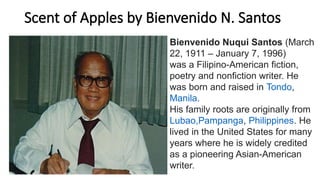
Scent of Apples by Bienvenido N. Santos
Bienvenido Nuqui Santos (March
22, 1911 – January 7, 1996)
was a Filipino-American fiction,
poetry and nonfiction writer. He
was born and raised in Tondo,
Manila.
His family roots are originally from
Lubao,Pampanga, Philippines. He
lived in the United States for many
years where he is widely credited
as a pioneering Asian-American
writer.
Filipino consciousness
and identity
UNLOCK AND EXPLORE!
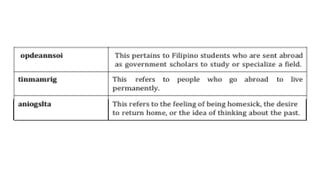
Arrange the following letters to discover the words in the box.
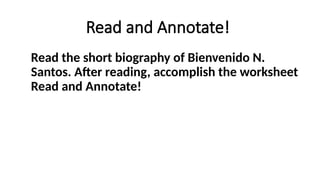
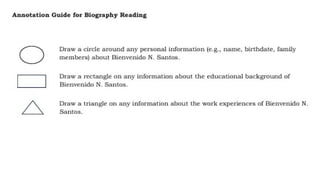
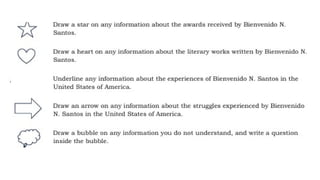
Read and Annotate!
Read the short biography of Bienvenido N.
Santos. After reading, accomplish the worksheet
Read and Annotate!
WHAT IS ANNOTATE?
To annotate is to make notes on or
mark up a text with one's thoughts,
questions, or realizations while
reading.
● The historical-biographical approach of reading a short story
combines the biographical and the historical aspects of
information as the primary insight in the creation of the text.
● The biographical context relates the events in the short
story to the actual experiences of the author as this kind of
reading assumes that the author’s work is his/her/their way
of revealing himself/herself/themselves or a way of
expressing his/her/their actual experiences. To prove the
claim that the author is present in the text, one has to read
the author’s biography to see how much an author’s
experience influences the text.
● Not all short stories are related to the personal life of
the author because some authors tend to revise the
facts of their own lives, which could be misleading
should one wish to connect the author’s life with the
text. Hence, not all short stories can be read and
analyzed from a biographical perspective.
● The historical context seeks to understand the text
based on the social, cultural, and political aspects and
occurrences of a particular time, which could directly
or indirectly shape the events in the short story. To
better understand the text from a historical point-of-
view, one has to research the period in which the
events are set and happen. By going back to the time
of the events, one can clearly see how the story
unfolded in relation to the author's experiences.
● One must also seek accurate historical
accounts since the proliferation of fake
or revised information may mislead them
in making sense of the historical
background of the short story.
PLOT SUMMARY
“Scent of Apples” by Bienvenido Santos is part of
a short story collection of the same name published
in 1978 by University of Washington Press. “Scent of
Apples” tells the story of one man and his family’s
unique experience as Filipino immigrants to the
United States. It’s a unique story, as Santos himself is
a character in it. Santos wrote “Scent of Apples”
during the Rebirth of Freedom—a period of activism
following WWII and the restoration of independence
to the Philippines.
By appreciating the context, it’s possible to better
understand the nostalgia woven through the story and
the difficulties Filipinos face trying to retain a connection
to their past while starting a new life elsewhere.
The story is told from Santos’s point of view. He’s
delivering a lecture in Kalamazoo, Michigan, before a
reasonably large audience of mostly college-aged
women. The talk centers on the Philippines, and Santos
talks of his people and his country fondly. He’s asked to
comment on the differences between American and
Filipino women, which he’s not sure how to answer
because he doesn’t know many American women.
In the audience, someone else speaks—a man, this time.
Santos can tell from his appearance that he’s also Filipino. A
farmer who works just outside of Kalamazoo, he left the
Philippines more than twenty years ago. He wants to take the
conversation one step further—he asks Santos whether
Filipino women are the same now as they were all those years
ago. At this question, the audience hushes, listening closely for
the answer.
Santos feels put on the spot; he doesn’t know how to answer.
He’s worried about giving the man false impressions, but he
also doesn’t want to shatter the man’s ideals about his
homeland. He doesn’t want to come across as insincere either.
There is a long pause as Santos decides how best to answer;
when he does, he has a strategy.
He asks the man to explain how he remembers the women,
so he can draw a proper comparison. This allows him to see
how best to answer the question. The man explains that
women used to be natural, kind, loyal, and modest. He
fondly remembers how they used to dress and says it’s the
men who’ve lost their faith and character.
Santos knows now how to answer him. He explains that,
while the women have changed on the outside, they still
have the same temperament and strength of religious faith.
The man seems happy with this explanation, and Santos can
rest easy knowing he hasn’t disappointed anyone. The
answer is also, to his mind, an honest one. However, the rest
of the talk feels less important after the interruption, and
Santos knows he’ll think about it for a while.
When he leaves the lecture, Santos meets the man outside.
He learns that his name is Celestino Fabia, and he labors on
farmland thirty miles away. He saw Santos’s name one day in
the local paper and, recognizing a Filipino compatriot,
traveled all this way to hear him speak about how things used
to be. Fabia invites Santos to dinner the following day, and he
accepts the invitation.
Santos goes to meet Fabia, who is overjoyed to introduce his
family to a fellow Filipino who reminds him of how things—
and Filipinos—used to be. Fabia worries over whether his
house is messy or dilapidated, but Santos doesn’t notice. He
knows Fabia is a farmer and money is very tight, and he’s also
not a superficial man. He’s looking forward to meeting
everyone.
On the way, Santos spots apple trees. They remind him of home,
and he’s suddenly filled with nostalgia and sadness. Sometimes, it
seems he can’t balance his memories with building a new life.
Fabia feels the same, and he pours out his thoughts to Santos
who feels privileged to hear them. They both fondly remember
their youth, but it’s sad to think everything’s changed.
Santos is embarrassed by how he feels when he meets Fabia’s
wife, Ruth. He notices she’s unattractive and her hands are rough.
He knows he shouldn’t notice such things, and he hopes it
doesn’t show on his face. He feels especially bad when he hears
everything Ruth has done for Fabia over the years—including
working all hours for very little money just to afford things like
healthcare. She reminds Fabia of Filipino women, and Santos
agrees.
Toward the end, Santos tells Fabia he plans on going
home and would like to visit Fabia’s town. Fabia
doesn’t want him to, because he knows no one will
remember him—and, perhaps, because he wants to
remember it as it was, not as it is now.
“Scent of Apples” reminds us of the struggles Filipinos
experienced letting go of their homeland and trying to
make a new life with nothing but memories of how
things used to be.
ASSIGNMENT:
• IN YOUR NOTEBOOK: (1)
LIST DOWN THE:
a. CHARACTERS
b. Setting
c. What type of POV did the author use?
d. What conflict is present in the text?
e. Plot
Historical-biographical context in reading.pptx

Historical-biographical context in reading.pptx

  • 1.
  • 2.
    •Analyze a literarytext as an expression of individual or communal values within biographical and historical contexts. a. define the biographical and historical approaches to reading a literary text. b. note and discuss historical and biographical data about a given topic, person, author, or experience. c. relate the author’s history and biography with the literary elements (i.e., setting, characters, and POV) of his/ her text.
  • 3.
    Scent of Applesby Bienvenido N. Santos Bienvenido Nuqui Santos (March 22, 1911 – January 7, 1996) was a Filipino-American fiction, poetry and nonfiction writer. He was born and raised in Tondo, Manila. His family roots are originally from Lubao,Pampanga, Philippines. He lived in the United States for many years where he is widely credited as a pioneering Asian-American writer.
  • 4.
  • 5.
    UNLOCK AND EXPLORE! Arrangethe following letters to discover the words in the box.
  • 7.
    Read and Annotate! Readthe short biography of Bienvenido N. Santos. After reading, accomplish the worksheet Read and Annotate!
  • 8.
    WHAT IS ANNOTATE? Toannotate is to make notes on or mark up a text with one's thoughts, questions, or realizations while reading.
  • 11.
    ● The historical-biographicalapproach of reading a short story combines the biographical and the historical aspects of information as the primary insight in the creation of the text. ● The biographical context relates the events in the short story to the actual experiences of the author as this kind of reading assumes that the author’s work is his/her/their way of revealing himself/herself/themselves or a way of expressing his/her/their actual experiences. To prove the claim that the author is present in the text, one has to read the author’s biography to see how much an author’s experience influences the text.
  • 12.
    ● Not allshort stories are related to the personal life of the author because some authors tend to revise the facts of their own lives, which could be misleading should one wish to connect the author’s life with the text. Hence, not all short stories can be read and analyzed from a biographical perspective.
  • 13.
    ● The historicalcontext seeks to understand the text based on the social, cultural, and political aspects and occurrences of a particular time, which could directly or indirectly shape the events in the short story. To better understand the text from a historical point-of- view, one has to research the period in which the events are set and happen. By going back to the time of the events, one can clearly see how the story unfolded in relation to the author's experiences.
  • 14.
    ● One mustalso seek accurate historical accounts since the proliferation of fake or revised information may mislead them in making sense of the historical background of the short story.
  • 15.
    PLOT SUMMARY “Scent ofApples” by Bienvenido Santos is part of a short story collection of the same name published in 1978 by University of Washington Press. “Scent of Apples” tells the story of one man and his family’s unique experience as Filipino immigrants to the United States. It’s a unique story, as Santos himself is a character in it. Santos wrote “Scent of Apples” during the Rebirth of Freedom—a period of activism following WWII and the restoration of independence to the Philippines.
  • 16.
    By appreciating thecontext, it’s possible to better understand the nostalgia woven through the story and the difficulties Filipinos face trying to retain a connection to their past while starting a new life elsewhere. The story is told from Santos’s point of view. He’s delivering a lecture in Kalamazoo, Michigan, before a reasonably large audience of mostly college-aged women. The talk centers on the Philippines, and Santos talks of his people and his country fondly. He’s asked to comment on the differences between American and Filipino women, which he’s not sure how to answer because he doesn’t know many American women.
  • 17.
    In the audience,someone else speaks—a man, this time. Santos can tell from his appearance that he’s also Filipino. A farmer who works just outside of Kalamazoo, he left the Philippines more than twenty years ago. He wants to take the conversation one step further—he asks Santos whether Filipino women are the same now as they were all those years ago. At this question, the audience hushes, listening closely for the answer. Santos feels put on the spot; he doesn’t know how to answer. He’s worried about giving the man false impressions, but he also doesn’t want to shatter the man’s ideals about his homeland. He doesn’t want to come across as insincere either. There is a long pause as Santos decides how best to answer; when he does, he has a strategy.
  • 18.
    He asks theman to explain how he remembers the women, so he can draw a proper comparison. This allows him to see how best to answer the question. The man explains that women used to be natural, kind, loyal, and modest. He fondly remembers how they used to dress and says it’s the men who’ve lost their faith and character. Santos knows now how to answer him. He explains that, while the women have changed on the outside, they still have the same temperament and strength of religious faith. The man seems happy with this explanation, and Santos can rest easy knowing he hasn’t disappointed anyone. The answer is also, to his mind, an honest one. However, the rest of the talk feels less important after the interruption, and Santos knows he’ll think about it for a while.
  • 19.
    When he leavesthe lecture, Santos meets the man outside. He learns that his name is Celestino Fabia, and he labors on farmland thirty miles away. He saw Santos’s name one day in the local paper and, recognizing a Filipino compatriot, traveled all this way to hear him speak about how things used to be. Fabia invites Santos to dinner the following day, and he accepts the invitation. Santos goes to meet Fabia, who is overjoyed to introduce his family to a fellow Filipino who reminds him of how things— and Filipinos—used to be. Fabia worries over whether his house is messy or dilapidated, but Santos doesn’t notice. He knows Fabia is a farmer and money is very tight, and he’s also not a superficial man. He’s looking forward to meeting everyone.
  • 20.
    On the way,Santos spots apple trees. They remind him of home, and he’s suddenly filled with nostalgia and sadness. Sometimes, it seems he can’t balance his memories with building a new life. Fabia feels the same, and he pours out his thoughts to Santos who feels privileged to hear them. They both fondly remember their youth, but it’s sad to think everything’s changed. Santos is embarrassed by how he feels when he meets Fabia’s wife, Ruth. He notices she’s unattractive and her hands are rough. He knows he shouldn’t notice such things, and he hopes it doesn’t show on his face. He feels especially bad when he hears everything Ruth has done for Fabia over the years—including working all hours for very little money just to afford things like healthcare. She reminds Fabia of Filipino women, and Santos agrees.
  • 21.
    Toward the end,Santos tells Fabia he plans on going home and would like to visit Fabia’s town. Fabia doesn’t want him to, because he knows no one will remember him—and, perhaps, because he wants to remember it as it was, not as it is now.
  • 22.
    “Scent of Apples”reminds us of the struggles Filipinos experienced letting go of their homeland and trying to make a new life with nothing but memories of how things used to be.
  • 23.
    ASSIGNMENT: • IN YOURNOTEBOOK: (1) LIST DOWN THE: a. CHARACTERS b. Setting c. What type of POV did the author use? d. What conflict is present in the text? e. Plot