Histology of Female
Reproductive System
Dr. Rajesh Ranjan
Assistant Professor
Deptt. ofVeterinary Anatomy
C.V.Sc., Rewa
Female Reproductive System
▪Ovaries
▪Oviducts
▪Uterus
▪Vagina
▪Vulva
Ovaries
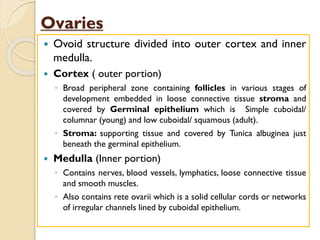
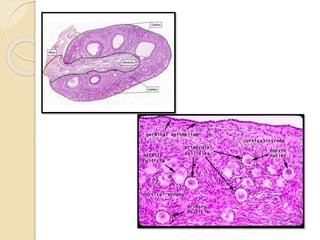
 Ovoid structure divided into outer cortex and inner
medulla.
 Cortex ( outer portion)
◦ Broad peripheral zone containing follicles in various stages of
development embedded in loose connective tissue stroma and
covered by Germinal epithelium which is Simple cuboidal/
columnar (young) and low cuboidal/ squamous (adult).
◦ Stroma: supporting tissue and covered by Tunica albuginea just
beneath the germinal epithelium.
 Medulla (Inner portion)
◦ Contains nerves, blood vessels, lymphatics, loose connective tissue
and smooth muscles.
◦ Also contains rete ovarii which is a solid cellular cords or networks
of irregular channels lined by cuboidal epithelium.
Ovarian Follicles
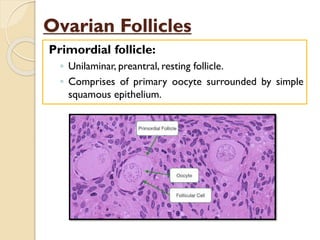
Primordial follicle:
◦ Unilaminar, preantral, resting follicle.
◦ Comprises of primary oocyte surrounded by simple
squamous epithelium.
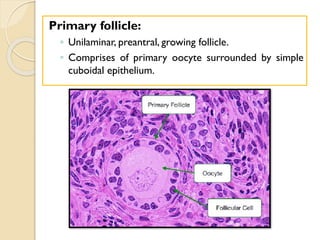
Primary follicle:
◦ Unilaminar, preantral, growing follicle.
◦ Comprises of primary oocyte surrounded by simple
cuboidal epithelium.
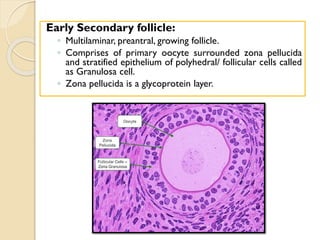
Early Secondary follicle:
◦ Multilaminar, preantral, growing follicle.
◦ Comprises of primary oocyte surrounded zona pellucida
and stratified epithelium of polyhedral/ follicular cells called
as Granulosa cell.
◦ Zona pellucida is a glycoprotein layer.
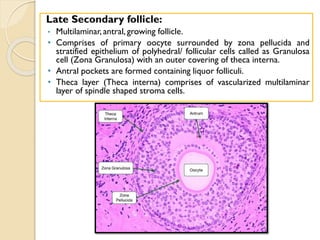
Late Secondary follicle:
• Multilaminar, antral, growing follicle.
• Comprises of primary oocyte surrounded by zona pellucida and
stratified epithelium of polyhedral/ follicular cells called as Granulosa
cell (Zona Granulosa) with an outer covering of theca interna.
• Antral pockets are formed containing liquor folliculi.
• Theca layer (Theca interna) comprises of vascularized multilaminar
layer of spindle shaped stroma cells.
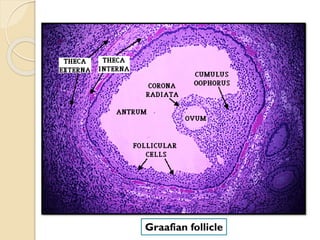
Graafian follicle:
 Also calledVesicular/Tertiary follicle.
 Multilaminar, antral, growing follicle.
 Comprises of primary oocyte surrounded by Zona
pellucida, Granulosa cells (Stratum granulosum) with
Antrum andTheca layers.
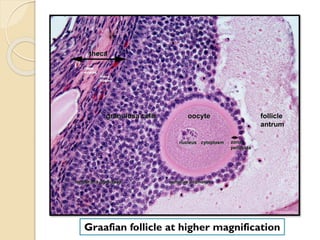
 Primary oocyte is spherical with centrally located
nucleus having sparse chromatin network and prominent
nucleolus.
 The primary oocyte lies in the accumulation of granulosa
cells known as Cumulus oophorus.
 The innermost cell layer of cumulus oophorus
immediately surrounding the oocyte becomes columnar
and radially disposed called Corona radiata.
 Antrum is filled with liquor folliculi.
 The granulosa cells form a parietal follicular lining, the
Stratum granulosum.
◦ It comprises of polyhedral cells (basal layer may be
columnar).
 Some of the granulosa cells may contain large PAS-positive
inclusions called the Call-Exner bodies which represent
intracellular precursors of liquor folliculi.
 Theca layers: comprises of Theca interna (inner vascular
layer) and Theca externa (outer fibrous layer).
 Cells in the theca interna are spindle shaped with delicate
reticular fiber network.
 Theca externa is loose connective tissue layer with fibrocytes
arranged concentrically around the theca interna.
Graafian follicle
Graafian follicle at higher magnification
Corpus luteum:
 At ovulation, the follicle ruptures, collapses and shrinks.
There is infolding of the follicular wall and forms
Corpus hemorrhagicum as blood gets accumulated
into the antrum.
 After that there is vascularization from the tunica
interna and the granulosa cells enlarge, luteinize and
forms the large luteal cells. The theca interna cells
form the small luteal cells. This leads to the formation
of Corpus luteum.
 The first sign of luteal regression is seen in late diestrus
and involves the condensation of lutein pigment, which
then appears reddish, followed by fibrosis and
resorption of the corpus luteum. The connective tissue
scar remaining after luteal regression is called Corpus
albicans.
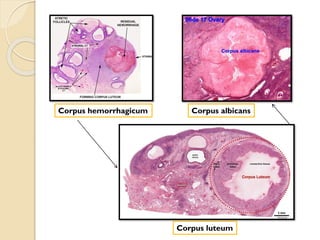
Corpus hemorrhagicum
Corpus luteum
Corpus albicans
Oviduct:
 Also called fallopian tube or uterine tube.
 Oviduct has three parts:
◦ Infundibulum
◦ Ampulla
◦ Isthmus
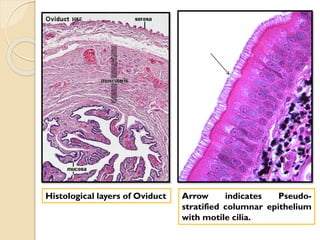
 The lining epithelium is Simple columnar/pseudostratified
columnar with motile cilia. Both ciliated and nonciliated cell types
possess microvilli.
 Lamina muscularis is absent. Lamina propria-submucosa
consist of loose connective tissue with many plasma cells, mast cells,
eosinophils.
 In ampulla, the tunica mucosa is highly infolded forming primary,
secondary and tertiary folds, while in isthmus region only primary
folds are present.
 Tunica muscularis comprises of inner circular smooth muscles with
isolated bundles of longitudinal and oblique muscle fibers.
 Tunica serosa is reflection of peritoneum having fibrous tissues
covered by mesothelium. Numerous blood vessels and nerves are also
present.
Histological layers of Oviduct Arrow indicates Pseudo-
stratified columnar epithelium
with motile cilia.
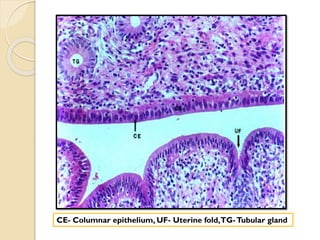
Uterus:
 Uterus has three parts: Two horns or cornua, Body or corpus and Neck
or cervix
 Histological structure of cornua and corpus:
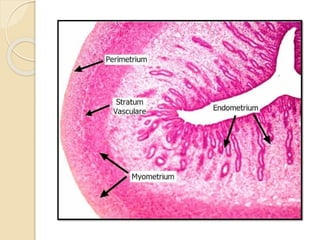
 Endometrium (Tunica mucosa and submucosa)
 The lining epithelium is
◦ Simple columnar in mare, bitch, queen.
◦ Simple columnar/ pseudostratified columnar in sow, ruminants.
 Lamina propria- submucosa is divided into sub-epithelial functional zone
that comprises of richly vascular L.C.T. with many fibrocytes, macrophages,
mast cells, etc and a deep part comprising of L.C.T. and simple coiled
branched tubular glands. These glands are absent in caruncular areas in
ruminants. Uterine glands are lined by ciliated and non-ciliated simple
columnar epithelium.
 Myometrium (Tunica muscularis): Consists of thick inner circular layer
and outer longitudinal layer of smooth muscles. In between these two layers
stratum vasculare is present.
 Perimetrium (Tunica serosa): Consists of L.C.T. covered by mesothelium,
few smooth muscle cells, lymphatics, blood vessels and nerves.
CE- Columnar epithelium, UF- Uterine fold,TG-Tubular gland
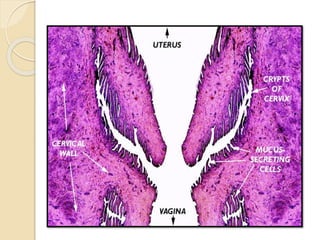
Cervix (Neck of uterus):
 Thick walled, muscular tube rich in elastic fibers.
 The mucosa-submucosa forms high primary, secondary and
tertiary folds. The lining epithelium is simple columnar with
many mucigenous cells including goblet cells.
 Lamina propria-submucosa contains dense irregular
connective tissue with collagenous and elastic fibers. Intra-
epithelial and simple tubular glands are present in ruminants.
Uterine glands do not extend into the cervix.
 Tunica muscularis consists of Inner circular and outer
longitudinal muscle layers. Elastic fibers are prominent in the
circular layer.
 Tunica serosa contains loose connective tissue covered by
mesothelium.
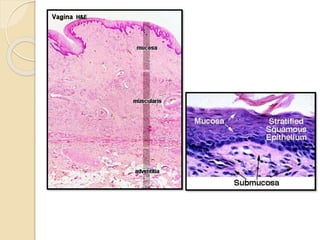
Vagina:
 Muscular tube with flat longitudinal mucosal-
submucosal folds throughout the its length.
 It is lined by stratified squamous non-cornified
epithelium. The number of goblet cells is variable in
different phases of estrus cycle.
 Lamina propria consists of loose or dense
irregular tissue and richly supplied by blood vessels
with few lymph nodules. Submucosa is continuous
with lamina propria.
 Tunica muscularis consist of smooth muscle
fibbers arranged in two or three layers as inner
circular, middle longitudinal and outer circular.
 Tunica serosa (cranial part) consists of loose
connective tissue covered by mesothelium and
Tunica adventitia is present in the caudal part.
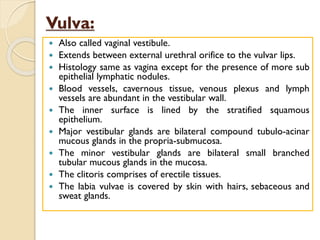
Vulva:
 Also called vaginal vestibule.
 Extends between external urethral orifice to the vulvar lips.
 Histology same as vagina except for the presence of more sub
epithelial lymphatic nodules.
 Blood vessels, cavernous tissue, venous plexus and lymph
vessels are abundant in the vestibular wall.
 The inner surface is lined by the stratified squamous
epithelium.
 Major vestibular glands are bilateral compound tubulo-acinar
mucous glands in the propria-submucosa.
 The minor vestibular glands are bilateral small branched
tubular mucous glands in the mucosa.
 The clitoris comprises of erectile tissues.
 The labia vulvae is covered by skin with hairs, sebaceous and
sweat glands.
Assignment
 Well labelled histological representation
of female genitalia of different species of
animals in practical notebook.
Thanks!

histology-of-female-reproductive-system.pdf

  • 1.
    Histology of Female ReproductiveSystem Dr. Rajesh Ranjan Assistant Professor Deptt. ofVeterinary Anatomy C.V.Sc., Rewa
  • 2.
  • 3.
    Ovaries  Ovoid structuredivided into outer cortex and inner medulla.  Cortex ( outer portion) ◦ Broad peripheral zone containing follicles in various stages of development embedded in loose connective tissue stroma and covered by Germinal epithelium which is Simple cuboidal/ columnar (young) and low cuboidal/ squamous (adult). ◦ Stroma: supporting tissue and covered by Tunica albuginea just beneath the germinal epithelium.  Medulla (Inner portion) ◦ Contains nerves, blood vessels, lymphatics, loose connective tissue and smooth muscles. ◦ Also contains rete ovarii which is a solid cellular cords or networks of irregular channels lined by cuboidal epithelium.
  • 5.
    Ovarian Follicles Primordial follicle: ◦Unilaminar, preantral, resting follicle. ◦ Comprises of primary oocyte surrounded by simple squamous epithelium.
  • 6.
    Primary follicle: ◦ Unilaminar,preantral, growing follicle. ◦ Comprises of primary oocyte surrounded by simple cuboidal epithelium.
  • 7.
    Early Secondary follicle: ◦Multilaminar, preantral, growing follicle. ◦ Comprises of primary oocyte surrounded zona pellucida and stratified epithelium of polyhedral/ follicular cells called as Granulosa cell. ◦ Zona pellucida is a glycoprotein layer.
  • 8.
    Late Secondary follicle: •Multilaminar, antral, growing follicle. • Comprises of primary oocyte surrounded by zona pellucida and stratified epithelium of polyhedral/ follicular cells called as Granulosa cell (Zona Granulosa) with an outer covering of theca interna. • Antral pockets are formed containing liquor folliculi. • Theca layer (Theca interna) comprises of vascularized multilaminar layer of spindle shaped stroma cells.
  • 9.
    Graafian follicle:  AlsocalledVesicular/Tertiary follicle.  Multilaminar, antral, growing follicle.  Comprises of primary oocyte surrounded by Zona pellucida, Granulosa cells (Stratum granulosum) with Antrum andTheca layers.  Primary oocyte is spherical with centrally located nucleus having sparse chromatin network and prominent nucleolus.  The primary oocyte lies in the accumulation of granulosa cells known as Cumulus oophorus.  The innermost cell layer of cumulus oophorus immediately surrounding the oocyte becomes columnar and radially disposed called Corona radiata.
  • 10.
     Antrum isfilled with liquor folliculi.  The granulosa cells form a parietal follicular lining, the Stratum granulosum. ◦ It comprises of polyhedral cells (basal layer may be columnar).  Some of the granulosa cells may contain large PAS-positive inclusions called the Call-Exner bodies which represent intracellular precursors of liquor folliculi.  Theca layers: comprises of Theca interna (inner vascular layer) and Theca externa (outer fibrous layer).  Cells in the theca interna are spindle shaped with delicate reticular fiber network.  Theca externa is loose connective tissue layer with fibrocytes arranged concentrically around the theca interna.
  • 11.
  • 12.
    Graafian follicle athigher magnification
  • 13.
    Corpus luteum:  Atovulation, the follicle ruptures, collapses and shrinks. There is infolding of the follicular wall and forms Corpus hemorrhagicum as blood gets accumulated into the antrum.  After that there is vascularization from the tunica interna and the granulosa cells enlarge, luteinize and forms the large luteal cells. The theca interna cells form the small luteal cells. This leads to the formation of Corpus luteum.  The first sign of luteal regression is seen in late diestrus and involves the condensation of lutein pigment, which then appears reddish, followed by fibrosis and resorption of the corpus luteum. The connective tissue scar remaining after luteal regression is called Corpus albicans.
  • 14.
  • 15.
    Oviduct:  Also calledfallopian tube or uterine tube.  Oviduct has three parts: ◦ Infundibulum ◦ Ampulla ◦ Isthmus  The lining epithelium is Simple columnar/pseudostratified columnar with motile cilia. Both ciliated and nonciliated cell types possess microvilli.  Lamina muscularis is absent. Lamina propria-submucosa consist of loose connective tissue with many plasma cells, mast cells, eosinophils.  In ampulla, the tunica mucosa is highly infolded forming primary, secondary and tertiary folds, while in isthmus region only primary folds are present.  Tunica muscularis comprises of inner circular smooth muscles with isolated bundles of longitudinal and oblique muscle fibers.  Tunica serosa is reflection of peritoneum having fibrous tissues covered by mesothelium. Numerous blood vessels and nerves are also present.
  • 16.
    Histological layers ofOviduct Arrow indicates Pseudo- stratified columnar epithelium with motile cilia.
  • 17.
    Uterus:  Uterus hasthree parts: Two horns or cornua, Body or corpus and Neck or cervix  Histological structure of cornua and corpus:  Endometrium (Tunica mucosa and submucosa)  The lining epithelium is ◦ Simple columnar in mare, bitch, queen. ◦ Simple columnar/ pseudostratified columnar in sow, ruminants.  Lamina propria- submucosa is divided into sub-epithelial functional zone that comprises of richly vascular L.C.T. with many fibrocytes, macrophages, mast cells, etc and a deep part comprising of L.C.T. and simple coiled branched tubular glands. These glands are absent in caruncular areas in ruminants. Uterine glands are lined by ciliated and non-ciliated simple columnar epithelium.  Myometrium (Tunica muscularis): Consists of thick inner circular layer and outer longitudinal layer of smooth muscles. In between these two layers stratum vasculare is present.  Perimetrium (Tunica serosa): Consists of L.C.T. covered by mesothelium, few smooth muscle cells, lymphatics, blood vessels and nerves.
  • 19.
    CE- Columnar epithelium,UF- Uterine fold,TG-Tubular gland
  • 20.
    Cervix (Neck ofuterus):  Thick walled, muscular tube rich in elastic fibers.  The mucosa-submucosa forms high primary, secondary and tertiary folds. The lining epithelium is simple columnar with many mucigenous cells including goblet cells.  Lamina propria-submucosa contains dense irregular connective tissue with collagenous and elastic fibers. Intra- epithelial and simple tubular glands are present in ruminants. Uterine glands do not extend into the cervix.  Tunica muscularis consists of Inner circular and outer longitudinal muscle layers. Elastic fibers are prominent in the circular layer.  Tunica serosa contains loose connective tissue covered by mesothelium.
  • 22.
    Vagina:  Muscular tubewith flat longitudinal mucosal- submucosal folds throughout the its length.  It is lined by stratified squamous non-cornified epithelium. The number of goblet cells is variable in different phases of estrus cycle.  Lamina propria consists of loose or dense irregular tissue and richly supplied by blood vessels with few lymph nodules. Submucosa is continuous with lamina propria.  Tunica muscularis consist of smooth muscle fibbers arranged in two or three layers as inner circular, middle longitudinal and outer circular.  Tunica serosa (cranial part) consists of loose connective tissue covered by mesothelium and Tunica adventitia is present in the caudal part.
  • 24.
    Vulva:  Also calledvaginal vestibule.  Extends between external urethral orifice to the vulvar lips.  Histology same as vagina except for the presence of more sub epithelial lymphatic nodules.  Blood vessels, cavernous tissue, venous plexus and lymph vessels are abundant in the vestibular wall.  The inner surface is lined by the stratified squamous epithelium.  Major vestibular glands are bilateral compound tubulo-acinar mucous glands in the propria-submucosa.  The minor vestibular glands are bilateral small branched tubular mucous glands in the mucosa.  The clitoris comprises of erectile tissues.  The labia vulvae is covered by skin with hairs, sebaceous and sweat glands.
  • 25.
    Assignment  Well labelledhistological representation of female genitalia of different species of animals in practical notebook.
  • 26.