Histamine
Introduction
Histamine Means: Tissue amine
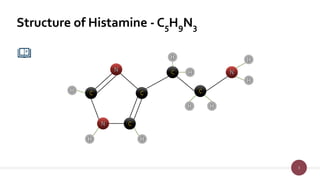
Chemical formula: C5H9N3
3
Structure of Histamine - C5H9N3
H
H
H H
H
H
H
H H
4
Histamine
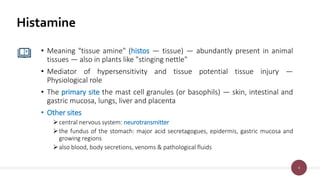
• Meaning "tissue amine" (histos — tissue) — abundantly present in animal
tissues — also in plants like "stinging nettle"
• Mediator of hypersensitivity and tissue potential tissue injury —
Physiological role
• The primary site the mast cell granules (or basophils) — skin, intestinal and
gastric mucosa, lungs, liver and placenta
• Other sites
central nervous system: neurotransmitter
the fundus of the stomach: major acid secretagogues, epidermis, gastric mucosa and
growing regions
also blood, body secretions, venoms & pathological fluids
5
Histamine – Synthesis
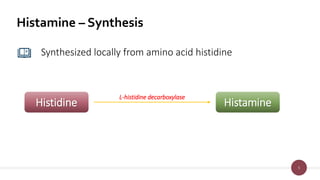
Synthesized locally from amino acid histidine
Histidine Histamine
L-histidine decarboxylase
6
Histamine – Storage and Release
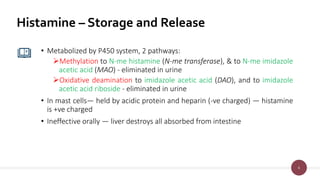
• Metabolized by P450 system, 2 pathways:
Methylation to N-me histamine (N-me transferase), & to N-me imidazole
acetic acid (MAO) - eliminated in urine
Oxidative deamination to imidazole acetic acid (DAO), and to imidazole
acetic acid riboside - eliminated in urine
• In mast cells— held by acidic protein and heparin (-ve charged) — histamine
is +ve charged
• Ineffective orally — liver destroys all absorbed from intestine
7
Histamine – Pharmacologicalactions
• Blood vessels: Dilatation of small vessels — arterioles, capillaries and venules
• SC administration — flushing, heat, increased HR and CO — little fall in
• Rapid IV injection: Fall in BP early (H1) and persistent (H2) — only H1
effect with low dose
• Dilatation of cranial vessels
• H1 component vasodilatation — mediated indirectly by EDRF But H2
component - mediation is directly on smooth muscle Of blood vessels
• Larger arteries and veins — constriction mediated by H1 receptor
• Increased capillary permeability — exudation of plasma
8
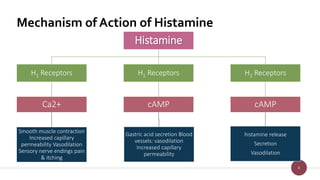
Mechanism of Action of Histamine
Histamine
H1 Receptors
Ca2+
Smooth muscle contraction
Increased capillary
permeability Vasodilation
Sensory nerve endings pain
& itching
H1 Receptors
cAMP
Gastric acid secretion Blood
vessels: vasodilation
Increased capillary
permeability
H1 Receptors
cAMP
histamine release
Secretion
Vasodilation
9
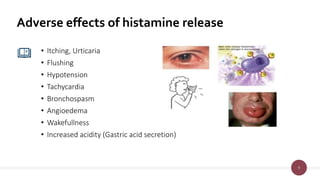
Adverse effects of histamine release
• Itching, Urticaria
• Flushing
• Hypotension
• Tachycardia
• Bronchospasm
• Angioedema
• Wakefullness
• Increased acidity (Gastric acid secretion)
ThankYou!
10
Mudassir Husain
Email: mudassirprnc@gmail.com
Website: www.yoututor.in

Histamine

  • 1.
  • 2.
    Introduction Histamine Means: Tissueamine Chemical formula: C5H9N3
  • 3.
    3 Structure of Histamine- C5H9N3 H H H H H H H H H
  • 4.
    4 Histamine • Meaning "tissueamine" (histos — tissue) — abundantly present in animal tissues — also in plants like "stinging nettle" • Mediator of hypersensitivity and tissue potential tissue injury — Physiological role • The primary site the mast cell granules (or basophils) — skin, intestinal and gastric mucosa, lungs, liver and placenta • Other sites central nervous system: neurotransmitter the fundus of the stomach: major acid secretagogues, epidermis, gastric mucosa and growing regions also blood, body secretions, venoms & pathological fluids
  • 5.
    5 Histamine – Synthesis Synthesizedlocally from amino acid histidine Histidine Histamine L-histidine decarboxylase
  • 6.
    6 Histamine – Storageand Release • Metabolized by P450 system, 2 pathways: Methylation to N-me histamine (N-me transferase), & to N-me imidazole acetic acid (MAO) - eliminated in urine Oxidative deamination to imidazole acetic acid (DAO), and to imidazole acetic acid riboside - eliminated in urine • In mast cells— held by acidic protein and heparin (-ve charged) — histamine is +ve charged • Ineffective orally — liver destroys all absorbed from intestine
  • 7.
    7 Histamine – Pharmacologicalactions •Blood vessels: Dilatation of small vessels — arterioles, capillaries and venules • SC administration — flushing, heat, increased HR and CO — little fall in • Rapid IV injection: Fall in BP early (H1) and persistent (H2) — only H1 effect with low dose • Dilatation of cranial vessels • H1 component vasodilatation — mediated indirectly by EDRF But H2 component - mediation is directly on smooth muscle Of blood vessels • Larger arteries and veins — constriction mediated by H1 receptor • Increased capillary permeability — exudation of plasma
  • 8.
    8 Mechanism of Actionof Histamine Histamine H1 Receptors Ca2+ Smooth muscle contraction Increased capillary permeability Vasodilation Sensory nerve endings pain & itching H1 Receptors cAMP Gastric acid secretion Blood vessels: vasodilation Increased capillary permeability H1 Receptors cAMP histamine release Secretion Vasodilation
  • 9.
    9 Adverse effects ofhistamine release • Itching, Urticaria • Flushing • Hypotension • Tachycardia • Bronchospasm • Angioedema • Wakefullness • Increased acidity (Gastric acid secretion)
  • 10.