Between the Wars
Returning and Remembering (or Not)
Mark Gertler,
Merry-Go-Round, 1916.
Tate Britain.
Shell Shock: The War in Your Head:
Film Response #2: If War was a Musical
Oh! What a Lovely War (directed by Richard Attenborough,1969)
Oh! What a Lovely War explores the myths and the music of
World War I. How do the songs reinforce the imagery of the
film? How does this film depict the myths of the Great War? In
what ways does this film support Boxwell’s article of the
threatricality of World War I or war as a social drama?
Manliness and War: Manly Desires in the Trench
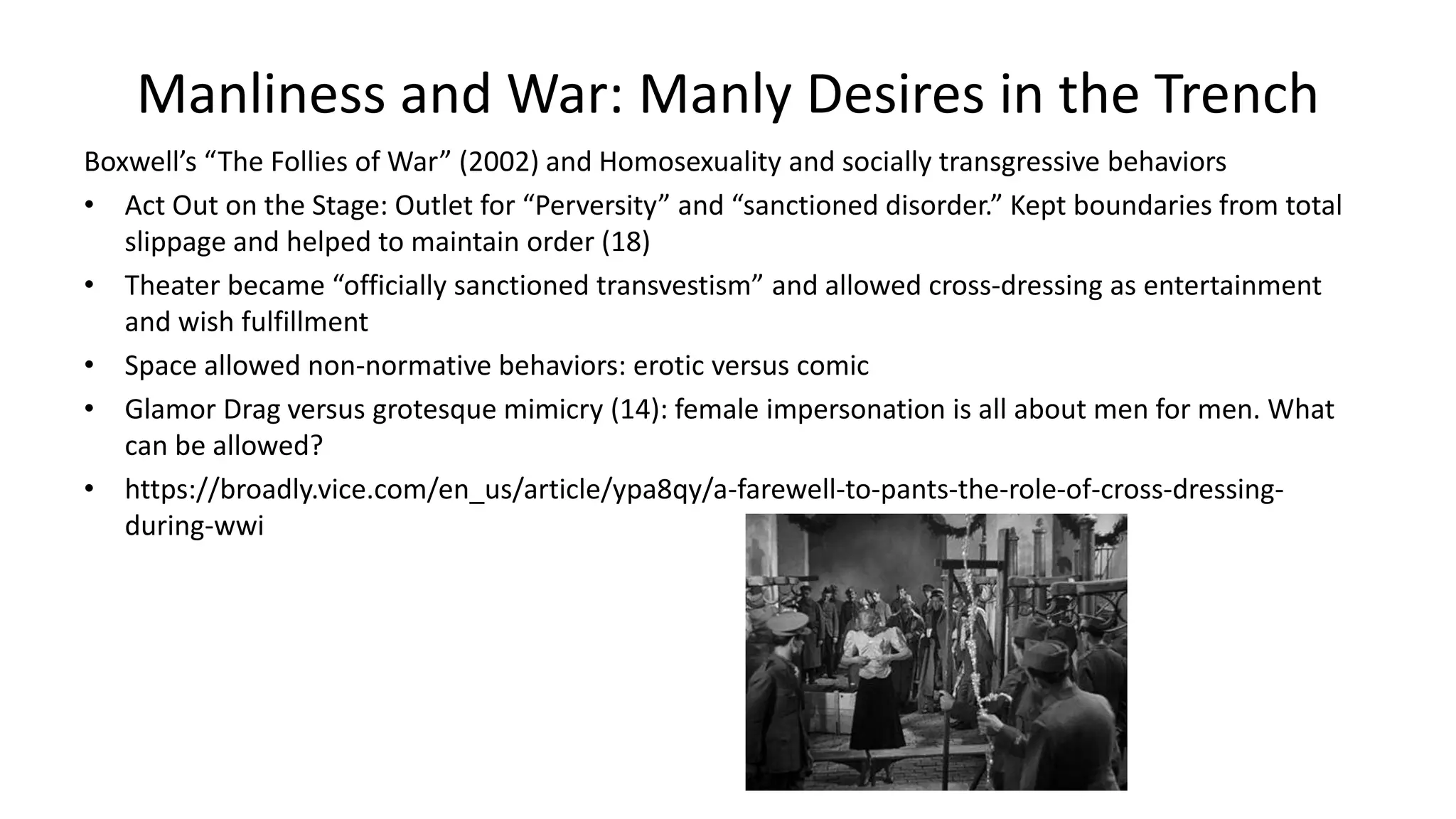
Boxwell’s “The Follies of War” (2002) and Homosexuality and socially transgressive behaviors
• Act Out on the Stage: Outlet for “Perversity” and “sanctioned disorder.” Kept boundaries from total
slippage and helped to maintain order (18)
• Theater became “officially sanctioned transvestism” and allowed cross-dressing as entertainment
and wish fulfillment
• Space allowed non-normative behaviors: erotic versus comic
• Glamor Drag versus grotesque mimicry (14): female impersonation is all about men for men. What
can be allowed?
• https://broadly.vice.com/en_us/article/ypa8qy/a-farewell-to-pants-the-role-of-cross-dressing-
during-wwi
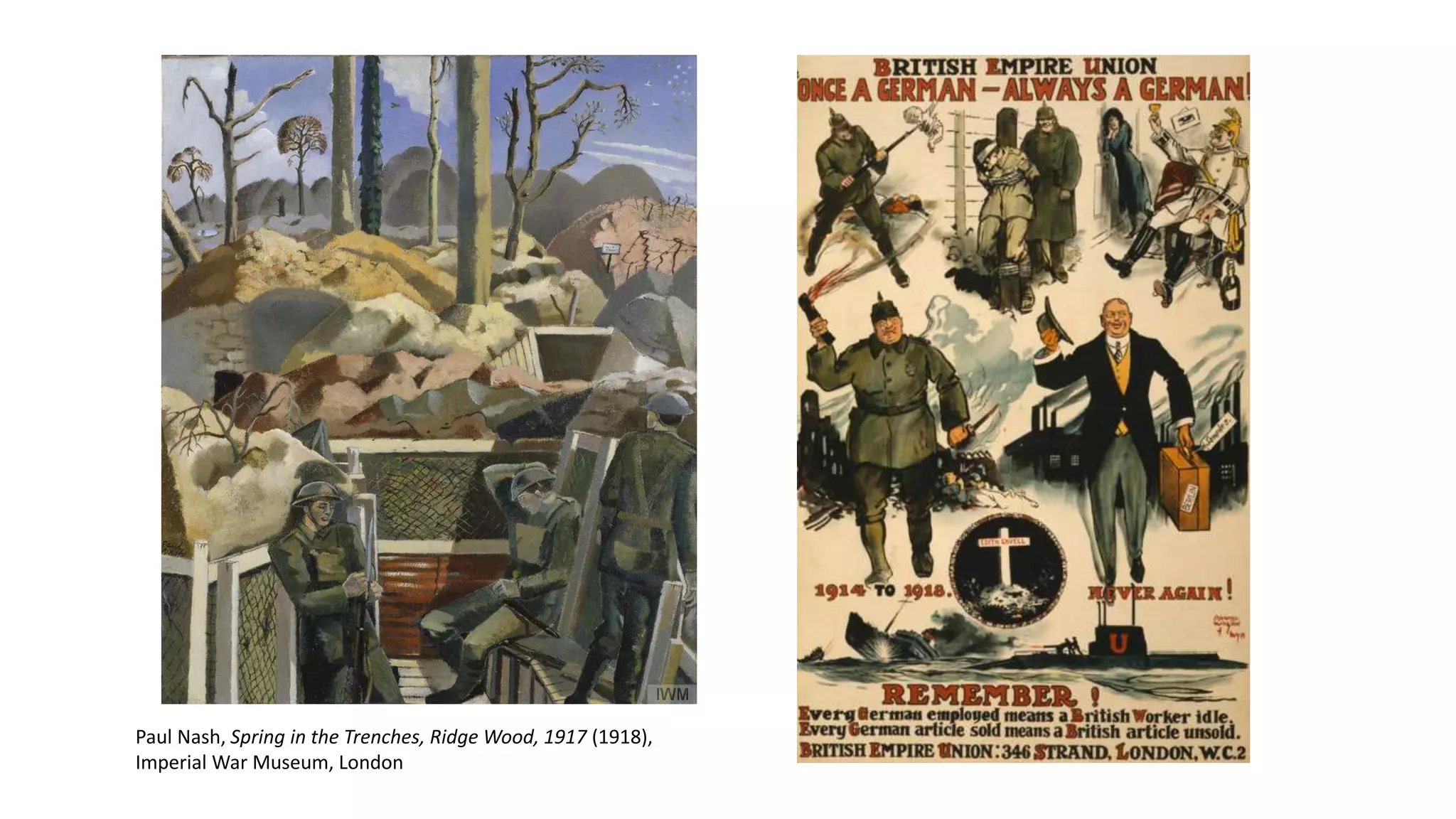
Paul Nash, Spring in the Trenches, Ridge Wood, 1917 (1918),
Imperial War Museum, London
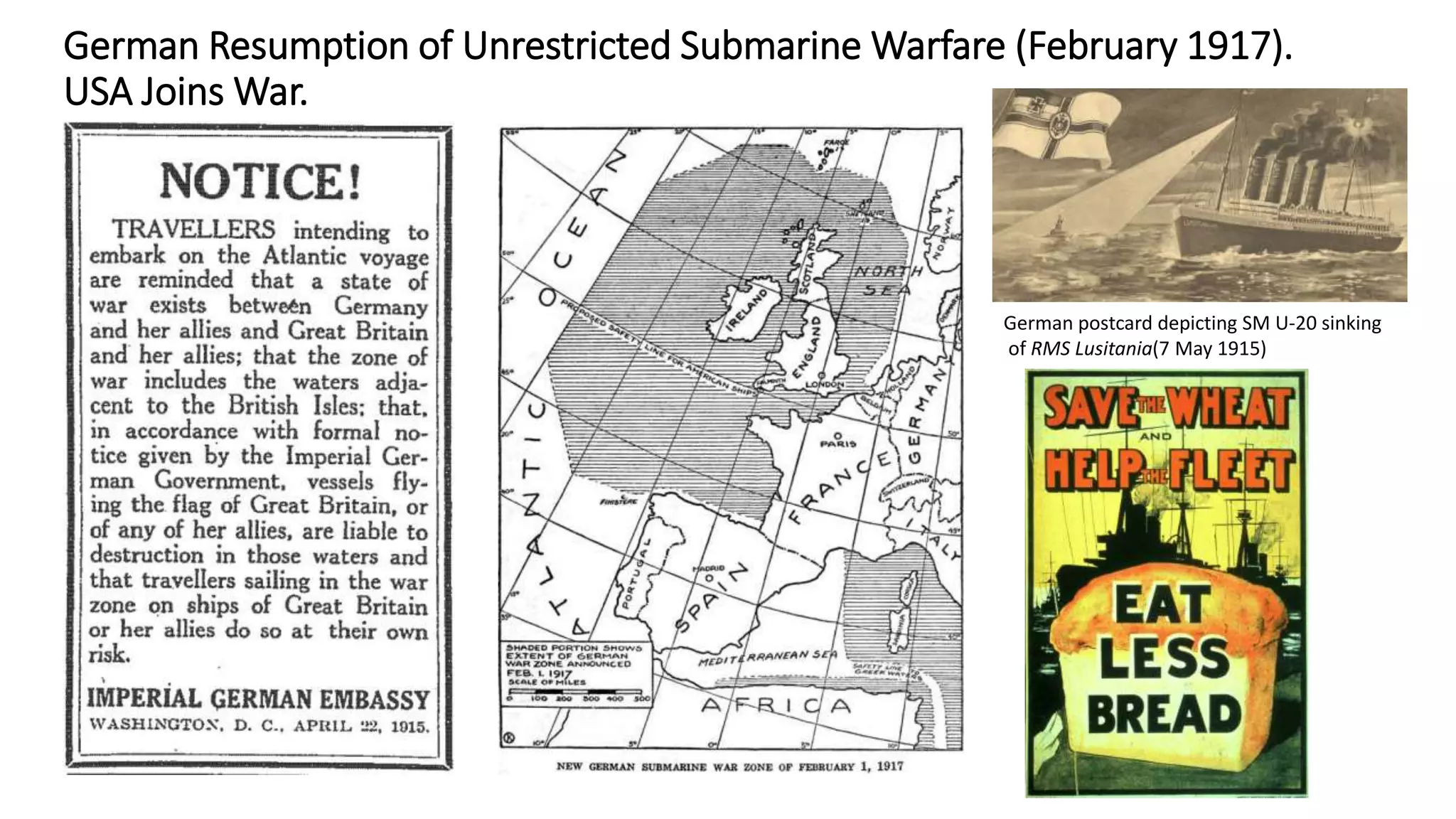
German Resumption of Unrestricted Submarine Warfare (February 1917).
USA Joins War.
German postcard depicting SM U-20 sinking
of RMS Lusitania(7 May 1915)
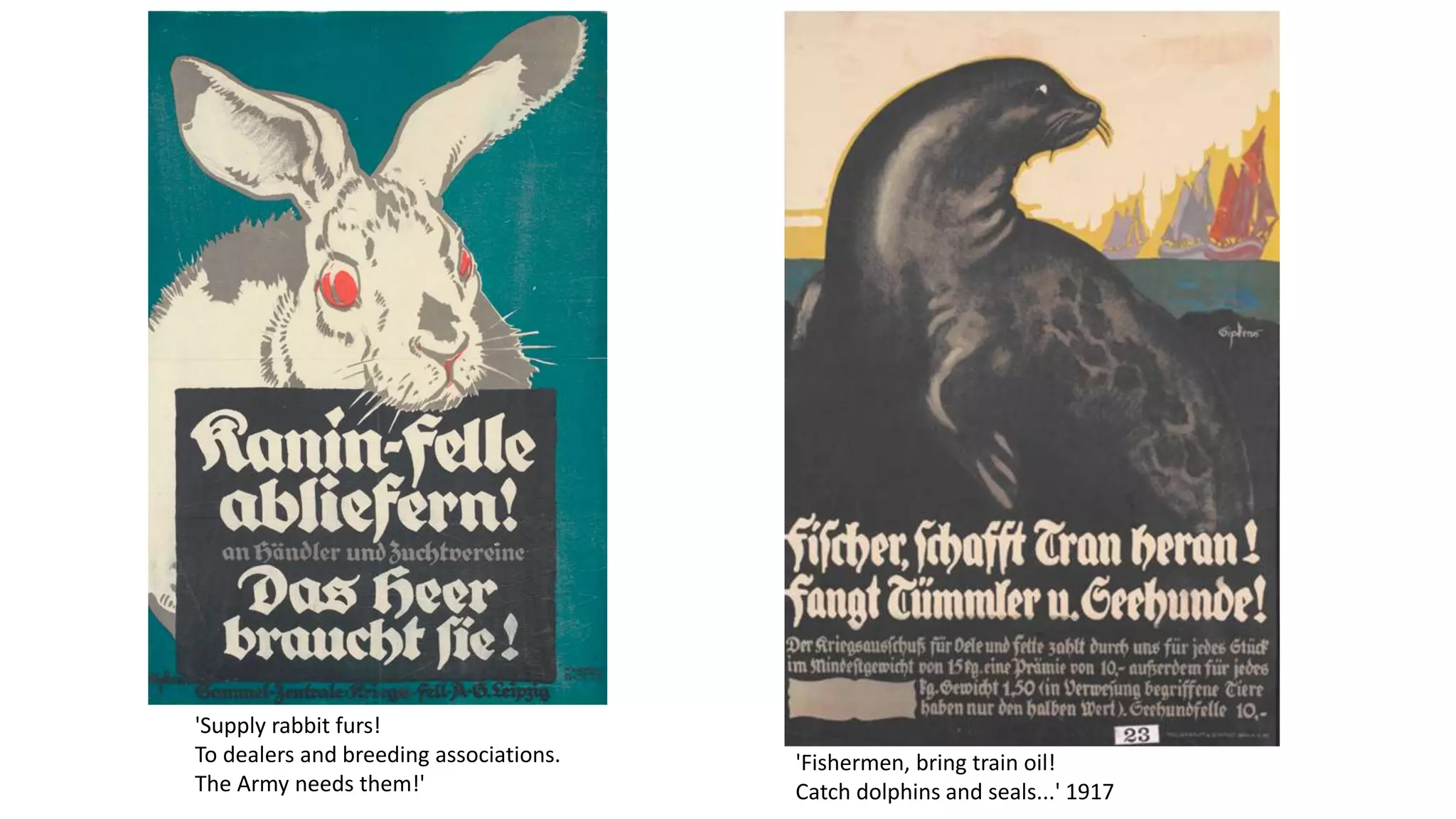
'Supply rabbit furs!
To dealers and breeding associations.
The Army needs them!'
'Fishermen, bring train oil!
Catch dolphins and seals...' 1917
Fighting the War at Home:
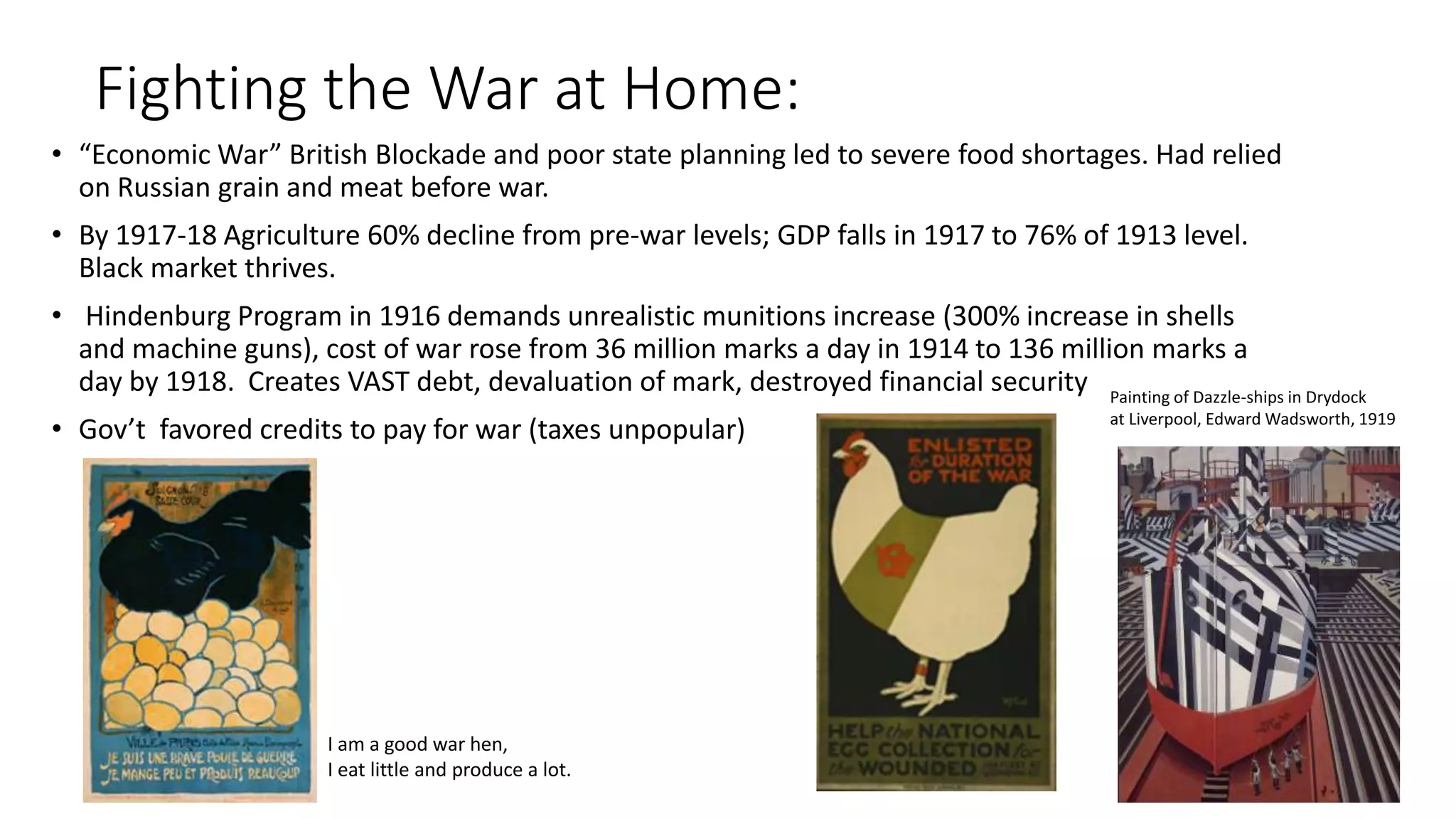
• “Economic War” British Blockade and poor state planning led to severe food shortages. Had relied
on Russian grain and meat before war.
• By 1917-18 Agriculture 60% decline from pre-war levels; GDP falls in 1917 to 76% of 1913 level.
Black market thrives.
• Hindenburg Program in 1916 demands unrealistic munitions increase (300% increase in shells
and machine guns), cost of war rose from 36 million marks a day in 1914 to 136 million marks a
day by 1918. Creates VAST debt, devaluation of mark, destroyed financial security
• Gov’t favored credits to pay for war (taxes unpopular)
Painting of Dazzle-ships in Drydock
at Liverpool, Edward Wadsworth, 1919
I am a good war hen,
I eat little and produce a lot.
“Turnip Winter” (1916-17): Hunger
• Berlin official weekly rations for adult in winter of 1917: 2-6 lbs. of
turnips (rutabagas) or 2 lbs. bread if available, less than 2 oz. butter
and 1 oz. margarine. Government report stated that “lack of
enthusiasm” apparent as food/butter riots break out.
• Ersatz common: “War Bread” created in Oct. 1914 (potato starch
replaced flour). By summer 1917, 837 nonmeat substitutes for
sausages and cold cuts patented. Health issues: TB, rickets,
dysentery, typhoid fever
• Consumption reduced to 50% of normal level. Wartime deaths
related to malnutrition around 750,000
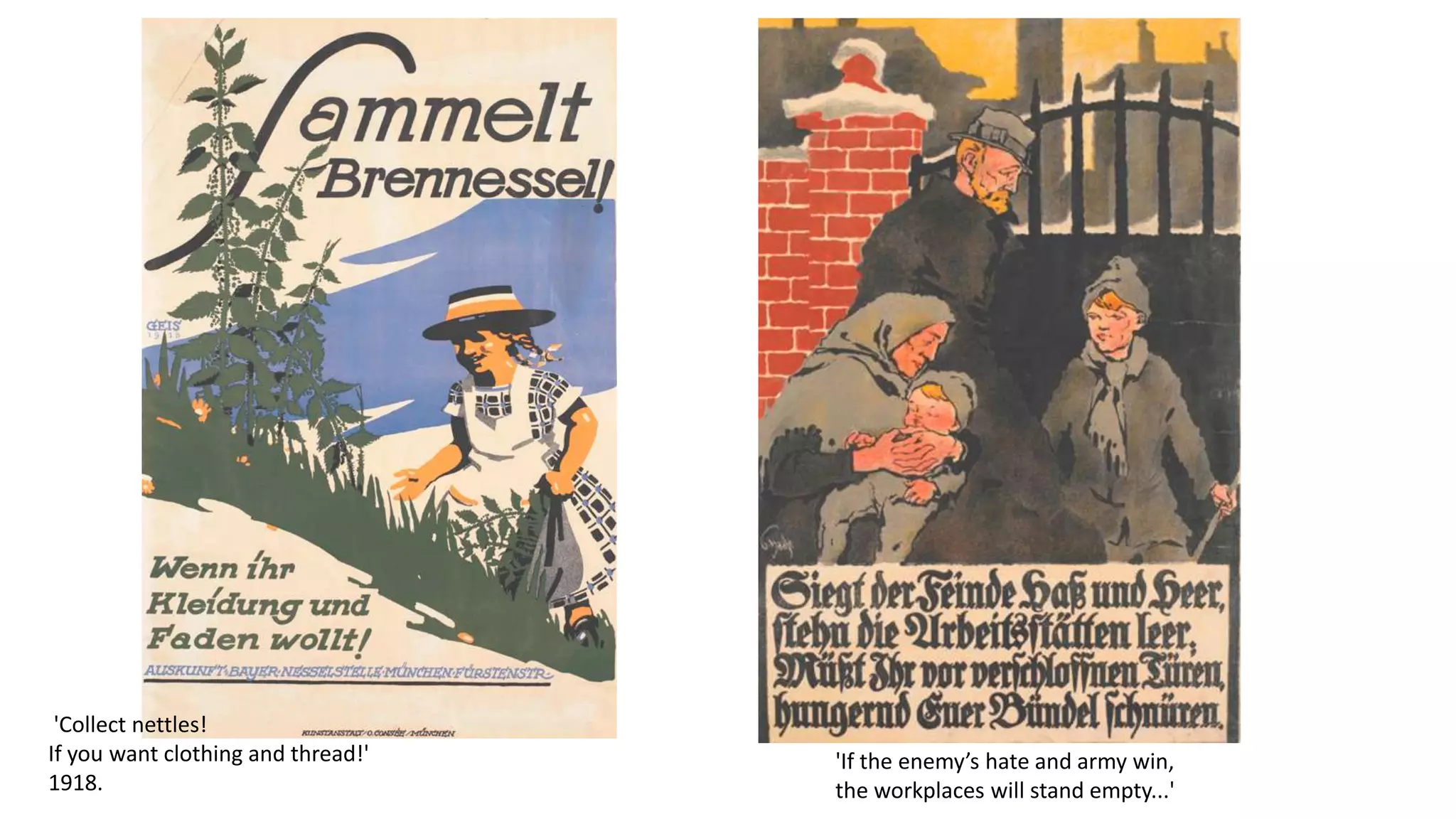
'Collect nettles!
If you want clothing and thread!'
1918.
'If the enemy’s hate and army win,
the workplaces will stand empty...'
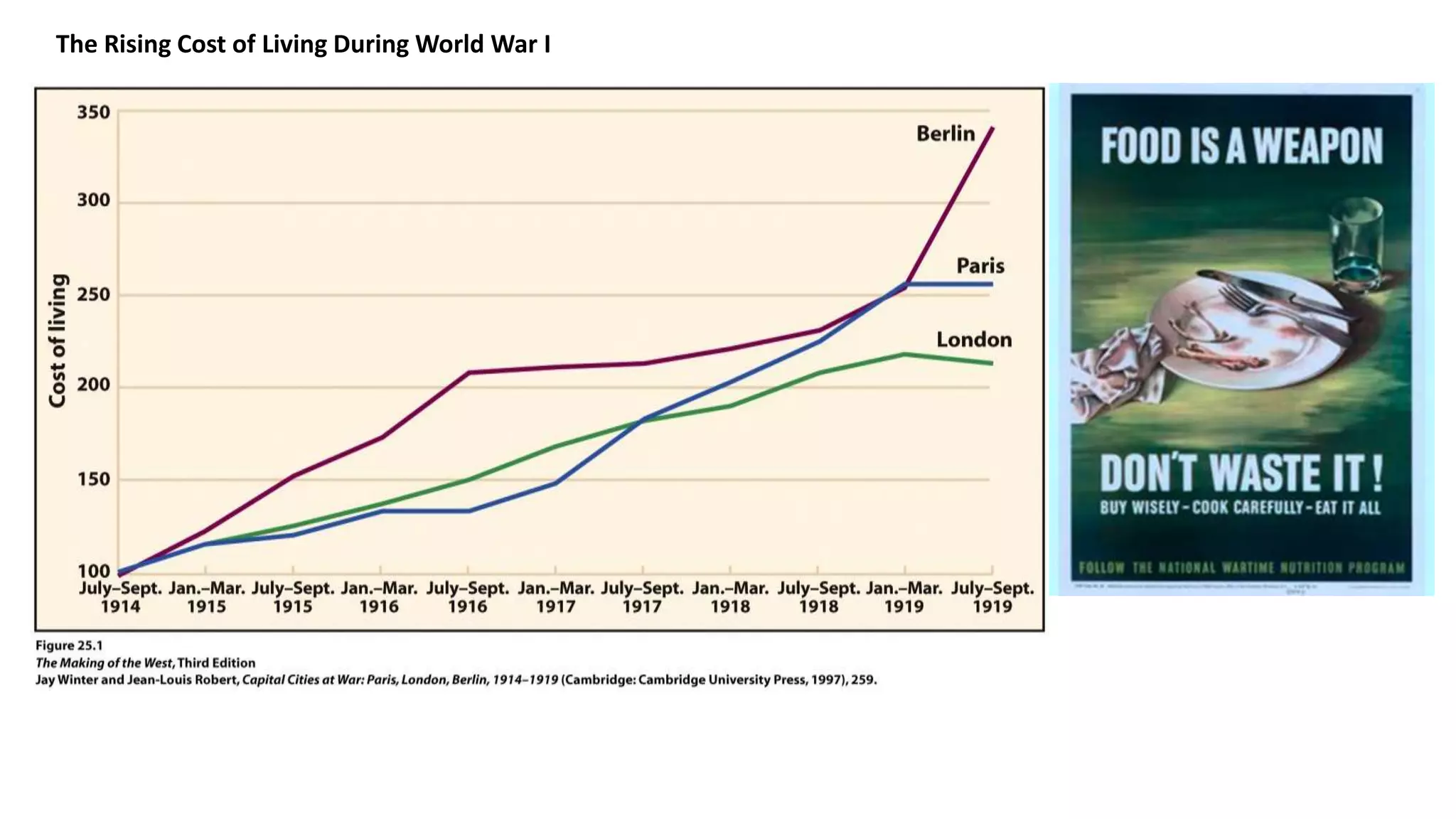
The Rising Cost of Living During World War I
The Battle Front by 1918
• Fussell “A perceptive observer could date corpses and skeletons lying on disused
battle fields by their evolving dress, (p. 50).”
• In 1918, Major P.H. Rilditch: “The progress of our successive attacks could be
clearly seen from the types of equipment on the skeletons, soft cloth caps
denoting the 1914 and early 1915 fighting, then respirators, then steel helmets
marking attack in 1916. Also Australian slouch hats, used in the costly abortive
attack in 1916.”
• War had gone on too long.
Subscribe to the 7th war bonds
1917
Félix Vallotton, L'église de Souain en silhouette
(The Church of Souain, Silhouetted), 1917
This is how it would look in
German lands if the French
reached the Rhine.' 1918.
Bolshevism brings war, unemployment and famine.
Association for conquering Bolshevism - 1918
1918 Spring Offensive: Maybe This Time?
Hindenburg and Ludendorff’s “pre-calculated” figure of 600,000
casualties but argued worth it
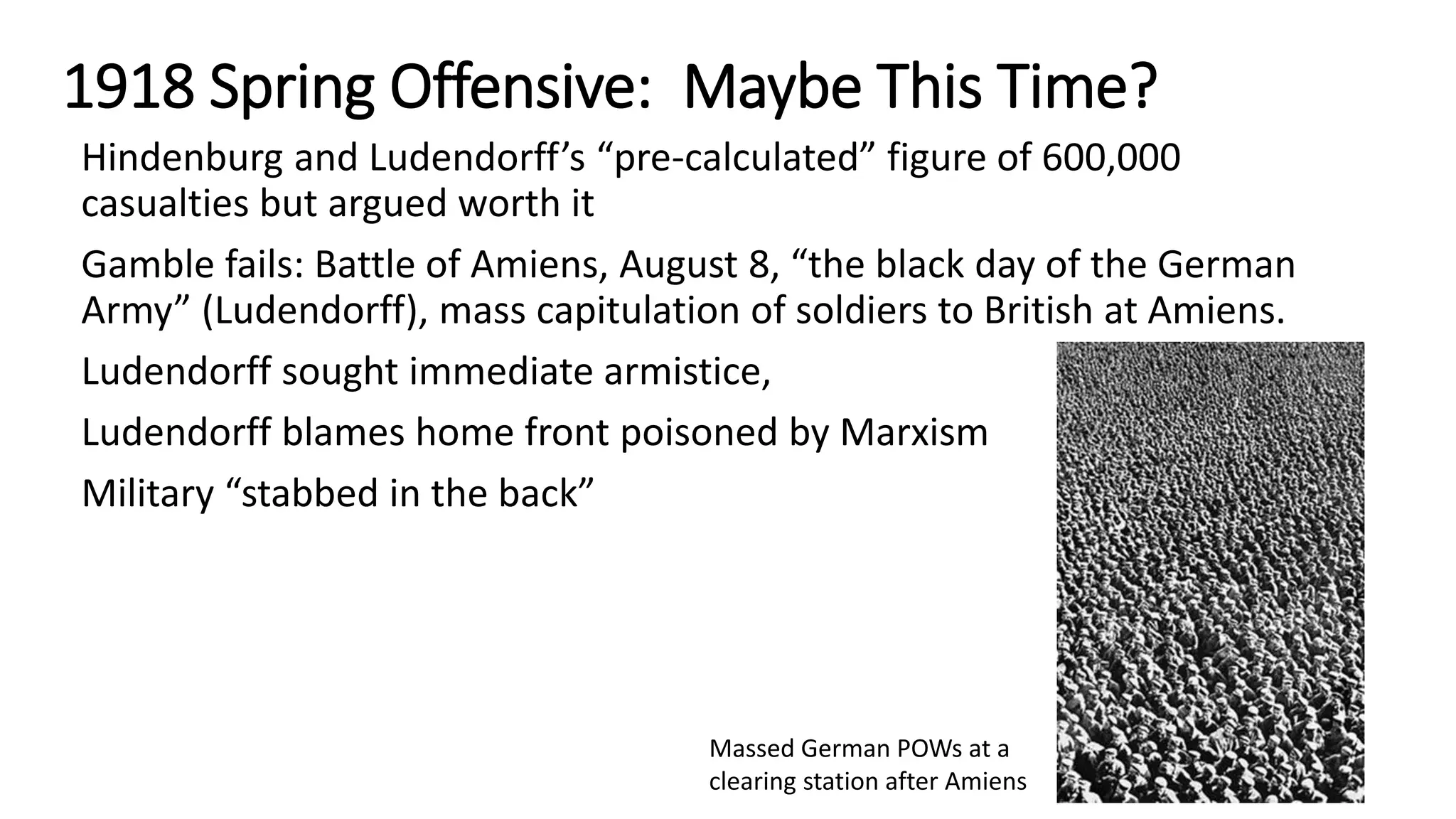
Gamble fails: Battle of Amiens, August 8, “the black day of the German
Army” (Ludendorff), mass capitulation of soldiers to British at Amiens.
Ludendorff sought immediate armistice,
Ludendorff blames home front poisoned by Marxism
Military “stabbed in the back”
Massed German POWs at a
clearing station after Amiens
Endurance?
Audoin-Rouzeau and Becker: “More than half of the 70 million
soldiers engaged in the Great War suffered physically from its
violence, whether it killed them or “only” wounded them.” (p.
25) “and we should not rule out the possibility that almost half
of the survivors sustained more of less serious psychological
disturbances.” (p. 25) Gassed (1919) by John Singer Sargent
What become of men who survived the trenches?
Wounded soldier in lower left of photo has “thousand-yard
stare” frequent manifestation of "shell-shock."
An Australian dressing station near Ypres, Belgium in 1917
Trained to Kill and Damaged Minds
If men trained to kill and trained to overcome reluctance of killing,
what accounts for shell-shock?
1922 War Office Committee of Enquiry into Shell-Shock concluded
that it was a lack of hardening.
Various interpretations of why not sufficiently “hardened” at this time
include:
Not seasoned veterans; unable to deal with fear and anxiety (WHR
Rivers at Craiglockhart)
Town v. country argument (Medical Officer Moran). Rural soldiers
death on farms (slaughter pigs); urban volunteers “soft”; needed
aggression instilled (bayonet drills)
shell shock
• Military officers and soldiers: Product of fear, cowardice. Failure to live up to
being a man. Manliness threatened.
• Official stance of Shell-shock: Cowards. Malingering.
• Impotence as “theme”(Hemingway, The Sun Also Rises). War emasculated
men—made them weak, cowardly—at same time women empowered,
independent.
• Heroes or Coward: Shell shock, S or
Shell-shock, W. Sickness or wounded.
If S, court martialed for cowardice.
Desire to cure and return to front.
Need to manage fear.
Gueules Cassées (i.e. the Broken Faces)
Shell shock: The Walking Wounded
• Eric Leed, “Fateful Memories: Industrialized War and Traumatic Neuroses,” and George L.
Mosse, “Shell-shock as a Social Disease,” in Journal of Contemporary History, 2000, Vol 35
(1), 85-108. Leed on results of industrialized war: “our wars mark minds.”
• Edgar Jones, “The Psychology of Killing: The Combat Experience of British Soldiers during
the First World War,” Journal of Contemporary History, 2006, Vol. 41 (2), 229-246. “The
opportunity to attack and kill the enemy did not lead to reduced rates of breakdown.” (p.
241). “Killing did not protect against shell shock.” (p. 245)
• Mental Cases: By end of the war 80,000 cases diagnosed but millions affected. By 1917,
one-seventh of military discharged for disability from British Army due to war neurosis.
Shell shock coined by medical officer Charles Myers in 1917. In 1922, 50,000 awarded
pensions on mental grounds but numbers much higher.
Trauma and the Reassertion of Manliness
• Arthur F. Hurst’s films on War Neuroses (see Julie M. Powell, “Shock
Troupe: Medical Film and the Performance of ‘Shell Shock’ for the
British Nation at War” (2016) and Stoyan Popkirov, “Different hsell,
same shock” (2017)
• Films are cultural products and create cultural narratives to create
meaning (See Powell, 340). Stories have power to heal
• Class and Gender notions of Disease: Men becoming womanly with
Hysteria and Working Class “out of control” and sickly
• What is needed? Discipline and rural Rehabilitation
• If men can be healed so can the nation; need to reassert manly
virtues and society “normalized”. See Powell (336)
Otto Dix, Wounded Veteran (1922)
Professor Dr. Höftmann of the Hindenburg's house in
Königsberg with a disabled veteran, who can now comfortably
use knife and fork.
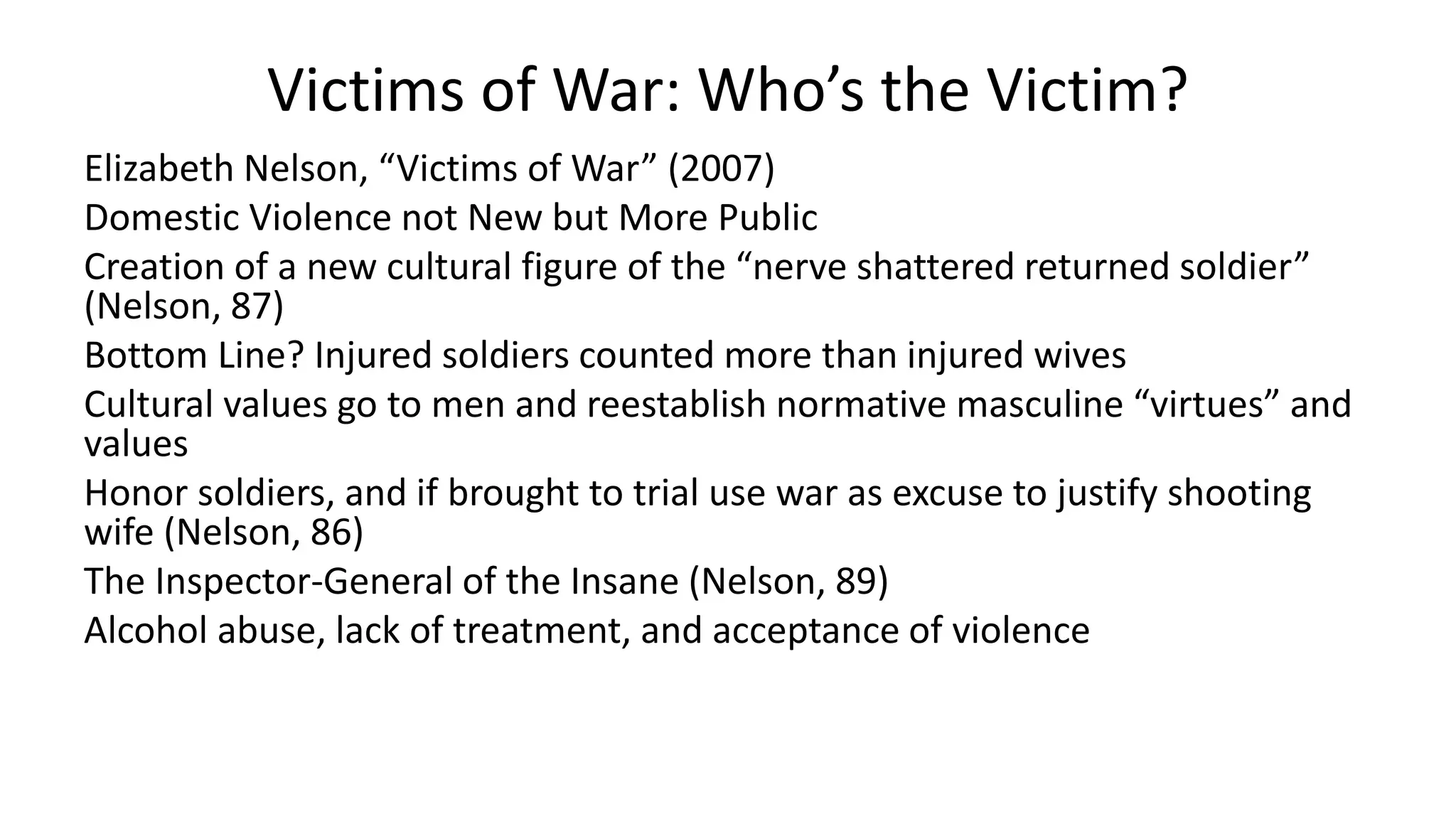
Victims of War: Who’s the Victim?
Elizabeth Nelson, “Victims of War” (2007)
Domestic Violence not New but More Public
Creation of a new cultural figure of the “nerve shattered returned soldier”
(Nelson, 87)
Bottom Line? Injured soldiers counted more than injured wives
Cultural values go to men and reestablish normative masculine “virtues” and
values
Honor soldiers, and if brought to trial use war as excuse to justify shooting
wife (Nelson, 86)
The Inspector-General of the Insane (Nelson, 89)
Alcohol abuse, lack of treatment, and acceptance of violence
The End is Near!
Peace Treaty of Versailles vindictive and humiliating but remember T of B-L!
440 articles with numerous appendices. Presented to Germany 7 May 1919; given 3 weeks to accept.
Germany to relinquish significant territory: West Prussia to Poland; occupation of Rhineland for 15 years;
cost of war and war reparation and war guilt (see Article 231).
German statement: “The German people would thus be condemned to perpetual slave labor.”
Relinquish self-determination in internal affairs and economic life controlled by international Reparation
Commission. To sign decree would be for Germans to sign their “own death sentence.” Presents counter-
proposals of demilitarization, territorial issues, and payments but a no go.
Paul Nash, Wire (1919)John Nash, Over the Top (1918)
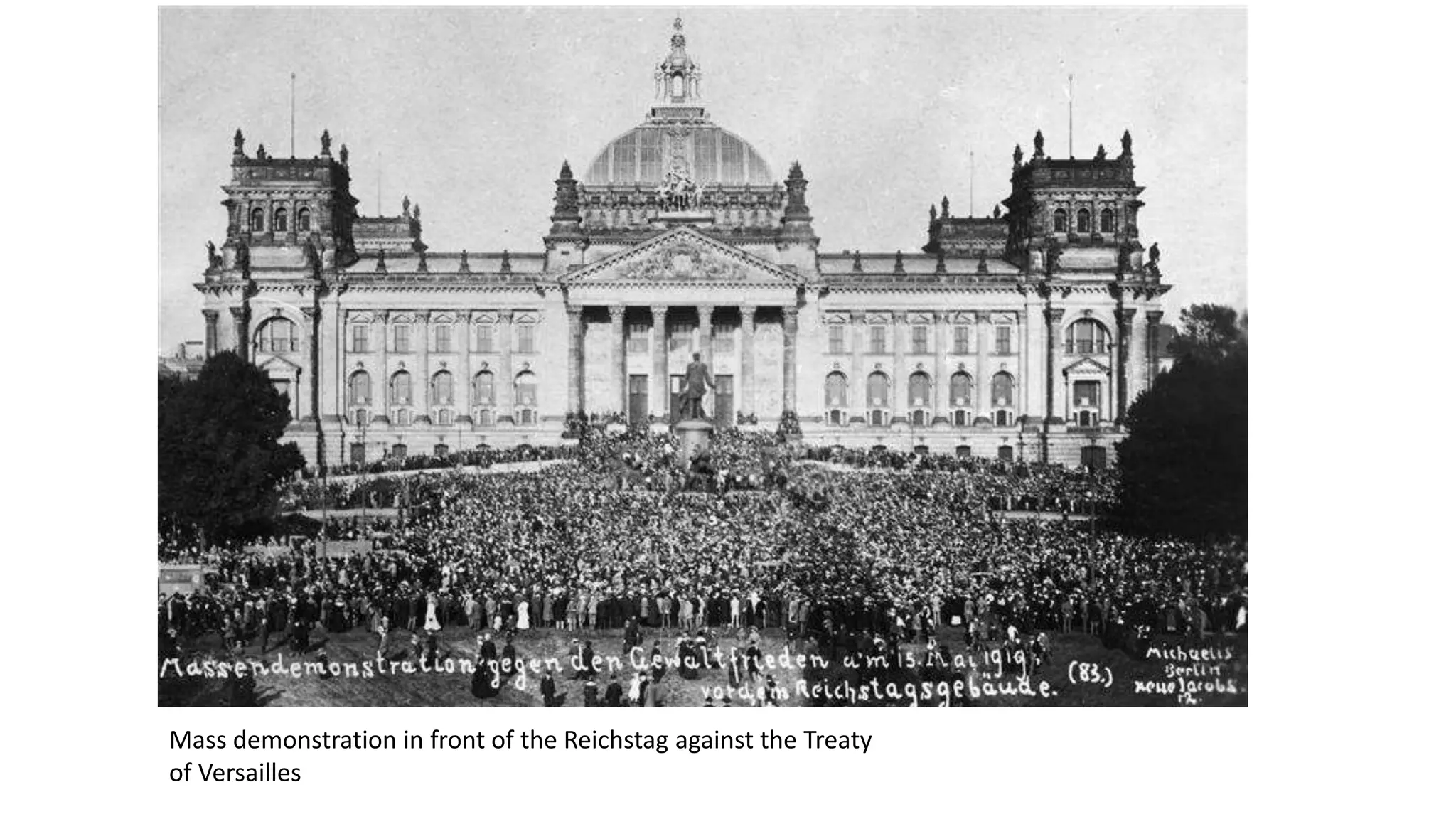
Mass demonstration in front of the Reichstag against the Treaty
of Versailles
Post-WWI Peace Settlements and Shattered Empires:
How to make a “good peace” after such a horrific war?
War of exhaustion
ends 11/11/18
Versailles Treaty
(1919)
Peace?: Versailles, Victory, and Victimization
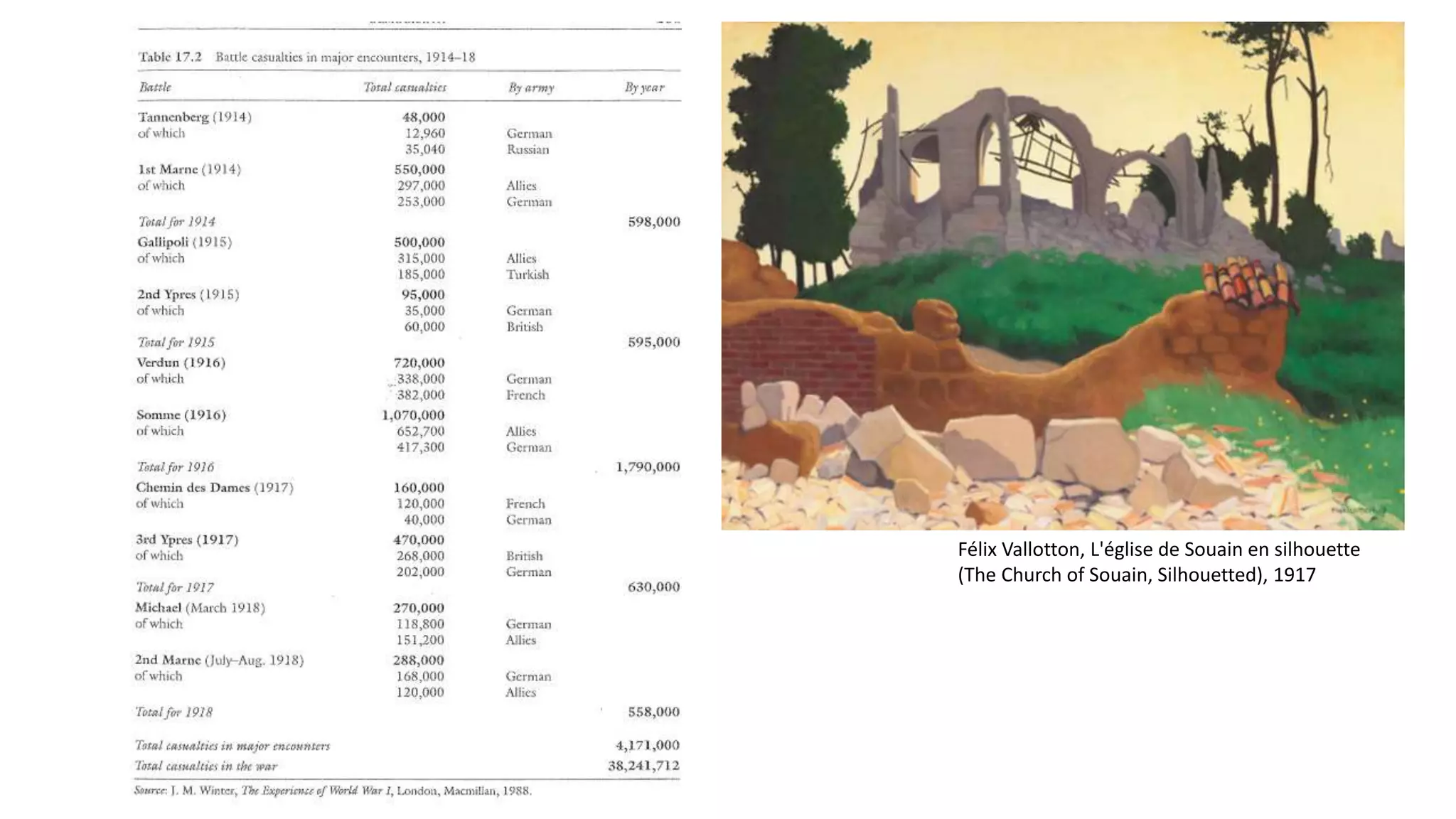
• Balance Sheet of dead: Between 10-13 million dead total, 37 million
military casualties, 30 million civilian casualties
• Germany 2 million
• Russia 1 ¾ million
• France 1 ½ million
• Britain just under 1 million (Civilian deaths 16,366, much lower
than on continent) Over 6 million men served in Brit military, roughly 58%
of all Scots, Welsh, and Eng. Men aged 15-49 served, Irish 15%)
• Italy ½ million
• America 50,000 (a little over 2 million served)
• Canada 65,000
• Total of 3 million widows and 6 million orphans as estimate.
• For France and elsewhere, “Virtually an entire society was probably in mourning;
an entire society formed a community of mourning.” (Audoin-Rouzeau and
Becker, p. 212)
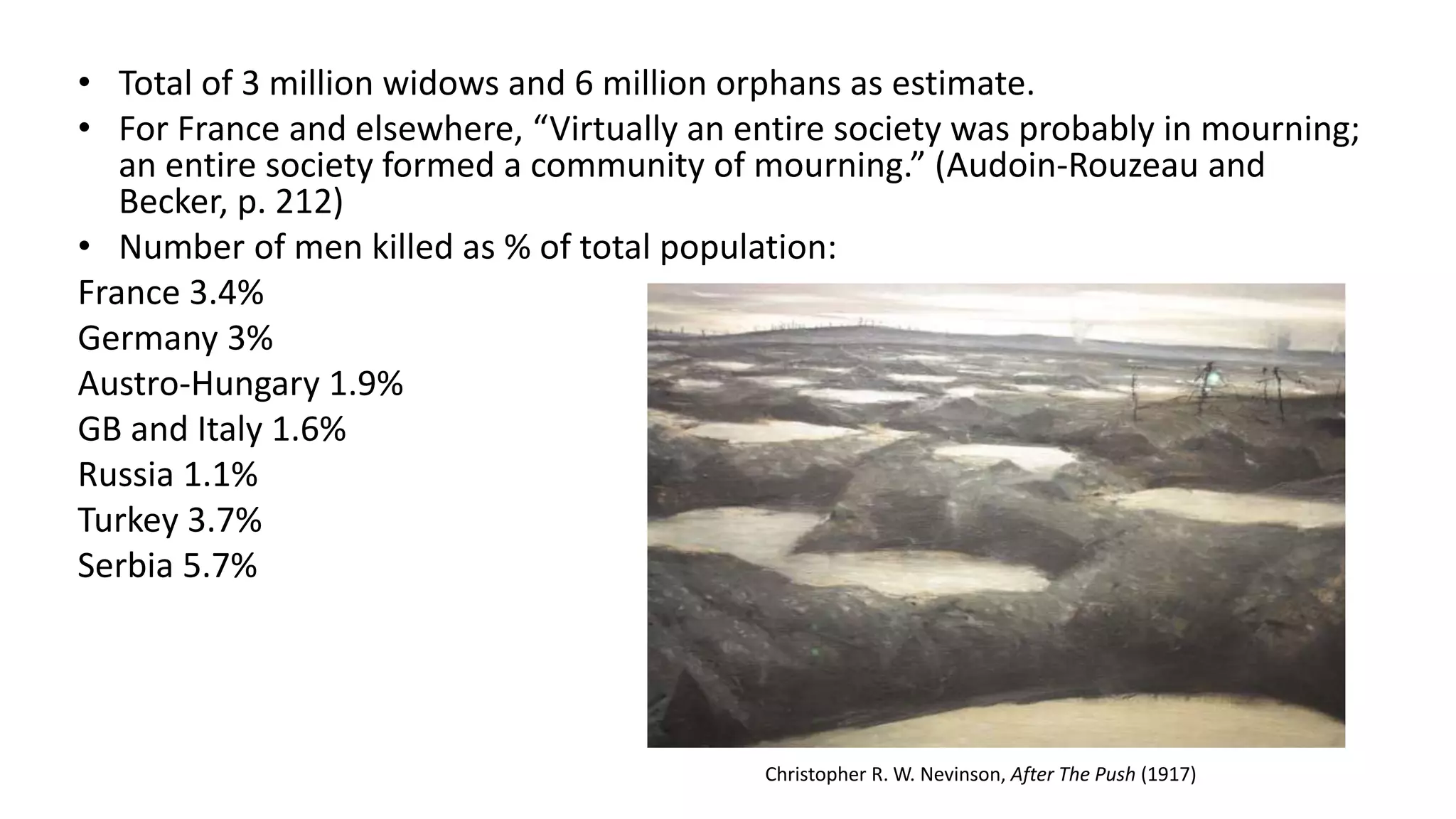
• Number of men killed as % of total population:
France 3.4%
Germany 3%
Austro-Hungary 1.9%
GB and Italy 1.6%
Russia 1.1%
Turkey 3.7%
Serbia 5.7%
Christopher R. W. Nevinson, After The Push (1917)
Christopher R. W. Nevinson,
Paths of Glory (1917)
Demographic Consequence of the First World War https://voxeu.org/article/demographic-consequence-first-
world-war
Finding larger meanings in war: Intellectuals, Artists, Soldiers
June 1915 “Manifesto of Celebrities” rejected artificial “Western civilization” with
its ideas of democracy, materialism, commercialism in favor of German culture
(Kultur) imbued with inner contemplation (Innerlichkeit), spirit (Geist), morality.
British a nation of money-grubbing shopkeepers and imperialists, unable to
compete with the culture of Beethoven, Goethe, and Nietzsche. Germany manly;
French and British not.
Thomas Mann’s “Observations of an Apolitical Man” (1918): “I myself confess that I
am deeply convinced that the German people will never be able to love political
democracy simply because they cannot love politics itself, and that the much
decried “authoritarian state” is and remains the one that is proper and becoming to
the German people, and the one they basically want.”
Jűnger’s Storm of Steel (1920) used storm trooper (tactic created in 1916) as new
ultra-militaristic, anti-bourgeois soldier who discarded old society for new morality.
War molded civilians into new human beings.
Otto Dix, War Cripples (Kriegskrüppel) (1920)
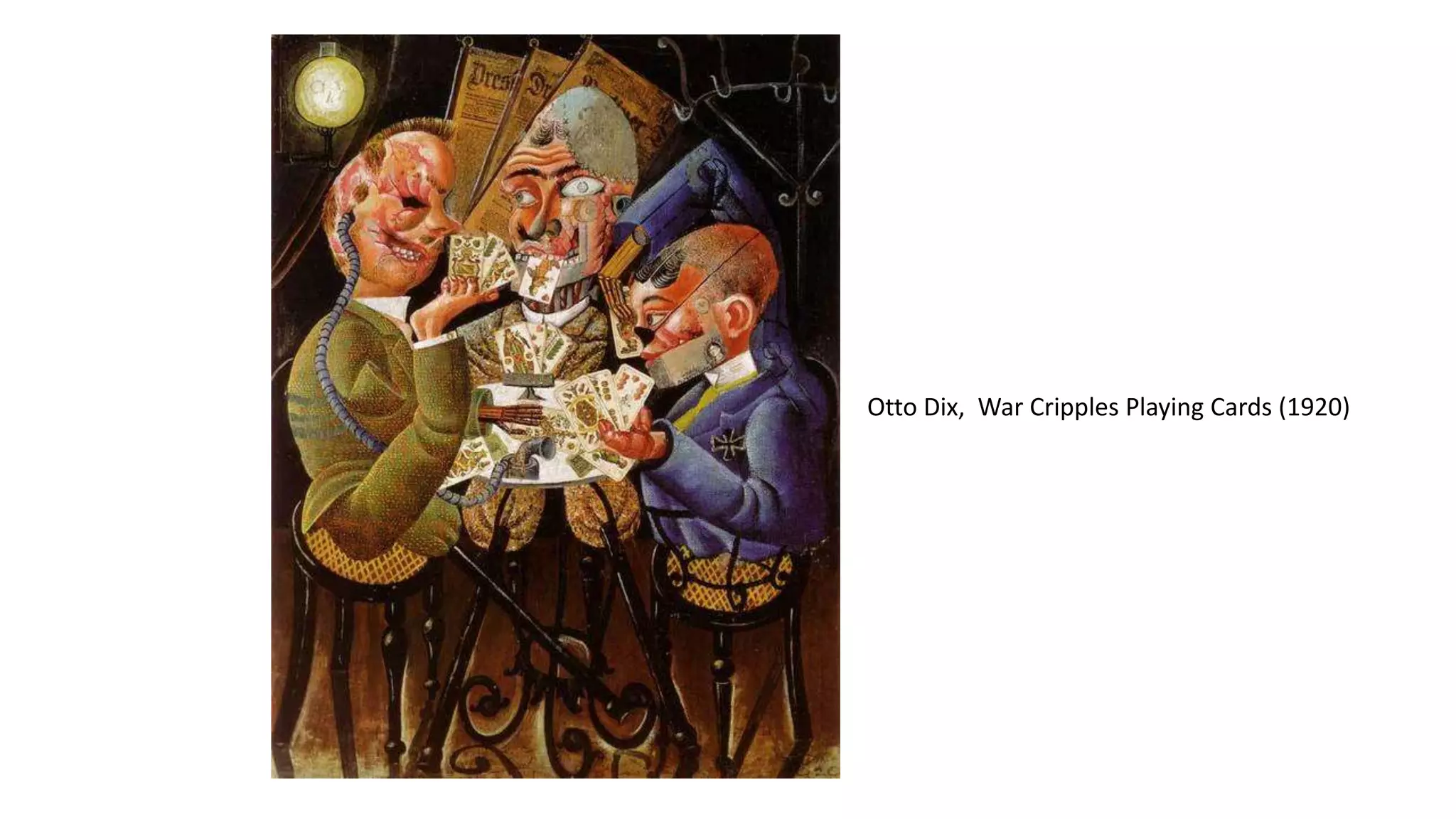
Otto Dix, War Cripples Playing Cards (1920)
Otto Dix, Prague Street (1920)
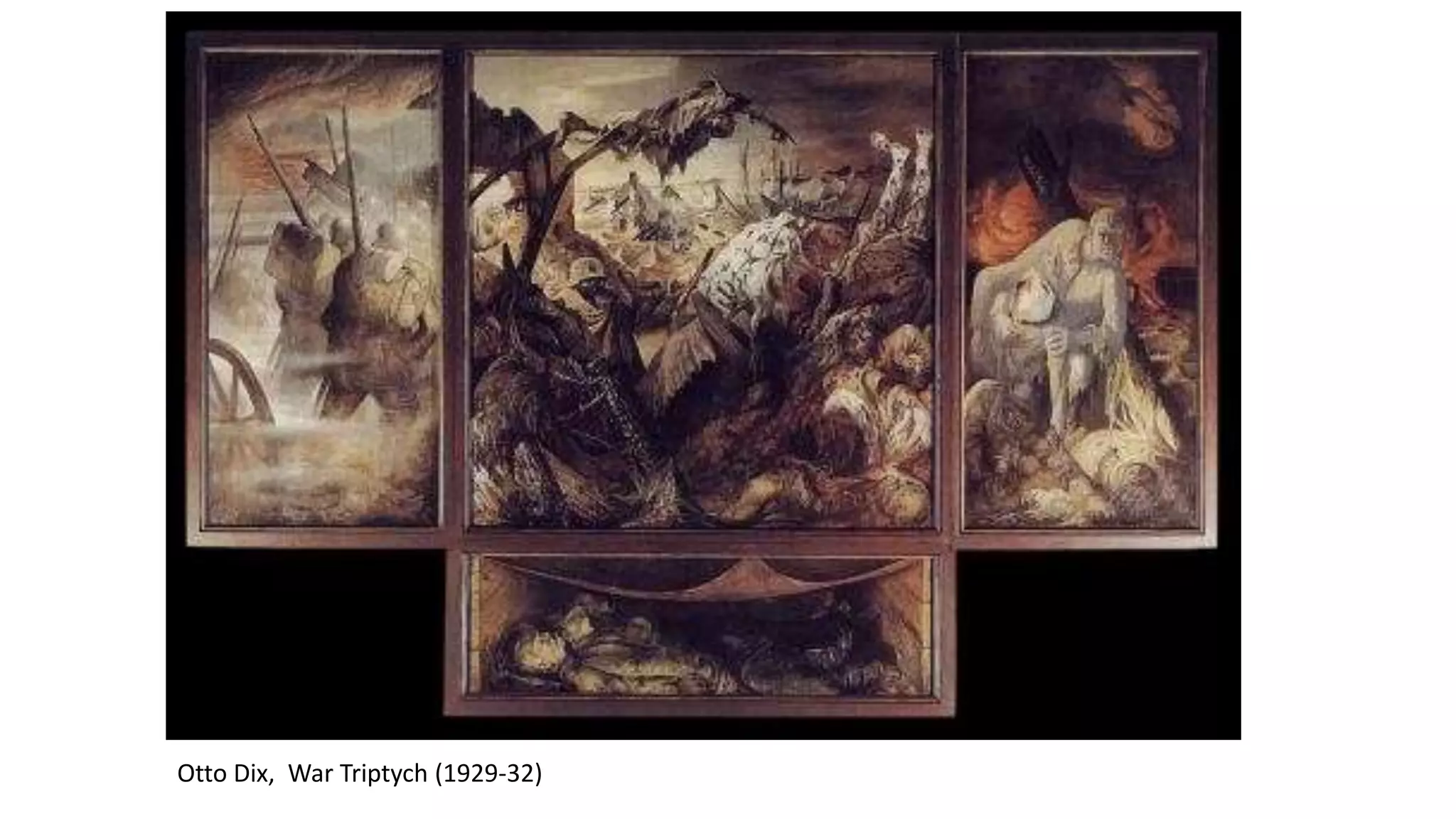
Otto Dix, War Triptych (1929-32)
Women Respond to War: Nurses and PoetsMay Wedderburn Cannan, “ Lamplight” (1917)
We planned to shake the world together, you and I.
Being young, and very wise;
Now in the light of the green shaded lamp
Almost I see your eyes
Light with the old gay laughter; you and I
Dreamed greatly of an Empire in those days,
Setting our feet upon laborious ways,
And all you asked of fame
Was crossed swords in the Army List;
My Dear, against your name.
We planned a great Empire together, you and I,
Bound only by the sea;
Now in the quiet of a chill Winter's night
Your voice comes hushed to me May and fellow VADs in Oxford
Full of forgotten memories: you and I
Dreamed great dreams of our future in those days,
Setting our feet on undiscovered ways,
And all I asked of fame
A scarlet cross on my breast, my Dear,
For the swords by your name.
We shall never shake the world together, you and I,
For you gave your life away;
And I think my heart was broken by war,
Since on a summer day
You took the road we never spoke of; you and I
Dreamed greatly of an Empire in those days;
You set your feet upon the Western ways
And have no need of fame -
There's a scarlet cross on my breast, my Dear,
And a torn cross with your name.
Rebecca West, The Return of the Soldier (1918)
Capt. Chris Baldry shell-shocked; suffers from memory loss; sent home from front to
recuperate, retreated into past and memory of love of working-class Margaret. Only past
makes any sense to him.
“Present”: 36 and married to another woman (upper-class Kitty). Kitty accuses him of
pretending.
Jenny (Chris’ sister and narrator): Realized that Margaret represented soul; rest is material
world and inconsequential. Margaret figures out what will cure him so that he can return to his
wife and to the front. A choice between happiness and reality (or truth), even though unhappy,
truth must win out otherwise “He would not be quite a man.” (p. 88).
Chris returns to reality and to the front. “That flooded trench in Flanders under that sky more
full of lying death than clouds, to that No Man’s Land where bullets fall like rain on the rotting
faces of the dead . . .” (p. 90).
Last line of the novel: “He’s cured!” (Kitty, p.90)
Vera Brittain’s Testament of Youth
Cover of the first 1933 edition
Vera Brittain’s “The Superfluous Woman”
Ghosts crying down the vistas of the years,
Recalling words
Whose echoes long have died,
And kind moss grown
Over the sharp and blood-bespattered stones
Which cut our feet upon the ancient ways.
But who will look for my coming?
Long busy days where many meet and part;
Crowded aside
Remembered hours of hope;
And city streets
Grown dark and hot with eager multitudes
Hurrying homeward whither respite waits.
But who will seek me at nightfall?
Light fading where the chimneys cut the sky;
Footsteps that pass,
Nor tarry at my door.
And far away,
Behind the row of crosses, shadows black
Stretch out long arms before the smouldering sun.
But who will give me my children?
Roland Leighton (1895–1915)
Vera Brittain (1893-1970)
The Birth of the Modern Novel:
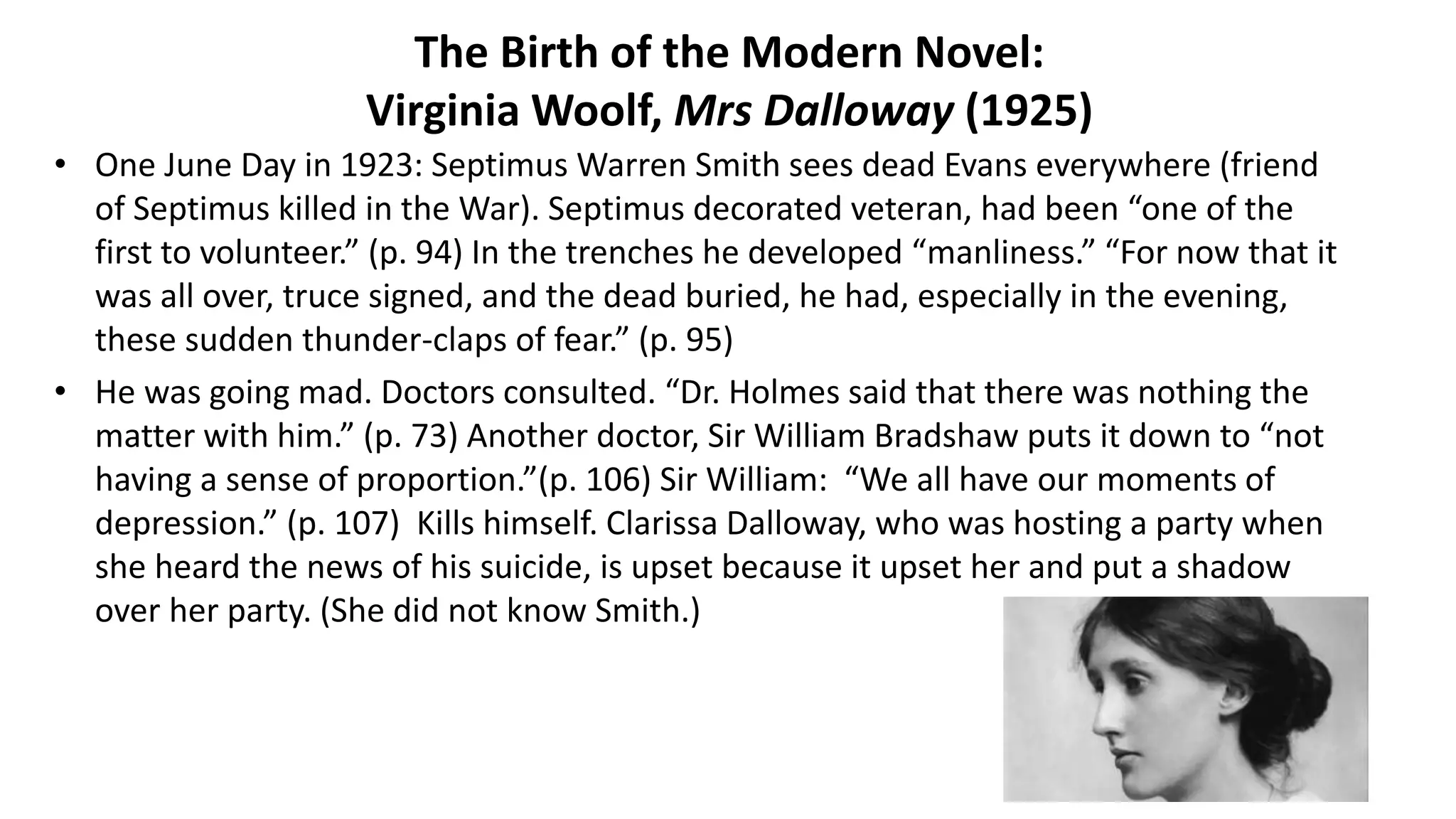
Virginia Woolf, Mrs Dalloway (1925)
• One June Day in 1923: Septimus Warren Smith sees dead Evans everywhere (friend
of Septimus killed in the War). Septimus decorated veteran, had been “one of the
first to volunteer.” (p. 94) In the trenches he developed “manliness.” “For now that it
was all over, truce signed, and the dead buried, he had, especially in the evening,
these sudden thunder-claps of fear.” (p. 95)
• He was going mad. Doctors consulted. “Dr. Holmes said that there was nothing the
matter with him.” (p. 73) Another doctor, Sir William Bradshaw puts it down to “not
having a sense of proportion.”(p. 106) Sir William: “We all have our moments of
depression.” (p. 107) Kills himself. Clarissa Dalloway, who was hosting a party when
she heard the news of his suicide, is upset because it upset her and put a shadow
over her party. (She did not know Smith.)
The Modern Novel and the Modern Man
Septimus Warren Smith fictional example of shell-shocked
veterans
Presence remains an ongoing problem, stigmatized.
War is over and everyone needs to act “normal” again
Ezra Pound and the whole Myth of the War:
“Mauberley” Stanzas IV and V (1920)
IV
These fought, in any case,
and some believing, pro domo, in any case ...
Some quick to arm,
some for adventure,
some from fear of weakness,
some from fear of censure,
some for love of slaughter, in imagination,
learning later ...
some in fear, learning love of slaughter;
Died some pro patria, non dulce non et decor” ...
walked eye-deep in hell
believing in old men’s lies, then unbelieving
came home, home to a lie,
home to many deceits,
home to old lies and new infamy;
usury age-old and age-thick
and liars in public places.
Daring as never before, wastage as never before.
Young blood and high blood,
Fair cheeks, and fine bodies;
fortitude as never before
frankness as never before,
disillusions as never told in the old days,
hysterias, trench confessions,
laughter out of dead bellies.
Paul Nash, The Menin Road, 1919
V
There died a myriad,
And of the best, among them,
For an old bitch gone in the teeth,
For a botched civilization.
Charm, smiling at the good mouth,
Quick eyes gone under earth’s lid,
For two gross of broken statues,
For a few thousand battered books.
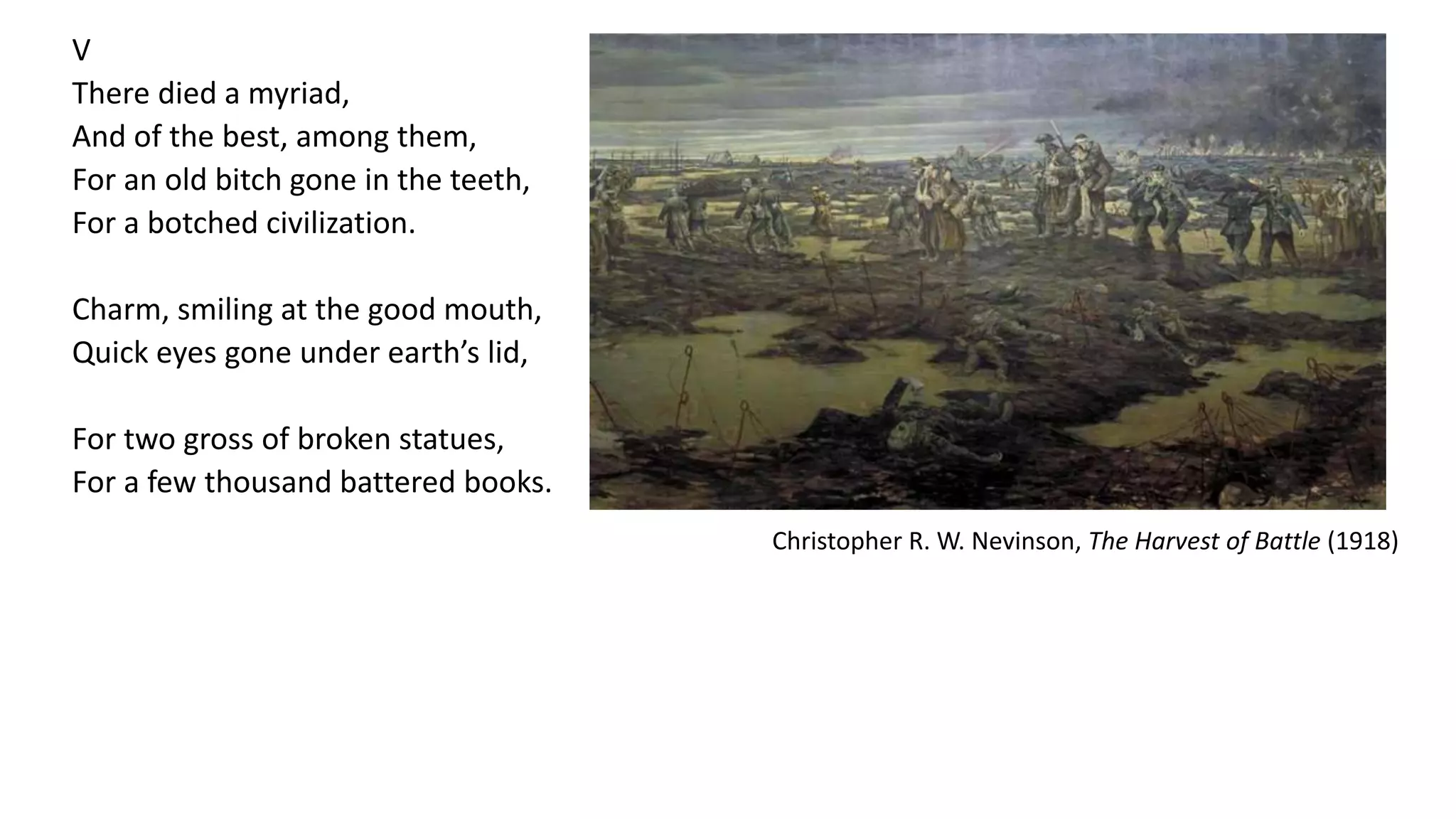
Christopher R. W. Nevinson, The Harvest of Battle (1918)

Hist a390 between the wars

  • 1.
    Between the Wars Returningand Remembering (or Not) Mark Gertler, Merry-Go-Round, 1916. Tate Britain.
  • 2.
    Shell Shock: TheWar in Your Head: Film Response #2: If War was a Musical Oh! What a Lovely War (directed by Richard Attenborough,1969) Oh! What a Lovely War explores the myths and the music of World War I. How do the songs reinforce the imagery of the film? How does this film depict the myths of the Great War? In what ways does this film support Boxwell’s article of the threatricality of World War I or war as a social drama?
  • 3.
    Manliness and War:Manly Desires in the Trench Boxwell’s “The Follies of War” (2002) and Homosexuality and socially transgressive behaviors • Act Out on the Stage: Outlet for “Perversity” and “sanctioned disorder.” Kept boundaries from total slippage and helped to maintain order (18) • Theater became “officially sanctioned transvestism” and allowed cross-dressing as entertainment and wish fulfillment • Space allowed non-normative behaviors: erotic versus comic • Glamor Drag versus grotesque mimicry (14): female impersonation is all about men for men. What can be allowed? • https://broadly.vice.com/en_us/article/ypa8qy/a-farewell-to-pants-the-role-of-cross-dressing- during-wwi
  • 4.
    Paul Nash, Springin the Trenches, Ridge Wood, 1917 (1918), Imperial War Museum, London
  • 5.
    German Resumption ofUnrestricted Submarine Warfare (February 1917). USA Joins War. German postcard depicting SM U-20 sinking of RMS Lusitania(7 May 1915)
  • 7.
    'Supply rabbit furs! Todealers and breeding associations. The Army needs them!' 'Fishermen, bring train oil! Catch dolphins and seals...' 1917
  • 8.
    Fighting the Warat Home: • “Economic War” British Blockade and poor state planning led to severe food shortages. Had relied on Russian grain and meat before war. • By 1917-18 Agriculture 60% decline from pre-war levels; GDP falls in 1917 to 76% of 1913 level. Black market thrives. • Hindenburg Program in 1916 demands unrealistic munitions increase (300% increase in shells and machine guns), cost of war rose from 36 million marks a day in 1914 to 136 million marks a day by 1918. Creates VAST debt, devaluation of mark, destroyed financial security • Gov’t favored credits to pay for war (taxes unpopular) Painting of Dazzle-ships in Drydock at Liverpool, Edward Wadsworth, 1919 I am a good war hen, I eat little and produce a lot.
  • 9.
    “Turnip Winter” (1916-17):Hunger • Berlin official weekly rations for adult in winter of 1917: 2-6 lbs. of turnips (rutabagas) or 2 lbs. bread if available, less than 2 oz. butter and 1 oz. margarine. Government report stated that “lack of enthusiasm” apparent as food/butter riots break out. • Ersatz common: “War Bread” created in Oct. 1914 (potato starch replaced flour). By summer 1917, 837 nonmeat substitutes for sausages and cold cuts patented. Health issues: TB, rickets, dysentery, typhoid fever • Consumption reduced to 50% of normal level. Wartime deaths related to malnutrition around 750,000
  • 10.
    'Collect nettles! If youwant clothing and thread!' 1918. 'If the enemy’s hate and army win, the workplaces will stand empty...'
  • 11.
    The Rising Costof Living During World War I
  • 12.
    The Battle Frontby 1918 • Fussell “A perceptive observer could date corpses and skeletons lying on disused battle fields by their evolving dress, (p. 50).” • In 1918, Major P.H. Rilditch: “The progress of our successive attacks could be clearly seen from the types of equipment on the skeletons, soft cloth caps denoting the 1914 and early 1915 fighting, then respirators, then steel helmets marking attack in 1916. Also Australian slouch hats, used in the costly abortive attack in 1916.” • War had gone on too long. Subscribe to the 7th war bonds 1917
  • 13.
    Félix Vallotton, L'églisede Souain en silhouette (The Church of Souain, Silhouetted), 1917
  • 14.
    This is howit would look in German lands if the French reached the Rhine.' 1918. Bolshevism brings war, unemployment and famine. Association for conquering Bolshevism - 1918
  • 15.
    1918 Spring Offensive:Maybe This Time? Hindenburg and Ludendorff’s “pre-calculated” figure of 600,000 casualties but argued worth it Gamble fails: Battle of Amiens, August 8, “the black day of the German Army” (Ludendorff), mass capitulation of soldiers to British at Amiens. Ludendorff sought immediate armistice, Ludendorff blames home front poisoned by Marxism Military “stabbed in the back” Massed German POWs at a clearing station after Amiens
  • 16.
    Endurance? Audoin-Rouzeau and Becker:“More than half of the 70 million soldiers engaged in the Great War suffered physically from its violence, whether it killed them or “only” wounded them.” (p. 25) “and we should not rule out the possibility that almost half of the survivors sustained more of less serious psychological disturbances.” (p. 25) Gassed (1919) by John Singer Sargent
  • 17.
    What become ofmen who survived the trenches? Wounded soldier in lower left of photo has “thousand-yard stare” frequent manifestation of "shell-shock." An Australian dressing station near Ypres, Belgium in 1917
  • 18.
    Trained to Killand Damaged Minds If men trained to kill and trained to overcome reluctance of killing, what accounts for shell-shock? 1922 War Office Committee of Enquiry into Shell-Shock concluded that it was a lack of hardening. Various interpretations of why not sufficiently “hardened” at this time include: Not seasoned veterans; unable to deal with fear and anxiety (WHR Rivers at Craiglockhart) Town v. country argument (Medical Officer Moran). Rural soldiers death on farms (slaughter pigs); urban volunteers “soft”; needed aggression instilled (bayonet drills)
  • 20.
    shell shock • Militaryofficers and soldiers: Product of fear, cowardice. Failure to live up to being a man. Manliness threatened. • Official stance of Shell-shock: Cowards. Malingering. • Impotence as “theme”(Hemingway, The Sun Also Rises). War emasculated men—made them weak, cowardly—at same time women empowered, independent. • Heroes or Coward: Shell shock, S or Shell-shock, W. Sickness or wounded. If S, court martialed for cowardice. Desire to cure and return to front. Need to manage fear. Gueules Cassées (i.e. the Broken Faces)
  • 21.
    Shell shock: TheWalking Wounded • Eric Leed, “Fateful Memories: Industrialized War and Traumatic Neuroses,” and George L. Mosse, “Shell-shock as a Social Disease,” in Journal of Contemporary History, 2000, Vol 35 (1), 85-108. Leed on results of industrialized war: “our wars mark minds.” • Edgar Jones, “The Psychology of Killing: The Combat Experience of British Soldiers during the First World War,” Journal of Contemporary History, 2006, Vol. 41 (2), 229-246. “The opportunity to attack and kill the enemy did not lead to reduced rates of breakdown.” (p. 241). “Killing did not protect against shell shock.” (p. 245) • Mental Cases: By end of the war 80,000 cases diagnosed but millions affected. By 1917, one-seventh of military discharged for disability from British Army due to war neurosis. Shell shock coined by medical officer Charles Myers in 1917. In 1922, 50,000 awarded pensions on mental grounds but numbers much higher.
  • 22.
    Trauma and theReassertion of Manliness • Arthur F. Hurst’s films on War Neuroses (see Julie M. Powell, “Shock Troupe: Medical Film and the Performance of ‘Shell Shock’ for the British Nation at War” (2016) and Stoyan Popkirov, “Different hsell, same shock” (2017) • Films are cultural products and create cultural narratives to create meaning (See Powell, 340). Stories have power to heal • Class and Gender notions of Disease: Men becoming womanly with Hysteria and Working Class “out of control” and sickly • What is needed? Discipline and rural Rehabilitation • If men can be healed so can the nation; need to reassert manly virtues and society “normalized”. See Powell (336)
  • 23.
    Otto Dix, WoundedVeteran (1922) Professor Dr. Höftmann of the Hindenburg's house in Königsberg with a disabled veteran, who can now comfortably use knife and fork.
  • 24.
    Victims of War:Who’s the Victim? Elizabeth Nelson, “Victims of War” (2007) Domestic Violence not New but More Public Creation of a new cultural figure of the “nerve shattered returned soldier” (Nelson, 87) Bottom Line? Injured soldiers counted more than injured wives Cultural values go to men and reestablish normative masculine “virtues” and values Honor soldiers, and if brought to trial use war as excuse to justify shooting wife (Nelson, 86) The Inspector-General of the Insane (Nelson, 89) Alcohol abuse, lack of treatment, and acceptance of violence
  • 25.
    The End isNear! Peace Treaty of Versailles vindictive and humiliating but remember T of B-L! 440 articles with numerous appendices. Presented to Germany 7 May 1919; given 3 weeks to accept. Germany to relinquish significant territory: West Prussia to Poland; occupation of Rhineland for 15 years; cost of war and war reparation and war guilt (see Article 231). German statement: “The German people would thus be condemned to perpetual slave labor.” Relinquish self-determination in internal affairs and economic life controlled by international Reparation Commission. To sign decree would be for Germans to sign their “own death sentence.” Presents counter- proposals of demilitarization, territorial issues, and payments but a no go. Paul Nash, Wire (1919)John Nash, Over the Top (1918)
  • 26.
    Mass demonstration infront of the Reichstag against the Treaty of Versailles
  • 27.
    Post-WWI Peace Settlementsand Shattered Empires: How to make a “good peace” after such a horrific war? War of exhaustion ends 11/11/18 Versailles Treaty (1919)
  • 28.
    Peace?: Versailles, Victory,and Victimization • Balance Sheet of dead: Between 10-13 million dead total, 37 million military casualties, 30 million civilian casualties • Germany 2 million • Russia 1 ¾ million • France 1 ½ million • Britain just under 1 million (Civilian deaths 16,366, much lower than on continent) Over 6 million men served in Brit military, roughly 58% of all Scots, Welsh, and Eng. Men aged 15-49 served, Irish 15%) • Italy ½ million • America 50,000 (a little over 2 million served) • Canada 65,000
  • 29.
    • Total of3 million widows and 6 million orphans as estimate. • For France and elsewhere, “Virtually an entire society was probably in mourning; an entire society formed a community of mourning.” (Audoin-Rouzeau and Becker, p. 212) • Number of men killed as % of total population: France 3.4% Germany 3% Austro-Hungary 1.9% GB and Italy 1.6% Russia 1.1% Turkey 3.7% Serbia 5.7% Christopher R. W. Nevinson, After The Push (1917)
  • 34.
    Christopher R. W.Nevinson, Paths of Glory (1917)
  • 35.
    Demographic Consequence ofthe First World War https://voxeu.org/article/demographic-consequence-first- world-war
  • 36.
    Finding larger meaningsin war: Intellectuals, Artists, Soldiers June 1915 “Manifesto of Celebrities” rejected artificial “Western civilization” with its ideas of democracy, materialism, commercialism in favor of German culture (Kultur) imbued with inner contemplation (Innerlichkeit), spirit (Geist), morality. British a nation of money-grubbing shopkeepers and imperialists, unable to compete with the culture of Beethoven, Goethe, and Nietzsche. Germany manly; French and British not. Thomas Mann’s “Observations of an Apolitical Man” (1918): “I myself confess that I am deeply convinced that the German people will never be able to love political democracy simply because they cannot love politics itself, and that the much decried “authoritarian state” is and remains the one that is proper and becoming to the German people, and the one they basically want.” Jűnger’s Storm of Steel (1920) used storm trooper (tactic created in 1916) as new ultra-militaristic, anti-bourgeois soldier who discarded old society for new morality. War molded civilians into new human beings.
  • 37.
    Otto Dix, WarCripples (Kriegskrüppel) (1920)
  • 38.
    Otto Dix, WarCripples Playing Cards (1920)
  • 39.
    Otto Dix, PragueStreet (1920)
  • 40.
    Otto Dix, WarTriptych (1929-32)
  • 41.
    Women Respond toWar: Nurses and PoetsMay Wedderburn Cannan, “ Lamplight” (1917) We planned to shake the world together, you and I. Being young, and very wise; Now in the light of the green shaded lamp Almost I see your eyes Light with the old gay laughter; you and I Dreamed greatly of an Empire in those days, Setting our feet upon laborious ways, And all you asked of fame Was crossed swords in the Army List; My Dear, against your name. We planned a great Empire together, you and I, Bound only by the sea; Now in the quiet of a chill Winter's night Your voice comes hushed to me May and fellow VADs in Oxford
  • 42.
    Full of forgottenmemories: you and I Dreamed great dreams of our future in those days, Setting our feet on undiscovered ways, And all I asked of fame A scarlet cross on my breast, my Dear, For the swords by your name. We shall never shake the world together, you and I, For you gave your life away; And I think my heart was broken by war, Since on a summer day You took the road we never spoke of; you and I Dreamed greatly of an Empire in those days; You set your feet upon the Western ways And have no need of fame - There's a scarlet cross on my breast, my Dear, And a torn cross with your name.
  • 43.
    Rebecca West, TheReturn of the Soldier (1918) Capt. Chris Baldry shell-shocked; suffers from memory loss; sent home from front to recuperate, retreated into past and memory of love of working-class Margaret. Only past makes any sense to him. “Present”: 36 and married to another woman (upper-class Kitty). Kitty accuses him of pretending. Jenny (Chris’ sister and narrator): Realized that Margaret represented soul; rest is material world and inconsequential. Margaret figures out what will cure him so that he can return to his wife and to the front. A choice between happiness and reality (or truth), even though unhappy, truth must win out otherwise “He would not be quite a man.” (p. 88). Chris returns to reality and to the front. “That flooded trench in Flanders under that sky more full of lying death than clouds, to that No Man’s Land where bullets fall like rain on the rotting faces of the dead . . .” (p. 90). Last line of the novel: “He’s cured!” (Kitty, p.90)
  • 44.
    Vera Brittain’s Testamentof Youth Cover of the first 1933 edition
  • 45.
    Vera Brittain’s “TheSuperfluous Woman” Ghosts crying down the vistas of the years, Recalling words Whose echoes long have died, And kind moss grown Over the sharp and blood-bespattered stones Which cut our feet upon the ancient ways. But who will look for my coming? Long busy days where many meet and part; Crowded aside Remembered hours of hope; And city streets Grown dark and hot with eager multitudes Hurrying homeward whither respite waits. But who will seek me at nightfall? Light fading where the chimneys cut the sky; Footsteps that pass, Nor tarry at my door. And far away, Behind the row of crosses, shadows black Stretch out long arms before the smouldering sun. But who will give me my children? Roland Leighton (1895–1915) Vera Brittain (1893-1970)
  • 46.
    The Birth ofthe Modern Novel: Virginia Woolf, Mrs Dalloway (1925) • One June Day in 1923: Septimus Warren Smith sees dead Evans everywhere (friend of Septimus killed in the War). Septimus decorated veteran, had been “one of the first to volunteer.” (p. 94) In the trenches he developed “manliness.” “For now that it was all over, truce signed, and the dead buried, he had, especially in the evening, these sudden thunder-claps of fear.” (p. 95) • He was going mad. Doctors consulted. “Dr. Holmes said that there was nothing the matter with him.” (p. 73) Another doctor, Sir William Bradshaw puts it down to “not having a sense of proportion.”(p. 106) Sir William: “We all have our moments of depression.” (p. 107) Kills himself. Clarissa Dalloway, who was hosting a party when she heard the news of his suicide, is upset because it upset her and put a shadow over her party. (She did not know Smith.)
  • 47.
    The Modern Noveland the Modern Man Septimus Warren Smith fictional example of shell-shocked veterans Presence remains an ongoing problem, stigmatized. War is over and everyone needs to act “normal” again
  • 48.
    Ezra Pound andthe whole Myth of the War: “Mauberley” Stanzas IV and V (1920) IV These fought, in any case, and some believing, pro domo, in any case ... Some quick to arm, some for adventure, some from fear of weakness, some from fear of censure, some for love of slaughter, in imagination, learning later ... some in fear, learning love of slaughter; Died some pro patria, non dulce non et decor” ... walked eye-deep in hell believing in old men’s lies, then unbelieving came home, home to a lie, home to many deceits, home to old lies and new infamy; usury age-old and age-thick and liars in public places.
  • 49.
    Daring as neverbefore, wastage as never before. Young blood and high blood, Fair cheeks, and fine bodies; fortitude as never before frankness as never before, disillusions as never told in the old days, hysterias, trench confessions, laughter out of dead bellies. Paul Nash, The Menin Road, 1919
  • 50.
    V There died amyriad, And of the best, among them, For an old bitch gone in the teeth, For a botched civilization. Charm, smiling at the good mouth, Quick eyes gone under earth’s lid, For two gross of broken statues, For a few thousand battered books. Christopher R. W. Nevinson, The Harvest of Battle (1918)