Smart Hiring โ€“ Selecting High Performance Employees for the New Economy The Smart Guide to Human Resource and Management Seminars   Presented by Warren J. Rutherford The Executive Suite
Program Smart Hiring Survey Our new economy โ€“ knowledge based Company future strategies - planning Person โ€“ future fit - asking Alignment Company needs Applications & Interviews Job Descriptions Assessing Person โ€“ Position Alignment Decision attributes โ€“ thinking our talents Assessment process Selection ยฉ  theexecutivesuite.com
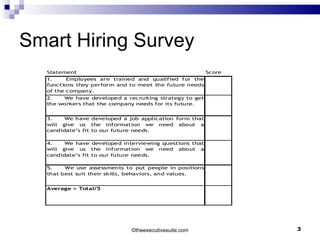
Smart Hiring Survey ยฉ theexecutivesuite.com
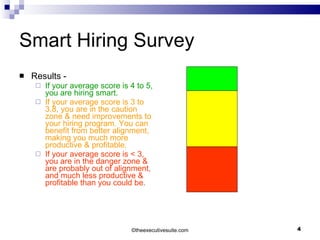
Smart Hiring Survey Results -  If your average score is 4 to 5, you are hiring smart. If your average score is 3 to 3.8, you are in the caution zone & need improvements to your hiring program. You can benefit from better alignment, making you much more productive & profitable. If your average score is < 3, you are in the danger zone & are probably out of alignment, and much less productive & profitable than you could be. ยฉ theexecutivesuite.com
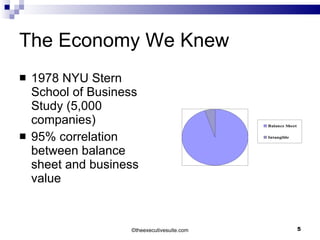
The Economy We Knew 1978 NYU Stern School of Business Study (5,000 companies) 95% correlation between balance sheet and business value ยฉ theexecutivesuite.com
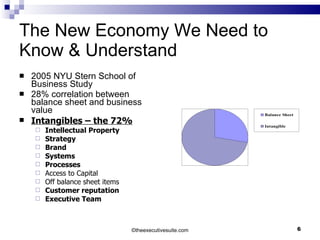
The New Economy We Need to Know & Understand 2005 NYU Stern School of Business Study 28% correlation between balance sheet and business value Intangibles โ€“ the 72% Intellectual Property Strategy Brand Systems Processes Access to Capital Off balance sheet items Customer reputation Executive Team ยฉ theexecutivesuite.com
Why it is Important! Only 5% of a workforce understands their companyโ€™s strategy. Only 15% of senior management spends more than 1 hour a month defining strategy and aligning operations to it. Only 25% have their operations aligned to the strategy. Only 40% align company from budget to strategy. David Norton, Balanced Scorecard Report, Vol. 3, No. 5 (Sep/Oct 2001) ยฉtheexecutivesuite.com
Strategies to Succeed How do people contribute to the success of our business? Cornell Study โ€“ Workforce alignment requires - The right types of people,  In the right places at the right times,  Doing the right things right.  A company with the right types of people has employees with the knowledge and skills necessary to help that company achieve its goals. ยฉ theexecutivesuite.com
Person โ€“ Future Fit 3 different strategies companies use to select employees โ€“ Person job fit  - match job applicantโ€™s knowledge and skills to the requirements of specific job openings and focus on an applicantโ€™s ability to perform well right away without extensive training.  Person organization fit  - focus on how well the individual fits with the culture or values of the company and hire people with the capacity to work well with other company employees  Person future fit  - focus on the potential long-term contribution of applicants, often to the extent that they are willing to leave positions open until the find the best and brightest new employees.  Creating and maintaining that person-future fit that the Cornell research identified as creating the best, long-term workforce alignment. Better to define where we are going and who we need to get us there to create a more aligned and focused workforce. ยฉ theexecutivesuite.com
Alignment Enhances Productivity and Profit Doesnโ€™t it make sense that -  An aligned workforce increases productivity and profit,  We need to better understand our employees to further drive the success, growth, and performance of our business. A study of large publicly traded firms, found that companies using โ€œ high performance โ€ human resource practices have market values that range from between $16,000 and $40,000 per employee higher than firms that do not use such practices.  ยฉ theexecutivesuite.com
Aligning Your Hiring Practices to Hire the Right Types of People Requires - Better understanding the companyโ€™s needs by defining and communicating our long-term company strategy and plan; Communicating that strategy and plan as a recruitment strategy โ€“ attracting who we want and need for our future success; Refining the application and interviewing process to solicit information about current talents as well as future potential and interests; ยฉ theexecutivesuite.com
Aligning Our Hiring Practices to Hire the Right Types of People Requires - Identifying an applicantโ€™s current potential to perform the functions of a job by understanding what is important in the job and matching that to what is present in the applicant; Assessing and understanding how an applicantโ€™s long-term potential can match with the companyโ€™s long-term strategy; and  Enabling job role changes to better fit a personโ€™s natural talents โ€“ by understanding a personโ€™s natural strengths and adapting the job role(s) as needed. ยฉ theexecutivesuite.com
Company Needs What is your companyโ€™s long-term company strategy and plan? Mission, vision, values, purpose. Have you involved your employees in its development? What are some of the steps you used โ€“ retreat, questionnaire? Are you communicating that strategy and plan to your existing employees, (in person, email, postings, meetings, interactive discussions) and Are you communicating that strategy and plan to job applicants so that you can - attract who you  want and need  for your future success? ยฉ theexecutivesuite.com
Application and Interviewing Process Remember โ€“ we are seeking  Alignment  to your companyโ€™s future strategy and plans, so โ€“  Do you ask an applicant to describe their future position responsibilities,  What talents they believe that they have that will enable them to achieve their future vision, What talents do they believe they are strong in, and  Why? ยฉ theexecutivesuite.com
Application and Interviewing Process For each of the common interviewing questions, ensure there are questions on the application which solicit this information.  For certain positions you may want the applicant to write out the response so that you can go over it in the interview. These questions and this process will help to identify their behavioral tendencies, their values, and their decision-making patterns. ยฉ theexecutivesuite.com
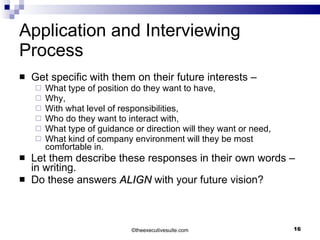
Application and Interviewing Process Get specific with them on their future interests โ€“ What type of position do they want to have,  Why,  With what level of responsibilities,  Who do they want to interact with,  What type of guidance or direction will they want or need,  What kind of company environment will they be most comfortable in. Let them describe these responses in their own words โ€“ in writing. Do these answers  ALIGN  with your future vision? ยฉ theexecutivesuite.com
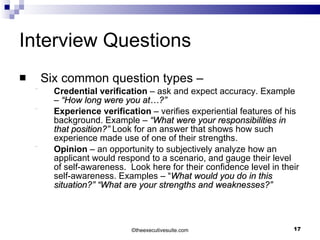
Interview Questions Six common question types โ€“  Credential verification  โ€“ ask and expect accuracy. Example โ€“  โ€œHow long were you atโ€ฆ?โ€ Experience verification  โ€“ verifies experiential features of his background. Example โ€“  โ€œWhat were your responsibilities in that position?โ€  Look for an answer that shows how such experience made use of one of their strengths. Opinion  โ€“ an opportunity to subjectively analyze how an applicant would respond to a scenario, and gauge their level of self-awareness.  Look here for their confidence level in their self-awareness. Examples โ€“  โ€œ What would you do in this situation?โ€ โ€œWhat are your strengths and weaknesses?โ€ ยฉ theexecutivesuite.com
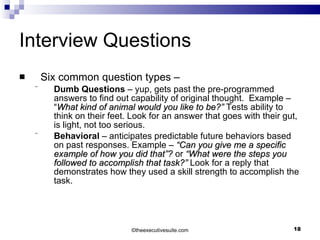
Interview Questions Six common question types โ€“ Dumb Questions  โ€“ yup, gets past the pre-programmed answers to find out capability of original thought.  Example โ€“  โ€œ What kind of animal would you like to be?โ€  Tests ability to think on their feet. Look for an answer that goes with their gut, is light, not too serious. Behavioral  โ€“ anticipates predictable future behaviors based on past responses. Example โ€“  โ€œCan you give me a specific example of how you did thatโ€?  or  โ€œWhat were the steps you followed to accomplish that task?โ€  Look for a reply that demonstrates how they used a skill strength to accomplish the task. ยฉ theexecutivesuite.com
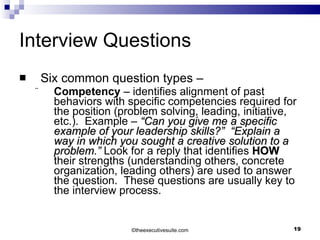
Interview Questions Six common question types โ€“  Competency  โ€“ identifies alignment of past behaviors with specific competencies required for the position (problem solving, leading, initiative, etc.).  Example โ€“  โ€œCan you give me a specific example of your leadership skills?โ€  โ€œExplain a way in which you sought a creative solution to a problem.โ€  Look for a reply that identifies  HOW  their strengths (understanding others, concrete organization, leading others) are used to answer the question.  These questions are usually key to the interview process. ยฉ theexecutivesuite.com
Interview Questions Competency Question Examples โ€“ โ€œ Give me an example of a project that you were responsible for organizing from beginning to end. How did you go about it?โ€ โ€œ Give me an example of a lesson you have learned from making a mistake. What did you do differently going forward?โ€ โ€œ What is the one thing in your life that you have not been able to accomplish or complete that gives you the most frustration? Why didnโ€™t you complete it?โ€  (Note โ€“ this helps to identify what they perceive as their weakness and how they have adapted (or not) to not rely on that weakness for their success.) ยฉ theexecutivesuite.com
How to Gauge a Quality Question Response Shake โ€˜em and make โ€˜em remember  Did he take time to  think through what he was going to say ? Remember the proverb โ€“  โ€œIt is better to remain silent and be thought a fool, then to speak and prove them right.โ€ Did he give a  specific example of a personal strength or weakness  to support his answer? Did he  qualify the question  โ€“ did he ask you to qualify what you were asking or looking for? ยฉ theexecutivesuite.com
Interview Essentials Some basic standards  โ€“ Brief answers  โ€“ applicant ~ 1/3 rd  of the time, interviewer rest of time to ask questions and answer questions. Appropriate dress  โ€“ Did you tell them โ€œcasualโ€ was OK? Did he  identify his goals  up front and ask you what you were looking for? Did he  ask you what you want , what you think, how you know when you will have found it and your opinions? Did he  explain why he left his last position ? Honestly? Did he  make a personal connection  on a personal level with you, are there shared values, behaviors, or strengths you have in common? ยฉ theexecutivesuite.com
Interview Essentials Some basic standards โ€“ Did he  ask what you are looking for in a solution  and did he ask you what you think of his ability to be that solution?  How does he handle rejection  โ€“ if you indicated that he has not shown how his experience and future vision fits your position โ€“ how does he respectfully respond to your concern? How does he show you he is  interested  in your company โ€“ research, questions? Did he bring up his  weakness  before you asked about it?  Did he  follow up  after the interview โ€“ handwritten, at least an email? Thank you, and reiterate his interest? ยฉ theexecutivesuite.com
Job Descriptions Do they effectively summarize the type of knowledge, skills, & abilities necessary to ensure that the essential functions are fulfilled. Do they effectively identify functions that can describe the major categories of the position โ€“ management, sales, finance, marketing, process? Do they identify how the position contributes to the accomplishment of company objectives? Do job descriptions exist? ยฉt heexecutivesuite.com
Functional Assessment of Each Position We know that there are 3 ways we can think about anything โ€“  Our head โ€“ systems & structure Our hands โ€“ practical, letโ€™s get it done Our heart โ€“ empathy, the impact on others Each of us has a different balance of these 3 styles & explains why our decisions and actions are different.  The way we make decisions & how we use them are at the core of who we are. They are key to our preferences, our strengths, and our weaknesses. What are the dominant thinking patterns required for people in each position? How does knowing that help to ensure that the person filling the position will be more successful in achieving position objectives and be more able to accomplish the desired person-future fit?  Think Position-Person Alignment & Workforce Alignment. ยฉ theexecutivesuite.com
Assessment Process Identify position tasks Aggregate tasks up to categories Identify decision attributes for each category Develop a position-specific profile to measure applicant match to profile as part of selection process. ยฉ theexecutivesuite.com
Selection Seek alignment to Company needs Application and Interview Applicant needs Job Description Assessment match Remember โ€“  A company with the right types of people has employees with the knowledge and skills necessary to help that company achieve its goals. ยฉ theexecutivesuite.com
Thank you! For more information -  Warren J. Rutherford Owner The Executive Suite 129 Airport Road Hyannis, MA 02601 [email_address] www.theexecutivesuite.com 508-778-7700 ยฉ theexecutivesuite.com

Hiring smart

  • 1.
    Smart Hiring โ€“Selecting High Performance Employees for the New Economy The Smart Guide to Human Resource and Management Seminars Presented by Warren J. Rutherford The Executive Suite
  • 2.
    Program Smart HiringSurvey Our new economy โ€“ knowledge based Company future strategies - planning Person โ€“ future fit - asking Alignment Company needs Applications & Interviews Job Descriptions Assessing Person โ€“ Position Alignment Decision attributes โ€“ thinking our talents Assessment process Selection ยฉ theexecutivesuite.com
  • 3.
    Smart Hiring Surveyยฉ theexecutivesuite.com
  • 4.
    Smart Hiring SurveyResults - If your average score is 4 to 5, you are hiring smart. If your average score is 3 to 3.8, you are in the caution zone & need improvements to your hiring program. You can benefit from better alignment, making you much more productive & profitable. If your average score is < 3, you are in the danger zone & are probably out of alignment, and much less productive & profitable than you could be. ยฉ theexecutivesuite.com
  • 5.
    The Economy WeKnew 1978 NYU Stern School of Business Study (5,000 companies) 95% correlation between balance sheet and business value ยฉ theexecutivesuite.com
  • 6.
    The New EconomyWe Need to Know & Understand 2005 NYU Stern School of Business Study 28% correlation between balance sheet and business value Intangibles โ€“ the 72% Intellectual Property Strategy Brand Systems Processes Access to Capital Off balance sheet items Customer reputation Executive Team ยฉ theexecutivesuite.com
  • 7.
    Why it isImportant! Only 5% of a workforce understands their companyโ€™s strategy. Only 15% of senior management spends more than 1 hour a month defining strategy and aligning operations to it. Only 25% have their operations aligned to the strategy. Only 40% align company from budget to strategy. David Norton, Balanced Scorecard Report, Vol. 3, No. 5 (Sep/Oct 2001) ยฉtheexecutivesuite.com
  • 8.
    Strategies to SucceedHow do people contribute to the success of our business? Cornell Study โ€“ Workforce alignment requires - The right types of people, In the right places at the right times, Doing the right things right. A company with the right types of people has employees with the knowledge and skills necessary to help that company achieve its goals. ยฉ theexecutivesuite.com
  • 9.
    Person โ€“ FutureFit 3 different strategies companies use to select employees โ€“ Person job fit - match job applicantโ€™s knowledge and skills to the requirements of specific job openings and focus on an applicantโ€™s ability to perform well right away without extensive training. Person organization fit - focus on how well the individual fits with the culture or values of the company and hire people with the capacity to work well with other company employees Person future fit - focus on the potential long-term contribution of applicants, often to the extent that they are willing to leave positions open until the find the best and brightest new employees. Creating and maintaining that person-future fit that the Cornell research identified as creating the best, long-term workforce alignment. Better to define where we are going and who we need to get us there to create a more aligned and focused workforce. ยฉ theexecutivesuite.com
  • 10.
    Alignment Enhances Productivityand Profit Doesnโ€™t it make sense that - An aligned workforce increases productivity and profit, We need to better understand our employees to further drive the success, growth, and performance of our business. A study of large publicly traded firms, found that companies using โ€œ high performance โ€ human resource practices have market values that range from between $16,000 and $40,000 per employee higher than firms that do not use such practices. ยฉ theexecutivesuite.com
  • 11.
    Aligning Your HiringPractices to Hire the Right Types of People Requires - Better understanding the companyโ€™s needs by defining and communicating our long-term company strategy and plan; Communicating that strategy and plan as a recruitment strategy โ€“ attracting who we want and need for our future success; Refining the application and interviewing process to solicit information about current talents as well as future potential and interests; ยฉ theexecutivesuite.com
  • 12.
    Aligning Our HiringPractices to Hire the Right Types of People Requires - Identifying an applicantโ€™s current potential to perform the functions of a job by understanding what is important in the job and matching that to what is present in the applicant; Assessing and understanding how an applicantโ€™s long-term potential can match with the companyโ€™s long-term strategy; and Enabling job role changes to better fit a personโ€™s natural talents โ€“ by understanding a personโ€™s natural strengths and adapting the job role(s) as needed. ยฉ theexecutivesuite.com
  • 13.
    Company Needs Whatis your companyโ€™s long-term company strategy and plan? Mission, vision, values, purpose. Have you involved your employees in its development? What are some of the steps you used โ€“ retreat, questionnaire? Are you communicating that strategy and plan to your existing employees, (in person, email, postings, meetings, interactive discussions) and Are you communicating that strategy and plan to job applicants so that you can - attract who you want and need for your future success? ยฉ theexecutivesuite.com
  • 14.
    Application and InterviewingProcess Remember โ€“ we are seeking Alignment to your companyโ€™s future strategy and plans, so โ€“ Do you ask an applicant to describe their future position responsibilities, What talents they believe that they have that will enable them to achieve their future vision, What talents do they believe they are strong in, and Why? ยฉ theexecutivesuite.com
  • 15.
    Application and InterviewingProcess For each of the common interviewing questions, ensure there are questions on the application which solicit this information. For certain positions you may want the applicant to write out the response so that you can go over it in the interview. These questions and this process will help to identify their behavioral tendencies, their values, and their decision-making patterns. ยฉ theexecutivesuite.com
  • 16.
    Application and InterviewingProcess Get specific with them on their future interests โ€“ What type of position do they want to have, Why, With what level of responsibilities, Who do they want to interact with, What type of guidance or direction will they want or need, What kind of company environment will they be most comfortable in. Let them describe these responses in their own words โ€“ in writing. Do these answers ALIGN with your future vision? ยฉ theexecutivesuite.com
  • 17.
    Interview Questions Sixcommon question types โ€“ Credential verification โ€“ ask and expect accuracy. Example โ€“ โ€œHow long were you atโ€ฆ?โ€ Experience verification โ€“ verifies experiential features of his background. Example โ€“ โ€œWhat were your responsibilities in that position?โ€ Look for an answer that shows how such experience made use of one of their strengths. Opinion โ€“ an opportunity to subjectively analyze how an applicant would respond to a scenario, and gauge their level of self-awareness. Look here for their confidence level in their self-awareness. Examples โ€“ โ€œ What would you do in this situation?โ€ โ€œWhat are your strengths and weaknesses?โ€ ยฉ theexecutivesuite.com
  • 18.
    Interview Questions Sixcommon question types โ€“ Dumb Questions โ€“ yup, gets past the pre-programmed answers to find out capability of original thought. Example โ€“ โ€œ What kind of animal would you like to be?โ€ Tests ability to think on their feet. Look for an answer that goes with their gut, is light, not too serious. Behavioral โ€“ anticipates predictable future behaviors based on past responses. Example โ€“ โ€œCan you give me a specific example of how you did thatโ€? or โ€œWhat were the steps you followed to accomplish that task?โ€ Look for a reply that demonstrates how they used a skill strength to accomplish the task. ยฉ theexecutivesuite.com
  • 19.
    Interview Questions Sixcommon question types โ€“ Competency โ€“ identifies alignment of past behaviors with specific competencies required for the position (problem solving, leading, initiative, etc.). Example โ€“ โ€œCan you give me a specific example of your leadership skills?โ€ โ€œExplain a way in which you sought a creative solution to a problem.โ€ Look for a reply that identifies HOW their strengths (understanding others, concrete organization, leading others) are used to answer the question. These questions are usually key to the interview process. ยฉ theexecutivesuite.com
  • 20.
    Interview Questions CompetencyQuestion Examples โ€“ โ€œ Give me an example of a project that you were responsible for organizing from beginning to end. How did you go about it?โ€ โ€œ Give me an example of a lesson you have learned from making a mistake. What did you do differently going forward?โ€ โ€œ What is the one thing in your life that you have not been able to accomplish or complete that gives you the most frustration? Why didnโ€™t you complete it?โ€ (Note โ€“ this helps to identify what they perceive as their weakness and how they have adapted (or not) to not rely on that weakness for their success.) ยฉ theexecutivesuite.com
  • 21.
    How to Gaugea Quality Question Response Shake โ€˜em and make โ€˜em remember Did he take time to think through what he was going to say ? Remember the proverb โ€“ โ€œIt is better to remain silent and be thought a fool, then to speak and prove them right.โ€ Did he give a specific example of a personal strength or weakness to support his answer? Did he qualify the question โ€“ did he ask you to qualify what you were asking or looking for? ยฉ theexecutivesuite.com
  • 22.
    Interview Essentials Somebasic standards โ€“ Brief answers โ€“ applicant ~ 1/3 rd of the time, interviewer rest of time to ask questions and answer questions. Appropriate dress โ€“ Did you tell them โ€œcasualโ€ was OK? Did he identify his goals up front and ask you what you were looking for? Did he ask you what you want , what you think, how you know when you will have found it and your opinions? Did he explain why he left his last position ? Honestly? Did he make a personal connection on a personal level with you, are there shared values, behaviors, or strengths you have in common? ยฉ theexecutivesuite.com
  • 23.
    Interview Essentials Somebasic standards โ€“ Did he ask what you are looking for in a solution and did he ask you what you think of his ability to be that solution? How does he handle rejection โ€“ if you indicated that he has not shown how his experience and future vision fits your position โ€“ how does he respectfully respond to your concern? How does he show you he is interested in your company โ€“ research, questions? Did he bring up his weakness before you asked about it? Did he follow up after the interview โ€“ handwritten, at least an email? Thank you, and reiterate his interest? ยฉ theexecutivesuite.com
  • 24.
    Job Descriptions Dothey effectively summarize the type of knowledge, skills, & abilities necessary to ensure that the essential functions are fulfilled. Do they effectively identify functions that can describe the major categories of the position โ€“ management, sales, finance, marketing, process? Do they identify how the position contributes to the accomplishment of company objectives? Do job descriptions exist? ยฉt heexecutivesuite.com
  • 25.
    Functional Assessment ofEach Position We know that there are 3 ways we can think about anything โ€“ Our head โ€“ systems & structure Our hands โ€“ practical, letโ€™s get it done Our heart โ€“ empathy, the impact on others Each of us has a different balance of these 3 styles & explains why our decisions and actions are different. The way we make decisions & how we use them are at the core of who we are. They are key to our preferences, our strengths, and our weaknesses. What are the dominant thinking patterns required for people in each position? How does knowing that help to ensure that the person filling the position will be more successful in achieving position objectives and be more able to accomplish the desired person-future fit? Think Position-Person Alignment & Workforce Alignment. ยฉ theexecutivesuite.com
  • 26.
    Assessment Process Identifyposition tasks Aggregate tasks up to categories Identify decision attributes for each category Develop a position-specific profile to measure applicant match to profile as part of selection process. ยฉ theexecutivesuite.com
  • 27.
    Selection Seek alignmentto Company needs Application and Interview Applicant needs Job Description Assessment match Remember โ€“ A company with the right types of people has employees with the knowledge and skills necessary to help that company achieve its goals. ยฉ theexecutivesuite.com
  • 28.
    Thank you! Formore information - Warren J. Rutherford Owner The Executive Suite 129 Airport Road Hyannis, MA 02601 [email_address] www.theexecutivesuite.com 508-778-7700 ยฉ theexecutivesuite.com

Editor's Notes

  • #3ย I will be presenting information in this workshop on some of the needed hiring practices that businesses are finding quite helpful in the new economy that is emerging from this severe recession. I have heard from business owners who want to know โ€“ How they can make better hiring decisions that will make their business more productive and more profitable. Our program will cover these areas, as well as discuss some of the reasons why you need to begin โ€œhiring, managing, motivating, and planning smarter.โ€ Much of the information presented is based on what I believe will work to your advantage as we move out of the recession. Someone asked me why make a presentation on hiring when companies continue to shed jobs โ€“ the reason is simple โ€“ you will hire again. Doesnโ€™t it make sense for you to start now to understand the why, what, and how of changing your practices? As part of our ON CALL Human Resource service we are available to help you to identify how you can improve this process. As we proceed, please let me know if you have any questions.
  • #4ย I have provided each of you a Hiring Smart Survey. Please take a few moments, if you have not already, and complete the survey. It will help you better understand some of the concepts and practices we will discuss during our session.
  • #5ย Now that you have listed your level, total the score and divide by 5. Based on your average score, with a show of hands โ€“ Who has an average equal to or greater than 4? Who has an average equal to or greater than 3 but equal to or less than 3.8? and Who has an average less than 3? Donโ€™t worry, we will talk about how you can each make some improvements to this process.
  • #6ย Some time back I read about a study performed in 1978 the Stern School of Business at New York University of 5,000 of companies in the United States. This study identified that there was a 95% correlation between a companyโ€™s balance sheet and itโ€™s business value โ€“ shares x stock price, . P&amp;L = Company Value Simply put โ€“ in 1978 95% of a companyโ€™s value was reflected in itโ€™s financial statements. That remaining 5% consisted of things not easily measured โ€“ the intangibles in the business. Hmmm, what might they be? Letโ€™s look further.
  • #7ย In 2005 the Stern School redid the study with the same companies and found that there was now only a 28% correlation between the balance sheet and the businessโ€™ value. What makes up the remaining 72%? Todayโ€™s performance drivers include your - Intellectual Property, Strategy, Brand, Systems, Processes, Access to Capital, Off balance sheet items, Customer reputation, and the Executive Team We know that we are in a globally competitive and intellectual economy. We rely more in a KNOWLEDGE-BASED economy on these intangibles to increase company value. In other words, what a company is worth today is much more dependent on non-traditional assets and things not measured on the P&amp;L and Balance Sheet. Obviously some things have changed behind what truly drives company value in todayโ€™s intellectual economy. To illustrate another way โ€“ how many of you would commit to stay with your current employer until retirement? What are the motivators for you to want to stay with a company? When we discussed this with the staff at one of my clients they indicated they cared more about being a part of the company growth process, they wanted more involvement in developing processes, serving customers better, and trying to reduce costs โ€“ was my client listening? The majority of a company&apos;s value is intangible.ย  Staff now devote the majority of their time to solving complex and routine problems through the application of their knowledge, collaboration, and leverage of organizational systems. Nearly 8 out of 10 employees are involved in producing services - expectations of value, rather than tangible products. The majority of tangible products are now bought primarily on the basis of brand, reputation, service, employee engagement, and other intangible factors. The full spectrum of intangible value - activities related to knowledge, collaboration, leverage of operational systems, and other associated activities have never been financially valued, or systematically analyzed. And this information is applicable across ALL industries!
  • #8ย David Norton, one of the originators of the Balanced Scorecard found some interesting data in his corporate research โ€“ As you review this list, ask yourself โ€“ where is your company on each of these 4 bullets โ€“ What % of your workforce understands your strategy? How many of your senior managers spend how much time monthly on strategy โ€“ operations alignment efforts? What % of your operations are aligned to your corporate strategy? What % of your budget is aligned to your corporate strategy?
  • #9ย Recently researchers at the Center for Advanced Human Resource Studies at Cornell University looked at this question โ€“ How do people contribute to the success of our business? They examined 3 areas โ€“ hiring, managing, and motivating, and found that if you could achieve workforce alignment โ€“ having all the dots connected โ€“ you would have a more productive and profitable company. Workforce alignment requires The right types of people, In the right places at the right times, Doing the right things right. A company with the right types of people has employees with the knowledge and skills necessary to help that company achieve its goals. Does that make sense?
  • #10ย When looking at employee selection processes, they found three strategies used to select people for positions โ€“ the person/job fit (selecting based on knowledge and abilities to perform a particular job well without a lot of formal training) This is the practice most companies know and use โ€“ we need someone now. the person/organization fit (selecting based on a person fitting with the cultures and values of the business and working well with others), This practice is used less but does have positive effect. the person/future fit (selecting for the long-term contributions of a person to the businessโ€™ long-term strategy). They found that businesses that selected on a person/future fit strategy created the best, long-term workforce alignment. Does it make sense then that it is better to define where we are going and who we need to get us there to create a more aligned and focused workforce?
  • #11ย In the past when I worked in corporate and client settings I found it remarkable that companies could even survive when there was no alignment. In one company I worked in we increased our performance 400% (from 10% to 40%) in 1 year; afterwards we inched up at a 10% to 20% performance improvement each and every year! How โ€“ I spoke to my fellow employees โ€“ I listened โ€“ I developed a plan that reflected THEM! After time, however, when we created and then maintained that alignment, I found that it took little effort to develop and even less effort to maintain โ€“ employees and management both saw the benefits and helped foster the improvements necessary over time.
  • #12ย Here are the 6 steps to alignment of your hiring practices to hire the right types of people โ€“ Develop a better understanding the companyโ€™s needs by defining and communicating our long-term company strategy and plan; Communicate that strategy and plan as a recruitment strategy โ€“ attracting who we want and need for our future success; and Refine the application and interviewing process to solicit information about current talents as well as future potential and interests; When we work with clients on their temporary and permanent placement and recruitment needs it is important for us to understanding the companyโ€™s strategy and plan, as well as understanding what type of person-future fit they need.
  • #13ย Identify an applicantโ€™s current potential to perform the functions of a job by understanding what is important in the job and matching that to what is present in the applicant; Assess and understand how an applicantโ€™s long-term potential can match with the companyโ€™s long-term strategy; and Enable job role changes to better fit a personโ€™s natural talents โ€“ by understanding a personโ€™s natural strengths and adapting the job role(s) as needed.
  • #14ย One of the ways I work with clients to develop their company needs is to ask a series of pointed questions as part of a business planning process. In order to start the change process off right we need to ask and answer these questions โ€“ and it certainly helps if we engage our employees in this process. Who you are, What you do, When you do it, Where you are going, Why you do it, How you are going to get there, and What resources you need to get there. Additionally, how did you engage your employees in the answers to these questions? How did you and do you continuously engage your employees in the implementation process? And do you communicate that information to your applicants? How? (allow for some questions โ€“ would anyone share an example of their process with us?)
  • #15ย Over the years in working with our clients I have developed a series of questions that I would ask ownership, management, and employees. These questions were not asked of applicants โ€“ only employees โ€“ and after a time I realized that if I truly wanted to help that client create a more aligned workforce, then applying these questions to the hiring process were critical - Do you ask an applicant to describe their future position responsibilities, What talents they believe that they have that will enable them to achieve their future vision, What talents do they believe they are strong in, and Why? The following information may present a significantly different approach to your current hiring (and management) practices โ€“ and these are changes that I believe will become essential in the coming months and years if we are to remain productive and profitable.
  • #17ย Get specific with them on their future interests โ€“ remember โ€“ the focus here is on their FUTURE. Donโ€™t be surprised if no one has yet asked them. It never ceased to amaze me that employees would always ask โ€“ WHY are you asking me this โ€“ no one ever did before? They may not be prepared for it. If they are not โ€“ do you want to work with them? What type of position do they want to have, Why, With what level of responsibilities, Who do they want to interact with, What type of guidance or direction will they want or need, What kind of company environment will they be most comfortable in. Let them describe these responses in their own words โ€“ in writing. Do these answers ALIGN with your future vision? Oh, and if you are a tad uncomfortable asking these of applicants โ€“ what about asking them of your employees first?
  • #18ย Some of these will seem basic โ€“ it is the analysis of the answers I am asking you to now consider. For instance โ€“ when asking about experience โ€“ look for an answer that shows how they made use of one of their strengths โ€“ LISTEN to hear if they talk about a strength. For Opinion questions I suggest you look for answers that show their self-awareness โ€“ especially their CONFIDENCE level in themselves. Do they have any weaknesses which they will admit?
  • #19ย One client asked me why I include dumb questions โ€“ thatโ€™s simple โ€“ the applicant is usually not prepared for it, and it tests their ability to think on their feet. Another client asked me why I asked behavioral questions. Behavioral questions look to identify in an applicantโ€™s answer how they used a strength to do a task. We are looking for identification of a strength so we can see if that type of strength is something we value for this position.
  • #20ย Competency questions also look for those attributes and strengths which an applicant has. Some examples include โ€“ problem-solving Leading Initiative Understanding others Concrete organization Leading others Donโ€™t underestimate the strength of these questions. And donโ€™t stop at the first question โ€“ dig in, ask them to provide you specific examples. Become satisfied you understand the linkage between their strengths AND their FUTURE FIT for themselves. Start to think of whether they are consistent with their own future view and their past and current view of themselves, their self-awareness, their level of confidence. Are they being authentic โ€“ or not?
  • #21ย Here are several types of competency questions โ€“ Feel free to develop ones that fit your business model. Make sure you include questions that address a perceived weakness โ€“ WHY? You need to assure yourself that they are not relying on a weakness for their success.
  • #22ย While these may not present something new or different โ€“ I find it helpful to remind myself of some basic interviewing techniques. Shake โ€˜em and make โ€˜em remember Did he take time to think through what he was going to say ? Remember the proverb โ€“ โ€œIt is better to remain silent and be thought a fool, then to speak and prove them right.โ€ Did he give a specific example of a personal strength or weakness to support his answer? Did he qualify the question โ€“ did he ask you to qualify what you were asking or looking for?
  • #23ย Here are some other reminders from my business interview toolkit.
  • #24ย When you are going through your notes on the interview โ€“ what did the applicant do in each of these 5 areas? Did he ask what you are looking for in a solution and did he ask you what you think of his ability to be that solution? How does he handle rejection โ€“ if you indicated that he has not shown how his experience and future vision fits your position โ€“ how does he respectfully respond to your concern? How does he show you he is interested in your company โ€“ research, questions? Did he bring up his weakness before you asked about it? Did he follow up after the interview โ€“ handwritten, at least an email? Thank you, and reiterate his interest?
  • #25ย After having developed several thousand job descriptions and applied job factoring and leveling systems to these I found that the description development process still boils down to the 4 essential questions. With most clients I found the last question the most important โ€“ for the client and their employees. Do they effectively summarize the type of knowledge, skills, &amp; abilities necessary to ensure that the essential functions are fulfilled. Do they effectively identify functions that can describe the major categories of the position โ€“ management, sales, finance, marketing, process? Do they identify how the position contributes to the accomplishment of company objectives? Do job descriptions exist?
  • #26ย As job functions became more reliant on worker knowledge I found it important to develop a way to identify the thinking and decision-making patterns required for these different job functions. The information discussed now has helped a number of clients develop a better approach to employee selection, management, and motivation. Think about it. The majority of your time, do you make decisions with your HEAD, HAND or your HEART? Story of 3 people โ€“ pure head, pure hand, and pure heart thinkers. Drop X in front of them, sees how they approach it. Head โ€“ understand situation, asks a lot of questions, and wants to think about it, put structure to it. Hand โ€“ picks it up, starts to play with it, wants to try and complete the task. They both start arguing with each other Heart โ€“ whatโ€™s it matter if you are both going to fight about it? Personal perspective โ€“ how will it be accepted by rest of team? Now that you understand these 3 dimensions of thought a little bit, how they would work together, trick is that none of us is pure in any one of these; we each have ability to think in all 3 of these ways within us. Question is โ€“ what is the ratio of these 3, because we each develop different levels of ability and preference for each. When you are hiring for a position have you thought about the dominant thinking patterns the position requires โ€“ and the attributes and strengths for the position? I believe you need to understand this information to help you develop a more effective alignment of the person to the position and to the company.
  • #27ย The process to complete the position is straight-forward. The questionnaire I have developed helps you to - Identify position tasks Aggregate tasks up to categories Identify decision attributes for each category, and Develop a position-specific profile to measure applicant match to profile as part of selection process.
  • #28ย In summary, when you complete the selection process make sure that you are able to - Seek alignment to your Company needs Application and Interview Applicant needs Job Description Assessment match Remember โ€“ A company with the right types of people has employees with the knowledge and skills necessary to help that company achieve its goals.
  • #29ย Thank you. If you would like an opportunity to discuss this information with me further please let me know how I may assist you.