Hip	Resurfacing	
Patients	with	advanced	arthritis	of	the	hip	may	be	candidates	for	either	traditional	total	
hip	replacement	(Arthroplasty)	or	hip	resurfacing	(Hip	Resurfacing	Arthroplasty).	Each	of	
these	procedures	is	a	type	of	hip	replacement,	but	there	are	important	differences.	Your	
orthopaedic	surgeon	will	talk	with	you	about	the	different	procedures	and	which	
operation	would	be	best	for	you.	
Description	
	
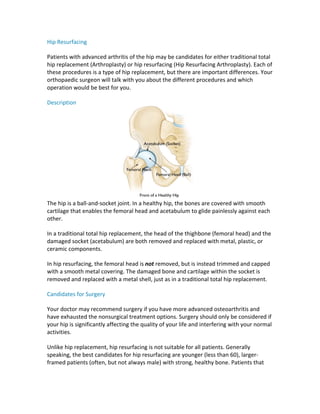
The	hip	is	a	ball-and-socket	joint.	In	a	healthy	hip,	the	bones	are	covered	with	smooth	
cartilage	that	enables	the	femoral	head	and	acetabulum	to	glide	painlessly	against	each	
other.	
In	a	traditional	total	hip	replacement,	the	head	of	the	thighbone	(femoral	head)	and	the	
damaged	socket	(acetabulum)	are	both	removed	and	replaced	with	metal,	plastic,	or	
ceramic	components.	
In	hip	resurfacing,	the	femoral	head	is	not	removed,	but	is	instead	trimmed	and	capped	
with	a	smooth	metal	covering.	The	damaged	bone	and	cartilage	within	the	socket	is	
removed	and	replaced	with	a	metal	shell,	just	as	in	a	traditional	total	hip	replacement.	
Candidates	for	Surgery	
Your	doctor	may	recommend	surgery	if	you	have	more	advanced	osteoarthritis	and	
have	exhausted	the	nonsurgical	treatment	options.	Surgery	should	only	be	considered	if	
your	hip	is	significantly	affecting	the	quality	of	your	life	and	interfering	with	your	normal	
activities.	
Unlike	hip	replacement,	hip	resurfacing	is	not	suitable	for	all	patients.	Generally	
speaking,	the	best	candidates	for	hip	resurfacing	are	younger	(less	than	60),	larger-
framed	patients	(often,	but	not	always	male)	with	strong,	healthy	bone.	Patients	that
are	older,	female,	smaller-framed,	with	weaker	or	damaged	bone	are	at	higher	risk	of	
complications,	such	as	femoral	neck	fracture.	
A	comprehensive	evaluation	by	your	orthopaedic	surgeon	will	help	you	determine	if	you	
are	a	good	candidate	for	hip	resurfacing.	
Your	Surgery	
Before	Surgery	
You	will	likely	be	admitted	to	the	hospital	on	the	day	before	surgery.	
Before	your	procedure,	a	doctor	from	the	anesthesia	department	will	evaluate	you.	He	
or	she	will	review	your	medical	history	and	discuss	anesthesia	choices	with	you.	You	
should	also	have	discussed	anesthesia	choices	with	your	surgeon	during	your	
preoperative	clinic	visits.	Anesthesia	can	be	either	general	(you	are	put	to	sleep)	or	
spinal	(you	are	awake	but	your	body	is	numb	from	the	waist	down).	
Your	surgeon	will	also	see	you	before	surgery	and	sign	your	hip	to	verify	the	surgical	
site.	
Surgical	Procedure	
A	hip	resurfacing	operation	typically	lasts	between	1	1/2	and	3	hours.	
Your	surgeon	will	make	an	incision	in	your	thigh	in	order	to	reach	the	hip	joint.	The	
femoral	head	is	then	dislocated	out	of	the	socket.	Next,	the	head	is	trimmed	with	
specially	designed	power	instruments.	A	metal	cap	is	cemented	over	the	prepared	
femoral	head.	The	cartilage	that	lines	the	socket	is	removed	with	a	power	tool	called	a	
reamer.	A	metal	cup	is	then	pushed	into	the	socket	and	held	in	place	by	friction	
between	the	bone	and	the	metal.	Once	the	cup	is	in	place,	the	femoral	head	is	relocated	
back	into	the	socket	and	the	incision	is	closed.	
After	the	surgery	you	will	be	taken	to	the	recovery	room,	where	nurses	will	closely	
monitor	you	as	you	recover	from	the	anesthesia.	You	will	then	be	taken	to	your	hospital	
room.	
Complications	
As	with	any	surgical	procedure,	there	are	risks	involved	with	hip	resurfacing.	Your	
surgeon	will	discuss	each	of	the	risks	with	you	and	will	take	specific	measures	to	help	
avoid	potential	complications.	
Although	rare,	the	most	common	complications	of	hip	resurfacing	are:
• Blood	clots.	Blood	clots	in	the	leg	veins	are	the	most	common	complication	of	hip	
resurfacing	surgery.	Blood	clots	can	form	in	the	deep	veins	of	the	legs	or	pelvis	after	
surgery.	Blood	thinners	such	as	warfarin	(Coumadin),	low-molecular-weight	heparin,	
aspirin,	or	other	drugs	can	help	prevent	this	problem.	
• Infection.	You	will	be	given	antibiotics	before	the	start	of	your	surgery	and	these	will	
be	continued	for	about	24	hours	afterward	to	prevent	infection.	
• Injury	to	nerves	or	vessels.	Although	it	rarely	happens,	nerves	or	blood	vessels	may	
be	injured	or	stretched	during	the	procedure.	
• Femoral	neck	fracture	
• Dislocation	
• Risks	of	anesthesia	
Recovery	
In	most	cases,	patients	go	home	1	to	4	days	after	surgery.	
You	may	begin	putting	weight	on	your	leg	immediately	after	surgery,	depending	on	your	
doctor's	preferences	and	the	strength	of	your	bone.	You	may	need	a	walker,	cane,	or	
crutches	for	the	first	few	days	or	weeks	until	you	become	comfortable	enough	to	walk	
without	assistance.	
A	physical	therapist	will	give	you	exercises	to	help	maintain	your	range	of	motion	and	
restore	your	strength.	You	will	continue	to	see	your	orthopaedic	surgeon	for	follow-up	
visits	in	his	or	her	clinic	at	regular	intervals.	
You	will	most	likely	resume	your	regular	activities	of	daily	living	by	6	weeks	after	
surgery.

Hip resurfacing