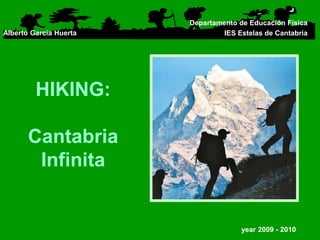
Departamento de Educación FísicaIES Estelas de CantabriaAlberto García HuertaHIKING:CantabriaInfinitayear2009 - 2010
INTRODUCTION    HIKING:” Togofor a walk in themountainsor in nature”.Themain objetive istofollow a pathor a trail.You can enjoylisteningtothesilenceorthesound of thewater, seeingthelandscape…
THE PATH AND ITS SIGNPOSTING   A pathmustgoacrossthevalley, towns, hills,…lookingforthebestway and visitinginteresting places abouttheirculture, history, landscape… 					JalónFlecha
KIND OF PATHS	DEPENDING ON THE LENGTH:Long-distance routes(LD)They run for more than 40 Km.	They are sign-posted with red and white signsShort-distance routes(SD)They are from 10 to 40 km. Long.	They are sign-posted with yellow and white signsLocal routes No more than 10 km. 	They are sign-posted with green and white signs. City routesThey are routes in the city. 	They are sign-posted with red and yellow signs.
EQUIPMENT – SHOES	Boots are the most important part of the required equipment.	We must walk on grounds, different from our streets or roads, with stones, branches, water or animals.	they should provide adequate protection against possible sprains, knocks and slippage. 	The boots must protect your ankle.	The sole must have a good marked drawing. 	Their laces must be perfectly tied.	Don´t wear your boots for the first time on a hike. You must first try them on shorter walks.
EQUIPMENT – SHOES 	USEFUL ADVICE:Tie the laces from the botton to the top.Check  them in a few minutes when your feet have expanded. You can wear the laces looser when you go up but very well-tied when you go down.
EQUIPMENT- CLOTHESUSEFUL ADVICE:Your clothes must be lightweight and permit air flow. If there is a lot of vegetation , especially thicket ,you must protect your arms and legs. In the mountain the weather changes quickly so you must wear some clothes to keep you warm.
EQUIPMENT- BACKPACKThe backpack increases the effort we need to walk.We feel its weight  on our legs and on our back to. its size must be appropiate to your back. You  must regulate to put the most of the weight on your hips.
EQUIPMENT- BACKPACKUSEFUL ADVICES:Generally, try to put big and light things in the botton and the heviest in the top, near your back. Then its centre of gravity will be between your shouldersPut the load  in a symmetrical way (left and right) for not to overload one side of your back. Don´t put any thing failed (water botle, shoes…) they can unbalance you because of their movement or they can catch on somewhere, specially branches.
EQUIPMENT- STICKSThey are not necessary but they can help you to keep balancedUSEFUL ADVICES: You can make it yourself.Only one is sufficent. If you have a knee pain they can be useful.
EQUIPMENT- MAPCARDINAL DIRECTIONS: NorthSouthEastWest
RIVERSBULDINGSROADSPATHSSUMMITEQUIPMENT- MAP
BASIC RULES OF BEHAVIOUR IN THE COUNTRYSIDEAvoid making any unnecessary noiseA photograph is much better than taking the photographed object away with you (flowers, insects, fossils, etc.)Avoid littering and take along rubbish bags insteadMake sure that the inhabitants of the rural district you are visiting do not regret your presence: Close gates after you

Hiking

  • 1.
    Departamento de EducaciónFísicaIES Estelas de CantabriaAlberto García HuertaHIKING:CantabriaInfinitayear2009 - 2010
  • 2.
    INTRODUCTION HIKING:” Togofor a walk in themountainsor in nature”.Themain objetive istofollow a pathor a trail.You can enjoylisteningtothesilenceorthesound of thewater, seeingthelandscape…
  • 3.
    THE PATH ANDITS SIGNPOSTING A pathmustgoacrossthevalley, towns, hills,…lookingforthebestway and visitinginteresting places abouttheirculture, history, landscape… JalónFlecha
  • 4.
    KIND OF PATHS DEPENDINGON THE LENGTH:Long-distance routes(LD)They run for more than 40 Km. They are sign-posted with red and white signsShort-distance routes(SD)They are from 10 to 40 km. Long. They are sign-posted with yellow and white signsLocal routes No more than 10 km. They are sign-posted with green and white signs. City routesThey are routes in the city. They are sign-posted with red and yellow signs.
  • 5.
    EQUIPMENT – SHOES Bootsare the most important part of the required equipment. We must walk on grounds, different from our streets or roads, with stones, branches, water or animals. they should provide adequate protection against possible sprains, knocks and slippage. The boots must protect your ankle. The sole must have a good marked drawing. Their laces must be perfectly tied. Don´t wear your boots for the first time on a hike. You must first try them on shorter walks.
  • 6.
    EQUIPMENT – SHOES USEFUL ADVICE:Tie the laces from the botton to the top.Check them in a few minutes when your feet have expanded. You can wear the laces looser when you go up but very well-tied when you go down.
  • 7.
    EQUIPMENT- CLOTHESUSEFUL ADVICE:Yourclothes must be lightweight and permit air flow. If there is a lot of vegetation , especially thicket ,you must protect your arms and legs. In the mountain the weather changes quickly so you must wear some clothes to keep you warm.
  • 8.
    EQUIPMENT- BACKPACKThe backpackincreases the effort we need to walk.We feel its weight on our legs and on our back to. its size must be appropiate to your back. You must regulate to put the most of the weight on your hips.
  • 9.
    EQUIPMENT- BACKPACKUSEFUL ADVICES:Generally,try to put big and light things in the botton and the heviest in the top, near your back. Then its centre of gravity will be between your shouldersPut the load in a symmetrical way (left and right) for not to overload one side of your back. Don´t put any thing failed (water botle, shoes…) they can unbalance you because of their movement or they can catch on somewhere, specially branches.
  • 10.
    EQUIPMENT- STICKSThey arenot necessary but they can help you to keep balancedUSEFUL ADVICES: You can make it yourself.Only one is sufficent. If you have a knee pain they can be useful.
  • 11.
  • 12.
  • 13.
    BASIC RULES OFBEHAVIOUR IN THE COUNTRYSIDEAvoid making any unnecessary noiseA photograph is much better than taking the photographed object away with you (flowers, insects, fossils, etc.)Avoid littering and take along rubbish bags insteadMake sure that the inhabitants of the rural district you are visiting do not regret your presence: Close gates after you