Hierarchical Learning in AI Notes 1 General Problem Jie Bao AI Lab, Iowa State University  [email_address]
Content of whole series Hierarchy and any problem in general information system HL in GA Delicate structure in coding string Behavior Learning Sociobiology and ecology competition  HL in NN Modular learning Ensemble learning Hybrid learning HL in MAS(MultiAgent System) Society entity: an agent in the hierarchy Society relationship: their languages
Why hierarchy? Nature system are mostly hierarchical system “ Divide and conquer” in Engineering The power and stableness from cooperation of subsystems Easier to design and implement
How to hierarchy? System theory:  summation( all parts) < whole system The biologically hierarchical system are formed by self-organization  Start from simple system Evolve from combine simple system to complex system The structural hierarchy is usually the result of evolutionary history
General Hierarchy Formation Direction: Order increasing Grow Multiplication Accelerate Interaction Higher level hierarchy appears! Differentiation Centralization
Three kinds of order-increasing system with Hierarchy They are all order-increasing They are derived from the former one They all have hierarchical structure Many theory and algorithm can be borrowed between the science of them ! General Hierarchy Formation Organism Society Automata
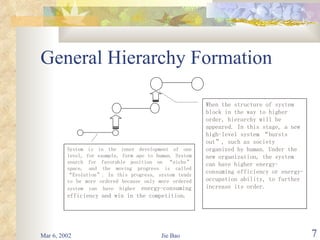
General Hierarchy Formation System is in the inner development of one level, for example, form ape to human. System search for favorable position on “niche” space, and the moving progress is called “Evolution”. In this progress, system tends to be more ordered because only more ordered system can have higher  energy-consuming efficiency and win in the competition.  When the structure of system block in the way to higher order, hierarchy will be appeared. In this stage, a new high-level system “bursts out”, such as society organized by human. Under the new organization, the system can have higher energy-consuming efficiency or energy-occupation ability, to further increase its order.
Hierarchical Structure(1) --Organism Body  System Organ Tissue Cell Cell organelle  Protein , nucleic acid ……
Hierarchical Structure(2) --Society Whole human world Nation State, Province City, County, Shire Community, Village Kin, Family  Person
Hierarchical Structure(3) --Automata Cyber space: internet Local area network Terminal (both software and hardware) Module ( eg. CPU, operating system) Sub-module (eg. ALU, disk system) Smaller module, (eg. Adder, a interrupt service routine) Bit operation(eg. Gate )
Hierarchical Evolution(1) --Organism Little molecule-> big molecule: 3.5 billion y  Molecule -> cell  (2 billion y?) Prokaryote -> Eukaryotic (? billion y ) Cell -> Multi-cellular (0.6 billion y) Multi-cellular -> society ( for human, 4 million y, for insects, 0.2 billion y?) Society -> Gaia Cell  ( now )
Hierarchical Evolution(2) --Society Vassals and tribes in China  1 221BC 10 400BC 140 700BC 800 1000BC 3,000 1600BC 10,000 2000BC
Hierarchical Evolution(3) --Automata Operation system: Windows CP/L(?K) : late 1970s DOS(1M): more interrupts  Windows 3.1(15M): GUI Windows 95(100M): multi-media IE, Plus, DirectX, ActiveX : Windows 98 (200M) Windows 2000(1G) : various fanciness
Hierarchy in AI: simulate the nature AI system Immune system Molecule Cell Multi-cell Society Hierarchy Evolution Gene neural network
The way to hierarchy(1): organism Mitosis and amitosis The evolution of neural system Differentiation of Tissue Organ  Isolated specie becomes “living fossil”  Species are generated quicker and quicker Growth of individual; the average body volume increase in evolution The physical freedom of Molecule and cell are decreasing ( less entropy) Organism  Multiplication Centralization Differentiation Hierarchy interaction Accelerate Growth Order increasing
The way to in hierarchy(2): Society Culture split, language pedigree ; colonizztion Government and international organization More detailed social  professional work From individual, group, tribe to nation and international society Open society are developed quicker than isolated society The acceleration  in social development Growth of total social economy Organization degree are increasing Society   Multiplication Centralization Differentiation Hierarchy interaction Accelerate Growth Order increasing
The way to in hierarchy(3): OS The replication of progress and virus. Central part controls all processes modules in OS are divided more detailedly The SDK of OS is composed by many application API Message and signal between progress Exponential growth of OS size Increase of OS size Process and operating system Multiplication Centralization Differentiation Hierarchy interaction Accelerate Growth Order increasing
The way to hierarchy(4): WAN ? Formation of Portal, manage center, service center  More and more different kind of websites WAN, LAN, terminal Protocol and messages Rapid almost exponent growth The extend of network size From unrestricted to be controlled and managed  Wide area network Multiplication Centralization Differentiation Hierarchy interaction Accelerate Growth Order increasing
The way to hierarchy(5): NN ? ? From less structured to complex structured, such as layer Group network with complex behavior by neurons Weights ? (evolutionary neural network) After training, input can converge to some attractors Neural Network Multiplication Centralization Differentiation Hierarchy interaction Accelerate Growth Order increasing
The way to hierarchy(6): GA Selection , crossover,mutation and new population From individuals to population Fitness  Schema theorem  Genetic Algorithm Multiplication Centralization Differentiation Hierarchy interaction Accelerate Growth Order increasing
The way to hierarchy(7): MAS Simple agent and complex agent society Agent Language  Converge to equilibrium point Multi-agent system Multiplication Centralization Differentiation Hierarchy interaction Accelerate Growth Order increasing
Hierarchical AI System: Social Computational intelligence: neural network, multi-agent system (MAS), evolution computation and artificial immune system. The basic idea of computational intelligence is “social computation”, that’s,  complex intelligence can be obtained self-organizingly by simple intelligence individuals under some simple social rules  (including competition, cooperation and so on).
Hierarchical AI System: Ecological Such a “social computation” system can be regarded as an hierarchical artificial ecology system, which has similar property and development to nature ecology system. So basic laws of computational intelligence can be regarded as “general ecology”.
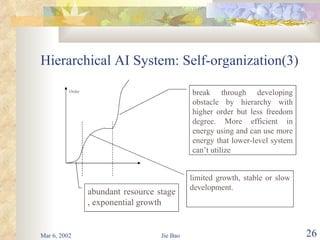
Hierarchical AI System: Self-organization Some general laws in computational intelligence, such as  order-increasing; information interchange; hierarchy structure and development; progressive centralization; progressive Differentiation,  are in fact general properties of a kind of self-organizing systems.
Hierarchical AI System: Self-organization(2) Possible system state space in early stage Possible system state space in early stage
Hierarchical AI System: Self-organization(3) limited growth, stable or slow development. break through developing obstacle by hierarchy with higher order but less freedom degree. More efficient in energy using and can use more energy that lower-level system can’t utilize  abundant resource stage , exponential growth Order
Hierarchical AI System: interdisciplinary  Therefore, the development of hierarchical learning in computational intelligence, especially the hierarchical MAS, is closely related to the development of life sciences and social sciences.  Neural Network (top-down) and MAS (bottom-up) are integrated methods to carry out the research in practice.
Hierarchical learning in Neural Network Ensemble learning Modular learning Hybrid learning
Hierarchical learning in GA Behavior evolution: hierarchical structure in nonlinear coding (tree)  Diversification of population Multi-level selection
Hierarchical learning in MAS Evolution of cooperation by Reinforcement learning Hierarchal Markov game: game between groups Hierarchical entity: agent and their society Hierarchical relationship:  language

Hierarchical Learning in AI - General Problem

  • 1.
    Hierarchical Learning inAI Notes 1 General Problem Jie Bao AI Lab, Iowa State University [email_address]
  • 2.
    Content of wholeseries Hierarchy and any problem in general information system HL in GA Delicate structure in coding string Behavior Learning Sociobiology and ecology competition HL in NN Modular learning Ensemble learning Hybrid learning HL in MAS(MultiAgent System) Society entity: an agent in the hierarchy Society relationship: their languages
  • 3.
    Why hierarchy? Naturesystem are mostly hierarchical system “ Divide and conquer” in Engineering The power and stableness from cooperation of subsystems Easier to design and implement
  • 4.
    How to hierarchy?System theory: summation( all parts) < whole system The biologically hierarchical system are formed by self-organization Start from simple system Evolve from combine simple system to complex system The structural hierarchy is usually the result of evolutionary history
  • 5.
    General Hierarchy FormationDirection: Order increasing Grow Multiplication Accelerate Interaction Higher level hierarchy appears! Differentiation Centralization
  • 6.
    Three kinds oforder-increasing system with Hierarchy They are all order-increasing They are derived from the former one They all have hierarchical structure Many theory and algorithm can be borrowed between the science of them ! General Hierarchy Formation Organism Society Automata
  • 7.
    General Hierarchy FormationSystem is in the inner development of one level, for example, form ape to human. System search for favorable position on “niche” space, and the moving progress is called “Evolution”. In this progress, system tends to be more ordered because only more ordered system can have higher energy-consuming efficiency and win in the competition. When the structure of system block in the way to higher order, hierarchy will be appeared. In this stage, a new high-level system “bursts out”, such as society organized by human. Under the new organization, the system can have higher energy-consuming efficiency or energy-occupation ability, to further increase its order.
  • 8.
    Hierarchical Structure(1) --OrganismBody System Organ Tissue Cell Cell organelle Protein , nucleic acid ……
  • 9.
    Hierarchical Structure(2) --SocietyWhole human world Nation State, Province City, County, Shire Community, Village Kin, Family Person
  • 10.
    Hierarchical Structure(3) --AutomataCyber space: internet Local area network Terminal (both software and hardware) Module ( eg. CPU, operating system) Sub-module (eg. ALU, disk system) Smaller module, (eg. Adder, a interrupt service routine) Bit operation(eg. Gate )
  • 11.
    Hierarchical Evolution(1) --OrganismLittle molecule-> big molecule: 3.5 billion y Molecule -> cell (2 billion y?) Prokaryote -> Eukaryotic (? billion y ) Cell -> Multi-cellular (0.6 billion y) Multi-cellular -> society ( for human, 4 million y, for insects, 0.2 billion y?) Society -> Gaia Cell ( now )
  • 12.
    Hierarchical Evolution(2) --SocietyVassals and tribes in China 1 221BC 10 400BC 140 700BC 800 1000BC 3,000 1600BC 10,000 2000BC
  • 13.
    Hierarchical Evolution(3) --AutomataOperation system: Windows CP/L(?K) : late 1970s DOS(1M): more interrupts Windows 3.1(15M): GUI Windows 95(100M): multi-media IE, Plus, DirectX, ActiveX : Windows 98 (200M) Windows 2000(1G) : various fanciness
  • 14.
    Hierarchy in AI:simulate the nature AI system Immune system Molecule Cell Multi-cell Society Hierarchy Evolution Gene neural network
  • 15.
    The way tohierarchy(1): organism Mitosis and amitosis The evolution of neural system Differentiation of Tissue Organ Isolated specie becomes “living fossil” Species are generated quicker and quicker Growth of individual; the average body volume increase in evolution The physical freedom of Molecule and cell are decreasing ( less entropy) Organism Multiplication Centralization Differentiation Hierarchy interaction Accelerate Growth Order increasing
  • 16.
    The way toin hierarchy(2): Society Culture split, language pedigree ; colonizztion Government and international organization More detailed social professional work From individual, group, tribe to nation and international society Open society are developed quicker than isolated society The acceleration in social development Growth of total social economy Organization degree are increasing Society Multiplication Centralization Differentiation Hierarchy interaction Accelerate Growth Order increasing
  • 17.
    The way toin hierarchy(3): OS The replication of progress and virus. Central part controls all processes modules in OS are divided more detailedly The SDK of OS is composed by many application API Message and signal between progress Exponential growth of OS size Increase of OS size Process and operating system Multiplication Centralization Differentiation Hierarchy interaction Accelerate Growth Order increasing
  • 18.
    The way tohierarchy(4): WAN ? Formation of Portal, manage center, service center More and more different kind of websites WAN, LAN, terminal Protocol and messages Rapid almost exponent growth The extend of network size From unrestricted to be controlled and managed Wide area network Multiplication Centralization Differentiation Hierarchy interaction Accelerate Growth Order increasing
  • 19.
    The way tohierarchy(5): NN ? ? From less structured to complex structured, such as layer Group network with complex behavior by neurons Weights ? (evolutionary neural network) After training, input can converge to some attractors Neural Network Multiplication Centralization Differentiation Hierarchy interaction Accelerate Growth Order increasing
  • 20.
    The way tohierarchy(6): GA Selection , crossover,mutation and new population From individuals to population Fitness Schema theorem Genetic Algorithm Multiplication Centralization Differentiation Hierarchy interaction Accelerate Growth Order increasing
  • 21.
    The way tohierarchy(7): MAS Simple agent and complex agent society Agent Language Converge to equilibrium point Multi-agent system Multiplication Centralization Differentiation Hierarchy interaction Accelerate Growth Order increasing
  • 22.
    Hierarchical AI System:Social Computational intelligence: neural network, multi-agent system (MAS), evolution computation and artificial immune system. The basic idea of computational intelligence is “social computation”, that’s, complex intelligence can be obtained self-organizingly by simple intelligence individuals under some simple social rules (including competition, cooperation and so on).
  • 23.
    Hierarchical AI System:Ecological Such a “social computation” system can be regarded as an hierarchical artificial ecology system, which has similar property and development to nature ecology system. So basic laws of computational intelligence can be regarded as “general ecology”.
  • 24.
    Hierarchical AI System:Self-organization Some general laws in computational intelligence, such as order-increasing; information interchange; hierarchy structure and development; progressive centralization; progressive Differentiation, are in fact general properties of a kind of self-organizing systems.
  • 25.
    Hierarchical AI System:Self-organization(2) Possible system state space in early stage Possible system state space in early stage
  • 26.
    Hierarchical AI System:Self-organization(3) limited growth, stable or slow development. break through developing obstacle by hierarchy with higher order but less freedom degree. More efficient in energy using and can use more energy that lower-level system can’t utilize abundant resource stage , exponential growth Order
  • 27.
    Hierarchical AI System:interdisciplinary Therefore, the development of hierarchical learning in computational intelligence, especially the hierarchical MAS, is closely related to the development of life sciences and social sciences. Neural Network (top-down) and MAS (bottom-up) are integrated methods to carry out the research in practice.
  • 28.
    Hierarchical learning inNeural Network Ensemble learning Modular learning Hybrid learning
  • 29.
    Hierarchical learning inGA Behavior evolution: hierarchical structure in nonlinear coding (tree) Diversification of population Multi-level selection
  • 30.
    Hierarchical learning inMAS Evolution of cooperation by Reinforcement learning Hierarchal Markov game: game between groups Hierarchical entity: agent and their society Hierarchical relationship: language