HFG Toolkit Presentation
Annie Baldridge
September, 2016
Abidjan, Cote d’Ivoire
- 1 -
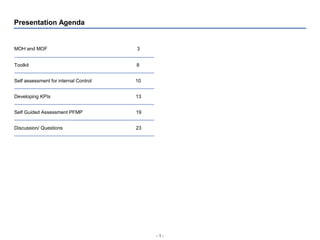
Presentation Agenda
MOH and MOF 3
Toolkit 8
Self assessment for internal Control 10
Developing KPIs 13
Self Guided Assessment PFMP 19
Discussion/ Questions 23
MOH & MOF
- 3 -
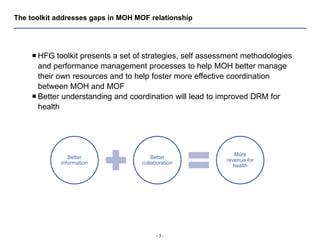
The toolkit addresses gaps in MOH MOF relationship
 HFG toolkit presents a set of strategies, self assessment methodologies
and performance management processes to help MOH better manage
their own resources and to help foster more effective coordination
between MOH and MOF
 Better understanding and coordination will lead to improved DRM for
health
Better
information
Better
collaboration
More
revenue for
health
- 4 -
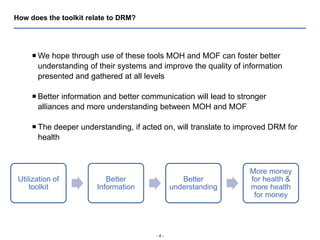
How does the toolkit relate to DRM?
 We hope through use of these tools MOH and MOF can foster better
understanding of their systems and improve the quality of information
presented and gathered at all levels
 Better information and better communication will lead to stronger
alliances and more understanding between MOH and MOF
 The deeper understanding, if acted on, will translate to improved DRM for
health
Utilization of
toolkit
Better
Information
Better
understanding
More money
for health &
more health
for money
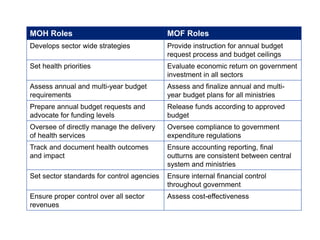
MOH Roles MOF Roles
Develops sector wide strategies Provide instruction for annual budget
request process and budget ceilings
Set health priorities Evaluate economic return on government
investment in all sectors
Assess annual and multi-year budget
requirements
Assess and finalize annual and multi-
year budget plans for all ministries
Prepare annual budget requests and
advocate for funding levels
Release funds according to approved
budget
Oversee of directly manage the delivery
of health services
Oversee compliance to government
expenditure regulations
Track and document health outcomes
and impact
Ensure accounting reporting, final
outturns are consistent between central
system and ministries
Set sector standards for control agencies Ensure internal financial control
throughout government
Ensure proper control over all sector
revenues
Assess cost-effectiveness
- 6 -
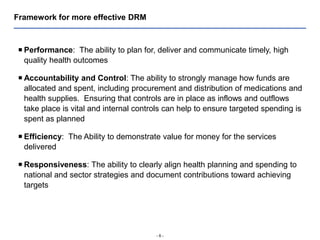
Framework for more effective DRM
 Performance: The ability to plan for, deliver and communicate timely, high
quality health outcomes
 Accountability and Control: The ability to strongly manage how funds are
allocated and spent, including procurement and distribution of medications and
health supplies. Ensuring that controls are in place as inflows and outflows
take place is vital and internal controls can help to ensure targeted spending is
spent as planned
 Efficiency: The Ability to demonstrate value for money for the services
delivered
 Responsiveness: The ability to clearly align health planning and spending to
national and sector strategies and document contributions toward achieving
targets
Toolkit
- 8 -
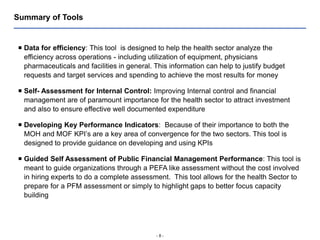
Summary of Tools
 Data for efficiency: This tool is designed to help the health sector analyze the
efficiency across operations - including utilization of equipment, physicians
pharmaceuticals and facilities in general. This information can help to justify budget
requests and target services and spending to achieve the most results for money
 Self- Assessment for Internal Control: Improving Internal control and financial
management are of paramount importance for the health sector to attract investment
and also to ensure effective well documented expenditure
 Developing Key Performance Indicators: Because of their importance to both the
MOH and MOF KPI’s are a key area of convergence for the two sectors. This tool is
designed to provide guidance on developing and using KPIs
 Guided Self Assessment of Public Financial Management Performance: This tool is
meant to guide organizations through a PEFA like assessment without the cost involved
in hiring experts to do a complete assessment. This tool allows for the health Sector to
prepare for a PFM assessment or simply to highlight gaps to better focus capacity
building
Data for Efficiency
- 10 -
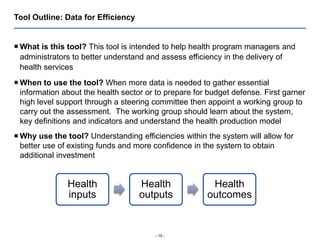
Tool Outline: Data for Efficiency
 What is this tool? This tool is intended to help health program managers and
administrators to better understand and assess efficiency in the delivery of
health services
 When to use the tool? When more data is needed to gather essential
information about the health sector or to prepare for budget defense. First garner
high level support through a steering committee then appoint a working group to
carry out the assessment. The working group should learn about the system,
key definitions and indicators and understand the health production model
 Why use the tool? Understanding efficiencies within the system will allow for
better use of existing funds and more confidence in the system to obtain
additional investment
Health
inputs
Health
outputs
Health
outcomes
- 11 -
Implementation and Outcomes
Productive
inefficiency
Eg: Low
occupancy
expired drugs
Technical
inefficiency
Rational drug
use
Hospital stay
length
Allocate
inefficiency
The right
supplies for the
relevant issues
Scale and
scope of
facilities
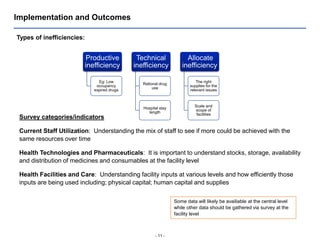
Types of inefficiencies:
Survey categories/indicators
Current Staff Utilization: Understanding the mix of staff to see if more could be achieved with the
same resources over time
Health Technologies and Pharmaceuticals: It is important to understand stocks, storage, availability
and distribution of medicines and consumables at the facility level
Health Facilities and Care: Understanding facility inputs at various levels and how efficiently those
inputs are being used including; physical capital; human capital and supplies
Some data will likely be availiable at the central level
while other data should be gathered via survey at the
facility level
- 12 -
Implementation and Outcomes
Develop
data
gathering
strategy
Decide if
facility
data
should be
gathered
Plan the
survey
Adapt
survey
tables to
country
context
Collect
data
through
interviews
and site
visits
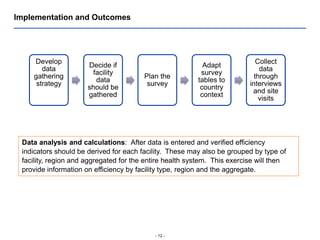
Data analysis and calculations: After data is entered and verified efficiency
indicators should be derived for each facility. These may also be grouped by type of
facility, region and aggregated for the entire health system. This exercise will then
provide information on efficiency by facility type, region and the aggregate.
Self- Assessment for Internal Control
- 14 -
Tool Outline: Self Assessment for Internal Control
 What is this tool? The purpose of this tool is to facilitate the self assessment of
internal control systems and practices in the health sector.
 Assessing internal controls will allow health sector decision makers to
demonstrate strong financial stewardship when justifying budget requests
and when attracting investment.
 Internal control is one of the most important functions in management and
one of the key points of intersection with the finance sector.
 When to use the tool? An assessment should be done every 6 months or
whenever there is a major change in the operations of the health sector. It may
be useful to carry out the assessment before the budget process each year.
 How to Implement? The organizations own staff should conduct this
assessment a working group with officials from throughout the organization
should be mobilized to carry out the assessment. Once indicators are identified
sub groups should be formed to carry out site visits.
- 15 -
Implementation and Outcomes
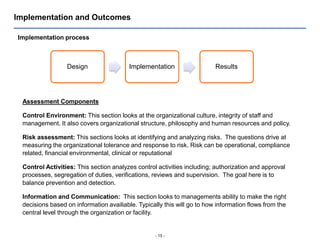
Design Implementation Results
Implementation process
Assessment Components
Control Environment: This section looks at the organizational culture, integrity of staff and
management. It also covers organizational structure, philosophy and human resources and policy.
Risk assessment: This sections looks at identifying and analyzing risks. The questions drive at
measuring the organizational tolerance and response to risk. Risk can be operational, compliance
related, financial environmental, clinical or reputational
Control Activities: This section analyzes control activities including; authorization and approval
processes, segregation of duties, verifications, reviews and supervision. The goal here is to
balance prevention and detection.
Information and Communication: This section looks to managements ability to make the right
decisions based on information availiable. Typically this will go to how information flows from the
central level through the organization or facility.
- 16 -
Implementation and Outcomes
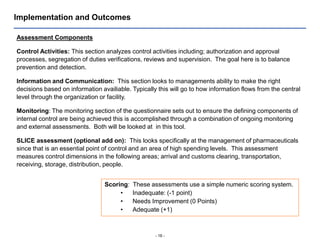
Assessment Components
Control Activities: This section analyzes control activities including; authorization and approval
processes, segregation of duties verifications, reviews and supervision. The goal here is to balance
prevention and detection.
Information and Communication: This section looks to managements ability to make the right
decisions based on information availiable. Typically this will go to how information flows from the central
level through the organization or facility.
Monitoring: The monitoring section of the questionnaire sets out to ensure the defining components of
internal control are being achieved this is accomplished through a combination of ongoing monitoring
and external assessments. Both will be looked at in this tool.
SLICE assessment (optional add on): This looks specifically at the management of pharmaceuticals
since that is an essential point of control and an area of high spending levels. This assessment
measures control dimensions in the following areas; arrival and customs clearing, transportation,
receiving, storage, distribution, people.
Scoring: These assessments use a simple numeric scoring system.
• Inadequate: (-1 point)
• Needs Improvement (0 Points)
• Adequate (+1)
Developing Key Performance
Indicators (KPI)
- 18 -
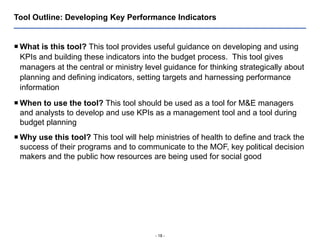
Tool Outline: Developing Key Performance Indicators
 What is this tool? This tool provides useful guidance on developing and using
KPIs and building these indicators into the budget process. This tool gives
managers at the central or ministry level guidance for thinking strategically about
planning and defining indicators, setting targets and harnessing performance
information
 When to use the tool? This tool should be used as a tool for M&E managers
and analysts to develop and use KPIs as a management tool and a tool during
budget planning
 Why use this tool? This tool will help ministries of health to define and track the
success of their programs and to communicate to the MOF, key political decision
makers and the public how resources are being used for social good
- 19 -
Implementation and Outcomes
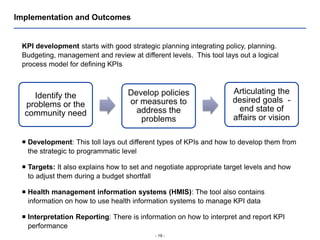
KPI development starts with good strategic planning integrating policy, planning.
Budgeting, management and review at different levels. This tool lays out a logical
process model for defining KPIs
Identify the
problems or the
community need
Develop policies
or measures to
address the
problems
Articulating the
desired goals -
end state of
affairs or vision
 Development: This toll lays out different types of KPIs and how to develop them from
the strategic to programmatic level
 Targets: It also explains how to set and negotiate appropriate target levels and how
to adjust them during a budget shortfall
 Health management information systems (HMIS): The tool also contains
information on how to use health information systems to manage KPI data
 Interpretation Reporting: There is information on how to interpret and report KPI
performance
Guided Self Assessment of Public
Financial Management Performance
- 21 -
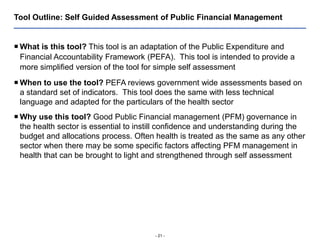
Tool Outline: Self Guided Assessment of Public Financial Management
 What is this tool? This tool is an adaptation of the Public Expenditure and
Financial Accountability Framework (PEFA). This tool is intended to provide a
more simplified version of the tool for simple self assessment
 When to use the tool? PEFA reviews government wide assessments based on
a standard set of indicators. This tool does the same with less technical
language and adapted for the particulars of the health sector
 Why use this tool? Good Public Financial management (PFM) governance in
the health sector is essential to instill confidence and understanding during the
budget and allocations process. Often health is treated as the same as any other
sector when there may be some specific factors affecting PFM management in
health that can be brought to light and strengthened through self assessment
- 22 -
Implementation
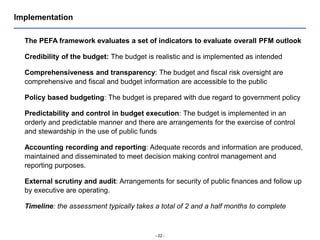
The PEFA framework evaluates a set of indicators to evaluate overall PFM outlook
Credibility of the budget: The budget is realistic and is implemented as intended
Comprehensiveness and transparency: The budget and fiscal risk oversight are
comprehensive and fiscal and budget information are accessible to the public
Policy based budgeting: The budget is prepared with due regard to government policy
Predictability and control in budget execution: The budget is implemented in an
orderly and predictable manner and there are arrangements for the exercise of control
and stewardship in the use of public funds
Accounting recording and reporting: Adequate records and information are produced,
maintained and disseminated to meet decision making control management and
reporting purposes.
External scrutiny and audit: Arrangements for security of public finances and follow up
by executive are operating.
Timeline: the assessment typically takes a total of 2 and a half months to complete
- 23 -
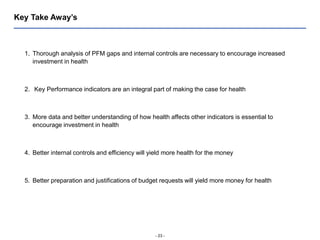
Key Take Away’s
1. Thorough analysis of PFM gaps and internal controls are necessary to encourage increased
investment in health
2. Key Performance indicators are an integral part of making the case for health
3. More data and better understanding of how health affects other indicators is essential to
encourage investment in health
4. Better internal controls and efficiency will yield more health for the money
5. Better preparation and justifications of budget requests will yield more money for health
Discussion/Questions
Thank you for your time

HFG Toolkit Presentation

  • 1.
    HFG Toolkit Presentation AnnieBaldridge September, 2016 Abidjan, Cote d’Ivoire
  • 2.
    - 1 - PresentationAgenda MOH and MOF 3 Toolkit 8 Self assessment for internal Control 10 Developing KPIs 13 Self Guided Assessment PFMP 19 Discussion/ Questions 23
  • 3.
  • 4.
    - 3 - Thetoolkit addresses gaps in MOH MOF relationship  HFG toolkit presents a set of strategies, self assessment methodologies and performance management processes to help MOH better manage their own resources and to help foster more effective coordination between MOH and MOF  Better understanding and coordination will lead to improved DRM for health Better information Better collaboration More revenue for health
  • 5.
    - 4 - Howdoes the toolkit relate to DRM?  We hope through use of these tools MOH and MOF can foster better understanding of their systems and improve the quality of information presented and gathered at all levels  Better information and better communication will lead to stronger alliances and more understanding between MOH and MOF  The deeper understanding, if acted on, will translate to improved DRM for health Utilization of toolkit Better Information Better understanding More money for health & more health for money
  • 6.
    MOH Roles MOFRoles Develops sector wide strategies Provide instruction for annual budget request process and budget ceilings Set health priorities Evaluate economic return on government investment in all sectors Assess annual and multi-year budget requirements Assess and finalize annual and multi- year budget plans for all ministries Prepare annual budget requests and advocate for funding levels Release funds according to approved budget Oversee of directly manage the delivery of health services Oversee compliance to government expenditure regulations Track and document health outcomes and impact Ensure accounting reporting, final outturns are consistent between central system and ministries Set sector standards for control agencies Ensure internal financial control throughout government Ensure proper control over all sector revenues Assess cost-effectiveness
  • 7.
    - 6 - Frameworkfor more effective DRM  Performance: The ability to plan for, deliver and communicate timely, high quality health outcomes  Accountability and Control: The ability to strongly manage how funds are allocated and spent, including procurement and distribution of medications and health supplies. Ensuring that controls are in place as inflows and outflows take place is vital and internal controls can help to ensure targeted spending is spent as planned  Efficiency: The Ability to demonstrate value for money for the services delivered  Responsiveness: The ability to clearly align health planning and spending to national and sector strategies and document contributions toward achieving targets
  • 8.
  • 9.
    - 8 - Summaryof Tools  Data for efficiency: This tool is designed to help the health sector analyze the efficiency across operations - including utilization of equipment, physicians pharmaceuticals and facilities in general. This information can help to justify budget requests and target services and spending to achieve the most results for money  Self- Assessment for Internal Control: Improving Internal control and financial management are of paramount importance for the health sector to attract investment and also to ensure effective well documented expenditure  Developing Key Performance Indicators: Because of their importance to both the MOH and MOF KPI’s are a key area of convergence for the two sectors. This tool is designed to provide guidance on developing and using KPIs  Guided Self Assessment of Public Financial Management Performance: This tool is meant to guide organizations through a PEFA like assessment without the cost involved in hiring experts to do a complete assessment. This tool allows for the health Sector to prepare for a PFM assessment or simply to highlight gaps to better focus capacity building
  • 10.
  • 11.
    - 10 - ToolOutline: Data for Efficiency  What is this tool? This tool is intended to help health program managers and administrators to better understand and assess efficiency in the delivery of health services  When to use the tool? When more data is needed to gather essential information about the health sector or to prepare for budget defense. First garner high level support through a steering committee then appoint a working group to carry out the assessment. The working group should learn about the system, key definitions and indicators and understand the health production model  Why use the tool? Understanding efficiencies within the system will allow for better use of existing funds and more confidence in the system to obtain additional investment Health inputs Health outputs Health outcomes
  • 12.
    - 11 - Implementationand Outcomes Productive inefficiency Eg: Low occupancy expired drugs Technical inefficiency Rational drug use Hospital stay length Allocate inefficiency The right supplies for the relevant issues Scale and scope of facilities Types of inefficiencies: Survey categories/indicators Current Staff Utilization: Understanding the mix of staff to see if more could be achieved with the same resources over time Health Technologies and Pharmaceuticals: It is important to understand stocks, storage, availability and distribution of medicines and consumables at the facility level Health Facilities and Care: Understanding facility inputs at various levels and how efficiently those inputs are being used including; physical capital; human capital and supplies Some data will likely be availiable at the central level while other data should be gathered via survey at the facility level
  • 13.
    - 12 - Implementationand Outcomes Develop data gathering strategy Decide if facility data should be gathered Plan the survey Adapt survey tables to country context Collect data through interviews and site visits Data analysis and calculations: After data is entered and verified efficiency indicators should be derived for each facility. These may also be grouped by type of facility, region and aggregated for the entire health system. This exercise will then provide information on efficiency by facility type, region and the aggregate.
  • 14.
    Self- Assessment forInternal Control
  • 15.
    - 14 - ToolOutline: Self Assessment for Internal Control  What is this tool? The purpose of this tool is to facilitate the self assessment of internal control systems and practices in the health sector.  Assessing internal controls will allow health sector decision makers to demonstrate strong financial stewardship when justifying budget requests and when attracting investment.  Internal control is one of the most important functions in management and one of the key points of intersection with the finance sector.  When to use the tool? An assessment should be done every 6 months or whenever there is a major change in the operations of the health sector. It may be useful to carry out the assessment before the budget process each year.  How to Implement? The organizations own staff should conduct this assessment a working group with officials from throughout the organization should be mobilized to carry out the assessment. Once indicators are identified sub groups should be formed to carry out site visits.
  • 16.
    - 15 - Implementationand Outcomes Design Implementation Results Implementation process Assessment Components Control Environment: This section looks at the organizational culture, integrity of staff and management. It also covers organizational structure, philosophy and human resources and policy. Risk assessment: This sections looks at identifying and analyzing risks. The questions drive at measuring the organizational tolerance and response to risk. Risk can be operational, compliance related, financial environmental, clinical or reputational Control Activities: This section analyzes control activities including; authorization and approval processes, segregation of duties, verifications, reviews and supervision. The goal here is to balance prevention and detection. Information and Communication: This section looks to managements ability to make the right decisions based on information availiable. Typically this will go to how information flows from the central level through the organization or facility.
  • 17.
    - 16 - Implementationand Outcomes Assessment Components Control Activities: This section analyzes control activities including; authorization and approval processes, segregation of duties verifications, reviews and supervision. The goal here is to balance prevention and detection. Information and Communication: This section looks to managements ability to make the right decisions based on information availiable. Typically this will go to how information flows from the central level through the organization or facility. Monitoring: The monitoring section of the questionnaire sets out to ensure the defining components of internal control are being achieved this is accomplished through a combination of ongoing monitoring and external assessments. Both will be looked at in this tool. SLICE assessment (optional add on): This looks specifically at the management of pharmaceuticals since that is an essential point of control and an area of high spending levels. This assessment measures control dimensions in the following areas; arrival and customs clearing, transportation, receiving, storage, distribution, people. Scoring: These assessments use a simple numeric scoring system. • Inadequate: (-1 point) • Needs Improvement (0 Points) • Adequate (+1)
  • 18.
  • 19.
    - 18 - ToolOutline: Developing Key Performance Indicators  What is this tool? This tool provides useful guidance on developing and using KPIs and building these indicators into the budget process. This tool gives managers at the central or ministry level guidance for thinking strategically about planning and defining indicators, setting targets and harnessing performance information  When to use the tool? This tool should be used as a tool for M&E managers and analysts to develop and use KPIs as a management tool and a tool during budget planning  Why use this tool? This tool will help ministries of health to define and track the success of their programs and to communicate to the MOF, key political decision makers and the public how resources are being used for social good
  • 20.
    - 19 - Implementationand Outcomes KPI development starts with good strategic planning integrating policy, planning. Budgeting, management and review at different levels. This tool lays out a logical process model for defining KPIs Identify the problems or the community need Develop policies or measures to address the problems Articulating the desired goals - end state of affairs or vision  Development: This toll lays out different types of KPIs and how to develop them from the strategic to programmatic level  Targets: It also explains how to set and negotiate appropriate target levels and how to adjust them during a budget shortfall  Health management information systems (HMIS): The tool also contains information on how to use health information systems to manage KPI data  Interpretation Reporting: There is information on how to interpret and report KPI performance
  • 21.
    Guided Self Assessmentof Public Financial Management Performance
  • 22.
    - 21 - ToolOutline: Self Guided Assessment of Public Financial Management  What is this tool? This tool is an adaptation of the Public Expenditure and Financial Accountability Framework (PEFA). This tool is intended to provide a more simplified version of the tool for simple self assessment  When to use the tool? PEFA reviews government wide assessments based on a standard set of indicators. This tool does the same with less technical language and adapted for the particulars of the health sector  Why use this tool? Good Public Financial management (PFM) governance in the health sector is essential to instill confidence and understanding during the budget and allocations process. Often health is treated as the same as any other sector when there may be some specific factors affecting PFM management in health that can be brought to light and strengthened through self assessment
  • 23.
    - 22 - Implementation ThePEFA framework evaluates a set of indicators to evaluate overall PFM outlook Credibility of the budget: The budget is realistic and is implemented as intended Comprehensiveness and transparency: The budget and fiscal risk oversight are comprehensive and fiscal and budget information are accessible to the public Policy based budgeting: The budget is prepared with due regard to government policy Predictability and control in budget execution: The budget is implemented in an orderly and predictable manner and there are arrangements for the exercise of control and stewardship in the use of public funds Accounting recording and reporting: Adequate records and information are produced, maintained and disseminated to meet decision making control management and reporting purposes. External scrutiny and audit: Arrangements for security of public finances and follow up by executive are operating. Timeline: the assessment typically takes a total of 2 and a half months to complete
  • 24.
    - 23 - KeyTake Away’s 1. Thorough analysis of PFM gaps and internal controls are necessary to encourage increased investment in health 2. Key Performance indicators are an integral part of making the case for health 3. More data and better understanding of how health affects other indicators is essential to encourage investment in health 4. Better internal controls and efficiency will yield more health for the money 5. Better preparation and justifications of budget requests will yield more money for health
  • 25.
  • 26.
    Thank you foryour time