Measuring health - livelihood linkages and implications for design of interventions
Context Generally accepted that serious illness  is one of the most difficult challenges that individuals, households and families may have to face Wide range of deleterious impacts and generally accepted to be a common cause of household impoverishment  Evidence that health ‘shocks’ are seen by the poor themselves as one of their greatest concerns  However, there is limited detailed evidence as to how households cope over time with the impacts of serious heath problems.
Variable nature of health problems: Dengue, TB, hypertension, diabetes, emphysema, lymphatic filariasis, cancer, AIDS … risk to life, level of disability and distress, duration of illness, prognosis, physical availability, cost of treatment Demographic and socio-economic characteristics of the individual falling ill, the household of which they are a member, their extended family and social networks. Diversity of local/national income-generating opportunities The effectiveness of formal or informal mechanisms (at national local or community level) intended to assist distressed households. The functioning of the health system and, in particular, the availability of safe, effective, affordable and trusted care. Complex pathways linking ill-health and well-being
Complex coping processes Key worker incapacitated -  Household labour supply reduced and reproductive labour demands increased Reduction in household production  Increased healthcare expenditure, if accessible. May necessitate reduced current consumption (food/transport/education/etc), possibly reducing productivity.  May lead to a run down of savings; forced borrowing at high rates of interest; and/or sale of physical assets,  Sale of productive assets further reduces income flows. Over time various household members have a series of difficult decisions assessing costs and benefits of alternative health care seeking strategies – including the strategy of not seeking care.
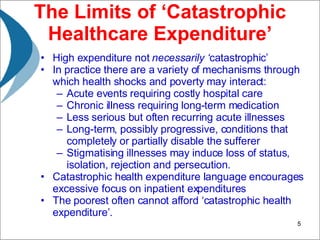
The Limits of ‘Catastrophic Healthcare Expenditure’ High expenditure not  necessarily ‘ catastrophic’ In practice there are a variety of mechanisms through which health shocks and poverty may interact: Acute events requiring costly hospital care Chronic illness requiring long-term medication Less serious but often recurring acute illnesses Long-term, possibly progressive, conditions that completely or partially disable the sufferer Stigmatising illnesses may induce loss of status, isolation, rejection and persecution. Catastrophic health expenditure language encourages excessive focus on inpatient expenditures The poorest often cannot afford ‘catastrophic health expenditure’.
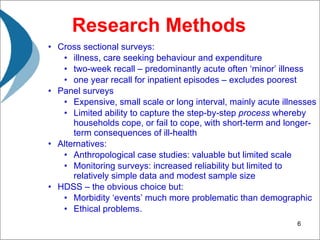
Research Methods Cross sectional surveys:  illness, care seeking behaviour and expenditure two-week recall – predominantly acute often ‘minor’ illness one year recall for inpatient episodes – excludes poorest  Panel surveys  Expensive, small scale or long interval, mainly acute illnesses Limited ability to capture the step-by-step  process  whereby households cope, or fail to cope, with short-term and longer-term consequences of ill-health Alternatives:  Anthropological case studies: valuable but limited scale  Monitoring surveys: increased reliability but limited to relatively simple data and modest sample size  HDSS – the obvious choice but: Morbidity ‘events’ much more problematic than demographic Ethical problems.
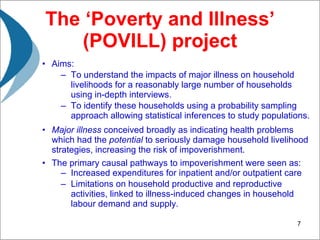
The ‘Poverty and Illness’ (POVILL) project Aims:  To understand the impacts of major illness on household livelihoods for a reasonably large number of households using in-depth interviews. To identify these households using a probability sampling approach allowing statistical inferences to study populations. Major illness  conceived broadly as indicating health problems which had the  potential  to seriously damage household livelihood strategies, increasing the risk of impoverishment.  The primary causal pathways to impoverishment were seen as: Increased expenditures for inpatient and/or outpatient care Limitations on household productive and reproductive  activities, linked to illness-induced changes in household labour demand and supply.
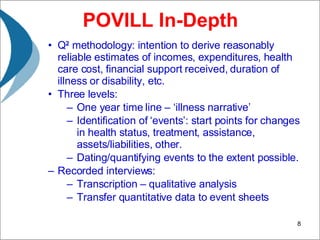
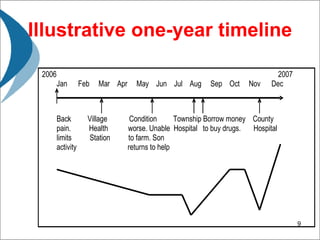
POVILL In-Depth Q 2  methodology: intention to derive reasonably reliable estimates of incomes, expenditures, health care cost, financial support received, duration of illness or disability, etc. Three levels: One year time line – ‘illness narrative’ Identification of ‘events’: start points for changes in health status, treatment, assistance, assets/liabilities, other. Dating/quantifying events to the extent possible. Recorded interviews: Transcription – qualitative analysis Transfer quantitative data to event sheets
Illustrative one-year timeline

Henry Panel Henry

  • 1.
    Measuring health -livelihood linkages and implications for design of interventions
  • 2.
    Context Generally acceptedthat serious illness is one of the most difficult challenges that individuals, households and families may have to face Wide range of deleterious impacts and generally accepted to be a common cause of household impoverishment Evidence that health ‘shocks’ are seen by the poor themselves as one of their greatest concerns However, there is limited detailed evidence as to how households cope over time with the impacts of serious heath problems.
  • 3.
    Variable nature ofhealth problems: Dengue, TB, hypertension, diabetes, emphysema, lymphatic filariasis, cancer, AIDS … risk to life, level of disability and distress, duration of illness, prognosis, physical availability, cost of treatment Demographic and socio-economic characteristics of the individual falling ill, the household of which they are a member, their extended family and social networks. Diversity of local/national income-generating opportunities The effectiveness of formal or informal mechanisms (at national local or community level) intended to assist distressed households. The functioning of the health system and, in particular, the availability of safe, effective, affordable and trusted care. Complex pathways linking ill-health and well-being
  • 4.
    Complex coping processesKey worker incapacitated - Household labour supply reduced and reproductive labour demands increased Reduction in household production Increased healthcare expenditure, if accessible. May necessitate reduced current consumption (food/transport/education/etc), possibly reducing productivity. May lead to a run down of savings; forced borrowing at high rates of interest; and/or sale of physical assets, Sale of productive assets further reduces income flows. Over time various household members have a series of difficult decisions assessing costs and benefits of alternative health care seeking strategies – including the strategy of not seeking care.
  • 5.
    The Limits of‘Catastrophic Healthcare Expenditure’ High expenditure not necessarily ‘ catastrophic’ In practice there are a variety of mechanisms through which health shocks and poverty may interact: Acute events requiring costly hospital care Chronic illness requiring long-term medication Less serious but often recurring acute illnesses Long-term, possibly progressive, conditions that completely or partially disable the sufferer Stigmatising illnesses may induce loss of status, isolation, rejection and persecution. Catastrophic health expenditure language encourages excessive focus on inpatient expenditures The poorest often cannot afford ‘catastrophic health expenditure’.
  • 6.
    Research Methods Crosssectional surveys: illness, care seeking behaviour and expenditure two-week recall – predominantly acute often ‘minor’ illness one year recall for inpatient episodes – excludes poorest Panel surveys Expensive, small scale or long interval, mainly acute illnesses Limited ability to capture the step-by-step process whereby households cope, or fail to cope, with short-term and longer-term consequences of ill-health Alternatives: Anthropological case studies: valuable but limited scale Monitoring surveys: increased reliability but limited to relatively simple data and modest sample size HDSS – the obvious choice but: Morbidity ‘events’ much more problematic than demographic Ethical problems.
  • 7.
    The ‘Poverty andIllness’ (POVILL) project Aims: To understand the impacts of major illness on household livelihoods for a reasonably large number of households using in-depth interviews. To identify these households using a probability sampling approach allowing statistical inferences to study populations. Major illness conceived broadly as indicating health problems which had the potential to seriously damage household livelihood strategies, increasing the risk of impoverishment. The primary causal pathways to impoverishment were seen as: Increased expenditures for inpatient and/or outpatient care Limitations on household productive and reproductive activities, linked to illness-induced changes in household labour demand and supply.
  • 8.
    POVILL In-Depth Q2 methodology: intention to derive reasonably reliable estimates of incomes, expenditures, health care cost, financial support received, duration of illness or disability, etc. Three levels: One year time line – ‘illness narrative’ Identification of ‘events’: start points for changes in health status, treatment, assistance, assets/liabilities, other. Dating/quantifying events to the extent possible. Recorded interviews: Transcription – qualitative analysis Transfer quantitative data to event sheets
  • 9.