Justice & Rights Rights & Duties Liberty Rights & Claim Rights Rights in the Catholic tradition “ Human rights are the minimum conditions for life in community.” Rights are a reflection of human  worth Immigration Rights & Borders
Passions can be helpful, but they can also blind us.  Can you determine what sorts of things are behind the passions you see on this video about a topic that ordinarily tends to be pretty dry (health insurance!)?  And can you identify blind spots on one or the other side (or both) based upon your reading for Tuesday, the video  Sick Around America , and our discussions about social & economic injustice in general? vt
discuss why access to medical care is a significant issue for social justice (especially in terms of ‘what’s up to you’ vs. ‘what’s not up to you’), and consider the Catholic contribution to the healthcare debate in this country.
“ In the end, the kind of health care we tolerate reflects the kind of society we are or want to be.”   — Dr. Edmund Pelligrino (XP, p. 139)
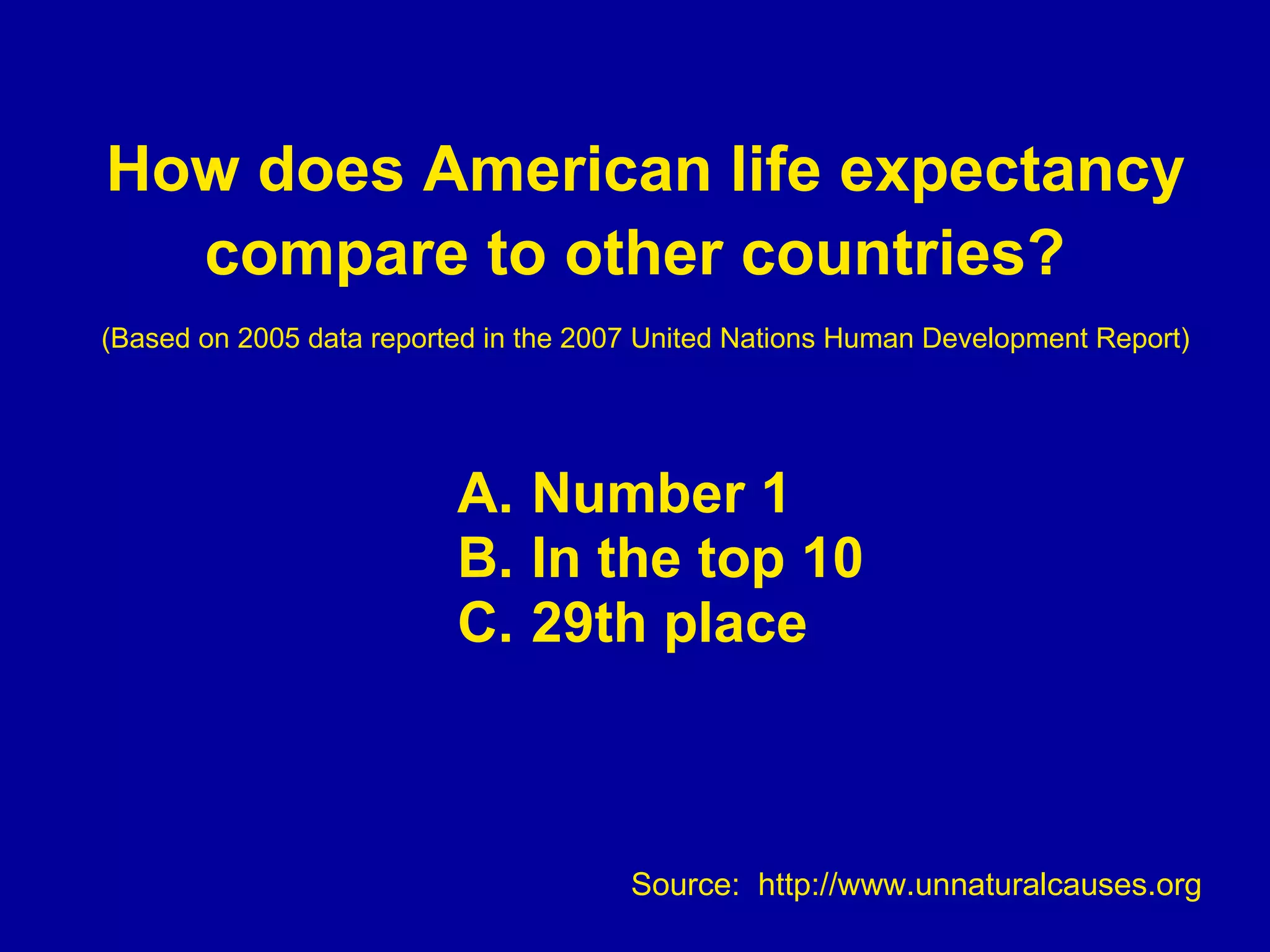
How does American life expectancy compare to other countries?   (Based on 2005 data reported in the 2007 United Nations Human Development Report) Number 1  In the top 10 29th place Source:  http://www.unnaturalcauses.org
ANSWER:  C. 29th place     At 77.9 years, we are tied with South Korea and Denmark for 29th – 31st place, despite being the second wealthiest country on the planet (measured by per capita GDP).  Japan has the highest life expectancy at 82.3 years
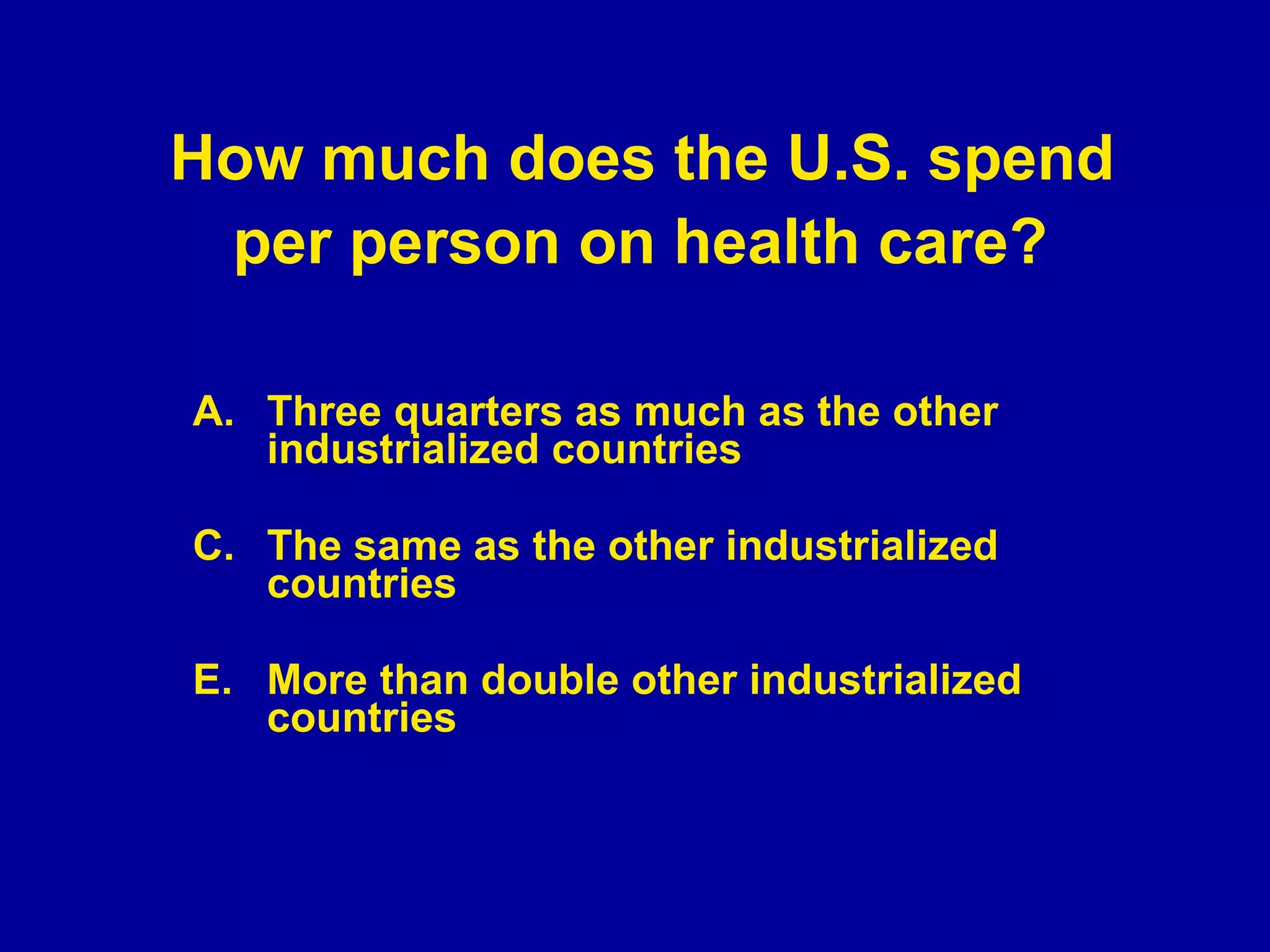
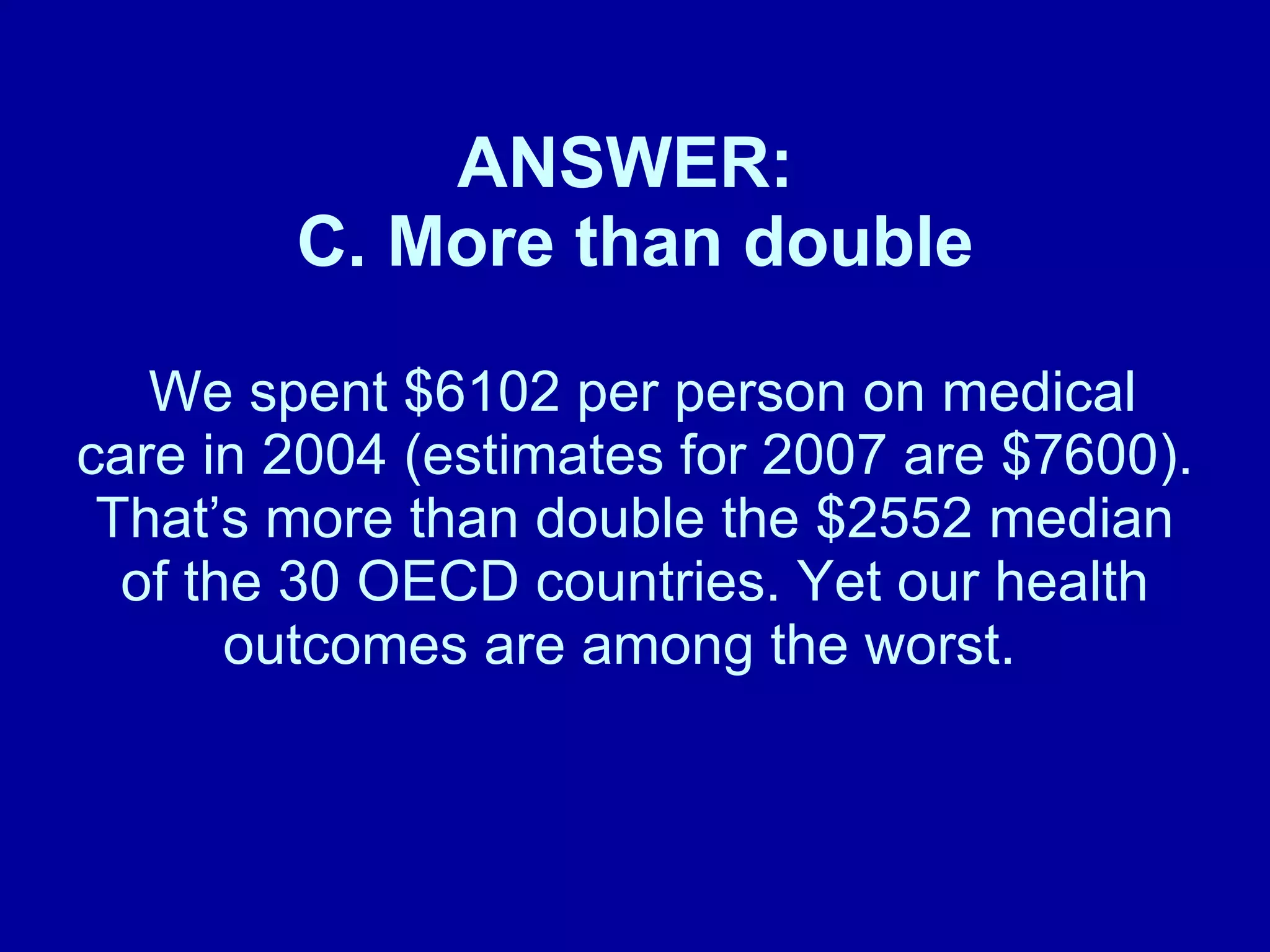
How much does the U.S. spend  per person on health care?   Three quarters as much as the other industrialized countries The same as the other industrialized countries More than double other industrialized countries
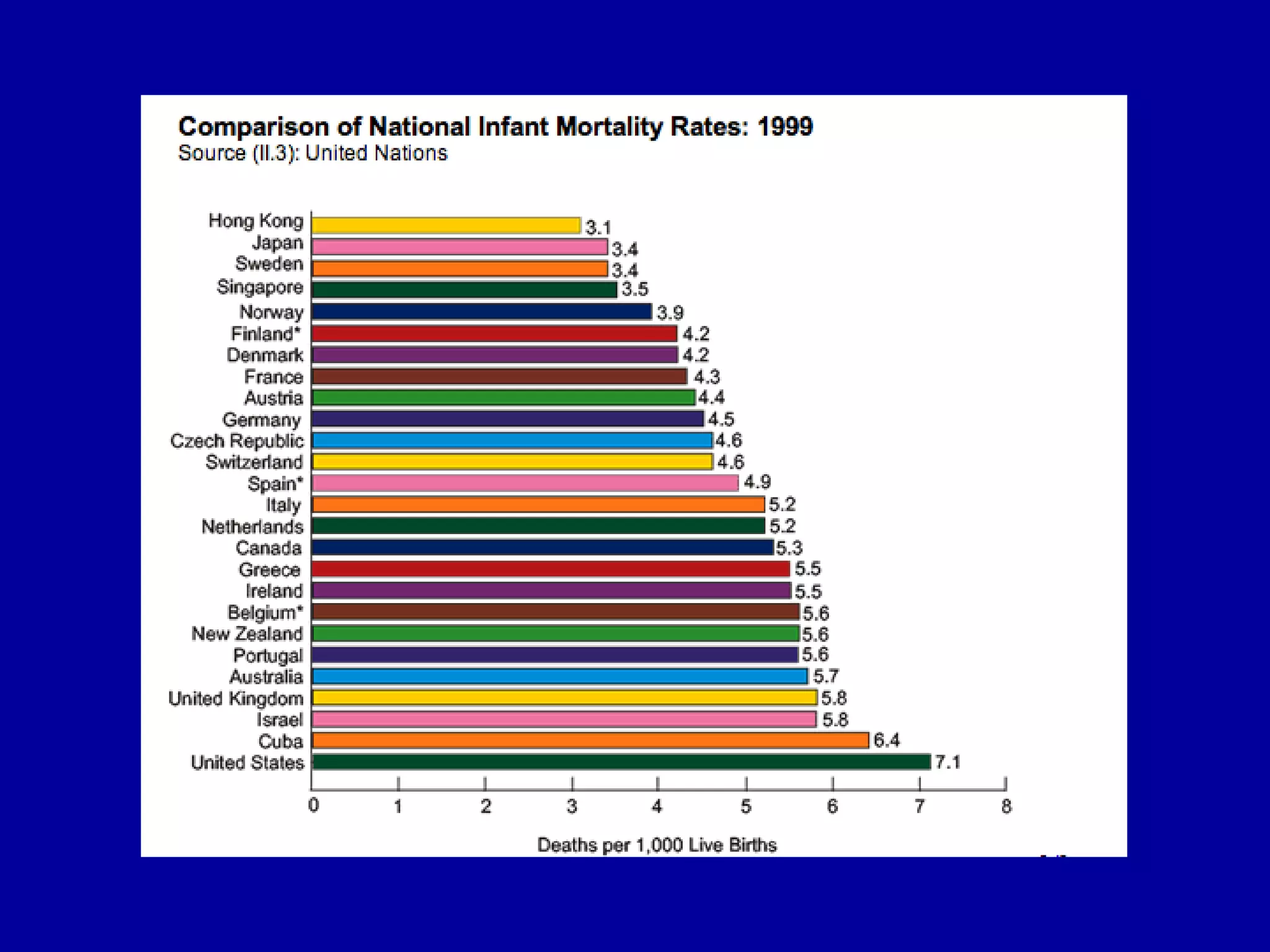
ANSWER:  C. More than double  We spent $6102 per person on medical care in 2004 (estimates for 2007 are $7600). That ’s more than double the $2552 median of the 30 OECD countries. Yet our health outcomes are among the worst.
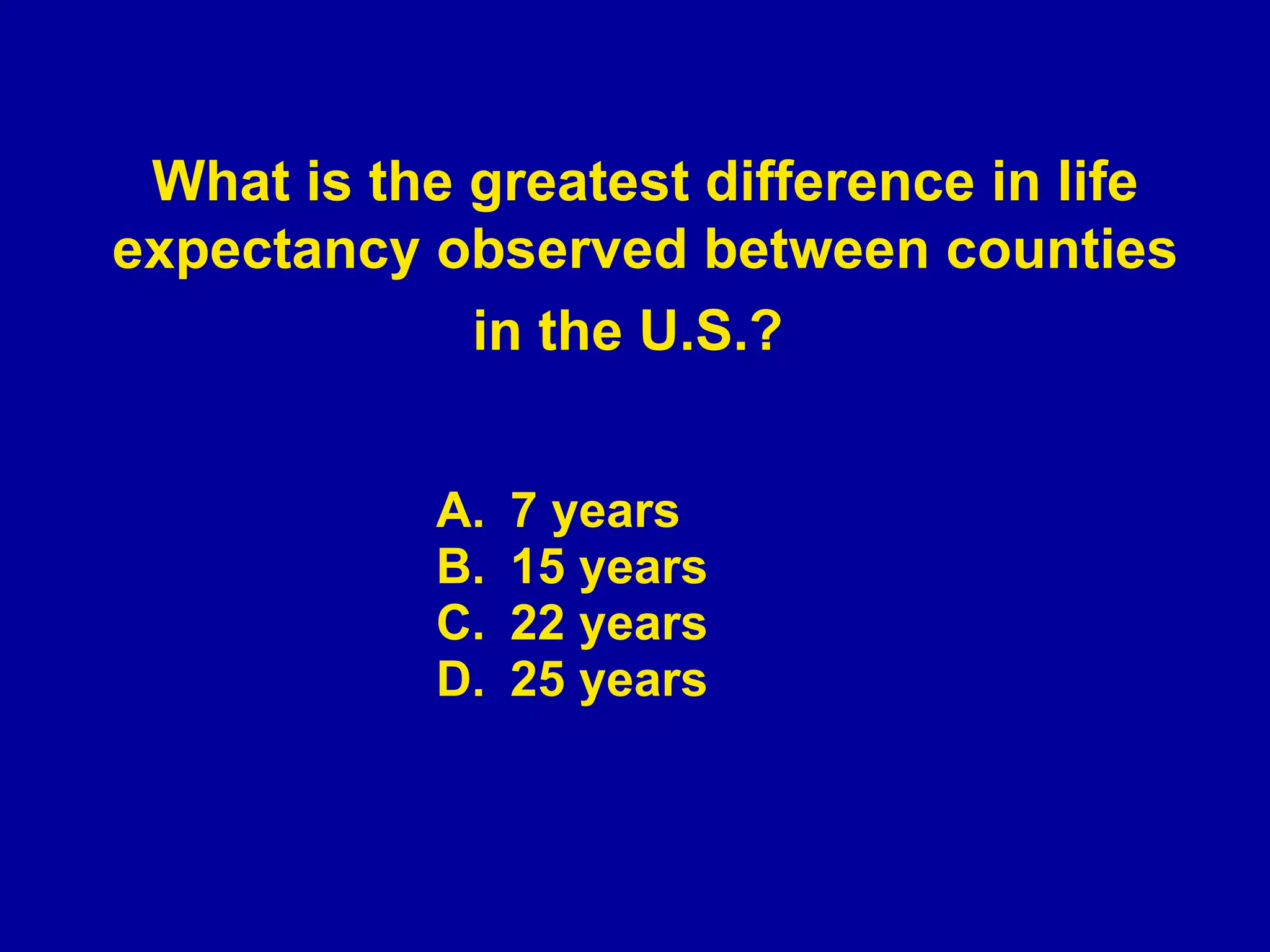
7 years 15 years 22 years 25 years What is the greatest difference in life expectancy observed between counties in the U.S.?
ANSWER:  B. 15 Years  Populations in some wealthy communities live on average well into their 80s, while others in some inner city neighborhoods and Native American reservations barely scratch 60.
Between 1980 and 2000 the gap in life expectancy between the most and least deprived counties in the U.S: A.  Declined by 12% B.  Remained the same C.  Widened by 60%
ANSWER: C Widened by 60% As economic inequality grew after 1980, so did the life expectancy gap between the rich and the rest of us. In contrast, a recent study (Krieger et al) showed that premature death and infant mortality gaps narrowed between 1966 and 1980.
Japanese Bangladeshis Cubans Algerians living in Paris All of the above African American males in Harlem have a shorter life expectancy from age five than which of the following groups?
ANSWER:  E. All of the above   The biggest killers of African American males in many poor, segregated urban neighborhoods are not violence nor drugs nor AIDS, but heart disease, stroke and other chronic diseases that cut men down in middle age.
Whether or not you smoke What you eat Whether or not you are wealthy Whether or not you have health insurance How often you exercise On average, which of the following conditions is the strongest predictor of your health?
ANSWER:  C. Whether or not you are wealthy   The wealthier you are, on average, the better your health, from the bottom all the way to the top. Genes, diet, exercise and other behaviors are important. But a poor smoker still stands a greater chance of getting ill than a rich smoker.
True False True or False:  The gap between white and African American infant mortality rates is greater today than it was in 1950;
ANSWER: A. True   The total number of infant deaths among both African American and white Americans has fallen since 1950. But today the infant mortality rate for African Americans is two and a half times that of white Americans, a greater gap than 60 years ago. In fact, the rate among African American mothers with college and professional degrees is higher than among white mothers who haven’t finished high school.
 
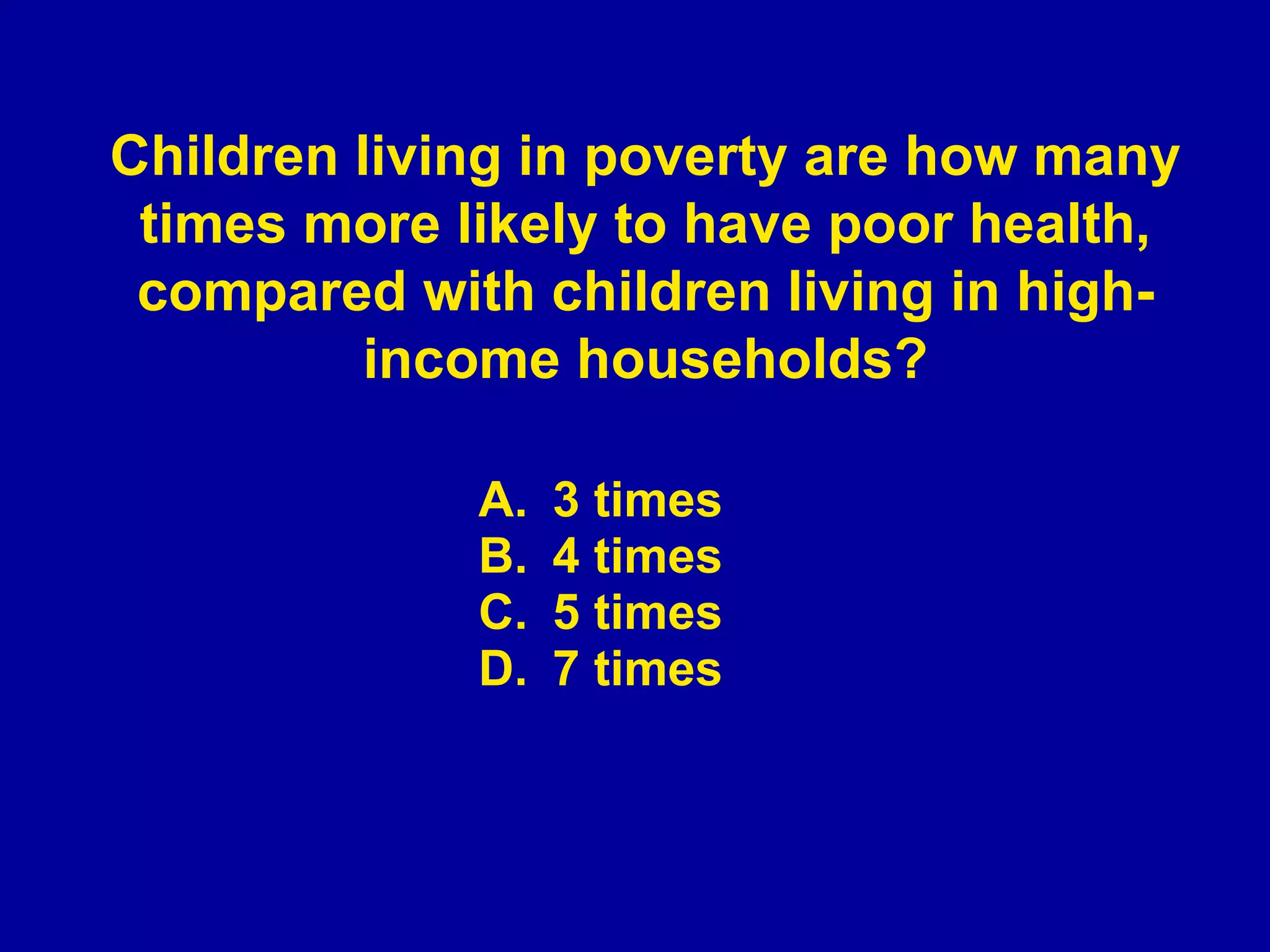
3 times 4 times 5 times 7 times Children living in poverty are how many times more likely to have poor health, compared with children living in high-income households?
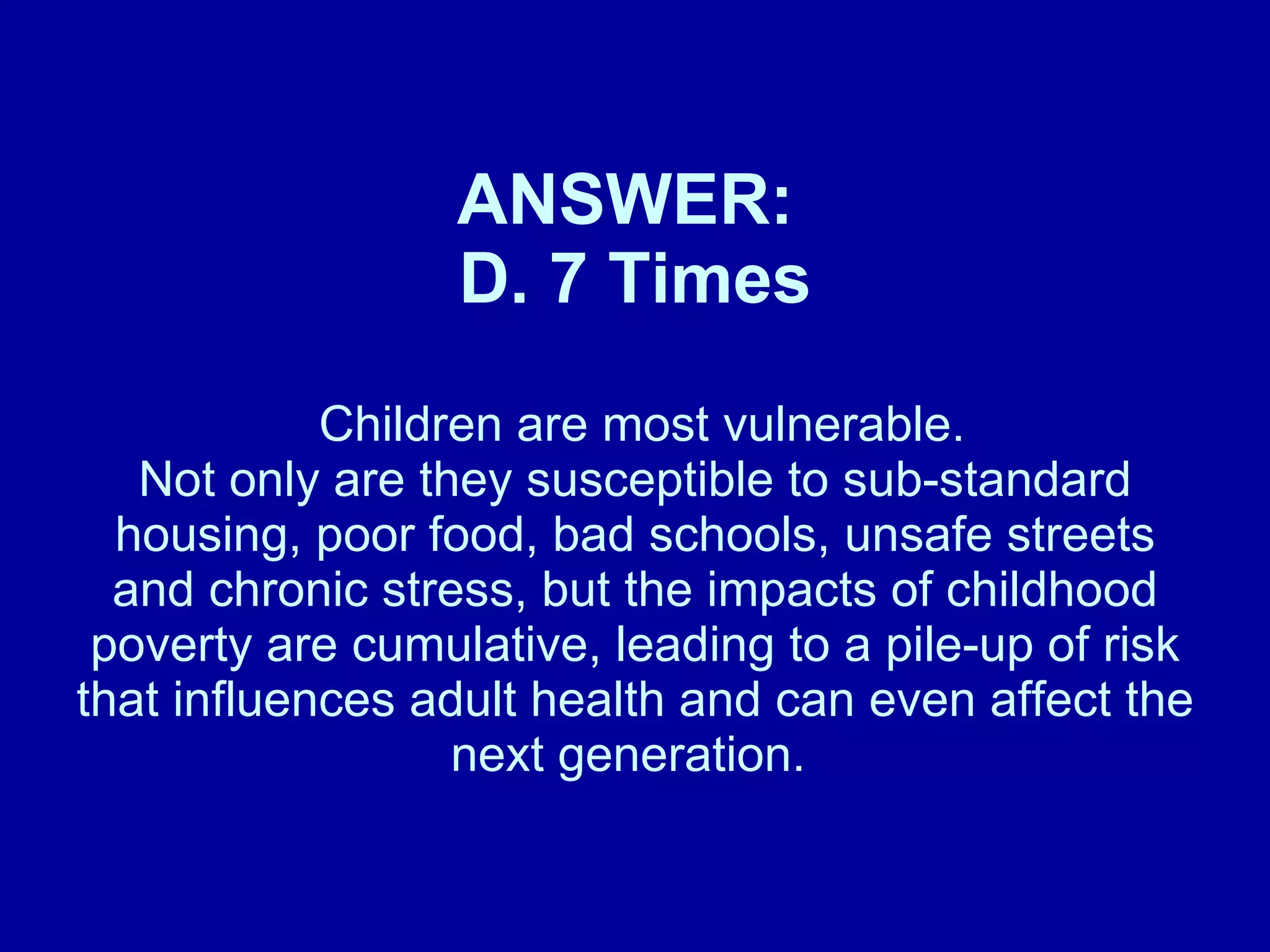
ANSWER:  D. 7 Times   Children are most vulnerable.  Not only are they susceptible to sub-standard housing, poor food, bad schools, unsafe streets and chronic stress, but the impacts of childhood poverty are cumulative, leading to a pile-up of risk that influences adult health and can even affect the next generation.
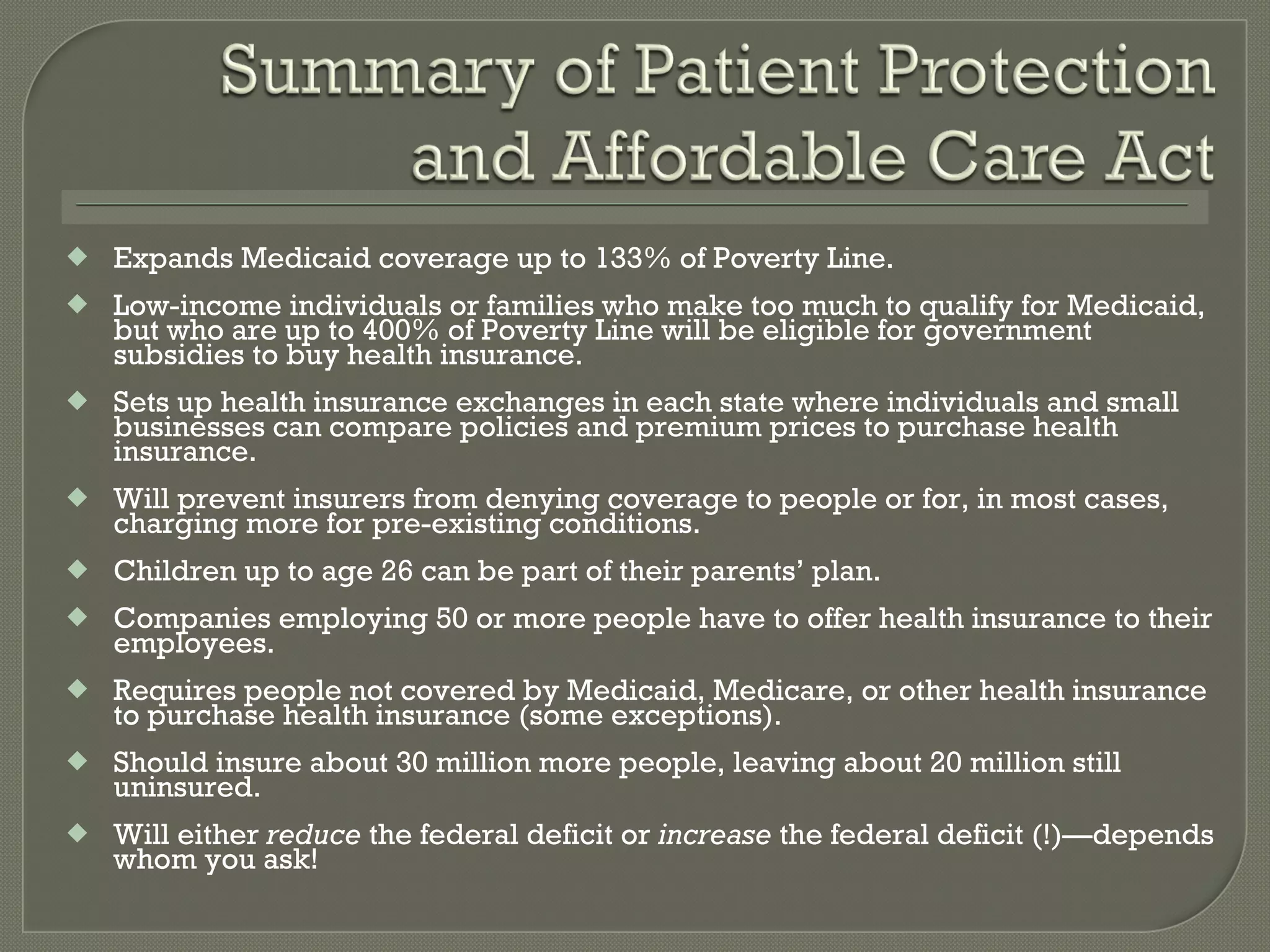
Expands Medicaid coverage up to 133% of Poverty Line. Low-income individuals or families who make too much to qualify for Medicaid, but who are up to 400% of Poverty Line will be eligible for government subsidies to buy health insurance. Sets up health insurance exchanges in each state where individuals and small businesses can compare policies and premium prices to purchase health insurance. Will prevent insurers from denying coverage to people or for, in most cases, charging more for pre-existing conditions. Children up to age 26 can be part of their parents’ plan. Companies employing 50 or more people have to offer health insurance to their employees. Requires people not covered by Medicaid, Medicare, or other health insurance to purchase health insurance (some exceptions). Should insure about 30 million more people, leaving about 20 million still uninsured. Will either  reduce  the federal deficit or  increase  the federal deficit (!)—depends whom you ask!
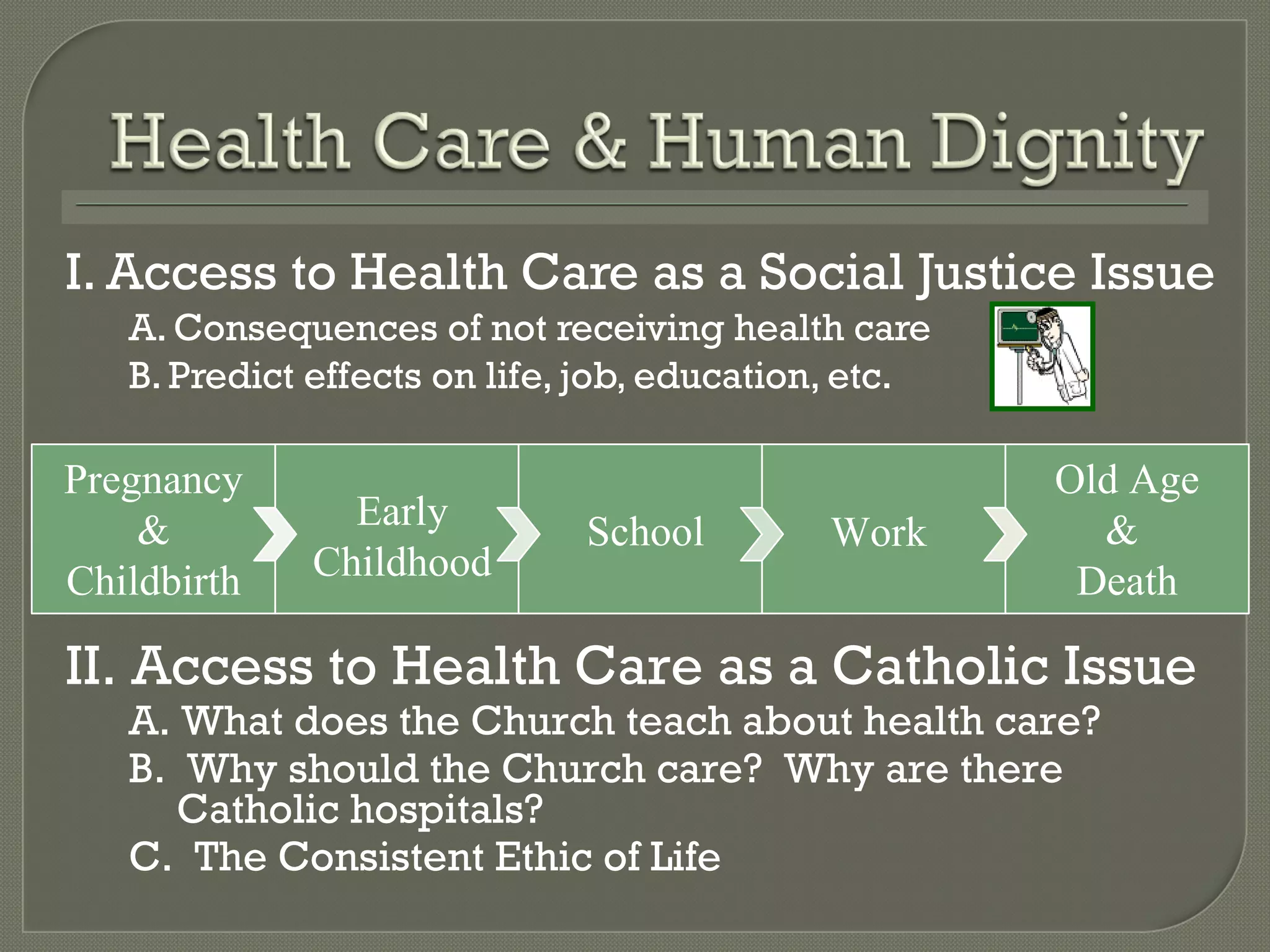
I. Access to Health Care as a Social Justice Issue A. Consequences of not receiving health care B. Predict effects on life, job, education, etc. Pregnancy & Childbirth Early Childhood School Work Old Age &  Death II. Access to Health Care as a Catholic Issue A. What does the Church teach about health care? B.  Why should the Church care?  Why are there Catholic hospitals? C.  The Consistent Ethic of Life
A 2 3 4 5
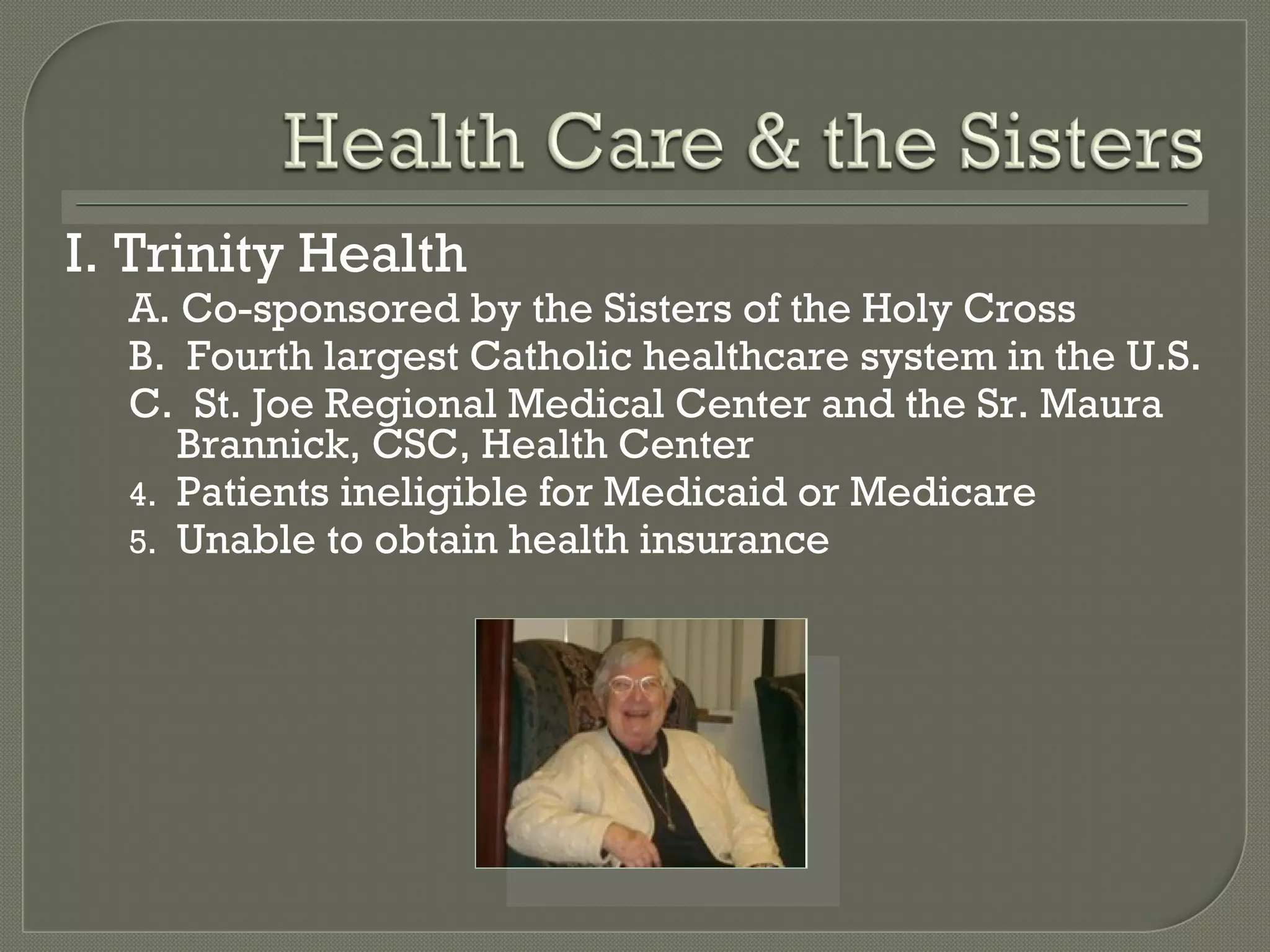
I. Trinity Health  A. Co-sponsored by the Sisters of the Holy Cross B.  Fourth largest Catholic healthcare system in the U.S. C.  St. Joe Regional Medical Center and the Sr. Maura Brannick, CSC, Health Center Patients ineligible for Medicaid or Medicare Unable to obtain health insurance
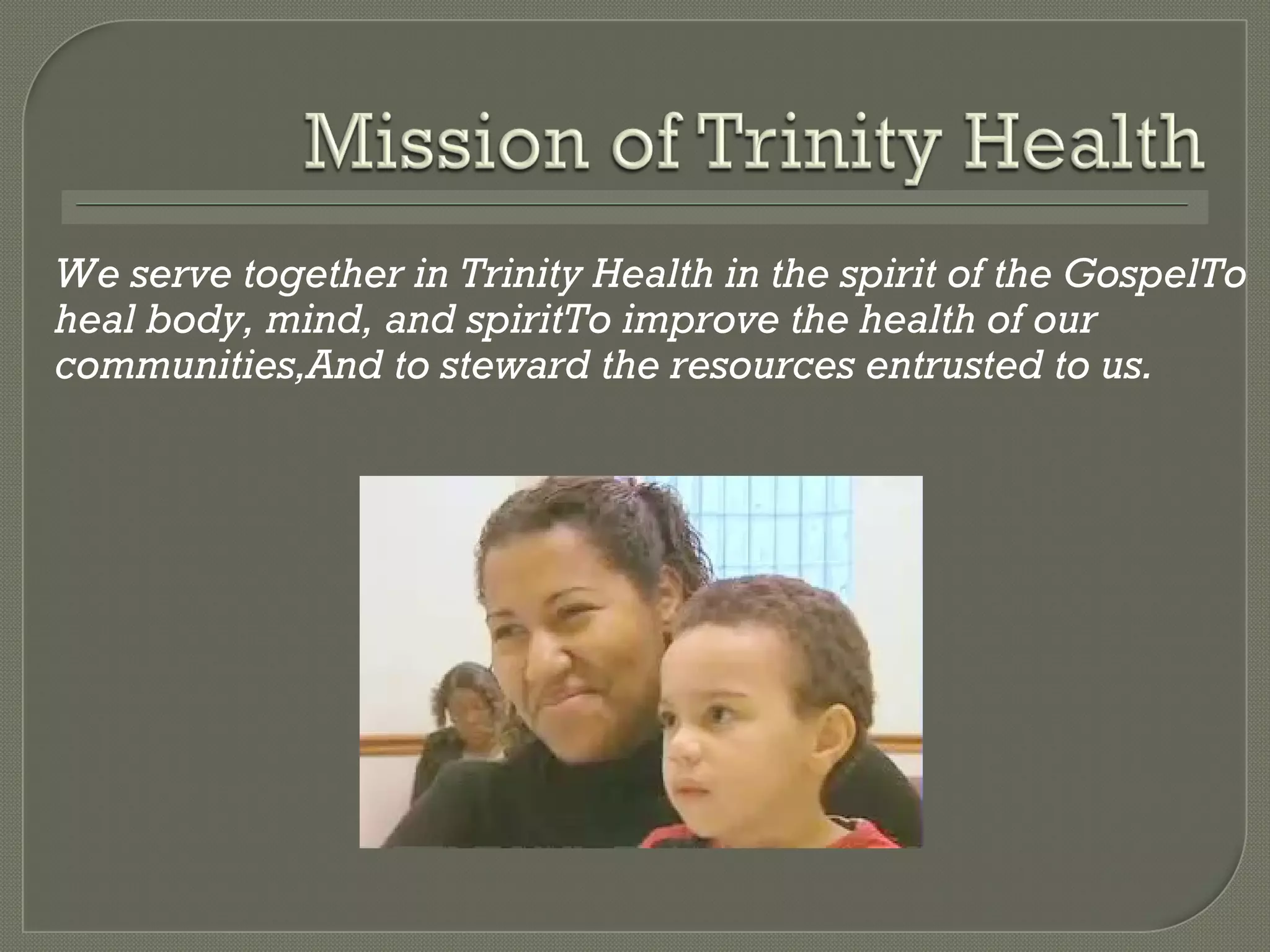
We serve together in Trinity Health in the spirit of the Gospel
To heal body, mind, and spirit
To improve the health of our communities,
And to steward the resources entrusted to us.
The right to life does not end at birth. You can’t welcome life into the world and then not care about what happens to it after it gets here. In short:  “We must defend the right to life of the weakest among us; we must also be supportive of the quality of life of the powerless among us:  the old and the young, the hungry and the homeless, the undocumented immigrant and the unemployed worker, the sick, the disabled and the dying.” (Cardinal Bernardin)

Class #23

  • 1.
    Justice & RightsRights & Duties Liberty Rights & Claim Rights Rights in the Catholic tradition “ Human rights are the minimum conditions for life in community.” Rights are a reflection of human worth Immigration Rights & Borders
  • 2.
    Passions can behelpful, but they can also blind us. Can you determine what sorts of things are behind the passions you see on this video about a topic that ordinarily tends to be pretty dry (health insurance!)? And can you identify blind spots on one or the other side (or both) based upon your reading for Tuesday, the video Sick Around America , and our discussions about social & economic injustice in general? vt
  • 3.
    discuss why accessto medical care is a significant issue for social justice (especially in terms of ‘what’s up to you’ vs. ‘what’s not up to you’), and consider the Catholic contribution to the healthcare debate in this country.
  • 4.
    “ In theend, the kind of health care we tolerate reflects the kind of society we are or want to be.” — Dr. Edmund Pelligrino (XP, p. 139)
  • 5.
    How does Americanlife expectancy compare to other countries? (Based on 2005 data reported in the 2007 United Nations Human Development Report) Number 1 In the top 10 29th place Source: http://www.unnaturalcauses.org
  • 6.
    ANSWER: C.29th place At 77.9 years, we are tied with South Korea and Denmark for 29th – 31st place, despite being the second wealthiest country on the planet (measured by per capita GDP). Japan has the highest life expectancy at 82.3 years
  • 7.
    How much doesthe U.S. spend per person on health care? Three quarters as much as the other industrialized countries The same as the other industrialized countries More than double other industrialized countries
  • 8.
    ANSWER: C.More than double We spent $6102 per person on medical care in 2004 (estimates for 2007 are $7600). That ’s more than double the $2552 median of the 30 OECD countries. Yet our health outcomes are among the worst.
  • 9.
    7 years 15years 22 years 25 years What is the greatest difference in life expectancy observed between counties in the U.S.?
  • 10.
    ANSWER: B.15 Years Populations in some wealthy communities live on average well into their 80s, while others in some inner city neighborhoods and Native American reservations barely scratch 60.
  • 11.
    Between 1980 and2000 the gap in life expectancy between the most and least deprived counties in the U.S: A. Declined by 12% B. Remained the same C. Widened by 60%
  • 12.
    ANSWER: C Widenedby 60% As economic inequality grew after 1980, so did the life expectancy gap between the rich and the rest of us. In contrast, a recent study (Krieger et al) showed that premature death and infant mortality gaps narrowed between 1966 and 1980.
  • 13.
    Japanese Bangladeshis CubansAlgerians living in Paris All of the above African American males in Harlem have a shorter life expectancy from age five than which of the following groups?
  • 14.
    ANSWER: E.All of the above The biggest killers of African American males in many poor, segregated urban neighborhoods are not violence nor drugs nor AIDS, but heart disease, stroke and other chronic diseases that cut men down in middle age.
  • 15.
    Whether or notyou smoke What you eat Whether or not you are wealthy Whether or not you have health insurance How often you exercise On average, which of the following conditions is the strongest predictor of your health?
  • 16.
    ANSWER: C.Whether or not you are wealthy The wealthier you are, on average, the better your health, from the bottom all the way to the top. Genes, diet, exercise and other behaviors are important. But a poor smoker still stands a greater chance of getting ill than a rich smoker.
  • 17.
    True False Trueor False: The gap between white and African American infant mortality rates is greater today than it was in 1950;
  • 18.
    ANSWER: A. True The total number of infant deaths among both African American and white Americans has fallen since 1950. But today the infant mortality rate for African Americans is two and a half times that of white Americans, a greater gap than 60 years ago. In fact, the rate among African American mothers with college and professional degrees is higher than among white mothers who haven’t finished high school.
  • 19.
  • 20.
    3 times 4times 5 times 7 times Children living in poverty are how many times more likely to have poor health, compared with children living in high-income households?
  • 21.
    ANSWER: D.7 Times Children are most vulnerable. Not only are they susceptible to sub-standard housing, poor food, bad schools, unsafe streets and chronic stress, but the impacts of childhood poverty are cumulative, leading to a pile-up of risk that influences adult health and can even affect the next generation.
  • 22.
    Expands Medicaid coverageup to 133% of Poverty Line. Low-income individuals or families who make too much to qualify for Medicaid, but who are up to 400% of Poverty Line will be eligible for government subsidies to buy health insurance. Sets up health insurance exchanges in each state where individuals and small businesses can compare policies and premium prices to purchase health insurance. Will prevent insurers from denying coverage to people or for, in most cases, charging more for pre-existing conditions. Children up to age 26 can be part of their parents’ plan. Companies employing 50 or more people have to offer health insurance to their employees. Requires people not covered by Medicaid, Medicare, or other health insurance to purchase health insurance (some exceptions). Should insure about 30 million more people, leaving about 20 million still uninsured. Will either reduce the federal deficit or increase the federal deficit (!)—depends whom you ask!
  • 23.
    I. Access toHealth Care as a Social Justice Issue A. Consequences of not receiving health care B. Predict effects on life, job, education, etc. Pregnancy & Childbirth Early Childhood School Work Old Age & Death II. Access to Health Care as a Catholic Issue A. What does the Church teach about health care? B. Why should the Church care? Why are there Catholic hospitals? C. The Consistent Ethic of Life
  • 24.
    A 2 34 5
  • 25.
    I. Trinity Health A. Co-sponsored by the Sisters of the Holy Cross B. Fourth largest Catholic healthcare system in the U.S. C. St. Joe Regional Medical Center and the Sr. Maura Brannick, CSC, Health Center Patients ineligible for Medicaid or Medicare Unable to obtain health insurance
  • 26.
    We serve togetherin Trinity Health in the spirit of the Gospel
To heal body, mind, and spirit
To improve the health of our communities,
And to steward the resources entrusted to us.
  • 27.
    The right tolife does not end at birth. You can’t welcome life into the world and then not care about what happens to it after it gets here. In short: “We must defend the right to life of the weakest among us; we must also be supportive of the quality of life of the powerless among us: the old and the young, the hungry and the homeless, the undocumented immigrant and the unemployed worker, the sick, the disabled and the dying.” (Cardinal Bernardin)

Editor's Notes

  • #3 This is what I want to use for the Voicethread. Say that it gives a good sense of the passions on both sides of the debate. Also talks about socialism. As them what side the Church is on here and what someone representing the Catholic view would say to some of the other protestors. Say to use the other video "Sick in America" as background to viewing this one. In class, perhaps do the thing with the eligibility for Medicaid Passions can be helpful, but they can also blind us. Can you determine what sorts of things are behind the passion you see on this video about a topic that ordinarily tends to be pretty dry (health insurance!)? And can you identify blind spots on one or the other side (or both) based upon your reading for Tuesday, the video Sick Around America, and our discussions about social & economic injustice in general?
  • #4 Maybe make announcement about when projects are due: --extensions beyond Dec. 2nd
  • #11 The % of Americans who will live beyond age 65 is higher in Costa Rica than in the U.S.: http://www.aacu.org/liberaleducation/le-fa07/le_fa07_Bonner.cfm
  • #23 Medicaid eligibility is 36% of poverty line for working parents in IN (http://www.statehealthfacts.org/mfs.jsp?rgn=16&rgn=1&x=6&y=5) Big constitutional questions of whether the federal government can force you to buy something. Health reform law will prohibit insurance companies from denying coverage because of a person’s medical history or health condition—starting in 2014. http://healthreform.kff.org/quizzes/health-reform-quiz/results-page.aspx The individual insurance mandate conservatives oppose, in the courts and in Congress, is an indispensable feature of health-care reform. The government can only require insurance companies to cover sick people as long as it also requires healthy people to buy insurance; otherwise premiums will skyrocket or insurance companies will go out of business. http://www.commonwealmagazine.org/theyre-back - But how, conservatives ask, can the government save money while at the same time making itself bigger? Columnist Charles Krauthammer thinks it’s absurd to go about reducing the deficit by adding $540 billion in new spending while increasing taxes by $770 billion. Mortimer Zuckerman said that estimating the cost of this new bill is like estimating your your grocery bill in 10 years. • maybe ask if this is socialism? -not really, because as said in the video, government healthcare doesn’t equal socialism -doctors remain in private practice, hospitals retain private ownership
  • #24 Trinity Health is a national Catholic health network of 44 acute-care hospitals, 379 outpatient centers, 26 long-term care facilities, and numerous hospice programs and senior living communities in Michigan, Iowa, Indiana, Maryland, Ohio, Idaho and California. Headquartered in Novi, Michigan, Trinity Health is the fourth-largest Catholic health system in the United States based on total revenue. With 44,500 full-time staff and more than 8,000 active physicians, Trinity Health operates an integrated and aligned health care delivery system dedicated to improving the health of its communities. It is sponsored by the Sisters of Mercy, West Midwest Community, and the Congregation of the Sisters of the Holy Cross. From CSC website: In May 2000, the Holy Cross Health System consolidated resources with the Sisters of Mercy’s Detroit Regional Health System, creating the fourth largest Catholic healthcare system in the United States, Trinity Health.
  • #26 Trinity Health is a national Catholic health network of 44 acute-care hospitals, 379 outpatient centers, 26 long-term care facilities, and numerous hospice programs and senior living communities in Michigan, Iowa, Indiana, Maryland, Ohio, Idaho and California. Headquartered in Novi, Michigan, Trinity Health is the fourth-largest Catholic health system in the United States based on total revenue. With 44,500 full-time staff and more than 8,000 active physicians, Trinity Health operates an integrated and aligned health care delivery system dedicated to improving the health of its communities. It is sponsored by the Sisters of Mercy, West Midwest Community, and the Congregation of the Sisters of the Holy Cross. From CSC website: In May 2000, the Holy Cross Health System consolidated resources with the Sisters of Mercy’s Detroit Regional Health System, creating the fourth largest Catholic healthcare system in the United States, Trinity Health. http://www.sjmed.com/mission/ • Catholic hospitals serve 1 out of 6 patients in the United States and provide 15% of the hospital beds.
  • #27 Trinity Health is a national Catholic health network of 44 acute-care hospitals, 379 outpatient centers, 26 long-term care facilities, and numerous hospice programs and senior living communities in Michigan, Iowa, Indiana, Maryland, Ohio, Idaho and California. Headquartered in Novi, Michigan, Trinity Health is the fourth-largest Catholic health system in the United States based on total revenue. With 44,500 full-time staff and more than 8,000 active physicians, Trinity Health operates an integrated and aligned health care delivery system dedicated to improving the health of its communities. It is sponsored by the Sisters of Mercy, West Midwest Community, and the Congregation of the Sisters of the Holy Cross. From CSC website: In May 2000, the Holy Cross Health System consolidated resources with the Sisters of Mercy’s Detroit Regional Health System, creating the fourth largest Catholic healthcare system in the United States, Trinity Health. http://www.sjmed.com/mission/