Hemophilia:
Understanding
the Clotting
Disorder
Presented by – Simra (2302843)
Subject- Physiology(Dr.Natia Shonia)
Introduction
– Hemophilia is a rare genetic disorder that
impairs the blood's ability to clot.
– It is caused by mutations in genes responsible
for producing clotting factors.
– Two main types:
– Hemophilia A: Factor VIII deficiency (most
common).
– Hemophilia B: Factor IX deficiency.
– It primarily affects males, while females are
typically carriers.
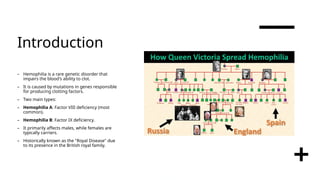
– Historically known as the "Royal Disease" due
to its presence in the British royal family.
Epidemiology
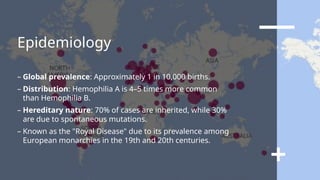
– Global prevalence: Approximately 1 in 10,000 births.
– Distribution: Hemophilia A is 4–5 times more common
than Hemophilia B.
– Hereditary nature: 70% of cases are inherited, while 30%
are due to spontaneous mutations.
– Known as the "Royal Disease" due to its prevalence among
European monarchies in the 19th and 20th centuries.
Pathophysiolo
gy
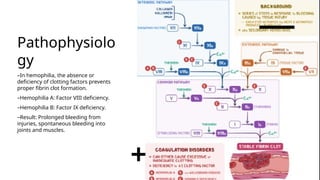
–In hemophilia, the absence or
deficiency of clotting factors prevents
proper fibrin clot formation.
–Hemophilia A: Factor VIII deficiency.
–Hemophilia B: Factor IX deficiency.
–Result: Prolonged bleeding from
injuries, spontaneous bleeding into
joints and muscles.
Symptoms &
Signs
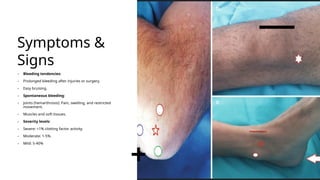
– Bleeding tendencies:
– Prolonged bleeding after injuries or surgery.
– Easy bruising.
– Spontaneous bleeding:
– Joints (hemarthrosis): Pain, swelling, and restricted
movement.
– Muscles and soft tissues.
– Severity levels:
– Severe: <1% clotting factor activity.
– Moderate: 1-5%.
– Mild: 5-40%
Diagnosis
– History: Family history of bleeding disorders.
– Physical Examination: Look for joint swelling, bruises.
– Laboratory Tests:
– Prolonged activated partial thromboplastin time (aPTT).
– Normal prothrombin time (PT) and platelet count.
– Specific assays for Factor VIII and IX levels.
Differential Diagnosis
– (VWD).
– Liver disease.
– Disseminated Intravascular Coagulation (DIC).
– Vitamin K deficiency.
– It’s essential to distinguish hemophilia from other conditions that
cause bleeding, such as Von Willebrand Disease or liver disorders.
These conditions might have overlapping symptoms but require
different treatments.
– different treatments.
Treatment
– Clotting Factor Replacement Therapy:
– Recombinant or plasma-derived Factor VIII/IX.
– Prophylaxis: Regular infusions to prevent bleeding episodes.
– Management of Acute Bleeding: Immediate factor
replacement.
– Newer Therapies:
– Gene therapy.
– Emicizumab (a bispecific antibody).
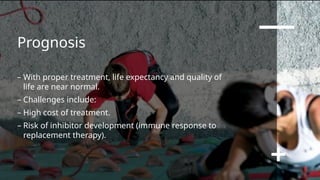
Prognosis
– With proper treatment, life expectancy and quality of
life are near normal.
– Challenges include:
– High cost of treatment.
– Risk of inhibitor development (immune response to
replacement therapy).
References
– Centers for Disease Control and Prevention (CDC).
– World Federation of Hemophilia (WFH).
– National Hemophilia Foundation (NHF).
Hemophilia- Simra Farooqui a presentation

Hemophilia- Simra Farooqui a presentation

  • 1.
    Hemophilia: Understanding the Clotting Disorder Presented by– Simra (2302843) Subject- Physiology(Dr.Natia Shonia)
  • 2.
    Introduction – Hemophilia isa rare genetic disorder that impairs the blood's ability to clot. – It is caused by mutations in genes responsible for producing clotting factors. – Two main types: – Hemophilia A: Factor VIII deficiency (most common). – Hemophilia B: Factor IX deficiency. – It primarily affects males, while females are typically carriers. – Historically known as the "Royal Disease" due to its presence in the British royal family.
  • 3.
    Epidemiology – Global prevalence:Approximately 1 in 10,000 births. – Distribution: Hemophilia A is 4–5 times more common than Hemophilia B. – Hereditary nature: 70% of cases are inherited, while 30% are due to spontaneous mutations. – Known as the "Royal Disease" due to its prevalence among European monarchies in the 19th and 20th centuries.
  • 4.
    Pathophysiolo gy –In hemophilia, theabsence or deficiency of clotting factors prevents proper fibrin clot formation. –Hemophilia A: Factor VIII deficiency. –Hemophilia B: Factor IX deficiency. –Result: Prolonged bleeding from injuries, spontaneous bleeding into joints and muscles.
  • 5.
    Symptoms & Signs – Bleedingtendencies: – Prolonged bleeding after injuries or surgery. – Easy bruising. – Spontaneous bleeding: – Joints (hemarthrosis): Pain, swelling, and restricted movement. – Muscles and soft tissues. – Severity levels: – Severe: <1% clotting factor activity. – Moderate: 1-5%. – Mild: 5-40%
  • 6.
    Diagnosis – History: Familyhistory of bleeding disorders. – Physical Examination: Look for joint swelling, bruises. – Laboratory Tests: – Prolonged activated partial thromboplastin time (aPTT). – Normal prothrombin time (PT) and platelet count. – Specific assays for Factor VIII and IX levels.
  • 7.
    Differential Diagnosis – (VWD). –Liver disease. – Disseminated Intravascular Coagulation (DIC). – Vitamin K deficiency. – It’s essential to distinguish hemophilia from other conditions that cause bleeding, such as Von Willebrand Disease or liver disorders. These conditions might have overlapping symptoms but require different treatments. – different treatments.
  • 8.
    Treatment – Clotting FactorReplacement Therapy: – Recombinant or plasma-derived Factor VIII/IX. – Prophylaxis: Regular infusions to prevent bleeding episodes. – Management of Acute Bleeding: Immediate factor replacement. – Newer Therapies: – Gene therapy. – Emicizumab (a bispecific antibody).
  • 9.
    Prognosis – With propertreatment, life expectancy and quality of life are near normal. – Challenges include: – High cost of treatment. – Risk of inhibitor development (immune response to replacement therapy).
  • 10.
    References – Centers forDisease Control and Prevention (CDC). – World Federation of Hemophilia (WFH). – National Hemophilia Foundation (NHF).