Helix Nebula – The Science Cloud
Status Update
Helge Meinhard / CERN
With contributions by Martin Gasthuber / DESY
HEPiX Fall 2016 @LBNL – contribution # 34
Presentation at HEPiX Zeuthen: https://indico.cern.ch/event/466991/contributions/1143637/
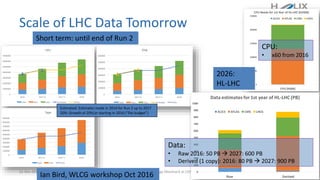
Scale of LHC Data Tomorrow
21-Oct-2016 HNSciCloud Status - Helge Meinhard at CERN.ch 2
Ian Bird, WLCG workshop Oct 2016
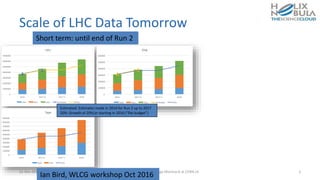
Scale of LHC Data Tomorrow
21-Oct-2016 HNSciCloud Status - Helge Meinhard at CERN.ch 2
0
1000000
2000000
3000000
4000000
5000000
6000000
7000000
2016 2017-A 2017-S 2018
CPU
Tier0 Tier1 Tier2 Estimated 20%/yr
0
100000
200000
300000
400000
500000
600000
2016 2017-A 2017-S 2018
Disk
Tier0 Tier1 Tier2 Estimated 20%
0
100000
200000
300000
400000
500000
600000
700000
800000
900000
2016 2017-A 2017-S 2018
Tape
Tier0 Tier1 20%
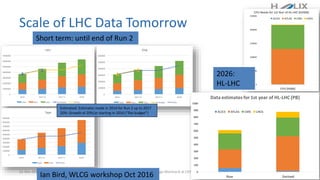
Estimated: Estimates made in 2014 for Run 2 up to 2017
20%: Growth of 20%/yr starting in 2016 (“flat budget”)
Short term: until end of Run 2
Ian Bird, WLCG workshop Oct 2016
Scale of LHC Data Tomorrow
21-Oct-2016 HNSciCloud Status - Helge Meinhard at CERN.ch 2
0
1000000
2000000
3000000
4000000
5000000
6000000
7000000
2016 2017-A 2017-S 2018
CPU
Tier0 Tier1 Tier2 Estimated 20%/yr
0
100000
200000
300000
400000
500000
600000
2016 2017-A 2017-S 2018
Disk
Tier0 Tier1 Tier2 Estimated 20%
0
100000
200000
300000
400000
500000
600000
700000
800000
900000
2016 2017-A 2017-S 2018
Tape
Tier0 Tier1 20%
Estimated: Estimates made in 2014 for Run 2 up to 2017
20%: Growth of 20%/yr starting in 2016 (“flat budget”)
0
50000
100000
150000
200000
250000
CPU (HS06)
CPU Needs for 1st Year of HL-LHC (kHS06)
ALICE ATLAS CMS LHCb
0
100
200
300
400
500
600
700
800
900
1000
Raw Derived
Data estimates for 1st year of HL-LHC (PB)
ALICE ATLAS CMS LHCb
Short term: until end of Run 2
2026:
HL-LHC
Ian Bird, WLCG workshop Oct 2016
Scale of LHC Data Tomorrow
21-Oct-2016 HNSciCloud Status - Helge Meinhard at CERN.ch 2
0
1000000
2000000
3000000
4000000
5000000
6000000
7000000
2016 2017-A 2017-S 2018
CPU
Tier0 Tier1 Tier2 Estimated 20%/yr
0
100000
200000
300000
400000
500000
600000
2016 2017-A 2017-S 2018
Disk
Tier0 Tier1 Tier2 Estimated 20%
0
100000
200000
300000
400000
500000
600000
700000
800000
900000
2016 2017-A 2017-S 2018
Tape
Tier0 Tier1 20%
Estimated: Estimates made in 2014 for Run 2 up to 2017
20%: Growth of 20%/yr starting in 2016 (“flat budget”)
0
50000
100000
150000
200000
250000
CPU (HS06)
CPU Needs for 1st Year of HL-LHC (kHS06)
ALICE ATLAS CMS LHCb
0
100
200
300
400
500
600
700
800
900
1000
Raw Derived
Data estimates for 1st year of HL-LHC (PB)
ALICE ATLAS CMS LHCb
Data:
• Raw 2016: 50 PB  2027: 600 PB
• Derived (1 copy): 2016: 80 PB  2027: 900 PB
CPU:
• x60 from 2016
Short term: until end of Run 2
2026:
HL-LHC
Ian Bird, WLCG workshop Oct 2016
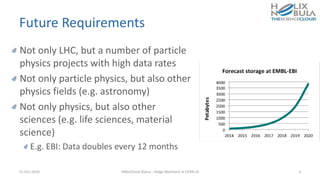
Future Requirements
Not only LHC, but a number of particle
physics projects with high data rates
Not only particle physics, but also other
physics fields (e.g. astronomy)
Not only physics, but also other
sciences (e.g. life sciences, material
science)
E.g. EBI: Data doubles every 12 months
21-Oct-2016 HNSciCloud Status - Helge Meinhard at CERN.ch 3
Scaling up: Public Clouds (1)
Additional resources, perhaps later replacing on-premise
capacity
Potential benefits:
Economy of scale
More elastic, adapts to changing demands
Somebody else worries about machines and infrastructure
21-Oct-2016 HNSciCloud Status - Helge Meinhard at CERN.ch 4
Scaling up Further: Public Clouds (2)
Potential issues:
Cloud provider’s business models not well adapted to procurement
rules and procedures of public organisations
Lack of skills for and experience with procurements
Market largely not targeting compute-heavy tasks
Performance metrics/benchmarks not established
Legal impediments
Not integrated with on-premise resources and/or publicly funded e-
infrastructures
21-Oct-2016 HNSciCloud Status - Helge Meinhard at CERN.ch 5
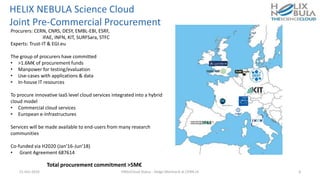
Procurers: CERN, CNRS, DESY, EMBL-EBI, ESRF,
IFAE, INFN, KIT, SURFSara, STFC
Experts: Trust-IT & EGI.eu
The group of procurers have committed
• >1.6M€ of procurement funds
• Manpower for testing/evaluation
• Use-cases with applications & data
• In-house IT resources
To procure innovative IaaS level cloud services integrated into a hybrid
cloud model
• Commercial cloud services
• European e-Infrastructures
Services will be made available to end-users from many research
communities
Co-funded via H2020 (Jan’16-Jun’18)
• Grant Agreement 687614
HELIX NEBULA Science Cloud
Joint Pre-Commercial Procurement
21-Oct-2016 HNSciCloud Status - Helge Meinhard at CERN.ch 6
Total procurement commitment >5M€
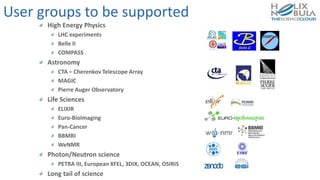
High Energy Physics
LHC experiments
Belle II
COMPASS
Astronomy
CTA – Cherenkov Telescope Array
MAGIC
Pierre Auger Observatory
Life Sciences
ELIXIR
Euro-BioImaging
Pan-Cancer
BBMRI
WeNMR
Photon/Neutron science
PETRA III, European XFEL, 3DIX, OCEAN, OSIRIS
Long tail of science
User groups to be supported
The HNSciCloud Project
Unlike “classical” EU projects, we are not the carrier of the
R&D activities
We “just” specify, audit and finally assess what has been
developed (and run) by commercial providers
Total volume is about 5.3 MEUR for the three phases
At least 50% to be spent on R&D in each phase
21-Oct-2016 HNSciCloud Status - Helge Meinhard at CERN.ch 8
Technical Challenges
Compute
Integration of some HPC requirements
Support for containers at massive scale
Data access
Caching at provider’s site, if possible automatically (avoid managed storage)
Transparent for application; POSIX subset
Network
Connection via GÉANT
Support of identity federation (eduGAIN) for IT managers
21-Oct-2016 HNSciCloud Status - Helge Meinhard at CERN.ch 8
Semi-Technical Challenges
Procurement
Match of cloud providers’ business model with public procurement rules
Different cultures
Between buyers’ communities
Between buyers and commercial providers
Nomenclature – common wording required
Communication – effective and efficient channels to be set up
Challenge is to make technology usable – at large scale, on- and off-
premises, independent of off-premise provider
21-Oct-2016 HNSciCloud Status - Helge Meinhard at CERN.ch 10
Storage and Data Access
Suppliers would like to leverage object stores
Best price point, best understood
Implicit assumption: Primary copy of (all) data stays on buyers’ premises
Reasons: legal, supplier lock-in, ... a lot of nervous feeling
No change of user application, POSIX-like access, auto-managed
POSIX like – open, close, read, write, seek suffices
Way back into buyers’ storage – writes
Namespace forwarding/connection – connect to buyers local system(s)
Speed of local (off-premise) data access
Direct remote (to buyer) access + pre fetching
Auto-managed – no end user involvement
21-Oct-2016 HNSciCloud Status - Helge Meinhard at CERN.ch 11
Container Support
Hybrid scale – scale out on-premise and off-premise
Separation of responsibilities and work – beside the well
known benefits
Scientist – standard/clear context for development & testing – no
need to start with the stuff you’ve installed on your laptop
Local admin – focus on local scale and shipping containers off-
premise, container definition for scientists, control scale-out to off-
premise resources
Off-premise admin – just scale as large as possible with lowest costs,
hidden to user/scientists
21-Oct-2016 HNSciCloud Status - Helge Meinhard at CERN.ch 12
Network, Identity Federation, HPCaaS
Connection of different worlds
GÉANT to cloud provider networks
Cloud provider X to cloud provider Y
Trans-ocean – i.e. LHCONE – not directly asked for
VPN usage and risks
Identity federation (eduGAIN, SAML 2.0)
Admins & end-user (scientist)
Not limited to WEB applications (CLI mode)
HPCaaS
Driven by photon science community – small and (few) large HPC jobs expected – some
are just multi-threaded, some using MPI
Little experience on buyers’ side – probably mirrored on supply side – steep learning curve
IPC network - probably the most limiting factor (10GE)
21-Oct-2016 HNSciCloud Status - Helge Meinhard at CERN.ch 13
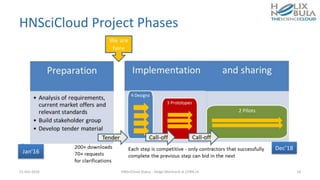
HNSciCloud Project Phases
21-Oct-2016 HNSciCloud Status - Helge Meinhard at CERN.ch 14
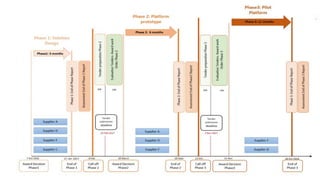
21-Oct-2016 HNSciCloud Status - Helge Meinhard at CERN.ch 15
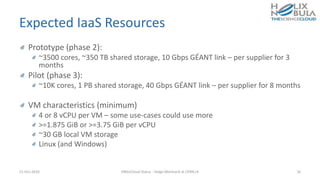
Expected IaaS Resources
Prototype (phase 2):
~3500 cores, ~350 TB shared storage, 10 Gbps GÉANT link – per supplier for 3
months
Pilot (phase 3):
~10K cores, 1 PB shared storage, 40 Gbps GÉANT link – per supplier for 8 months
VM characteristics (minimum)
4 or 8 vCPU per VM – some use-cases could use more
>=1.875 GiB or >=3.75 GiB per vCPU
~30 GB local VM storage
Linux (and Windows)
21-Oct-2016 HNSciCloud Status - Helge Meinhard at CERN.ch 16
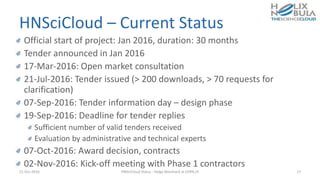
HNSciCloud – Current Status
Official start of project: Jan 2016, duration: 30 months
Tender announced in Jan 2016
17-Mar-2016: Open market consultation
21-Jul-2016: Tender issued (> 200 downloads, > 70 requests for
clarification)
07-Sep-2016: Tender information day – design phase
19-Sep-2016: Deadline for tender replies
Sufficient number of valid tenders received
Evaluation by administrative and technical experts
07-Oct-2016: Award decision, contracts
02-Nov-2016: Kick-off meeting with Phase 1 contractors
21-Oct-2016 HNSciCloud Status - Helge Meinhard at CERN.ch 17
Summary
Commercial cloud services are expected to play an increasing role in the computing models of
scientific Research Infrastructures as part of a hybrid cloud platform
Such a hybrid cloud platform has the potential to serve many high-profile research projects
Helix Nebula Science Cloud is a Pre-Commercial Procurement project with a budget of more than
5M€ that is co-funded by the European Commission
The objective is to produce a hybrid cloud platform for the European research community
Changes to the procurement process in the public research sector are necessary to benefit from a
dynamic Digital Single Market and should be supported by the platform
A hybrid cloud poses a number of technical challenges that are being addressed by Helix Nebula
Science Cloud
Helix Nebula Science Cloud is the first in a foreseen series of EC co-funded projects which will
contribute to the European Cloud Initiative
21-Oct-2016 HNSciCloud Status - Helge Meinhard at CERN.ch 18

Helix Nebula - The Science Cloud, Status Update

  • 1.
    Helix Nebula –The Science Cloud Status Update Helge Meinhard / CERN With contributions by Martin Gasthuber / DESY HEPiX Fall 2016 @LBNL – contribution # 34 Presentation at HEPiX Zeuthen: https://indico.cern.ch/event/466991/contributions/1143637/
  • 2.
    Scale of LHCData Tomorrow 21-Oct-2016 HNSciCloud Status - Helge Meinhard at CERN.ch 2 Ian Bird, WLCG workshop Oct 2016
  • 3.
    Scale of LHCData Tomorrow 21-Oct-2016 HNSciCloud Status - Helge Meinhard at CERN.ch 2 0 1000000 2000000 3000000 4000000 5000000 6000000 7000000 2016 2017-A 2017-S 2018 CPU Tier0 Tier1 Tier2 Estimated 20%/yr 0 100000 200000 300000 400000 500000 600000 2016 2017-A 2017-S 2018 Disk Tier0 Tier1 Tier2 Estimated 20% 0 100000 200000 300000 400000 500000 600000 700000 800000 900000 2016 2017-A 2017-S 2018 Tape Tier0 Tier1 20% Estimated: Estimates made in 2014 for Run 2 up to 2017 20%: Growth of 20%/yr starting in 2016 (“flat budget”) Short term: until end of Run 2 Ian Bird, WLCG workshop Oct 2016
  • 4.
    Scale of LHCData Tomorrow 21-Oct-2016 HNSciCloud Status - Helge Meinhard at CERN.ch 2 0 1000000 2000000 3000000 4000000 5000000 6000000 7000000 2016 2017-A 2017-S 2018 CPU Tier0 Tier1 Tier2 Estimated 20%/yr 0 100000 200000 300000 400000 500000 600000 2016 2017-A 2017-S 2018 Disk Tier0 Tier1 Tier2 Estimated 20% 0 100000 200000 300000 400000 500000 600000 700000 800000 900000 2016 2017-A 2017-S 2018 Tape Tier0 Tier1 20% Estimated: Estimates made in 2014 for Run 2 up to 2017 20%: Growth of 20%/yr starting in 2016 (“flat budget”) 0 50000 100000 150000 200000 250000 CPU (HS06) CPU Needs for 1st Year of HL-LHC (kHS06) ALICE ATLAS CMS LHCb 0 100 200 300 400 500 600 700 800 900 1000 Raw Derived Data estimates for 1st year of HL-LHC (PB) ALICE ATLAS CMS LHCb Short term: until end of Run 2 2026: HL-LHC Ian Bird, WLCG workshop Oct 2016
  • 5.
    Scale of LHCData Tomorrow 21-Oct-2016 HNSciCloud Status - Helge Meinhard at CERN.ch 2 0 1000000 2000000 3000000 4000000 5000000 6000000 7000000 2016 2017-A 2017-S 2018 CPU Tier0 Tier1 Tier2 Estimated 20%/yr 0 100000 200000 300000 400000 500000 600000 2016 2017-A 2017-S 2018 Disk Tier0 Tier1 Tier2 Estimated 20% 0 100000 200000 300000 400000 500000 600000 700000 800000 900000 2016 2017-A 2017-S 2018 Tape Tier0 Tier1 20% Estimated: Estimates made in 2014 for Run 2 up to 2017 20%: Growth of 20%/yr starting in 2016 (“flat budget”) 0 50000 100000 150000 200000 250000 CPU (HS06) CPU Needs for 1st Year of HL-LHC (kHS06) ALICE ATLAS CMS LHCb 0 100 200 300 400 500 600 700 800 900 1000 Raw Derived Data estimates for 1st year of HL-LHC (PB) ALICE ATLAS CMS LHCb Data: • Raw 2016: 50 PB  2027: 600 PB • Derived (1 copy): 2016: 80 PB  2027: 900 PB CPU: • x60 from 2016 Short term: until end of Run 2 2026: HL-LHC Ian Bird, WLCG workshop Oct 2016
  • 6.
    Future Requirements Not onlyLHC, but a number of particle physics projects with high data rates Not only particle physics, but also other physics fields (e.g. astronomy) Not only physics, but also other sciences (e.g. life sciences, material science) E.g. EBI: Data doubles every 12 months 21-Oct-2016 HNSciCloud Status - Helge Meinhard at CERN.ch 3
  • 7.
    Scaling up: PublicClouds (1) Additional resources, perhaps later replacing on-premise capacity Potential benefits: Economy of scale More elastic, adapts to changing demands Somebody else worries about machines and infrastructure 21-Oct-2016 HNSciCloud Status - Helge Meinhard at CERN.ch 4
  • 8.
    Scaling up Further:Public Clouds (2) Potential issues: Cloud provider’s business models not well adapted to procurement rules and procedures of public organisations Lack of skills for and experience with procurements Market largely not targeting compute-heavy tasks Performance metrics/benchmarks not established Legal impediments Not integrated with on-premise resources and/or publicly funded e- infrastructures 21-Oct-2016 HNSciCloud Status - Helge Meinhard at CERN.ch 5
  • 9.
    Procurers: CERN, CNRS,DESY, EMBL-EBI, ESRF, IFAE, INFN, KIT, SURFSara, STFC Experts: Trust-IT & EGI.eu The group of procurers have committed • >1.6M€ of procurement funds • Manpower for testing/evaluation • Use-cases with applications & data • In-house IT resources To procure innovative IaaS level cloud services integrated into a hybrid cloud model • Commercial cloud services • European e-Infrastructures Services will be made available to end-users from many research communities Co-funded via H2020 (Jan’16-Jun’18) • Grant Agreement 687614 HELIX NEBULA Science Cloud Joint Pre-Commercial Procurement 21-Oct-2016 HNSciCloud Status - Helge Meinhard at CERN.ch 6 Total procurement commitment >5M€
  • 10.
    High Energy Physics LHCexperiments Belle II COMPASS Astronomy CTA – Cherenkov Telescope Array MAGIC Pierre Auger Observatory Life Sciences ELIXIR Euro-BioImaging Pan-Cancer BBMRI WeNMR Photon/Neutron science PETRA III, European XFEL, 3DIX, OCEAN, OSIRIS Long tail of science User groups to be supported
  • 11.
    The HNSciCloud Project Unlike“classical” EU projects, we are not the carrier of the R&D activities We “just” specify, audit and finally assess what has been developed (and run) by commercial providers Total volume is about 5.3 MEUR for the three phases At least 50% to be spent on R&D in each phase 21-Oct-2016 HNSciCloud Status - Helge Meinhard at CERN.ch 8
  • 12.
    Technical Challenges Compute Integration ofsome HPC requirements Support for containers at massive scale Data access Caching at provider’s site, if possible automatically (avoid managed storage) Transparent for application; POSIX subset Network Connection via GÉANT Support of identity federation (eduGAIN) for IT managers 21-Oct-2016 HNSciCloud Status - Helge Meinhard at CERN.ch 8
  • 13.
    Semi-Technical Challenges Procurement Match ofcloud providers’ business model with public procurement rules Different cultures Between buyers’ communities Between buyers and commercial providers Nomenclature – common wording required Communication – effective and efficient channels to be set up Challenge is to make technology usable – at large scale, on- and off- premises, independent of off-premise provider 21-Oct-2016 HNSciCloud Status - Helge Meinhard at CERN.ch 10
  • 14.
    Storage and DataAccess Suppliers would like to leverage object stores Best price point, best understood Implicit assumption: Primary copy of (all) data stays on buyers’ premises Reasons: legal, supplier lock-in, ... a lot of nervous feeling No change of user application, POSIX-like access, auto-managed POSIX like – open, close, read, write, seek suffices Way back into buyers’ storage – writes Namespace forwarding/connection – connect to buyers local system(s) Speed of local (off-premise) data access Direct remote (to buyer) access + pre fetching Auto-managed – no end user involvement 21-Oct-2016 HNSciCloud Status - Helge Meinhard at CERN.ch 11
  • 15.
    Container Support Hybrid scale– scale out on-premise and off-premise Separation of responsibilities and work – beside the well known benefits Scientist – standard/clear context for development & testing – no need to start with the stuff you’ve installed on your laptop Local admin – focus on local scale and shipping containers off- premise, container definition for scientists, control scale-out to off- premise resources Off-premise admin – just scale as large as possible with lowest costs, hidden to user/scientists 21-Oct-2016 HNSciCloud Status - Helge Meinhard at CERN.ch 12
  • 16.
    Network, Identity Federation,HPCaaS Connection of different worlds GÉANT to cloud provider networks Cloud provider X to cloud provider Y Trans-ocean – i.e. LHCONE – not directly asked for VPN usage and risks Identity federation (eduGAIN, SAML 2.0) Admins & end-user (scientist) Not limited to WEB applications (CLI mode) HPCaaS Driven by photon science community – small and (few) large HPC jobs expected – some are just multi-threaded, some using MPI Little experience on buyers’ side – probably mirrored on supply side – steep learning curve IPC network - probably the most limiting factor (10GE) 21-Oct-2016 HNSciCloud Status - Helge Meinhard at CERN.ch 13
  • 17.
    HNSciCloud Project Phases 21-Oct-2016HNSciCloud Status - Helge Meinhard at CERN.ch 14
  • 18.
    21-Oct-2016 HNSciCloud Status- Helge Meinhard at CERN.ch 15
  • 19.
    Expected IaaS Resources Prototype(phase 2): ~3500 cores, ~350 TB shared storage, 10 Gbps GÉANT link – per supplier for 3 months Pilot (phase 3): ~10K cores, 1 PB shared storage, 40 Gbps GÉANT link – per supplier for 8 months VM characteristics (minimum) 4 or 8 vCPU per VM – some use-cases could use more >=1.875 GiB or >=3.75 GiB per vCPU ~30 GB local VM storage Linux (and Windows) 21-Oct-2016 HNSciCloud Status - Helge Meinhard at CERN.ch 16
  • 20.
    HNSciCloud – CurrentStatus Official start of project: Jan 2016, duration: 30 months Tender announced in Jan 2016 17-Mar-2016: Open market consultation 21-Jul-2016: Tender issued (> 200 downloads, > 70 requests for clarification) 07-Sep-2016: Tender information day – design phase 19-Sep-2016: Deadline for tender replies Sufficient number of valid tenders received Evaluation by administrative and technical experts 07-Oct-2016: Award decision, contracts 02-Nov-2016: Kick-off meeting with Phase 1 contractors 21-Oct-2016 HNSciCloud Status - Helge Meinhard at CERN.ch 17
  • 21.
    Summary Commercial cloud servicesare expected to play an increasing role in the computing models of scientific Research Infrastructures as part of a hybrid cloud platform Such a hybrid cloud platform has the potential to serve many high-profile research projects Helix Nebula Science Cloud is a Pre-Commercial Procurement project with a budget of more than 5M€ that is co-funded by the European Commission The objective is to produce a hybrid cloud platform for the European research community Changes to the procurement process in the public research sector are necessary to benefit from a dynamic Digital Single Market and should be supported by the platform A hybrid cloud poses a number of technical challenges that are being addressed by Helix Nebula Science Cloud Helix Nebula Science Cloud is the first in a foreseen series of EC co-funded projects which will contribute to the European Cloud Initiative 21-Oct-2016 HNSciCloud Status - Helge Meinhard at CERN.ch 18