Klee Wyck
Emily Carr
(1871-1945)
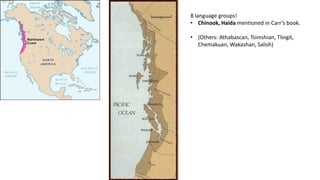
8 language groups!
• Chinook, Haida mentioned in Carr’s book.
• (Others: Athabascan, Tsimshian, Tlingit,
Chemakuan, Wakashan, Salish)
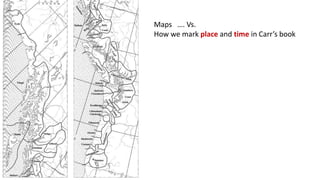
Maps …. Vs.
How we mark place and time in Carr’s book
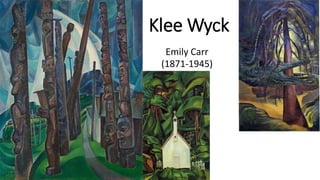
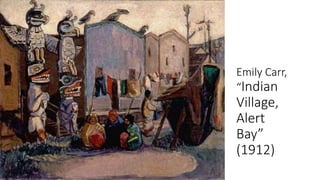
Emily Carr,
“Indian
Village,
Alert
Bay”
(1912)
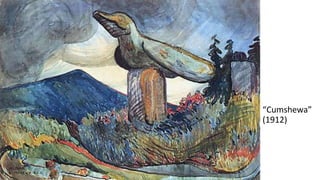
“Cumshewa”
(1912)
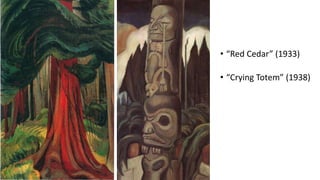
• “Red Cedar” (1933)
• “Crying Totem” (1938)
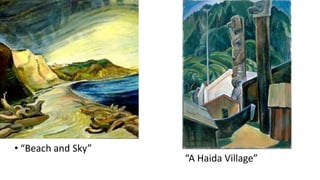
• “Beach and Sky”
“A Haida Village”
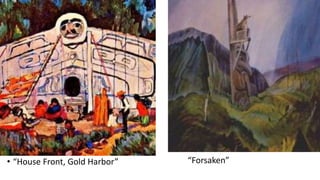
• “House Front, Gold Harbor” “Forsaken”
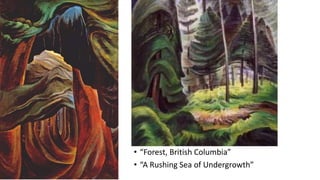
• “Forest, British Columbia”
• “A Rushing Sea of Undergrowth”
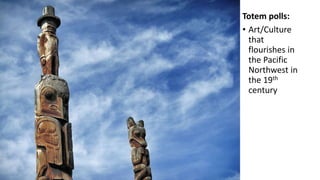
Totem polls:
• Art/Culture
that
flourishes in
the Pacific
Northwest in
the 19th
century
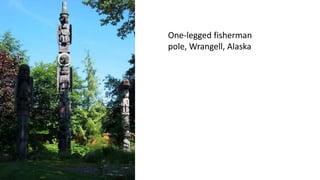
One-legged fisherman
pole, Wrangell, Alaska
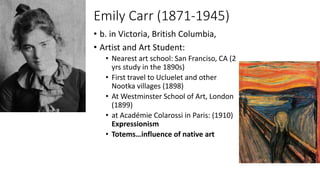
Emily Carr (1871-1945)
• b. in Victoria, British Columbia,
• Artist and Art Student:
• Nearest art school: San Franciso, CA (2
yrs study in the 1890s)
• First travel to Ucluelet and other
Nootka villages (1898)
• At Westminster School of Art, London
(1899)
• at Académie Colarossi in Paris: (1910)
Expressionism
• Totems…influence of native art
Emily Carr:
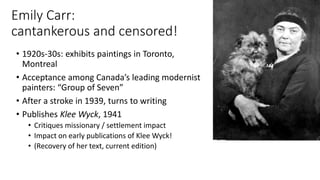
cantankerous and censored!
• 1920s-30s: exhibits paintings in Toronto,
Montreal
• Acceptance among Canada’s leading modernist
painters: “Group of Seven”
• After a stroke in 1939, turns to writing
• Publishes Klee Wyck, 1941
• Critiques missionary / settlement impact
• Impact on early publications of Klee Wyck!
• (Recovery of her text, current edition)

Klee Wyck

Editor's Notes

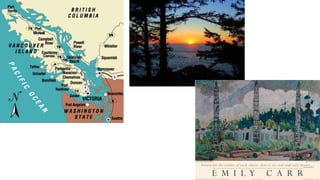
  • #3 Emily Carr poster: “Tanoo”
  • #14 one of 9 children Begins to pursue art seriously after the deaths of both parents (1891) Edvard Munch, The Scream (1893), canonical/ definitive of the Expressionist movement: Post impressionist. Impressionism attempts to catch an effect of a scene on its observers. Expressionism takes a scene and distorts it to convey strong emotion of the artist