HEART PACEMAKER
By:- Swapnil Patel
Presentation Topics
01
02
03
04
What is Heart pacemaker?
Historical timeline
Theory
Future Technologies
What is Heart pacemaker?
01
Heart Pacemaker
01
A pacemaker is a small, battery-operated device. This
device senses when your heart is beating irregularly or
too slowly. It sends a signal to your heart that makes
your heart beat at the correct pace.
Photo of pacemaker
Timeline of pacemaker
02
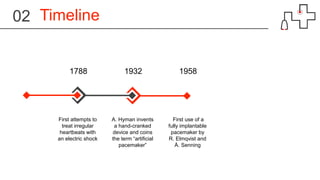
Timeline
1788
First attempts to
treat irregular
heartbeats with
an electric shock
02
Timeline
19321788
First attempts to
treat irregular
heartbeats with
an electric shock
A. Hyman invents
a hand-cranked
device and coins
the term “artificial
pacemaker”
02
Timeline
195819321788
First attempts to
treat irregular
heartbeats with
an electric shock
A. Hyman invents
a hand-cranked
device and coins
the term “artificial
pacemaker”
First use of a
fully implantable
pacemaker by
R. Elmqvist and
Å. Senning
02
Timeline
1982195819321788
First attempts to
treat irregular
heartbeats with
an electric shock
A. Hyman invents
a hand-cranked
device and coins
the term “artificial
pacemaker”
First use of a
fully implantable
pacemaker by
R. Elmqvist and
Å. Senning
A. Rickards
introduces
rate-modulated
pacemakers that
adapt the heart
rate to demand
02
Theory of Heart
pacemaker
03
Theory
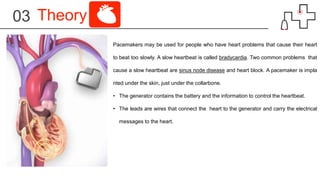
Pacemakers may be used for people who have heart problems that cause their heart
to beat too slowly. A slow heartbeat is called bradycardia. Two common problems that
cause a slow heartbeat are sinus node disease and heart block. A pacemaker is impla
nted under the skin, just under the collarbone.
• The generator contains the battery and the information to control the heartbeat.
• The leads are wires that connect the heart to the generator and carry the electrical
messages to the heart.
03
Theory
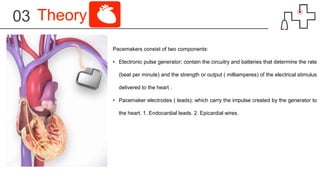
Pacemakers consist of two components:
• Electronic pulse generator; contain the circuitry and batteries that determine the rate
(beat per minute) and the strength or output ( milliamperes) of the electrical stimulus
delivered to the heart .
• Pacemaker electrodes ( leads); which carry the impulse created by the generator to
the heart. 1. Endocardial leads. 2. Epicardial wires.
03
Theory
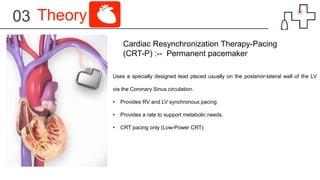
Uses a specially designed lead placed usually on the posterior-lateral wall of the LV
via the Coronary Sinus circulation.
• Provides RV and LV synchronous pacing.
• Provides a rate to support metabolic needs.
• CRT pacing only (Low-Power CRT)
03
Cardiac Resynchronization Therapy-Pacing
(CRT-P) :-- Permanent pacemaker
Working of device
Future of Heart
pacemaker
04
Future
• Tracking device data and patient health through wireless remote monitoring systems.
• Models that are magnetic resonance imaging (MRI)-safe.
• Longer battery life and technology to help reduce pacing requirements to conserve
battery power.
• New data recording functionality to provide more information on patient health and
device status.
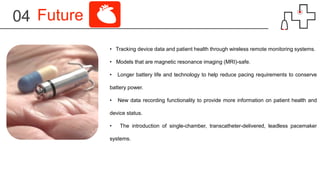
• The introduction of single-chamber, transcatheter-delivered, leadless pacemaker
systems.
04
References
• http://www.medtronic.com/us-en/about/news/micra-fda-
approval.html
• David Geselowitz, Dorin Panescu, Max Valentinuzzi, and Alex
Zapolansky of the STARS Editorial Board and the History Ce
nter staff of the IEEE History Center.
• https://medlineplus.gov/ency/article/007369.htm
Thank you

Heart Pacemaker

  • 1.
  • 2.
    Presentation Topics 01 02 03 04 What isHeart pacemaker? Historical timeline Theory Future Technologies
  • 3.
    What is Heartpacemaker? 01
  • 4.
    Heart Pacemaker 01 A pacemakeris a small, battery-operated device. This device senses when your heart is beating irregularly or too slowly. It sends a signal to your heart that makes your heart beat at the correct pace.
  • 5.
  • 6.
  • 7.
    Timeline 1788 First attempts to treatirregular heartbeats with an electric shock 02
  • 8.
    Timeline 19321788 First attempts to treatirregular heartbeats with an electric shock A. Hyman invents a hand-cranked device and coins the term “artificial pacemaker” 02
  • 9.
    Timeline 195819321788 First attempts to treatirregular heartbeats with an electric shock A. Hyman invents a hand-cranked device and coins the term “artificial pacemaker” First use of a fully implantable pacemaker by R. Elmqvist and Å. Senning 02
  • 10.
    Timeline 1982195819321788 First attempts to treatirregular heartbeats with an electric shock A. Hyman invents a hand-cranked device and coins the term “artificial pacemaker” First use of a fully implantable pacemaker by R. Elmqvist and Å. Senning A. Rickards introduces rate-modulated pacemakers that adapt the heart rate to demand 02
  • 11.
  • 12.
    Theory Pacemakers may beused for people who have heart problems that cause their heart to beat too slowly. A slow heartbeat is called bradycardia. Two common problems that cause a slow heartbeat are sinus node disease and heart block. A pacemaker is impla nted under the skin, just under the collarbone. • The generator contains the battery and the information to control the heartbeat. • The leads are wires that connect the heart to the generator and carry the electrical messages to the heart. 03
  • 13.
    Theory Pacemakers consist oftwo components: • Electronic pulse generator; contain the circuitry and batteries that determine the rate (beat per minute) and the strength or output ( milliamperes) of the electrical stimulus delivered to the heart . • Pacemaker electrodes ( leads); which carry the impulse created by the generator to the heart. 1. Endocardial leads. 2. Epicardial wires. 03
  • 14.
    Theory Uses a speciallydesigned lead placed usually on the posterior-lateral wall of the LV via the Coronary Sinus circulation. • Provides RV and LV synchronous pacing. • Provides a rate to support metabolic needs. • CRT pacing only (Low-Power CRT) 03 Cardiac Resynchronization Therapy-Pacing (CRT-P) :-- Permanent pacemaker
  • 15.
  • 16.
  • 17.
    Future • Tracking devicedata and patient health through wireless remote monitoring systems. • Models that are magnetic resonance imaging (MRI)-safe. • Longer battery life and technology to help reduce pacing requirements to conserve battery power. • New data recording functionality to provide more information on patient health and device status. • The introduction of single-chamber, transcatheter-delivered, leadless pacemaker systems. 04
  • 18.
    References • http://www.medtronic.com/us-en/about/news/micra-fda- approval.html • DavidGeselowitz, Dorin Panescu, Max Valentinuzzi, and Alex Zapolansky of the STARS Editorial Board and the History Ce nter staff of the IEEE History Center. • https://medlineplus.gov/ency/article/007369.htm
  • 19.