Design And Analysis Algorithm
Heap is a “complete” binary tree, usually
represented as an array.
Types:
 Min Heap (largest element at root)
A[parent(i)]≥A[i]
 Max Heap
A[parent(i)]≤A[i]
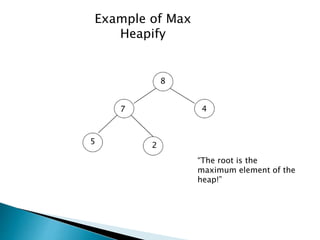
“The root is the
maximum element of the
heap!”
Example of Max
Heapify
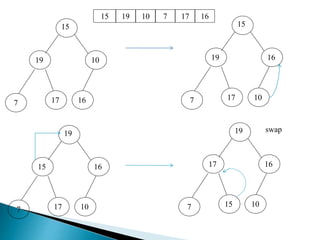
15
19 10
17 16
15
19 16
177 10
15 19 10 7 17 16
19
15 16
17 10
19
17
157 10
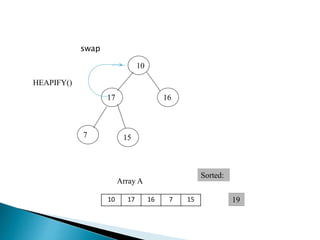
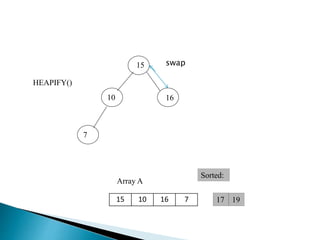
swap
16
7
7
17 16
157 10
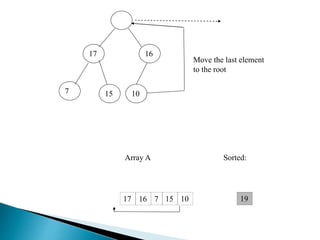
Move the last element
to the root
19
Sorted:Array A
17 16 7 15 10
17 16
157
10
19
Array A
Sorted:
swap
HEAPIFY()
10 17 16 7 15
10
157
16
19
Array A
Sorted:
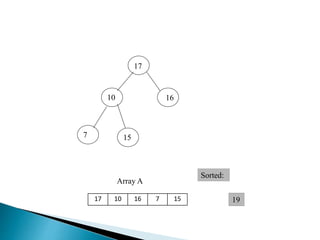
17
17 10 16 7 15
10
17
157
16
1917
Array A
Sorted:
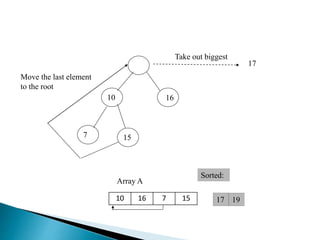
Take out biggest
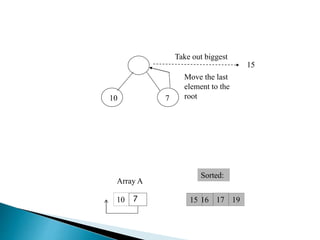
Move the last element
to the root
10 16 7 15
10
15
7
16
1917
Array A
Sorted:
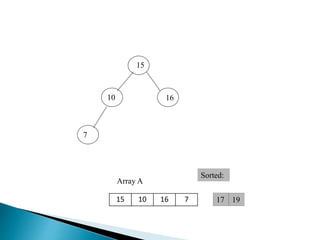
15 10 16 7
10
15
7
16
1917
Array A
Sorted:
HEAPIFY()
swap
15 10 16 7
16
10
7
15
1917
Array A
Sorted:
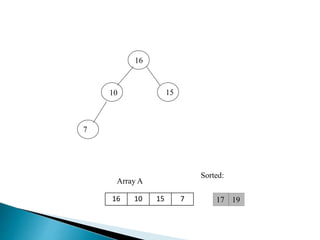
16 10 15 7
16
10
7
15
1916 17
Array A
Sorted:
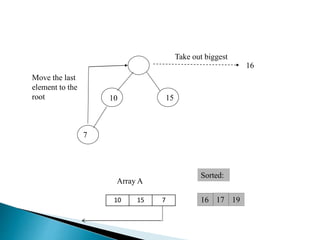
Take out biggest
Move the last
element to the
root
10 15 7
10
7
15
1916 17
Array A
Sorted:
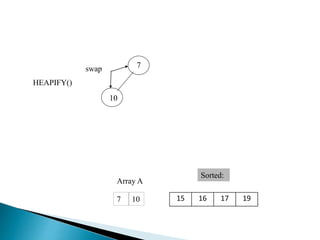
swap
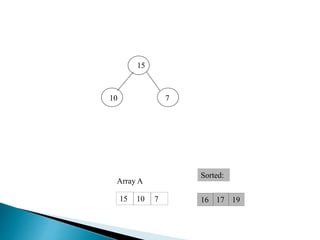
7 10 15
10 7
15
1916 17
Array A
Sorted:
71015
10 7
15
1916 1710 15
Array A
Sorted:
Move the last
element to the
root
Take out biggest
77
10
7
107
Array A
Sorted:
HEAPIFY()
swap
15 16 17 19
7
10
Array A
Sorted:
107 15 16 17 19
10
7
7
Array A
Sorted:
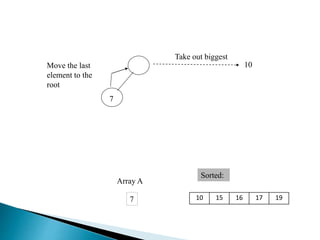
Move the last
element to the
root
Take out biggest
10 15 16 17 19
7
Array A Sorted:
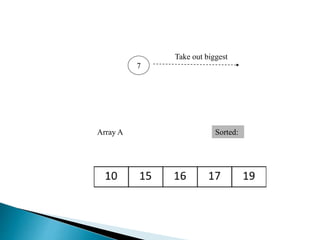
Take out biggest
 BUILD‐MAX‐HEAP(A)
 1. heap‐size[A] ← length[A]
 2. for i ← ⌊length[A]/2⌋ downto 1
 3. do MAX‐HEAPIFY(A,i)
 Heap sort has time complexity O(n log n). The reason is that the
height of a complete binary tree is log(n).
 To fully heapify an element whose sub trees are already max-heaps,
we need to keep comparing the element with its left and right
children and pushing it downwards until it reaches a point where
both its children are smaller than it.
 In worst case, we need to move an element from root to leaf node
making a multiple of log(n) comparisons and swaps. During the
build max heap stage, we do that for n/2 elements so the worst case
complexity of build heap step is n/2*log(n)~n log n.

Heap Sort