HEALTHY YOUNG ONES
Eleanor A. Estoque
SHS Guidance Coor
WHAT IS PUBERTY?
• The process of physical changes by which a child’s
body becomes an adult body capable of
reproduction
• The hormones cause the physical changes in the
body, they also affect emotions
POSITIVE CHALLENGES OF GROWING UP
Some examples might include… (MALE)
Good things about growing up Challenging things about growing up
Independence
Romantic Relationships
Peer Pressure
Pressure to take risks
Meet new friends
Increased responsibility
Freedom to express yourself
Discovering new talents
Pimples
Stage of confusion
Work/study stress
Discrimination
Pressure to earn income
POSITIVE CHALLENGES OF GROWING UP
Some examples might include… (FEMALE)
Good things about growing up Challenging things about growing
up
Independence
Romantic Relationships
Increased responsibility
Freedom to express yourself
Discovering new talents
Dysmenorrhea
Stressful experiences
Pimples
Work/study stress
Discrimination
Pressure to help with domestic duties
PARTS OF MALE REPRODUCTIVE
SYSTEM
1. SPERM DUCT
- during mating, sperm cells that have been released pass through the sperm
ducts.
2. TESTES
– held in place by the scrotum. Its job is to produce millions of male cells called
SPERMS
Scrotum – is a bag of tough skin.
3. PROSTATE GLAND
– the job is to secrete prostate fluid, one of the components of semen.
PARTS OF MALE REPRODUCTIVE
SYSTEM
4. URETHRA
- a tube inside the male organ that carries urine or semen. Continuing part of the
sperm duct
5. PENIS
- a “THING” hanging in front of every male which he pees with
- The size may differ for growing boys because they develop differently
- An erect one for an adult man may be about 5.7 inches in length
- Its job is to pass urine out of the man’s body and to pass semen into female
organ during mating
PARTS OF FEMALE REPRODUCTIVE
SYSTEM
1. OVIDUCT – the vessel through which an egg cell travels to the
uterus
1. OVARIES – where eggs are stored and release every month
2. UTERUS – an inverted pear, soft lining which holds the fertilized egg and
nurture it until it is a fully developed baby
3. CERVIX – ring of muscle located at the lower third portion of the uterus.
During birth, the cervix expands and the baby passes through it.
4. VAGINA – an elastic, muscular canal that connects the cervix to the outside of
the woman’s body.
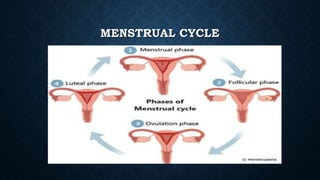
MENSTRUAL CYCLE
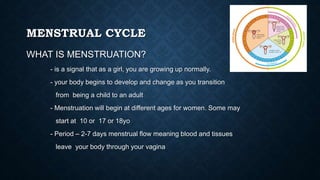
WHAT IS MENSTRUATION?
- is a signal that as a girl, you are growing up normally.
- your body begins to develop and change as you transition
from being a child to an adult
- Menstruation will begin at different ages for women. Some may
start at 10 or 17 or 18yo
- Period – 2-7 days menstrual flow meaning blood and tissues
leave your body through your vagina
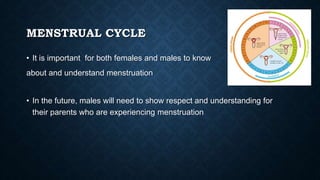
MENSTRUAL CYCLE
• It is important for both females and males to know
about and understand menstruation
• In the future, males will need to show respect and understanding for
their parents who are experiencing menstruation
MENSTRUAL CYCLE
PHASE I: MENSTRUAL PHASE
• Starts on 1st day of bleeding
• Bleeding comes from shedding of lining of uterus
• Indicates: NOT PREGNANT
• Usually 4-6 days
• Normal and healthy
• Bleeding does not mean the woman is sick.
PHASE II: PRE-OVULATORY PHASE
• Bleeding has stopped
• Egg cells begin to develop
• Lining of uterus starts to thicken
• Mucus plug  prevents entry of sperm
• Dry days, dry feeling, no mucus
• INFERTILE PHASE
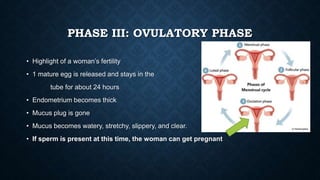
PHASE III: OVULATORY PHASE
• Highlight of a woman’s fertility
• 1 mature egg is released and stays in the
tube for about 24 hours
• Endometrium becomes thick
• Mucus plug is gone
• Mucus becomes watery, stretchy, slippery, and clear.
• If sperm is present at this time, the woman can get pregnant
PHASE IV: POST-OVULATORY PHASE
• No egg is present
• Mucus plug
• Dry feeling
• Absolute infertile phase
• Blood vessel rupture, escape of blood
Into the endometrial lining
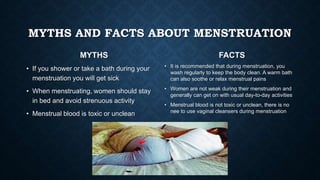
MYTHS AND FACTS ABOUT MENSTRUATION
MYTHS
• If you shower or take a bath during your
menstruation you will get sick
• When menstruating, women should stay
in bed and avoid strenuous activity
• Menstrual blood is toxic or unclean
FACTS
• It is recommended that during menstruation, you
wash regularly to keep the body clean. A warm bath
can also soothe or relax menstrual pains
• Women are not weak during their menstruation and
generally can get on with usual day-to-day activities
• Menstrual blood is not toxic or unclean, there is no
nee to use vaginal cleansers during menstruation
…MYTHS AND FACTS ABOUT
MENSTRUATION
MYTHS
• Eating certain foods will shorten or delay
the menstrual period
• It is not possible to get pregnant during
the menstrual period
FACTS
• Menstrual periods last longer for some
women than others. It is important to eat
well but no food will alter the duration of
the menstrual cycle
• It is possible to get pregnant if you have
sexual intercourse during menstruation
KEY MESSAGES
• One of the changes that women go through at
puberty is menstruation.
• When a woman starts to menstruate, it means
that her body is developing and is now able to
conceive a child
HYGIENE & PERSONAL CARE PRODUCTS
• There are some products that can be used to catch the blood as it leaves the uterus
• Most common are:
Sanitary pads – with wing or non-wings
- comes in many sizes – each girl will be
able to find one that is comfortable to her
GIRLS SHOULD REMEMBER TO CHANGE PADS
about every 4hours
HYGIENE & PERSONAL CARE
PRODUCTS
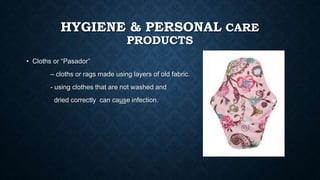
• Cloths or “Pasador”
– cloths or rags made using layers of old fabric.
- using clothes that are not washed and
dried correctly can cause infection.
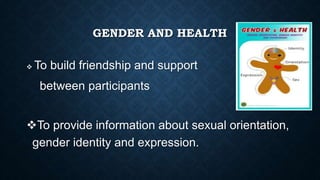
GENDER AND HEALTH
 To build friendship and support
between participants
To provide information about sexual orientation,
gender identity and expression.
REPRODUCTION AND RESPONSIBILITY
OBJECTIVES:
• To provide supportive relationships
between the participants
• To provide information about reproduction
• To build comfort and confidence in talking about sex
REPRODUCTION
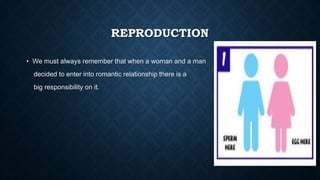
• We must always remember that when a woman and a man
decided to enter into romantic relationship there is a
big responsibility on it.
REPRODUCTION
2. Both of them must communicate more often if they are ready to start a family.
Communication is important in relationship.
REPRODUCTION
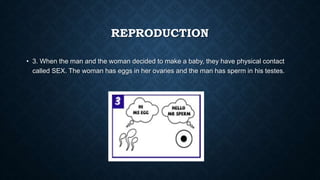
• 3. When the man and the woman decided to make a baby, they have physical contact
called SEX. The woman has eggs in her ovaries and the man has sperm in his testes.
REPRODUCTION
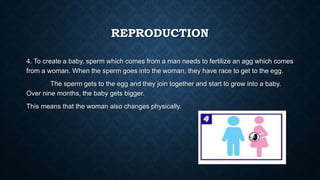
4. To create a baby, sperm which comes from a man needs to fertilize an agg which comes
from a woman. When the sperm goes into the woman, they have race to get to the egg.
The sperm gets to the egg and they join together and start to grow into a baby.
Over nine months, the baby gets bigger.
This means that the woman also changes physically.
REPRODUCTION
5. It is important that the couple will ensure that the mother and the baby are healthy.
Check-up for both of them together with the father is necessary at the rural health unit.
REPRODUCTION
6. Once the baby reaches the ninth month it is the time for delivery!
It is encouraged most especially when the mother is adolescent to deliver the
baby in the hospital.
Check-up and hospital delivery is crucial to ensure safe delivery of the baby and
the mother.
RESPONSIBILITY
a. Remind the group that if a couple has had sex without using contraception, it is
POSSIBLE that the woman will become pregnant.
b. Symptoms that pregnancy has taken place;
- Missed period
- Nausea
- Vomiting
- Sore breasts
- Increased urination and tiredness
RESPONSIBILITY
c. Pregnancy tests – can be bought from the pharmacy and carried out at
home. At the clinic, a blood or urine may be used for testing.
d. Sometimes women become pregnant without planning to. This may be
because she and her partner did not have the information on how babies
are made.
RESPONSIBILITY
IMPLICATIONS OF UNPLANNED PREGNANCY
o Having to tell family and friends
o Having to leave school early to have the baby
o Stigma from the community
o Having find out how to look after herself and her baby during pregnancy
o Health implications for mother younger than 20 years old
SEXUALLY
TRANSMITTED
INFECTION
SEXUALLY TRANSMITTED INFECTION
WHAT IS STI?
- are infections that are passed from person to
person through sexual intercourse, other forms of sexual
activity or during pregnancy and delivery
SEXUALLY TRANSMITTED INFECTION
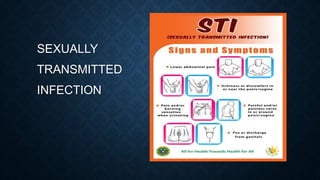
COMMON SIGNS AND SYMPTOMS
 Pus or unusual yellowish/greenish/greyish discharge from the penis,
vagina or anus
 Rash, sores, lumps or blisters
 Swelling on genital/anal area
SOME STIs HAVE NO SIGNS/SYMPTOMS ESP FOR WOMEN. SOME S/S
MAY DISAPPEAR EVEN W/OUT PROPER TX BUT CAN STILL BE PASSED
ON TO OTHERS AND CAN CONTINUE TO DAMAGE HEALTH
SEXUALLY TRANSMITTED INFECTION
MODE OF TRANSMISSION
STI are passed on through unprotected sex, skin to skin contact or
exchange of body fluids.
Some STI are caused by viruses and cannot be cured
STI can be passed from mother to child and cause serious illness or
birth defects
SEXUALLY TRANSMITTED INFECTION
Every sexual activity is an opportunity to get variety of STI.
CONDOMS do not cover everything!
A person who is sexually active should have regular sexual health check-
up
The most common STI are: GONORRHEA, SYPHILIS, CHLAMYDIA,
HERPES, GENITAL WARTS, HEPA B, CANDIDIASIS & HIV
SEXUALLY TRANSMITTED INFECTION
DIAGNOSIS & TREATMENT
 A doctor or nurse can check whether a person has an STI. STI can be treated with
appropriate medication.
A person with STI should also encourage his/her partner to submit for medical
assessment and treatment.
Having STI increases the risk of having HIV
STI cases is highly encouraged to undergo HIV test
Having both STI and HIV can complicate one’s treatment
SEXUALLY TRANSMITTED INFECTION
• Untreated or incompletely treated STI lead to long-term or
serious complication like infertility, cancer, adverse pregnancy
and complications to infants. STIs like HIV, syphilis, Hepa B
have no cure.
• DO NOT SELF MEDICATE.
WAYS NOT TO GET INFECTED WITH STI
A – Abstain from sex
B – Be mutually faithful
C – Correct and consistent use of condom
D – Don’t use drugs and alcohol
E – Education on STI and HIV
HUMAN IMMUNODEFICIENCY VIRUS
and
ACQUIRED IMMNUNE
DEFICIENCY SYNDROME
HUMAN IMMUNODEFICIENCY VIRUS AND ACQUIRED
IMMUNE DEFICIENCY SYNDROME
WHAT IS HUMAN IMMUNODEFICINECY VIRUS?
- is a virus that weakens the immune system.
- the window period of HIV is usually 2 – 3 weeks
after the last potential HIV exposure.
- HIV infection causes Acquired Immunodeficiency
Syndrome
HUMAN IMMUNODEFICIENCY VIRUS AND ACQUIRED
IMMUNE DEFICIENCY SYNDROME
WHAT IS ACQUIRED IMMUNE DEFICINCY SYNDROME?
- is a condition of a person with HIV when immune
system is already weak or destroyed and the body can
no longer fight off common opportunistic infections like
Tuberculosis or pneumonia.
A person with HIV do not necessarily have AIDS.
HUMAN IMMUNODEFICIENCY VIRUS AND ACQUIRED
IMMUNE DEFICIENCY SYNDROME
MODE OF HIV TRANSMISSION
BLOOD
SEMEN HIGH CONCENTRATION OF HIV
VAGINAL FLUIDS
BREAST MILK
HUMAN IMMUNODEFICIENCY VIRUS AND ACQUIRED
IMMUNE DEFICIENCY SYNDROME
HIV is transmitted through:
• Unprotected penetrative anal, vaginal – to a lesser extent oral
sex
• Sharing of contaminated needles
• An infected mother to her baby during pregnancy, labor
delivery or breastfeeding
HUMAN IMMUNODEFICIENCY VIRUS AND ACQUIRED
IMMUNE DEFICIENCY SYNDROME
MISCONCEPTIONS on the TRANSMISSION of HIV
• Sneezing
• Contact with saliva
• Shaking hands
• Hugging and Kissing
• Sharing of food utensils
• Swimming in the pool
• Using the same telephone
HUMAN IMMUNODEFICIENCY VIRUS AND ACQUIRED
IMMUNE DEFICIENCY SYNDROME
HIV transmission/exposure can be through:
1. Blood and blood products
2. Sexual transmission
3. During pregnancy
4. During labor day
5. During breastfeeding
6. HIV testing
HUMAN IMMUNODEFICIENCY VIRUS AND ACQUIRED
IMMUNE DEFICIENCY SYNDROME
TREATMENT
 There is no cure nor vaccine for HIV
 People with HIV are given a combination of drugs
called – antiretroviral (ART)
 Aims to welcome adolescent to go to their
nearest health center and provide them
with RIGHT information on Adolescent
Sexual and Reproductive Health…
REMINDER
EVERYTHING WILL BE BETTER, IF WE WILL WORK
TOGETHER!
THANK YOU!
GOD BLESS AHDP!

Healthy Young Ones

  • 1.
    HEALTHY YOUNG ONES EleanorA. Estoque SHS Guidance Coor
  • 4.
    WHAT IS PUBERTY? •The process of physical changes by which a child’s body becomes an adult body capable of reproduction • The hormones cause the physical changes in the body, they also affect emotions
  • 6.
  • 7.
    POSITIVE CHALLENGES OFGROWING UP Some examples might include… (MALE) Good things about growing up Challenging things about growing up Independence Romantic Relationships Peer Pressure Pressure to take risks Meet new friends Increased responsibility Freedom to express yourself Discovering new talents Pimples Stage of confusion Work/study stress Discrimination Pressure to earn income
  • 8.
    POSITIVE CHALLENGES OFGROWING UP Some examples might include… (FEMALE) Good things about growing up Challenging things about growing up Independence Romantic Relationships Increased responsibility Freedom to express yourself Discovering new talents Dysmenorrhea Stressful experiences Pimples Work/study stress Discrimination Pressure to help with domestic duties
  • 10.
    PARTS OF MALEREPRODUCTIVE SYSTEM 1. SPERM DUCT - during mating, sperm cells that have been released pass through the sperm ducts. 2. TESTES – held in place by the scrotum. Its job is to produce millions of male cells called SPERMS Scrotum – is a bag of tough skin. 3. PROSTATE GLAND – the job is to secrete prostate fluid, one of the components of semen.
  • 11.
    PARTS OF MALEREPRODUCTIVE SYSTEM 4. URETHRA - a tube inside the male organ that carries urine or semen. Continuing part of the sperm duct 5. PENIS - a “THING” hanging in front of every male which he pees with - The size may differ for growing boys because they develop differently - An erect one for an adult man may be about 5.7 inches in length - Its job is to pass urine out of the man’s body and to pass semen into female organ during mating
  • 12.
    PARTS OF FEMALEREPRODUCTIVE SYSTEM 1. OVIDUCT – the vessel through which an egg cell travels to the uterus 1. OVARIES – where eggs are stored and release every month 2. UTERUS – an inverted pear, soft lining which holds the fertilized egg and nurture it until it is a fully developed baby 3. CERVIX – ring of muscle located at the lower third portion of the uterus. During birth, the cervix expands and the baby passes through it. 4. VAGINA – an elastic, muscular canal that connects the cervix to the outside of the woman’s body.
  • 13.
    MENSTRUAL CYCLE WHAT ISMENSTRUATION? - is a signal that as a girl, you are growing up normally. - your body begins to develop and change as you transition from being a child to an adult - Menstruation will begin at different ages for women. Some may start at 10 or 17 or 18yo - Period – 2-7 days menstrual flow meaning blood and tissues leave your body through your vagina
  • 14.
    MENSTRUAL CYCLE • Itis important for both females and males to know about and understand menstruation • In the future, males will need to show respect and understanding for their parents who are experiencing menstruation
  • 15.
  • 16.
    PHASE I: MENSTRUALPHASE • Starts on 1st day of bleeding • Bleeding comes from shedding of lining of uterus • Indicates: NOT PREGNANT • Usually 4-6 days • Normal and healthy • Bleeding does not mean the woman is sick.
  • 17.
    PHASE II: PRE-OVULATORYPHASE • Bleeding has stopped • Egg cells begin to develop • Lining of uterus starts to thicken • Mucus plug  prevents entry of sperm • Dry days, dry feeling, no mucus • INFERTILE PHASE
  • 18.
    PHASE III: OVULATORYPHASE • Highlight of a woman’s fertility • 1 mature egg is released and stays in the tube for about 24 hours • Endometrium becomes thick • Mucus plug is gone • Mucus becomes watery, stretchy, slippery, and clear. • If sperm is present at this time, the woman can get pregnant
  • 19.
    PHASE IV: POST-OVULATORYPHASE • No egg is present • Mucus plug • Dry feeling • Absolute infertile phase • Blood vessel rupture, escape of blood Into the endometrial lining
  • 20.
    MYTHS AND FACTSABOUT MENSTRUATION MYTHS • If you shower or take a bath during your menstruation you will get sick • When menstruating, women should stay in bed and avoid strenuous activity • Menstrual blood is toxic or unclean FACTS • It is recommended that during menstruation, you wash regularly to keep the body clean. A warm bath can also soothe or relax menstrual pains • Women are not weak during their menstruation and generally can get on with usual day-to-day activities • Menstrual blood is not toxic or unclean, there is no nee to use vaginal cleansers during menstruation
  • 21.
    …MYTHS AND FACTSABOUT MENSTRUATION MYTHS • Eating certain foods will shorten or delay the menstrual period • It is not possible to get pregnant during the menstrual period FACTS • Menstrual periods last longer for some women than others. It is important to eat well but no food will alter the duration of the menstrual cycle • It is possible to get pregnant if you have sexual intercourse during menstruation
  • 22.
    KEY MESSAGES • Oneof the changes that women go through at puberty is menstruation. • When a woman starts to menstruate, it means that her body is developing and is now able to conceive a child
  • 23.
    HYGIENE & PERSONALCARE PRODUCTS • There are some products that can be used to catch the blood as it leaves the uterus • Most common are: Sanitary pads – with wing or non-wings - comes in many sizes – each girl will be able to find one that is comfortable to her GIRLS SHOULD REMEMBER TO CHANGE PADS about every 4hours
  • 24.
    HYGIENE & PERSONALCARE PRODUCTS • Cloths or “Pasador” – cloths or rags made using layers of old fabric. - using clothes that are not washed and dried correctly can cause infection.
  • 25.
    GENDER AND HEALTH To build friendship and support between participants To provide information about sexual orientation, gender identity and expression.
  • 26.
    REPRODUCTION AND RESPONSIBILITY OBJECTIVES: •To provide supportive relationships between the participants • To provide information about reproduction • To build comfort and confidence in talking about sex
  • 27.
    REPRODUCTION • We mustalways remember that when a woman and a man decided to enter into romantic relationship there is a big responsibility on it.
  • 28.
    REPRODUCTION 2. Both ofthem must communicate more often if they are ready to start a family. Communication is important in relationship.
  • 29.
    REPRODUCTION • 3. Whenthe man and the woman decided to make a baby, they have physical contact called SEX. The woman has eggs in her ovaries and the man has sperm in his testes.
  • 30.
    REPRODUCTION 4. To createa baby, sperm which comes from a man needs to fertilize an agg which comes from a woman. When the sperm goes into the woman, they have race to get to the egg. The sperm gets to the egg and they join together and start to grow into a baby. Over nine months, the baby gets bigger. This means that the woman also changes physically.
  • 31.
    REPRODUCTION 5. It isimportant that the couple will ensure that the mother and the baby are healthy. Check-up for both of them together with the father is necessary at the rural health unit.
  • 32.
    REPRODUCTION 6. Once thebaby reaches the ninth month it is the time for delivery! It is encouraged most especially when the mother is adolescent to deliver the baby in the hospital. Check-up and hospital delivery is crucial to ensure safe delivery of the baby and the mother.
  • 33.
    RESPONSIBILITY a. Remind thegroup that if a couple has had sex without using contraception, it is POSSIBLE that the woman will become pregnant. b. Symptoms that pregnancy has taken place; - Missed period - Nausea - Vomiting - Sore breasts - Increased urination and tiredness
  • 34.
    RESPONSIBILITY c. Pregnancy tests– can be bought from the pharmacy and carried out at home. At the clinic, a blood or urine may be used for testing. d. Sometimes women become pregnant without planning to. This may be because she and her partner did not have the information on how babies are made.
  • 35.
    RESPONSIBILITY IMPLICATIONS OF UNPLANNEDPREGNANCY o Having to tell family and friends o Having to leave school early to have the baby o Stigma from the community o Having find out how to look after herself and her baby during pregnancy o Health implications for mother younger than 20 years old
  • 36.
  • 37.
    SEXUALLY TRANSMITTED INFECTION WHATIS STI? - are infections that are passed from person to person through sexual intercourse, other forms of sexual activity or during pregnancy and delivery
  • 38.
    SEXUALLY TRANSMITTED INFECTION COMMONSIGNS AND SYMPTOMS  Pus or unusual yellowish/greenish/greyish discharge from the penis, vagina or anus  Rash, sores, lumps or blisters  Swelling on genital/anal area SOME STIs HAVE NO SIGNS/SYMPTOMS ESP FOR WOMEN. SOME S/S MAY DISAPPEAR EVEN W/OUT PROPER TX BUT CAN STILL BE PASSED ON TO OTHERS AND CAN CONTINUE TO DAMAGE HEALTH
  • 39.
    SEXUALLY TRANSMITTED INFECTION MODEOF TRANSMISSION STI are passed on through unprotected sex, skin to skin contact or exchange of body fluids. Some STI are caused by viruses and cannot be cured STI can be passed from mother to child and cause serious illness or birth defects
  • 40.
    SEXUALLY TRANSMITTED INFECTION Everysexual activity is an opportunity to get variety of STI. CONDOMS do not cover everything! A person who is sexually active should have regular sexual health check- up The most common STI are: GONORRHEA, SYPHILIS, CHLAMYDIA, HERPES, GENITAL WARTS, HEPA B, CANDIDIASIS & HIV
  • 41.
    SEXUALLY TRANSMITTED INFECTION DIAGNOSIS& TREATMENT  A doctor or nurse can check whether a person has an STI. STI can be treated with appropriate medication. A person with STI should also encourage his/her partner to submit for medical assessment and treatment. Having STI increases the risk of having HIV STI cases is highly encouraged to undergo HIV test Having both STI and HIV can complicate one’s treatment
  • 42.
    SEXUALLY TRANSMITTED INFECTION •Untreated or incompletely treated STI lead to long-term or serious complication like infertility, cancer, adverse pregnancy and complications to infants. STIs like HIV, syphilis, Hepa B have no cure. • DO NOT SELF MEDICATE.
  • 43.
    WAYS NOT TOGET INFECTED WITH STI A – Abstain from sex B – Be mutually faithful C – Correct and consistent use of condom D – Don’t use drugs and alcohol E – Education on STI and HIV
  • 44.
    HUMAN IMMUNODEFICIENCY VIRUS and ACQUIREDIMMNUNE DEFICIENCY SYNDROME
  • 45.
    HUMAN IMMUNODEFICIENCY VIRUSAND ACQUIRED IMMUNE DEFICIENCY SYNDROME WHAT IS HUMAN IMMUNODEFICINECY VIRUS? - is a virus that weakens the immune system. - the window period of HIV is usually 2 – 3 weeks after the last potential HIV exposure. - HIV infection causes Acquired Immunodeficiency Syndrome
  • 46.
    HUMAN IMMUNODEFICIENCY VIRUSAND ACQUIRED IMMUNE DEFICIENCY SYNDROME WHAT IS ACQUIRED IMMUNE DEFICINCY SYNDROME? - is a condition of a person with HIV when immune system is already weak or destroyed and the body can no longer fight off common opportunistic infections like Tuberculosis or pneumonia. A person with HIV do not necessarily have AIDS.
  • 47.
    HUMAN IMMUNODEFICIENCY VIRUSAND ACQUIRED IMMUNE DEFICIENCY SYNDROME MODE OF HIV TRANSMISSION BLOOD SEMEN HIGH CONCENTRATION OF HIV VAGINAL FLUIDS BREAST MILK
  • 48.
    HUMAN IMMUNODEFICIENCY VIRUSAND ACQUIRED IMMUNE DEFICIENCY SYNDROME HIV is transmitted through: • Unprotected penetrative anal, vaginal – to a lesser extent oral sex • Sharing of contaminated needles • An infected mother to her baby during pregnancy, labor delivery or breastfeeding
  • 49.
    HUMAN IMMUNODEFICIENCY VIRUSAND ACQUIRED IMMUNE DEFICIENCY SYNDROME MISCONCEPTIONS on the TRANSMISSION of HIV • Sneezing • Contact with saliva • Shaking hands • Hugging and Kissing • Sharing of food utensils • Swimming in the pool • Using the same telephone
  • 50.
    HUMAN IMMUNODEFICIENCY VIRUSAND ACQUIRED IMMUNE DEFICIENCY SYNDROME HIV transmission/exposure can be through: 1. Blood and blood products 2. Sexual transmission 3. During pregnancy 4. During labor day 5. During breastfeeding 6. HIV testing
  • 51.
    HUMAN IMMUNODEFICIENCY VIRUSAND ACQUIRED IMMUNE DEFICIENCY SYNDROME TREATMENT  There is no cure nor vaccine for HIV  People with HIV are given a combination of drugs called – antiretroviral (ART)
  • 52.
     Aims towelcome adolescent to go to their nearest health center and provide them with RIGHT information on Adolescent Sexual and Reproductive Health…
  • 53.
  • 54.
    EVERYTHING WILL BEBETTER, IF WE WILL WORK TOGETHER! THANK YOU! GOD BLESS AHDP!

Editor's Notes

  • #6 This flip-tarp & user guide offers a wealth of ASRH information to pave the way for desirable behavioral changes and development of critical life skills among adolescents towards the improvement of their health and well-being.
  • #21 Menstruation is a sign of normal growth and development . In other words, you’re healthy and you’re growing up just the way you should.
  • #34 It is important to be non-judgmental about the person’s sexuality. Make sure to deliver correct information rather that share opinions.