Holistic approach for
disease free life
1
INDEX
2
Chapter
No. Description
1 INTRODUCTION
2 Summary of Health Sutras/Tips
3
Method of Cooking, How to take water, when to take water,
food etc.
4 Understanding Children, Art of parenting, Nutrition for children
5 Cow dung Ash
6 Ayurveda
7 VATA & Its Nature
8 PITTA & its nature
9 KAPHA & its nature
10
Types of persons and Three Doshas – How to select right person for
different types of jobs/works
(VATA, KAPHA,PITTA)
11 Personal Hygiene
12 Nutrition
13 Adulteration Of Food
14 Diseases & Comprehensive treatment – Chronic Diseases
15 Diseases & Comprehensive treatment – Seasonal Diseases
16 Diseases & Comprehensive treatment – Minor diseases
Holistic Approach for Disease free life
(Chapter 1)
INTRODUCTION
a) Do you want to know why High B.P. / Diabetes / Gas
trouble / Arthritis / T.B. etc. have increased of late?
b) Do you want to know why incidences like Cancer,
Heart ailments, Kidney problems, Liver problems
etc. have increased manifold after 2000?
c) Do you want to live a quality and disease free life?
To know answers to above, please listen to “Arogya
Rahasya” / DVD by Shri Rajiv Dixit based on “Sutras”
of Maharshi VAGBHATA, a disciple of CHARAK a great
ancient Indian Surgeon.
3
1
a) India was ruled by English people for about 300 years and
during the 300 years, British cleverly introduced an education
system which thought = Whatever west "does" is modern and
civilized and hence to be followed by Indians. This type of
'Slave' mind was created by the education system of British.
b) Indians who have gone abroad have started adopting the
practices of West in Food, cooking, eating, dance, singing,
clothes etc. Seeing the rich western returned Indians, rest of
Indians started blindly copying them thinking that it is a mark of
Modernity/Civilization. Even hotels and movies started blindly
copying western practices further accelerating the adoption of
wrong practices of west by majority of Indians leading to a “
Health Catastrophe” shortly. We can copy good practices of
west like Honesty, cleanliness, liberal donation to society, hard
work ,pride in one’s language and culture etc.
4
1.0 INTRODUCTION
2
c) One important point/difference is lost sight of by Indian
who have adopted the Western culture i.e., the food habits,
culture of music, singing, clothes etc., of West is evolved
and designed to suit their cold climate atmosphere. India
being a hot climate, those practices of West will not suit
Indians and are the main causes for spurt in increase of
"Diseases" in the country.
d) The culture of India in food, clothes, ornaments, music,
dance etc., is evolved to suit her climate and is highly
scientific and has health benefits in all the customs followed
by Indians including festivals. Ex. Wearing of Bangles by
Women - has an effect of "acupuncture" of touching the
nerves and hence improving health of women. Similarly ear
rings and other jewelry worn by women has an effect on
health of women.
5
1.0 INTRODUCTION
2
e)Women who have stopped Indian way of living and
started western ways, are started having chronic
diseases like diabetes, cancer, BP etc., by the age of50 -
60. Similarly the cooking utensils and the items used in
kitchen and toilets are having a bad effect on health.
6
1.0 INTRODUCTION
2
Similarly, the lifestyle adopted from USA/Europe like
light Breakfast in the morning is suited only for cold
climate and not to hot climate Country like India.
a) Due to blindly following appliances / lifestyle of
USA/Europe, diseases increased manifold especially
after 2000.
b) Diseases which are rare like Cancer, heart attack
have become common in India now.
c) 85% present day of diseases can be treated by self
by following health principles suited to Indian
climate.
d) Only 15% diseases need specialists. By following the
health principles, even the chronic diseases can be
prevented. 7
1.0 INTRODUCTION
3
4
a) USA / Europe – only Onion, Potato & Wheat
grown mainly.
b) India – Variety of vegetables, fruits & food
items is high and conducive to nutritional
requirements (Vitamin, minerals) of body than
Western food.
While Westerners are shifting to Indian foods,
Indians like fools are trying to eat Western
foods like PIZZAS, BURGERS as a false prestige
and inviting deliberately chronic diseases like
Obesity, Cancer, Diabetes, B.P., Kidney
problems etc. 8
1.0 INTRODUCTION
5
6
While we do not have control over pollution like
use of pesticides for food production, air & water
pollution etc., We have full control over what
type of appliances to be used for cooking, eating
etc., & have full control of what to eat & when,
how to eat etc.
a) About 3000 years back disciple of Ancient
surgeon Charak, Maharshi Vagbhata has laid
down scientific principles of how to cook, how
to eat, what to eat & when etc.
b) Vagbhata has written the SUTRAS after
physically experimentation including on himself
and after deep meditation only and hence the
SUTRAS are 100% applicable to India. 9
1.0 INTRODUCTION
7
8
c) Vagbhata lived for 135 years.
d) Unfortunately, this important health science
which has a great bearing on health of Indians
and hence on the intelligence and productivity, is
not made part of our curriculum in schools &
colleges.
e) The health policy of government need to be
reoriented keeping the principles given by
Maharshi VAGBHATA
f) School text books should contain these practical
health principles along with theories on human
body and plant and animal kingdom.
10
1.0 INTRODUCTION
8
a) Allopathy cures only symptom and not cause of
disease.
Example:
b) Lips breakage in due to excess Vatam
• Applying vaseline alone will not cure the problem.
• But controlling vata by applying oil massage will
control the disease.
c) If you are suffering from kidney problem which is
due to excess Pitta. If excess Pitta is not controlled
in the body and only kidneys are treated, the
disease then attacks next weak part in the body say
liver etc. 11
1.0 INTRODUCTION
9
a) With increased diseases, people are now at a
loss and are groping for solutions.
b) In these times of crisis, solutions given by
Vagbhata are a God gift and need to be spread
to relations, friends and one and all.
c) The tips given in the booklet help more in
prevention of onset of diseases than curing
diseases.
d) In case you are suffering from any diseases do
take allopathic medicine treatment along with
following principles given in the booklet. 12
1.0 INTRODUCTION
10
a) The CD/DVD is of 685 MB and lasts 8 hours.
b) Shri Rajiv Dixit after lot of research & discussion with
modern day Allopathic, Ayurveda doctors have selected key
“Sutras” of Vagbhata and explains with scientific reason
about various aspects of cooking, eating etc.
c) As many do not have time to spare 8 hours, I have prepared
the ‘Actionable’ points given by Maharshi Vagbhata. To
make the healthy tips complete, I have taken important tips
from other authors as given in “References”. I express my
sincere gratitude and thanks to shri Solan Gupta, Chief
Electrical Engineer, S.C.Railway whose advise made me to
write this paper.
d) I also express my gratitude to Ramakrishna Math,
Hyderabad whose spiritual retreats and lectures of
president swami Jnanadananda and swami
Bodhamayananda and other swamis of RK Math and also
lecturers of parents motivation course. I also express my
sincere gratitude to all the authors given in references.
13
1.0 INTRODUCTION
11
d) Those who desire to know the detailed logic /
reason, may kindly listen to the DVD OR VISIT
WEBSITE
For Telugu: www.mediafire.com/folder/coj25vz362qp6
For Hindi : www.mediafire.com/folder/imkxfy8frqhex
Or read books given under Reference
Power point presentation is also shared on
slideshare.net under the heading “Health&medicine”
Every effort is made to avoid errors / mistakes in
preparing this book. I will be glad and grateful for
bringing out any mistakes or offering suggestions to
make the book more useful.
For any clarification, contact :
Ch.S.Reddy, IRSEE(NF/SAG), Dy.CEE/Loco/HQ S.C.Railway.
Email:csreddychilukuri@gmail.com
14
1.0 INTRODUCTION
11
12
13
14
Chapter 2
2.0 Summary of Health Tips
 Avoid at once food items which reduce immunity of system
like – Strong Tea, Coffee, Refined and processed foods, cool
drinks, maida products, pickles, sauces, noodles, fried foods,
white sugar, condiments, ice-creams, meat, alcohol drinks,
smoking.
 India – Hot Climate – Cold climate Habits of West do not suit
us and are the main reason for SPURT in diseases.
• Vatam is more – 80% diseases due to Vata Dosha
• In daily routine take care that “Vata” does not increase
• Do not Run – It will increase ‘Vata’ - walking is O.K.
• USA/Canada – Cold – Kapam is more
 IDEAL COOKING – When Air & Sun Rays touch the food
being cooked.
 Avoid using cooker, micro-wave oven – Only 13% nutrients
useful if we cook in them. 15
2.0 Summary of Health Tips
 Minimize use of Refrigerator – Keep items from fridge
in open air for 48 minutes before using them. Switch
over to natural fridges
 Do not use Aluminium Vessels – Use Earthen, Brass &
Bronze vessels
 Drink Water like Tea i.e. Sip by Sip.
 Morning on waking up – Saliva in mouth to be
swallowed with water – Great medicine – Do not spit
saliva of mouth on waking up.
 Do not eat food or drink water in standing posture.
 Water in copper vessels is good for health in winter –
Do not keep feet on ground while taking water from
copper vessel/jug. Other seasons – use silver Jugs.
16
2.0 Summary of Health Tips
Do not take water immediately after :
• Urination
• Stools
• Bath
Do not take cold water after walking in SUN &
under shelter. But while in Sun it is ok.
Do not give cold / normal water to a person after
accident.
Water intake = Weight / 10 – 2
Do not take water after food – At least 40
minutes gap is must.
17
2.0 Summary of Health Tips
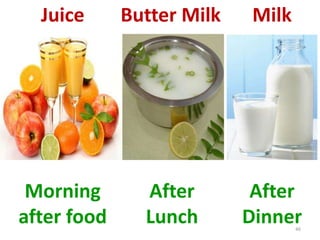
If you feel thirsty after taking food – Take
• Fruit Juice – In the Morning
• Butter Milk – In the Afternoon
• Milk – At Night
Do not drink Cold water especially from fridge
bottles- Ideal – Lukewarm – Body Temperature is
370C
Use Rock Salt instead of Sea Salt. Use Jaggery
(Black) instead of white jiggery.
Use pure (Ganuga) Oil, instead of Refined Oil.
Consume / Eat food within 48 minutes of
cooking. 18
2.0 Summary of Health Tips
 Food eaten after 12 hours of cooking contains no
nutrients and hence useless and unfit even for
Animals.
 Wheat Flour has maximum life of 15 days.
 Maize / Chana etc. – Maximum life ‘7’ days.
Moral: - Do not buy wheat / Atta flour as it will be
definitely more than 15
days old.
 Morning – heavy food; Afternoon – Light food; Night
– Tiffin
 Fruits should be taken before meals.
 Sweets to be taken before meals.
 Take soup after meals.
19
2.0 Summary of Health Tips
• Avoid eating contradictory foods together
• Take Rest after taking food during lunch time for
15-20 minutes – sleeping is Ideal
• Do not sleep immediately after food intake at
night – minimum 2 hrs gap.
• Do not eat ice-cream after hot food. Take before
meals if can’t resist.
• Take pan daily (without kachu and betel nut).
• Do not take Tea or hot water in plastic cup/glass
or paper cup. Take in glass/porcelain cup/steel
glass.
• Do not store food items in plastic boxes.
• Eat more of alkaline producing food items.
• Do not keep batteries of invertors inside houses. 20
2.0 Summary of Health Tips
• Vitamins B & C water soluble-To be taken daily as
body can’t retain for more than a day.
• Number of times motions per day – ideal is equal
to number of times we take food in a day.
• Sleep with head towards South or East only
• If you are above 45 years age, do not climb
staircases.
• Wear socks & slippers on marble/granite floors
especially in winter.
• Man has three Doshas i.e. Vata, Pitta & Kapha.
Imbalance of these doshas causes various
diseases. 21
2.0 Summary of Health Tips
First identify your body constitution by pulse
rate.
• 60 – 70 – Kapha type of Body
• 70 – 80 – Pitta type of Body
• 80 – 90 – Vata type of Body
• Morning – Vata is more
• Afternoon – Pitta is more
• Night – Kapha is more
Foods to be selected cautiously according to
time and constitution of one’s body.
22
2.0 Summary of Health Tips
VATA is due to Air & Akash
Air has five qualities
• Speed
• Dryness
• Coolness
• Intrusion
• Change
• Avoid sleeping directly under ceiling fan.
• Avoid high speed driving of scooters.
• Do not sit near window in train/bus.
• Best Vata controller is Oil / Beeter leaves.
23
2.0 Summary of Health Tips
Pitta Dosha increases due to
• Fear
• Anger
• Jealousy
• Sorrow
• A PITTA type person should not take Pitta
increasing foods like, Pickles, Non-Veg.,
Tur(Kandi) Dhal, Papaya, Dry Radish, dry
beetroot etc., during lunch time.
Best Pitta controller is Ghee.
Best Kapha controller is Jaggery.
Cow Urine contain 18 nutrients 24
2.0 Summary of Health Tips
 All products of Cow – Urine, dung, milk etc., are useful
for mankind.
 Cow breeding / growth to be encouraged by
Government
 Cow Slaughter to be controlled.
 Saltwa in a person is dominant between 4 AM to 6AM.
 Any book writing, poetry , article work involving
intellect etc should be undertaken between 4 AM to
6AM.
 Only such works undertaken between 4 AM to 6AM
will have depth & will be easily understood by people
and enable then to utilise the contents of book in their
life.
 Students to read between 4 AM to 6 AM for exams
25
How to Spread Awareness about Health
Anganwadi workers
DWACRA Women
Teachers in school
Health professionals at Mandal / Revenue
Division / District level
Village Temples – Mike to ‘Air’ audio CD on
Health everyday for one hour in the morning
after Bhajans / Suprabatam / Aarati songsand
evening between 07 to 08 P.M.
NSS Volunteers
26
How to Spread Awareness about Health
Rajiv Vidya Mission Volunteers
Posters at all Government offices on the tips
for Goods Health.
School syllabus from first class to have lessons
on practical Health tips.
Discussions on Television.
All training institutes of Government – One
class to be taken on practical health tips.
By sharing with friends & relatives.
Health camps at each Mandal / Headquarters
27
Chapter 3
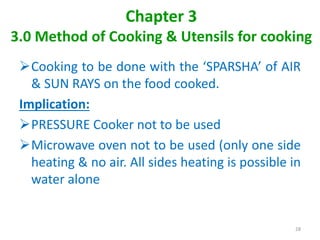
3.0 Method of Cooking & Utensils for cooking
Cooking to be done with the ‘SPARSHA’ of AIR
& SUN RAYS on the food cooked.
Implication:
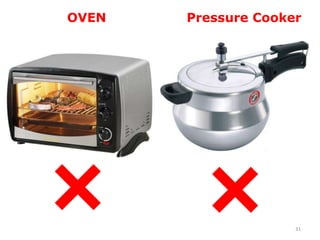
PRESSURE Cooker not to be used
Microwave oven not to be used (only one side
heating & no air. All sides heating is possible in
water alone
28
29
Brass vessel Aluminium vessel
30
Brass vessel Aluminium vessel
31
OVEN Pressure Cooker
3.0(a) Utensil for Cooking:-
Research by CDRI proved that, Aluminium is
worst material for storing or cooking materials.
Before 1970’s – No Aluminium utensils.
Aluminium plates used in JAILS by British.
Research in Lucknow Jail confirmed following, if
cooking / storage of food is done in Aluminium
utensils.
• Decrease of Immunity.
• Age decreases.
• Susceptible to diseases very fast.
• Strength goes down in the body.
32
3.0 (b) Effect of cooking in Aluminum Vessels
Eating of food cooked in Aluminium cooker
causes:
• Tuberculosis
• Bronchitis
• Diabetes
• Arthritis
• Asthma
• Many more diseases
33
3.0 (c) Why food cooked in Pressure
Cooker looses Nutrients
A food items which take more time for growth,
requires more time for cooking
For evolution of any item, time is required.
For example, birth of a child takes ‘9’ months.
Protein & nutrients (Vitamins & minerals will not
come out, if cooking is done FAST say in a cooker,
microwave oven etc.
In Dhal, absorption of nutrients takes over 8
months.
Hence, dissolving of nutrients for assimilation by
MAN takes more time.
34
3.0 (c) Why food cooked in Pressure
Cooker looses Nutrients
All nutrients of food do not dissolve & hence
not available for consumption and hence
purpose of taking food is not served.
• Pressure Cooker – 87% of nutrients lost
(WORST)
• Bronze Vessels – 3% of nutrients lost
• Brass - 7% of nutrients lost
• Earthen vessels – 0% of nutrients lost (BEST)
35
3.0 (d) Which vessels to be used for cooking
Cooking in Earthen Vessels is best:
Alternate – Brass & Bronze
Research: Food cooked in Earthen vessels do
not decay easily.
Example: Dhal of Puri Jagannath temple
Prasad tested at Delhi & found no decay. Earth
has 18 micro-nutrients and food cooked in
earthen ware, micronutrients will be intact.
36
37
3.0 (d) Cooking in Earthen Vessels
3.1 How to Drink Water
Consumption of Water
90% of diseases are due to stomach. Proper
digestion of food in stomach is very important.
Water plays an important role in digestion.
Why – Food after digestion, converts to juice and
converts to blood, serum, urine, stools, etc.
responsible for the body to function.
How to Drink Water:
Take sip by sip like Tea.
Take while sitting only.
Take in a article which is round like Lota / Chambu
where surface tension is less. Glass is not a
healthy article. Glass has come to India through
French. 38
39
Lota/Chambu Glass
3.1 (a) Cold / Hot / Lukewarm?
Body temperature is 370C
Lukewarm water is BEST throughout year even
in summer.
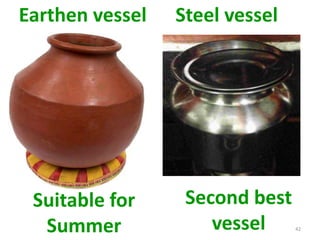
Summer – Pot stored is ok.
Water in Copper vessels is good without
lukewarm but water should be taken without
feet touching ground. Water in copper vessels
to be taken during winter only.
Take water in silver vessels – it cools the body
and control PITTA.
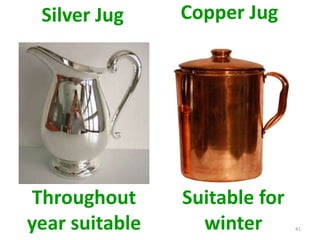
40
41
Throughout
year suitable
Suitable for
winter
Silver Jug Copper Jug
42
Suitable for
Summer
Second best
vessel
Earthen vessel Steel vessel
43
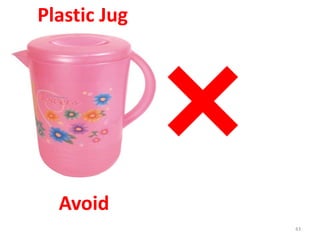
Avoid
Plastic Jug
3.1 (b) Effect of taking Cold water
Stomach is made cool
Body cells get cool
All organs of body become cool
Body releases secretions to heat cold water
for which blood is diverted from organs like
Brain, Heart etc. seriously affecting them in
the long run due to frequent shortfall of
blood.
44
3.1 (c) When to take water ?
After one hour 30 minutes of taking food ( 1 – 2
sips to clear throat is ok)
If you feel thirsty, take :
• Juice – in the morning / breakfast
• Buttermilk – Afternoon / Lunch
• Milk – Night / Dinner
Immediately after waking up take lukewarm
water. (Morning SALIVA in mouth is a great
medicine & should not be spit but consumed
inside by sipping lukewarm water)
45
46
Juice Butter Milk Milk
Morning
after food
After
Lunch
After
Dinner
3.1 (d) When Water should not be taken
Do not take water immediately after :
 1) Urination 2) Stools 3) Bath
Wait for 20 – 25 minutes, preferably take water
before above activities.
Do not take cold water after walking in SUN &
under shelter. But while in Sun it is ok.
Do not give cold / normal water to a person after
accident.
Instead – give
• not Hot Tea.
• Hot Water.
• Urine (if you are in forest / place where tea /
hot water readily not available)
47
3.1 (e) Effect of taking water after food
Enzymes secrete immediately after eating like
when a switch is ‘ON’, bulb glows.
• When digestion is going, if water is taken,
enzymes become calm and food becomes stale.
• Gas generates due to stale food & cholesterol
increases due to stale food.
• Gases spread throughout body & difficult to
control.
• 103 diseases caused due to such gas. Example,
Acidity, Piles, Cancer etc.
• Bad Cholesterol i.e. LDL is produced when food is
in stale condition
How much water to be taken?
• Water intake = [Weight / 10 – 2] 48
3.2 When to take food? Hot or Cold?
Consume / Eat food within 48 minutes of
cooking. Take food in hot condition.
Food eaten after 12 hours of cooking contains
no nutrients and hence useless and unfit even
for Animals
Stored food overnight is recommended only
one day in a year i.e._______.
49
3.2(a) Food Timings
Jataragni is strong within 02 hours of Sunrise i.e.
09.00 to 09.30 Hrs.
Food taken during this period will be fully utilized
and converted to energy and other products
necessary for the body.
Different body organs work efficiently at different
times.
Example: -
• Heart – 02 Hours before Brahmi Muhurta i.e.
02.00 to 02.30 Hrs.
• Liver (similarly Jataragni) – Up to 02 hours from
sunrise.
50
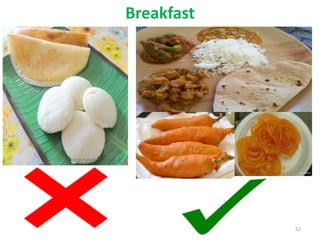
3.2(b) Food Timings & Quantity
Lunch to be taken in the morning and not
break-fast
Any food liked by your mind / tongue – Take in
the morning only.
Example: Sweets, Mirchi, Bajii etc.
Afternoon Food: - Take 1/3rd less than morning
Evening Food: - 40 minutes before Sunset
This habit will help a lot – Diabetes, Asthama,
Arthritis, and those suffering from Vata Dosha
diseases.
51
Breakfast
52
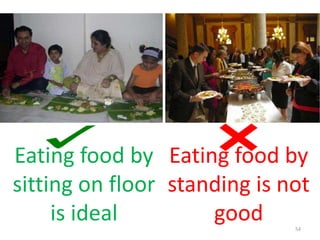
3.2(c) How to eat Food ?
By sitting on floor is ideal
‘Agni’ is generated by sitting in Sukhasana that
helps in quick digestion of food eaten.
Eating in standing posture
• Jataragni intensity decreases a lot.
• Plate should be at a higher level than the
seat
• Dining table – Sit on Chair with folded legs in
Sukhasana.
53
54
Eating food by
sitting on floor
is ideal
Eating food by
standing is not
good
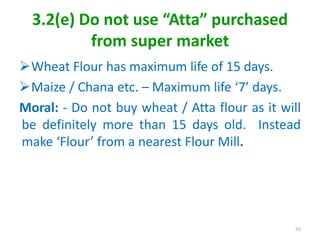
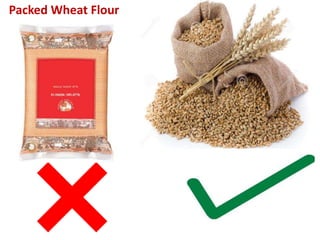
3.2(e) Do not use “Atta” purchased
from super market
Wheat Flour has maximum life of 15 days.
Maize / Chana etc. – Maximum life ‘7’ days.
Moral: - Do not buy wheat / Atta flour as it will
be definitely more than 15 days old. Instead
make ‘Flour’ from a nearest Flour Mill.
55
56
Packed Wheat Flour
3.2(f) What to do after taking food?
 Take at least 30 minutes rest after taking food in the morning
and afternoon.
 Lie down on left side resting on left hands like Lord Vishnu
resting on Aadi Sesha.
 Brazil, Mexico, Australia and now China also made it
compulsory in offices to take rest after lunch.
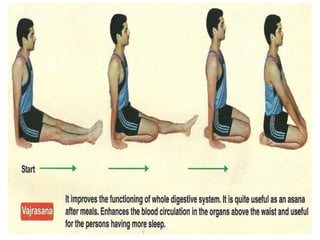
 If it is not possible to take a nap, at least do Vajrasana for 10
minutes.
 Do not sleep immediately after taking food in the evening /
night.
 Take rest after a minimum of 02 hours of taking food.
 Why? - Due to sunset, condition of harmones inside do not
help if rest is taken.
 Do not take any Dhal curry with Curd. If you want to take curd
/ Butter milk after Dhal, then add – Zilakara, Vamu & Rock
Salt and do “TALIMPU”
 Effect: - If you sleep immediately after dinner, you are prone to
Diabetes & Heart attack.
57
58
3.2(g) Contradictory foods
 Eating Foods having different Guna & Swabhava
 i.e. Contradictory Foods together is not good for health
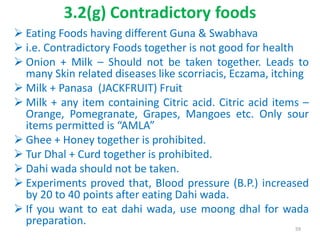
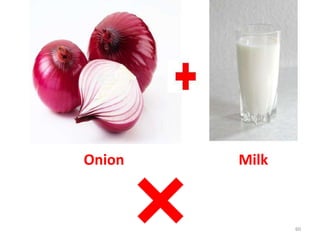
 Onion + Milk – Should not be taken together. Leads to
many Skin related diseases like scorriacis, Eczama, itching
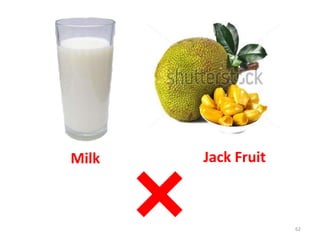
 Milk + Panasa (JACKFRUIT) Fruit
 Milk + any item containing Citric acid. Citric acid items –
Orange, Pomegranate, Grapes, Mangoes etc. Only sour
items permitted is “AMLA”
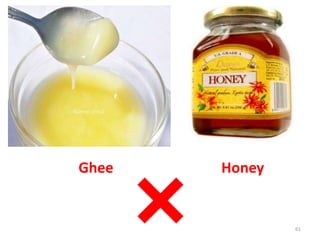
 Ghee + Honey together is prohibited.
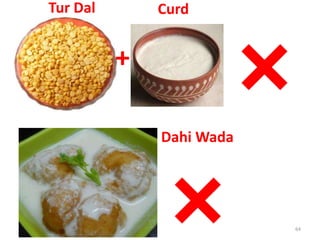
 Tur Dhal + Curd together is prohibited.
 Dahi wada should not be taken.
 Experiments proved that, Blood pressure (B.P.) increased
by 20 to 40 points after eating Dahi wada.
 If you want to eat dahi wada, use moong dhal for wada
preparation.
59
60
Onion Milk
61
Ghee Honey
62
Jack FruitMilk
63
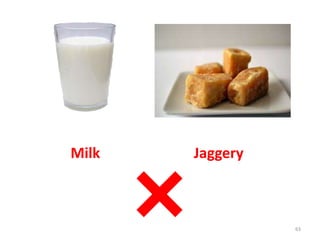
Milk Jaggery
64
+
Dahi Wada
CurdTur Dal
3.3 Effect of taking cold items after
hot items
Do not take cold items with hot items and vice
- versa
• Tea – Tea is at 50 – 600C
• Stomach enzymes try to bring tea to
stomach temperature by 37 – 400 C When
this process is going, if you take Ice cream,
stomach gets confused. Whether to cool tea
or heat Ice cream?
65
3.4 Benefit of PAN
Take PAN daily. For those above 45 years, it is
must, since Calcium need to be taken
externally as internal production capacity
decreases.
 Beetel leaves – Controls Kapha & Pitta dosha
 Lime (Sunnam) – Controls Vatam
 Beetel leaves a) Use Desi only
b) Green and ripe one
66
3.5 Need to take Vitamins ‘B’ & ‘C’ daily
Triphala – Amla, Karakkaya, Thanekaya
– Controls Kapha, Vata & Pitta
Karakkaya : Thanekaya : Amla
1 : 2 : 3
How to take: Morning with Jaggary or Honey
• Night – With Milk or Hot water
• Morning – Acts as a nourishment
• Night – Acts as a Stomach Cleaner
Healthy People – Take in the Morning
Triphala in equal measure – for Cancer patients
If you take triphala for 03 Months – give rest for 15
– 20 days
67
3.6 Triphala
Dosage of Triphala:
• Morning – One big spoon
• Night – One small spoon
• Even Diabetic patients can take Triphala with
jaggery
When to take Triphala? Before or After food?
• Those having Stomach related problems should
take after Dinner with Milk or hot water.
• Morning – 45 Minutes before breakfast.
68
3.7 CALCIUM
Use of Calcium
Calcium is essential in the body for assimilation of
other nutrients.
Calcium is produced in the body from foods taken
up to 45 years of age
After 45 years – Calcium to be supplemented
externally
Lime is a rich source of Calcium
Lime with Tamalapaku to be taken daily at night.
Calcium rich foods - Milk / Curd / Ghee / Orange
/ Grapes / Bananas /Mango.
69
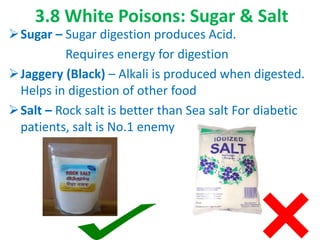
3.8 White Poisons: Sugar & Salt
Sugar – Sugar digestion produces Acid.
Requires energy for digestion
Jaggery (Black) – Alkali is produced when digested.
Helps in digestion of other food
Salt – Rock salt is better than Sea salt For diabetic
patients, salt is No.1 enemy
70
3.9 When to take Ice Cream & Fruits ?
ICE CREAM
Avoiding is ideal.
If you can’t resist, then take before meals & not
after meals.
FRUITS
Fruits to be eaten before meals.
Two advantages:
• 100% nutrients in fruits are absorbed into
blood.
• Tendency of over eating is reduced.
71
3.10 When to take Soup, Sweets ?
When to take Soup?
• After food and not before food.
• Taking soup after food helps indigestion.
• Indians – Jataragni/appetite is naturally good
unlike for European/Americans
When to take sweets?
Before meals – Absorption of nutrients is more
If taken after meals, digestion starts after previous
food by which time sweats decay and emit foul
smells and release toxins etc.
72
3.10 When to take Curd / Butter Milk ?
Morning - Curd
Afternoon – Butter Milk
Night – Curd or Butter Milk should not be taken.
Instead milk may be taken.
73
3.11 Number of Motions per Day
Ideal – Equal to the number of times we eat in
a day.
If you eat three times a day, three No. of
motions per day is ideal. Two times per day is
better. One time per day is bad.
Bowel/motion: 2-3 times per day will
eliminate accumulation of toxins inside the
body and hence stability / immunity of body
will be improved.
74
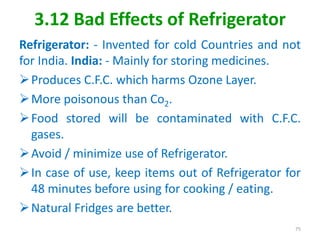
3.12 Bad Effects of Refrigerator
Refrigerator: - Invented for cold Countries and not
for India. India: - Mainly for storing medicines.
Produces C.F.C. which harms Ozone Layer.
More poisonous than Co2.
Food stored will be contaminated with C.F.C.
gases.
Avoid / minimize use of Refrigerator.
In case of use, keep items out of Refrigerator for
48 minutes before using for cooking / eating.
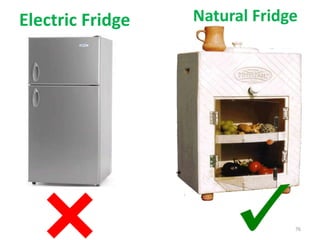
Natural Fridges are better.
75
Natural Fridge
76
Electric Fridge
3.13 (a) Use of Plastics to be eliminated
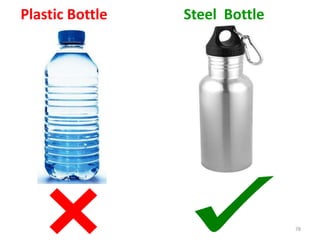
Plastic water Bottle – use steel water bottle.
Plastic water Jugs – use silver/copper/steel.
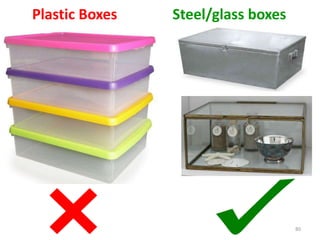
Plastic storage boxes – use steel/glass.
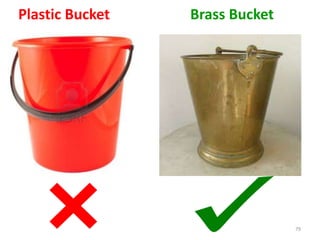
Plastic Buckets – use brass/steel storage
buckets.
Plastic water can/bottles – use Earthen/Steel
cans.
Taking tea or hot water or very hot liquid in
plastic cups, glasses etc., causes cancer in the
long run.
77
78
Steel BottlePlastic Bottle
79
Brass BucketPlastic Bucket
80
Steel/glass boxesPlastic Boxes
3.13(b) Can I keep my inverter batteries
inside house ?
A car with doors closed emits poisonous gases
and known to cause cancer.
Keep doors open for 1 minute or so till gases
inside go out.
81
3.13(c) Travelling in car & Health
Batteries emit fumes of metals inside the
batteries.
Increase of any metal content inside body causes
various diseases like Hypothyroid, Kidney stones
etc.
Keep batteries outside house.
3.14 Which type of floor is best for health ?
Granite/Marble/Shabad/Stone/Concrete/earth
Do not walk barefoot on granite/marble
floors.
Use socks on granite/marble floors.
Use “acupuncture “ type slippers.
Walk barefoot on earth now then.
Walking barefoot on marble/granite - Energy
in the body flows to earth
82
3.15 I am above 45 Years – can I
climb stair case ?
Knees produce a liquid at about 45 year of
age. Sufficient for rest of life based on past
activity. If you put pressure on knees by
climbing stairs or running etc., liquid will get
consumed and result in early Arthritis. Use of
lift is must for those above 45 years of Age.
83
3.16 Direction for Sleep?
Head should be towards South or East
Reading or for learning any new subject, North
facing is O.K
Sadhus, Saints, those who practice Brahmacharya
– Keep Head towards East
For Children to increase in Height, keep head
towards South during sleep
84
3.17 Live according to climate of place of living
Man should do physical work up to 60 years.
Afterwards, slowly activity to be reduced.
Live according to the climate and conditions of
the place of living
India: -
• Hot Climate (Air will be hot)
• Vatam is more – 80% diseases due to Vata
Dosha
• In daily routine take care that “Vata” does not
increase
• Do not Run – It will increase ‘Vata’ - walking is
O.K.
• USA/Canada – Cold – Kapam is more
85
86
Do not run as it will
increase Vata dosha
in old people
Walking
3.18 What are Speeds in The Body ?
 There are 14 types of Speeds (Vegams). Do not control
them. Important among them are:
 Laugh – Natural – No artificial laugh- Laughing clubs cause
damage to body – surprisingly laugh causes - types of
diseases.
 Thummu- Natural is O.K. Forceful one causes diseases.
 Thirstiness – Tea sip by sip. Quick drinking may lead to
Hernia Appendicitis. If you control thirstiness – 58 types of
diseases will come.
 Hunger – If you stop forceful, 103 type of diseases will
come.
 Avalimpu – Comes when there is less O2 in Blood.
 Urine – If you stop, bad elements in blood goes to body.
 Motions – if you suppress – causes No. of diseases.
 Sleep – if you suppress – causes No. of diseases.
87
3.18 Effects of forcefully stopping the
Speeds in the Body
 Urine: Stomach Pain, Gas trouble, Kidney stone, Kidney
diseases etc.
 Motion: Stomach Pain, Headache, Gastric Trouble, Cold,
Chest Pain
 Shukra/Sexual: Fever, Chest pain, Kidney diseases,
Kidney stones, infertility/impotence
 Aparna Vayu: Stoppage of urine & motions, Gastric
troubles, lack of appetite, Chest pain, eye diseases,
lung diseases
 Vomiting: Fever, skin diseases, rashes
 Tummu (Sneeze): Headache, neck freeze, twist in face,
weakness of eyes.
 Tenupu (Burp): Shivering, Cough, Tiredness, Hiccups,
Gas trouble, Tightness of chest
88
3.18 Effects of forcefully stopping the
Speeds in the Body
 Avalinta (Yawning) : Headache, Stiffness in neck,
shivering
 Hunger: Shrinkage of body, weakness, stomach pain
 Thirst: Dryness of throat, rotation of eyes, dizziness,
pain in heart
 Water eye due to sorrow: Cold, Eye diseases, heart
diseases, eyes rotation, stiffness in neck
 Sleep: Hiccups, doziness, eyes becoming heavy, feeling
of heavy head, passion.
 Excess breathing due to overwork: Heart diseases, loss
of memory, death
 Cough: Pain in chest, tiredness, hiccups, shrinkage of
body.
89
3.19 Is forceful laugh useful or harmful
Laughing clubs are imported from west.
Blind imitation of western habits without
analysis & studying their suitability to India.
Any life style by west is seen as sign of
civilization and blindly copied by rest of world
especially Asian countries like India.
Any forceful laughter damages the nerves.
Laugh to be spontaneous and not artificial and
forceful.
Cutting of jokes will enable natural laugh
90
3.20 Massage of Body to eliminate toxins
Oil massage of entire body once in a
week/month is must to eliminate the toxins in
the body.
Olden Days :- Massage is common in the family.
With so much pesticides, stress, pollution,
accumulation of toxins are high in the body.
Body massage helps to eliminate some of the
toxins.
After 10 minutes of massage take steam bath
for reaping the benefits of massage.
91
3.21 Asanas & Pranayama for good health
Asanas gives oxygen to all muscles / cells of body
where exercises give only to the parts which are
exercised.
Asanas are designed to suit to the ‘HOT climate of
Bharat”.
Exercises involving brisk activity geneates excess
“VATA” in the body of practiced for a longer
periods.
Exercises are recommended for students up to
20Years only as children have excess “KAPHA” and
exercises helps in balancing the Kapha in the body.
92
3.22 How to do ASANAS
Concentrate on the PART of body which is giving
“PAIN” while performing the ASANA.
KEEP ‘Eyes’ in closed condition during the Asana
posture. (Beginners may keep eyes in open
condition)
In the final position of Asana breathing is normal
Learn Asanas first from a qualified guru.
Never practice Asanas by seeing TV or reading
from books.
 Those suffering from diseases, certain Asanas are
not recommended. Learn from guru which Asanas
are prohibited for which disease.
93
3.22 Asana most suited to students
Sarvangasana :
This asana sublimates the sexual energy into
OJHAS and increases “intellectual power many
times”.
The need for masturbation or night discharge
will be minimized by practicing this asana on a
daily basis.
This asana to be performed on a soft bed sheet.
Should not be done beyond one’s limit.
Should ________ Asana after performing this
asana.
94
3.23 PRANAYAMA
Pranayama is the fourth ‘limb’ of Ashtanga yoga of
patanjali.
Pranayama to be practiced after learning from a
qualified guru.
Pranayama cleans the 72000 nadis inside our body.
Pranayama calms the mind and controls our
emotions especially the negative emotions.
Anuloma/Viloma or Nadi Shuddi Pranayama and
kapalabhati pranayama known to cure/mitigate
many common/chronic diseases.
Practice pranayama daily at least 15 minutes
Timings :- Sun Rise or Sun set & empty stomach. 95
3.24 Daily Routine has Spiritual and
Health Significance
96
Brushing
Tooth
-To be done before sunrise.
-After sunrise – not good for health
After Bath - Apply Tilak on head
- Then Pray God
- Then Do Pooja
Taking Food - Offer to God before taking food
- After feeding guests, poor and orphans
- Should feed animals also
Night - Pray God before sleep – prevents bad
dreams
3.25 Efficacy of prayer in curing diseases
It is proven worldwide by experiments that
‘Prayer’ on chosen deities helps in quick healing
of chronic diseases.
Prayer to be done when alone and in silence.
No other thought except the chosen deity to be
concentrated.
If ‘Mantra Deekshaw’ is taken from a “Guru”,
repeat the “ Mantra” silently as many times as
possible.
One pointed prayer enables reception of cosmic
energy by body and helps in curing chronic
diseases.
97
3.26 Excess use of cell phones, Tabs & Laptops
 Do not use cell phones with Right ear.
 Do not talk in cell phones for long or when you have
land line phone with you.
 Do not use Tab/Laptop for longer duration at a stretch.
Give rest after every 1Hr or so.
 Do not allow children watch videos / games / movies in
mobile phone, Tab or laptop as it causes itching in eyes
and rubbing of eyes damages the eyes. Instead use TV
for watching videos / games / internet / movies.
 Do not keep tab / laptop on thighs – the bones will
become brittle.
 Do not keep mobile phone anywhere in pocket as for
as possible hold it with your hands and keep it at more
than a feet while sitting anywhere.
98
Chapter 4
4.0 Understanding Children
Office & house – understanding one’s prakruti
is important.
Do not compare two children
Each child is excellent in some fields
Comparison is not good for a child’s health
Comparison leads to Inferiority complex in
one child.
99
4.1 KAPHA Nature of Child
kapha persons have more storage capacity
Kapha persons have good memory capacity
Once understands, can’t forget
Child need not understand
Child should be made memorize different
subjects. Memory capacity is more in children
Let children memorise ‘GITA SLOKAS’
Movie songs & dances not good for children
children shouldn’t be used to enact “elder
roles” i.e., acting as “old people” etc.
100
4.1(a) Children & Kapha
 Children: Kapha is more – Hence, they should be
encouraged to have more sleep
• Less than 04 years – 16 hours of sleep
• 04 – 08 years – 12 – 14 Hours
• 08 to 14 years – 09 to 10 hours
 Therefore, up to 3rd Class: Children should not be woken
up forcibly, since sleep requirement will not be met –
leads to long term effect on psychological mind.
 School going Children up to 3rd Class
• 11 A.M. is best timing.
• 08 A.M. is worst timing
• For 4th to 10th class – Should be made 09 to 10 A.M.
101
4.2 Effect of excess Vata on a Child
 Children  kapha is more.
 Youth  Pitta is important
 Old  Vata is important
 If a child is hyperactive  Vata in child child
becomes old fast.
 Children are given foods which increase vata
 Children should play instead of watching cartoon etc.
 Vata can be there in a child – but vata excess shouldn’t
be in a child
 If a child is active, and extravert though it is vata nature
of child but it is positive.
 Hyperactive  effect of vata excess
 Understands any matter easily but forgets very fast
 Child should be given cheese
102
4.3 Important tips for bringing up children
Children should sleep by 08.00 P.M.
Less sleep leads to unrest & Anger.
Children should not be disturbed in sleep.
For studies, Kapha should be less.
Kapha is more on Head & Ear.
Oil massage to be done to control Kapham.
Yoga, Pranayam – Not good for people having
Kapham
103
4.3 Important tips for bringing up children
Children up to 8 – 14 years yoga not
recommended.
Don’t give sermon – follow what you want your
children to follow.
Give freedom but don’t be licentious
Be punctual
Do some exercises or play
Do go to temple & take children to temples once
in a week.
Bow to your parents in front of your children
Children cartoon Films  becoming cartoons
themselves.
104
4.4 Art of parenting – Set Goals for
children
Child is not an animal
You can set a goal unlike animals
Set goal at each age for children from 6 years
onwards.
So that by age 18, children can set their final
goal.
105
4.4 Guidelines for Parents
Direct to higher education in vedanta
Learn the technique of living a life & guide the
children
Do your duty in a detached way
Culture of India – life based on duties & not on
rights.
West – Reverse
Slowly value system changing
Rights have become more important now
106
4.4 Guidelines for parents
Love towards fellow beings.
Compassion towards animals
Feeling of affection towards subordinates.
Gratitude to god, parents, nature, relations,
friends, etc.,
Do not have superiority or inferiority complex.
107
4.5 - 20 Manners to be taught to
growing up children by parents
 Take bath daily – keep body clean
 Keep nails of fingers clean by trimming them regularly
 Wear loose cotton clothes instead of Nylon clothes
which are harmful to health.
 Get rid of keeping fingers in nose, mouth, biting nails
etc.
 Do not read in excess light or dim light. Do not read in
sleeping or bending postures.
 Keep your house and surroundings clean.
 Do not waste water and power.
 Do not use knife on tables. Do not spoil walls with
pencils & pens. 108
4.5 - 20 Manners to be taught to
growing up children by parents
 Do not keep legs on books – do not use books as
pillow. Do not use mouth saliva to turn pages in a
book.
 Do not keep fingers in milk or water. Drink clean water
always.
 Do not spit or urinate in bushes, trains & public places.
Do not throw fruit waste, paper etc on roads. Remove
glass pieces, thorns, stones on road.
 Know value of time. Avoid useless talk and useless
works.
 Always speak truth. Do not speak lie due to fear or
money.
 Do not harass weak and those younger to you. Help
them to the extent possible.
109
4.5 - 20 Manners to be taught to
growing up children by parents
Don’t heckle anyone. Don’t accuse others.
Don’t irritate blind, physically handicapped
people.
Always respect parents, elders and gurus.
Don’t show disrespect to any nations flag, song,
religion works, saints. Don’t blame any religion.
Always be happy and cheerful
Pray to god regularly. Strength to mind due to
prayer can’t be obtained in anything else.
110
4.6 Nutrition & Children
Many recent studies in nutrition are gaining
popularity because they are resulting in happier,
smarter, and less hyperactive children.
Parents who follow these guidelines are also
finding their lives less stressful and more fulfilling.
To have children who are smart, loving and
helpful makes life a breeze compared to dealing
with children who are out-of-control,
hyperactive, unfocused, and even violent and
aggressive.
111
4.6(a) Your Child’s Brain
Just as the traditional "Authoritarian" and
"Punitive" style of parenting has become
outdated, so has the approach to eating which
does not take into consideration the
unhealthy effects different types of foods have
on your child’s brain.
112
4.6(b) Preservatives & Effect on
Children
Preservatives are used to increase shelf life.
By just removing harmful preservatives, you
will notice a difference in your child's
behavior.
Apart from unhealthy hydrogenated oils, trans
fats, artificial flavor and coloring, salt and
sugar, packaged foods high in preservatives
affect brain development.
113
4.7 Sugar and White Flour Products
Refined white sugar, as well as foods made with
processed white flour, is an addictive processed
food that acts more like a drug.
It reduces thyroid function, causes tooth decay,
causes mood swings, impairs healing, and
adversely affects the immune system.
Reduce sugar, or eliminate it completely, from
your child's regular diet. This will increase
concentration levels, immunity to diseases, and
improve behavior, as well as prevent thyroid
disease and tooth decay.
114
4.7 Sugar and White Flour Products
White rice is a processed food. The bran has been
removed, which changes the rice from a complex
carbohydrate rich in protein and B vitamins to a
simple carbohydrate, which raises blood sugar
levels and contributes to diabetes. Try to
substitute brown rice or include it in the diet,
along with whole grain breads.
Giving seeds and nuts to your child instead of
fried snacks, like chips, will give your child Omega
3 fatty acids, which are known to improve brain
function and reduce heart disease and attention
deficit disorders.
115
4.8 Diet & Children
"Mood swings, inability to concentrate, temper
tantrums, and the most significant—low self-
esteem—are all the affects of too much sugar in
your child's diet." Kathleen DesMaison, Author
Little Sugar Addicts.
Do not send sweets, candy, chocolate, cookies, or
other foods high in sugar to school with your
child.
Avoid adding sugar to your child's milk. Gradually,
your child's sense of taste will return to normal
and the natural sweetness in foods can be
enjoyed.
116
4.8 Diet & Children
Instead of giving sugar, substitute natural, more
healthy sweeteners, like jaggery/gud, and honey,
but limit these to 2 times per week. Give fresh
and dried fruit if your child wants something
sweet. Try to limit cake, ice cream, and chocolate
to special occasions.
Important point: If you want to improve your
child's behavior, eliminate sugar completely from
the regular diet. We understand it is unrealistic
not to have something sweet for your child once
in a while, but on a daily basis, try to eliminate
sugar and you will see results within just days.
117
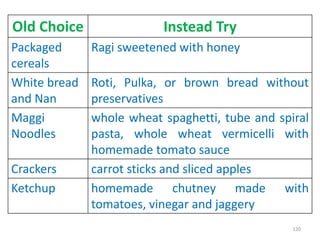
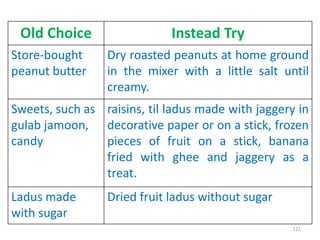
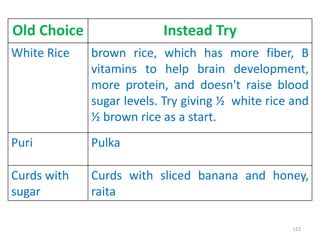
4.9 List of Common Foods
Below is a list of foods high in sugar and low in
nutrition that you should avoid giving your
child on a regular basis and foods you can
substitute, which are especially good for
vegetarians. (Substitutions are available at
good supermarkets, as well as Spencers,
Fresh, and Balaji).
Remember: natural foods may seem more
expensive but you use half the amount. 1/2
cup of brown rice will be more satisfying than
1 cup of white rice.
118
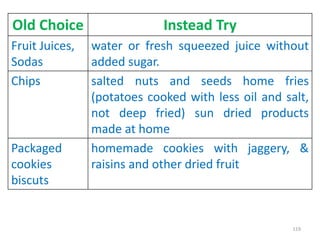
Old Choice Instead Try
Fruit Juices,
Sodas
water or fresh squeezed juice without
added sugar.
Chips salted nuts and seeds home fries
(potatoes cooked with less oil and salt,
not deep fried) sun dried products
made at home
Packaged
cookies
biscuts
homemade cookies with jaggery, &
raisins and other dried fruit
119
Old Choice Instead Try
Packaged
cereals
Ragi sweetened with honey
White bread
and Nan
Roti, Pulka, or brown bread without
preservatives
Maggi
Noodles
whole wheat spaghetti, tube and spiral
pasta, whole wheat vermicelli with
homemade tomato sauce
Crackers carrot sticks and sliced apples
Ketchup homemade chutney made with
tomatoes, vinegar and jaggery
120
Old Choice Instead Try
Store-bought
peanut butter
Dry roasted peanuts at home ground
in the mixer with a little salt until
creamy.
Sweets, such as
gulab jamoon,
candy
raisins, til ladus made with jaggery in
decorative paper or on a stick, frozen
pieces of fruit on a stick, banana
fried with ghee and jaggery as a
treat.
Ladus made
with sugar
Dried fruit ladus without sugar
121
Old Choice Instead Try
White Rice brown rice, which has more fiber, B
vitamins to help brain development,
more protein, and doesn't raise blood
sugar levels. Try giving ½ white rice and
½ brown rice as a start.
Puri Pulka
Curds with
sugar
Curds with sliced banana and honey,
raita
122
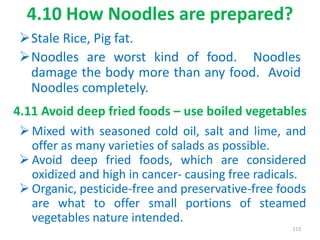
4.10 How Noodles are prepared?
Stale Rice, Pig fat.
Noodles are worst kind of food. Noodles
damage the body more than any food. Avoid
Noodles completely.
123
4.11 Avoid deep fried foods – use boiled vegetables
 Mixed with seasoned cold oil, salt and lime, and
offer as many varieties of salads as possible.
 Avoid deep fried foods, which are considered
oxidized and high in cancer- causing free radicals.
 Organic, pesticide-free and preservative-free foods
are what to offer small portions of steamed
vegetables nature intended.
Be Patient
 Important: Some children who have been eating
candy and cookies and chips and other packaged
foods high in sugar on a regular basis will go through
sugar withdrawal when you eliminate these foods,
and their behavior may get worse for a brief period
of time. This is normal. Stick it out. Be gentle and
loving. It will only last a short time before you see a
wonderful transformation.
Set Example
 Be consistent and firm about dietary changes. Bad
habits don't change over night. Once the addiction to
sugar and unhealthy fried and processed foods is
broken, your child will be smarter, healthier, and
happier and able to appreciate the goodness in
natural foods. Also, children learn by example. Follow
these guidelines along with your child.
124
Chapter 5
5.0 How cow is killed?
 Not given food & water for some days so that meat is
tasty.
 Then beaten mercilessly.
 Then 2000 water is poured to remove hair.
 Then cow is hanged with head down & then its head is
cut.
 When cow body beats the earth, its skin is removed.
 The painful emotions of cow enter the meat and all
products used by mankind and affects those who use
them.
 All those who use cow products are committing great sin.
 Toothpaste - Use cow dung based or ayurvedic based like
vajradhanti.
 Soaps - Use aloe vera/cow dung based.
 Leather products - Do not use cow based leathers. 125
5.1 Economy of cow slaughter
 Profit from one cow slaughter - Rs.5000
 No. of cows killed per day 50,000
 Profit per year = 50000 X 5000 X 365 = 9000 cr.
 Other products = 90,000 cr p.a
 Profit margin are 20 times.
 Hence the industries purchasing Politician –
bureaucracy under politicians
 Then how to fight the lobby?
 Do not use products having cow based items like
soaps, tooth paste, leather bags etc.
 Encourage cow farming
 1947 – 30 cr population 30 cr cows population
 2000’s-- 120 cr population 7 cr cow population 126
5.2 Cow Profitability
 Monthly at least 1000/- profit per cow is possible
 7cr X 100 = 7000 cr profit per month = 84000 cr per year
 90000 cr profit per year by killing 18 lakh cows per year is
better or 84000 cr per year profit by saving cows is better?
THINK
 Take pledge today not to use
 Soaps having cow fat
 Toothpaste having cow bone powder
 Leather products having cow leather
 Pain killers having “VOVINE” i.e., cow blood
• Take pledge to use
 Cow milk & ghee
 Cow dung Ayurved based soaps & tooth paste
 Cow urine based hand wash, after shave lotion.
 Cow dung based ash for water sterilisation.
 Cow dung based Agarbatti. 127
5.3 Products used by killing cow
Daily 30,000 cows killed everyday.
Cow is killed in a brutal way.
Any tonic mentions “VOVINE” that tonic
contains “cow blood”.
In soaps, fat from cows are used.
Toothpaste – cow bones powder used.
Painkillers – cow bones powder used.
Use cow urine instead of pain killers.
Chappals, bags Cow leather used.
Purse, car seats etc cow leather used
128
5.4 Cow dung Ash
 Ash relieves the pain poisonous insect bites.
 During rainy season, when boiling is not possible due
to floods, ash in drinking water will prevent water
borne diseases.
 When on tour, always keep cow dung ash since we do
not know the quality of mineral water.
 Agarbatti made of cow dung. Ash generated from
Agarbatti can be used in water.
 Tooth powder using cow dung ash plus mineral salt will
give strength to teeth & gums and removes foul smell.
 Do not keep tooth brush inside bathroom as it attracts
bacteria & virus which are high in toilets
 Brush gums with fingers and tooth powder.
129
5.4 Cow dung Ash
 Bad smell in fridge, put coal (cow dung) piece inside -- it
will attract bad odor.
 Use fingers on “tongue” – it will enable cleaning of throat
 Those who have sinus should use fingers on tongue
 Those who have stammering also use fingers on tongue
 Cow dung absorbs poison of snake & other insects
 Cow dung based soap removes skin diseases & skin glows.
 Children also can use soap during exams
 Cow dung based food items have good taste. Food will be
saltvic
 Fertilizer foods effect:
• First fertilizer used in Punjab & Assam.
• Terrorists started from Punjab & Assam.
• Cancer increased in Punjab.
130
5.4 How to use cow dung ash soap ?
 For every 10 litres, add ‘5’ pinches of ash.
 For killing bacteria in water, add cow dung burnt
powder or cow dung based agarbatti stick burnt ashes.
 How to use cow dung based soap?
• Keep soap in water for one minute
 How to use coal of cow dung for brushing teeth?
• Keep in mouth for 5 minute and then brush the teeth
 Highest No. of cows  Rajasthan
 1 Cr 10 Lakhs in Rajasthan out of total 7 Cr Desi cows in
India 90 lakh are in Famine Area
 Need for everyone in India to contribute for “Cow
Seva” i.e., protection of cow.
131
5.5 Cow Urine
 Relieves asthma
 Relieves pain of cancer
 Any one suffering from infections, cow urine works
wonders
 Cysts, tumors in body. Medicines with cow urine work
wonders
 Cow products have “Pranashakti”
 Cow urine when added to any medicine, its power
increases manifold.
 ‘Prana Shakti” knowledge is known to Indians only.
 Indians have to teach world the importance of “Prana
Shakti”.
132
5.6 Cow Milk & Buffalow milk
 Buffalo milk  looses nutrients on boiling
 Cow milk  no loss of nutrients after repeated boiling
 Cow milk  boil in iron vessel instead of steel
 Iron will be supplied to body
 Boil milk slowly
 Use Ghee in cow milk
 Stir with wooden spoons or with a piece of Roti
 Ulcer & constipation will be cured
 Cow ghee  Purity test
• If your weight looses by 8 kg in a month and
Cholesterol decreases, ghee used is pure cow Ghee
133
5.7 Desi Cow Vs Jersee Cow Milk/Ghee
Dosage --> Solid -- 2 small spoons /day
of Ghee --> Liquid – 6 spoons/day
Take khichdi with ghee two times a week
Laddus / sweets etc., cow ghee based sweets
only to be taken
Jersi cow milk is cancerous & causes diabetes
Desi cow cheese is better for children, while
ghee is better for elders
134
5.8 Cow Ghee benefits ?
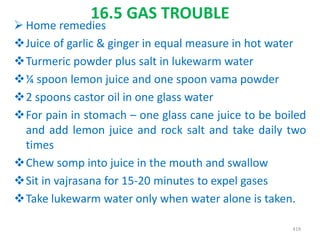
 How to use ghee for gas trouble ?
• Pour 2 drops of ghee in each nostril.
• Use tonic made from cow urine – take one cup with
one cup of water
 Cow ghee from cows which have been given “grass”
with “seva” bhava will be extremely useful.
 Cows which eat on roads  ghee will not be that
effective
 Cows to whom injection is given also will not be
effective
 But if you take ghee by chanting/remembering God, it
will be useful also.
 Ghee can be given to even two day old child.
135
5.8 Cow Ghee benefits
 Cow ghee – two drops in each nostril every day has many advantages
• Dreamless sleep
• Ear problems will be cured
• Helps in curing of following diseases:
• Migraine
• Paralysis
• Hyperactivity of children will reduce
• Sinus
• Frozen shoulders
• Coma
• Asthma
• Hearing problems
• Forgetfulness
• Sleeplessness
• Hair loss
• Tension
• Ulcer & acidity
 Lie down without pillow.
 Put one or two drops in each nose.
 Do not talk – keep quiet for 10 minutes.
 Do not drink water for 10 minutes.
136
5.8 Cow Ghee & Arthritis
 Arthritis : cow milk boil + turmeric
 Then add few drops of cow ghee
 Take the liquid, from 15th day it will give result.
5.8 Cow milk with cow ghee
Taking Cow milk with cow ghee
Relief for back pain
Arthritis
Ulcer
Acidity
Constipation etc
137
5.8 Who shouldn’t take Ghee
 Those who have ameobiosis shouldn’t take ghee.
 Also those who get blood in stools, shouldn’t take ghee.
5.8 Nature of Curd/Ghee/Cheese/Butter Milk
 Curd causes heat in body
 Butter milk cools the body
 Ghee cools the body
 Cheese cools the body
 Pregnant women should take curd in silver vessel
 Make curd using cow milk in silver vessel.
 Buttermilk + Rock salt in the morning cures kidney stones
(others should not take buttermilk in the morning or
night).
 Butter milk daily during lunch time  no cataract
problem and protects from jaundice, malaria & Thyphoid.
138
139
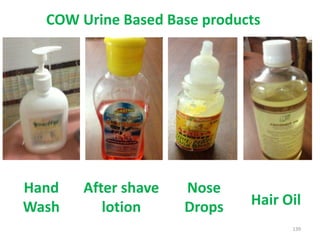
COW Urine Based Base products
Hand
Wash
After shave
lotion
Nose
Drops Hair Oil
Chapter 6
6.0 Ayurveda
Ayurveda plants.
First we should bow before them & pray
before them like we do for “Tulasi” tree
We should take the plants in “surrender”
attitude
Medicines in ayurveda are given only after a
doctor physically examining the ‘prakruti’ of an
individual.
140
6.0 Ayurveda
Moraltake ayurveda products from an ayurveda
doctor only.
Ayurveda has many remedies for a disease. Ex.
Cold, fever etc.,
Suitable remedy to be selected depending on
one’s nature
Otherwise what is good for one may not be good
for others.
Ex. Pitta & kapha type of persons need different
treatment
Therefore understanding one’s prakurti & nature
of remedy is critical in suggesting a remedy for a
disease.
141
6.1 Tri Doshas
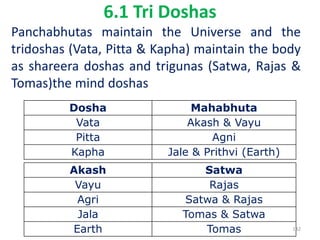
Panchabhutas maintain the Universe and the
tridoshas (Vata, Pitta & Kapha) maintain the body
as shareera doshas and trigunas (Satwa, Rajas &
Tomas)the mind doshas
Dosha Mahabhuta
Vata Akash & Vayu
Pitta Agni
Kapha Jale & Prithvi (Earth)
Akash Satwa
Vayu Rajas
Agri Satwa & Rajas
Jala Tomas & Satwa
Earth Tomas 142
6.1 Tri Doshas
 When the doshas are in balance i.e. in a state of
equilibrium, we remain healthy.
 Disease is caused, when there is imbalance within the
three doshas. It is important to realize that, these are
forces and not substances.
 Kapha is not mucus - it is the force that causes mucus
to arise. Similarly, Pitta is not bile- but force that cause
bile to be produced.
II(a) Strongest Dosha in Body has the tendency to
increase & one is more susceptible to illnesses
associated with an increase of the Body constitution
doshas.
Example: If one is Pitta type, then Pitta type diseases are
common. So, avoid Pitta type foods especially during lunch.143
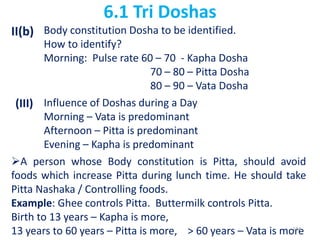
6.1 Tri Doshas
II(b) Body constitution Dosha to be identified.
How to identify?
Morning: Pulse rate 60 – 70 - Kapha Dosha
70 – 80 – Pitta Dosha
80 – 90 – Vata Dosha
(III) Influence of Doshas during a Day
Morning – Vata is predominant
Afternoon – Pitta is predominant
Evening – Kapha is predominant
A person whose Body constitution is Pitta, should avoid
foods which increase Pitta during lunch time. He should take
Pitta Nashaka / Controlling foods.
Example: Ghee controls Pitta. Buttermilk controls Pitta.
Birth to 13 years – Kapha is more,
13 years to 60 years – Pitta is more, > 60 years – Vata is more144
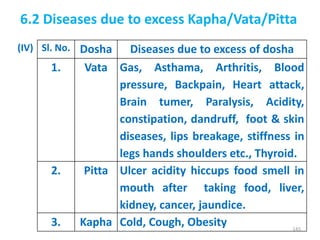
6.2 Diseases due to excess Kapha/Vata/Pitta
(IV) Sl. No. Dosha Diseases due to excess of dosha
1. Vata Gas, Asthama, Arthritis, Blood
pressure, Backpain, Heart attack,
Brain tumer, Paralysis, Acidity,
constipation, dandruff, foot & skin
diseases, lips breakage, stiffness in
legs hands shoulders etc., Thyroid.
2. Pitta Ulcer acidity hiccups food smell in
mouth after taking food, liver,
kidney, cancer, jaundice.
3. Kapha Cold, Cough, Obesity 145
Effect of various foods on Kaphs/Vata/Pitta in the body
(V) Sl. No Food Controls Increases
1. Jaggery Kapha
2. Cooking Oil Vata
3. Tamalapaku
(Betel leaves)
Kapha & Vata
4. Triphala Kapha, Vata &
Pitta
5. Mentulu (mint seeds) Kapha + Vata Pitta
6. Lime Vata Calcium
7. Cinnamon (Dalchina
Chekka)
Vata & Kapha
8. Voma pitta
9. Zilakar, Inua & Dhania pitta
10. Ghee Pitta 146
(V) Sl. No. Food Controls Increases Remarks
11. Sonti Kapha pitta
12. Honey Kapha
13. Sompu Kapha
14. Lavang Kapha
15. Milk, Curd,
Butter milk
Vata
16. Juices Vata
17. Cow urine Kapha/Vata/
Pitta
18 Radish
(Raw)
Vata Pitta Ripe Radish is
not good
19 Beetroot
(Raw)
Pitta
147
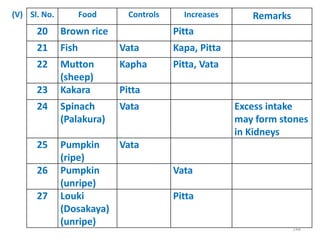
(V) Sl. No. Food Controls Increases Remarks
20 Brown rice Pitta
21 Fish Vata Kapa, Pitta
22 Mutton
(sheep)
Kapha Pitta, Vata
23 Kakara Pitta
24 Spinach
(Palakura)
Vata Excess intake
may form stones
in Kidneys
25 Pumpkin
(ripe)
Vata
26 Pumpkin
(unripe)
Vata
27 Louki
(Dosakaya)
(unripe)
Pitta
148
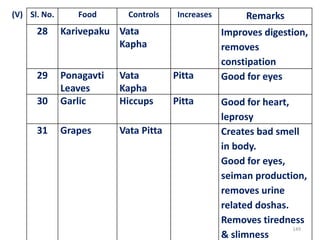
(V) Sl. No. Food Controls Increases Remarks
28 Karivepaku Vata
Kapha
Improves digestion,
removes
constipation
29 Ponagavti
Leaves
Vata
Kapha
Pitta Good for eyes
30 Garlic Hiccups Pitta Good for heart,
leprosy
31 Grapes Vata Pitta Creates bad smell
in body.
Good for eyes,
seiman production,
removes urine
related doshas.
Removes tiredness
& slimness
149
(V) Sl.
No.
Food Controls Increases Remarks
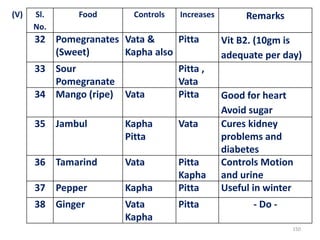
32 Pomegranates
(Sweet)
Vata &
Kapha also
Pitta Vit B2. (10gm is
adequate per day)
33 Sour
Pomegranate
Pitta ,
Vata
34 Mango (ripe) Vata Pitta Good for heart
Avoid sugar
35 Jambul Kapha
Pitta
Vata Cures kidney
problems and
diabetes
36 Tamarind Vata Pitta
Kapha
Controls Motion
and urine
37 Pepper Kapha Pitta Useful in winter
38 Ginger Vata
Kapha
Pitta - Do -
150
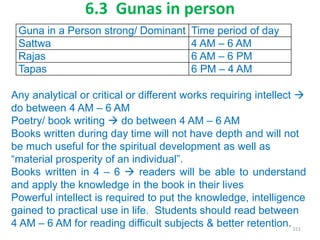
6.3 Gunas in person
151
Guna in a Person strong/ Dominant Time period of day
Sattwa 4 AM – 6 AM
Rajas 6 AM – 6 PM
Tapas 6 PM – 4 AM
Any analytical or critical or different works requiring intellect 
do between 4 AM – 6 AM
Poetry/ book writing  do between 4 AM – 6 AM
Books written during day time will not have depth and will not
be much useful for the spiritual development as well as
“material prosperity of an individual”.
Books written in 4 – 6  readers will be able to understand
and apply the knowledge in the book in their lives
Powerful intellect is required to put the knowledge, intelligence
gained to practical use in life. Students should read between
4 AM – 6 AM for reading difficult subjects & better retention.
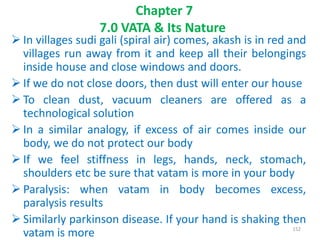
 In villages sudi gali (spiral air) comes, akash is in red and
villages run away from it and keep all their belongings
inside house and close windows and doors.
 If we do not close doors, then dust will enter our house
 To clean dust, vacuum cleaners are offered as a
technological solution
 In a similar analogy, if excess of air comes inside our
body, we do not protect our body
 If we feel stiffness in legs, hands, neck, stomach,
shoulders etc be sure that vatam is more in your body
 Paralysis: when vatam in body becomes excess,
paralysis results
 Similarly parkinson disease. If your hand is shaking then
vatam is more
Chapter 7
7.0 VATA & Its Nature
152
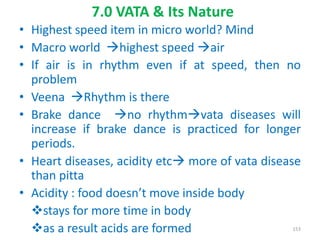
• Highest speed item in micro world? Mind
• Macro world highest speed air
• If air is in rhythm even if at speed, then no
problem
• Veena Rhythm is there
• Brake dance no rhythmvata diseases will
increase if brake dance is practiced for longer
periods.
• Heart diseases, acidity etc more of vata disease
than pitta
• Acidity : food doesn’t move inside body
stays for more time in body
as a result acids are formed
7.0 VATA & Its Nature
153
When something is in stomach, acid is released
to digest the food. If food doesn’t move even
after digestion, excess acids released stay in
stomach and damage the intestines and also
increase acidity of blood.
Constipation vata related disease
Breathing problem asthma vata diseases
Heartbeats  vata
Rhythmic air movement does not increase vata
It is only un-rhythmic air that causes increase
in vata
7.0 VATA & Its Nature
154
7.1 Diseases due to excess ‘vata’
Paralysis
Heart
Arthritis
Acidity
Constipation
Asthma
Thyroid
155
7.2 Nature/Properties of VATA
• Vata – mixture of akaash & air
• Akaash  inactive
• Air  5 ‘’gunas’/properties
Speed
Touch / Dryness
Coolness
Self occupation of space
Change
156
7.3 First property of Air : Speed
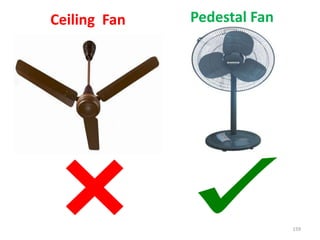
Ceiling fan
• Increases vata
• Don’t sleep directly under ceiling fan
• Sleep away from fan
• Fan speed to be slow
• Use pedestal fan instead of ceiling fan
• Cover ears with monkey caps, light weight bed
sheet & Cover body with bed sheets
Driving motor cycle
• Don’t run fast. Below 40 Kmph is OK.
Train journey
• Do not sit near window
157
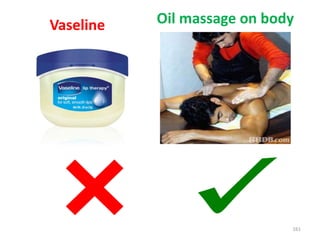
7.4 Second property of Vatam : Dryness
What we do if lips dry/break ? we apply vassoline
But vatam is increased not only in lips but also
entire body.
The increase of vatam is expressed as “breakage
of lips”.
We should not restrict to applying Vaseline we
should treat entire body.
Similarly “dandruff”
Apply “oil” for hair
Also massage oil over entire body.
Similarly “cracks in feet”
Instead of attending to basic cause i.e., increase
in vatam, we try to treat the symptom alone.
158
159
Pedestal FanCeiling Fan
7.4 Second property of Vatam : Dryness
• If we do not reduce vatam inside body, it will reach
“intestines”
• If intestines become dry, then food will not move.
• This leads to constipation.
• Constipation is due to vata excess.
• Nature cure people give Enema to “constipation people”
which further dries the intestines and increases vata in
body and hence constipation aggravates.
• The patient becomes “chronic patient” what to do?
• Add ghee in milk. If we neglect, dryness (i.e., vata
increase) it reaches blood vessels
• Any dry product gets solidify.
• The arteries become blocked.
160
161
Oil massage on bodyVaseline
7.4 Second property of Vatam : Dryness
 As there is dryness in arteries, heart has to pump blood
at high pressure so that blood reaches all parts of body.
 High blood pressure controller  take pure desi cow
ghee.
 If arteries become dry, cholesterol get stuck up on the
walls of bold vessels.
 Solution: Take pure desi cow ghee. Ghee should be
prepared using hand and wooden tool and not
aluminium/steel tool and should not use machines as is
being done now a days in factories.
 Due to use of machines, friction is generated which
spoils the Pranashakti in ghee.
 If you neglect further, cholesteroal reaches blood
vessels & stick to veins and obstruct flow of blood 162
7.5 Third property of vatam “coolness”
Coolness increases vatam
In cold climate, pains increase for vata patients
like heart disease, asthma etc.,
90% pains in body are due to excess vata.
Present day fashion –‘starter’
If starter is not in your body then why go to a
dinner?
‘starter’ culture is for cold climate countries.
Blind imitation of west is doing immense damage
to health of Indians.
Dessert - ice cream – cold item after hot dinner –
spoils whatever eaten. 163
7.5 Third property of vatam “coolness”
If you want to eat ice cream, eat before dinner.
Ice cream  dinner soup.
Do not take cold water after eating ghee or ghee
related products.
Take hot water after ghee is taken
Arthritis
take hot water after food is taken
or hot lemon juice
or hot rasam from dhal
Massage the body with warm ‘Til’ oil daily
Take luke warm ‘Til’ oil of one spoon daily with
food in the morning
164
7.6 Fourth property of Air
To enter empty space and stay there
• Sleeping directly under fan aggravates thyroid
disease.
• If you want to sleep under fan, pour 1-2 drops of
pure coconut oil in ears & not parachute oil once
in 2 days. Then close ears with “cotton”
• Also use 1-2 drops of ghee in nostrils.
• When you sleep directly under fan, your face
becomes bulge in the morning.
• Whenever you are on fasting take hot water.
• Do not take cold fruit juices during fasting time.
• Prolonged fastness – leads to entry of air and
leads to various diseases.
165
7.6 Fourth property of Air
To enter empty space and stay there
Pain in hands, legs, back pain etc.
Some people are very thin  due to excess
vata
Vayu dries a person.
Similarly obesity is due to excess vata.
When excess air enters, leads to obesity.
When air is removed, body becomes thin
Taking pure cow ghee reduces 8-10 kg weight
in 2-3 months.
166
7.6 Fourth property of Air
To enter empty space and stay there
30 years back  obesity due to excess air  now
‘fatty’ people
Take ghee in milk and mix using two Lotas / steel
utensils for 25 times.
Then take hot butter milk.
How to reduce weight
Pure cow ghee in food (Breakfast / Dinner)
Pure cow ghee in milk (Dinner)
Hot butter milk (Lunch)
Pure ghee in nostrils (Night before sleep)
167
7.7 Fifth property of Vayu – ‘change’
• After waking up, body will be hot – taking cold water
will harm
• Take normal water after 15-20 minutes
• Taking hot / Luke warm water is OK.
• Do not take normal water immediately after
urine/motion/bath
After urine frequent urine disease
After motion  constipation
After bath  skin diseases, gas troubles, pneumonia,
strain on lungs
• But you can take hot water if you are too much thirsty.
• Take water before urination/motion/bath
168
7.7 Fifth property of Vayu – ‘change’
 Night 2 pm  you can take cold water since you will
go to sleep again
 Sleep  waking up sleep . no change in ‘state’ &
hence no problem.
 Women – do not drink after coming out of ‘kitchen’
  Take water before work is completed in kitchen.
 Walking/playing in sun
  you can take water if you are under sun – but if you
come to shade from hot sun, do not take normal water
immediately
  wait for 20 min
  can take hot water.
 After a ‘change’ do not take water. Ex.
urination/motion/bath/walking any playing etc.
169
7.8 Bigger events/changes
Accidents
• Do not give cold water
• Give hot water (hot tea)
• If you are in jungle take urine
170
7.8 Other major changes like Marriage for
a man/woman is a big transformation
Do not take cold items for 40 days after marriage.
Taking cold items  vata property of dryness will
increase
If this property enters in mind, person becomes
“harsh” and soft mind becomes rigid.
As a result, adjustment becomes difficult.
Any product  when dries  becomes rigid.
What to eat? Ghee, sweet products
Do not eat maida based products
Do not eat pizzas/bhel pooris
Do not take dried/burnt products after marriage
171
7.8 Biggest change for a woman is becoming mother
Rajasthan  mothers stay in room not having
windows/ ventilators.
No air in room  woman is protected from
excess vata
Pure ghee to be taken
Massage of body with oil
Ghee in nostrils
Oil in ears (Coconut)
Oil on Navel (Til or coconut)
172
7.9 Usefulness of oil on Nabhi
 Heat in intestines is reduced
 Lips will not break
 Massage oil clockwise & anti clockwise around navel
before bath
 At night also do above when ghee is taken in nostrils.
 After birth of a child, air tries enter the gap inside body.
 Vata increases
 Ghee will reduce excess vata
 70% of diseases are due to excess vata
 Vata has effect on mind
 Those suffering from mental diseases treatment of
body also to be done along with MIND.
 Mad people  body also to be treated
173
7.10 How do you remove air from a pillow?
By pressing it
Apply pressure on body
Massage the body – use warm ‘Til’ oil
Excess vata will go out of body
Massaging is must at last 2-3 times a week
Press legs for 15 minutes
Pressing legs removes excess vata
Olden days  elders legs are pressed
Daily pressing of legs will help in removal of
excess vata
Massage from bottom to top i.e., towards
direction of ‘heart’
174
Chapter 8
8.0 PITTA & its nature
 Pitta  Agnitattvam
 Nature of Agni
• Burning
• Illumination
• Red & yellow colour ex.fever – face becomes red - excess
pitta
• Bad smell
• Expansion/melting
 Red blisters etc  due to excess pitta
 Yellow eyes  due to excess pitta
 Jaundice  pitta disease
 Examples. Food gets spoiled in summer and emits foul smell175
Mouth smell
Bad gases from mouth
Budhi and pitta has a relation
Budhi  head
Brain is always in heated condition as it works
always.
Brain works better under cold conditions
Air conditioning help in brain function.
Now and then brain to be given rest and to be
cooled – How ? Meditation, picnics.
Max damage to an organ due to pitta diseases. Eg.
Kidney disease, liver damage, uterus damage.
8.0 PITTA & its nature
176
 After many years of increase of pitta, organs get damage.
 Early detection of increase in pitta and measures to
control pitta will help a lot.
 When pitta is excess, we should not take cold products
ex.hot bulb – if cold water is poured, bulb gets fused.
 So take products which control pitta like a radiator of a car.
Then pitta in body will be in balance.
 12 AM  sun at peak , if you take fruit juice, pitta
increases
 We should take products which cool body in the morning.
By 12, body becomes cool Ex- coconut water, Ghee.
 Heat does not increase in the afternoon
 Eating icecream, cold drinks, fruit juices during afternoon
to be avoided
8.0 PITTA & its nature
177
8.1 Why Pitta increases in body?
(a) Anger (Krodham)
 When some one speaks with anger, we say he is
speaking like a mad fellow
 When pitta increases, budhi doesn’t not function
properly
 Remedy is not giving water
 It aggravates further
 Correct Remedy
• With folded fist, hit pillow/mattress 10 times
• Energy of anger will be earthed
• Anger energy has to be diverted
 In office: hold your fist as well as tighten the leg
muscles and then release. Anger energy will be
released. 178
8.1 Why Pitta increases in body?
(a) Anger (Krodham)
When children make mistake, do not get angry
and beat them
Children should be made to understand the
mistake
When someone comes to home in angry mood do
not give “masalas” etc, but give sweets/ cool
products
Oil increases pitta
Ghee reduces pitta
We can control pitta, vata & kapha with right kind
of food at right time.
Summer: After mangoes, take milk or take neredu
fruit. 179
8.1 Why Pitta increases in body?
(b) Second reason for increasing pitta is “sorrow”
Due to sorrow pitta increases
Face lustre goes away
Whenever there is change, pitta increases
180
8.1 Why Pitta increases in body?
(c) Third reason for increase of “Pitta” is fear
Face becomes green/yellow in fear
Fear of money
If kings are in fear, people will be in fear
Woman – fear of safety
Many diseases due to fear
181
8.1 Why Pitta increases in body?
(d) Fourth reason for increasing Pitta is jealousy
 Jealousy may lead to cancer also.
 Serials in TV are spoiling the society
 Joint family system collapsed
 Husband & wife getting separated
 More TVs will be sold if No. of families are more. Hence
wrong values system propagated through TV serials.
 Ads in TV are causing further damage
 When TV came to India, TB has come to India
 If we are away from TV, both pitta & vata will be
controlled.
 Because of above 4 reasons, pitta increases manifold.
182
8.2 How to identify Excess PITTA
 If your legs & hands sweat and sweat has bad smell
then heat is increasing inside body.
 If you neglect for 8-10 years heart will be damaged.
 If your urine is yellow, then heat is more in body. If
after taking water also, urine is yellow, it implies that
there is excess Pitta inside the body.
 Bad smell from body, do not control bad smell by
perfumes. Control the cause of bad smell i.e., increase
in Pitta. Take cool products
 Cold and nose watering. In mother tongue, cold is
called “ cold due to hot”. In English hot is gone.
 Cold is due to excess pitta.
 But hot products are given for treating cold.
 Take coconut water in the morning, butter milk in the
afternoon. Ghee in the morning.
183
8.3 How to control excess PITTA
 Summer: drinking water in silver vessels or silver coin
in a pot containing water is ideal to control PITTA in the
body.
 Drink coconut water in the morning to control PITTA
 Murappa with amla or maredu, should not be taken in
afternoon or evening
 Sunset time  do not take cold products. But if you go
out in sun at 4 PM, then you can take fruit juice.
 Foods which cool body to be taken before onset of
heat in the body.
 12AM-4PM and 12 PM – 4 AM are Pitta timings
 Take products which cool body between 8 AM – 12 AM
and 8 PM – 12PM
184
8.3 How to control excess PITTA
 Taking tulasi decoction or turmeric decoction or taking
tea, temporarily gives relief but increases PITTA and
increases disease.
 Solution  take coconut water in the morning
 Do not take cold drinks in the morning
 Do not take butter milk in the morning
 Small kid having loose motions. Mother should take
“radish” in the morning. Mothers should take “pure
ghee” to reduce heat in the body. Take radish in Jan.
 A food item will have its “guna” effective if it is grown
during the time suited for it.
 If mangoes are grown in winter, then they will not have
their positive effect.
185
8.3 How to control excess PITTA
 Take groundnuts in the morning only. Evening gas
will be produced. Groundnuts will cool the body.
 Buttermilk : buttermilk will not cool the body like
coconut water. Hence it can be taken during afternoon
also .
 In everyone’s body, some organ will be weak. Disease
attacks that organ first.
 Liver weak: if pitta is more, liver gets damage.
Allopathic doctorgives tonic/tablets & treats liver
only. But if pitta is not controlled, then, pitta attacks
next weak organ.
 If pitta is not controlled, then, pitta may damage
kidney , then heart etc.
 Basic cause of a disease is not treated in allopathy.
Only symptom is treated which is bad.
186
8.4 Migraine due to excess of PITTA
 With increase in sun rays, migraine increases
 Take cool items in the morning
 Migraine pain will be less
 Take water from POT. Water in copper vessel to be
taken in winter only or during Kapha period at most
i.e., 8 AM to 12 AM & 8 PM to 12 PM
 Water in copper vessels increase heat in body 
increases pitta.
 Silver is a cool metal
 Drink water in a “silver vessel” or heat pure silver
(10gm) and put in a water vessel.
 Drink 4-5 times a day and Pitta will be under control.
 Silver coin in water controls PITTA
187
8.5 TIPS FOR KIDNEY PATIENTS
 Kidneys purify blood - how? They remove the bad
items in blood in the form of water. Same duty is
performed by skin
 We should work so that we sweat profusely. But what
we do?
 We keep a kidney patient in A.C room or ICC? Disease
aggravates.
 Kidney patients should do works which result in
sweating.
 Kidney patient is asked to take less water to avoid load
on kidneys.
 Due to less water, Pitta increases kidney gets
damage fast
 Some other organ will also get damage due to pitta.
 Until pitta is controlled, one organ after another will be
attacked and damaged. 188
8.5 TIPS FOR KIDNEY PATIENTS
 Steam bath is ideal for kidney patients.
 Apply ghee on foot and rub bottom of foot with bronze
plate
 Give coconut water in the morning
 Ghee to be taken with food in the morning and night
 Buttermilk in the afternoon
 Groundnut in the morning
 Main organ for pitta is small intestines
 Amudam (Caster oil)  to remove pittam in body  once
in a month
 If pitta is not controlled, it may lead to T.B or cancer or
tumors, cysts etc.
 Any infection in body is due to “excess pitta”
 Pitta nature is “bad odour”. Bad odour comes from
“decayed products”
 Infection means  decay throat/urine/blood – infection is
due to excess pitta.
189
8.6 Malaria & Excess Pitta
October heat increases pitta increases
(sharad) taking payasam controls pitta
malaria comes only when pittam is excess
mosquitos pumps bacteria into body blood
if pitta is balanced, bacteria can’t do anything
Mosquitos bite lakhs of people but only few are
getting malaria
Rainy season  mosquitos are more
Coconut water in morning (heat is controlled)
Cheese to children (heat is controlled)
pakodi in the morning (heat is produced)
190
8.7 How to celebrate HOLY for Health ?
 Holy comes in ‘vasanta’ season ie., just before onset of
summer
 We get drench during holyday
 Earth & cow dung sticks to body for 5-6 hours
 Body gets coolness and gets ready for summer
 Coolness in body protects us from possible diseases
due to heat in summer
 Carrot shouldn’t be taken after vasanta season
 Carrot produces pitta
 Sravana month  shouldn’t take milk as it increases
vata
 Cows eats grass and leaves milk produced will have
more vata
 Sravana month do abhisekeham of lord shiva with
milk 191
Chapter 9
9.0 KAPHA & its nature
Activity in body  Controlled by Vata
Metabolism in body  Controlled by Pitta
Body structure  Controlled by Kapha
Kapha Center  Stomach
Pitta Centre  Small intestine & deodurm
Vata Center  big intestines & testacles
Kapha  water + earth
Water +earth meshy sand/earth.
192
9.0 KAPHA & its nature
i. Heaviness
ii. Slushy
iii. Coolness
iv. Slow motion
v. Stickiness
Kapha --- ahamkara (body)
Pitta --- budhi (intellect)
Vata --- mind (mind)
Common property of kapha & vata is coolness
Obesity may be due to vata or kapha.
If you reduce weight by taking ghee, vata alone is
excess. If weight is not reduced, kapha is also
excess 193
Ahamkaram – when ‘I’ is added, it becomes
‘ahamkara’
I have money
I am a rich man – ahamkara
I am man, woman – ahamkara
Ahamkara has high inertia and doesn’t leave us
easily
If inertia enters, it can’t leave easily
If a kapha person becomes sick, he becomes a
chronic patient
9.0 KAPHA & its nature
194
9.0 KAPHA & its nature
Kapha is a sticky product & is heavy.
Kapha increases Blood Pressure.
Heavy weight items have gravitational
pull.
Gravitation increases Blood Pressure.
Light foods to be taken.
To reduce Blood Pressure, body is tempted
towards sleep.
High B.P. patients should sleep more.
B.P. is less in sleep & more in walking
state. 195
9.1 Diseases due to excess Kapha
Obesity causes due to Excess kapha
Jaggary should be taken plenty to control
obesity
Sesame seeds Oil is having HDL which is good
for health.
To reduce weight, eat sesame seeds after food.
In 04 months, about 08 kg. will be reduced.
Black sesame seeds ideal.
But take sesame seeds during winter only as
heat is produced.
196
9.2 Kapha Control Food
 Best food to control Kapha is Jaggery (Bellam)
• Contain more phosphoruous
• Can be given to even One day old child
• White Jaggary is Poisonous
• Black / Copper / Chocolate color jaggary to be used.
• White Jaggary – Washing power is used.
 Sugar – Phosphorous in sugar cane is destroyed.
–After digestion of sugar acid is produced where
Jaggary produces Alkali
197
9.3 Importance of usage of Jaggary
Jaggary digests other food whereas sugar needs
energy for digestion.
Do not take Jaggery mixed with Milk
Take Jaggary before or after taking Milk
Take Jaggary with Curd
Take Jaggary with Sesame seeds(Nuvvulu)
Groundnuts with Jaggary is good
Acids in stomach are controlled by above foods.
Nuvvulu+ Jaggary is excellent during November
to February (Winter) to control kapha
198
9.4 Uses of Cinnamon (Dalchina Chekka)
Vata type of diseases: Gas trouble, Asthma etc.
Kapha Diseases: Cough, Cold, Obesity –
Cinnamon cures both Vata & Kapha disease.
Use Cinnamon powder with Honey or Jaggery.
199
Vata prakruti persons  creative
Good artists, poets
If you tell a same work ‘ten times’ vata type
persons do it differently .
Kapha -> do it in same way.
Shiva’s family -- diverse but there is unity &
love & affection. Understanding one’s prakruti
is imp.
Chapter 10
10.0 Types of persons and Three Doshas
(VATA, KAPHA/PITTA)
200
Pitta type person  suited for medical, Engg, legal,
managerial professions
Can do Analysis
Gets angry fast & remains in angry mood
VATA  can’t do analysis but has creative &
imaginative powers.
May give works in between but makes changes
according to needs of situation.
Gets angry fast but cools down fast
KAPHA  can’t start a new work easily
But if he starts, he will stick to it and completes it
Can be a good follower
Will not get angry easily. But if he is angry it
takes long time to over come anger.
10.1 How to select a right person for different
types of Jobs/Works
201
• For any work, persons with three types of prakruti are
required.
• PITTA  can start a work
• VATA  can make changes according to the needs of
situation
• KAPHA  for completing a work
• PRO  kapha person is best
• Patient hearing
• Will not get angry
• For competitions, PITTA type are not suited. They can’t
digest. they will try to take revenge.
• VATA  tomorrow’s work  do it today, today’s work
do it now.
• KAPHA  today’s work will think of doing tomorrow or
later. Postponement is their nature.
10.2 Types of persons for different tasks of a
project
202
 Kapha nature person  give masalas -- they will become
active
 Mirchi, bajji etc.,
 Do not give sweet items
 Give dry items
 VATA Prakriti person
 shouldn’t do more exercise
 shouldn’t be given works having too much physical
exercise
Excess exercise harms him
should do till legs joints work smoothlessly & effortlessly
 PITTA prakriti person
should do more exercise
should do till he gets sweat
through the sweat, the heat in the body goes out
10.3 Tips for Kapha/Potta/Vata Persons
203
KAPHA prakriti person
should do excess exercise so that the fat
in the body is melted
sweat from forehead should reach foot
suited for more labour oriented works
10.3 Tips for Kapha/Potta/Vata Persons
204
10.4 Link between different prakritis
Many times diseases are caused due to a
combination of excess vata/pitta or pitta/kapha
70% diseases vata
40% diseases pitta
20% diseases kapha
the one who is born early becomes old first
Akash air fire waterearth
vata oldest (Akash + Air)
Pitta (Agni+water)=> youthful nature
Kapha child nature (Water + Earth)
205
10.5 Food & Prakritis
Food when taken enters stomach – food is in
child state  kapha is important in stomach
Food in small intestines becomes juice food
becomes young  pitta is important
Large intestines entire juice are absorbed by
blood
food reaches old age
vata is important in large intestines
206
10.6 Inhalation & Prakritis
Air when taken is in wet state  reaches lungs
kapha is important in lungs
Afterwards oxygen in air mixes with blood
Oxygen is juice of air  youth nature
Pitta is important in blood
All diseases of blood are due to excess pitta
Ex: piles, bleeding, cysts, blisters, lumps etc.,
Blood then reaches heart  vata is important
in heart
207
10.7 Day timings & Prakritis
Morning  child nature
kapha is important
Afternoon day reaches youthful state
pitta is important
Evening day becomes old
vata is important
Night starting kapha
Midnight pitta
Early morning vata
208
10.8 Rain & Prakirtis
 Due to rain
temperature lowers by 10-15⁰c
humidity is more
vatam increases in body due to rain
Remedy heat to be produced in body to treat excess
vata
food items which produce heat are taken at the time of
rain.
Ex.pakodi/mirchi/bajji
Hot food items protect from infection also
Pakodi do not use refined oil
Do not use onion as it increases vata
Take betel leaves/green leafy vegetables for
pakodis
209
 Depending upon your problem during particular time of
day, which prakriti is excess can be diagnosed
 Ex: if you get a problem at 12 AM, then there is PITTA
excess in you. Migraine is one of them
 If you get a problem during evening or while night is
going to expire vata is excess
 if you get a problem during AN or midnight pitta
excess.
 if you get problem during start of day or start of night,
there is excess kapha
Day timings Night timings
1 Kapha 8 AM – 12 AM 8 PM -12 PM
2 Pitta 12 AM – 4 PM 12 PM – 4 AM
3 Vata 4 PM -8 PM 4 AM – 8 AM
10.9 Timing of Problems –Relation to Excess
Vata/Pitta/Kapha
210
heart attacks are more after 4 AM  why?
excess vata during 4 AM-8 AM
heart attack is a vata disease – hence it gets
aggravated when vata is excess
if you get horrific/terrifying dreams then pitta is
main prakriti in you
if you quarrel in dream, pitta increases in your
body
Type of dreams throw light on our prakriti
nature:
Dream is horrific pitta
Dream is creative  vata
Dream is dull/depression/cold kapha
10.9 Timings of a problems – Relation to
Doshas
211
Chapter 11
11.0 PERSONAL HYGIENE
The term ‘personal hygiene’ is often confused and
equated with personal cleanliness.
Cleanliness is certainly a part of personal hygiene,
but the scope of personal hygiene is much wider.
It is the science of preserving and promoting health
mainly through the active efforts of an individual.
It is practiced through sanitary habits and healthy
way of life.
 Personal hygiene is primarily within the scope of
an individual.
212
11.0 PERSONAL HYGIENE
ill health is due to the unfavorable reaction
between an individual, the disease producing
agent and the environment.
If an individual is constitutionally strong enough,
and is well trained in observing good personal
hygiene, he can completely neutralize the
adverse effects of the offending agents and the
unfavorable environment.
This state of personal health can be acquired
only through one’s own active efforts. All that is
required to be done in order to attain and
promote such a level of health, constitutes the
science of personal health. 213
11.1 KNOWLEDGE OF HEALTH & DISEASE
As a first step, it is necessary to have
fundamental knowledge about health, what it is
and how to acquire it, and about disease, how
one suffer from it and how to prevent it. Best
strength is knowledge. To prevent illness and
acquire positive health, full knowledge of health
and disease is important.
214
11.2 MOTIVATION
Active efforts are possible only if one is well
motivated to be health.
All depends on how much importance does
one gives to health and what is one’s attitude
towards health.
Health is not the aim of life, but the means.
Without health, very little can be done.
Happiness and efficient productivity are the
fruits of good health.
215
11.2 MOTIVATION
All must remember that excellent health is
the key of success in life and every one must
possess it.
No one is perfectly healthy. A healthy man
can become healthier and so long as man
lives in the world of aggressive agents and the
hostile environment, it is absolutely necessary
to practice personal hygiene.
216
11.3 PERSONAL COMFORT & HEALTH
Personal comfort is a valuable asset for happy life
and efficient work. It is always productive.
Personal comfort depends on the physical
environmental factors like proper ventilation,
atmospheric temperature, adequate lighting, etc.
The personal factors like bathing cleaning and
change of clothing and foot-wear, and the social
factors like satisfactory pecuniary condition, good
occupational and working conditions, family life
and good social friends attribute towards
personal comfort & Health 217
Ventilation – House and the place of work
should not be stuffy and over-crowded. There
must be proper circulation of air.
Lighting – it should be adequate for the
purpose, e.g., more light is necessary for close
and delicate work like repair of a wrist-watch,
and much less light may be sufficient for a
work like masonry or carpentry. Glare as well
as excessive shadowing should be avoided.
11.4 PERSONAL COMFORT
218
Clothing – clothes should be properly selected
and changed according to the season. Clothes
should be white or lightly coloured, thin and
loose in summer. During winter, heavy, dark
coloured and well fitting clothes are more
protective. Aesthetically and from the point
of a clean habit, clothes should be changed
and washed daily.
11.4 PERSONAL COMFORT
219
Footwear – footwear should be wisely selected
and used. Little oversized is better than an
undersized shoe.
Foot-wear should not be uncomfortable and
should not hamper the free movements of the
feet. Shoes and other foot-wear should be
maintained in good order.
Regular use of shoes not only protects the feet
from mechanical injuries, but also from diseases
like tetanus, warts, hook-worm disease, bites,
etc.
11.4 PERSONAL COMFORT
220
11.5 PERSONAL CLEANLINESS & HEALTHY HABITS
Clean habits are basic to good health. This is
because the environment in which man lives is
full of harmful agents and unless contact with
them is avoided, one is likely to suffer from the ill-
effects resulting from such agents. Apart from
taking a bath daily and wearing clean clothes,
developing other clean habits from early
childhood is of prime importance
221
11.5 PERSONAL CLEANLINESS & HEALTHY HABITS
 Washing feet on entering the house.
 Washing hands thoroughly with soap and
water every time after going to toilet or
latrine and before taking food.
 Cleaning teeth in the morning and again
before going to bed.
 Cleaning hair, cutting the nails short, are all
examples of hygienic habits.
222
11.5 PERSONAL CLEANLINESS & HEALTHY HABITS
Clean habits and use of soap will reduce the
chance of getting infection and spreading it
to others.
Eyes also need special care.
Regularity of bowel movement every day is
necessary for the preservation of health.
No. of motions/bowels = No. of times one
takes food in a day.
223
11.5 PERSONAL CLEANLINESS & HEALTHY HABITS
Cleanliness is also a social responsibility and
everyone should help to keep the public
places like roads, parks, offices etc., clean.
The habits like indiscriminate spitting and
throwing rubbish are detrimental to health.
Acts like coughing and sneezing are likely to
spread many diseases and during such acts a
handkerchief should always be used to cover
the mouth.
224
11.5 PERSONAL CLEANLINESS & HEALTHY HABITS
Unfortunately, some habits which are not of
any advantage, have now proved to be
harmful.
The best examples are of smoking and
chewing of tobacco, and excessive alcohol
drinking.
Smoking is a habit commonly indulged in,
but it is proved to be definitely harmful to
health.
225
11.6 ILL EFFECTS OF SMOKING & TOBACCO CHEWING
Excessive smoking has been shown to be a
causative factor in diseases like lung cancer,
high blood pressure, coronary heart disease,
etc.
Smoking also causes irritation of the respiratory
passage. Smokers not only have poor health
bur have also a shorter life on account of the
diseases mentioned above.
Tobacco chewing is similarly a harmful habit as
this is shown to be the commonest cause of
cancer of the mouth. 226
11.7 ILL EFFECTS OF ALCOHOL
Alcoholism is a social, moral and economic
disaster, and also has a profound effect on
health.
It may lead to mental depression, chronic gastric
complaints, degeneration of the tissues of the
heart and arteries, and death due to the liver
failure.
The evidence against these harmful habits is so
clear that one should not be hesitant in giving
them up.
227
Chapter 12
12.0 NUTRITION
Good nutrition is the foundation of good health.
Diet should not only be adequate but also be
balanced.
Regularity in meal times is very important.
It is an excellent habit not to take the same
articles of food as a routine, but have as much
variety in food as possible.
228
Food that has been exposed to house-flies
should not be eaten.
Food should always be covered to prevent
dust and flies contaminating it.
Cheaper foods may not be necessarily not
nutritious, e.g. green vegetables are cheaper,
but still are of greater nutritional value than
costlier vegetables like cauliflower.
229
12.0 NUTRITION
12.1 EXERCISE AND ACTIVITY
 Regular and moderate exercise tones up the
various systems of the body, maintains weight
and the physiological efficiency of the body, and
keeps one active ad cheerful.
 Swimming and active outdoor games give good
exercise.
 Sedentary life coupled with the intake of
excessive food may lead to obesity, especially if
there is a familial tendency of the same.
 Exercise and physical activity help to keep the
body fit.
230
12.2 REST AND RECREATION
Relaxation is necessary to avoid fatigue and
to regain efficiency.
Sleep required for an adult is for 6-8 hours.
More sleep is, however, required for children.
Rest after heavy physical and mental activity
is refreshing.
One should have varied interest in life.
Hobbies, friends, trips, vacations, etc., make
life cheerful and help to keep the mind in
proper poise. 231
12.3 IMMUNIZATION AND PREVENTION
OF INFECTION
One must protect oneself and the children in
the family against the common preventable
diseases like smallpox, diphtheria, whooping
cough, tetanus, typhoid, poliomyelitis, etc.
Immunization against all these diseases is
simple and effective.
In order to avoid infection, it is best not to
take children with ourselves, while visiting
hospitals and sick friends and relatives.
232
12.3 IMMUNIZATION AND PREVENTION
OF INFECTION
After visiting or attending on a person who is
ill, especially if he is suffering from an
infectious disease, it is wise to change the
clothes and to thoroughly wash the hands
and other exposed parts of the body.
233
12.4 HEALTH CHECK UP
 Any defect in the body should be corrected as
soon as it is detected.
 Any physical deformities like squinting eye,
carious teeth, etc., should be corrected.
 Many diseases can be effectively treated and
cured if diagnosed at an early stage.
 Examples of such diseases are many, e.g. cancer
of various parts of the body, tuberculosis,
diabetes, etc.
 Yearly medical check-up is very valuable in this
respect.
234
12.5 PRINCIPLES OF NUTRITION
Food is one of the basic necessities of life. It
is required for several purposes.
If enough food is not taken, one feels hungry
and does not have the necessary energy to
attend to our work.
Food is required to supply the body-building
materials necessary for an infant to grow into
an adult or for an adult to replace the daily
wear and tear in tissues occurring in the
course of normal living.
235
12.5 PRINCIPLES OF NUTRITION
Certain materials needed in small amounts by the
body and which help to assimilate the food and
keep the body mechanisms in proper shape and
working order are also provided by food itself.
Optimum nutrition is essential for maintenance of
good health.
Nutrition of the body means the supply of
essential nutrients in adequate quantities and in
proper proportions to all the cells and tissues of
the body so as to keep the structure and functions
of the body in a sound state.
236
This is effected by ingesting food and water,
and digesting and assimilating the same.
Diet is nothing else but a combination of
different foods as they are available in nature.
Such a combination is essential because there
is no single food which will give man each and
every nutrient in proper proportion required
for nourishing the body cells.
237
12.5 PRINCIPLES OF NUTRITION
It is needless to say that the selection of a diet
good for health, both the working knowledge of
the basic principles of nutrition and the art of
preparing food, are essential. For nourishment
of the cells, the basic principles involved are :
1. Water
2.Digestive end products of proteins,
carbohydrates and fats
3. Vitamins
4. Minerals.
238
12.5 PRINCIPLES OF NUTRITION
WATER : Water forms about 70% of the body
weight and is an important constituent of all
body cells. All the chemical reactions and
processes in the body take place in the medium
of water. Sufficient quantity of water should,
therefore, be taken daily. More water is
required in summer than in winter.
FOOD : The three basic components of food are
proteins, carbohydrates and fats. Richness or
otherwise of the various foods, is dependent on
the proportion and the quality of these
components present in the foods.
239
These are very complex nitrogen containing
substances. These are formed by different
combinations of about 20 amino-acids.
Ten of the amino-acids are absolutely
essential for proper nutrition and a diet
should provide these adequately and in
proper proportion.
 Proteins are essential for the growth and
repair of the tissues of the body and also for
body defense.
240
12.6 PROTEINS
Daily requirement of proteins for adults is
about 1 gm per kg body weight.
In children, the daily requirement is higher
and because of their active growth they may
require 2 to 3.5 gms per kg body weight
(Table 1).
Nutritive value of a protein is dependent on
its essential amino-acid make-up and its
digestibility.
One gram of protein yields about 4 calories.
241
12.6 PROTEINS
TABLE 1
Recommended Daily Requirement for Proteins
Proteins in grams per day
Children
Upto 5 years 3.5
Per kg. body weight.
5 – 7 years 3.0
7- 12 years 2.5
Adolescents
12 – 15 years 2.5
15 – 21 years 2.0
Adults
Man (55 kg.) 82
Woman (45 kg.) 67
Pregnancy 101
Lactation 112 242
12.7 CARBOHYDRATES
These are chemical compounds containing
carbon, hydrogen and oxygen.
They are formed by combination of various
sugars and occur in nature as sugars, starch and
cellulose depending on the simplicity or
complexity of the chemical structure.
 Carbohydrates give energy on which all the
activities of life are dependent.
One gram of carbohydrate yields about 4
calories.
Body cells utilize simple sugars to form heat
which is converted into energy for maintaining
life. 243
12.7 CARBOHYDRATES
Cellulose is indigestible, nevertheless it gives
roughage which is valuable as a mechanical
stimulant to the bowel and prevents
constipation.
Indian diets contain proportionately higher
quantity of the carbohydrates and much less of
the proteins.
After supplying the body needs for proteins and
fats, sufficient quantity of carbohydrates should
be included in our diet to make up the total
caloric requirements.
244
12.8 FATS
These are also the energy giving foods but
these are concentrated sources.
One gram of fat gives 9 calories
approximately.
These fats, in addition, give taste to the food
and make the diet palatable.
This is why people crave for fried foods like
“Vadas” or “Bhajias”.
245
12.8 FATS
Fats are costly and for the proper health of
the body, one should not have more than 15%
of the total calories from the fats.
Daily intake of about 45 to 60 gms for an adult
is all that is necessary.
It is preferable to have a considerable portion
of this quantity from the vegetable oils.
246
TABLE 2
Recommended Daily Requirement for FATS ,
Carbohydrates & Fiber
247
Carbohydrates - 52 gm
Fats - 45 gm
TABLE 3
IMPORTANT SOURCES, FUNCTIONS AND DEFICIENCY
SYMPTOMS OF PROTEINS, CARBOHYDRATES AND FATS
Nutrient Rich Sources
Essential
Functions
Deficiency
Symptoms
1. Protein Milk, Legumes, Nuts, Pulses,
Beans – Soyabean, Cheese,
Outer layers of cereals, Meat,
Fish, Eggs
Repair and
growth of
body tissues,
Body defence
Weak muscles,
Poor body tone,
Retarded mental
Reactions, Lower
resistance
to disease.
2.
Carbohydrates
Sugars, Syrups & Jams, Cereals
such as Rice, Potatoes and other
tubers, Sago.
Production of
Heat and
Energy.
Bulk – diet.
Loss of weight.
3. Fats Groundnut oil, Oils
like safflower (kardai),
cottonseed, sesame (Gingelly),
Nuts, butter, ghee, cream,
Margarine, cheese, meat fats
Production of
Heat and
Energy
Loss of weight,
Retarded growth.
248
12.9 VITAMINS
These do not give any calories, but they are
indispensable in regulating the chemical
processes in the body metabolism.
Vitamins stimulate growth of the body and
prevent a number of deficiency diseases.
Vitamins are, therefore known as the
“Protective Foods”.
They are usually referred to by letters. Vitamins
A, D, E and K are fat soluble; the rest are water
soluble (Table 4) i.e. B&C.
249
TABLE 4
VITAMINS – THEIR IMPORTANT SOURCES, FUNCTIONS
AND DEFICIENCY DISORDERS
Vitamin Rich Sources
Essential
Functions
Deficiency
Symptoms
Vitamin A
Daily
requirement
(D.R.) in adult –
4000 -5000 IU
Children –
(2000-4000 IU)
All vegetables,
yellow fruits
(mango, papaya,
orange, melon),
tomatoes, ghee,
curd, butter, milk,
yellow of eggs, fish
oil, carrot, pumpkin
Growth, health of
eyes, health of
skin, and mucous
membrane
Retarded growth,
night blindness,
susceptibility to
infections, changes
in skin.
250
TABLE 4
VITAMINS – THEIR IMPORTANT SOURCES, FUNCTIONS
AND DEFICIENCY DISORDERS
Vitamin Rich Sources
Essential
Functions
Deficiency
Symptoms
Vitamin B1
(Thiamine)
Daily
requirement
1 to 2 mg
(adults) 0.4-
1.2mg
(children)
Outer layers of the
grains like rice and
wheat, Til (Gingelly
seeds),
groundnuts,
unmilled pulses,
dry chillies, peas,
egg, banana, apple,
dark green leafy
vegetables,
soyabean.
Growth,
utilization of
carbohydrates,
proper working
of the heart,
nerves and
muscles. Aids in
digestion.
Retarded growth,
loss of appetite and
weight, weakness,
palpitation, nerve
disorders, early
fatigue and
defective digestion,
diabetics, mental
depression.
251
TABLE 4
VITAMINS – THEIR IMPORTANT SOURCES, FUNCTIONS
AND DEFICIENCY DISORDERS
Vitamin Rich Sources
Essential
Functions
Deficiency
Symptoms
Vitamin B2
(Riboflavin)
Daily requirement
1.6-2.6 mg (adult)
0.6-1.0 mg
(children)
Milk and milk
products, green
vegetables, eggs,
liver, meat, fish,
banana, tomato,
almonds, grapes,
pomegranates
Growth, health of
the skin and
mouth, utilization
of carbohydrates,
health of the eyes.
Formation of red
blood cells.
Synthesis of
glycogen
Retarded growth,
redness of eyes,
dimness of vision
and intolerance to
light, soreness of
angles of mouth, red
tongue. Eczema
clear eased motor
coordination, dry
skin, ulcers on lips.
252
TABLE 4
VITAMINS – THEIR IMPORTANT SOURCES, FUNCTIONS
AND DEFICIENCY DISORDERS
Vitamin Rich Sources
Essential
Functions
Deficiency
Symptoms
Nicotinic Acid
(Niacin) (B3)
Daily
requirement
16-21mg – adult
4-12 mg –
children
Potatoes, outer
layers of grain,
pulses, nuts,
tomatoes, leafy
vegetables, meat,
fish, sunflower
seeds.
Growth,
utilisation of
carbohydrates,
proper working of
gastro-intestinal
and nervous
system, tissue.
Smooth & red
tongue, digestive
and metal disorders,
pigmented scaly skin
(Pellagra, dermatitis
& dementia)
253
TABLE 4
VITAMINS – THEIR IMPORTANT SOURCES, FUNCTIONS
AND DEFICIENCY DISORDERS
Vitamin Rich Sources
Essential
Functions
Deficiency
Symptoms
Vitamin B6
(Pyridoxine)
Daily requirement
2mg – Adult
0.9-1.6 – children
Green leafy
vegetables, meat,
liver, pulses,
wheat, other
cereals, carrots,
peanuts.
Growth, health of
skin, proper
working of
muscles and
nerves.
Absorption of fats
& proteins
Convulsions in
children. Poor
growth, anaemia,
skin lesions.
Weakness, insomnia,
irritability, migraine,
kidney stones ,
mental disturbances
254
TABLE 4
VITAMINS – THEIR IMPORTANT SOURCES, FUNCTIONS
AND DEFICIENCY DISORDERS
Vitamin Rich Sources
Essential
Functions
Deficiency
Symptoms
Folic Acid (B9)
Adult – 100mg
Children – 30-60
mg
Green leafy
vegetables, liver,
pulses, gingelly
seeds, cluster
beans.
Growth & division
of all body cells,
protein
metabolism &
healing processes.
Anaemia in infants
and pregnant
women. Skin
disorders. Impairs
the ability of the
immune system to
fight infection.
Vitamin (B12)
D.R. 1-2 mg
(adults)
0.2-1.0 mg for
children
Milk, meat, liver,
egg, shrimp
Formation of
blood, cell
replacement
Pernicious anaemia,
(immature red blood
cells) poor appetite,
chronic fatigue.
255
TABLE 4
VITAMINS – THEIR IMPORTANT SOURCES, FUNCTIONS
AND DEFICIENCY DISORDERS
Vitamin Rich Sources
Essential
Functions
Deficiency
Symptoms
Vitamin C
(Ascorbic acid)
D.R. – 60 mgms
(water soluble)
Amla, lemon citrus
fruits tomatoes,
leafy vegetables,
guva, drumstick
leaves, bitter
gourd, oranges.
Growth, tissue
repair, health of
blood vessels,
gums etc. protects
against infection,
quick healing of
wounds.
Bleeding gums,
scurvy, tendency for
haemorrhages, poor
wound healing.
Vitamin D
(formed in the
skin under action
of sunshine)
D.R – 400-800
I.U.
Milk, liver, eggs,
fish liver oil
cheese, butter,
shrimp, cabbage,
spinach
Growth, utilization
of calcium and
phosphorous,
health of bones
and teeth.
Softness and
bending of bones,
(Rickets), poor
development and
decay of the teeth,
osteomalacia.
256
TABLE 4
VITAMINS – THEIR IMPORTANT SOURCES, FUNCTIONS
AND DEFICIENCY DISORDERS
Vitamin Rich Sources
Essential
Functions
Deficiency Symptoms
Vitamin E
(Tocopherol)
D.R. not
determined
Wheat germ oil,
leafy vegetables,
milk, butter
almonds, eggs,
water melon,
sesame oil &
mustard oil.
Normal
reproduction in
animals
Reproduction failure in
humans weakness &
sensory disturbances
in low birth wt. infants
causes haemolytic
anaemia. Decreased
ability of lymphocytes.
Vitamin K
D.R. – adequate
quantities
produced in
intestines.
Dark green
vegetables,
tomatoes, also
formed in the
intestines. Dairy &
meat products,
fruits seeds & tubers
Normal clotting
of blood.
Bleeding tendency.
257
Age Vitamin A Vitamin
B1
Thiamin
Vitamin
B2
Riboflavin
Vitamin B3
NIACIN"'
Vitamin B6
Pyridoxine
Folate
Folic Acid
B9
Vitam
in B12
RDA UDL RDA RDA RDA UDL RDA UDL RDA UDL RDA
1-3
years
300
meg
600
meg
0.5 mg 0.5 mg 6 mg 10 mg 0.5 mg 30 mg 150
meg
300
meg
0.9
meg
4-8
years
400
meg
900
meg
0.6 mg 0.6 mg 8 mg 15 mg 0.6 mg 40 mg 200
meg
400
meg
1.2
meg
9-13
years
600
meg
1700
meg
0.9 mg 0.9 mg 12 mg 20 mg 1.0 mg 60 mg 300
meg
600
meg
1.8
meg
Boys, 14-18
years
900
meg
2800
meg
1.2 mg 1.3 mg 16 mg 30 mg 1.3 mg 80 mg 400
meg
800
meg
2.4
meg
Girls,
14-18 yrs
700
meg
2800
meg
1.0 mg 1.0 mg 14 mg 30 mg 1.2 mg 80 mg 400
meg
800
meg
2.4
meg
Men,
19+ years
900
meg
3000
meg
1.2 mg 1.3 mg 16 mg 35 mg from 19-50 yrs
1.3 mg
Men 51+yrs 1.7
mg Women
51+yrs. 1.5 mg
100
mg
400
meg
1000
meg
2.4
meg
Women,
19+ yrs
700
meg
1.1 mg 1.1 mg 14 mg 35 mg 100
mg
400
meg
1000
meg
2.4
meg
Pregnancy 770
meg
1.4 mg 1.4 mg 18 mg 35 mg 1.9 mg 100
mg
600
meg
1000
meg
2.6
meg
Breast
feeding
1300
meg
1.4 mg 1.6 mg 17 mg 35 mg 2.0 mg 100
mg
500
meg
1000
meg
2.8
meg
RDA - Recommended Dietary Allowance, UDL - Upper Daily Limit
Age. Biotin
B
Pantot
henic
Acid B5
Choline Vitamin C
Ascorbic
acid
Vitamin D Vitamin E Alpha
Tocopherol
Vita
min
K
RDA RDA RDA UDL RDA UDL RDA UDL RDA UDL RDA
1-3
years
8 meg 2 mg 200
mg
1000
mg
15
mg
400
mg
5 meg 50
meg
9 IU
(6 mg)
1500 IU
(1000 mg)
30
meg
4-8
years
12
meg
3 mg 250
mg
2000
mg
25
mg
65 mg 5 meg 50
meg
10 IU (7
mg)
1500 IU
(1000 mg)
55
meg
9-13
years
20
meg
4 mg 375
mg
3000
mg
45
mg
1200
mg
5 meg 50
meg
16 IU
(11 mg)
1500 IU
(1000 mg)
60
meg
Boys,
14-18
years
25
meg
5 mg 550
mg
3500
mg
75
mg
1800
mg
5 meg 50
meg
22 IU
(15 mg)
1500 IU
(1000 mg)
75
meg
Girls, 14-
18 years
25
meg
5 mg 400
mg
- 65
mg
2000
mg
5 meg 50
meg
22 IU
(15 mg)
1500 IU
(1000 mg)
75
meg
Men,
19+
years
30
meg
5 mg 550
mg
- 90
mg
- Upto 30
yrs 5 meg
31-70 yrs
10 meg
71+ yrs 15
meg
50
meg
22 IU
(15 mg)
1500 IU
(1000 mg)
120
meg
Women,
19+
years
30
meg
5 mg 425
mg
- 75
mg
- 50
meg
22 IU
(15 mg)
1500 IU
(1000 mg)
90
meg
Pregnanc
y
30
meg
6 mg 450
mg
- 85
mg
- 5 meg 50
meg
22 IU
(15 mg)
1500 IU
(1000 mg)
90
meg
Breastfee
ding
35
meg
7 mg 550
mg
- 120
mg
5 meg 50
meg
28 IU (5
mg)
1500 IU
(1000 mg)
90
meg
Age
Calcium Magnesium Phosphorus Boron
Chrom
ium
Copper Fluoride Iodine
RDA UDL RDA UDL RDA UDL UDL RDA RDA UDL RDA UDL RDA UDL
1-3
years
500 mg
2500
mg
80 mg
65
mg
460
mg
3000
mg
3 mg
11
meg
340
meg
340
meg
0.7 mg
1.3
mg
90
meg
200
meg
4-8
years
800 mg
2500
mg
130 mg
110
mg
500
mg
3000
mg
6 mg
15
meg
440
meg
440
meg
1.0 mg
2.2
mg
90
meg
300
meg
9-13
years
1300 mg
2500
mg
240 mg
350
mg
1250
mg
3000
mg
11 mg
25
meg
700
meg
700
meg
2.0 mg
10.0
mg
120
meg
600
meg
Boys, 14-
18 yrs
1300 mg
2500
mg
410 mg -
1250
mg
3000
mg
17 mg
21
meg
890
meg
890
meg
3.0 mg -
150
meg
900
meg
Girls, 14-
18 yrs
1300 mg
2500
mg
360 mg -
1250
mg
3000
mg
17 mg
35
meg
890
meg
890
meg
3.0 mg -
150
meg
900
meg
Men,
19+
years
<50 yrs
1000 mg
51+ yrs
1200 mg
2500
mg
19-30 yrs
400 mg
31+yrs
420 mg
-
700
mg
3000
mg
20 mg
24
meg
900
meg
900
meg
4.0 mg -
150
meg
1100
meg
Women,
19+
years
2500
mg
19-30 yrs
310 mg
31+yrs
320 mg
-
700
mg
3000
mg
20 mg
35
meg
900
meg
900
meg
3.0 mg -
150
meg
1100
meg
Pregnanc
y
1000 mg
2500
mg
350-360
mg
-
700
mg
3000
mg
-
25
meg
1000
meg
1000
meg
3.0 mg -
220
meg
-
Breast
feeding
1000 mg
2500
mg
310-320
mg
-
700
mg
3000
mg
-
30
meg
1000
meg
1000
meg
3.0 mg -
290
meg
-
RDA - Recommended Dietary Allowance, UDL - Upper Daily Limit
Age Iron Manganese Molybdenum Selenium Zinc Sodium Potassiu
m
RDA UDL RDA UDL RDA UDL RDA UDL RDA UDL RDA UDL RDA
1-3 years 7 mg 40 mg
1.2
mg
2 mg 17 meg
300
meg
20
meg
90
meg
3 mg 7 mg 1000 mg
1500
mg
3000 mg
4-8 years 10 mg 40 mg
1.5
mg
3 mg 22 meg
600
meg
30
meg
150
meg
5 mg 12 mg 1200 mg
1900
mg
3800 mg
9-13
years
8 mg 40 mg
1.9
mg
6 mg 34 meg
1100
meg
40
meg
280
meg
8 mg 23 mg 1500 mg
2200
mg
4500 mg
Boys, 14-
18 years
11 mg 45 mg
1.6
mg
9 mg 43 meg
1700
meg
55
meg
400
meg
11 mg 34 mg 1500 mg
2300
mg
4700 mg
Girls, 14-
18 years
15 mg 45 mg
2.2
mg
9 mg 43 meg
1700
meg
55
meg
400
meg
9 mg 34 mg 1500 mg
2300
mg
4700 mg
Men, 19+
years
8 mg 45 mg
1.6
mg
11 mg 45 meg
2000
meg
55
meg
400
meg
11 mg 40 mg 19-50 years
1500 mg 51-
70 years 1300
mg 71+ years
1200 mg
2300
mg
4700 mg
Women,
19+ years
19-50
years 18
mg 51+
Yrs 8mg
45 mg
2.3
mg
11 mg 45 meg
2000
meg
55
meg
400
meg
8 mg 40 mg
2300
mg
4700 mg
Pregnanc
y
27 mg 45 mg
1.8
mg
60
meg
11 mg 1500 mg 4700 mg
Breast
feeding
9 mg 45 mg
2.0
mg
70
meg
12 mg 1500 mg 5100 mg
RDA - Recommended Dietary Allowance, UDL - Upper Daily Limit
Vitamins & Minerals in Food Items
Vegetables / cereals / Fruits / Nuts /
Non-veg / Milk products /Spices / dates etc.
262
12.10 MINERAL
On an average, man excretes daily about 20
to 30 gms of mineral salts, consisting mostly
of chlorides, sulphates and phosphates of
sodium, potassium, magnesium and calcium.
It is but natural that all these must be
replenished daily through the food-stuffs.
Similarly, a large number of other elements
like iron, calcium, copper, cobalt etc., play a
vital role in the body metabolism
263
12.10 MINERAL
As a general rule, one can remember that a
diet which is otherwise adequate in
proteins, fats, carbohydrates and vitamins
will provide all the minerals in sufficient
quantities.
264
12.11 BALANCED DIET
For proper nutrition of the body, sufficient
amounts of proteins, carbohydrates, fats,
water, vitamins and minerals are essential.
As no single foodstuff gives this, it is necessary
that a good diet should contain all these
principles in correct proportions and in
adequate quantities.
 Such a diet which ensures supply of all the
essential nutrients in known as a ‘balanced
diet’.
265
12.11 BALANCED DIET
It is not enough to provide a balanced diet,
but the food should be palatable and liked by
the people.
The art of preparation of good and appetizing
food has no limit.
One of the golden rules is to eat varied foods
which not only avoid monotony, but ensure
better nutrition.
266
Chapter 13
13.0 ADULTERATION OF FOOD
Population explosion.
Shortage of food grains
Adulteration of food items increased from
1990’s
Adulteration leads to decreases in nutrients
and off late poisonous items are added to
food items.
267
13.0 ADULTERATION OF FOOD
Adulteration affects both rich and poor.
Due to increased prices, common man forced
to save money by buying cheap food items.
Cheap food items may be adulterated and
prone poisonous to health.
Evil effects of adulteration of food on health is
slow and hence we do not suspect adulteration
of food.
Adulterated food if consumed over a long
period has adverse effects.
268
13.1 EFFECTS OF ADULTERATED FOOD
Lack of growth in children.
Causes illness among children/adults due to
decreased power of resistance to diseases.
Person takes treatment for his illness but his
attention is not drawn to adulteration of
food.
Common man buys cheap food grains
without knowing food grains are adulterated
& lack in nutrition.
269
News reports now and then in press is not
alerting all common man about ill effects of
buying adulterated food.
Adulteration of mustard oil with argamone
oil causes heart diseases, blindness etc.
Adulteration of sweets with argamone oil
caused dropsy.
270
13.1 EFFECTS OF ADULTERATED FOOD
13.2 TYPES OF FOOD ADULTERATED
Adulteration of food increasing in India
In Maharashtra out of 20,000 samples, 30 to
55% samples of food found adulterated.
Initially, milk & milk products only are
adulterated.
Now all kinds of food are adulterated.
271
13.3 TYPES OF FOOD ADULTERATED
With all-round development everywhere, there
was an increase in the incidence of adulteration of
food. No foodgrain or eatable is now exempt from
adulteration. In Maharashtra, in 1966, the
following percentage of articles were found to be
adulterated :
Ice cream and Ice fruit 70.6% Milk 33.9%
Curds 67.2% Chilly powder 22.5%
Asaphatida 65.3% Ghee 18.4%
Sherbats, Soda, Lemon etc. 50.0% Edible oils 4.04%
Butter 44.5%
272
13.4 HOW IS ADULTERATION DONE
Adding artificial & poisonous colours to increase
weight and boost sales.
Substances of cheap or low quality are mixed.
Sand, growel or dust are often mixed with food
grains.
Difficult to separate adulterated with wheat
flour, gram flour or chilly powder.
Iron particles can be separated by magnet.
273
13.4 HOW IS ADULTERATION DONE
Lakhi pulse consumption causes lathyrism i.e.
Patient walks zig-zag with sticks.
Lakhi pulse can be grown easily along with
wheat without much water and also grows in
barren soil.
Poor farmers without knowing bad effects, grow
it in madhya pradesh.
274
13.4 ADULTERATION OF MILK PRODUCTS
Water mixed in milk after cream is removed.
If water is infected with germs, causes
Diarrhoea & Typhoid.
Sweetdish of milk – pulp of bottling paper
mixed.
Ghee/Butter – Vansapathi oil is mixed.
Oils - Cheap quality of oil mixed with high cost
oils.
275
13.4 HOW IS ADULTERATION DONE
 Chilly powder is mixed with salt, dust of wood,
earth fine sand or talcum powder and injurious
colours prepared from coal-tar are added to make
it attractively red.
 Pulses and turmeric are rendered yellow with the
use of the injurious colour of ‘metallic yellow’.
 The used tea leaves are coloured with ferrous
sulphate and mixed with fresh tea leaves. Fine
sugar is mixed with washing soda.
 Cinnamon is mixed with the bark of other trees
after colouring and scenting the same.
 Saw dust or even horse-dung is mixed with spices.276
13.4 HOW IS ADULTERATION DONE
Asaphatida is very often adulterated.
Sherbats and other drinks and sweets are often
mixed with injurious coal-tar colours whose use
is prohibited by law.
Saccrine and the injurious chemical saline
whose use is prohibited is used instead of sugar.
According to the law of Prevention of Food
Adulteration, a specific mention must be made
on the container if Saccarin is used in a food
article.
277
13.7 CONSIDERATION OF LAW
The law of ‘Prevention of Adulteration of Food’ was
passed in 1954 and rules were subsequently framed on
that behalf.
According to this act, each state government passes its
own law and frames its own rules.
The rules framed by the Maharashtra State Legislature
have been brought into force since June 1964.
The Act is in force in other states also.
So far, the Act and its rules are applicable to the city
areas only.
Enforcement of the law is done by Municipalities and
Corporation according to their financial resources. 278
13.7 CONSIDERATION OF LAW
For this purpose, adulteration prevention officers
and food inspectors are appointed.
As per law, samples of food grains and other
eatable articles are collected from a shop-keeper in
the presence of two witnesses and are examined in
the food testing laboratories conducted by the
Health department of the Government.
According to the new act of 1964, it is incumbent
on the wholesaler who sells his articles (like grains,
oil, ghee or other sealed eatables) to a retailer to
write details of his goods in a ‘Warranty form’.
adulterated. 279
13.7 CONSIDERATION OF LAW
If a retailer or a wholesaler takes such warranty
from the ‘producer’, it is the producer and not
the retailer or the wholesaler who is liable for
prosecution in case the samples taken are found
to be adulterated.
The enactment of adulteration prevention act
has not proved enough of a deterrent.
We need to educate the public and carry on
propaganda against adulteration of food.
280
13.7 CONSIDERATION OF LAW
There should be a continuous and vigorous
campaign for prevention of food adulteration.
The rules in this behalf must be strictly applied
against producers and traders.
The producers and traders should also be
persuaded to desist from such a trade which is
anti-national as it is injurious to the health of the
people.
In fact, their cooperation should be sought to put
a stop of food adulteration.
281
13.5 HOW TO IDENTIFY ADULTERATED FOOD
Women can do a lot in preventing adulteration of
food, because they are mainly concerned with
making purchases and preparing food.
They can spot certain adulterations in their own
home.
The following are some of the examples:
More water is required to moisten wheat flour
that is mixed with chalk powder and a moistened
wheat flour does not have its usual sticky quality.
 Tea powder coloured with ferrous sulphate, if put
in water makes the water coloured. 282
13.5 HOW TO IDENTIFY ADULTERATED FOOD
Pure asaphatida gets itself dissolved in water and
makes it milky and if burnt, gives out a flame.
If water added hydrochloric acid is dropped on
tuver pulse coloured with metallic yellow, the
colour at once becomes violet.
If hydrochloric acid and furfurol is mixed with ghee
adulterated with vanaspati, the ghee at once
becomes red.
Women should be able to spot such adulterations
immediately. They should insist on the quality
rather than the quantity of food articles
purchased. 283
13.6 HOW TO PREVENT ADULTERATION
Ladies’ Clubs should get prepared on a
cooperative basis such articles as spices, pickles,
chilly powder, scented betelnut, turmeric powder,
ghee, butter etc. with the help of needy women
and sell them at reasonable rates as this would
help prevention of adulteration of these
substances.
284
13.6 HOW TO PREVENT ADULTERATION
Pay attention to the following points to avoid the
evil effects of adulteration of food.
One must suspect adulteration of food in articles
that are being sold at rates cheaper than the
prevalent market rates.
Do not buy readymade spices. Prepare them at
home after buying the constituent articles.
Do not buy the attractively coloured red chilly
powder as the colour used is often harmful.
Prepare powder from chilles bought in the market.
285
13.6 HOW TO PREVENT ADULTERATION
Do not buy loose food articles. Buy them in
labeled original packing.
Do not buy sugar balls (laddus), sugar and milk
balls (pedhas) and other sweets which are
generally made in attractive colours.
In case of suspicion of adulteration of food, report
the same to the local health department or to the
food inspector.
286
14. Diseases & Comprehensive treatment
287
Comprehensive treatment for
various types of Chronic Diseases
 Common for all types of Diseases: The present style of
cooking, eating, drinking water, sleeping, walking etc.,
shall be modified according to principles given in Chapter
3. Following the principles given in Chapter 3 will arrest
the further deterioration of the disease one is suffering
from.
 Chronic diseases covered in this chapter are heart
aliments, High BP, Diabetes, Kidney stones, Thyroid,
Cancer, Arthritis, varicose veins, TB & Obesity.
 The natural / ayurveda treatment given for each disease
to be taken prefferabally on the advise of ayurveda doctor.
Allopathy doctors to be consulted for all chronic diseases
given in this chapter. The various tips given in this chapter
supplement in early curing of disease.
288
14.1 Heart Diseases: Heart diseases are mainly due to
increase of ‘Vata’ in the body and Excess Fats/Cholesterol
 Avoid aerobic type activity like jogging, fast driving by
motor bike etc.
 Don’t sleep under ceiling fan.
 Do not eat or minimize eating high cholesterol content
foods like mutton, chicken, cashew nut.
 Don’t climb stair cases. Use lift/escalator
 Avoid smoking/alcohol intake in excess.
 Don’t take cold water
 Don’t eat ice cream after food
 Do not take coconut and palm oil
 Do not take Banana, Jack fruit
 Avoid over straining
 Avoid worries, tension, anger, haste & jealousy
Do’s for High B.P./High
Cholesterol/Heart Diseases:
 Take 50 ml juice of pomegranate daily before 12 AM
 Take Amla or Triphala juice / Wheat grass juice on
empty stomach daily (One glass) (06.00 – 07.00 A.M.)
 Take Dalchin (Cinnamon) powder – 5 gm. Daily with
rice & cow ghee/oil or decoction of dachin leaves in
the evening between 04.00 P.M. to 06.00 P.M.
 Guggulu – 500 mg. thrice daily. Helps in maintaining
normal lipid profile.
 Do take orange juice
 Water melon is very useful for high BP patients
 Water melon pieces + Rock salt + Black pepper powder
= make juice by hand and take. High BP may be
controlled in 06-07 days. 289
When to take: Any fruit take before 02.00 P.M.
Ideal – Can take before or after breakfast in
the morning.
Take papaya – 2 or 3 small pieces – Daily two
times – 08.00 A.M. & 06.00 – 07.00 P.M.
05 gm. Triphala power plus hot water daily
before sleep at night.
Garlic is useful for thinning blood. Take garlic
in all curries.
Also take 01 to 02 pieces of Raw Garlic daily
followed by lukewarm water or water melon
juice / orange juice etc. around 11.00 A.M. 290
 Ginger juice (100 ml.) plus Honey – Lip the product.
Once in a week. 04.00 A.M – 08.00 A.M or 04.00 P.M –
08.00 P.M i.e. kapha period since both ginger & honey
increase “pitta” inside body. Take preferably in winter
only.
 After food at Dinner: Soup Bottle Gourd (Sorakaya) +
Coriander seeds + Zilakarra + Turmeric powder +
Coriander leaves. Boil and take the soup after food in
the morning or night.
 Arjuna tree stem pakam. Arjuna tree powder (30 gm) +
200 ml cow milk + 200 ml water. Boil till only milk is
available. Filter the liquid. Add ‘Misri’ and take the
drink daily once in the evening.
 Use Sesame oil for cooking.
 Take plenty of fiber foods. Fiber reduces LDL
cholesterol. Carrot/Beetroot/Lady
finger/Cucumber/tomato/onion/garlic. 291
Foods having lecithin to control cholesterol:
Foods: Soyabean, Egg yolk, Whole grain cereals.
Take during Breakfast or lunch
Water – At least 10 glasses per day
Coriander (dry) seeds decoction.
Boil dry seeds in water
Filter
Cool
Drink
Right Time: 12.00 A.M.
Coconut water – 11.00 A.M.
Exercise: Walking, swimming, badminton &
cycling.
292
 Asanas: Padmasana, Shalabhasana, Vajrasana,
Ardhamatsyandrasana. Do not do asanas if BP is above
200.
 Hydrotherapy: Cold hip bath for 10 minutes (Put ice
cubes in tub and sit for 10 minutes)
 Steam Bath: (Except to those suffering from
hypertension and other circulatory disorders).
 Mud packs: Over abdomen once in a month / quarter
will be useful.
 Take PAN with lime daily two times. After Lunch and
Dinner. This is essential for above 45 years age.
 Pranayama:
Aruloma – Viloma – 10 minutes (in different spells)
Kapalabheh – 10 minutes (in different spells)
 Do on empty stomach – 05.00 A.M. – 07.00 A.M.
 Take 08 hours of sleep
 Take Bitter guard (Karela) decoction between 04.00 PM
– 06.00 PM as Tea. 293
14.2 (a) DIABETES - Symptoms
Primarily caused by systematic over eating and
consequent obesity.
Over eating of not only sugar and refined
carbohydrates but also of proteins and fats which
are transformed into sugar if taken in excess.
Diabetic patients have inadequate utilization
and/or secretion of insulin.
Shortfall in insulin causes abnormalities in
metabolism of carbohydrates, proteins and fats.
Diabetes is a nutrition disorder
294
14.2 (b) DIABETES – Types
Symptoms: frequent urination of yellow
colour, high levels of glucose in blood,
excretion of excess glucose in urine, excessive
thirst, extreme hunger, weight
loss/weakness/fatigue, irritability
Sugar levels in blood for normal person
Fasting 80-120 mg per 100 ml of blood
After food  maximum 180 mg.
Insulin maintains proper blood glucose levels
by allowing glucose to leave the blood stream
and enter cells and thus nourish the cells.
295
14 (c) DIABETES – Treatment
Inadequate insulin results in lack of
nourishment of cells and hence causes
tiredness
Type I – Pancreases doesn’t produce insulin
– Need insulin injection daily
Type II – Adult onset diabetes
– Non insulin dependent
– Inadequate insulin production or
utilization
296
14.2 (d) DIABETES - Treatment
 Common to both Type I & II
Daily exercise
Pranayana/meditation to deal with stress at work and
family
Do not take water after food
Take lukewarm water always and drink sip by sip
Do not take water stored in plastic or aluminium
containers
 Do not use aluminium vessels for cooking
Avoid cooker/microwave oven/induction heater
Avoid fridge – if unavoidable, keep items from fridge
at least 48 minutes outside before they are consumed
Take vitamin ‘B’ & ‘C’ daily as they are water soluble
Take ‘PAN’ daily
Have atleast 7 hours of sleep. 297
14.2 (d) DIABETES - Treatment
Type II Diabetes
Foods to be avoided/minimized
Tea, coffee, cool drinks
White bread, white flour products like maida,
sugars, sweets, tinned fruits/juices,
chocolates, pastries, refined cereals, alcoholic
drinks.
All types of non vegetarian foods
Cooked starchy foods to be avoided.
Less fats to be taken
Less oil to be taken
298
14.2 (d) DIABETES - Treatment
Type II Diabetes
Food to be taken
Vegetarian, low caloric
Low fat
Alkaline diet
FRUITS
JAMBUL fruit is best
Fresh fruits having sugar/starch like orange,
pomegranate, pineapple etc contain sugar
fructose and does not need insulin for their
metabolism.
Exception – banana to be avoided. 299
14.2 (d) DIABETES - Treatment
Type II Diabetes
Vegetables & other foods
Raw foods stimulate and help increase
production of insulin
Manganese is vital in the production of
natural insulin
Manganese is found in “citrus fruits”, outer
covering of nuts, grains, green leaves etc
Onion, cucumber & garlic are beneficial for
diabetic patients.
300
14.2 (e) Quantity of various types of foods
for diabetic patients & other precautions
Carbohydrates: Carbohydrates intake slowly to be
reduced to 250 gm per day over a period of say 3-6
months (drastic reduction of carbohydrates is not
advisable).
Proteins : 1 gm/kg of body weight is adequate.
Fats: low fats will keep cholesterol low.
Vitamins: ‘B’ complex will avoid the development of
diabetes neuritis.
Minerals: Potassium & Manganese helps in release
of insulin from pancreas.
Calories : Calori intake should be adequate for
growing children and underweight persons.
Obese: Take green leafy vegetables more. 301
Beans: contain fiber & starch
Calcium: 1.2 mg/day reduces insulin
requirements. PAN with lime daily is useful (lime
contains calcium)
Vitamin D3- Vit D3 also reduces insulin
requirement. Exposure to SUN for 15 min/day. 6
Am - 10 AM or 4 Pm – 6 Pm
Red, yellow & orange fruits (pineapple, apple,
pomegranates, watermelon, papaya etc.)
Dark green leafy vegetables (spinach, pudina,
coriander etc.)
302
14.2 (e) Quantity of various types of foods
for diabetic patients & other precautions
Sleep: less than 7 hours/day will aggravate
diabetes. Avoid seeing exciting news & crime
reports at night.
Yoga: Regular asanas & pranayama reduces sugar
levels by 33%
Cinnamon: for mild diabetic patients, cinnamon
decoction is adequate to lower sugar.
Filter the boiled levels Cinnamon water using
cheese cloth to separate oils & fats on the surface
of boiled water.
Caution: PITTA type persons should take cinnamon
boiled & filtered water in the morning before 11
AM or evening between 6 PM to 10 PM
Case studies: Both type I & Type II diabetes can be
reversed by following above tips: 303
14.2 (f) Potassium rich food items
304
Pumpkin Drumsticks
Sunflower oil Groundnut oil
Pea nuts & peas Tomato
Almonds Onion
Carrot Watermelon
Bitter gourd Cucumber
Pudina
14.2 (g) Manganese rich foods:
Orange Sunflower seeds Green leafy vegetables
Cashew nuts (not good for heart patients &
those who do not do exercise)
14.2 (h)
Hydrotherapy: bathing in cold water increases
the circulation and enhances the capacity of
the muscles to utilize sugar/glucose.
Bowels/ motions: clearing bowels at least 2
times a day will eliminate accumulation of
toxins in the body.
Magnetotherapy: magnetotherapy helps in
controlling diabetes. Only a magnetotherapist
should do the therapy.
305
14.2 (i) Other Ayurveda remedies
Soak mentulu(Fenugreek seeds) in water
overnight and then drink water & chew the
seeds. This helps in controlling diabetes
Powder equal quantity of amla, mentulu
(Fenugreek seeds) and turmeric. Take 5 gm of
powder with water in morning, afternoon &
evening.
Juices – useful for diabetes: Tomato,
cucumber, lemon, bitter gourd, carrot,
cabbage, spinach, jamun, orange, pineapple,
pomegranate.
306
14.3 CANCER
14.3.1 Characteristics of many cancers
Development of a new growth nodule or a
tumour in the tissues of their origin.
Original tumour forms colonies (secondary
tumour) at some distant parts of the body
Cancer cell has no useful action. It just sits inside
the tumor tissue doing nothing except
multiplying and refusing to die.
When cells are denied 60% of oxygen
requirement, they exhibit anerobic respiration
resulting in cancer cells due to fermentation.
When pH is alkali, blood has great potential to
absorb hydrogen and results in more oxygen
delivered to the cells
307
 Taking excess acidic foods leads to dumping of excessive
acids in the cells. Acid in cell prevents absorption of
oxygen & results in fermentation of glucose
Many cells in the acidic environment die but few
cells survive by becoming abnormal cells. These
abnormal cells are called MALIGNANT which stops
corresponding brain with our DNA memory code.
Therefore malignant cells grow indefinitely and
without order. This is called CANCER. Hence
cancer cells thrive on acidic PH and hypoxia. It
means alkaline PH and oxygen should make cancer
cell revert to be inert and harmless
 Certain cancer causing substances known as carcinogens
increase the chance of getting cancer disease.
 Cancer incidence is in direct proportion to the amount
of animal protein taken especially meat.
308
14.3.2 difference between cancer &
other diseases
Unlike other diseases, no early warning
symptoms like pain, fever, etc to make patient
to consult a doctor
309
14.3.3 Causes of cancer
Cancer is probably caused by interaction of many
factors and is the final result of a long continued
chain of events.
Occupational agents like exposure to radiation
sunrays, synthetic dyes etc.
Injury continued over a long period often initiates
cancer.
Chewing of tobacco
Smoking
Tight wearing of dhoti or saree
High caloric diet & increase in weight beyond
optimum enhances chances of developing cancer.
310
14.3.4 Features of cancer
Cancer is not contagious
14.3.5 Cancer is not hereditary
14.3.6 Detection of cancer
Cancer is more prevalent in persons above 40
years. Hence common sites & danger signals
of cancer are given below and people should
consult expert about these symptoms.
Unusual and repeated bleeding especially in
women after menopause.
A painless lump or thickening in any part of
the body, particularly the breast of a women.
311
A persistent sore throat.
A continuing change in bowel or bladder
habits.
Hoarseness or cough which does not improve
with usual medication.
Recurrent bouts of indigestion or difficulty in
swallowing.
A sudden change in the size and character of a
wart or a mole.
Any ulcer that fails to heal within a reasonable
time after treatment.
312
14.3.7 Prevention of cancer
First & foremost is to keep immune system strong.
Vitamin ‘C’ intake daily and exercises/ yoga daily
will keep immune system strong.
Proper intake of water and alkali related food
items/fruits.
Steam bath once in a week
Oil body massage once in a month at least
Avoid processed foods, carbonated drinks (cool
drinks) etc which are highly acidic in nature (if
more acids get accumulate in the cells, less oxygen
is absorbed resulting in fermentation of glucose)
Thumb Rule: have a diet having 80% alkaline and
20% acidic forming ingredients.
313
14.3.7 Prevention of cancer
Grapes: grapes contain several nutrients that
are known to kill cancer cells
Avoid/minimize meat/chicken etc
Do not take tea in plastic cups. Avoid plastic
bottles for water/any liquid storage in the
kitchen
Take Wheat grass powder with water.
Liberal use of green & yellow vegetables &
fruits
314
14.3.8 Treatment
 Surgical
 Radiation/ chemotherapy
 Alternate therapies (non-toxic treatment)
 Aloe arbores cems
It is prepared from aloe arborescence plant. Dosage
– as advised by doctor
 Bio-oxidative therapies
 According to noble laurete Dr.Otto Warburg, all
degenerative diseases are result of lack of oxygen at
the cellular level.
 Two natural substances were found effective in treating
some of our most common serious diseases including
heart diseases, cancer & AIDS
 They are ozone & hydrogen peroide.
 The above to be administered to cancer patients by
an expert doctor. 315
14.3.8 Treatment
Brandt/Kehr grape cure
Grapes contain several nutrients that are
known to kill cancer cells. The diet to be taken
under the guidance of an expert doctor.
Budwig diet: This is the theory behind the
Budwig Diet: The use of oxygen in the organism
can be stimulated by lipoproteins (sulfur-rich
proteins and linoleic acid). Excellent sources of
sulfur-rich proteins are nuts, onions, chives, garlic
and especially cottage cheese and yogurt. The
blend of Flaxseed oil and cottage cheese should
be a part of every cancer patient's diet. The
blending of this will convert the oil-soluble
omega-3 in to water-soluble omega-3.
316
14.3.8 Treatment
Cellet Budwig – cellet is a powder to be taken
on the advise of doctor
Essiac Tea – to be taken on the advise of
doctor
Gerson Therapy – it is a metabolic therapy
which uses a special diet
317
Alkaline based items
Green leafy vegetables
Carrot
Cabbage
Beetroot
Onion
Garlic
Cucumber
Tomato
318
14.4 Arthritis
Main Types of Arthritis
Osteoarthritis (degenerative arthritis)
Rheumatoid Arthritis
319
14.4.1 OSTEOARTHRITIS
Definition: Degeneration of joints which usually occurs in
older age group.
 Hereditary also plays a role in this disease
 Results from structural changes in the articular cartilage in
the joints especially weight bearing joints of knees & spine
 Symptoms: Main symptoms are pain & stiffness in the
joints & pain usually increases after exercises
 A cracking noise may come from the joint when it is moved
& nodules may develop adjacent to joints
 Other symptoms: Water eyes, dry neck, leg cramps,
allergies, liver disturbances, problems in functioning of gall
bladder.
Possible causes: Malnutrition, continuous physical stress,
obesity, calcium deficiency, shortage of hydrochloric acid.
320
14.4.2 RHEUMATOID ARTHRITIS
Definition: An inflammatory disease that
affects the entire body and is not limited to the
joints.
It affects muscles tendons and other tissues
Often called the cooked food disease
Symptoms: Anemia, colitis, constipation, gall
bladder disturbances, low blood pressure,
deformed hands & feet.
Possible causes: hormonal imbalance, physical &
emotional stress, infection, shock & injury.
Hereditary factors may also be responsible.
321
14.4.3 TREATMENT
Avoid the following for both types of Arthritis
Soft drinks
Less sugar
No chemical additives based foods
No flavouring based foods
No colouring based foods
No preservative based foods
No processed foods
322
14.4.4 Osteoarthritis
 Water kept overnight in a copper jug, to be taken every
day.
 Give rest for 15 days after every 3 months.
 During the rest period of 15 days of not using copper
vessel based water, drink black gingelly seeds soaked
overnight in water – seeds also to be swallowed along
with water.
 7 AM  lemon juice in lukewarm water
 8 AM  pineapple juice
 give rest on SUN
 9AM  pomegranate juice
 10 AM  Heavy breakfast with SALADS and two cooked
vegetables and Rice/Wheat chappati or idli, ragi
dosa, upma etc. 323
SALADS: Carrot, tomatoes, onion, cucumber
Cooked vegetables: At least two of the following.
 Cauliflower
 Beetroot
Cabbage (once in a week)
 Carrot
 Mushrooms
 Beans
 Peas
 Spinach
 Tomatoes
 Asparagus
324
Lunch: Jowar chappati, cooked vegetables,
butter milk
Dinner: Ragi java, milk, idli/upma, ragi dosa,
Jowar pulkas etc.
Massage: Massage the body with mustard
oil/coconut oil once in a week.
Water Therapy: Relax in a tub of warm water
mixed with iodised salt for 30 minutes every
night. Give rest on SUNDAY.
Asanas: Bhujangasana, shalabhasana,
naukasana, vakrasana, trikonasana, shavasana
325
14.5 Varicose Veins
Sign of slowing down of circulation of blood.
Affects those who stand at one place for longer
periods
Seen in the calves of legs
Treatment
Take alkaline based foods
Cold spinal pack
Alternate hot & cold hip bath
Keep pillow on legs for 10 minutes
326
14.5 Varicose Veins
Treatment
Take excess of vitamin ‘C’ (amla/lemon/citrus
fruits) & vitamin E (water melon)
Carrot plus spinach juice
Avoid
coffee/tea/alcohol/condiments/maida/white
sugar/sugar products bread/potato
Avoid spinach if you have kidney problem.
327
14.6 Kidney disease
Role of Kidney
To filter blood to remove harmful substances
such as metabolic byproducts, harmones,
drugs, toxins and water from the body via
blood.
Waste product (urine) is taken via ureter and
collected in the bladder for urination.
Regulation: Regulates natural balance of
chemicals within the blood to cope with
varying demands & stress.
328
14.6 Kidney disease
Produces 4 harmones & a nutrient
Erythropoceitin harmone  stimulates bone
marrow to make oxygen carrying red blood
cells.
Anti – diuretic harmone
Renin harmone
Addoosterone harmone
Vitamin ‘D’ (nutrient)
Interesting facts
Kidneys filter entire blood 60 times per day
Filter 120 ml of blood a minute
Expels 1 litre of urine everyday
329
14.6 Kidney disease
Kidney failure  when kidneys function at 15%
or less of the maximum potential.
Two types of failures
Acute  sudden & normally a transient condition
Chronic  develops slowly over a period of time
Diseases which cause kidney failure
Diabetes
High B.P
330
Physical signs & symptoms
Anemia
High B.P
Fluid potential/swelling
High acidity in the body
High urea levels in blood
Decrease in mental function/coma
Abnormally dark or light skin
Blood in vomit or stools
Breath odour
Deceased alertness/drowsiness
Decreased sensation in hands, feet or other areas
Easy bruising or bleeding
331
Physical signs & symptoms
Excessive night time urination
Excessive thirst
Frequent hiccups
General ill feeling
Generalized itching
Headache
Increased or decreased urine output
Muscle cramps
Nail abnormalities
Unintentional weight loss
White crystals in/on the skin
332
Tests
Urine tests
Blood tests
creatinine
urea
estimated GFR
blood Ph
electrolyte levels
blood cell count
GFR (glamercular filtration rate)
Urine analysis
Ultrasound
Biopsy
333
Treatment for early stage of kidney disease
(Those listed below to be taken on the advice of doctor only)
Take diuretics
Diabetic medication
Blood pressure medication
Erythropeitin – this helps production of red blood
cells in bone marrow and prevents anemia
Calcitrol – these are form of vitamin ‘D’ which is
normally produced by kidney & due to kidney
disease to be taken from outside
Phosphate binders
Bicarbonate tablets to control acidity in blood
334
Little known causes of kidney disease
Stress – causes diabetes & high B.P also
Malnutrition
High oxidation
Liver – kidneys & liver closely together to
neutralize and excrete toxins from the body. If
liver doesn’t function then it puts extra load
on kidney
Environmental factors – heavy metals like
mercury, lead & cadmium destroy the tissues
of the kidneys
335
Sources of heavy metals
Canned foods
Various paints
Hair dyes
Vaccines
Tyres
Car fumes
Solder
Cigarettes
Synthetic body formula
Batteries 336
Tooth filtings (amalgam)
Cosmetics
Plastics
Fluorescent lights
Cola drinks
Marganine
Confectionery
How to prevent kidney disease
 Take balanced diet having adequate vitamins and minerals
 We take carbohydrates (rice/roti), proteins (dhal), fats
(oil/sweets) fibre(salad) daily but do not give importance
to VITAMINS and MINERALS.
 Two seasonal fruits/day and vegetables (one leafy daily &
other green/yellow colour vegetable) daily will provide
required Vitamins & Minerals.
 More than nutrition, it is the abuse of body by wrong life
style (as given above) which is causing more damage to
health than any thing.
 Use of used paint cans for water storage is dangerous
 Plastics to be avoided altogether in the kitchen & home
 Avoid canned foods
 Avoid cold drinks
 Avoid taking hot tea/coffee etc in plastic or paper cups.
337
Kidney stones
Kidney stones are hard lumps of mineral salts
(uric acid, phosphorous, calcium, oxalic acid)
found within the urinary tract or kidneys
Symptoms  pain while passing urine. Pain is
first felt in the side & thereafter in the groin &
thighs.
Desire to urinate frequently
Scanty urination
Nausea
Vomiting
Sweating
Chills & shock
Blood in urine
338
Causes for kidney stones
Due to defective metabolism caused by heavy
perspiration or insufficient intake of fluids. Heavy
perspiration  jogging, aerobatic type games, which
are suited to cold climate countries & not India.
Excessive intake of acid forming foods like white
flour (maida) sugar products, meat, tea, coffee,
condiments & spices etc
Lack of vitamin ‘A’
Excessive vitamin ‘D’
High intake of calcium
Sedentary life style
Family genetics 339
Causes for kidney stones
Osteoportsis & bone loss
Ulcerative colitis
Hyper parathy rodism
Diuretics
Cold drinks
Treatment
Acidity – Disturbances of acid alkaline balance
within the body (ph) and causes accumulation of
excess acid in the tissues and blood stream.
Alkaline Diet is the solution
340
Alkaline diet is beneficial for the following
types of diseases
Diabetes
Hypertension
Heart management
Obesity
Kidney stones
Immune deficiency
Harmone problems
Gout
341
Osteroporosis
Joint pain/arthritis
Slow digestion
Headaches
Chronic fatigue
Aching muscles
Premature ageing
Maintain health : 60% alkaline forming foods & 40%
acid forming
To restore health from diseases – 80% alkaline
forming foods & 20% acid forming foods.
Reduce foods containing potassium, phosphates &
sodium
Drink water sufficiently
Take watermelon daily (give rest on SUN)
Reduce/avoid spinach, tea, coffee, alcohol,
chocolate, strawberries, nuts, wheat bran, meat,
salt, sugar, refined foods.
Avoid antibiotics use where possible
Expose to sun for 15-30 minutes daily (<9 AM or
after 4 PM) 342
Take lemon & ginger daily
Take vegetables juices than fruit juices
Tulasi juice with honey
Take plenty of vitamin B6 foods
ASANAS beneficial for kidney diseases
Paana muktasana
Bhujangasana
Ultanapadasana
Dhanurasana
Halasana
343
Acid forming foods
All meats (including fish)
Alcoholic beverages
Beans (sprouting makes them alkaline)
Breads (including cereals, pastries & crackers)
Grains (rice, oat, wheat, corn)
Butter & cheese
Coffee & soft drinks
Drugs
Nuts (cashews, dried coconut, peanuts & walnut)
Pastas
Sweetness
Tobacco products
344
Alkaline forming foods
Almost all vegetables & fruits
Eggs
Beans (soya, green)
Grains (amarnath, barley, millet, flax)
Herbs
Nuts (almonds, chestnuts & fresh coconut)
Oils (cold processed & unprocessed)
Herbal tea
Most spices
Honey
Lecithine 345
14.7 Hypothyroidism
 Definition: hypothyroidism is a state when body is
unable to produce adequate amounts of thyroxin(T3),
Triode thyroxin (T4) (thyroid harmones)
 Thyroid and its harmones are regulated by pituitary
gland.
 Pituitary gland is regulated by hypothalamus and thyroid
hormones.
 Process: Hypothalamus first produces a harmone called
TRH (Thyrotrgrin releasing harmone) and stimulated
pituitary gland to release thyroid stimulating harmone
(TSH). Once TSH reaches thyroid, thyroid start working &
releases thyroid harmones which are required
throughout the body.
 Pituitary gland controls the rate at which thyroid
harmones are produced. 346
Types of Hypothyroidism
Primary: Any factor or condition that affects
thyroid directly eg. Iodine deficiency
Secondary: when pituitary gland is unable to
produce adequate amounts of TSH(Thyroid
stimulating harmone) ex. Damage to pituitary
gland due to tumour, radiation or surgery.
Tertiary: defect in hypothalamus to produce
enough TSH (Thyrotroptin releasing harmone)
to pituitary gland.
Damage to hypothalamus can be caused by
tumour, radiation, surgery or stress.
347
Hypothyroidism
 Whom does hypothyroidism affect
Two person in 100
Average age is 60 years
Affects more women than men
 Functions of thyroid
Carbohydrate, protein & fat metabolism
Digestive process
Vitamin utilization
Blood flow
Oxygen utilization
Muscle and nerve activity
Harmone secretion
Mitochondrial production (energy production)
Sexual & reproductive health 348
Hypothyroidism
Symptoms of the disease
Fatigue
Easy weight gain
Droppy eyelids
Infertility
Excessive menstrual bleeding
Intolerance to cold
Tightness & swelling of neck
Depression
Reduced libido 349
Hypothyroidism
Symptoms of the disease
Muscle weakness
Slow reflexes
Thinning of hair on scalp, armpits, pubic
Loss of appetite
Constipation
Dry skin
Brittle nails
Memory problems
Difficulty in concentration 350
Causes of hypothyroidism
Iodine deficiency
Hashimotos disease –auto immune disease
where body starts attacking its own thyroid
gland.
Radioactive iodine
Thyroid surgery
External beam
351
Nutrition
 Vitamins/ minerals/ amino acids that either produce
and or enhance thyroid harmones are
 Vitamin A
 Vitamin B2
 Vitamin B3
 Vitamin B6
 Vitamin B12
 Vitamin C
 Vitamin E
 Minerals : copper, iodine, manganese, selenium,
tyrosium, zinc
 Environmental Factors: heavy metals and chemicals
particularly mercury, lead and cadmium block the
action of harmones by binding to various thyroid
harmones.
352
14.8 TUBERCULOSIS (T.B)
Caused by a tiny germ called tubercle bacillus
Germ enters the body through nose, mouth &
wind pipe & settles down in lung
Infectious & communicable disease
Those suffering from the disease for a
considerable time eject living germs while
coughing or splitting and when these enter
nose or mouth of healthy persons, they
contract the disease.
353
14.8 TUBERCULOSIS (T.B)
Types
Lungs
Intestines
Bones
Glands
Causes
Low immunity i.e., lower resistance is the
chief cause
Deficiency of vitamin ‘C’ and calcium
354
14.8 TUBERCULOSIS (T.B)
Causes of lowered resistance
Use of stale, devitaminized & acid forming
foods
Wrong combination of foods like fruits with
starchy foods at the same time causing
fermentation in the stomach
Excessive loss of semen
Lack of ventilation in the house
355
14.8 TUBERCULOSIS (T.B)
 Other causes of T.B
Loss of sleep
Exposure to cold
Sedentary life
Stress & overwork
Tobacco in any form
Alcohol
Impure air
Contaminated milk
Tea/coffee
Cold drinks
Malnutrition
The germs may be present in the body but are quite
harmless for those who are full of vitality & natural
resistance 356
14.8 TUBERCULOSIS (T.B)
Signs & symptoms of T.B
• Low fever
• Raised pulse rate
• Tiredness
• Loss of appetite
• Loss of weight
• Cough with sputum
• Pain in chest
• Breathlessness
• Blood splitting
• Laryngitis at times
• Cough of more than 2 weeks  examine
thoroughly for T.B 357
14.8 TUBERCULOSIS (T.B)
Treatment
• (Along with allopathic treatment take following
treatment)
• Fruits: apple , grapes, orange, pineapple,
watermelon, papaya etc.,
• Prohibited: banana, dried & tinned fruits
• Main item required is calcium
• Milk  richest source of organic calcium
• Beetel leaves with LIME
358
14.8 TUBERCULOSIS (T.B)
Avoid foods which devitalize the body
White bread
White sugar
Refined cereals
Tinned/canned/preserved foods
Strong ea/coffee/pickles
Condiments
Sauces
359
14.8 TUBERCULOSIS (T.B)
Other ayurvedic remedies
Custard apple
Amla (Indian goose berry a rich source of
vitamin ‘C’, fresh amla juice with honey in the
morning daily
Radish
Do take allopathic medicines along with above
as many drugs are now available for treatment
of T.B.
360
14.8 TUBERCULOSIS (T.B)
Other precautions to be taken
Complete rest (body/mind)
Fresh air (spend most of the time in open air)
Exposure to sun rays will kill the germs
Sleep in well ventilated rooms
Slow massage of body helps
Deep breathing helps
Early diagnosis and continuous treatment is
essential to treat the disease.
361
14.9 OBESITY
 Characteristics
• Excessive deposition or storage of fat in adipose tissue
• Can occur at any age in both sexes
• Common among higher income groups
• Higher in persons who consume more food and lead
sedentary life ex.housewives
• After pregnancy/menopause
• Extra fat puts strain on heart, kidney, liver, & load
bearing joints like hips, knees & ankles
• Shortens life span
• Obese people are prone to high B.P, heart ailments,
diabetes, arthritis, gout, liver and gall bladder disorders
• Kapha type disease
362
14.9 OBESITY
Causes
• Over eating
• Disturbances in thyroid/pituitary glands
• Stress
• Anxiety
• Fear
• Hostility
• Insecurity
363
14.9 OBESITY
Treatment
Foods to be drastically curtailed or altogether
avoided
High fat foods eg. Butter, cheese, chocolate,
cream, ice-cream, fat meats, fried foods
High carbohydrate foods bread, candy cake,
cookies, cereal products, potatoes, sugar,
honey, legumes
All cold drinks & alcoholic drinks
364
14.9 OBESITY
Follow fletcherism Rules
• Chew your food to a pulp or milky liquid in the
mouth until it practically swallows itself
• Never eat until hungry
• Enjoy every bite of food savouring the flavor
until it is swallowed
• Do not eat when tired, angry, worried and at
meal time refuse to think or talk about
unpleasant subjects
365
14.9 OBESITY
Home Remedies
• 10 gm of honey in hot water, honey mobilizes
extra fat in the body and puts it into
circulation for use as energy for normal
functions
• Fasting once in a week on lemon juice plus
honey (one spoon of honey with half a lemon
plus lukewarm water)
• Cabbage has tartrocic acid which prevents
conversion of sugar and other carbohydrates
into fat, cabbage salad daily helps a lot
• Walking, swimming, badminton etc 366
14.9 OBESITY
 Nature cure & yoga Asanas
• Vajrasana
• Bhujangansana
• Salabhasana
• Ultanapadasana
• Sarvangasana
• Dharurasana
• Naukasana
• Vakrasana
• Pachimottasana
• Trikonasana
• Ardhakati - Chakrasana
• Kriyasjalaneti
• Pranayana kapalabhati & bhastrika
• Nature cure  steam bath, sauna bath, body massage,
jacujji 367
14.9 OBESITY
Ayurveda
• Desi cow ghee to be taken daily
• Jaggery to be taken daily to control kapha on
obesity is a kapha disease
• Eat sesame seeds after food in winter
368
15. Seasonal Diseases
Major seasonal diseases in India:
Malaria
Dengue fever
Cholera
Measles
Swine Flue
Sun stroke
369
Body is prone for diseases during seasons when
immunity of body is low and attack of
bacteria/viruses/sun-stroke takes place during
such times.
Remedy: Take Vitamin ‘C’ daily in the form of at
least two lemons with honey per day and one
Amla per day (raw or in candy form or chutney
form)
Take precautions against season severity i.e. Rain
coats, shoes, umbrella, sweater etc.
Avoid items which lower the immunity of body
Example: Cool drinks, junk food, noodles, too
much of acidic foods, prohibited food
combinations, sugar products, etc.
370
15.1 Malaria
 Infectitious disease
 Widespread in hot climate regions
 Intermittent fever is the characteristics of malaria.
 Types of Malaria
Tertian fever
Quarter fever
Malignant tertian fever
 Symptoms
High fever on every day or alternate days or every
fourth day
Chill, headache
Shivering & pain in the limbs
Temperature comes down with profused sweating 371
15.1 Malaria
Effects of Malaria
Anemia
Kidney failure
Dysentery
Causes:
Caused by a tiny parasite called “Plasmodium”
Spread by biting of healthy person by a mosquito
called anopheles after biting a sick person
Malaria carrying mosquito breed in stagnant water
Wrong food habits
Faculty style of living
Malaria manifests quickly in a person having excess
PITTA and who was bitten by mosquito
372
15.1 Malaria
Treatment:
See a Doctor and get blood sample be tested for
malaria, dengue, typhoid etc.
Take medicines prescribed by Doctor
Avoid at once food items which reduce immunity of
system like – Strong Tea, Coffee, Refined and
processed foods, cool drinks, maida products,
pickles, sauces, noodles, fried foods, white sugar,
condiments, ice-creams, meat, alcohol drinks,
smoking.
Take Vitamin ‘C’ items liberally i.e. more than
required quota per day to bring back immunity back
Ex: Lemon juice, Amla, orange juice, other citrus
fruit juices.
373
15.1 Malaria
Treatment:
See a Doctor and get blood sample be tested for
malaria, dengue, typhoid etc.
Take medicines prescribed by Doctor
Avoid at once food items which reduce immunity of
system like – Strong Tea, Coffee, Refined and
processed foods, cool drinks, maida products,
pickles, sauces, noodles, fried foods, white sugar,
condiments, ice-creams, meat, alcohol drinks,
smoking.
Take Vitamin ‘C’ items liberally i.e. more than
required quota per day to bring back immunity back
Ex: Lemon juice, Amla, orange juice, other citrus
fruit juices.
374
15.1 Malaria
Home Remedies:
3 gms of lime (Sunnam), 60 ml of water – Boil
and then add one lemon juice and sugar candy
for taste and take before onset of fever.
Coarsely powdered dalchin to be boiled in
water with a pinch of pepper powder and
honey (Do not take between 12 AM to 4 pm)
Always drink boiled / lukewarm water only.
375
15.2 Dengue Fever
Infectitious disease
Seasonal (Rainy season) disease
Caused by virus called Dengue
Spread by mosquitoes (Adis) which are big,
white and bite even during day time
376
15.2 Dengue Fever
(A) Symptoms for normal Dengue fever:
High fever with chills
Body pain
Severe pains in knees and legs
Headache
Symptoms appear after 3-6 days of mosquito bite
Tongue loose ‘taste’ power
No appetite
Vomitings may come
Stomach pain / slight throat pain
Pain in eyes when eyelids are moved.
Red rashes on skin, blisters on neck and chest
377
15.2 Dengue Fever
(B) Dengue fever with blood loss: In addition to (A)
above, additional symptoms are:
Blood coming out from nose and nails
Blood in stools and vomits
Blisters on skin (black/blue) and blood from
them
(C) Dengue fever with shock: In addition to (A) &
(B) above, following are additional symptoms
Uneasiness / Restlessness with skin in cold
condition
Un conscious
Heartbeat too fast or slow
Low B.P.
378
15.2 Dengue Fever
 Treatment for ordinary Dengue:
Body re-coupes itself
Medicines assist in recovery
Get blood tested especially for platelets count
Take paracetamol and other medicines prescribed by
Doctor
Use cold pack if fever is more than 1020 C
Do not take Asprin, Desprin etc.
Take plenty of coconut and lemon water and fruit juices
Nutritious food to be given
Green leafy vegetable must for Vitamin ‘B’ or ‘B’ Complex
tablets supplement
Complete bed rest
Avoid foods which reduce immunity and which increase
toxicity inside body.
Room should have good ventilation and air movement 379
15.2 Dengue Fever
How to control “Adis” mosquitoes
Spreads in stagnated especially dirty water
Avoid water on old tyres, broken glass pieces,
ditches, water coolers, flower pots etc.
Gambusia, lebister type small fishes eat larvae
of dengue fever mosquitoes
Arrange mosquito meshes to windows / doors
‘Guggil” smoke will drive away mosquitoes.
Wear fully covered dresses.
Fogging of area
Keep your premises clean
Do not keep waste in your house/apartment. 380
15.3 CHOLERA
 Spreads in monsoon
 Water borne disease
 Disease of intestine
 Causes:
Caused by a short, curved, rod shaped germ called –
VIBRIO CHLERAE
The germ produces powerful poison called ENDOTOXIN
Spread by files & water contaminated by the germs.
Real cause is the toxic and devitalizing condition of system
brought about by incorrect feeding habits and faulty style
of living
The disease strikes suddenly and fills the intestinal canal
with bacteria germs which die rapidly and leave the
person quickly alive or dead. 381
15.3 CHOLERA
Symptoms: Appears in 3 stages
 First Stage:
 Patient suffers from mild diarrhea and vomiting and worsens rapidly.
 Motion becomes watery
 Cramps in the muscle of abdomen and limbs due to lack of salts
 Temperature rises but skin is cold and blue & pulse is weak.
 Second stage:
 Body becomes colder, skin dry wrinkled and purple.
 Voice becomes weak and husky
 Urine looks dark
 This is a serious condition and patient may die within 24 hours.
 Third stage:
 Recovery follows in favorable cases.
 Fluids loss decreases and improvement in general condition
 Patient may be attacked again with typhoid fever some times.
 Patient may suffer for 2 to 3 weeks and may be in danger from
pneumonia
382
15.3 CHOLERA
Treatment :
Arrest loss of fluids and salts from body
Water to be given in small quantities to avoid
vomiting. Retention of water even fro one minute
means absorption
Intravenous infusion of saline solution
After acute stage is over. Give green coconut water
and barely water in very thin form.
When stools begin to form, patient to be given
buttermilk.
Rice in soft form plus curd.
Do not give solid foods till patient fully recovers.
Best: lemon, onion & mint
383
15.3 CHOLERA
Home remedies:
 Lemon juice can kill cholera bacteria with a very short time.
 Lemon contains vitamin “C” which increases immunity of
body.
 Taking lemon daily either as juice or with foods as a daily
routine prevents cholera.
 Root bark of Guava (Jamakaya) is rich in TANNIS
 Take as decoction it will arrest vomiting and symptoms of
diarrhea
 Leaves and flowers of peach to be taken in the form of syrup
 Drumstick tree leaves juice with honey and coconut water 2-3
times/day
 Onion 30gm and seven black peppers to be grind and paste to
be given to patient. This arrests thirst and restlessness
 Fresh juice of bitter gourd in the early stage of cholera. Onion
bitter guard plus lemon plus honey 384
15.3 CHOLERA
How to prevent the disease:
Avoid contamination of water and mixing of
human waste with water.
Rainy season – boil water and use for cooking
and drinking.
Cleaning of vegetables and fruits with potassium
permanganate solution
Keeping body immunity strong by some form of
exercise and taking vitamin “C” foods daily.
385
15.4 Measles
Seasonal disease of winter
Highly infections
Common in children
Causes :
Caused by virus called “ MEASLES”
Virus is transmitted through invisible droplets
of moisture discharged from a patient nose or
mouth when patient sneezes or coughs
386
15.4 Measles
Real cause :
Wrong feeding of child
unhygienic living conditions
Starchy and sugar foods accumulate toxins
inside the body and make resistance less.
Cool drinks, maida products, canned/tinned
foods, kurkure, chocolates, biscuits, pickles,
sauces, noodles etc., increase toxins inside the
body and reduce body immunity
387
15.4 Measles
Symptoms :
Appear after 7-14 days of exposure to the virus.
Feverishness, cold
Watering of eyes
Dry cough
Rashes on skin appear after 3-5 days of onset of
symptoms
Small rounded spots, critically appears on face,
neck and spread over entire body.
Lack of appetite
Complications which may arise from this disease
include “Pneumonia” , bronchitis & ear abscess. 388
15.4 Measles
 CURE:
Give lemon and orange juice frequently
Ventilated room
Less light in the room as light has detrimental effect on
eyes.
Cold pack to reduce temperature
Lukewarm water bath to be given daily to ease itching.
Add neem leaves extracts to bath water
Mudpack on abdomen twice a day
 Home remedies:
Orange juice or raw form to improve appetite
Lemon juice (3-4 lemons at a time) with honey
Turmeric: raw roots of turmeric should be dried in the sun
and grinded to a fine powder and take with lukewarm
water & honey.
389
15.5 Swine Flue
Swine Influenza (swine flue) is a respiratory disease
of pigs caused by Type ‘A’ Influenza virus H1N1.
Humans who work closely with pigs may contract
the disease
Highly contagious & spreads from human to human
How Swine Flue spreads
Swine Flu virus is transmitted by airborne droplets
from an infected person sneeze or cough or from
germs on hands.
Prevalent in winter/rainy season
390
15.5 Swine Flue
Symptoms
Similar to seasonal flue & difficult to distinguish
High fever
Soar throat
Cough
Stuffy nose
Chills
Headaches
Body aches
Fatigue
At times vomiting & diarrhoea
Diagnosis: Respiratory specimen to be collected
within 4-5 days of illness (children may shed the
virus after 7 days or longer) 391
15.5 Swine Flue
 How to prevent infection
• Avoid contract with people who are sick & having any
form of influenza
• Wash your hands frequently with soap and water
• Cover your mouth when you sneeze or cough
• Try to stay in good health which require avoiding
junk/toxic foods like cold drinks, noodles, sauces,
pickles, pastries, canned tinned foods, maida products
• Take vitamin ‘C’ foods daily to keep immunity strong
daily
• Use surgical nose mark when you move in crowed areas
• Do not take vaccines/medicines on your own as
indiscriminate use may result in susceptibility of virus
392
15.5 Swine Flue
How to prevent infection
• Do not give shake hand instead say ‘Namante’
• If you are having flue like symptoms stay at home.
• Do not use public transportation to go to hospital
• Avoid touching your eyes, nose or mouth too often
• Avoid visiting unhygienic places or using public
toilets
• Wear N-95 surgical mask
• Drinking lots of warm water and fluids wash off the
virus into the stomach where they can’t survive.
• Drinking lots of warm water and fluids wash off the
virus into the stomach where they can’t survive. 393
15.5 Swine Flue
 How to prevent infection
• Take decoction of turmeric, pepper & ginger
• Use disposable tissues instead of hand kerchiefs if you
have cold
• Clean the surfaces frequently like sofas, phones etc if
anyone in family has swine flu virus
• Those suffering from swine flue must war surgical N95
mask & should avoid touching any object in the house.
• Good ventilation in room
• Do jalaneti
• Pranayana
• Take herbal tea
• Take inhalation of steam of boiled water with neem
powder
394
15.5 Swine Flue
Treatment
Take tamiflue/zanamivir
Take vitamin ‘C’ daily to boost immunity
Control of fever & fluid balance is the key in the
treatment
As per NICD, swine flue can be treated if it is
diagnosed at a very early stage
Tablets to be taken within 48 hrs of first
symptom
395
15.5 Swine Flue
High risk persons who get swine flue fast are
Individuals having respiratory diseases like
pneumonia
Pregnant women
People suffering from chronic diseases like heart
& diabetes
Old persons above 65 years of age
Children below 2 years
396
15.5 Swine Flue
Foods to be taken to prevent swine flue
Vitamin ‘D’ rich foods including exposure to
sunlight (20 min/day)
Mushrooms, egg yolk
Immunity boosting foods
Vitamin ‘C’ foods – Amla/lemon/citrus fruits
Zinc  sunflower seeds, pumpkin seeds
Garlic & ginger  rich in anti-oxidants and flush
out toxins from the body
397
15.5 Swine Flue
Foods to avoid when you are affected with
flue
Hotel food
Cold drinks
Sugary foods
Canned/processed foods
Noodles
Pickles/sauces/pastries
Maida products
398
15.5 Swine Flue
Vaccination
• Recommended for children between 6 months to 2
years
• Pregnant women
• Adults above 50 years
• Health care providers
• Those suffering from diabetes, heart, pneumonia,
respiratory diseases, kidney problems, liver
disorder, blood disorders, neurological problems
etc
• 2 years – 49 years  attenuated vaccine through
nose (intranasal spray)
399
15.6 Sun Stroke
Sun-stroke result from prolonged exposure to high temperatures in
combination with dehydration resulting in failure of body's temperature
control system.
 Tips to protect from Sun-stroke.
 Provide body with water continuously even if you do not feel thirsty,
drink water.
 Take lemon juice with Pudina leaves immersed in the morning &
afternoon.
 Take Fruits like water melon, liberally.
 Do not take cold drinks or alcohol.
 -Choose right clothing - Cotton & loose clothes best light coloured
clothes.
 Avoid exercises & aerobatic workouts between 11 AM to 5 PM during
summer.
 Wear Cap/HAT, so that sun rays do not fall directly on your head &
face.
 Wear full shirts, so that direct exposure of body to sun in minimum.
 After remaining for long in SUN and coming to shade, normal water
should not be taken, instead take lukewarm water. If you are in SUN,
you can take normal water. 400
16. Minor Diseases
Diarrhoea
Jaundice
Dysentery
Sore Throat
Gas trouble
401
16.1 Diarrhoea
Definition
Frequent passage of loose/watery unformed
stools.
3 to 4 watery stools per day can be terms as
‘Diarrho
Causes:
Over eating
Eating wrong foods
Putre faction in intestinal tract due to long stay of
digested food like non-veg
Fermentation caused by incomplete carbohydrate
digestion
Use of anti-biotic drug
402
16.1 Diarrhoea
Causes:
Excessive intake of laxatives (Purgatives)
Parasites, germs, bacteria, virus or poison which
have entered into body through food, water or air
Allergies to certain foods/substances like milk,
egg, sea foods etc
Emotional strain or stress
Fright/fear in children
May result due to certain diseases like ulcerative
colitis
Due to operations on gastro intestinal track
403
16.1 Diarrhoea
 Effect of prolonged Diarrhoea
Weakening of body due to loss of nutrients and vitamins
A, D, E, K as food is rushed through without giving a
chance to absorb the nutrients.
Dehydration due to loss of body fluids and washing out of
minerals from body and due to nervous conditions.
 Treatment
Acute Diarrohoea
Complete rest for stomach for 1-2 days
Take hot water to compensate for loss of fluids
 Mild diarrohoea
Fruit juices {orange, pomegranate, carrot, pineapple etc }
Cooked vegetables, boiled milk, rice etc
Never eat “Raw foods” like tomato, beet root etc
404
16.1 Diarrhoea
Home Remedies
Butter milk with a pinch of rock salt for 3-4
times a day preferably with lukewarm water
(acid in butter milk kills germs & bacteria)
Carrot soup supplies water to overcome
dehydration. Replenishes sodium, potassium,
phosphorous, calcium, sulphur, magnesium,
pectin and coats the intestine to control
inflammation.
Checks growth of harmful intestinal bacteria &
prevents vomiting.
405
16.1 Diarrhoea
 How to make carrot soup
 Cook ½ Kg of carrot in 200 ml of water until it is soft. Strain
the pulp and add boiled water and drink the soup with salt.
 Pomegranate juice helps overcome weakness give 50 ml of
juice repeatedly to control diarrhea.
 Mango seed powder: Mango seeds to be dried in shade
and powdered and keep as medicine. Take 2 gm
with/without honey at a time and daily 2-3 times.
 Turmeric intestinal antiseptic
 Gastric stimulant & tonic
 Take powder with water or buttermilk
 Starchy liquids like coconut water, barley water replace the
fluids lost and also bind the stools.
 Banana helps to control motions
 Garlic helps to control motions
 Abdominical compress 406
16.2 JAUNDICE
Definition  A liver disorder due to obstruction
in the bile duct or loss of function of bile
producing liver cells.
Functions of Liver
•Vast chemical laboratory & performs many
important functions
•Inactivates hormones not needed
•Synthesizes amino acids used in building tissues
•Breaks proteins into sugar
•Breaks fat when required for energy
•Produces lecithin, bile, cholesterol and blood
albumin vital for removal of tissue wastes
•Stores vitamin & minerals
407
16.2 JAUNDICE
Symptoms
• Extreme weakness
• Headache
• Fever
• Loss of appetite
• Undue fatigue
• Severe constipation
• Nausea
• Yellow colouration of eyes tongue, skin & urine
• Dull pain in liver region 408
16.2 JAUNDICE
Causes
 Obstruction of bile ducts into intestine by gall
stones or hepatitis (inflammation of liver) by a
virus results in bile mixing with blood giving
yellow pigmentation to the skin.
 Virus may spread due to dirty surroundings, bad
sanitary conditions, contamination of water and
food.
 Pernicious anemia also causes jaundice
 Diseases like typhoid, malaria, yellow fever and
TB which affect liver also causes jaundice.
409
16.2 JAUNDICE
CURE
Avoid fats like ghee, butter, cream and oils
Avoid chilli powder
Pulses/legumes etc which have a tendency to
putrefy/fermant in the lower intestines shall be
avoided.
Regular motions 2-3 times/day will prevent
absorption of decomposed poisonous material
into the blood stream
Fruit juices like lemon, grapes carrot, beet and
sugarcane to be taken
Juice of green leaves of radish (leaves to be
pounded & juice extracted through cloth) 410
16.2 JAUNDICE
CURE
Lemon juice water to be taken in plenty to protect
the damaged liver cells
Alternate hot & cold compresses on abdomen
(hot1 min; cold  few minutes) (ten
repetitions/6hrs)
Hot immersions bath at 1040 F for 10 minutes
daily removes itching sensations and also
eliminates bile pigments through skin & kidneys.
Asanas: Bhujangasana, utasanapadasana,
viparitakarani, shavasana
Pranayanam: nadi- shuddi
Exposure to sun light & fresh air 411
16.3 DYSENTERY
 Characterized by inflammation and ulceration of the
bowel
 Colin pain in the abdomen
 Semi-formed stools/liquid stools with mucus & blood at
times
 Causes
Infection by germs called protozoa & bacilli
Protozoa or amoebic dysentery
Bacilli dysentery
Amoebic dysentery is milder than bacilli dysentery
Bacilli dysentery responds to treatment but ameobic
dysentery doesn’t respond to treatment easily
Other causes  fatigue, ill, lowered irritability, intestinal
disorders, insanitary condition etc 412
16.3 DYSENTERY
Symptoms of Dysentery
Pain in abdomen
Diarrhoea
Loose motion
Mucus/blood with stools at times
Constant desire to evacuvate
Felling of pain in rectum
Stomach looses power to digest and absorb food
Temp may rise also
How germs develop in colon
Due to putrefaction of excessive quantities of
animal protein food, fried substances, over spiced
foods & hard to digest fatty foods
413
16.3 DYSENTERY
 Treatment
 Fasting till acute symptoms are present
 Fasting with juices of orange/lemon or buttermilk
 Buttermilk kills harmful bacteria and produce helpful micro
organisms in the intestines
 Castor oil in the form of emulsion.
Helps removal of toxic matter
Acts as lubrication
Minimizes strain during motions
 Complete rest
 Mint seeds help in controlling loose motions fast
 Sabdan rice & curd rice after acute symptoms are over
 Bael fruit pulp with jaggery thrice daily
 Chronic cases  unripe bael fruit pulp
 Lemon pieces to be added to 250m water & boil (filtered
water to be given 3 times daily-(boil each time separately)
414
16.4 SORE THROAT
Definition: inflammation of pharynx or back of
the throat
Ailment/diseases which cause sore throat are
Cold
Influenza
Tonsillitis
Mumps
Measles
Sinusitis
Diphtheria
Leukemia (Rarely)
415
16.4 SORE THROAT
Other causes
 Excessive smoking
 Excessive talking
 Singing/acting & teaching (frequent use of voice)
Treatment
 Fast on orange juice with warm water
 Take every 2-3 hrs from 8 AM to 8 PM
 Fast for 3-5 days
 Motions – at least 2 times a day
 Gargle with warm water & salt
 Hot Epsom salt bath during sore throat period 416
16.4 SORE THROAT Home remedies
 Mango bark fluid to be applied on throat & to be used as gargle (10 ml
fluid with 125 ml of water)
 Betel leaves are very useful. Apply the leaves locally on throat to obtain
releif
 Fruit of betel tree mixed with honey useful for irritating throat cough.
 Dalchin (cinnamon) powder (coarse) and mix pinch of pepper powder &
boil. Add honey & then take
 Gargle prepared from fenugreek seeds (methi) is also effective
 Two table spoons of seeds in cold water & boil in low flame. Cool the
liquid and filter and use the liquid as gargler
 Tulasi leaves decoction and as gargler
 Precautions
 Avoid rapid changes in temperature like hot sunshine to AC room
 Avoid cold and sour foods which may irritate throat
 (Note: if above doesn’t work, one may take allopathic antibiotics & get
their blood & other tests done to find out root cause of sore throat.) 417
16.5 GAS TROUBLE
 Causes
 Undisciplined way of taking food
 Uneven timings for intake of food & sleep
 Eating when stomach is full
 Excessive consumption of tea, coffee & cigars
 Excessive consumption of spices, oils, masalas, chilli powder
 Fear, anger, sorrow, stress
 Symptoms
 Appetite will not be good
 Pain in stomach or back
 Hiccups
 Dryness of stools
 Laziness
 Tiredness feeling 418
16.5 GAS TROUBLE
 Home remedies
Juice of garlic & ginger in equal measure in hot water
Turmeric powder plus salt in lukewarm water
¼ spoon lemon juice and one spoon vama powder
2 spoons castor oil in one glass water
For pain in stomach – one glass cane juice to be boiled
and add lemon juice and rock salt and take daily two
times
Chew somp into juice in the mouth and swallow
Sit in vajrasana for 15-20 minutes to expel gases
Take lukewarm water only when water alone is taken.
419
Addresses where health products are available
1) For door delivery of earthen vessels,
copper / silver/ brass / steel vessels,
desi cow products , pure (ganuga)
cooking oil (groundnut, sesame seeds
etc.) Natural fridge, CD’s, Books etc
Ganapati Enterprises Ph:09347035353
2) For Earthen/Brass Vessels, Cow
based products, CD’s, Books, Crystal
Lamps etc.
a) Arogya Rahasya
Near Saibaba Temple, Padmarao Nagar,
Secunderabad
Ph : 040-27500015, 09849015638
b) Arogya Rahasya products near
Heritage fresh, SRT colony near RTC’X’
Roads. Ph:9133398811
3) For door delivery of earthen vessels,
copper / silver/ brass / steel vessels,
desi cow products , pure (ganuga)
cooking oil (groundnut, sesame seeds
etc.) Natural fridge, CD’s, Books etc
Jevan Enterprises
Ph: 09666195333
420
References
1. Books by Swami Vivekananda and Ramakrishna Math
2. Ashtanga Hridaya By Maharshi “Vagbhata”
3. Books by Rajiv Dixit a social activist
4. Talks by swamy Maheshwari
5. Nature cure by Dr.Bakhru
6. Talks by Swami Ramdev
7. Talks by Sadguru Jaggi Vasudev.
8. Talks by Mantena Satyanarayana
9. You & Your Health by V.N.Bhave
10.Yoga books by Dr.ALV Kumar
11.Books by NIN
12.Food and nutrition by Dr. Gupta
13.Books by swami A.Parthasarathy
14.Health guide for children by Dr. P.Sudarshan Reddy
15.An article on diet for children by shri Rahul Bhushan –
Principal Lumbini Montessori house of children 421

Health tips

  • 1.
  • 2.
    INDEX 2 Chapter No. Description 1 INTRODUCTION 2Summary of Health Sutras/Tips 3 Method of Cooking, How to take water, when to take water, food etc. 4 Understanding Children, Art of parenting, Nutrition for children 5 Cow dung Ash 6 Ayurveda 7 VATA & Its Nature 8 PITTA & its nature 9 KAPHA & its nature 10 Types of persons and Three Doshas – How to select right person for different types of jobs/works (VATA, KAPHA,PITTA) 11 Personal Hygiene 12 Nutrition 13 Adulteration Of Food 14 Diseases & Comprehensive treatment – Chronic Diseases 15 Diseases & Comprehensive treatment – Seasonal Diseases 16 Diseases & Comprehensive treatment – Minor diseases
  • 3.
    Holistic Approach forDisease free life (Chapter 1) INTRODUCTION a) Do you want to know why High B.P. / Diabetes / Gas trouble / Arthritis / T.B. etc. have increased of late? b) Do you want to know why incidences like Cancer, Heart ailments, Kidney problems, Liver problems etc. have increased manifold after 2000? c) Do you want to live a quality and disease free life? To know answers to above, please listen to “Arogya Rahasya” / DVD by Shri Rajiv Dixit based on “Sutras” of Maharshi VAGBHATA, a disciple of CHARAK a great ancient Indian Surgeon. 3 1
  • 4.
    a) India wasruled by English people for about 300 years and during the 300 years, British cleverly introduced an education system which thought = Whatever west "does" is modern and civilized and hence to be followed by Indians. This type of 'Slave' mind was created by the education system of British. b) Indians who have gone abroad have started adopting the practices of West in Food, cooking, eating, dance, singing, clothes etc. Seeing the rich western returned Indians, rest of Indians started blindly copying them thinking that it is a mark of Modernity/Civilization. Even hotels and movies started blindly copying western practices further accelerating the adoption of wrong practices of west by majority of Indians leading to a “ Health Catastrophe” shortly. We can copy good practices of west like Honesty, cleanliness, liberal donation to society, hard work ,pride in one’s language and culture etc. 4 1.0 INTRODUCTION 2
  • 5.
    c) One importantpoint/difference is lost sight of by Indian who have adopted the Western culture i.e., the food habits, culture of music, singing, clothes etc., of West is evolved and designed to suit their cold climate atmosphere. India being a hot climate, those practices of West will not suit Indians and are the main causes for spurt in increase of "Diseases" in the country. d) The culture of India in food, clothes, ornaments, music, dance etc., is evolved to suit her climate and is highly scientific and has health benefits in all the customs followed by Indians including festivals. Ex. Wearing of Bangles by Women - has an effect of "acupuncture" of touching the nerves and hence improving health of women. Similarly ear rings and other jewelry worn by women has an effect on health of women. 5 1.0 INTRODUCTION 2
  • 6.
    e)Women who havestopped Indian way of living and started western ways, are started having chronic diseases like diabetes, cancer, BP etc., by the age of50 - 60. Similarly the cooking utensils and the items used in kitchen and toilets are having a bad effect on health. 6 1.0 INTRODUCTION 2
  • 7.
    Similarly, the lifestyleadopted from USA/Europe like light Breakfast in the morning is suited only for cold climate and not to hot climate Country like India. a) Due to blindly following appliances / lifestyle of USA/Europe, diseases increased manifold especially after 2000. b) Diseases which are rare like Cancer, heart attack have become common in India now. c) 85% present day of diseases can be treated by self by following health principles suited to Indian climate. d) Only 15% diseases need specialists. By following the health principles, even the chronic diseases can be prevented. 7 1.0 INTRODUCTION 3 4
  • 8.
    a) USA /Europe – only Onion, Potato & Wheat grown mainly. b) India – Variety of vegetables, fruits & food items is high and conducive to nutritional requirements (Vitamin, minerals) of body than Western food. While Westerners are shifting to Indian foods, Indians like fools are trying to eat Western foods like PIZZAS, BURGERS as a false prestige and inviting deliberately chronic diseases like Obesity, Cancer, Diabetes, B.P., Kidney problems etc. 8 1.0 INTRODUCTION 5 6
  • 9.
    While we donot have control over pollution like use of pesticides for food production, air & water pollution etc., We have full control over what type of appliances to be used for cooking, eating etc., & have full control of what to eat & when, how to eat etc. a) About 3000 years back disciple of Ancient surgeon Charak, Maharshi Vagbhata has laid down scientific principles of how to cook, how to eat, what to eat & when etc. b) Vagbhata has written the SUTRAS after physically experimentation including on himself and after deep meditation only and hence the SUTRAS are 100% applicable to India. 9 1.0 INTRODUCTION 7 8
  • 10.
    c) Vagbhata livedfor 135 years. d) Unfortunately, this important health science which has a great bearing on health of Indians and hence on the intelligence and productivity, is not made part of our curriculum in schools & colleges. e) The health policy of government need to be reoriented keeping the principles given by Maharshi VAGBHATA f) School text books should contain these practical health principles along with theories on human body and plant and animal kingdom. 10 1.0 INTRODUCTION 8
  • 11.
    a) Allopathy curesonly symptom and not cause of disease. Example: b) Lips breakage in due to excess Vatam • Applying vaseline alone will not cure the problem. • But controlling vata by applying oil massage will control the disease. c) If you are suffering from kidney problem which is due to excess Pitta. If excess Pitta is not controlled in the body and only kidneys are treated, the disease then attacks next weak part in the body say liver etc. 11 1.0 INTRODUCTION 9
  • 12.
    a) With increaseddiseases, people are now at a loss and are groping for solutions. b) In these times of crisis, solutions given by Vagbhata are a God gift and need to be spread to relations, friends and one and all. c) The tips given in the booklet help more in prevention of onset of diseases than curing diseases. d) In case you are suffering from any diseases do take allopathic medicine treatment along with following principles given in the booklet. 12 1.0 INTRODUCTION 10
  • 13.
    a) The CD/DVDis of 685 MB and lasts 8 hours. b) Shri Rajiv Dixit after lot of research & discussion with modern day Allopathic, Ayurveda doctors have selected key “Sutras” of Vagbhata and explains with scientific reason about various aspects of cooking, eating etc. c) As many do not have time to spare 8 hours, I have prepared the ‘Actionable’ points given by Maharshi Vagbhata. To make the healthy tips complete, I have taken important tips from other authors as given in “References”. I express my sincere gratitude and thanks to shri Solan Gupta, Chief Electrical Engineer, S.C.Railway whose advise made me to write this paper. d) I also express my gratitude to Ramakrishna Math, Hyderabad whose spiritual retreats and lectures of president swami Jnanadananda and swami Bodhamayananda and other swamis of RK Math and also lecturers of parents motivation course. I also express my sincere gratitude to all the authors given in references. 13 1.0 INTRODUCTION 11
  • 14.
    d) Those whodesire to know the detailed logic / reason, may kindly listen to the DVD OR VISIT WEBSITE For Telugu: www.mediafire.com/folder/coj25vz362qp6 For Hindi : www.mediafire.com/folder/imkxfy8frqhex Or read books given under Reference Power point presentation is also shared on slideshare.net under the heading “Health&medicine” Every effort is made to avoid errors / mistakes in preparing this book. I will be glad and grateful for bringing out any mistakes or offering suggestions to make the book more useful. For any clarification, contact : Ch.S.Reddy, IRSEE(NF/SAG), Dy.CEE/Loco/HQ S.C.Railway. Email:csreddychilukuri@gmail.com 14 1.0 INTRODUCTION 11 12 13 14
  • 15.
    Chapter 2 2.0 Summaryof Health Tips  Avoid at once food items which reduce immunity of system like – Strong Tea, Coffee, Refined and processed foods, cool drinks, maida products, pickles, sauces, noodles, fried foods, white sugar, condiments, ice-creams, meat, alcohol drinks, smoking.  India – Hot Climate – Cold climate Habits of West do not suit us and are the main reason for SPURT in diseases. • Vatam is more – 80% diseases due to Vata Dosha • In daily routine take care that “Vata” does not increase • Do not Run – It will increase ‘Vata’ - walking is O.K. • USA/Canada – Cold – Kapam is more  IDEAL COOKING – When Air & Sun Rays touch the food being cooked.  Avoid using cooker, micro-wave oven – Only 13% nutrients useful if we cook in them. 15
  • 16.
    2.0 Summary ofHealth Tips  Minimize use of Refrigerator – Keep items from fridge in open air for 48 minutes before using them. Switch over to natural fridges  Do not use Aluminium Vessels – Use Earthen, Brass & Bronze vessels  Drink Water like Tea i.e. Sip by Sip.  Morning on waking up – Saliva in mouth to be swallowed with water – Great medicine – Do not spit saliva of mouth on waking up.  Do not eat food or drink water in standing posture.  Water in copper vessels is good for health in winter – Do not keep feet on ground while taking water from copper vessel/jug. Other seasons – use silver Jugs. 16
  • 17.
    2.0 Summary ofHealth Tips Do not take water immediately after : • Urination • Stools • Bath Do not take cold water after walking in SUN & under shelter. But while in Sun it is ok. Do not give cold / normal water to a person after accident. Water intake = Weight / 10 – 2 Do not take water after food – At least 40 minutes gap is must. 17
  • 18.
    2.0 Summary ofHealth Tips If you feel thirsty after taking food – Take • Fruit Juice – In the Morning • Butter Milk – In the Afternoon • Milk – At Night Do not drink Cold water especially from fridge bottles- Ideal – Lukewarm – Body Temperature is 370C Use Rock Salt instead of Sea Salt. Use Jaggery (Black) instead of white jiggery. Use pure (Ganuga) Oil, instead of Refined Oil. Consume / Eat food within 48 minutes of cooking. 18
  • 19.
    2.0 Summary ofHealth Tips  Food eaten after 12 hours of cooking contains no nutrients and hence useless and unfit even for Animals.  Wheat Flour has maximum life of 15 days.  Maize / Chana etc. – Maximum life ‘7’ days. Moral: - Do not buy wheat / Atta flour as it will be definitely more than 15 days old.  Morning – heavy food; Afternoon – Light food; Night – Tiffin  Fruits should be taken before meals.  Sweets to be taken before meals.  Take soup after meals. 19
  • 20.
    2.0 Summary ofHealth Tips • Avoid eating contradictory foods together • Take Rest after taking food during lunch time for 15-20 minutes – sleeping is Ideal • Do not sleep immediately after food intake at night – minimum 2 hrs gap. • Do not eat ice-cream after hot food. Take before meals if can’t resist. • Take pan daily (without kachu and betel nut). • Do not take Tea or hot water in plastic cup/glass or paper cup. Take in glass/porcelain cup/steel glass. • Do not store food items in plastic boxes. • Eat more of alkaline producing food items. • Do not keep batteries of invertors inside houses. 20
  • 21.
    2.0 Summary ofHealth Tips • Vitamins B & C water soluble-To be taken daily as body can’t retain for more than a day. • Number of times motions per day – ideal is equal to number of times we take food in a day. • Sleep with head towards South or East only • If you are above 45 years age, do not climb staircases. • Wear socks & slippers on marble/granite floors especially in winter. • Man has three Doshas i.e. Vata, Pitta & Kapha. Imbalance of these doshas causes various diseases. 21
  • 22.
    2.0 Summary ofHealth Tips First identify your body constitution by pulse rate. • 60 – 70 – Kapha type of Body • 70 – 80 – Pitta type of Body • 80 – 90 – Vata type of Body • Morning – Vata is more • Afternoon – Pitta is more • Night – Kapha is more Foods to be selected cautiously according to time and constitution of one’s body. 22
  • 23.
    2.0 Summary ofHealth Tips VATA is due to Air & Akash Air has five qualities • Speed • Dryness • Coolness • Intrusion • Change • Avoid sleeping directly under ceiling fan. • Avoid high speed driving of scooters. • Do not sit near window in train/bus. • Best Vata controller is Oil / Beeter leaves. 23
  • 24.
    2.0 Summary ofHealth Tips Pitta Dosha increases due to • Fear • Anger • Jealousy • Sorrow • A PITTA type person should not take Pitta increasing foods like, Pickles, Non-Veg., Tur(Kandi) Dhal, Papaya, Dry Radish, dry beetroot etc., during lunch time. Best Pitta controller is Ghee. Best Kapha controller is Jaggery. Cow Urine contain 18 nutrients 24
  • 25.
    2.0 Summary ofHealth Tips  All products of Cow – Urine, dung, milk etc., are useful for mankind.  Cow breeding / growth to be encouraged by Government  Cow Slaughter to be controlled.  Saltwa in a person is dominant between 4 AM to 6AM.  Any book writing, poetry , article work involving intellect etc should be undertaken between 4 AM to 6AM.  Only such works undertaken between 4 AM to 6AM will have depth & will be easily understood by people and enable then to utilise the contents of book in their life.  Students to read between 4 AM to 6 AM for exams 25
  • 26.
    How to SpreadAwareness about Health Anganwadi workers DWACRA Women Teachers in school Health professionals at Mandal / Revenue Division / District level Village Temples – Mike to ‘Air’ audio CD on Health everyday for one hour in the morning after Bhajans / Suprabatam / Aarati songsand evening between 07 to 08 P.M. NSS Volunteers 26
  • 27.
    How to SpreadAwareness about Health Rajiv Vidya Mission Volunteers Posters at all Government offices on the tips for Goods Health. School syllabus from first class to have lessons on practical Health tips. Discussions on Television. All training institutes of Government – One class to be taken on practical health tips. By sharing with friends & relatives. Health camps at each Mandal / Headquarters 27
  • 28.
    Chapter 3 3.0 Methodof Cooking & Utensils for cooking Cooking to be done with the ‘SPARSHA’ of AIR & SUN RAYS on the food cooked. Implication: PRESSURE Cooker not to be used Microwave oven not to be used (only one side heating & no air. All sides heating is possible in water alone 28
  • 29.
  • 30.
  • 31.
  • 32.
    3.0(a) Utensil forCooking:- Research by CDRI proved that, Aluminium is worst material for storing or cooking materials. Before 1970’s – No Aluminium utensils. Aluminium plates used in JAILS by British. Research in Lucknow Jail confirmed following, if cooking / storage of food is done in Aluminium utensils. • Decrease of Immunity. • Age decreases. • Susceptible to diseases very fast. • Strength goes down in the body. 32
  • 33.
    3.0 (b) Effectof cooking in Aluminum Vessels Eating of food cooked in Aluminium cooker causes: • Tuberculosis • Bronchitis • Diabetes • Arthritis • Asthma • Many more diseases 33
  • 34.
    3.0 (c) Whyfood cooked in Pressure Cooker looses Nutrients A food items which take more time for growth, requires more time for cooking For evolution of any item, time is required. For example, birth of a child takes ‘9’ months. Protein & nutrients (Vitamins & minerals will not come out, if cooking is done FAST say in a cooker, microwave oven etc. In Dhal, absorption of nutrients takes over 8 months. Hence, dissolving of nutrients for assimilation by MAN takes more time. 34
  • 35.
    3.0 (c) Whyfood cooked in Pressure Cooker looses Nutrients All nutrients of food do not dissolve & hence not available for consumption and hence purpose of taking food is not served. • Pressure Cooker – 87% of nutrients lost (WORST) • Bronze Vessels – 3% of nutrients lost • Brass - 7% of nutrients lost • Earthen vessels – 0% of nutrients lost (BEST) 35
  • 36.
    3.0 (d) Whichvessels to be used for cooking Cooking in Earthen Vessels is best: Alternate – Brass & Bronze Research: Food cooked in Earthen vessels do not decay easily. Example: Dhal of Puri Jagannath temple Prasad tested at Delhi & found no decay. Earth has 18 micro-nutrients and food cooked in earthen ware, micronutrients will be intact. 36
  • 37.
    37 3.0 (d) Cookingin Earthen Vessels
  • 38.
    3.1 How toDrink Water Consumption of Water 90% of diseases are due to stomach. Proper digestion of food in stomach is very important. Water plays an important role in digestion. Why – Food after digestion, converts to juice and converts to blood, serum, urine, stools, etc. responsible for the body to function. How to Drink Water: Take sip by sip like Tea. Take while sitting only. Take in a article which is round like Lota / Chambu where surface tension is less. Glass is not a healthy article. Glass has come to India through French. 38
  • 39.
  • 40.
    3.1 (a) Cold/ Hot / Lukewarm? Body temperature is 370C Lukewarm water is BEST throughout year even in summer. Summer – Pot stored is ok. Water in Copper vessels is good without lukewarm but water should be taken without feet touching ground. Water in copper vessels to be taken during winter only. Take water in silver vessels – it cools the body and control PITTA. 40
  • 41.
  • 42.
  • 43.
  • 44.
    3.1 (b) Effectof taking Cold water Stomach is made cool Body cells get cool All organs of body become cool Body releases secretions to heat cold water for which blood is diverted from organs like Brain, Heart etc. seriously affecting them in the long run due to frequent shortfall of blood. 44
  • 45.
    3.1 (c) Whento take water ? After one hour 30 minutes of taking food ( 1 – 2 sips to clear throat is ok) If you feel thirsty, take : • Juice – in the morning / breakfast • Buttermilk – Afternoon / Lunch • Milk – Night / Dinner Immediately after waking up take lukewarm water. (Morning SALIVA in mouth is a great medicine & should not be spit but consumed inside by sipping lukewarm water) 45
  • 46.
    46 Juice Butter MilkMilk Morning after food After Lunch After Dinner
  • 47.
    3.1 (d) WhenWater should not be taken Do not take water immediately after :  1) Urination 2) Stools 3) Bath Wait for 20 – 25 minutes, preferably take water before above activities. Do not take cold water after walking in SUN & under shelter. But while in Sun it is ok. Do not give cold / normal water to a person after accident. Instead – give • not Hot Tea. • Hot Water. • Urine (if you are in forest / place where tea / hot water readily not available) 47
  • 48.
    3.1 (e) Effectof taking water after food Enzymes secrete immediately after eating like when a switch is ‘ON’, bulb glows. • When digestion is going, if water is taken, enzymes become calm and food becomes stale. • Gas generates due to stale food & cholesterol increases due to stale food. • Gases spread throughout body & difficult to control. • 103 diseases caused due to such gas. Example, Acidity, Piles, Cancer etc. • Bad Cholesterol i.e. LDL is produced when food is in stale condition How much water to be taken? • Water intake = [Weight / 10 – 2] 48
  • 49.
    3.2 When totake food? Hot or Cold? Consume / Eat food within 48 minutes of cooking. Take food in hot condition. Food eaten after 12 hours of cooking contains no nutrients and hence useless and unfit even for Animals Stored food overnight is recommended only one day in a year i.e._______. 49
  • 50.
    3.2(a) Food Timings Jataragniis strong within 02 hours of Sunrise i.e. 09.00 to 09.30 Hrs. Food taken during this period will be fully utilized and converted to energy and other products necessary for the body. Different body organs work efficiently at different times. Example: - • Heart – 02 Hours before Brahmi Muhurta i.e. 02.00 to 02.30 Hrs. • Liver (similarly Jataragni) – Up to 02 hours from sunrise. 50
  • 51.
    3.2(b) Food Timings& Quantity Lunch to be taken in the morning and not break-fast Any food liked by your mind / tongue – Take in the morning only. Example: Sweets, Mirchi, Bajii etc. Afternoon Food: - Take 1/3rd less than morning Evening Food: - 40 minutes before Sunset This habit will help a lot – Diabetes, Asthama, Arthritis, and those suffering from Vata Dosha diseases. 51
  • 52.
  • 53.
    3.2(c) How toeat Food ? By sitting on floor is ideal ‘Agni’ is generated by sitting in Sukhasana that helps in quick digestion of food eaten. Eating in standing posture • Jataragni intensity decreases a lot. • Plate should be at a higher level than the seat • Dining table – Sit on Chair with folded legs in Sukhasana. 53
  • 54.
    54 Eating food by sittingon floor is ideal Eating food by standing is not good
  • 55.
    3.2(e) Do notuse “Atta” purchased from super market Wheat Flour has maximum life of 15 days. Maize / Chana etc. – Maximum life ‘7’ days. Moral: - Do not buy wheat / Atta flour as it will be definitely more than 15 days old. Instead make ‘Flour’ from a nearest Flour Mill. 55
  • 56.
  • 57.
    3.2(f) What todo after taking food?  Take at least 30 minutes rest after taking food in the morning and afternoon.  Lie down on left side resting on left hands like Lord Vishnu resting on Aadi Sesha.  Brazil, Mexico, Australia and now China also made it compulsory in offices to take rest after lunch.  If it is not possible to take a nap, at least do Vajrasana for 10 minutes.  Do not sleep immediately after taking food in the evening / night.  Take rest after a minimum of 02 hours of taking food.  Why? - Due to sunset, condition of harmones inside do not help if rest is taken.  Do not take any Dhal curry with Curd. If you want to take curd / Butter milk after Dhal, then add – Zilakara, Vamu & Rock Salt and do “TALIMPU”  Effect: - If you sleep immediately after dinner, you are prone to Diabetes & Heart attack. 57
  • 58.
  • 59.
    3.2(g) Contradictory foods Eating Foods having different Guna & Swabhava  i.e. Contradictory Foods together is not good for health  Onion + Milk – Should not be taken together. Leads to many Skin related diseases like scorriacis, Eczama, itching  Milk + Panasa (JACKFRUIT) Fruit  Milk + any item containing Citric acid. Citric acid items – Orange, Pomegranate, Grapes, Mangoes etc. Only sour items permitted is “AMLA”  Ghee + Honey together is prohibited.  Tur Dhal + Curd together is prohibited.  Dahi wada should not be taken.  Experiments proved that, Blood pressure (B.P.) increased by 20 to 40 points after eating Dahi wada.  If you want to eat dahi wada, use moong dhal for wada preparation. 59
  • 60.
  • 61.
  • 62.
  • 63.
  • 64.
  • 65.
    3.3 Effect oftaking cold items after hot items Do not take cold items with hot items and vice - versa • Tea – Tea is at 50 – 600C • Stomach enzymes try to bring tea to stomach temperature by 37 – 400 C When this process is going, if you take Ice cream, stomach gets confused. Whether to cool tea or heat Ice cream? 65
  • 66.
    3.4 Benefit ofPAN Take PAN daily. For those above 45 years, it is must, since Calcium need to be taken externally as internal production capacity decreases.  Beetel leaves – Controls Kapha & Pitta dosha  Lime (Sunnam) – Controls Vatam  Beetel leaves a) Use Desi only b) Green and ripe one 66
  • 67.
    3.5 Need totake Vitamins ‘B’ & ‘C’ daily Triphala – Amla, Karakkaya, Thanekaya – Controls Kapha, Vata & Pitta Karakkaya : Thanekaya : Amla 1 : 2 : 3 How to take: Morning with Jaggary or Honey • Night – With Milk or Hot water • Morning – Acts as a nourishment • Night – Acts as a Stomach Cleaner Healthy People – Take in the Morning Triphala in equal measure – for Cancer patients If you take triphala for 03 Months – give rest for 15 – 20 days 67
  • 68.
    3.6 Triphala Dosage ofTriphala: • Morning – One big spoon • Night – One small spoon • Even Diabetic patients can take Triphala with jaggery When to take Triphala? Before or After food? • Those having Stomach related problems should take after Dinner with Milk or hot water. • Morning – 45 Minutes before breakfast. 68
  • 69.
    3.7 CALCIUM Use ofCalcium Calcium is essential in the body for assimilation of other nutrients. Calcium is produced in the body from foods taken up to 45 years of age After 45 years – Calcium to be supplemented externally Lime is a rich source of Calcium Lime with Tamalapaku to be taken daily at night. Calcium rich foods - Milk / Curd / Ghee / Orange / Grapes / Bananas /Mango. 69
  • 70.
    3.8 White Poisons:Sugar & Salt Sugar – Sugar digestion produces Acid. Requires energy for digestion Jaggery (Black) – Alkali is produced when digested. Helps in digestion of other food Salt – Rock salt is better than Sea salt For diabetic patients, salt is No.1 enemy 70
  • 71.
    3.9 When totake Ice Cream & Fruits ? ICE CREAM Avoiding is ideal. If you can’t resist, then take before meals & not after meals. FRUITS Fruits to be eaten before meals. Two advantages: • 100% nutrients in fruits are absorbed into blood. • Tendency of over eating is reduced. 71
  • 72.
    3.10 When totake Soup, Sweets ? When to take Soup? • After food and not before food. • Taking soup after food helps indigestion. • Indians – Jataragni/appetite is naturally good unlike for European/Americans When to take sweets? Before meals – Absorption of nutrients is more If taken after meals, digestion starts after previous food by which time sweats decay and emit foul smells and release toxins etc. 72
  • 73.
    3.10 When totake Curd / Butter Milk ? Morning - Curd Afternoon – Butter Milk Night – Curd or Butter Milk should not be taken. Instead milk may be taken. 73
  • 74.
    3.11 Number ofMotions per Day Ideal – Equal to the number of times we eat in a day. If you eat three times a day, three No. of motions per day is ideal. Two times per day is better. One time per day is bad. Bowel/motion: 2-3 times per day will eliminate accumulation of toxins inside the body and hence stability / immunity of body will be improved. 74
  • 75.
    3.12 Bad Effectsof Refrigerator Refrigerator: - Invented for cold Countries and not for India. India: - Mainly for storing medicines. Produces C.F.C. which harms Ozone Layer. More poisonous than Co2. Food stored will be contaminated with C.F.C. gases. Avoid / minimize use of Refrigerator. In case of use, keep items out of Refrigerator for 48 minutes before using for cooking / eating. Natural Fridges are better. 75
  • 76.
  • 77.
    3.13 (a) Useof Plastics to be eliminated Plastic water Bottle – use steel water bottle. Plastic water Jugs – use silver/copper/steel. Plastic storage boxes – use steel/glass. Plastic Buckets – use brass/steel storage buckets. Plastic water can/bottles – use Earthen/Steel cans. Taking tea or hot water or very hot liquid in plastic cups, glasses etc., causes cancer in the long run. 77
  • 78.
  • 79.
  • 80.
  • 81.
    3.13(b) Can Ikeep my inverter batteries inside house ? A car with doors closed emits poisonous gases and known to cause cancer. Keep doors open for 1 minute or so till gases inside go out. 81 3.13(c) Travelling in car & Health Batteries emit fumes of metals inside the batteries. Increase of any metal content inside body causes various diseases like Hypothyroid, Kidney stones etc. Keep batteries outside house.
  • 82.
    3.14 Which typeof floor is best for health ? Granite/Marble/Shabad/Stone/Concrete/earth Do not walk barefoot on granite/marble floors. Use socks on granite/marble floors. Use “acupuncture “ type slippers. Walk barefoot on earth now then. Walking barefoot on marble/granite - Energy in the body flows to earth 82
  • 83.
    3.15 I amabove 45 Years – can I climb stair case ? Knees produce a liquid at about 45 year of age. Sufficient for rest of life based on past activity. If you put pressure on knees by climbing stairs or running etc., liquid will get consumed and result in early Arthritis. Use of lift is must for those above 45 years of Age. 83
  • 84.
    3.16 Direction forSleep? Head should be towards South or East Reading or for learning any new subject, North facing is O.K Sadhus, Saints, those who practice Brahmacharya – Keep Head towards East For Children to increase in Height, keep head towards South during sleep 84
  • 85.
    3.17 Live accordingto climate of place of living Man should do physical work up to 60 years. Afterwards, slowly activity to be reduced. Live according to the climate and conditions of the place of living India: - • Hot Climate (Air will be hot) • Vatam is more – 80% diseases due to Vata Dosha • In daily routine take care that “Vata” does not increase • Do not Run – It will increase ‘Vata’ - walking is O.K. • USA/Canada – Cold – Kapam is more 85
  • 86.
    86 Do not runas it will increase Vata dosha in old people Walking
  • 87.
    3.18 What areSpeeds in The Body ?  There are 14 types of Speeds (Vegams). Do not control them. Important among them are:  Laugh – Natural – No artificial laugh- Laughing clubs cause damage to body – surprisingly laugh causes - types of diseases.  Thummu- Natural is O.K. Forceful one causes diseases.  Thirstiness – Tea sip by sip. Quick drinking may lead to Hernia Appendicitis. If you control thirstiness – 58 types of diseases will come.  Hunger – If you stop forceful, 103 type of diseases will come.  Avalimpu – Comes when there is less O2 in Blood.  Urine – If you stop, bad elements in blood goes to body.  Motions – if you suppress – causes No. of diseases.  Sleep – if you suppress – causes No. of diseases. 87
  • 88.
    3.18 Effects offorcefully stopping the Speeds in the Body  Urine: Stomach Pain, Gas trouble, Kidney stone, Kidney diseases etc.  Motion: Stomach Pain, Headache, Gastric Trouble, Cold, Chest Pain  Shukra/Sexual: Fever, Chest pain, Kidney diseases, Kidney stones, infertility/impotence  Aparna Vayu: Stoppage of urine & motions, Gastric troubles, lack of appetite, Chest pain, eye diseases, lung diseases  Vomiting: Fever, skin diseases, rashes  Tummu (Sneeze): Headache, neck freeze, twist in face, weakness of eyes.  Tenupu (Burp): Shivering, Cough, Tiredness, Hiccups, Gas trouble, Tightness of chest 88
  • 89.
    3.18 Effects offorcefully stopping the Speeds in the Body  Avalinta (Yawning) : Headache, Stiffness in neck, shivering  Hunger: Shrinkage of body, weakness, stomach pain  Thirst: Dryness of throat, rotation of eyes, dizziness, pain in heart  Water eye due to sorrow: Cold, Eye diseases, heart diseases, eyes rotation, stiffness in neck  Sleep: Hiccups, doziness, eyes becoming heavy, feeling of heavy head, passion.  Excess breathing due to overwork: Heart diseases, loss of memory, death  Cough: Pain in chest, tiredness, hiccups, shrinkage of body. 89
  • 90.
    3.19 Is forcefullaugh useful or harmful Laughing clubs are imported from west. Blind imitation of western habits without analysis & studying their suitability to India. Any life style by west is seen as sign of civilization and blindly copied by rest of world especially Asian countries like India. Any forceful laughter damages the nerves. Laugh to be spontaneous and not artificial and forceful. Cutting of jokes will enable natural laugh 90
  • 91.
    3.20 Massage ofBody to eliminate toxins Oil massage of entire body once in a week/month is must to eliminate the toxins in the body. Olden Days :- Massage is common in the family. With so much pesticides, stress, pollution, accumulation of toxins are high in the body. Body massage helps to eliminate some of the toxins. After 10 minutes of massage take steam bath for reaping the benefits of massage. 91
  • 92.
    3.21 Asanas &Pranayama for good health Asanas gives oxygen to all muscles / cells of body where exercises give only to the parts which are exercised. Asanas are designed to suit to the ‘HOT climate of Bharat”. Exercises involving brisk activity geneates excess “VATA” in the body of practiced for a longer periods. Exercises are recommended for students up to 20Years only as children have excess “KAPHA” and exercises helps in balancing the Kapha in the body. 92
  • 93.
    3.22 How todo ASANAS Concentrate on the PART of body which is giving “PAIN” while performing the ASANA. KEEP ‘Eyes’ in closed condition during the Asana posture. (Beginners may keep eyes in open condition) In the final position of Asana breathing is normal Learn Asanas first from a qualified guru. Never practice Asanas by seeing TV or reading from books.  Those suffering from diseases, certain Asanas are not recommended. Learn from guru which Asanas are prohibited for which disease. 93
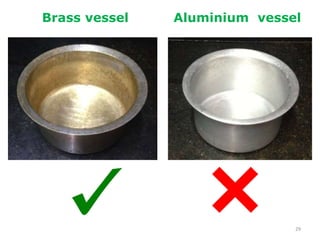
  • 94.
    3.22 Asana mostsuited to students Sarvangasana : This asana sublimates the sexual energy into OJHAS and increases “intellectual power many times”. The need for masturbation or night discharge will be minimized by practicing this asana on a daily basis. This asana to be performed on a soft bed sheet. Should not be done beyond one’s limit. Should ________ Asana after performing this asana. 94
  • 95.
    3.23 PRANAYAMA Pranayama isthe fourth ‘limb’ of Ashtanga yoga of patanjali. Pranayama to be practiced after learning from a qualified guru. Pranayama cleans the 72000 nadis inside our body. Pranayama calms the mind and controls our emotions especially the negative emotions. Anuloma/Viloma or Nadi Shuddi Pranayama and kapalabhati pranayama known to cure/mitigate many common/chronic diseases. Practice pranayama daily at least 15 minutes Timings :- Sun Rise or Sun set & empty stomach. 95
  • 96.
    3.24 Daily Routinehas Spiritual and Health Significance 96 Brushing Tooth -To be done before sunrise. -After sunrise – not good for health After Bath - Apply Tilak on head - Then Pray God - Then Do Pooja Taking Food - Offer to God before taking food - After feeding guests, poor and orphans - Should feed animals also Night - Pray God before sleep – prevents bad dreams
  • 97.
    3.25 Efficacy ofprayer in curing diseases It is proven worldwide by experiments that ‘Prayer’ on chosen deities helps in quick healing of chronic diseases. Prayer to be done when alone and in silence. No other thought except the chosen deity to be concentrated. If ‘Mantra Deekshaw’ is taken from a “Guru”, repeat the “ Mantra” silently as many times as possible. One pointed prayer enables reception of cosmic energy by body and helps in curing chronic diseases. 97
  • 98.
    3.26 Excess useof cell phones, Tabs & Laptops  Do not use cell phones with Right ear.  Do not talk in cell phones for long or when you have land line phone with you.  Do not use Tab/Laptop for longer duration at a stretch. Give rest after every 1Hr or so.  Do not allow children watch videos / games / movies in mobile phone, Tab or laptop as it causes itching in eyes and rubbing of eyes damages the eyes. Instead use TV for watching videos / games / internet / movies.  Do not keep tab / laptop on thighs – the bones will become brittle.  Do not keep mobile phone anywhere in pocket as for as possible hold it with your hands and keep it at more than a feet while sitting anywhere. 98
  • 99.
    Chapter 4 4.0 UnderstandingChildren Office & house – understanding one’s prakruti is important. Do not compare two children Each child is excellent in some fields Comparison is not good for a child’s health Comparison leads to Inferiority complex in one child. 99
  • 100.
    4.1 KAPHA Natureof Child kapha persons have more storage capacity Kapha persons have good memory capacity Once understands, can’t forget Child need not understand Child should be made memorize different subjects. Memory capacity is more in children Let children memorise ‘GITA SLOKAS’ Movie songs & dances not good for children children shouldn’t be used to enact “elder roles” i.e., acting as “old people” etc. 100
  • 101.
    4.1(a) Children &Kapha  Children: Kapha is more – Hence, they should be encouraged to have more sleep • Less than 04 years – 16 hours of sleep • 04 – 08 years – 12 – 14 Hours • 08 to 14 years – 09 to 10 hours  Therefore, up to 3rd Class: Children should not be woken up forcibly, since sleep requirement will not be met – leads to long term effect on psychological mind.  School going Children up to 3rd Class • 11 A.M. is best timing. • 08 A.M. is worst timing • For 4th to 10th class – Should be made 09 to 10 A.M. 101
  • 102.
    4.2 Effect ofexcess Vata on a Child  Children  kapha is more.  Youth  Pitta is important  Old  Vata is important  If a child is hyperactive  Vata in child child becomes old fast.  Children are given foods which increase vata  Children should play instead of watching cartoon etc.  Vata can be there in a child – but vata excess shouldn’t be in a child  If a child is active, and extravert though it is vata nature of child but it is positive.  Hyperactive  effect of vata excess  Understands any matter easily but forgets very fast  Child should be given cheese 102
  • 103.
    4.3 Important tipsfor bringing up children Children should sleep by 08.00 P.M. Less sleep leads to unrest & Anger. Children should not be disturbed in sleep. For studies, Kapha should be less. Kapha is more on Head & Ear. Oil massage to be done to control Kapham. Yoga, Pranayam – Not good for people having Kapham 103
  • 104.
    4.3 Important tipsfor bringing up children Children up to 8 – 14 years yoga not recommended. Don’t give sermon – follow what you want your children to follow. Give freedom but don’t be licentious Be punctual Do some exercises or play Do go to temple & take children to temples once in a week. Bow to your parents in front of your children Children cartoon Films  becoming cartoons themselves. 104
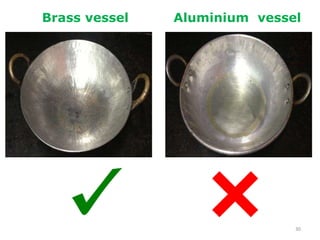
  • 105.
    4.4 Art ofparenting – Set Goals for children Child is not an animal You can set a goal unlike animals Set goal at each age for children from 6 years onwards. So that by age 18, children can set their final goal. 105
  • 106.
    4.4 Guidelines forParents Direct to higher education in vedanta Learn the technique of living a life & guide the children Do your duty in a detached way Culture of India – life based on duties & not on rights. West – Reverse Slowly value system changing Rights have become more important now 106
  • 107.
    4.4 Guidelines forparents Love towards fellow beings. Compassion towards animals Feeling of affection towards subordinates. Gratitude to god, parents, nature, relations, friends, etc., Do not have superiority or inferiority complex. 107
  • 108.
    4.5 - 20Manners to be taught to growing up children by parents  Take bath daily – keep body clean  Keep nails of fingers clean by trimming them regularly  Wear loose cotton clothes instead of Nylon clothes which are harmful to health.  Get rid of keeping fingers in nose, mouth, biting nails etc.  Do not read in excess light or dim light. Do not read in sleeping or bending postures.  Keep your house and surroundings clean.  Do not waste water and power.  Do not use knife on tables. Do not spoil walls with pencils & pens. 108
  • 109.
    4.5 - 20Manners to be taught to growing up children by parents  Do not keep legs on books – do not use books as pillow. Do not use mouth saliva to turn pages in a book.  Do not keep fingers in milk or water. Drink clean water always.  Do not spit or urinate in bushes, trains & public places. Do not throw fruit waste, paper etc on roads. Remove glass pieces, thorns, stones on road.  Know value of time. Avoid useless talk and useless works.  Always speak truth. Do not speak lie due to fear or money.  Do not harass weak and those younger to you. Help them to the extent possible. 109
  • 110.
    4.5 - 20Manners to be taught to growing up children by parents Don’t heckle anyone. Don’t accuse others. Don’t irritate blind, physically handicapped people. Always respect parents, elders and gurus. Don’t show disrespect to any nations flag, song, religion works, saints. Don’t blame any religion. Always be happy and cheerful Pray to god regularly. Strength to mind due to prayer can’t be obtained in anything else. 110
  • 111.
    4.6 Nutrition &Children Many recent studies in nutrition are gaining popularity because they are resulting in happier, smarter, and less hyperactive children. Parents who follow these guidelines are also finding their lives less stressful and more fulfilling. To have children who are smart, loving and helpful makes life a breeze compared to dealing with children who are out-of-control, hyperactive, unfocused, and even violent and aggressive. 111
  • 112.
    4.6(a) Your Child’sBrain Just as the traditional "Authoritarian" and "Punitive" style of parenting has become outdated, so has the approach to eating which does not take into consideration the unhealthy effects different types of foods have on your child’s brain. 112
  • 113.
    4.6(b) Preservatives &Effect on Children Preservatives are used to increase shelf life. By just removing harmful preservatives, you will notice a difference in your child's behavior. Apart from unhealthy hydrogenated oils, trans fats, artificial flavor and coloring, salt and sugar, packaged foods high in preservatives affect brain development. 113
  • 114.
    4.7 Sugar andWhite Flour Products Refined white sugar, as well as foods made with processed white flour, is an addictive processed food that acts more like a drug. It reduces thyroid function, causes tooth decay, causes mood swings, impairs healing, and adversely affects the immune system. Reduce sugar, or eliminate it completely, from your child's regular diet. This will increase concentration levels, immunity to diseases, and improve behavior, as well as prevent thyroid disease and tooth decay. 114
  • 115.
    4.7 Sugar andWhite Flour Products White rice is a processed food. The bran has been removed, which changes the rice from a complex carbohydrate rich in protein and B vitamins to a simple carbohydrate, which raises blood sugar levels and contributes to diabetes. Try to substitute brown rice or include it in the diet, along with whole grain breads. Giving seeds and nuts to your child instead of fried snacks, like chips, will give your child Omega 3 fatty acids, which are known to improve brain function and reduce heart disease and attention deficit disorders. 115
  • 116.
    4.8 Diet &Children "Mood swings, inability to concentrate, temper tantrums, and the most significant—low self- esteem—are all the affects of too much sugar in your child's diet." Kathleen DesMaison, Author Little Sugar Addicts. Do not send sweets, candy, chocolate, cookies, or other foods high in sugar to school with your child. Avoid adding sugar to your child's milk. Gradually, your child's sense of taste will return to normal and the natural sweetness in foods can be enjoyed. 116
  • 117.
    4.8 Diet &Children Instead of giving sugar, substitute natural, more healthy sweeteners, like jaggery/gud, and honey, but limit these to 2 times per week. Give fresh and dried fruit if your child wants something sweet. Try to limit cake, ice cream, and chocolate to special occasions. Important point: If you want to improve your child's behavior, eliminate sugar completely from the regular diet. We understand it is unrealistic not to have something sweet for your child once in a while, but on a daily basis, try to eliminate sugar and you will see results within just days. 117
  • 118.
    4.9 List ofCommon Foods Below is a list of foods high in sugar and low in nutrition that you should avoid giving your child on a regular basis and foods you can substitute, which are especially good for vegetarians. (Substitutions are available at good supermarkets, as well as Spencers, Fresh, and Balaji). Remember: natural foods may seem more expensive but you use half the amount. 1/2 cup of brown rice will be more satisfying than 1 cup of white rice. 118
  • 119.
    Old Choice InsteadTry Fruit Juices, Sodas water or fresh squeezed juice without added sugar. Chips salted nuts and seeds home fries (potatoes cooked with less oil and salt, not deep fried) sun dried products made at home Packaged cookies biscuts homemade cookies with jaggery, & raisins and other dried fruit 119
  • 120.
    Old Choice InsteadTry Packaged cereals Ragi sweetened with honey White bread and Nan Roti, Pulka, or brown bread without preservatives Maggi Noodles whole wheat spaghetti, tube and spiral pasta, whole wheat vermicelli with homemade tomato sauce Crackers carrot sticks and sliced apples Ketchup homemade chutney made with tomatoes, vinegar and jaggery 120
  • 121.
    Old Choice InsteadTry Store-bought peanut butter Dry roasted peanuts at home ground in the mixer with a little salt until creamy. Sweets, such as gulab jamoon, candy raisins, til ladus made with jaggery in decorative paper or on a stick, frozen pieces of fruit on a stick, banana fried with ghee and jaggery as a treat. Ladus made with sugar Dried fruit ladus without sugar 121
  • 122.
    Old Choice InsteadTry White Rice brown rice, which has more fiber, B vitamins to help brain development, more protein, and doesn't raise blood sugar levels. Try giving ½ white rice and ½ brown rice as a start. Puri Pulka Curds with sugar Curds with sliced banana and honey, raita 122
  • 123.
    4.10 How Noodlesare prepared? Stale Rice, Pig fat. Noodles are worst kind of food. Noodles damage the body more than any food. Avoid Noodles completely. 123 4.11 Avoid deep fried foods – use boiled vegetables  Mixed with seasoned cold oil, salt and lime, and offer as many varieties of salads as possible.  Avoid deep fried foods, which are considered oxidized and high in cancer- causing free radicals.  Organic, pesticide-free and preservative-free foods are what to offer small portions of steamed vegetables nature intended.
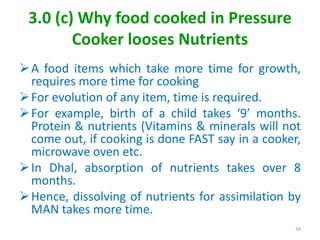
  • 124.
    Be Patient  Important:Some children who have been eating candy and cookies and chips and other packaged foods high in sugar on a regular basis will go through sugar withdrawal when you eliminate these foods, and their behavior may get worse for a brief period of time. This is normal. Stick it out. Be gentle and loving. It will only last a short time before you see a wonderful transformation. Set Example  Be consistent and firm about dietary changes. Bad habits don't change over night. Once the addiction to sugar and unhealthy fried and processed foods is broken, your child will be smarter, healthier, and happier and able to appreciate the goodness in natural foods. Also, children learn by example. Follow these guidelines along with your child. 124
  • 125.
    Chapter 5 5.0 Howcow is killed?  Not given food & water for some days so that meat is tasty.  Then beaten mercilessly.  Then 2000 water is poured to remove hair.  Then cow is hanged with head down & then its head is cut.  When cow body beats the earth, its skin is removed.  The painful emotions of cow enter the meat and all products used by mankind and affects those who use them.  All those who use cow products are committing great sin.  Toothpaste - Use cow dung based or ayurvedic based like vajradhanti.  Soaps - Use aloe vera/cow dung based.  Leather products - Do not use cow based leathers. 125
  • 126.
    5.1 Economy ofcow slaughter  Profit from one cow slaughter - Rs.5000  No. of cows killed per day 50,000  Profit per year = 50000 X 5000 X 365 = 9000 cr.  Other products = 90,000 cr p.a  Profit margin are 20 times.  Hence the industries purchasing Politician – bureaucracy under politicians  Then how to fight the lobby?  Do not use products having cow based items like soaps, tooth paste, leather bags etc.  Encourage cow farming  1947 – 30 cr population 30 cr cows population  2000’s-- 120 cr population 7 cr cow population 126
  • 127.
    5.2 Cow Profitability Monthly at least 1000/- profit per cow is possible  7cr X 100 = 7000 cr profit per month = 84000 cr per year  90000 cr profit per year by killing 18 lakh cows per year is better or 84000 cr per year profit by saving cows is better? THINK  Take pledge today not to use  Soaps having cow fat  Toothpaste having cow bone powder  Leather products having cow leather  Pain killers having “VOVINE” i.e., cow blood • Take pledge to use  Cow milk & ghee  Cow dung Ayurved based soaps & tooth paste  Cow urine based hand wash, after shave lotion.  Cow dung based ash for water sterilisation.  Cow dung based Agarbatti. 127
  • 128.
    5.3 Products usedby killing cow Daily 30,000 cows killed everyday. Cow is killed in a brutal way. Any tonic mentions “VOVINE” that tonic contains “cow blood”. In soaps, fat from cows are used. Toothpaste – cow bones powder used. Painkillers – cow bones powder used. Use cow urine instead of pain killers. Chappals, bags Cow leather used. Purse, car seats etc cow leather used 128
  • 129.
    5.4 Cow dungAsh  Ash relieves the pain poisonous insect bites.  During rainy season, when boiling is not possible due to floods, ash in drinking water will prevent water borne diseases.  When on tour, always keep cow dung ash since we do not know the quality of mineral water.  Agarbatti made of cow dung. Ash generated from Agarbatti can be used in water.  Tooth powder using cow dung ash plus mineral salt will give strength to teeth & gums and removes foul smell.  Do not keep tooth brush inside bathroom as it attracts bacteria & virus which are high in toilets  Brush gums with fingers and tooth powder. 129
  • 130.
    5.4 Cow dungAsh  Bad smell in fridge, put coal (cow dung) piece inside -- it will attract bad odor.  Use fingers on “tongue” – it will enable cleaning of throat  Those who have sinus should use fingers on tongue  Those who have stammering also use fingers on tongue  Cow dung absorbs poison of snake & other insects  Cow dung based soap removes skin diseases & skin glows.  Children also can use soap during exams  Cow dung based food items have good taste. Food will be saltvic  Fertilizer foods effect: • First fertilizer used in Punjab & Assam. • Terrorists started from Punjab & Assam. • Cancer increased in Punjab. 130
  • 131.
    5.4 How touse cow dung ash soap ?  For every 10 litres, add ‘5’ pinches of ash.  For killing bacteria in water, add cow dung burnt powder or cow dung based agarbatti stick burnt ashes.  How to use cow dung based soap? • Keep soap in water for one minute  How to use coal of cow dung for brushing teeth? • Keep in mouth for 5 minute and then brush the teeth  Highest No. of cows  Rajasthan  1 Cr 10 Lakhs in Rajasthan out of total 7 Cr Desi cows in India 90 lakh are in Famine Area  Need for everyone in India to contribute for “Cow Seva” i.e., protection of cow. 131
  • 132.
    5.5 Cow Urine Relieves asthma  Relieves pain of cancer  Any one suffering from infections, cow urine works wonders  Cysts, tumors in body. Medicines with cow urine work wonders  Cow products have “Pranashakti”  Cow urine when added to any medicine, its power increases manifold.  ‘Prana Shakti” knowledge is known to Indians only.  Indians have to teach world the importance of “Prana Shakti”. 132
  • 133.
    5.6 Cow Milk& Buffalow milk  Buffalo milk  looses nutrients on boiling  Cow milk  no loss of nutrients after repeated boiling  Cow milk  boil in iron vessel instead of steel  Iron will be supplied to body  Boil milk slowly  Use Ghee in cow milk  Stir with wooden spoons or with a piece of Roti  Ulcer & constipation will be cured  Cow ghee  Purity test • If your weight looses by 8 kg in a month and Cholesterol decreases, ghee used is pure cow Ghee 133
  • 134.
    5.7 Desi CowVs Jersee Cow Milk/Ghee Dosage --> Solid -- 2 small spoons /day of Ghee --> Liquid – 6 spoons/day Take khichdi with ghee two times a week Laddus / sweets etc., cow ghee based sweets only to be taken Jersi cow milk is cancerous & causes diabetes Desi cow cheese is better for children, while ghee is better for elders 134
  • 135.
    5.8 Cow Gheebenefits ?  How to use ghee for gas trouble ? • Pour 2 drops of ghee in each nostril. • Use tonic made from cow urine – take one cup with one cup of water  Cow ghee from cows which have been given “grass” with “seva” bhava will be extremely useful.  Cows which eat on roads  ghee will not be that effective  Cows to whom injection is given also will not be effective  But if you take ghee by chanting/remembering God, it will be useful also.  Ghee can be given to even two day old child. 135
  • 136.
    5.8 Cow Gheebenefits  Cow ghee – two drops in each nostril every day has many advantages • Dreamless sleep • Ear problems will be cured • Helps in curing of following diseases: • Migraine • Paralysis • Hyperactivity of children will reduce • Sinus • Frozen shoulders • Coma • Asthma • Hearing problems • Forgetfulness • Sleeplessness • Hair loss • Tension • Ulcer & acidity  Lie down without pillow.  Put one or two drops in each nose.  Do not talk – keep quiet for 10 minutes.  Do not drink water for 10 minutes. 136
  • 137.
    5.8 Cow Ghee& Arthritis  Arthritis : cow milk boil + turmeric  Then add few drops of cow ghee  Take the liquid, from 15th day it will give result. 5.8 Cow milk with cow ghee Taking Cow milk with cow ghee Relief for back pain Arthritis Ulcer Acidity Constipation etc 137
  • 138.
    5.8 Who shouldn’ttake Ghee  Those who have ameobiosis shouldn’t take ghee.  Also those who get blood in stools, shouldn’t take ghee. 5.8 Nature of Curd/Ghee/Cheese/Butter Milk  Curd causes heat in body  Butter milk cools the body  Ghee cools the body  Cheese cools the body  Pregnant women should take curd in silver vessel  Make curd using cow milk in silver vessel.  Buttermilk + Rock salt in the morning cures kidney stones (others should not take buttermilk in the morning or night).  Butter milk daily during lunch time  no cataract problem and protects from jaundice, malaria & Thyphoid. 138
  • 139.
    139 COW Urine BasedBase products Hand Wash After shave lotion Nose Drops Hair Oil
  • 140.
    Chapter 6 6.0 Ayurveda Ayurvedaplants. First we should bow before them & pray before them like we do for “Tulasi” tree We should take the plants in “surrender” attitude Medicines in ayurveda are given only after a doctor physically examining the ‘prakruti’ of an individual. 140
  • 141.
    6.0 Ayurveda Moraltake ayurvedaproducts from an ayurveda doctor only. Ayurveda has many remedies for a disease. Ex. Cold, fever etc., Suitable remedy to be selected depending on one’s nature Otherwise what is good for one may not be good for others. Ex. Pitta & kapha type of persons need different treatment Therefore understanding one’s prakurti & nature of remedy is critical in suggesting a remedy for a disease. 141
  • 142.
    6.1 Tri Doshas Panchabhutasmaintain the Universe and the tridoshas (Vata, Pitta & Kapha) maintain the body as shareera doshas and trigunas (Satwa, Rajas & Tomas)the mind doshas Dosha Mahabhuta Vata Akash & Vayu Pitta Agni Kapha Jale & Prithvi (Earth) Akash Satwa Vayu Rajas Agri Satwa & Rajas Jala Tomas & Satwa Earth Tomas 142
  • 143.
    6.1 Tri Doshas When the doshas are in balance i.e. in a state of equilibrium, we remain healthy.  Disease is caused, when there is imbalance within the three doshas. It is important to realize that, these are forces and not substances.  Kapha is not mucus - it is the force that causes mucus to arise. Similarly, Pitta is not bile- but force that cause bile to be produced. II(a) Strongest Dosha in Body has the tendency to increase & one is more susceptible to illnesses associated with an increase of the Body constitution doshas. Example: If one is Pitta type, then Pitta type diseases are common. So, avoid Pitta type foods especially during lunch.143
  • 144.
    6.1 Tri Doshas II(b)Body constitution Dosha to be identified. How to identify? Morning: Pulse rate 60 – 70 - Kapha Dosha 70 – 80 – Pitta Dosha 80 – 90 – Vata Dosha (III) Influence of Doshas during a Day Morning – Vata is predominant Afternoon – Pitta is predominant Evening – Kapha is predominant A person whose Body constitution is Pitta, should avoid foods which increase Pitta during lunch time. He should take Pitta Nashaka / Controlling foods. Example: Ghee controls Pitta. Buttermilk controls Pitta. Birth to 13 years – Kapha is more, 13 years to 60 years – Pitta is more, > 60 years – Vata is more144
  • 145.
    6.2 Diseases dueto excess Kapha/Vata/Pitta (IV) Sl. No. Dosha Diseases due to excess of dosha 1. Vata Gas, Asthama, Arthritis, Blood pressure, Backpain, Heart attack, Brain tumer, Paralysis, Acidity, constipation, dandruff, foot & skin diseases, lips breakage, stiffness in legs hands shoulders etc., Thyroid. 2. Pitta Ulcer acidity hiccups food smell in mouth after taking food, liver, kidney, cancer, jaundice. 3. Kapha Cold, Cough, Obesity 145
  • 146.
    Effect of variousfoods on Kaphs/Vata/Pitta in the body (V) Sl. No Food Controls Increases 1. Jaggery Kapha 2. Cooking Oil Vata 3. Tamalapaku (Betel leaves) Kapha & Vata 4. Triphala Kapha, Vata & Pitta 5. Mentulu (mint seeds) Kapha + Vata Pitta 6. Lime Vata Calcium 7. Cinnamon (Dalchina Chekka) Vata & Kapha 8. Voma pitta 9. Zilakar, Inua & Dhania pitta 10. Ghee Pitta 146
  • 147.
    (V) Sl. No.Food Controls Increases Remarks 11. Sonti Kapha pitta 12. Honey Kapha 13. Sompu Kapha 14. Lavang Kapha 15. Milk, Curd, Butter milk Vata 16. Juices Vata 17. Cow urine Kapha/Vata/ Pitta 18 Radish (Raw) Vata Pitta Ripe Radish is not good 19 Beetroot (Raw) Pitta 147
  • 148.
    (V) Sl. No.Food Controls Increases Remarks 20 Brown rice Pitta 21 Fish Vata Kapa, Pitta 22 Mutton (sheep) Kapha Pitta, Vata 23 Kakara Pitta 24 Spinach (Palakura) Vata Excess intake may form stones in Kidneys 25 Pumpkin (ripe) Vata 26 Pumpkin (unripe) Vata 27 Louki (Dosakaya) (unripe) Pitta 148
  • 149.
    (V) Sl. No.Food Controls Increases Remarks 28 Karivepaku Vata Kapha Improves digestion, removes constipation 29 Ponagavti Leaves Vata Kapha Pitta Good for eyes 30 Garlic Hiccups Pitta Good for heart, leprosy 31 Grapes Vata Pitta Creates bad smell in body. Good for eyes, seiman production, removes urine related doshas. Removes tiredness & slimness 149
  • 150.
    (V) Sl. No. Food ControlsIncreases Remarks 32 Pomegranates (Sweet) Vata & Kapha also Pitta Vit B2. (10gm is adequate per day) 33 Sour Pomegranate Pitta , Vata 34 Mango (ripe) Vata Pitta Good for heart Avoid sugar 35 Jambul Kapha Pitta Vata Cures kidney problems and diabetes 36 Tamarind Vata Pitta Kapha Controls Motion and urine 37 Pepper Kapha Pitta Useful in winter 38 Ginger Vata Kapha Pitta - Do - 150
  • 151.
    6.3 Gunas inperson 151 Guna in a Person strong/ Dominant Time period of day Sattwa 4 AM – 6 AM Rajas 6 AM – 6 PM Tapas 6 PM – 4 AM Any analytical or critical or different works requiring intellect  do between 4 AM – 6 AM Poetry/ book writing  do between 4 AM – 6 AM Books written during day time will not have depth and will not be much useful for the spiritual development as well as “material prosperity of an individual”. Books written in 4 – 6  readers will be able to understand and apply the knowledge in the book in their lives Powerful intellect is required to put the knowledge, intelligence gained to practical use in life. Students should read between 4 AM – 6 AM for reading difficult subjects & better retention.
  • 152.
     In villagessudi gali (spiral air) comes, akash is in red and villages run away from it and keep all their belongings inside house and close windows and doors.  If we do not close doors, then dust will enter our house  To clean dust, vacuum cleaners are offered as a technological solution  In a similar analogy, if excess of air comes inside our body, we do not protect our body  If we feel stiffness in legs, hands, neck, stomach, shoulders etc be sure that vatam is more in your body  Paralysis: when vatam in body becomes excess, paralysis results  Similarly parkinson disease. If your hand is shaking then vatam is more Chapter 7 7.0 VATA & Its Nature 152
  • 153.
    • Highest speeditem in micro world? Mind • Macro world highest speed air • If air is in rhythm even if at speed, then no problem • Veena Rhythm is there • Brake dance no rhythmvata diseases will increase if brake dance is practiced for longer periods. • Heart diseases, acidity etc more of vata disease than pitta • Acidity : food doesn’t move inside body stays for more time in body as a result acids are formed 7.0 VATA & Its Nature 153
  • 154.
    When something isin stomach, acid is released to digest the food. If food doesn’t move even after digestion, excess acids released stay in stomach and damage the intestines and also increase acidity of blood. Constipation vata related disease Breathing problem asthma vata diseases Heartbeats  vata Rhythmic air movement does not increase vata It is only un-rhythmic air that causes increase in vata 7.0 VATA & Its Nature 154
  • 155.
    7.1 Diseases dueto excess ‘vata’ Paralysis Heart Arthritis Acidity Constipation Asthma Thyroid 155
  • 156.
    7.2 Nature/Properties ofVATA • Vata – mixture of akaash & air • Akaash  inactive • Air  5 ‘’gunas’/properties Speed Touch / Dryness Coolness Self occupation of space Change 156
  • 157.
    7.3 First propertyof Air : Speed Ceiling fan • Increases vata • Don’t sleep directly under ceiling fan • Sleep away from fan • Fan speed to be slow • Use pedestal fan instead of ceiling fan • Cover ears with monkey caps, light weight bed sheet & Cover body with bed sheets Driving motor cycle • Don’t run fast. Below 40 Kmph is OK. Train journey • Do not sit near window 157
  • 158.
    7.4 Second propertyof Vatam : Dryness What we do if lips dry/break ? we apply vassoline But vatam is increased not only in lips but also entire body. The increase of vatam is expressed as “breakage of lips”. We should not restrict to applying Vaseline we should treat entire body. Similarly “dandruff” Apply “oil” for hair Also massage oil over entire body. Similarly “cracks in feet” Instead of attending to basic cause i.e., increase in vatam, we try to treat the symptom alone. 158
  • 159.
  • 160.
    7.4 Second propertyof Vatam : Dryness • If we do not reduce vatam inside body, it will reach “intestines” • If intestines become dry, then food will not move. • This leads to constipation. • Constipation is due to vata excess. • Nature cure people give Enema to “constipation people” which further dries the intestines and increases vata in body and hence constipation aggravates. • The patient becomes “chronic patient” what to do? • Add ghee in milk. If we neglect, dryness (i.e., vata increase) it reaches blood vessels • Any dry product gets solidify. • The arteries become blocked. 160
  • 161.
    161 Oil massage onbodyVaseline
  • 162.
    7.4 Second propertyof Vatam : Dryness  As there is dryness in arteries, heart has to pump blood at high pressure so that blood reaches all parts of body.  High blood pressure controller  take pure desi cow ghee.  If arteries become dry, cholesterol get stuck up on the walls of bold vessels.  Solution: Take pure desi cow ghee. Ghee should be prepared using hand and wooden tool and not aluminium/steel tool and should not use machines as is being done now a days in factories.  Due to use of machines, friction is generated which spoils the Pranashakti in ghee.  If you neglect further, cholesteroal reaches blood vessels & stick to veins and obstruct flow of blood 162
  • 163.
    7.5 Third propertyof vatam “coolness” Coolness increases vatam In cold climate, pains increase for vata patients like heart disease, asthma etc., 90% pains in body are due to excess vata. Present day fashion –‘starter’ If starter is not in your body then why go to a dinner? ‘starter’ culture is for cold climate countries. Blind imitation of west is doing immense damage to health of Indians. Dessert - ice cream – cold item after hot dinner – spoils whatever eaten. 163
  • 164.
    7.5 Third propertyof vatam “coolness” If you want to eat ice cream, eat before dinner. Ice cream  dinner soup. Do not take cold water after eating ghee or ghee related products. Take hot water after ghee is taken Arthritis take hot water after food is taken or hot lemon juice or hot rasam from dhal Massage the body with warm ‘Til’ oil daily Take luke warm ‘Til’ oil of one spoon daily with food in the morning 164
  • 165.
    7.6 Fourth propertyof Air To enter empty space and stay there • Sleeping directly under fan aggravates thyroid disease. • If you want to sleep under fan, pour 1-2 drops of pure coconut oil in ears & not parachute oil once in 2 days. Then close ears with “cotton” • Also use 1-2 drops of ghee in nostrils. • When you sleep directly under fan, your face becomes bulge in the morning. • Whenever you are on fasting take hot water. • Do not take cold fruit juices during fasting time. • Prolonged fastness – leads to entry of air and leads to various diseases. 165
  • 166.
    7.6 Fourth propertyof Air To enter empty space and stay there Pain in hands, legs, back pain etc. Some people are very thin  due to excess vata Vayu dries a person. Similarly obesity is due to excess vata. When excess air enters, leads to obesity. When air is removed, body becomes thin Taking pure cow ghee reduces 8-10 kg weight in 2-3 months. 166
  • 167.
    7.6 Fourth propertyof Air To enter empty space and stay there 30 years back  obesity due to excess air  now ‘fatty’ people Take ghee in milk and mix using two Lotas / steel utensils for 25 times. Then take hot butter milk. How to reduce weight Pure cow ghee in food (Breakfast / Dinner) Pure cow ghee in milk (Dinner) Hot butter milk (Lunch) Pure ghee in nostrils (Night before sleep) 167
  • 168.
    7.7 Fifth propertyof Vayu – ‘change’ • After waking up, body will be hot – taking cold water will harm • Take normal water after 15-20 minutes • Taking hot / Luke warm water is OK. • Do not take normal water immediately after urine/motion/bath After urine frequent urine disease After motion  constipation After bath  skin diseases, gas troubles, pneumonia, strain on lungs • But you can take hot water if you are too much thirsty. • Take water before urination/motion/bath 168
  • 169.
    7.7 Fifth propertyof Vayu – ‘change’  Night 2 pm  you can take cold water since you will go to sleep again  Sleep  waking up sleep . no change in ‘state’ & hence no problem.  Women – do not drink after coming out of ‘kitchen’   Take water before work is completed in kitchen.  Walking/playing in sun   you can take water if you are under sun – but if you come to shade from hot sun, do not take normal water immediately   wait for 20 min   can take hot water.  After a ‘change’ do not take water. Ex. urination/motion/bath/walking any playing etc. 169
  • 170.
    7.8 Bigger events/changes Accidents •Do not give cold water • Give hot water (hot tea) • If you are in jungle take urine 170
  • 171.
    7.8 Other majorchanges like Marriage for a man/woman is a big transformation Do not take cold items for 40 days after marriage. Taking cold items  vata property of dryness will increase If this property enters in mind, person becomes “harsh” and soft mind becomes rigid. As a result, adjustment becomes difficult. Any product  when dries  becomes rigid. What to eat? Ghee, sweet products Do not eat maida based products Do not eat pizzas/bhel pooris Do not take dried/burnt products after marriage 171
  • 172.
    7.8 Biggest changefor a woman is becoming mother Rajasthan  mothers stay in room not having windows/ ventilators. No air in room  woman is protected from excess vata Pure ghee to be taken Massage of body with oil Ghee in nostrils Oil in ears (Coconut) Oil on Navel (Til or coconut) 172
  • 173.
    7.9 Usefulness ofoil on Nabhi  Heat in intestines is reduced  Lips will not break  Massage oil clockwise & anti clockwise around navel before bath  At night also do above when ghee is taken in nostrils.  After birth of a child, air tries enter the gap inside body.  Vata increases  Ghee will reduce excess vata  70% of diseases are due to excess vata  Vata has effect on mind  Those suffering from mental diseases treatment of body also to be done along with MIND.  Mad people  body also to be treated 173
  • 174.
    7.10 How doyou remove air from a pillow? By pressing it Apply pressure on body Massage the body – use warm ‘Til’ oil Excess vata will go out of body Massaging is must at last 2-3 times a week Press legs for 15 minutes Pressing legs removes excess vata Olden days  elders legs are pressed Daily pressing of legs will help in removal of excess vata Massage from bottom to top i.e., towards direction of ‘heart’ 174
  • 175.
    Chapter 8 8.0 PITTA& its nature  Pitta  Agnitattvam  Nature of Agni • Burning • Illumination • Red & yellow colour ex.fever – face becomes red - excess pitta • Bad smell • Expansion/melting  Red blisters etc  due to excess pitta  Yellow eyes  due to excess pitta  Jaundice  pitta disease  Examples. Food gets spoiled in summer and emits foul smell175
  • 176.
    Mouth smell Bad gasesfrom mouth Budhi and pitta has a relation Budhi  head Brain is always in heated condition as it works always. Brain works better under cold conditions Air conditioning help in brain function. Now and then brain to be given rest and to be cooled – How ? Meditation, picnics. Max damage to an organ due to pitta diseases. Eg. Kidney disease, liver damage, uterus damage. 8.0 PITTA & its nature 176
  • 177.
     After manyyears of increase of pitta, organs get damage.  Early detection of increase in pitta and measures to control pitta will help a lot.  When pitta is excess, we should not take cold products ex.hot bulb – if cold water is poured, bulb gets fused.  So take products which control pitta like a radiator of a car. Then pitta in body will be in balance.  12 AM  sun at peak , if you take fruit juice, pitta increases  We should take products which cool body in the morning. By 12, body becomes cool Ex- coconut water, Ghee.  Heat does not increase in the afternoon  Eating icecream, cold drinks, fruit juices during afternoon to be avoided 8.0 PITTA & its nature 177
  • 178.
    8.1 Why Pittaincreases in body? (a) Anger (Krodham)  When some one speaks with anger, we say he is speaking like a mad fellow  When pitta increases, budhi doesn’t not function properly  Remedy is not giving water  It aggravates further  Correct Remedy • With folded fist, hit pillow/mattress 10 times • Energy of anger will be earthed • Anger energy has to be diverted  In office: hold your fist as well as tighten the leg muscles and then release. Anger energy will be released. 178
  • 179.
    8.1 Why Pittaincreases in body? (a) Anger (Krodham) When children make mistake, do not get angry and beat them Children should be made to understand the mistake When someone comes to home in angry mood do not give “masalas” etc, but give sweets/ cool products Oil increases pitta Ghee reduces pitta We can control pitta, vata & kapha with right kind of food at right time. Summer: After mangoes, take milk or take neredu fruit. 179
  • 180.
    8.1 Why Pittaincreases in body? (b) Second reason for increasing pitta is “sorrow” Due to sorrow pitta increases Face lustre goes away Whenever there is change, pitta increases 180
  • 181.
    8.1 Why Pittaincreases in body? (c) Third reason for increase of “Pitta” is fear Face becomes green/yellow in fear Fear of money If kings are in fear, people will be in fear Woman – fear of safety Many diseases due to fear 181
  • 182.
    8.1 Why Pittaincreases in body? (d) Fourth reason for increasing Pitta is jealousy  Jealousy may lead to cancer also.  Serials in TV are spoiling the society  Joint family system collapsed  Husband & wife getting separated  More TVs will be sold if No. of families are more. Hence wrong values system propagated through TV serials.  Ads in TV are causing further damage  When TV came to India, TB has come to India  If we are away from TV, both pitta & vata will be controlled.  Because of above 4 reasons, pitta increases manifold. 182
  • 183.
    8.2 How toidentify Excess PITTA  If your legs & hands sweat and sweat has bad smell then heat is increasing inside body.  If you neglect for 8-10 years heart will be damaged.  If your urine is yellow, then heat is more in body. If after taking water also, urine is yellow, it implies that there is excess Pitta inside the body.  Bad smell from body, do not control bad smell by perfumes. Control the cause of bad smell i.e., increase in Pitta. Take cool products  Cold and nose watering. In mother tongue, cold is called “ cold due to hot”. In English hot is gone.  Cold is due to excess pitta.  But hot products are given for treating cold.  Take coconut water in the morning, butter milk in the afternoon. Ghee in the morning. 183
  • 184.
    8.3 How tocontrol excess PITTA  Summer: drinking water in silver vessels or silver coin in a pot containing water is ideal to control PITTA in the body.  Drink coconut water in the morning to control PITTA  Murappa with amla or maredu, should not be taken in afternoon or evening  Sunset time  do not take cold products. But if you go out in sun at 4 PM, then you can take fruit juice.  Foods which cool body to be taken before onset of heat in the body.  12AM-4PM and 12 PM – 4 AM are Pitta timings  Take products which cool body between 8 AM – 12 AM and 8 PM – 12PM 184
  • 185.
    8.3 How tocontrol excess PITTA  Taking tulasi decoction or turmeric decoction or taking tea, temporarily gives relief but increases PITTA and increases disease.  Solution  take coconut water in the morning  Do not take cold drinks in the morning  Do not take butter milk in the morning  Small kid having loose motions. Mother should take “radish” in the morning. Mothers should take “pure ghee” to reduce heat in the body. Take radish in Jan.  A food item will have its “guna” effective if it is grown during the time suited for it.  If mangoes are grown in winter, then they will not have their positive effect. 185
  • 186.
    8.3 How tocontrol excess PITTA  Take groundnuts in the morning only. Evening gas will be produced. Groundnuts will cool the body.  Buttermilk : buttermilk will not cool the body like coconut water. Hence it can be taken during afternoon also .  In everyone’s body, some organ will be weak. Disease attacks that organ first.  Liver weak: if pitta is more, liver gets damage. Allopathic doctorgives tonic/tablets & treats liver only. But if pitta is not controlled, then, pitta attacks next weak organ.  If pitta is not controlled, then, pitta may damage kidney , then heart etc.  Basic cause of a disease is not treated in allopathy. Only symptom is treated which is bad. 186
  • 187.
    8.4 Migraine dueto excess of PITTA  With increase in sun rays, migraine increases  Take cool items in the morning  Migraine pain will be less  Take water from POT. Water in copper vessel to be taken in winter only or during Kapha period at most i.e., 8 AM to 12 AM & 8 PM to 12 PM  Water in copper vessels increase heat in body  increases pitta.  Silver is a cool metal  Drink water in a “silver vessel” or heat pure silver (10gm) and put in a water vessel.  Drink 4-5 times a day and Pitta will be under control.  Silver coin in water controls PITTA 187
  • 188.
    8.5 TIPS FORKIDNEY PATIENTS  Kidneys purify blood - how? They remove the bad items in blood in the form of water. Same duty is performed by skin  We should work so that we sweat profusely. But what we do?  We keep a kidney patient in A.C room or ICC? Disease aggravates.  Kidney patients should do works which result in sweating.  Kidney patient is asked to take less water to avoid load on kidneys.  Due to less water, Pitta increases kidney gets damage fast  Some other organ will also get damage due to pitta.  Until pitta is controlled, one organ after another will be attacked and damaged. 188
  • 189.
    8.5 TIPS FORKIDNEY PATIENTS  Steam bath is ideal for kidney patients.  Apply ghee on foot and rub bottom of foot with bronze plate  Give coconut water in the morning  Ghee to be taken with food in the morning and night  Buttermilk in the afternoon  Groundnut in the morning  Main organ for pitta is small intestines  Amudam (Caster oil)  to remove pittam in body  once in a month  If pitta is not controlled, it may lead to T.B or cancer or tumors, cysts etc.  Any infection in body is due to “excess pitta”  Pitta nature is “bad odour”. Bad odour comes from “decayed products”  Infection means  decay throat/urine/blood – infection is due to excess pitta. 189
  • 190.
    8.6 Malaria &Excess Pitta October heat increases pitta increases (sharad) taking payasam controls pitta malaria comes only when pittam is excess mosquitos pumps bacteria into body blood if pitta is balanced, bacteria can’t do anything Mosquitos bite lakhs of people but only few are getting malaria Rainy season  mosquitos are more Coconut water in morning (heat is controlled) Cheese to children (heat is controlled) pakodi in the morning (heat is produced) 190
  • 191.
    8.7 How tocelebrate HOLY for Health ?  Holy comes in ‘vasanta’ season ie., just before onset of summer  We get drench during holyday  Earth & cow dung sticks to body for 5-6 hours  Body gets coolness and gets ready for summer  Coolness in body protects us from possible diseases due to heat in summer  Carrot shouldn’t be taken after vasanta season  Carrot produces pitta  Sravana month  shouldn’t take milk as it increases vata  Cows eats grass and leaves milk produced will have more vata  Sravana month do abhisekeham of lord shiva with milk 191
  • 192.
    Chapter 9 9.0 KAPHA& its nature Activity in body  Controlled by Vata Metabolism in body  Controlled by Pitta Body structure  Controlled by Kapha Kapha Center  Stomach Pitta Centre  Small intestine & deodurm Vata Center  big intestines & testacles Kapha  water + earth Water +earth meshy sand/earth. 192
  • 193.
    9.0 KAPHA &its nature i. Heaviness ii. Slushy iii. Coolness iv. Slow motion v. Stickiness Kapha --- ahamkara (body) Pitta --- budhi (intellect) Vata --- mind (mind) Common property of kapha & vata is coolness Obesity may be due to vata or kapha. If you reduce weight by taking ghee, vata alone is excess. If weight is not reduced, kapha is also excess 193
  • 194.
    Ahamkaram – when‘I’ is added, it becomes ‘ahamkara’ I have money I am a rich man – ahamkara I am man, woman – ahamkara Ahamkara has high inertia and doesn’t leave us easily If inertia enters, it can’t leave easily If a kapha person becomes sick, he becomes a chronic patient 9.0 KAPHA & its nature 194
  • 195.
    9.0 KAPHA &its nature Kapha is a sticky product & is heavy. Kapha increases Blood Pressure. Heavy weight items have gravitational pull. Gravitation increases Blood Pressure. Light foods to be taken. To reduce Blood Pressure, body is tempted towards sleep. High B.P. patients should sleep more. B.P. is less in sleep & more in walking state. 195
  • 196.
    9.1 Diseases dueto excess Kapha Obesity causes due to Excess kapha Jaggary should be taken plenty to control obesity Sesame seeds Oil is having HDL which is good for health. To reduce weight, eat sesame seeds after food. In 04 months, about 08 kg. will be reduced. Black sesame seeds ideal. But take sesame seeds during winter only as heat is produced. 196
  • 197.
    9.2 Kapha ControlFood  Best food to control Kapha is Jaggery (Bellam) • Contain more phosphoruous • Can be given to even One day old child • White Jaggary is Poisonous • Black / Copper / Chocolate color jaggary to be used. • White Jaggary – Washing power is used.  Sugar – Phosphorous in sugar cane is destroyed. –After digestion of sugar acid is produced where Jaggary produces Alkali 197
  • 198.
    9.3 Importance ofusage of Jaggary Jaggary digests other food whereas sugar needs energy for digestion. Do not take Jaggery mixed with Milk Take Jaggary before or after taking Milk Take Jaggary with Curd Take Jaggary with Sesame seeds(Nuvvulu) Groundnuts with Jaggary is good Acids in stomach are controlled by above foods. Nuvvulu+ Jaggary is excellent during November to February (Winter) to control kapha 198
  • 199.
    9.4 Uses ofCinnamon (Dalchina Chekka) Vata type of diseases: Gas trouble, Asthma etc. Kapha Diseases: Cough, Cold, Obesity – Cinnamon cures both Vata & Kapha disease. Use Cinnamon powder with Honey or Jaggery. 199
  • 200.
    Vata prakruti persons creative Good artists, poets If you tell a same work ‘ten times’ vata type persons do it differently . Kapha -> do it in same way. Shiva’s family -- diverse but there is unity & love & affection. Understanding one’s prakruti is imp. Chapter 10 10.0 Types of persons and Three Doshas (VATA, KAPHA/PITTA) 200
  • 201.
    Pitta type person suited for medical, Engg, legal, managerial professions Can do Analysis Gets angry fast & remains in angry mood VATA  can’t do analysis but has creative & imaginative powers. May give works in between but makes changes according to needs of situation. Gets angry fast but cools down fast KAPHA  can’t start a new work easily But if he starts, he will stick to it and completes it Can be a good follower Will not get angry easily. But if he is angry it takes long time to over come anger. 10.1 How to select a right person for different types of Jobs/Works 201
  • 202.
    • For anywork, persons with three types of prakruti are required. • PITTA  can start a work • VATA  can make changes according to the needs of situation • KAPHA  for completing a work • PRO  kapha person is best • Patient hearing • Will not get angry • For competitions, PITTA type are not suited. They can’t digest. they will try to take revenge. • VATA  tomorrow’s work  do it today, today’s work do it now. • KAPHA  today’s work will think of doing tomorrow or later. Postponement is their nature. 10.2 Types of persons for different tasks of a project 202
  • 203.
     Kapha natureperson  give masalas -- they will become active  Mirchi, bajji etc.,  Do not give sweet items  Give dry items  VATA Prakriti person  shouldn’t do more exercise  shouldn’t be given works having too much physical exercise Excess exercise harms him should do till legs joints work smoothlessly & effortlessly  PITTA prakriti person should do more exercise should do till he gets sweat through the sweat, the heat in the body goes out 10.3 Tips for Kapha/Potta/Vata Persons 203
  • 204.
    KAPHA prakriti person shoulddo excess exercise so that the fat in the body is melted sweat from forehead should reach foot suited for more labour oriented works 10.3 Tips for Kapha/Potta/Vata Persons 204
  • 205.
    10.4 Link betweendifferent prakritis Many times diseases are caused due to a combination of excess vata/pitta or pitta/kapha 70% diseases vata 40% diseases pitta 20% diseases kapha the one who is born early becomes old first Akash air fire waterearth vata oldest (Akash + Air) Pitta (Agni+water)=> youthful nature Kapha child nature (Water + Earth) 205
  • 206.
    10.5 Food &Prakritis Food when taken enters stomach – food is in child state  kapha is important in stomach Food in small intestines becomes juice food becomes young  pitta is important Large intestines entire juice are absorbed by blood food reaches old age vata is important in large intestines 206
  • 207.
    10.6 Inhalation &Prakritis Air when taken is in wet state  reaches lungs kapha is important in lungs Afterwards oxygen in air mixes with blood Oxygen is juice of air  youth nature Pitta is important in blood All diseases of blood are due to excess pitta Ex: piles, bleeding, cysts, blisters, lumps etc., Blood then reaches heart  vata is important in heart 207
  • 208.
    10.7 Day timings& Prakritis Morning  child nature kapha is important Afternoon day reaches youthful state pitta is important Evening day becomes old vata is important Night starting kapha Midnight pitta Early morning vata 208
  • 209.
    10.8 Rain &Prakirtis  Due to rain temperature lowers by 10-15⁰c humidity is more vatam increases in body due to rain Remedy heat to be produced in body to treat excess vata food items which produce heat are taken at the time of rain. Ex.pakodi/mirchi/bajji Hot food items protect from infection also Pakodi do not use refined oil Do not use onion as it increases vata Take betel leaves/green leafy vegetables for pakodis 209
  • 210.
     Depending uponyour problem during particular time of day, which prakriti is excess can be diagnosed  Ex: if you get a problem at 12 AM, then there is PITTA excess in you. Migraine is one of them  If you get a problem during evening or while night is going to expire vata is excess  if you get a problem during AN or midnight pitta excess.  if you get problem during start of day or start of night, there is excess kapha Day timings Night timings 1 Kapha 8 AM – 12 AM 8 PM -12 PM 2 Pitta 12 AM – 4 PM 12 PM – 4 AM 3 Vata 4 PM -8 PM 4 AM – 8 AM 10.9 Timing of Problems –Relation to Excess Vata/Pitta/Kapha 210
  • 211.
    heart attacks aremore after 4 AM  why? excess vata during 4 AM-8 AM heart attack is a vata disease – hence it gets aggravated when vata is excess if you get horrific/terrifying dreams then pitta is main prakriti in you if you quarrel in dream, pitta increases in your body Type of dreams throw light on our prakriti nature: Dream is horrific pitta Dream is creative  vata Dream is dull/depression/cold kapha 10.9 Timings of a problems – Relation to Doshas 211
  • 212.
    Chapter 11 11.0 PERSONALHYGIENE The term ‘personal hygiene’ is often confused and equated with personal cleanliness. Cleanliness is certainly a part of personal hygiene, but the scope of personal hygiene is much wider. It is the science of preserving and promoting health mainly through the active efforts of an individual. It is practiced through sanitary habits and healthy way of life.  Personal hygiene is primarily within the scope of an individual. 212
  • 213.
    11.0 PERSONAL HYGIENE illhealth is due to the unfavorable reaction between an individual, the disease producing agent and the environment. If an individual is constitutionally strong enough, and is well trained in observing good personal hygiene, he can completely neutralize the adverse effects of the offending agents and the unfavorable environment. This state of personal health can be acquired only through one’s own active efforts. All that is required to be done in order to attain and promote such a level of health, constitutes the science of personal health. 213
  • 214.
    11.1 KNOWLEDGE OFHEALTH & DISEASE As a first step, it is necessary to have fundamental knowledge about health, what it is and how to acquire it, and about disease, how one suffer from it and how to prevent it. Best strength is knowledge. To prevent illness and acquire positive health, full knowledge of health and disease is important. 214
  • 215.
    11.2 MOTIVATION Active effortsare possible only if one is well motivated to be health. All depends on how much importance does one gives to health and what is one’s attitude towards health. Health is not the aim of life, but the means. Without health, very little can be done. Happiness and efficient productivity are the fruits of good health. 215
  • 216.
    11.2 MOTIVATION All mustremember that excellent health is the key of success in life and every one must possess it. No one is perfectly healthy. A healthy man can become healthier and so long as man lives in the world of aggressive agents and the hostile environment, it is absolutely necessary to practice personal hygiene. 216
  • 217.
    11.3 PERSONAL COMFORT& HEALTH Personal comfort is a valuable asset for happy life and efficient work. It is always productive. Personal comfort depends on the physical environmental factors like proper ventilation, atmospheric temperature, adequate lighting, etc. The personal factors like bathing cleaning and change of clothing and foot-wear, and the social factors like satisfactory pecuniary condition, good occupational and working conditions, family life and good social friends attribute towards personal comfort & Health 217
  • 218.
    Ventilation – Houseand the place of work should not be stuffy and over-crowded. There must be proper circulation of air. Lighting – it should be adequate for the purpose, e.g., more light is necessary for close and delicate work like repair of a wrist-watch, and much less light may be sufficient for a work like masonry or carpentry. Glare as well as excessive shadowing should be avoided. 11.4 PERSONAL COMFORT 218
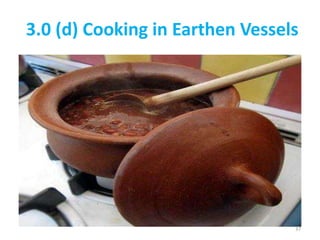
  • 219.
    Clothing – clothesshould be properly selected and changed according to the season. Clothes should be white or lightly coloured, thin and loose in summer. During winter, heavy, dark coloured and well fitting clothes are more protective. Aesthetically and from the point of a clean habit, clothes should be changed and washed daily. 11.4 PERSONAL COMFORT 219
  • 220.
    Footwear – footwearshould be wisely selected and used. Little oversized is better than an undersized shoe. Foot-wear should not be uncomfortable and should not hamper the free movements of the feet. Shoes and other foot-wear should be maintained in good order. Regular use of shoes not only protects the feet from mechanical injuries, but also from diseases like tetanus, warts, hook-worm disease, bites, etc. 11.4 PERSONAL COMFORT 220
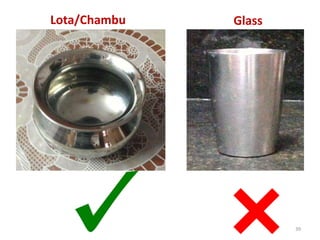
  • 221.
    11.5 PERSONAL CLEANLINESS& HEALTHY HABITS Clean habits are basic to good health. This is because the environment in which man lives is full of harmful agents and unless contact with them is avoided, one is likely to suffer from the ill- effects resulting from such agents. Apart from taking a bath daily and wearing clean clothes, developing other clean habits from early childhood is of prime importance 221
  • 222.
    11.5 PERSONAL CLEANLINESS& HEALTHY HABITS  Washing feet on entering the house.  Washing hands thoroughly with soap and water every time after going to toilet or latrine and before taking food.  Cleaning teeth in the morning and again before going to bed.  Cleaning hair, cutting the nails short, are all examples of hygienic habits. 222
  • 223.
    11.5 PERSONAL CLEANLINESS& HEALTHY HABITS Clean habits and use of soap will reduce the chance of getting infection and spreading it to others. Eyes also need special care. Regularity of bowel movement every day is necessary for the preservation of health. No. of motions/bowels = No. of times one takes food in a day. 223
  • 224.
    11.5 PERSONAL CLEANLINESS& HEALTHY HABITS Cleanliness is also a social responsibility and everyone should help to keep the public places like roads, parks, offices etc., clean. The habits like indiscriminate spitting and throwing rubbish are detrimental to health. Acts like coughing and sneezing are likely to spread many diseases and during such acts a handkerchief should always be used to cover the mouth. 224
  • 225.
    11.5 PERSONAL CLEANLINESS& HEALTHY HABITS Unfortunately, some habits which are not of any advantage, have now proved to be harmful. The best examples are of smoking and chewing of tobacco, and excessive alcohol drinking. Smoking is a habit commonly indulged in, but it is proved to be definitely harmful to health. 225
  • 226.
    11.6 ILL EFFECTSOF SMOKING & TOBACCO CHEWING Excessive smoking has been shown to be a causative factor in diseases like lung cancer, high blood pressure, coronary heart disease, etc. Smoking also causes irritation of the respiratory passage. Smokers not only have poor health bur have also a shorter life on account of the diseases mentioned above. Tobacco chewing is similarly a harmful habit as this is shown to be the commonest cause of cancer of the mouth. 226
  • 227.
    11.7 ILL EFFECTSOF ALCOHOL Alcoholism is a social, moral and economic disaster, and also has a profound effect on health. It may lead to mental depression, chronic gastric complaints, degeneration of the tissues of the heart and arteries, and death due to the liver failure. The evidence against these harmful habits is so clear that one should not be hesitant in giving them up. 227
  • 228.
    Chapter 12 12.0 NUTRITION Goodnutrition is the foundation of good health. Diet should not only be adequate but also be balanced. Regularity in meal times is very important. It is an excellent habit not to take the same articles of food as a routine, but have as much variety in food as possible. 228
  • 229.
    Food that hasbeen exposed to house-flies should not be eaten. Food should always be covered to prevent dust and flies contaminating it. Cheaper foods may not be necessarily not nutritious, e.g. green vegetables are cheaper, but still are of greater nutritional value than costlier vegetables like cauliflower. 229 12.0 NUTRITION
  • 230.
    12.1 EXERCISE ANDACTIVITY  Regular and moderate exercise tones up the various systems of the body, maintains weight and the physiological efficiency of the body, and keeps one active ad cheerful.  Swimming and active outdoor games give good exercise.  Sedentary life coupled with the intake of excessive food may lead to obesity, especially if there is a familial tendency of the same.  Exercise and physical activity help to keep the body fit. 230
  • 231.
    12.2 REST ANDRECREATION Relaxation is necessary to avoid fatigue and to regain efficiency. Sleep required for an adult is for 6-8 hours. More sleep is, however, required for children. Rest after heavy physical and mental activity is refreshing. One should have varied interest in life. Hobbies, friends, trips, vacations, etc., make life cheerful and help to keep the mind in proper poise. 231
  • 232.
    12.3 IMMUNIZATION ANDPREVENTION OF INFECTION One must protect oneself and the children in the family against the common preventable diseases like smallpox, diphtheria, whooping cough, tetanus, typhoid, poliomyelitis, etc. Immunization against all these diseases is simple and effective. In order to avoid infection, it is best not to take children with ourselves, while visiting hospitals and sick friends and relatives. 232
  • 233.
    12.3 IMMUNIZATION ANDPREVENTION OF INFECTION After visiting or attending on a person who is ill, especially if he is suffering from an infectious disease, it is wise to change the clothes and to thoroughly wash the hands and other exposed parts of the body. 233
  • 234.
    12.4 HEALTH CHECKUP  Any defect in the body should be corrected as soon as it is detected.  Any physical deformities like squinting eye, carious teeth, etc., should be corrected.  Many diseases can be effectively treated and cured if diagnosed at an early stage.  Examples of such diseases are many, e.g. cancer of various parts of the body, tuberculosis, diabetes, etc.  Yearly medical check-up is very valuable in this respect. 234
  • 235.
    12.5 PRINCIPLES OFNUTRITION Food is one of the basic necessities of life. It is required for several purposes. If enough food is not taken, one feels hungry and does not have the necessary energy to attend to our work. Food is required to supply the body-building materials necessary for an infant to grow into an adult or for an adult to replace the daily wear and tear in tissues occurring in the course of normal living. 235
  • 236.
    12.5 PRINCIPLES OFNUTRITION Certain materials needed in small amounts by the body and which help to assimilate the food and keep the body mechanisms in proper shape and working order are also provided by food itself. Optimum nutrition is essential for maintenance of good health. Nutrition of the body means the supply of essential nutrients in adequate quantities and in proper proportions to all the cells and tissues of the body so as to keep the structure and functions of the body in a sound state. 236
  • 237.
    This is effectedby ingesting food and water, and digesting and assimilating the same. Diet is nothing else but a combination of different foods as they are available in nature. Such a combination is essential because there is no single food which will give man each and every nutrient in proper proportion required for nourishing the body cells. 237 12.5 PRINCIPLES OF NUTRITION
  • 238.
    It is needlessto say that the selection of a diet good for health, both the working knowledge of the basic principles of nutrition and the art of preparing food, are essential. For nourishment of the cells, the basic principles involved are : 1. Water 2.Digestive end products of proteins, carbohydrates and fats 3. Vitamins 4. Minerals. 238 12.5 PRINCIPLES OF NUTRITION
  • 239.
    WATER : Waterforms about 70% of the body weight and is an important constituent of all body cells. All the chemical reactions and processes in the body take place in the medium of water. Sufficient quantity of water should, therefore, be taken daily. More water is required in summer than in winter. FOOD : The three basic components of food are proteins, carbohydrates and fats. Richness or otherwise of the various foods, is dependent on the proportion and the quality of these components present in the foods. 239
  • 240.
    These are verycomplex nitrogen containing substances. These are formed by different combinations of about 20 amino-acids. Ten of the amino-acids are absolutely essential for proper nutrition and a diet should provide these adequately and in proper proportion.  Proteins are essential for the growth and repair of the tissues of the body and also for body defense. 240 12.6 PROTEINS
  • 241.
    Daily requirement ofproteins for adults is about 1 gm per kg body weight. In children, the daily requirement is higher and because of their active growth they may require 2 to 3.5 gms per kg body weight (Table 1). Nutritive value of a protein is dependent on its essential amino-acid make-up and its digestibility. One gram of protein yields about 4 calories. 241 12.6 PROTEINS
  • 242.
    TABLE 1 Recommended DailyRequirement for Proteins Proteins in grams per day Children Upto 5 years 3.5 Per kg. body weight. 5 – 7 years 3.0 7- 12 years 2.5 Adolescents 12 – 15 years 2.5 15 – 21 years 2.0 Adults Man (55 kg.) 82 Woman (45 kg.) 67 Pregnancy 101 Lactation 112 242
  • 243.
    12.7 CARBOHYDRATES These arechemical compounds containing carbon, hydrogen and oxygen. They are formed by combination of various sugars and occur in nature as sugars, starch and cellulose depending on the simplicity or complexity of the chemical structure.  Carbohydrates give energy on which all the activities of life are dependent. One gram of carbohydrate yields about 4 calories. Body cells utilize simple sugars to form heat which is converted into energy for maintaining life. 243
  • 244.
    12.7 CARBOHYDRATES Cellulose isindigestible, nevertheless it gives roughage which is valuable as a mechanical stimulant to the bowel and prevents constipation. Indian diets contain proportionately higher quantity of the carbohydrates and much less of the proteins. After supplying the body needs for proteins and fats, sufficient quantity of carbohydrates should be included in our diet to make up the total caloric requirements. 244
  • 245.
    12.8 FATS These arealso the energy giving foods but these are concentrated sources. One gram of fat gives 9 calories approximately. These fats, in addition, give taste to the food and make the diet palatable. This is why people crave for fried foods like “Vadas” or “Bhajias”. 245
  • 246.
    12.8 FATS Fats arecostly and for the proper health of the body, one should not have more than 15% of the total calories from the fats. Daily intake of about 45 to 60 gms for an adult is all that is necessary. It is preferable to have a considerable portion of this quantity from the vegetable oils. 246
  • 247.
    TABLE 2 Recommended DailyRequirement for FATS , Carbohydrates & Fiber 247 Carbohydrates - 52 gm Fats - 45 gm
  • 248.
    TABLE 3 IMPORTANT SOURCES,FUNCTIONS AND DEFICIENCY SYMPTOMS OF PROTEINS, CARBOHYDRATES AND FATS Nutrient Rich Sources Essential Functions Deficiency Symptoms 1. Protein Milk, Legumes, Nuts, Pulses, Beans – Soyabean, Cheese, Outer layers of cereals, Meat, Fish, Eggs Repair and growth of body tissues, Body defence Weak muscles, Poor body tone, Retarded mental Reactions, Lower resistance to disease. 2. Carbohydrates Sugars, Syrups & Jams, Cereals such as Rice, Potatoes and other tubers, Sago. Production of Heat and Energy. Bulk – diet. Loss of weight. 3. Fats Groundnut oil, Oils like safflower (kardai), cottonseed, sesame (Gingelly), Nuts, butter, ghee, cream, Margarine, cheese, meat fats Production of Heat and Energy Loss of weight, Retarded growth. 248
  • 249.
    12.9 VITAMINS These donot give any calories, but they are indispensable in regulating the chemical processes in the body metabolism. Vitamins stimulate growth of the body and prevent a number of deficiency diseases. Vitamins are, therefore known as the “Protective Foods”. They are usually referred to by letters. Vitamins A, D, E and K are fat soluble; the rest are water soluble (Table 4) i.e. B&C. 249
  • 250.
    TABLE 4 VITAMINS –THEIR IMPORTANT SOURCES, FUNCTIONS AND DEFICIENCY DISORDERS Vitamin Rich Sources Essential Functions Deficiency Symptoms Vitamin A Daily requirement (D.R.) in adult – 4000 -5000 IU Children – (2000-4000 IU) All vegetables, yellow fruits (mango, papaya, orange, melon), tomatoes, ghee, curd, butter, milk, yellow of eggs, fish oil, carrot, pumpkin Growth, health of eyes, health of skin, and mucous membrane Retarded growth, night blindness, susceptibility to infections, changes in skin. 250
  • 251.
    TABLE 4 VITAMINS –THEIR IMPORTANT SOURCES, FUNCTIONS AND DEFICIENCY DISORDERS Vitamin Rich Sources Essential Functions Deficiency Symptoms Vitamin B1 (Thiamine) Daily requirement 1 to 2 mg (adults) 0.4- 1.2mg (children) Outer layers of the grains like rice and wheat, Til (Gingelly seeds), groundnuts, unmilled pulses, dry chillies, peas, egg, banana, apple, dark green leafy vegetables, soyabean. Growth, utilization of carbohydrates, proper working of the heart, nerves and muscles. Aids in digestion. Retarded growth, loss of appetite and weight, weakness, palpitation, nerve disorders, early fatigue and defective digestion, diabetics, mental depression. 251
  • 252.
    TABLE 4 VITAMINS –THEIR IMPORTANT SOURCES, FUNCTIONS AND DEFICIENCY DISORDERS Vitamin Rich Sources Essential Functions Deficiency Symptoms Vitamin B2 (Riboflavin) Daily requirement 1.6-2.6 mg (adult) 0.6-1.0 mg (children) Milk and milk products, green vegetables, eggs, liver, meat, fish, banana, tomato, almonds, grapes, pomegranates Growth, health of the skin and mouth, utilization of carbohydrates, health of the eyes. Formation of red blood cells. Synthesis of glycogen Retarded growth, redness of eyes, dimness of vision and intolerance to light, soreness of angles of mouth, red tongue. Eczema clear eased motor coordination, dry skin, ulcers on lips. 252
  • 253.
    TABLE 4 VITAMINS –THEIR IMPORTANT SOURCES, FUNCTIONS AND DEFICIENCY DISORDERS Vitamin Rich Sources Essential Functions Deficiency Symptoms Nicotinic Acid (Niacin) (B3) Daily requirement 16-21mg – adult 4-12 mg – children Potatoes, outer layers of grain, pulses, nuts, tomatoes, leafy vegetables, meat, fish, sunflower seeds. Growth, utilisation of carbohydrates, proper working of gastro-intestinal and nervous system, tissue. Smooth & red tongue, digestive and metal disorders, pigmented scaly skin (Pellagra, dermatitis & dementia) 253
  • 254.
    TABLE 4 VITAMINS –THEIR IMPORTANT SOURCES, FUNCTIONS AND DEFICIENCY DISORDERS Vitamin Rich Sources Essential Functions Deficiency Symptoms Vitamin B6 (Pyridoxine) Daily requirement 2mg – Adult 0.9-1.6 – children Green leafy vegetables, meat, liver, pulses, wheat, other cereals, carrots, peanuts. Growth, health of skin, proper working of muscles and nerves. Absorption of fats & proteins Convulsions in children. Poor growth, anaemia, skin lesions. Weakness, insomnia, irritability, migraine, kidney stones , mental disturbances 254
  • 255.
    TABLE 4 VITAMINS –THEIR IMPORTANT SOURCES, FUNCTIONS AND DEFICIENCY DISORDERS Vitamin Rich Sources Essential Functions Deficiency Symptoms Folic Acid (B9) Adult – 100mg Children – 30-60 mg Green leafy vegetables, liver, pulses, gingelly seeds, cluster beans. Growth & division of all body cells, protein metabolism & healing processes. Anaemia in infants and pregnant women. Skin disorders. Impairs the ability of the immune system to fight infection. Vitamin (B12) D.R. 1-2 mg (adults) 0.2-1.0 mg for children Milk, meat, liver, egg, shrimp Formation of blood, cell replacement Pernicious anaemia, (immature red blood cells) poor appetite, chronic fatigue. 255
  • 256.
    TABLE 4 VITAMINS –THEIR IMPORTANT SOURCES, FUNCTIONS AND DEFICIENCY DISORDERS Vitamin Rich Sources Essential Functions Deficiency Symptoms Vitamin C (Ascorbic acid) D.R. – 60 mgms (water soluble) Amla, lemon citrus fruits tomatoes, leafy vegetables, guva, drumstick leaves, bitter gourd, oranges. Growth, tissue repair, health of blood vessels, gums etc. protects against infection, quick healing of wounds. Bleeding gums, scurvy, tendency for haemorrhages, poor wound healing. Vitamin D (formed in the skin under action of sunshine) D.R – 400-800 I.U. Milk, liver, eggs, fish liver oil cheese, butter, shrimp, cabbage, spinach Growth, utilization of calcium and phosphorous, health of bones and teeth. Softness and bending of bones, (Rickets), poor development and decay of the teeth, osteomalacia. 256
  • 257.
    TABLE 4 VITAMINS –THEIR IMPORTANT SOURCES, FUNCTIONS AND DEFICIENCY DISORDERS Vitamin Rich Sources Essential Functions Deficiency Symptoms Vitamin E (Tocopherol) D.R. not determined Wheat germ oil, leafy vegetables, milk, butter almonds, eggs, water melon, sesame oil & mustard oil. Normal reproduction in animals Reproduction failure in humans weakness & sensory disturbances in low birth wt. infants causes haemolytic anaemia. Decreased ability of lymphocytes. Vitamin K D.R. – adequate quantities produced in intestines. Dark green vegetables, tomatoes, also formed in the intestines. Dairy & meat products, fruits seeds & tubers Normal clotting of blood. Bleeding tendency. 257
  • 258.
    Age Vitamin AVitamin B1 Thiamin Vitamin B2 Riboflavin Vitamin B3 NIACIN"' Vitamin B6 Pyridoxine Folate Folic Acid B9 Vitam in B12 RDA UDL RDA RDA RDA UDL RDA UDL RDA UDL RDA 1-3 years 300 meg 600 meg 0.5 mg 0.5 mg 6 mg 10 mg 0.5 mg 30 mg 150 meg 300 meg 0.9 meg 4-8 years 400 meg 900 meg 0.6 mg 0.6 mg 8 mg 15 mg 0.6 mg 40 mg 200 meg 400 meg 1.2 meg 9-13 years 600 meg 1700 meg 0.9 mg 0.9 mg 12 mg 20 mg 1.0 mg 60 mg 300 meg 600 meg 1.8 meg Boys, 14-18 years 900 meg 2800 meg 1.2 mg 1.3 mg 16 mg 30 mg 1.3 mg 80 mg 400 meg 800 meg 2.4 meg Girls, 14-18 yrs 700 meg 2800 meg 1.0 mg 1.0 mg 14 mg 30 mg 1.2 mg 80 mg 400 meg 800 meg 2.4 meg Men, 19+ years 900 meg 3000 meg 1.2 mg 1.3 mg 16 mg 35 mg from 19-50 yrs 1.3 mg Men 51+yrs 1.7 mg Women 51+yrs. 1.5 mg 100 mg 400 meg 1000 meg 2.4 meg Women, 19+ yrs 700 meg 1.1 mg 1.1 mg 14 mg 35 mg 100 mg 400 meg 1000 meg 2.4 meg Pregnancy 770 meg 1.4 mg 1.4 mg 18 mg 35 mg 1.9 mg 100 mg 600 meg 1000 meg 2.6 meg Breast feeding 1300 meg 1.4 mg 1.6 mg 17 mg 35 mg 2.0 mg 100 mg 500 meg 1000 meg 2.8 meg RDA - Recommended Dietary Allowance, UDL - Upper Daily Limit
  • 259.
    RDA - RecommendedDietary Allowance, UDL - Upper Daily Limit Age. Biotin B Pantot henic Acid B5 Choline Vitamin C Ascorbic acid Vitamin D Vitamin E Alpha Tocopherol Vita min K RDA RDA RDA UDL RDA UDL RDA UDL RDA UDL RDA 1-3 years 8 meg 2 mg 200 mg 1000 mg 15 mg 400 mg 5 meg 50 meg 9 IU (6 mg) 1500 IU (1000 mg) 30 meg 4-8 years 12 meg 3 mg 250 mg 2000 mg 25 mg 65 mg 5 meg 50 meg 10 IU (7 mg) 1500 IU (1000 mg) 55 meg 9-13 years 20 meg 4 mg 375 mg 3000 mg 45 mg 1200 mg 5 meg 50 meg 16 IU (11 mg) 1500 IU (1000 mg) 60 meg Boys, 14-18 years 25 meg 5 mg 550 mg 3500 mg 75 mg 1800 mg 5 meg 50 meg 22 IU (15 mg) 1500 IU (1000 mg) 75 meg Girls, 14- 18 years 25 meg 5 mg 400 mg - 65 mg 2000 mg 5 meg 50 meg 22 IU (15 mg) 1500 IU (1000 mg) 75 meg Men, 19+ years 30 meg 5 mg 550 mg - 90 mg - Upto 30 yrs 5 meg 31-70 yrs 10 meg 71+ yrs 15 meg 50 meg 22 IU (15 mg) 1500 IU (1000 mg) 120 meg Women, 19+ years 30 meg 5 mg 425 mg - 75 mg - 50 meg 22 IU (15 mg) 1500 IU (1000 mg) 90 meg Pregnanc y 30 meg 6 mg 450 mg - 85 mg - 5 meg 50 meg 22 IU (15 mg) 1500 IU (1000 mg) 90 meg Breastfee ding 35 meg 7 mg 550 mg - 120 mg 5 meg 50 meg 28 IU (5 mg) 1500 IU (1000 mg) 90 meg
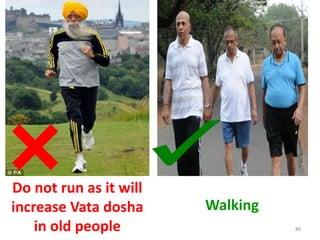
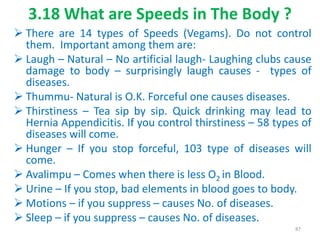
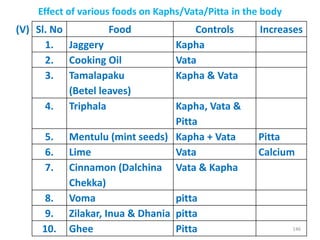
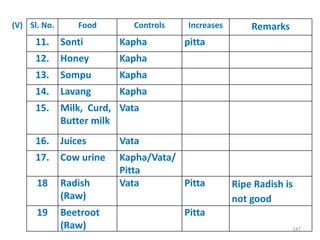
  • 260.
    Age Calcium Magnesium PhosphorusBoron Chrom ium Copper Fluoride Iodine RDA UDL RDA UDL RDA UDL UDL RDA RDA UDL RDA UDL RDA UDL 1-3 years 500 mg 2500 mg 80 mg 65 mg 460 mg 3000 mg 3 mg 11 meg 340 meg 340 meg 0.7 mg 1.3 mg 90 meg 200 meg 4-8 years 800 mg 2500 mg 130 mg 110 mg 500 mg 3000 mg 6 mg 15 meg 440 meg 440 meg 1.0 mg 2.2 mg 90 meg 300 meg 9-13 years 1300 mg 2500 mg 240 mg 350 mg 1250 mg 3000 mg 11 mg 25 meg 700 meg 700 meg 2.0 mg 10.0 mg 120 meg 600 meg Boys, 14- 18 yrs 1300 mg 2500 mg 410 mg - 1250 mg 3000 mg 17 mg 21 meg 890 meg 890 meg 3.0 mg - 150 meg 900 meg Girls, 14- 18 yrs 1300 mg 2500 mg 360 mg - 1250 mg 3000 mg 17 mg 35 meg 890 meg 890 meg 3.0 mg - 150 meg 900 meg Men, 19+ years <50 yrs 1000 mg 51+ yrs 1200 mg 2500 mg 19-30 yrs 400 mg 31+yrs 420 mg - 700 mg 3000 mg 20 mg 24 meg 900 meg 900 meg 4.0 mg - 150 meg 1100 meg Women, 19+ years 2500 mg 19-30 yrs 310 mg 31+yrs 320 mg - 700 mg 3000 mg 20 mg 35 meg 900 meg 900 meg 3.0 mg - 150 meg 1100 meg Pregnanc y 1000 mg 2500 mg 350-360 mg - 700 mg 3000 mg - 25 meg 1000 meg 1000 meg 3.0 mg - 220 meg - Breast feeding 1000 mg 2500 mg 310-320 mg - 700 mg 3000 mg - 30 meg 1000 meg 1000 meg 3.0 mg - 290 meg - RDA - Recommended Dietary Allowance, UDL - Upper Daily Limit
  • 261.
    Age Iron ManganeseMolybdenum Selenium Zinc Sodium Potassiu m RDA UDL RDA UDL RDA UDL RDA UDL RDA UDL RDA UDL RDA 1-3 years 7 mg 40 mg 1.2 mg 2 mg 17 meg 300 meg 20 meg 90 meg 3 mg 7 mg 1000 mg 1500 mg 3000 mg 4-8 years 10 mg 40 mg 1.5 mg 3 mg 22 meg 600 meg 30 meg 150 meg 5 mg 12 mg 1200 mg 1900 mg 3800 mg 9-13 years 8 mg 40 mg 1.9 mg 6 mg 34 meg 1100 meg 40 meg 280 meg 8 mg 23 mg 1500 mg 2200 mg 4500 mg Boys, 14- 18 years 11 mg 45 mg 1.6 mg 9 mg 43 meg 1700 meg 55 meg 400 meg 11 mg 34 mg 1500 mg 2300 mg 4700 mg Girls, 14- 18 years 15 mg 45 mg 2.2 mg 9 mg 43 meg 1700 meg 55 meg 400 meg 9 mg 34 mg 1500 mg 2300 mg 4700 mg Men, 19+ years 8 mg 45 mg 1.6 mg 11 mg 45 meg 2000 meg 55 meg 400 meg 11 mg 40 mg 19-50 years 1500 mg 51- 70 years 1300 mg 71+ years 1200 mg 2300 mg 4700 mg Women, 19+ years 19-50 years 18 mg 51+ Yrs 8mg 45 mg 2.3 mg 11 mg 45 meg 2000 meg 55 meg 400 meg 8 mg 40 mg 2300 mg 4700 mg Pregnanc y 27 mg 45 mg 1.8 mg 60 meg 11 mg 1500 mg 4700 mg Breast feeding 9 mg 45 mg 2.0 mg 70 meg 12 mg 1500 mg 5100 mg RDA - Recommended Dietary Allowance, UDL - Upper Daily Limit
  • 262.
    Vitamins & Mineralsin Food Items Vegetables / cereals / Fruits / Nuts / Non-veg / Milk products /Spices / dates etc. 262
  • 263.
    12.10 MINERAL On anaverage, man excretes daily about 20 to 30 gms of mineral salts, consisting mostly of chlorides, sulphates and phosphates of sodium, potassium, magnesium and calcium. It is but natural that all these must be replenished daily through the food-stuffs. Similarly, a large number of other elements like iron, calcium, copper, cobalt etc., play a vital role in the body metabolism 263
  • 264.
    12.10 MINERAL As ageneral rule, one can remember that a diet which is otherwise adequate in proteins, fats, carbohydrates and vitamins will provide all the minerals in sufficient quantities. 264
  • 265.
    12.11 BALANCED DIET Forproper nutrition of the body, sufficient amounts of proteins, carbohydrates, fats, water, vitamins and minerals are essential. As no single foodstuff gives this, it is necessary that a good diet should contain all these principles in correct proportions and in adequate quantities.  Such a diet which ensures supply of all the essential nutrients in known as a ‘balanced diet’. 265
  • 266.
    12.11 BALANCED DIET Itis not enough to provide a balanced diet, but the food should be palatable and liked by the people. The art of preparation of good and appetizing food has no limit. One of the golden rules is to eat varied foods which not only avoid monotony, but ensure better nutrition. 266
  • 267.
    Chapter 13 13.0 ADULTERATIONOF FOOD Population explosion. Shortage of food grains Adulteration of food items increased from 1990’s Adulteration leads to decreases in nutrients and off late poisonous items are added to food items. 267
  • 268.
    13.0 ADULTERATION OFFOOD Adulteration affects both rich and poor. Due to increased prices, common man forced to save money by buying cheap food items. Cheap food items may be adulterated and prone poisonous to health. Evil effects of adulteration of food on health is slow and hence we do not suspect adulteration of food. Adulterated food if consumed over a long period has adverse effects. 268
  • 269.
    13.1 EFFECTS OFADULTERATED FOOD Lack of growth in children. Causes illness among children/adults due to decreased power of resistance to diseases. Person takes treatment for his illness but his attention is not drawn to adulteration of food. Common man buys cheap food grains without knowing food grains are adulterated & lack in nutrition. 269
  • 270.
    News reports nowand then in press is not alerting all common man about ill effects of buying adulterated food. Adulteration of mustard oil with argamone oil causes heart diseases, blindness etc. Adulteration of sweets with argamone oil caused dropsy. 270 13.1 EFFECTS OF ADULTERATED FOOD
  • 271.
    13.2 TYPES OFFOOD ADULTERATED Adulteration of food increasing in India In Maharashtra out of 20,000 samples, 30 to 55% samples of food found adulterated. Initially, milk & milk products only are adulterated. Now all kinds of food are adulterated. 271
  • 272.
    13.3 TYPES OFFOOD ADULTERATED With all-round development everywhere, there was an increase in the incidence of adulteration of food. No foodgrain or eatable is now exempt from adulteration. In Maharashtra, in 1966, the following percentage of articles were found to be adulterated : Ice cream and Ice fruit 70.6% Milk 33.9% Curds 67.2% Chilly powder 22.5% Asaphatida 65.3% Ghee 18.4% Sherbats, Soda, Lemon etc. 50.0% Edible oils 4.04% Butter 44.5% 272
  • 273.
    13.4 HOW ISADULTERATION DONE Adding artificial & poisonous colours to increase weight and boost sales. Substances of cheap or low quality are mixed. Sand, growel or dust are often mixed with food grains. Difficult to separate adulterated with wheat flour, gram flour or chilly powder. Iron particles can be separated by magnet. 273
  • 274.
    13.4 HOW ISADULTERATION DONE Lakhi pulse consumption causes lathyrism i.e. Patient walks zig-zag with sticks. Lakhi pulse can be grown easily along with wheat without much water and also grows in barren soil. Poor farmers without knowing bad effects, grow it in madhya pradesh. 274
  • 275.
    13.4 ADULTERATION OFMILK PRODUCTS Water mixed in milk after cream is removed. If water is infected with germs, causes Diarrhoea & Typhoid. Sweetdish of milk – pulp of bottling paper mixed. Ghee/Butter – Vansapathi oil is mixed. Oils - Cheap quality of oil mixed with high cost oils. 275
  • 276.
    13.4 HOW ISADULTERATION DONE  Chilly powder is mixed with salt, dust of wood, earth fine sand or talcum powder and injurious colours prepared from coal-tar are added to make it attractively red.  Pulses and turmeric are rendered yellow with the use of the injurious colour of ‘metallic yellow’.  The used tea leaves are coloured with ferrous sulphate and mixed with fresh tea leaves. Fine sugar is mixed with washing soda.  Cinnamon is mixed with the bark of other trees after colouring and scenting the same.  Saw dust or even horse-dung is mixed with spices.276
  • 277.
    13.4 HOW ISADULTERATION DONE Asaphatida is very often adulterated. Sherbats and other drinks and sweets are often mixed with injurious coal-tar colours whose use is prohibited by law. Saccrine and the injurious chemical saline whose use is prohibited is used instead of sugar. According to the law of Prevention of Food Adulteration, a specific mention must be made on the container if Saccarin is used in a food article. 277
  • 278.
    13.7 CONSIDERATION OFLAW The law of ‘Prevention of Adulteration of Food’ was passed in 1954 and rules were subsequently framed on that behalf. According to this act, each state government passes its own law and frames its own rules. The rules framed by the Maharashtra State Legislature have been brought into force since June 1964. The Act is in force in other states also. So far, the Act and its rules are applicable to the city areas only. Enforcement of the law is done by Municipalities and Corporation according to their financial resources. 278
  • 279.
    13.7 CONSIDERATION OFLAW For this purpose, adulteration prevention officers and food inspectors are appointed. As per law, samples of food grains and other eatable articles are collected from a shop-keeper in the presence of two witnesses and are examined in the food testing laboratories conducted by the Health department of the Government. According to the new act of 1964, it is incumbent on the wholesaler who sells his articles (like grains, oil, ghee or other sealed eatables) to a retailer to write details of his goods in a ‘Warranty form’. adulterated. 279
  • 280.
    13.7 CONSIDERATION OFLAW If a retailer or a wholesaler takes such warranty from the ‘producer’, it is the producer and not the retailer or the wholesaler who is liable for prosecution in case the samples taken are found to be adulterated. The enactment of adulteration prevention act has not proved enough of a deterrent. We need to educate the public and carry on propaganda against adulteration of food. 280
  • 281.
    13.7 CONSIDERATION OFLAW There should be a continuous and vigorous campaign for prevention of food adulteration. The rules in this behalf must be strictly applied against producers and traders. The producers and traders should also be persuaded to desist from such a trade which is anti-national as it is injurious to the health of the people. In fact, their cooperation should be sought to put a stop of food adulteration. 281
  • 282.
    13.5 HOW TOIDENTIFY ADULTERATED FOOD Women can do a lot in preventing adulteration of food, because they are mainly concerned with making purchases and preparing food. They can spot certain adulterations in their own home. The following are some of the examples: More water is required to moisten wheat flour that is mixed with chalk powder and a moistened wheat flour does not have its usual sticky quality.  Tea powder coloured with ferrous sulphate, if put in water makes the water coloured. 282
  • 283.
    13.5 HOW TOIDENTIFY ADULTERATED FOOD Pure asaphatida gets itself dissolved in water and makes it milky and if burnt, gives out a flame. If water added hydrochloric acid is dropped on tuver pulse coloured with metallic yellow, the colour at once becomes violet. If hydrochloric acid and furfurol is mixed with ghee adulterated with vanaspati, the ghee at once becomes red. Women should be able to spot such adulterations immediately. They should insist on the quality rather than the quantity of food articles purchased. 283
  • 284.
    13.6 HOW TOPREVENT ADULTERATION Ladies’ Clubs should get prepared on a cooperative basis such articles as spices, pickles, chilly powder, scented betelnut, turmeric powder, ghee, butter etc. with the help of needy women and sell them at reasonable rates as this would help prevention of adulteration of these substances. 284
  • 285.
    13.6 HOW TOPREVENT ADULTERATION Pay attention to the following points to avoid the evil effects of adulteration of food. One must suspect adulteration of food in articles that are being sold at rates cheaper than the prevalent market rates. Do not buy readymade spices. Prepare them at home after buying the constituent articles. Do not buy the attractively coloured red chilly powder as the colour used is often harmful. Prepare powder from chilles bought in the market. 285
  • 286.
    13.6 HOW TOPREVENT ADULTERATION Do not buy loose food articles. Buy them in labeled original packing. Do not buy sugar balls (laddus), sugar and milk balls (pedhas) and other sweets which are generally made in attractive colours. In case of suspicion of adulteration of food, report the same to the local health department or to the food inspector. 286
  • 287.
    14. Diseases &Comprehensive treatment 287 Comprehensive treatment for various types of Chronic Diseases  Common for all types of Diseases: The present style of cooking, eating, drinking water, sleeping, walking etc., shall be modified according to principles given in Chapter 3. Following the principles given in Chapter 3 will arrest the further deterioration of the disease one is suffering from.  Chronic diseases covered in this chapter are heart aliments, High BP, Diabetes, Kidney stones, Thyroid, Cancer, Arthritis, varicose veins, TB & Obesity.  The natural / ayurveda treatment given for each disease to be taken prefferabally on the advise of ayurveda doctor. Allopathy doctors to be consulted for all chronic diseases given in this chapter. The various tips given in this chapter supplement in early curing of disease.
  • 288.
    288 14.1 Heart Diseases:Heart diseases are mainly due to increase of ‘Vata’ in the body and Excess Fats/Cholesterol  Avoid aerobic type activity like jogging, fast driving by motor bike etc.  Don’t sleep under ceiling fan.  Do not eat or minimize eating high cholesterol content foods like mutton, chicken, cashew nut.  Don’t climb stair cases. Use lift/escalator  Avoid smoking/alcohol intake in excess.  Don’t take cold water  Don’t eat ice cream after food  Do not take coconut and palm oil  Do not take Banana, Jack fruit  Avoid over straining  Avoid worries, tension, anger, haste & jealousy
  • 289.
    Do’s for HighB.P./High Cholesterol/Heart Diseases:  Take 50 ml juice of pomegranate daily before 12 AM  Take Amla or Triphala juice / Wheat grass juice on empty stomach daily (One glass) (06.00 – 07.00 A.M.)  Take Dalchin (Cinnamon) powder – 5 gm. Daily with rice & cow ghee/oil or decoction of dachin leaves in the evening between 04.00 P.M. to 06.00 P.M.  Guggulu – 500 mg. thrice daily. Helps in maintaining normal lipid profile.  Do take orange juice  Water melon is very useful for high BP patients  Water melon pieces + Rock salt + Black pepper powder = make juice by hand and take. High BP may be controlled in 06-07 days. 289
  • 290.
    When to take:Any fruit take before 02.00 P.M. Ideal – Can take before or after breakfast in the morning. Take papaya – 2 or 3 small pieces – Daily two times – 08.00 A.M. & 06.00 – 07.00 P.M. 05 gm. Triphala power plus hot water daily before sleep at night. Garlic is useful for thinning blood. Take garlic in all curries. Also take 01 to 02 pieces of Raw Garlic daily followed by lukewarm water or water melon juice / orange juice etc. around 11.00 A.M. 290
  • 291.
     Ginger juice(100 ml.) plus Honey – Lip the product. Once in a week. 04.00 A.M – 08.00 A.M or 04.00 P.M – 08.00 P.M i.e. kapha period since both ginger & honey increase “pitta” inside body. Take preferably in winter only.  After food at Dinner: Soup Bottle Gourd (Sorakaya) + Coriander seeds + Zilakarra + Turmeric powder + Coriander leaves. Boil and take the soup after food in the morning or night.  Arjuna tree stem pakam. Arjuna tree powder (30 gm) + 200 ml cow milk + 200 ml water. Boil till only milk is available. Filter the liquid. Add ‘Misri’ and take the drink daily once in the evening.  Use Sesame oil for cooking.  Take plenty of fiber foods. Fiber reduces LDL cholesterol. Carrot/Beetroot/Lady finger/Cucumber/tomato/onion/garlic. 291
  • 292.
    Foods having lecithinto control cholesterol: Foods: Soyabean, Egg yolk, Whole grain cereals. Take during Breakfast or lunch Water – At least 10 glasses per day Coriander (dry) seeds decoction. Boil dry seeds in water Filter Cool Drink Right Time: 12.00 A.M. Coconut water – 11.00 A.M. Exercise: Walking, swimming, badminton & cycling. 292
  • 293.
     Asanas: Padmasana,Shalabhasana, Vajrasana, Ardhamatsyandrasana. Do not do asanas if BP is above 200.  Hydrotherapy: Cold hip bath for 10 minutes (Put ice cubes in tub and sit for 10 minutes)  Steam Bath: (Except to those suffering from hypertension and other circulatory disorders).  Mud packs: Over abdomen once in a month / quarter will be useful.  Take PAN with lime daily two times. After Lunch and Dinner. This is essential for above 45 years age.  Pranayama: Aruloma – Viloma – 10 minutes (in different spells) Kapalabheh – 10 minutes (in different spells)  Do on empty stomach – 05.00 A.M. – 07.00 A.M.  Take 08 hours of sleep  Take Bitter guard (Karela) decoction between 04.00 PM – 06.00 PM as Tea. 293
  • 294.
    14.2 (a) DIABETES- Symptoms Primarily caused by systematic over eating and consequent obesity. Over eating of not only sugar and refined carbohydrates but also of proteins and fats which are transformed into sugar if taken in excess. Diabetic patients have inadequate utilization and/or secretion of insulin. Shortfall in insulin causes abnormalities in metabolism of carbohydrates, proteins and fats. Diabetes is a nutrition disorder 294
  • 295.
    14.2 (b) DIABETES– Types Symptoms: frequent urination of yellow colour, high levels of glucose in blood, excretion of excess glucose in urine, excessive thirst, extreme hunger, weight loss/weakness/fatigue, irritability Sugar levels in blood for normal person Fasting 80-120 mg per 100 ml of blood After food  maximum 180 mg. Insulin maintains proper blood glucose levels by allowing glucose to leave the blood stream and enter cells and thus nourish the cells. 295
  • 296.
    14 (c) DIABETES– Treatment Inadequate insulin results in lack of nourishment of cells and hence causes tiredness Type I – Pancreases doesn’t produce insulin – Need insulin injection daily Type II – Adult onset diabetes – Non insulin dependent – Inadequate insulin production or utilization 296
  • 297.
    14.2 (d) DIABETES- Treatment  Common to both Type I & II Daily exercise Pranayana/meditation to deal with stress at work and family Do not take water after food Take lukewarm water always and drink sip by sip Do not take water stored in plastic or aluminium containers  Do not use aluminium vessels for cooking Avoid cooker/microwave oven/induction heater Avoid fridge – if unavoidable, keep items from fridge at least 48 minutes outside before they are consumed Take vitamin ‘B’ & ‘C’ daily as they are water soluble Take ‘PAN’ daily Have atleast 7 hours of sleep. 297
  • 298.
    14.2 (d) DIABETES- Treatment Type II Diabetes Foods to be avoided/minimized Tea, coffee, cool drinks White bread, white flour products like maida, sugars, sweets, tinned fruits/juices, chocolates, pastries, refined cereals, alcoholic drinks. All types of non vegetarian foods Cooked starchy foods to be avoided. Less fats to be taken Less oil to be taken 298
  • 299.
    14.2 (d) DIABETES- Treatment Type II Diabetes Food to be taken Vegetarian, low caloric Low fat Alkaline diet FRUITS JAMBUL fruit is best Fresh fruits having sugar/starch like orange, pomegranate, pineapple etc contain sugar fructose and does not need insulin for their metabolism. Exception – banana to be avoided. 299
  • 300.
    14.2 (d) DIABETES- Treatment Type II Diabetes Vegetables & other foods Raw foods stimulate and help increase production of insulin Manganese is vital in the production of natural insulin Manganese is found in “citrus fruits”, outer covering of nuts, grains, green leaves etc Onion, cucumber & garlic are beneficial for diabetic patients. 300
  • 301.
    14.2 (e) Quantityof various types of foods for diabetic patients & other precautions Carbohydrates: Carbohydrates intake slowly to be reduced to 250 gm per day over a period of say 3-6 months (drastic reduction of carbohydrates is not advisable). Proteins : 1 gm/kg of body weight is adequate. Fats: low fats will keep cholesterol low. Vitamins: ‘B’ complex will avoid the development of diabetes neuritis. Minerals: Potassium & Manganese helps in release of insulin from pancreas. Calories : Calori intake should be adequate for growing children and underweight persons. Obese: Take green leafy vegetables more. 301
  • 302.
    Beans: contain fiber& starch Calcium: 1.2 mg/day reduces insulin requirements. PAN with lime daily is useful (lime contains calcium) Vitamin D3- Vit D3 also reduces insulin requirement. Exposure to SUN for 15 min/day. 6 Am - 10 AM or 4 Pm – 6 Pm Red, yellow & orange fruits (pineapple, apple, pomegranates, watermelon, papaya etc.) Dark green leafy vegetables (spinach, pudina, coriander etc.) 302 14.2 (e) Quantity of various types of foods for diabetic patients & other precautions
  • 303.
    Sleep: less than7 hours/day will aggravate diabetes. Avoid seeing exciting news & crime reports at night. Yoga: Regular asanas & pranayama reduces sugar levels by 33% Cinnamon: for mild diabetic patients, cinnamon decoction is adequate to lower sugar. Filter the boiled levels Cinnamon water using cheese cloth to separate oils & fats on the surface of boiled water. Caution: PITTA type persons should take cinnamon boiled & filtered water in the morning before 11 AM or evening between 6 PM to 10 PM Case studies: Both type I & Type II diabetes can be reversed by following above tips: 303
  • 304.
    14.2 (f) Potassiumrich food items 304 Pumpkin Drumsticks Sunflower oil Groundnut oil Pea nuts & peas Tomato Almonds Onion Carrot Watermelon Bitter gourd Cucumber Pudina 14.2 (g) Manganese rich foods: Orange Sunflower seeds Green leafy vegetables Cashew nuts (not good for heart patients & those who do not do exercise)
  • 305.
    14.2 (h) Hydrotherapy: bathingin cold water increases the circulation and enhances the capacity of the muscles to utilize sugar/glucose. Bowels/ motions: clearing bowels at least 2 times a day will eliminate accumulation of toxins in the body. Magnetotherapy: magnetotherapy helps in controlling diabetes. Only a magnetotherapist should do the therapy. 305
  • 306.
    14.2 (i) OtherAyurveda remedies Soak mentulu(Fenugreek seeds) in water overnight and then drink water & chew the seeds. This helps in controlling diabetes Powder equal quantity of amla, mentulu (Fenugreek seeds) and turmeric. Take 5 gm of powder with water in morning, afternoon & evening. Juices – useful for diabetes: Tomato, cucumber, lemon, bitter gourd, carrot, cabbage, spinach, jamun, orange, pineapple, pomegranate. 306
  • 307.
    14.3 CANCER 14.3.1 Characteristicsof many cancers Development of a new growth nodule or a tumour in the tissues of their origin. Original tumour forms colonies (secondary tumour) at some distant parts of the body Cancer cell has no useful action. It just sits inside the tumor tissue doing nothing except multiplying and refusing to die. When cells are denied 60% of oxygen requirement, they exhibit anerobic respiration resulting in cancer cells due to fermentation. When pH is alkali, blood has great potential to absorb hydrogen and results in more oxygen delivered to the cells 307
  • 308.
     Taking excessacidic foods leads to dumping of excessive acids in the cells. Acid in cell prevents absorption of oxygen & results in fermentation of glucose Many cells in the acidic environment die but few cells survive by becoming abnormal cells. These abnormal cells are called MALIGNANT which stops corresponding brain with our DNA memory code. Therefore malignant cells grow indefinitely and without order. This is called CANCER. Hence cancer cells thrive on acidic PH and hypoxia. It means alkaline PH and oxygen should make cancer cell revert to be inert and harmless  Certain cancer causing substances known as carcinogens increase the chance of getting cancer disease.  Cancer incidence is in direct proportion to the amount of animal protein taken especially meat. 308
  • 309.
    14.3.2 difference betweencancer & other diseases Unlike other diseases, no early warning symptoms like pain, fever, etc to make patient to consult a doctor 309
  • 310.
    14.3.3 Causes ofcancer Cancer is probably caused by interaction of many factors and is the final result of a long continued chain of events. Occupational agents like exposure to radiation sunrays, synthetic dyes etc. Injury continued over a long period often initiates cancer. Chewing of tobacco Smoking Tight wearing of dhoti or saree High caloric diet & increase in weight beyond optimum enhances chances of developing cancer. 310
  • 311.
    14.3.4 Features ofcancer Cancer is not contagious 14.3.5 Cancer is not hereditary 14.3.6 Detection of cancer Cancer is more prevalent in persons above 40 years. Hence common sites & danger signals of cancer are given below and people should consult expert about these symptoms. Unusual and repeated bleeding especially in women after menopause. A painless lump or thickening in any part of the body, particularly the breast of a women. 311
  • 312.
    A persistent sorethroat. A continuing change in bowel or bladder habits. Hoarseness or cough which does not improve with usual medication. Recurrent bouts of indigestion or difficulty in swallowing. A sudden change in the size and character of a wart or a mole. Any ulcer that fails to heal within a reasonable time after treatment. 312
  • 313.
    14.3.7 Prevention ofcancer First & foremost is to keep immune system strong. Vitamin ‘C’ intake daily and exercises/ yoga daily will keep immune system strong. Proper intake of water and alkali related food items/fruits. Steam bath once in a week Oil body massage once in a month at least Avoid processed foods, carbonated drinks (cool drinks) etc which are highly acidic in nature (if more acids get accumulate in the cells, less oxygen is absorbed resulting in fermentation of glucose) Thumb Rule: have a diet having 80% alkaline and 20% acidic forming ingredients. 313
  • 314.
    14.3.7 Prevention ofcancer Grapes: grapes contain several nutrients that are known to kill cancer cells Avoid/minimize meat/chicken etc Do not take tea in plastic cups. Avoid plastic bottles for water/any liquid storage in the kitchen Take Wheat grass powder with water. Liberal use of green & yellow vegetables & fruits 314
  • 315.
    14.3.8 Treatment  Surgical Radiation/ chemotherapy  Alternate therapies (non-toxic treatment)  Aloe arbores cems It is prepared from aloe arborescence plant. Dosage – as advised by doctor  Bio-oxidative therapies  According to noble laurete Dr.Otto Warburg, all degenerative diseases are result of lack of oxygen at the cellular level.  Two natural substances were found effective in treating some of our most common serious diseases including heart diseases, cancer & AIDS  They are ozone & hydrogen peroide.  The above to be administered to cancer patients by an expert doctor. 315
  • 316.
    14.3.8 Treatment Brandt/Kehr grapecure Grapes contain several nutrients that are known to kill cancer cells. The diet to be taken under the guidance of an expert doctor. Budwig diet: This is the theory behind the Budwig Diet: The use of oxygen in the organism can be stimulated by lipoproteins (sulfur-rich proteins and linoleic acid). Excellent sources of sulfur-rich proteins are nuts, onions, chives, garlic and especially cottage cheese and yogurt. The blend of Flaxseed oil and cottage cheese should be a part of every cancer patient's diet. The blending of this will convert the oil-soluble omega-3 in to water-soluble omega-3. 316
  • 317.
    14.3.8 Treatment Cellet Budwig– cellet is a powder to be taken on the advise of doctor Essiac Tea – to be taken on the advise of doctor Gerson Therapy – it is a metabolic therapy which uses a special diet 317
  • 318.
    Alkaline based items Greenleafy vegetables Carrot Cabbage Beetroot Onion Garlic Cucumber Tomato 318
  • 319.
    14.4 Arthritis Main Typesof Arthritis Osteoarthritis (degenerative arthritis) Rheumatoid Arthritis 319
  • 320.
    14.4.1 OSTEOARTHRITIS Definition: Degenerationof joints which usually occurs in older age group.  Hereditary also plays a role in this disease  Results from structural changes in the articular cartilage in the joints especially weight bearing joints of knees & spine  Symptoms: Main symptoms are pain & stiffness in the joints & pain usually increases after exercises  A cracking noise may come from the joint when it is moved & nodules may develop adjacent to joints  Other symptoms: Water eyes, dry neck, leg cramps, allergies, liver disturbances, problems in functioning of gall bladder. Possible causes: Malnutrition, continuous physical stress, obesity, calcium deficiency, shortage of hydrochloric acid. 320
  • 321.
    14.4.2 RHEUMATOID ARTHRITIS Definition:An inflammatory disease that affects the entire body and is not limited to the joints. It affects muscles tendons and other tissues Often called the cooked food disease Symptoms: Anemia, colitis, constipation, gall bladder disturbances, low blood pressure, deformed hands & feet. Possible causes: hormonal imbalance, physical & emotional stress, infection, shock & injury. Hereditary factors may also be responsible. 321
  • 322.
    14.4.3 TREATMENT Avoid thefollowing for both types of Arthritis Soft drinks Less sugar No chemical additives based foods No flavouring based foods No colouring based foods No preservative based foods No processed foods 322
  • 323.
    14.4.4 Osteoarthritis  Waterkept overnight in a copper jug, to be taken every day.  Give rest for 15 days after every 3 months.  During the rest period of 15 days of not using copper vessel based water, drink black gingelly seeds soaked overnight in water – seeds also to be swallowed along with water.  7 AM  lemon juice in lukewarm water  8 AM  pineapple juice  give rest on SUN  9AM  pomegranate juice  10 AM  Heavy breakfast with SALADS and two cooked vegetables and Rice/Wheat chappati or idli, ragi dosa, upma etc. 323
  • 324.
    SALADS: Carrot, tomatoes,onion, cucumber Cooked vegetables: At least two of the following.  Cauliflower  Beetroot Cabbage (once in a week)  Carrot  Mushrooms  Beans  Peas  Spinach  Tomatoes  Asparagus 324
  • 325.
    Lunch: Jowar chappati,cooked vegetables, butter milk Dinner: Ragi java, milk, idli/upma, ragi dosa, Jowar pulkas etc. Massage: Massage the body with mustard oil/coconut oil once in a week. Water Therapy: Relax in a tub of warm water mixed with iodised salt for 30 minutes every night. Give rest on SUNDAY. Asanas: Bhujangasana, shalabhasana, naukasana, vakrasana, trikonasana, shavasana 325
  • 326.
    14.5 Varicose Veins Signof slowing down of circulation of blood. Affects those who stand at one place for longer periods Seen in the calves of legs Treatment Take alkaline based foods Cold spinal pack Alternate hot & cold hip bath Keep pillow on legs for 10 minutes 326
  • 327.
    14.5 Varicose Veins Treatment Takeexcess of vitamin ‘C’ (amla/lemon/citrus fruits) & vitamin E (water melon) Carrot plus spinach juice Avoid coffee/tea/alcohol/condiments/maida/white sugar/sugar products bread/potato Avoid spinach if you have kidney problem. 327
  • 328.
    14.6 Kidney disease Roleof Kidney To filter blood to remove harmful substances such as metabolic byproducts, harmones, drugs, toxins and water from the body via blood. Waste product (urine) is taken via ureter and collected in the bladder for urination. Regulation: Regulates natural balance of chemicals within the blood to cope with varying demands & stress. 328
  • 329.
    14.6 Kidney disease Produces4 harmones & a nutrient Erythropoceitin harmone  stimulates bone marrow to make oxygen carrying red blood cells. Anti – diuretic harmone Renin harmone Addoosterone harmone Vitamin ‘D’ (nutrient) Interesting facts Kidneys filter entire blood 60 times per day Filter 120 ml of blood a minute Expels 1 litre of urine everyday 329
  • 330.
    14.6 Kidney disease Kidneyfailure  when kidneys function at 15% or less of the maximum potential. Two types of failures Acute  sudden & normally a transient condition Chronic  develops slowly over a period of time Diseases which cause kidney failure Diabetes High B.P 330
  • 331.
    Physical signs &symptoms Anemia High B.P Fluid potential/swelling High acidity in the body High urea levels in blood Decrease in mental function/coma Abnormally dark or light skin Blood in vomit or stools Breath odour Deceased alertness/drowsiness Decreased sensation in hands, feet or other areas Easy bruising or bleeding 331
  • 332.
    Physical signs &symptoms Excessive night time urination Excessive thirst Frequent hiccups General ill feeling Generalized itching Headache Increased or decreased urine output Muscle cramps Nail abnormalities Unintentional weight loss White crystals in/on the skin 332
  • 333.
    Tests Urine tests Blood tests creatinine urea estimatedGFR blood Ph electrolyte levels blood cell count GFR (glamercular filtration rate) Urine analysis Ultrasound Biopsy 333
  • 334.
    Treatment for earlystage of kidney disease (Those listed below to be taken on the advice of doctor only) Take diuretics Diabetic medication Blood pressure medication Erythropeitin – this helps production of red blood cells in bone marrow and prevents anemia Calcitrol – these are form of vitamin ‘D’ which is normally produced by kidney & due to kidney disease to be taken from outside Phosphate binders Bicarbonate tablets to control acidity in blood 334
  • 335.
    Little known causesof kidney disease Stress – causes diabetes & high B.P also Malnutrition High oxidation Liver – kidneys & liver closely together to neutralize and excrete toxins from the body. If liver doesn’t function then it puts extra load on kidney Environmental factors – heavy metals like mercury, lead & cadmium destroy the tissues of the kidneys 335
  • 336.
    Sources of heavymetals Canned foods Various paints Hair dyes Vaccines Tyres Car fumes Solder Cigarettes Synthetic body formula Batteries 336 Tooth filtings (amalgam) Cosmetics Plastics Fluorescent lights Cola drinks Marganine Confectionery
  • 337.
    How to preventkidney disease  Take balanced diet having adequate vitamins and minerals  We take carbohydrates (rice/roti), proteins (dhal), fats (oil/sweets) fibre(salad) daily but do not give importance to VITAMINS and MINERALS.  Two seasonal fruits/day and vegetables (one leafy daily & other green/yellow colour vegetable) daily will provide required Vitamins & Minerals.  More than nutrition, it is the abuse of body by wrong life style (as given above) which is causing more damage to health than any thing.  Use of used paint cans for water storage is dangerous  Plastics to be avoided altogether in the kitchen & home  Avoid canned foods  Avoid cold drinks  Avoid taking hot tea/coffee etc in plastic or paper cups. 337
  • 338.
    Kidney stones Kidney stonesare hard lumps of mineral salts (uric acid, phosphorous, calcium, oxalic acid) found within the urinary tract or kidneys Symptoms  pain while passing urine. Pain is first felt in the side & thereafter in the groin & thighs. Desire to urinate frequently Scanty urination Nausea Vomiting Sweating Chills & shock Blood in urine 338
  • 339.
    Causes for kidneystones Due to defective metabolism caused by heavy perspiration or insufficient intake of fluids. Heavy perspiration  jogging, aerobatic type games, which are suited to cold climate countries & not India. Excessive intake of acid forming foods like white flour (maida) sugar products, meat, tea, coffee, condiments & spices etc Lack of vitamin ‘A’ Excessive vitamin ‘D’ High intake of calcium Sedentary life style Family genetics 339
  • 340.
    Causes for kidneystones Osteoportsis & bone loss Ulcerative colitis Hyper parathy rodism Diuretics Cold drinks Treatment Acidity – Disturbances of acid alkaline balance within the body (ph) and causes accumulation of excess acid in the tissues and blood stream. Alkaline Diet is the solution 340
  • 341.
    Alkaline diet isbeneficial for the following types of diseases Diabetes Hypertension Heart management Obesity Kidney stones Immune deficiency Harmone problems Gout 341 Osteroporosis Joint pain/arthritis Slow digestion Headaches Chronic fatigue Aching muscles Premature ageing
  • 342.
    Maintain health :60% alkaline forming foods & 40% acid forming To restore health from diseases – 80% alkaline forming foods & 20% acid forming foods. Reduce foods containing potassium, phosphates & sodium Drink water sufficiently Take watermelon daily (give rest on SUN) Reduce/avoid spinach, tea, coffee, alcohol, chocolate, strawberries, nuts, wheat bran, meat, salt, sugar, refined foods. Avoid antibiotics use where possible Expose to sun for 15-30 minutes daily (<9 AM or after 4 PM) 342
  • 343.
    Take lemon &ginger daily Take vegetables juices than fruit juices Tulasi juice with honey Take plenty of vitamin B6 foods ASANAS beneficial for kidney diseases Paana muktasana Bhujangasana Ultanapadasana Dhanurasana Halasana 343
  • 344.
    Acid forming foods Allmeats (including fish) Alcoholic beverages Beans (sprouting makes them alkaline) Breads (including cereals, pastries & crackers) Grains (rice, oat, wheat, corn) Butter & cheese Coffee & soft drinks Drugs Nuts (cashews, dried coconut, peanuts & walnut) Pastas Sweetness Tobacco products 344
  • 345.
    Alkaline forming foods Almostall vegetables & fruits Eggs Beans (soya, green) Grains (amarnath, barley, millet, flax) Herbs Nuts (almonds, chestnuts & fresh coconut) Oils (cold processed & unprocessed) Herbal tea Most spices Honey Lecithine 345
  • 346.
    14.7 Hypothyroidism  Definition:hypothyroidism is a state when body is unable to produce adequate amounts of thyroxin(T3), Triode thyroxin (T4) (thyroid harmones)  Thyroid and its harmones are regulated by pituitary gland.  Pituitary gland is regulated by hypothalamus and thyroid hormones.  Process: Hypothalamus first produces a harmone called TRH (Thyrotrgrin releasing harmone) and stimulated pituitary gland to release thyroid stimulating harmone (TSH). Once TSH reaches thyroid, thyroid start working & releases thyroid harmones which are required throughout the body.  Pituitary gland controls the rate at which thyroid harmones are produced. 346
  • 347.
    Types of Hypothyroidism Primary:Any factor or condition that affects thyroid directly eg. Iodine deficiency Secondary: when pituitary gland is unable to produce adequate amounts of TSH(Thyroid stimulating harmone) ex. Damage to pituitary gland due to tumour, radiation or surgery. Tertiary: defect in hypothalamus to produce enough TSH (Thyrotroptin releasing harmone) to pituitary gland. Damage to hypothalamus can be caused by tumour, radiation, surgery or stress. 347
  • 348.
    Hypothyroidism  Whom doeshypothyroidism affect Two person in 100 Average age is 60 years Affects more women than men  Functions of thyroid Carbohydrate, protein & fat metabolism Digestive process Vitamin utilization Blood flow Oxygen utilization Muscle and nerve activity Harmone secretion Mitochondrial production (energy production) Sexual & reproductive health 348
  • 349.
    Hypothyroidism Symptoms of thedisease Fatigue Easy weight gain Droppy eyelids Infertility Excessive menstrual bleeding Intolerance to cold Tightness & swelling of neck Depression Reduced libido 349
  • 350.
    Hypothyroidism Symptoms of thedisease Muscle weakness Slow reflexes Thinning of hair on scalp, armpits, pubic Loss of appetite Constipation Dry skin Brittle nails Memory problems Difficulty in concentration 350
  • 351.
    Causes of hypothyroidism Iodinedeficiency Hashimotos disease –auto immune disease where body starts attacking its own thyroid gland. Radioactive iodine Thyroid surgery External beam 351
  • 352.
    Nutrition  Vitamins/ minerals/amino acids that either produce and or enhance thyroid harmones are  Vitamin A  Vitamin B2  Vitamin B3  Vitamin B6  Vitamin B12  Vitamin C  Vitamin E  Minerals : copper, iodine, manganese, selenium, tyrosium, zinc  Environmental Factors: heavy metals and chemicals particularly mercury, lead and cadmium block the action of harmones by binding to various thyroid harmones. 352
  • 353.
    14.8 TUBERCULOSIS (T.B) Causedby a tiny germ called tubercle bacillus Germ enters the body through nose, mouth & wind pipe & settles down in lung Infectious & communicable disease Those suffering from the disease for a considerable time eject living germs while coughing or splitting and when these enter nose or mouth of healthy persons, they contract the disease. 353
  • 354.
    14.8 TUBERCULOSIS (T.B) Types Lungs Intestines Bones Glands Causes Lowimmunity i.e., lower resistance is the chief cause Deficiency of vitamin ‘C’ and calcium 354
  • 355.
    14.8 TUBERCULOSIS (T.B) Causesof lowered resistance Use of stale, devitaminized & acid forming foods Wrong combination of foods like fruits with starchy foods at the same time causing fermentation in the stomach Excessive loss of semen Lack of ventilation in the house 355
  • 356.
    14.8 TUBERCULOSIS (T.B) Other causes of T.B Loss of sleep Exposure to cold Sedentary life Stress & overwork Tobacco in any form Alcohol Impure air Contaminated milk Tea/coffee Cold drinks Malnutrition The germs may be present in the body but are quite harmless for those who are full of vitality & natural resistance 356
  • 357.
    14.8 TUBERCULOSIS (T.B) Signs& symptoms of T.B • Low fever • Raised pulse rate • Tiredness • Loss of appetite • Loss of weight • Cough with sputum • Pain in chest • Breathlessness • Blood splitting • Laryngitis at times • Cough of more than 2 weeks  examine thoroughly for T.B 357
  • 358.
    14.8 TUBERCULOSIS (T.B) Treatment •(Along with allopathic treatment take following treatment) • Fruits: apple , grapes, orange, pineapple, watermelon, papaya etc., • Prohibited: banana, dried & tinned fruits • Main item required is calcium • Milk  richest source of organic calcium • Beetel leaves with LIME 358
  • 359.
    14.8 TUBERCULOSIS (T.B) Avoidfoods which devitalize the body White bread White sugar Refined cereals Tinned/canned/preserved foods Strong ea/coffee/pickles Condiments Sauces 359
  • 360.
    14.8 TUBERCULOSIS (T.B) Otherayurvedic remedies Custard apple Amla (Indian goose berry a rich source of vitamin ‘C’, fresh amla juice with honey in the morning daily Radish Do take allopathic medicines along with above as many drugs are now available for treatment of T.B. 360
  • 361.
    14.8 TUBERCULOSIS (T.B) Otherprecautions to be taken Complete rest (body/mind) Fresh air (spend most of the time in open air) Exposure to sun rays will kill the germs Sleep in well ventilated rooms Slow massage of body helps Deep breathing helps Early diagnosis and continuous treatment is essential to treat the disease. 361
  • 362.
    14.9 OBESITY  Characteristics •Excessive deposition or storage of fat in adipose tissue • Can occur at any age in both sexes • Common among higher income groups • Higher in persons who consume more food and lead sedentary life ex.housewives • After pregnancy/menopause • Extra fat puts strain on heart, kidney, liver, & load bearing joints like hips, knees & ankles • Shortens life span • Obese people are prone to high B.P, heart ailments, diabetes, arthritis, gout, liver and gall bladder disorders • Kapha type disease 362
  • 363.
    14.9 OBESITY Causes • Overeating • Disturbances in thyroid/pituitary glands • Stress • Anxiety • Fear • Hostility • Insecurity 363
  • 364.
    14.9 OBESITY Treatment Foods tobe drastically curtailed or altogether avoided High fat foods eg. Butter, cheese, chocolate, cream, ice-cream, fat meats, fried foods High carbohydrate foods bread, candy cake, cookies, cereal products, potatoes, sugar, honey, legumes All cold drinks & alcoholic drinks 364
  • 365.
    14.9 OBESITY Follow fletcherismRules • Chew your food to a pulp or milky liquid in the mouth until it practically swallows itself • Never eat until hungry • Enjoy every bite of food savouring the flavor until it is swallowed • Do not eat when tired, angry, worried and at meal time refuse to think or talk about unpleasant subjects 365
  • 366.
    14.9 OBESITY Home Remedies •10 gm of honey in hot water, honey mobilizes extra fat in the body and puts it into circulation for use as energy for normal functions • Fasting once in a week on lemon juice plus honey (one spoon of honey with half a lemon plus lukewarm water) • Cabbage has tartrocic acid which prevents conversion of sugar and other carbohydrates into fat, cabbage salad daily helps a lot • Walking, swimming, badminton etc 366
  • 367.
    14.9 OBESITY  Naturecure & yoga Asanas • Vajrasana • Bhujangansana • Salabhasana • Ultanapadasana • Sarvangasana • Dharurasana • Naukasana • Vakrasana • Pachimottasana • Trikonasana • Ardhakati - Chakrasana • Kriyasjalaneti • Pranayana kapalabhati & bhastrika • Nature cure  steam bath, sauna bath, body massage, jacujji 367
  • 368.
    14.9 OBESITY Ayurveda • Desicow ghee to be taken daily • Jaggery to be taken daily to control kapha on obesity is a kapha disease • Eat sesame seeds after food in winter 368
  • 369.
    15. Seasonal Diseases Majorseasonal diseases in India: Malaria Dengue fever Cholera Measles Swine Flue Sun stroke 369
  • 370.
    Body is pronefor diseases during seasons when immunity of body is low and attack of bacteria/viruses/sun-stroke takes place during such times. Remedy: Take Vitamin ‘C’ daily in the form of at least two lemons with honey per day and one Amla per day (raw or in candy form or chutney form) Take precautions against season severity i.e. Rain coats, shoes, umbrella, sweater etc. Avoid items which lower the immunity of body Example: Cool drinks, junk food, noodles, too much of acidic foods, prohibited food combinations, sugar products, etc. 370
  • 371.
    15.1 Malaria  Infectitiousdisease  Widespread in hot climate regions  Intermittent fever is the characteristics of malaria.  Types of Malaria Tertian fever Quarter fever Malignant tertian fever  Symptoms High fever on every day or alternate days or every fourth day Chill, headache Shivering & pain in the limbs Temperature comes down with profused sweating 371
  • 372.
    15.1 Malaria Effects ofMalaria Anemia Kidney failure Dysentery Causes: Caused by a tiny parasite called “Plasmodium” Spread by biting of healthy person by a mosquito called anopheles after biting a sick person Malaria carrying mosquito breed in stagnant water Wrong food habits Faculty style of living Malaria manifests quickly in a person having excess PITTA and who was bitten by mosquito 372
  • 373.
    15.1 Malaria Treatment: See aDoctor and get blood sample be tested for malaria, dengue, typhoid etc. Take medicines prescribed by Doctor Avoid at once food items which reduce immunity of system like – Strong Tea, Coffee, Refined and processed foods, cool drinks, maida products, pickles, sauces, noodles, fried foods, white sugar, condiments, ice-creams, meat, alcohol drinks, smoking. Take Vitamin ‘C’ items liberally i.e. more than required quota per day to bring back immunity back Ex: Lemon juice, Amla, orange juice, other citrus fruit juices. 373
  • 374.
    15.1 Malaria Treatment: See aDoctor and get blood sample be tested for malaria, dengue, typhoid etc. Take medicines prescribed by Doctor Avoid at once food items which reduce immunity of system like – Strong Tea, Coffee, Refined and processed foods, cool drinks, maida products, pickles, sauces, noodles, fried foods, white sugar, condiments, ice-creams, meat, alcohol drinks, smoking. Take Vitamin ‘C’ items liberally i.e. more than required quota per day to bring back immunity back Ex: Lemon juice, Amla, orange juice, other citrus fruit juices. 374
  • 375.
    15.1 Malaria Home Remedies: 3gms of lime (Sunnam), 60 ml of water – Boil and then add one lemon juice and sugar candy for taste and take before onset of fever. Coarsely powdered dalchin to be boiled in water with a pinch of pepper powder and honey (Do not take between 12 AM to 4 pm) Always drink boiled / lukewarm water only. 375
  • 376.
    15.2 Dengue Fever Infectitiousdisease Seasonal (Rainy season) disease Caused by virus called Dengue Spread by mosquitoes (Adis) which are big, white and bite even during day time 376
  • 377.
    15.2 Dengue Fever (A)Symptoms for normal Dengue fever: High fever with chills Body pain Severe pains in knees and legs Headache Symptoms appear after 3-6 days of mosquito bite Tongue loose ‘taste’ power No appetite Vomitings may come Stomach pain / slight throat pain Pain in eyes when eyelids are moved. Red rashes on skin, blisters on neck and chest 377
  • 378.
    15.2 Dengue Fever (B)Dengue fever with blood loss: In addition to (A) above, additional symptoms are: Blood coming out from nose and nails Blood in stools and vomits Blisters on skin (black/blue) and blood from them (C) Dengue fever with shock: In addition to (A) & (B) above, following are additional symptoms Uneasiness / Restlessness with skin in cold condition Un conscious Heartbeat too fast or slow Low B.P. 378
  • 379.
    15.2 Dengue Fever Treatment for ordinary Dengue: Body re-coupes itself Medicines assist in recovery Get blood tested especially for platelets count Take paracetamol and other medicines prescribed by Doctor Use cold pack if fever is more than 1020 C Do not take Asprin, Desprin etc. Take plenty of coconut and lemon water and fruit juices Nutritious food to be given Green leafy vegetable must for Vitamin ‘B’ or ‘B’ Complex tablets supplement Complete bed rest Avoid foods which reduce immunity and which increase toxicity inside body. Room should have good ventilation and air movement 379
  • 380.
    15.2 Dengue Fever Howto control “Adis” mosquitoes Spreads in stagnated especially dirty water Avoid water on old tyres, broken glass pieces, ditches, water coolers, flower pots etc. Gambusia, lebister type small fishes eat larvae of dengue fever mosquitoes Arrange mosquito meshes to windows / doors ‘Guggil” smoke will drive away mosquitoes. Wear fully covered dresses. Fogging of area Keep your premises clean Do not keep waste in your house/apartment. 380
  • 381.
    15.3 CHOLERA  Spreadsin monsoon  Water borne disease  Disease of intestine  Causes: Caused by a short, curved, rod shaped germ called – VIBRIO CHLERAE The germ produces powerful poison called ENDOTOXIN Spread by files & water contaminated by the germs. Real cause is the toxic and devitalizing condition of system brought about by incorrect feeding habits and faulty style of living The disease strikes suddenly and fills the intestinal canal with bacteria germs which die rapidly and leave the person quickly alive or dead. 381
  • 382.
    15.3 CHOLERA Symptoms: Appearsin 3 stages  First Stage:  Patient suffers from mild diarrhea and vomiting and worsens rapidly.  Motion becomes watery  Cramps in the muscle of abdomen and limbs due to lack of salts  Temperature rises but skin is cold and blue & pulse is weak.  Second stage:  Body becomes colder, skin dry wrinkled and purple.  Voice becomes weak and husky  Urine looks dark  This is a serious condition and patient may die within 24 hours.  Third stage:  Recovery follows in favorable cases.  Fluids loss decreases and improvement in general condition  Patient may be attacked again with typhoid fever some times.  Patient may suffer for 2 to 3 weeks and may be in danger from pneumonia 382
  • 383.
    15.3 CHOLERA Treatment : Arrestloss of fluids and salts from body Water to be given in small quantities to avoid vomiting. Retention of water even fro one minute means absorption Intravenous infusion of saline solution After acute stage is over. Give green coconut water and barely water in very thin form. When stools begin to form, patient to be given buttermilk. Rice in soft form plus curd. Do not give solid foods till patient fully recovers. Best: lemon, onion & mint 383
  • 384.
    15.3 CHOLERA Home remedies: Lemon juice can kill cholera bacteria with a very short time.  Lemon contains vitamin “C” which increases immunity of body.  Taking lemon daily either as juice or with foods as a daily routine prevents cholera.  Root bark of Guava (Jamakaya) is rich in TANNIS  Take as decoction it will arrest vomiting and symptoms of diarrhea  Leaves and flowers of peach to be taken in the form of syrup  Drumstick tree leaves juice with honey and coconut water 2-3 times/day  Onion 30gm and seven black peppers to be grind and paste to be given to patient. This arrests thirst and restlessness  Fresh juice of bitter gourd in the early stage of cholera. Onion bitter guard plus lemon plus honey 384
  • 385.
    15.3 CHOLERA How toprevent the disease: Avoid contamination of water and mixing of human waste with water. Rainy season – boil water and use for cooking and drinking. Cleaning of vegetables and fruits with potassium permanganate solution Keeping body immunity strong by some form of exercise and taking vitamin “C” foods daily. 385
  • 386.
    15.4 Measles Seasonal diseaseof winter Highly infections Common in children Causes : Caused by virus called “ MEASLES” Virus is transmitted through invisible droplets of moisture discharged from a patient nose or mouth when patient sneezes or coughs 386
  • 387.
    15.4 Measles Real cause: Wrong feeding of child unhygienic living conditions Starchy and sugar foods accumulate toxins inside the body and make resistance less. Cool drinks, maida products, canned/tinned foods, kurkure, chocolates, biscuits, pickles, sauces, noodles etc., increase toxins inside the body and reduce body immunity 387
  • 388.
    15.4 Measles Symptoms : Appearafter 7-14 days of exposure to the virus. Feverishness, cold Watering of eyes Dry cough Rashes on skin appear after 3-5 days of onset of symptoms Small rounded spots, critically appears on face, neck and spread over entire body. Lack of appetite Complications which may arise from this disease include “Pneumonia” , bronchitis & ear abscess. 388
  • 389.
    15.4 Measles  CURE: Givelemon and orange juice frequently Ventilated room Less light in the room as light has detrimental effect on eyes. Cold pack to reduce temperature Lukewarm water bath to be given daily to ease itching. Add neem leaves extracts to bath water Mudpack on abdomen twice a day  Home remedies: Orange juice or raw form to improve appetite Lemon juice (3-4 lemons at a time) with honey Turmeric: raw roots of turmeric should be dried in the sun and grinded to a fine powder and take with lukewarm water & honey. 389
  • 390.
    15.5 Swine Flue SwineInfluenza (swine flue) is a respiratory disease of pigs caused by Type ‘A’ Influenza virus H1N1. Humans who work closely with pigs may contract the disease Highly contagious & spreads from human to human How Swine Flue spreads Swine Flu virus is transmitted by airborne droplets from an infected person sneeze or cough or from germs on hands. Prevalent in winter/rainy season 390
  • 391.
    15.5 Swine Flue Symptoms Similarto seasonal flue & difficult to distinguish High fever Soar throat Cough Stuffy nose Chills Headaches Body aches Fatigue At times vomiting & diarrhoea Diagnosis: Respiratory specimen to be collected within 4-5 days of illness (children may shed the virus after 7 days or longer) 391
  • 392.
    15.5 Swine Flue How to prevent infection • Avoid contract with people who are sick & having any form of influenza • Wash your hands frequently with soap and water • Cover your mouth when you sneeze or cough • Try to stay in good health which require avoiding junk/toxic foods like cold drinks, noodles, sauces, pickles, pastries, canned tinned foods, maida products • Take vitamin ‘C’ foods daily to keep immunity strong daily • Use surgical nose mark when you move in crowed areas • Do not take vaccines/medicines on your own as indiscriminate use may result in susceptibility of virus 392
  • 393.
    15.5 Swine Flue Howto prevent infection • Do not give shake hand instead say ‘Namante’ • If you are having flue like symptoms stay at home. • Do not use public transportation to go to hospital • Avoid touching your eyes, nose or mouth too often • Avoid visiting unhygienic places or using public toilets • Wear N-95 surgical mask • Drinking lots of warm water and fluids wash off the virus into the stomach where they can’t survive. • Drinking lots of warm water and fluids wash off the virus into the stomach where they can’t survive. 393
  • 394.
    15.5 Swine Flue How to prevent infection • Take decoction of turmeric, pepper & ginger • Use disposable tissues instead of hand kerchiefs if you have cold • Clean the surfaces frequently like sofas, phones etc if anyone in family has swine flu virus • Those suffering from swine flue must war surgical N95 mask & should avoid touching any object in the house. • Good ventilation in room • Do jalaneti • Pranayana • Take herbal tea • Take inhalation of steam of boiled water with neem powder 394
  • 395.
    15.5 Swine Flue Treatment Taketamiflue/zanamivir Take vitamin ‘C’ daily to boost immunity Control of fever & fluid balance is the key in the treatment As per NICD, swine flue can be treated if it is diagnosed at a very early stage Tablets to be taken within 48 hrs of first symptom 395
  • 396.
    15.5 Swine Flue Highrisk persons who get swine flue fast are Individuals having respiratory diseases like pneumonia Pregnant women People suffering from chronic diseases like heart & diabetes Old persons above 65 years of age Children below 2 years 396
  • 397.
    15.5 Swine Flue Foodsto be taken to prevent swine flue Vitamin ‘D’ rich foods including exposure to sunlight (20 min/day) Mushrooms, egg yolk Immunity boosting foods Vitamin ‘C’ foods – Amla/lemon/citrus fruits Zinc  sunflower seeds, pumpkin seeds Garlic & ginger  rich in anti-oxidants and flush out toxins from the body 397
  • 398.
    15.5 Swine Flue Foodsto avoid when you are affected with flue Hotel food Cold drinks Sugary foods Canned/processed foods Noodles Pickles/sauces/pastries Maida products 398
  • 399.
    15.5 Swine Flue Vaccination •Recommended for children between 6 months to 2 years • Pregnant women • Adults above 50 years • Health care providers • Those suffering from diabetes, heart, pneumonia, respiratory diseases, kidney problems, liver disorder, blood disorders, neurological problems etc • 2 years – 49 years  attenuated vaccine through nose (intranasal spray) 399
  • 400.
    15.6 Sun Stroke Sun-strokeresult from prolonged exposure to high temperatures in combination with dehydration resulting in failure of body's temperature control system.  Tips to protect from Sun-stroke.  Provide body with water continuously even if you do not feel thirsty, drink water.  Take lemon juice with Pudina leaves immersed in the morning & afternoon.  Take Fruits like water melon, liberally.  Do not take cold drinks or alcohol.  -Choose right clothing - Cotton & loose clothes best light coloured clothes.  Avoid exercises & aerobatic workouts between 11 AM to 5 PM during summer.  Wear Cap/HAT, so that sun rays do not fall directly on your head & face.  Wear full shirts, so that direct exposure of body to sun in minimum.  After remaining for long in SUN and coming to shade, normal water should not be taken, instead take lukewarm water. If you are in SUN, you can take normal water. 400
  • 401.
  • 402.
    16.1 Diarrhoea Definition Frequent passageof loose/watery unformed stools. 3 to 4 watery stools per day can be terms as ‘Diarrho Causes: Over eating Eating wrong foods Putre faction in intestinal tract due to long stay of digested food like non-veg Fermentation caused by incomplete carbohydrate digestion Use of anti-biotic drug 402
  • 403.
    16.1 Diarrhoea Causes: Excessive intakeof laxatives (Purgatives) Parasites, germs, bacteria, virus or poison which have entered into body through food, water or air Allergies to certain foods/substances like milk, egg, sea foods etc Emotional strain or stress Fright/fear in children May result due to certain diseases like ulcerative colitis Due to operations on gastro intestinal track 403
  • 404.
    16.1 Diarrhoea  Effectof prolonged Diarrhoea Weakening of body due to loss of nutrients and vitamins A, D, E, K as food is rushed through without giving a chance to absorb the nutrients. Dehydration due to loss of body fluids and washing out of minerals from body and due to nervous conditions.  Treatment Acute Diarrohoea Complete rest for stomach for 1-2 days Take hot water to compensate for loss of fluids  Mild diarrohoea Fruit juices {orange, pomegranate, carrot, pineapple etc } Cooked vegetables, boiled milk, rice etc Never eat “Raw foods” like tomato, beet root etc 404
  • 405.
    16.1 Diarrhoea Home Remedies Buttermilk with a pinch of rock salt for 3-4 times a day preferably with lukewarm water (acid in butter milk kills germs & bacteria) Carrot soup supplies water to overcome dehydration. Replenishes sodium, potassium, phosphorous, calcium, sulphur, magnesium, pectin and coats the intestine to control inflammation. Checks growth of harmful intestinal bacteria & prevents vomiting. 405
  • 406.
    16.1 Diarrhoea  Howto make carrot soup  Cook ½ Kg of carrot in 200 ml of water until it is soft. Strain the pulp and add boiled water and drink the soup with salt.  Pomegranate juice helps overcome weakness give 50 ml of juice repeatedly to control diarrhea.  Mango seed powder: Mango seeds to be dried in shade and powdered and keep as medicine. Take 2 gm with/without honey at a time and daily 2-3 times.  Turmeric intestinal antiseptic  Gastric stimulant & tonic  Take powder with water or buttermilk  Starchy liquids like coconut water, barley water replace the fluids lost and also bind the stools.  Banana helps to control motions  Garlic helps to control motions  Abdominical compress 406
  • 407.
    16.2 JAUNDICE Definition A liver disorder due to obstruction in the bile duct or loss of function of bile producing liver cells. Functions of Liver •Vast chemical laboratory & performs many important functions •Inactivates hormones not needed •Synthesizes amino acids used in building tissues •Breaks proteins into sugar •Breaks fat when required for energy •Produces lecithin, bile, cholesterol and blood albumin vital for removal of tissue wastes •Stores vitamin & minerals 407
  • 408.
    16.2 JAUNDICE Symptoms • Extremeweakness • Headache • Fever • Loss of appetite • Undue fatigue • Severe constipation • Nausea • Yellow colouration of eyes tongue, skin & urine • Dull pain in liver region 408
  • 409.
    16.2 JAUNDICE Causes  Obstructionof bile ducts into intestine by gall stones or hepatitis (inflammation of liver) by a virus results in bile mixing with blood giving yellow pigmentation to the skin.  Virus may spread due to dirty surroundings, bad sanitary conditions, contamination of water and food.  Pernicious anemia also causes jaundice  Diseases like typhoid, malaria, yellow fever and TB which affect liver also causes jaundice. 409
  • 410.
    16.2 JAUNDICE CURE Avoid fatslike ghee, butter, cream and oils Avoid chilli powder Pulses/legumes etc which have a tendency to putrefy/fermant in the lower intestines shall be avoided. Regular motions 2-3 times/day will prevent absorption of decomposed poisonous material into the blood stream Fruit juices like lemon, grapes carrot, beet and sugarcane to be taken Juice of green leaves of radish (leaves to be pounded & juice extracted through cloth) 410
  • 411.
    16.2 JAUNDICE CURE Lemon juicewater to be taken in plenty to protect the damaged liver cells Alternate hot & cold compresses on abdomen (hot1 min; cold  few minutes) (ten repetitions/6hrs) Hot immersions bath at 1040 F for 10 minutes daily removes itching sensations and also eliminates bile pigments through skin & kidneys. Asanas: Bhujangasana, utasanapadasana, viparitakarani, shavasana Pranayanam: nadi- shuddi Exposure to sun light & fresh air 411
  • 412.
    16.3 DYSENTERY  Characterizedby inflammation and ulceration of the bowel  Colin pain in the abdomen  Semi-formed stools/liquid stools with mucus & blood at times  Causes Infection by germs called protozoa & bacilli Protozoa or amoebic dysentery Bacilli dysentery Amoebic dysentery is milder than bacilli dysentery Bacilli dysentery responds to treatment but ameobic dysentery doesn’t respond to treatment easily Other causes  fatigue, ill, lowered irritability, intestinal disorders, insanitary condition etc 412
  • 413.
    16.3 DYSENTERY Symptoms ofDysentery Pain in abdomen Diarrhoea Loose motion Mucus/blood with stools at times Constant desire to evacuvate Felling of pain in rectum Stomach looses power to digest and absorb food Temp may rise also How germs develop in colon Due to putrefaction of excessive quantities of animal protein food, fried substances, over spiced foods & hard to digest fatty foods 413
  • 414.
    16.3 DYSENTERY  Treatment Fasting till acute symptoms are present  Fasting with juices of orange/lemon or buttermilk  Buttermilk kills harmful bacteria and produce helpful micro organisms in the intestines  Castor oil in the form of emulsion. Helps removal of toxic matter Acts as lubrication Minimizes strain during motions  Complete rest  Mint seeds help in controlling loose motions fast  Sabdan rice & curd rice after acute symptoms are over  Bael fruit pulp with jaggery thrice daily  Chronic cases  unripe bael fruit pulp  Lemon pieces to be added to 250m water & boil (filtered water to be given 3 times daily-(boil each time separately) 414
  • 415.
    16.4 SORE THROAT Definition:inflammation of pharynx or back of the throat Ailment/diseases which cause sore throat are Cold Influenza Tonsillitis Mumps Measles Sinusitis Diphtheria Leukemia (Rarely) 415
  • 416.
    16.4 SORE THROAT Othercauses  Excessive smoking  Excessive talking  Singing/acting & teaching (frequent use of voice) Treatment  Fast on orange juice with warm water  Take every 2-3 hrs from 8 AM to 8 PM  Fast for 3-5 days  Motions – at least 2 times a day  Gargle with warm water & salt  Hot Epsom salt bath during sore throat period 416
  • 417.
    16.4 SORE THROATHome remedies  Mango bark fluid to be applied on throat & to be used as gargle (10 ml fluid with 125 ml of water)  Betel leaves are very useful. Apply the leaves locally on throat to obtain releif  Fruit of betel tree mixed with honey useful for irritating throat cough.  Dalchin (cinnamon) powder (coarse) and mix pinch of pepper powder & boil. Add honey & then take  Gargle prepared from fenugreek seeds (methi) is also effective  Two table spoons of seeds in cold water & boil in low flame. Cool the liquid and filter and use the liquid as gargler  Tulasi leaves decoction and as gargler  Precautions  Avoid rapid changes in temperature like hot sunshine to AC room  Avoid cold and sour foods which may irritate throat  (Note: if above doesn’t work, one may take allopathic antibiotics & get their blood & other tests done to find out root cause of sore throat.) 417
  • 418.
    16.5 GAS TROUBLE Causes  Undisciplined way of taking food  Uneven timings for intake of food & sleep  Eating when stomach is full  Excessive consumption of tea, coffee & cigars  Excessive consumption of spices, oils, masalas, chilli powder  Fear, anger, sorrow, stress  Symptoms  Appetite will not be good  Pain in stomach or back  Hiccups  Dryness of stools  Laziness  Tiredness feeling 418
  • 419.
    16.5 GAS TROUBLE Home remedies Juice of garlic & ginger in equal measure in hot water Turmeric powder plus salt in lukewarm water ¼ spoon lemon juice and one spoon vama powder 2 spoons castor oil in one glass water For pain in stomach – one glass cane juice to be boiled and add lemon juice and rock salt and take daily two times Chew somp into juice in the mouth and swallow Sit in vajrasana for 15-20 minutes to expel gases Take lukewarm water only when water alone is taken. 419
  • 420.
    Addresses where healthproducts are available 1) For door delivery of earthen vessels, copper / silver/ brass / steel vessels, desi cow products , pure (ganuga) cooking oil (groundnut, sesame seeds etc.) Natural fridge, CD’s, Books etc Ganapati Enterprises Ph:09347035353 2) For Earthen/Brass Vessels, Cow based products, CD’s, Books, Crystal Lamps etc. a) Arogya Rahasya Near Saibaba Temple, Padmarao Nagar, Secunderabad Ph : 040-27500015, 09849015638 b) Arogya Rahasya products near Heritage fresh, SRT colony near RTC’X’ Roads. Ph:9133398811 3) For door delivery of earthen vessels, copper / silver/ brass / steel vessels, desi cow products , pure (ganuga) cooking oil (groundnut, sesame seeds etc.) Natural fridge, CD’s, Books etc Jevan Enterprises Ph: 09666195333 420
  • 421.
    References 1. Books bySwami Vivekananda and Ramakrishna Math 2. Ashtanga Hridaya By Maharshi “Vagbhata” 3. Books by Rajiv Dixit a social activist 4. Talks by swamy Maheshwari 5. Nature cure by Dr.Bakhru 6. Talks by Swami Ramdev 7. Talks by Sadguru Jaggi Vasudev. 8. Talks by Mantena Satyanarayana 9. You & Your Health by V.N.Bhave 10.Yoga books by Dr.ALV Kumar 11.Books by NIN 12.Food and nutrition by Dr. Gupta 13.Books by swami A.Parthasarathy 14.Health guide for children by Dr. P.Sudarshan Reddy 15.An article on diet for children by shri Rahul Bhushan – Principal Lumbini Montessori house of children 421