REFERRAL HEALTH
MECHANISM IN NEPAL
PREPEARED BY
SABINA THAPA
SAGAR KUNWAR
LA GRANDEE INTL. COLLEGE, SIMALCHAUR POKHARA
INTRODUCTION
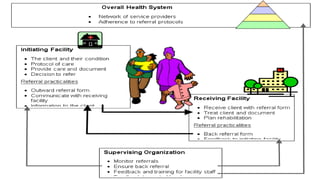
• A referral can be defined as a process in which a health worker at a one
level of the health system, having insufficient resources (drugs, equipment,
skills) to manage a clinical condition, seeks the assistance of a better or
differently resourced facility at the same or higher level to assist in, or take
over the management of, the client’s case. Key reasons for deciding to refer
either an emergency or routine case include:
• to seek expert opinion regarding the client
• to seek additional or different services for the client
• to seek admission and management of the client
• to seek use of diagnostic and therapeutic tools
CHARACTERISTICS
• An effective referral system ensures a close relationship between all levels
of the health system and helps to ensure people receive the best possible
care closest to home.
• It also assists in making cost-effective use of hospitals and primary health
care services.
• Support to health centres and outreach services by experienced staff from
the hospital or district health office helps build capacity and enhance
access to better quality care.
• In many developing countries, a high proportion of clients seen at the
outpatient clinics at secondary facilities could be appropriately looked after
at primary health care centres at lower overall cost to the client and the
health system.
CONTD…
• Clients receive optimal care at the appropriate level and not
unnecessarily costly
• Hospital facilities are used optimally and cost-effectively
• Clients who most need specialist services can accessing them in a
timely way
• Primary health services are well utilized and their reputation is
enhanced
NEPAL SCENARIO
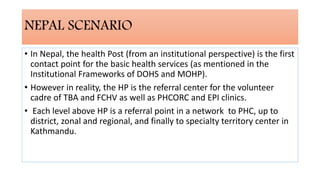
• In Nepal, the health Post (from an institutional perspective) is the first
contact point for the basic health services (as mentioned in the
Institutional Frameworks of DOHS and MOHP).
• However in reality, the HP is the referral center for the volunteer
cadre of TBA and FCHV as well as PHCORC and EPI clinics.
• Each level above HP is a referral point in a network to PHC, up to
district, zonal and regional, and finally to specialty territory center in
Kathmandu.
CONTD…
• This referral hierarchy has been designed to ensure that the majority
of population receives public health and minor treatment in places
accessible to them and at a price they can afford, inversely the system
works as a supporting mechanism for lower levels by providing
logistical, financial, supervisory and technical support from the center
to periphery.
CONTD…
• There is an absence of an effective and efficient referral system
linking community health services to higher level of care for modern
and traditional system of medicine (public, NGO, and private), tertiary
care facilities often are providing PHC services, an inappropriate use
of financial, technical and human resource and functional relation
between different level are not clearly defined e.g. DHO with PHCC,
PHCC with HP
Referral system in Second long term
health plan (1997-2017)
CONTD…
• It can be anticipated that the development of an adequate network of
fully functioning district and zonal hospital will enable more effective
referral networks to be established with a reduction of a reduction of
inappropriate cases presented to tertiary hospitals. (Strategic Plan for
Human Resource fir Health (2003-2017).
• Tenth five year plan has included; manage and strengthen referral
system.
• Improve hospital services and referral through integrated
management of district health system. (Three Year Health Plan).
CONTD….
• Needs indicated by SLHTP regarding referral system:
• Develop appropriate referral system
• Encourage Traditional faith healer to refer persons to the district
health system and to provide basic preventive and promotive
services.
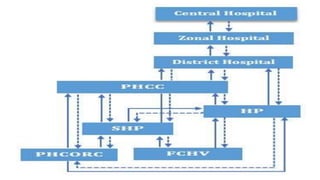
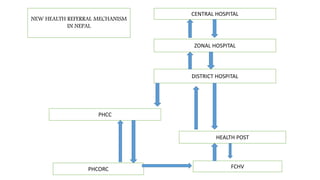
CENTRAL HOSPITAL
ZONAL HOSPITAL
DISTRICT HOSPITAL
PHCC
HEALTH POST
PHCORC FCHV
NEW HEALTH REFERRAL MECHANISM
IN NEPAL
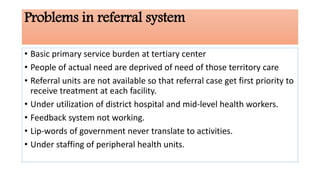
Problems in referral system
• Basic primary service burden at tertiary center
• People of actual need are deprived of need of those territory care
• Referral units are not available so that referral case get first priority to
receive treatment at each facility.
• Under utilization of district hospital and mid-level health workers.
• Feedback system not working.
• Lip-words of government never translate to activities.
• Under staffing of peripheral health units.
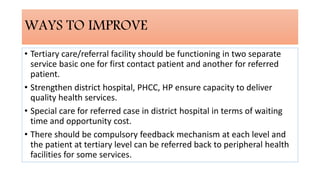
WAYS TO IMPROVE
• Tertiary care/referral facility should be functioning in two separate
service basic one for first contact patient and another for referred
patient.
• Strengthen district hospital, PHCC, HP ensure capacity to deliver
quality health services.
• Special care for referred case in district hospital in terms of waiting
time and opportunity cost.
• There should be compulsory feedback mechanism at each level and
the patient at tertiary level can be referred back to peripheral health
facilities for some services.
THANK YOU

Health system referral

  • 1.
    REFERRAL HEALTH MECHANISM INNEPAL PREPEARED BY SABINA THAPA SAGAR KUNWAR LA GRANDEE INTL. COLLEGE, SIMALCHAUR POKHARA
  • 2.
    INTRODUCTION • A referralcan be defined as a process in which a health worker at a one level of the health system, having insufficient resources (drugs, equipment, skills) to manage a clinical condition, seeks the assistance of a better or differently resourced facility at the same or higher level to assist in, or take over the management of, the client’s case. Key reasons for deciding to refer either an emergency or routine case include: • to seek expert opinion regarding the client • to seek additional or different services for the client • to seek admission and management of the client • to seek use of diagnostic and therapeutic tools
  • 3.
    CHARACTERISTICS • An effectivereferral system ensures a close relationship between all levels of the health system and helps to ensure people receive the best possible care closest to home. • It also assists in making cost-effective use of hospitals and primary health care services. • Support to health centres and outreach services by experienced staff from the hospital or district health office helps build capacity and enhance access to better quality care. • In many developing countries, a high proportion of clients seen at the outpatient clinics at secondary facilities could be appropriately looked after at primary health care centres at lower overall cost to the client and the health system.
  • 4.
    CONTD… • Clients receiveoptimal care at the appropriate level and not unnecessarily costly • Hospital facilities are used optimally and cost-effectively • Clients who most need specialist services can accessing them in a timely way • Primary health services are well utilized and their reputation is enhanced
  • 6.
    NEPAL SCENARIO • InNepal, the health Post (from an institutional perspective) is the first contact point for the basic health services (as mentioned in the Institutional Frameworks of DOHS and MOHP). • However in reality, the HP is the referral center for the volunteer cadre of TBA and FCHV as well as PHCORC and EPI clinics. • Each level above HP is a referral point in a network to PHC, up to district, zonal and regional, and finally to specialty territory center in Kathmandu.
  • 7.
    CONTD… • This referralhierarchy has been designed to ensure that the majority of population receives public health and minor treatment in places accessible to them and at a price they can afford, inversely the system works as a supporting mechanism for lower levels by providing logistical, financial, supervisory and technical support from the center to periphery.
  • 8.
    CONTD… • There isan absence of an effective and efficient referral system linking community health services to higher level of care for modern and traditional system of medicine (public, NGO, and private), tertiary care facilities often are providing PHC services, an inappropriate use of financial, technical and human resource and functional relation between different level are not clearly defined e.g. DHO with PHCC, PHCC with HP
  • 9.
    Referral system inSecond long term health plan (1997-2017)
  • 10.
    CONTD… • It canbe anticipated that the development of an adequate network of fully functioning district and zonal hospital will enable more effective referral networks to be established with a reduction of a reduction of inappropriate cases presented to tertiary hospitals. (Strategic Plan for Human Resource fir Health (2003-2017). • Tenth five year plan has included; manage and strengthen referral system. • Improve hospital services and referral through integrated management of district health system. (Three Year Health Plan).
  • 11.
    CONTD…. • Needs indicatedby SLHTP regarding referral system: • Develop appropriate referral system • Encourage Traditional faith healer to refer persons to the district health system and to provide basic preventive and promotive services.
  • 13.
    CENTRAL HOSPITAL ZONAL HOSPITAL DISTRICTHOSPITAL PHCC HEALTH POST PHCORC FCHV NEW HEALTH REFERRAL MECHANISM IN NEPAL
  • 14.
    Problems in referralsystem • Basic primary service burden at tertiary center • People of actual need are deprived of need of those territory care • Referral units are not available so that referral case get first priority to receive treatment at each facility. • Under utilization of district hospital and mid-level health workers. • Feedback system not working. • Lip-words of government never translate to activities. • Under staffing of peripheral health units.
  • 15.
    WAYS TO IMPROVE •Tertiary care/referral facility should be functioning in two separate service basic one for first contact patient and another for referred patient. • Strengthen district hospital, PHCC, HP ensure capacity to deliver quality health services. • Special care for referred case in district hospital in terms of waiting time and opportunity cost. • There should be compulsory feedback mechanism at each level and the patient at tertiary level can be referred back to peripheral health facilities for some services.
  • 16.