GERMAN HEALTHCARE
SYSTEM
Presentation by :
Jividha and Shubham
Types of healthcare system:-
Beveridge
 Bismarck
 National
 Out-of-Pocket
BISMARCK’S MODEL
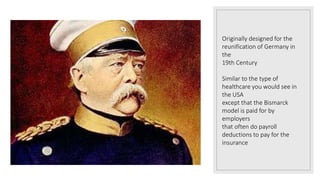
Originally designed for the
reunification of Germany in
the
19th Century
Similar to the type of
healthcare you would see in
the USA
except that the Bismarck
model is paid for by
employers
that often do payroll
deductions to pay for the
insurance
overview
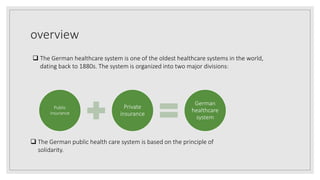
 The German healthcare system is one of the oldest healthcare systems in the world,
dating back to 1880s. The system is organized into two major divisions:
Public
insurance
Private
insurance
German
healthcare
system
 The German public health care system is based on the principle of
solidarity.
Understanding the German healthcare system
 The most important thing to know about the German health care system is that it is
mandatory. All nationals and temporary residents in Germany have to pay for health insurance
every month. The cost of health insurance in Germany comes down to two main factors:
Your income and employment status.
Whether you are paying for Public or Private health insurance.
Characteristics
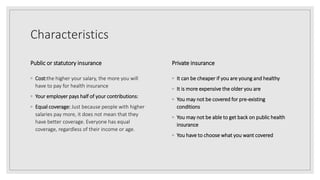
Public or statutory insurance
◦ Cost:the higher your salary, the more you will
have to pay for health insurance
◦ Your employer pays half of your contributions:
◦ Equal coverage: Just because people with higher
salaries pay more, it does not mean that they
have better coverage. Everyone has equal
coverage, regardless of their income or age.
Private insurance
◦ It can be cheaper if you are young and healthy
◦ It is more expensive the older you are
◦ You may not be covered for pre-existing
conditions
◦ You may not be able to get back on public health
insurance
◦ You have to choose what you want covered
More on public insurance
◦ You can include your dependents on your own insurance: If you have children or your spouse is
unemployed (or has a low income), then you can include them on your own health insurance
with no additional cost.
◦ Who can opt-out: If your income is above a certain amount (appx. € 59,000 per year), then you
can opt-out of public health insurance and obtain private health insurance instead. If your
annual income is less than € 59,000, then you must get public health insurance.
◦ 59,000 EURO = 5176217.89 INR
◦ Long-term care services are covered separately under Germany’s
mandatory, statutory long-term care insurance (LTCI).
ROLE OF PLAYERS
The statutory health insurance (SHI) system consists of 110 sickness funds (acting as third-party payers) covering around
88% of the population. The self-employed and employees who exceed a certain income threshold may choose to stay
with SHI or opt for private health insurance (PHI) provided by 41 insurance companies. PHI covers around 10% of the
population, including civil servants; the remainder (e.g. military) are covered through special schemes. An estimated
0.1% of the population, however, does not have insurance due to administrative hurdles or problems paying premiums
SHI is financed mostly through income-related contributions equally shared between employer and employees.
Contributions are pooled in a central fund and reallocated to sickness funds based on the health needs of their
constituents. PHI is financed through premiums defined by individual health risk upon entry (“life-time underwriting”)
CONTINUED..
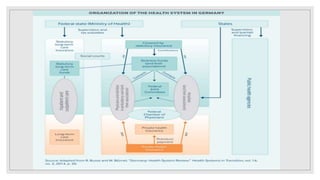
◦ Role of government: The German health care system is notable for the sharing of decision-
making powers among the federal and state governments and self-regulated organizations of
payers and providers
◦ Role of public health insurance: In 2017, total health expenditures made up 11.5 percent of the
gross domestic product (GDP). Of this health spending, 74 percent was publicly funded, and
most of that spending (57% of total) went toward SHI
◦ Role of private health insurance: In 2017, private health insurance accounted for 8.4 percent of
total health expenditures
SERVICES COVERED UNDER SHI
◦ Preventive services, including regular
dental checkups, child checkups, basic
immunizations, chronic disease
checkups, and cancer screenings at
certain ages
◦ Inpatient and outpatient hospital care
◦ Physician services
◦ Mental health care
◦ Dental care
◦ Optometry
◦ Physical therapy
◦ Prescription drugs, except for those
explicitly excluded by law
◦ Medical aids
◦ Rehabilitation
◦ Hospice and palliative care
◦ Maternity care
◦ Sick leave compensation.
HOW IS THE DELIVERY SYSTEM
ORGANIZED AND HOW ARE
PROVIDERS PAID?
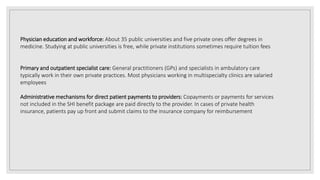
Physician education and workforce: About 35 public universities and five private ones offer degrees in
medicine. Studying at public universities is free, while private institutions sometimes require tuition fees
Primary and outpatient specialist care: General practitioners (GPs) and specialists in ambulatory care
typically work in their own private practices. Most physicians working in multispecialty clinics are salaried
employees
Administrative mechanisms for direct patient payments to providers: Copayments or payments for services
not included in the SHI benefit package are paid directly to the provider. In cases of private health
insurance, patients pay up front and submit claims to the insurance company for reimbursement
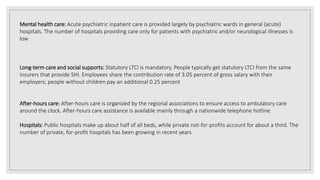
Mental health care: Acute psychiatric inpatient care is provided largely by psychiatric wards in general (acute)
hospitals. The number of hospitals providing care only for patients with psychiatric and/or neurological illnesses is
low
Long-term care and social supports: Statutory LTCI is mandatory. People typically get statutory LTCI from the same
insurers that provide SHI. Employees share the contribution rate of 3.05 percent of gross salary with their
employers; people without children pay an additional 0.25 percent
After-hours care: After-hours care is organized by the regional associations to ensure access to ambulatory care
around the clock. After-hours care assistance is available mainly through a nationwide telephone hotline
Hospitals: Public hospitals make up about half of all beds, while private not-for-profits account for about a third. The
number of private, for-profit hospitals has been growing in recent years
MAJOR STRATEGIES TO ENSURE
QUALITY OF CARE
 Quality of care is addressed through a range of measures broadly defined by law and in more detail by the
Federal Joint Committee
 The Institute for Quality Assurance and Transparency (IQTiG) is responsible for measuring and reporting on
quality of care and provider performance on behalf of the Federal Joint Committee
 In addition, the institute develops criteria for evaluating certificates and quality targets and ensures that
the published results are comprehensible to the public
 All hospitals are required to publish findings on selected indicators, as defined by the IQTiG, to enable
hospital comparisons
 The results of these quality checks are published in transparency reports
 Disease management programs ensure quality of care for people with chronic illness
 Nonbinding clinical guidelines are produced by the Physicians’ Agency for Quality in Medicine and other
professional societies
WHAT IS BEING DONE TO
REDUCE DISPARITIES?
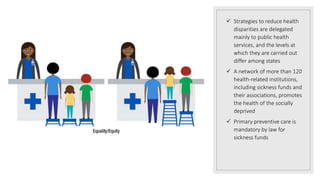
 Strategies to reduce health
disparities are delegated
mainly to public health
services, and the levels at
which they are carried out
differ among states
 A network of more than 120
health-related institutions,
including sickness funds and
their associations, promotes
the health of the socially
deprived
 Primary preventive care is
mandatory by law for
sickness funds
ELECTRONIC HEALTH
RECORD
Since 2015, electronic medical chip cards have been used nationwide by all
the SHI-insured
they encode information including the person’s name, address, date of birth,
and sickness fund, along with details of insurance coverage and the person’s
status regarding supplementary charges
In 2015, Parliament passed a law for secure digital communications and
health care applications
SHI physicians receive additional fees for sharing electronic medical reports
with other providers (since 2016–2017)
COST CONTROL
TECHNIQUES
• The Hospital Care Structure Reform Act of 2016 aims
not only to link hospital payments to good service
quality but also to reduce payments for low-value
services
• To enhance competition, some purchasing power has
been handed over to the individual sickness funds
instead of relying on collective contracts with regional
associations
• All drugs, both patented and generic, are placed into
groups with a reference price serving as a maximum
level for reimbursement, unless an added medical
benefit can be demonstrated
CAN GERMAN SYSTEM BE
ADAPTED IN INDIA?
Conclusion
Germany seems to have an utterly well-organized system, where help, care, prescription drugs or
surgery is guaranteed when needed. This method is used in many European countries
India saw its crisis several years ago and started projects to improve the situation and tried to
offer everybody the care they needed, similar as in European countries. Since average income in
India is very low and big parts of the population live below the international poverty line, the
government and the provinces have to raise the incidental costs themselves
RSBY - Rashtriya Swasthya Bima Yojana
The RSBY is an Indian mission, launched in 2008. Rashtriya Swasthya Bima Yojana, the Indian
name for this project can be translated to National Health Insurance Program. The main idea of it
is to cover a specific amount of the medical fees for the poorest parts of the population
THANK YOU

German healthcare system.pptx

  • 1.
  • 2.
    Types of healthcaresystem:- Beveridge  Bismarck  National  Out-of-Pocket
  • 3.
  • 4.
    Originally designed forthe reunification of Germany in the 19th Century Similar to the type of healthcare you would see in the USA except that the Bismarck model is paid for by employers that often do payroll deductions to pay for the insurance
  • 5.
    overview  The Germanhealthcare system is one of the oldest healthcare systems in the world, dating back to 1880s. The system is organized into two major divisions: Public insurance Private insurance German healthcare system  The German public health care system is based on the principle of solidarity.
  • 6.
    Understanding the Germanhealthcare system  The most important thing to know about the German health care system is that it is mandatory. All nationals and temporary residents in Germany have to pay for health insurance every month. The cost of health insurance in Germany comes down to two main factors: Your income and employment status. Whether you are paying for Public or Private health insurance.
  • 7.
    Characteristics Public or statutoryinsurance ◦ Cost:the higher your salary, the more you will have to pay for health insurance ◦ Your employer pays half of your contributions: ◦ Equal coverage: Just because people with higher salaries pay more, it does not mean that they have better coverage. Everyone has equal coverage, regardless of their income or age. Private insurance ◦ It can be cheaper if you are young and healthy ◦ It is more expensive the older you are ◦ You may not be covered for pre-existing conditions ◦ You may not be able to get back on public health insurance ◦ You have to choose what you want covered
  • 8.
    More on publicinsurance ◦ You can include your dependents on your own insurance: If you have children or your spouse is unemployed (or has a low income), then you can include them on your own health insurance with no additional cost. ◦ Who can opt-out: If your income is above a certain amount (appx. € 59,000 per year), then you can opt-out of public health insurance and obtain private health insurance instead. If your annual income is less than € 59,000, then you must get public health insurance. ◦ 59,000 EURO = 5176217.89 INR ◦ Long-term care services are covered separately under Germany’s mandatory, statutory long-term care insurance (LTCI).
  • 9.
    ROLE OF PLAYERS Thestatutory health insurance (SHI) system consists of 110 sickness funds (acting as third-party payers) covering around 88% of the population. The self-employed and employees who exceed a certain income threshold may choose to stay with SHI or opt for private health insurance (PHI) provided by 41 insurance companies. PHI covers around 10% of the population, including civil servants; the remainder (e.g. military) are covered through special schemes. An estimated 0.1% of the population, however, does not have insurance due to administrative hurdles or problems paying premiums SHI is financed mostly through income-related contributions equally shared between employer and employees. Contributions are pooled in a central fund and reallocated to sickness funds based on the health needs of their constituents. PHI is financed through premiums defined by individual health risk upon entry (“life-time underwriting”)
  • 11.
    CONTINUED.. ◦ Role ofgovernment: The German health care system is notable for the sharing of decision- making powers among the federal and state governments and self-regulated organizations of payers and providers ◦ Role of public health insurance: In 2017, total health expenditures made up 11.5 percent of the gross domestic product (GDP). Of this health spending, 74 percent was publicly funded, and most of that spending (57% of total) went toward SHI ◦ Role of private health insurance: In 2017, private health insurance accounted for 8.4 percent of total health expenditures
  • 12.
    SERVICES COVERED UNDERSHI ◦ Preventive services, including regular dental checkups, child checkups, basic immunizations, chronic disease checkups, and cancer screenings at certain ages ◦ Inpatient and outpatient hospital care ◦ Physician services ◦ Mental health care ◦ Dental care ◦ Optometry ◦ Physical therapy ◦ Prescription drugs, except for those explicitly excluded by law ◦ Medical aids ◦ Rehabilitation ◦ Hospice and palliative care ◦ Maternity care ◦ Sick leave compensation.
  • 13.
    HOW IS THEDELIVERY SYSTEM ORGANIZED AND HOW ARE PROVIDERS PAID?
  • 14.
    Physician education andworkforce: About 35 public universities and five private ones offer degrees in medicine. Studying at public universities is free, while private institutions sometimes require tuition fees Primary and outpatient specialist care: General practitioners (GPs) and specialists in ambulatory care typically work in their own private practices. Most physicians working in multispecialty clinics are salaried employees Administrative mechanisms for direct patient payments to providers: Copayments or payments for services not included in the SHI benefit package are paid directly to the provider. In cases of private health insurance, patients pay up front and submit claims to the insurance company for reimbursement
  • 15.
    Mental health care:Acute psychiatric inpatient care is provided largely by psychiatric wards in general (acute) hospitals. The number of hospitals providing care only for patients with psychiatric and/or neurological illnesses is low Long-term care and social supports: Statutory LTCI is mandatory. People typically get statutory LTCI from the same insurers that provide SHI. Employees share the contribution rate of 3.05 percent of gross salary with their employers; people without children pay an additional 0.25 percent After-hours care: After-hours care is organized by the regional associations to ensure access to ambulatory care around the clock. After-hours care assistance is available mainly through a nationwide telephone hotline Hospitals: Public hospitals make up about half of all beds, while private not-for-profits account for about a third. The number of private, for-profit hospitals has been growing in recent years
  • 16.
    MAJOR STRATEGIES TOENSURE QUALITY OF CARE
  • 17.
     Quality ofcare is addressed through a range of measures broadly defined by law and in more detail by the Federal Joint Committee  The Institute for Quality Assurance and Transparency (IQTiG) is responsible for measuring and reporting on quality of care and provider performance on behalf of the Federal Joint Committee  In addition, the institute develops criteria for evaluating certificates and quality targets and ensures that the published results are comprehensible to the public  All hospitals are required to publish findings on selected indicators, as defined by the IQTiG, to enable hospital comparisons  The results of these quality checks are published in transparency reports  Disease management programs ensure quality of care for people with chronic illness  Nonbinding clinical guidelines are produced by the Physicians’ Agency for Quality in Medicine and other professional societies
  • 18.
    WHAT IS BEINGDONE TO REDUCE DISPARITIES?
  • 19.
     Strategies toreduce health disparities are delegated mainly to public health services, and the levels at which they are carried out differ among states  A network of more than 120 health-related institutions, including sickness funds and their associations, promotes the health of the socially deprived  Primary preventive care is mandatory by law for sickness funds
  • 20.
  • 21.
    Since 2015, electronicmedical chip cards have been used nationwide by all the SHI-insured they encode information including the person’s name, address, date of birth, and sickness fund, along with details of insurance coverage and the person’s status regarding supplementary charges In 2015, Parliament passed a law for secure digital communications and health care applications SHI physicians receive additional fees for sharing electronic medical reports with other providers (since 2016–2017)
  • 22.
  • 23.
    • The HospitalCare Structure Reform Act of 2016 aims not only to link hospital payments to good service quality but also to reduce payments for low-value services • To enhance competition, some purchasing power has been handed over to the individual sickness funds instead of relying on collective contracts with regional associations • All drugs, both patented and generic, are placed into groups with a reference price serving as a maximum level for reimbursement, unless an added medical benefit can be demonstrated
  • 24.
    CAN GERMAN SYSTEMBE ADAPTED IN INDIA?
  • 25.
    Conclusion Germany seems tohave an utterly well-organized system, where help, care, prescription drugs or surgery is guaranteed when needed. This method is used in many European countries India saw its crisis several years ago and started projects to improve the situation and tried to offer everybody the care they needed, similar as in European countries. Since average income in India is very low and big parts of the population live below the international poverty line, the government and the provinces have to raise the incidental costs themselves RSBY - Rashtriya Swasthya Bima Yojana The RSBY is an Indian mission, launched in 2008. Rashtriya Swasthya Bima Yojana, the Indian name for this project can be translated to National Health Insurance Program. The main idea of it is to cover a specific amount of the medical fees for the poorest parts of the population
  • 26.