Improving Health
and Increasing Wealth:
A Summary of Research Linking Health
and Personal Finance
Barbara O’Neill, Ph.D., CFP®, CRPC®, AFC, CHC, CFEd, CFCS, CPFFE
Karen Ensle, Ed.D., RDN, FAND, CFCS
Rutgers Cooperative Extension
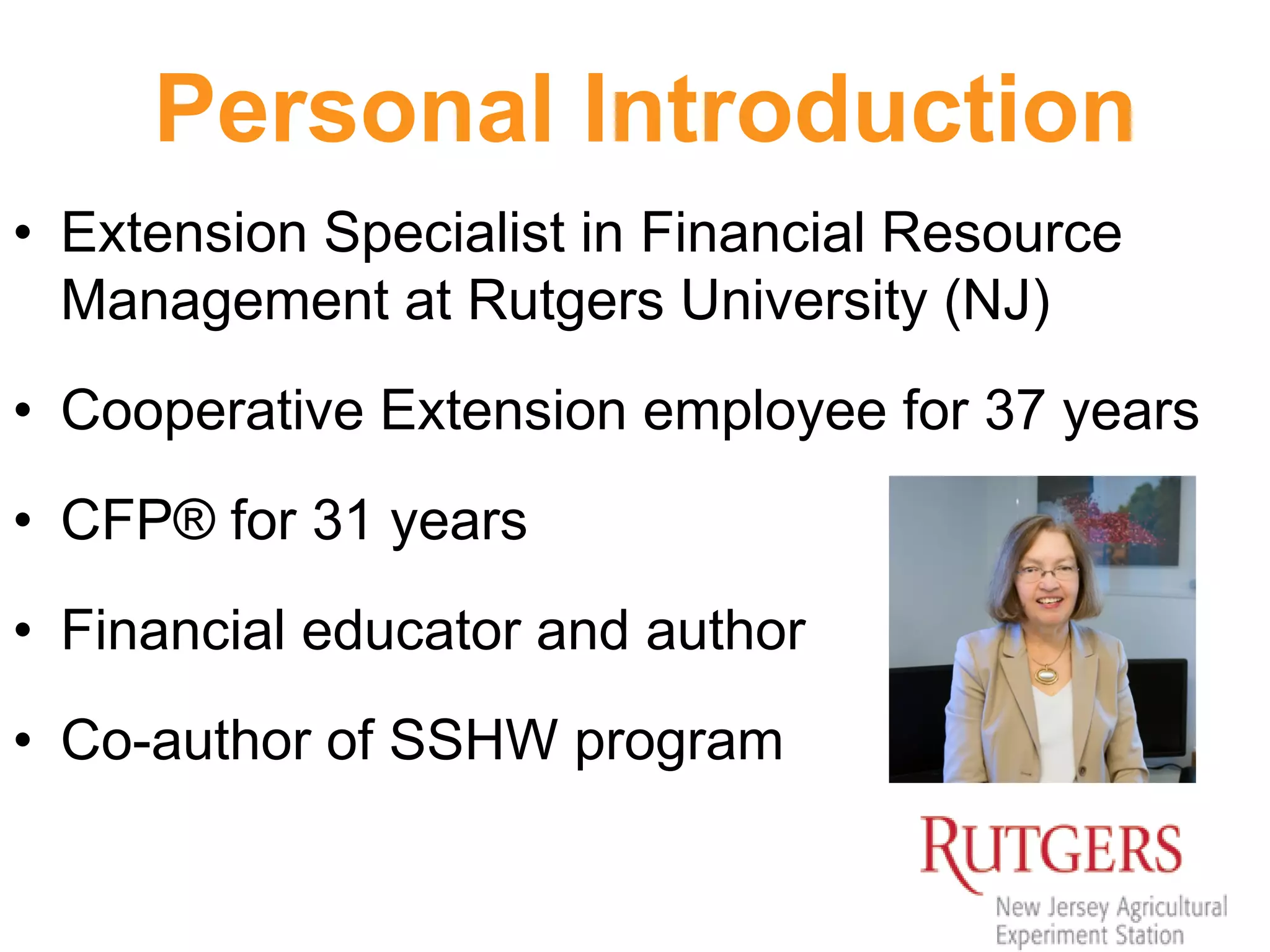
Personal Introduction
• Extension Specialist in Financial Resource
Management at Rutgers University (NJ)
• Cooperative Extension employee for 37 years
• CFP® for 31 years
• Financial educator and author
• Co-author of SSHW program
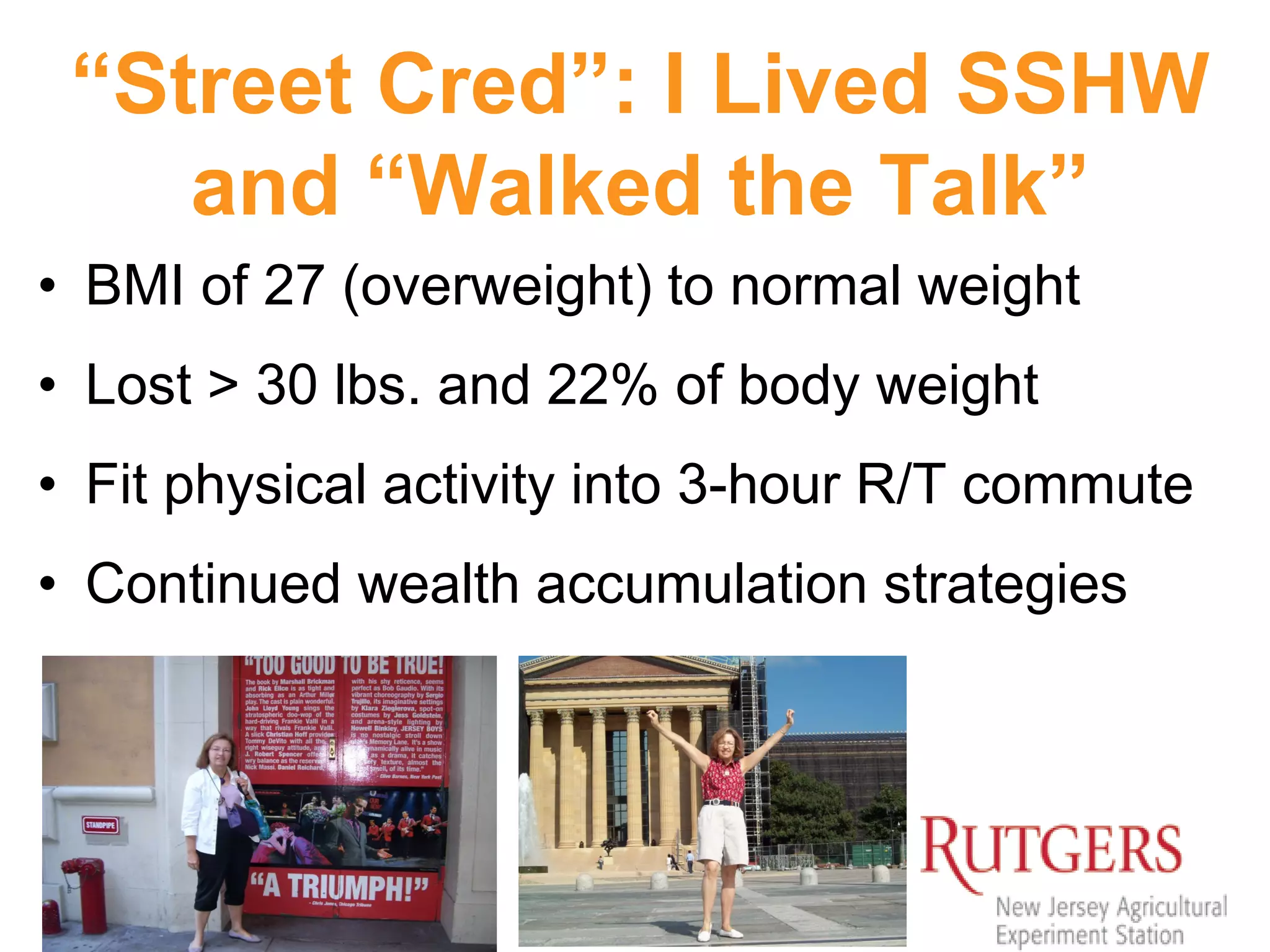
“Street Cred”: I Lived SSHW
and “Walked the Talk”
• BMI of 27 (overweight) to normal weight
• Lost > 30 lbs. and 22% of body weight
• Fit physical activity into 3-hour R/T commute
• Continued wealth accumulation strategies
Workshop Objectives
• Describe research on health-wealth linkages
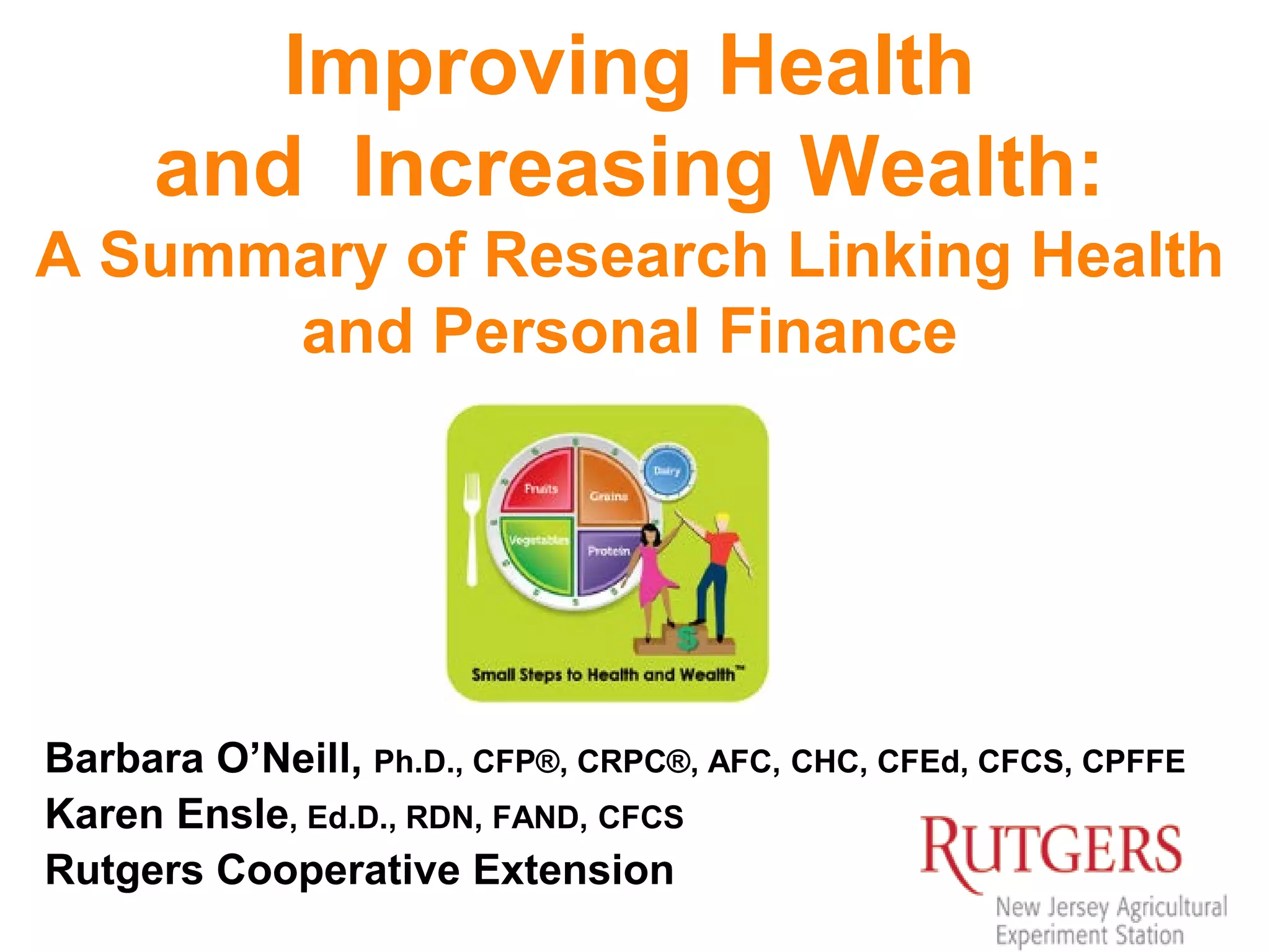
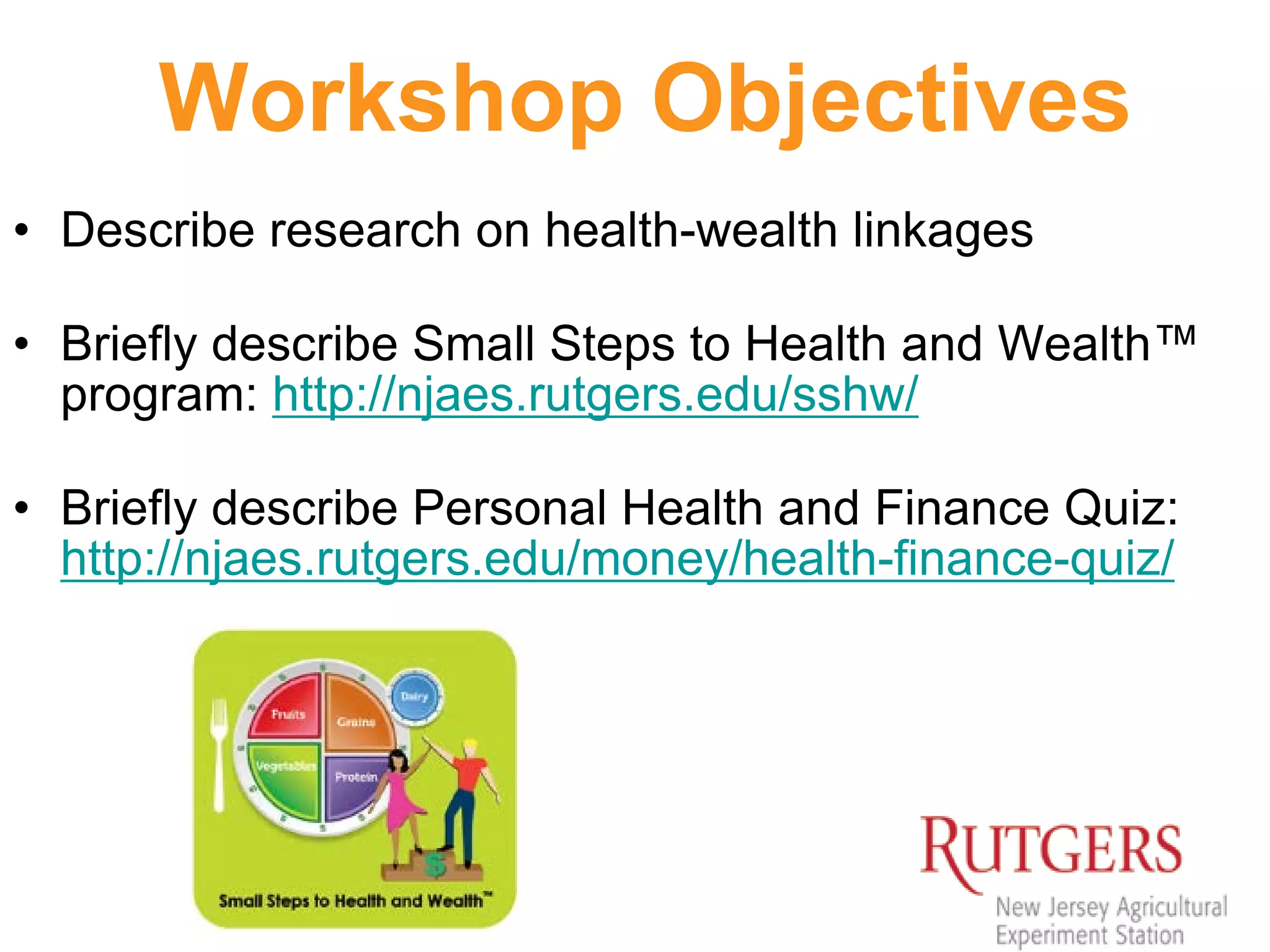
• Briefly describe Small Steps to Health and Wealth™
program: http://njaes.rutgers.edu/sshw/
• Briefly describe Personal Health and Finance Quiz:
http://njaes.rutgers.edu/money/health-finance-quiz/
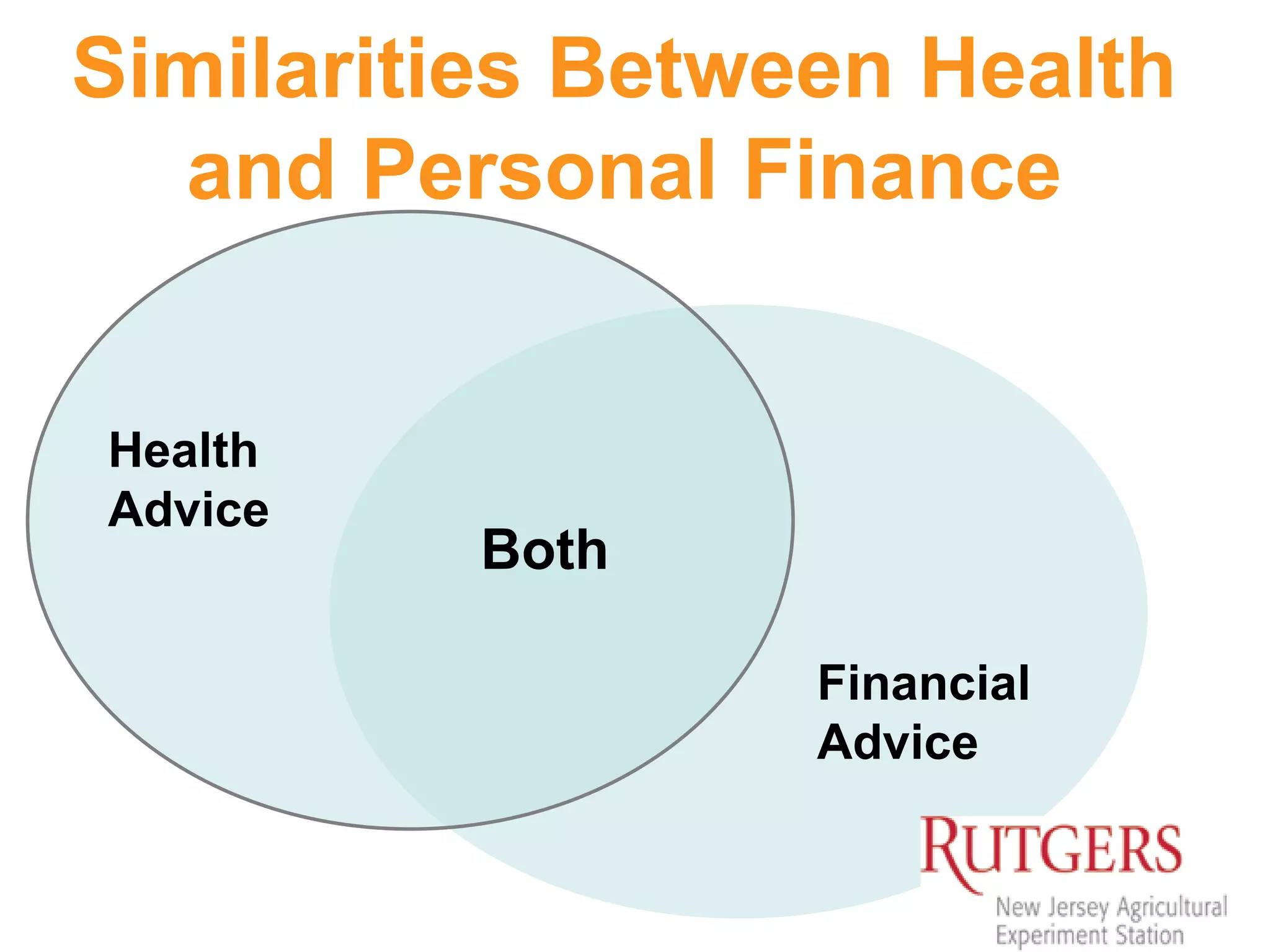
Similarities Between Health
and Personal Finance
Both
Health
Advice
Financial
Advice
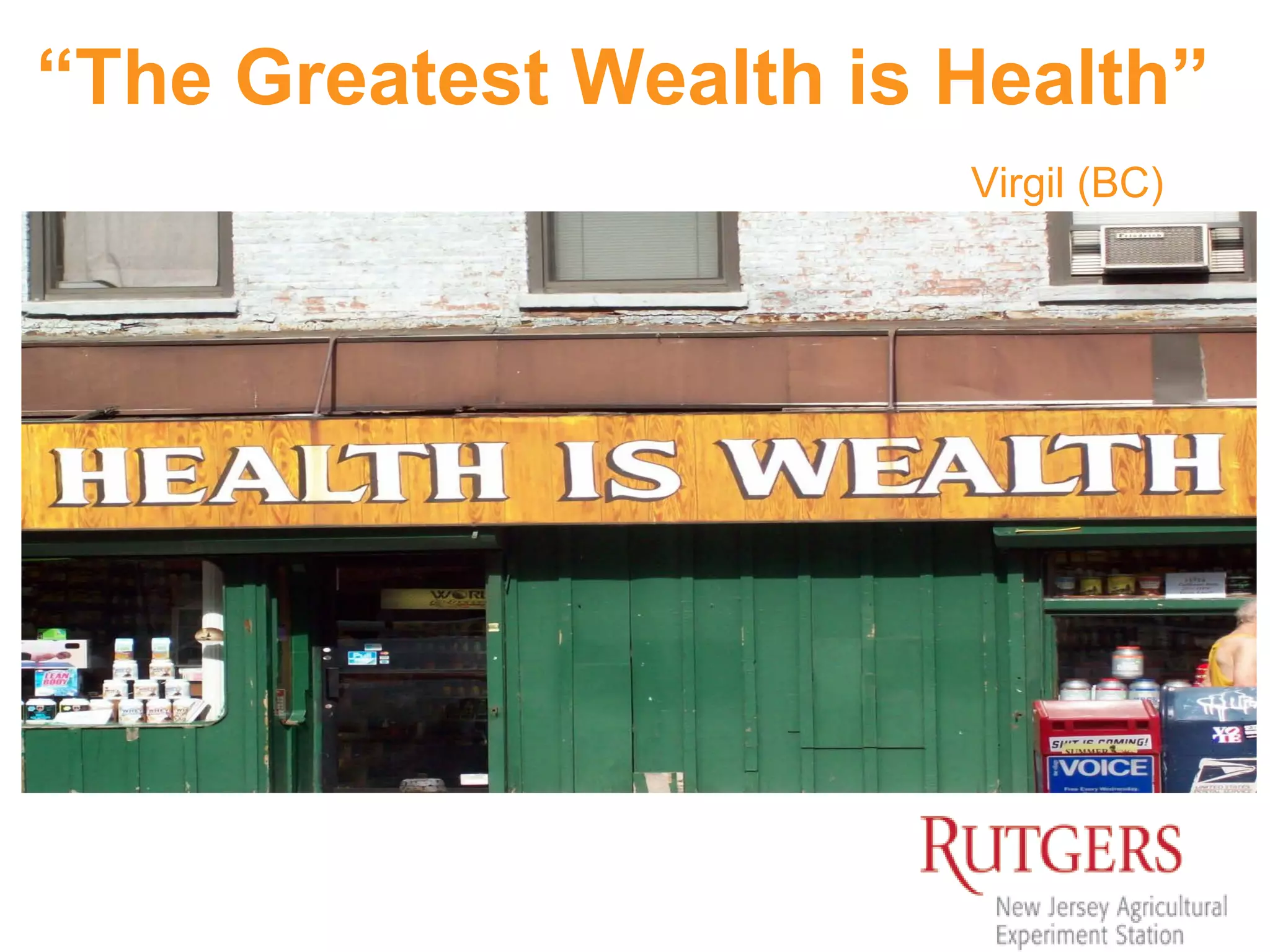
“The Greatest Wealth is Health”
Virgil (BC)
Health and Personal
Finance Research
Findings and Theories
Recent Health-Wealth
Research Findings
• The “cost” of better health is the need for greater wealth
(higher total lifetime health care costs for healthier people)
– More years of out-of-pocket expenses
– Increased likelihood of chronic condition in later life
– Increased likelihood of need for long-term care
– http://crr.bc.edu/wp-content/uploads/2010/05/IB_10-8.pdf (Sun, Webb, & Zhivan, 2010)
• Healthy living habits improve during tough economic times
– http://www.stlouisfed.org/publications/re/articles/?id=2018
– http://libres.uncg.edu/ir/uncg/f/C_Ruhm_Healthy_2005.pdf (Ruhm, 2005))
More Research Findings
• Associations between financial distress and physical
symptoms of stress
– http://ldi.upenn.edu/uploads/media_items/foreclosure-and-health-status.original.pdf
– http://www.personalfinancefoundation.org/research/efd/The-Association-Among-Health-
Race-and-Debt.pdf
• Childhood self-control predicts research subjects’ future
health, wealth, and other life outcomes
Moffitt, T.E, Arseneault, L., Belsky, D., Dickson, N, Hancox, R.J., Harrington, H.,
Houts, R., Poulton, R., Roberts, B.W., Ross, S., Sears, M.R, Thomson, W.M., &
Caspi, A. (2011). A gradient of childhood self-control predicts health, wealth, and
public safety. Proceedings of the National Academy of Sciences, 108(7), 2693-2698.
More Research Findings
• Smokers’ lower net worth vs. non-smokers
– http://www.ncbi.nlm.nih.gov/pmc/articles/PMC1747936/pdf/v013p00370.pdf
• Negative association of BMI and income,
especially among white females
– http://www.nber.org/papers/w11343
• Positive impact of financial incentives on health
behaviors
– http://mcr.sagepub.com/content/65/6_suppl/36S.short
• Widespread health insurance illiteracy
– http://www.aicpa.org/press/pressreleases/2013/pages/us-adults-fail-health-insurance-101-aicpa-
survey.aspx
– http://www.washingtonpost.com/blogs/wonkblog/wp/2013/08/08/do-you-understand-health-insurance-
most-people-dont/
– http://www.hks.harvard.edu/fs/bmadria/Documents/Madrian%20Papers/Consumers%20Misunderstanding
%20of%20Health%20Insurance.pdf
More Research Findings
• Positive relationship between engaging in regular physical
activity and labor market earnings
• Regular exercise yielded a 6% to 10% wage increase
• Possible reason: Fit employees are highly disciplined and
more productive, which can lead to career advancement and
higher earnings
Kosteas, V.D. (2012). The effect of exercise on earnings: Evidence from the
NLSY. Journal of Labor Research, 33, 225-250.
More Research Findings
• Dor, Ferguson, Langwith, and Tan (2010) estimated overall
annual costs of being obese as $4,879 for an obese woman
and $2,646 for an obese man
• Their analysis included non-medical indirect costs such as
sick days, lost productivity, lower wages, life insurance
premiums (i.e., not being able to qualify for preferred rates),
and even the need for extra gasoline
• The difference between genders was mostly the result of lost
wages for obese women; obese women lost more income
through lost wages than from medical costs
https://publichealth.gwu.edu/departments/healthpolicy/DHP_Publications/pub_upl
oads/dhpPublication_35308C47-5056-9D20-3DB-157B39AC53093.pdf
Retirement Plan Savings and
Health Behavior Study
• Published in Psychological Science in 2014:
http://pss.sagepub.com/content/early/2014/06/25/0956797614540467.abstract
• An employee’s decision to contribute to a 401(k) predicted
action to correct poor physical health indicators that were
revealed during an employer-sponsored health examination
• Employees who saved for the future in a 401(k) showed
improvements in abnormal blood-test results and health
behaviors about 27% more often than non-contributors did
• Findings were attributed to individuals’ time-discounting trait
that predicts long-term behavior
SSHW Research (Rutgers)
Refereed Journal Articles
O’Neill, B. The greatest Wealth is Health: Relationships Between Health and Financial Behaviors. Journal of Personal
Finance, (2015), 14(1). URL: http://www.iarfc.org/documents/issues/Vol.14Issue1.pdf.
O’Neill, B. & Ensle, K. Small Steps to Health and Wealth™: Program Update and Research Insights. The Forum for
Family and Consumer Issues (2014), (19(1). [WWW Document] URL: http://ncsu.edu/ffci/publications/2014/v19-n1-
2014-spring/oneil-ensle.php.
O'Neill, B. & Ensle, K. Have it Their Way: Creating Personalized Online Challenges to Motivate Learners. Journal of
Extension (April 2012), 50(2), 6 pages [WWW Document] URL: www.joe.org/joe/2012april/tt3.php.
O'Neill, B. & Ensle, K. The Online Small Steps to Health and Wealth™ Challenge: A Model for Interdisciplinary FCS
Programs. Journal of Family and Consumer Sciences (2010), 102(4), 52-55.
O'Neill, B. Health and Wealth Connections: Evidence from Research and Practice. Journal of Family and Consumer
Sciences (2009), 101(3), 14-19.
O'Neill, B. & Ensle, K. Small Steps to Health and Wealth™: Available Resources and Potential Economic Impacts.
The Forum for Family and Consumer Issues (Summer/Fall 2008), 13(2), 5 pages [ WWW document] URL:
ncsu.edu/ffci/publications/2008/v13-n2-2008-summer-fall/oneill.php.
O'Neill, B. Health and Wealth Connections: Implications for Financial Planners. Journal of Personal Finance (2005),
4(2), 27-39.
O'Neill, B. Small Steps to Health and Wealth. The Forum for Family and Consumer Issues, (December 2004), 9(3), 8
[WWW document] URL: www.ces.ncsu.edu/depts/fcs/pub/9_3/smallsteps.html.
What is a Theory?
• Set of concepts, definitions, and propositions
• Systematic view of events or situations
• Allows exploration and/or explanation of
events or situations
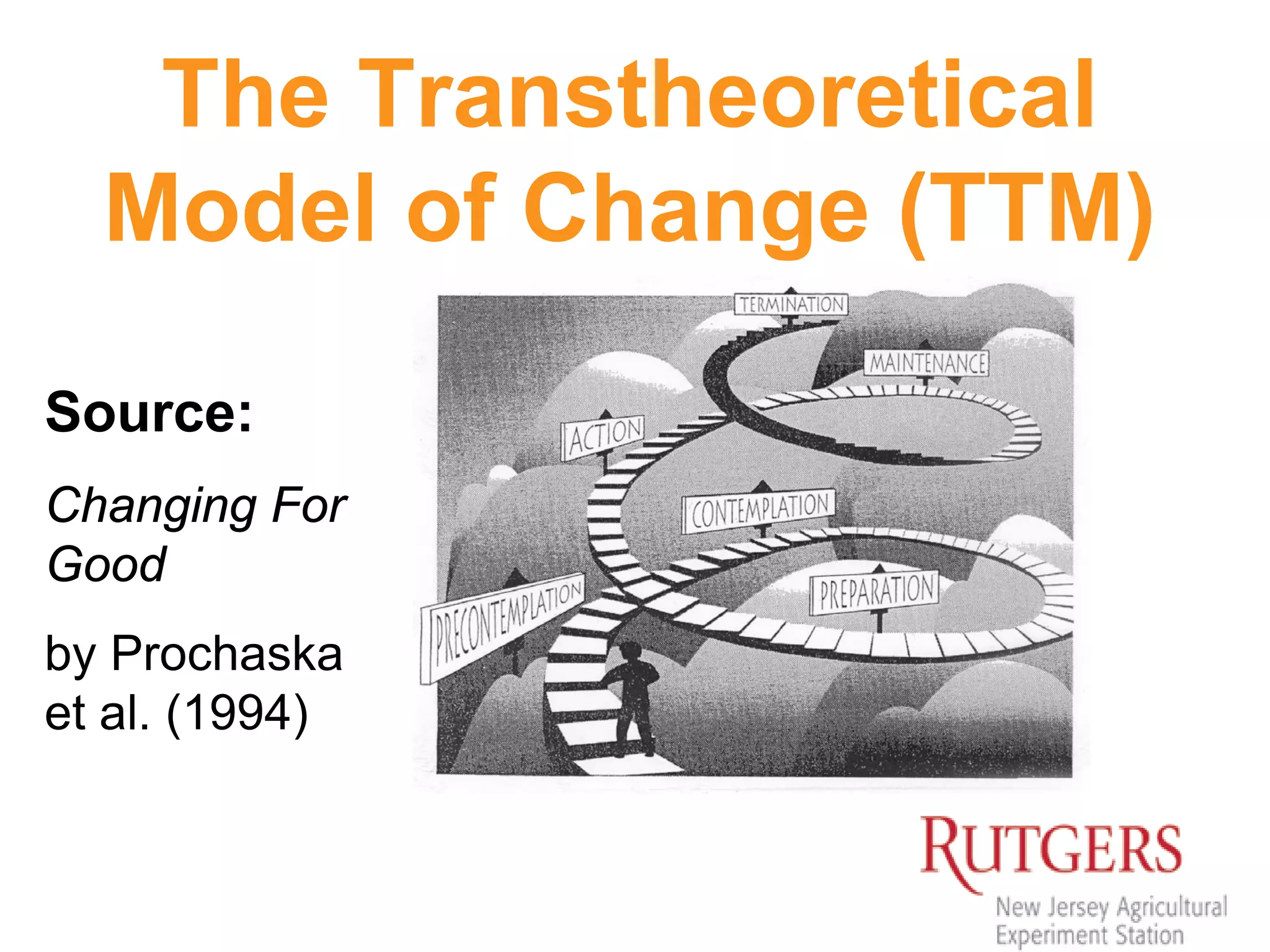
The Transtheoretical
Model of Change (TTM)
Source:
Changing For
Good
by Prochaska
et al. (1994)
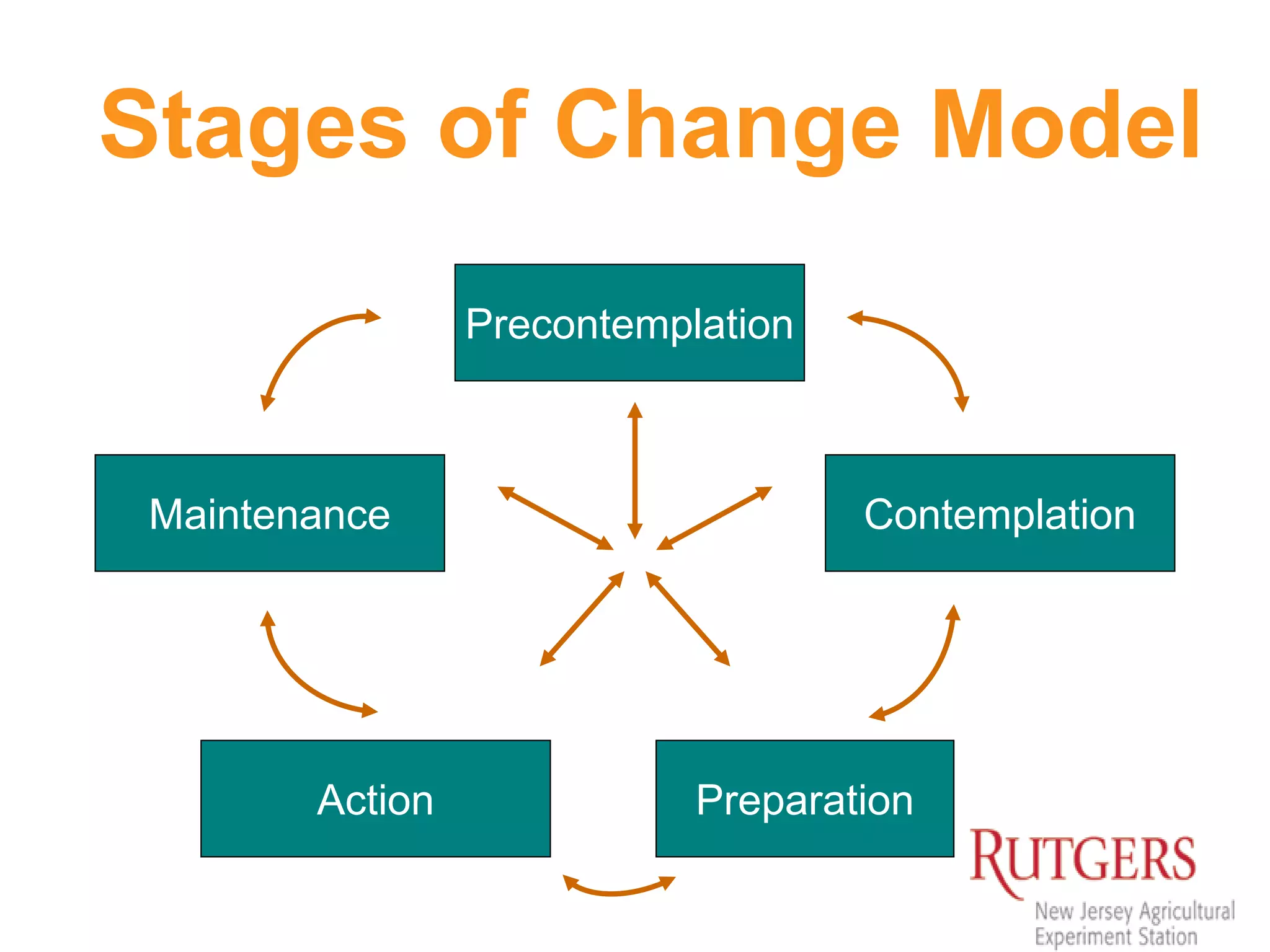
Stages of Change Model
Precontemplation
Action Preparation
Maintenance Contemplation
Diffusion of Innovations Theory
• How new ideas, products, and behaviors become
norms
• All levels: individual, interpersonal, community, and
organizational
• Success determined by: nature of the innovation,
communication channels, adoption time
Source: Everett M. Rogers, Diffusion of Innovations, 4th ed. (New York: The Free Press, 1995).
19
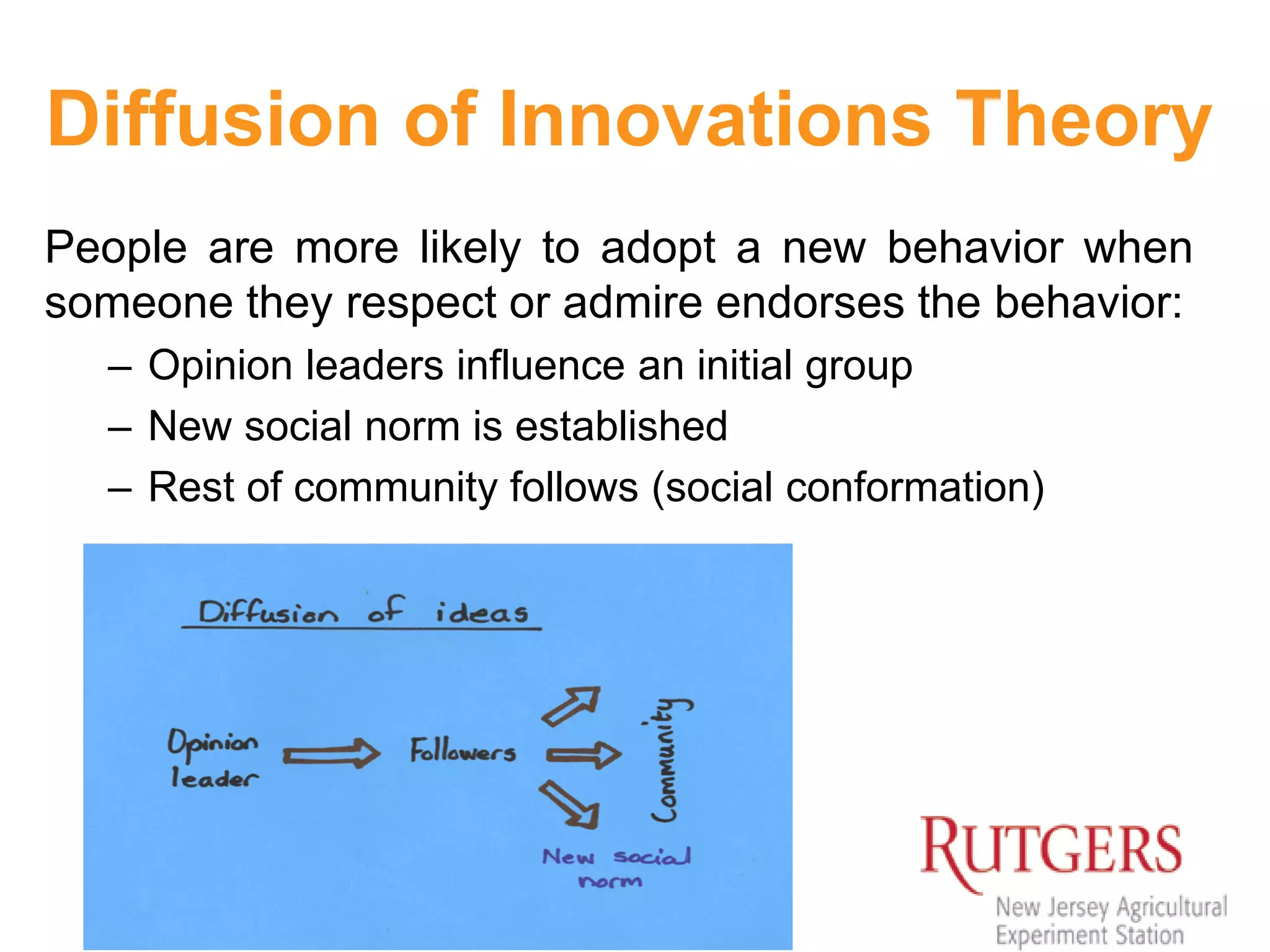
Diffusion of Innovations Theory
People are more likely to adopt a new behavior when
someone they respect or admire endorses the behavior:
– Opinion leaders influence an initial group
– New social norm is established
– Rest of community follows (social conformation)
Fishbein and Ajzen’s Theory of
Reasoned Action (TRA)
• Originally developed in 1967; further developed
during the 1970s.
• By the 1980s, very commonly used to study human
behavior
• Fishbein and Ajzen were both working on similar
concepts to explain human behavior; eventually
collaborated to create and publish the model in 1980
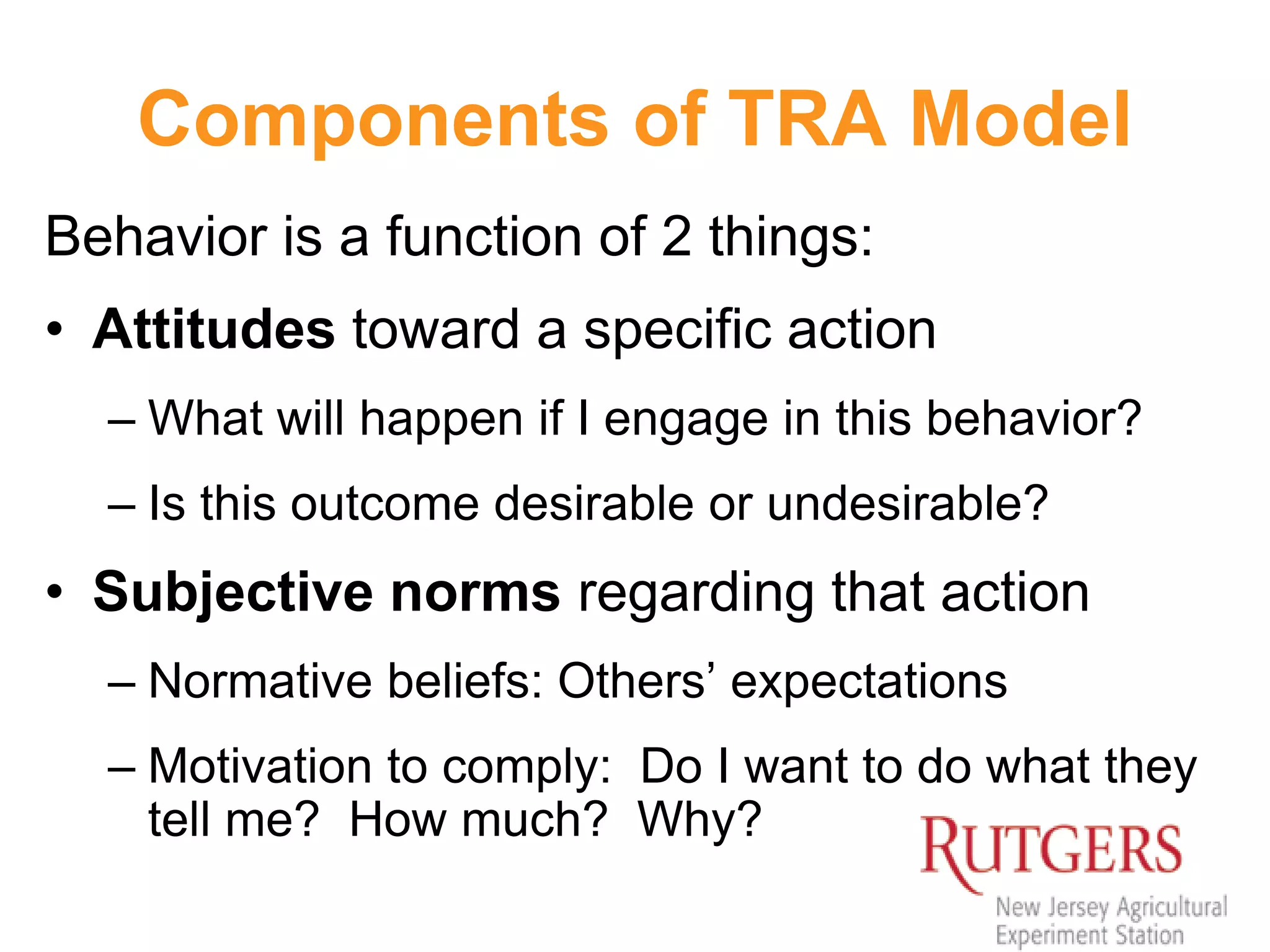
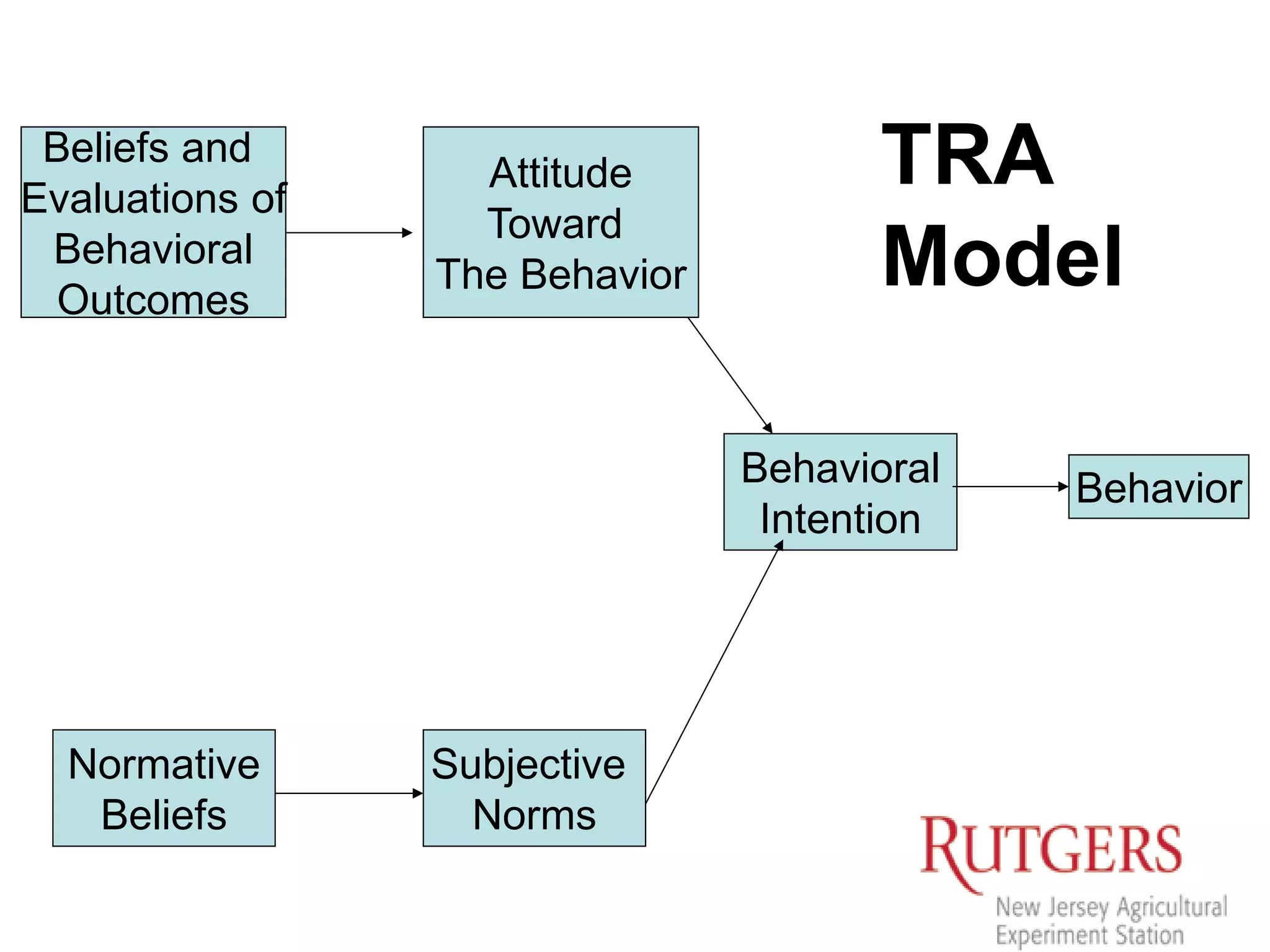
Components of TRA Model
Behavior is a function of 2 things:
• Attitudes toward a specific action
– What will happen if I engage in this behavior?
– Is this outcome desirable or undesirable?
• Subjective norms regarding that action
– Normative beliefs: Others’ expectations
– Motivation to comply: Do I want to do what they
tell me? How much? Why?
Beliefs and
Evaluations of
Behavioral
Outcomes
Attitude
Toward
The Behavior
Behavioral
Intention
Behavior
Normative
Beliefs
Subjective
Norms
TRA
Model
Limitations of TRA Model
• People who have little power over their
behaviors (or believe they have little power).
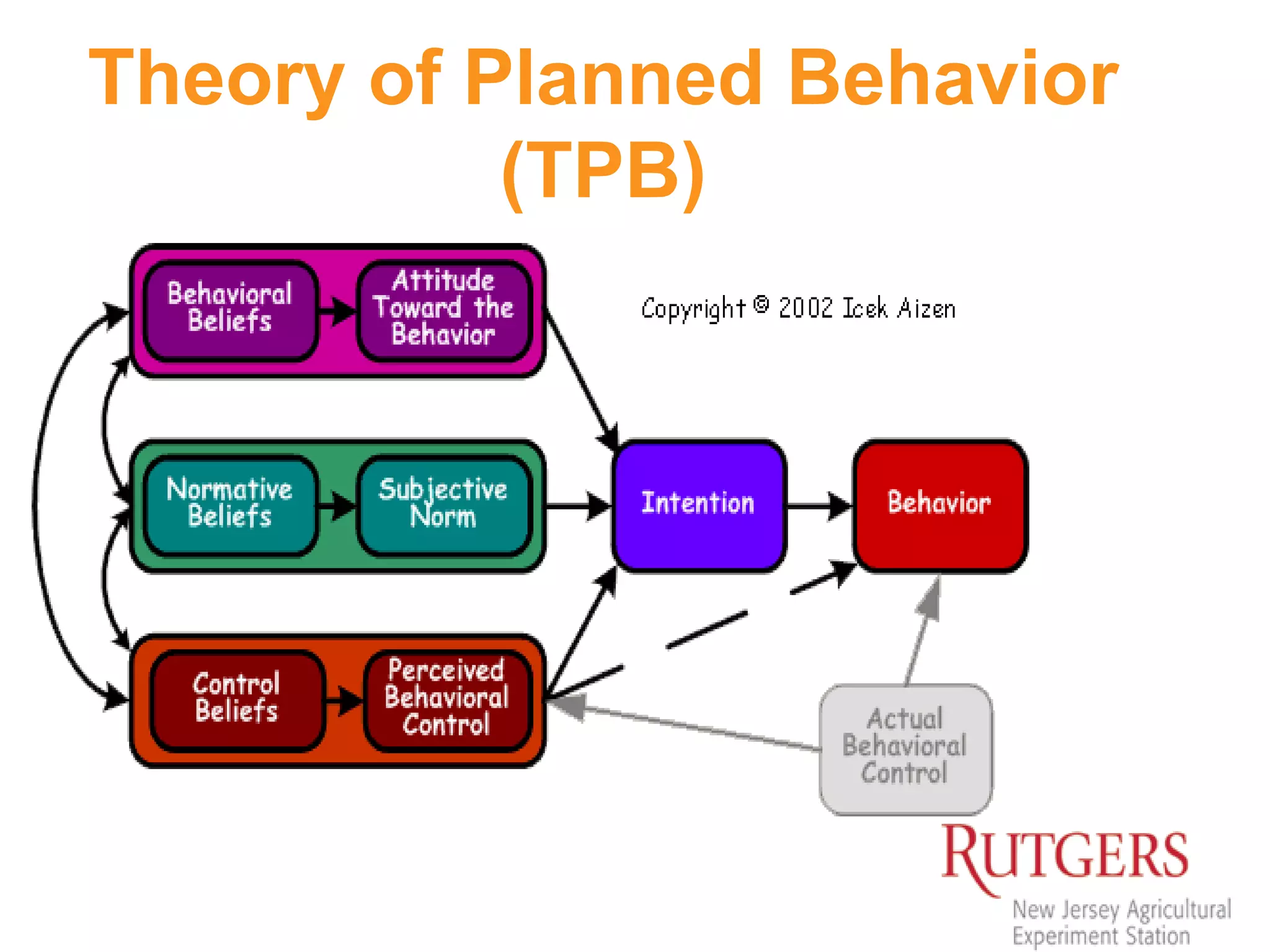
• As a result, Ajzen added a third element to
the original theory:
– Perceived Behavioral Control
Theory of Planned Behavior
(TPB)
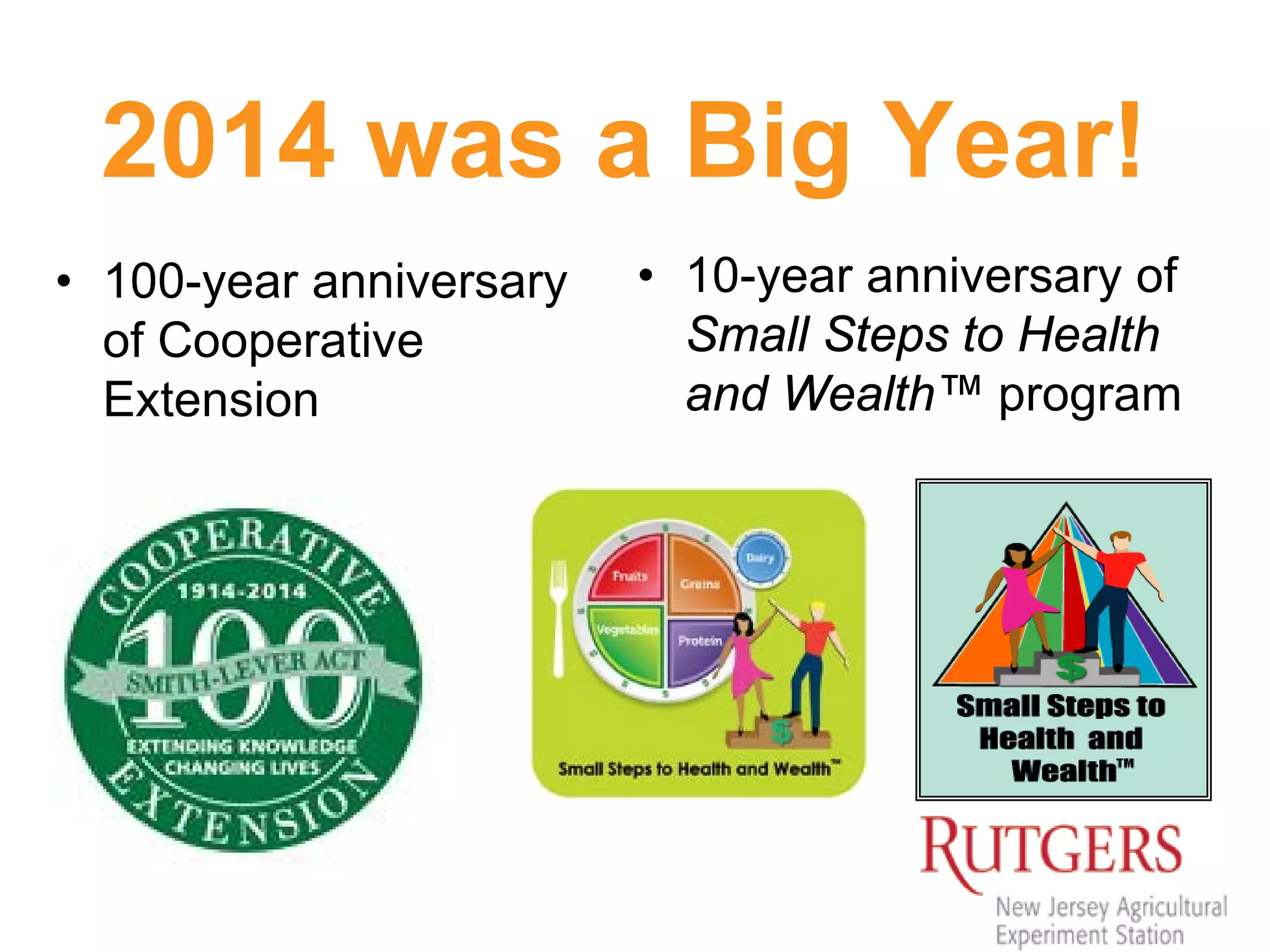
2014 was a Big Year!
• 100-year anniversary
of Cooperative
Extension
• 10-year anniversary of
Small Steps to Health
and Wealth™ program
SSHW History
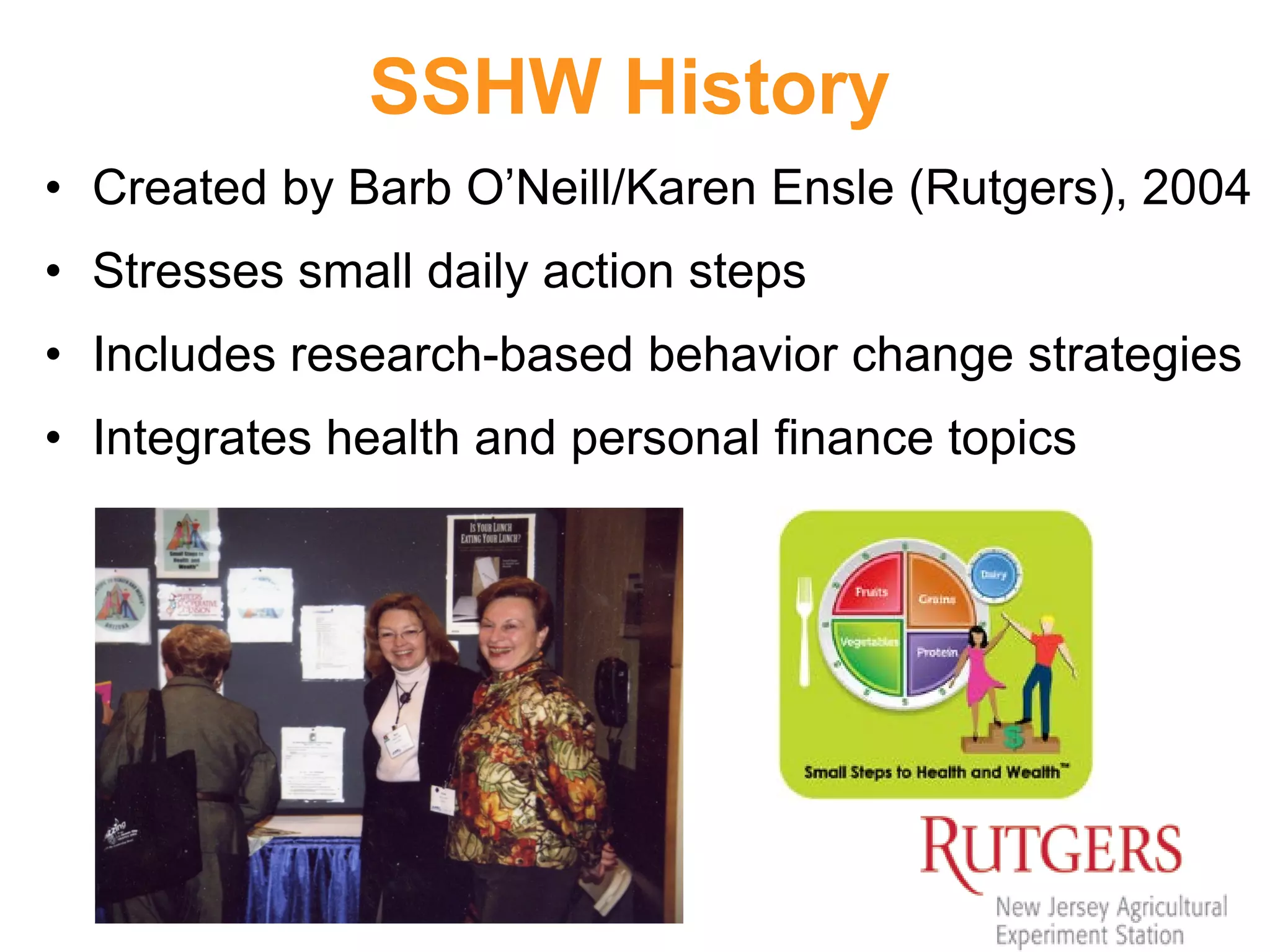
• Created by Barb O’Neill/Karen Ensle (Rutgers), 2004
• Stresses small daily action steps
• Includes research-based behavior change strategies
• Integrates health and personal finance topics
SSHW “Elevator Statement”
Small Steps to Health and Wealth™
encourages participants to make
positive behavior changes to
simultaneously improve their health
and personal finances.
Why SSHW?
Americans Have “Issues”
• Overweight/obesity
• Physical inactivity
• Heart disease and diabetes
• Low savings rates
• High household debt/bankruptcy rates
• Inadequate emergency reserves
• Other?
SSHW is a “Turn-Key”
Program
• Dozens of program materials developed by Rutgers
Cooperative Extension, University of FL, University of KY, etc.
• More program materials in the works
• All Extension educators are encouraged to contribute to
repository of SSHW materials on the internal SSHW Web site
• Two requirements: use the SSHW national brand on new
products and share them with colleagues
Key SSHW Program
Components
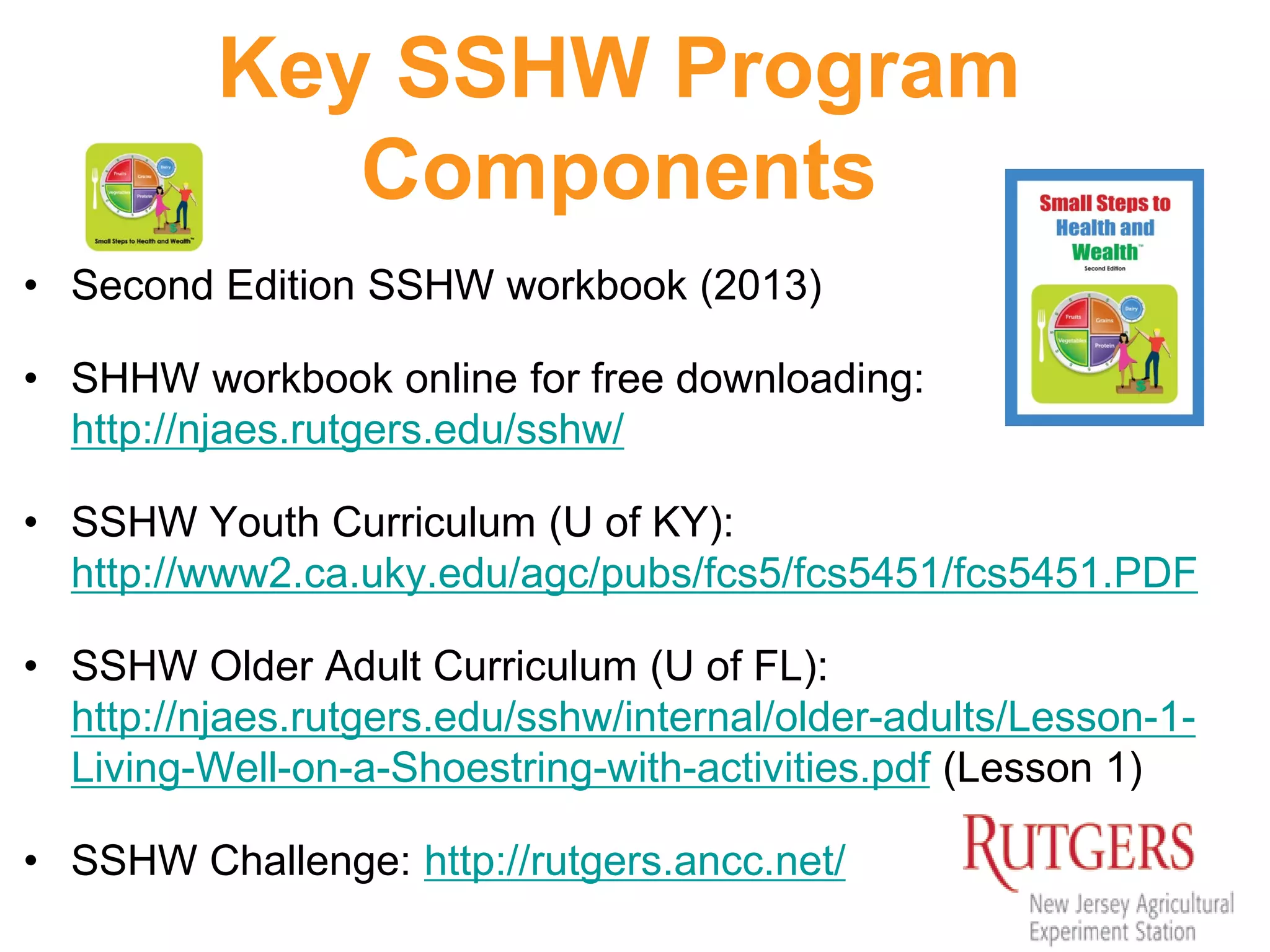
• Second Edition SSHW workbook (2013)
• SHHW workbook online for free downloading:
http://njaes.rutgers.edu/sshw/
• SSHW Youth Curriculum (U of KY):
http://www2.ca.uky.edu/agc/pubs/fcs5/fcs5451/fcs5451.PDF
• SSHW Older Adult Curriculum (U of FL):
http://njaes.rutgers.edu/sshw/internal/older-adults/Lesson-1-
Living-Well-on-a-Shoestring-with-activities.pdf (Lesson 1)
• SSHW Challenge: http://rutgers.ancc.net/
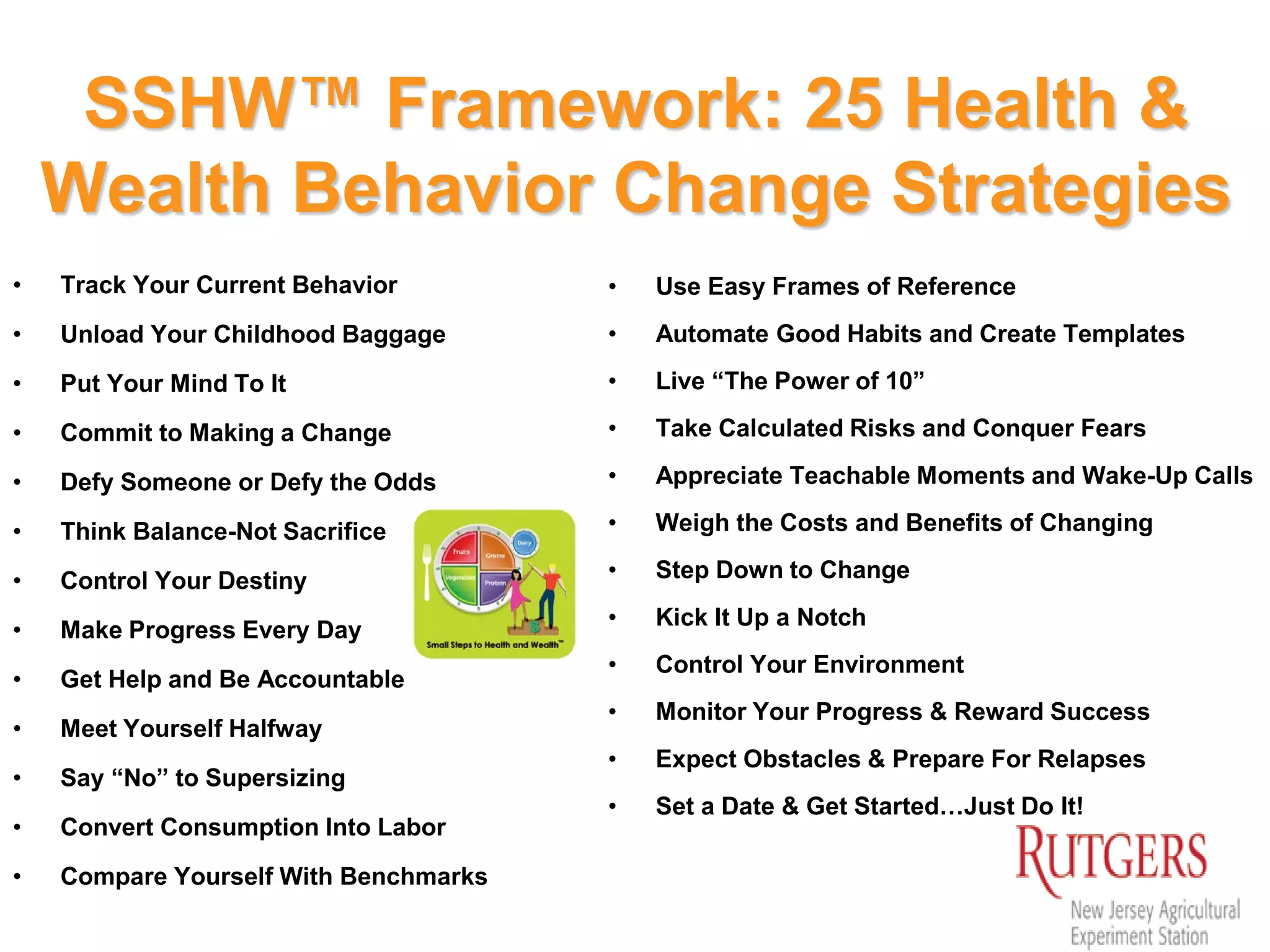
SSHW™ Framework: 25 Health &
Wealth Behavior Change Strategies
• Track Your Current Behavior
• Unload Your Childhood Baggage
• Put Your Mind To It
• Commit to Making a Change
• Defy Someone or Defy the Odds
• Think Balance-Not Sacrifice
• Control Your Destiny
• Make Progress Every Day
• Get Help and Be Accountable
• Meet Yourself Halfway
• Say “No” to Supersizing
• Convert Consumption Into Labor
• Compare Yourself With Benchmarks
• Use Easy Frames of Reference
• Automate Good Habits and Create Templates
• Live “The Power of 10”
• Take Calculated Risks and Conquer Fears
• Appreciate Teachable Moments and Wake-Up Calls
• Weigh the Costs and Benefits of Changing
• Step Down to Change
• Kick It Up a Notch
• Control Your Environment
• Monitor Your Progress & Reward Success
• Expect Obstacles & Prepare For Relapses
• Set a Date & Get Started…Just Do It!
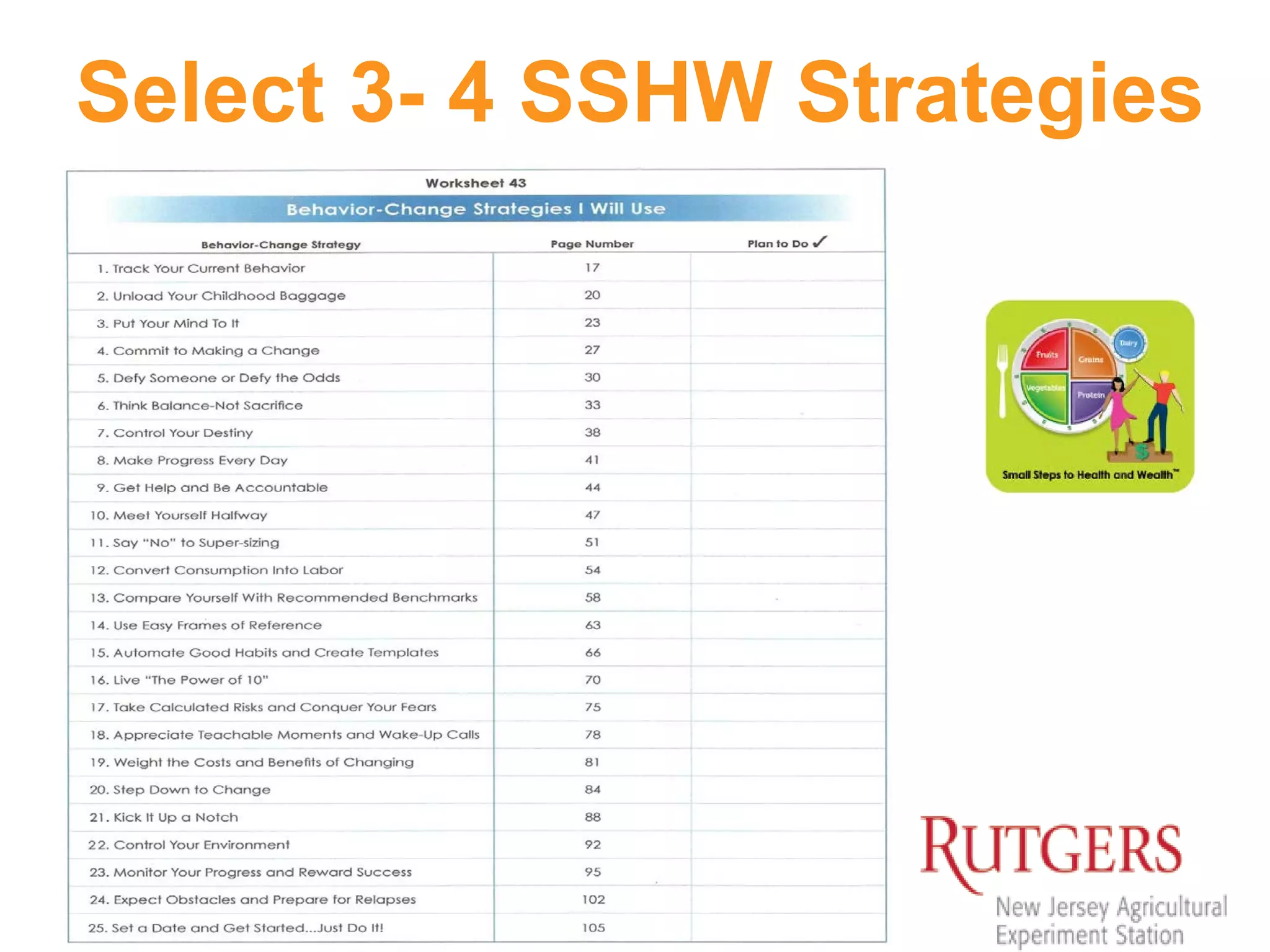
Select 3- 4 SSHW Strategies
Personal Health and
Finance Quiz
http://njaes.rutgers.edu/money/health-finance-quiz/
• Believed to be FIRST combined online health and
personal finance behavioral practice assessment
tool; IRB approved at Rutgers
• Three distinct uses:
– Stand-alone self-assessment tool for users
– To collect data for ongoing research
– For educators to use for SSHW program evaluation (pre-
and post-program score)
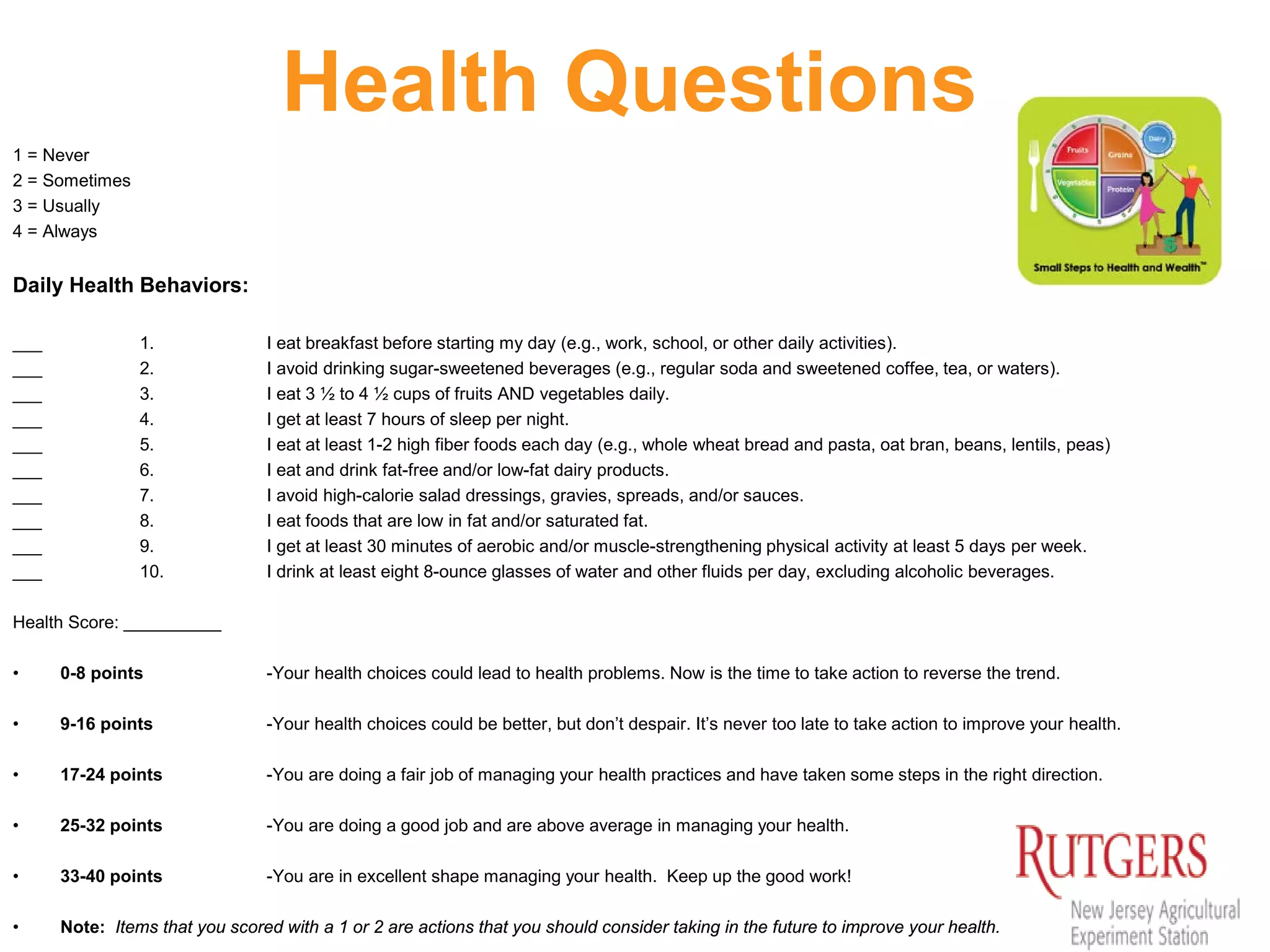
Health Questions
1 = Never
2 = Sometimes
3 = Usually
4 = Always
Daily Health Behaviors:
___ 1. I eat breakfast before starting my day (e.g., work, school, or other daily activities).
___ 2. I avoid drinking sugar-sweetened beverages (e.g., regular soda and sweetened coffee, tea, or waters).
___ 3. I eat 3 ½ to 4 ½ cups of fruits AND vegetables daily.
___ 4. I get at least 7 hours of sleep per night.
___ 5. I eat at least 1-2 high fiber foods each day (e.g., whole wheat bread and pasta, oat bran, beans, lentils, peas)
___ 6. I eat and drink fat-free and/or low-fat dairy products.
___ 7. I avoid high-calorie salad dressings, gravies, spreads, and/or sauces.
___ 8. I eat foods that are low in fat and/or saturated fat.
___ 9. I get at least 30 minutes of aerobic and/or muscle-strengthening physical activity at least 5 days per week.
___ 10. I drink at least eight 8-ounce glasses of water and other fluids per day, excluding alcoholic beverages.
Health Score: __________
• 0-8 points -Your health choices could lead to health problems. Now is the time to take action to reverse the trend.
• 9-16 points -Your health choices could be better, but don’t despair. It’s never too late to take action to improve your health.
• 17-24 points -You are doing a fair job of managing your health practices and have taken some steps in the right direction.
• 25-32 points -You are doing a good job and are above average in managing your health.
• 33-40 points -You are in excellent shape managing your health. Keep up the good work!
• Note: Items that you scored with a 1 or 2 are actions that you should consider taking in the future to improve your health.
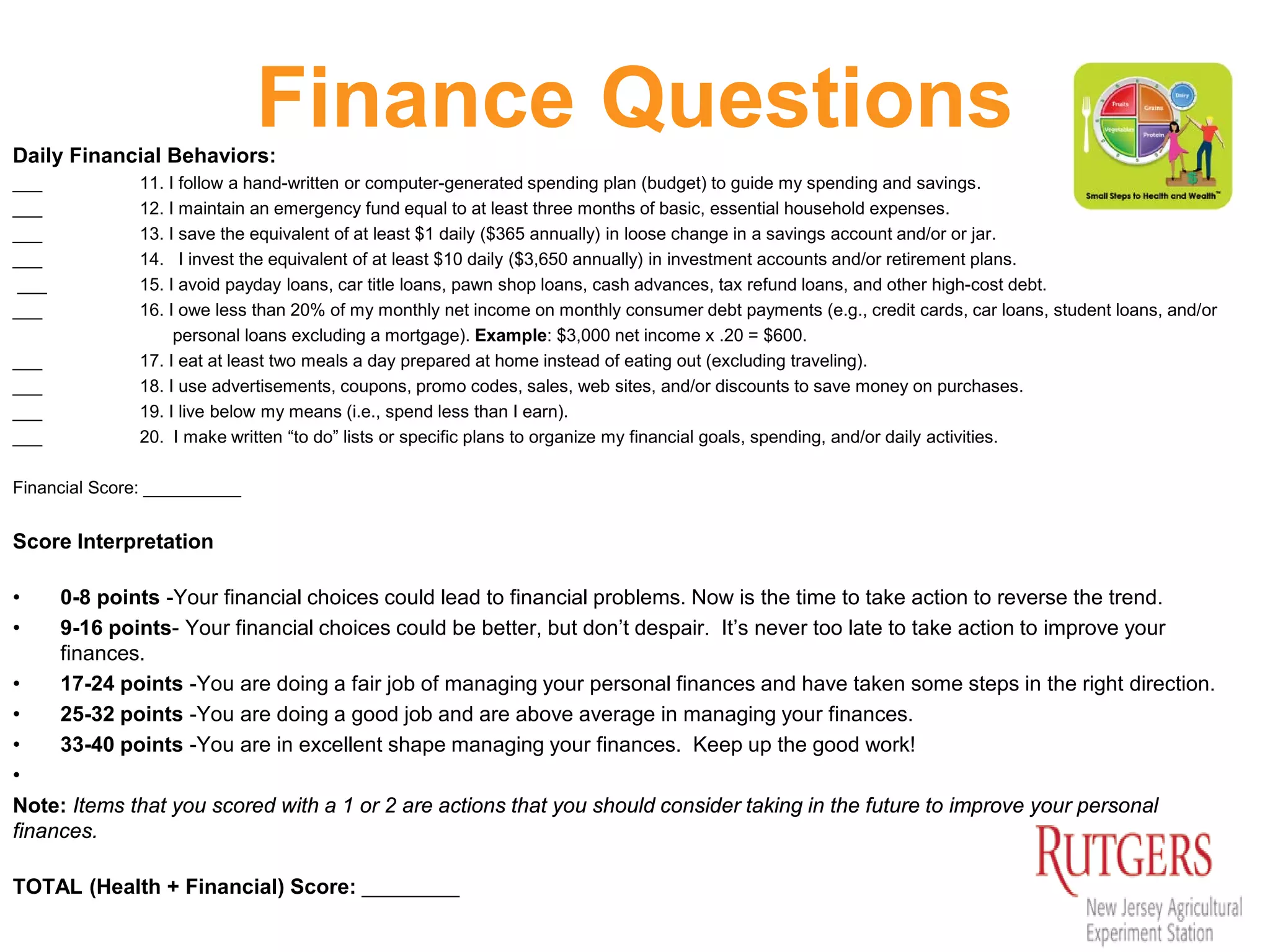
Finance QuestionsDaily Financial Behaviors:
___ 11. I follow a hand-written or computer-generated spending plan (budget) to guide my spending and savings.
___ 12. I maintain an emergency fund equal to at least three months of basic, essential household expenses.
___ 13. I save the equivalent of at least $1 daily ($365 annually) in loose change in a savings account and/or or jar.
___ 14. I invest the equivalent of at least $10 daily ($3,650 annually) in investment accounts and/or retirement plans.
___ 15. I avoid payday loans, car title loans, pawn shop loans, cash advances, tax refund loans, and other high-cost debt.
___ 16. I owe less than 20% of my monthly net income on monthly consumer debt payments (e.g., credit cards, car loans, student loans, and/or
personal loans excluding a mortgage). Example: $3,000 net income x .20 = $600.
___ 17. I eat at least two meals a day prepared at home instead of eating out (excluding traveling).
___ 18. I use advertisements, coupons, promo codes, sales, web sites, and/or discounts to save money on purchases.
___ 19. I live below my means (i.e., spend less than I earn).
___ 20. I make written “to do” lists or specific plans to organize my financial goals, spending, and/or daily activities.
Financial Score: __________
Score Interpretation
• 0-8 points -Your financial choices could lead to financial problems. Now is the time to take action to reverse the trend.
• 9-16 points- Your financial choices could be better, but don’t despair. It’s never too late to take action to improve your
finances.
• 17-24 points -You are doing a fair job of managing your personal finances and have taken some steps in the right direction.
• 25-32 points -You are doing a good job and are above average in managing your finances.
• 33-40 points -You are in excellent shape managing your finances. Keep up the good work!
•
Note: Items that you scored with a 1 or 2 are actions that you should consider taking in the future to improve your personal
finances.
TOTAL (Health + Financial) Score: __________
Graduate Student Master’s
Thesis Data Source
University of Kentucky MS degree graduate
student/Extension agent, Laura White, using
the quiz to study the impact of a SSHW class
series
SSHW Webinar
https://learn.extension.org/events/1625#.U6CYX01OWM8
• Delivered 7/29/14 for eXtension (MFLN and
CFLN collaboration)
• Archived for viewing 24/7/365
• Can take online quiz for CEU credits
SSHW Internal Web Site
http://njaes.rutgers.edu/sshw/internal/
• Includes marketing pieces, lesson plans,
youth materials, older adult materials, class
activities, PowerPoint slides, logic model,
and post-class evaluation form
• For Extension educators only
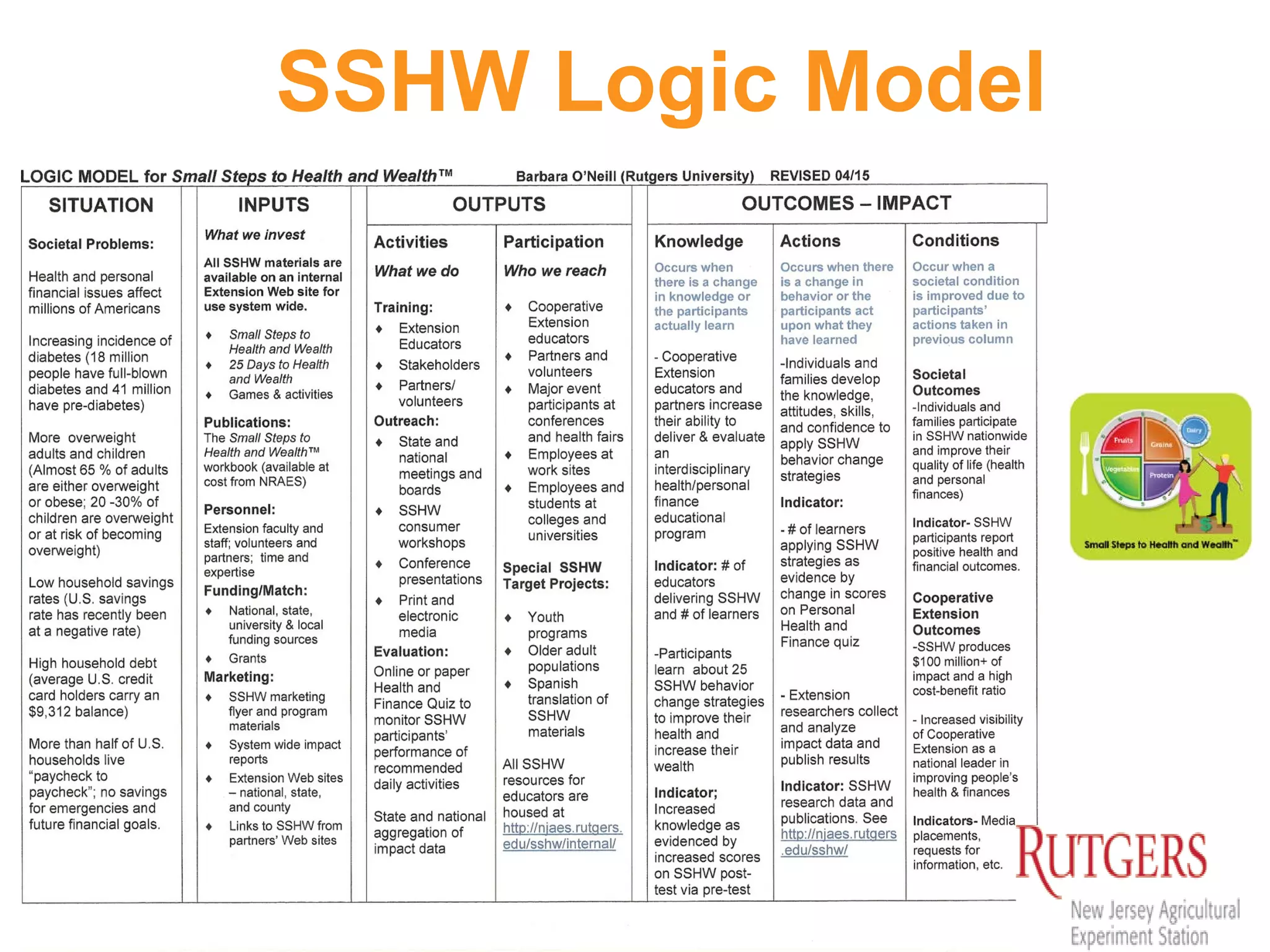
SSHW Logic Model
SSHW Evaluation Methods
• After-Class Evaluation Form
• SSHW Pre- and Post-Test
• Personal Health and Finance Quiz
• Anecdotes and Success Stories
• 3-Month, 6-Month, 12-Month Follow-Up
Evaluations
• Other?
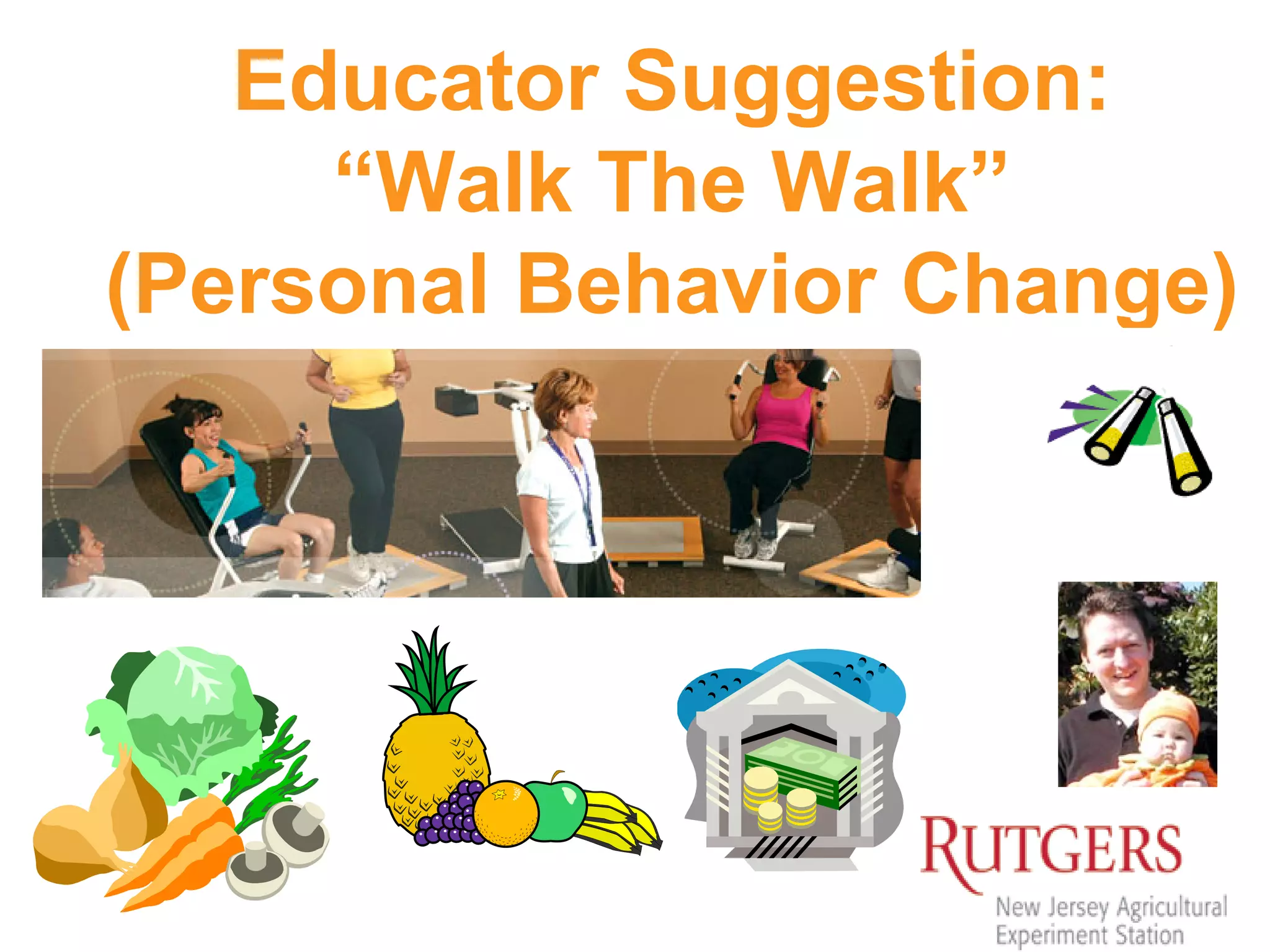
Educator Suggestion:
“Walk The Walk”
(Personal Behavior Change)
Why Change Your Behavior?
• Consider how hard it is to change yourself
and you will understand what a challenge it
will be to change others
• To have a success story to share with others
and to be a role model

Health and Wealth Research Summary-05-15

  • 1.
    Improving Health and IncreasingWealth: A Summary of Research Linking Health and Personal Finance Barbara O’Neill, Ph.D., CFP®, CRPC®, AFC, CHC, CFEd, CFCS, CPFFE Karen Ensle, Ed.D., RDN, FAND, CFCS Rutgers Cooperative Extension
  • 2.
    Personal Introduction • ExtensionSpecialist in Financial Resource Management at Rutgers University (NJ) • Cooperative Extension employee for 37 years • CFP® for 31 years • Financial educator and author • Co-author of SSHW program
  • 3.
    “Street Cred”: ILived SSHW and “Walked the Talk” • BMI of 27 (overweight) to normal weight • Lost > 30 lbs. and 22% of body weight • Fit physical activity into 3-hour R/T commute • Continued wealth accumulation strategies
  • 4.
    Workshop Objectives • Describeresearch on health-wealth linkages • Briefly describe Small Steps to Health and Wealth™ program: http://njaes.rutgers.edu/sshw/ • Briefly describe Personal Health and Finance Quiz: http://njaes.rutgers.edu/money/health-finance-quiz/
  • 5.
    Similarities Between Health andPersonal Finance Both Health Advice Financial Advice
  • 6.
    “The Greatest Wealthis Health” Virgil (BC)
  • 7.
    Health and Personal FinanceResearch Findings and Theories
  • 8.
    Recent Health-Wealth Research Findings •The “cost” of better health is the need for greater wealth (higher total lifetime health care costs for healthier people) – More years of out-of-pocket expenses – Increased likelihood of chronic condition in later life – Increased likelihood of need for long-term care – http://crr.bc.edu/wp-content/uploads/2010/05/IB_10-8.pdf (Sun, Webb, & Zhivan, 2010) • Healthy living habits improve during tough economic times – http://www.stlouisfed.org/publications/re/articles/?id=2018 – http://libres.uncg.edu/ir/uncg/f/C_Ruhm_Healthy_2005.pdf (Ruhm, 2005))
  • 9.
    More Research Findings •Associations between financial distress and physical symptoms of stress – http://ldi.upenn.edu/uploads/media_items/foreclosure-and-health-status.original.pdf – http://www.personalfinancefoundation.org/research/efd/The-Association-Among-Health- Race-and-Debt.pdf • Childhood self-control predicts research subjects’ future health, wealth, and other life outcomes Moffitt, T.E, Arseneault, L., Belsky, D., Dickson, N, Hancox, R.J., Harrington, H., Houts, R., Poulton, R., Roberts, B.W., Ross, S., Sears, M.R, Thomson, W.M., & Caspi, A. (2011). A gradient of childhood self-control predicts health, wealth, and public safety. Proceedings of the National Academy of Sciences, 108(7), 2693-2698.
  • 10.
    More Research Findings •Smokers’ lower net worth vs. non-smokers – http://www.ncbi.nlm.nih.gov/pmc/articles/PMC1747936/pdf/v013p00370.pdf • Negative association of BMI and income, especially among white females – http://www.nber.org/papers/w11343 • Positive impact of financial incentives on health behaviors – http://mcr.sagepub.com/content/65/6_suppl/36S.short • Widespread health insurance illiteracy – http://www.aicpa.org/press/pressreleases/2013/pages/us-adults-fail-health-insurance-101-aicpa- survey.aspx – http://www.washingtonpost.com/blogs/wonkblog/wp/2013/08/08/do-you-understand-health-insurance- most-people-dont/ – http://www.hks.harvard.edu/fs/bmadria/Documents/Madrian%20Papers/Consumers%20Misunderstanding %20of%20Health%20Insurance.pdf
  • 11.
    More Research Findings •Positive relationship between engaging in regular physical activity and labor market earnings • Regular exercise yielded a 6% to 10% wage increase • Possible reason: Fit employees are highly disciplined and more productive, which can lead to career advancement and higher earnings Kosteas, V.D. (2012). The effect of exercise on earnings: Evidence from the NLSY. Journal of Labor Research, 33, 225-250.
  • 12.
    More Research Findings •Dor, Ferguson, Langwith, and Tan (2010) estimated overall annual costs of being obese as $4,879 for an obese woman and $2,646 for an obese man • Their analysis included non-medical indirect costs such as sick days, lost productivity, lower wages, life insurance premiums (i.e., not being able to qualify for preferred rates), and even the need for extra gasoline • The difference between genders was mostly the result of lost wages for obese women; obese women lost more income through lost wages than from medical costs https://publichealth.gwu.edu/departments/healthpolicy/DHP_Publications/pub_upl oads/dhpPublication_35308C47-5056-9D20-3DB-157B39AC53093.pdf
  • 13.
    Retirement Plan Savingsand Health Behavior Study • Published in Psychological Science in 2014: http://pss.sagepub.com/content/early/2014/06/25/0956797614540467.abstract • An employee’s decision to contribute to a 401(k) predicted action to correct poor physical health indicators that were revealed during an employer-sponsored health examination • Employees who saved for the future in a 401(k) showed improvements in abnormal blood-test results and health behaviors about 27% more often than non-contributors did • Findings were attributed to individuals’ time-discounting trait that predicts long-term behavior
  • 14.
    SSHW Research (Rutgers) RefereedJournal Articles O’Neill, B. The greatest Wealth is Health: Relationships Between Health and Financial Behaviors. Journal of Personal Finance, (2015), 14(1). URL: http://www.iarfc.org/documents/issues/Vol.14Issue1.pdf. O’Neill, B. & Ensle, K. Small Steps to Health and Wealth™: Program Update and Research Insights. The Forum for Family and Consumer Issues (2014), (19(1). [WWW Document] URL: http://ncsu.edu/ffci/publications/2014/v19-n1- 2014-spring/oneil-ensle.php. O'Neill, B. & Ensle, K. Have it Their Way: Creating Personalized Online Challenges to Motivate Learners. Journal of Extension (April 2012), 50(2), 6 pages [WWW Document] URL: www.joe.org/joe/2012april/tt3.php. O'Neill, B. & Ensle, K. The Online Small Steps to Health and Wealth™ Challenge: A Model for Interdisciplinary FCS Programs. Journal of Family and Consumer Sciences (2010), 102(4), 52-55. O'Neill, B. Health and Wealth Connections: Evidence from Research and Practice. Journal of Family and Consumer Sciences (2009), 101(3), 14-19. O'Neill, B. & Ensle, K. Small Steps to Health and Wealth™: Available Resources and Potential Economic Impacts. The Forum for Family and Consumer Issues (Summer/Fall 2008), 13(2), 5 pages [ WWW document] URL: ncsu.edu/ffci/publications/2008/v13-n2-2008-summer-fall/oneill.php. O'Neill, B. Health and Wealth Connections: Implications for Financial Planners. Journal of Personal Finance (2005), 4(2), 27-39. O'Neill, B. Small Steps to Health and Wealth. The Forum for Family and Consumer Issues, (December 2004), 9(3), 8 [WWW document] URL: www.ces.ncsu.edu/depts/fcs/pub/9_3/smallsteps.html.
  • 15.
    What is aTheory? • Set of concepts, definitions, and propositions • Systematic view of events or situations • Allows exploration and/or explanation of events or situations
  • 16.
    The Transtheoretical Model ofChange (TTM) Source: Changing For Good by Prochaska et al. (1994)
  • 17.
    Stages of ChangeModel Precontemplation Action Preparation Maintenance Contemplation
  • 18.
    Diffusion of InnovationsTheory • How new ideas, products, and behaviors become norms • All levels: individual, interpersonal, community, and organizational • Success determined by: nature of the innovation, communication channels, adoption time Source: Everett M. Rogers, Diffusion of Innovations, 4th ed. (New York: The Free Press, 1995).
  • 19.
    19 Diffusion of InnovationsTheory People are more likely to adopt a new behavior when someone they respect or admire endorses the behavior: – Opinion leaders influence an initial group – New social norm is established – Rest of community follows (social conformation)
  • 20.
    Fishbein and Ajzen’sTheory of Reasoned Action (TRA) • Originally developed in 1967; further developed during the 1970s. • By the 1980s, very commonly used to study human behavior • Fishbein and Ajzen were both working on similar concepts to explain human behavior; eventually collaborated to create and publish the model in 1980
  • 21.
    Components of TRAModel Behavior is a function of 2 things: • Attitudes toward a specific action – What will happen if I engage in this behavior? – Is this outcome desirable or undesirable? • Subjective norms regarding that action – Normative beliefs: Others’ expectations – Motivation to comply: Do I want to do what they tell me? How much? Why?
  • 22.
    Beliefs and Evaluations of Behavioral Outcomes Attitude Toward TheBehavior Behavioral Intention Behavior Normative Beliefs Subjective Norms TRA Model
  • 23.
    Limitations of TRAModel • People who have little power over their behaviors (or believe they have little power). • As a result, Ajzen added a third element to the original theory: – Perceived Behavioral Control
  • 24.
    Theory of PlannedBehavior (TPB)
  • 25.
    2014 was aBig Year! • 100-year anniversary of Cooperative Extension • 10-year anniversary of Small Steps to Health and Wealth™ program
  • 26.
    SSHW History • Createdby Barb O’Neill/Karen Ensle (Rutgers), 2004 • Stresses small daily action steps • Includes research-based behavior change strategies • Integrates health and personal finance topics
  • 27.
    SSHW “Elevator Statement” SmallSteps to Health and Wealth™ encourages participants to make positive behavior changes to simultaneously improve their health and personal finances.
  • 28.
    Why SSHW? Americans Have“Issues” • Overweight/obesity • Physical inactivity • Heart disease and diabetes • Low savings rates • High household debt/bankruptcy rates • Inadequate emergency reserves • Other?
  • 29.
    SSHW is a“Turn-Key” Program • Dozens of program materials developed by Rutgers Cooperative Extension, University of FL, University of KY, etc. • More program materials in the works • All Extension educators are encouraged to contribute to repository of SSHW materials on the internal SSHW Web site • Two requirements: use the SSHW national brand on new products and share them with colleagues
  • 30.
    Key SSHW Program Components •Second Edition SSHW workbook (2013) • SHHW workbook online for free downloading: http://njaes.rutgers.edu/sshw/ • SSHW Youth Curriculum (U of KY): http://www2.ca.uky.edu/agc/pubs/fcs5/fcs5451/fcs5451.PDF • SSHW Older Adult Curriculum (U of FL): http://njaes.rutgers.edu/sshw/internal/older-adults/Lesson-1- Living-Well-on-a-Shoestring-with-activities.pdf (Lesson 1) • SSHW Challenge: http://rutgers.ancc.net/
  • 31.
    SSHW™ Framework: 25Health & Wealth Behavior Change Strategies • Track Your Current Behavior • Unload Your Childhood Baggage • Put Your Mind To It • Commit to Making a Change • Defy Someone or Defy the Odds • Think Balance-Not Sacrifice • Control Your Destiny • Make Progress Every Day • Get Help and Be Accountable • Meet Yourself Halfway • Say “No” to Supersizing • Convert Consumption Into Labor • Compare Yourself With Benchmarks • Use Easy Frames of Reference • Automate Good Habits and Create Templates • Live “The Power of 10” • Take Calculated Risks and Conquer Fears • Appreciate Teachable Moments and Wake-Up Calls • Weigh the Costs and Benefits of Changing • Step Down to Change • Kick It Up a Notch • Control Your Environment • Monitor Your Progress & Reward Success • Expect Obstacles & Prepare For Relapses • Set a Date & Get Started…Just Do It!
  • 32.
    Select 3- 4SSHW Strategies
  • 33.
    Personal Health and FinanceQuiz http://njaes.rutgers.edu/money/health-finance-quiz/ • Believed to be FIRST combined online health and personal finance behavioral practice assessment tool; IRB approved at Rutgers • Three distinct uses: – Stand-alone self-assessment tool for users – To collect data for ongoing research – For educators to use for SSHW program evaluation (pre- and post-program score)
  • 34.
    Health Questions 1 =Never 2 = Sometimes 3 = Usually 4 = Always Daily Health Behaviors: ___ 1. I eat breakfast before starting my day (e.g., work, school, or other daily activities). ___ 2. I avoid drinking sugar-sweetened beverages (e.g., regular soda and sweetened coffee, tea, or waters). ___ 3. I eat 3 ½ to 4 ½ cups of fruits AND vegetables daily. ___ 4. I get at least 7 hours of sleep per night. ___ 5. I eat at least 1-2 high fiber foods each day (e.g., whole wheat bread and pasta, oat bran, beans, lentils, peas) ___ 6. I eat and drink fat-free and/or low-fat dairy products. ___ 7. I avoid high-calorie salad dressings, gravies, spreads, and/or sauces. ___ 8. I eat foods that are low in fat and/or saturated fat. ___ 9. I get at least 30 minutes of aerobic and/or muscle-strengthening physical activity at least 5 days per week. ___ 10. I drink at least eight 8-ounce glasses of water and other fluids per day, excluding alcoholic beverages. Health Score: __________ • 0-8 points -Your health choices could lead to health problems. Now is the time to take action to reverse the trend. • 9-16 points -Your health choices could be better, but don’t despair. It’s never too late to take action to improve your health. • 17-24 points -You are doing a fair job of managing your health practices and have taken some steps in the right direction. • 25-32 points -You are doing a good job and are above average in managing your health. • 33-40 points -You are in excellent shape managing your health. Keep up the good work! • Note: Items that you scored with a 1 or 2 are actions that you should consider taking in the future to improve your health.
  • 35.
    Finance QuestionsDaily FinancialBehaviors: ___ 11. I follow a hand-written or computer-generated spending plan (budget) to guide my spending and savings. ___ 12. I maintain an emergency fund equal to at least three months of basic, essential household expenses. ___ 13. I save the equivalent of at least $1 daily ($365 annually) in loose change in a savings account and/or or jar. ___ 14. I invest the equivalent of at least $10 daily ($3,650 annually) in investment accounts and/or retirement plans. ___ 15. I avoid payday loans, car title loans, pawn shop loans, cash advances, tax refund loans, and other high-cost debt. ___ 16. I owe less than 20% of my monthly net income on monthly consumer debt payments (e.g., credit cards, car loans, student loans, and/or personal loans excluding a mortgage). Example: $3,000 net income x .20 = $600. ___ 17. I eat at least two meals a day prepared at home instead of eating out (excluding traveling). ___ 18. I use advertisements, coupons, promo codes, sales, web sites, and/or discounts to save money on purchases. ___ 19. I live below my means (i.e., spend less than I earn). ___ 20. I make written “to do” lists or specific plans to organize my financial goals, spending, and/or daily activities. Financial Score: __________ Score Interpretation • 0-8 points -Your financial choices could lead to financial problems. Now is the time to take action to reverse the trend. • 9-16 points- Your financial choices could be better, but don’t despair. It’s never too late to take action to improve your finances. • 17-24 points -You are doing a fair job of managing your personal finances and have taken some steps in the right direction. • 25-32 points -You are doing a good job and are above average in managing your finances. • 33-40 points -You are in excellent shape managing your finances. Keep up the good work! • Note: Items that you scored with a 1 or 2 are actions that you should consider taking in the future to improve your personal finances. TOTAL (Health + Financial) Score: __________
  • 36.
    Graduate Student Master’s ThesisData Source University of Kentucky MS degree graduate student/Extension agent, Laura White, using the quiz to study the impact of a SSHW class series
  • 37.
    SSHW Webinar https://learn.extension.org/events/1625#.U6CYX01OWM8 • Delivered7/29/14 for eXtension (MFLN and CFLN collaboration) • Archived for viewing 24/7/365 • Can take online quiz for CEU credits
  • 38.
    SSHW Internal WebSite http://njaes.rutgers.edu/sshw/internal/ • Includes marketing pieces, lesson plans, youth materials, older adult materials, class activities, PowerPoint slides, logic model, and post-class evaluation form • For Extension educators only
  • 39.
  • 40.
    SSHW Evaluation Methods •After-Class Evaluation Form • SSHW Pre- and Post-Test • Personal Health and Finance Quiz • Anecdotes and Success Stories • 3-Month, 6-Month, 12-Month Follow-Up Evaluations • Other?
  • 41.
    Educator Suggestion: “Walk TheWalk” (Personal Behavior Change)
  • 42.
    Why Change YourBehavior? • Consider how hard it is to change yourself and you will understand what a challenge it will be to change others • To have a success story to share with others and to be a role model