How To Write
Headlines For The Web
October 2012
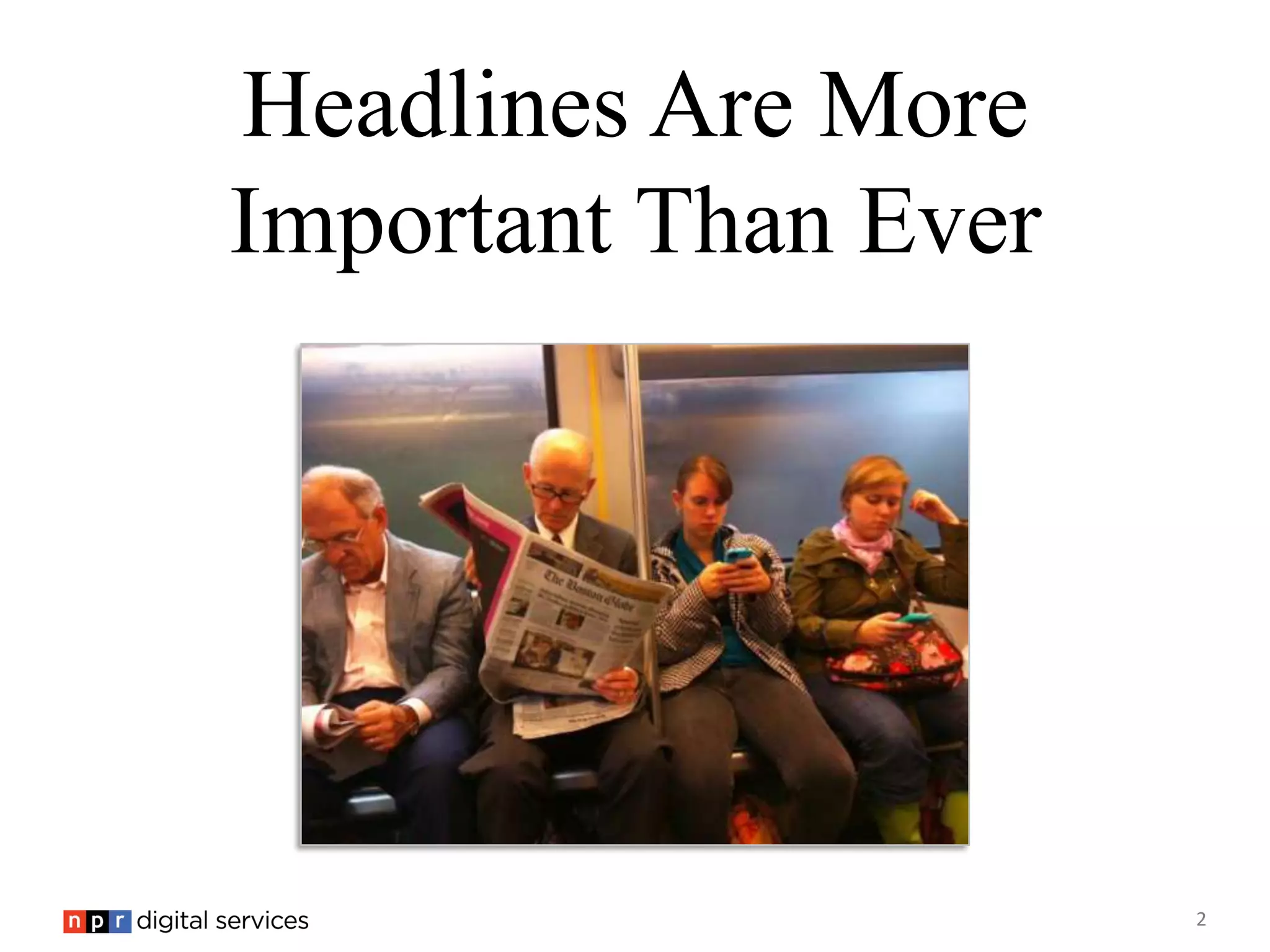
Headlines Are More
Important Than Ever


                      2
Headlines Are More
     Important Than Ever

1.         It’s promotion
           for your story
          Your headline is the only
      representation your story gets on
                   the web

                                          3
Headlines Are More
     Important Than Ever

2.       It will make or
        break your story
      You’re killing your own story
          with a dud headline

                                      4
Headlines Are More
     Important Than Ever

3.     Humans will decide
      the fate of your story
        Making headlines SEO-
       friendly is no longer good
                 enough

                                    5
Headlines Are More
     Important Than Ever

4.     Social is growing
      Which means competition and
       opportunity for audience is
               growing


                                     6
Headlines Are More
     Important Than Ever

5.      Home pages are
         less important
       Which means you have to
       make your headline perfect
             everywhere
                                    7
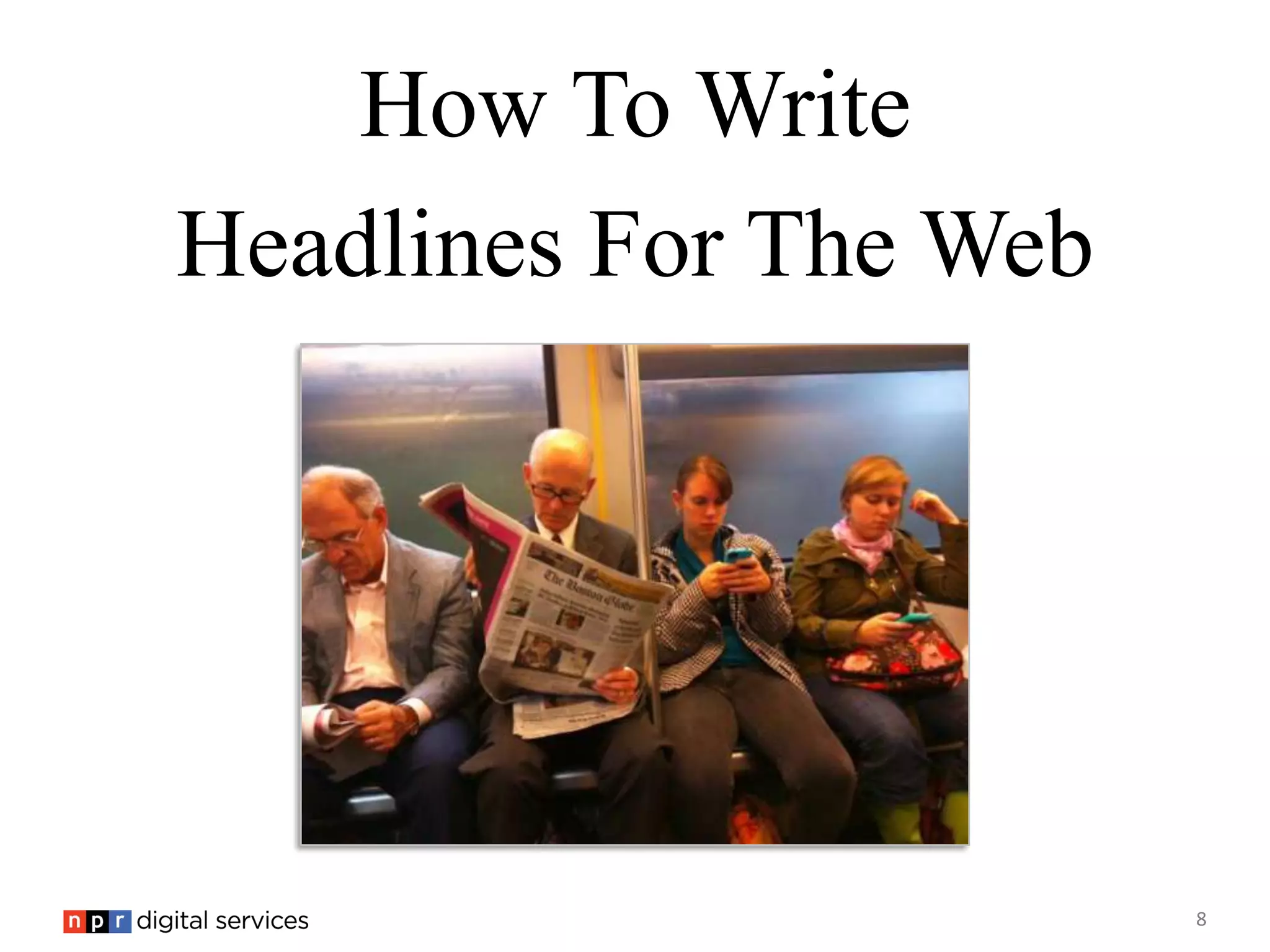
How To Write
Headlines For The Web


                        8
The Sooner The Better
• Try not to wait until the end of the content creation
  process to come up with a headline.

• Early on in the process, think about ideas for your
  headline.

• Thinking of your headline up front creates a thesis under
  which to frame your story.

• Ask yourself this constantly: What is this story about?


                                                              9
Open A Blank Document
• Start free associating around
  what your headline could be.

• What are the key words that tell
  you what this story is about?

• Who are the important players in
  the story? Consider them for
  your headline.

• Are there any quotes or nuggets
  that help tell the story? They will
  make your life easier.

                                        10
Provide the Facts for Breaking News
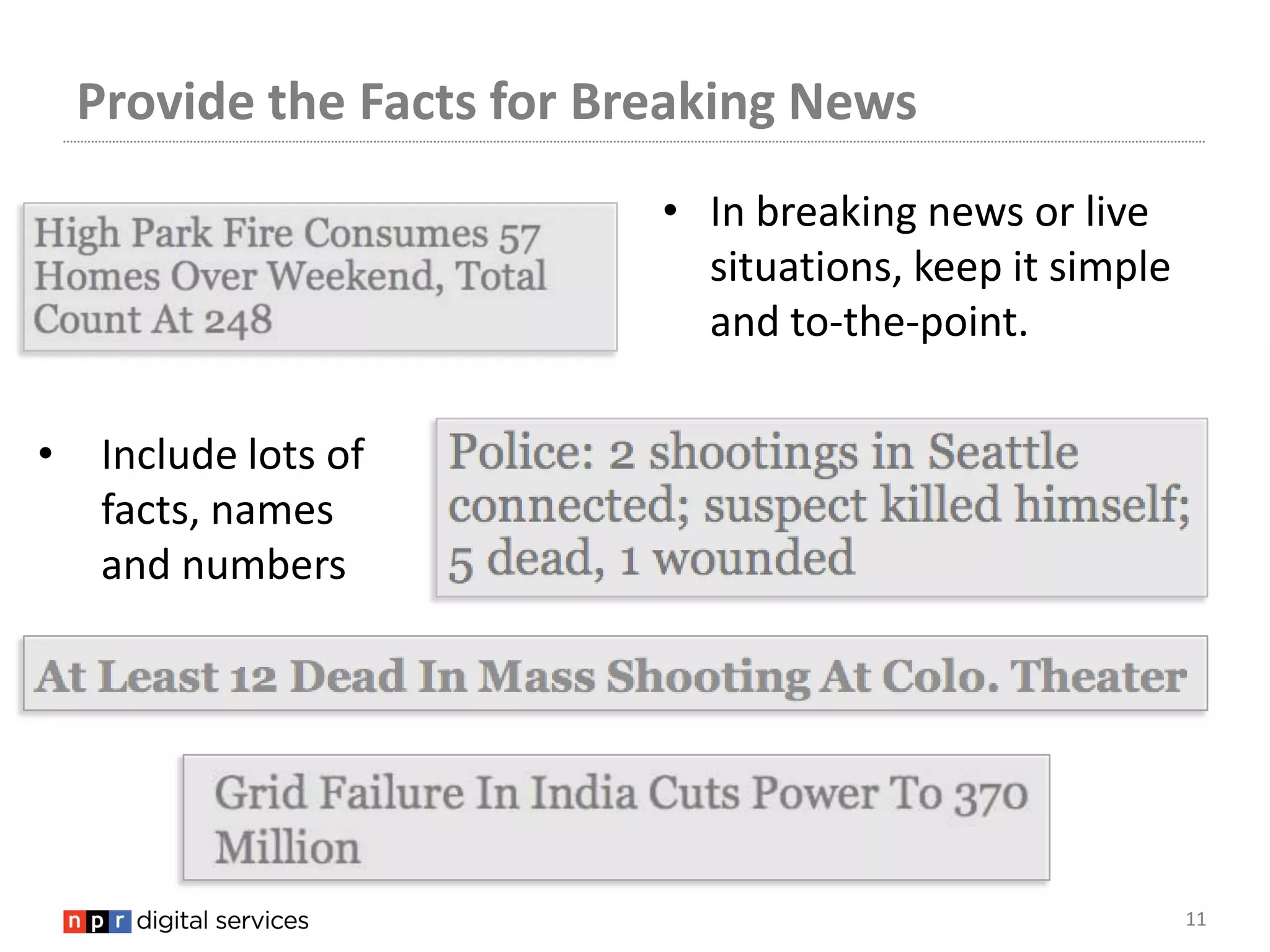
                            • In breaking news or live
                              situations, keep it simple
                              and to-the-point.

•    Include lots of
     facts, names
     and numbers


                                                           11
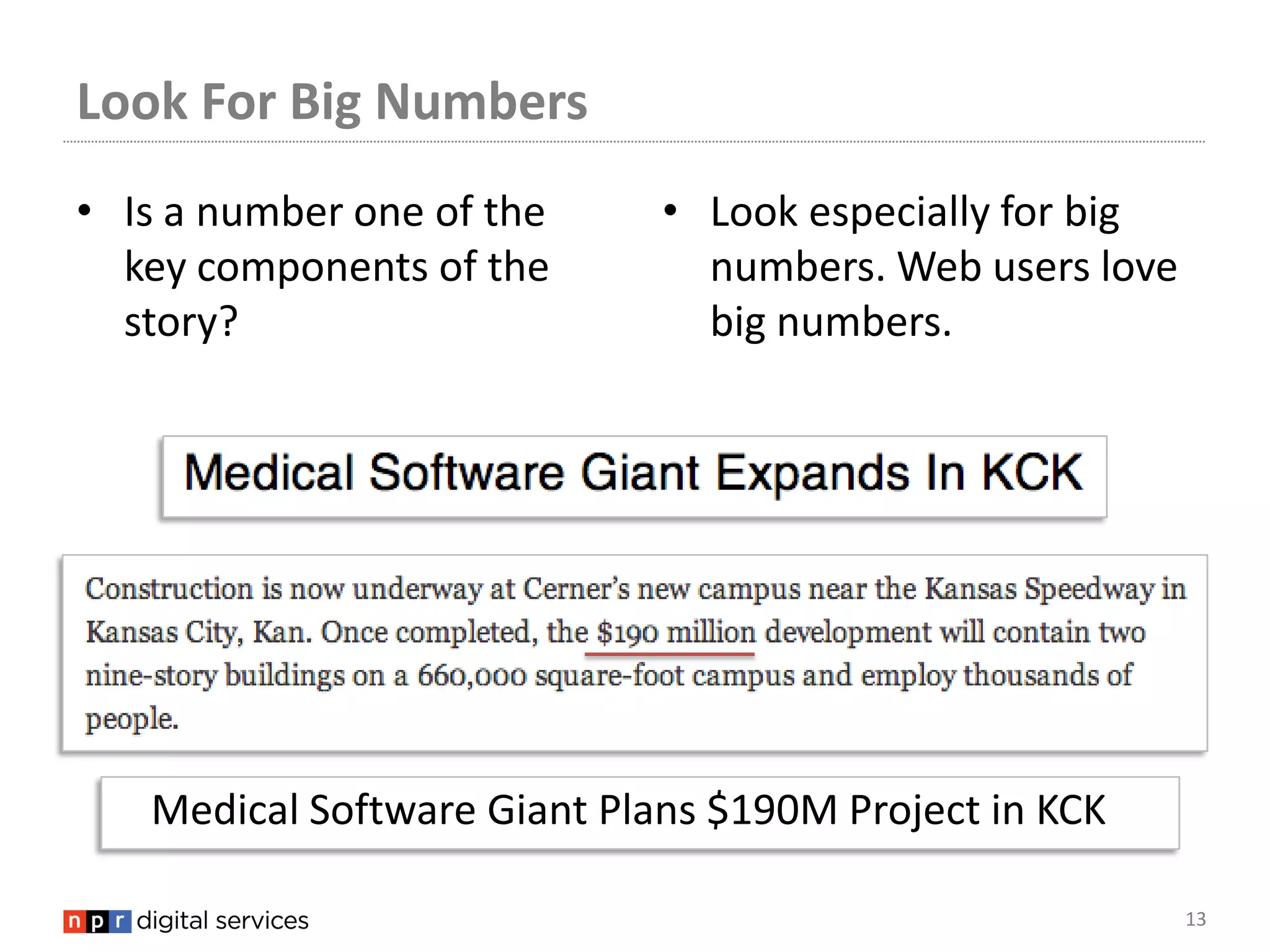
Look For Big Numbers
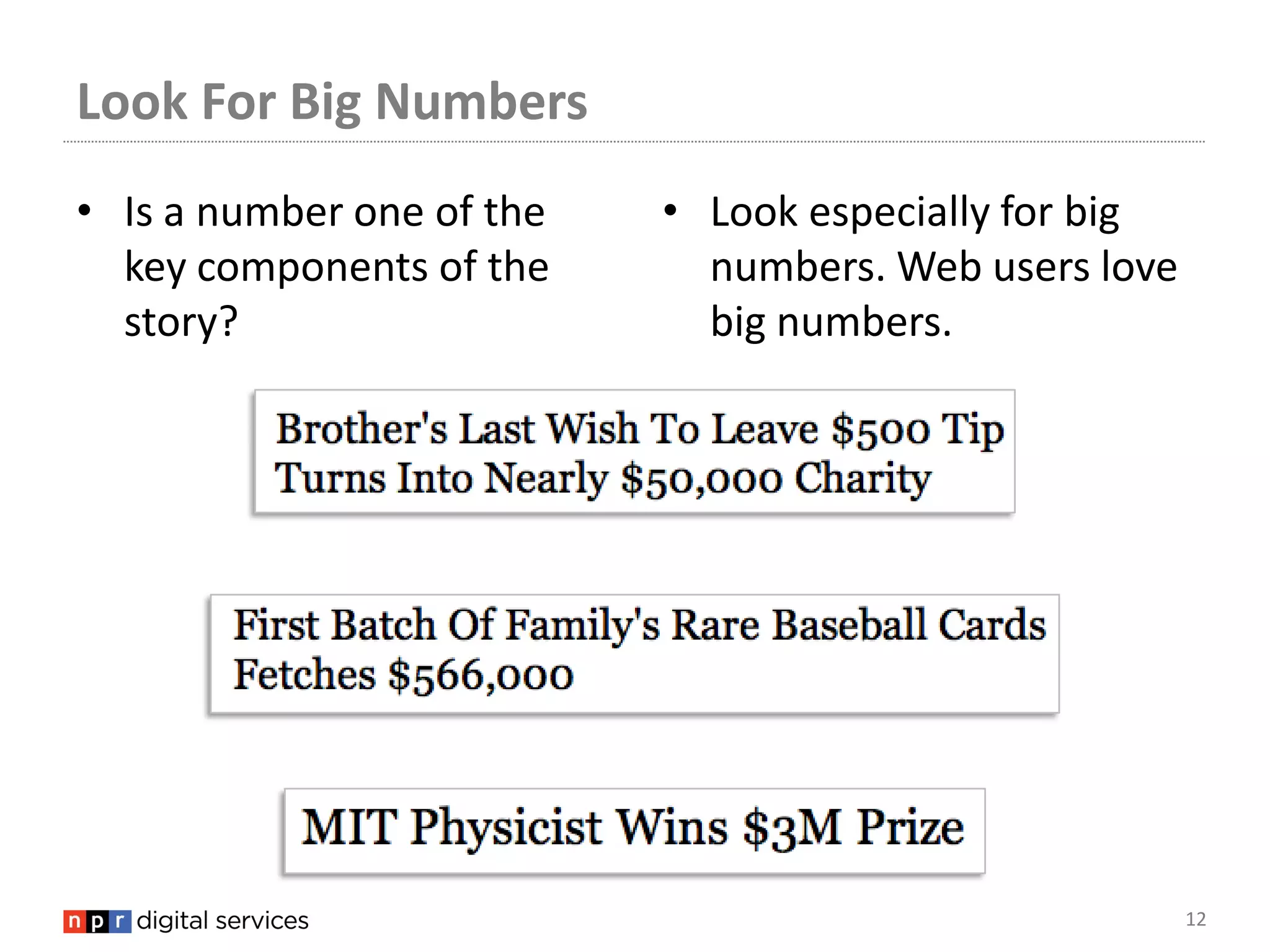
• Is a number one of the   • Look especially for big
  key components of the      numbers. Web users love
  story?                     big numbers.


                                                       12
Look For Big Numbers
• Is a number one of the     • Look especially for big
  key components of the        numbers. Web users love
  story?                       big numbers.


   Medical Software Giant Plans $190M Project in KCK

                                                         13
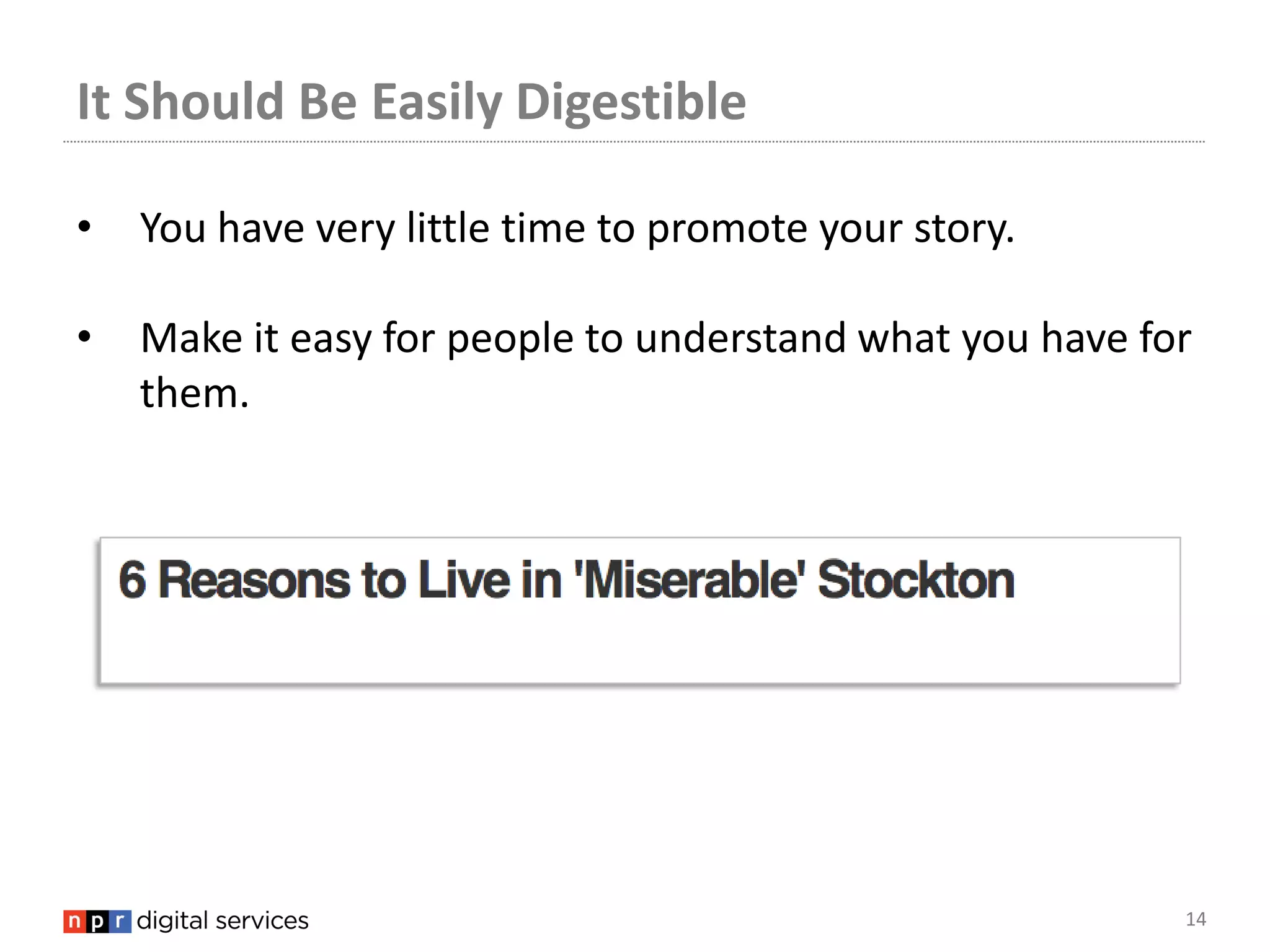
It Should Be Easily Digestible

•   You have very little time to promote your story.

•   Make it easy for people to understand what you have for
    them.


                                                          14
Follow the Proper Noun Rule

•   “Name the known, omit the obscure”

•   If the subject in your headline is well known to your
    primary audience, you can include it.

•   But if the name is obscure, you might consider skipping
    it.


                                                              15
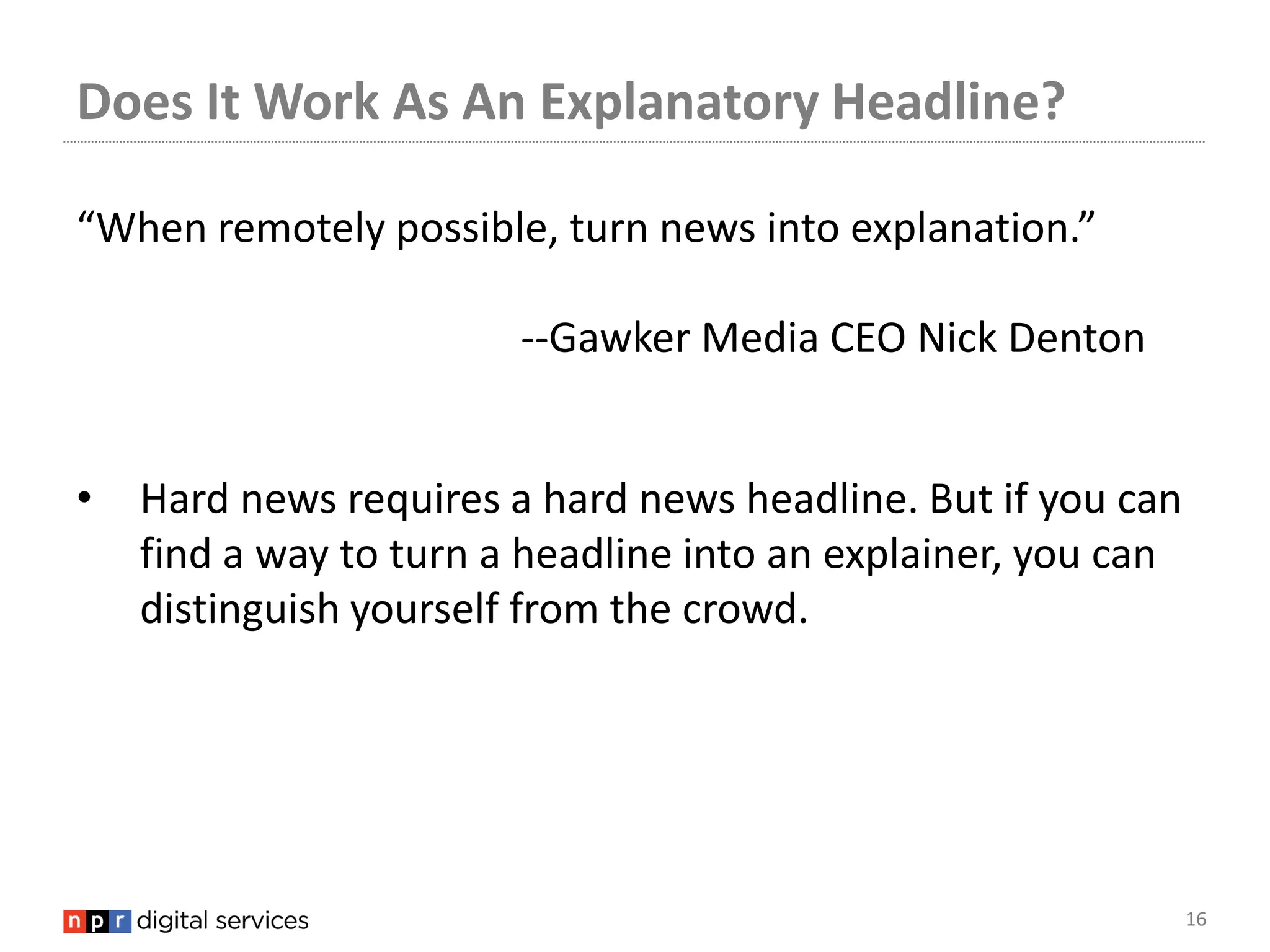
Does It Work As An Explanatory Headline?

“When remotely possible, turn news into explanation.”

                        --Gawker Media CEO Nick Denton


•   Hard news requires a hard news headline. But if you can
    find a way to turn a headline into an explainer, you can
    distinguish yourself from the crowd.


                                                               16
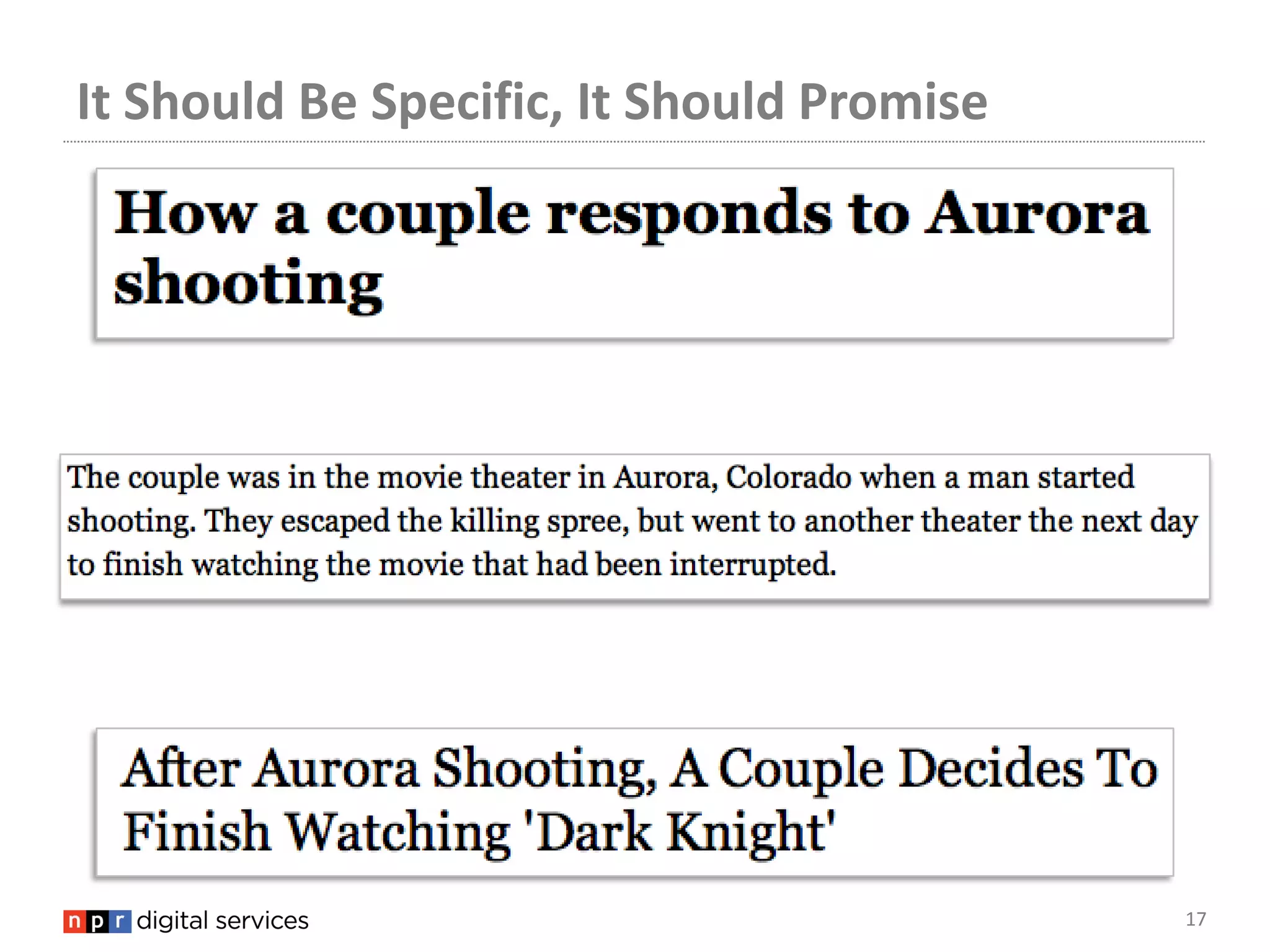
It Should Be Specific, It Should Promise


                                           17
It Should Be Specific, It Should Promise

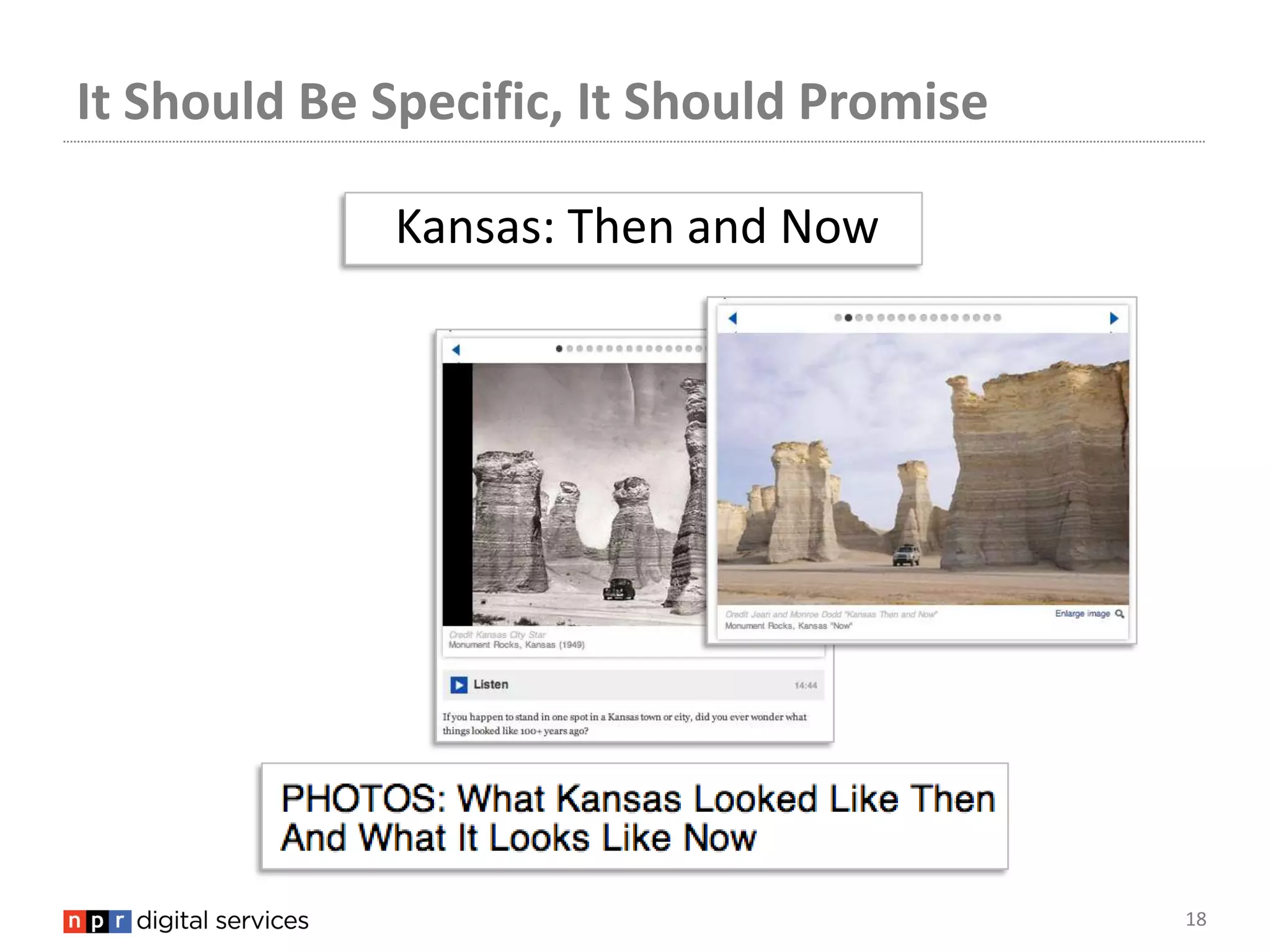
             Kansas: Then and Now


                                           18
It Should Be Specific, It Should Promise
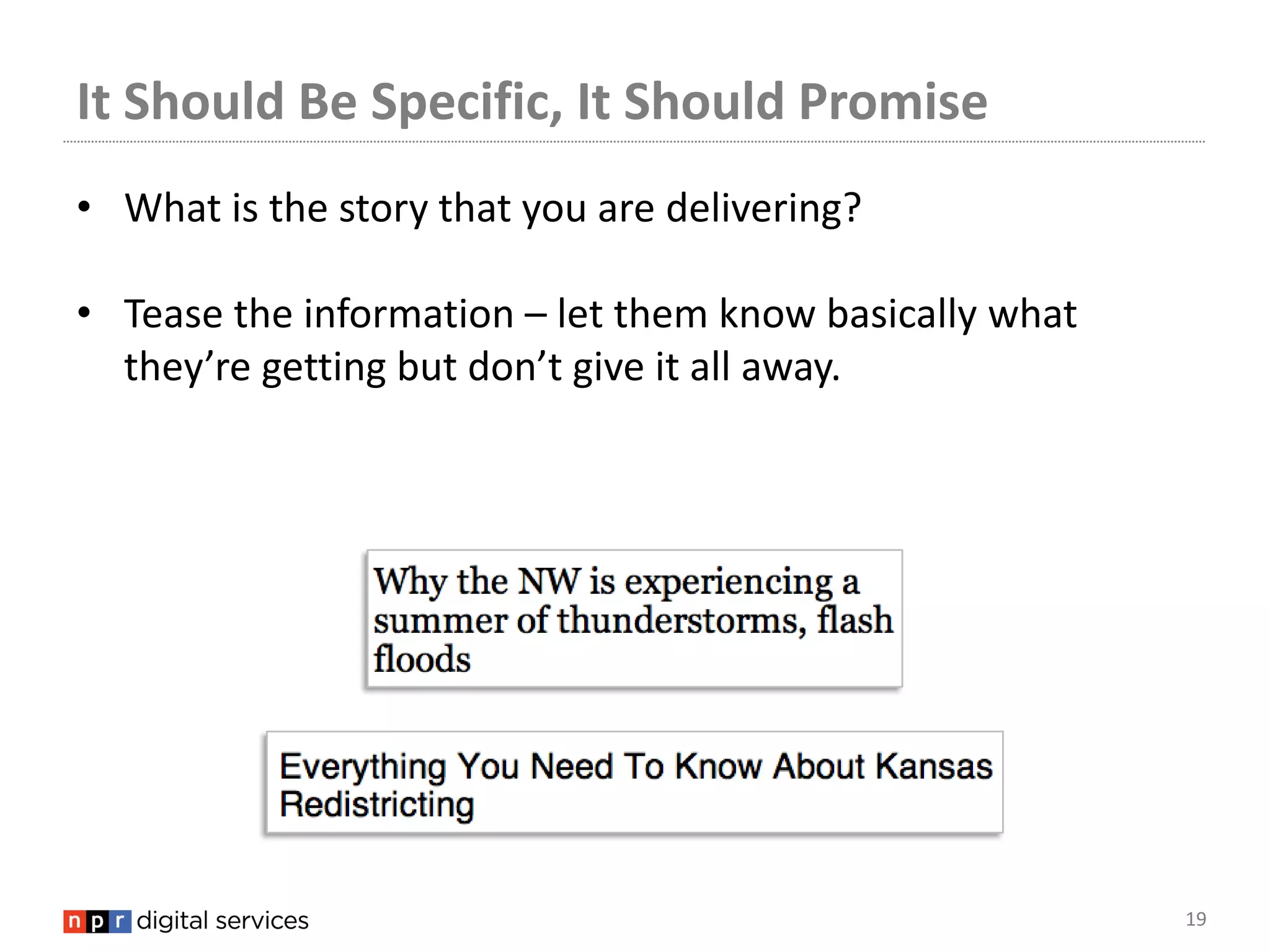
• What is the story that you are delivering?

• Tease the information – let them know basically what
  they’re getting but don’t give it all away.


                                                         19
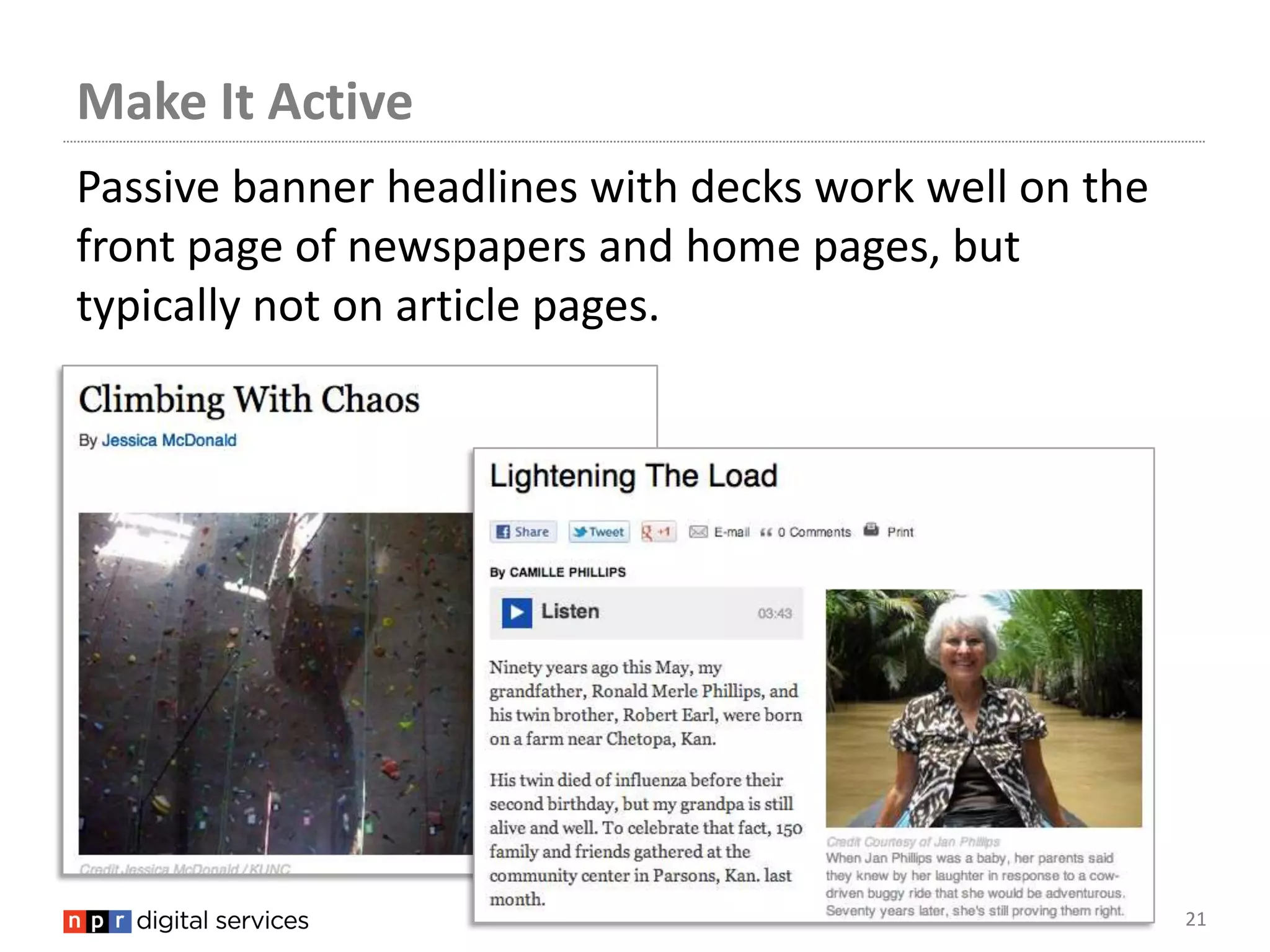
Make It Active
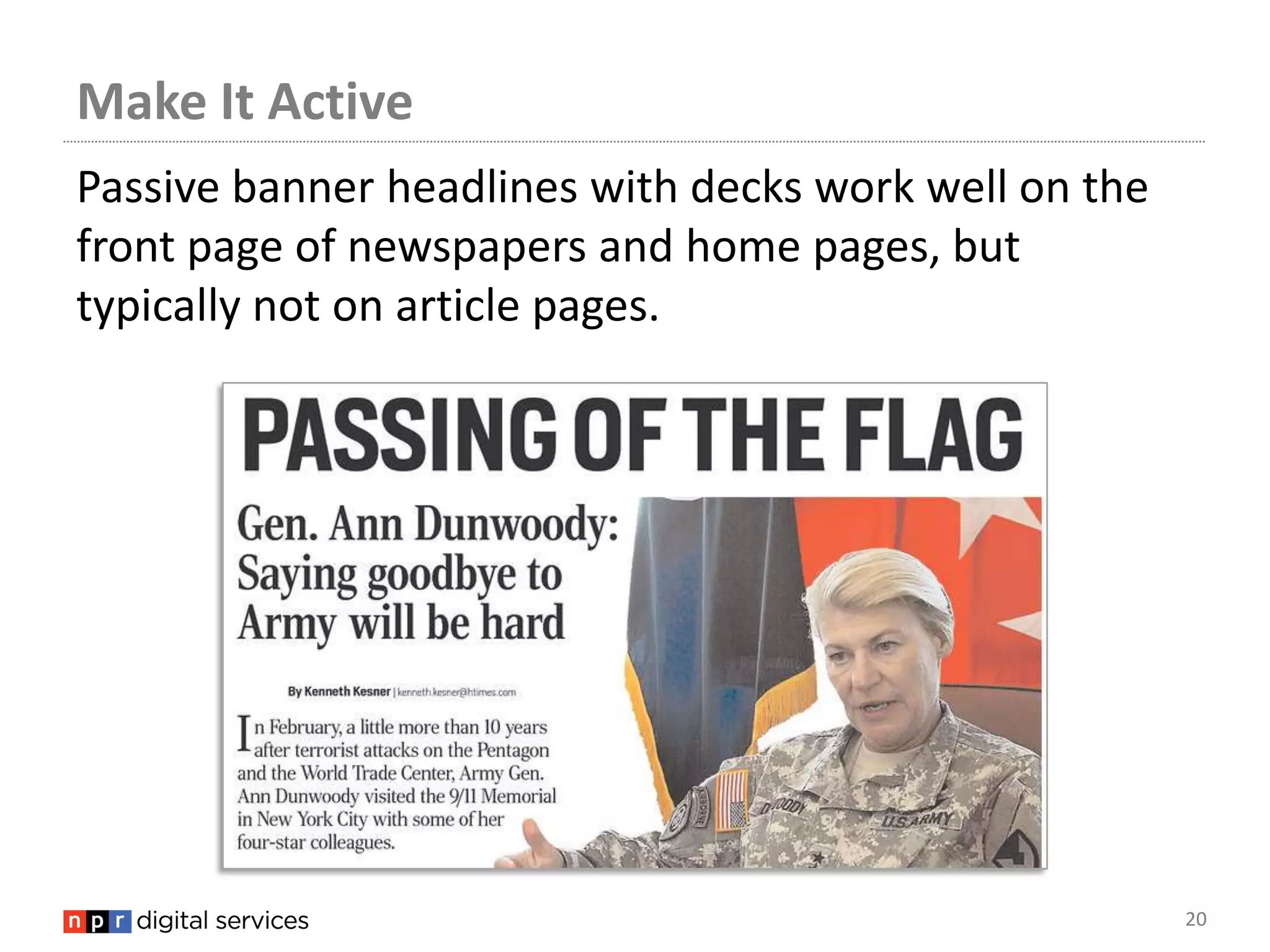
Passive banner headlines with decks work well on the
front page of newspapers and home pages, but
typically not on article pages.


                                                       20
Make It Active
Passive banner headlines with decks work well on the
front page of newspapers and home pages, but
typically not on article pages.


                                                       21
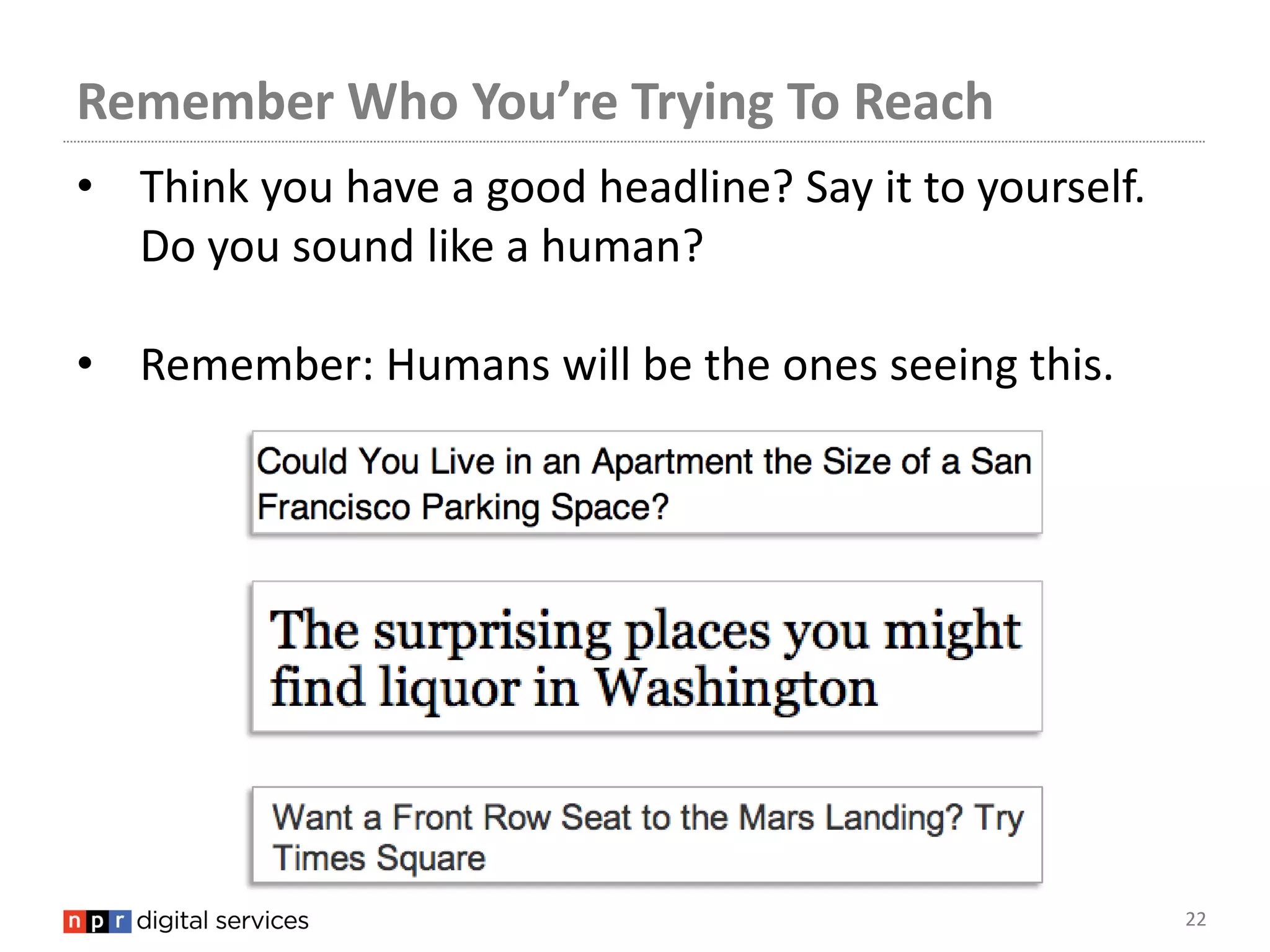
Remember Who You’re Trying To Reach
• Think you have a good headline? Say it to yourself.
  Do you sound like a human?

• Remember: Humans will be the ones seeing this.


                                                        22
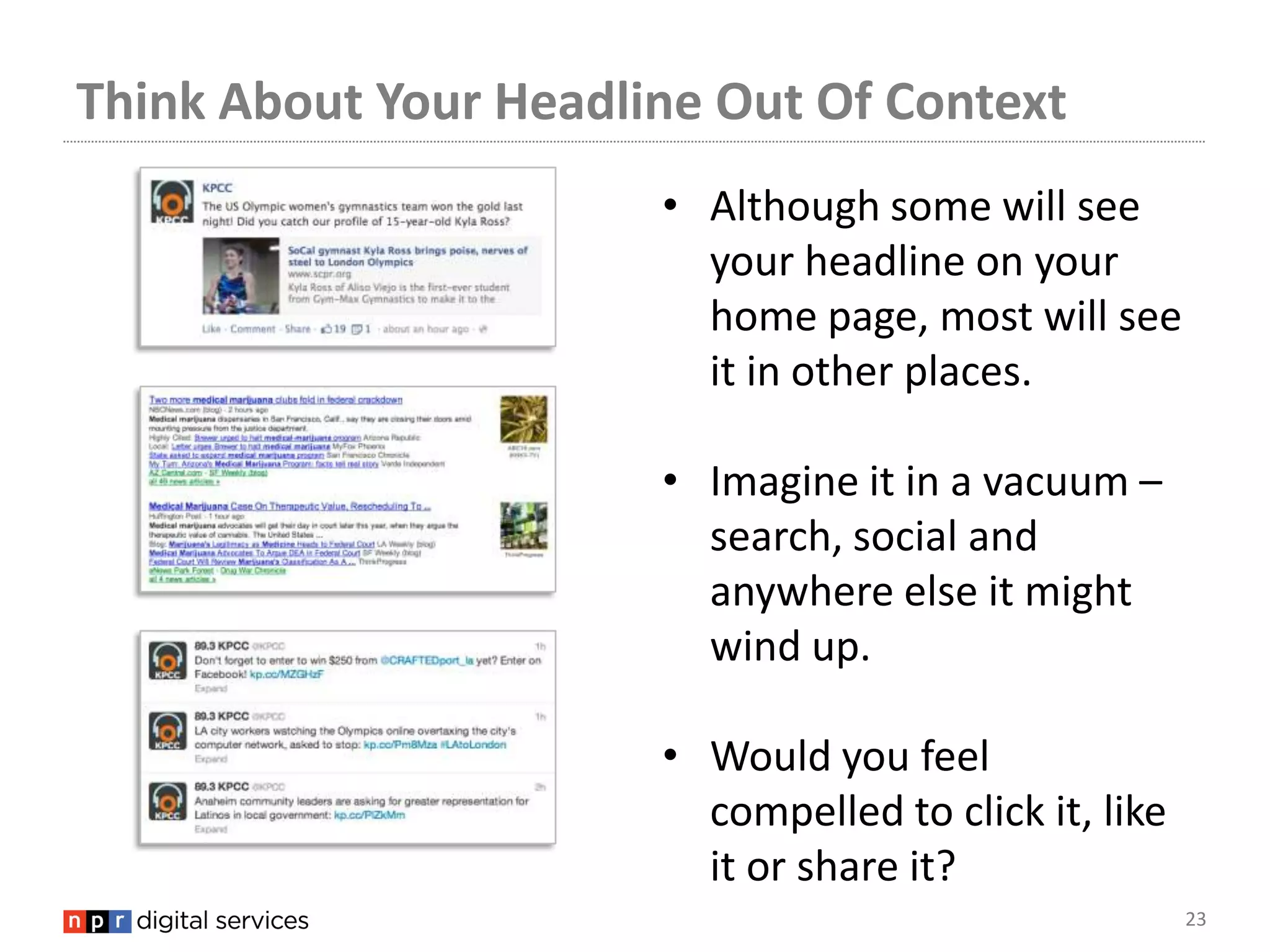
Think About Your Headline Out Of Context
                       • Although some will see
                         your headline on your
                         home page, most will see
                         it in other places.

                       • Imagine it in a vacuum –
                         search, social and
                         anywhere else it might
                         wind up.

                       • Would you feel
                         compelled to click it, like
                         it or share it?
                                                       23
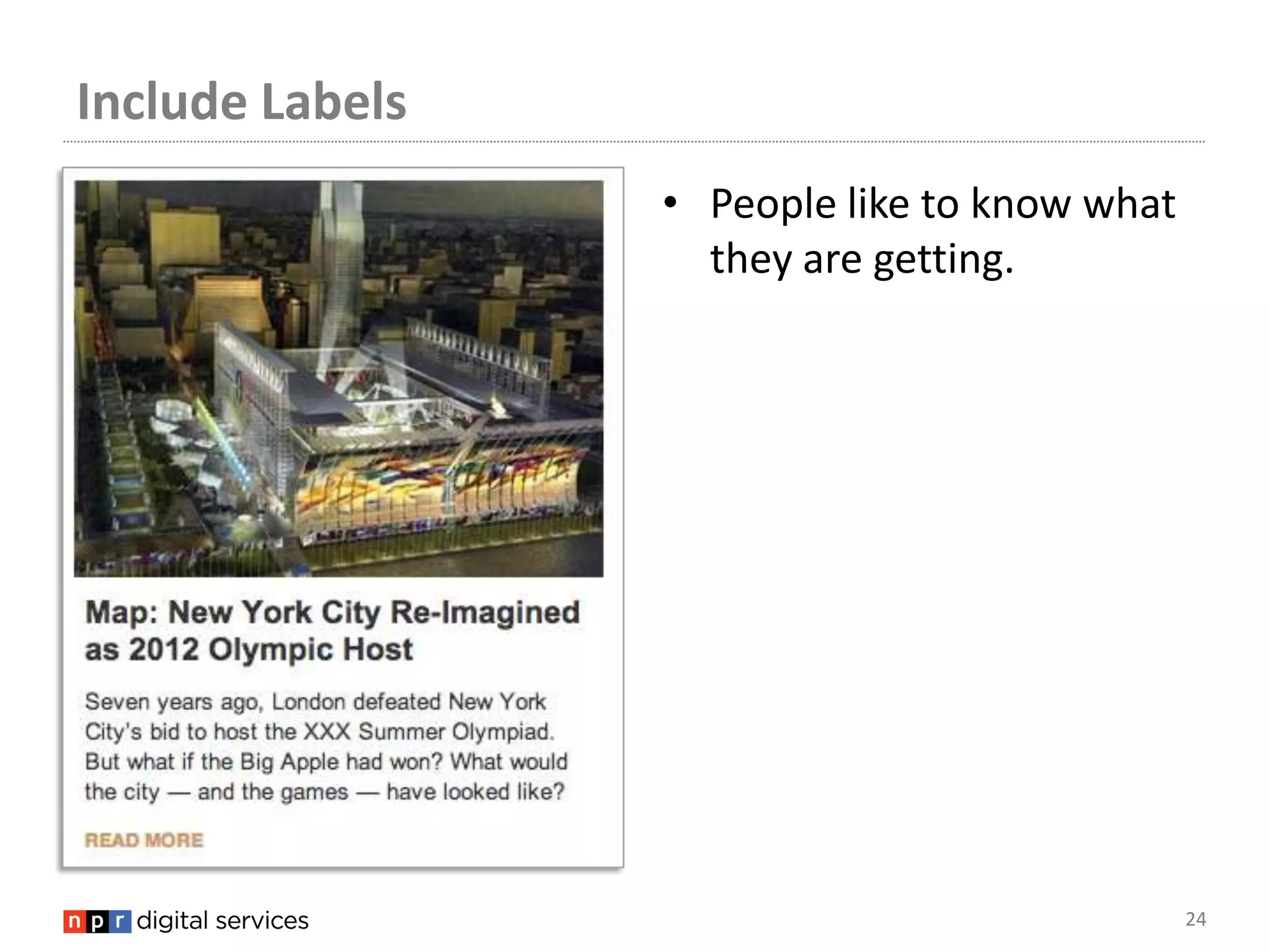
Include Labels
                 • People like to know what
                   they are getting.


                                              24
Include Labels
                 • People like to know what
                   they are getting.

                 • If the main component of
                   your story is a video,
                   photo, map or chart, let
                   people know in the
                   headline.


                                              25
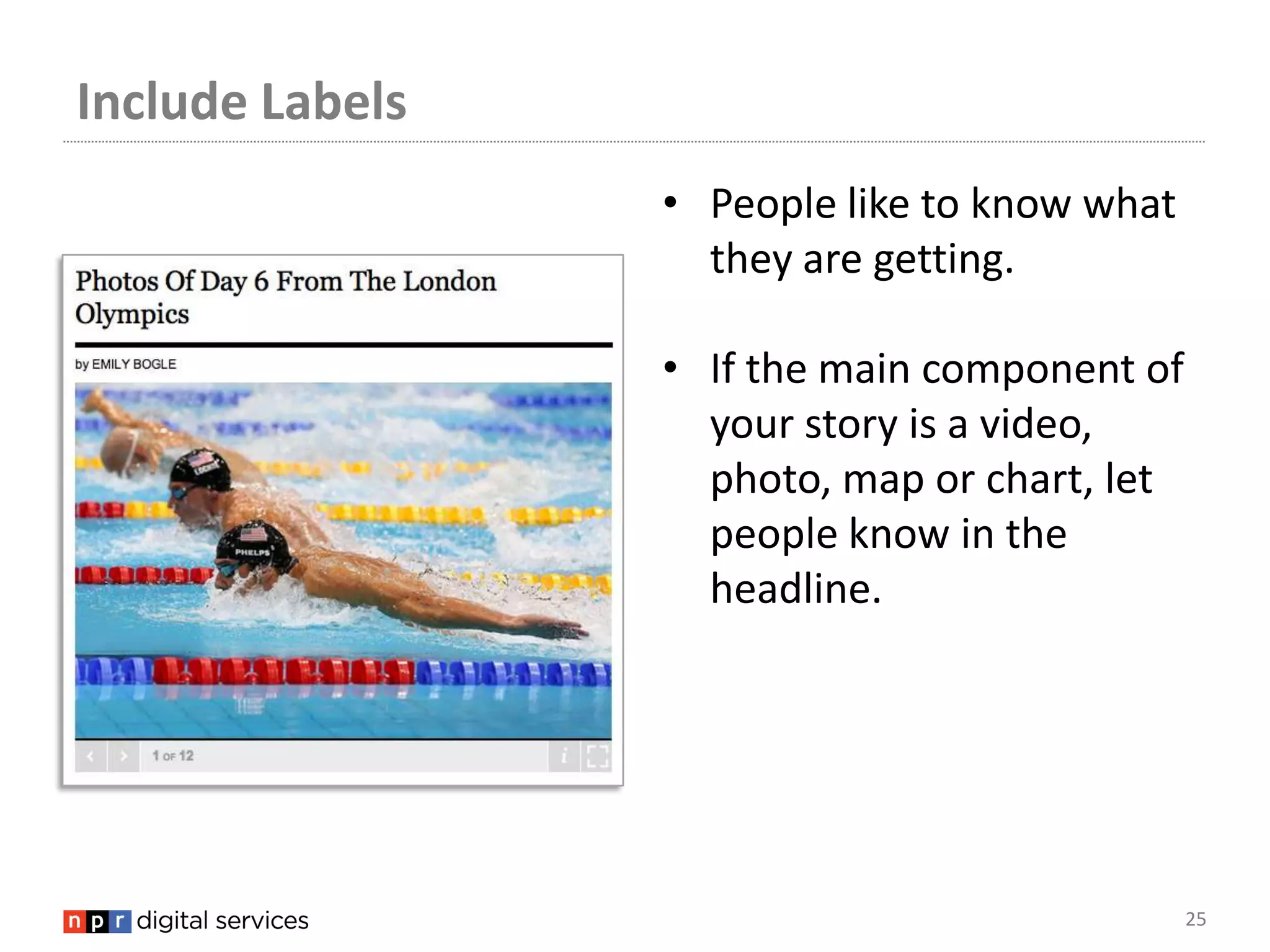
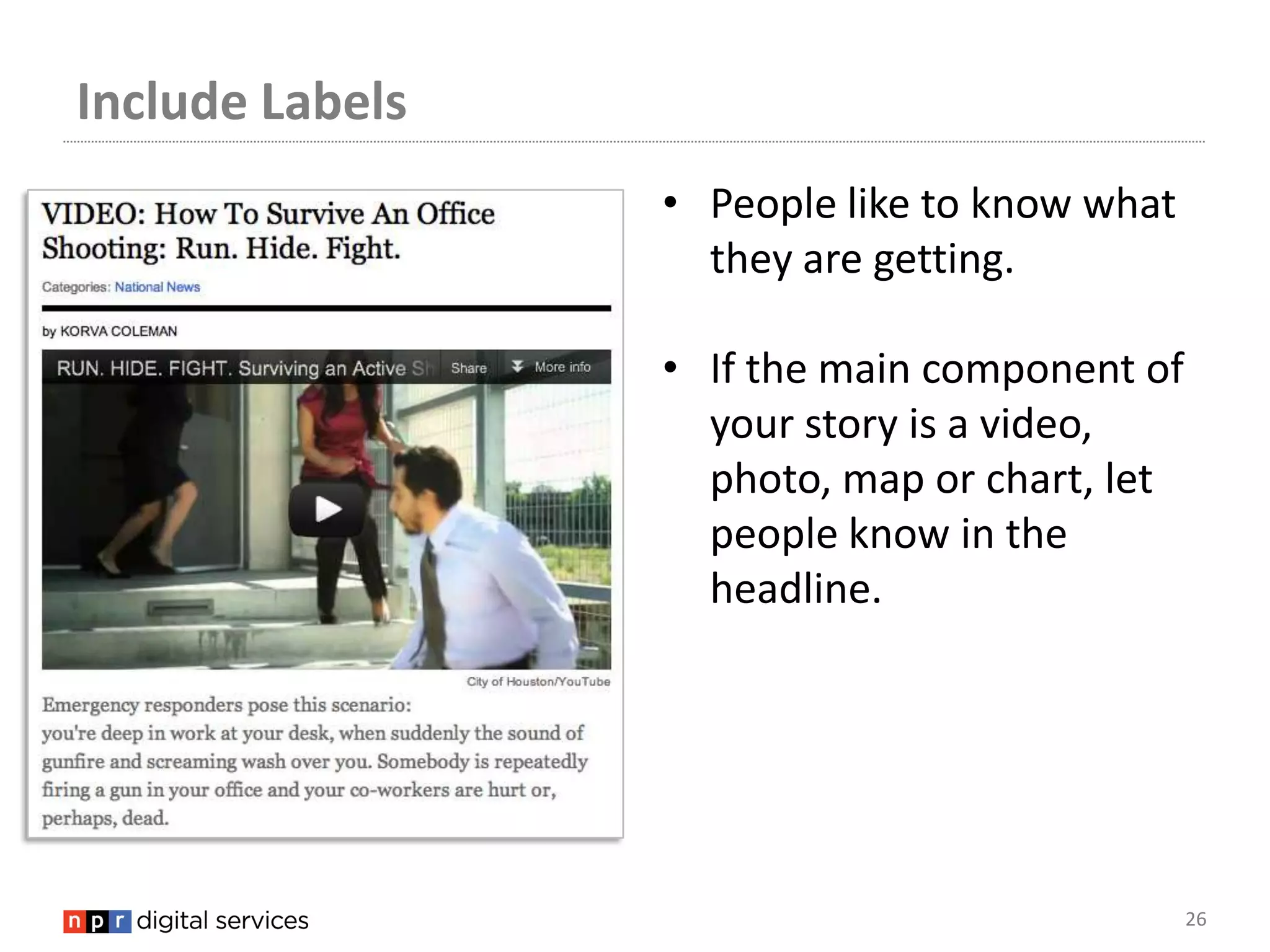
Include Labels
                 • People like to know what
                   they are getting.

                 • If the main component of
                   your story is a video,
                   photo, map or chart, let
                   people know in the
                   headline.


                                              26
Make Sure It’s Accurate

• Sometimes a clever or fun headline can get away from
  the accuracy of the story.


                                                         27
Drop Unnecessary words

• After you’ve written a headline you’re happy with, look
  at it, find unnecessary words and get rid of them.


                                                            28
ARE YOU STUCK?


                 29
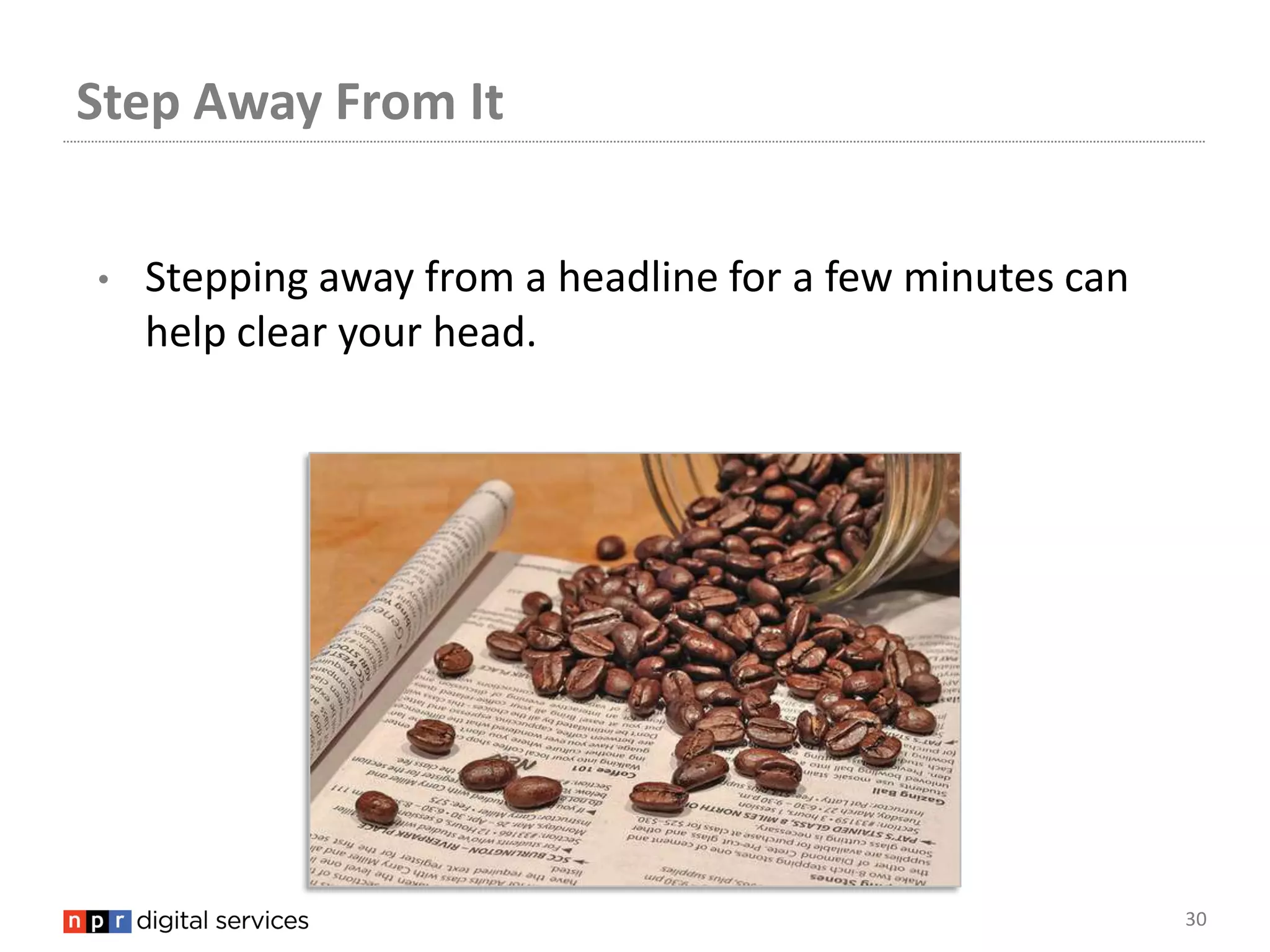
Step Away From It


•   Stepping away from a headline for a few minutes can
    help clear your head.


                                                          30
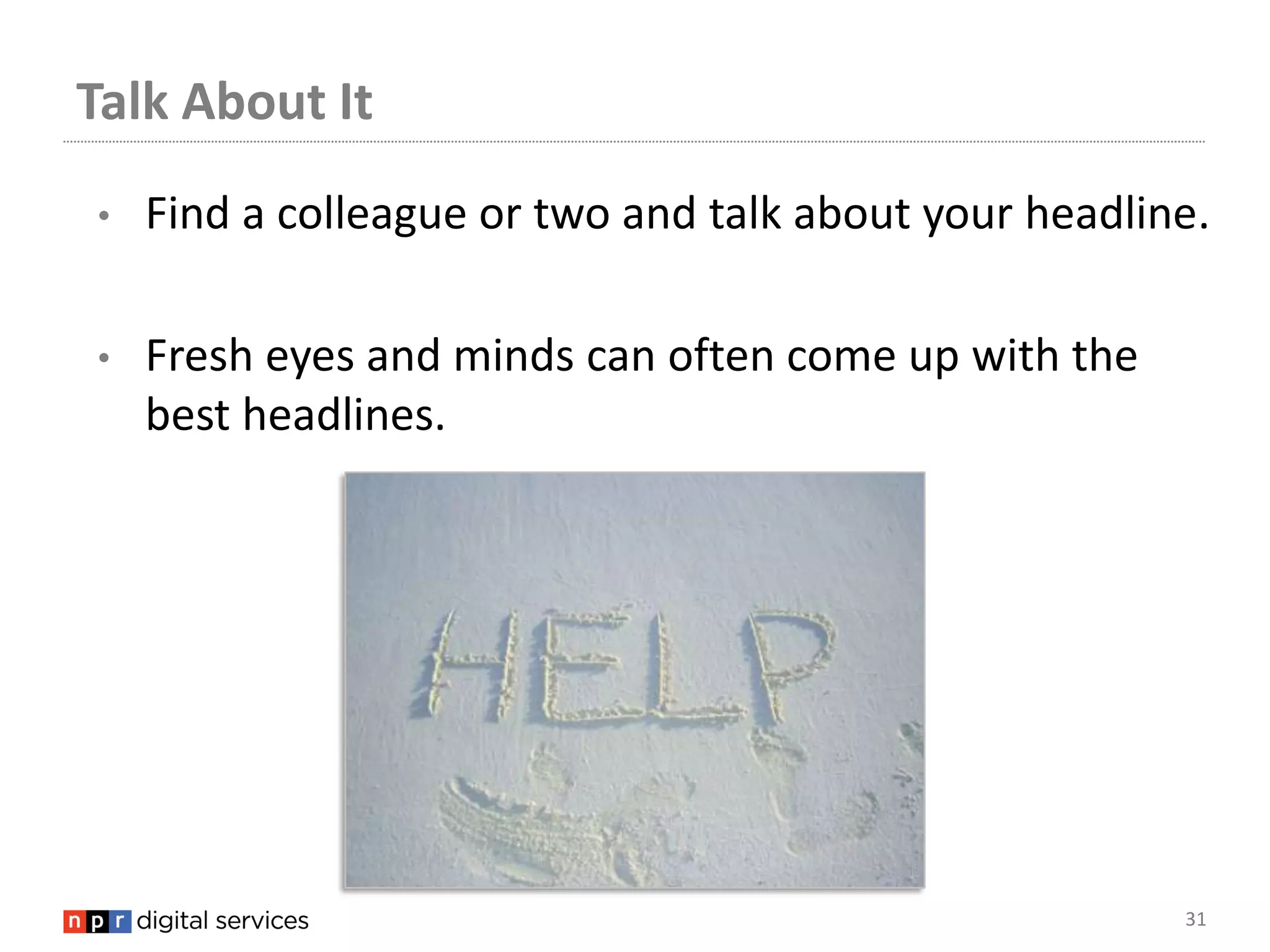
Talk About It
•   Find a colleague or two and talk about your headline.

•   Fresh eyes and minds can often come up with the
    best headlines.


                                                       31
Don’t Forget The Blank Document


                                  32
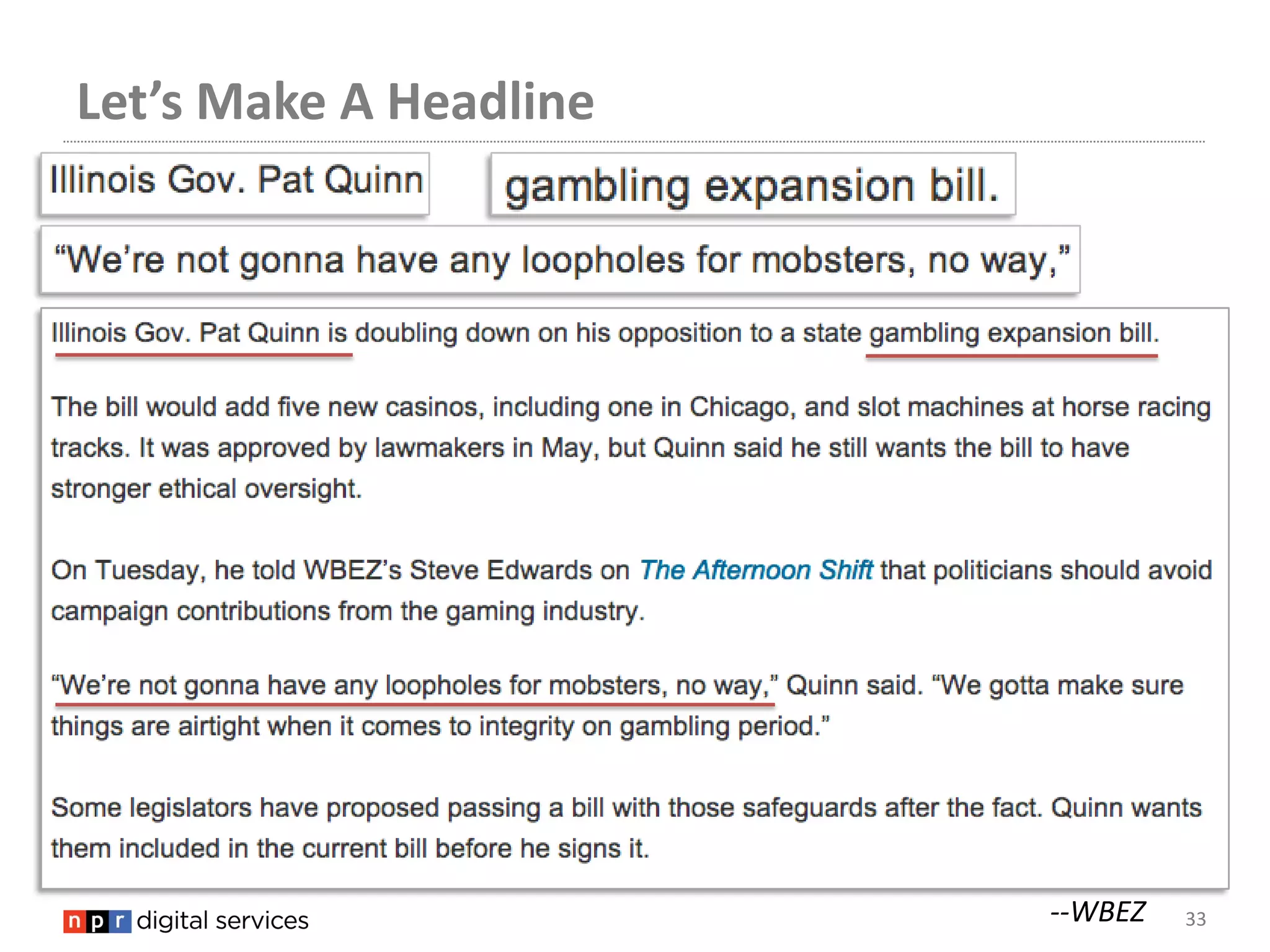
Let’s Make A Headline


                        --WBEZ   33
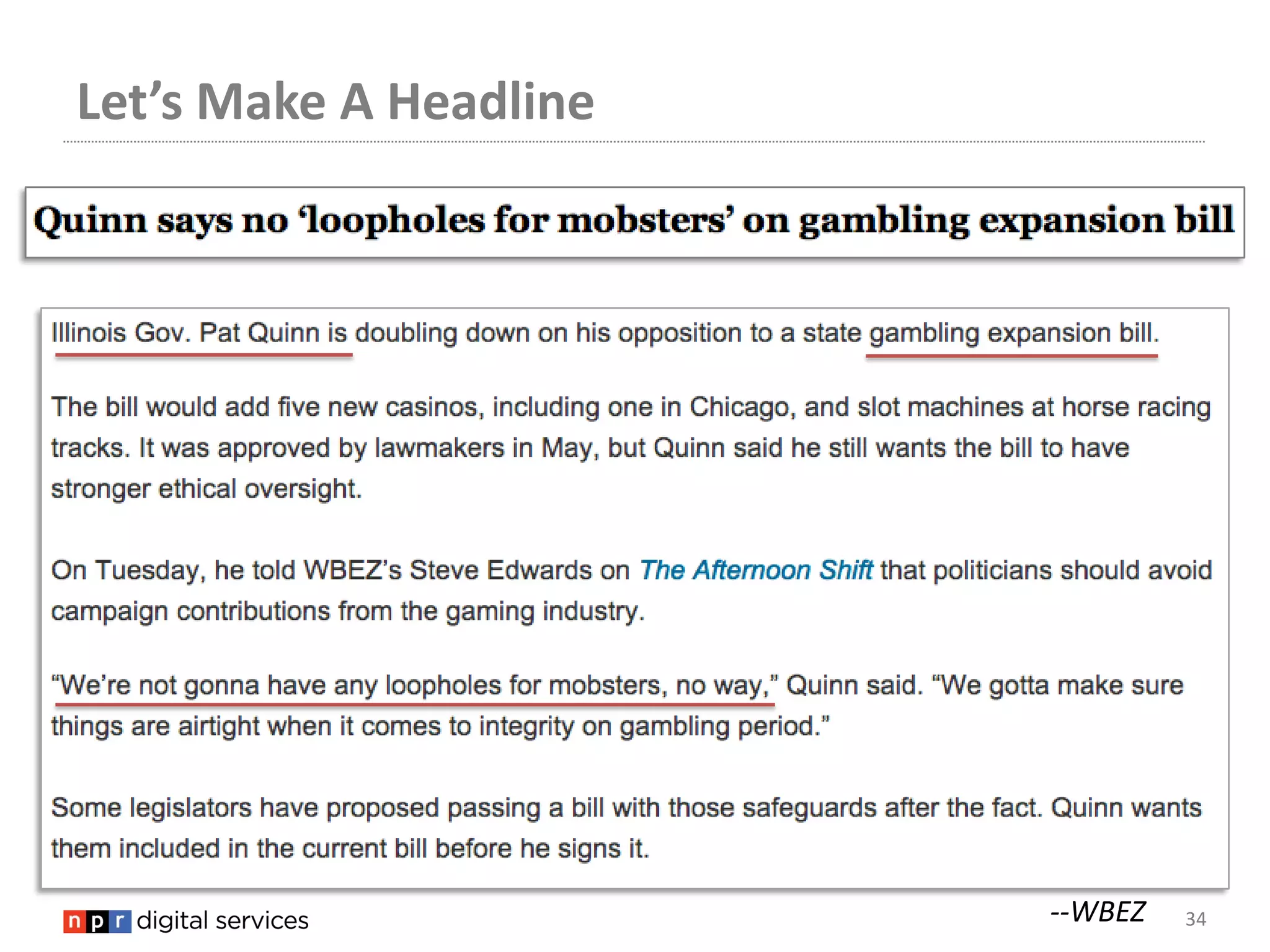
Let’s Make A Headline


                        --WBEZ   34
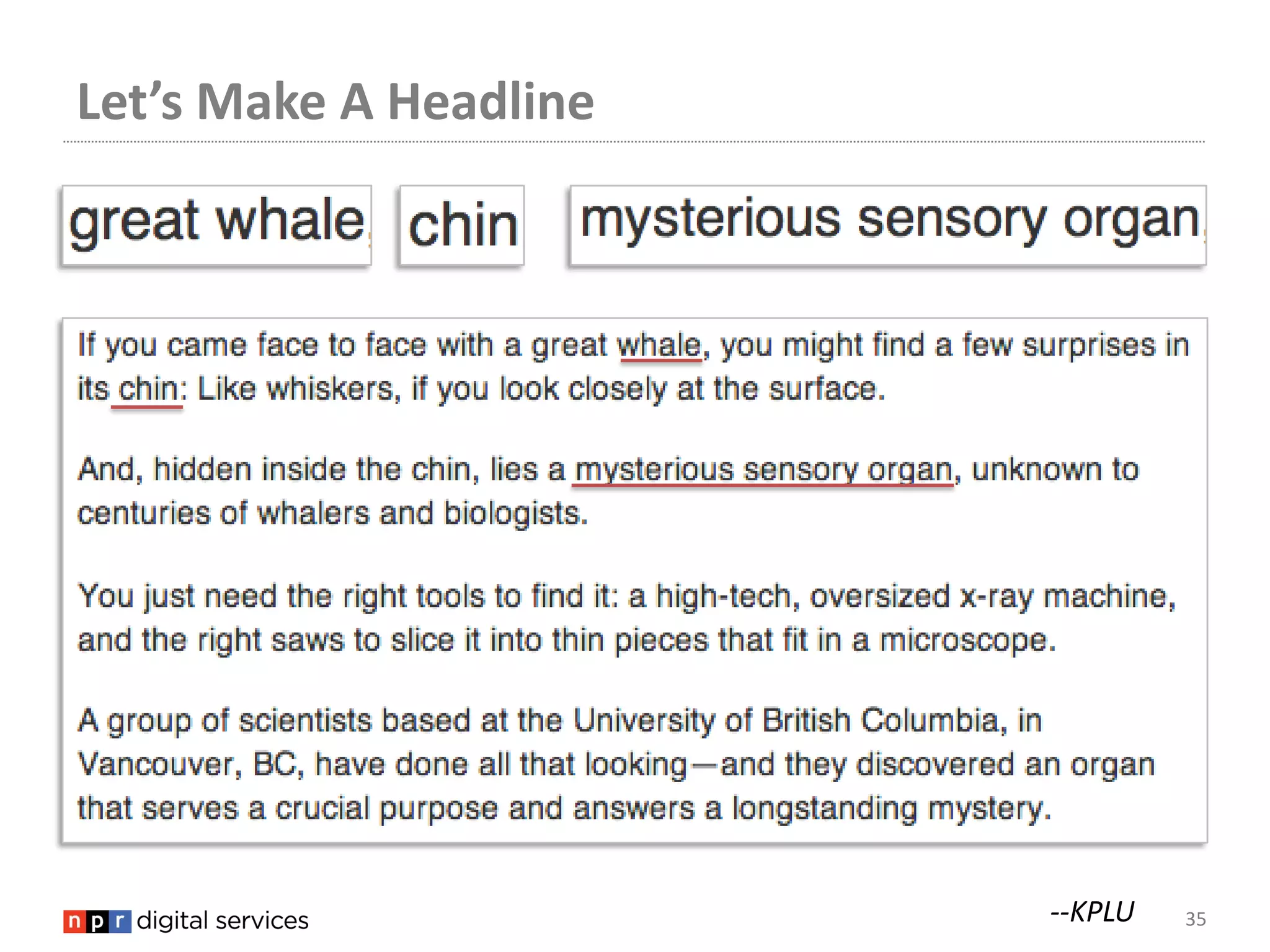
Let’s Make A Headline


                        --KPLU   35
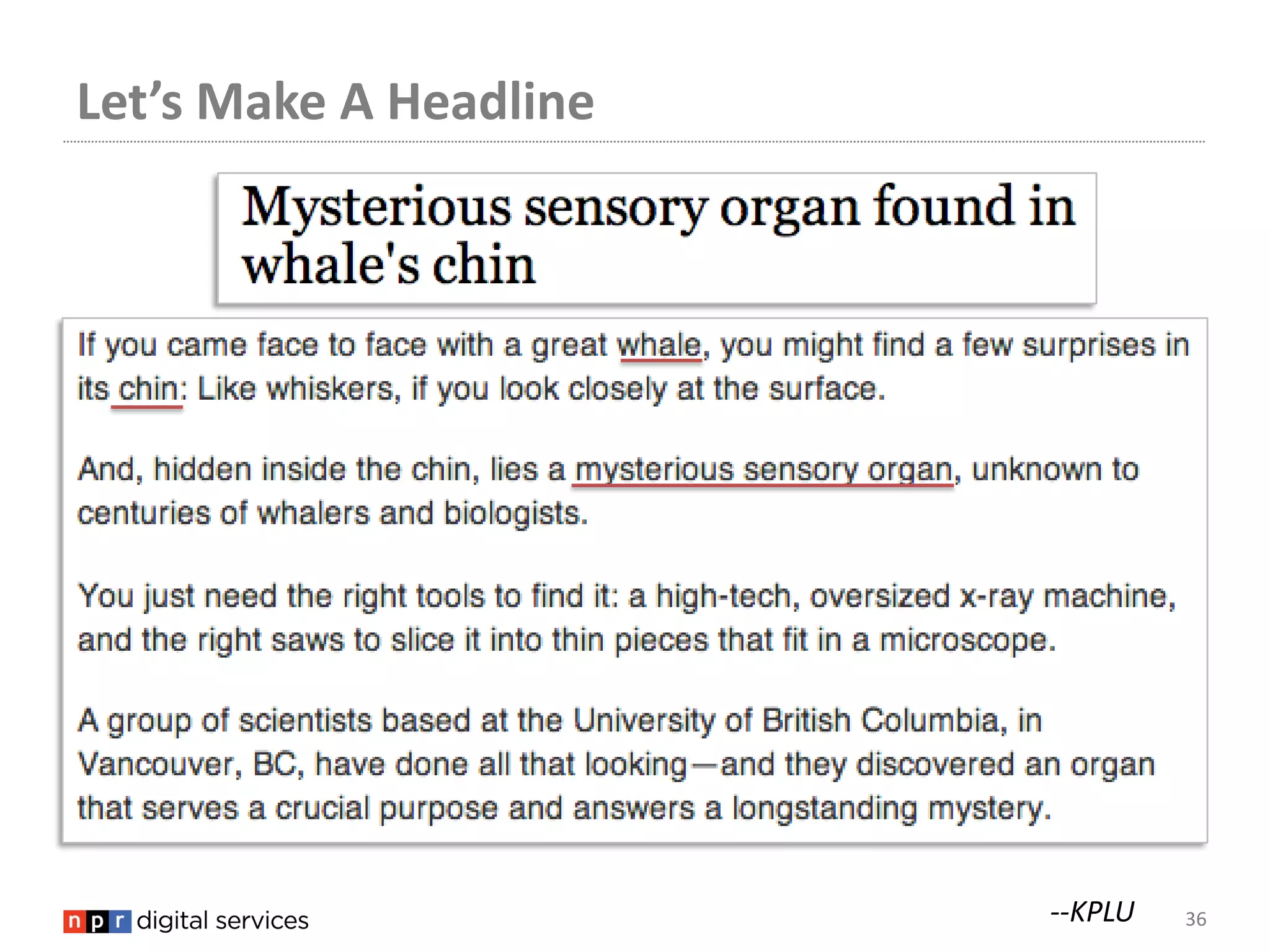
Let’s Make A Headline


                        --KPLU   36
WHAT ABOUT GOOGLE?


                     37
Search Engine Optimization

                       • Google mimics user
                         behavior, crawling your
                         text, looking at your
                         headline first.

                       • Make sure you include
                         key details in your
                         headlines.


                                                   38
How Does Google Work?
                        • Timely, fresh content.

                        • Text, text, text – in a
                          visual framework.

                        • Relevant proper nouns.

                        • Linking out to quality
                          sources.

                        • Being a credible
                          established source of
                          news.
                                                    39
Ask Yourself
1.   Does it promise me something specific?

2.   Would I Like, Share, Tweet or Comment on it?

3.   Is it accurate?

4.   Is it active?

5.   Are important players reflected?             www.bit.ly/headlinelist

6.   Is the main point of your story reflected?

7.   Does it obey the proper noun rule?

8.   Is it easily digestible?

9.   Are there any unnecessary words?
                                                                        40
Questions?


eathas@npr.org


                 41
Your Assignment

1. Select three stories you’ve created.

2. Write five different headlines for each story.

3. Highlight the best headline with an asterisk.

4. E-mail it to dseditorial@npr.org and include your
   station in the Subject by end of day Thursday.


                                          eathas@npr.org
                                                           42

Webinar: How to Write Headlines for the Web

  • 1.
    How To Write HeadlinesFor The Web October 2012
  • 2.
  • 3.
    Headlines Are More Important Than Ever 1. It’s promotion for your story Your headline is the only representation your story gets on the web 3
  • 4.
    Headlines Are More Important Than Ever 2. It will make or break your story You’re killing your own story with a dud headline 4
  • 5.
    Headlines Are More Important Than Ever 3. Humans will decide the fate of your story Making headlines SEO- friendly is no longer good enough 5
  • 6.
    Headlines Are More Important Than Ever 4. Social is growing Which means competition and opportunity for audience is growing 6
  • 7.
    Headlines Are More Important Than Ever 5. Home pages are less important Which means you have to make your headline perfect everywhere 7
  • 8.
  • 9.
    The Sooner TheBetter • Try not to wait until the end of the content creation process to come up with a headline. • Early on in the process, think about ideas for your headline. • Thinking of your headline up front creates a thesis under which to frame your story. • Ask yourself this constantly: What is this story about? 9
  • 10.
    Open A BlankDocument • Start free associating around what your headline could be. • What are the key words that tell you what this story is about? • Who are the important players in the story? Consider them for your headline. • Are there any quotes or nuggets that help tell the story? They will make your life easier. 10
  • 11.
    Provide the Factsfor Breaking News • In breaking news or live situations, keep it simple and to-the-point. • Include lots of facts, names and numbers 11
  • 12.
    Look For BigNumbers • Is a number one of the • Look especially for big key components of the numbers. Web users love story? big numbers. 12
  • 13.
    Look For BigNumbers • Is a number one of the • Look especially for big key components of the numbers. Web users love story? big numbers. Medical Software Giant Plans $190M Project in KCK 13
  • 14.
    It Should BeEasily Digestible • You have very little time to promote your story. • Make it easy for people to understand what you have for them. 14
  • 15.
    Follow the ProperNoun Rule • “Name the known, omit the obscure” • If the subject in your headline is well known to your primary audience, you can include it. • But if the name is obscure, you might consider skipping it. 15
  • 16.
    Does It WorkAs An Explanatory Headline? “When remotely possible, turn news into explanation.” --Gawker Media CEO Nick Denton • Hard news requires a hard news headline. But if you can find a way to turn a headline into an explainer, you can distinguish yourself from the crowd. 16
  • 17.
    It Should BeSpecific, It Should Promise 17
  • 18.
    It Should BeSpecific, It Should Promise Kansas: Then and Now 18
  • 19.
    It Should BeSpecific, It Should Promise • What is the story that you are delivering? • Tease the information – let them know basically what they’re getting but don’t give it all away. 19
  • 20.
    Make It Active Passivebanner headlines with decks work well on the front page of newspapers and home pages, but typically not on article pages. 20
  • 21.
    Make It Active Passivebanner headlines with decks work well on the front page of newspapers and home pages, but typically not on article pages. 21
  • 22.
    Remember Who You’reTrying To Reach • Think you have a good headline? Say it to yourself. Do you sound like a human? • Remember: Humans will be the ones seeing this. 22
  • 23.
    Think About YourHeadline Out Of Context • Although some will see your headline on your home page, most will see it in other places. • Imagine it in a vacuum – search, social and anywhere else it might wind up. • Would you feel compelled to click it, like it or share it? 23
  • 24.
    Include Labels • People like to know what they are getting. 24
  • 25.
    Include Labels • People like to know what they are getting. • If the main component of your story is a video, photo, map or chart, let people know in the headline. 25
  • 26.
    Include Labels • People like to know what they are getting. • If the main component of your story is a video, photo, map or chart, let people know in the headline. 26
  • 27.
    Make Sure It’sAccurate • Sometimes a clever or fun headline can get away from the accuracy of the story. 27
  • 28.
    Drop Unnecessary words •After you’ve written a headline you’re happy with, look at it, find unnecessary words and get rid of them. 28
  • 29.
  • 30.
    Step Away FromIt • Stepping away from a headline for a few minutes can help clear your head. 30
  • 31.
    Talk About It • Find a colleague or two and talk about your headline. • Fresh eyes and minds can often come up with the best headlines. 31
  • 32.
    Don’t Forget TheBlank Document 32
  • 33.
    Let’s Make AHeadline --WBEZ 33
  • 34.
    Let’s Make AHeadline --WBEZ 34
  • 35.
    Let’s Make AHeadline --KPLU 35
  • 36.
    Let’s Make AHeadline --KPLU 36
  • 37.
  • 38.
    Search Engine Optimization • Google mimics user behavior, crawling your text, looking at your headline first. • Make sure you include key details in your headlines. 38
  • 39.
    How Does GoogleWork? • Timely, fresh content. • Text, text, text – in a visual framework. • Relevant proper nouns. • Linking out to quality sources. • Being a credible established source of news. 39
  • 40.
    Ask Yourself 1. Does it promise me something specific? 2. Would I Like, Share, Tweet or Comment on it? 3. Is it accurate? 4. Is it active? 5. Are important players reflected? www.bit.ly/headlinelist 6. Is the main point of your story reflected? 7. Does it obey the proper noun rule? 8. Is it easily digestible? 9. Are there any unnecessary words? 40
  • 41.
  • 42.
    Your Assignment 1. Selectthree stories you’ve created. 2. Write five different headlines for each story. 3. Highlight the best headline with an asterisk. 4. E-mail it to dseditorial@npr.org and include your station in the Subject by end of day Thursday. eathas@npr.org 42