HEAD TRANSPLANTATION
AKAKI TSERETELI STATE UNIVERSITY
FACULTY OF MEDICINE(ENGLISH)
AMAN KUMAR
SEMESTER-3rd
TOPICS TO BE COVERED
 INTRODUCTION
 WHAT IS TRANSPLANT?
 NEED OF HEAD TRANSPLANT
 HISTORY OF HEAD TRANSPLANT
 MEDICAL CHALLANGES
 BENEFITS OF HUMAN HEAD TRANSPLANT
INTRODUCTION
 Earlier this year Italian neuroscientist Sergio Canavero shocked the world when
he announced he would perform the world’s
first human head transplant. and he has recruited ahead surgeon (pun intended) to
lead the controversial procedure. This operation may sound like something out of a
horror movie, but one man is hoping it will improve his quality of life.
In the HHT, another important topic is spinal cord. The greatest technical hurdle to
such endeavor is of course the reconnection of the donor's and recipient's spinal
cords.
WHAT IS TRANSPLANT?
 Organ transplantation is a medical procedure in which one body part is replaced in the body of
a recipient, to replace a damaged or missing organ.
 The donor and recipient may be at the same location, or organs may be transported from a
donor site to another
 location. Organs and/or tissues that are transplanted within the same person's body are called
autografts .
 Transplants that are recently performed between two subjects of the same species are called
allografts.
NEEDOFHEAD TRANSPLANT
It’s a rare motor neuron disease known as Werdnig-
Hoffmann Disease. The disease causes motor
neurons – the nerve cells responsible for sending
signals from the central nervous system to your
muscles – to Deteriorate, which leads to muscle
atrophy and in severe cases, difficulty swallowing and
breathing.
 Currently there is no treatment for this disease .
So for now surgeons are preferring the HEAD
TRANSPLANT SURGERY
WHAT IS HEAD TRANSPLANT?
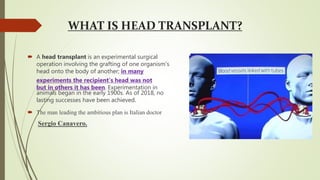
 A head transplant is an experimental surgical
operation involving the grafting of one organism's
head onto the body of another; in many
experiments the recipient's head was not
but in others it has been. Experimentation in
animals began in the early 1900s. As of 2018, no
lasting successes have been achieved.
 The man leading the ambitious plan is Italian doctor
Sergio Canavero.
Dogheadtransplant
 The first produces a two-headed animal. Reportedly, a
number of two-headed dogs were produced. Both heads
could breathe and eat. But the dogs died in less than a month
because of rejection issues with the transplanted head.
 Transplantation of a dog-head performed in the GDR by
Vladimir Demikhov on January 13, 1959
 In 1954, Vladimir Demikhov, a Soviet surgeon who had done
important work to improve coronary bypass surgery,
performed an experiment in which he grafted a dog's head
and upper body including the front legs, onto another dog
but the dog died due to organ rejection.
Firstheadtransplant,1970
• Similar experiments were done in monkeys, but the monkey’s own head was removed and the donor
head attached, producing a one-headed animal.
• For this reason, actually
• The first successful head transplant was carried out in 1970 in US.
• It was moved the head of one monkey on to another.
• The monkey lived for 9 days, but its immune system rejected the head. But the heads did
function.
• But nobody knew how to connect the transplanted head to the spinal cord.
HOW IT CAN BE DONE?
 Firstly, because their cells can survive without oxygen, the recipient's head and the donor body are cooled.
 Then, tissue around the neck is cut up and major blood vessels are linked using tiny tubes.
 Next, the spinal cords are cleanly seperated, and then the recipient's head is moved onto the donor body.
 Lastly, the ends of the spinal cord are combined using the
 chemical polyethylene glycol (PG ise special adhesive).
 After this, the person would be put into a coma for around
4 weeks while they heal.
ACCORDING TO Dr Canavero believes the person would wake up with the same voice, move and
feel their face and learn to walk within a year.
HISTORY
 Alexis carrel was a French surgeon who had developed improved surgical methods to connect
blood vessels in the context of organ transplantation.
 In 1908 he collaborated with the American Charles Claude Guthrie to attempt to graft the head of
one dog on an intact second dog; the grafted head showed some reflexes early on but
quickly and the animal was killed after a few hours.
 In the 1950s and '60s immunosuppressive drugs were developed and organ
transplantation techniques were developed that eventually made transplantation of kidneys, livers,
and other organs standard medical procedures.
In 1965 Robert J. White did a series of experiments in which he attempted to graft only the
vascular system of isolated dog brains onto existing dogs, to learn how to manage this challenge
could maintain high levels of brain activity and metabolism by avoiding any break in the blood
supply. The animals survived between 6 hours and 2 days.
In 1970 he did four experiments in which he cut the head off of a monkey and connected the
blood vessels of another monkey head to it; he did not attempt to connect the nervous systems.
White used deep hypothermia to protect the brains during the times when they were cut off from
blood during procedure. The recipient bodies had to be kept alive with mechanical ventilation and
drugs to stimulate the heart. The grafted heads were able to function - the eyes tracked moving
objects and it could chew and swallow. There were problems with the grafting of blood vessels
that led to blood clots forming, and White used high doses of immunosuppressive drugs that had
severe side effects; the animals died between 6 hours and 3 days after the heads were engrafted.
In 2012 Xiaoping Ren published work in which he grafted the head of a mouse onto another
mouse's body; again the focus was on how to avoid harm from the loss of blood supply; with his
protocol the grafted heads survived up to six months.
In 2013 Sergio Canavero published a protocol that he said would make human head
transplantation possible.
In 2015 Xiaoping Ren published work in which he cut off the heads of mice but left the brain stem
in place, and then connected the vasculature of the donor head to the recipient body; this work
was an effort to address whether it was possible to keep the body of the recipient animal alive
without life support. All prior experimental work that involved removing the recipient body's head
had cut the head off lower down, just below the second bone in the spinal column. Ren also
used moderate hypothermia to protect the brains during the procedure.
Medical challenges
There are three main technical challenges.
 The immune response to avoid transplant rejection .
 The brain is highly dependent on continuous flow of blood to provide oxygen and nutrients
and remove waste products,
 Managing the nervous systems in both the body and the head is essential.
The autonomic nervous system controls essential functions like breathing and the heart
beating and is governed largely by the brain stem; if the recipient body's head is removed this
can no longer function. Additionally each nerve coming out of the head via the spinal cord
needs to be connected to the putatively corresponding nerve in the recipient body's spinal
cord in order for the brain to control movement and receive sensory information. Finally, the
risk of systematic neuropathic pain is high.
CONCLUSION
 Many medical professionals do not embrace this procedure, describing it as
outlandish and impossible. While surviving such a complicated and intricate surgery is
highly unlikely, it could help restore independence for the severely disabled. And
some people, like Spiridonov ,feel it's worth the risk.
Anyhow, if this surgery can being successfully performed ,then it will write a history in
medical science.
THANK YOU

Head transplantation

  • 1.
    HEAD TRANSPLANTATION AKAKI TSERETELISTATE UNIVERSITY FACULTY OF MEDICINE(ENGLISH) AMAN KUMAR SEMESTER-3rd
  • 2.
    TOPICS TO BECOVERED  INTRODUCTION  WHAT IS TRANSPLANT?  NEED OF HEAD TRANSPLANT  HISTORY OF HEAD TRANSPLANT  MEDICAL CHALLANGES  BENEFITS OF HUMAN HEAD TRANSPLANT
  • 3.
    INTRODUCTION  Earlier thisyear Italian neuroscientist Sergio Canavero shocked the world when he announced he would perform the world’s first human head transplant. and he has recruited ahead surgeon (pun intended) to lead the controversial procedure. This operation may sound like something out of a horror movie, but one man is hoping it will improve his quality of life. In the HHT, another important topic is spinal cord. The greatest technical hurdle to such endeavor is of course the reconnection of the donor's and recipient's spinal cords.
  • 4.
    WHAT IS TRANSPLANT? Organ transplantation is a medical procedure in which one body part is replaced in the body of a recipient, to replace a damaged or missing organ.  The donor and recipient may be at the same location, or organs may be transported from a donor site to another  location. Organs and/or tissues that are transplanted within the same person's body are called autografts .  Transplants that are recently performed between two subjects of the same species are called allografts.
  • 5.
    NEEDOFHEAD TRANSPLANT It’s arare motor neuron disease known as Werdnig- Hoffmann Disease. The disease causes motor neurons – the nerve cells responsible for sending signals from the central nervous system to your muscles – to Deteriorate, which leads to muscle atrophy and in severe cases, difficulty swallowing and breathing.  Currently there is no treatment for this disease . So for now surgeons are preferring the HEAD TRANSPLANT SURGERY
  • 6.
    WHAT IS HEADTRANSPLANT?  A head transplant is an experimental surgical operation involving the grafting of one organism's head onto the body of another; in many experiments the recipient's head was not but in others it has been. Experimentation in animals began in the early 1900s. As of 2018, no lasting successes have been achieved.  The man leading the ambitious plan is Italian doctor Sergio Canavero.
  • 7.
    Dogheadtransplant  The firstproduces a two-headed animal. Reportedly, a number of two-headed dogs were produced. Both heads could breathe and eat. But the dogs died in less than a month because of rejection issues with the transplanted head.  Transplantation of a dog-head performed in the GDR by Vladimir Demikhov on January 13, 1959  In 1954, Vladimir Demikhov, a Soviet surgeon who had done important work to improve coronary bypass surgery, performed an experiment in which he grafted a dog's head and upper body including the front legs, onto another dog but the dog died due to organ rejection.
  • 8.
    Firstheadtransplant,1970 • Similar experimentswere done in monkeys, but the monkey’s own head was removed and the donor head attached, producing a one-headed animal. • For this reason, actually • The first successful head transplant was carried out in 1970 in US. • It was moved the head of one monkey on to another. • The monkey lived for 9 days, but its immune system rejected the head. But the heads did function. • But nobody knew how to connect the transplanted head to the spinal cord.
  • 9.
    HOW IT CANBE DONE?  Firstly, because their cells can survive without oxygen, the recipient's head and the donor body are cooled.  Then, tissue around the neck is cut up and major blood vessels are linked using tiny tubes.  Next, the spinal cords are cleanly seperated, and then the recipient's head is moved onto the donor body.  Lastly, the ends of the spinal cord are combined using the  chemical polyethylene glycol (PG ise special adhesive).  After this, the person would be put into a coma for around 4 weeks while they heal. ACCORDING TO Dr Canavero believes the person would wake up with the same voice, move and feel their face and learn to walk within a year.
  • 10.
    HISTORY  Alexis carrelwas a French surgeon who had developed improved surgical methods to connect blood vessels in the context of organ transplantation.  In 1908 he collaborated with the American Charles Claude Guthrie to attempt to graft the head of one dog on an intact second dog; the grafted head showed some reflexes early on but quickly and the animal was killed after a few hours.  In the 1950s and '60s immunosuppressive drugs were developed and organ transplantation techniques were developed that eventually made transplantation of kidneys, livers, and other organs standard medical procedures.
  • 11.
    In 1965 RobertJ. White did a series of experiments in which he attempted to graft only the vascular system of isolated dog brains onto existing dogs, to learn how to manage this challenge could maintain high levels of brain activity and metabolism by avoiding any break in the blood supply. The animals survived between 6 hours and 2 days. In 1970 he did four experiments in which he cut the head off of a monkey and connected the blood vessels of another monkey head to it; he did not attempt to connect the nervous systems. White used deep hypothermia to protect the brains during the times when they were cut off from blood during procedure. The recipient bodies had to be kept alive with mechanical ventilation and drugs to stimulate the heart. The grafted heads were able to function - the eyes tracked moving objects and it could chew and swallow. There were problems with the grafting of blood vessels that led to blood clots forming, and White used high doses of immunosuppressive drugs that had severe side effects; the animals died between 6 hours and 3 days after the heads were engrafted.
  • 12.
    In 2012 XiaopingRen published work in which he grafted the head of a mouse onto another mouse's body; again the focus was on how to avoid harm from the loss of blood supply; with his protocol the grafted heads survived up to six months. In 2013 Sergio Canavero published a protocol that he said would make human head transplantation possible. In 2015 Xiaoping Ren published work in which he cut off the heads of mice but left the brain stem in place, and then connected the vasculature of the donor head to the recipient body; this work was an effort to address whether it was possible to keep the body of the recipient animal alive without life support. All prior experimental work that involved removing the recipient body's head had cut the head off lower down, just below the second bone in the spinal column. Ren also used moderate hypothermia to protect the brains during the procedure.
  • 13.
    Medical challenges There arethree main technical challenges.  The immune response to avoid transplant rejection .  The brain is highly dependent on continuous flow of blood to provide oxygen and nutrients and remove waste products,  Managing the nervous systems in both the body and the head is essential. The autonomic nervous system controls essential functions like breathing and the heart beating and is governed largely by the brain stem; if the recipient body's head is removed this can no longer function. Additionally each nerve coming out of the head via the spinal cord needs to be connected to the putatively corresponding nerve in the recipient body's spinal cord in order for the brain to control movement and receive sensory information. Finally, the risk of systematic neuropathic pain is high.
  • 14.
    CONCLUSION  Many medicalprofessionals do not embrace this procedure, describing it as outlandish and impossible. While surviving such a complicated and intricate surgery is highly unlikely, it could help restore independence for the severely disabled. And some people, like Spiridonov ,feel it's worth the risk. Anyhow, if this surgery can being successfully performed ,then it will write a history in medical science.
  • 15.