HUMAN HEAD
TRANPLANT
HARUN YILDIZ
Introduction
I. The Concept of Human Head Transplant
II. Human Head Transplant (HHT) History
III. How Will It Be Done?
IV. Benefits of HHT
I. First Human Head Transplant
Switching heads sounds pretty "Frankenstein," for sure.
• It sounds like the plot from a horror movie,
• but scientists believe a human head transplant
could soon become a reality.
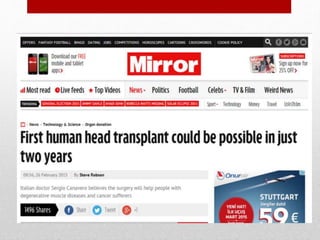
The man leading the ambitious plan is Italian doctor
Sergio Canavero.
Doctors will launch a project at a conference this
summer. He will carry out the first procedure as soon as
2017.
Dog head transplant
• The first produces a two-headed animal. Reportedly, a
number of two-headed dogs were produced. Both heads
could breathe and eat. But the dogs died in less than a
month because of rejection issues with the transplanted
head.
Monkey head transplant
• Similar experiments were done in monkeys, but the
monkey’s own head was removed and the donor head
attached, producing a one-headed animal.
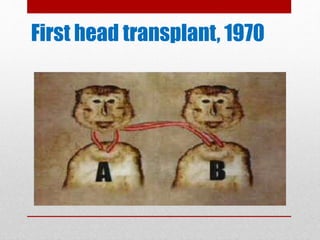
First head transplant, 1970
• For this reason, actually
• The first successful head transplant was carried out in
1970 in US.
• It was moved the head of one monkey on to another.
• The monkey lived for 9 days, but its immune system
rejected the head. But the heads did function.
• But nobody knew how to connect the transplanted
head to the spinal cord.
because
• In the HHT, another important topic is spinal
cord. The greatest technical hurdle to such
endeavor is of course the reconnection of the
donor's and recipient's spinal cords.
SPINAL CORD:
to conduct motor and sensory information,
to coordinate certain reflexes and central pattern generators
He first submited his idea in 2013.
He has some the major obstacles to surgery.
These include making the spinal cord with a new
head, and ensuring the body's immune system
does not reject it.
He believes head transplants could help people
with degenerative muscle disease, widespread
organ failure (total paralysis) and cancer sufferers.
• Dr Canavero plans to announce the project at the
annual conference of the American Academy of
Neurological and Orthopaedic Surgeons, US, in
June.
• He published a paper with a theory on how he
believes the operation could be carried out
successfully this month.
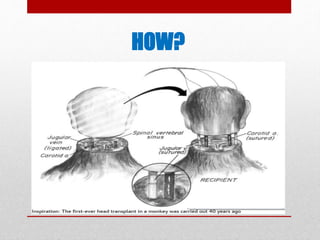
HOW?
Firstly, because their cells can survive without oxygen, the
recipient's head and the donor body are cooled.
Then, tissue around the neck is cut up and major blood
vessels are linked using tiny tubes.
Next, the spinal cords are cleanly seperated, and then the
recipient's head is moved onto the donor body.
Lastly, the ends of the spinal cord are combined using the
chemical polyethylene glycol (PG ise special adhesive).
• After this, the person would be put into a coma for around
4 weeks while they heal.
• Dr Canavero believes the person would wake up with the
same voice, move and feel their face and learn to walk
within a year.
• He says several people have already volunteered.
• Some critics have critized Dr Canavero's project
'pure fantasy'.
• For Example, Dr. Jerry Silver, Case Western Reserve
University neurologist "It's complete fantasy, that you could use
[PEG technology] in such a traumatic injury in an adult mammal.
This is bad science, this should never happen."
• But it is now more than 40 years since the first
monkey head transplant
• and a similar operation on a mouse was recently
successful in China.
Additionally
The operation is expected about $13 million..
Thanks for listening..
SOURCES
• http://www.mirror.co.uk/news/technology-science/science/first-human-head-transplant-could-5233587
(headlines of article)
• http://www.huffingtonpost.com/2013/07/06/head-transplant-italian-neuroscientist_n_3533391.html
(for video)

Head transplant yildiz harun

  • 1.
  • 2.
    Introduction I. The Conceptof Human Head Transplant II. Human Head Transplant (HHT) History III. How Will It Be Done? IV. Benefits of HHT
  • 4.
    I. First HumanHead Transplant
  • 5.
    Switching heads soundspretty "Frankenstein," for sure.
  • 6.
    • It soundslike the plot from a horror movie, • but scientists believe a human head transplant could soon become a reality.
  • 7.
    The man leadingthe ambitious plan is Italian doctor Sergio Canavero. Doctors will launch a project at a conference this summer. He will carry out the first procedure as soon as 2017.
  • 8.
    Dog head transplant •The first produces a two-headed animal. Reportedly, a number of two-headed dogs were produced. Both heads could breathe and eat. But the dogs died in less than a month because of rejection issues with the transplanted head.
  • 9.
    Monkey head transplant •Similar experiments were done in monkeys, but the monkey’s own head was removed and the donor head attached, producing a one-headed animal.
  • 10.
  • 11.
    • For thisreason, actually • The first successful head transplant was carried out in 1970 in US. • It was moved the head of one monkey on to another. • The monkey lived for 9 days, but its immune system rejected the head. But the heads did function. • But nobody knew how to connect the transplanted head to the spinal cord.
  • 12.
    because • In theHHT, another important topic is spinal cord. The greatest technical hurdle to such endeavor is of course the reconnection of the donor's and recipient's spinal cords.
  • 13.
    SPINAL CORD: to conductmotor and sensory information, to coordinate certain reflexes and central pattern generators
  • 14.
    He first submitedhis idea in 2013. He has some the major obstacles to surgery. These include making the spinal cord with a new head, and ensuring the body's immune system does not reject it. He believes head transplants could help people with degenerative muscle disease, widespread organ failure (total paralysis) and cancer sufferers.
  • 15.
    • Dr Canaveroplans to announce the project at the annual conference of the American Academy of Neurological and Orthopaedic Surgeons, US, in June. • He published a paper with a theory on how he believes the operation could be carried out successfully this month.
  • 16.
  • 17.
    Firstly, because theircells can survive without oxygen, the recipient's head and the donor body are cooled. Then, tissue around the neck is cut up and major blood vessels are linked using tiny tubes. Next, the spinal cords are cleanly seperated, and then the recipient's head is moved onto the donor body. Lastly, the ends of the spinal cord are combined using the chemical polyethylene glycol (PG ise special adhesive).
  • 18.
    • After this,the person would be put into a coma for around 4 weeks while they heal. • Dr Canavero believes the person would wake up with the same voice, move and feel their face and learn to walk within a year. • He says several people have already volunteered.
  • 19.
    • Some criticshave critized Dr Canavero's project 'pure fantasy'. • For Example, Dr. Jerry Silver, Case Western Reserve University neurologist "It's complete fantasy, that you could use [PEG technology] in such a traumatic injury in an adult mammal. This is bad science, this should never happen." • But it is now more than 40 years since the first monkey head transplant • and a similar operation on a mouse was recently successful in China.
  • 20.
    Additionally The operation isexpected about $13 million..
  • 21.
    Thanks for listening.. SOURCES •http://www.mirror.co.uk/news/technology-science/science/first-human-head-transplant-could-5233587 (headlines of article) • http://www.huffingtonpost.com/2013/07/06/head-transplant-italian-neuroscientist_n_3533391.html (for video)