Geoscience	
 Data	
 
Analysis	
 and	
 Visualization
	
 Tools	
 from	
 NCAR
HDF/HDF-EOS Workshop XI
Nov 6-8, 2007
David Brown!
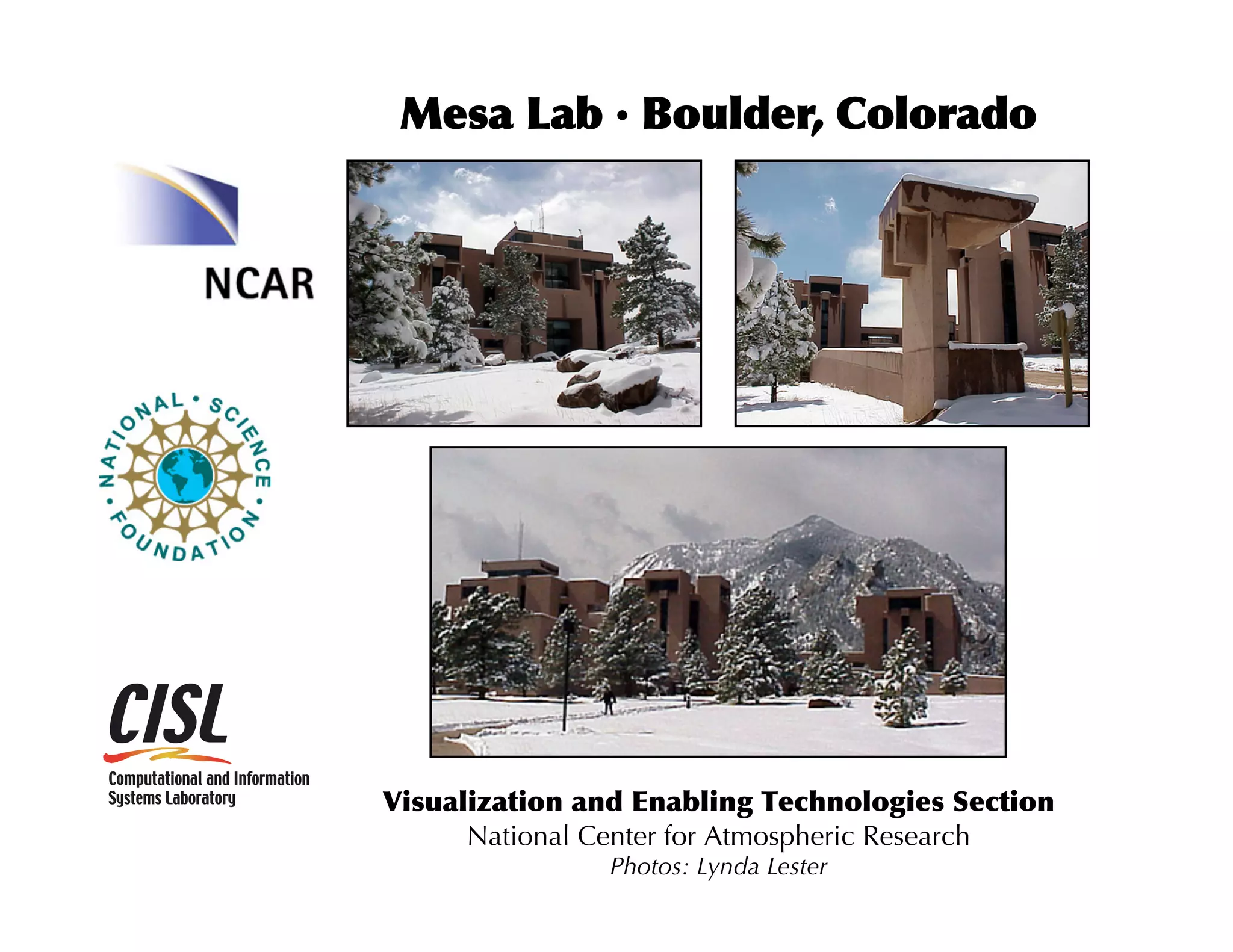
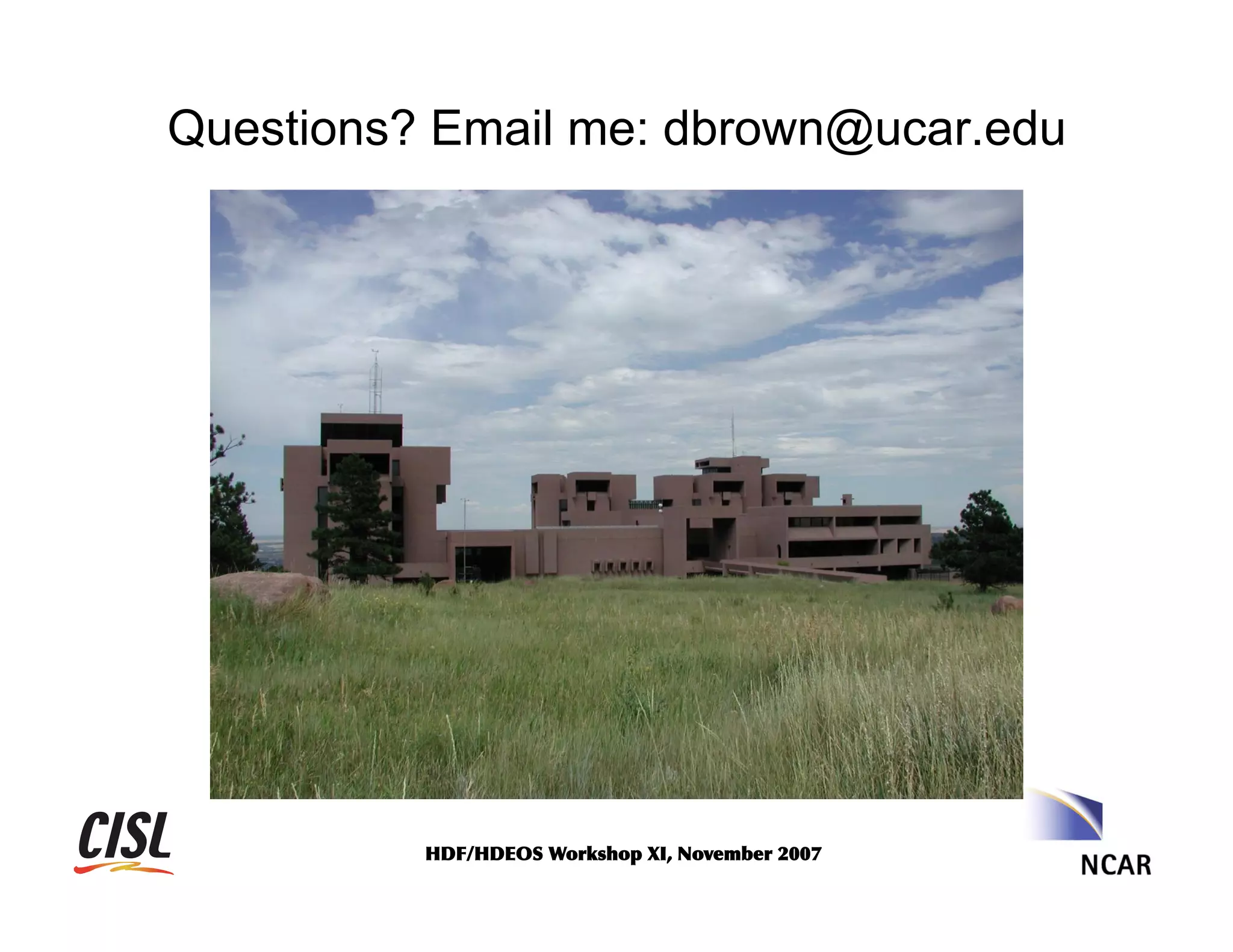
Mesa	
 Lab	
 ·	
 Boulder,	
 Colorado

Visualization	
 and	
 Enabling	
 Technologies	
 Section
National Center for Atmospheric Research
Photos: Lynda Lester
Topics
• 

• 
• 
• 
• 

Two interfaces: the same capabilities (mostly)
–  NCL - a self-contained scripting language
–  PyNGL and PyNIO - Python modules
Quick overview: visualization and analysis
Data model
State of our I/O component development
Enabling access to HDF 5, HDFEOS 5, and
NetCDF 4

HDF/HDEOS	
 Workshop	
 XI,	
 November	
 2007
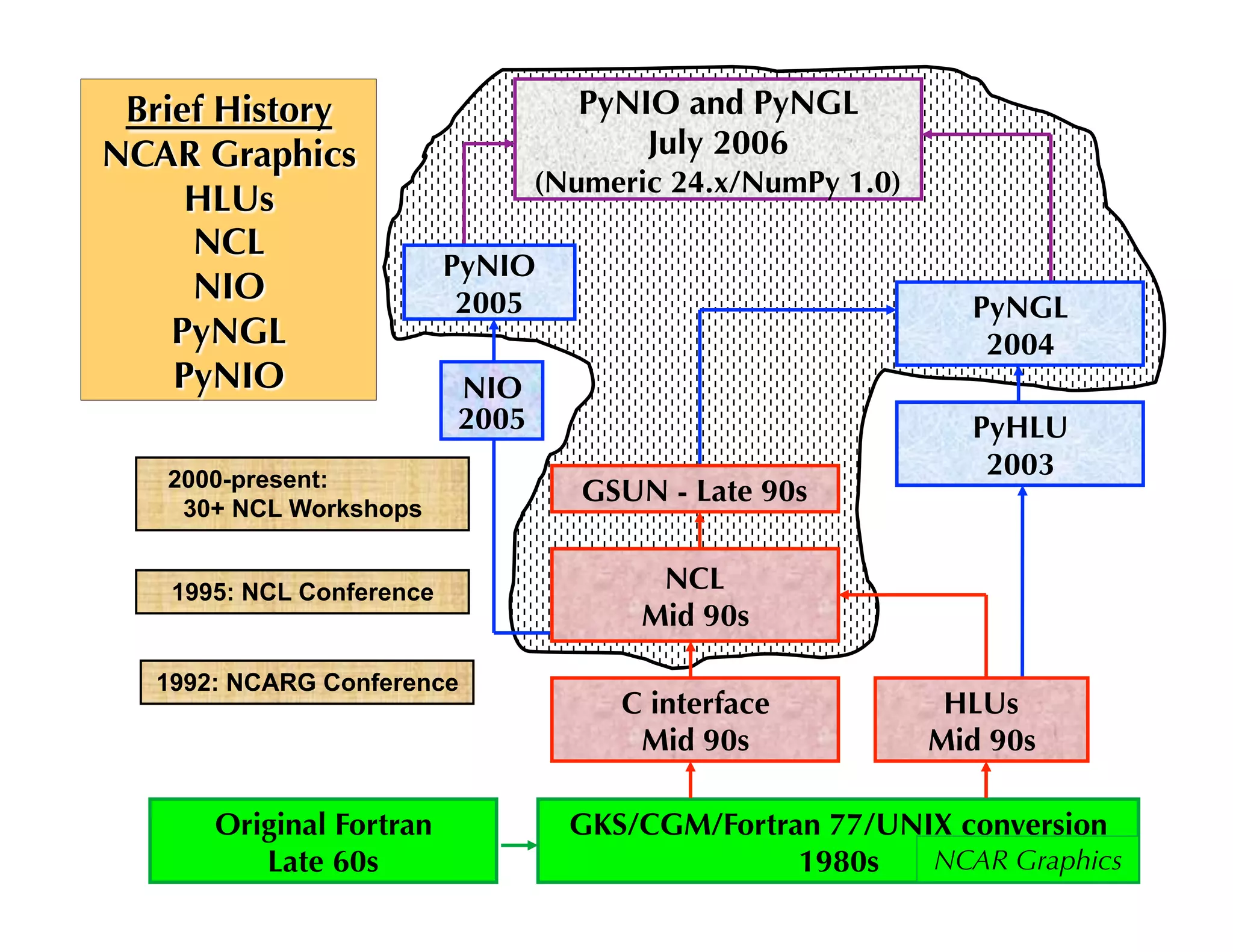
PyNIO and PyNGL
July 2006
(Numeric 24.x/NumPy 1.0)
PyNIO
2005

PyNGL
2004

NIO
2005
2000-present:
30+ NCL Workshops
1995: NCL Conference

1992: NCARG Conference

Original Fortran
Late 60s

GSUN - Late 90s

PyHLU
2003

NCL
Mid 90s
C interface
Mid 90s

HLUs
Mid 90s

GKS/CGM/Fortran 77/UNIX conversion
NCAR Graphics
1980s
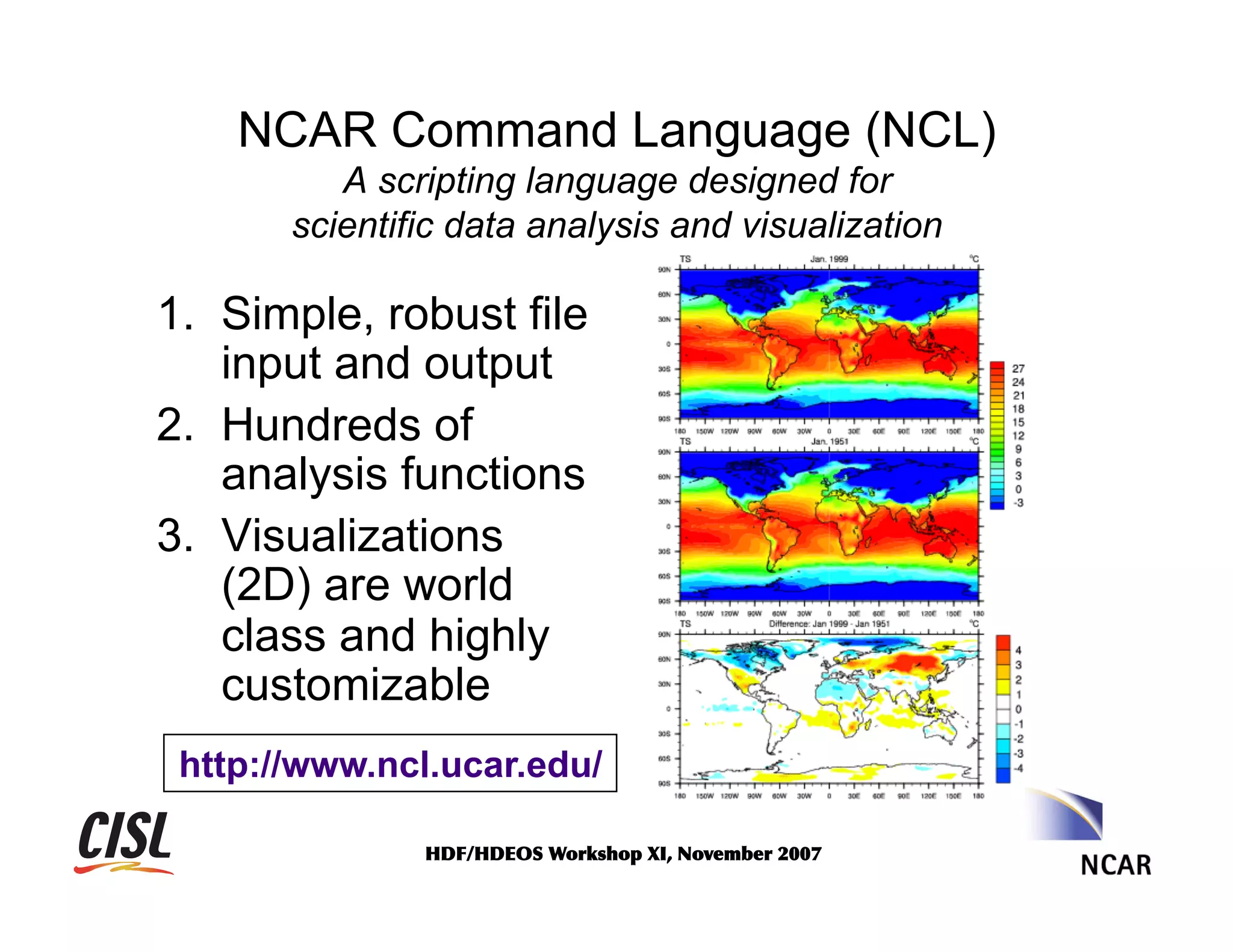
NCAR Command Language (NCL)
A scripting language designed for
scientific data analysis and visualization

1.  Simple, robust file
input and output
2.  Hundreds of
analysis functions
3.  Visualizations
(2D) are world
class and highly
customizable
http://www.ncl.ucar.edu/
HDF/HDEOS	
 Workshop	
 XI,	
 November	
 2007
NCL: Data analysis
•  Array-based syntax and operators
•  Hundreds of functions
- 
- 
- 
- 

Spherical harmonics
Scalar and vector regridding
Vertical interpolation
EOFs

•  Many tailored to geosciences
•  Most handle missing data
•  Can call C and Fortran routines
HDF/HDEOS	
 Workshop	
 XI,	
 November	
 2007
NCL: Visualization
•  High-quality and customizable visualizations
•  Contours, XY, vectors, streamlines
• 
Maps with most common map projections
•  Handles data on regular and irregular grids,
triangular meshes
•  Specialized scripts for skew-T, wind roses,
histograms, Taylor diagrams, panels, bar charts
•  GSUN interface: simplifies visualization
•  Over 1,400 visualization options available

HDF/HDEOS	
 Workshop	
 XI,	
 November	
 2007
HDF/HDEOS	
 Workshop	
 XI,	
 November	
 2007
PyNGL - Python module
• 
• 
• 
• 

Python NCL Graphics Library
Python version of popular GSUN interface
Same publication-quality graphics as NCL
Utilizes existing Python modules and
development tools (swig, Numeric, NumPy)
•  Contains some climate-specific data
analysis functions
•  Extensive and updated documentation

http://www.pyngl.ucar.edu/
HDF/HDEOS	
 Workshop	
 XI,	
 November	
 2007
NCL Data Model
•  Based on netCDF 3
•  Language variables can have:
•  Named dimensions
•  Attributes
•  Coordinates variables
•  A convention in NetCDF but a language feature in
NCL
•  1d array with the same name as a dimension
•  Contains coordinate values for dimension elements

HDF/HDEOS	
 Workshop	
 XI,	
 November	
 2007
Supported file format I/O
•  One function reads all supported data
formats:
•  NetCDF (now including NetCDF4 classic),
HDF4, HDF-EOS
2, GRIB 1 and 2
•  Writes NetCDF and HDF4

•  All file formats massaged into same
model: file variables have basically the
same features as internal variables
•  Flat name space: HDF group names are
appended to variable names
HDF/HDEOS	
 Workshop	
 XI,	
 November	
 2007
PyNIO - Python module
• 
• 
• 
• 
• 

Same I/O library as NCL (libnio)
Reads and writes same formats as NCL
Same NetCDF-like view of all formats
But interfaces with NumPy for data access
Modeled on the Scientific NetCDF module
–  NioVariable type is a reference to the variable in
the file (metadata is attached to variable)
–  Dereferencing it results in a NumPy variable with
no metadata

•  *Numpy is a Python array processing module

http://www.pyngl.ucar.edu/Nio.shtml
HDF/HDEOS	
 Workshop	
 XI,	
 November	
 2007
2D Coordinates
•  Traditional NetCDF coordinate variables are
1D vectors
•  However, satellite data and model data on
modern grids require 2D coordinate grids
•  2D coordinate variables created on the fly for
GRIB grids and HDFEOS Grid-type data
•  Added value variables that allow data to be
plotted on any map projection

HDF/HDEOS	
 Workshop	
 XI,	
 November	
 2007
Enabling NetCDF 4 ‘classic’
•  Recompile with NetCDF 4 and HDF 5 1.8
beta (we also included szip)
•  Add options for specifying format and
compression level
•  Tests using ncl_convert2nc on GRIB files
show reduction in file size by ~1/2 over GRIB.
•  Caveats:
–  Beta version NetCDF 4 not yet supported on some
architectures (64 bit mainly)
–  Not supported for OPeNDAP NetCDF client library
HDF/HDEOS	
 Workshop	
 XI,	
 November	
 2007
Path to HDF, HDFEOS 5 and
full NetCDF 4 support
•  size_t for dimension sizes to enable large
variables on 64-bit hosts
•  Add support for more atomic types (int64)
•  Support for groups in the file context
•  User control of chunking
•  Compound and variable length data types
•  Components to read HDF 5 and HDFEOS 5
•  Current NetCDF module extended to handle v4
•  More support for aggregation
HDF/HDEOS	
 Workshop	
 XI,	
 November	
 2007
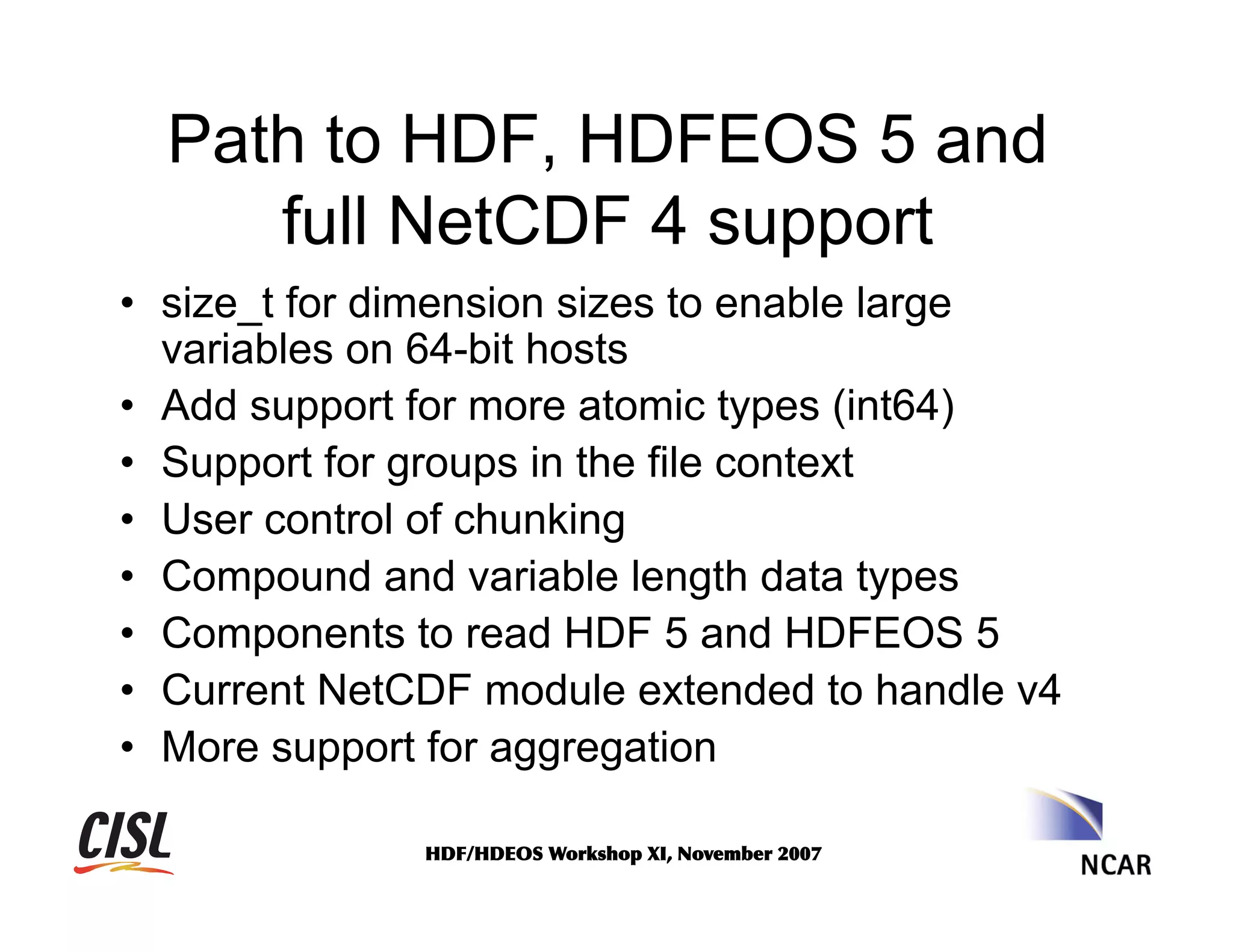
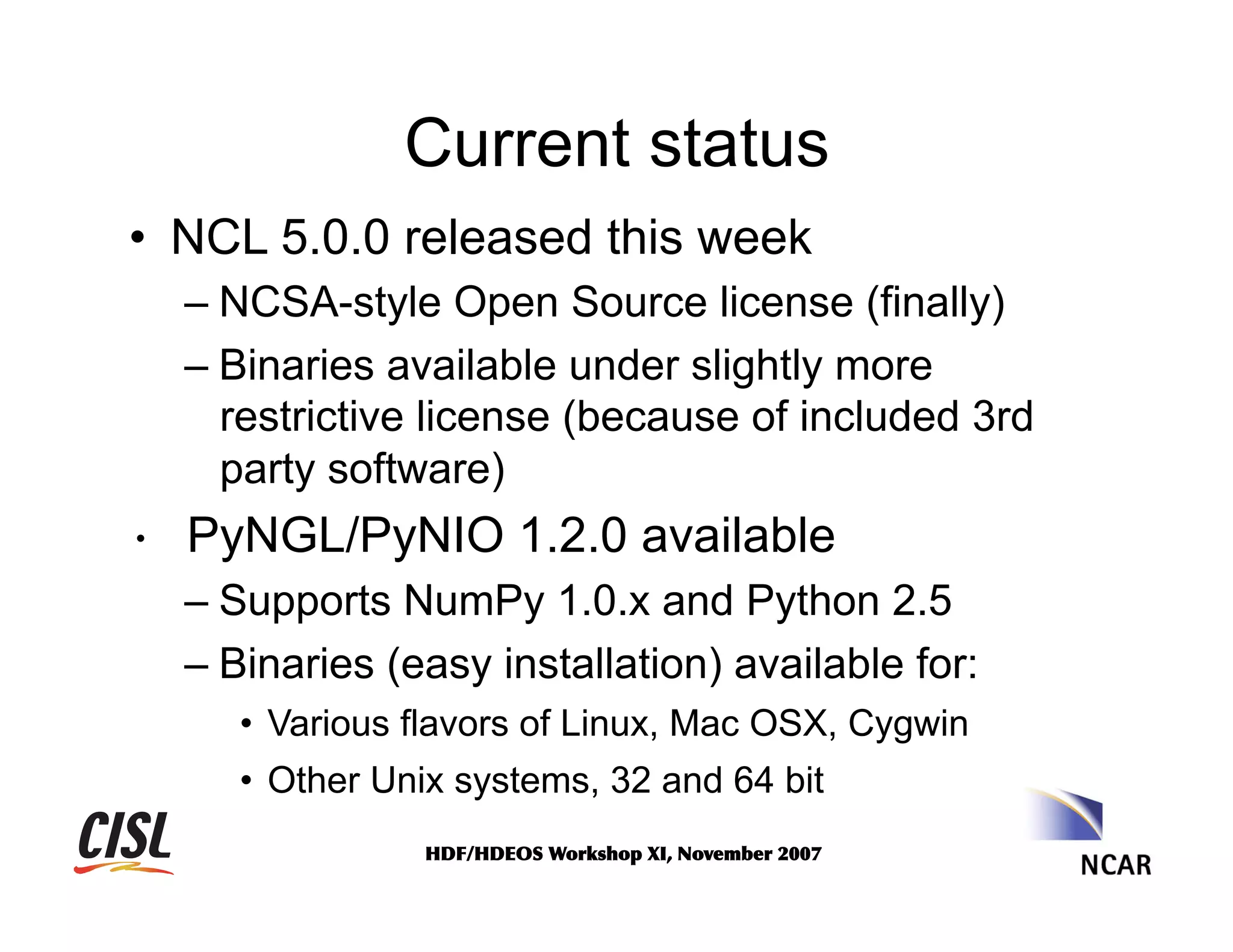
Current status
•  NCL 5.0.0 released this week
–  NCSA-style Open Source license (finally)
–  Binaries available under slightly more
restrictive license (because of included 3rd
party software)

•  PyNGL/PyNIO 1.2.0 available
–  Supports NumPy 1.0.x and Python 2.5
–  Binaries (easy installation) available for:
•  Various flavors of Linux, Mac OSX, Cygwin
•  Other Unix systems, 32 and 64 bit
HDF/HDEOS	
 Workshop	
 XI,	
 November	
 2007
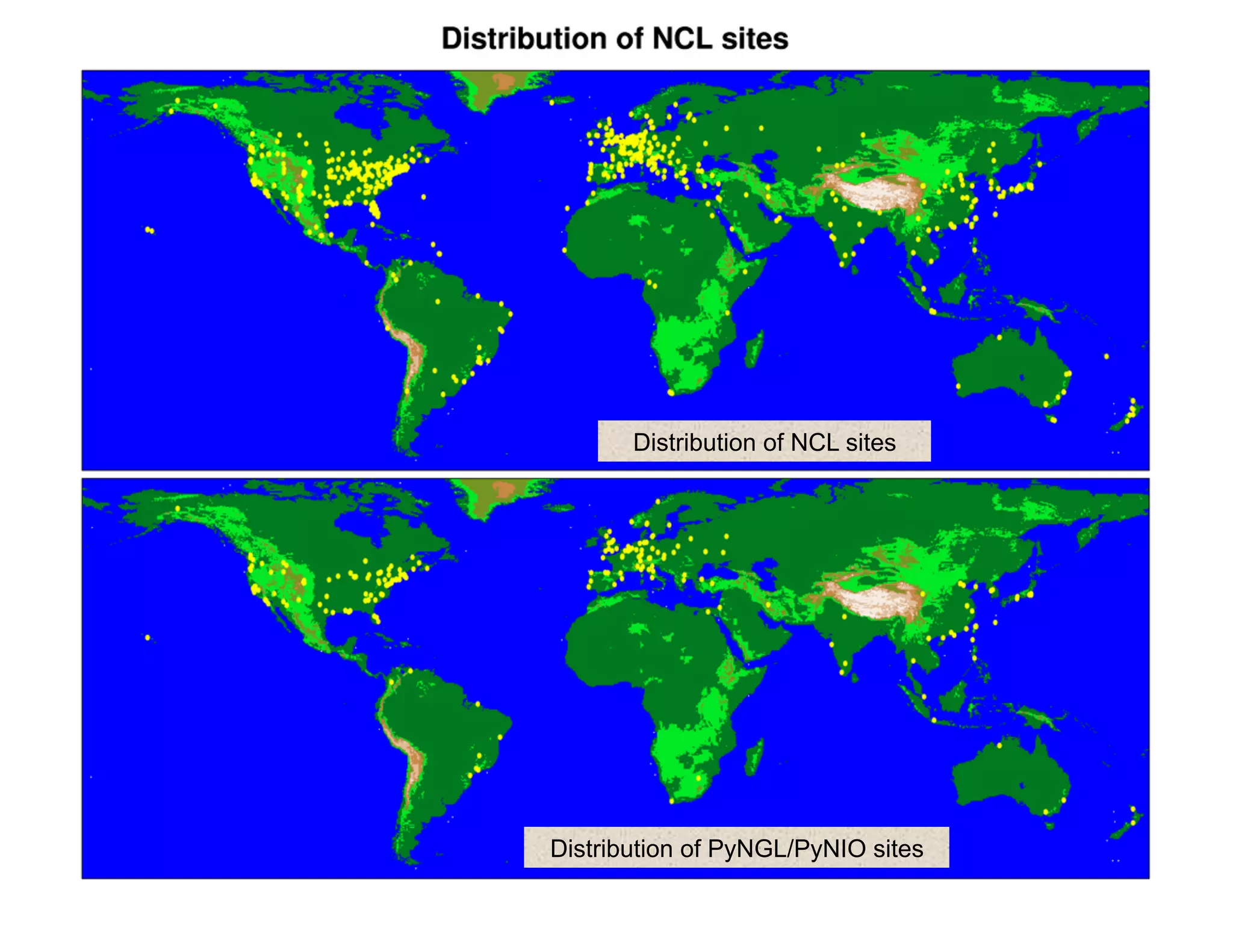
Distribution of NCL sites

Distribution of PyNGL/PyNIO sites
Support
•  Websites with extensive documentation
•  Tutorials
•  Hundreds of examples with
downloadable scripts
•  Active email lists
–  ncl-talk@ucar.edu, pyngl-talk@ucar.edu

•  Hands-on training workshops
HDF/HDEOS	
 Workshop	
 XI,	
 November	
 2007
Download locations
•  NCL
http://www.ncl.ucar.edu/download.html

•  PyNGL and PyNIO
http://www.pyngl.ucar.edu/download.html

HDF/HDEOS	
 Workshop	
 XI,	
 November	
 2007
Questions? Email me: dbrown@ucar.edu

HDF/HDEOS	
 Workshop	
 XI,	
 November	
 2007
education

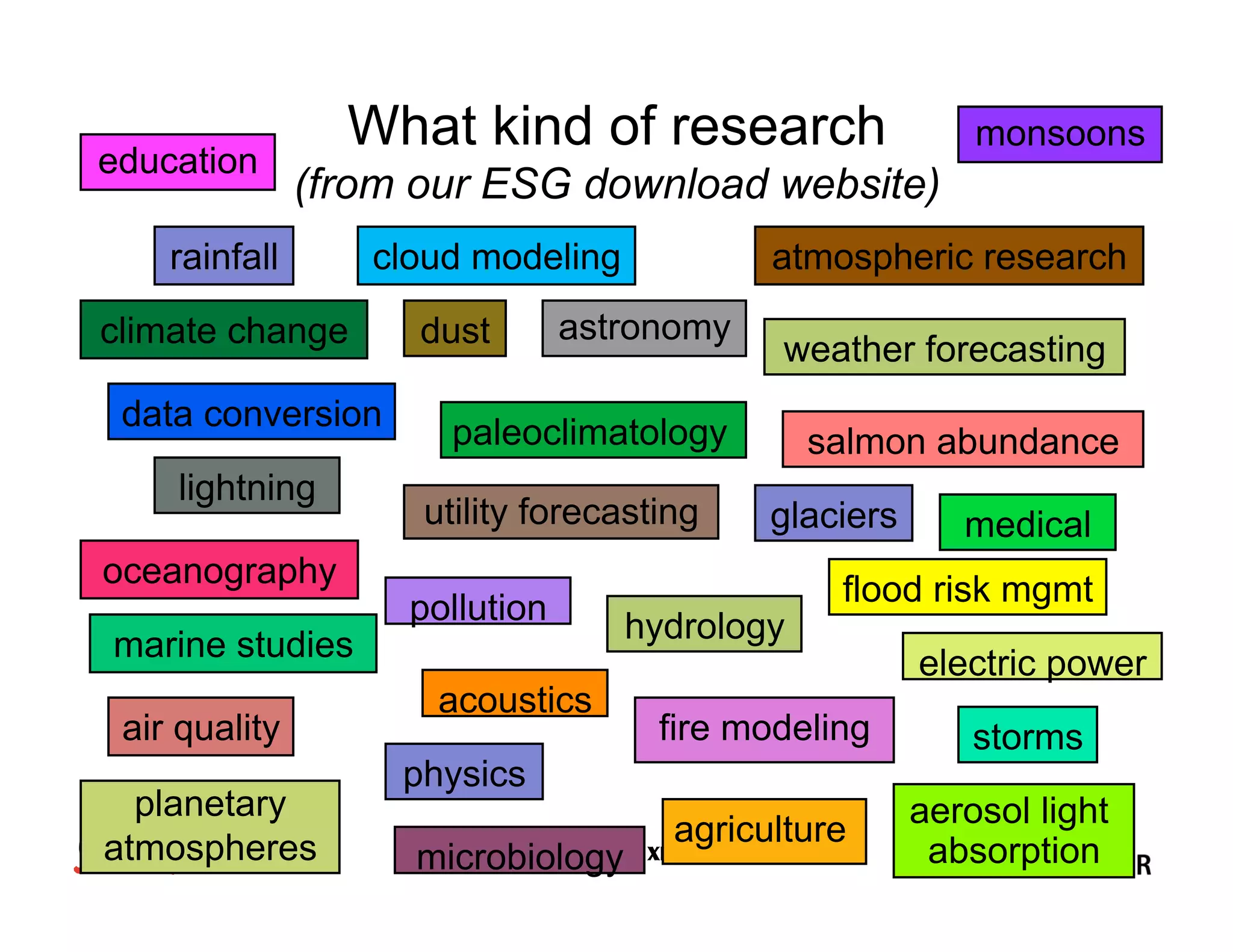
What kind of research

monsoons

(from our ESG download website)

rainfall

cloud modeling

climate change
data conversion
lightning
oceanography
marine studies
air quality
planetary
atmospheres

dust

atmospheric research

astronomy

weather forecasting

paleoclimatology
utility forecasting
pollution
acoustics

salmon abundance
glaciers

hydrology

medical

flood risk mgmt

fire modeling

physics
agriculture
HDF/HDEOS	
 Workshop	
 XI,	
 November	
 2007	
 
microbiology

electric power
storms
aerosol light
absorption
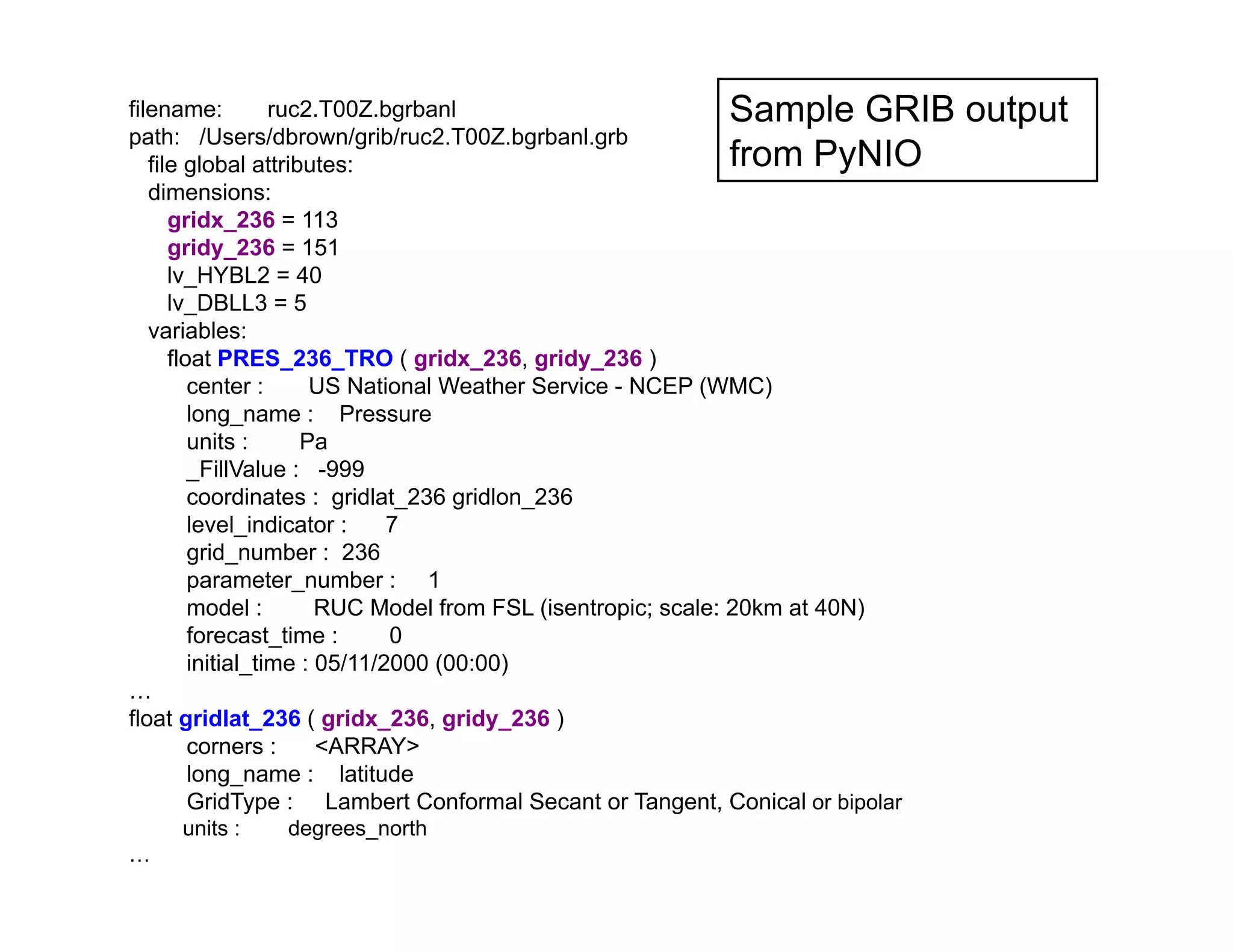
Sample GRIB output
from PyNIO

filename:
ruc2.T00Z.bgrbanl
path: /Users/dbrown/grib/ruc2.T00Z.bgrbanl.grb
file global attributes:
dimensions:
gridx_236 = 113
gridy_236 = 151
lv_HYBL2 = 40
lv_DBLL3 = 5
variables:
float PRES_236_TRO ( gridx_236, gridy_236 )
center :
US National Weather Service - NCEP (WMC)
long_name : Pressure
units :
Pa
_FillValue : -999
coordinates : gridlat_236 gridlon_236
level_indicator :
7
grid_number : 236
parameter_number : 1
model :
RUC Model from FSL (isentropic; scale: 20km at 40N)
forecast_time :
0
initial_time : 05/11/2000 (00:00)
…
float gridlat_236 ( gridx_236, gridy_236 )
corners :
ARRAY
long_name : latitude
GridType : Lambert Conformal Secant or Tangent, Conical or bipolar


…

units :

degrees_north
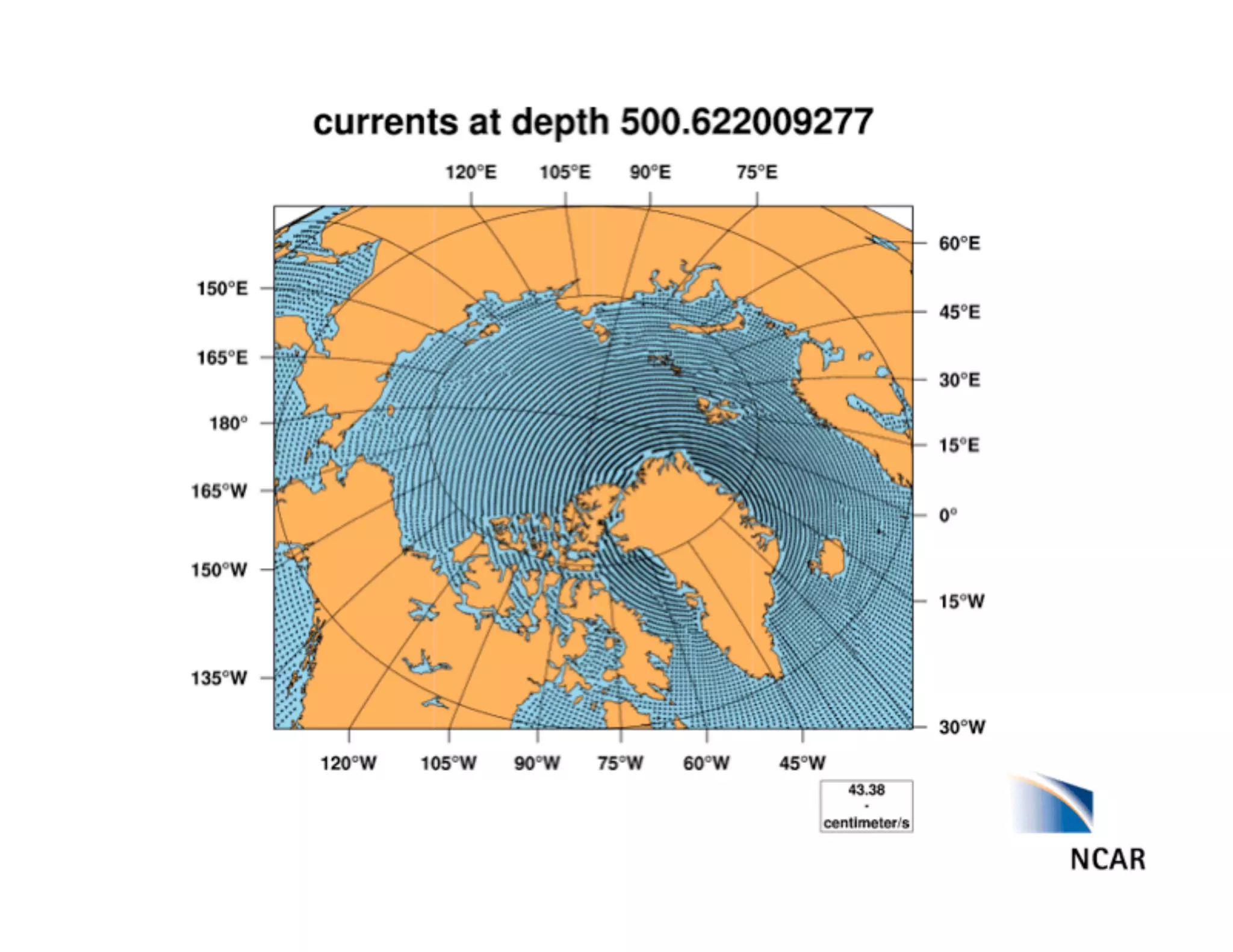
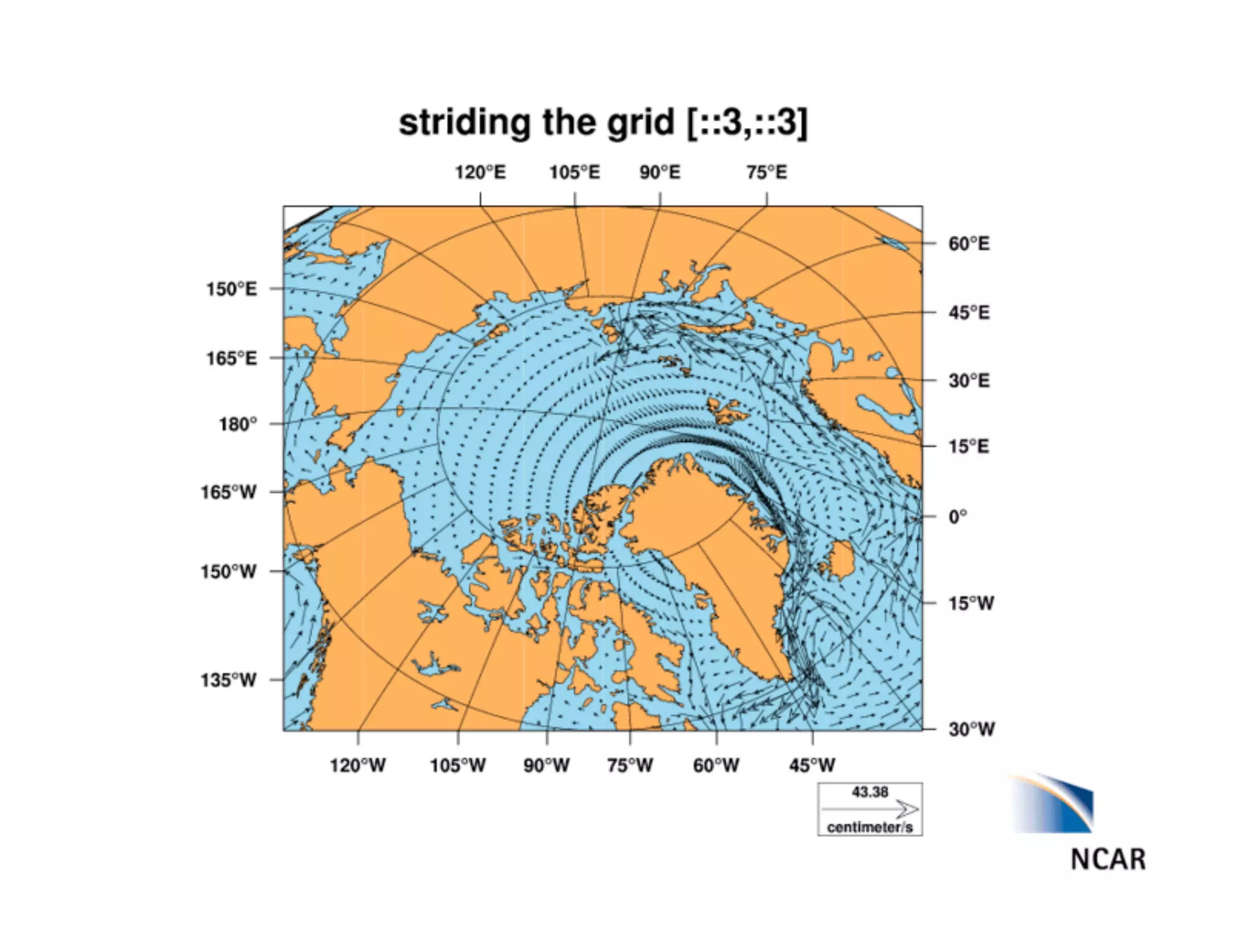
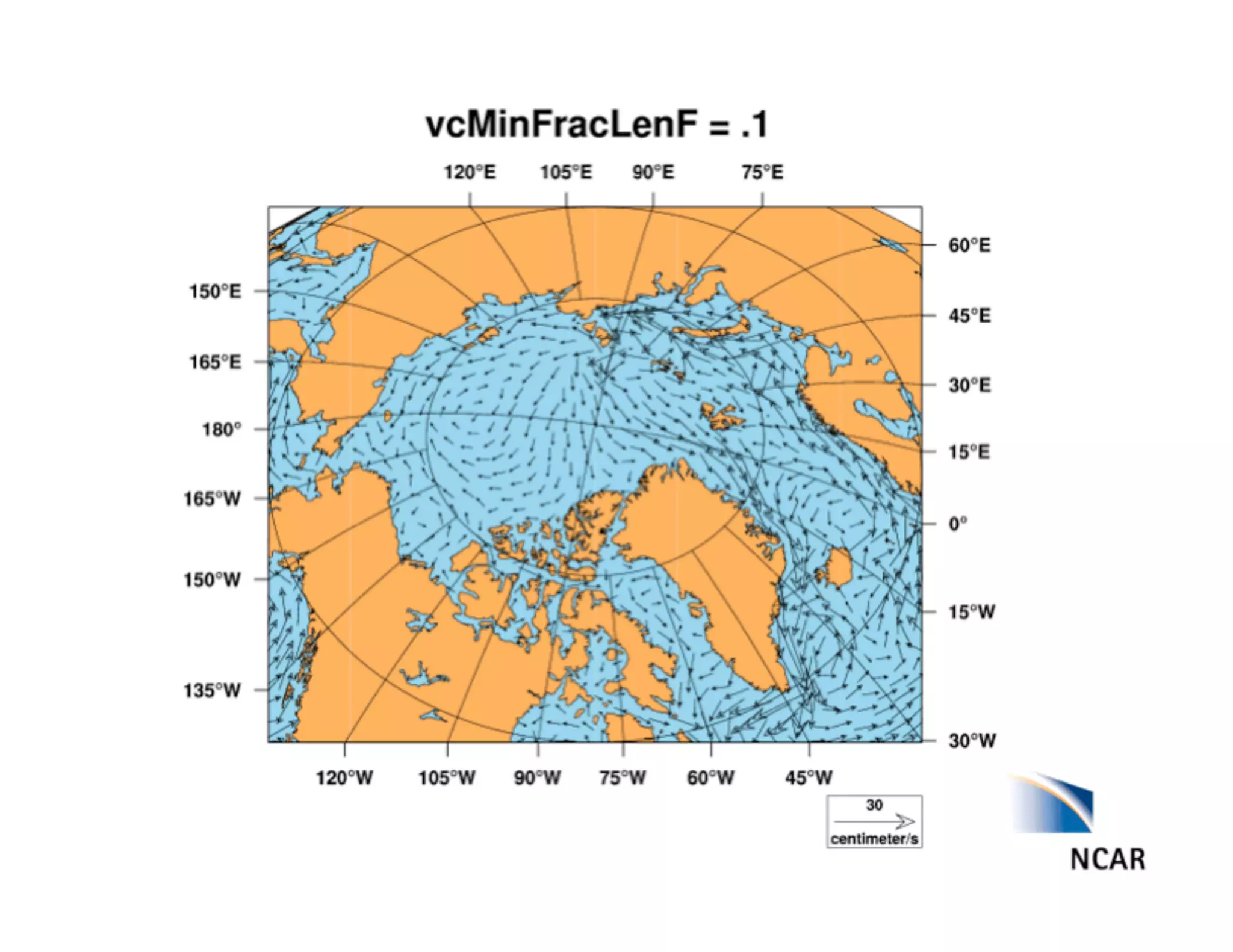
Resources (a.k.a. attributes)
•  Same control mechanism for NCL and
PyNGL
•  Detailed control of the appearance of a
visualization
•  Example using POP grid ocean current
data

HDF/HDEOS	
 Workshop	
 XI,	
 November	
 2007
HDF/HDEOS	
 Workshop	
 XI,	
 November	
 2007
HDF/HDEOS	
 Workshop	
 XI,	
 November	
 2007
HDF/HDEOS	
 Workshop	
 XI,	
 November	
 2007
HDF/HDEOS	
 Workshop	
 XI,	
 November	
 2007
HDF/HDEOS	
 Workshop	
 XI,	
 November	
 2007
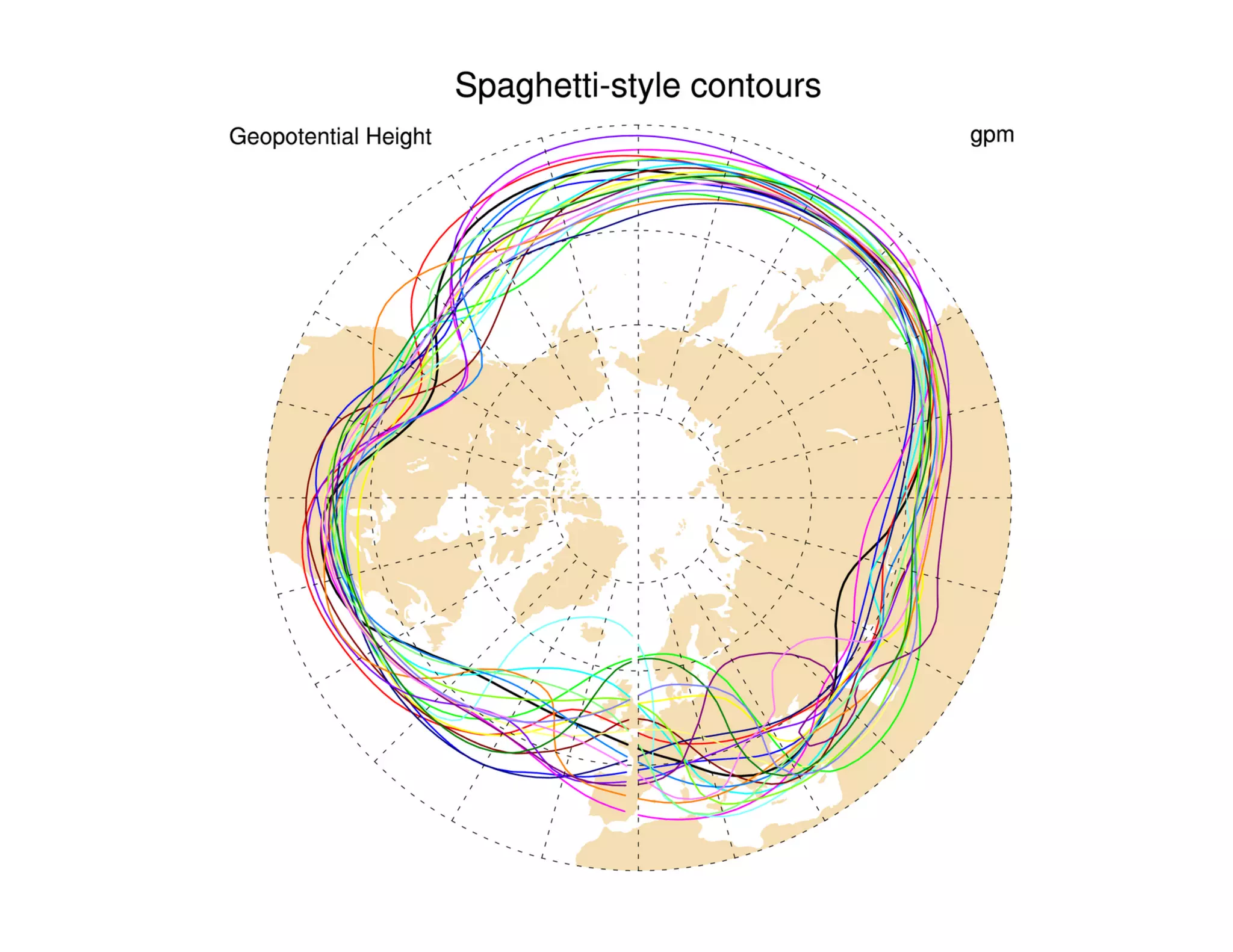
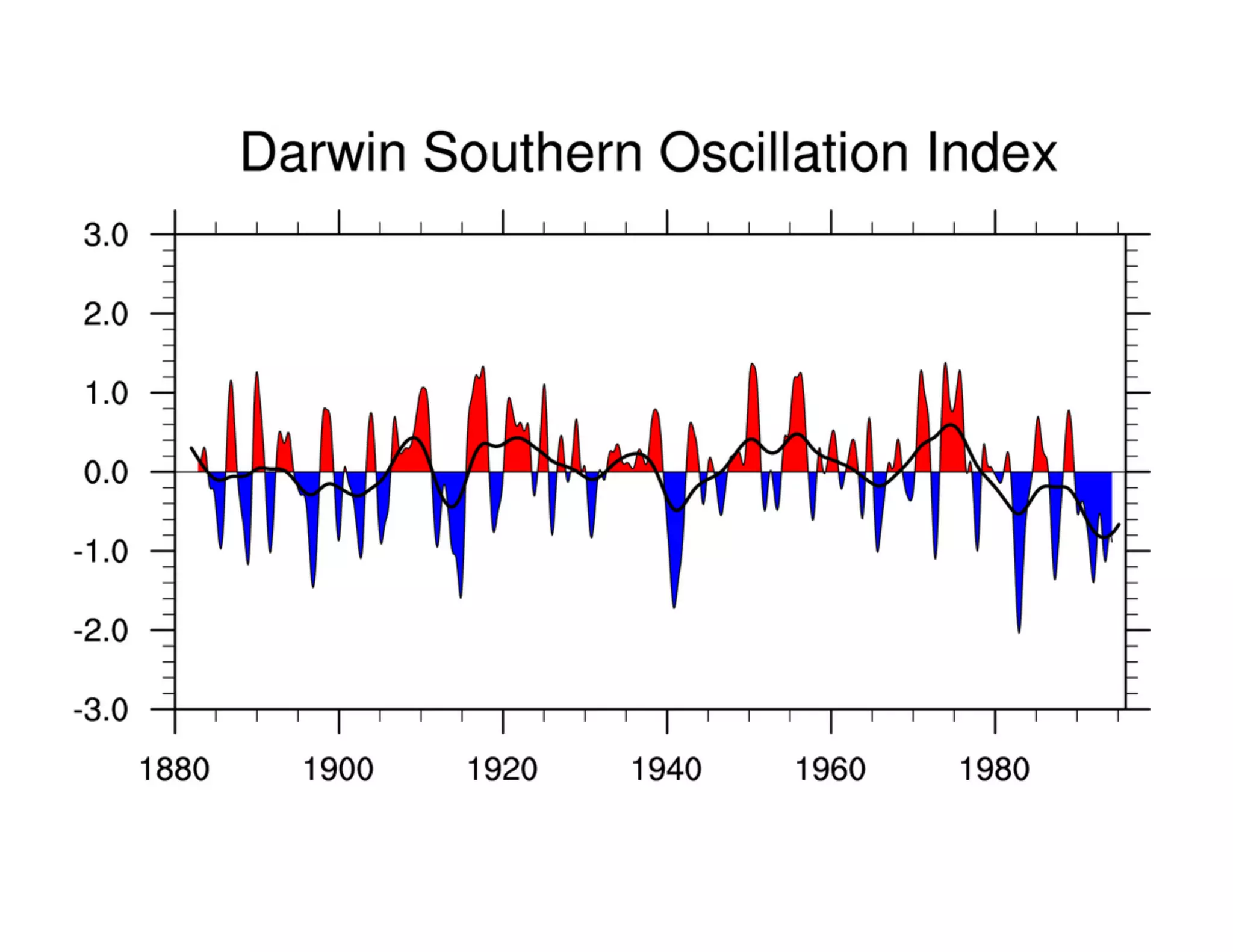
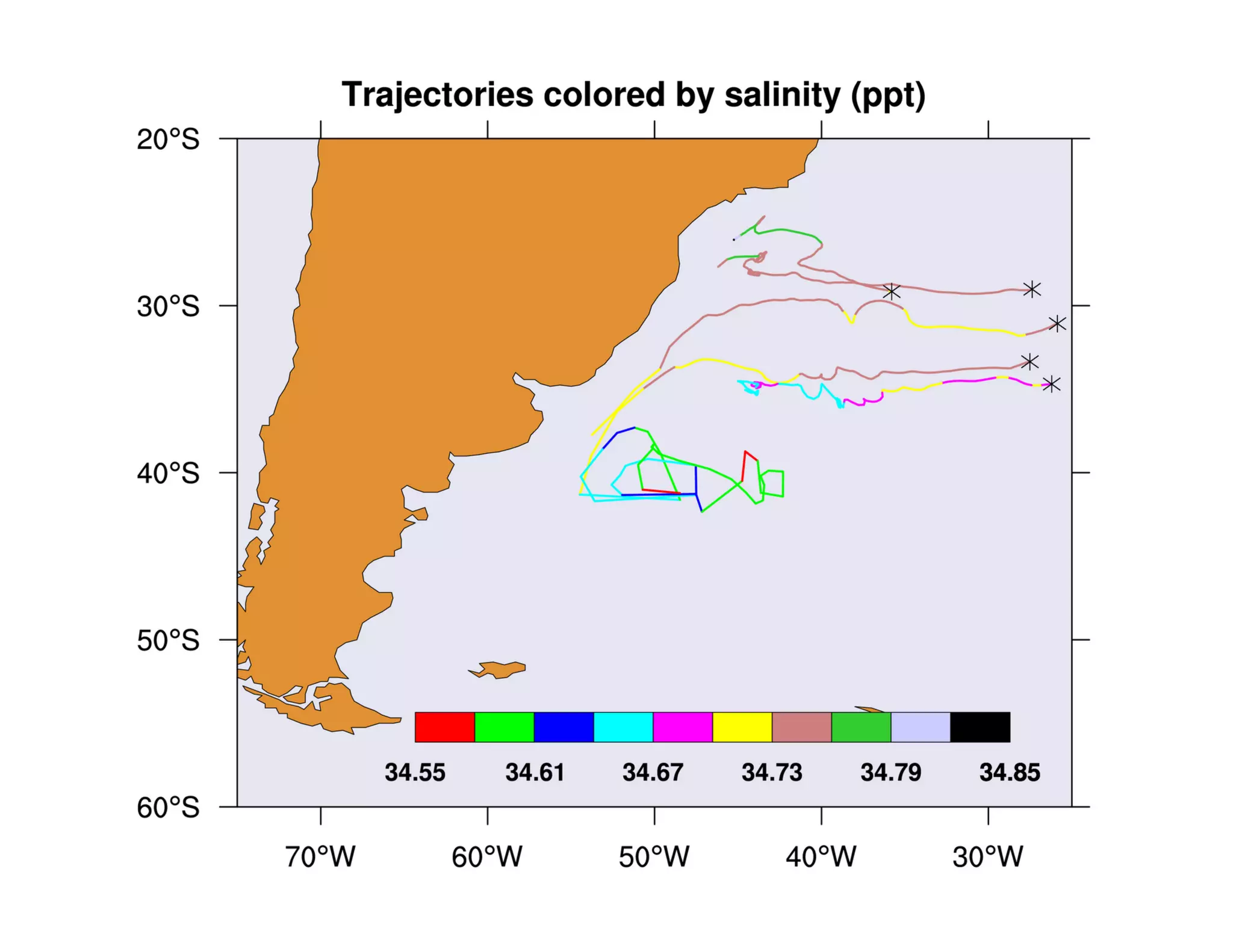
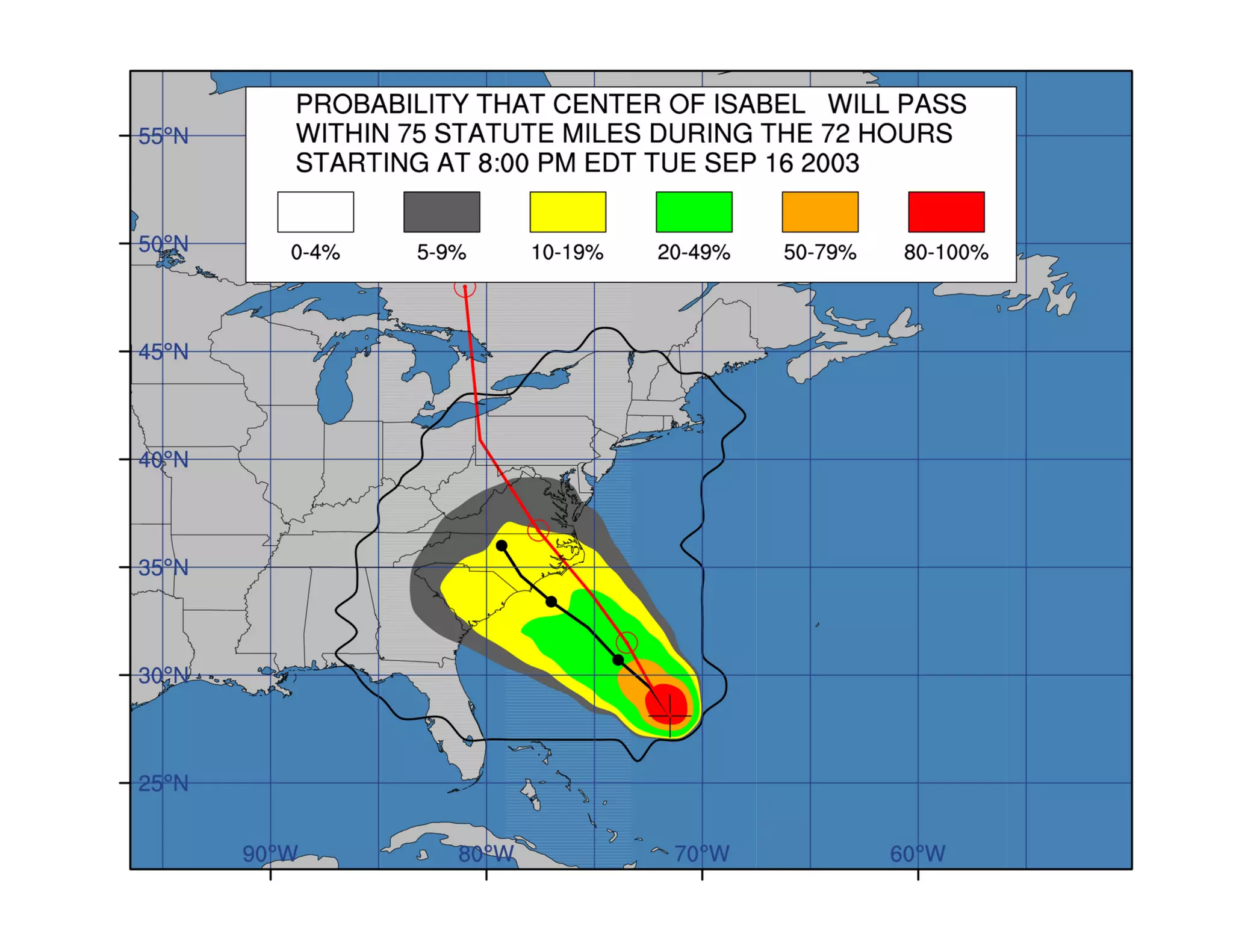
NCL and PyNGL visualization
examples
•  scatter and line plots, contours, vectors,
skew-t, meteograms, maps, wind barbs,
bar charts, streamlines, trajectories,
filled polygons, paneled visualizations

HDF/HDEOS	
 Workshop	
 XI,	
 November	
 2007
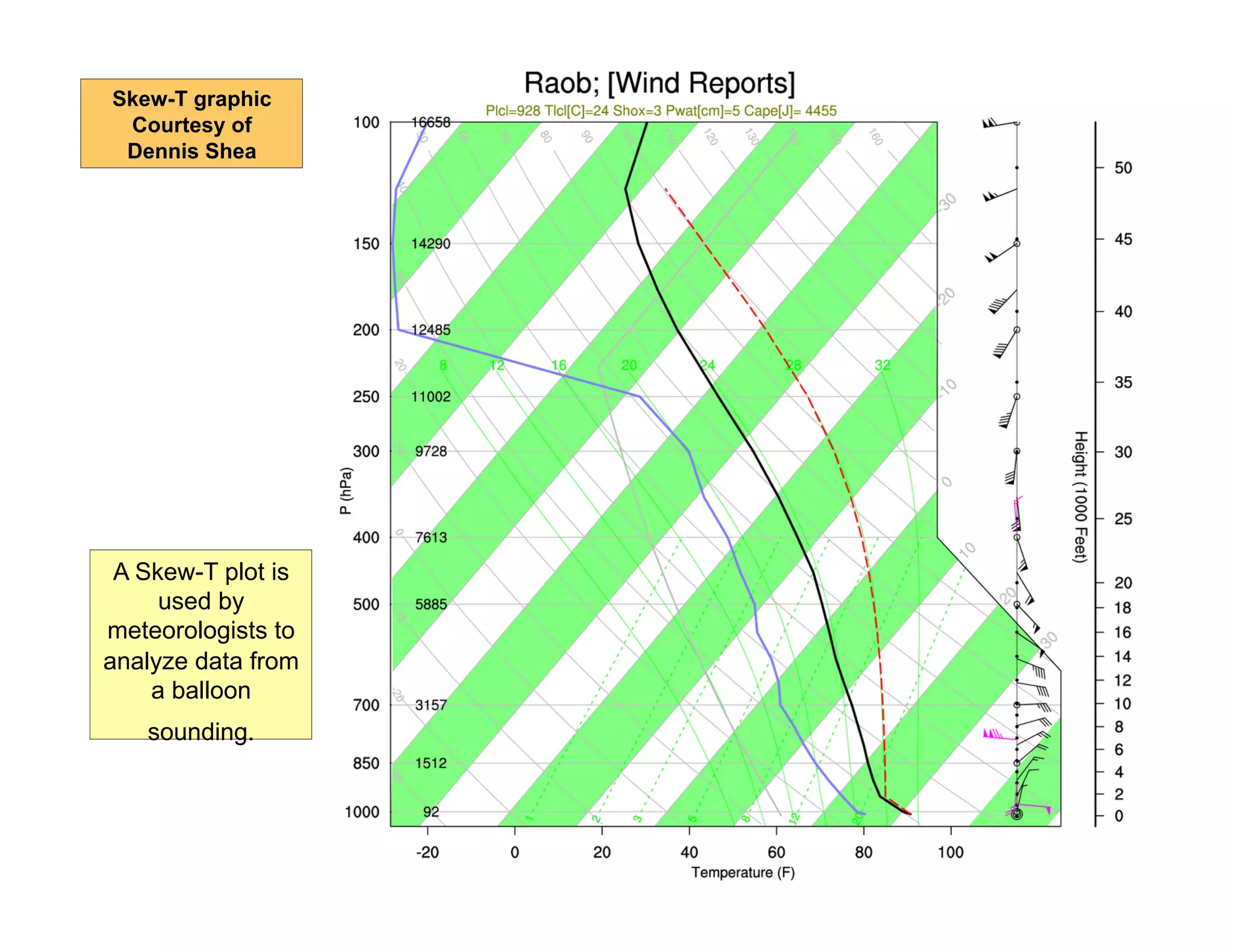
Skew-T graphic
Courtesy of
Dennis Shea

A Skew-T plot is
used by
meteorologists to
analyze data from
a balloon
sounding.
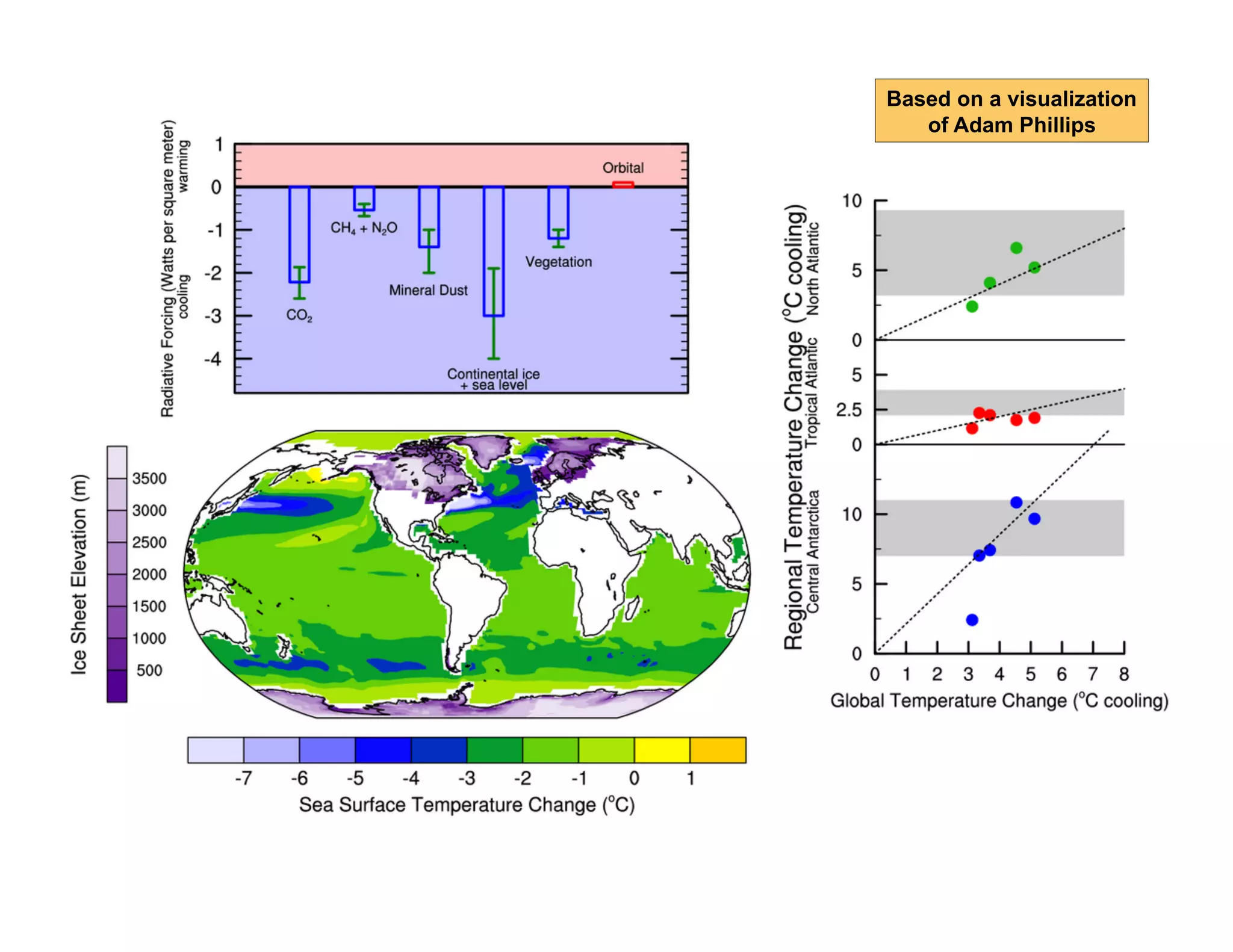
Based on a visualization
of Adam Phillips
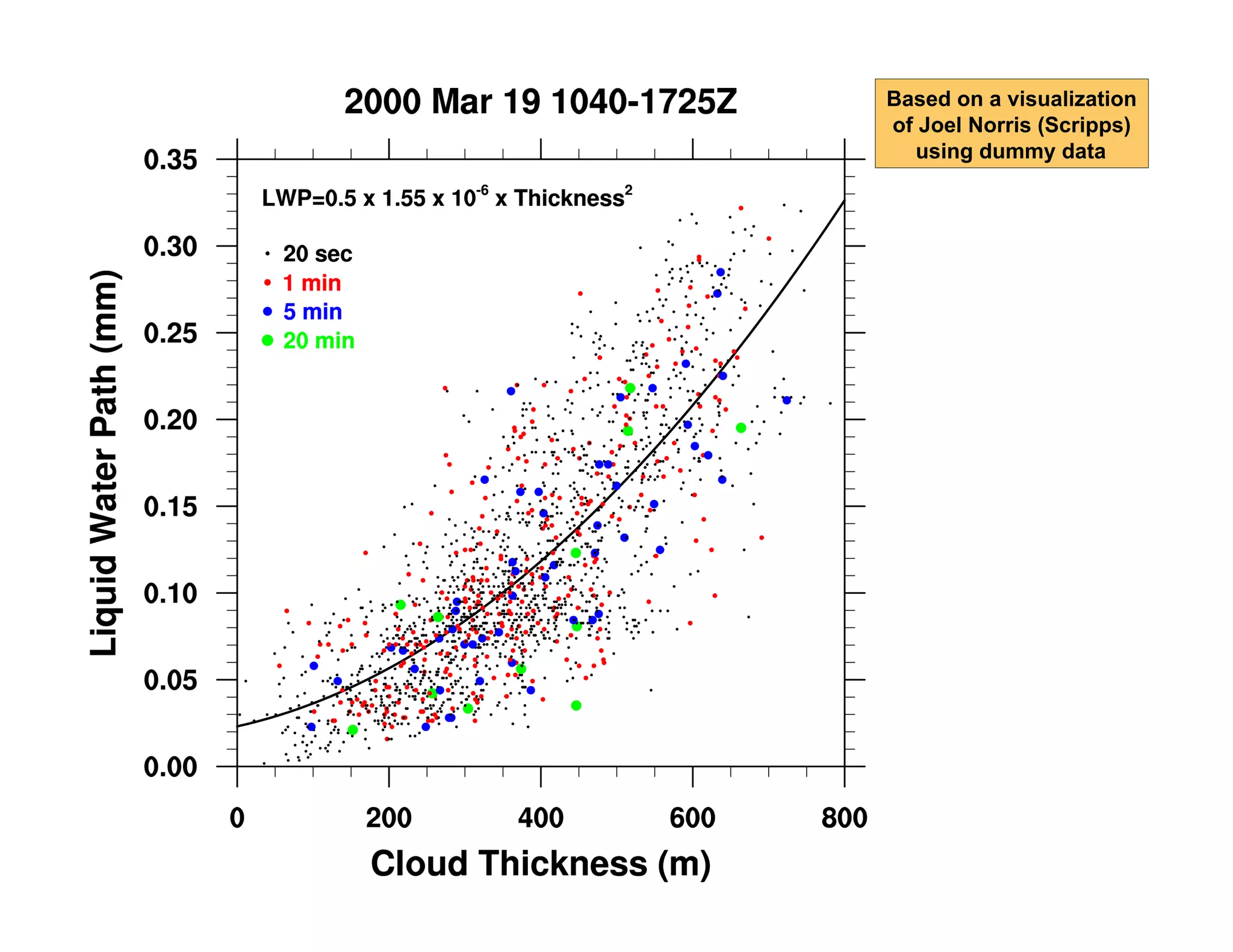
Based on a visualization
of Joel Norris (Scripps)
using dummy data
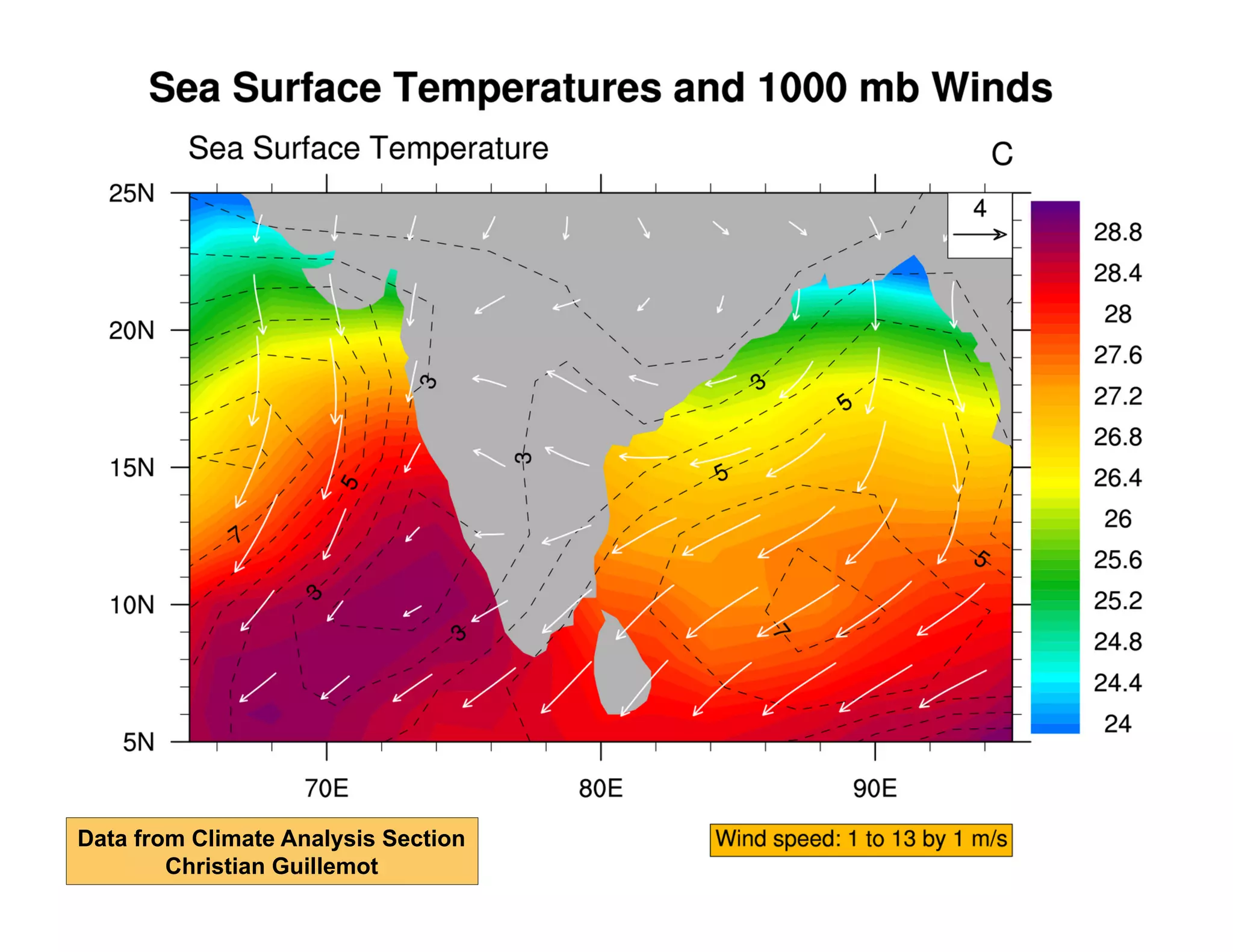
Data from Climate Analysis Section
Christian Guillemot
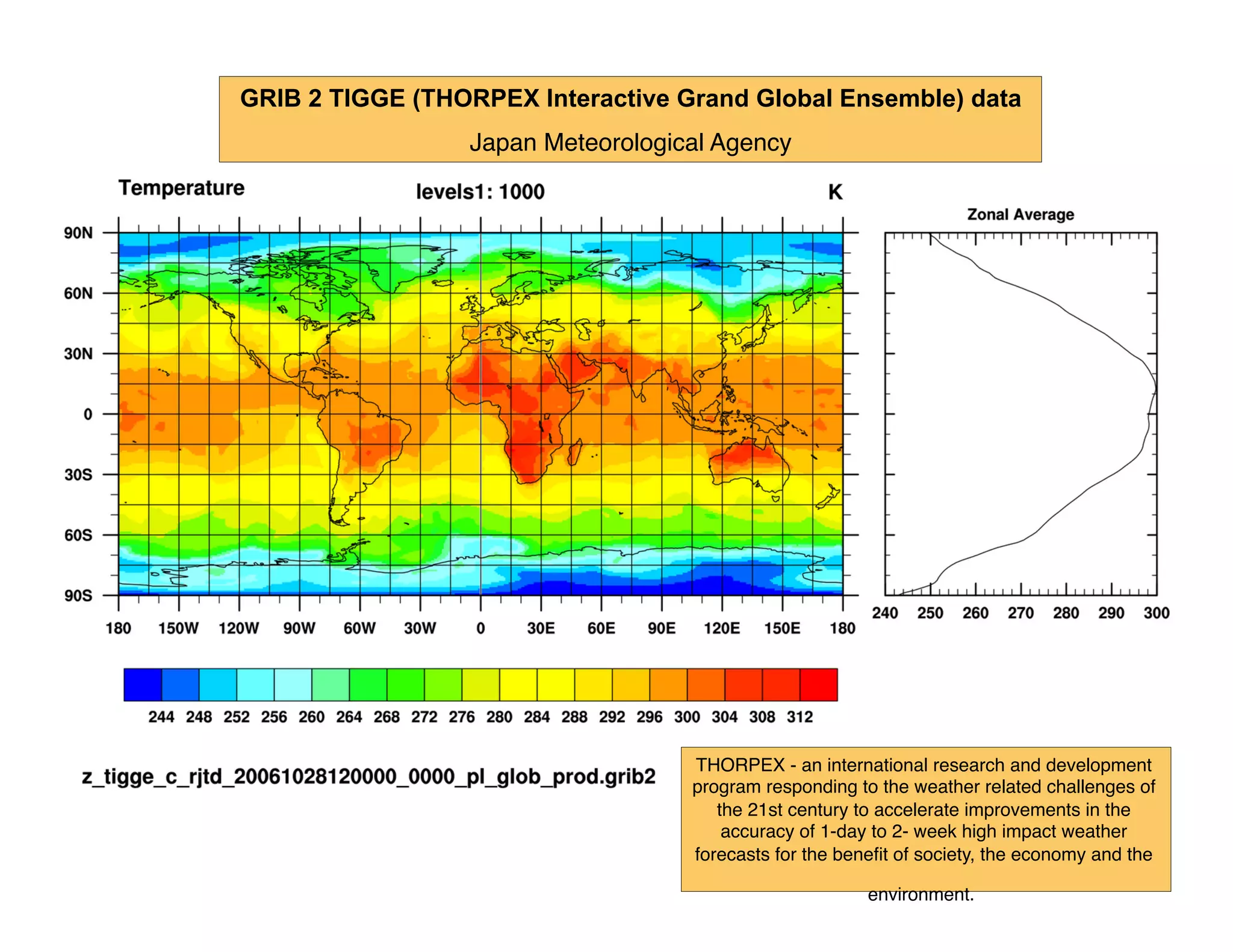
GRIB 2 TIGGE (THORPEX Interactive Grand Global Ensemble) data
Japan Meteorological Agency
!

THORPEX - an international research and development
program responding to the weather related challenges of
the 21st century to accelerate improvements in the
accuracy of 1-day to 2- week high impact weather
forecasts for the benefit of society, the economy and the

!

environment.
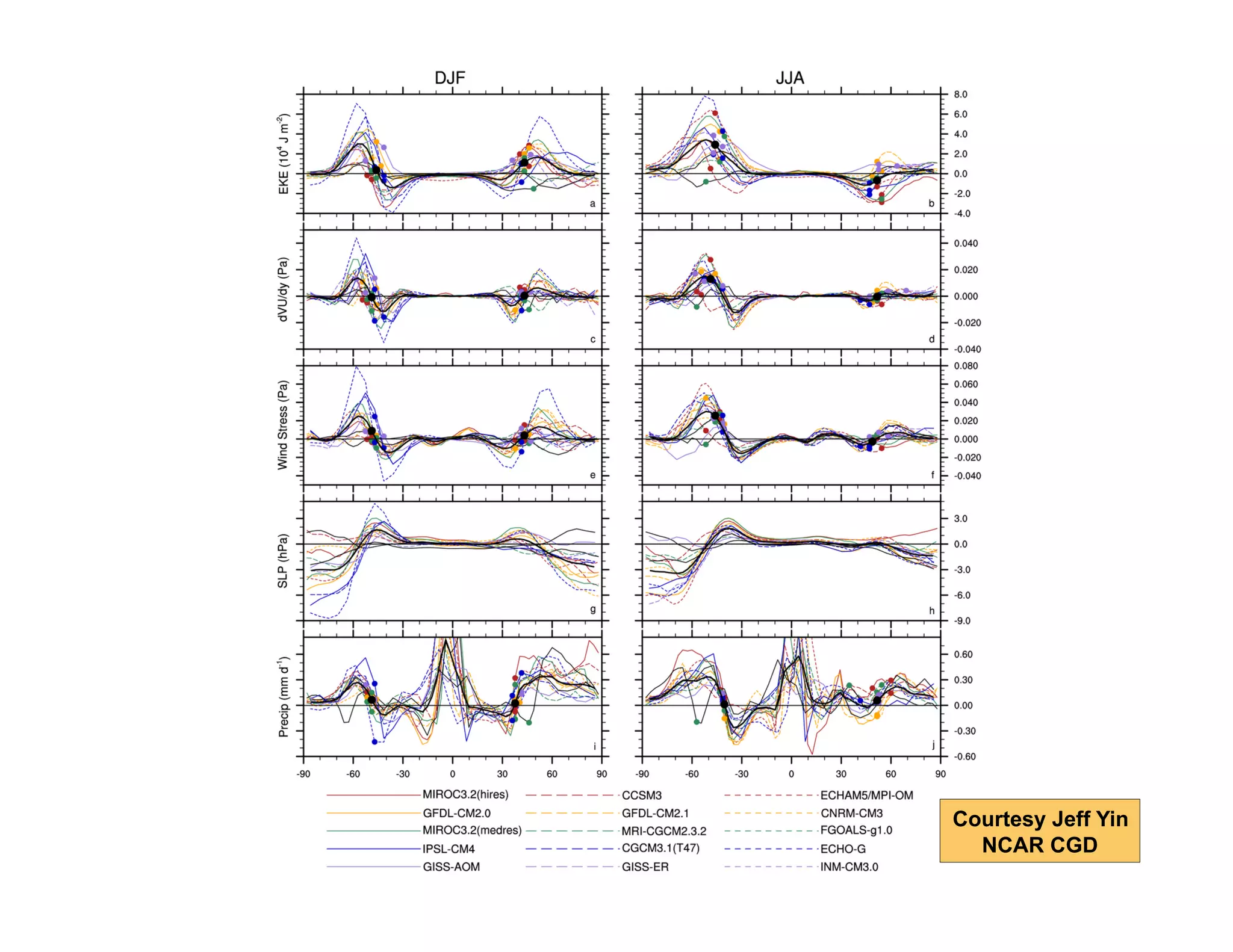
Courtesy Jeff Yin
NCAR CGD
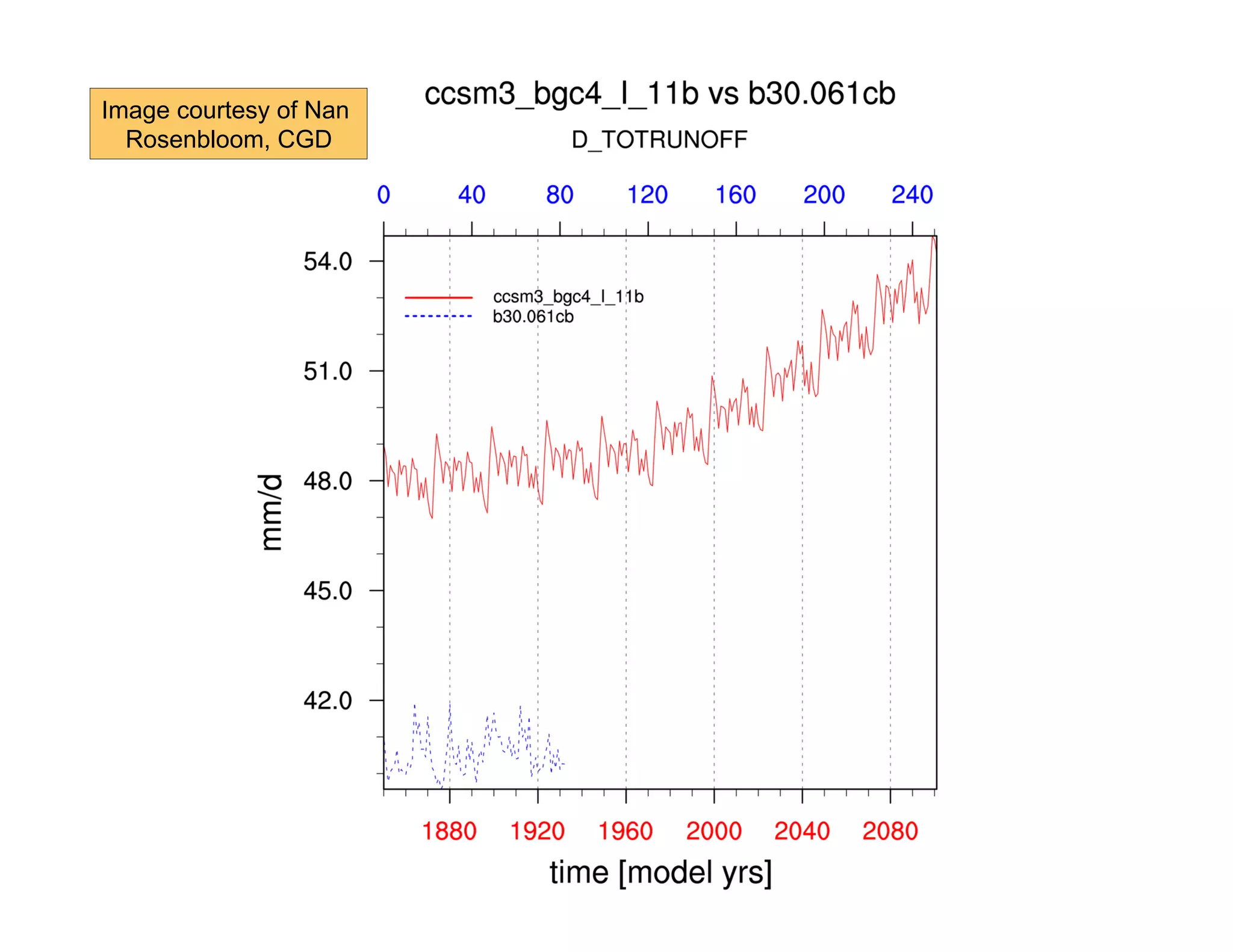
Image courtesy of Nan
Rosenbloom, CGD
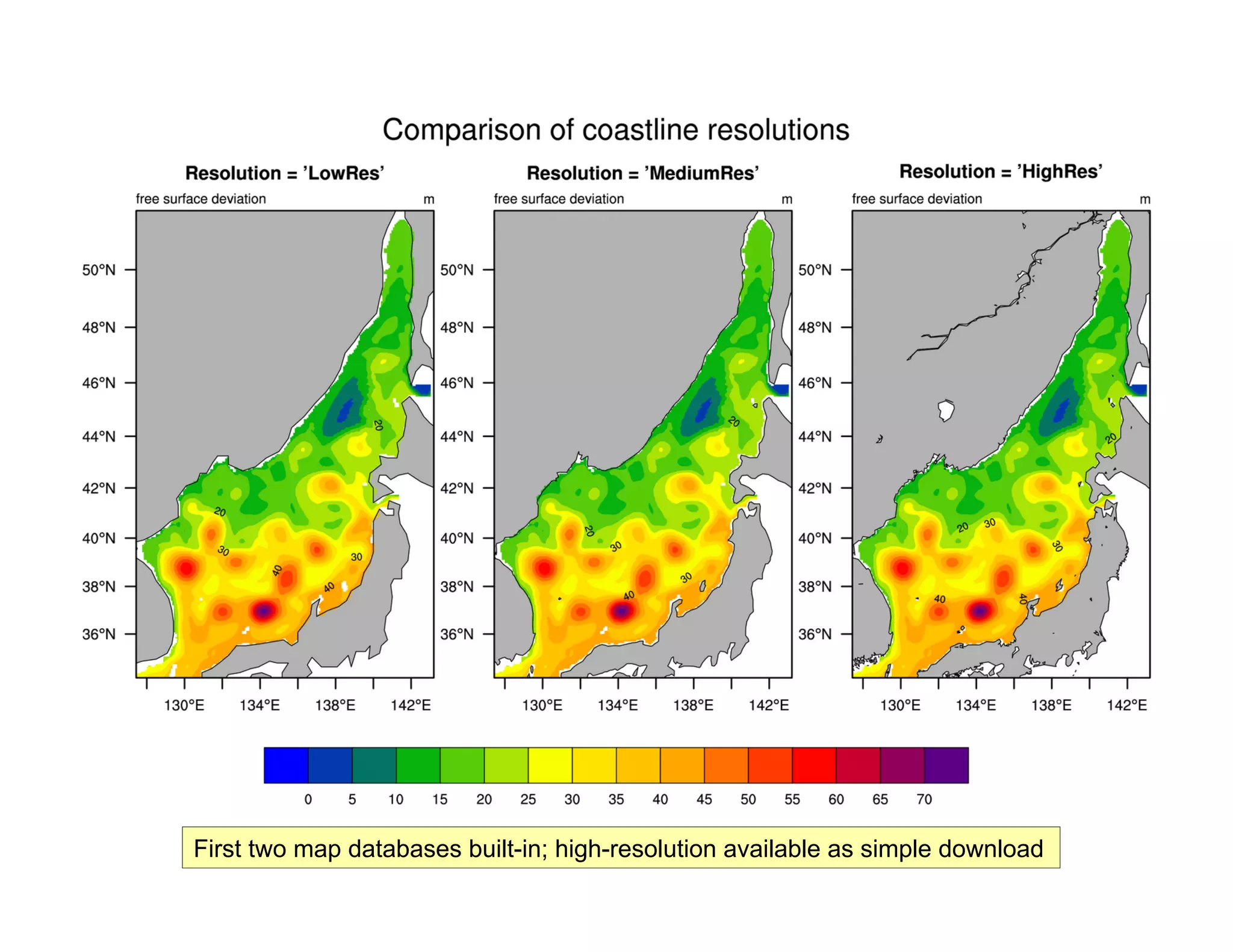
First two map databases built-in; high-resolution available as simple download
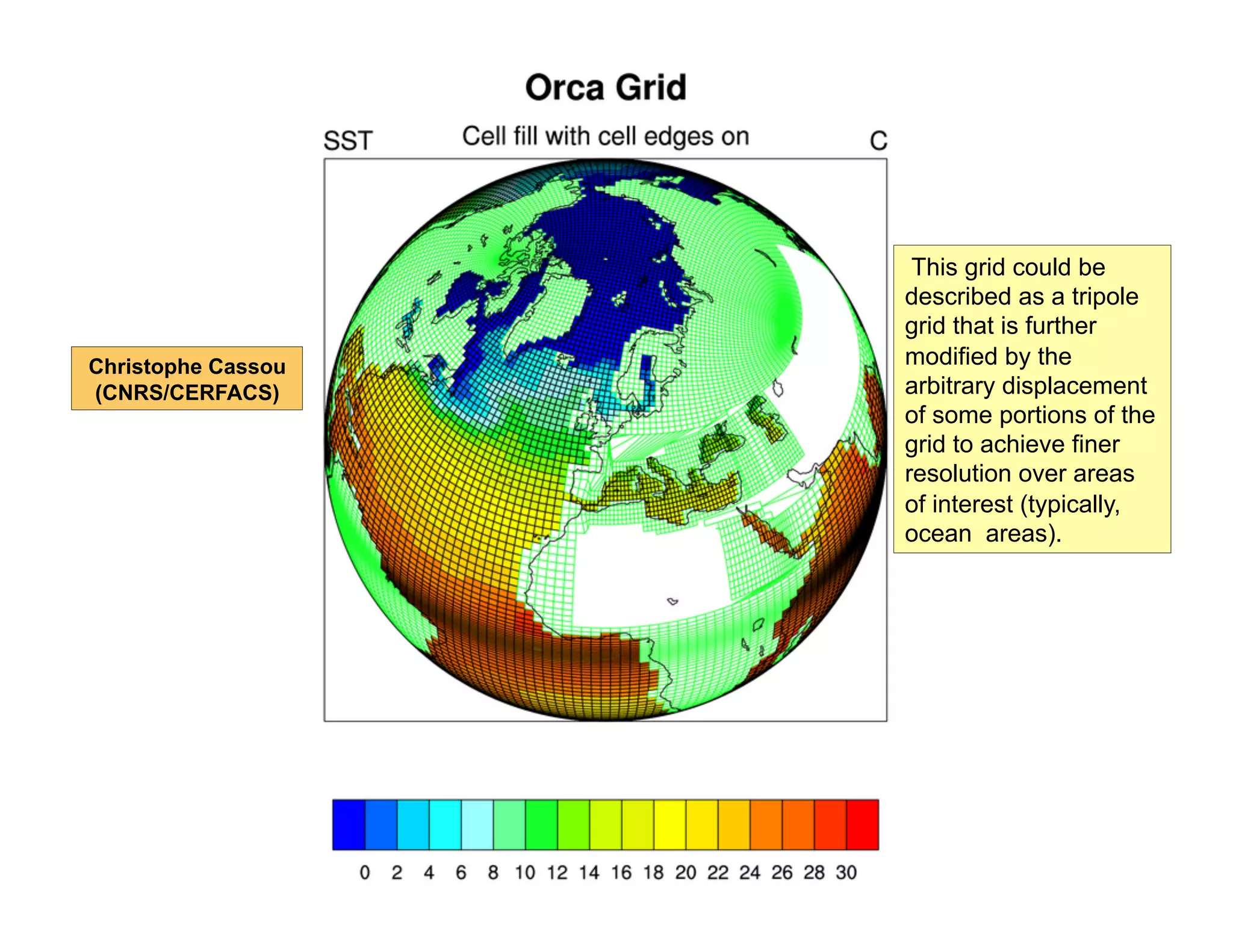
Christophe Cassou
(CNRS/CERFACS)

This grid could be
described as a tripole
grid that is further
modified by the
arbitrary displacement
of some portions of the
grid to achieve finer
resolution over areas
of interest (typically,
ocean areas).
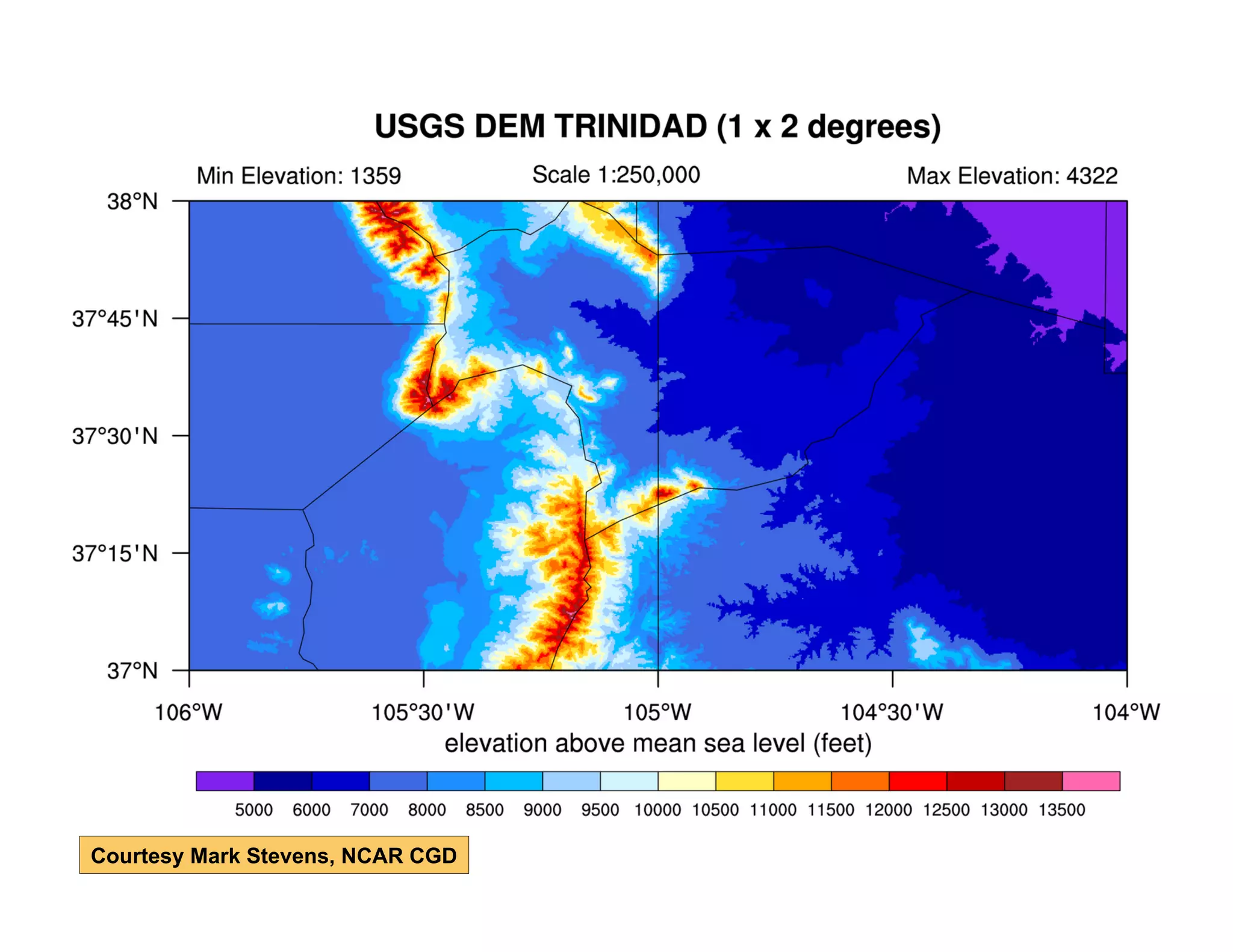
Courtesy Mark Stevens, NCAR CGD
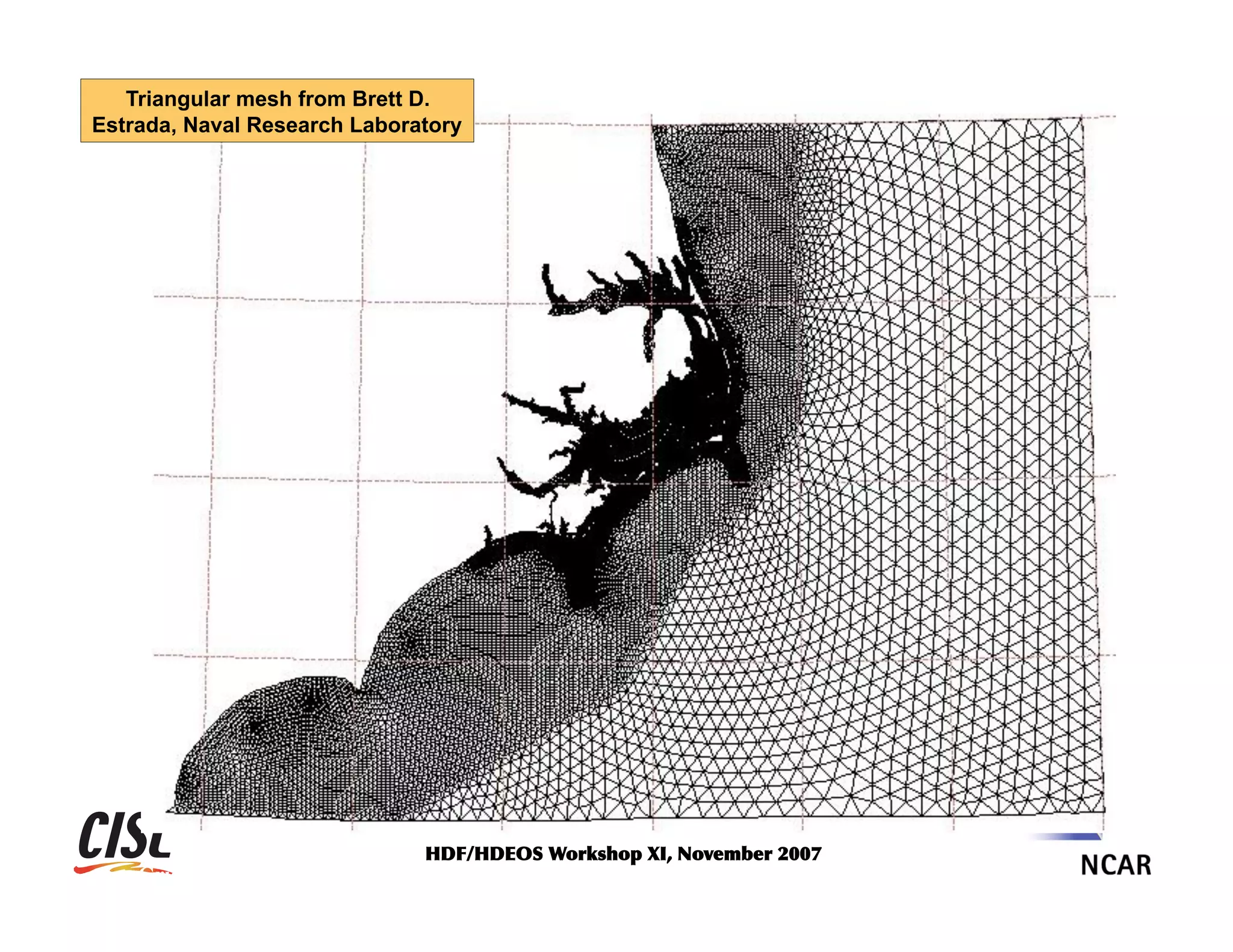
Brett D. Estrada
Naval Research Laboratory
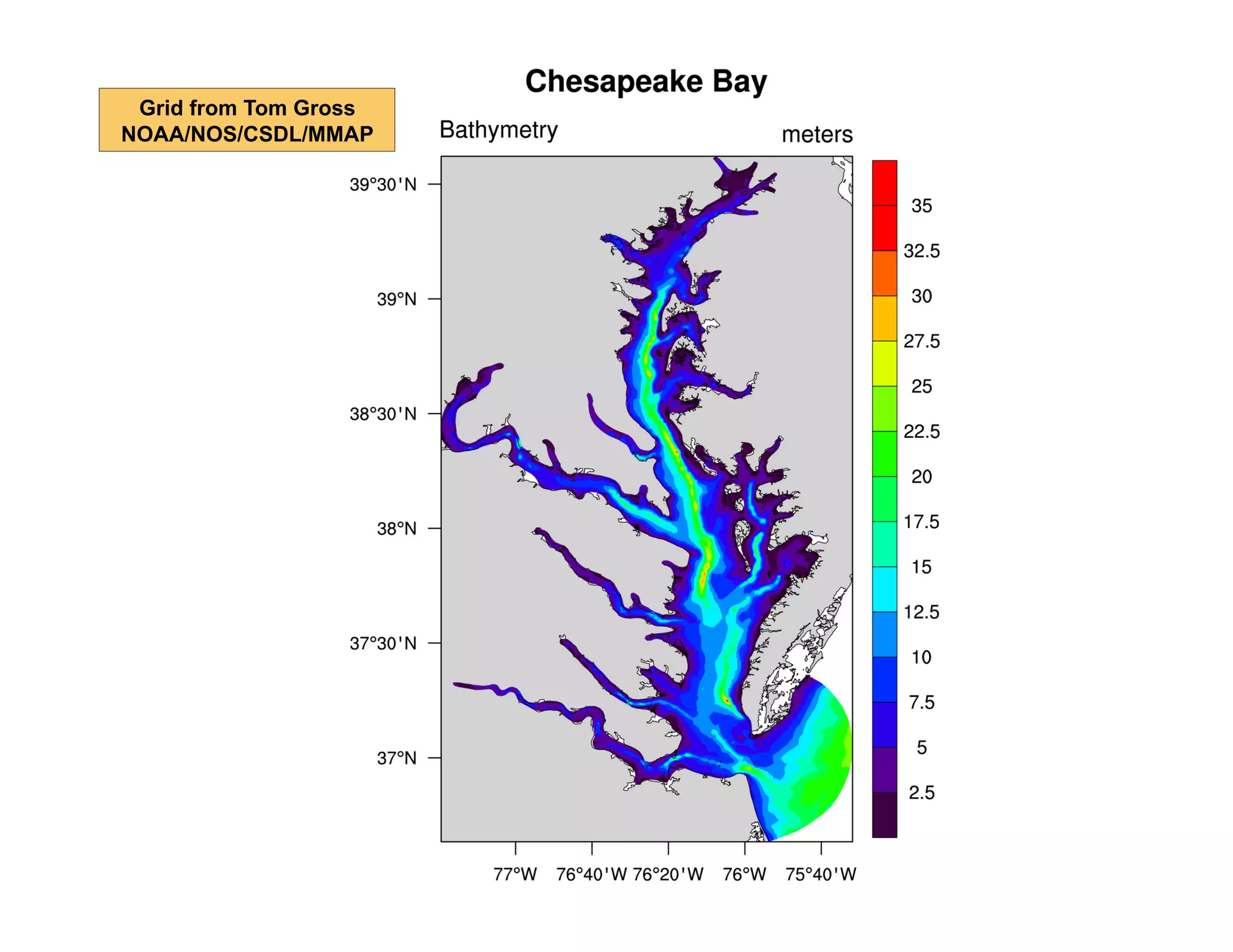
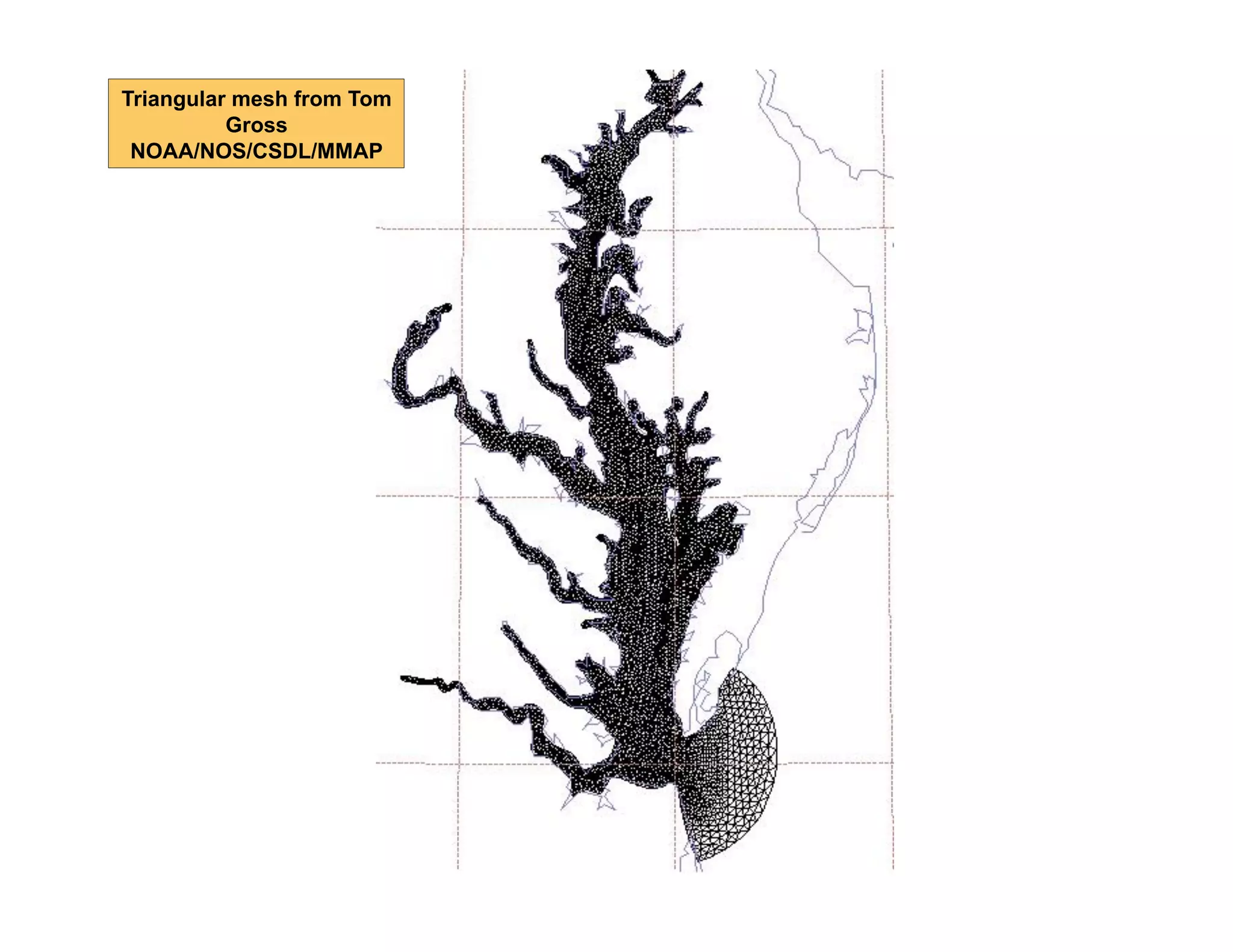
Grid from Tom Gross
NOAA/NOS/CSDL/MMAP
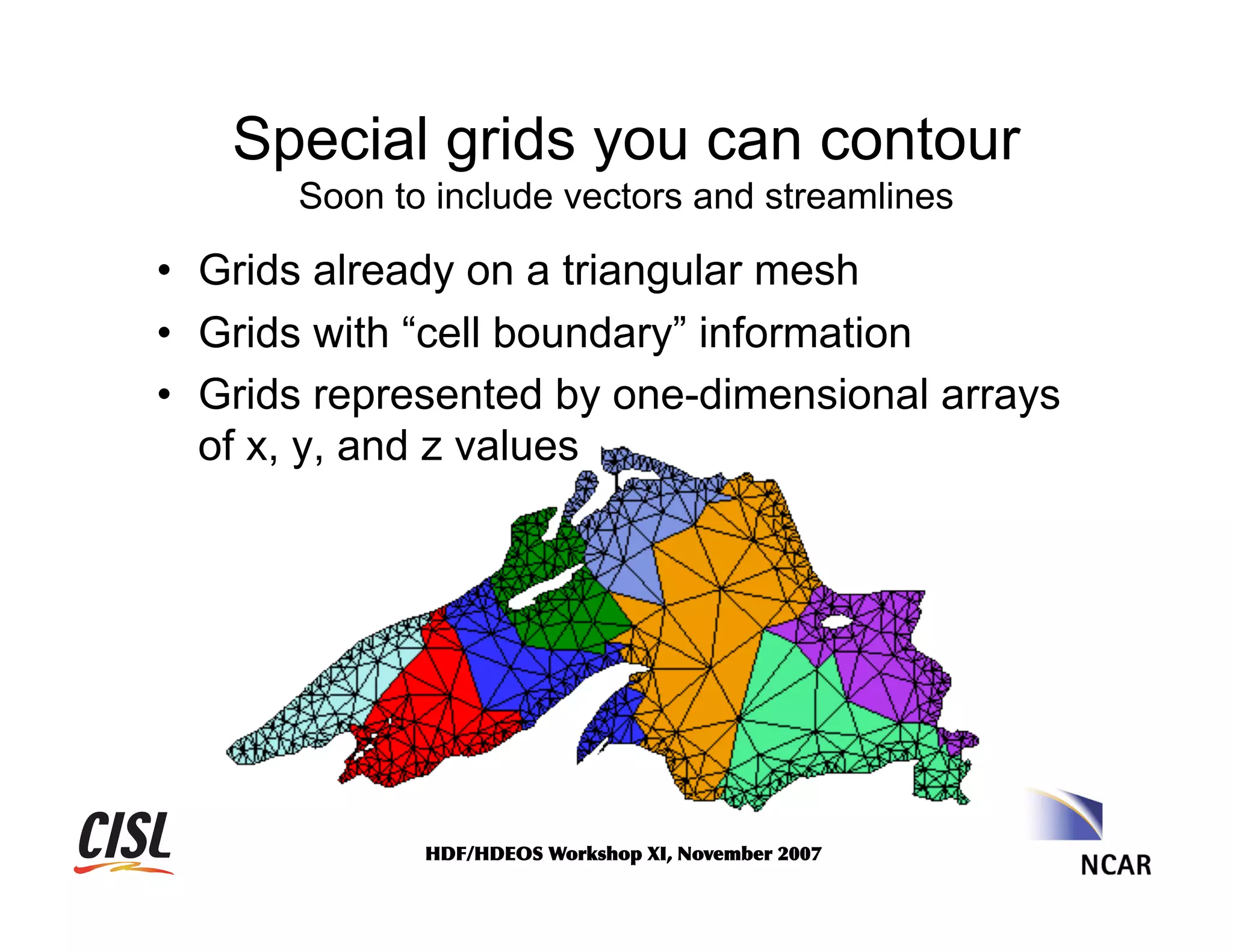
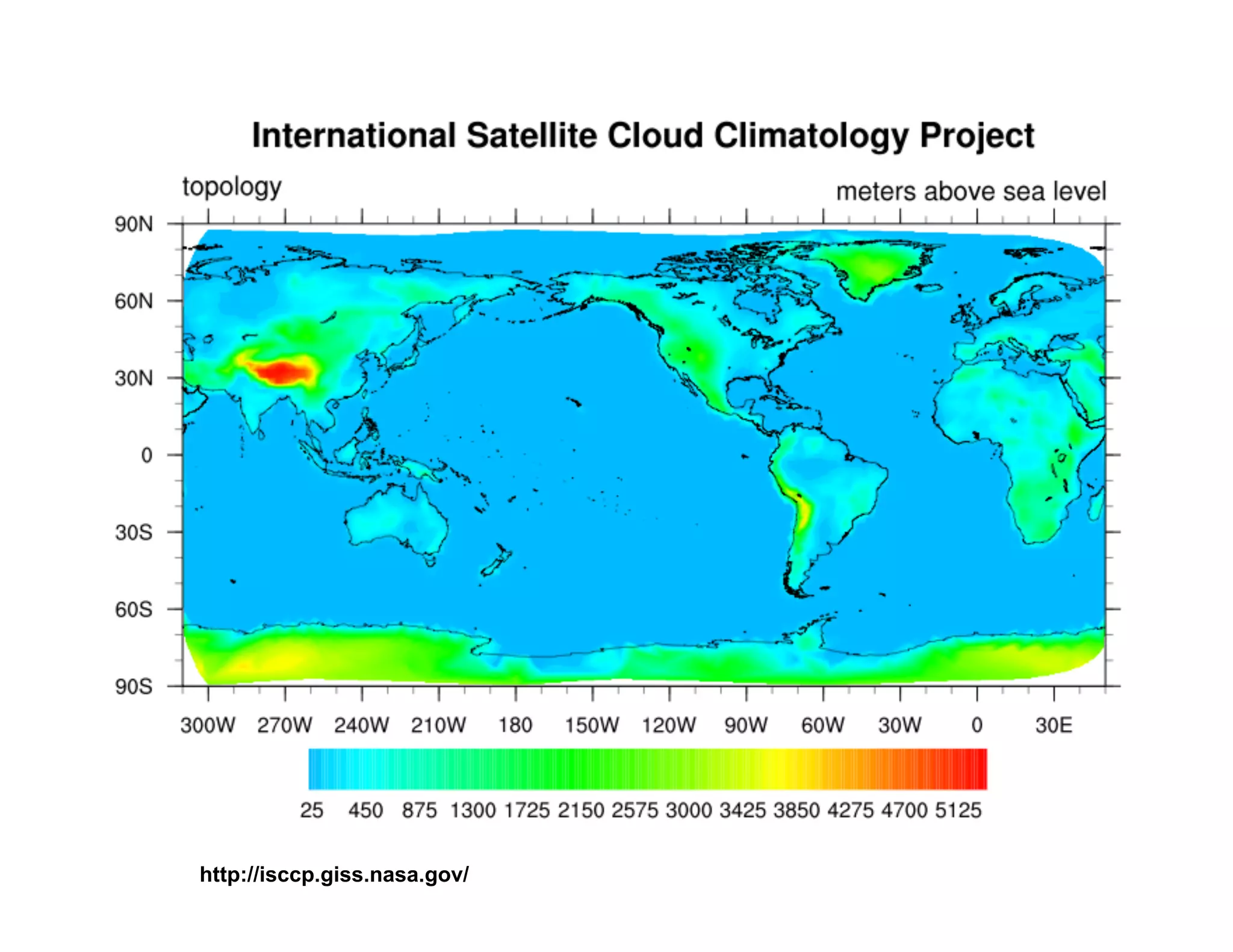
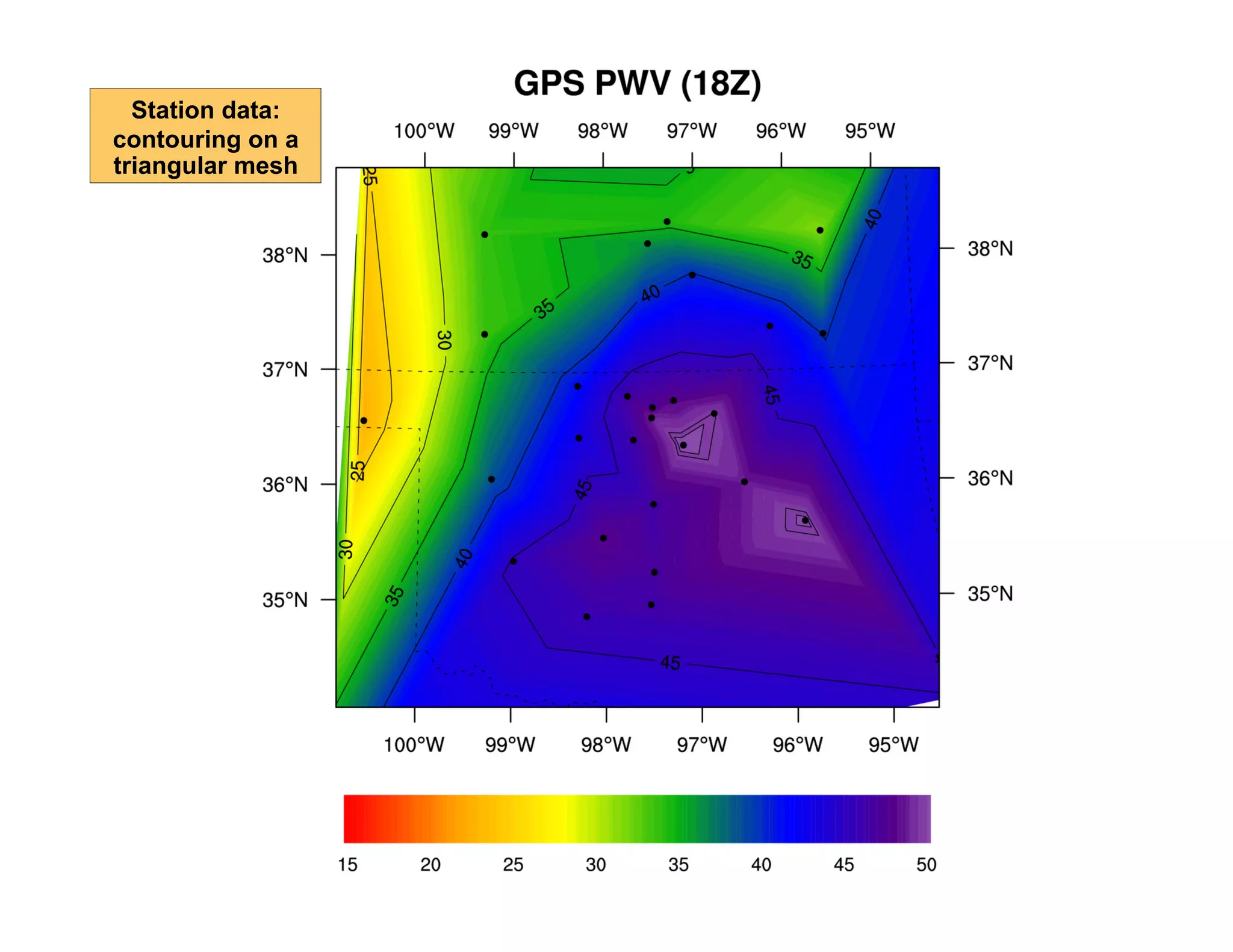
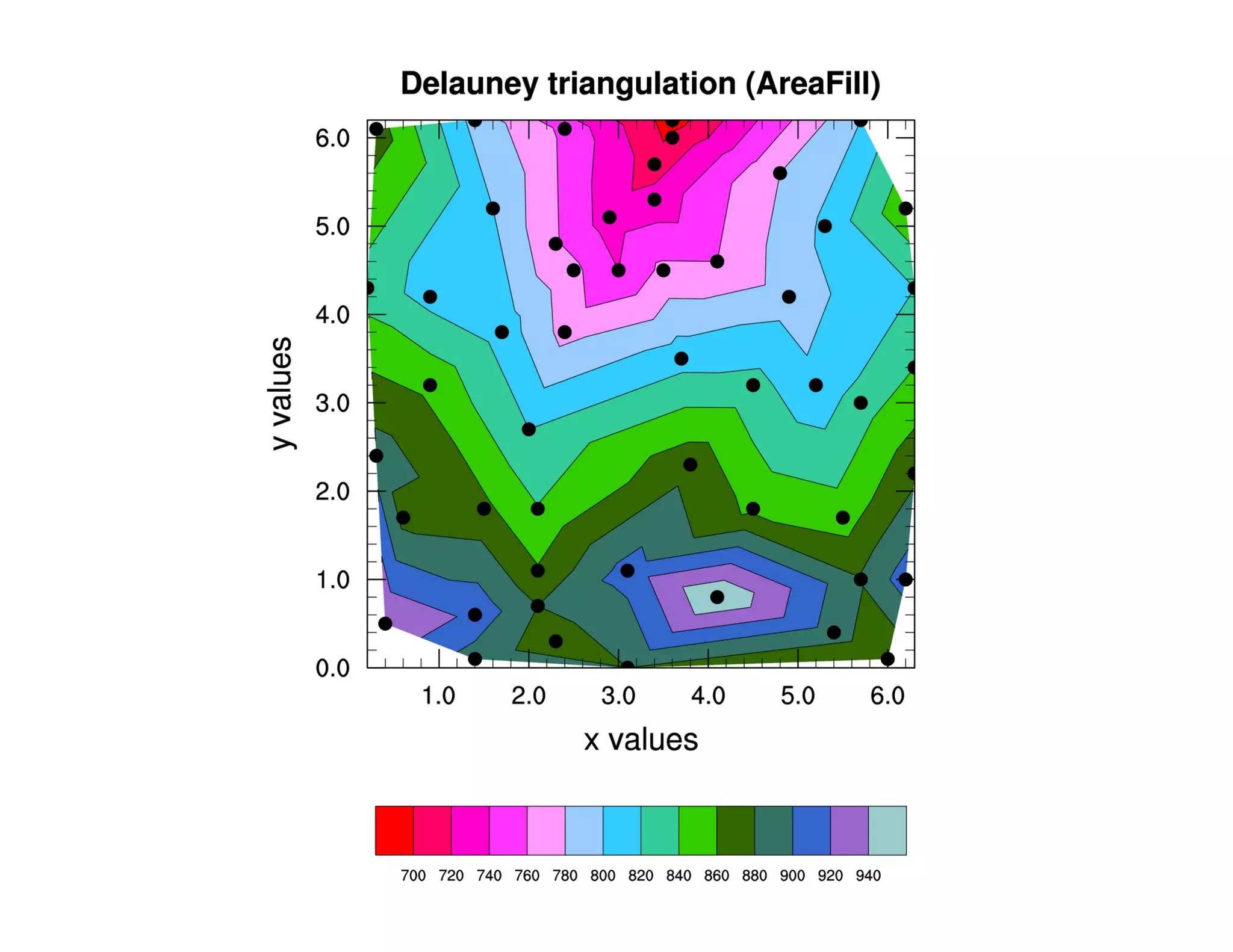
Special grids you can contour
Soon to include vectors and streamlines

•  Grids already on a triangular mesh
•  Grids with “cell boundary” information
•  Grids represented by one-dimensional arrays
of x, y, and z values

HDF/HDEOS	
 Workshop	
 XI,	
 November	
 2007
HDF/HDEOS	
 Workshop	
 XI,	
 November	
 2007	
 

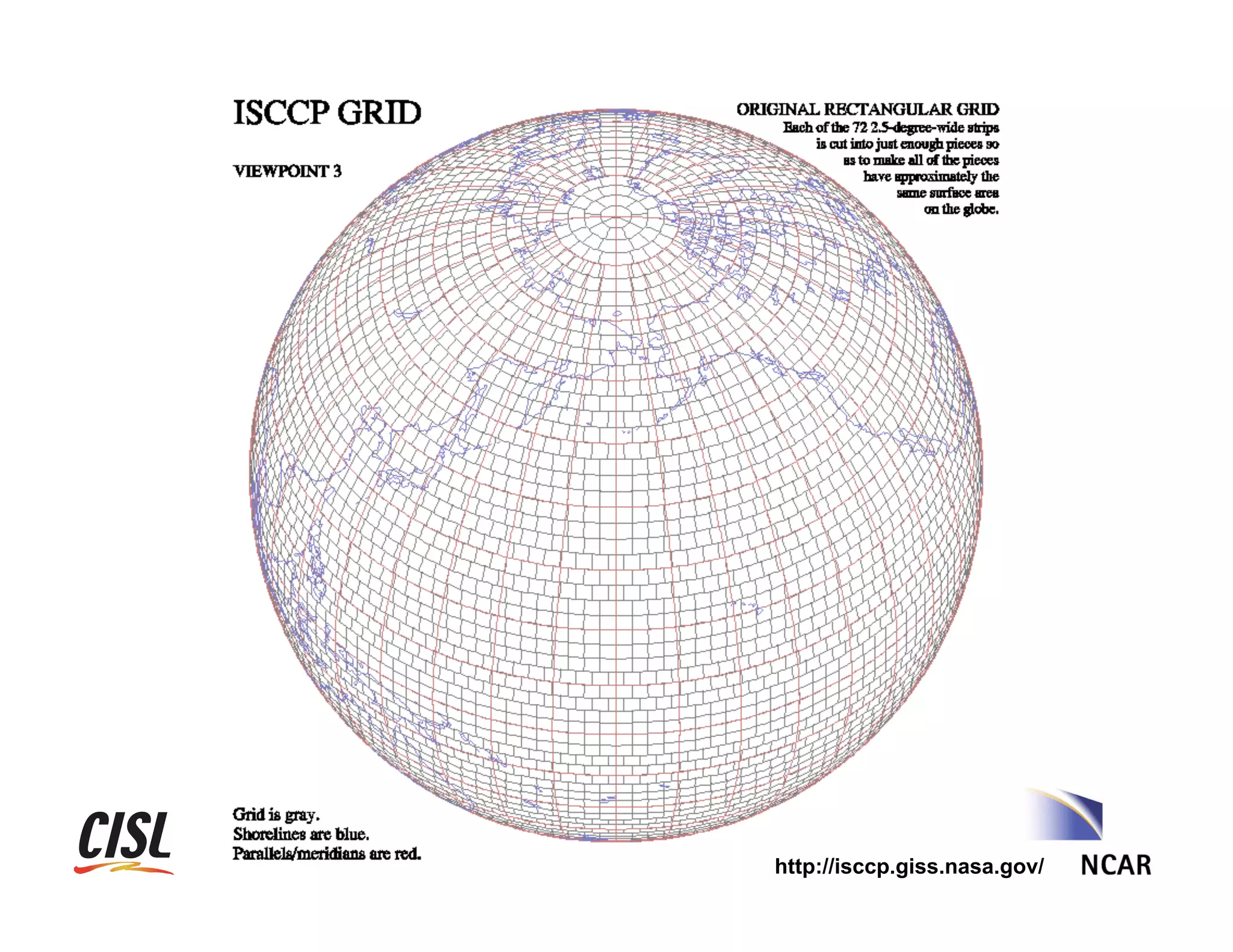
http://isccp.giss.nasa.gov/
HDF/HDEOS	
 Workshop	
 XI,	
 November	
 2007	
 

http://isccp.giss.nasa.gov/
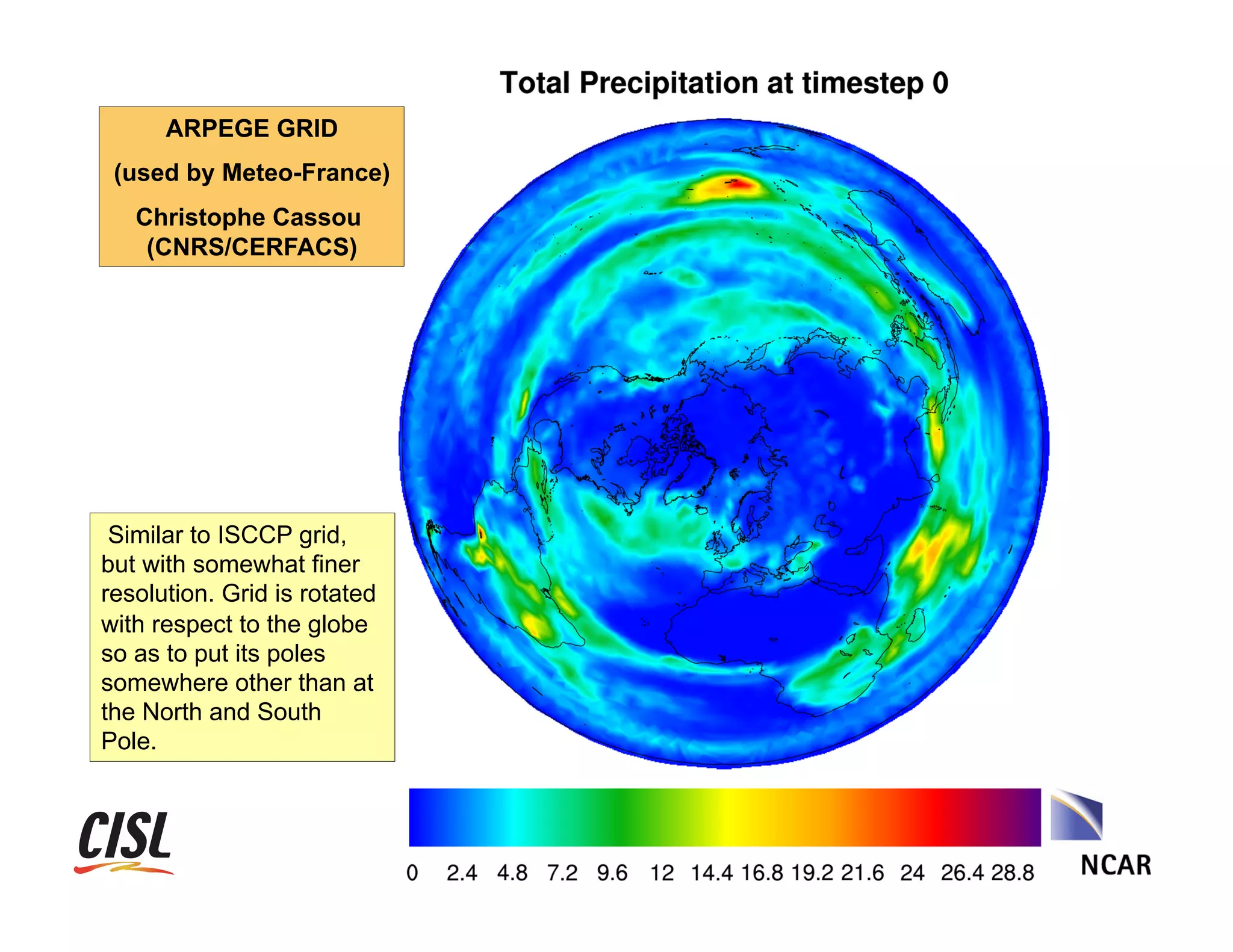
ARPEGE GRID
(used by Meteo-France)
Christophe Cassou
(CNRS/CERFACS)

Similar to ISCCP grid,
but with somewhat finer
resolution. Grid is rotated
with respect to the globe
so as to put its poles
somewhere other than at
the North and South
Pole.

HDF/HDEOS	
 Workshop	
 XI,	
 November	
 2007
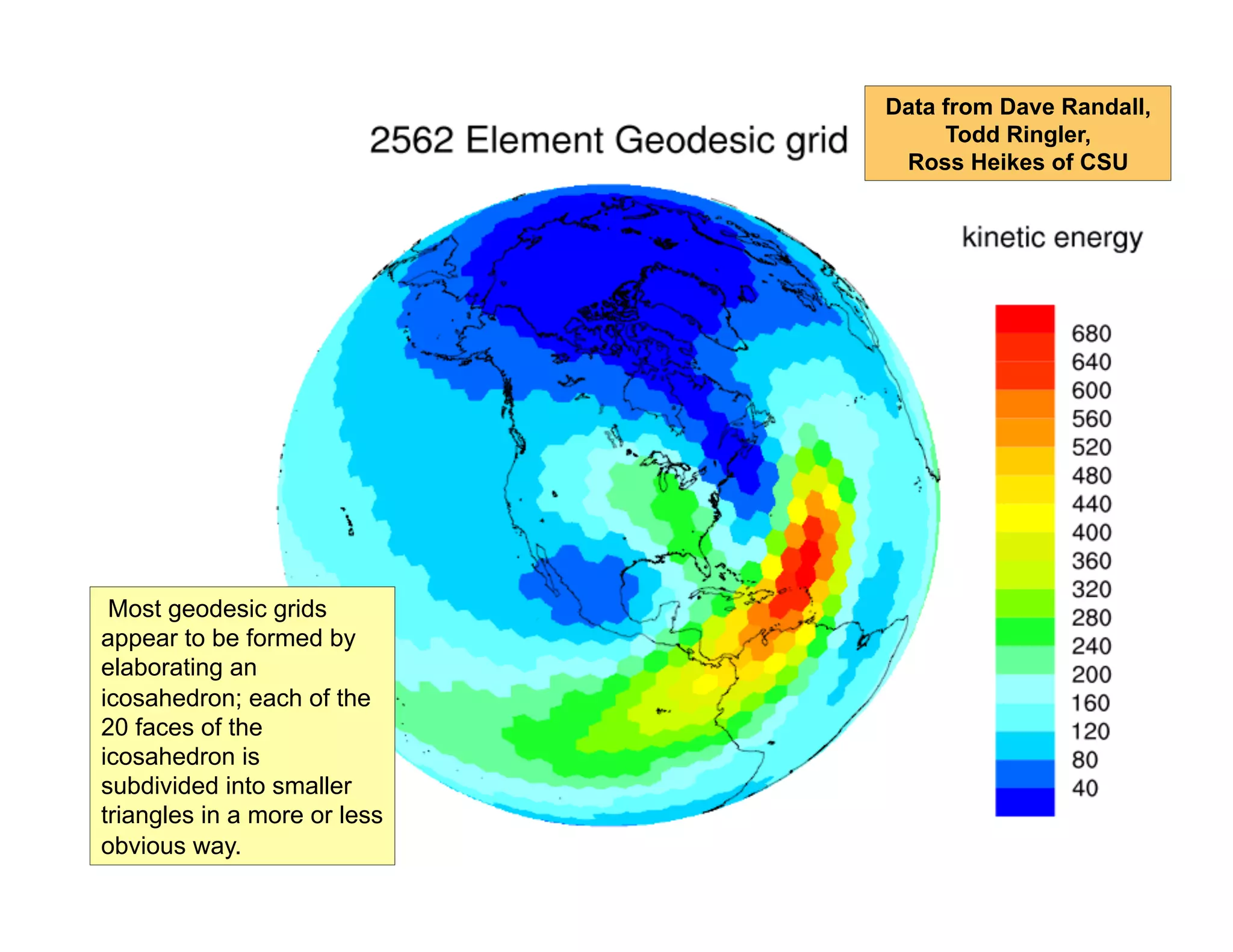
Data from Dave Randall,
Todd Ringler,
Ross Heikes of CSU

Most geodesic grids
appear to be formed by
elaborating an
icosahedron; each of the
20 faces of the
icosahedron is
subdivided into smaller
triangles in a more or less
obvious way.
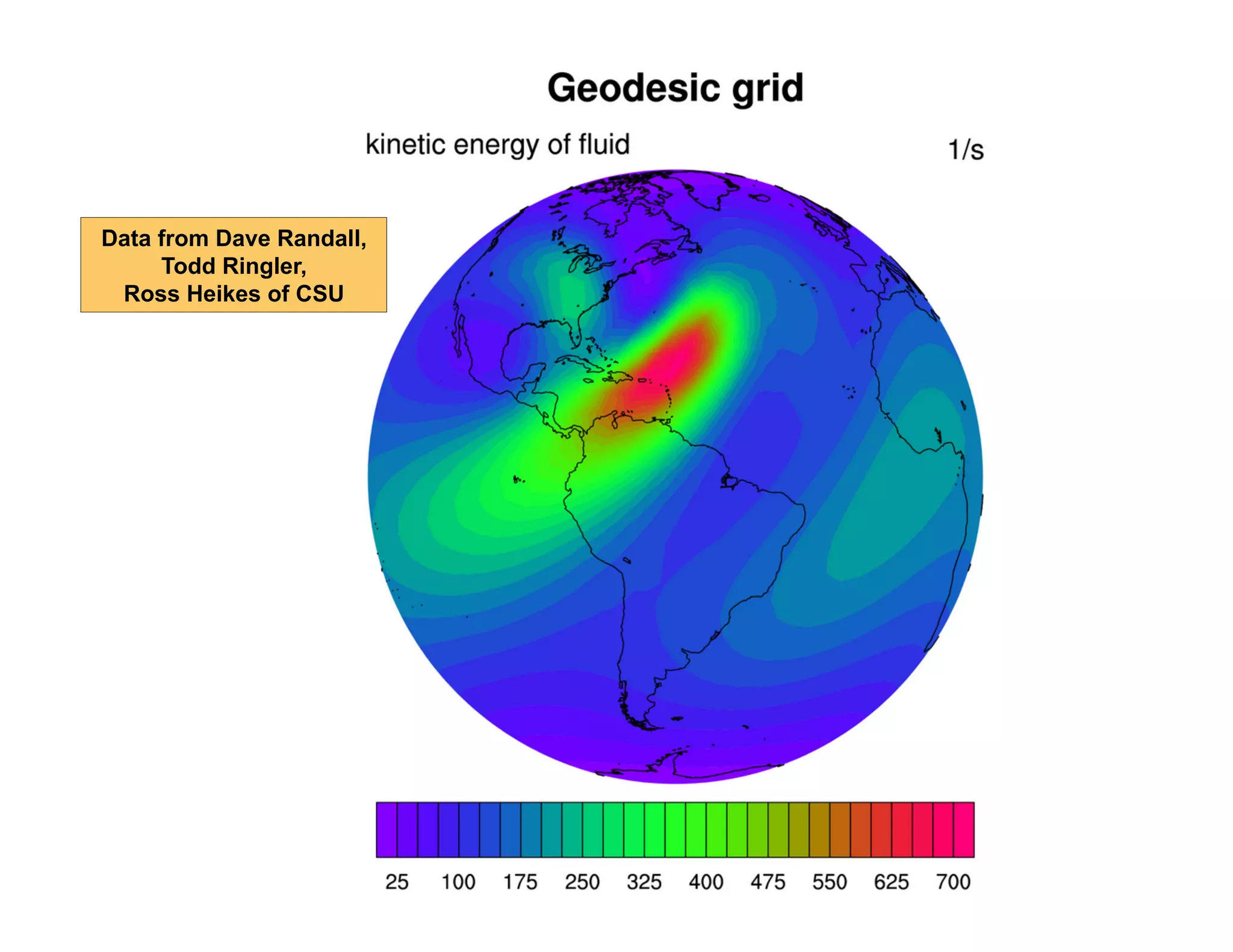
Data from Dave Randall,
Todd Ringler,
Ross Heikes of CSU
Station data:
contouring on a
triangular mesh
Triangular mesh from Brett D.
Estrada, Naval Research Laboratory

HDF/HDEOS	
 Workshop	
 XI,	
 November	
 2007	
 

Grid from Brett D. Estrada, Naval Research Laboratory
Triangular mesh from Tom
Gross
NOAA/NOS/CSDL/MMAP
Samples from VASPACKT
Vectors and streamlines on a triangular mesh

• 
• 
• 
• 
• 

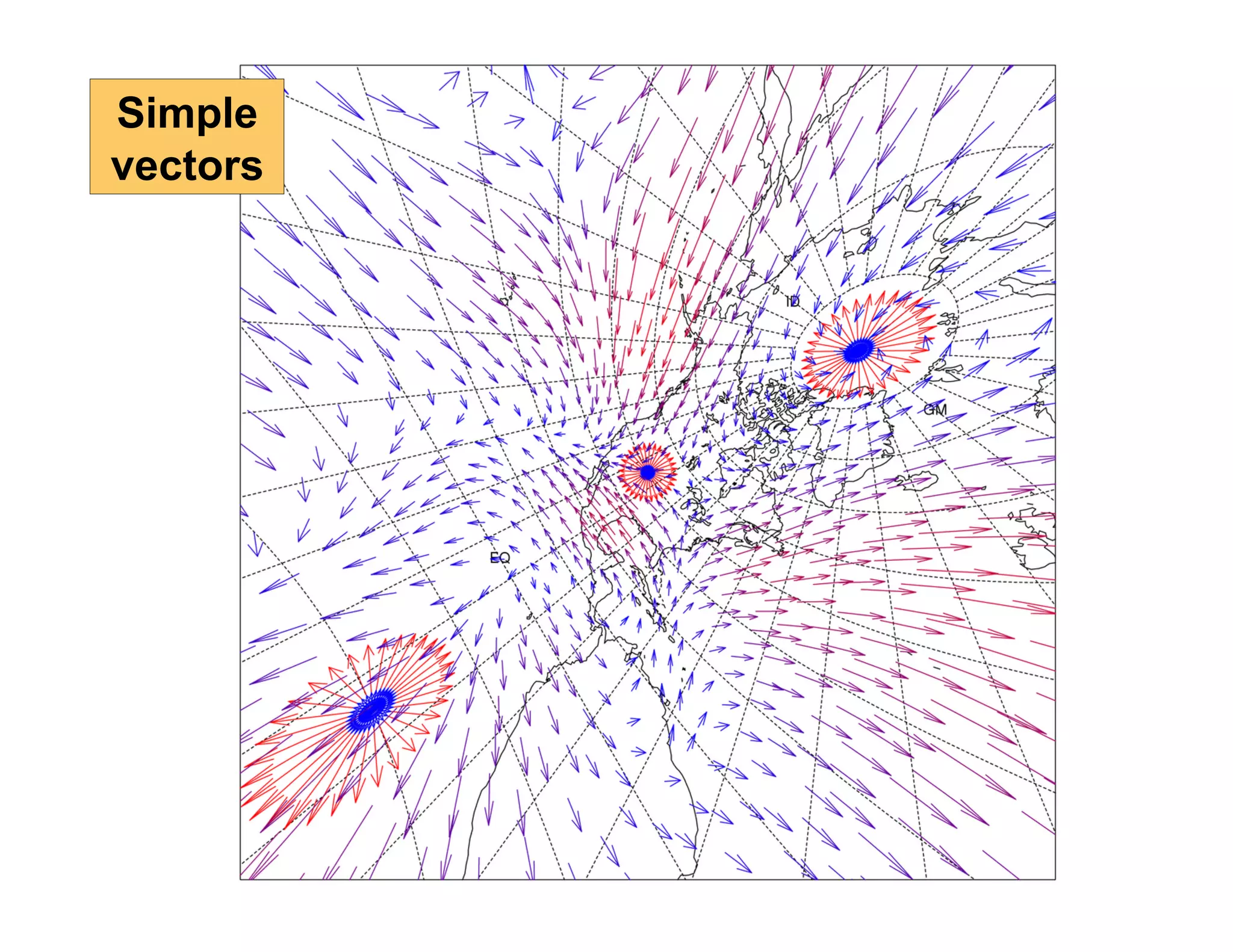
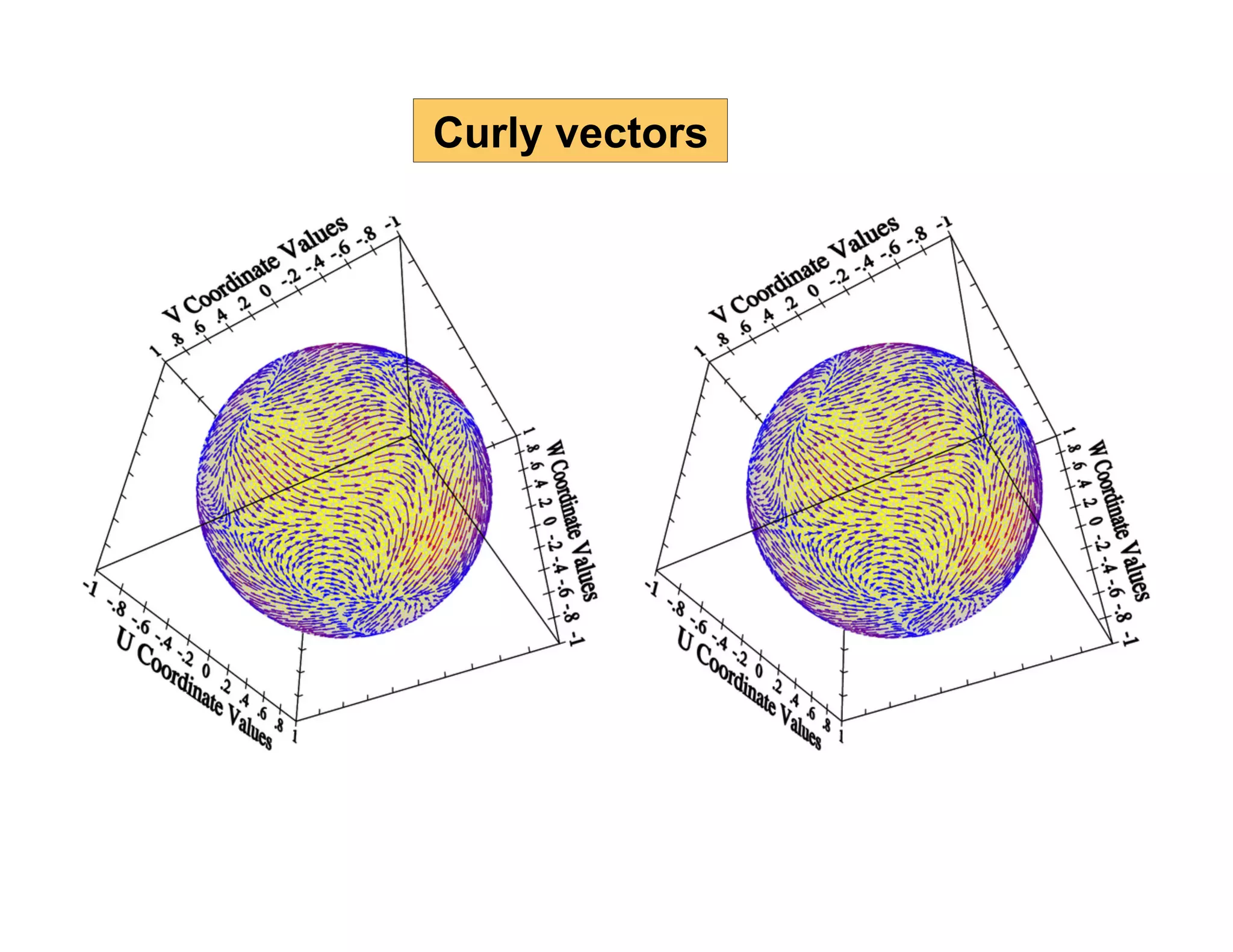
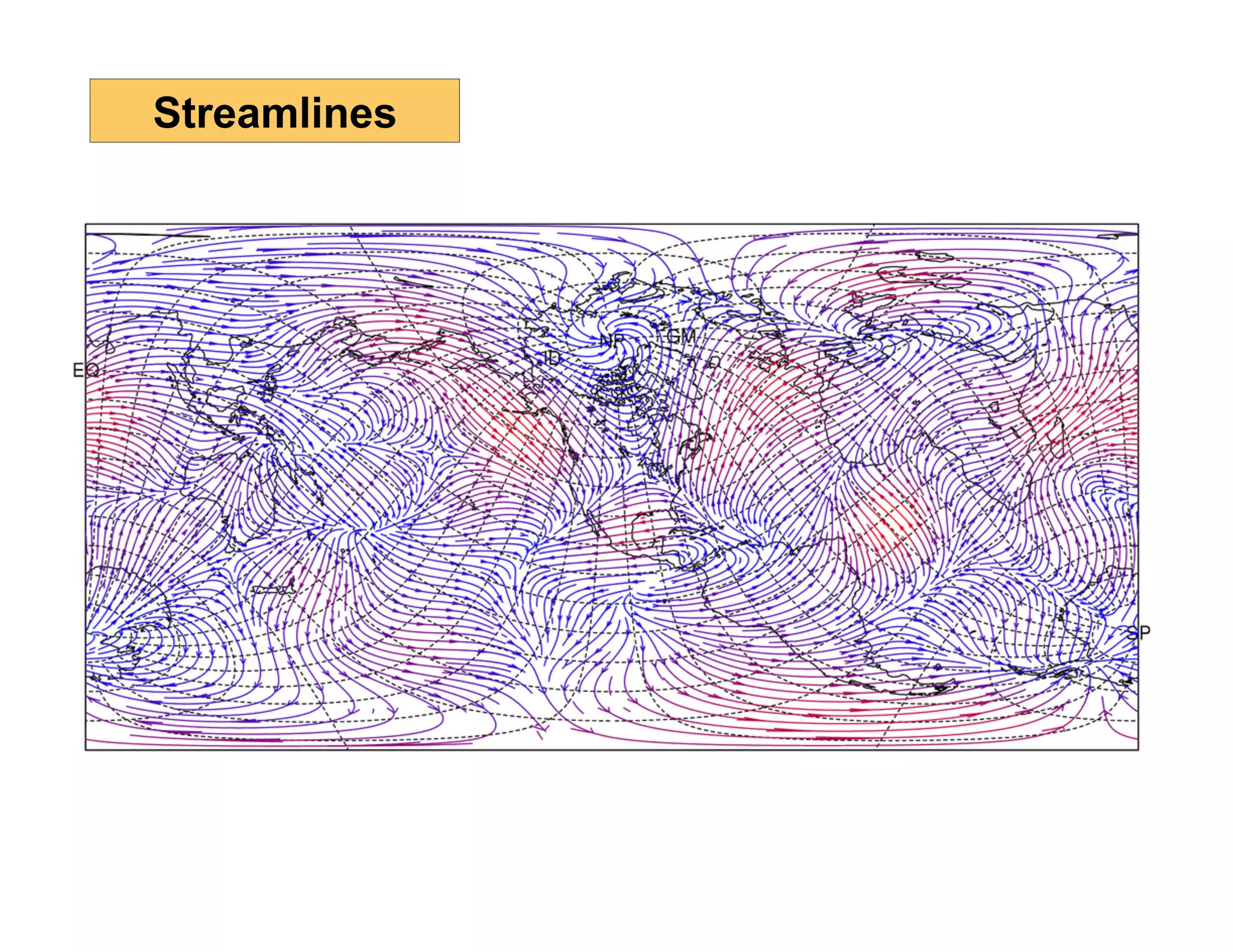
Developed by Dave Kennison
Simple vectors
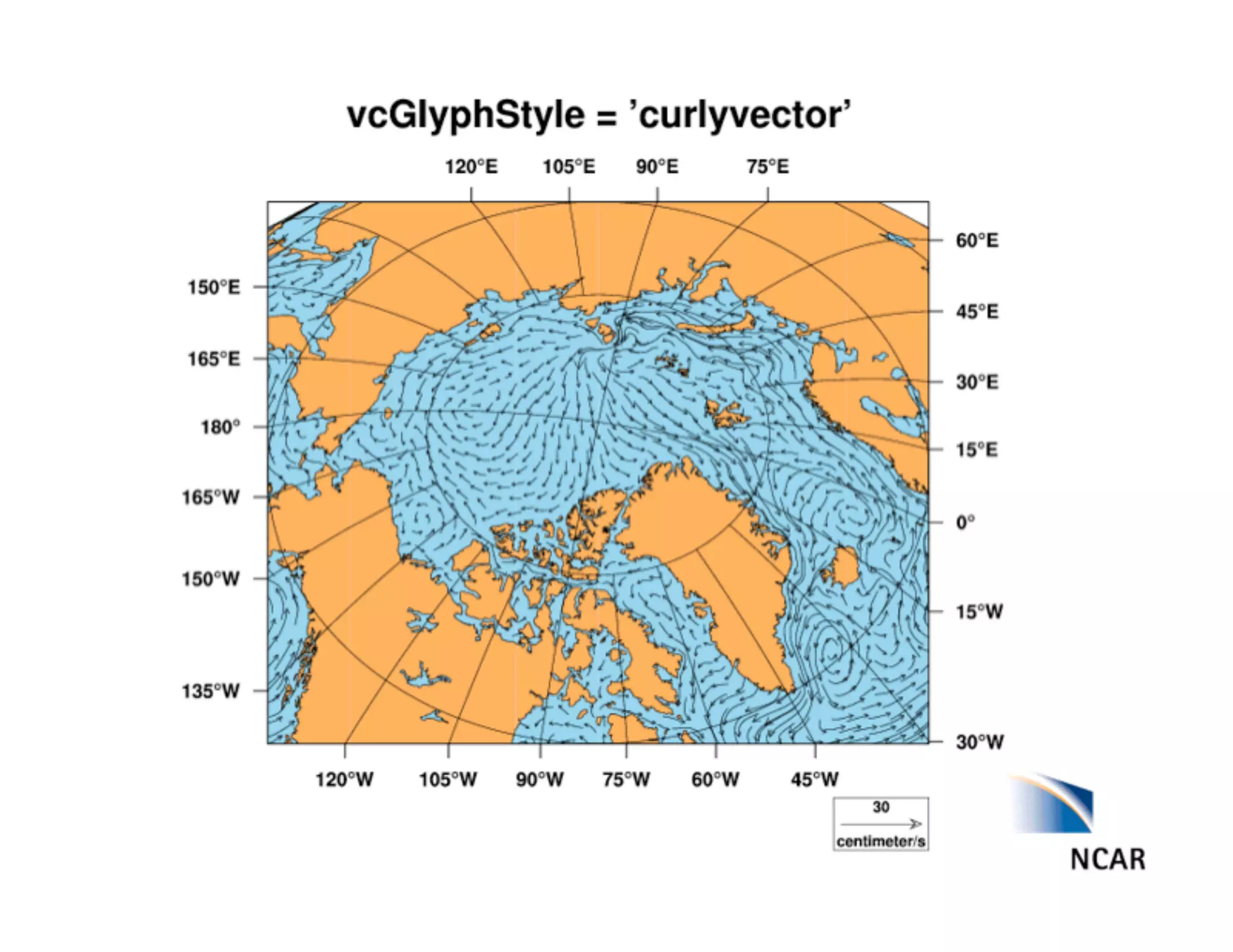
Curly vectors
Streamlines
Examples use dummy data

HDF/HDEOS	
 Workshop	
 XI,	
 November	
 2007
Simple
vectors
Curly vectors
Streamlines

Geoscience Data Analysis and Visualization Tools from NCAR

  • 1.
    Geoscience Data Analysis and Visualization Tools from NCAR HDF/HDF-EOS Workshop XI Nov 6-8, 2007 David Brown!
  • 2.
    Mesa Lab · Boulder, Colorado Visualization and Enabling Technologies Section National Center for Atmospheric Research Photos: Lynda Lester
  • 3.
    Topics •  •  •  •  •  Two interfaces: thesame capabilities (mostly) –  NCL - a self-contained scripting language –  PyNGL and PyNIO - Python modules Quick overview: visualization and analysis Data model State of our I/O component development Enabling access to HDF 5, HDFEOS 5, and NetCDF 4 HDF/HDEOS Workshop XI, November 2007
  • 4.
    PyNIO and PyNGL July2006 (Numeric 24.x/NumPy 1.0) PyNIO 2005 PyNGL 2004 NIO 2005 2000-present: 30+ NCL Workshops 1995: NCL Conference 1992: NCARG Conference Original Fortran Late 60s GSUN - Late 90s PyHLU 2003 NCL Mid 90s C interface Mid 90s HLUs Mid 90s GKS/CGM/Fortran 77/UNIX conversion NCAR Graphics 1980s
  • 5.
    NCAR Command Language(NCL) A scripting language designed for scientific data analysis and visualization 1.  Simple, robust file input and output 2.  Hundreds of analysis functions 3.  Visualizations (2D) are world class and highly customizable http://www.ncl.ucar.edu/ HDF/HDEOS Workshop XI, November 2007
  • 6.
    NCL: Data analysis • Array-based syntax and operators •  Hundreds of functions -  -  -  -  Spherical harmonics Scalar and vector regridding Vertical interpolation EOFs •  Many tailored to geosciences •  Most handle missing data •  Can call C and Fortran routines HDF/HDEOS Workshop XI, November 2007
  • 7.
    NCL: Visualization •  High-qualityand customizable visualizations •  Contours, XY, vectors, streamlines •  Maps with most common map projections •  Handles data on regular and irregular grids, triangular meshes •  Specialized scripts for skew-T, wind roses, histograms, Taylor diagrams, panels, bar charts •  GSUN interface: simplifies visualization •  Over 1,400 visualization options available HDF/HDEOS Workshop XI, November 2007
  • 8.
  • 9.
    PyNGL - Pythonmodule •  •  •  •  Python NCL Graphics Library Python version of popular GSUN interface Same publication-quality graphics as NCL Utilizes existing Python modules and development tools (swig, Numeric, NumPy) •  Contains some climate-specific data analysis functions •  Extensive and updated documentation http://www.pyngl.ucar.edu/ HDF/HDEOS Workshop XI, November 2007
  • 10.
    NCL Data Model • Based on netCDF 3 •  Language variables can have: •  Named dimensions •  Attributes •  Coordinates variables •  A convention in NetCDF but a language feature in NCL •  1d array with the same name as a dimension •  Contains coordinate values for dimension elements HDF/HDEOS Workshop XI, November 2007
  • 11.
    Supported file formatI/O •  One function reads all supported data formats: •  NetCDF (now including NetCDF4 classic), HDF4, HDF-EOS 2, GRIB 1 and 2 •  Writes NetCDF and HDF4 •  All file formats massaged into same model: file variables have basically the same features as internal variables •  Flat name space: HDF group names are appended to variable names HDF/HDEOS Workshop XI, November 2007
  • 12.
    PyNIO - Pythonmodule •  •  •  •  •  Same I/O library as NCL (libnio) Reads and writes same formats as NCL Same NetCDF-like view of all formats But interfaces with NumPy for data access Modeled on the Scientific NetCDF module –  NioVariable type is a reference to the variable in the file (metadata is attached to variable) –  Dereferencing it results in a NumPy variable with no metadata •  *Numpy is a Python array processing module http://www.pyngl.ucar.edu/Nio.shtml HDF/HDEOS Workshop XI, November 2007
  • 13.
    2D Coordinates •  TraditionalNetCDF coordinate variables are 1D vectors •  However, satellite data and model data on modern grids require 2D coordinate grids •  2D coordinate variables created on the fly for GRIB grids and HDFEOS Grid-type data •  Added value variables that allow data to be plotted on any map projection HDF/HDEOS Workshop XI, November 2007
  • 14.
    Enabling NetCDF 4‘classic’ •  Recompile with NetCDF 4 and HDF 5 1.8 beta (we also included szip) •  Add options for specifying format and compression level •  Tests using ncl_convert2nc on GRIB files show reduction in file size by ~1/2 over GRIB. •  Caveats: –  Beta version NetCDF 4 not yet supported on some architectures (64 bit mainly) –  Not supported for OPeNDAP NetCDF client library HDF/HDEOS Workshop XI, November 2007
  • 15.
    Path to HDF,HDFEOS 5 and full NetCDF 4 support •  size_t for dimension sizes to enable large variables on 64-bit hosts •  Add support for more atomic types (int64) •  Support for groups in the file context •  User control of chunking •  Compound and variable length data types •  Components to read HDF 5 and HDFEOS 5 •  Current NetCDF module extended to handle v4 •  More support for aggregation HDF/HDEOS Workshop XI, November 2007
  • 16.
    Current status •  NCL5.0.0 released this week –  NCSA-style Open Source license (finally) –  Binaries available under slightly more restrictive license (because of included 3rd party software) •  PyNGL/PyNIO 1.2.0 available –  Supports NumPy 1.0.x and Python 2.5 –  Binaries (easy installation) available for: •  Various flavors of Linux, Mac OSX, Cygwin •  Other Unix systems, 32 and 64 bit HDF/HDEOS Workshop XI, November 2007
  • 17.
    Distribution of NCLsites Distribution of PyNGL/PyNIO sites
  • 18.
    Support •  Websites withextensive documentation •  Tutorials •  Hundreds of examples with downloadable scripts •  Active email lists –  ncl-talk@ucar.edu, pyngl-talk@ucar.edu •  Hands-on training workshops HDF/HDEOS Workshop XI, November 2007
  • 19.
    Download locations •  NCL http://www.ncl.ucar.edu/download.html • PyNGL and PyNIO http://www.pyngl.ucar.edu/download.html HDF/HDEOS Workshop XI, November 2007
  • 20.
    Questions? Email me:dbrown@ucar.edu HDF/HDEOS Workshop XI, November 2007
  • 21.
    education What kind ofresearch monsoons (from our ESG download website) rainfall cloud modeling climate change data conversion lightning oceanography marine studies air quality planetary atmospheres dust atmospheric research astronomy weather forecasting paleoclimatology utility forecasting pollution acoustics salmon abundance glaciers hydrology medical flood risk mgmt fire modeling physics agriculture HDF/HDEOS Workshop XI, November 2007 microbiology electric power storms aerosol light absorption
  • 22.
    Sample GRIB output fromPyNIO filename: ruc2.T00Z.bgrbanl path: /Users/dbrown/grib/ruc2.T00Z.bgrbanl.grb file global attributes: dimensions: gridx_236 = 113 gridy_236 = 151 lv_HYBL2 = 40 lv_DBLL3 = 5 variables: float PRES_236_TRO ( gridx_236, gridy_236 ) center : US National Weather Service - NCEP (WMC) long_name : Pressure units : Pa _FillValue : -999 coordinates : gridlat_236 gridlon_236 level_indicator : 7 grid_number : 236 parameter_number : 1 model : RUC Model from FSL (isentropic; scale: 20km at 40N) forecast_time : 0 initial_time : 05/11/2000 (00:00) … float gridlat_236 ( gridx_236, gridy_236 ) corners : ARRAY long_name : latitude GridType : Lambert Conformal Secant or Tangent, Conical or bipolar … units : degrees_north
  • 23.
    Resources (a.k.a. attributes) • Same control mechanism for NCL and PyNGL •  Detailed control of the appearance of a visualization •  Example using POP grid ocean current data HDF/HDEOS Workshop XI, November 2007
  • 24.
  • 25.
  • 26.
  • 27.
  • 28.
  • 29.
    NCL and PyNGLvisualization examples •  scatter and line plots, contours, vectors, skew-t, meteograms, maps, wind barbs, bar charts, streamlines, trajectories, filled polygons, paneled visualizations HDF/HDEOS Workshop XI, November 2007
  • 32.
    Skew-T graphic Courtesy of DennisShea A Skew-T plot is used by meteorologists to analyze data from a balloon sounding.
  • 36.
    Based on avisualization of Adam Phillips
  • 37.
    Based on avisualization of Joel Norris (Scripps) using dummy data
  • 38.
    Data from ClimateAnalysis Section Christian Guillemot
  • 39.
    GRIB 2 TIGGE(THORPEX Interactive Grand Global Ensemble) data Japan Meteorological Agency ! THORPEX - an international research and development program responding to the weather related challenges of the 21st century to accelerate improvements in the accuracy of 1-day to 2- week high impact weather forecasts for the benefit of society, the economy and the ! environment.
  • 40.
  • 42.
    Image courtesy ofNan Rosenbloom, CGD
  • 43.
    First two mapdatabases built-in; high-resolution available as simple download
  • 44.
    Christophe Cassou (CNRS/CERFACS) This gridcould be described as a tripole grid that is further modified by the arbitrary displacement of some portions of the grid to achieve finer resolution over areas of interest (typically, ocean areas).
  • 45.
  • 46.
    Brett D. Estrada NavalResearch Laboratory
  • 47.
    Grid from TomGross NOAA/NOS/CSDL/MMAP
  • 48.
    Special grids youcan contour Soon to include vectors and streamlines •  Grids already on a triangular mesh •  Grids with “cell boundary” information •  Grids represented by one-dimensional arrays of x, y, and z values HDF/HDEOS Workshop XI, November 2007
  • 49.
    HDF/HDEOS Workshop XI, November 2007 http://isccp.giss.nasa.gov/
  • 50.
    HDF/HDEOS Workshop XI, November 2007 http://isccp.giss.nasa.gov/
  • 51.
    ARPEGE GRID (used byMeteo-France) Christophe Cassou (CNRS/CERFACS) Similar to ISCCP grid, but with somewhat finer resolution. Grid is rotated with respect to the globe so as to put its poles somewhere other than at the North and South Pole. HDF/HDEOS Workshop XI, November 2007
  • 52.
    Data from DaveRandall, Todd Ringler, Ross Heikes of CSU Most geodesic grids appear to be formed by elaborating an icosahedron; each of the 20 faces of the icosahedron is subdivided into smaller triangles in a more or less obvious way.
  • 53.
    Data from DaveRandall, Todd Ringler, Ross Heikes of CSU
  • 54.
    Station data: contouring ona triangular mesh
  • 56.
    Triangular mesh fromBrett D. Estrada, Naval Research Laboratory HDF/HDEOS Workshop XI, November 2007 Grid from Brett D. Estrada, Naval Research Laboratory
  • 57.
    Triangular mesh fromTom Gross NOAA/NOS/CSDL/MMAP
  • 58.
    Samples from VASPACKT Vectorsand streamlines on a triangular mesh •  •  •  •  •  Developed by Dave Kennison Simple vectors Curly vectors Streamlines Examples use dummy data HDF/HDEOS Workshop XI, November 2007
  • 59.
  • 60.
  • 61.