HCS321
Theories of how
children develop
emotionally and
socially
This presentation draws on resources developed by Cate Thomas
Overview
Introduction
Moving beyond Nature vs. Nurture
Cognitive Development
Attachment
Ecological Systems Theory
Early Brain Development
Introduction
 Helping or Responding to
Children Young People and
Families experiencing adversity
 Whose Rights and Responsibility
 Protection or Welfare?
 Why is knowledge of children’s
development important?
Moving beyond Nature vs. Nurture
Biology- Genetic Transmission
Our DNA is the baseline of
who/what we become.
 Positivist
 Statistical
 Generalised
Environment- The life lived
Our ancestry provides the
starting point of how we can
become who we want to be.
 Relativist
 Interpretive
 Contextual
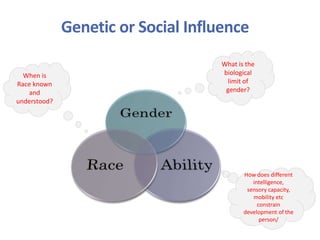
Genetic or Social Influence
What is the
biological
limit of
gender?
How does different
intelligence,
sensory capacity,
mobility etc
constrain
development of the
person/
When is
Race known
and
understood?
Theories of Normal Childhood Development
Cognitive theory
Jean Piaget
The nature of Intelligence
Operative (finding out) and
Figurative (making meaning)
Assimilation (making new
knowledge fit what we know) OR
Accommodation (changing what
we know to take on new
knowledge)
Stages and ages (children
progress through identifiable
stages)
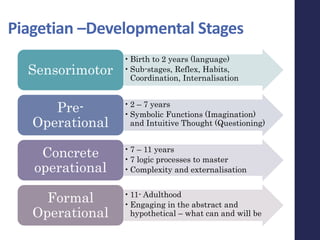
Piagetian –Developmental Stages
•Birth to 2 years (language)
•Sub-stages, Reflex, Habits,
Coordination, Internalisation
Sensorimotor
•2 – 7 years
•Symbolic Functions (Imagination)
and Intuitive Thought (Questioning)
Pre-
Operational
•7 – 11 years
•7 logic processes to master
•Complexity and externalisation
Concrete
operational
•11- Adulthood
•Engaging in the abstract and
hypothetical – what can and will be
Formal
Operational
Cognitive Theory
Lev Vygotsky
 Contemporary of Piaget, but working in Soviet
Russia.
 ZPD – Zone of Proximal Development
Children's development is influenced by their
exposure to what others can do, not limited to
what they can do.
 Learning and Intelligence is Culturally informed
and prioritised.
Children learn what is culturally important for
them to know at the earliest possible time.
Post/neo Piagetians
Piaget became strongly criticised for
aspects of his methodology.
He acknowledge some limits to his
original theory but since his death (1980)
has regained support from theorists who
seek to adjust and improve his theories.
 Devolving stages to apply in cultural
and Domain specific (Math/Art) contexts
(Demitriou)
 Additional Stages or processes in
Formal Operational stage (Fischer)
Attachment theory
John Bowlby
English psychologist
 Post WW2 studies of maternal deprivation
 Influenced by own childhood in upper class English family
 Challenged dominant psycho-analytic views of children
who did not emotionally engage with mothers to consider
the mothers actions as well as child’s
 Researched maternal deprivation for WHO in Europe and
recommended, “that young children should have a
continuous and positive relationship with their mother, or
they may suffer serious permanent mental health issues.”
 Researched extensively on the impact of grief and loss in
children.
 Became internationally influential on maternal and child
public health policy.
 Criticized by feminist theory for making parenting mother-
centric and validating paternalistic views of “good and bad
mothering”
Attachment Theory
Mary Ainsworth
American/Canadian psychologist
Post WW2 studies of Maternal Deprivation on
Children
Undertook renowned longitudinal ethnographic
study of mother-child attachment in Uganda in the
1960’s that identified many cross cultural, linguistic
and geographic similarities in mother-child
attachment that supported Bowlby’s arguments.
Developed the “Strange Situation”
Secure/Insecure Attachment Classification
procedure: Criticised that this procedure is highly
artificial and in some views unethical because it
subjects a child (and parent to stress)
The Strange Situation Procedure
•Child with parent in room
•Child free to play with any toy of choiceObserve Child’s
Exploration
•Stranger enters
•Parent leaves
•Stranger responds behaviourally to child's reactions.
Observe Child Reactions
to Parent
•Parent returns and comforts child
•Stranger and parent leave –child aloneObserve Reunion
and Departure
•Stranger re-enters and responds behaviourally to the
childObserve Childs
Reactions to Stranger
•Parent re-enters room, picks up child and engages with
them
•Stranger leaves.
Observe Childs response
to Reunion
The Ainsworth Classification
Child/Parent
Secure
Insecure
•Anxious-Resistant
Insecure
•Anxious-Avoidant
Disorganised/Disoriented
•(added by Mary Main)
Urie Bronfenbrenner
Bronfenbrenner was a social and
educational psychologist considered a
leader in the direct application of
developmental studies with the practice of
teaching pre-school children in
disadvantaged communities in the US and
Europe in the 1960’s and 70’s.
Through this direct interaction, he
developed the Ecological Systems Theory
utilising general systems theory from the
hard sciences into the human and social
context.
Widely viewed as the most
comprehensive and adaptive model of
human development and learning.
Bronfenbrenner’s Ecological Systems Theory
Note: Image from- https://www.psychologynoteshq.com/bronfenbrenner-ecological-theory/
Early Brain Development
Since the 1980’s the dramatic improvement in
medical imaging allowed us to see better how the
brain responds to stimulus...
 We now know impact of trauma (Perry et al) and
sustained social ecological stress (McCain &
Mustard) changes the way in which neurological
pathways in the brain develop and work.
 Consequently society has become increasingly
focussed on investing in services in the first 5 years
of life while young brains are ‘most malleable’ and
formative
 The plasticity of brains and neuro-development
continues throughout life though less easily beyond
the early 20’s
Summary
 Child Welfare encompasses the lived experience of the child
as an individual, and as a member of a family/community,
even a global society.
 Children develop in a context of internal-physiological
growth that is influenced by the external relationships and
environments that put meanings on the child
(Piaget/Vygotsky).
 Enduring close intimate relationships are highly influential to
social adaptiveness (Bowlby/Atkinson).
 Development in a social and emotional context is inevitably a
learning process that engages the child at multiple levels
over time (Bronfenbrenner) .

HCS321 201830

  • 1.
    HCS321 Theories of how childrendevelop emotionally and socially This presentation draws on resources developed by Cate Thomas
  • 2.
    Overview Introduction Moving beyond Naturevs. Nurture Cognitive Development Attachment Ecological Systems Theory Early Brain Development
  • 3.
    Introduction  Helping orResponding to Children Young People and Families experiencing adversity  Whose Rights and Responsibility  Protection or Welfare?  Why is knowledge of children’s development important?
  • 4.
    Moving beyond Naturevs. Nurture Biology- Genetic Transmission Our DNA is the baseline of who/what we become.  Positivist  Statistical  Generalised Environment- The life lived Our ancestry provides the starting point of how we can become who we want to be.  Relativist  Interpretive  Contextual
  • 5.
    Genetic or SocialInfluence What is the biological limit of gender? How does different intelligence, sensory capacity, mobility etc constrain development of the person/ When is Race known and understood?
  • 6.
    Theories of NormalChildhood Development
  • 7.
    Cognitive theory Jean Piaget Thenature of Intelligence Operative (finding out) and Figurative (making meaning) Assimilation (making new knowledge fit what we know) OR Accommodation (changing what we know to take on new knowledge) Stages and ages (children progress through identifiable stages)
  • 8.
    Piagetian –Developmental Stages •Birthto 2 years (language) •Sub-stages, Reflex, Habits, Coordination, Internalisation Sensorimotor •2 – 7 years •Symbolic Functions (Imagination) and Intuitive Thought (Questioning) Pre- Operational •7 – 11 years •7 logic processes to master •Complexity and externalisation Concrete operational •11- Adulthood •Engaging in the abstract and hypothetical – what can and will be Formal Operational
  • 9.
    Cognitive Theory Lev Vygotsky Contemporary of Piaget, but working in Soviet Russia.  ZPD – Zone of Proximal Development Children's development is influenced by their exposure to what others can do, not limited to what they can do.  Learning and Intelligence is Culturally informed and prioritised. Children learn what is culturally important for them to know at the earliest possible time.
  • 10.
    Post/neo Piagetians Piaget becamestrongly criticised for aspects of his methodology. He acknowledge some limits to his original theory but since his death (1980) has regained support from theorists who seek to adjust and improve his theories.  Devolving stages to apply in cultural and Domain specific (Math/Art) contexts (Demitriou)  Additional Stages or processes in Formal Operational stage (Fischer)
  • 11.
    Attachment theory John Bowlby Englishpsychologist  Post WW2 studies of maternal deprivation  Influenced by own childhood in upper class English family  Challenged dominant psycho-analytic views of children who did not emotionally engage with mothers to consider the mothers actions as well as child’s  Researched maternal deprivation for WHO in Europe and recommended, “that young children should have a continuous and positive relationship with their mother, or they may suffer serious permanent mental health issues.”  Researched extensively on the impact of grief and loss in children.  Became internationally influential on maternal and child public health policy.  Criticized by feminist theory for making parenting mother- centric and validating paternalistic views of “good and bad mothering”
  • 12.
    Attachment Theory Mary Ainsworth American/Canadianpsychologist Post WW2 studies of Maternal Deprivation on Children Undertook renowned longitudinal ethnographic study of mother-child attachment in Uganda in the 1960’s that identified many cross cultural, linguistic and geographic similarities in mother-child attachment that supported Bowlby’s arguments. Developed the “Strange Situation” Secure/Insecure Attachment Classification procedure: Criticised that this procedure is highly artificial and in some views unethical because it subjects a child (and parent to stress)
  • 13.
    The Strange SituationProcedure •Child with parent in room •Child free to play with any toy of choiceObserve Child’s Exploration •Stranger enters •Parent leaves •Stranger responds behaviourally to child's reactions. Observe Child Reactions to Parent •Parent returns and comforts child •Stranger and parent leave –child aloneObserve Reunion and Departure •Stranger re-enters and responds behaviourally to the childObserve Childs Reactions to Stranger •Parent re-enters room, picks up child and engages with them •Stranger leaves. Observe Childs response to Reunion
  • 14.
  • 15.
    Urie Bronfenbrenner Bronfenbrenner wasa social and educational psychologist considered a leader in the direct application of developmental studies with the practice of teaching pre-school children in disadvantaged communities in the US and Europe in the 1960’s and 70’s. Through this direct interaction, he developed the Ecological Systems Theory utilising general systems theory from the hard sciences into the human and social context. Widely viewed as the most comprehensive and adaptive model of human development and learning.
  • 16.
    Bronfenbrenner’s Ecological SystemsTheory Note: Image from- https://www.psychologynoteshq.com/bronfenbrenner-ecological-theory/
  • 17.
    Early Brain Development Sincethe 1980’s the dramatic improvement in medical imaging allowed us to see better how the brain responds to stimulus...  We now know impact of trauma (Perry et al) and sustained social ecological stress (McCain & Mustard) changes the way in which neurological pathways in the brain develop and work.  Consequently society has become increasingly focussed on investing in services in the first 5 years of life while young brains are ‘most malleable’ and formative  The plasticity of brains and neuro-development continues throughout life though less easily beyond the early 20’s
  • 18.
    Summary  Child Welfareencompasses the lived experience of the child as an individual, and as a member of a family/community, even a global society.  Children develop in a context of internal-physiological growth that is influenced by the external relationships and environments that put meanings on the child (Piaget/Vygotsky).  Enduring close intimate relationships are highly influential to social adaptiveness (Bowlby/Atkinson).  Development in a social and emotional context is inevitably a learning process that engages the child at multiple levels over time (Bronfenbrenner) .

Editor's Notes

  • #5 The nature vs. nurture debate within psychology is concerned with the extent to which particular aspects of behavior are a product of either inherited (i.e., genetic) or acquired (i.e., learned) characteristics.