Safe Hazardous Materials
 Transportation Training
Hazmat Overview
• Transporting HM is serious
  business
• >13,000 chemical related deaths
  annually
• >90% of HM shipped over
  highways
• All individuals involved in any
  manner with HM transport are
  HM employees as defined in
  49CFR
Hazardous Materials Table

• All hazardous materials are on HM table
• Alphabetical order by proper shipping
  name
• Each HM has a unique identification
  number
• All begin with UN (United Nations)
• Table begins on approximately p.154 in
  HM Guide
• Need product name to use HM Table
Column 1 - Symbols
• (+) => Prohibits any description variation
• A => Refers to air transit only
• D => Refers to domestics transit only
• G =>Requires one or more technical
  names be entered in parentheses
• I => Refers to international transit only
• W => Refers to water transit only
Column 2 - Proper Shipping Name

  • Descriptions and Proper Shipping Name
  • If do not have name, but have ID number - use
    ID Cross Reference chart on p.88
  • Numbers are listed in order -- gives you proper
    shipping name to cross reference to HM Table
Column 3 - Hazard Class
• Each HM is in a Hazard Class
• Refer to p.14-15 to see the classes
Hazard Classes

• Class 1 - Explosives      • Class 6 - Poisons
• Class 2 - Gases           • Class 7 - Radioactive
• Class 3 - Flammable and     Materials
  Combustible Liquids       • Class 8 - Corrosives
• Class 4 - Flammable       • Class 9 -
  Solids                      Miscellaneous
• Class 5 - Oxidizers and   • ORM-D - Other
  Organic Peroxides            Regulated Material
Column 4 - Product Identification
           Number
• Used to be NA prefixes - being fazed out
• New prefix is UN - United Nations
  – used globally for uniform referencing
• Each HM has its own unique ID#
Column 5 - Packaging Group
• Refers to the least necessary packaging
  group required
• Three categories based on degree of
  danger
  – PG I - Strongest type, any product can be
    packed in this type
  – PG II - intermediate
  – PG III - Only the least dangerous material
    may be packed in this type
Column 6 - Proper Label Code
• Refers to the hazard warning labels
  required for the package
• All HM packages are required to be
  labeled
• Labels should be facing out when loaded
  on skids
Column 7 - Special Provisions
• Refers to the special provisions listing that
  begins on page 515
• Should be checked for any special
  precautions or information on product
Hazardous Substances
• Material including its mixtures and
  solutions, in a quantity, in one package,
  that equals or exceeds the reportable
  quantity listed.
• Appendix A, 172.101 beginning on page
  441
Hazardous Substance Cont…
• If the quantity exceeds the RQ, the letters
  RQ must appear
  – Either before or after the description on the
    shipping papers
  – OR RQ can be in place of the “X” in HM
    column
When is Placarding Required?
• Depends on TYPE and QUANTITY
• TABLE 1 requires placards in any amount
  – refer to page 37
• TABLE 2 (page 37-38) requires placards
  when amount exceeds 454 kilograms, or
  1,001 lbs.....
1,000 Kilogram Rule
• If aggregate weight of all TABLE 2
  materials exceeds 454 kg, but no one
  product exceeds 1,000 kg(2,205 lbs) a
  DANGEROUS placard can be used in lieu
  of the specific placards
• Remember these conversions
  – 1,000 kg = 2,205 lbs
  – 454 kg = 1,001 lbs
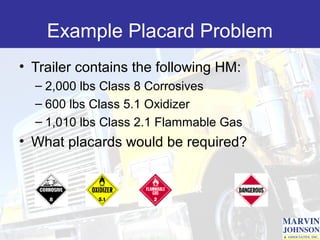
Example Placard Problem
• Trailer contains the following HM:
  – 2,000 lbs Class 8 Corrosives
  – 600 lbs Class 5.1 Oxidizer
  – 1,010 lbs Class 2.1 Flammable Gas
• What placards would be required?


         +       +         OR
Example 2
•   3,000 lbs Class 8 Corrosive
•   600 lbs Class 5 Oxidizer
•   1,010 lbs Class 2.1 Flammable Gas
•   What placards are required?
    – Either specific placards for each as before,
      OR


                          +
REMINDER!
• TABLE 1 REQUIRES HAZARD CLASS
  SPECIFIC PLACARDS IN ANY AMOUNT!
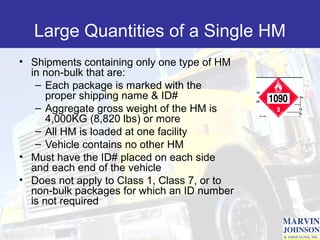
Large Quantities of a Single HM
• Shipments containing only one type of HM
  in non-bulk that are:
   – Each package is marked with the
      proper shipping name & ID#
   – Aggregate gross weight of the HM is
      4,000KG (8,820 lbs) or more
   – All HM is loaded at one facility
   – Vehicle contains no other HM
• Must have the ID# placed on each side
  and each end of the vehicle
• Does not apply to Class 1, Class 7, or to
  non-bulk packages for which an ID number
  is not required
Shipping Papers
    • All HM except            • NEW! - First 4 entries
      ORM-D requires             must be in this order
      shipping papers            (IHSP) – NOTE*
                                 Voluntary compliance
       – UN Identification
                                 begins 1/1/08,
         Number                  mandatory compliance
       – Proper Shipping         begins 1/1/2013
         Name                  • Only quantity can be
       – Hazard Class            abbreviated (lbs..., kg)
                                  – Can be placed 1st or
       – Packaging Group            last
       – Quantity
10 Drums-Hydrochloric Acid/Class 8/UN1789/III/500 gal
Shipping Papers Change
• A new item to watch for in the Basic
  Description in addition to the information
  on the previous slide
  – Must list the number and type of packages
     • i.e. “12 drums” or “12 boxes”, etc.
  – This is different than listing the quantity by
    mass or volume
Mixed Shipments
• 3 ways to identify HM in mixed shipments
  – List HM first on shipping papers
  – Place an “X” in HM column
  – Use contrasting ink color
Shipping Paper Location
• Within reach of the driver when restrained
  in seatbelt
• Tabbed or on top of any other paperwork
• *Should be in plain view*
• When driver leaves vehicle
  – Left in driver’s seat, OR
  – Left in driver’s door pouch
Driver’s Responsibilities
•   Check for proper paperwork
•   Check for proper placards and labels
•   Proper Load securement
•   Check tires according to regulations
•   Know vehicle attendance requirements
Emergency Response Guide
• Contains information on the following:
  – Fires
  – Leaks
  – Spills
  – First Aid
• Must be in driver’s possession while
  transporting HM
ERG Cont...
• Has 4 color coded sections
  – Yellow: when ID# is known
  – Blue: when product name is known
  – Orange: Emergency response info guides
  – Green: Isolation Distances
• Note: highlighted entries are inhalation
  hazards, refer to the green section
Final Precautions
• This training is not meant to make you a
  hazmat emergency responder
• Things you cannot see can kill you
• Things you cannot smell can kill you
• Fire can be invisible
• Do not take unnecessary risks that may do
  severe harm to yourself or others
Thank You for Attending


Hazardous Materials Safety Training

Hazmat training

  • 1.
    Safe Hazardous Materials Transportation Training
  • 2.
    Hazmat Overview • TransportingHM is serious business • >13,000 chemical related deaths annually • >90% of HM shipped over highways • All individuals involved in any manner with HM transport are HM employees as defined in 49CFR
  • 3.
    Hazardous Materials Table •All hazardous materials are on HM table • Alphabetical order by proper shipping name • Each HM has a unique identification number • All begin with UN (United Nations) • Table begins on approximately p.154 in HM Guide • Need product name to use HM Table
  • 4.
    Column 1 -Symbols • (+) => Prohibits any description variation • A => Refers to air transit only • D => Refers to domestics transit only • G =>Requires one or more technical names be entered in parentheses • I => Refers to international transit only • W => Refers to water transit only
  • 5.
    Column 2 -Proper Shipping Name • Descriptions and Proper Shipping Name • If do not have name, but have ID number - use ID Cross Reference chart on p.88 • Numbers are listed in order -- gives you proper shipping name to cross reference to HM Table
  • 6.
    Column 3 -Hazard Class • Each HM is in a Hazard Class • Refer to p.14-15 to see the classes
  • 7.
    Hazard Classes • Class1 - Explosives • Class 6 - Poisons • Class 2 - Gases • Class 7 - Radioactive • Class 3 - Flammable and Materials Combustible Liquids • Class 8 - Corrosives • Class 4 - Flammable • Class 9 - Solids Miscellaneous • Class 5 - Oxidizers and • ORM-D - Other Organic Peroxides Regulated Material
  • 8.
    Column 4 -Product Identification Number • Used to be NA prefixes - being fazed out • New prefix is UN - United Nations – used globally for uniform referencing • Each HM has its own unique ID#
  • 9.
    Column 5 -Packaging Group • Refers to the least necessary packaging group required • Three categories based on degree of danger – PG I - Strongest type, any product can be packed in this type – PG II - intermediate – PG III - Only the least dangerous material may be packed in this type
  • 10.
    Column 6 -Proper Label Code • Refers to the hazard warning labels required for the package • All HM packages are required to be labeled • Labels should be facing out when loaded on skids
  • 11.
    Column 7 -Special Provisions • Refers to the special provisions listing that begins on page 515 • Should be checked for any special precautions or information on product
  • 12.
    Hazardous Substances • Materialincluding its mixtures and solutions, in a quantity, in one package, that equals or exceeds the reportable quantity listed. • Appendix A, 172.101 beginning on page 441
  • 13.
    Hazardous Substance Cont… •If the quantity exceeds the RQ, the letters RQ must appear – Either before or after the description on the shipping papers – OR RQ can be in place of the “X” in HM column
  • 14.
    When is PlacardingRequired? • Depends on TYPE and QUANTITY • TABLE 1 requires placards in any amount – refer to page 37 • TABLE 2 (page 37-38) requires placards when amount exceeds 454 kilograms, or 1,001 lbs.....
  • 15.
    1,000 Kilogram Rule •If aggregate weight of all TABLE 2 materials exceeds 454 kg, but no one product exceeds 1,000 kg(2,205 lbs) a DANGEROUS placard can be used in lieu of the specific placards • Remember these conversions – 1,000 kg = 2,205 lbs – 454 kg = 1,001 lbs
  • 16.
    Example Placard Problem •Trailer contains the following HM: – 2,000 lbs Class 8 Corrosives – 600 lbs Class 5.1 Oxidizer – 1,010 lbs Class 2.1 Flammable Gas • What placards would be required? + + OR
  • 17.
    Example 2 • 3,000 lbs Class 8 Corrosive • 600 lbs Class 5 Oxidizer • 1,010 lbs Class 2.1 Flammable Gas • What placards are required? – Either specific placards for each as before, OR +
  • 18.
    REMINDER! • TABLE 1REQUIRES HAZARD CLASS SPECIFIC PLACARDS IN ANY AMOUNT!
  • 19.
    Large Quantities ofa Single HM • Shipments containing only one type of HM in non-bulk that are: – Each package is marked with the proper shipping name & ID# – Aggregate gross weight of the HM is 4,000KG (8,820 lbs) or more – All HM is loaded at one facility – Vehicle contains no other HM • Must have the ID# placed on each side and each end of the vehicle • Does not apply to Class 1, Class 7, or to non-bulk packages for which an ID number is not required
  • 20.
    Shipping Papers • All HM except • NEW! - First 4 entries ORM-D requires must be in this order shipping papers (IHSP) – NOTE* Voluntary compliance – UN Identification begins 1/1/08, Number mandatory compliance – Proper Shipping begins 1/1/2013 Name • Only quantity can be – Hazard Class abbreviated (lbs..., kg) – Can be placed 1st or – Packaging Group last – Quantity 10 Drums-Hydrochloric Acid/Class 8/UN1789/III/500 gal
  • 21.
    Shipping Papers Change •A new item to watch for in the Basic Description in addition to the information on the previous slide – Must list the number and type of packages • i.e. “12 drums” or “12 boxes”, etc. – This is different than listing the quantity by mass or volume
  • 22.
    Mixed Shipments • 3ways to identify HM in mixed shipments – List HM first on shipping papers – Place an “X” in HM column – Use contrasting ink color
  • 23.
    Shipping Paper Location •Within reach of the driver when restrained in seatbelt • Tabbed or on top of any other paperwork • *Should be in plain view* • When driver leaves vehicle – Left in driver’s seat, OR – Left in driver’s door pouch
  • 24.
    Driver’s Responsibilities • Check for proper paperwork • Check for proper placards and labels • Proper Load securement • Check tires according to regulations • Know vehicle attendance requirements
  • 25.
    Emergency Response Guide •Contains information on the following: – Fires – Leaks – Spills – First Aid • Must be in driver’s possession while transporting HM
  • 26.
    ERG Cont... • Has4 color coded sections – Yellow: when ID# is known – Blue: when product name is known – Orange: Emergency response info guides – Green: Isolation Distances • Note: highlighted entries are inhalation hazards, refer to the green section
  • 27.
    Final Precautions • Thistraining is not meant to make you a hazmat emergency responder • Things you cannot see can kill you • Things you cannot smell can kill you • Fire can be invisible • Do not take unnecessary risks that may do severe harm to yourself or others
  • 28.
    Thank You forAttending Hazardous Materials Safety Training