This Section Covers
• The Intent of the Regulations
• Bulk Tank Loading, Unloading, and Marking
• Driver Responsibilities
• Driving and Parking Rules
• Communications Rules
• Emergencies
• Loading and Unloading
HAZARDOUS
MATERIALS
Section 9
Hazardous materials are products that pose a risk to health, safety, and
property during transportation. The term often is shortened to HAZMAT, which
you may see on road signs, or to HM in government regulations. Hazardous
materials include explosives, various types of gas, solids, flammable and
combustible liquid, and other materials. Because of the risks involved and the
potential consequences these risks impose, all levels of government regulate
the handling of hazardous materials.
The Hazardous Materials Regulations (HMR) is found in parts 171 - 180 of
title 49 of the Code of Federal Regulations. The common reference for these
regulations is 49 CFR 171 - 180
The Hazardous Materials Table in the regulations contains a list of these
items. However, this list is not all-inclusive.
Whether or not a material is considered hazardous is based on its
characteristics and the shipper's decision on whether or not the material
meets a definition of a hazardous material in the regulations.
The regulations require vehicles transporting certain types or quantities of
hazardous materials to display diamond-shaped, square on point, warning
signs called placards.
This section is designed to assist you in understanding your role and
responsibilities in hauling hazardous materials. Due to the constantly
changing nature of government regulations, it is impossible to guarantee
absolute accuracy of the materials in this section. An up-to-date copy of the
complete regulations is essential for you to have. Included in these regulations
is a complete glossary of terms.
You must have a commercial driver license (CDL) with a hazardous materials
endorsement before you drive any size vehicle that is used to transport
hazardous material as defined in 49 CFR 383.5. You must pass a written test
about the regulations and requirements to get this endorsement.
Everything you need to know to pass the written test is in this section.
However, this is only a beginning. Most drivers need to know much more on
the job. You can learn more by reading and understanding the federal and
state rules applicable to hazardous materials, as well as, attending hazardous
materials training courses. Your employer, colleges and universities, and
various associations usually offer these courses. You can get copies of the
Federal Regulations (49 CFR) through your local Government Printing Office
bookstore and various industry publishers. Union or company offices often
have copies of the rules for driver use. Find out where you can get your own
copy to use on the job.
The regulations require training and testing for all drivers involved in
transporting hazardous materials. Your employer or a designated
representative is required to provide this training and testing. Hazardous
materials employers are required to keep a record of training for each
employee as long as that employee is working with hazardous materials, and
for 90 days thereafter. The regulations require that hazardous materials
employees be trained and tested at least once every three years.
All drivers must be trained in the security risks of hazardous materials
transportation. This training must include how to recognize and respond to
possible security threats.
The regulations also require that drivers have special training before driving a
vehicle transporting certain flammable gas materials or highway route
controlled quantities of radioactive materials.
In addition, drivers transporting cargo tanks and portable tanks must receive
specialized training. Each driver’s employer or his or her designated
representative must provide such training.
Some locations require permits to transport certain explosives or bulk
hazardous wastes. States and counties also may require drivers to follow
special hazardous materials routes. The federal government may require
permits or exemptions for special hazardous materials cargo such as rocket
fuel. Find out about permits, exemptions, and special routes for the places you
drive
9.1.3 – Assure Safe Drivers and Equipment
In order to get a hazardous materials endorsement on a CDL, you must pass
a written test about transporting hazardous materials. To pass the test, you
must know how to:
Identify what are hazardous materials. Safely load shipments.
Properly placard your vehicle in accordance with the rules.
Safely transport shipments.
Learn the rules and follow them. Following the rules reduces the risk of injury
from hazardous materials. Taking shortcuts by breaking rules is unsafe. Non-
compliance with regulations can result in fines and jail.
Inspect your vehicle before and during each trip. Law enforcement officers
may stop and inspect your vehicle. When stopped, they may check your
shipping papers, vehicle placards, and the hazardous materials endorsement
on your driver license, and your knowledge of hazardous materials.
9.2 – Hazardous Materials Transportation—Who Does
What
9.2.1 – The Shipper
Sends products from one place to another by truck, rail, vessel, or airplane.
Uses the hazardous materials regulations to determine the product’s:
Identification number Proper shipping name. Hazard class.
Packing group. Correct packaging.
Correct label and markings. Correct placards.
Must package, mark, and label the materials; prepare shipping papers;
provide emergency response information; and supply placards.
Certify on the shipping paper that the shipment has been prepared according
to the rules (unless you are pulling cargo tanks supplied by you or your
employer).
9.2.2 – The Carrier
Takes the shipment from the shipper to its destination.
Prior to transportation, checks that the shipper correctly described, marked,
labeled, and otherwise prepared the shipment for transportation.
Refuses improper shipments.
9.2.3 – The Driver
Makes sure the shipper has identified, marked, and labeled the hazardous
materials properly.
Refuses leaking packages and shipments. Placards vehicle when loading, if
required. Safely transports the shipment without delay.
Follows all special rules about transporting hazardous materials.
Keeps hazardous materials shipping papers and emergency response
information in the proper place.
Reports accidents and incidents involving hazardous materials to the proper
government agency, when the accident/incident occurs while driver is in
physical control of the shipment.
9.3 – Communication Rules
9.3.1 – Definitions
Some words and phrases have special meanings when talking about
hazardous materials. Some of these may differ from meanings you are used
to. The words and phrases in this section may be on your test. The meanings
of other important words are in the glossary at the end of Section 9.
A material's hazard class reflects the risks associated with it. There are nine
different hazard classes. The types of materials included in these nine classes
are in Figure 9.1.
HazardousMaterialsClass
Class Division NameofClassorDivision
Examples
1.1 MassExplosion DynamiteFlaresDisplay
FireworksAmmunitionBlasting
AgentsExplosiveDevices
1.2 ProjectionHazard
1.3 FireHazard
1 1.4 MinorExplosion
1.5 VeryInsensitive
1.6 Extremely
Insensitive
2.1 FlammableGases Propane
2 2.2 Non-FlammableGases Helium
2.3 Poisonous/Toxic Fluorine,Compressed
Gases
3 - FlammableLiquids Gasoline
4 4.14.2 4.3 Flammable
SolidsSpontaneouslyCombustibleDangerous
WhenWet
Ammonium Picrate,WettedWhite
PhosphorusSodium
5 5.15.2 OxidizersOrganicPeroxides Ammonium NitrateMethylEthylKetonePeroxide
6.1 Poison(Toxic PotassiumCyanide
6 Material)
6.2 Infectious AnthraxVirus
Substances
7 - Radioactive Uranium
8 - Corrosives BatteryFluid
9 - MiscellaneousHazardousMaterials PolychlorinatedBiphenyls(PCB)
None
- ORM-D (OtherRegulated Material-Domestic) Food Flavorings,Medicines
- CombustibleLiquids FuelOil
Figure 9.1
A shipping paper describes the hazardous materials being transported.
Shipping orders, bills of lading, and manifests are all shipping papers. Figure
9.6 shows an example shipping paper.
After an accident or hazardous materials spill or leak, you may be injured and
unable to communicate the hazards of the materials you are transporting.
Firefighters and police can prevent or reduce the amount of damage or injury
at the scene if they know what hazardous materials are being carried. Your
life, and the lives of others, may depend on quickly locating the hazardous
materials shipping papers. For that reason the rules require:
Shippers to describe hazardous materials correctly and include an emergency
response telephone number on shipping papers.
Carriers and drivers to quickly identify hazardous materials shipping papers,
or keep them on top of other shipping papers and keep the required
emergency response information with the shipping papers.
Drivers to keep hazardous materials shipping papers:
In a pouch on the driver's door, or
In clear view within immediate reach while the seat belt is fastened while
driving, or
On the driver's seat when out of the vehicle.
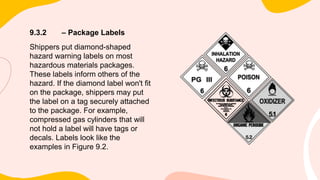
9.3.2 – Package Labels
Shippers put diamond-shaped
hazard warning labels on most
hazardous materials packages.
These labels inform others of the
hazard. If the diamond label won't fit
on the package, shippers may put
the label on a tag securely attached
to the package. For example,
compressed gas cylinders that will
not hold a label will have tags or
decals. Labels look like the
examples in Figure 9.2.
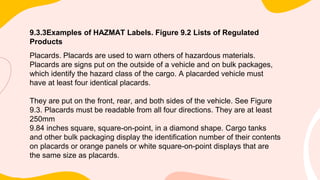
9.3.3Examples of HAZMAT Labels. Figure 9.2 Lists of Regulated
Products
Placards. Placards are used to warn others of hazardous materials.
Placards are signs put on the outside of a vehicle and on bulk packages,
which identify the hazard class of the cargo. A placarded vehicle must
have at least four identical placards.
They are put on the front, rear, and both sides of the vehicle. See Figure
9.3. Placards must be readable from all four directions. They are at least
250mm
9.84 inches square, square-on-point, in a diamond shape. Cargo tanks
and other bulk packaging display the identification number of their contents
on placards or orange panels or white square-on-point displays that are
the same size as placards.
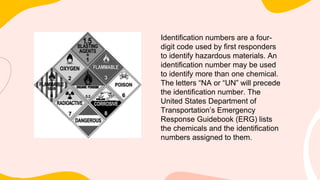
Identification numbers are a four-
digit code used by first responders
to identify hazardous materials. An
identification number may be used
to identify more than one chemical.
The letters “NA or “UN” will precede
the identification number. The
United States Department of
Transportation’s Emergency
Response Guidebook (ERG) lists
the chemicals and the identification
numbers assigned to them.
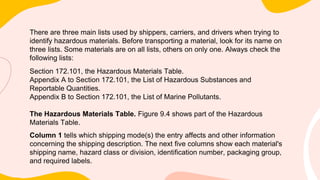
There are three main lists used by shippers, carriers, and drivers when trying to
identify hazardous materials. Before transporting a material, look for its name on
three lists. Some materials are on all lists, others on only one. Always check the
following lists:
Section 172.101, the Hazardous Materials Table.
Appendix A to Section 172.101, the List of Hazardous Substances and
Reportable Quantities.
Appendix B to Section 172.101, the List of Marine Pollutants.
The Hazardous Materials Table. Figure 9.4 shows part of the Hazardous
Materials Table.
Column 1 tells which shipping mode(s) the entry affects and other information
concerning the shipping description. The next five columns show each material's
shipping name, hazard class or division, identification number, packaging group,
and required labels.
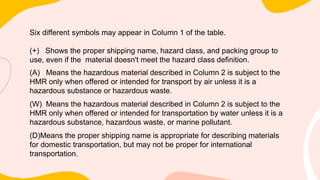
Six different symbols may appear in Column 1 of the table.
(+) Shows the proper shipping name, hazard class, and packing group to
use, even if the material doesn't meet the hazard class definition.
(A) Means the hazardous material described in Column 2 is subject to the
HMR only when offered or intended for transport by air unless it is a
hazardous substance or hazardous waste.
(W) Means the hazardous material described in Column 2 is subject to the
HMR only when offered or intended for transportation by water unless it is a
hazardous substance, hazardous waste, or marine pollutant.
(D)Means the proper shipping name is appropriate for describing materials
for domestic transportation, but may not be proper for international
transportation.
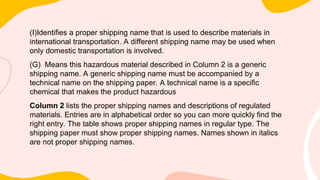
(I)Identifies a proper shipping name that is used to describe materials in
international transportation. A different shipping name may be used when
only domestic transportation is involved.
(G) Means this hazardous material described in Column 2 is a generic
shipping name. A generic shipping name must be accompanied by a
technical name on the shipping paper. A technical name is a specific
chemical that makes the product hazardous
Column 2 lists the proper shipping names and descriptions of regulated
materials. Entries are in alphabetical order so you can more quickly find the
right entry. The table shows proper shipping names in regular type. The
shipping paper must show proper shipping names. Names shown in italics
are not proper shipping names.
49CFR172.101HazardousMaterialsTable
Symbols Hazardous MaterialsDescription
& ProperShippingNames HazardClass
orDivision
IdentificationNumbe
rs
PG
LabelCodes SpecialProvision
s(172.102)
Packaging(173.***)
Exceptions NonBulk Bulk
(1) (2) (3) (4) (5) (6) (7) (8A) (8B) (8C)
A Acetaldehydeammonia 9 UN1841 III 9 IB8,IP3, 155 204 240
IP7,T1,
TP33

New 1 - HAZARDOUS MATERIALS 1.pptx

  • 1.
    This Section Covers •The Intent of the Regulations • Bulk Tank Loading, Unloading, and Marking • Driver Responsibilities • Driving and Parking Rules • Communications Rules • Emergencies • Loading and Unloading HAZARDOUS MATERIALS Section 9
  • 2.
    Hazardous materials areproducts that pose a risk to health, safety, and property during transportation. The term often is shortened to HAZMAT, which you may see on road signs, or to HM in government regulations. Hazardous materials include explosives, various types of gas, solids, flammable and combustible liquid, and other materials. Because of the risks involved and the potential consequences these risks impose, all levels of government regulate the handling of hazardous materials. The Hazardous Materials Regulations (HMR) is found in parts 171 - 180 of title 49 of the Code of Federal Regulations. The common reference for these regulations is 49 CFR 171 - 180 The Hazardous Materials Table in the regulations contains a list of these items. However, this list is not all-inclusive.
  • 3.
    Whether or nota material is considered hazardous is based on its characteristics and the shipper's decision on whether or not the material meets a definition of a hazardous material in the regulations. The regulations require vehicles transporting certain types or quantities of hazardous materials to display diamond-shaped, square on point, warning signs called placards. This section is designed to assist you in understanding your role and responsibilities in hauling hazardous materials. Due to the constantly changing nature of government regulations, it is impossible to guarantee absolute accuracy of the materials in this section. An up-to-date copy of the complete regulations is essential for you to have. Included in these regulations is a complete glossary of terms.
  • 4.
    You must havea commercial driver license (CDL) with a hazardous materials endorsement before you drive any size vehicle that is used to transport hazardous material as defined in 49 CFR 383.5. You must pass a written test about the regulations and requirements to get this endorsement. Everything you need to know to pass the written test is in this section. However, this is only a beginning. Most drivers need to know much more on the job. You can learn more by reading and understanding the federal and state rules applicable to hazardous materials, as well as, attending hazardous materials training courses. Your employer, colleges and universities, and various associations usually offer these courses. You can get copies of the Federal Regulations (49 CFR) through your local Government Printing Office bookstore and various industry publishers. Union or company offices often have copies of the rules for driver use. Find out where you can get your own copy to use on the job.
  • 5.
    The regulations requiretraining and testing for all drivers involved in transporting hazardous materials. Your employer or a designated representative is required to provide this training and testing. Hazardous materials employers are required to keep a record of training for each employee as long as that employee is working with hazardous materials, and for 90 days thereafter. The regulations require that hazardous materials employees be trained and tested at least once every three years. All drivers must be trained in the security risks of hazardous materials transportation. This training must include how to recognize and respond to possible security threats. The regulations also require that drivers have special training before driving a vehicle transporting certain flammable gas materials or highway route controlled quantities of radioactive materials.
  • 6.
    In addition, driverstransporting cargo tanks and portable tanks must receive specialized training. Each driver’s employer or his or her designated representative must provide such training. Some locations require permits to transport certain explosives or bulk hazardous wastes. States and counties also may require drivers to follow special hazardous materials routes. The federal government may require permits or exemptions for special hazardous materials cargo such as rocket fuel. Find out about permits, exemptions, and special routes for the places you drive
  • 7.
    9.1.3 – AssureSafe Drivers and Equipment In order to get a hazardous materials endorsement on a CDL, you must pass a written test about transporting hazardous materials. To pass the test, you must know how to: Identify what are hazardous materials. Safely load shipments. Properly placard your vehicle in accordance with the rules. Safely transport shipments. Learn the rules and follow them. Following the rules reduces the risk of injury from hazardous materials. Taking shortcuts by breaking rules is unsafe. Non- compliance with regulations can result in fines and jail. Inspect your vehicle before and during each trip. Law enforcement officers may stop and inspect your vehicle. When stopped, they may check your shipping papers, vehicle placards, and the hazardous materials endorsement on your driver license, and your knowledge of hazardous materials.
  • 8.
    9.2 – HazardousMaterials Transportation—Who Does What 9.2.1 – The Shipper Sends products from one place to another by truck, rail, vessel, or airplane. Uses the hazardous materials regulations to determine the product’s: Identification number Proper shipping name. Hazard class. Packing group. Correct packaging. Correct label and markings. Correct placards. Must package, mark, and label the materials; prepare shipping papers; provide emergency response information; and supply placards. Certify on the shipping paper that the shipment has been prepared according to the rules (unless you are pulling cargo tanks supplied by you or your employer).
  • 9.
    9.2.2 – TheCarrier Takes the shipment from the shipper to its destination. Prior to transportation, checks that the shipper correctly described, marked, labeled, and otherwise prepared the shipment for transportation. Refuses improper shipments. 9.2.3 – The Driver Makes sure the shipper has identified, marked, and labeled the hazardous materials properly. Refuses leaking packages and shipments. Placards vehicle when loading, if required. Safely transports the shipment without delay. Follows all special rules about transporting hazardous materials. Keeps hazardous materials shipping papers and emergency response information in the proper place.
  • 10.
    Reports accidents andincidents involving hazardous materials to the proper government agency, when the accident/incident occurs while driver is in physical control of the shipment. 9.3 – Communication Rules 9.3.1 – Definitions Some words and phrases have special meanings when talking about hazardous materials. Some of these may differ from meanings you are used to. The words and phrases in this section may be on your test. The meanings of other important words are in the glossary at the end of Section 9. A material's hazard class reflects the risks associated with it. There are nine different hazard classes. The types of materials included in these nine classes are in Figure 9.1.
  • 11.
    HazardousMaterialsClass Class Division NameofClassorDivision Examples 1.1MassExplosion DynamiteFlaresDisplay FireworksAmmunitionBlasting AgentsExplosiveDevices 1.2 ProjectionHazard 1.3 FireHazard 1 1.4 MinorExplosion 1.5 VeryInsensitive 1.6 Extremely Insensitive 2.1 FlammableGases Propane 2 2.2 Non-FlammableGases Helium 2.3 Poisonous/Toxic Fluorine,Compressed Gases 3 - FlammableLiquids Gasoline 4 4.14.2 4.3 Flammable SolidsSpontaneouslyCombustibleDangerous WhenWet Ammonium Picrate,WettedWhite PhosphorusSodium 5 5.15.2 OxidizersOrganicPeroxides Ammonium NitrateMethylEthylKetonePeroxide 6.1 Poison(Toxic PotassiumCyanide 6 Material) 6.2 Infectious AnthraxVirus Substances 7 - Radioactive Uranium 8 - Corrosives BatteryFluid 9 - MiscellaneousHazardousMaterials PolychlorinatedBiphenyls(PCB) None - ORM-D (OtherRegulated Material-Domestic) Food Flavorings,Medicines - CombustibleLiquids FuelOil
  • 12.
    Figure 9.1 A shippingpaper describes the hazardous materials being transported. Shipping orders, bills of lading, and manifests are all shipping papers. Figure 9.6 shows an example shipping paper. After an accident or hazardous materials spill or leak, you may be injured and unable to communicate the hazards of the materials you are transporting. Firefighters and police can prevent or reduce the amount of damage or injury at the scene if they know what hazardous materials are being carried. Your life, and the lives of others, may depend on quickly locating the hazardous materials shipping papers. For that reason the rules require: Shippers to describe hazardous materials correctly and include an emergency response telephone number on shipping papers.
  • 13.
    Carriers and driversto quickly identify hazardous materials shipping papers, or keep them on top of other shipping papers and keep the required emergency response information with the shipping papers. Drivers to keep hazardous materials shipping papers: In a pouch on the driver's door, or In clear view within immediate reach while the seat belt is fastened while driving, or On the driver's seat when out of the vehicle.
  • 14.
    9.3.2 – PackageLabels Shippers put diamond-shaped hazard warning labels on most hazardous materials packages. These labels inform others of the hazard. If the diamond label won't fit on the package, shippers may put the label on a tag securely attached to the package. For example, compressed gas cylinders that will not hold a label will have tags or decals. Labels look like the examples in Figure 9.2.
  • 15.
    9.3.3Examples of HAZMATLabels. Figure 9.2 Lists of Regulated Products Placards. Placards are used to warn others of hazardous materials. Placards are signs put on the outside of a vehicle and on bulk packages, which identify the hazard class of the cargo. A placarded vehicle must have at least four identical placards. They are put on the front, rear, and both sides of the vehicle. See Figure 9.3. Placards must be readable from all four directions. They are at least 250mm 9.84 inches square, square-on-point, in a diamond shape. Cargo tanks and other bulk packaging display the identification number of their contents on placards or orange panels or white square-on-point displays that are the same size as placards.
  • 16.
    Identification numbers area four- digit code used by first responders to identify hazardous materials. An identification number may be used to identify more than one chemical. The letters “NA or “UN” will precede the identification number. The United States Department of Transportation’s Emergency Response Guidebook (ERG) lists the chemicals and the identification numbers assigned to them.
  • 17.
    There are threemain lists used by shippers, carriers, and drivers when trying to identify hazardous materials. Before transporting a material, look for its name on three lists. Some materials are on all lists, others on only one. Always check the following lists: Section 172.101, the Hazardous Materials Table. Appendix A to Section 172.101, the List of Hazardous Substances and Reportable Quantities. Appendix B to Section 172.101, the List of Marine Pollutants. The Hazardous Materials Table. Figure 9.4 shows part of the Hazardous Materials Table. Column 1 tells which shipping mode(s) the entry affects and other information concerning the shipping description. The next five columns show each material's shipping name, hazard class or division, identification number, packaging group, and required labels.
  • 18.
    Six different symbolsmay appear in Column 1 of the table. (+) Shows the proper shipping name, hazard class, and packing group to use, even if the material doesn't meet the hazard class definition. (A) Means the hazardous material described in Column 2 is subject to the HMR only when offered or intended for transport by air unless it is a hazardous substance or hazardous waste. (W) Means the hazardous material described in Column 2 is subject to the HMR only when offered or intended for transportation by water unless it is a hazardous substance, hazardous waste, or marine pollutant. (D)Means the proper shipping name is appropriate for describing materials for domestic transportation, but may not be proper for international transportation.
  • 19.
    (I)Identifies a propershipping name that is used to describe materials in international transportation. A different shipping name may be used when only domestic transportation is involved. (G) Means this hazardous material described in Column 2 is a generic shipping name. A generic shipping name must be accompanied by a technical name on the shipping paper. A technical name is a specific chemical that makes the product hazardous Column 2 lists the proper shipping names and descriptions of regulated materials. Entries are in alphabetical order so you can more quickly find the right entry. The table shows proper shipping names in regular type. The shipping paper must show proper shipping names. Names shown in italics are not proper shipping names.
  • 20.
    49CFR172.101HazardousMaterialsTable Symbols Hazardous MaterialsDescription &ProperShippingNames HazardClass orDivision IdentificationNumbe rs PG LabelCodes SpecialProvision s(172.102) Packaging(173.***) Exceptions NonBulk Bulk (1) (2) (3) (4) (5) (6) (7) (8A) (8B) (8C) A Acetaldehydeammonia 9 UN1841 III 9 IB8,IP3, 155 204 240 IP7,T1, TP33