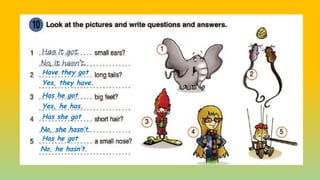
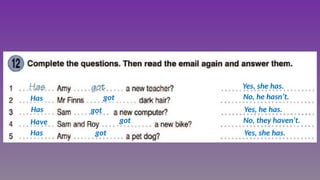
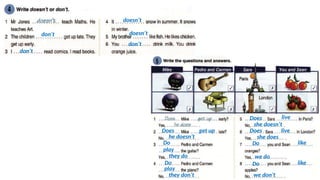
Yes, she has.
Yes,he has.
Yes, she has.
No, he hasn’t.
No, they haven’t.
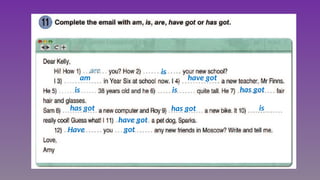
Has
Has
Has
Have
got
got
got
got
4.
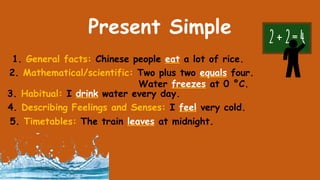
Present Simple
1. Generalfacts: Chinese people eat a lot of rice.
2. Mathematical/scientific: Two plus two equals four.
Water freezes at 0 °С.
3. Habitual: I drink water every day.
4. Describing Feelings and Senses: I feel very cold.
5. Timetables: The train leaves at midnight.
5.
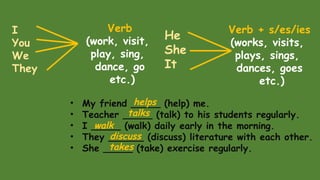
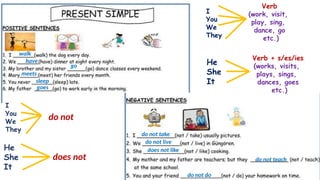
• My friend_____ (help) me.
• Teacher _____ (talk) to his students regularly.
• I _____ (walk) daily early in the morning.
• They ______ (discuss) literature with each other.
• She _____ (take) exercise regularly.
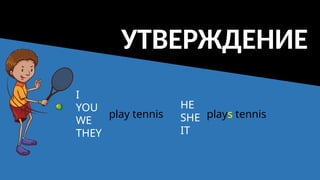
He
She
It
I
You
We
They
Verb
(work, visit,
play, sing,
dance, go
etc.)
Verb + s/es/ies
(works, visits,
plays, sings,
dances, goes
etc.)
helps
talks
walk
discuss
takes
6.
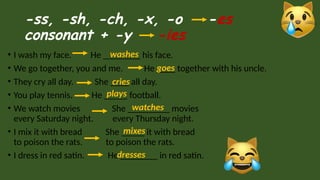
-ss, -sh, -ch,-x, -o -es
consonant + -y -ies
• I wash my face. He ________ his face.
• We go together, you and me. He ____ together with his uncle.
• They cry all day. She ____ all day.
• You play tennis. He _____ football.
• We watch movies She _________ movies
every Saturday night. every Thursday night.
• I mix it with bread She _____ it with bread
to poison the rats. to poison the rats.
• I dress in red satin. He ________ in red satin.
washes
goes
cries
plays
watches
mixes
dresses
7.
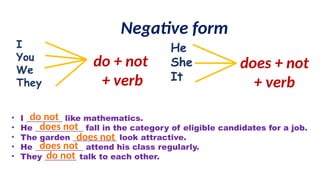
Negative form
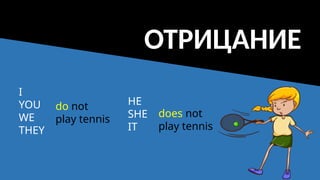
I
You
We
They
He
She
It
do +not
+ verb
does + not
+ verb
• I _________ like mathematics.
• He ____________ fall in the category of eligible candidates for a job.
• The garden ___________ look attractive.
• He ____________ attend his class regularly.
• They ________ talk to each other.
do not
do not
does not
does not
does not
8.
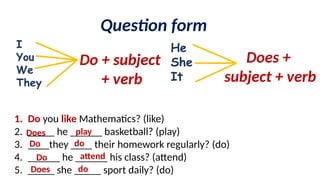
Question form
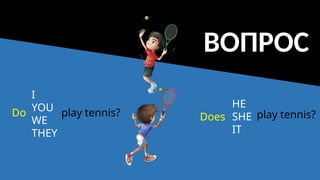
I
You
We
They
He
She
It
Do +subject
+ verb
Does +
subject + verb
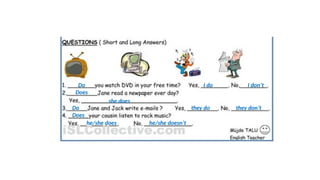
1. Do you like Mathematics? (like)
2. _____ he ______ basketball? (play)
3. ____they ____ their homework regularly? (do)
4. ______ he ______ his class? (attend)
5. _____ she _____ sport daily? (do)
Does play
do
Does
Do do
attend
Do
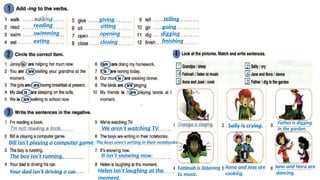
reading
swimming
eating
giving
sitting
opening
closing
telling
going
digging
finishing
Bill isn’t playinga computer game.
The boy isn’t running.
Your dad isn’t driving a car.
We aren’t watching TV.
The boys aren’t writing in their notebooks.
It isn’t snowing now.
Helen isn’t laughing at the
moment.
4
5
2
6
3
Sally is crying.
Father is digging
in the garden.
Fatimah is listening
to music.
Anna and Jose are
cooking.
Jane and Nora are
dancing.