HARSHA E.C.
CALICUT UNIVERSITY
Information science is often considered as a
branch of computer science. However it is
actually a broad interdisciplinary field,
incorporating not only aspects of computer
science. But often diverse fields such as
archival science, commerce,
communication, law, library science,
management, mathematics, philosophy,
social science.
Information science should not be confused
with information theory and library science.
Information theory is the study of a
particular mathematical concept of
information.
Information science as an academic
discipline is often taught in combination
with Library science as Library and
information science.
Information science deals with all the
processes and techniques including
generation, dissemination, usage etc:
In nutshell , Information science is the study
about Information itself , as Economics is
the study about economic system, Library
science is the study about library and
techniques . Hence information science
discuss on information and how it is used by
people with the help of new technology
especially by computer.
In 1960’s Information science was concerned
primarily with applying the new computer
technology to the processing and
managing of documents.
An early definition of information science going
back to 1968, the year when American society
for Information science and Technology is
“Information science is that discipline that
investigate the properties and behavior of
information , the forces governing the flow of
information , and the means of processing
information for optimum accessibility and
usability . It is concerned with that body of
knowledge relating to the origination ,
collection, organization, transformation and
utilization of information. There is information
processing device and their programming
systems.
Clearly, Information science is the study of the
nature, collection and management of
information and of it’s uses especially involving
computer storage and retrievals , interpretation
, transformation and utilization of information
through database .
There is no necessity to confuse with Library and
information science and Information science.
Library and information science utilized
information science in order to enrich or widen
the Library science. So Library science merge
with Information science and became Library
and information science ( Adopt new
technologies and evolve new techniques to
satisfy uses)
The Department of Information science at
otago focuses
“The concept became particularly
predominant since the end of world war
second with the wide spread use of
computer network.”
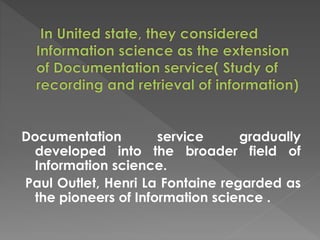
Documentation service gradually
developed into the broader field of
Information science.
Paul Outlet, Henri La Fontaine regarded as
the pioneers of Information science .
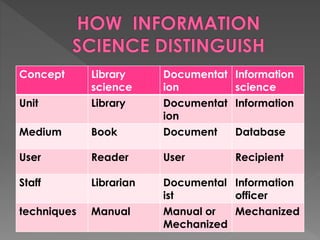
Concept Library
science
Documentat
ion
Information
science
Unit Library Documentat
ion
Information
Medium Book Document Database
User Reader User Recipient
Staff Librarian Documental
ist
Information
officer
techniques Manual Manual or
Mechanized
Mechanized
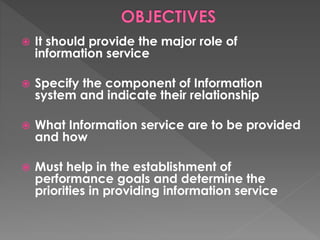
 It should provide the major role of
information service
 Specify the component of Information
system and indicate their relationship
 What Information service are to be provided
and how
 Must help in the establishment of
performance goals and determine the
priorities in providing information service
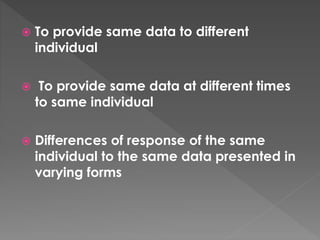
 To provide same data to different
individual
 To provide same data at different times
to same individual
 Differences of response of the same
individual to the same data presented in
varying forms
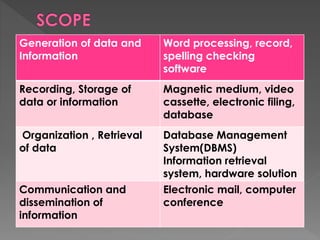
Generation of data and
Information
Word processing, record,
spelling checking
software
Recording, Storage of
data or information
Magnetic medium, video
cassette, electronic filing,
database
Organization , Retrieval
of data
Database Management
System(DBMS)
Information retrieval
system, hardware solution
Communication and
dissemination of
information
Electronic mail, computer
conference
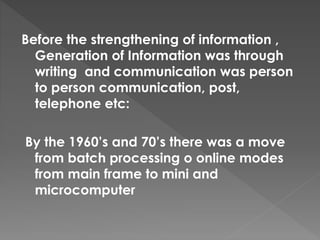
Before the strengthening of information ,
Generation of Information was through
writing and communication was person
to person communication, post,
telephone etc:
By the 1960’s and 70’s there was a move
from batch processing o online modes
from main frame to mini and
microcomputer
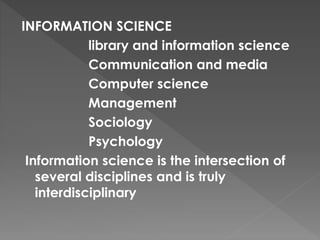
INFORMATION SCIENCE
library and information science
Communication and media
Computer science
Management
Sociology
Psychology
Information science is the intersection of
several disciplines and is truly
interdisciplinary
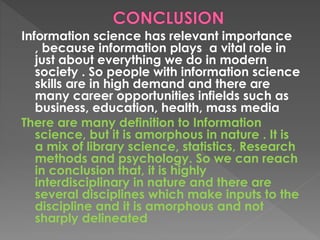
Information science has relevant importance
, because information plays a vital role in
just about everything we do in modern
society . So people with information science
skills are in high demand and there are
many career opportunities infields such as
business, education, health, mass media
There are many definition to Information
science, but it is amorphous in nature . It is
a mix of library science, statistics, Research
methods and psychology. So we can reach
in conclusion that, it is highly
interdisciplinary in nature and there are
several disciplines which make inputs to the
discipline and it is amorphous and not
sharply delineated
THANK YOU

Harsha, information

  • 1.
  • 3.
    Information science isoften considered as a branch of computer science. However it is actually a broad interdisciplinary field, incorporating not only aspects of computer science. But often diverse fields such as archival science, commerce, communication, law, library science, management, mathematics, philosophy, social science. Information science should not be confused with information theory and library science. Information theory is the study of a particular mathematical concept of information.
  • 4.
    Information science asan academic discipline is often taught in combination with Library science as Library and information science. Information science deals with all the processes and techniques including generation, dissemination, usage etc:
  • 5.
    In nutshell ,Information science is the study about Information itself , as Economics is the study about economic system, Library science is the study about library and techniques . Hence information science discuss on information and how it is used by people with the help of new technology especially by computer. In 1960’s Information science was concerned primarily with applying the new computer technology to the processing and managing of documents.
  • 6.
    An early definitionof information science going back to 1968, the year when American society for Information science and Technology is “Information science is that discipline that investigate the properties and behavior of information , the forces governing the flow of information , and the means of processing information for optimum accessibility and usability . It is concerned with that body of knowledge relating to the origination , collection, organization, transformation and utilization of information. There is information processing device and their programming systems.
  • 7.
    Clearly, Information scienceis the study of the nature, collection and management of information and of it’s uses especially involving computer storage and retrievals , interpretation , transformation and utilization of information through database . There is no necessity to confuse with Library and information science and Information science. Library and information science utilized information science in order to enrich or widen the Library science. So Library science merge with Information science and became Library and information science ( Adopt new technologies and evolve new techniques to satisfy uses)
  • 8.
    The Department ofInformation science at otago focuses “The concept became particularly predominant since the end of world war second with the wide spread use of computer network.”
  • 9.
    Documentation service gradually developedinto the broader field of Information science. Paul Outlet, Henri La Fontaine regarded as the pioneers of Information science .
  • 10.
    Concept Library science Documentat ion Information science Unit LibraryDocumentat ion Information Medium Book Document Database User Reader User Recipient Staff Librarian Documental ist Information officer techniques Manual Manual or Mechanized Mechanized
  • 11.
     It shouldprovide the major role of information service  Specify the component of Information system and indicate their relationship  What Information service are to be provided and how  Must help in the establishment of performance goals and determine the priorities in providing information service
  • 12.
     To providesame data to different individual  To provide same data at different times to same individual  Differences of response of the same individual to the same data presented in varying forms
  • 13.
    Generation of dataand Information Word processing, record, spelling checking software Recording, Storage of data or information Magnetic medium, video cassette, electronic filing, database Organization , Retrieval of data Database Management System(DBMS) Information retrieval system, hardware solution Communication and dissemination of information Electronic mail, computer conference
  • 14.
    Before the strengtheningof information , Generation of Information was through writing and communication was person to person communication, post, telephone etc: By the 1960’s and 70’s there was a move from batch processing o online modes from main frame to mini and microcomputer
  • 15.
    INFORMATION SCIENCE library andinformation science Communication and media Computer science Management Sociology Psychology Information science is the intersection of several disciplines and is truly interdisciplinary
  • 16.
    Information science hasrelevant importance , because information plays a vital role in just about everything we do in modern society . So people with information science skills are in high demand and there are many career opportunities infields such as business, education, health, mass media There are many definition to Information science, but it is amorphous in nature . It is a mix of library science, statistics, Research methods and psychology. So we can reach in conclusion that, it is highly interdisciplinary in nature and there are several disciplines which make inputs to the discipline and it is amorphous and not sharply delineated
  • 17.