Tina Harralson,1 Linda Toche-Manley,1 
Laura Dietzen,1 Grant Grissom,1 
Erin O’Hea,2 & Edwin Boudreaux 2 
1 Polaris Health Directions, Langhorne, PA 
2 University of Massachusetts Medical School, Worcester, MA
With NIH funding, in 2006, Polaris staff and UMass 
Medical School researchers specializing in Psycho-oncology 
began work on filling a need in cancer care: 
 An automated psychosocial assessment validated 
and normed for cancer patients 
 Real-time referral and reporting system 
 Tailored patient education materials
In 2007 IOM published a report “Cancer Care for the 
Whole Patient: Meeting Psychosocial Health Needs” 
Recommendations: 
… screen for distress and psychosocial health 
… refer to appropriate care 
…follow-up and reevaluation
In 2012 the Commission on Cancer 
released a new accreditation standard 
to take effect in 2015 
Standard 3.2: Psychosocial Distress Screening 
Distress should be recognized, monitored, & documented 
 Tool: Preference for standardized, validated instruments with established clinical 
cutoffs 
 Assessment: Identify psychological, behavioral and social problems that interfere 
with the ability of patients to participate fully in their health care and manage their 
illness and its consequences 
 Referral: Link with psychosocial services offered on-site or by referral. 
 Documentation: Screening, referral or provision of care, and follow-up are 
documented in the patient medical record to facilitate integrated, high-quality care.
The Polaris Oncology Distress Management System 
is a valid tool that provides: 
Screening  Referral  Follow-up  Documentation 
 Features have been tested among cancer patients, oncology 
providers, and mental health providers. 
 MD Anderson, Cooper Hospital (NJ) and UMass Medical 
 More than 1000 cancer patients completed the assessment 
during the NIH-funded randomized controlled trial.
Science and Technology Behind the System 
 Published, peer-reviewed 
 Valid/reliable instrument 
 Psychometrically sound 
 Normed on cancer patients 
 In ACoS Best Practice Repository 
 More than 250,000 patient assessments completed 
with technology 
 Secure Web Platform; HIPAA-compliant
Polaris Oncology Distress Management System 
 Secure, Web-based, automated assessment of patient’s psychosocial needs 
 Completed by patient on laptop or notebook in 5-10 minutes /6th grade 
reading level 
 Real-time reports tailored to patient and provider 
 Timely referrals 
 Monitor patient progress 
 Customizable by site 
 EHR integration via HL7 interface; integrate care notes 
 Aggregate reports
All Patients are Asked Questions in 
Core Areas: 
 Distress 
 Counselor for emotional issue 
 Support Resources/Social Support 
 Functional Disability 
 Physical Symptoms/Side Effects & Severity 
 Alcohol Use 
 Tobacco Use
Patients with Distress > 4 
Asked additional questions regarding: 
 Mental Health History 
Diagnoses – Hospitalizations – Medication - Therapy 
 Overall well-being 
 Depression 
 Anxiety 
 Cancer-related PTSD 
 Functional Disability
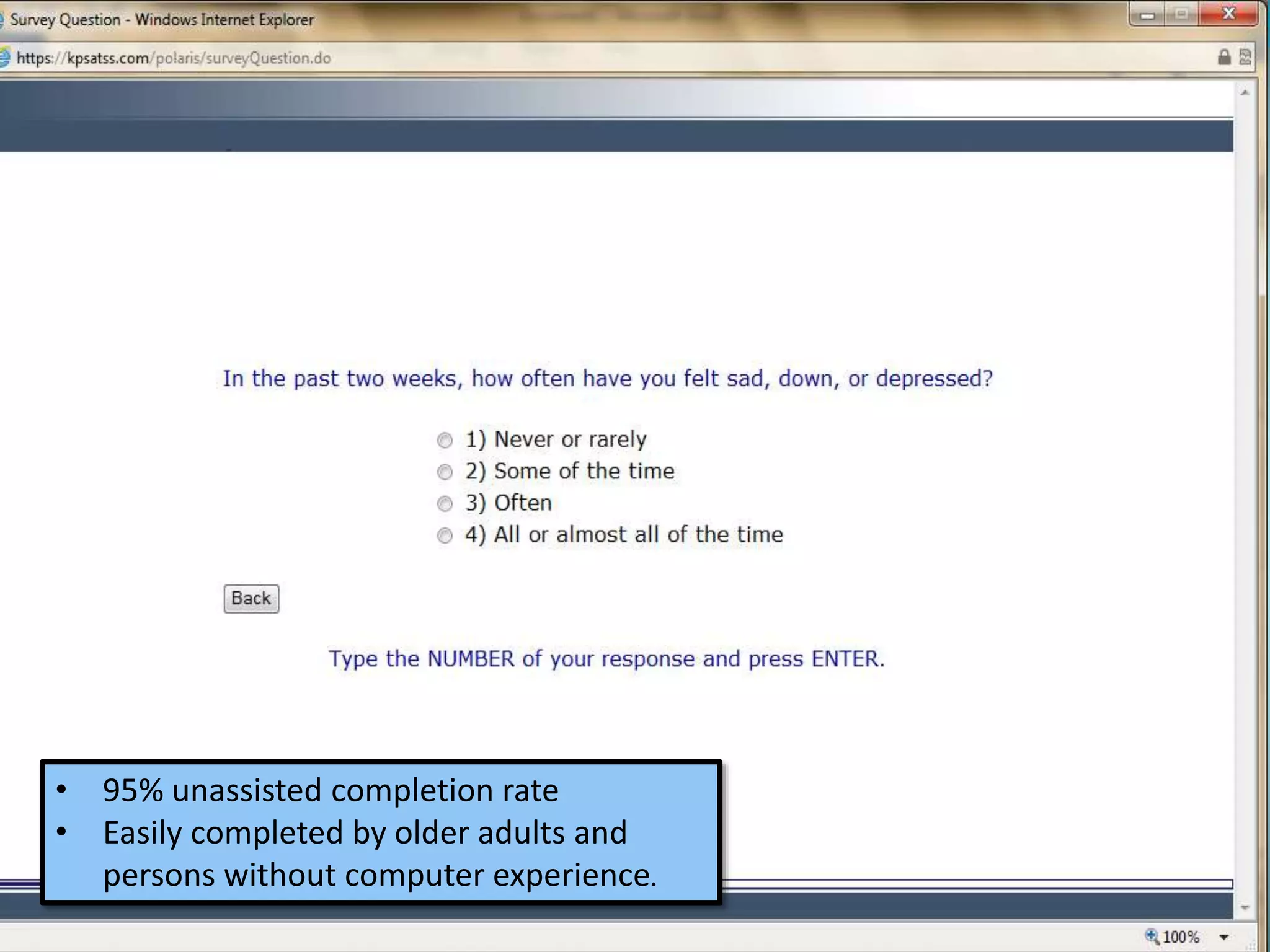
Assessment Screenshot 
• 95% unassisted completion rate 
• Easily completed by older adults and 
persons without computer experience.
Reports produced in real-time… 
• View on Web 
• View in EHR 
• Print hard copy
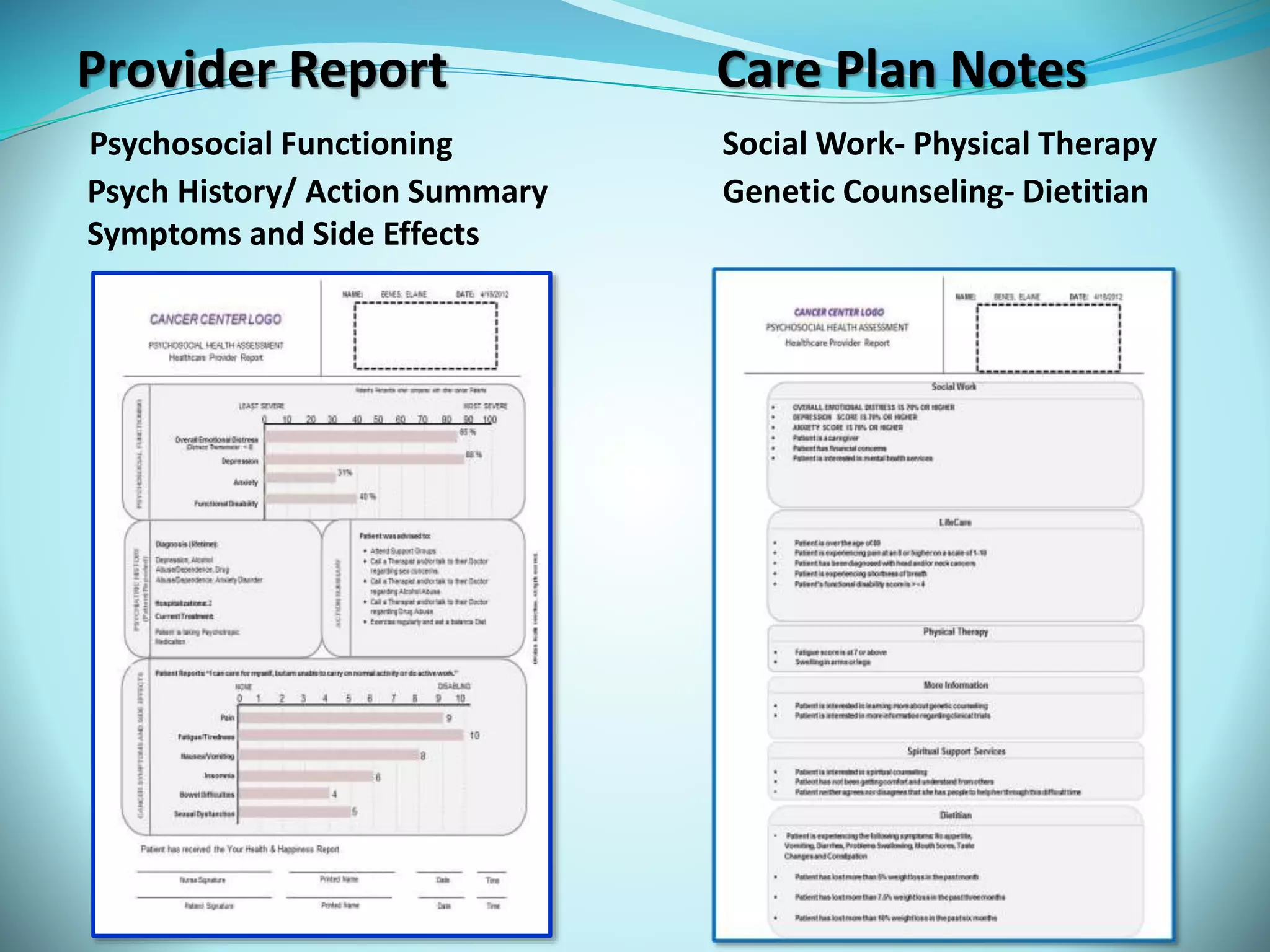
Provider Report Care Plan Notes 
Psychosocial Functioning Social Work- Physical Therapy 
Psych History/ Action Summary Genetic Counseling- Dietitian 
Symptoms and Side Effects
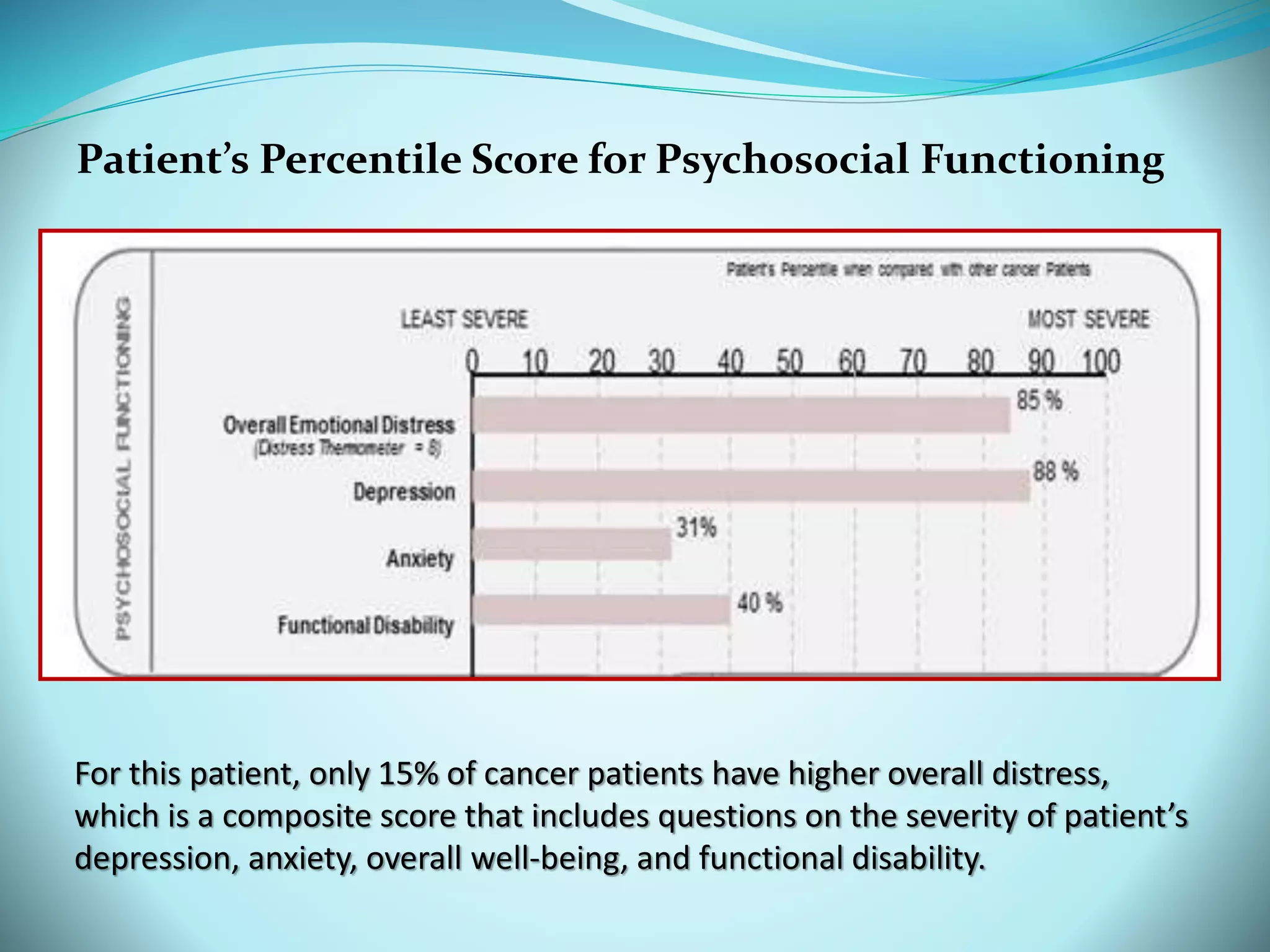
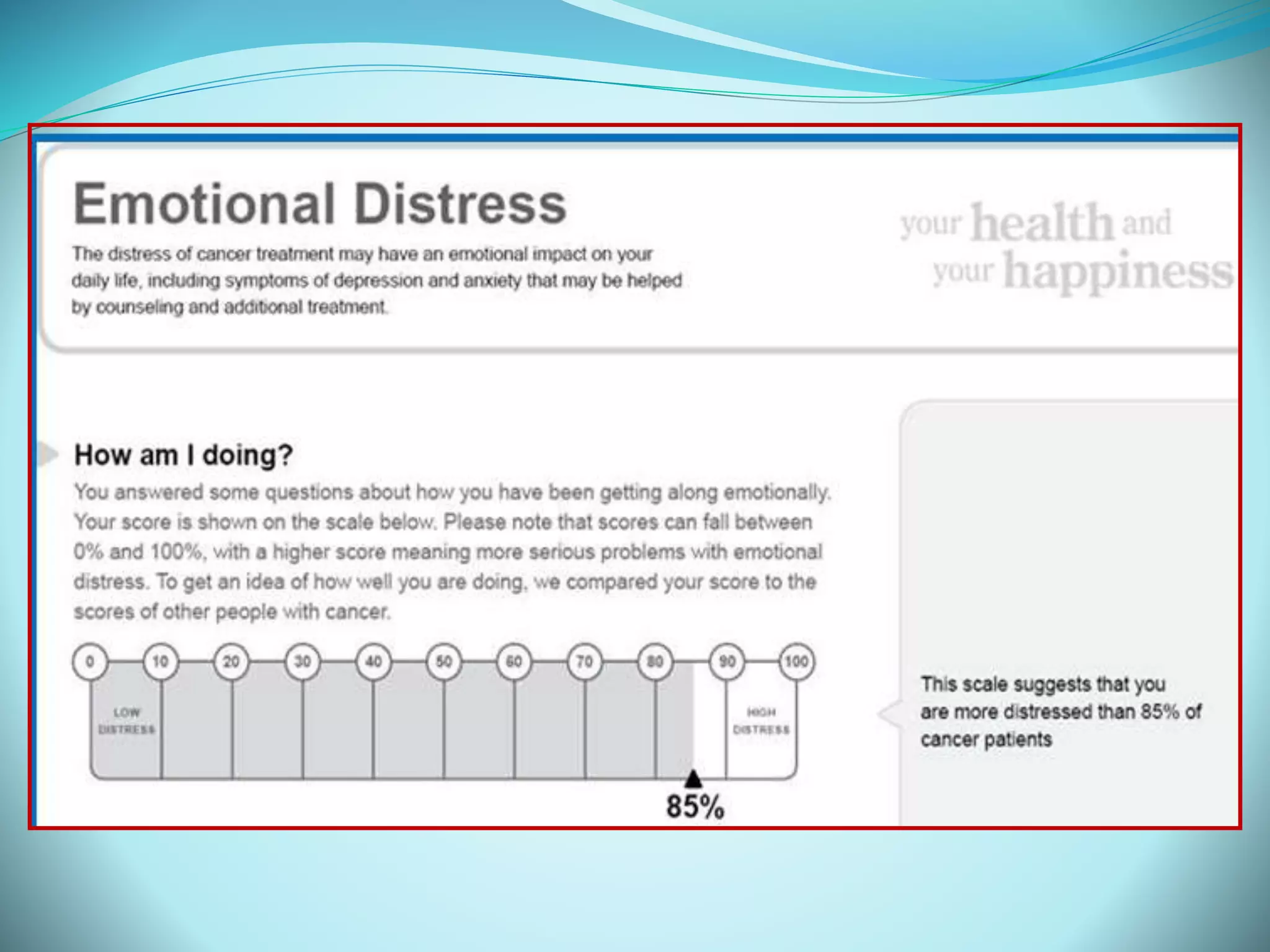
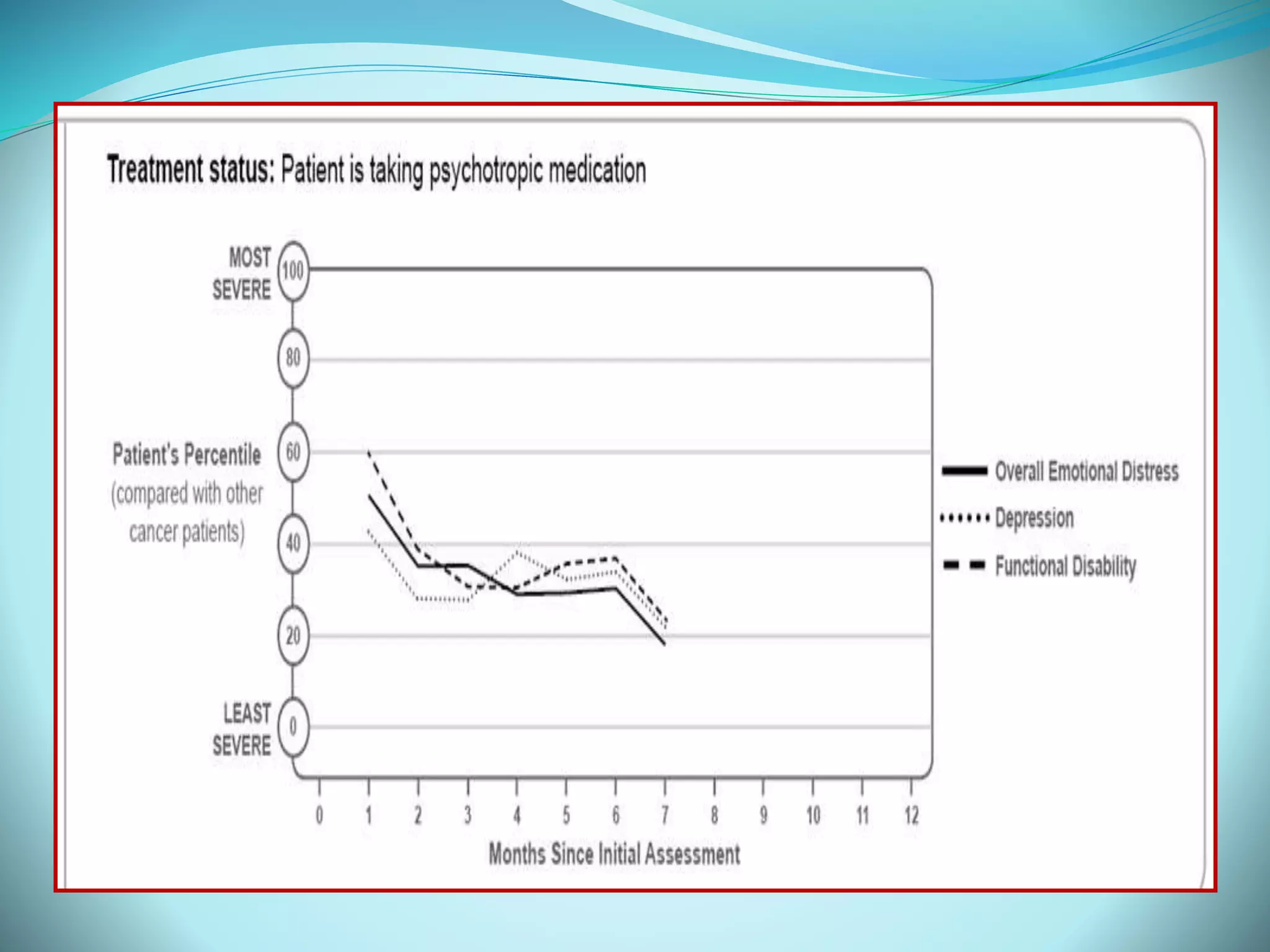
Patient’s Percentile Score for Psychosocial Functioning 
For this patient, only 15% of cancer patients have higher overall distress, 
which is a composite score that includes questions on the severity of patient’s 
depression, anxiety, overall well-being, and functional disability.
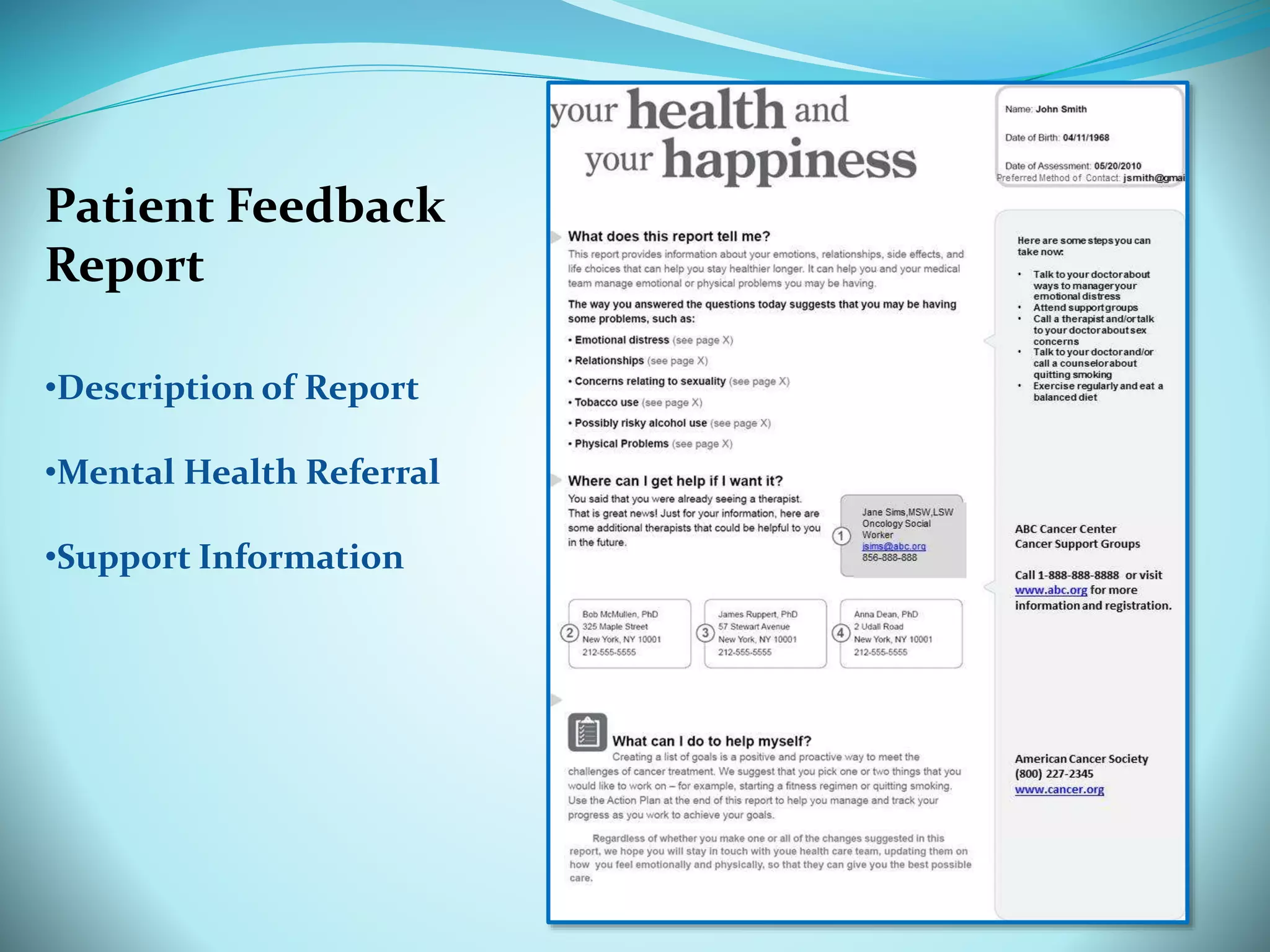
Patient Feedback 
Report 
•Description of Report 
•Mental Health Referral 
•Support Information
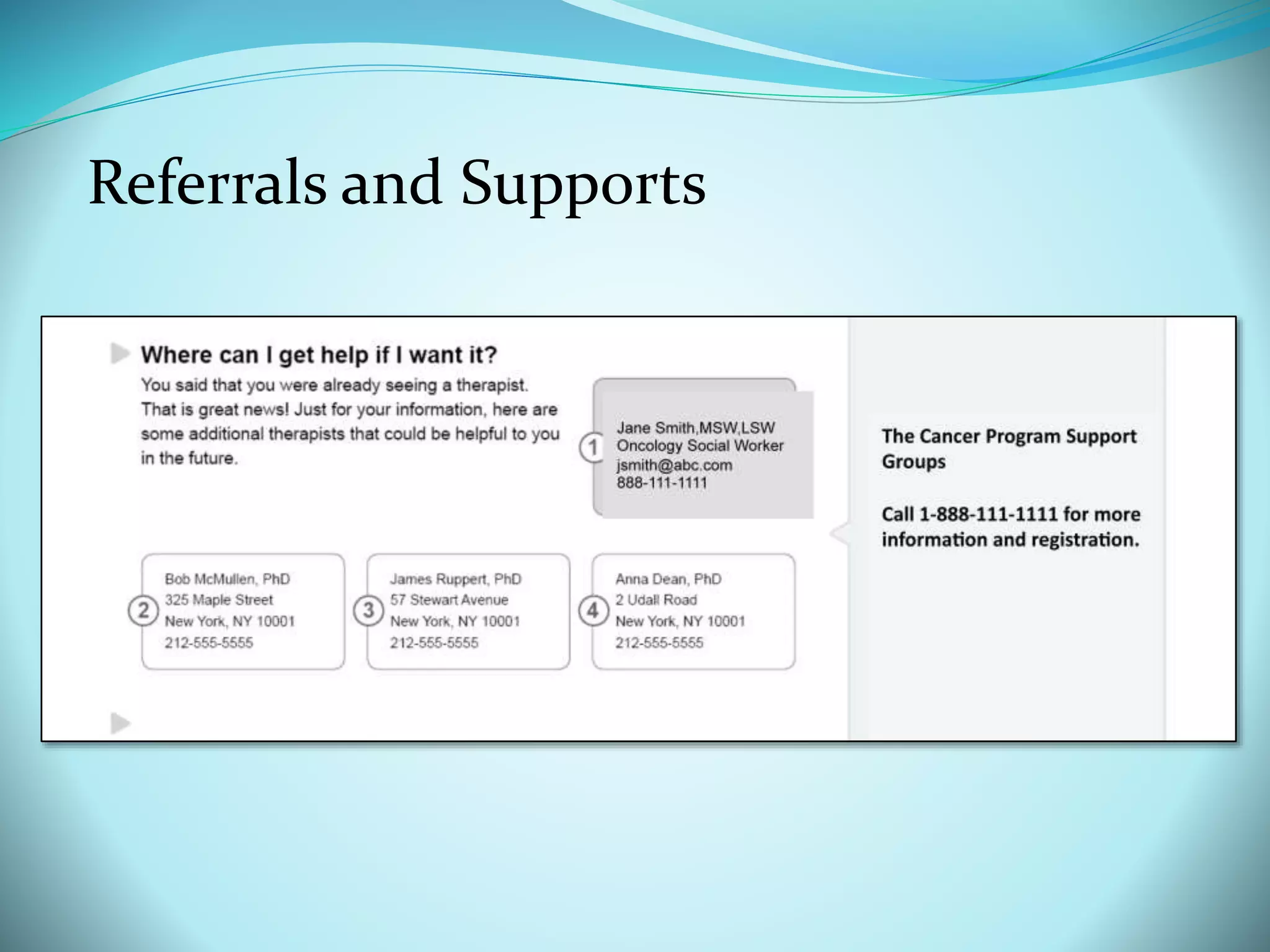
Referrals and Supports
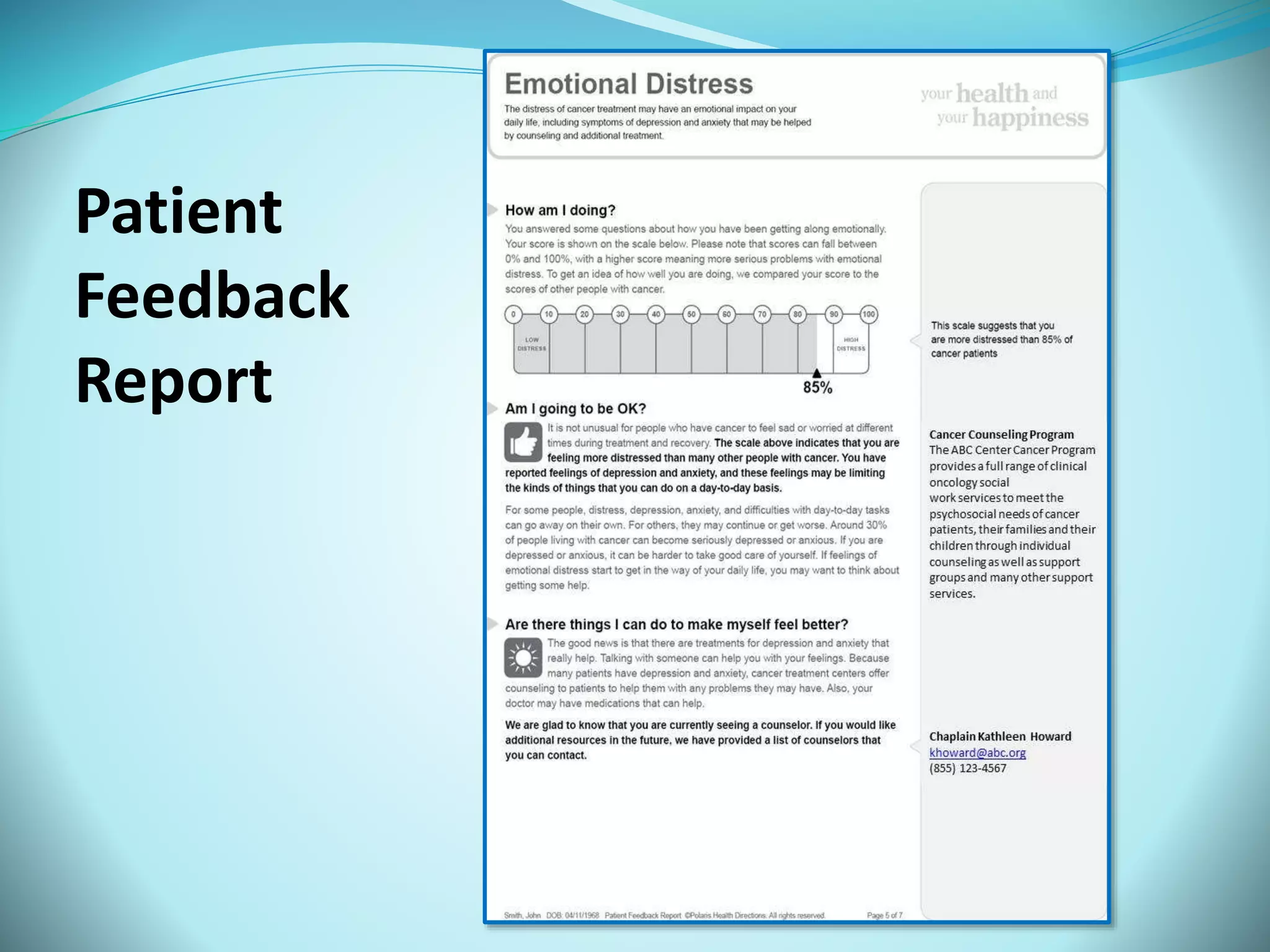
Patient 
Feedback 
Report
Patient Feedback Report 
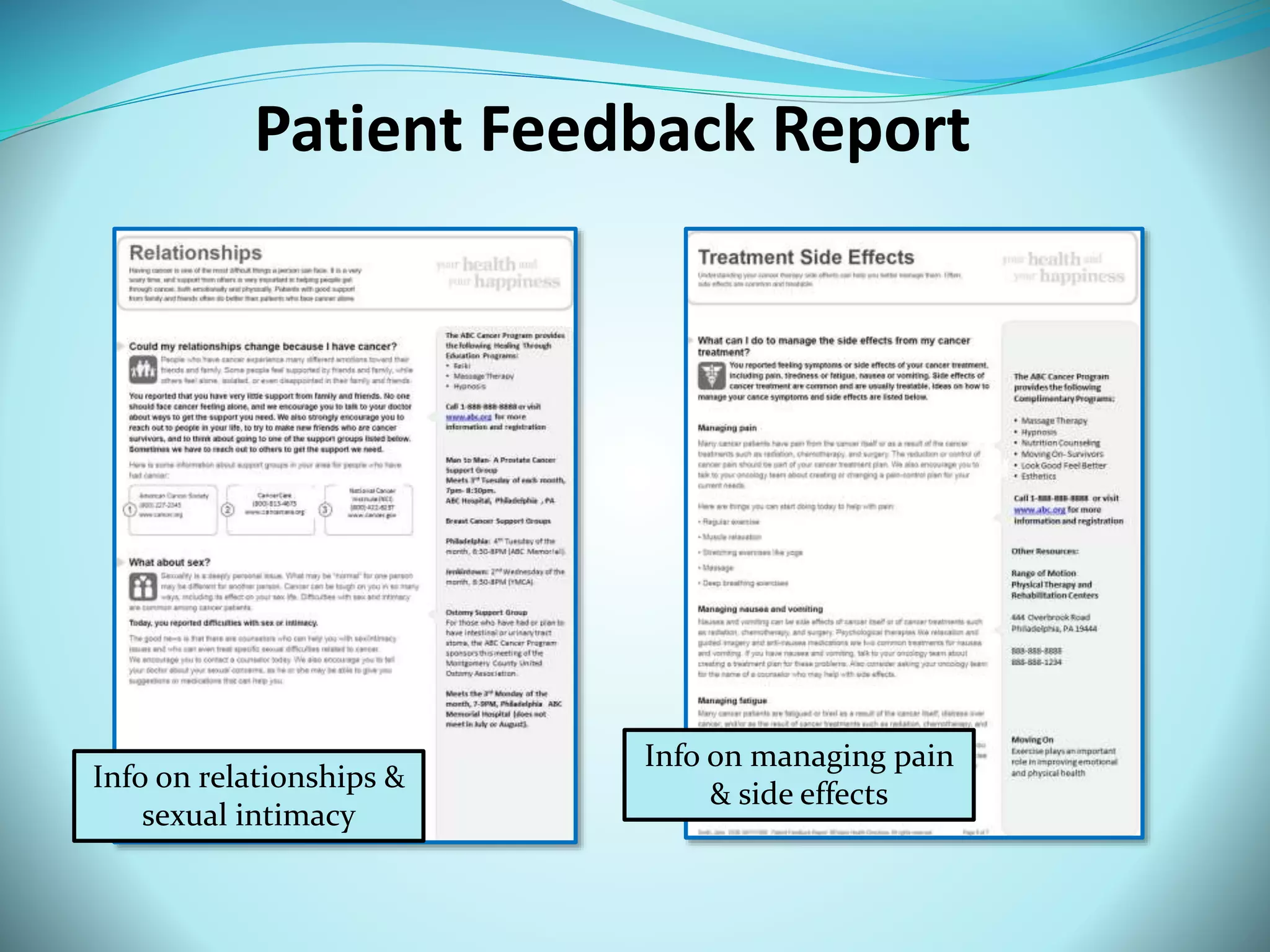
Info on relationships & 
sexual intimacy 
Info on managing pain 
& side effects
Patient Feedback Report 
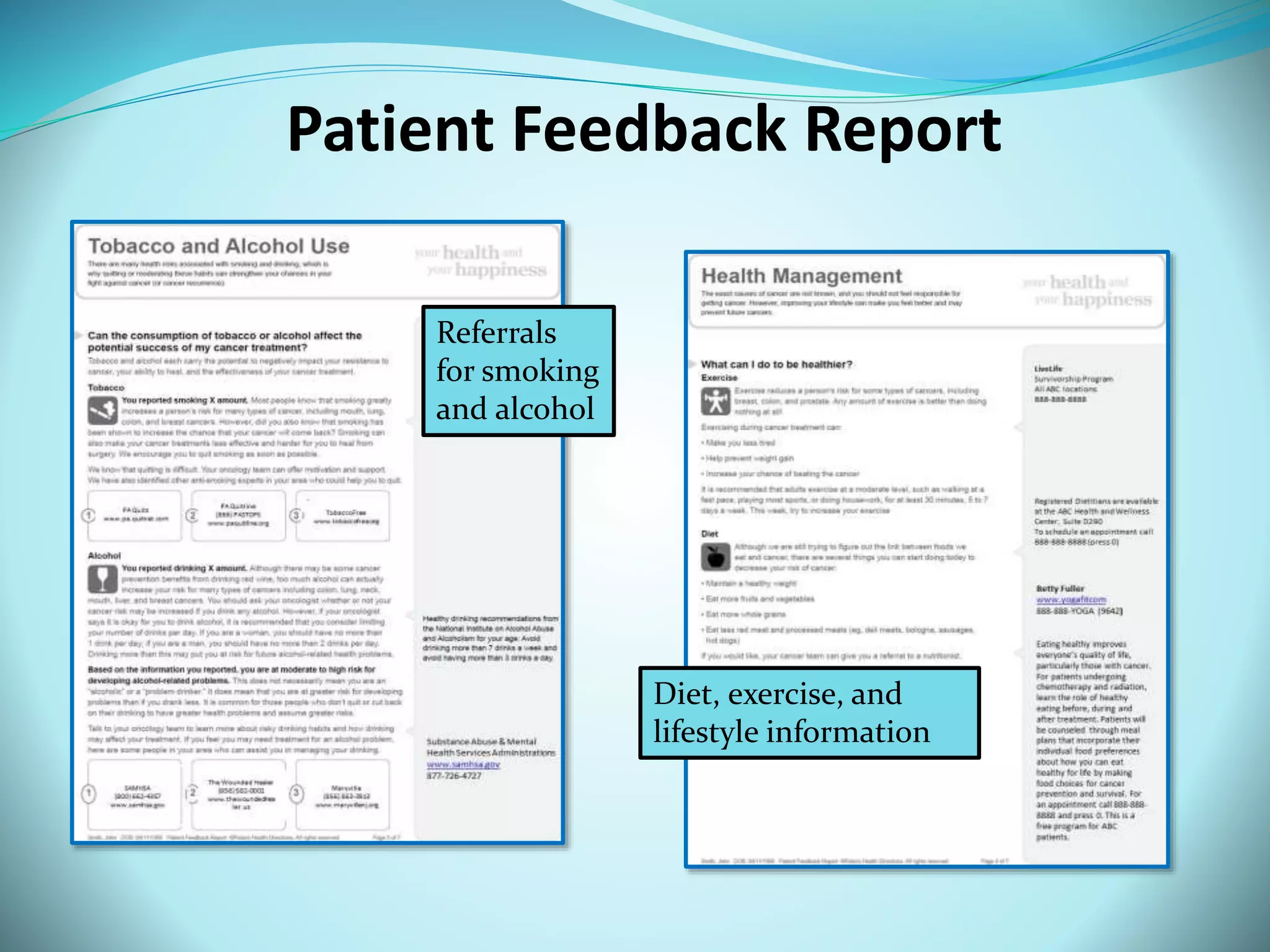
Referrals 
for smoking 
and alcohol 
Diet, exercise, and 
lifestyle information
Patient Feedback Report: Action Plan 
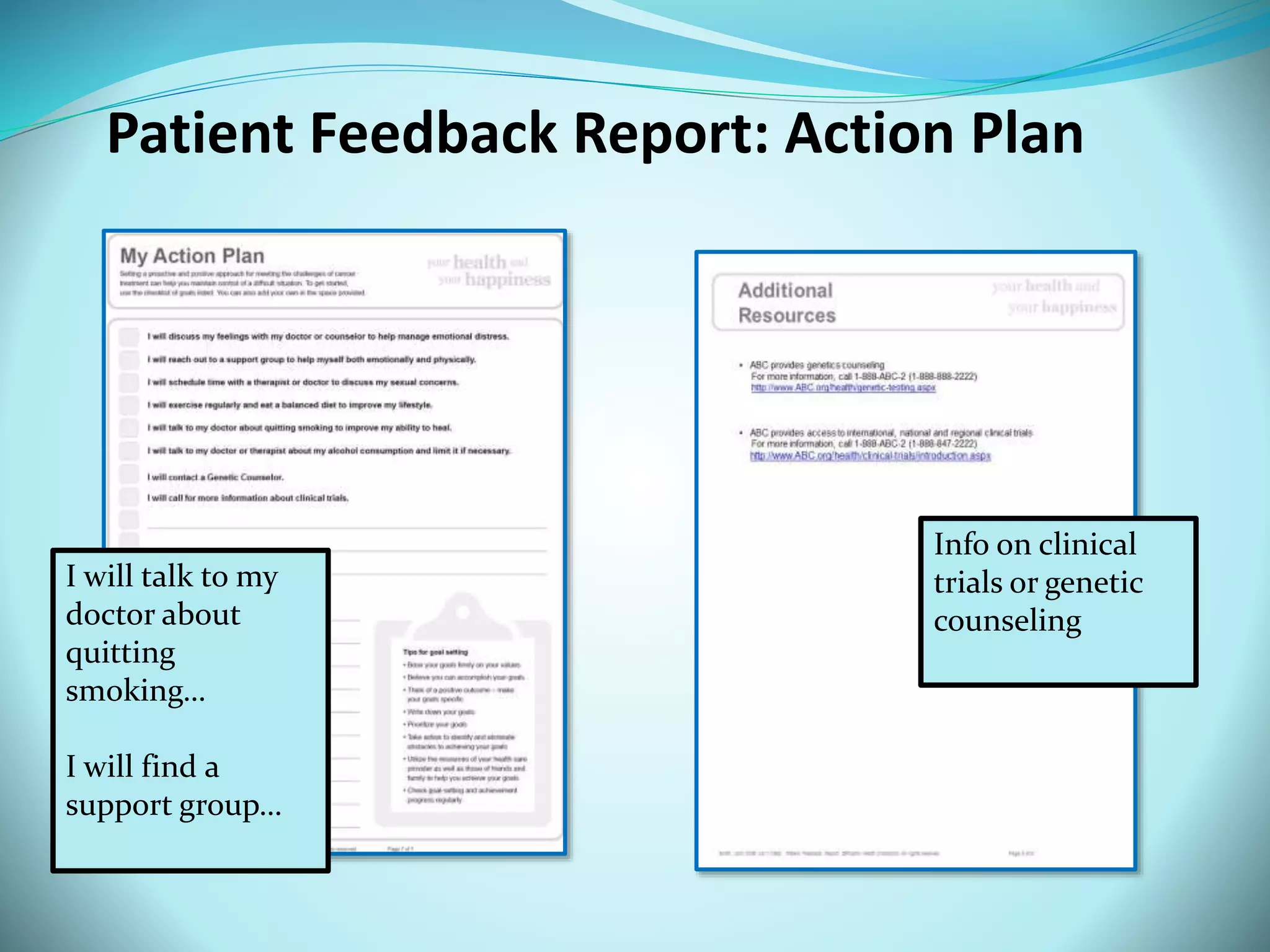
I will talk to my 
doctor about 
quitting 
smoking… 
I will find a 
support group… 
Info on clinical 
trials or genetic 
counseling
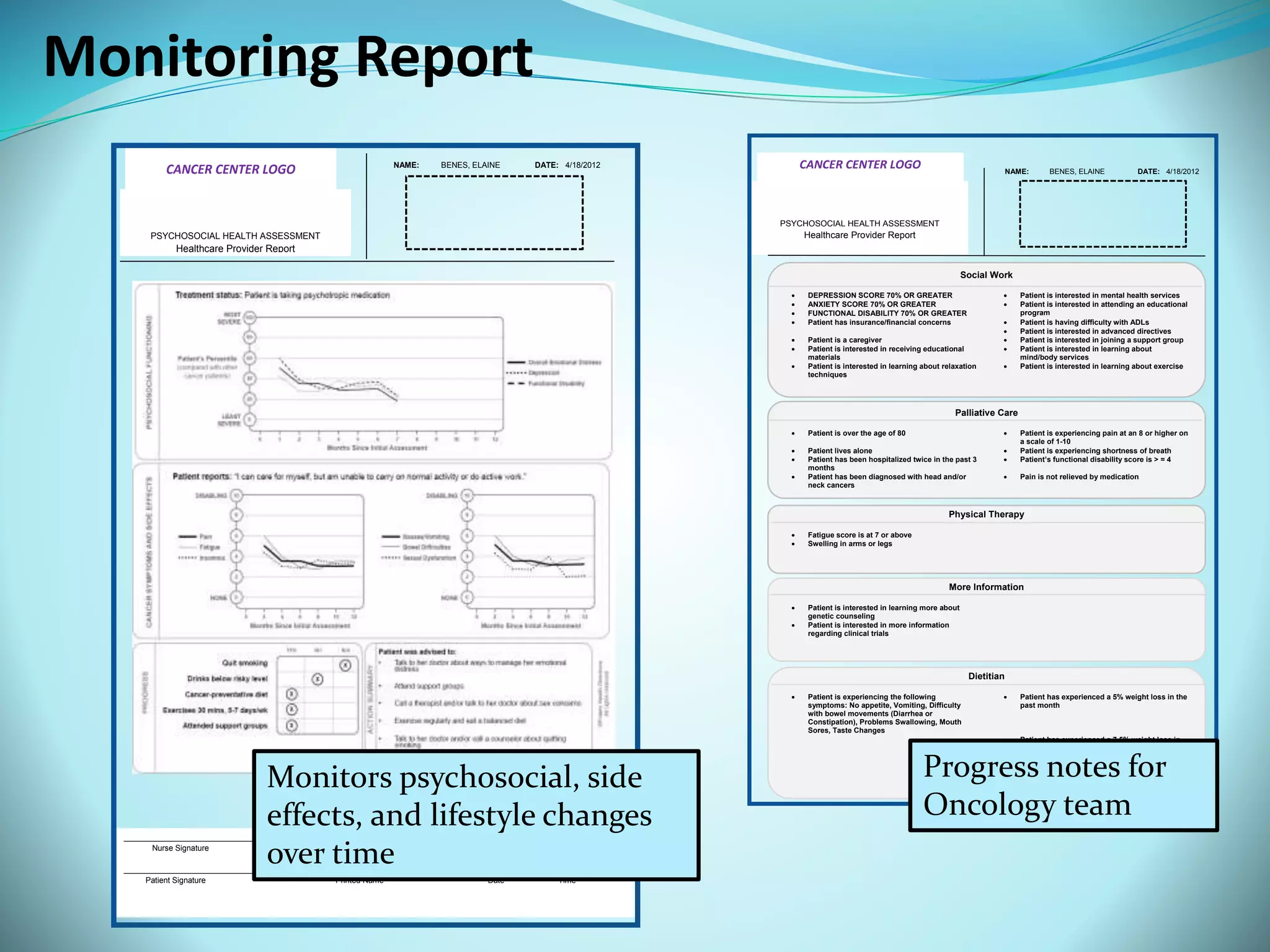
Monitoring Report 
NAME: BENES, ELAINE DATE: 4/18/2012 
CANCER CENTER LOGO 
PSYCHOSOCIAL HEALTH ASSESSMENT 
Healthcare Provider Report 
______________________________ ______________________________ __________ __________ 
Nurse Signature Printed Name Date Time 
______________________________ ______________________________ __________ __________ 
Patient Signature Printed Name Date Time 
Social Work 
CANCER CENTER LOGO 
 DEPRESSION SCORE 70% OR GREATER 
 ANXIETY SCORE 70% OR GREATER 
 FUNCTIONAL DISABILITY 70% OR GREATER 
 Patient is interested in mental health services 
 Patient is interested in attending an educational 
program 
 Patient has insurance/financial concerns  Patient is having difficulty with ADLs 
 Patient is interested in advanced directives 
 Patient is a caregiver  Patient is interested in joining a support group 
 Patient is interested in receiving educational 
materials 
 Patient is interested in learning about 
mind/body services 
 Patient is interested in learning about relaxation 
techniques 
 Patient is interested in learning about exercise 
Palliative Care 
 Patient is over the age of 80  Patient is experiencing pain at an 8 or higher on 
a scale of 1-10 
 Patient lives alone  Patient is experiencing shortness of breath 
 Patient has been hospitalized twice in the past 3 
months 
 Patient’s functional disability score is > = 4 
 Patient has been diagnosed with head and/or 
neck cancers 
 Pain is not relieved by medication 
Physical Therapy 
 Fatigue score is at 7 or above 
 Swelling in arms or legs 
More Information 
 Patient is interested in learning more about 
genetic counseling 
 Patient is interested in more information 
regarding clinical trials 
Dietitian 
 Patient is experiencing the following 
symptoms: No appetite, Vomiting, Difficulty 
with bowel movements (Diarrhea or 
Constipation), Problems Swallowing, Mouth 
Sores, Taste Changes 
 Patient has experienced a 5% weight loss in the 
past month 
 Patient has experienced a 7.5% weight loss in 
the past three months 
 Patient has experienced a 10% weight loss in 
the past six months 
PSYCHOSOCIAL HEALTH ASSESSMENT 
Healthcare Provider Report 
NAME: BENES, ELAINE DATE: 4/18/2012 
Monitors psychosocial, side 
effects, and lifestyle changes 
over time 
Progress notes for 
Oncology team
Publications 
 O’Hea EL, Cutillo AS, Dietzen L, Harralson T, Grissom G, 
Person S, Boudreaux ED. The Mental Health and Dynamic 
Referral for Oncology (MHADRO): Methodology of a 
multi-site Randomized Control Trial. Contemporary 
Clinical Trials. In press. 
 Boudreaux ED, O’Hea EL, Grissom G, Lord S, Houseman J, 
Grana G. Initial testing of the Mental Health Assessment 
and Dynamic Referral for Oncology (MHADRO). Journal 
of Psychosocial Oncology, 2011;29:83-102.

Harralson slides apos 2013 _web

  • 1.
    Tina Harralson,1 LindaToche-Manley,1 Laura Dietzen,1 Grant Grissom,1 Erin O’Hea,2 & Edwin Boudreaux 2 1 Polaris Health Directions, Langhorne, PA 2 University of Massachusetts Medical School, Worcester, MA
  • 2.
    With NIH funding,in 2006, Polaris staff and UMass Medical School researchers specializing in Psycho-oncology began work on filling a need in cancer care:  An automated psychosocial assessment validated and normed for cancer patients  Real-time referral and reporting system  Tailored patient education materials
  • 3.
    In 2007 IOMpublished a report “Cancer Care for the Whole Patient: Meeting Psychosocial Health Needs” Recommendations: … screen for distress and psychosocial health … refer to appropriate care …follow-up and reevaluation
  • 4.
    In 2012 theCommission on Cancer released a new accreditation standard to take effect in 2015 Standard 3.2: Psychosocial Distress Screening Distress should be recognized, monitored, & documented  Tool: Preference for standardized, validated instruments with established clinical cutoffs  Assessment: Identify psychological, behavioral and social problems that interfere with the ability of patients to participate fully in their health care and manage their illness and its consequences  Referral: Link with psychosocial services offered on-site or by referral.  Documentation: Screening, referral or provision of care, and follow-up are documented in the patient medical record to facilitate integrated, high-quality care.
  • 5.
    The Polaris OncologyDistress Management System is a valid tool that provides: Screening  Referral  Follow-up  Documentation  Features have been tested among cancer patients, oncology providers, and mental health providers.  MD Anderson, Cooper Hospital (NJ) and UMass Medical  More than 1000 cancer patients completed the assessment during the NIH-funded randomized controlled trial.
  • 6.
    Science and TechnologyBehind the System  Published, peer-reviewed  Valid/reliable instrument  Psychometrically sound  Normed on cancer patients  In ACoS Best Practice Repository  More than 250,000 patient assessments completed with technology  Secure Web Platform; HIPAA-compliant
  • 7.
    Polaris Oncology DistressManagement System  Secure, Web-based, automated assessment of patient’s psychosocial needs  Completed by patient on laptop or notebook in 5-10 minutes /6th grade reading level  Real-time reports tailored to patient and provider  Timely referrals  Monitor patient progress  Customizable by site  EHR integration via HL7 interface; integrate care notes  Aggregate reports
  • 8.
    All Patients areAsked Questions in Core Areas:  Distress  Counselor for emotional issue  Support Resources/Social Support  Functional Disability  Physical Symptoms/Side Effects & Severity  Alcohol Use  Tobacco Use
  • 9.
    Patients with Distress> 4 Asked additional questions regarding:  Mental Health History Diagnoses – Hospitalizations – Medication - Therapy  Overall well-being  Depression  Anxiety  Cancer-related PTSD  Functional Disability
  • 10.
    Assessment Screenshot •95% unassisted completion rate • Easily completed by older adults and persons without computer experience.
  • 11.
    Reports produced inreal-time… • View on Web • View in EHR • Print hard copy
  • 12.
    Provider Report CarePlan Notes Psychosocial Functioning Social Work- Physical Therapy Psych History/ Action Summary Genetic Counseling- Dietitian Symptoms and Side Effects
  • 13.
    Patient’s Percentile Scorefor Psychosocial Functioning For this patient, only 15% of cancer patients have higher overall distress, which is a composite score that includes questions on the severity of patient’s depression, anxiety, overall well-being, and functional disability.
  • 14.
    Patient Feedback Report •Description of Report •Mental Health Referral •Support Information
  • 15.
  • 16.
  • 18.
    Patient Feedback Report Info on relationships & sexual intimacy Info on managing pain & side effects
  • 19.
    Patient Feedback Report Referrals for smoking and alcohol Diet, exercise, and lifestyle information
  • 20.
    Patient Feedback Report:Action Plan I will talk to my doctor about quitting smoking… I will find a support group… Info on clinical trials or genetic counseling
  • 21.
    Monitoring Report NAME:BENES, ELAINE DATE: 4/18/2012 CANCER CENTER LOGO PSYCHOSOCIAL HEALTH ASSESSMENT Healthcare Provider Report ______________________________ ______________________________ __________ __________ Nurse Signature Printed Name Date Time ______________________________ ______________________________ __________ __________ Patient Signature Printed Name Date Time Social Work CANCER CENTER LOGO  DEPRESSION SCORE 70% OR GREATER  ANXIETY SCORE 70% OR GREATER  FUNCTIONAL DISABILITY 70% OR GREATER  Patient is interested in mental health services  Patient is interested in attending an educational program  Patient has insurance/financial concerns  Patient is having difficulty with ADLs  Patient is interested in advanced directives  Patient is a caregiver  Patient is interested in joining a support group  Patient is interested in receiving educational materials  Patient is interested in learning about mind/body services  Patient is interested in learning about relaxation techniques  Patient is interested in learning about exercise Palliative Care  Patient is over the age of 80  Patient is experiencing pain at an 8 or higher on a scale of 1-10  Patient lives alone  Patient is experiencing shortness of breath  Patient has been hospitalized twice in the past 3 months  Patient’s functional disability score is > = 4  Patient has been diagnosed with head and/or neck cancers  Pain is not relieved by medication Physical Therapy  Fatigue score is at 7 or above  Swelling in arms or legs More Information  Patient is interested in learning more about genetic counseling  Patient is interested in more information regarding clinical trials Dietitian  Patient is experiencing the following symptoms: No appetite, Vomiting, Difficulty with bowel movements (Diarrhea or Constipation), Problems Swallowing, Mouth Sores, Taste Changes  Patient has experienced a 5% weight loss in the past month  Patient has experienced a 7.5% weight loss in the past three months  Patient has experienced a 10% weight loss in the past six months PSYCHOSOCIAL HEALTH ASSESSMENT Healthcare Provider Report NAME: BENES, ELAINE DATE: 4/18/2012 Monitors psychosocial, side effects, and lifestyle changes over time Progress notes for Oncology team
  • 23.
    Publications  O’HeaEL, Cutillo AS, Dietzen L, Harralson T, Grissom G, Person S, Boudreaux ED. The Mental Health and Dynamic Referral for Oncology (MHADRO): Methodology of a multi-site Randomized Control Trial. Contemporary Clinical Trials. In press.  Boudreaux ED, O’Hea EL, Grissom G, Lord S, Houseman J, Grana G. Initial testing of the Mental Health Assessment and Dynamic Referral for Oncology (MHADRO). Journal of Psychosocial Oncology, 2011;29:83-102.

Editor's Notes

  • #4 In 2007 IOM published a report, “Cancer Care for the Whole Patient: Meeting Psychosocial Health Needs” noting a need for screening for distress and other issues involved in psychosocial health. The IOM suggested that besides just screening that the patient be referred for appropriate care and that follow-up and reevaluation be conducted. About the same time NIH indicated an interest in funding research to develop a system to meet these needs in an efficient and comprehensive manner that would benefit the patient and the care team. At that point in time , the only distress screen was the NCCN distress thermometer tool that was completed manually. NIH funded Polaris to develop a web-based distress management system that had the capability of being integrated into electronic medical records.
  • #5 PODMS complies with American College of Surgeons’ Commission on Cancer accreditation standard 3.2. that says Distress should be recognized, monitored, documented and treated promptly at all stages of the disease. Tool: Preference for standardized, validated instruments with established clinical cutoffs Assessment: Identify psychological, behavioral and social problems that interfere with patient’s ability to participate fully in their health care and manage their illness and its consequences Referral: Link with psychosocial services offered on-site or by referral. Documentation: Screening, referral or provision of care, and follow-up are documented in the patient medical record to facilitate integrated, high-quality care. The Polaris Oncology Distress Management automates and streamlines this process for busy clinicians , especially social workers, who may use information collected in the assessment for care planning.
  • #7 PODMS has a strong science and technology base. Statistical analyses have been conducted on over 1000 cancer patients indicating that PODMS assessment is a valid and reliable instrument with established clinical cut-offs. Results have been published in peer-reviewed journals and presented at national conferences. It is included in the American College of Surgeons Best Practice Repository The technology platform has been used with other Polaris application with more than 250,000 patients nationwide in leading hospital systems. The PODMS system is fully HIPAA compliant.
  • #8  The development of the current system began as a research study in 2006. Data from over 1000 cancer patients was collected to test and validate the current system. Data was collected at University of Mass Medical Center, MD Anderson Cancer Center, and Cooper Hospital Cancer Center in NJ. Features of the Distress Management System include: Web-based automated assessment and case management It can easily be completed by the patient on any internet connected computer Real-time reports are produced.. 1) tailored feedback report and 2) brief oncology provider report that can be used to discuss issues at that appointment The system has a capability of referring patients to mental health and other specialty providers (i.e., dietitian, financial assistance) based on the patient’s responses to the assessment. A report can be generated for the specialist as well. There are core questions that all patients are asked but the system can be customized by site show specific services offered at that site and to produce tailored aggregate reports The Distress Management System has the capability of being integrated into the EHR via HL7 interface. This feature can save time and also provide continuity of care for the patient as various departments of a cancer center can view the patient and aggregate reports in the EHR. Additionally if a patient had high distress or indicated that they were interested in mental health counseling the system offered them a mental health referrals to internal and external providers based on the patients insurance plan and geographical location. If the patient choose a mental health referral then a summary of the patient’s assessment similar to the oncology provider report was faxed to the mental health provider. They system also includes follow-up assessments and reports that help track patient progress. Research results indicate that patient and providers alike were very satisfied with this system and found it useful in clinical decision-making and case management. Today the system is now being used in 4 hospital systems (6 locations total) This will double by early 2013. It is system is customizable by site with referrals and it has the capability of being integrated in electronic health records (EHR) via HL7 interface.
  • #9 The Assessment includes 10 Core Psychosocial and Physical symptom questions: Distress Question similar to the NCCN Distress Thermometer: “Please indicate the number (0-No Distress to 10-Extreme distress) that best describes how much distress you have been experiencing IN THE PAST WEEK including today.” ( Core:1 question) Benefit from seeing a counselor for emotions/stress?: “Do you think you would benefit from seeing a counselor or therapist to manage your emotions or stress?” ( Core: 1 question) (We feel this is an important question to ask all patients regardless on their response on Distress question. Our research shows that 21% of patients who scored <4 on distress (low distress) would still like to talk to a counselor) Support Questions include distress over finances and insurance and 2 basic social support questions. If they indicate a need for further social support on the basic questions they will be asked more social support 5 more questions. Some sites customize and offer a clerical support option and information about support groups. (Core:3 questions) Functional Ability : All patients are asked 2 functional ability questions. If they indicate functional disability they will be asked more questions in that area. (Core: 2 questions) Physical Symptoms and side effects and their severity: For example: if patient endorsees pain or nausea they are asked to rate on scale of 0-10 how severe. ( Core: 1 question that is checklist and when they check one they rate severity) Alcohol Use: All patients are asked, “ How often do you have a drink containing alcohol?” A drop down box provides options ranging from Never to daily. Patients that say they drink more than never will be asked the remaining 2 alcohol use questions. These questions are converted to the gold standard AUDIT score (Core: 1 questions) Tobacco Use: All patients are asked how many days they used tobacco products in past 30 days. Any use triggers remaining 5 questions giving the standardized “Heavy Smoking Index” score. Sites can add referral to Tobacco counseling at this point if desired. (Core : 1 question)
  • #10 The Core Questions act as a screener for a more in-depth assessment. Patients who score >4 on the distress question (similar to NCCN distress thermometer) and/or who endorse tobacco or smoking use are asked to complete up to 33 additional questions to help pinpoint the source of the patient’s distress and assist the clinician in supporting the patient’s cancer care. These areas include: Mental Health History including questions about past diagnoses, hospitalizations, medications, and if the patient has ever or is seeing a therapist now, Over all well-being question Specific depression & anxiety questions Cancer-related PTSD And more Functional Disability questions Patients who indicate that they are currently using tobacco or drinking will also be asked additional questions. Persons indicating high levels of distress, depression, anxiety, functional disability and/or poor over all welling being will be given an overall distress score that can be tracked by health care providers. Current data indicates that 37% of the cancer patients in active cancer treatment have Distress >= 4 on the 0-10 Distress Thermometer.
  • #11 The Distress Management System produces real-time reports… produced just seconds after the patient completes the assessment. The report can be printed, viewed on the Web and /or viewed in EHR. Show over the next few slides and describe each feature: Here are examples of Provider reports for a Patient with high distress(> 4) at intake Follow-up Patient report Patient Feedback Report for Patient with high distress(> 4)
  • #12 The Distress Management System produces real-time reports… produced just seconds after the patient completes the assessment. The report can be printed, viewed on the Web and /or viewed in EHR. Show over the next few slides and describe each feature: Here are examples of Provider reports for a Patient with high distress(> 4) at intake Follow-up Patient report Patient Feedback Report for Patient with high distress(> 4)
  • #13 This is the Provider Report for a Patient with High Distress.. Patients with Low Distress also get reports but with less detail.
  • #15 The Patient Feedback Report is tailored to the patient based on their responses to the assessment. Includes referral information, educational materials and support resources. The first page provides an overview of the 8 page report. It focuses on how the patient can help themselves and where the patient can get psychosocial help. Mental Health providers in the boxes on this page were tailored to the patient based on insurance and zip code . These are also customized by site… for instance if the site has its own mental health care department.
  • #17 The Scale at the top of page 2 indicates the Patient’s Overall Emotional Distress.. For Patients who indicated >= 4 on the Distress Thermometer question are asked to complete a more in-depth set of questions that are complied into a composite score know as “Overall Emotional Distress” and that will be indicated on this scale. This patient is more distressed than 85% of all cancer patients based on normative data collected from over 1000 cancer patients. For Patients who indicated <4 on the one Distress Question, they are not asked the in-depth set of questions. So the percentile score on this scale is based on the single Distress question. ALL Patients get a feedback report whether they are distressed or not.
  • #19 The next 2 pages cover information on relationships and treatment side effects. Relationships page provides resources for patients and their family.
  • #20 The next 2 pages cover tobacco and alcohol use & health management. Information is suppressed if the patient does not smoke or drink. All patients get some information on healthy living: exercise and diet. Notes in the sidebars can be customized. The Health Management page can also include referrals to dietary consults.
  • #21 The “My Action Plan” page empowers patients to take charge of their diagnosis. We suggest that the oncology provider review this page and the full report with the patient at their treatment visit. The final page is available for the Cancer Center to put additional resources or notes to the patient. This page can include things like the Center’s support group calendar.
  • #22 Patients who complete follow-up assessments will receive monitoring reports that allows the clinicians and care teams to track patient progress. Like the intake report, there is an optional customizable 2nd page.