Bronzeville 
Dani, Gessa, Kayla, and Sophie
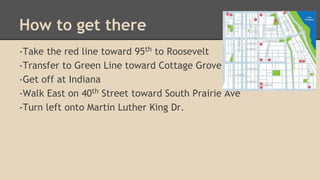
How to get there 
-Take the red line toward 95th to Roosevelt 
-Transfer to Green Line toward Cottage Grove 
-Get off at Indiana 
-Walk East on 40th Street toward South Prairie Ave 
-Turn left onto Martin Luther King Dr.
Demographic 
-About 12,000 people per square mile 
-The population of Bronzeville is mostly 
African American, and a small portion is other 
races including Hispanic and Caucasian
History 
-Bronzeville: “Chicago’s Black Metropolis” 
-Historical Landmarks such as: Ida B. Wells’ home and Stephen A. Douglas’ tomb. 
-Population grew dramatically during the Great Migration during 1910 and 1920. 
-From 1920s to 1950s Bronzeville was the center for African-American culture and 
business and was well known for nightclubs, dance halls and arts. 
-After World War II, upper and middle classes left the area, businesses started to 
decline, and the poverty increased. 
-Andrew “Rube” Foster (founder of the Negro National Baseball League), Bessie 
Coleman (first African-American women pilot), and Louis Armstrong (legandary trumpet 
player and band leader who performed at Bronzeville night clubs) were all associated 
with the development of Bronzeville.
Restaurants and Stores 
-Mostly consists of landmarks, parks, & homes. 
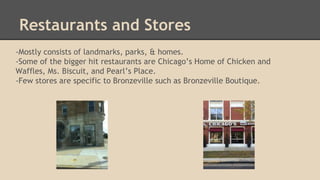
-Some of the bigger hit restaurants are Chicago’s Home of Chicken and 
Waffles, Ms. Biscuit, and Pearl’s Place. 
-Few stores are specific to Bronzeville such as Bronzeville Boutique.
Architecture 
-Most of the homes in Bronzeville are modeled after 
Victorian Age Architecture. 
-The buildings and even churches all have an old historic 
style.
Attractions 
-A. Philip Randolph Museum Gallery: 
10406 S. Maryland Ave. Chicago, IL 60628 
Their mission is to honor A. Philip Randolph, a leader of the African-American Civil 
Rights Movement, and to remember the contributions made by other African- 
Americans to America's labor movement; with a significant focus on the African 
American Railroad Employee. 
-Taylor Park: 
39 W. 47th St. Chicago, Illinois 60609 
Located at the former Robert Taylor Homes, once the nation's largest public housing 
project.
Attractions 
Bronzeville bus tours are offered: 
-Black Metropolis, Pullman Porter, Great Migration and Blues Trail Tour: 
All day tour that provides history of Chicago’s African-American cultural 
community 
-The Tour of Duty: 
Guides you through the connections of Bronzeville, President Abraham 
Lincoln and the Civil War 
Civil War to Civil Rights Tour: 
Explores the timeline of Bronzeville’s transformation
Attractions: Parks 
-Bronzeville is made up of a lot of green space and trees 
and has several parks including Washington Park and Ellis 
Park.
Historical Landmarks 
-Bronzeville itself is The Black Metropolis-one of 
the most significant landmarks in African- 
American history. 
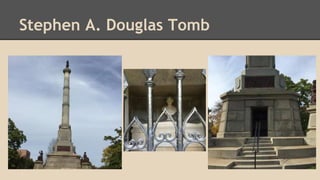
-Tomb of Stephen A. Douglas 
-Home of Ida B. Wells 
-The Victory Monument 
-Regal Theatre (demolished in 1973)
Stephen A. Douglas Tomb
Stephen A. Douglas 
-Famous politician from Illinois. 
-Democratic Nominee in the 1860 election against 
Abraham Lincoln. 
-Nicknamed the "Little Giant" because he was 
short in physical stature, but a forceful and 
dominant figure in politics.
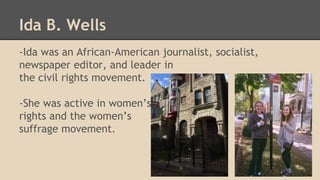
Ida B. Wells 
-Ida was an African-American journalist, socialist, 
newspaper editor, and leader in 
the civil rights movement. 
-She was active in women’s 
rights and the women’s 
suffrage movement.
Personal Reflections 
-Bronzeville is a historically rich community. 
-We learned more about African-American 
heritage. 
-After visiting Bronzeville, we are more aware 
of what exists on the south side of Chicago.
For more information... 
Check out Bronzeville’s 
Welcome Center located on 
411 E. 35th Street for more 
information and history about 
the neighborhood!
Works Cited 
"The Black Metropolis Pullman Porter Great Migration Blues Trail." Bronzeville Visitor Information Center. Web. 19 Oct. 2014. 
<http://www.bviconline.info/>. 
"Bronzeville Area Residents' and Commerce Council." Bronzeville Area Residents' and Commerce Council. Web. 19 Oct. 2014. 
<http://www.thebarcc.org/history.php>. 
"Bronzeville Neighborhood in Chicago, Illinois (IL), 60653 Detailed Profile."Bronzeville Neighborhood in Chicago, Illinois (IL), 60653 
Subdivision Profile. N.p., n.d. Web. 19 Oct. 2014. 
"Chicago Park District." Taylor Park. Web. 19 Oct. 2014. <http://www.chicagoparkdistrict.com/parks/Taylor-Park/>. 
Foner, Eric. "Stephen A. Douglas." History.com. A&E Television Networks, 1991. Web. 19 Oct. 2014. 
Herman, Jessica. "The Guide to Bronzeville: 14 Great Things to Do." Chicago Magazine Real Estate Neighborhoods. 
Chicago Magazine, 14 Aug. 2013. Web. 19 Oct. 2014. 
"Ida B. Wells." Wikipedia. Wikimedia Foundation, 18 Oct. 2014. Web. 19 Oct. 2014. 
<http://en.wikipedia.org/wiki/Ida_B._Wells>.

Connections to Community: Bronzeville

  • 1.
    Bronzeville Dani, Gessa,Kayla, and Sophie
  • 2.
    How to getthere -Take the red line toward 95th to Roosevelt -Transfer to Green Line toward Cottage Grove -Get off at Indiana -Walk East on 40th Street toward South Prairie Ave -Turn left onto Martin Luther King Dr.
  • 3.
    Demographic -About 12,000people per square mile -The population of Bronzeville is mostly African American, and a small portion is other races including Hispanic and Caucasian
  • 4.
    History -Bronzeville: “Chicago’sBlack Metropolis” -Historical Landmarks such as: Ida B. Wells’ home and Stephen A. Douglas’ tomb. -Population grew dramatically during the Great Migration during 1910 and 1920. -From 1920s to 1950s Bronzeville was the center for African-American culture and business and was well known for nightclubs, dance halls and arts. -After World War II, upper and middle classes left the area, businesses started to decline, and the poverty increased. -Andrew “Rube” Foster (founder of the Negro National Baseball League), Bessie Coleman (first African-American women pilot), and Louis Armstrong (legandary trumpet player and band leader who performed at Bronzeville night clubs) were all associated with the development of Bronzeville.
  • 5.
    Restaurants and Stores -Mostly consists of landmarks, parks, & homes. -Some of the bigger hit restaurants are Chicago’s Home of Chicken and Waffles, Ms. Biscuit, and Pearl’s Place. -Few stores are specific to Bronzeville such as Bronzeville Boutique.
  • 6.
    Architecture -Most ofthe homes in Bronzeville are modeled after Victorian Age Architecture. -The buildings and even churches all have an old historic style.
  • 7.
    Attractions -A. PhilipRandolph Museum Gallery: 10406 S. Maryland Ave. Chicago, IL 60628 Their mission is to honor A. Philip Randolph, a leader of the African-American Civil Rights Movement, and to remember the contributions made by other African- Americans to America's labor movement; with a significant focus on the African American Railroad Employee. -Taylor Park: 39 W. 47th St. Chicago, Illinois 60609 Located at the former Robert Taylor Homes, once the nation's largest public housing project.
  • 8.
    Attractions Bronzeville bustours are offered: -Black Metropolis, Pullman Porter, Great Migration and Blues Trail Tour: All day tour that provides history of Chicago’s African-American cultural community -The Tour of Duty: Guides you through the connections of Bronzeville, President Abraham Lincoln and the Civil War Civil War to Civil Rights Tour: Explores the timeline of Bronzeville’s transformation
  • 9.
    Attractions: Parks -Bronzevilleis made up of a lot of green space and trees and has several parks including Washington Park and Ellis Park.
  • 10.
    Historical Landmarks -Bronzevilleitself is The Black Metropolis-one of the most significant landmarks in African- American history. -Tomb of Stephen A. Douglas -Home of Ida B. Wells -The Victory Monument -Regal Theatre (demolished in 1973)
  • 11.
  • 12.
    Stephen A. Douglas -Famous politician from Illinois. -Democratic Nominee in the 1860 election against Abraham Lincoln. -Nicknamed the "Little Giant" because he was short in physical stature, but a forceful and dominant figure in politics.
  • 13.
    Ida B. Wells -Ida was an African-American journalist, socialist, newspaper editor, and leader in the civil rights movement. -She was active in women’s rights and the women’s suffrage movement.
  • 14.
    Personal Reflections -Bronzevilleis a historically rich community. -We learned more about African-American heritage. -After visiting Bronzeville, we are more aware of what exists on the south side of Chicago.
  • 15.
    For more information... Check out Bronzeville’s Welcome Center located on 411 E. 35th Street for more information and history about the neighborhood!
  • 16.
    Works Cited "TheBlack Metropolis Pullman Porter Great Migration Blues Trail." Bronzeville Visitor Information Center. Web. 19 Oct. 2014. <http://www.bviconline.info/>. "Bronzeville Area Residents' and Commerce Council." Bronzeville Area Residents' and Commerce Council. Web. 19 Oct. 2014. <http://www.thebarcc.org/history.php>. "Bronzeville Neighborhood in Chicago, Illinois (IL), 60653 Detailed Profile."Bronzeville Neighborhood in Chicago, Illinois (IL), 60653 Subdivision Profile. N.p., n.d. Web. 19 Oct. 2014. "Chicago Park District." Taylor Park. Web. 19 Oct. 2014. <http://www.chicagoparkdistrict.com/parks/Taylor-Park/>. Foner, Eric. "Stephen A. Douglas." History.com. A&E Television Networks, 1991. Web. 19 Oct. 2014. Herman, Jessica. "The Guide to Bronzeville: 14 Great Things to Do." Chicago Magazine Real Estate Neighborhoods. Chicago Magazine, 14 Aug. 2013. Web. 19 Oct. 2014. "Ida B. Wells." Wikipedia. Wikimedia Foundation, 18 Oct. 2014. Web. 19 Oct. 2014. <http://en.wikipedia.org/wiki/Ida_B._Wells>.