Quality Assurance AuthorityEducation & TrainingTraining
      Quality Assurance Authority for for Education &


SchoolS
Review
Unit

Review Framework and Guidance
For use in the Review of All Schools and
Kindergartens in the Kingdom of Bahrain


Second edition 2011
SchoolS
Review
Unit

Review Framework and Guidance
For use in the Review of All Schools and
Kindergartens in the Kingdom of Bahrain


Second edition 2011
Contents

    Introduction                                                                 5

    • Background to the Quality Assurance Authority for Education and Training   5
    • The Schools Review Unit                                                    5


    The review framework                                                         6

    • Introduction                                                               6
    • Section one: main questions for schools                                    6
    • Section two: main questions for kindergartens                              6


    The Review Framework for Schools                                             8

    • Overall effectiveness                                                      8
    • Student's achievement                                                      8
    • The quality of provision                                                   9
    • Leadership, management and governance                                      11


    The Review Framework for Kindergartens                                       13

    • Overall effectiveness                                                      13
    • Children's growth and development                                          13
    • The quality of provision                                                   14
    • Leadership, management and governance                                      16


    Review Guidance                                                              17

    • Guidance on Using The Review Framework for Schools and Kindergartens       27
    • Section1 : Schools                                                         27
    • Section2 : Kindergartens                                                   52


4
Introduction

Background to the Quality Assurance Authority for Education and Training

The Quality Assurance Authority for Education and Training (QAAET) was established as an
independent national authority, attached to the cabinet, to ensure that the quality of education
and training in Bahrain meets international standards and best practice, in accordance with the
vision set by the National Education Reform initiatives. Under Article (4) of Royal Decree No. 32 of
2008 amended by Royal Decree No. 6 of 2009, the QAAET is mandated to ‘review the quality of the
performance of education and training institutions in the light of the guiding indicators developed
by the Authority.’


The QAAET comprises four units, the Schools Review Unit (SRU), the Vocational Review Unit
(VRU), the Higher Education Review Unit (HERU) and the National Examinations Unit (NEU).
Further information about the QAAET can be found at www.qaa.edu.bh


The Schools Review Unit

The Schools Review Unit (SRU) is responsible for:


•   Evaluating and reporting on the quality of provision in all schools* and kindergartens (KGs);

•   Establishing success measures;

•   Spreading best practice;

•   Making recommendations for school/kindergarten improvements.


[* The term ‘schools’ refers to all establishments providing full-time education for children and
young people between the ages of six and eighteen].


Review involves monitoring standards and evaluating the quality of provision against a clear set
of indicators. The reviews are independent, objective and transparent. They provide important
information for schools and kindergartens about their strengths and areas for improvement to
assist in focusing efforts and resources as part of the cycle of school improvement in order to raise
standards.


The framework used by the SRU reflects international best practice in the sector. It has been
developed to encompass the context and the needs of all schools and KGs operating in Bahrain,
both government and private.


The framework and its implementation details are available in the Review Framework and
Guidance approved by the QAAET.


                                                                                                        5
The Review Framework

    Introduction

    The framework sets out the evaluation requirements to be used in the review of all schools and
    KGs in the Kingdom of Bahrain. It lists the main questions that reviewers must pursue to arrive at
    an answer to the overall question ‘How effective is the school or KG and why?’ in separate sections:
    Section 1 lists the main questions for schools, and Section 2 lists the main questions for KGs.


    Section 1 - main questions for schools:

    In arriving at the answer to the overall question, ‘How effective is the school and why?’ Reviewers
    consider:


    •   Students’ achievement
        - How well students of all ages, abilities and backgrounds achieve in their academic work;
        - The progress that students of all ages, abilities and backgrounds make in their personal
          development.


    •   The quality of provision
        - The effectiveness of teaching and learning;
        - How well the implementation and enrichment of the curriculum meets the educational
          needs of the students;
        - How well students are supported and guided.


    •   Leadership, management and governance
        - The effectiveness of leadership and management, including the governance arrangements
          where they exist, in promoting high achievement and strong personal development and in
          bringing about improvement in the school.

    Section 2 - main questions for kindergartens:

    In arriving at the answer to the overall question ‘How effective is the kindergarten and why?’
    Reviewers consider:


    •   The children’s growth and development
        - How well children of all ages, abilities and backgrounds are progressing in specific areas of
          growth and development.


    •   The quality of kindergarten provision
        - The effectiveness of teaching and learning;
        - The effectiveness of the curriculum implementation;
        - How well the kindergarten promotes the children’s welfare.


6
•   Leadership, management and governance
    - The effectiveness of leadership, management and governance in promoting the children’s
      growth and development and in bringing about improvement.

Evaluation:

For both schools and kindergartens, the main questions are shown by ‘’and reviewers’ responses
to them are made on the evaluation scale:
    1: ‘Outstanding’
    2: ‘Good’
    3: ‘Satisfactory’
    4: ‘Inadequate’


In reaching their judgements, reviewers consider

•   The extent to which particular practices and procedures are in place;

•   The quality of practice in elements which contribute to the main question.


Compliance with particular practices and procedures (shown by ‘’ in the schedule) is judged on
a scale:
    1: Always
    2: Often
    3: Sometimes
    4: Never


The quality of the school’s/kindergarten’s performance and practice are evaluated against criteria
which contribute to the main questions.


These judgements (shown by ‘’ in the schedule) are made on the same four-point evaluation
scale as the main questions.


As well as forming the basis of school/kindergarten review, schools/kindergartens are invited to use
this framework and the evaluation scale in the evaluation of their own performance and practice.


The guidance, which accompanies the framework, provides more information about the
judgements to be made and shows how reviewers and schools/kindergartens should interpret the
main questions and criteria.


                                                                                                       7
The Review Framework for Schools

    Overall effectiveness
       How effective is the school in meeting the needs of students and their parents?


        The judgement should be based on the extent to which the school enables students to achieve
        as well as they can academically and in their personal development. It should take into account
        the extent to which:

    	       Students are satisfied with the school;

    	  The school successfully fulfils its mission and its promise to parents.


       How strong is the school’s capacity to improve?


        The judgement should be based on the extent to which strategic planning is focused on
        improvement and on how well self-evaluation and other management processes are used to
        assure quality and improve teaching, learning and achievement. It should also consider the
        extent to which:
    	       The school has enhanced its high level of effectiveness or improved important aspects of
             its performance in recent years.


    Reviewers will assess the school’s strengths and identify areas for improvement. As a result of
    which the school will develop an action plan which sets out the steps it will take to improve its
    performance.

    Schools whose overall effectiveness is ‘inadequate’ will be subject to monitoring visits as
    per the QAAET policy and procedure.

    Students’ achievement

       How well do students achieve in their academic work?


        In arriving at a judgement, reviewers check whether:

           Assessments are made of students’ ability on entry to the school;

           Records of students’ achievements are kept;

           Performance results are analysed.


        But particularly, reviewers evaluate the extent to which students of all ages, abilities and
        backgrounds:

    	  Are performing well in general and especially in key subjects against the standards set by
        the curriculum in operation in the school;
    	  Are making the progress expected of them in relation to their starting points and their
        abilities.


8
   How good is the students’ personal development?


    In arriving at a judgement, reviewers check whether:

       Records are kept of students’ attendance;

       Records are kept of students’ punctuality;

       Incidents of poor behaviour and action taken are logged.


    But particularly, reviewers evaluate the extent to which students of all ages and
    backgrounds:
	  Attend school regularly and punctually;
	      Participate fully and enthusiastically in school life;
	      Develop self-confidence and the capacity to work independently and take responsibility;
	  Work effectively together, respecting the views, feelings and beliefs of others;
	      Behave in a mature and responsible way in lessons and around the school;
	      Feel safe and secure in school and are free from bullying and other hurtful behaviour;
	      Develop an understanding of the heritage and culture of Bahrain, including the values of
        Islam.

The quality of provision

   How effective is teaching and learning?


    In arriving at a judgement, reviewers check whether:

       Teachers have the appropriate professional qualifications for their roles;

       Teachers have lesson plans which guide their teaching;

       Lessons start and end on time;

       Learning objectives are shared with the class and pursued;

       Students’ work is marked.


    But particularly, reviewers evaluate the extent to which teachers:
	      Have strong knowledge of the subjects and courses they teach and how this is reflected in
        their lessons;
	      Enable students to acquire skills and understanding as well as knowledge;
	      Enable students to develop higher order thinking skills;
	      Manage lessons effectively so that they are orderly and productive;
	      Secure students’ engagement, motivate, encourage and support them;
	      Challenge students of all abilities so that they make at least the expected progress in
        relation to their prior attainment;


                                                                                                    9
     Use teaching and learning strategies and resources that lead to effective learning;
     	      Set tasks and assignments for students to be undertaken out of lesson time that consolidate
             and extend work done in class;
     	      Use assessment, including marking, effectively to diagnose students’ needs and adjust
             their teaching accordingly.


        How well does the implementation and enrichment of the curriculum meet the
         educational needs of the students?


         In arriving at a judgement, reviewers check whether:

            The school has schemes of work which show how the curriculum should be taught;

            Records are kept of students’ participation in extra-curricular activities.


         But particularly, reviewers evaluate the extent to which:
     	       The school provides for all its students, within the scope of the curriculum it offers, a
              broad range of experiences, well suited to their educational needs;
     	       The curriculum is kept under review and its implementation revised as a result of self-
              evaluation and in response to the changing needs of the students;
     	      Links are made between subjects so that students experience a coherent curriculum;
     	       The school seeks to develop students’ understanding of the rights and responsibilities of
              being part of a community;
     	       The curriculum adequately prepares students for the next stage of their education or for
              employment;
     	      Extra-curricular activities enhance students’ experiences and promote wide-ranging
             interests;
     	       The curriculum is enriched by the use of the school environment and resources available
              in the local community.

        How well are students supported and guided?


         In arriving at a judgement, reviewers check whether:

            Records are kept of students’ personal and academic progress and the advice they
             receive;

            Information about curriculum and other choices is provided for students;

            Students have access to staff for guidance and support;

            Regular information is sent to parents about their children’s progress;

            The school has rules and routines defining acceptable behaviour;

            The school carries out risk assessments relating to health and safety.


10
But particularly, reviewers evaluate the extent to which:
	      Students are inducted into the school in a way that helps them settle quickly and easily;
	  The school monitors students’ academic progress so that their needs can be met;
	  The school monitors students’ personal development so that their needs can be met;
	       The school deploys staffing and resources effectively to support students with special
         educational needs of different kinds;
	      Students are sensitively supported and helped when they have problems;
	      Students have access to well-informed advice and guidance about the next stage of their
        education and in preparation for employment;
	      Parents are well informed about students’ progress;
	      Students and the school’s administrative and academic staff work in a healthy and safe
        environment.


    • In schools with boarding provision, reviewers consider the extent to which:
	  The living and sleeping accommodation for students, including dining, washing and rest
    room facilities, meets their needs and ensures their health and safety;
	  The members of staff with responsibilities for boarding, such as house parents, ensure the
    health, safety, and care of students;
	  After-school and weekend activities are of a sufficient range and quality; and boarders and
    day students are integrated into joint after-school clubs and activities;
	  There are effective procedures for the welfare and protection of students, including
    permissions to leave the boarding house after school hours, at weekends and for holidays
    and provisions for travel and collection.


Leadership, management and governance

 How effective are leadership, management and governance in promoting high
  achievement and personal development and in bringing about improvement?


    In arriving at a judgement, reviewers check whether:

       Leaders and managers have clear job descriptions which set out their responsibilities;

       The school regularly seeks parents’ and students’ views about its provision;

       The school plans its development and improvement;

       Results over time are recorded and analysed;

       Procedures for monitoring the school’s performance and provision are in place;

       Records are kept of teachers’ professional development needs and opportunities they have
        taken up.


                                                                                                    11
But particularly, reviewers evaluate the extent to which:
     	  The principal and others with leadership responsibilities have a clear vision for the school,
         focused on achievement, which is shared with, and by, staff;
     	      Leaders inspire, motivate and support staff effectively;
     	      Self-evaluation, including the analysis of performance, is rigorous and used to assure
             quality and bring about further improvement;
     	      Strategic planning is firmly focused on improvement;
     	      Staff are effectively managed, developed and efficiently deployed;
     	      Budgeting, planning and resource allocation are firmly linked to ensure the provision of
             good quality teaching and learning and a high quality learning environment, appropriate
             to the school’s mission;
     	  The school seeks, and is responsive to, the views of students and parents about its
         provision;
     	  The school has well-developed links with the local and wider community that enhance
         and enrich the students’ educational experiences;
     	  Where one exists, the governing body’s roles and responsibilities are understood, respected
         and kept separate from those of the school’s professional leadership;
     	  Where one exists, the governing body, board of directors or advisory group works effectively
         with the school’s leaders; holds them accountable for the school’s performance; and makes
         a significant contribution to the strategic leadership of the school.


12
The Review Framework for Kindergartens

Overall effectiveness


 How effective is the kindergarten in meeting the needs of children and
  their parents?

    The judgement is based on the extent to which the kindergarten promotes children’s overall
    growth and development. It should take into account the extent to which:
	      Children are satisfied with the kindergarten;
	  The kindergarten successfully fulfils its mission and its promise to parents.

 How strong is the kindergarten’s capacity to improve?

    The judgement should be based on the extent to which strategic planning is focused on
    improvement and on how well self-evaluation and other management processes are used
    to assure quality and improve teaching, learning and children’s growth and development. It
    should also consider the extent to which:
	  The kindergarten has enhanced its high level of effectiveness or improved important
    aspects of its performance in recent years.


    Reviewers will assess the kindergarten’s strengths and identify areas for improvement. As a
    result of which the kindergarten will develop an action plan which sets out the steps it will
    take to improve its performance.

Kindergartens whose overall effectiveness is ‘inadequate’ will be subject to monitoring
visits as per the QAAET policy and procedure.


Children’s growth and development


 How well do the children develop intellectually, socially, creatively and
  physically?

    In arriving at a judgement, reviewers check whether:

       Developmentally appropriate and culturally sensitive assessments are completed that
        measure children’s overall abilities and skills on entry to the kindergarten;

       Records are kept of children’s attendance and punctuality;

       Developmental outcomes are consistently collected and analysed;

       Information about the development of individual children is reported to parents at critical
        periods throughout the year.


                                                                                                      13
But particularly, reviewers evaluate the extent to which children of all ages, abilities and
     backgrounds:
     	  Are making good progress in communication and numeracy against the standards set by
         the curriculum in operation in the kindergarten;
     	  Are making good progress in their physical development;
     	  Attend kindergarten regularly and punctually;
     	      Participate fully and enthusiastically in kindergarten activities;
     	      Develop self-regulation skills, sharing and co-operative behaviour, and independence
             appropriate to their age and ability;
     	  Are curious and inquisitive about the world/community around them;
     	  Are respectful of other children and adults;
     	      Respond creatively to experiences, using media and materials, music, physical activity and
             imaginative play;
     	  Are ready intellectually, socially, creatively and physically, by the time they leave
         kindergarten, to begin the primary phase of their education.

     The quality of provision

      How effective are the teaching and learning?

         In arriving at a judgement, reviewers check whether:

            The kindergarten has an educational philosophy that guides its curriculum and
             pedagogy;

            Teachers and other staff have appropriate professional qualifications for their roles.


         But particularly, reviewers evaluate the extent to which teachers and other staff:
     	      Have strong knowledge of child development and early childhood education;
     	      Manage daily routines and learning experiences effectively, with a balance of adult and
             child-initiated activities;
     	      Secure children’s engagement; motivate, encourage and support them;
     	      Provide opportunities for children to work in small groups and learn from each other;
     	      Challenge children so that they progress toward the next level of development in all areas
             of learning;
     	      Use a variety of teaching and learning resources that lead to effective learning;
     	      Use assessment techniques appropriate for the children’s ages.


14
 How well does the implementation and enrichment of the curriculum meet the
    intellectual, social and physical needs of the children?


    In arriving at a judgement, reviewers check whether:

       The KG has schemes of work which show how the curriculum should be implemented and
        enriched;

       Records are kept of children’s participation in all activities.


    But particularly, reviewers evaluate the extent to which:
	  The KG provides for all its children, within the scope of the curriculum it offers, a broad
    range of experiences, well suited to their intellectual, social and physical needs;
	  The curriculum is kept under review and its implementation revised as a result of self-
    evaluation and in response to the changing needs of the children;
	      Extra-curricular activities enhance children’s experiences and promote wide-ranging
        interests;
	  The curriculum is enriched by the use of the KG’s environment and resources available in
    the local community to enrich the children’s learning.

 How well does the kindergarten promote the children’s welfare?

    In arriving at a judgement, reviewers check whether:

       Records are kept of home-kindergarten communication with parents;

       There are rules and routines defining acceptable behaviour and child guidance strategies;

       Incidents of any inappropriate behaviour, and action(s) taken, are logged;

       Risk assessments are made relating to the health and safety of children.


    But particularly, reviewers evaluate the extent to which:
	      Children are introduced to the kindergarten in a way that helps them feel comfortable and
        safe;
	      Parents are actively encouraged to participate in their child’s learning and are offered a
        variety of ways to become involved;
	      Children who experience difficulties with learning or behaviour are identified quickly and
        effectively supported;
	      Children and staff work in a healthy and safe environment.


                                                                                                     15
Leadership, management and governance

      How effective are leadership, management and governance?

         In arriving at a judgement, reviewers check whether:

            Leaders and managers have clear job descriptions, which set out their responsibilities;

            The views of parents and children are regularly sought;

            There are procedures for monitoring performance and the quality of provision;

            There are plans for development and improvement;

            Records are kept of the professional development needs of the staff and where these needs
             have been met.


         But particularly, reviewers evaluate the extent to which:
     	  The separate roles and responsibilities of the governing body and the kindergarten’s
         professional leadership are understood and respected;
     	  The governing body, board of directors or advisory group works effectively with the
         kindergarten’s leaders, holds them accountable for the kindergarten’s performance and
         makes a significant contribution to the strategic leadership of the kindergarten;
     	      Staff with leadership responsibilities have a clear vision for the kindergarten, focused on
             children’s development, which is shared with, and by, other staff;
     	      Self-evaluation, including the analysis of performance, is rigorous and used to assure
             quality and bring about further improvement;
     	      Strategic planning is firmly focused on improvement;
     	  The staff are effectively managed, developed and efficiently deployed;
     	      Budgeting, planning and resource allocation are firmly linked and ensure the provision of
             good quality teaching and learning and a high quality learning environment, appropriate
             to the kindergarten’s mission;
     	  The kindergarten seeks, and is responsive to, the views of parents about its provision;
     	  There are links with the local and wider community, which enhances and enriches the
         children’s development.


16
Review Guidance

Introduction

Reviews assess the extent to which schools and kindergartens provide a quality learning experience
for students which is measured through a number of criteria. The openness of the criteria, the
identification of the strengths and weaknesses of the school and kindergarten, the professional
discussion with the school and kindergarten about its work and its self-evaluation, and the
recommendations which stem from Review all contribute to the success of the Review process. The
Review Report provides the school with judgements where strengths and areas for improvement
are identified. However, the task of improvement is the responsibility of the school or kindergarten
and those who give it day-to-day support.


The review methodology and guidance are developed to form the basis of the model of review to
be used in the Kingdom of Bahrain.


A universal principle is that students and children succeed when they are well taught, are carefully
guided and supported both academically and personally, and when leadership and management
are effective in ensuring that these priorities are met. This guidance sets out:
	  The approach to review;
	       The review arrangements and procedures;
	  Advice to schools and kindergartens on interpreting the Review Framework and Guidance
    and forming judgements.


The Approach to Reviews in Bahrain’s Schools and Kindergarten

Self-evaluation plays a central part in the review process. Schools and kindergartens are asked
to evaluate their effectiveness, their students’ achievement, the quality of their provision and the
effectiveness of their leadership and management, using the Review Framework, and record their
findings in a self-evaluation form (SEF). To do this, they are asked to use the same criteria that
reviewers use. Schools and kindergarten are also asked to audit how fully they follow particular
procedures and practices.


Reviewers use the evidence which the school offers in its SEF, along with that contained in other
documents from the school, to frame hypotheses about the school. These are included, with a
commentary, in a pre-review brief (PRB). Reviewers test the hypotheses by directly observing
students, children and teachers at work, reviewing students’ work, analyzing data and school
documentation and talking with key staff and with students. Schools are asked to send a
questionnaire to parents to seek their views on the school and reviewers will talk with parents and
students.


The review approach is collaborative. Through the SEF, the school or the kindergarten supplies
the main source of information for the review. The principal and senior staff have the opportunity
to comment on the PRB and the school will be asked to arrange for reviewers to talk with the key
staff who can shed light on the main issues in the PRB, and schools will be able to suggest where
particular practices, strong or weak, can be seen in the school.

                                                                                                       17
However, the judgements about the school or kindergarten that appear in the review report are
     made by the review team, based on the evidence they collect during the review visit. Regular
     feedback is an essential part of the review process so that the staff of the school and kindergarten
     are fully involved and understand how the judgements evolve.


     The process is intended to encourage rigorous self-evaluation, which the school and kindergarten
     can use to assure the quality of its provision and identify areas for improvement.

     The review arrangements and procedures

     Review timescales and overview

     The Schools Review Unit (SRU) was established within the programme of the national reform of
     education, and is responsible for evaluating all schools and kindergarten, using a set of clear and
     written standards to ensure quality. The standards are explained in the Framework for the Review
     of Schools and Kindergartens.


     The review will be organised be a lead reviewer and his or her team. School and kindergarten
     principals and other staff will be introduced to and trained in the use of a self-evaluation form
     (SEF) before their school and kindergarten is visited. The SEF is an important element of the review
     process. Schools and kindergartens will be notified of the review dates one week before the on-site
     review.


     The on-site review will normally extend for three days. The following table explains the stages of
     the review.


     Time                           Activity
                                    	      Training the school / kindergarten principal and other
                                            senior staff on completing the self- evaluation form (SEF)
     Prior to the review but                as needed.
     and not less than 8 weeks      	      Schools /kindergarten are given the SEF, parents’
     before it                              questionnaire (PQ) to be completed.
                                    	      Schools / kindergarten send the PQs to parents following
                                            the SEF training session.

     2 weeks after SEF training     	      The school/kindergarten returns the SEF and other key
     and not less than 6 weeks              documentation to the SRU.
     before the expected review     	      The school/kindergarten sends the completed PQs
     dates                                  separately from the SEF in a sealed envelope to the SRU.

                                    	      The lead reviewer writes the Pre-Review Brief (PRB) based
     3 weeks before the review              on the SEF and the PQ analysis and any other available
                                            information.

                                    	      The PRB is sent to the school/kindergarten. The school/
                                            kindergarten organises the necessary meetings based on
     1 week before the Review               the PRB.
                                    	      The SRU informs the school of the date of its review and
                                            the name of the lead reviewer.


18
     The lead reviewer visits the school/kindergarten to clarify
2 days before the review               and adjust any issues arising in the review and to discuss
                                       the PRB.
                                	     The school/kindergarten completes its arrangements for
                                       the required meetings.
1 day before the review
                                	     The school contacts a sample of parents to meet the review
                                       team.

                                	     A meeting is conducted with the school/kindergarten
                  First day            principal and deputy to clarify any concerns regarding PRB
                                       and other arrangements.
                                	     The school/kindergarten is requested to: arrange meetings
 On-site                               with academic and administrative staff, students, parents;
 Review                                provide documents and samples of students’ work and any
                 Subsequent            other information.
                    days        	     Final oral feedback will be given to the principal and
                                       school/kindergarten management on the final day of the
                                       review.

                                	     School/kindergarten receives draft report for their accuracy
5 - 6 weeks after the Review
                                       check

1 week after receiving the      	     School/kindergarten      comments      integrated    where
draft report                           appropriate


Number of reviewers and days allocated:

The number of reviewers in a team depends on the size of the school/kindergarten and the age
range of its students. The on-site reviews will normally last for three days. The following guidance
usually applies:


Number of Students             Number of Reviewers

200 and fewer                  3 reviewers
201 - 500                      4-5 reviewers
501 - 1100                     5-7 reviewers
1100 - 2000                    8-10 reviewers

Over 2000                      11 reviewers or more


Deployment of reviewers
Individual reviewers will lead on different aspects of the Review Framework. The review team
will work closely together and the main judgements about the school/kindergarten will be made
collectively.
The review teams may at times be accompanied by observers. Observers will not be involved in
making judgements or recommendations.


                                                                                                       19
The self-evaluation form (SEF)
     Principals and senior staff will be offered training in the use of the self-evaluation form (SEF)
     before the review takes place. One of the intended outcomes of school/kindergarten review is to
     help schools to identify the key evidence on which to base self-evaluation and how to use it to
     evaluate their provision and achievements.

     The SEF is the main document when planning the review. It is a key source of evidence about the
     schools/kindergarten’s effectiveness and points to other evidence that will need to be gathered
     during the review visit. The SEF gives particular insights into the capacity of leaders and managers
     to evaluate their schools/kindergartens objectively and to be clear about what needs to improve.
     Rigorous and effective self-evaluation, along with a record of school/kindergarten improvement, is
     a strong indicator of a school’s/kindergartens’ capacity to improve.

     During the review, in discussions with managers and teachers, reviewers will refer to the contents of
     the SEF. They will investigate why the school/kindergarten came to particular conclusions, challenge
     conclusions if appropriate in the light of emerging direct evidence and explore whether other
     evidence is available to support its conclusions. In these circumstances, the school/kindergarten
     will be asked to substantiate the case it has made in the SEF.

     Guidance will be provided on completing the SEF, but in essence:
     The SEF follows the structure of the Review Framework for Schools and Kindergartens.
     		 Schools/kindergarten should evaluate their performance, the quality of provision and the
         effectiveness of leadership and management in relation to each of the main questions
         (denoted by ‘’ in the Review Framework) and the criteria (denoted by ‘’) using a grade.
     		 For each of the criteria, schools/kindergartens should cite the key evidence that led to the
         judgement; this could include references to other documents;
     		 As an aid to forming judgements, schools/kindergartens should use the Guidance on using
         the review framework for schools and kindergarten;
     		 Schools/kindergartens should also complete the self-audit questions, which appear in the
         SEF, assessing how far they have in place particular procedures and practices (denoted by
         ‘’ in the review framework).

     Schools/kindergartens should return the completed SEF to the SRU six weeks before the review
     together with:
     		 The school’s/kindergarten’s brochure for parents or similar document;
     		 Any analyses of the school’s/kindergarten’s performance by external bodies, such as
         accrediting agencies;
     		 The school’s/kindergarten’s plan/s;
     		 A timetable of lessons each week;
     		 Data on students’ academic achievement/ children’s growth and development;
     		 The school’s/kindergarten’s development or improvement plan;
     		 The completed parents’ questionnaires in unopened envelopes.


20
Pre-review brief (PRB)
The pre-review brief (PRB) is prepared by the lead reviewer. It should be brief, but it should capture
the most important points about the school/kindergarten. It will draw primarily on the SEF and
the other documents provided in advance by the school/kindergarten. The PRB consists largely of
an analysis of the SEF and how far it appears to be adequately evidenced. For each of the main
questions in the review framework it will identify:

		 Apparent strengths and weaknesses, particularly in relation to the criteria in the review
    framework;
		 Hypotheses about the performance of the school/kindergarten and factors likely to be
    influencing it;
		 Any gaps in evidence;
		 Areas where the judgements in the SEF conflict with the evidence cited;
		 Internal inconsistencies between aspects of provision and outcomes, for example students’
    achievements against the quality of teaching;
		 The main issues to be resolved and hypotheses to be tested in the review.

The PRB will be discussed with the principal and sent to the review team together with a review
plan based on the issues to be explored and the hypotheses to test.

The reviews are likely to focus particularly on the standards achieved by students, the quality of
teaching and the effectiveness of leadership and management in assuring and improving quality.

Review procedures
During their time in school, reviewers will:
		 Observe lessons and other activities;
		 Evaluate students’ written and other work/ children’s growth and development
		 Analyse any available data about the performance of students;
		 Study policy and other documents which are crucial to the school’s/kindergarten’s work;
		 Hold discussions with staff, especially senior staff, students/children and parents;
		 Inspect the premises.

Reviewers have a code of conduct, which will be observed at all times.


Code of conduct
Reviewers will uphold the highest professional standards in their work, and ensure that staff of
the school are treated fairly and benefit from their review. These standards are ensured through
the following code.
Reviewers will:
		 Evaluate objectively and impartially;
		 Report honestly, ensuring that judgements are fair and reliable;
		 Carry out their work with integrity, treating all those they meet with courtesy and
    sensitivity;


                                                                                                         21
 Do all they can to minimise the stress on those involved in the Review, and act with their
              best interests and well-being as priorities;
      		 Maintain purposeful and productive dialogue with those whose work is being evaluated,
          and communicate judgements clearly and frankly;
      		 Respect the confidentiality of information, particularly about individuals and their
          work.

     Lesson visits
     Reviewers will normally spend at least 60% of their time in school/kindergarten observing lessons,
     but not all teachers will be seen teaching. Reviewers will sample lessons from across the school/
     kindergarten. Each reviewer will aim to see a number of lessons or parts of lessons. Reviewers
     will not always be able to observe a whole lesson, although they will stay for at least 20 minutes
     and normally more. As determined by the lead reviewer, lesson visiting will be planned to follow
     up issues or check hypotheses in the PRB, but most will be in English, mathematics, science and
     Arabic. In kindergartens, visits will cover all areas of learning.

     Reviewers will offer brief feedback to the teacher either at the end of the lesson or later. The
     feedback will not include a judgement about the quality of the lesson as a whole. If the reviewer
     is visiting a lesson to pursue a specific issue, feedback will be confined to what has been learned
     about that issue. Reviewers will often use the feedback to check that the teacher has assessed the
     success or otherwise of the lesson.

     Reviewers will not report their observations of individual lessons to the principal or other senior
     managers except in exceptional circumstances, such as when issues of safety are involved.

     Reviewers will try to minimize disruption to lessons, but if the opportunity arises to talk with
     students about their work they are likely to do so. Reviewers will approach kindergarten children
     sensitively and ensure that they do not feel threatened or alarmed by the presence of a stranger in
     the room. They will not intervene in a lesson in any way. If there is a plan for the lesson, it is helpful
     if it can be made available to the reviewer. Normally, reviewers will sit towards the back of a class,
     but if a teacher would prefer him/her to sit elsewhere, they should indicate where.

     Discussions
     Discussions with key staff are likely to occupy a good proportion of review time. Reviewers will also
     hold discussions with students, parents and, perhaps others. The lead reviewer will wish to have at
     least one discussion with the proprietor of the school/kindergarten (or representative) and/or one
     or more members of the governing body, board of directors or advisory group.

     The principal will be asked to set up a programme of interviews with those staff who can offer the
     most information on the issues being pursued in the review. Discussions might focus on:
     		 How particular self-evaluation judgements in the SEF were made;
     		 How processes in the school/kindergarten, such as self-evaluation, induction or tracking
             students’ progress, occur;
     		 What has been done about particular concerns;
     		 Priorities for the school/kindergarten and how they are identified;
     		 Recent developments and how they were implemented, and plans for the future;
     		 Perceptions of strengths and weaknesses;
     		 How the views of staff, students/children and parents are handled.

22
Invariably, reviewers will pursue enquiries from a number of angles, including discussions and
direct observations, to get a clear view of issues. They will want to trace issues through the school/
kindergarten to see how they affect the achievement and personal development of students.

Discussions with staff should not, except by prior arrangement, exceed 45 minutes.

Examination of students’/children’s work
In schools, reviewers will see students’ work as they visit lessons, and the school will be asked to
gather all the written work of a sample of students for reviewers to look at. Normally this will be
a sample of six students, representing different abilities, from each of, for example, Grades 3, 6, 9
and 12.

Analysis of samples of work like this allows reviewers to assess the standards of students’ work
and the progress they have made over time; whether students of different abilities are being
properly challenged, how the nature of work varies or is similar across subjects; and the quality of
assessment, in particular, marking of students’ work.

In kindergartens, reviewers will evaluate the outcomes of children’s learning, including any written
work as they visit lessons and observe children in different activities. The kindergarten will be asked
to gather appropriate samples of work for reviewers to look at. Normally these will be samples
from across different areas of learning which represent different abilities.


Obtaining the views of parents and students

The SEF should provide evidence about the way the school/kindergarten seeks and acts on the
views of its students/children and their parents. It might also give insights into parents’ and
students’/children’s views of the school/kindergarten – what they are pleased about and what
concerns them.


Parents

The school/kindergarten will be asked to send a questionnaire to parents to seek their views
about the school/kindergarten. Responses should be returned to the lead reviewer in confidence.
Reviewers will analyze the responses and identify any patterns in the strengths parents see in the
school/kindergarten and any concerns.

If possible, reviewers will want to meet groups of parents and the school/kindergarten will be asked
to arrange this. Meetings with parents give opportunities to talk with them about their views of
the school/kindergarten and to follow up any particularly positive features or concerns that might
emerge from their responses to the parents’ questionnaire (PQ).


Students/Children

Reviewers will take opportunities to talk with students/children. Opportunities will arise in lessons,
while students/children are involved in extra-curricular activities, and in social areas around
the school. If there are meetings of students, such as a students’ council, reviewers are likely to
attend.


                                                                                                          23
In addition to these occasions, in schools, all reviewers will interview small groups of students to
     get their views of how effectively the school supports their academic and personal development.
     The kindergarten may be asked to arrange a time when one of the review team can meet and talk
     to a representative group of children.

     Completing evidence forms
     Reviewers will complete evidence forms (EFs) for all review activities – lesson observations;
     discussions; examination of students’/children’s work; the analysis of data or documentation;
     and incidental observations around the school/kindergarten. EFs will also be used to record the
     progress of the review, for example, the outcomes of team meetings and observations made by the
     school/kindergarten at the oral feedback.

     Three types of EF (combined in one EF) will be completed in the review of the schools/kindergarten
     to record information and evidence from:

     		 The observation of lessons;
     		 The analysis of students’/children’s work;
     		 From all other review activities.


     Storing evidence
     The SRU will keep a record of all review evidence. The evidence base will be retained for at least a
     year following the review.


     Team meetings
     Meetings of the review team are essential to develop a common sense of purpose, to agree on the
     issues to be pursued and to arrive at collective judgements. The pattern of meetings is likely to be:


                                  Review team meets at the end of the day to discuss the major issues
     Day 1
                                  seen during the day and to amend the review plan if necessary.

                                  Review team meets at the end of the day to discuss the results of the
                                  day, and begin forming the recommendations, checking the standards
     Subsequent days
                                  of performance when recording the judgements, and amending the
                                  review plan if necessary.

                                  The review team meets to finalize the recommendations, complete
     Final Day                    the Record of Review Judgements (RRJ) and discuss the final
                                  feedback.


     In preparation for the final team meeting, reviewers will formulate a list of the main strengths and
     weaknesses in the areas for which they have been responsible. When these are agreed or modified
     after discussion among the team, they become part of the record of evidence and judgements from
     the review. The main strengths and weaknesses and overall judgements are recorded in the RRJ.


24
At the final meeting, the team will come to a collective view on the main questions in the Review
Framework, including the overall effectiveness of the school.

The main judgements are not made by averaging or aggregating the grades for each criterion,
nor is the overall effectiveness judgement arrived at from averaging the grades for the other main
questions. These are professional judgements, made on the basis of weighing all the evidence and
taking into account the particular circumstances of the school/kindergarten.

The judgements reached by the team will be considered alongside those offered by the school/
kindergarten in its completed SEF. Where there are differences, the team must be able to explain
why.

Feedback

Effective reviews are not possible unless reviewers engage in professional dialogue. Throughout
the review, they will share observations and hypotheses with the school/kindergarten in a way that
allows the school to respond. They should be open to additional evidence.

The following will occur:

		 Reviewers will, whenever possible, offer brief feedback to teachers following or soon after
    lesson observations;
		 The lead reviewer will discuss the progress of the review and the emerging hypotheses and
    issues with the principal each day;
		 The review team will feedback its main findings at the end of the review. This is likely to be
    at the end of the final day.

The oral feedback is not the report. The findings, particularly in relation to criteria, may change
as a result of reflection, and phrasing of the oral feedback will not be the same as the phrasing of
the report. The main judgements offered at the oral feedback are provisional. If they do change as
result of the QA process, the principal will be informed before the written report is issued.


The Review Report

The review report will consist of a brief overview of the effectiveness of the school/kindergarten,
including an evaluation of the capacity of the school/kindergarten to improve, and the factors that
account for it, followed by the main strengths and areas for improvements in each of the aspects of
the school/kindergarten covered by the review framework. It will also include recommendations of
what the school/kindergarten should do to improve.

The first draft will be sent to the school for a factual accuracy check five to six weeks after the
review. The school then has five days to check the report for inaccuracies and propose reasons for
amendments. The judgements in the report made by the review team are unlikely to change unless
further compelling evidence is offered, or the quality assurance procedures suggest that change is
necessary.

The final report will be sent to the school/kindergarten after approval of the QAAET Board and
the endorsement of the Cabinet. Meanwhile, the school/kindergarten will have the draft version
of the report.


                                                                                                       25
Quality assurance
     Schools/kindergartens will be invited to give their views on the review, its conduct and its likely effect
     in helping the school/kindergarten to improve. They will also be invited to suggest any changes to
     the review model, the review criteria or guidance as part of a process of review development.

     Schools/kindergartens will be asked to complete a post-review questionnaire and return it to the
     SRU. This will inform the SRUof how it may improve its practices.

     Child protection protocol
     The review team will gather information about the school/kindergarten from different sources, and
     the team may get information or claims that could relate to harassment or threatening the safety
     of the students/children. The review team will deal with these claims seriously and sensitively.
     Should the review team hear about these claims from the PQs, the interview with parents or the
     students/children, the issue will be taken very seriously, and the SRU procedures will be followed.
     Key actions include:

     		 Recording the information on an EF;
     		 Checking that the school’s/kindergarten’s principal is taking the necessary and appropriate
         measures on this issue;
     		 The relevant authority will be notified.

     The SRU is not responsible for dealing with these cases but will highlight them and check whether
     the school/kindergarten is taking effective measures.

     Complaints
     The SRU expects reviews to be completed efficiently, but in some exceptional cases the school/
     kindergarten may not be satisfied with an aspect of the review process. In this case the school/
     kindergarten principal should discuss this aspect with the lead reviewer. If the matter is not resolved
     with the school/kindergarten, there are procedures for the school/kindergarten to follow with the
     SRU, and the Principal can file a formal complaint as per the QAAET policy and procedure.

     Complaints might concern:
     		 The reviewers’ conduct;
     		 The review judgements;
     		 The feedback or the quality of the report (communication and interaction).

     Appeals
     Schools/kindergartens have a right of appeal as per the QAAET policy and procedure. The appeals
     policy will be provided to all schools and kindergartens.


     Post review action plans

     Schools/kindergartens must produce an action plan for the SRU ten weeks after the end of the
     review. The SRU will check and keep a record of all action plans.


26
Guidance on Using the Review Framework for Schools and
Kindergartens
This guidance sets out advice to schools and kindergartens on interpreting the Review Framework
for Schools and Kindergartens (KGs) and forming judgements. It is split into two sections:
        1. A section of guidance specifically for schools.
        2. A section of guidance specifically for KGs.


Section 1 – Schools

Judgements in the review framework
The Review Framework sets out the judgements that are made in the review of schools, who are
asked to follow the same framework in their self-evaluation.

The framework focuses on the outcomes for students - their academic achievement and personal
development - and the factors that most contribute to them: the quality of teaching; the effectiveness
of leadership and management; the curriculum delivery; and the support and guidance to students.
The overarching questions that the framework seeks to answer are ‘How effective is the school,
and why?’

Some factors have a more immediate impact on achievement than others. Teaching has a direct
impact on students – the way they approach their work, how much they learn and how they develop
as young people. The quality of leadership also bears strongly on the success of the school.


The framework requires judgements at three levels:
       1. Judgements which answer the main questions. These are shown by ‘’ in the
          framework. They include questions such as ‘How effective is the school in meeting the
          needs of students and their parents?’ and ‘How effective are the teaching and learning?’

        2. Judgements relating to the criteria which contribute to the main questions. These
           are shown by ‘’ in the framework. The criteria are expressed as the standards expected
           and reviewers judge the extent to which they are met. These judgements help towards
           answering the main questions.

        3. Judgements about how far particular practices and procedures are in place. These
           are shown by ‘’ in the framework and provide an audit of the school’s practices.

Judgement scales
Judgements relating both to the main questions and to the criteria that contribute to them are
made on a four-point scale. This guidance is about how to pitch the judgements on this scale. It
should not be interpreted as a set of rules. For example, where there are minor weaknesses in
otherwise ‘good’ or ‘outstanding’ provision, reviewers must judge how much weight is to
be given to those weaknesses in the particular circumstances.

In general, the scale should be interpreted as:


                                                                                                         27
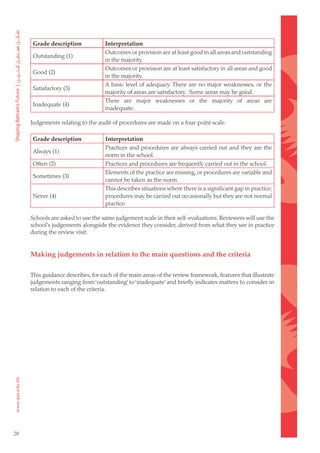
Grade description             Interpretation
                                   Outcomes or provision are at least good in all areas and outstanding
     Outstanding (1)
                                   in the majority.
                                   Outcomes or provision are at least satisfactory in all areas and good
     Good (2)
                                   in the majority.
                                   A basic level of adequacy. There are no major weaknesses, or the
     Satisfactory (3)
                                   majority of areas are satisfactory. Some areas may be good.
                                   There are major weaknesses or the majority of areas are
     Inadequate (4)
                                   inadequate.

     Judgements relating to the audit of procedures are made on a four-point scale.

     Grade description             Interpretation
                                   Practices and procedures are always carried out and they are the
     Always (1)
                                   norm in the school.
     Often (2)                     Practices and procedures are frequently carried out in the school.
                                   Elements of the practice are missing, or procedures are variable and
     Sometimes (3)
                                   cannot be taken as the norm.
                                   This describes situations where there is a significant gap in practice;
     Never (4)                     procedures may be carried out occasionally but they are not normal
                                   practice.

     Schools are asked to use the same judgement scale in their self-evaluations. Reviewers will use the
     school’s judgements alongside the evidence they consider, derived from what they see in practice
     during the review visit.


     Making judgements in relation to the main questions and the criteria

     This guidance describes, for each of the main areas of the review framework, features that illustrate
     judgements ranging from ‘outstanding’ to ‘inadequate’ and briefly indicates matters to consider in
     relation to each of the criteria.


28
Overall Effectiveness

 How effective is the school in meeting the needs of students and their parents?

This is the last judgement to be made and sums up the school as a whole. It must take account
of the characteristics and particular circumstances of the school, but at the heart of it must lie
the question of how well students achieve academically and in their personal development and
whether the school does all it can to help them to achieve as well as they can.

Making the judgement about a school’s overall effectiveness requires a synthesis of the evaluations
made in response to the other main questions in the framework. This is not an arithmetical
calculation of the grades but involves bringing the various judgements together and weighing
their relative importance to form a coherent overall assessment.

Every review team will develop a ‘narrative’ to explain why the outcomes achieved by the students in
this school are as they are. To do this, they will consider carefully how the teaching, the curriculum
and the support and guidance provided to students affect the outcomes those students achieve.
And they will arrive at a view of the nature of the impact of the school’s leadership and management
on the quality of the education it provides and, consequently, on the academic achievement and
personal development the students achieve. The team will establish how these links work, and
arrive at a corporate view of what accounts for this particular school’s performance.

In most schools there will be a strong correlation between the ratings the team gives in response
to each of the main questions. If the outcomes are good, then it is likely that they will have been
produced by good provision, supported by leadership and management whose effectiveness is also
good.

But the ‘narrative’ in individual schools can produce exceptions, and in such cases review teams will
incorporate them and explain them clearly in their review reports. For example:

   • A new leadership team, supported by an energetic and effective governing body, might have
     made a strong start, but there has been insufficient time for the impact of its work to register
     in improved teaching and higher achievement by students. In these circumstances, the
     review team might rate leadership, management and governance as ‘Good’ while assessing
     academic achievement and teaching as only ‘Satisfactory’

   • A school whose students come from highly advantaged backgrounds might register good
     academic achievement, but the review team might nevertheless consider that the teaching
     is of only satisfactory quality. The narrative in that school would suggest that outcomes
     – particularly progress – could be higher; and that this significant under-achievement is
     explained by unambitious teaching, which fails to inspire and challenge sufficiently.

Examples like these are not anomalies. They are reflections of the complexity frequently involved
in arriving at a coherent, substantiated answer to the key question, ‘How effective is the school,
and why?’


                                                                                                         29
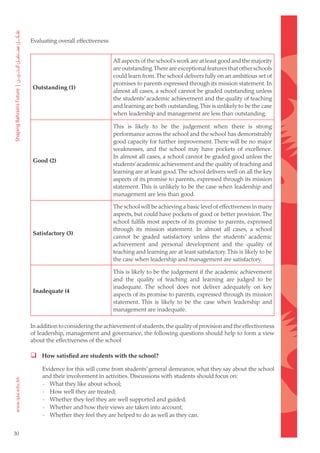
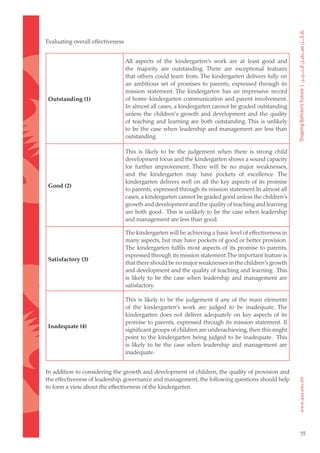
Evaluating overall effectiveness


                                        All aspects of the school’s work are at least good and the majority
                                        are outstanding. There are exceptional features that other schools
                                        could learn from. The school delivers fully on an ambitious set of
                                        promises to parents expressed through its mission statement. In
     Outstanding (1)
                                        almost all cases, a school cannot be graded outstanding unless
                                        the students’ academic achievement and the quality of teaching
                                        and learning are both outstanding. This is unlikely to be the case
                                        when leadership and management are less than outstanding.

                                        This is likely to be the judgement when there is strong
                                        performance across the school and the school has demonstrably
                                        good capacity for further improvement. There will be no major
                                        weaknesses, and the school may have pockets of excellence.
                                        In almost all cases, a school cannot be graded good unless the
     Good (2)
                                        students’ academic achievement and the quality of teaching and
                                        learning are at least good. The school delivers well on all the key
                                        aspects of its promise to parents, expressed through its mission
                                        statement. This is unlikely to be the case when leadership and
                                        management are less than good.

                                        The school will be achieving a basic level of effectiveness in many
                                        aspects, but could have pockets of good or better provision. The
                                        school fulfils most aspects of its promise to parents, expressed
                                        through its mission statement. In almost all cases, a school
     Satisfactory (3)
                                        cannot be graded satisfactory unless the students’ academic
                                        achievement and personal development and the quality of
                                        teaching and learning are at least satisfactory. This is likely to be
                                        the case when leadership and management are satisfactory.

                                        This is likely to be the judgement if the academic achievement
                                        and the quality of teaching and learning are judged to be
                                        inadequate. The school does not deliver adequately on key
     Inadequate (4
                                        aspects of its promise to parents, expressed through its mission
                                        statement. This is likely to be the case when leadership and
                                        management are inadequate.

     In addition to considering the achievement of students, the quality of provision and the effectiveness
     of leadership, management and governance, the following questions should help to form a view
     about the effectiveness of the school

      How satisfied are students with the school?
         Evidence for this will come from students’ general demeanor, what they say about the school
         and their involvement in activities. Discussions with students should focus on:
         - What they like about school;
         - How well they are treated;
         - Whether they feel they are well supported and guided;
         - Whether and how their views are taken into account;
         - Whether they feel they are helped to do as well as they can.


30
 How successfully does the school fulfil its mission and its promise to parents?
    All schools make an informal or formal promise or contract with the parents who enroll their
    children. The school – in the case of private schools in return for a fee – offers a certain type
    of educational experience, often expressed through a statement of mission or vision, in which
    it makes a commitment to parents and to the society in which it is located. This question asks
    how well the school delivers on these promises.

    Evidence will come from the questionnaire, which the school is asked to send to parents. The
    school may also have evidence of its own about parents’ satisfaction, which may come from its
    engagement with an accrediting agency. If there is an opportunity to talk with parents, it will
    be useful to explore:
    - Their feelings about the school, its strengths and features that need to be improved;
    - Whether their views are taken into account and how;
    - How the school responds to any concerns that they have;
    - Whether, in the case of private schools, they consider the school provides good value for
       money.

 What is the school’s capacity to improve?

    This is another judgement which is made at the end of the review. It should take into
    account the school’s performance in recent years and whether the processes of evaluation and
    strategic planning are sufficient, together with appropriate school management structures, to
    give confidence that the school can sustain and enhance high standards or improve itself.

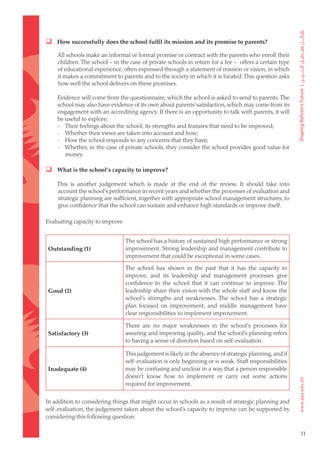
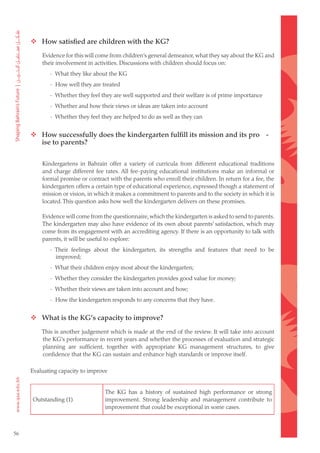
Evaluating capacity to improve


                                 The school has a history of sustained high performance or strong
Outstanding (1)                  improvement. Strong leadership and management contribute to
                                 improvement that could be exceptional in some cases.

                                 The school has shown in the past that it has the capacity to
                                 improve, and its leadership and management processes give
                                 confidence to the school that it can continue to improve. The
Good (2)                         leadership share their vision with the whole staff and know the
                                 school’s strengths and weaknesses. The school has a strategic
                                 plan focused on improvement, and middle management have
                                 clear responsibilities to implement improvement.

                                 There are no major weaknesses in the school’s processes for
Satisfactory (3)                 assuring and improving quality, and the school’s planning refers
                                 to having a sense of direction based on self-evaluation.

                                 This judgement is likely in the absence of strategic planning, and if
                                 self-evaluation is only beginning or is weak. Staff responsibilities
Inadequate (4)                   may be confusing and unclear in a way that a person responsible
                                 doesn’t know how to implement or carry out some actions
                                 required for improvement.


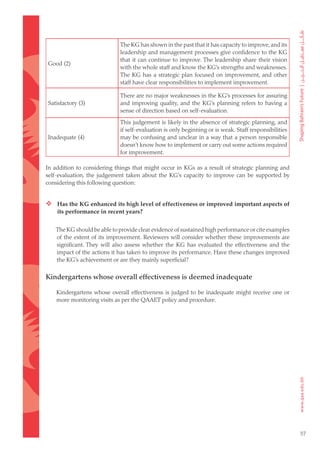
In addition to considering things that might occur in schools as a result of strategic planning and
self-evaluation, the judgement taken about the school’s capacity to improve can be supported by
considering this following question:

                                                                                                         31
 Has the school enhanced its high level of effectiveness or improved important aspects
         of its performance in recent years?


        The school should be able to provide clear evidence of sustained high performance or cite
        examples of the extent of its improvement. Reviewers will consider whether these improvements
        are significant. They will also assess whether the school has evaluated the effectiveness and the
        impact of the actions it has taken to improve its performance. Have these changes improved
        the school’s achievement or are they mainly superficial?

     Schools whose overall effectiveness is deemed inadequate.

        Schools whose overall effectiveness is judged to be inadequate might receive one or more
        monitoring visits as per the QAAET policy and procedure.


32
Students’ achievement

 How well do students achieve in their academic work?

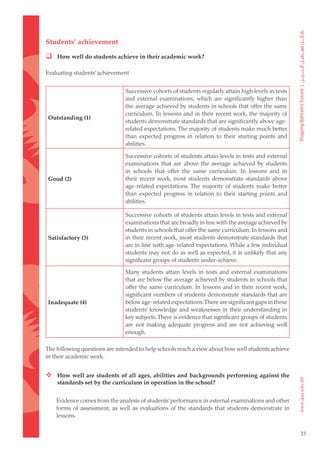
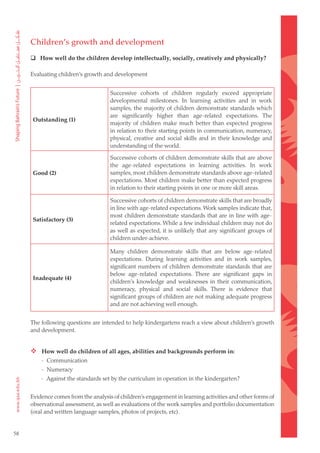
Evaluating students’ achievement


                               Successive cohorts of students regularly attain high levels in tests
                               and external examinations, which are significantly higher than
                               the average achieved by students in schools that offer the same
                               curriculum. In lessons and in their recent work, the majority of
Outstanding (1)
                               students demonstrate standards that are significantly above age-
                               related expectations. The majority of students make much better
                               than expected progress in relation to their starting points and
                               abilities.

                               Successive cohorts of students attain levels in tests and external
                               examinations that are above the average achieved by students
                               in schools that offer the same curriculum. In lessons and in
Good (2)                       their recent work, most students demonstrate standards above
                               age-related expectations. The majority of students make better
                               than expected progress in relation to their starting points and
                               abilities.

                               Successive cohorts of students attain levels in tests and external
                               examinations that are broadly in line with the average achieved by
                               students in schools that offer the same curriculum. In lessons and
Satisfactory (3)               in their recent work, most students demonstrate standards that
                               are in line with age-related expectations. While a few individual
                               students may not do as well as expected, it is unlikely that any
                               significant groups of students under-achieve.

                               Many students attain levels in tests and external examinations
                               that are below the average achieved by students in schools that
                               offer the same curriculum. In lessons and in their recent work,
                               significant numbers of students demonstrate standards that are
Inadequate (4)                 below age-related expectations. There are significant gaps in these
                               students’ knowledge and weaknesses in their understanding in
                               key subjects. There is evidence that significant groups of students
                               are not making adequate progress and are not achieving well
                               enough.

The following questions are intended to help schools reach a view about how well students achieve
in their academic work.


 How well are students of all ages, abilities and backgrounds performing against the
    standards set by the curriculum in operation in the school?


    Evidence comes from the analysis of students’ performance in external examinations and other
    forms of assessment, as well as evaluations of the standards that students demonstrate in
    lessons.


                                                                                                      33
Reviewers will assess how thoroughly and well the school records and analyses students’
         performance in external and internal examinations and tests. This provides a good indication of
         how well the school evaluates its performance, which is important in assessing the effectiveness
         of leadership and management.


         In arriving at judgements, reviewers consider the results of examinations and tests, the
         outcomes of the scrutiny of a sample of students’ current work and the observation of work
         being done in lessons. Although examination and test results may indicate high success rates,
         it is important to ascertain whether the pass rates accurately reflect the levels of knowledge
         and understanding seen in lessons. By looking at students’ work and talking to them, reviewers
         assess whether their knowledge and understanding are as high as they should be. Reviewers
         use their professional knowledge and experience to reach an understanding of the students’
         performance in general and especially in key subjects such as Arabic, English, mathematics
         and science in relation to that of their peers in similar schools that offer the same curriculum.


      Are students making the progress expected of them in relation to their starting points
         and their abilities?

        Direct evidence for this comes from looking at students’ work and the school’s records of the
        levels they have reached at different points in time. Does the school assess the students’ ability
        on entry to the school? Does the level of their work progress as it should? If the information is
        available, how does the progress of the students compare with those in other similar schools?
        Does the evidence collected from lesson observation show students attaining as well as they
        can? Is there evidence of student’s progress from internal and external assessments, and how
        is it used by students, teachers and management to improve student performance?

        Reviewers will gauge the progress students are making and how well they are learning in lessons.
        Are they acquiring skills and understanding, as well as knowledge? Are they developing higher
        order thinking skills and the capacity to work well in groups and on their own? Evidence of
        progress in learning will come from the observation of lessons in a wide range of subjects, not
        solely the ‘core’ subjects.

      How good is the students’ personal development?

     Evaluating students’ personal development


                                     Students’ personal development will be at least good in all criteria
                                     and the majority of criteria will be outstanding or exemplary,
     Outstanding (1)                 including students’ willingness and capacity to take responsibility
                                     and show leadership skills. Students behave maturely and are
                                     committed and enthusiastic learners.
                                     Good personal development will be seen in a mature and eager
                                     approach to school. Students develop a sense of worth, show
                                     respect and care for each other and contribute fully to the life of
                                     the school. These qualities will be reflected in good attendance
     Good (2)                        and punctuality. A strong sense of purpose is likely to pervade
                                     lessons and the school. Students develop the capacity to work
                                     independently and co-operatively. There is a strong sense of
                                     community in the school. No element of personal development
                                     will be unsatisfactory.

34
Students’ personal development will not be inadequate in any
Satisfactory (3)                major criteria and it may be good in some and satisfactory in
                                most.
                                Where personal development is inadequate, it is likely that
                                significant groups of students will not be enjoying their education
                                and this may be reflected in poor behaviour, attendance
Inadequate (4)
                                and attitudes in class. Students are not likely to want to be
                                involved in activities in the school and may be unwilling to take
                                responsibility.
The following questions are intended to help schools reach a view about the standard of the
students’ personal development.


 Do students attend school regularly and punctually?

   The school, in its SEF, may support its view of attendance by comparisons with appropriate
   available averages. To be good, the school’s attendance rate should be higher than average.
   Attendance should be regular to enable students to make good progress in their learning.
   Reviewers will explore whether the school monitors attendance and punctuality, whether it
   keeps records and what it does to encourage good attendance. Do attendance rates vary across
   different age groups? If so, why? What does the school do about it? Similar questions might be
   asked about punctuality.


 Do students participate fully and enthusiastically in school life?

   Students’ attitudes to school will be evident in lessons, in extra-curricular activities and around
   the school. In effective schools, students are enthusiastic about and absorbed by what the
   school provides, and are keen to participate. In lessons, the extent of enthusiasm will be seen
   in students’ willingness to ask and respond to questions and volunteer ideas. The extent of
   involvement in extra-curricular activities and in events the school organizes also gives first-
   hand indications about students’ attitudes.


 Do students develop self-confidence and the capacity to work independently, and take
    responsibility?


   Different styles of learning require students to work in different ways. Observation will
   give first-hand evidence of how adaptable students are and whether they have developed
   confidence in working independently. Do they pursue problems as far as they can, or do they
   give up easily?


   Taking responsibility not only relates to leadership roles in, for example, extra-curricular
   activities, but to students advancing their learning. This might be seen in how maturely they
   respond to new tasks and the extent to which they show initiative. Are leadership roles offered
   to just a few students or more? If the school has a school council or has monitoring or other
   responsible roles, these give direct opportunities to see pupils taking leadership roles. Are
   older students in any way responsible for younger ones? Discussions with students allow
   reviewers to explore many of these aspects.


                                                                                                         35
 Do students work effectively together, respecting the views, the feelings and the beliefs
         of others?

        Observations in lessons, again, give clues about students’ ability to work collaboratively. In
        group work, these include how well students listen to each other and build on each other’s
        contributions and how they divide responsibilities when carrying out practical assignments.
        This criterion also relates to sensitivity, understanding and respect for others, their values and
        beliefs. Evidence will come from discussions, especially discussions on moral or spiritual issues,
        but also from observing interactions in social areas of the school.


      Do students behave in a mature and responsible way in lessons and around the
         school?

        Reviewers learn much about the personal development of students through direct observation
        of their behaviour in and out of lessons. Do they behave well? Do they show respect for others,
        including their teachers? Are students considerate towards each other? Do they form good
        friendships? Do they care for the fabric of the school? Do they contribute to enhancing the
        facilities available to them?


        Reviewers will also pursue with the school what it does to promote good behaviour and how
        it responds to any poor behaviour. Does the school log incidents of poor behaviour and the
        action taken? Does the school monitor behaviour and the social development of the students
        in general?


      Do students feel safe and secure in school and are they free from bullying and other
         kinds of hurtful behaviour?

        All students should feel safe, valued and respected and the school, in all it does, should
        be promoting positive values and seeking to combat all forms of intimidating behaviour,
        harassment and prejudice. Students also need to know that the school takes all reasonable
        steps to ensure that they work in a safe and healthy environment.


        Evidence will come mainly from discussions with students, but reviewers will also explore
        records the school has about incidents of harassment or hurtful behaviour and the action
        taken.


      Do students develop understanding of the heritage and culture of Bahrain, including
         the values of Islam?

        Evidence chiefly comes from lesson observation and discussions with students about what
        it means to them to live in Bahrain and their understanding of its distinctive character.
        The analysis of curriculum content, and the selection of learning resources in use, will help
        reviewers to assess the extent to which students have opportunities to develop this kind of
        understanding.


        Private schools educate children from a wide range of nationalities and they offer a variety
        of curricula from different ‘home’ education systems. What they all have in common is their
        geographical location in Bahrain, and it is important that private schools pay due regard to the
        character and traditions of the host country.


36
The quality of provision

 How effective are teaching and learning?

Evaluating the effectiveness of teaching and learning

                                Teaching and learning is at least good in all criteria and is
                                outstanding or exemplary in the majority. As a result, students
Outstanding (1)                 thrive, are committed and enthusiastic learners, and make
                                exceptionally good progress. Teaching and learning cannot be
                                outstanding if the content is inaccurate in any way.

                                A good teaching and learning engages students strongly in their
                                work. Teachers have good subject and course knowledge, which
                                lends confidence to their teaching styles. Students are challenged,
                                but without the demand being so great that they cannot cope.
                                Available resources are used effectively to support learning.
Good (2)                        Teachers are sensitive to and respond effectively when students
                                need help, for example by offering different ways of tackling
                                problems. They cater for the different needs of students well, and
                                regularly and systematically assess students’ progress. Students
                                make good progress and have positive attitudes to learning. Time
                                throughout the lesson is used productively.

                                Teaching and learning will not be inadequate in any major criteria
                                including teachers’ subject knowledge, teaching and learning
                                strategies, supporting students and assessment. There might
Satisfactory (3)
                                be some good features while lesson planning may need some
                                improvement and lacks creativity. The students make progress
                                but they are not attracted to their work.

                                Teaching and learning will be inadequate if students are not
                                making enough progress. The work may be pitched wrongly – too
                                easy or too hard. Inadequacy may also result from teachers not
                                having sufficient knowledge of their subjects or the courses they
Inadequate (4)                  are teaching, or not sufficiently engaging or supporting students,
                                so they are left too much to their own devices and make too little
                                progress. Any more than a few or minor errors in the accuracy of
                                content is likely to lead to a lesson being inadequate. There is no
                                assessment of students’ progress.

Judgements about teaching and learning will be based on direct observation by reviewers, evidence
from any observations carried out by the school and from planning documents.
Reviewers judge how well the teaching helps the students to learn effectively. They do not apply
any pre-conceived notions of ‘good’ teaching styles but instead concentrate on assessing how
successfully the teaching they witness promotes and supports the students’ learning.


The following questions are intended to help schools reach a view about how well the teaching
promotes and enables effective learning.


                                                                                                      37
 Do teachers have good knowledge about the subjects and courses they teach and how
         to teach them?


        This criterion is concerned with more than simply the teachers’ academic qualifications.
        Reviewers will judge how well teachers are able to use the knowledge they have to promote
        good learning among the students. In lessons, good subject and course knowledge is seen in
        clear explanations, knowledgeable responses to students’ questions, an ability to offer different
        examples to illustrate points or different ways of tackling problems, and the capacity to extend
        students in the subject. Good subject knowledge is often seen in the enthusiasm that teachers
        show in their teaching.


      Do the teachers enable students to acquire skills and understanding, as well as
         knowledge?


        Analysis of lesson planning will give reviewers insight into the extent to which teachers
        attempt to do more than transmit facts. Observation of lessons will give even greater insight.
        Do teachers set problems? Do they encourage discussion? Do they challenge students to frame
        hypotheses? Are students learning how to learn?


      Do teachers enable students to develop higher order thinking skills?

        This is an important skill and schools should seek to foster it. Does the school provide enough
        opportunities through teaching the curriculum to allow the students to think critically, justify
        their views and develop reasoning? How do students respond – do they wait until answers are
        provided or do they seek answers themselves? Do they ask questions, do they reach solutions,
        and do they think creatively?


      Do teachers manage lessons effectively so that they are orderly and productive?

        Lessons should not only be well-ordered and calm, but also purposeful and productive, so that
        they achieve their objectives. The learning and teaching in schools should be well-organised
        with well-established daily routines in classrooms and elsewhere. Lessons should be based
        on clear, confident instruction and activities that are worthwhile. There should be no need for
        teachers to spend a high proportion of their time disciplining students. Where there is any
        tendency for students to misbehave, incidents should be handled firmly but calmly so that
        students’ energies are re-focused on the tasks in hand.


        Part of the management of lessons involves effective use of time. Reviewers will note whether
        lessons start promptly and in a stimulating way, whether activities are organized efficiently
        so that tasks are not unnecessarily drawn out, whether productive use is made of all the time
        available, and whether lessons are effectively rounded off.


38
 Do teachers ensure students’ engagement, motivating, encouraging and supporting
    them?


   Teachers’ success in engaging students will be seen in their attentiveness and how well they
   are involved with activities, tackle problems and respond in question and answer sessions.
   Reviewers will be alert to situations where students are left to get on with their work using ICT
   or other resources without the judicious interventions of teachers to support, check, encourage
   and challenge.


 Do teachers challenge students of all abilities so that they make at least the progress
    expected of them?


   Effective teaching and learning extends students intellectually, creatively and physically.
   Clues to whether challenge is sufficient are seen in the effort which students have to put
   into their work to complete it. When work is insufficiently challenging, students quickly and
   easily complete it and become bored. This can arise from mundane or routine tasks. Reviewers
   will expect to see targeted questioning and intervention by teachers and tasks that provide
   challenge.


 Do teachers use teaching and learning methods and the resources which lead to effective
    learning appropriately?


   Effective methods will motivate students and promote sound gains in knowledge, understanding
   and skills. Teachers use an appropriate range of different teaching styles that they choose for
   the appropriate purposes. Although the school may have adopted a ‘prescribed’ curriculum,
   teachers should be seeking ways to teach their subjects that make the subject material
   accessible. Are teachers constrained in their approaches or do they use different approaches to
   present, explain and consolidate course content?


   Not all students learn in the same way. It is therefore important to provide a variety of grouping
   and teaching strategies. Often, whole-class teaching is not the most effective approach; working
   in pairs or small groups can be more effective. For young children it is much more effective and
   developmentally appropriate. Learning to work in teams and to acknowledge others’ point of
   view, moreover, is valuable personal development. Analysis of schemes of work and lesson
   plans will show whether teachers are aware of these issues, and lesson observation will show
   whether a variety of activities is offered, and what its impact on learning is.


 Do the tasks set for students to be undertaken out of lesson time consolidate and extend
    work done in class?


   The SEF may indicate that the school has a policy for independent study, including homework,
   and how this is being monitored. Direct evidence will come from examining students’ work,
   from talking with them and from noting what happens at the end of lessons that are observed.
   Are the tasks given to students used only to provide practice or are they used also to extend
   and consolidate work done in lessons? It is quite possible to set good tasks which involve the
   students’ working from textbooks: the source is not important; it is the quality of what they are
   asked to do that matters.


                                                                                                        39
 Do teachers use assessment, including marking, effectively to diagnose students’ needs
         and adjust their teaching accordingly?


         Clues about the nature of assessment and how it is used come from observations of lessons,
         scrutiny of students’ work, the school’s policies and discussions with teachers. Do the teachers
         routinely share the learning objectives of lessons with the class and refer to them subsequently
         for the purpose of discussing with students what they have learnt? Are teachers constantly
         assessing what students know, understand and can do and do they adjust their teaching to
         support students who need help and extend those who could be challenged further? Do they
         ask diagnostic questions that test understanding? Do they follow up answers to respond to
         students’ needs? They should also expect to see teachers giving feedback to students during
         lessons, which helps them to understand how well they have done and what they need to do
         next to improve the quality of their work.


         How helpful is marking? Is it cursory, or does it give students useful insights into how well
         they are doing and what they can do to improve? Are comments on students’ work followed
         up? Does the teacher check that unfinished work is subsequently completed?


         Discussions with students will give clues about how well assessment is used. Are they
         given feedback from tests and other assessments? Is testing used to diagnose strengths and
         weaknesses in learning? Are changes to teaching made as a result of assessments, and do
         students who need it receive additional support?


      How well does the implementation and enrichment of the curriculum meet the
         educational needs of the students?


     Evaluating the implementation of the curriculum


                                     All criteria of the school’s implementation of the curriculum
                                     are at least good and the majority are outstanding or exemplary
                                     including developing students’ understanding of their rights
                                     and responsibilities, curriculum enrichments and extracurricular
     Outstanding (1)                 activities. The way in which the curriculum is implemented has an
                                     explicit rationale that is clearly focused on achieving the school’s
                                     aims and delivering its promise to parents. The way in which the
                                     curriculum is taught and enriched prepares students very well for
                                     subsequent stages of education or employment.
                                     The curriculum is used as a means to promote skills and values, and
                                     teaching focuses strongly on understanding as well as developing
                                     knowledge. The school does as much as it can to enhance the
     Good (2)
                                     curriculum in a variety of ways, through extra-curricular activities,
                                     the use of the school environment and the resources available in
                                     the local community.
                                     Curriculum implementation may be good in some criteria, but
     Satisfactory (3)                ordinary and uninspiring in most. To be satisfactory it will not be
                                     deficient in any major criteria.


40
Curriculum implementation has significant weaknesses. Its
                                rationale will be unclear and may be dictated mostly by the
                                content of textbooks. There may be discontinuity in some subjects
                                from year to year and significant gaps in content. It is neither
Inadequate (4)
                                broad nor balanced. It may make very little or no provision for
                                extra-curricular activities and the curriculum may be presented
                                as a collection of disjointed subjects, which does little to inspire
                                students or prepare them well for the future.


Reviewers’ judgements refer to a school’s implementation of its curriculum rather than to the
curriculum itself. QAAET respects the rights of private schools to select their own curricula and
does not endorse any one curriculum in preference to another.


The school’s documentation is the central source of evidence about the quality with which it
implements its curriculum. Discussions with staff and students, as well as observing the curriculum
in action, provide additional evidence. The following questions are intended to help schools reach
a view about the curriculum implementation.


 Does the school provide for all its students, within the scope of the curriculum it offers,
    a broad range of experiences, well suited to their educational needs?


    Reviewers judge the breadth of curriculum implementation, the mix of subjects offered, how
    much choice there is for older students and the challenges it presents for them. They take into
    account the prescriptions of the curriculum in operation in the school, and assess the extent to
    which the school takes advantage of the scope it offers. They assess how relevant the subjects,
    courses and other activities offered are to the students’ needs, including those who are high
    achieving and those who have difficulties with learning.


 Is the curriculum kept under review and is its implementation revised as a result of
    self-evaluation and in response to the changing needs of the students?


    Does the school have plans and schemes of work that show how the curriculum should be
    organized and sequenced? Are these plans regularly reviewed as part of the school’s self-
    evaluation process? Are changes to the way the curriculum is implemented well planned, and
    do they ensure that the needs and interests of all students are met? When appropriate, does
    the school take account of the views of students and parents to help it decide what changes to
    make?


 Are links made between subjects so that students experience a coherent curriculum?

    Do students see skills as transferable from one subject to another and are they encouraged to
    do this? Does the school compartmentalize subjects, or is there planning so that knowledge
    from one subject can be used in another? For example, does the school ensure that students
    have the appropriate mathematical knowledge to tackle work in science successfully? Does the
    school, for example, promote a common approach to helping students develop their writing?
    Evidence of coherence in approaches will be evident in the scrutiny of students’ work, but also
    in lessons.

                                                                                                       41
 Does the school seek to develop students’ understanding of the rights and responsibilities
         of being part of a community?


         Does the school promote a spirit of community? Does the school take deliberate steps to
         encourage good relationships among students? Does it make clear to students how they
         expect them to contribute to the life of the school? Does it enable students to take on real
         responsibilities within the school? Does it encourage students to care and watch out for each
         other? Does the school enable and encourage students to contribute to national activities that
         develop citizenship, field visits such as to cultural landmarks or other social activities?


      Does the way in which the curriculum is delivered adequately prepare students for the
         next stage of their education or for employment?


         Does the way in which the curriculum is delivered equip students of all ages with the basic skills
         they need to enable them to succeed in the next stage of their education? Does the curriculum
         implementation deliberately plan to promote progression and continuity in students’ learning?
         Does the way in which the curriculum is delivered in the secondary phase equip students with
         the qualifications and the skills they need for higher education? Does the way in which the
         curriculum is delivered include content that is intended to prepare students for the world of
         work? Are there students at risk of not acquiring the skills they need? What is the school doing
         about it?


      Is the curriculum enhanced by extra-curricular activities which promote wide-ranging
         interests?


        The quality of the curriculum implementation will also depend on what the school chooses to
        add to its basic provision in order to broaden students’ experiences. Some experiences may be
        within the planned curriculum for all students and others may be outside, offered to students
        on a voluntary basis. Students may have to choose what additional opportunities to take up.
        Are they constrained in their choices and, if so, what guidance do they have? What is the take-
        up of extra-curricular activities, and does the school keep records? The important question is:
        how broad and rich is the curriculum for individual students?


      Is the curriculum enriched by the use of the school environment and resources available
         in the local community?


         Does the school consciously use the school buildings, their surroundings and resources
         available locally as part of the learning environment? For example, are the decoration and the
         ambience of the buildings conducive to learning? Are displays in classrooms used meaningfully
         to enhance learning and celebrate students’ work? Is care taken to ensure that the school
         grounds and the environment are attractive? In response, do students show respect and care
         for their immediate surroundings? Does the school make use of local resources, local people
         and local events to strengthen the students’ knowledge and understanding of, for example,
         local and national culture, traditions and values?


42
 How well are students guided and supported?

Evaluating the quality of guidance and support


                               Guidance and support will be at least good in all criteria and
                               outstanding or exemplary in the majority. These include the
                               counselling of students in difficult circumstances, the vigilance of
                               staff for students’ well-being or the strong support for students’
Outstanding (1)
                               academic progress in class. The environment is fully safe, hygienic
                               and secure for students and staff. The site, accommodation and
                               equipment are kept in excellent condition. Students are at all
                               times supervised and protected from hazards.

                               Good quality guidance and support is seen in the high level of
                               commitment among staff and their competence in ensuring that
                               students are safe, feel content and settled in school, are helped and
                               supported when they have difficulties academically or personally,
                               and are soundly and impartially guided when they have to make
Good (2)
                               decisions on matters which affect their lives. The environment is
                               safe and healthy for students and staff. The site, accommodation
                               and equipment are hygienic and well maintained. The students
                               are supervised at work and at play, as they move round the school
                               and on school transport.

                               There will be no major deficiencies in any of the major criteria of
                               the guidance and support provided for students and some criteria
                               may be good. Support and guidance is at a minimum level.
Satisfactory (3)
                               Essential requirements for maintaining the health and safety of
                               students are met. The site is secure, safe and clean. Students are
                               kept safe throughout the school day and accidents are rare.

                               Students are left very much to their own devices such that they
                               may feel isolated and that the school does not care much for
                               them. There may be little or no guidance on any subject choices
                               that have to be made, and little is done to support and counsel
                               students who may be having a difficult time emotionally or
Inadequate (4)
                               otherwise. Health and safety procedures are either non-existent
                               or poorly implemented. Hazard checks are irregular and not
                               rigorous. Some parts of the site are unsafe or unhygienic. There
                               is only weak supervision of students at times during the school
                               day.

The following questions are intended to help schools reach a view about the guidance and support
for students.


                                                                                                       43
 Are students inducted into the school in a way that helps them settle quickly and
         easily?


        This is particularly important for students who join the school at non-standard times. But, for
        all students, the speed and ease with which they settle into school will influence the success
        they have with their school work and their attitude to school.


      Does the school monitor students’ academic progress so that their learning needs can
         be met?


        Much rests on the assessment, monitoring and recording systems in the school. Is assessment
        limited to standard tests, or is more done to find out how students learn and personal
        circumstances that might affect their progress in school? In class, do teachers diagnose learning
        difficulties and find ways around them? Are they alert to times when students need help,
        balancing the need for them to become independent students with the frustration that can
        grow from feelings of failure? Are students given the right level of support to help them move
        on?


      Does the school monitor students’ personal development so that their learning needs
         can be met?


        Does the school operate as if all students are the same, or does it recognize different needs
        personally as well as academically? How much attention does the school pay to assessing and
        recording the extent and rate of their students’ personal development? Does the school report
        to parents on students’ personal development or, except in cases where a child is particularly
        troubled or troublesome, do reports to parents refer to personal development only in vague
        and general terms? Does the school use the information it gathers about students’ personal
        development to help it to make changes to its provision?


      Does the school deploy staffing and resources effectively to support students with
         special educational needs of different kinds?

        Reviewers will assess the quality of the provision the school makes, particularly the extent to
        which staffing, facilities and resources are targeted effectively towards removing the barriers
        to learning that individual students experience. Evidence comes from examining the school’s
        plans for supporting such students, from observation of the support they actually receive and
        discussion with teachers and other staff and, when possible, with parents.


        Many private schools stipulate in their admissions policies the range of needs – physical,
        emotional and cognitive – for which they are able to cater. In some cases special provision is
        offered in return for additional fees. Reviewers will assess the quality of that provision.


      Are students sensitively supported and helped when they have problems?

        Students need support of different kinds, including with their work in class and on personal
        issues. On personal matters, do students have someone they are happy to turn to and can


44
trust for sensitive advice and support? Is there a sense of caring in the school in which staff
   are alert to students’ needs? Do older students take on the roles of mentors to younger ones?
   Do students receive advice and guidance when they have personal problems or problems
   in learning? Are confidential records kept on students, but is information shared with those
   who need to know, when it would have a material effect on students’ learning, such as when
   students have physical or emotional difficulties? Generally, do the staff know students well
   enough?


 Do students have access to staff for advice and guidance about the next stage of their
    education and in preparation for employment?


   Where students have choices to make, for example, about any optional subjects or what
   programmes to follow beyond school, they need to make those choices on the basis of clear
   information and impartial advice, tailored to their needs. Is written information clear and
   comprehensive? Do students have access to the advice they need?


 Are parents well informed about students’ progress?

   Parents should feel confident in the school. In part, confidence will stem from parents knowing
   what their child is doing in school and the progress he/she is making. How does the school
   do this? How clear is information to parents? Do parents understand what it means and what
   they can do about it? Are there meetings to talk about students’ progress? Good links with
   parents are vital, for example, to promote good attendance and for sharing and resolving any
   concerns.


 Does the school ensure that students and staff work in a healthy and safe
    environment?


   A climate of care, understanding, tolerance and respect should permeate the school. It should
   be actively promoted so that a safe environment for all students is created. Is it evident in the
   day-to-day interactions between students and between staff and students? What steps does
   the school take to create such a climate? Does it have rules and routines defining acceptable
   behaviour and is behaviour effectively managed? Does the school monitor any incidents of
   racism, or intimidating behaviour? Does it respond decisively, swiftly and effectively when any
   incidents of harassment or ill feeling arise?


   Reviewers will consider whether the school has carried out risk assessment and takes reasonable
   steps through its policies and practices to promote the health and long-term wellbeing of staff
   and students. This involves evaluating how well the school’s management oversees health
   and safety and understands its responsibilities, how well the environment and activities are
   monitored, how alert staff and others are to potential hazards, and how far the school draws
   on expert advice. Reviewers will also explore the extent to which the school carries out risk
   assessments and takes steps to ensure that the school environment is, as far as possible, free
   from hazards.


                                                                                                       45
 Schools with boarding provision

         The experience of boarding plays a valuable part in students’ education and development. It can
         contribute in important ways to the achievement of the school’s aims. The welfare of boarding
         students extends to their whole life at school and not solely to their boarding experience.
         Schools with boarding provision should promote the personal development and welfare of
         each individual boarder.


         Reviewers will take the quality of boarding provision into account when making an overall
         judgement about how well students are guided and supported. Reviewers will record their
         evaluation of boarding provision separately in the Record of Review Judgements.


     Evaluating the quality of boarding provision


                                     Provision for boarders is at least good in all criteria and is
                                     outstanding or exemplary in the majority. An excellent, wide-
                                     ranging programme of activities and events caters for all boarders’
                                     needs and interests, and extends through the weekends. There is
     Outstanding (1)
                                     a high standard of care, and excellent opportunities for boarders’
                                     personal development. A strong commitment to safety and
                                     safeguarding permeates all aspects of the boarding provision.
                                     Communication between parents, staff and boarders is excellent.
                                     Provision for boarders enhances their personal development. A
                                     well-structured and varied programme of activities meets their
                                     needs and interests. There is a good standard of care overall and
     Good (2)                        safety and safeguarding are effective and well integrated. Good
                                     links between care staff and teachers promote achievement and
                                     wellbeing. Communication between the parents/carers, staff and
                                     boarders is good.

                                     Provision is at least satisfactory in all major criteria and may
                                     be good in some. Boarders are suitably cared for, kept safe and
                                     are properly supervised. All safeguarding and child protection
                                     procedures are clear and effective. There may be minor shortfalls
                                     or inconsistencies in provision but these do not significantly
     Satisfactory (3)
                                     affect the safety and wellbeing of boarders. There is satisfactory
                                     provision for educational and recreational activities, including
                                     at evenings and weekends and adequate privacy and space.
                                     Communication and consultation between parents, staff and
                                     boarders are adequate.

                                     There are major weaknesses in the school’s boarding provision.
                                     Leaders and managers have failed to ensure that the school meets
     Inadequate (4)
                                     the boarders’needs in relation to their welfare, safety and personal
                                     development. Boarding does little to enhance the students’ lives.


     The following questions are intended to help schools reach a view about the quality of boarding
     provision.


46
 Does the living and sleeping accommodation for students, including dining, washing
    and toilet facilities, meet their needs and ensure their health and safety?


   Does the school have regard to local regulatory requirements? Do the students have adequate
   access to high quality and secure accommodation with adequate privacy for sleeping, studying,
   toilet and washing, laundry, changing facilities, and recreation areas? The school should identify
   any potential safety hazards and take effective action to minimise them. Reviewers will assess
   provision for the accommodation for sick pupils and any arrangements that are in place for
   off-site accommodation and short-term exchanges.


 Do the members of staff with responsibilities for boarding, such as house parents,
    ensure the health, safety, and care of students?


   Does the school provide adequate supervision of boarders, including when they leave the
   school site, and night supervision? Does the school provide staff job descriptions, induction,
   supervision and training, and guidance on boarding practice? Are there effective policies
   governing staff/boarder relationships, privacy, staff recruitment and checks on other adults
   that may come into contact with boarders or have access to boarding accommodation?


 Are after-school and weekend activities of a sufficient range and quality; and are
    boarders and day students integrated into joint after-school clubs and activities?


   Does the school offer a well-managed programme of activities in which boarders can
   participate? Does it consult boarders about the content of the programme?


 Are there effective procedures for the welfare and protection of students, including
    permissions to leave the boarding house after school hours, at weekends and for
    holidays and are provisions in place for travel and collection?


   These should cover bullying, child protection issues (and responding to allegations and
   complaints), security (including internet safeguarding), behaviour, discipline, sanctions,
   rewards and restraint, health education and boarders’ health records. Does the school provide
   adequate welfare support to boarders, including medical treatment and first aid, care of ill
   boarders, management of health and personal problems, parental contact and telephones,
   pocket money and care of possessions and the induction of new boarders?


                                                                                                        47
Leadership, management and governance


      How effective are leadership, management and governance in promoting high
         achievement, strong personal development and school improvement?

     Evaluating the effectiveness of leadership, management and governance


                                   Leadership and management will be at least good in all criteria
                                   and outstanding or exemplary in the majority. These include
                                   exceptionally rigorous self-evaluation and strategic planning
                                   stemming from it, a relentless quest for improvement including
                                   informed testing of innovative practices, a strong common sense
     Outstanding (1)               of unity and effective use of teams to bring about improvement.
                                   Effective governance, where a governing body exists, or effective
                                   use of an advisory body, will make a significant contribution
                                   to the leadership of the school, in support of its educational
                                   leaders. There will be a strong focus on raising achievement for
                                   all students.

                                   Good leadership and management are focused on maximizing
                                   achievement and promoting good personal development.
                                   There will be a common sense of purpose among staff, driven
                                   by the school’s leadership, which is reflected in the clarity and
                                   consistency of day-to-day practices and an emphasis on the best
     Good (2)
                                   teaching and support for students. There will be a quest to assure
                                   quality and to secure improvement informed by evaluation of
                                   current practices. The governing body or advisory body will exert a
                                   positive influence on the work of the school, playing a significant
                                   role in leading improvement.

                                   Some elements of leadership and management will be good.
                                   Much will be ordinary and even uninspired, and there will be
     Satisfactory (3)              no major weaknesses in any major criteria. A governing body or
                                   advisory board will be in place, which influences the work of the
                                   school and plays a part in the school’s improvement plans.

                                   Leadership and management will be inadequate where they
                                   have little or no impact on the quality of provision or students’
                                   achievement. There will be important weaknesses such as:
                                   absence of monitoring or evaluation; breakdown of trust,
                                   communication or sense of purpose among staff; inconsistent or
     Inadequate (4)
                                   ineffective day-to-day practices; or little or no strategic planning
                                   for improvement. Governance, where a governing body exists,
                                   will be ineffective or non-existent and may impede the school’s
                                   achievement of its aims. Where no governing body exists, there is
                                   no effective advisory board in place, either.


48
The quality of leadership, supported by efficient management, is central to the success of the
school. The following questions are intended to help schools reach a view about leadership and
management, but ultimately the success of the school is the major test.


 Do the principal and others with leadership responsibility have a clear vision for the
    school, focused on achievement, which is shared with and by the staff?

    Reviewers will establish whether there is a shared vision among senior leaders about the
    direction the school is going and whether leaders involve other staff and, perhaps, parents and
    students in that vision. Whether the goals are realistic or sufficiently challenging will depend
    on the current circumstances and recent history of the school. To what extent is the vision
    focused on achievement and improvement? Discussions with senior managers and staff will
    establish whether there is a sense of common purpose and whether aspirations for the future
    are known and shared. Are leaders and managers helped to achieve the school’s vision by
    having clear job descriptions, which set out their responsibilities?


 Are leaders effective in inspiring, motivating and supporting staff?

    Effective leadership is usually reflected in the attitudes and approaches of staff at all levels in
    the school, in the enthusiasm for change and improvement and a shared sense of purpose and
    direction. Do leaders lead by example? What strategies do they use to bring about change?
    How do staff respond?


 Is self-evaluation, including the analysis of performance, rigorous and is it used to
    assure quality and bring about further improvement?

    This criterion covers inter-related and essential components of effective management. At the
    heart of them are mechanisms to monitor provision and performance, analysis and evaluation.
    Rigorous self-evaluation includes these elements. Does the school record and analyse the
    students’ performance over time in external and internal examinations and tests? The school
    should have the confidence to be honest with itself about how successful it is in this and in
    all other aspects of its work. Does the school know its weaknesses as well as its strengths?
    How does it use the information it gains from self-evaluation? Is it used to assure quality and
    take action where quality is not as high as it should be? How does self-evaluation link with
    planning for improvement?

    The processes of self-evaluation are far more important than any recorded summary of findings.
    Who is involved in self-evaluation? How does self-evaluation happen? Is it manageable?


 Does the school have a strategic plan, which is firmly focused on improvement?

    A strategic plan is an essential component in translating the vision for the school into action
    to bring about improvement. This criterion does not insist on the existence of a single, specific
    document: it is not the quality of the document that is important; it is the quality of the
    strategy. Does it identify the right priorities for the school, based on sound self-evaluation?
    Are they realistic and workable? Do the school’s plans set out clearly what is to be done,
    how and when? Do they include processes and procedures for monitoring and evaluating the
    success of the plans? By tracing management decisions through to action in the classroom,
    reviewers can check how well intentions and plans are translated into effective practice.


                                                                                                          49
 Are the staff effectively managed, developed and efficiently deployed?

         Teaching staff represent one of the most expensive resources in a school’s running costs, yet
         recruiting and retaining suitable staff may also be one of the biggest challenges that senior
         management face. In the face of these factors and, more important, to link good teaching
         and good achievement, the management, deployment and development of staff are of crucial
         importance.

         How does the school monitor and manage the performance of staff? What action is taken
         to assure quality and secure improvement? What steps are taken to ensure that deployment
         is efficient? In relation to deployment, are steps taken to ensure that there is a good match
         between teachers’ qualifications and experience and the subjects they teach? Is the use of
         non-contact time monitored?

         Is the effectiveness of staff maximized through professional development? How is professional
         development linked with performance management of staff and the school’s self-evaluation?
         Does the school maintain records of the professional development needs of the staff and
         of the opportunities they have taken up? Are any attempts made to evaluate the impact of
         professional development activities?


      Are budgeting, planning and resource allocation firmly linked, to ensure the provision
         of good quality teaching and learning and a high quality learning environment,
         appropriate to the school’s mission?

         Learning resources include books and equipment, library facilities and provision for information
         technology. Are these used to best effect in teaching to facilitate and support learning and
         to help students develop knowledge, understanding and skills? Direct evidence comes from
         classroom observations. Reviewers will form a view about whether resources are well chosen,
         whether they are sufficient and whether they are in good condition, so that students have
         pride in using good quality materials. Are rooms used efficiently, or are they vacant for much
         of the time? Does the accommodation enhance the learning atmosphere?

         Private schools vary a great deal in the level of fees they charge parents, and consequently in
         the amounts of funding that they have available to spend on accommodation, facilities and
         resources. In making their judgements, reviewers will, as in public schools, concentrate on
         assessing how well and to what effect schools deploy the resources available to them, rather
         than on their quality in absolute terms.


      Does the school seek, and is it responsive to, the views of students and parents about
         its provision?

         Parents and students are the most important groups of people with interests in the school’s
         work. How well students are prepared for life beyond school is in the school’s hands; and their
         parents understandably have a keen interest in this. How does the school seek the views of
         parents and students? Whether or not it has a formal parents council or students council, does
         it listen to their concerns and suggestions? What actions have been taken as a result of their
         views and comments? How does the school respond to parents and students when they have
         concerns or complaints? Does it welcome parents and involve them in its work, the choices
         that have to be made and the personal and academic progress of their child or children?


50
 Does the school have well-developed links with the local and wider community that
    enhance and enrich the students’ educational experiences?

    The locality in which a school in situated will contain human and material resources that
    can be harnessed to enhance the quality of the education it offers. Effective community links
    are an advantage to both the school and its locality. Schools benefit from drawing on local
    facilities, events and expertise; communities benefit from well-judged and well-organized
    involvement by students in its activities. Does the school take steps to exploit the resources
    available in its immediate and wider locality? What is the impact of the links it develops on
    the quality of the education that the students experience?


 Where one exists, are the governing body’s roles and responsibilities understood and
    respected and kept separate from those of the school’s professional leadership?

    Public schools are not required to have governing bodies, and so it is unlikely that reviewers
    will apply this criterion to them. Public schools are expected, however, to have a parents
    council and a students council. Reviewers will consider the effectiveness of these councils
    when assessing how responsive the school is to the views of students and parents.

    Private schools are expected to have some form of governance arrangements, or be in
    the process of establishing them. These arrangements should enable representatives of the
    school community, including parents, to participate in supporting the school, to be involved
    in reviewing its performance and to influence decision-making. Not every private school
    will have a formally constituted governing body or board of directors. In some, the owner or
    proprietor may rely on an informal advisory group to assist in the governance of the school.
    Those that belong to a chain of private schools are likely to be governed by an authority
    common to all the schools in the group. All these are perfectly acceptable arrangements in
    principle. The question for reviewers is whether the respective professional and governance
    roles are kept separate, so that both may function effectively.


 Where one exists, does the governing board, board of directors or advisory group
    work effectively with the school’s leaders, holding them accountable for the school’s
    performance and making a significant contribution to the strategic leadership of the
    school?

    Reviewers will assess whether the governance arrangements in private schools provide effective
    oversight of their work, in line with their aims. Do those with non-executive responsibilities
    effectively hold the school accountable for its educational standards and the well-being of the
    students? Do they provide strategic guidance, contributing effectively to financial planning
    and do they oversee investment in staff, accommodation and resources? The central question
    is whether the governing body or proprietor(s) have a good insight into the working of
    the school and provide support and stimulus for growth and improvement. Do they play a
    significant part in ensuring that the school delivers on its promise to parents? In government
    schools, reviewers will evaluate how an advisory board interacts with the school and how the
    schools respond to their advice.


                                                                                                      51
Section 2 - Kindergartens

     Judgements in the Review Framework
     The review framework sets out the judgements that are made in the review. Kindergartens are
     asked to follow the same framework in their self-evaluation.

     The framework focuses on the outcomes for children - their growth and development - and the
     factors that most contribute to them: in particular, the quality of teaching and the effectiveness of
     governance, leadership and management. The overarching questions that the framework seeks to
     answer are ‘How effective is the kindergarten and why?’

     Some factors have a more immediate impact on achievement than others. Teaching has a direct
     impact on children – the way they behave, how much they learn and how they develop. The quality
     of leadership also bears strongly on the success of the kindergarten.
     The Framework requires judgements at three levels:

             1. Judgements which answer the main questions. These are shown by ‘’ in the
                framework. They include questions such as ‘How effective is the kindergarten in
                meeting the needs of children and their parents?’ and ‘How effective are the teaching
                and learning?’
             2. Judgements relating to the criteria which contribute to the main questions. These
                are shown by ‘’ in the framework. The criteria are expressed as the standards expected
                and reviewers judge the extent to which they are met. These judgements help towards
                answering the main questions.
             3. Judgements about how far particular practices and procedures are in place.
                These are shown by ‘’ in the framework and provide an audit of the kindergarten’s
                practices.


     Judgement Scales
     Judgements relating to the main questions and the criteria that contribute to them are made on a
     four-point scale. This guidance is about how to pitch the judgements on this scale. It should not be
     interpreted as a set of rules. For example, where there are minor weaknesses in otherwise good or
     outstanding provision, reviewers must judge how much weight is to be given to those weaknesses
     in the particular circumstances. In general, the scale should be interpreted as:


     Grade description             Interpretation

                                   Outcomes or provision are at least good in all areas and outstanding
     Outstanding (1)
                                   in the majority.

                                   Outcomes or provision are at least satisfactory in all areas and good
     Good (2)
                                   in the majority.

                                   A basic level of adequacy. There are no major weaknesses, or the
     Satisfactory (3)
                                   majority of areas are satisfactory. Some areas may be good.

                                   There are major weaknesses or the majority of areas are
     Inadequate (4)
                                   inadequate.


52
Judgements relating to the audit of procedures are made on a four-point
scale.

Grade description             Interpretation

                              Practices and procedures are always carried out, and they are the
Always (1)
                              norm in the kindergarten.
                              Practices and procedures are frequently carried out in the
Often (2)
                              kindergarten.
                              Elements of the practice are missing, or procedures are variable and
Sometimes (3)
                              cannot be taken as the norm.
                              This describes situations where there is a significant gap in practice;
Never (4)                     procedures may be carried out occasionally but they are not normal
                              practice.

Kindergartens are asked to use the same descriptions in their self-evaluations. Reviewers will use
the kindergarten’s judgements alongside the evidence they consider, derived from what they see
in practice during the review visit.


Making judgements in relation to the main questions and the criteria
This guidance describes, for each of the main areas of the review framework, features that illustrate
judgements ranging from outstanding to inadequate and briefly indicates matters to consider in
relation to each of the criteria.


                                                                                                        53
Overall effectiveness

      How effective is the kindergarten in meeting the needs of children and their parents?

         This is the last judgement to be made and sums up the kindergarten as a whole. It must take
         account of the characteristics and particular circumstances of the kindergarten, but at the
         heart of it must lie the question of how well the kindergarten promotes the children’s growth
         and development.

         Making the judgement about a KG’s overall effectiveness requires a synthesis of the evaluations
         made in response to the other main questions in the framework. This is not an arithmetical
         calculation of the grades but involves bringing the various judgements together and weighing
         their relative importance to form a coherent overall assessment.

         Every review team will develop a ‘narrative’ to explain why children’s overall development in a
         KG is as it is. To do this, reviewers will consider carefully how the teaching, the curriculum and
         the promotion of the children’s welfare affect the overall development of those children. And
         they will arrive at a view of the nature of the impact of the KG’s leadership and management
         on the quality of the education it provides and, consequently, on the overall development the
         children achieve. The team will establish how these links work, and arrive at a corporate view
         of what accounts for this particular KG’s performance.

         In most KGs there will be a strong correlation between the ratings the team gives in response to
         each of the main questions. If the outcomes are good, then it is likely that they will have been
         produced by good provision, supported by leadership and management whose effectiveness
         is also good.

         But the ‘narrative’ in individual KGs can produce exceptions, and in such cases review teams
         will incorporate them and explain them clearly in their review reports. For example:

            • A new leadership team, supported by an energetic and effective governing body, might
              have made a strong start, but there has been insufficient time for the impact of its
              work to register in improved teaching and better development of children. In these
              circumstances, the review team might rate leadership, management and governance as
              ‘good’ while assessing intellectual achievement and teaching as only ‘satisfactory’;

            • A KG whose children come from highly advantaged backgrounds might register good
              intellectual achievement, but the review team might nevertheless consider that the
              teaching is of only satisfactory quality. The narrative in that KG would suggest that
              outcomes – particularly progress – could be higher; and that this significant under-
              achievement is explained by unambitious teaching, which fails to inspire and challenge
              sufficiently.

         Examples like these are not anomalies. They are reflections of the complexity frequently
         involved in arriving at a coherent, substantiated answer to the key question, ‘How effective is
         the KG, and why?’


54
Evaluating overall effectiveness


                                   All aspects of the kindergarten’s work are at least good and
                                   the majority are outstanding. There are exceptional features
                                   that others could learn from. The kindergarten delivers fully on
                                   an ambitious set of promises to parents, expressed through its
                                   mission statement. The kindergarten has an impressive record
Outstanding (1)                    of home-kindergarten communication and parent involvement.
                                   In almost all cases, a kindergarten cannot be graded outstanding
                                   unless the children‘s growth and development and the quality
                                   of teaching and learning are both outstanding. This is unlikely
                                   to be the case when leadership and management are less than
                                   outstanding.

                                   This is likely to be the judgement when there is strong child
                                   development focus and the kindergarten shows a sound capacity
                                   for further improvement. There will be no major weaknesses,
                                   and the kindergarten may have pockets of excellence. The
                                   kindergarten delivers well on all the key aspects of its promise
Good (2)
                                   to parents, expressed through its mission statement.In almost all
                                   cases, a kindergarten cannot be graded good unless the children’s
                                   growth and development and the quality of teaching and learning
                                   are both good. This is unlikely to be the case when leadership
                                   and management are less than good.

                                   The kindergarten will be achieving a basic level of effectiveness in
                                   many aspects, but may have pockets of good or better provision.
                                   The kindergarten fulfils most aspects of its promise to parents,
                                   expressed through its mission statement.The important feature is
Satisfactory (3)
                                   that there should be no major weaknesses in the children’s growth
                                   and development and the quality of teaching and learning. This
                                   is likely to be the case when leadership and management are
                                   satisfactory.

                                   This is likely to be the judgement if any of the main elements
                                   of the kindergarten’s work are judged to be inadequate. The
                                   kindergarten does not deliver adequately on key aspects of its
                                   promise to parents, expressed through its mission statement. If
Inadequate (4)
                                   significant groups of children are underachieving, then this might
                                   point to the kindergarten being judged to be inadequate. This
                                   is likely to be the case when leadership and management are
                                   inadequate.


In addition to considering the growth and development of children, the quality of provision and
the effectiveness of leadership, governance and management, the following questions should help
to form a view about the effectiveness of the kindergarten.


                                                                                                          55
 How satisfied are children with the KG?
         Evidence for this will come from children’s general demeanor, what they say about the KG and
         their involvement in activities. Discussions with children should focus on:
            - What they like about the KG
            - How well they are treated
            - Whether they feel they are well supported and their welfare is of prime importance
            - Whether and how their views or ideas are taken into account
            - Whether they feel they are helped to do as well as they can


      How successfully does the kindergarten fulfill its mission and its pro -
       ise to parents?


         Kindergartens in Bahrain offer a variety of curricula from different educational traditions
         and charge different fee rates. All fee-paying educational institutions make an informal or
         formal promise or contract with the parents who enroll their children. In return for a fee, the
         kindergarten offers a certain type of educational experience, expressed though a statement of
         mission or vision, in which it makes a commitment to parents and to the society in which it is
         located. This question asks how well the kindergarten delivers on these promises.

         Evidence will come from the questionnaire, which the kindergarten is asked to send to parents.
         The kindergarten may also have evidence of its own about parents’ satisfaction, which may
         come from its engagement with an accrediting agency. If there is an opportunity to talk with
         parents, it will be useful to explore:
            - Their feelings about the kindergarten, its strengths and features that need to be
              improved;
            - What their children enjoy most about the kindergarten;
            - Whether they consider the kindergarten provides good value for money;
            - Whether their views are taken into account and how;
            - How the kindergarten responds to any concerns that they have.


      What is the KG’s capacity to improve?
         This is another judgement which is made at the end of the review. It will take into account
         the KG’s performance in recent years and whether the processes of evaluation and strategic
         planning are sufficient, together with appropriate KG management structures, to give
         confidence that the KG can sustain and enhance high standards or improve itself.

     Evaluating capacity to improve


                                  The KG has a history of sustained high performance or strong
     Outstanding (1)              improvement. Strong leadership and management contribute to
                                  improvement that could be exceptional in some cases.


56
The KG has shown in the past that it has capacity to improve, and its
                             leadership and management processes give confidence to the KG
                             that it can continue to improve. The leadership share their vision
Good (2)
                             with the whole staff and know the KG’s strengths and weaknesses.
                             The KG has a strategic plan focused on improvement, and other
                             staff have clear responsibilities to implement improvement.

                             There are no major weaknesses in the KG’s processes for assuring
Satisfactory (3)             and improving quality, and the KG’s planning refers to having a
                             sense of direction based on self-evaluation.
                             This judgement is likely in the absence of strategic planning, and
                             if self-evaluation is only beginning or is weak. Staff responsibilities
Inadequate (4)               may be confusing and unclear in a way that a person responsible
                             doesn’t know how to implement or carry out some actions required
                             for improvement.

In addition to considering things that might occur in KGs as a result of strategic planning and
self-evaluation, the judgement taken about the KG’s capacity to improve can be supported by
considering this following question:


 Has the KG enhanced its high level of effectiveness or improved important aspects of
    its performance in recent years?


   The KG should be able to provide clear evidence of sustained high performance or cite examples
   of the extent of its improvement. Reviewers will consider whether these improvements are
   significant. They will also assess whether the KG has evaluated the effectiveness and the
   impact of the actions it has taken to improve its performance. Have these changes improved
   the KG’s achievement or are they mainly superficial?

Kindergartens whose overall effectiveness is deemed inadequate

    Kindergartens whose overall effectiveness is judged to be inadequate might receive one or
    more monitoring visits as per the QAAET policy and procedure.


                                                                                                       57
Children’s growth and development
      How well do the children develop intellectually, socially, creatively and physically?

     Evaluating children’s growth and development


                                     Successive cohorts of children regularly exceed appropriate
                                     developmental milestones. In learning activities and in work
                                     samples, the majority of children demonstrate standards which
                                     are significantly higher than age-related expectations. The
     Outstanding (1)
                                     majority of children make much better than expected progress
                                     in relation to their starting points in communication, numeracy,
                                     physical, creative and social skills and in their knowledge and
                                     understanding of the world.

                                     Successive cohorts of children demonstrate skills that are above
                                     the age-related expectations in learning activities. In work
     Good (2)                        samples, most children demonstrate standards above age-related
                                     expectations. Most children make better than expected progress
                                     in relation to their starting points in one or more skill areas.

                                     Successive cohorts of children demonstrate skills that are broadly
                                     in line with age-related expectations. Work samples indicate that,
                                     most children demonstrate standards that are in line with age-
     Satisfactory (3)
                                     related expectations. While a few individual children may not do
                                     as well as expected, it is unlikely that any significant groups of
                                     children under-achieve.

                                     Many children demonstrate skills that are below age-related
                                     expectations. During learning activities and in work samples,
                                     significant numbers of children demonstrate standards that are
                                     below age-related expectations. There are significant gaps in
     Inadequate (4)
                                     children’s knowledge and weaknesses in their communication,
                                     numeracy, physical and social skills. There is evidence that
                                     significant groups of children are not making adequate progress
                                     and are not achieving well enough.


     The following questions are intended to help kindergartens reach a view about children’s growth
     and development.


      How well do children of all ages, abilities and backgrounds perform in:
         - Communication
         - Numeracy
         - Against the standards set by the curriculum in operation in the kindergarten?


     Evidence comes from the analysis of children’s engagement in learning activities and other forms of
     observational assessment, as well as evaluations of the work samples and portfolio documentation
     (oral and written language samples, photos of projects, etc).


58
 Are children making good progress in their physical development?

   Observations of children during activities and free play should concentrate on assessing how
   much progress they are making in their control and coordination, using, for example, a range of
   small and large equipment. Do they, for example, show increasing control over an object, such
   as a ball, by touching, pushing, patting, throwing, catching or kicking it? Do they experiment
   with different ways of moving? Are they becoming increasingly aware of space, of themselves
   and of others? Do older children show that they know the importance of keeping healthy by
   exercising, eating well, getting enough sleep and keeping clean?


 Do children attend kindergarten regularly and punctually?

   Attendance should be regular to enable children to make good progress in their learning.
   Reviewers will explore whether the kindergarten monitors attendance and what it does to
   encourage good attendance. Do attendance rates vary across different age groups? If so, why?
   What does the kindergarten do about it? Similar questions might be asked about punctuality.


 Do children participate fully and enthusiastically in kindergarten activities?

   Children’s attitudes to will be evident in play and learning activities and around the kindergarten.
   In effective kindergartens, children are enthusiastic about and absorbed by what it provides,
   and are keen to participate. The extent of their enthusiasm will be seen in their engagement,
   willingness to ask and respond to questions and volunteer ideas.


 Do children develop self-regulation skills, sharing and co-operative behaviour, and
   independence appropriate to their age and developmental level?


   Different styles of learning require children to work in different ways. Observation will give
   first-hand evidence of how adaptable children are and whether they have developed self-
   regulation, sharing and co-operative behaviour and self-confidence in working independently.
   Do they pursue problems as far as they can, or do they give up easily and request assistance
   from adults?


 Do children develop curiosity and imagination?

   These are important attributes and kindergartens should seek to foster them. Does the
   kindergarten provide enough opportunities through teaching the curriculum to allow the
   children to ask questions about what they observe, and to offer comments as part of discussions?
   Are children encouraged to contribute ideas and try things out for themselves? Are there
   sufficient practical and play-based activities which allow children to use their imagination and
   devise their own responses?


                                                                                                          59
 Are children respectful of other children and adults?

        Observations of learning activities, again, give clues about children’s ability to work
        collaboratively, according to age level norms. In group work, these include how well children
        listen to each other and build on each other’s contributions and how they divide responsibilities
        when carrying out practical assignments. This criterion also relates to sensitivity, understanding
        and respect for others, their values and beliefs. Evidence will come from listening to children
        talking, especially discussions about moral or spiritual issues, but also from observing
        interactions in social areas of the kindergarten.


      Do children respond creatively to experiences, using media and materials, music,
        physical activity and imaginative play?


        Evidence comes from observation of activities and through conversations with children and
        their teachers. Reviewers will assess how well children can talk about what they are trying to
        create, in response to comments and questions. Are children able to communicate their ideas
        by using a widening range of materials, tools, role play, songs and musical instruments? Do
        they understand the effects they can create by choosing different media to work with?


      Are children ready intellectually, socially and physically, by the time they leave, to
        begin the primary phase of their education?


        Evidence comes from observations of activities, looking at children’s work and conversations
        with children and teachers. Further questions concern whether the curriculum aligns with
        standards in receiving kindergartens. Does the kindergarten regularly communicate with
        receiving kindergartens about children’s developmental levels, needs and interests?


60
The Quality of Provision

 How effective are teaching and learning?

Evaluating the effectiveness of teaching and learning


                                Teaching and learning is at least good in all criteria and is
                                outstanding or exemplary in the majority. As a result, children
                                thrive and are actively engaged in play and learning activities that
Outstanding (1)
                                integrate content and developmental skills. Teaching and learning
                                cannot be outstanding if the pedagogy is developmentally
                                inappropriate in any way.

                                Effective teaching and learning engages children actively.
                                Teachers have good knowledge of child development, and this
                                lends confidence to their teaching styles. Children are challenged,
                                but without the demand being so great that they cannot cope.
Good (2)
                                Children make good progress and have positive attitudes to
                                learning. Available resources are used effectively to support
                                learning. Teachers cater for the different needs of children well.
                                What is taught is meaningful and relevant to children’s lives.

                                Teaching and learning will not be inadequate in any major criteria
                                including teachers knowledge of early childhood education,
                                management of daily routines and assessment. There might
Satisfactory (3)
                                be some good features while lesson planning may need some
                                improvement and lacks creativity. The children make progress
                                but they are not interested in their work.

                                Teaching and learning will be inadequate if children are not making
                                adequate progress. The learning activities may be developmentally
                                inappropriate or outside of the children’s interests. Inadequacy
Inadequate (4)
                                may also result from teachers not having sufficient knowledge of
                                the development of the children in their care, or if teachers are
                                not sufficiently engaging or supporting children.


Judgements about teaching and learning will be based on direct observation by reviewers, evidence
from any observations carried out by the kindergarten and from planning documents.


Reviewers judge how well the teaching helps the children to learn effectively. They do not apply
any pre-conceived notions of ‘good’ teaching styles but instead concentrate on assessing how
successfully the teaching they witness promotes and supports the children’s learning.


The following questions are intended to help reviewers and kindergartens reach a view about how
well the teaching promotes and enables effective learning.


                                                                                                       61
 Do teachers have good knowledge of child development and early childhood
        education?


        In KGs, reviewers assess the teachers’ knowledge of child development and early childhood
        education. Reviewers consider, for example, how well the teachers arrange indoor and outdoor
        learning environments that engage and support children’s learning and their progress toward
        independence. Are a variety of integrated activities, including play, planned and implemented,
        based on children’s developmental needs and interests? Do the teachers give the children
        opportunities to develop their skills by exploring materials and equipment and using them in
        imaginative play? Do the teachers talk with the children about what they have learnt?


      Do teachers manage daily routines and learning experiences effectively, with a balance
        of adult- and child-initiated activities?


        Lessons should be calm and purposeful. They should be based on clear, confident instruction
        and activities that are meaningful, worthwhile and focused on ensuring gains in knowledge,
        skills and understanding. There should be no need for frenetic activity, cajoling or shouting.
        Where there is any tendency for children to misbehave, incidents should be handled firmly but
        calmly so that children’s energies are re-focused on the tasks in hand.


      Do teachers ensure children’s engagement, motivating, encouraging and supporting
        them?


        Teachers’ success in engaging children will be seen in their attentiveness and how well they
        are involved with activities, tackle problems and respond in question and answer sessions.
        Reviewers will be alert to situations where children are left unsupervised, without interactions
        with teachers to support, check, encourage and challenge.


      Do teachers provide opportunities to the children to work together and to learn from
        each other?


        Not all children learn in the same way. It is therefore important to provide a variety of
        grouping and teaching strategies. For young children, whole-class teaching is seldom the
        most effective approach; working individually, in pairs or small groups is much more effective
        and developmentally appropriate. Analysis of schemes of work and lesson plans will show
        whether teachers are aware of these issues, and lesson observation will show whether a variety
        of activities is offered, and what its impact on learning is. Are children helped to understand
        how to work and play together, to listen to one another and to take turns and is there a balance
        of adult- and child-initiated activities?


      Do teachers challenge children so that they make at least the expected progress?

        Effective teaching and learning extends children intellectually, creatively and physically. Clues
        to whether challenge is sufficient are seen in the effort that children put into their learning.
        When activities and materials are insufficiently challenging, children easily become bored. This


62
can arise from mundane or routine tasks. Reviewers will expect to see targeted questioning
   and intervention by teachers and tasks and materials that provide challenge. Do the teachers
   focus on encouraging individual children to increase the scope of what they understand and
   can do by giving them progressively more challenging tasks?


 Do teachers use a variety of teaching and learning resources that lead to effective
   learning?


   Effective methods will motivate children and promote sound gains in knowledge,
   understanding and skills. Teachers should be seeking ways to engage children with meaningful
   and developmentally appropriate materials and equipment. Are teachers constrained in their
   approaches or do they use a variety of resources to present, explain, integrate and consolidate
   concepts and ideas?


 Do teachers use assessment techniques appropriate for the children’s ages?

   Clues about the nature of assessment and how it is used come from observations of lessons,
   looking at children’s work, the kindergarten’s policies and discussions with teachers and
   other staff. Do the teachers regularly assess what children know, understand and can do, and
   do they adjust their teaching in consequence? Do they ask questions that test the children’s
   understanding? Do they follow up answers to respond to children’s needs? Do they use
   observational checklists, work samples, parent interviews and developmental milestones to
   identify children’s needs and align teaching and learning experiences to match them?


 How well does the implementation and enrichment of the curriculum meet the
    intellectual, social and physical needs of the children?


Evaluating how well the kindergarten implements and enriches the curriculum to meet the
intellectual, social and physical needs of the children


                               All criteria of the KGs’ implementation and enrichment of the
                               curriculum are at least good and the majority are outstanding or
                               exemplary including curriculum enrichment and extracurricular
                               activities. The way in which the curriculum is implemented has
Outstanding (1)
                               an explicit rationale that is clearly focused on achieving the KG’s
                               aims and delivering its promise to parents. The way in which the
                               curriculum is implemented and enriched prepares children very
                               well for the first stage of school education.

                               The curriculum is used as a means to promote skills and values,
                               and teaching focuses strongly on understanding as well as
                               developing knowledge. The KG does as much as it can to enhance
Good (2)
                               the curriculum in a variety of ways, through extra-curricular
                               activities, the use of the KG’s environment and the resources
                               available in the local community.


                                                                                                     63
Curriculum implementation may be good in some criteria, but
     Satisfactory (3)                ordinary and uninspiring in most. To be satisfactory it will not be
                                     deficient in any major criteria.

                                     Inadequate curriculum implementation will have important
                                     weaknesses. Its rationale will be unclear and may be dictated
                                     mostly by the content of textbooks. There may be discontinuity
                                     in some learning areas from year to year and significant gaps in
     Inadequate (4)                  content. It is neither broad nor balanced. It may make very little
                                     or no provision for extra-curricular activities and the curriculum
                                     may be presented as a collection of disjointed learning areas and
                                     activities, which does little to inspire children or prepare them
                                     well for the future.


     Reviewers’ judgements refer to a KG’s implementation of its curriculum rather than to the quality
     of the curriculum itself. QAAET respects the rights of private KGs to select their own curricula and
     does not endorse any one curriculum in preference to another.


     The KG’s documentation is the central source of evidence about the quality with which it implements
     its curriculum. Discussions with staff and children, as well as observing the curriculum in action,
     provide additional evidence. The following questions are intended to help KG reach a view about
     the curriculum implementation.

      Does the KG provide for all its children, within the scope of the curriculum it offers, a
        broad range of experiences, well suited to their intellectual, social and physical needs?


         Reviewers judge the breadth of curriculum implementation, the mix of activities offered, how
         much choice there is for children of different ages and the challenges it presents for them. They
         take into account the prescriptions of the curriculum in operation in the KG, and assess the
         extent to which the KG takes advantage of the scope it offers. They assess how relevant the
         activities offered are to the children’s needs, including those who are high achieving and those
         who have difficulties with learning.

      Is the curriculum kept under review and is its implementation revised as a result of self-
        evaluation and in response to the changing needs of the children?


         Does the KG have plans that show how the curriculum should be organized and sequenced?
         Are these plans regularly reviewed as part of the KG’s self-evaluation process? Are changes to
         the way the curriculum is implemented well planned, and do they ensure that the needs and
         interests of all children are met? When appropriate, does the KG take account of the views of
         children and parents to help it decide what changes to make?

      Is the curriculum enhanced by extra-curricular activities which promote wide-ranging
        interests?

         The quality of the curriculum implementation will also depend on what the KG chooses to
         add to its basic provision in order to broaden children’s experiences. Some experiences may be


64
within the planned curriculum for all children and others may be outside, offered to children
    on a voluntary basis. Children may have to choose what additional opportunities to take up.
    Are they constrained in their choices and, if so, what guidance do they have? What is the take-
    up of extra-curricular activities, and does the KG keep records? The important question is:
    how broad and rich is the curriculum for individual children?


 Is the curriculum enriched by the use of the school environment and resources available
   in the local community?

    Does the KG consciously use the KG’s buildings, its surroundings and resources available
    locally as part of the learning environment? For example, are the decoration and the ambience
    of the buildings conducive to learning? Are displays in classrooms used meaningfully to
    enhance learning and celebrate children’s achievements? Is care taken to ensure that the KG’s
    grounds and the environment are attractive? In response, do children show respect and care
    for their immediate surroundings?


 How well does the kindergarten promote the children’s welfare?

Evaluating how well the kindergarten promotes the children’s welfare


                               Support for children’s welfare will be at least good in all criteria
                               and outstanding or exemplary in the majority. Children’s health,
                               safety and wellbeing are promoted by the highly consistent
Outstanding (1)                implementation of policies and procedures. The staff are highly
                               skilled and sensitive in their management of children and their
                               behaviour. They use positive strategies for all children to ensure
                               their wellbeing. Relationships are excellent.

                               Good quality support is seen in the high level of commitment
                               among staff and their competence in ensuring that children
Good (2)                       are safe, feel content and settled. Positive child guidance is a
                               kindergarten wide effort. Comprehensive policies and procedures
                               ensure that children are protected and well supported.

                               There will be no major deficiencies in the support provided for
                               children and some criteria may be good. Relationships are secure.
Satisfactory (3)
                               Where outdoor play space is not regularly accessible, effective
                               and safe alternatives are planned.

                               Children are often left to their own devices. They may feel that
                               the kindergarten does not care much for them. The staff use
                               only minimal or ineffective child guidance techniques. Some
Inadequate (4)
                               individuals or groups of children, such as those with learning
                               difficulties or disabilities, are not sufficiently well supported and
                               integrated.


The following questions are intended to help kindergartens reach a view about how well children’s
welfare is promoted.


                                                                                                       65
 Are children introduced to the kindergarten in a way that helps them feel comfortable
        and safe?


        Do the staff work with parents to develop smooth transitions for children from home to
        kindergarten? Are new children introduced in a way that helps them feel comfortable and
        safe? Are staff alert to times when children need help, balancing the need for them to become
        independent learners with the frustration that can grow from feelings of failure? Are children
        given the right level of support to help them progress developmentally? Is there a sense of
        caring in the kindergarten in which staff are alert to children’s needs?

      Are parents actively encouraged to participate in their child’s learning and offered a
        variety of ways to become involved?


        Parents should feel confident in the kindergarten. In part, confidence will stem from parents
        knowing what their child is doing and the progress he/she is making. How does the kindergarten
        do this? How clear is information to parents? Do parents understand what it means and what
        they can do about it? Are there meetings to talk about children’s progress? Good links with
        parents are vital, for example, to promote good attendance and for sharing and resolving
        any concerns. How does the kindergarten respond to parents when they have concerns or
        complaints? Does the kindergarten welcome parents and involve them in the kindergarten’s
        work and the personal and academic progress of their children?

      Are children who experience difficulties with learning or behaviour identified early and
        supported effectively?


        Reviewers will assess how well and how speedily the staff identify children with learning
        difficulties of any kind. The will judge the quality of the provision the kindergarten makes for
        these children, particularly the extent to which staffing, facilities and resources are targeted
        effectively towards removing the barriers to learning that individual children experience.
        Evidence comes from examining the kindergarten’s plans for supporting such children, from
        observation of the support they actually receive and discussion with teachers and other staff
        and with parents.

      Do the children and staff work in a healthy and safe environment?

        Reviewers will consider whether the kindergarten has carried out risk assessment and
        takes reasonable steps through its policies and practices to promote the health and long-
        term wellbeing of staff and children. This involves evaluating how well the kindergarten’s
        management oversees health and safety and understands its responsibilities, how well the
        environment and activities are monitored, how alert staff and others are to potential hazards,
        and how far the kindergarten draws on expert advice.


        A climate of care, understanding, tolerance and respect should permeate the kindergarten.
        It should be actively promoted so that a safe environment for all children is created. Is it
        evident in the day-to-day interactions between children and between staff and children? What
        steps does the kindergarten take to create such a climate? Does the kindergarten monitor
        any incidents of racism, or intimidating behaviour? Does it respond decisively, swiftly and
        effectively when any incidents of harassment or ill feeling arise?

66
Leadership, management and governance

 How effective are leadership, management and governance?

Evaluating the effectiveness of leadership, management and governance


                              Leadership and management will be at least good in all criteria
                              and outstanding or exemplary in the majority. These include
                              exceptionally rigorous self-evaluation and strategic planning
                              stemming from it, a relentless quest for improvement including
Outstanding (1)               informed testing of innovative practices, a strong common sense
                              of unity and effective use of teams to bring about improvement.
                              Effective governance or equivalent will make a significant
                              contribution to the leadership of the kindergarten, in support of
                              its educational leaders.

                              Good leadership and management are focused on maximizing
                              children’s overall development. There will be a common sense of
                              purpose among the staff, driven by the kindergarten’s leadership,
                              which is reflected in the clarity and consistency of day-to-day
                              practices and an emphasis on the best teaching and support for
Good (2)
                              children. There will be a quest to assure quality and to secure
                              improvement informed by evaluation of current practices. The
                              kindergarten’s leaders will be accountable for its performance to the
                              governing body or equivalent, which will include representatives
                              of all the kindergarten’s main stakeholder groups.

                              Some criteria of leadership and management will be good. Much
                              will be ordinary and even uninspired, and there should be no
Satisfactory (3)
                              major weaknesses. A governing body or equivalent will be in
                              place, to which the kindergarten is accountable.

                              Leadership and management will be inadequate where they
                              have little or no impact on the quality of provision or children’s
                              development.There will be important weaknesses such as: absence
                              of monitoring or evaluation; breakdown of trust, communication
Inadequate (4)                or sense of purpose among staff; inconsistent or ineffective day-
                              to-day practices; or little or no strategic planning for improvement.
                              Governance or liaison with an equivalent body will be ineffective
                              or non-existent and may impede the kindergarten’s achievement
                              of its aims.


The quality of leadership, including governance, supported by efficient management, is central
to the success of any kindergarten. The following questions are intended to help kindergartens
reach a view about governance, leadership and management, but ultimately the success of the
kindergarten is the major test.


                                                                                                      67
 Are the separate roles and responsibilities of the governing body or equivalent and the
        kindergarten’s professional leadership understood and respected?


        Not every kindergarten will have a formally constituted governing body or board of directors.
        In some, the owner or proprietor may rely on an informal advisory group to assist in the
        governance of the kindergarten. Those that belong to a chain of kindergartens are likely to be
        governed by an authority common to all the kindergartens in the group. All these are perfectly
        acceptable arrangements in principle. The question for reviewers is whether the respective
        professional and governance roles are kept separate, so that both may function effectively.

      Does the governing board, board of directors or advisory group work effectively with the
        kindergarten’s leaders, holding them accountable for the kindergarten’s performance
        and making a significant contribution to the strategic leadership of the kindergarten?


        Reviewers will assess whether the governance arrangements provide the kindergarten with
        effective oversight of its work, in line with its aims. Do those with non-executive responsibilities
        effectively hold the kindergarten accountable for its educational standards and the wellbeing of
        the children? Do they provide strategic guidance, contributing effectively to financial planning
        and do they oversee investment in staff, accommodation and resources? The central question
        is whether the governing body or proprietor(s) have a good insight into the working of the
        kindergarten and provide support and stimulus for growth and improvement. Do they play a
        significant part in ensuring that the kindergarten delivers on its promise to parents?

      Do the staff with leadership responsibilities have a clear vision for the kindergarten,
        focused on children’s development, which is shared with and by others?


        Reviewers will establish whether there is a shared vision about the direction the kindergarten
        is going and whether leaders involve other staff and parents in that vision. Whether the goals
        are realistic or sufficiently challenging will depend on the current circumstances and recent
        history. To what extent is the vision focused on children developing as well as they can?
        Discussions with staff will establish whether there is a sense of common purpose and whether
        aspirations for the future are known and shared.

      Is there rigorous self-evaluation, including the analysis of performance, used to assure
        quality and bring about improvements?


        Senior staff should have the confidence to be honest about how successful the kindergarten is.
        Do they know its weaknesses as well as its strengths? How do they use the information they
        gain from self-evaluation? Is it used to assure quality and take action where quality is not as
        high as it should be? How does self-evaluation link with planning for improvement?

      Is there a strategic plan, which is firmly focused on improvement?

        A strategic plan is an essential component in translating the vision into action to bring about
        improvement. This might include specific development plans. Are there such plans? Do they
        set out clearly what is to be done, how and when? Do they include processes and procedures
        for monitoring and evaluating the success of the plans? By tracing management decisions


68
through to action in the classroom, reviewers can check how well intentions and plans are
   translated into effective practice.

 Are the staff effectively managed, developed and efficiently deployed?

   How does the kindergarten monitor and manage the performance of its staff? What action is
   taken to assure quality and secure improvement? Are steps taken to ensure that there is a good
   match between the qualifications and experience of the staff and the needs of the children?
   Do the staff take part in training? How is professional development linked with performance
   management of staff and the kindergarten’s self-evaluation?

 Are budgeting, planning and resource allocation firmly linked, to ensure the provision
   of good quality teaching and learning and a high quality learning environment,
   appropriate to the kindergarten’s mission?


   In making their judgements, reviewers will concentrate on assessing how well and to what
   effect kindergartens deploy the resources available to them, rather than on their quality in
   absolute terms.


   Direct evidence comes from observations in classrooms and when children play. Reviewers
   should form a view about whether resources are well chosen, whether they are sufficient,
   whether they are in good condition so that students have pride in using good quality materials.
   Are rooms used efficiently, or are they vacant for much of the time? Does the accommodation
   help the children to learn?

 Does the kindergarten seek, and is it responsive to, the views of parents about its
   provision?


   Parents are the most important group of people with interests in the kindergarten’s work. Does
   it listen to parents’ concerns and suggestions? What action has been taken as a result of their
   views and comments?

 Does the kindergarten have well-developed links with the local and wider community
   that enhance and enrich the children’s development?


   The locality in which a kindergarten in situated will contain human and material resources
   that can be harnessed to enhance the quality of the education it offers. Effective community
   links are an advantage to both the kindergarten and its locality. Kindergartens benefit from
   drawing on local facilities, events and expertise; communities benefit from well-judged and
   well-organized involvement by children in its activities. Does the kindergarten take steps to
   exploit the resources available in its immediate and wider locality? What is the impact of the
   links it develops on the quality of the education that the children experience?


                                                                                                     69
70

Handbook english 2011

  • 1.
    Quality Assurance AuthorityEducation& TrainingTraining Quality Assurance Authority for for Education & SchoolS Review Unit Review Framework and Guidance For use in the Review of All Schools and Kindergartens in the Kingdom of Bahrain Second edition 2011
  • 3.
    SchoolS Review Unit Review Framework andGuidance For use in the Review of All Schools and Kindergartens in the Kingdom of Bahrain Second edition 2011
  • 4.
    Contents Introduction 5 • Background to the Quality Assurance Authority for Education and Training 5 • The Schools Review Unit 5 The review framework 6 • Introduction 6 • Section one: main questions for schools 6 • Section two: main questions for kindergartens 6 The Review Framework for Schools 8 • Overall effectiveness 8 • Student's achievement 8 • The quality of provision 9 • Leadership, management and governance 11 The Review Framework for Kindergartens 13 • Overall effectiveness 13 • Children's growth and development 13 • The quality of provision 14 • Leadership, management and governance 16 Review Guidance 17 • Guidance on Using The Review Framework for Schools and Kindergartens 27 • Section1 : Schools 27 • Section2 : Kindergartens 52 4
  • 5.
    Introduction Background to theQuality Assurance Authority for Education and Training The Quality Assurance Authority for Education and Training (QAAET) was established as an independent national authority, attached to the cabinet, to ensure that the quality of education and training in Bahrain meets international standards and best practice, in accordance with the vision set by the National Education Reform initiatives. Under Article (4) of Royal Decree No. 32 of 2008 amended by Royal Decree No. 6 of 2009, the QAAET is mandated to ‘review the quality of the performance of education and training institutions in the light of the guiding indicators developed by the Authority.’ The QAAET comprises four units, the Schools Review Unit (SRU), the Vocational Review Unit (VRU), the Higher Education Review Unit (HERU) and the National Examinations Unit (NEU). Further information about the QAAET can be found at www.qaa.edu.bh The Schools Review Unit The Schools Review Unit (SRU) is responsible for: • Evaluating and reporting on the quality of provision in all schools* and kindergartens (KGs); • Establishing success measures; • Spreading best practice; • Making recommendations for school/kindergarten improvements. [* The term ‘schools’ refers to all establishments providing full-time education for children and young people between the ages of six and eighteen]. Review involves monitoring standards and evaluating the quality of provision against a clear set of indicators. The reviews are independent, objective and transparent. They provide important information for schools and kindergartens about their strengths and areas for improvement to assist in focusing efforts and resources as part of the cycle of school improvement in order to raise standards. The framework used by the SRU reflects international best practice in the sector. It has been developed to encompass the context and the needs of all schools and KGs operating in Bahrain, both government and private. The framework and its implementation details are available in the Review Framework and Guidance approved by the QAAET. 5
  • 6.
    The Review Framework Introduction The framework sets out the evaluation requirements to be used in the review of all schools and KGs in the Kingdom of Bahrain. It lists the main questions that reviewers must pursue to arrive at an answer to the overall question ‘How effective is the school or KG and why?’ in separate sections: Section 1 lists the main questions for schools, and Section 2 lists the main questions for KGs. Section 1 - main questions for schools: In arriving at the answer to the overall question, ‘How effective is the school and why?’ Reviewers consider: • Students’ achievement - How well students of all ages, abilities and backgrounds achieve in their academic work; - The progress that students of all ages, abilities and backgrounds make in their personal development. • The quality of provision - The effectiveness of teaching and learning; - How well the implementation and enrichment of the curriculum meets the educational needs of the students; - How well students are supported and guided. • Leadership, management and governance - The effectiveness of leadership and management, including the governance arrangements where they exist, in promoting high achievement and strong personal development and in bringing about improvement in the school. Section 2 - main questions for kindergartens: In arriving at the answer to the overall question ‘How effective is the kindergarten and why?’ Reviewers consider: • The children’s growth and development - How well children of all ages, abilities and backgrounds are progressing in specific areas of growth and development. • The quality of kindergarten provision - The effectiveness of teaching and learning; - The effectiveness of the curriculum implementation; - How well the kindergarten promotes the children’s welfare. 6
  • 7.
    Leadership, management and governance - The effectiveness of leadership, management and governance in promoting the children’s growth and development and in bringing about improvement. Evaluation: For both schools and kindergartens, the main questions are shown by ‘’and reviewers’ responses to them are made on the evaluation scale: 1: ‘Outstanding’ 2: ‘Good’ 3: ‘Satisfactory’ 4: ‘Inadequate’ In reaching their judgements, reviewers consider • The extent to which particular practices and procedures are in place; • The quality of practice in elements which contribute to the main question. Compliance with particular practices and procedures (shown by ‘’ in the schedule) is judged on a scale: 1: Always 2: Often 3: Sometimes 4: Never The quality of the school’s/kindergarten’s performance and practice are evaluated against criteria which contribute to the main questions. These judgements (shown by ‘’ in the schedule) are made on the same four-point evaluation scale as the main questions. As well as forming the basis of school/kindergarten review, schools/kindergartens are invited to use this framework and the evaluation scale in the evaluation of their own performance and practice. The guidance, which accompanies the framework, provides more information about the judgements to be made and shows how reviewers and schools/kindergartens should interpret the main questions and criteria. 7
  • 8.
    The Review Frameworkfor Schools Overall effectiveness  How effective is the school in meeting the needs of students and their parents? The judgement should be based on the extent to which the school enables students to achieve as well as they can academically and in their personal development. It should take into account the extent to which:  Students are satisfied with the school;  The school successfully fulfils its mission and its promise to parents.  How strong is the school’s capacity to improve? The judgement should be based on the extent to which strategic planning is focused on improvement and on how well self-evaluation and other management processes are used to assure quality and improve teaching, learning and achievement. It should also consider the extent to which:  The school has enhanced its high level of effectiveness or improved important aspects of its performance in recent years. Reviewers will assess the school’s strengths and identify areas for improvement. As a result of which the school will develop an action plan which sets out the steps it will take to improve its performance. Schools whose overall effectiveness is ‘inadequate’ will be subject to monitoring visits as per the QAAET policy and procedure. Students’ achievement  How well do students achieve in their academic work? In arriving at a judgement, reviewers check whether:  Assessments are made of students’ ability on entry to the school;  Records of students’ achievements are kept;  Performance results are analysed. But particularly, reviewers evaluate the extent to which students of all ages, abilities and backgrounds:  Are performing well in general and especially in key subjects against the standards set by the curriculum in operation in the school;  Are making the progress expected of them in relation to their starting points and their abilities. 8
  • 9.
    How good is the students’ personal development? In arriving at a judgement, reviewers check whether:  Records are kept of students’ attendance;  Records are kept of students’ punctuality;  Incidents of poor behaviour and action taken are logged. But particularly, reviewers evaluate the extent to which students of all ages and backgrounds:  Attend school regularly and punctually;  Participate fully and enthusiastically in school life;  Develop self-confidence and the capacity to work independently and take responsibility;  Work effectively together, respecting the views, feelings and beliefs of others;  Behave in a mature and responsible way in lessons and around the school;  Feel safe and secure in school and are free from bullying and other hurtful behaviour;  Develop an understanding of the heritage and culture of Bahrain, including the values of Islam. The quality of provision  How effective is teaching and learning? In arriving at a judgement, reviewers check whether:  Teachers have the appropriate professional qualifications for their roles;  Teachers have lesson plans which guide their teaching;  Lessons start and end on time;  Learning objectives are shared with the class and pursued;  Students’ work is marked. But particularly, reviewers evaluate the extent to which teachers:  Have strong knowledge of the subjects and courses they teach and how this is reflected in their lessons;  Enable students to acquire skills and understanding as well as knowledge;  Enable students to develop higher order thinking skills;  Manage lessons effectively so that they are orderly and productive;  Secure students’ engagement, motivate, encourage and support them;  Challenge students of all abilities so that they make at least the expected progress in relation to their prior attainment; 9
  • 10.
    Use teaching and learning strategies and resources that lead to effective learning;  Set tasks and assignments for students to be undertaken out of lesson time that consolidate and extend work done in class;  Use assessment, including marking, effectively to diagnose students’ needs and adjust their teaching accordingly.  How well does the implementation and enrichment of the curriculum meet the educational needs of the students? In arriving at a judgement, reviewers check whether:  The school has schemes of work which show how the curriculum should be taught;  Records are kept of students’ participation in extra-curricular activities. But particularly, reviewers evaluate the extent to which:  The school provides for all its students, within the scope of the curriculum it offers, a broad range of experiences, well suited to their educational needs;  The curriculum is kept under review and its implementation revised as a result of self- evaluation and in response to the changing needs of the students;  Links are made between subjects so that students experience a coherent curriculum;  The school seeks to develop students’ understanding of the rights and responsibilities of being part of a community;  The curriculum adequately prepares students for the next stage of their education or for employment;  Extra-curricular activities enhance students’ experiences and promote wide-ranging interests;  The curriculum is enriched by the use of the school environment and resources available in the local community.  How well are students supported and guided? In arriving at a judgement, reviewers check whether:  Records are kept of students’ personal and academic progress and the advice they receive;  Information about curriculum and other choices is provided for students;  Students have access to staff for guidance and support;  Regular information is sent to parents about their children’s progress;  The school has rules and routines defining acceptable behaviour;  The school carries out risk assessments relating to health and safety. 10
  • 11.
    But particularly, reviewersevaluate the extent to which:  Students are inducted into the school in a way that helps them settle quickly and easily;  The school monitors students’ academic progress so that their needs can be met;  The school monitors students’ personal development so that their needs can be met;  The school deploys staffing and resources effectively to support students with special educational needs of different kinds;  Students are sensitively supported and helped when they have problems;  Students have access to well-informed advice and guidance about the next stage of their education and in preparation for employment;  Parents are well informed about students’ progress;  Students and the school’s administrative and academic staff work in a healthy and safe environment. • In schools with boarding provision, reviewers consider the extent to which:  The living and sleeping accommodation for students, including dining, washing and rest room facilities, meets their needs and ensures their health and safety;  The members of staff with responsibilities for boarding, such as house parents, ensure the health, safety, and care of students;  After-school and weekend activities are of a sufficient range and quality; and boarders and day students are integrated into joint after-school clubs and activities;  There are effective procedures for the welfare and protection of students, including permissions to leave the boarding house after school hours, at weekends and for holidays and provisions for travel and collection. Leadership, management and governance  How effective are leadership, management and governance in promoting high achievement and personal development and in bringing about improvement? In arriving at a judgement, reviewers check whether:  Leaders and managers have clear job descriptions which set out their responsibilities;  The school regularly seeks parents’ and students’ views about its provision;  The school plans its development and improvement;  Results over time are recorded and analysed;  Procedures for monitoring the school’s performance and provision are in place;  Records are kept of teachers’ professional development needs and opportunities they have taken up. 11
  • 12.
    But particularly, reviewersevaluate the extent to which:  The principal and others with leadership responsibilities have a clear vision for the school, focused on achievement, which is shared with, and by, staff;  Leaders inspire, motivate and support staff effectively;  Self-evaluation, including the analysis of performance, is rigorous and used to assure quality and bring about further improvement;  Strategic planning is firmly focused on improvement;  Staff are effectively managed, developed and efficiently deployed;  Budgeting, planning and resource allocation are firmly linked to ensure the provision of good quality teaching and learning and a high quality learning environment, appropriate to the school’s mission;  The school seeks, and is responsive to, the views of students and parents about its provision;  The school has well-developed links with the local and wider community that enhance and enrich the students’ educational experiences;  Where one exists, the governing body’s roles and responsibilities are understood, respected and kept separate from those of the school’s professional leadership;  Where one exists, the governing body, board of directors or advisory group works effectively with the school’s leaders; holds them accountable for the school’s performance; and makes a significant contribution to the strategic leadership of the school. 12
  • 13.
    The Review Frameworkfor Kindergartens Overall effectiveness  How effective is the kindergarten in meeting the needs of children and their parents? The judgement is based on the extent to which the kindergarten promotes children’s overall growth and development. It should take into account the extent to which:  Children are satisfied with the kindergarten;  The kindergarten successfully fulfils its mission and its promise to parents.  How strong is the kindergarten’s capacity to improve? The judgement should be based on the extent to which strategic planning is focused on improvement and on how well self-evaluation and other management processes are used to assure quality and improve teaching, learning and children’s growth and development. It should also consider the extent to which:  The kindergarten has enhanced its high level of effectiveness or improved important aspects of its performance in recent years. Reviewers will assess the kindergarten’s strengths and identify areas for improvement. As a result of which the kindergarten will develop an action plan which sets out the steps it will take to improve its performance. Kindergartens whose overall effectiveness is ‘inadequate’ will be subject to monitoring visits as per the QAAET policy and procedure. Children’s growth and development  How well do the children develop intellectually, socially, creatively and physically? In arriving at a judgement, reviewers check whether:  Developmentally appropriate and culturally sensitive assessments are completed that measure children’s overall abilities and skills on entry to the kindergarten;  Records are kept of children’s attendance and punctuality;  Developmental outcomes are consistently collected and analysed;  Information about the development of individual children is reported to parents at critical periods throughout the year. 13
  • 14.
    But particularly, reviewersevaluate the extent to which children of all ages, abilities and backgrounds:  Are making good progress in communication and numeracy against the standards set by the curriculum in operation in the kindergarten;  Are making good progress in their physical development;  Attend kindergarten regularly and punctually;  Participate fully and enthusiastically in kindergarten activities;  Develop self-regulation skills, sharing and co-operative behaviour, and independence appropriate to their age and ability;  Are curious and inquisitive about the world/community around them;  Are respectful of other children and adults;  Respond creatively to experiences, using media and materials, music, physical activity and imaginative play;  Are ready intellectually, socially, creatively and physically, by the time they leave kindergarten, to begin the primary phase of their education. The quality of provision  How effective are the teaching and learning? In arriving at a judgement, reviewers check whether:  The kindergarten has an educational philosophy that guides its curriculum and pedagogy;  Teachers and other staff have appropriate professional qualifications for their roles. But particularly, reviewers evaluate the extent to which teachers and other staff:  Have strong knowledge of child development and early childhood education;  Manage daily routines and learning experiences effectively, with a balance of adult and child-initiated activities;  Secure children’s engagement; motivate, encourage and support them;  Provide opportunities for children to work in small groups and learn from each other;  Challenge children so that they progress toward the next level of development in all areas of learning;  Use a variety of teaching and learning resources that lead to effective learning;  Use assessment techniques appropriate for the children’s ages. 14
  • 15.
     How welldoes the implementation and enrichment of the curriculum meet the intellectual, social and physical needs of the children? In arriving at a judgement, reviewers check whether:  The KG has schemes of work which show how the curriculum should be implemented and enriched;  Records are kept of children’s participation in all activities. But particularly, reviewers evaluate the extent to which:  The KG provides for all its children, within the scope of the curriculum it offers, a broad range of experiences, well suited to their intellectual, social and physical needs;  The curriculum is kept under review and its implementation revised as a result of self- evaluation and in response to the changing needs of the children;  Extra-curricular activities enhance children’s experiences and promote wide-ranging interests;  The curriculum is enriched by the use of the KG’s environment and resources available in the local community to enrich the children’s learning.  How well does the kindergarten promote the children’s welfare? In arriving at a judgement, reviewers check whether:  Records are kept of home-kindergarten communication with parents;  There are rules and routines defining acceptable behaviour and child guidance strategies;  Incidents of any inappropriate behaviour, and action(s) taken, are logged;  Risk assessments are made relating to the health and safety of children. But particularly, reviewers evaluate the extent to which:  Children are introduced to the kindergarten in a way that helps them feel comfortable and safe;  Parents are actively encouraged to participate in their child’s learning and are offered a variety of ways to become involved;  Children who experience difficulties with learning or behaviour are identified quickly and effectively supported;  Children and staff work in a healthy and safe environment. 15
  • 16.
    Leadership, management andgovernance  How effective are leadership, management and governance? In arriving at a judgement, reviewers check whether:  Leaders and managers have clear job descriptions, which set out their responsibilities;  The views of parents and children are regularly sought;  There are procedures for monitoring performance and the quality of provision;  There are plans for development and improvement;  Records are kept of the professional development needs of the staff and where these needs have been met. But particularly, reviewers evaluate the extent to which:  The separate roles and responsibilities of the governing body and the kindergarten’s professional leadership are understood and respected;  The governing body, board of directors or advisory group works effectively with the kindergarten’s leaders, holds them accountable for the kindergarten’s performance and makes a significant contribution to the strategic leadership of the kindergarten;  Staff with leadership responsibilities have a clear vision for the kindergarten, focused on children’s development, which is shared with, and by, other staff;  Self-evaluation, including the analysis of performance, is rigorous and used to assure quality and bring about further improvement;  Strategic planning is firmly focused on improvement;  The staff are effectively managed, developed and efficiently deployed;  Budgeting, planning and resource allocation are firmly linked and ensure the provision of good quality teaching and learning and a high quality learning environment, appropriate to the kindergarten’s mission;  The kindergarten seeks, and is responsive to, the views of parents about its provision;  There are links with the local and wider community, which enhances and enriches the children’s development. 16
  • 17.
    Review Guidance Introduction Reviews assessthe extent to which schools and kindergartens provide a quality learning experience for students which is measured through a number of criteria. The openness of the criteria, the identification of the strengths and weaknesses of the school and kindergarten, the professional discussion with the school and kindergarten about its work and its self-evaluation, and the recommendations which stem from Review all contribute to the success of the Review process. The Review Report provides the school with judgements where strengths and areas for improvement are identified. However, the task of improvement is the responsibility of the school or kindergarten and those who give it day-to-day support. The review methodology and guidance are developed to form the basis of the model of review to be used in the Kingdom of Bahrain. A universal principle is that students and children succeed when they are well taught, are carefully guided and supported both academically and personally, and when leadership and management are effective in ensuring that these priorities are met. This guidance sets out:  The approach to review;  The review arrangements and procedures;  Advice to schools and kindergartens on interpreting the Review Framework and Guidance and forming judgements. The Approach to Reviews in Bahrain’s Schools and Kindergarten Self-evaluation plays a central part in the review process. Schools and kindergartens are asked to evaluate their effectiveness, their students’ achievement, the quality of their provision and the effectiveness of their leadership and management, using the Review Framework, and record their findings in a self-evaluation form (SEF). To do this, they are asked to use the same criteria that reviewers use. Schools and kindergarten are also asked to audit how fully they follow particular procedures and practices. Reviewers use the evidence which the school offers in its SEF, along with that contained in other documents from the school, to frame hypotheses about the school. These are included, with a commentary, in a pre-review brief (PRB). Reviewers test the hypotheses by directly observing students, children and teachers at work, reviewing students’ work, analyzing data and school documentation and talking with key staff and with students. Schools are asked to send a questionnaire to parents to seek their views on the school and reviewers will talk with parents and students. The review approach is collaborative. Through the SEF, the school or the kindergarten supplies the main source of information for the review. The principal and senior staff have the opportunity to comment on the PRB and the school will be asked to arrange for reviewers to talk with the key staff who can shed light on the main issues in the PRB, and schools will be able to suggest where particular practices, strong or weak, can be seen in the school. 17
  • 18.
    However, the judgementsabout the school or kindergarten that appear in the review report are made by the review team, based on the evidence they collect during the review visit. Regular feedback is an essential part of the review process so that the staff of the school and kindergarten are fully involved and understand how the judgements evolve. The process is intended to encourage rigorous self-evaluation, which the school and kindergarten can use to assure the quality of its provision and identify areas for improvement. The review arrangements and procedures Review timescales and overview The Schools Review Unit (SRU) was established within the programme of the national reform of education, and is responsible for evaluating all schools and kindergarten, using a set of clear and written standards to ensure quality. The standards are explained in the Framework for the Review of Schools and Kindergartens. The review will be organised be a lead reviewer and his or her team. School and kindergarten principals and other staff will be introduced to and trained in the use of a self-evaluation form (SEF) before their school and kindergarten is visited. The SEF is an important element of the review process. Schools and kindergartens will be notified of the review dates one week before the on-site review. The on-site review will normally extend for three days. The following table explains the stages of the review. Time Activity  Training the school / kindergarten principal and other senior staff on completing the self- evaluation form (SEF) Prior to the review but as needed. and not less than 8 weeks  Schools /kindergarten are given the SEF, parents’ before it questionnaire (PQ) to be completed.  Schools / kindergarten send the PQs to parents following the SEF training session. 2 weeks after SEF training  The school/kindergarten returns the SEF and other key and not less than 6 weeks documentation to the SRU. before the expected review  The school/kindergarten sends the completed PQs dates separately from the SEF in a sealed envelope to the SRU.  The lead reviewer writes the Pre-Review Brief (PRB) based 3 weeks before the review on the SEF and the PQ analysis and any other available information.  The PRB is sent to the school/kindergarten. The school/ kindergarten organises the necessary meetings based on 1 week before the Review the PRB.  The SRU informs the school of the date of its review and the name of the lead reviewer. 18
  • 19.
    The lead reviewer visits the school/kindergarten to clarify 2 days before the review and adjust any issues arising in the review and to discuss the PRB.  The school/kindergarten completes its arrangements for the required meetings. 1 day before the review  The school contacts a sample of parents to meet the review team.  A meeting is conducted with the school/kindergarten First day principal and deputy to clarify any concerns regarding PRB and other arrangements.  The school/kindergarten is requested to: arrange meetings On-site with academic and administrative staff, students, parents; Review provide documents and samples of students’ work and any Subsequent other information. days  Final oral feedback will be given to the principal and school/kindergarten management on the final day of the review.  School/kindergarten receives draft report for their accuracy 5 - 6 weeks after the Review check 1 week after receiving the  School/kindergarten comments integrated where draft report appropriate Number of reviewers and days allocated: The number of reviewers in a team depends on the size of the school/kindergarten and the age range of its students. The on-site reviews will normally last for three days. The following guidance usually applies: Number of Students Number of Reviewers 200 and fewer 3 reviewers 201 - 500 4-5 reviewers 501 - 1100 5-7 reviewers 1100 - 2000 8-10 reviewers Over 2000 11 reviewers or more Deployment of reviewers Individual reviewers will lead on different aspects of the Review Framework. The review team will work closely together and the main judgements about the school/kindergarten will be made collectively. The review teams may at times be accompanied by observers. Observers will not be involved in making judgements or recommendations. 19
  • 20.
    The self-evaluation form(SEF) Principals and senior staff will be offered training in the use of the self-evaluation form (SEF) before the review takes place. One of the intended outcomes of school/kindergarten review is to help schools to identify the key evidence on which to base self-evaluation and how to use it to evaluate their provision and achievements. The SEF is the main document when planning the review. It is a key source of evidence about the schools/kindergarten’s effectiveness and points to other evidence that will need to be gathered during the review visit. The SEF gives particular insights into the capacity of leaders and managers to evaluate their schools/kindergartens objectively and to be clear about what needs to improve. Rigorous and effective self-evaluation, along with a record of school/kindergarten improvement, is a strong indicator of a school’s/kindergartens’ capacity to improve. During the review, in discussions with managers and teachers, reviewers will refer to the contents of the SEF. They will investigate why the school/kindergarten came to particular conclusions, challenge conclusions if appropriate in the light of emerging direct evidence and explore whether other evidence is available to support its conclusions. In these circumstances, the school/kindergarten will be asked to substantiate the case it has made in the SEF. Guidance will be provided on completing the SEF, but in essence: The SEF follows the structure of the Review Framework for Schools and Kindergartens.  Schools/kindergarten should evaluate their performance, the quality of provision and the effectiveness of leadership and management in relation to each of the main questions (denoted by ‘’ in the Review Framework) and the criteria (denoted by ‘’) using a grade.  For each of the criteria, schools/kindergartens should cite the key evidence that led to the judgement; this could include references to other documents;  As an aid to forming judgements, schools/kindergartens should use the Guidance on using the review framework for schools and kindergarten;  Schools/kindergartens should also complete the self-audit questions, which appear in the SEF, assessing how far they have in place particular procedures and practices (denoted by ‘’ in the review framework). Schools/kindergartens should return the completed SEF to the SRU six weeks before the review together with:  The school’s/kindergarten’s brochure for parents or similar document;  Any analyses of the school’s/kindergarten’s performance by external bodies, such as accrediting agencies;  The school’s/kindergarten’s plan/s;  A timetable of lessons each week;  Data on students’ academic achievement/ children’s growth and development;  The school’s/kindergarten’s development or improvement plan;  The completed parents’ questionnaires in unopened envelopes. 20
  • 21.
    Pre-review brief (PRB) Thepre-review brief (PRB) is prepared by the lead reviewer. It should be brief, but it should capture the most important points about the school/kindergarten. It will draw primarily on the SEF and the other documents provided in advance by the school/kindergarten. The PRB consists largely of an analysis of the SEF and how far it appears to be adequately evidenced. For each of the main questions in the review framework it will identify:  Apparent strengths and weaknesses, particularly in relation to the criteria in the review framework;  Hypotheses about the performance of the school/kindergarten and factors likely to be influencing it;  Any gaps in evidence;  Areas where the judgements in the SEF conflict with the evidence cited;  Internal inconsistencies between aspects of provision and outcomes, for example students’ achievements against the quality of teaching;  The main issues to be resolved and hypotheses to be tested in the review. The PRB will be discussed with the principal and sent to the review team together with a review plan based on the issues to be explored and the hypotheses to test. The reviews are likely to focus particularly on the standards achieved by students, the quality of teaching and the effectiveness of leadership and management in assuring and improving quality. Review procedures During their time in school, reviewers will:  Observe lessons and other activities;  Evaluate students’ written and other work/ children’s growth and development  Analyse any available data about the performance of students;  Study policy and other documents which are crucial to the school’s/kindergarten’s work;  Hold discussions with staff, especially senior staff, students/children and parents;  Inspect the premises. Reviewers have a code of conduct, which will be observed at all times. Code of conduct Reviewers will uphold the highest professional standards in their work, and ensure that staff of the school are treated fairly and benefit from their review. These standards are ensured through the following code. Reviewers will:  Evaluate objectively and impartially;  Report honestly, ensuring that judgements are fair and reliable;  Carry out their work with integrity, treating all those they meet with courtesy and sensitivity; 21
  • 22.
     Do allthey can to minimise the stress on those involved in the Review, and act with their best interests and well-being as priorities;  Maintain purposeful and productive dialogue with those whose work is being evaluated, and communicate judgements clearly and frankly;  Respect the confidentiality of information, particularly about individuals and their work. Lesson visits Reviewers will normally spend at least 60% of their time in school/kindergarten observing lessons, but not all teachers will be seen teaching. Reviewers will sample lessons from across the school/ kindergarten. Each reviewer will aim to see a number of lessons or parts of lessons. Reviewers will not always be able to observe a whole lesson, although they will stay for at least 20 minutes and normally more. As determined by the lead reviewer, lesson visiting will be planned to follow up issues or check hypotheses in the PRB, but most will be in English, mathematics, science and Arabic. In kindergartens, visits will cover all areas of learning. Reviewers will offer brief feedback to the teacher either at the end of the lesson or later. The feedback will not include a judgement about the quality of the lesson as a whole. If the reviewer is visiting a lesson to pursue a specific issue, feedback will be confined to what has been learned about that issue. Reviewers will often use the feedback to check that the teacher has assessed the success or otherwise of the lesson. Reviewers will not report their observations of individual lessons to the principal or other senior managers except in exceptional circumstances, such as when issues of safety are involved. Reviewers will try to minimize disruption to lessons, but if the opportunity arises to talk with students about their work they are likely to do so. Reviewers will approach kindergarten children sensitively and ensure that they do not feel threatened or alarmed by the presence of a stranger in the room. They will not intervene in a lesson in any way. If there is a plan for the lesson, it is helpful if it can be made available to the reviewer. Normally, reviewers will sit towards the back of a class, but if a teacher would prefer him/her to sit elsewhere, they should indicate where. Discussions Discussions with key staff are likely to occupy a good proportion of review time. Reviewers will also hold discussions with students, parents and, perhaps others. The lead reviewer will wish to have at least one discussion with the proprietor of the school/kindergarten (or representative) and/or one or more members of the governing body, board of directors or advisory group. The principal will be asked to set up a programme of interviews with those staff who can offer the most information on the issues being pursued in the review. Discussions might focus on:  How particular self-evaluation judgements in the SEF were made;  How processes in the school/kindergarten, such as self-evaluation, induction or tracking students’ progress, occur;  What has been done about particular concerns;  Priorities for the school/kindergarten and how they are identified;  Recent developments and how they were implemented, and plans for the future;  Perceptions of strengths and weaknesses;  How the views of staff, students/children and parents are handled. 22
  • 23.
    Invariably, reviewers willpursue enquiries from a number of angles, including discussions and direct observations, to get a clear view of issues. They will want to trace issues through the school/ kindergarten to see how they affect the achievement and personal development of students. Discussions with staff should not, except by prior arrangement, exceed 45 minutes. Examination of students’/children’s work In schools, reviewers will see students’ work as they visit lessons, and the school will be asked to gather all the written work of a sample of students for reviewers to look at. Normally this will be a sample of six students, representing different abilities, from each of, for example, Grades 3, 6, 9 and 12. Analysis of samples of work like this allows reviewers to assess the standards of students’ work and the progress they have made over time; whether students of different abilities are being properly challenged, how the nature of work varies or is similar across subjects; and the quality of assessment, in particular, marking of students’ work. In kindergartens, reviewers will evaluate the outcomes of children’s learning, including any written work as they visit lessons and observe children in different activities. The kindergarten will be asked to gather appropriate samples of work for reviewers to look at. Normally these will be samples from across different areas of learning which represent different abilities. Obtaining the views of parents and students The SEF should provide evidence about the way the school/kindergarten seeks and acts on the views of its students/children and their parents. It might also give insights into parents’ and students’/children’s views of the school/kindergarten – what they are pleased about and what concerns them. Parents The school/kindergarten will be asked to send a questionnaire to parents to seek their views about the school/kindergarten. Responses should be returned to the lead reviewer in confidence. Reviewers will analyze the responses and identify any patterns in the strengths parents see in the school/kindergarten and any concerns. If possible, reviewers will want to meet groups of parents and the school/kindergarten will be asked to arrange this. Meetings with parents give opportunities to talk with them about their views of the school/kindergarten and to follow up any particularly positive features or concerns that might emerge from their responses to the parents’ questionnaire (PQ). Students/Children Reviewers will take opportunities to talk with students/children. Opportunities will arise in lessons, while students/children are involved in extra-curricular activities, and in social areas around the school. If there are meetings of students, such as a students’ council, reviewers are likely to attend. 23
  • 24.
    In addition tothese occasions, in schools, all reviewers will interview small groups of students to get their views of how effectively the school supports their academic and personal development. The kindergarten may be asked to arrange a time when one of the review team can meet and talk to a representative group of children. Completing evidence forms Reviewers will complete evidence forms (EFs) for all review activities – lesson observations; discussions; examination of students’/children’s work; the analysis of data or documentation; and incidental observations around the school/kindergarten. EFs will also be used to record the progress of the review, for example, the outcomes of team meetings and observations made by the school/kindergarten at the oral feedback. Three types of EF (combined in one EF) will be completed in the review of the schools/kindergarten to record information and evidence from:  The observation of lessons;  The analysis of students’/children’s work;  From all other review activities. Storing evidence The SRU will keep a record of all review evidence. The evidence base will be retained for at least a year following the review. Team meetings Meetings of the review team are essential to develop a common sense of purpose, to agree on the issues to be pursued and to arrive at collective judgements. The pattern of meetings is likely to be: Review team meets at the end of the day to discuss the major issues Day 1 seen during the day and to amend the review plan if necessary. Review team meets at the end of the day to discuss the results of the day, and begin forming the recommendations, checking the standards Subsequent days of performance when recording the judgements, and amending the review plan if necessary. The review team meets to finalize the recommendations, complete Final Day the Record of Review Judgements (RRJ) and discuss the final feedback. In preparation for the final team meeting, reviewers will formulate a list of the main strengths and weaknesses in the areas for which they have been responsible. When these are agreed or modified after discussion among the team, they become part of the record of evidence and judgements from the review. The main strengths and weaknesses and overall judgements are recorded in the RRJ. 24
  • 25.
    At the finalmeeting, the team will come to a collective view on the main questions in the Review Framework, including the overall effectiveness of the school. The main judgements are not made by averaging or aggregating the grades for each criterion, nor is the overall effectiveness judgement arrived at from averaging the grades for the other main questions. These are professional judgements, made on the basis of weighing all the evidence and taking into account the particular circumstances of the school/kindergarten. The judgements reached by the team will be considered alongside those offered by the school/ kindergarten in its completed SEF. Where there are differences, the team must be able to explain why. Feedback Effective reviews are not possible unless reviewers engage in professional dialogue. Throughout the review, they will share observations and hypotheses with the school/kindergarten in a way that allows the school to respond. They should be open to additional evidence. The following will occur:  Reviewers will, whenever possible, offer brief feedback to teachers following or soon after lesson observations;  The lead reviewer will discuss the progress of the review and the emerging hypotheses and issues with the principal each day;  The review team will feedback its main findings at the end of the review. This is likely to be at the end of the final day. The oral feedback is not the report. The findings, particularly in relation to criteria, may change as a result of reflection, and phrasing of the oral feedback will not be the same as the phrasing of the report. The main judgements offered at the oral feedback are provisional. If they do change as result of the QA process, the principal will be informed before the written report is issued. The Review Report The review report will consist of a brief overview of the effectiveness of the school/kindergarten, including an evaluation of the capacity of the school/kindergarten to improve, and the factors that account for it, followed by the main strengths and areas for improvements in each of the aspects of the school/kindergarten covered by the review framework. It will also include recommendations of what the school/kindergarten should do to improve. The first draft will be sent to the school for a factual accuracy check five to six weeks after the review. The school then has five days to check the report for inaccuracies and propose reasons for amendments. The judgements in the report made by the review team are unlikely to change unless further compelling evidence is offered, or the quality assurance procedures suggest that change is necessary. The final report will be sent to the school/kindergarten after approval of the QAAET Board and the endorsement of the Cabinet. Meanwhile, the school/kindergarten will have the draft version of the report. 25
  • 26.
    Quality assurance Schools/kindergartens will be invited to give their views on the review, its conduct and its likely effect in helping the school/kindergarten to improve. They will also be invited to suggest any changes to the review model, the review criteria or guidance as part of a process of review development. Schools/kindergartens will be asked to complete a post-review questionnaire and return it to the SRU. This will inform the SRUof how it may improve its practices. Child protection protocol The review team will gather information about the school/kindergarten from different sources, and the team may get information or claims that could relate to harassment or threatening the safety of the students/children. The review team will deal with these claims seriously and sensitively. Should the review team hear about these claims from the PQs, the interview with parents or the students/children, the issue will be taken very seriously, and the SRU procedures will be followed. Key actions include:  Recording the information on an EF;  Checking that the school’s/kindergarten’s principal is taking the necessary and appropriate measures on this issue;  The relevant authority will be notified. The SRU is not responsible for dealing with these cases but will highlight them and check whether the school/kindergarten is taking effective measures. Complaints The SRU expects reviews to be completed efficiently, but in some exceptional cases the school/ kindergarten may not be satisfied with an aspect of the review process. In this case the school/ kindergarten principal should discuss this aspect with the lead reviewer. If the matter is not resolved with the school/kindergarten, there are procedures for the school/kindergarten to follow with the SRU, and the Principal can file a formal complaint as per the QAAET policy and procedure. Complaints might concern:  The reviewers’ conduct;  The review judgements;  The feedback or the quality of the report (communication and interaction). Appeals Schools/kindergartens have a right of appeal as per the QAAET policy and procedure. The appeals policy will be provided to all schools and kindergartens. Post review action plans Schools/kindergartens must produce an action plan for the SRU ten weeks after the end of the review. The SRU will check and keep a record of all action plans. 26
  • 27.
    Guidance on Usingthe Review Framework for Schools and Kindergartens This guidance sets out advice to schools and kindergartens on interpreting the Review Framework for Schools and Kindergartens (KGs) and forming judgements. It is split into two sections: 1. A section of guidance specifically for schools. 2. A section of guidance specifically for KGs. Section 1 – Schools Judgements in the review framework The Review Framework sets out the judgements that are made in the review of schools, who are asked to follow the same framework in their self-evaluation. The framework focuses on the outcomes for students - their academic achievement and personal development - and the factors that most contribute to them: the quality of teaching; the effectiveness of leadership and management; the curriculum delivery; and the support and guidance to students. The overarching questions that the framework seeks to answer are ‘How effective is the school, and why?’ Some factors have a more immediate impact on achievement than others. Teaching has a direct impact on students – the way they approach their work, how much they learn and how they develop as young people. The quality of leadership also bears strongly on the success of the school. The framework requires judgements at three levels: 1. Judgements which answer the main questions. These are shown by ‘’ in the framework. They include questions such as ‘How effective is the school in meeting the needs of students and their parents?’ and ‘How effective are the teaching and learning?’ 2. Judgements relating to the criteria which contribute to the main questions. These are shown by ‘’ in the framework. The criteria are expressed as the standards expected and reviewers judge the extent to which they are met. These judgements help towards answering the main questions. 3. Judgements about how far particular practices and procedures are in place. These are shown by ‘’ in the framework and provide an audit of the school’s practices. Judgement scales Judgements relating both to the main questions and to the criteria that contribute to them are made on a four-point scale. This guidance is about how to pitch the judgements on this scale. It should not be interpreted as a set of rules. For example, where there are minor weaknesses in otherwise ‘good’ or ‘outstanding’ provision, reviewers must judge how much weight is to be given to those weaknesses in the particular circumstances. In general, the scale should be interpreted as: 27
  • 28.
    Grade description Interpretation Outcomes or provision are at least good in all areas and outstanding Outstanding (1) in the majority. Outcomes or provision are at least satisfactory in all areas and good Good (2) in the majority. A basic level of adequacy. There are no major weaknesses, or the Satisfactory (3) majority of areas are satisfactory. Some areas may be good. There are major weaknesses or the majority of areas are Inadequate (4) inadequate. Judgements relating to the audit of procedures are made on a four-point scale. Grade description Interpretation Practices and procedures are always carried out and they are the Always (1) norm in the school. Often (2) Practices and procedures are frequently carried out in the school. Elements of the practice are missing, or procedures are variable and Sometimes (3) cannot be taken as the norm. This describes situations where there is a significant gap in practice; Never (4) procedures may be carried out occasionally but they are not normal practice. Schools are asked to use the same judgement scale in their self-evaluations. Reviewers will use the school’s judgements alongside the evidence they consider, derived from what they see in practice during the review visit. Making judgements in relation to the main questions and the criteria This guidance describes, for each of the main areas of the review framework, features that illustrate judgements ranging from ‘outstanding’ to ‘inadequate’ and briefly indicates matters to consider in relation to each of the criteria. 28
  • 29.
    Overall Effectiveness  Howeffective is the school in meeting the needs of students and their parents? This is the last judgement to be made and sums up the school as a whole. It must take account of the characteristics and particular circumstances of the school, but at the heart of it must lie the question of how well students achieve academically and in their personal development and whether the school does all it can to help them to achieve as well as they can. Making the judgement about a school’s overall effectiveness requires a synthesis of the evaluations made in response to the other main questions in the framework. This is not an arithmetical calculation of the grades but involves bringing the various judgements together and weighing their relative importance to form a coherent overall assessment. Every review team will develop a ‘narrative’ to explain why the outcomes achieved by the students in this school are as they are. To do this, they will consider carefully how the teaching, the curriculum and the support and guidance provided to students affect the outcomes those students achieve. And they will arrive at a view of the nature of the impact of the school’s leadership and management on the quality of the education it provides and, consequently, on the academic achievement and personal development the students achieve. The team will establish how these links work, and arrive at a corporate view of what accounts for this particular school’s performance. In most schools there will be a strong correlation between the ratings the team gives in response to each of the main questions. If the outcomes are good, then it is likely that they will have been produced by good provision, supported by leadership and management whose effectiveness is also good. But the ‘narrative’ in individual schools can produce exceptions, and in such cases review teams will incorporate them and explain them clearly in their review reports. For example: • A new leadership team, supported by an energetic and effective governing body, might have made a strong start, but there has been insufficient time for the impact of its work to register in improved teaching and higher achievement by students. In these circumstances, the review team might rate leadership, management and governance as ‘Good’ while assessing academic achievement and teaching as only ‘Satisfactory’ • A school whose students come from highly advantaged backgrounds might register good academic achievement, but the review team might nevertheless consider that the teaching is of only satisfactory quality. The narrative in that school would suggest that outcomes – particularly progress – could be higher; and that this significant under-achievement is explained by unambitious teaching, which fails to inspire and challenge sufficiently. Examples like these are not anomalies. They are reflections of the complexity frequently involved in arriving at a coherent, substantiated answer to the key question, ‘How effective is the school, and why?’ 29
  • 30.
    Evaluating overall effectiveness All aspects of the school’s work are at least good and the majority are outstanding. There are exceptional features that other schools could learn from. The school delivers fully on an ambitious set of promises to parents expressed through its mission statement. In Outstanding (1) almost all cases, a school cannot be graded outstanding unless the students’ academic achievement and the quality of teaching and learning are both outstanding. This is unlikely to be the case when leadership and management are less than outstanding. This is likely to be the judgement when there is strong performance across the school and the school has demonstrably good capacity for further improvement. There will be no major weaknesses, and the school may have pockets of excellence. In almost all cases, a school cannot be graded good unless the Good (2) students’ academic achievement and the quality of teaching and learning are at least good. The school delivers well on all the key aspects of its promise to parents, expressed through its mission statement. This is unlikely to be the case when leadership and management are less than good. The school will be achieving a basic level of effectiveness in many aspects, but could have pockets of good or better provision. The school fulfils most aspects of its promise to parents, expressed through its mission statement. In almost all cases, a school Satisfactory (3) cannot be graded satisfactory unless the students’ academic achievement and personal development and the quality of teaching and learning are at least satisfactory. This is likely to be the case when leadership and management are satisfactory. This is likely to be the judgement if the academic achievement and the quality of teaching and learning are judged to be inadequate. The school does not deliver adequately on key Inadequate (4 aspects of its promise to parents, expressed through its mission statement. This is likely to be the case when leadership and management are inadequate. In addition to considering the achievement of students, the quality of provision and the effectiveness of leadership, management and governance, the following questions should help to form a view about the effectiveness of the school  How satisfied are students with the school? Evidence for this will come from students’ general demeanor, what they say about the school and their involvement in activities. Discussions with students should focus on: - What they like about school; - How well they are treated; - Whether they feel they are well supported and guided; - Whether and how their views are taken into account; - Whether they feel they are helped to do as well as they can. 30
  • 31.
     How successfullydoes the school fulfil its mission and its promise to parents? All schools make an informal or formal promise or contract with the parents who enroll their children. The school – in the case of private schools in return for a fee – offers a certain type of educational experience, often expressed through a statement of mission or vision, in which it makes a commitment to parents and to the society in which it is located. This question asks how well the school delivers on these promises. Evidence will come from the questionnaire, which the school is asked to send to parents. The school may also have evidence of its own about parents’ satisfaction, which may come from its engagement with an accrediting agency. If there is an opportunity to talk with parents, it will be useful to explore: - Their feelings about the school, its strengths and features that need to be improved; - Whether their views are taken into account and how; - How the school responds to any concerns that they have; - Whether, in the case of private schools, they consider the school provides good value for money.  What is the school’s capacity to improve? This is another judgement which is made at the end of the review. It should take into account the school’s performance in recent years and whether the processes of evaluation and strategic planning are sufficient, together with appropriate school management structures, to give confidence that the school can sustain and enhance high standards or improve itself. Evaluating capacity to improve The school has a history of sustained high performance or strong Outstanding (1) improvement. Strong leadership and management contribute to improvement that could be exceptional in some cases. The school has shown in the past that it has the capacity to improve, and its leadership and management processes give confidence to the school that it can continue to improve. The Good (2) leadership share their vision with the whole staff and know the school’s strengths and weaknesses. The school has a strategic plan focused on improvement, and middle management have clear responsibilities to implement improvement. There are no major weaknesses in the school’s processes for Satisfactory (3) assuring and improving quality, and the school’s planning refers to having a sense of direction based on self-evaluation. This judgement is likely in the absence of strategic planning, and if self-evaluation is only beginning or is weak. Staff responsibilities Inadequate (4) may be confusing and unclear in a way that a person responsible doesn’t know how to implement or carry out some actions required for improvement. In addition to considering things that might occur in schools as a result of strategic planning and self-evaluation, the judgement taken about the school’s capacity to improve can be supported by considering this following question: 31
  • 32.
     Has theschool enhanced its high level of effectiveness or improved important aspects of its performance in recent years? The school should be able to provide clear evidence of sustained high performance or cite examples of the extent of its improvement. Reviewers will consider whether these improvements are significant. They will also assess whether the school has evaluated the effectiveness and the impact of the actions it has taken to improve its performance. Have these changes improved the school’s achievement or are they mainly superficial? Schools whose overall effectiveness is deemed inadequate. Schools whose overall effectiveness is judged to be inadequate might receive one or more monitoring visits as per the QAAET policy and procedure. 32
  • 33.
    Students’ achievement  Howwell do students achieve in their academic work? Evaluating students’ achievement Successive cohorts of students regularly attain high levels in tests and external examinations, which are significantly higher than the average achieved by students in schools that offer the same curriculum. In lessons and in their recent work, the majority of Outstanding (1) students demonstrate standards that are significantly above age- related expectations. The majority of students make much better than expected progress in relation to their starting points and abilities. Successive cohorts of students attain levels in tests and external examinations that are above the average achieved by students in schools that offer the same curriculum. In lessons and in Good (2) their recent work, most students demonstrate standards above age-related expectations. The majority of students make better than expected progress in relation to their starting points and abilities. Successive cohorts of students attain levels in tests and external examinations that are broadly in line with the average achieved by students in schools that offer the same curriculum. In lessons and Satisfactory (3) in their recent work, most students demonstrate standards that are in line with age-related expectations. While a few individual students may not do as well as expected, it is unlikely that any significant groups of students under-achieve. Many students attain levels in tests and external examinations that are below the average achieved by students in schools that offer the same curriculum. In lessons and in their recent work, significant numbers of students demonstrate standards that are Inadequate (4) below age-related expectations. There are significant gaps in these students’ knowledge and weaknesses in their understanding in key subjects. There is evidence that significant groups of students are not making adequate progress and are not achieving well enough. The following questions are intended to help schools reach a view about how well students achieve in their academic work.  How well are students of all ages, abilities and backgrounds performing against the standards set by the curriculum in operation in the school? Evidence comes from the analysis of students’ performance in external examinations and other forms of assessment, as well as evaluations of the standards that students demonstrate in lessons. 33
  • 34.
    Reviewers will assesshow thoroughly and well the school records and analyses students’ performance in external and internal examinations and tests. This provides a good indication of how well the school evaluates its performance, which is important in assessing the effectiveness of leadership and management. In arriving at judgements, reviewers consider the results of examinations and tests, the outcomes of the scrutiny of a sample of students’ current work and the observation of work being done in lessons. Although examination and test results may indicate high success rates, it is important to ascertain whether the pass rates accurately reflect the levels of knowledge and understanding seen in lessons. By looking at students’ work and talking to them, reviewers assess whether their knowledge and understanding are as high as they should be. Reviewers use their professional knowledge and experience to reach an understanding of the students’ performance in general and especially in key subjects such as Arabic, English, mathematics and science in relation to that of their peers in similar schools that offer the same curriculum.  Are students making the progress expected of them in relation to their starting points and their abilities? Direct evidence for this comes from looking at students’ work and the school’s records of the levels they have reached at different points in time. Does the school assess the students’ ability on entry to the school? Does the level of their work progress as it should? If the information is available, how does the progress of the students compare with those in other similar schools? Does the evidence collected from lesson observation show students attaining as well as they can? Is there evidence of student’s progress from internal and external assessments, and how is it used by students, teachers and management to improve student performance? Reviewers will gauge the progress students are making and how well they are learning in lessons. Are they acquiring skills and understanding, as well as knowledge? Are they developing higher order thinking skills and the capacity to work well in groups and on their own? Evidence of progress in learning will come from the observation of lessons in a wide range of subjects, not solely the ‘core’ subjects.  How good is the students’ personal development? Evaluating students’ personal development Students’ personal development will be at least good in all criteria and the majority of criteria will be outstanding or exemplary, Outstanding (1) including students’ willingness and capacity to take responsibility and show leadership skills. Students behave maturely and are committed and enthusiastic learners. Good personal development will be seen in a mature and eager approach to school. Students develop a sense of worth, show respect and care for each other and contribute fully to the life of the school. These qualities will be reflected in good attendance Good (2) and punctuality. A strong sense of purpose is likely to pervade lessons and the school. Students develop the capacity to work independently and co-operatively. There is a strong sense of community in the school. No element of personal development will be unsatisfactory. 34
  • 35.
    Students’ personal developmentwill not be inadequate in any Satisfactory (3) major criteria and it may be good in some and satisfactory in most. Where personal development is inadequate, it is likely that significant groups of students will not be enjoying their education and this may be reflected in poor behaviour, attendance Inadequate (4) and attitudes in class. Students are not likely to want to be involved in activities in the school and may be unwilling to take responsibility. The following questions are intended to help schools reach a view about the standard of the students’ personal development.  Do students attend school regularly and punctually? The school, in its SEF, may support its view of attendance by comparisons with appropriate available averages. To be good, the school’s attendance rate should be higher than average. Attendance should be regular to enable students to make good progress in their learning. Reviewers will explore whether the school monitors attendance and punctuality, whether it keeps records and what it does to encourage good attendance. Do attendance rates vary across different age groups? If so, why? What does the school do about it? Similar questions might be asked about punctuality.  Do students participate fully and enthusiastically in school life? Students’ attitudes to school will be evident in lessons, in extra-curricular activities and around the school. In effective schools, students are enthusiastic about and absorbed by what the school provides, and are keen to participate. In lessons, the extent of enthusiasm will be seen in students’ willingness to ask and respond to questions and volunteer ideas. The extent of involvement in extra-curricular activities and in events the school organizes also gives first- hand indications about students’ attitudes.  Do students develop self-confidence and the capacity to work independently, and take responsibility? Different styles of learning require students to work in different ways. Observation will give first-hand evidence of how adaptable students are and whether they have developed confidence in working independently. Do they pursue problems as far as they can, or do they give up easily? Taking responsibility not only relates to leadership roles in, for example, extra-curricular activities, but to students advancing their learning. This might be seen in how maturely they respond to new tasks and the extent to which they show initiative. Are leadership roles offered to just a few students or more? If the school has a school council or has monitoring or other responsible roles, these give direct opportunities to see pupils taking leadership roles. Are older students in any way responsible for younger ones? Discussions with students allow reviewers to explore many of these aspects. 35
  • 36.
     Do studentswork effectively together, respecting the views, the feelings and the beliefs of others? Observations in lessons, again, give clues about students’ ability to work collaboratively. In group work, these include how well students listen to each other and build on each other’s contributions and how they divide responsibilities when carrying out practical assignments. This criterion also relates to sensitivity, understanding and respect for others, their values and beliefs. Evidence will come from discussions, especially discussions on moral or spiritual issues, but also from observing interactions in social areas of the school.  Do students behave in a mature and responsible way in lessons and around the school? Reviewers learn much about the personal development of students through direct observation of their behaviour in and out of lessons. Do they behave well? Do they show respect for others, including their teachers? Are students considerate towards each other? Do they form good friendships? Do they care for the fabric of the school? Do they contribute to enhancing the facilities available to them? Reviewers will also pursue with the school what it does to promote good behaviour and how it responds to any poor behaviour. Does the school log incidents of poor behaviour and the action taken? Does the school monitor behaviour and the social development of the students in general?  Do students feel safe and secure in school and are they free from bullying and other kinds of hurtful behaviour? All students should feel safe, valued and respected and the school, in all it does, should be promoting positive values and seeking to combat all forms of intimidating behaviour, harassment and prejudice. Students also need to know that the school takes all reasonable steps to ensure that they work in a safe and healthy environment. Evidence will come mainly from discussions with students, but reviewers will also explore records the school has about incidents of harassment or hurtful behaviour and the action taken.  Do students develop understanding of the heritage and culture of Bahrain, including the values of Islam? Evidence chiefly comes from lesson observation and discussions with students about what it means to them to live in Bahrain and their understanding of its distinctive character. The analysis of curriculum content, and the selection of learning resources in use, will help reviewers to assess the extent to which students have opportunities to develop this kind of understanding. Private schools educate children from a wide range of nationalities and they offer a variety of curricula from different ‘home’ education systems. What they all have in common is their geographical location in Bahrain, and it is important that private schools pay due regard to the character and traditions of the host country. 36
  • 37.
    The quality ofprovision  How effective are teaching and learning? Evaluating the effectiveness of teaching and learning Teaching and learning is at least good in all criteria and is outstanding or exemplary in the majority. As a result, students Outstanding (1) thrive, are committed and enthusiastic learners, and make exceptionally good progress. Teaching and learning cannot be outstanding if the content is inaccurate in any way. A good teaching and learning engages students strongly in their work. Teachers have good subject and course knowledge, which lends confidence to their teaching styles. Students are challenged, but without the demand being so great that they cannot cope. Available resources are used effectively to support learning. Good (2) Teachers are sensitive to and respond effectively when students need help, for example by offering different ways of tackling problems. They cater for the different needs of students well, and regularly and systematically assess students’ progress. Students make good progress and have positive attitudes to learning. Time throughout the lesson is used productively. Teaching and learning will not be inadequate in any major criteria including teachers’ subject knowledge, teaching and learning strategies, supporting students and assessment. There might Satisfactory (3) be some good features while lesson planning may need some improvement and lacks creativity. The students make progress but they are not attracted to their work. Teaching and learning will be inadequate if students are not making enough progress. The work may be pitched wrongly – too easy or too hard. Inadequacy may also result from teachers not having sufficient knowledge of their subjects or the courses they Inadequate (4) are teaching, or not sufficiently engaging or supporting students, so they are left too much to their own devices and make too little progress. Any more than a few or minor errors in the accuracy of content is likely to lead to a lesson being inadequate. There is no assessment of students’ progress. Judgements about teaching and learning will be based on direct observation by reviewers, evidence from any observations carried out by the school and from planning documents. Reviewers judge how well the teaching helps the students to learn effectively. They do not apply any pre-conceived notions of ‘good’ teaching styles but instead concentrate on assessing how successfully the teaching they witness promotes and supports the students’ learning. The following questions are intended to help schools reach a view about how well the teaching promotes and enables effective learning. 37
  • 38.
     Do teachershave good knowledge about the subjects and courses they teach and how to teach them? This criterion is concerned with more than simply the teachers’ academic qualifications. Reviewers will judge how well teachers are able to use the knowledge they have to promote good learning among the students. In lessons, good subject and course knowledge is seen in clear explanations, knowledgeable responses to students’ questions, an ability to offer different examples to illustrate points or different ways of tackling problems, and the capacity to extend students in the subject. Good subject knowledge is often seen in the enthusiasm that teachers show in their teaching.  Do the teachers enable students to acquire skills and understanding, as well as knowledge? Analysis of lesson planning will give reviewers insight into the extent to which teachers attempt to do more than transmit facts. Observation of lessons will give even greater insight. Do teachers set problems? Do they encourage discussion? Do they challenge students to frame hypotheses? Are students learning how to learn?  Do teachers enable students to develop higher order thinking skills? This is an important skill and schools should seek to foster it. Does the school provide enough opportunities through teaching the curriculum to allow the students to think critically, justify their views and develop reasoning? How do students respond – do they wait until answers are provided or do they seek answers themselves? Do they ask questions, do they reach solutions, and do they think creatively?  Do teachers manage lessons effectively so that they are orderly and productive? Lessons should not only be well-ordered and calm, but also purposeful and productive, so that they achieve their objectives. The learning and teaching in schools should be well-organised with well-established daily routines in classrooms and elsewhere. Lessons should be based on clear, confident instruction and activities that are worthwhile. There should be no need for teachers to spend a high proportion of their time disciplining students. Where there is any tendency for students to misbehave, incidents should be handled firmly but calmly so that students’ energies are re-focused on the tasks in hand. Part of the management of lessons involves effective use of time. Reviewers will note whether lessons start promptly and in a stimulating way, whether activities are organized efficiently so that tasks are not unnecessarily drawn out, whether productive use is made of all the time available, and whether lessons are effectively rounded off. 38
  • 39.
     Do teachersensure students’ engagement, motivating, encouraging and supporting them? Teachers’ success in engaging students will be seen in their attentiveness and how well they are involved with activities, tackle problems and respond in question and answer sessions. Reviewers will be alert to situations where students are left to get on with their work using ICT or other resources without the judicious interventions of teachers to support, check, encourage and challenge.  Do teachers challenge students of all abilities so that they make at least the progress expected of them? Effective teaching and learning extends students intellectually, creatively and physically. Clues to whether challenge is sufficient are seen in the effort which students have to put into their work to complete it. When work is insufficiently challenging, students quickly and easily complete it and become bored. This can arise from mundane or routine tasks. Reviewers will expect to see targeted questioning and intervention by teachers and tasks that provide challenge.  Do teachers use teaching and learning methods and the resources which lead to effective learning appropriately? Effective methods will motivate students and promote sound gains in knowledge, understanding and skills. Teachers use an appropriate range of different teaching styles that they choose for the appropriate purposes. Although the school may have adopted a ‘prescribed’ curriculum, teachers should be seeking ways to teach their subjects that make the subject material accessible. Are teachers constrained in their approaches or do they use different approaches to present, explain and consolidate course content? Not all students learn in the same way. It is therefore important to provide a variety of grouping and teaching strategies. Often, whole-class teaching is not the most effective approach; working in pairs or small groups can be more effective. For young children it is much more effective and developmentally appropriate. Learning to work in teams and to acknowledge others’ point of view, moreover, is valuable personal development. Analysis of schemes of work and lesson plans will show whether teachers are aware of these issues, and lesson observation will show whether a variety of activities is offered, and what its impact on learning is.  Do the tasks set for students to be undertaken out of lesson time consolidate and extend work done in class? The SEF may indicate that the school has a policy for independent study, including homework, and how this is being monitored. Direct evidence will come from examining students’ work, from talking with them and from noting what happens at the end of lessons that are observed. Are the tasks given to students used only to provide practice or are they used also to extend and consolidate work done in lessons? It is quite possible to set good tasks which involve the students’ working from textbooks: the source is not important; it is the quality of what they are asked to do that matters. 39
  • 40.
     Do teachersuse assessment, including marking, effectively to diagnose students’ needs and adjust their teaching accordingly? Clues about the nature of assessment and how it is used come from observations of lessons, scrutiny of students’ work, the school’s policies and discussions with teachers. Do the teachers routinely share the learning objectives of lessons with the class and refer to them subsequently for the purpose of discussing with students what they have learnt? Are teachers constantly assessing what students know, understand and can do and do they adjust their teaching to support students who need help and extend those who could be challenged further? Do they ask diagnostic questions that test understanding? Do they follow up answers to respond to students’ needs? They should also expect to see teachers giving feedback to students during lessons, which helps them to understand how well they have done and what they need to do next to improve the quality of their work. How helpful is marking? Is it cursory, or does it give students useful insights into how well they are doing and what they can do to improve? Are comments on students’ work followed up? Does the teacher check that unfinished work is subsequently completed? Discussions with students will give clues about how well assessment is used. Are they given feedback from tests and other assessments? Is testing used to diagnose strengths and weaknesses in learning? Are changes to teaching made as a result of assessments, and do students who need it receive additional support?  How well does the implementation and enrichment of the curriculum meet the educational needs of the students? Evaluating the implementation of the curriculum All criteria of the school’s implementation of the curriculum are at least good and the majority are outstanding or exemplary including developing students’ understanding of their rights and responsibilities, curriculum enrichments and extracurricular Outstanding (1) activities. The way in which the curriculum is implemented has an explicit rationale that is clearly focused on achieving the school’s aims and delivering its promise to parents. The way in which the curriculum is taught and enriched prepares students very well for subsequent stages of education or employment. The curriculum is used as a means to promote skills and values, and teaching focuses strongly on understanding as well as developing knowledge. The school does as much as it can to enhance the Good (2) curriculum in a variety of ways, through extra-curricular activities, the use of the school environment and the resources available in the local community. Curriculum implementation may be good in some criteria, but Satisfactory (3) ordinary and uninspiring in most. To be satisfactory it will not be deficient in any major criteria. 40
  • 41.
    Curriculum implementation hassignificant weaknesses. Its rationale will be unclear and may be dictated mostly by the content of textbooks. There may be discontinuity in some subjects from year to year and significant gaps in content. It is neither Inadequate (4) broad nor balanced. It may make very little or no provision for extra-curricular activities and the curriculum may be presented as a collection of disjointed subjects, which does little to inspire students or prepare them well for the future. Reviewers’ judgements refer to a school’s implementation of its curriculum rather than to the curriculum itself. QAAET respects the rights of private schools to select their own curricula and does not endorse any one curriculum in preference to another. The school’s documentation is the central source of evidence about the quality with which it implements its curriculum. Discussions with staff and students, as well as observing the curriculum in action, provide additional evidence. The following questions are intended to help schools reach a view about the curriculum implementation.  Does the school provide for all its students, within the scope of the curriculum it offers, a broad range of experiences, well suited to their educational needs? Reviewers judge the breadth of curriculum implementation, the mix of subjects offered, how much choice there is for older students and the challenges it presents for them. They take into account the prescriptions of the curriculum in operation in the school, and assess the extent to which the school takes advantage of the scope it offers. They assess how relevant the subjects, courses and other activities offered are to the students’ needs, including those who are high achieving and those who have difficulties with learning.  Is the curriculum kept under review and is its implementation revised as a result of self-evaluation and in response to the changing needs of the students? Does the school have plans and schemes of work that show how the curriculum should be organized and sequenced? Are these plans regularly reviewed as part of the school’s self- evaluation process? Are changes to the way the curriculum is implemented well planned, and do they ensure that the needs and interests of all students are met? When appropriate, does the school take account of the views of students and parents to help it decide what changes to make?  Are links made between subjects so that students experience a coherent curriculum? Do students see skills as transferable from one subject to another and are they encouraged to do this? Does the school compartmentalize subjects, or is there planning so that knowledge from one subject can be used in another? For example, does the school ensure that students have the appropriate mathematical knowledge to tackle work in science successfully? Does the school, for example, promote a common approach to helping students develop their writing? Evidence of coherence in approaches will be evident in the scrutiny of students’ work, but also in lessons. 41
  • 42.
     Does theschool seek to develop students’ understanding of the rights and responsibilities of being part of a community? Does the school promote a spirit of community? Does the school take deliberate steps to encourage good relationships among students? Does it make clear to students how they expect them to contribute to the life of the school? Does it enable students to take on real responsibilities within the school? Does it encourage students to care and watch out for each other? Does the school enable and encourage students to contribute to national activities that develop citizenship, field visits such as to cultural landmarks or other social activities?  Does the way in which the curriculum is delivered adequately prepare students for the next stage of their education or for employment? Does the way in which the curriculum is delivered equip students of all ages with the basic skills they need to enable them to succeed in the next stage of their education? Does the curriculum implementation deliberately plan to promote progression and continuity in students’ learning? Does the way in which the curriculum is delivered in the secondary phase equip students with the qualifications and the skills they need for higher education? Does the way in which the curriculum is delivered include content that is intended to prepare students for the world of work? Are there students at risk of not acquiring the skills they need? What is the school doing about it?  Is the curriculum enhanced by extra-curricular activities which promote wide-ranging interests? The quality of the curriculum implementation will also depend on what the school chooses to add to its basic provision in order to broaden students’ experiences. Some experiences may be within the planned curriculum for all students and others may be outside, offered to students on a voluntary basis. Students may have to choose what additional opportunities to take up. Are they constrained in their choices and, if so, what guidance do they have? What is the take- up of extra-curricular activities, and does the school keep records? The important question is: how broad and rich is the curriculum for individual students?  Is the curriculum enriched by the use of the school environment and resources available in the local community? Does the school consciously use the school buildings, their surroundings and resources available locally as part of the learning environment? For example, are the decoration and the ambience of the buildings conducive to learning? Are displays in classrooms used meaningfully to enhance learning and celebrate students’ work? Is care taken to ensure that the school grounds and the environment are attractive? In response, do students show respect and care for their immediate surroundings? Does the school make use of local resources, local people and local events to strengthen the students’ knowledge and understanding of, for example, local and national culture, traditions and values? 42
  • 43.
     How wellare students guided and supported? Evaluating the quality of guidance and support Guidance and support will be at least good in all criteria and outstanding or exemplary in the majority. These include the counselling of students in difficult circumstances, the vigilance of staff for students’ well-being or the strong support for students’ Outstanding (1) academic progress in class. The environment is fully safe, hygienic and secure for students and staff. The site, accommodation and equipment are kept in excellent condition. Students are at all times supervised and protected from hazards. Good quality guidance and support is seen in the high level of commitment among staff and their competence in ensuring that students are safe, feel content and settled in school, are helped and supported when they have difficulties academically or personally, and are soundly and impartially guided when they have to make Good (2) decisions on matters which affect their lives. The environment is safe and healthy for students and staff. The site, accommodation and equipment are hygienic and well maintained. The students are supervised at work and at play, as they move round the school and on school transport. There will be no major deficiencies in any of the major criteria of the guidance and support provided for students and some criteria may be good. Support and guidance is at a minimum level. Satisfactory (3) Essential requirements for maintaining the health and safety of students are met. The site is secure, safe and clean. Students are kept safe throughout the school day and accidents are rare. Students are left very much to their own devices such that they may feel isolated and that the school does not care much for them. There may be little or no guidance on any subject choices that have to be made, and little is done to support and counsel students who may be having a difficult time emotionally or Inadequate (4) otherwise. Health and safety procedures are either non-existent or poorly implemented. Hazard checks are irregular and not rigorous. Some parts of the site are unsafe or unhygienic. There is only weak supervision of students at times during the school day. The following questions are intended to help schools reach a view about the guidance and support for students. 43
  • 44.
     Are studentsinducted into the school in a way that helps them settle quickly and easily? This is particularly important for students who join the school at non-standard times. But, for all students, the speed and ease with which they settle into school will influence the success they have with their school work and their attitude to school.  Does the school monitor students’ academic progress so that their learning needs can be met? Much rests on the assessment, monitoring and recording systems in the school. Is assessment limited to standard tests, or is more done to find out how students learn and personal circumstances that might affect their progress in school? In class, do teachers diagnose learning difficulties and find ways around them? Are they alert to times when students need help, balancing the need for them to become independent students with the frustration that can grow from feelings of failure? Are students given the right level of support to help them move on?  Does the school monitor students’ personal development so that their learning needs can be met? Does the school operate as if all students are the same, or does it recognize different needs personally as well as academically? How much attention does the school pay to assessing and recording the extent and rate of their students’ personal development? Does the school report to parents on students’ personal development or, except in cases where a child is particularly troubled or troublesome, do reports to parents refer to personal development only in vague and general terms? Does the school use the information it gathers about students’ personal development to help it to make changes to its provision?  Does the school deploy staffing and resources effectively to support students with special educational needs of different kinds? Reviewers will assess the quality of the provision the school makes, particularly the extent to which staffing, facilities and resources are targeted effectively towards removing the barriers to learning that individual students experience. Evidence comes from examining the school’s plans for supporting such students, from observation of the support they actually receive and discussion with teachers and other staff and, when possible, with parents. Many private schools stipulate in their admissions policies the range of needs – physical, emotional and cognitive – for which they are able to cater. In some cases special provision is offered in return for additional fees. Reviewers will assess the quality of that provision.  Are students sensitively supported and helped when they have problems? Students need support of different kinds, including with their work in class and on personal issues. On personal matters, do students have someone they are happy to turn to and can 44
  • 45.
    trust for sensitiveadvice and support? Is there a sense of caring in the school in which staff are alert to students’ needs? Do older students take on the roles of mentors to younger ones? Do students receive advice and guidance when they have personal problems or problems in learning? Are confidential records kept on students, but is information shared with those who need to know, when it would have a material effect on students’ learning, such as when students have physical or emotional difficulties? Generally, do the staff know students well enough?  Do students have access to staff for advice and guidance about the next stage of their education and in preparation for employment? Where students have choices to make, for example, about any optional subjects or what programmes to follow beyond school, they need to make those choices on the basis of clear information and impartial advice, tailored to their needs. Is written information clear and comprehensive? Do students have access to the advice they need?  Are parents well informed about students’ progress? Parents should feel confident in the school. In part, confidence will stem from parents knowing what their child is doing in school and the progress he/she is making. How does the school do this? How clear is information to parents? Do parents understand what it means and what they can do about it? Are there meetings to talk about students’ progress? Good links with parents are vital, for example, to promote good attendance and for sharing and resolving any concerns.  Does the school ensure that students and staff work in a healthy and safe environment? A climate of care, understanding, tolerance and respect should permeate the school. It should be actively promoted so that a safe environment for all students is created. Is it evident in the day-to-day interactions between students and between staff and students? What steps does the school take to create such a climate? Does it have rules and routines defining acceptable behaviour and is behaviour effectively managed? Does the school monitor any incidents of racism, or intimidating behaviour? Does it respond decisively, swiftly and effectively when any incidents of harassment or ill feeling arise? Reviewers will consider whether the school has carried out risk assessment and takes reasonable steps through its policies and practices to promote the health and long-term wellbeing of staff and students. This involves evaluating how well the school’s management oversees health and safety and understands its responsibilities, how well the environment and activities are monitored, how alert staff and others are to potential hazards, and how far the school draws on expert advice. Reviewers will also explore the extent to which the school carries out risk assessments and takes steps to ensure that the school environment is, as far as possible, free from hazards. 45
  • 46.
     Schools withboarding provision The experience of boarding plays a valuable part in students’ education and development. It can contribute in important ways to the achievement of the school’s aims. The welfare of boarding students extends to their whole life at school and not solely to their boarding experience. Schools with boarding provision should promote the personal development and welfare of each individual boarder. Reviewers will take the quality of boarding provision into account when making an overall judgement about how well students are guided and supported. Reviewers will record their evaluation of boarding provision separately in the Record of Review Judgements. Evaluating the quality of boarding provision Provision for boarders is at least good in all criteria and is outstanding or exemplary in the majority. An excellent, wide- ranging programme of activities and events caters for all boarders’ needs and interests, and extends through the weekends. There is Outstanding (1) a high standard of care, and excellent opportunities for boarders’ personal development. A strong commitment to safety and safeguarding permeates all aspects of the boarding provision. Communication between parents, staff and boarders is excellent. Provision for boarders enhances their personal development. A well-structured and varied programme of activities meets their needs and interests. There is a good standard of care overall and Good (2) safety and safeguarding are effective and well integrated. Good links between care staff and teachers promote achievement and wellbeing. Communication between the parents/carers, staff and boarders is good. Provision is at least satisfactory in all major criteria and may be good in some. Boarders are suitably cared for, kept safe and are properly supervised. All safeguarding and child protection procedures are clear and effective. There may be minor shortfalls or inconsistencies in provision but these do not significantly Satisfactory (3) affect the safety and wellbeing of boarders. There is satisfactory provision for educational and recreational activities, including at evenings and weekends and adequate privacy and space. Communication and consultation between parents, staff and boarders are adequate. There are major weaknesses in the school’s boarding provision. Leaders and managers have failed to ensure that the school meets Inadequate (4) the boarders’needs in relation to their welfare, safety and personal development. Boarding does little to enhance the students’ lives. The following questions are intended to help schools reach a view about the quality of boarding provision. 46
  • 47.
     Does theliving and sleeping accommodation for students, including dining, washing and toilet facilities, meet their needs and ensure their health and safety? Does the school have regard to local regulatory requirements? Do the students have adequate access to high quality and secure accommodation with adequate privacy for sleeping, studying, toilet and washing, laundry, changing facilities, and recreation areas? The school should identify any potential safety hazards and take effective action to minimise them. Reviewers will assess provision for the accommodation for sick pupils and any arrangements that are in place for off-site accommodation and short-term exchanges.  Do the members of staff with responsibilities for boarding, such as house parents, ensure the health, safety, and care of students? Does the school provide adequate supervision of boarders, including when they leave the school site, and night supervision? Does the school provide staff job descriptions, induction, supervision and training, and guidance on boarding practice? Are there effective policies governing staff/boarder relationships, privacy, staff recruitment and checks on other adults that may come into contact with boarders or have access to boarding accommodation?  Are after-school and weekend activities of a sufficient range and quality; and are boarders and day students integrated into joint after-school clubs and activities? Does the school offer a well-managed programme of activities in which boarders can participate? Does it consult boarders about the content of the programme?  Are there effective procedures for the welfare and protection of students, including permissions to leave the boarding house after school hours, at weekends and for holidays and are provisions in place for travel and collection? These should cover bullying, child protection issues (and responding to allegations and complaints), security (including internet safeguarding), behaviour, discipline, sanctions, rewards and restraint, health education and boarders’ health records. Does the school provide adequate welfare support to boarders, including medical treatment and first aid, care of ill boarders, management of health and personal problems, parental contact and telephones, pocket money and care of possessions and the induction of new boarders? 47
  • 48.
    Leadership, management andgovernance  How effective are leadership, management and governance in promoting high achievement, strong personal development and school improvement? Evaluating the effectiveness of leadership, management and governance Leadership and management will be at least good in all criteria and outstanding or exemplary in the majority. These include exceptionally rigorous self-evaluation and strategic planning stemming from it, a relentless quest for improvement including informed testing of innovative practices, a strong common sense Outstanding (1) of unity and effective use of teams to bring about improvement. Effective governance, where a governing body exists, or effective use of an advisory body, will make a significant contribution to the leadership of the school, in support of its educational leaders. There will be a strong focus on raising achievement for all students. Good leadership and management are focused on maximizing achievement and promoting good personal development. There will be a common sense of purpose among staff, driven by the school’s leadership, which is reflected in the clarity and consistency of day-to-day practices and an emphasis on the best Good (2) teaching and support for students. There will be a quest to assure quality and to secure improvement informed by evaluation of current practices. The governing body or advisory body will exert a positive influence on the work of the school, playing a significant role in leading improvement. Some elements of leadership and management will be good. Much will be ordinary and even uninspired, and there will be Satisfactory (3) no major weaknesses in any major criteria. A governing body or advisory board will be in place, which influences the work of the school and plays a part in the school’s improvement plans. Leadership and management will be inadequate where they have little or no impact on the quality of provision or students’ achievement. There will be important weaknesses such as: absence of monitoring or evaluation; breakdown of trust, communication or sense of purpose among staff; inconsistent or Inadequate (4) ineffective day-to-day practices; or little or no strategic planning for improvement. Governance, where a governing body exists, will be ineffective or non-existent and may impede the school’s achievement of its aims. Where no governing body exists, there is no effective advisory board in place, either. 48
  • 49.
    The quality ofleadership, supported by efficient management, is central to the success of the school. The following questions are intended to help schools reach a view about leadership and management, but ultimately the success of the school is the major test.  Do the principal and others with leadership responsibility have a clear vision for the school, focused on achievement, which is shared with and by the staff? Reviewers will establish whether there is a shared vision among senior leaders about the direction the school is going and whether leaders involve other staff and, perhaps, parents and students in that vision. Whether the goals are realistic or sufficiently challenging will depend on the current circumstances and recent history of the school. To what extent is the vision focused on achievement and improvement? Discussions with senior managers and staff will establish whether there is a sense of common purpose and whether aspirations for the future are known and shared. Are leaders and managers helped to achieve the school’s vision by having clear job descriptions, which set out their responsibilities?  Are leaders effective in inspiring, motivating and supporting staff? Effective leadership is usually reflected in the attitudes and approaches of staff at all levels in the school, in the enthusiasm for change and improvement and a shared sense of purpose and direction. Do leaders lead by example? What strategies do they use to bring about change? How do staff respond?  Is self-evaluation, including the analysis of performance, rigorous and is it used to assure quality and bring about further improvement? This criterion covers inter-related and essential components of effective management. At the heart of them are mechanisms to monitor provision and performance, analysis and evaluation. Rigorous self-evaluation includes these elements. Does the school record and analyse the students’ performance over time in external and internal examinations and tests? The school should have the confidence to be honest with itself about how successful it is in this and in all other aspects of its work. Does the school know its weaknesses as well as its strengths? How does it use the information it gains from self-evaluation? Is it used to assure quality and take action where quality is not as high as it should be? How does self-evaluation link with planning for improvement? The processes of self-evaluation are far more important than any recorded summary of findings. Who is involved in self-evaluation? How does self-evaluation happen? Is it manageable?  Does the school have a strategic plan, which is firmly focused on improvement? A strategic plan is an essential component in translating the vision for the school into action to bring about improvement. This criterion does not insist on the existence of a single, specific document: it is not the quality of the document that is important; it is the quality of the strategy. Does it identify the right priorities for the school, based on sound self-evaluation? Are they realistic and workable? Do the school’s plans set out clearly what is to be done, how and when? Do they include processes and procedures for monitoring and evaluating the success of the plans? By tracing management decisions through to action in the classroom, reviewers can check how well intentions and plans are translated into effective practice. 49
  • 50.
     Are thestaff effectively managed, developed and efficiently deployed? Teaching staff represent one of the most expensive resources in a school’s running costs, yet recruiting and retaining suitable staff may also be one of the biggest challenges that senior management face. In the face of these factors and, more important, to link good teaching and good achievement, the management, deployment and development of staff are of crucial importance. How does the school monitor and manage the performance of staff? What action is taken to assure quality and secure improvement? What steps are taken to ensure that deployment is efficient? In relation to deployment, are steps taken to ensure that there is a good match between teachers’ qualifications and experience and the subjects they teach? Is the use of non-contact time monitored? Is the effectiveness of staff maximized through professional development? How is professional development linked with performance management of staff and the school’s self-evaluation? Does the school maintain records of the professional development needs of the staff and of the opportunities they have taken up? Are any attempts made to evaluate the impact of professional development activities?  Are budgeting, planning and resource allocation firmly linked, to ensure the provision of good quality teaching and learning and a high quality learning environment, appropriate to the school’s mission? Learning resources include books and equipment, library facilities and provision for information technology. Are these used to best effect in teaching to facilitate and support learning and to help students develop knowledge, understanding and skills? Direct evidence comes from classroom observations. Reviewers will form a view about whether resources are well chosen, whether they are sufficient and whether they are in good condition, so that students have pride in using good quality materials. Are rooms used efficiently, or are they vacant for much of the time? Does the accommodation enhance the learning atmosphere? Private schools vary a great deal in the level of fees they charge parents, and consequently in the amounts of funding that they have available to spend on accommodation, facilities and resources. In making their judgements, reviewers will, as in public schools, concentrate on assessing how well and to what effect schools deploy the resources available to them, rather than on their quality in absolute terms.  Does the school seek, and is it responsive to, the views of students and parents about its provision? Parents and students are the most important groups of people with interests in the school’s work. How well students are prepared for life beyond school is in the school’s hands; and their parents understandably have a keen interest in this. How does the school seek the views of parents and students? Whether or not it has a formal parents council or students council, does it listen to their concerns and suggestions? What actions have been taken as a result of their views and comments? How does the school respond to parents and students when they have concerns or complaints? Does it welcome parents and involve them in its work, the choices that have to be made and the personal and academic progress of their child or children? 50
  • 51.
     Does theschool have well-developed links with the local and wider community that enhance and enrich the students’ educational experiences? The locality in which a school in situated will contain human and material resources that can be harnessed to enhance the quality of the education it offers. Effective community links are an advantage to both the school and its locality. Schools benefit from drawing on local facilities, events and expertise; communities benefit from well-judged and well-organized involvement by students in its activities. Does the school take steps to exploit the resources available in its immediate and wider locality? What is the impact of the links it develops on the quality of the education that the students experience?  Where one exists, are the governing body’s roles and responsibilities understood and respected and kept separate from those of the school’s professional leadership? Public schools are not required to have governing bodies, and so it is unlikely that reviewers will apply this criterion to them. Public schools are expected, however, to have a parents council and a students council. Reviewers will consider the effectiveness of these councils when assessing how responsive the school is to the views of students and parents. Private schools are expected to have some form of governance arrangements, or be in the process of establishing them. These arrangements should enable representatives of the school community, including parents, to participate in supporting the school, to be involved in reviewing its performance and to influence decision-making. Not every private school will have a formally constituted governing body or board of directors. In some, the owner or proprietor may rely on an informal advisory group to assist in the governance of the school. Those that belong to a chain of private schools are likely to be governed by an authority common to all the schools in the group. All these are perfectly acceptable arrangements in principle. The question for reviewers is whether the respective professional and governance roles are kept separate, so that both may function effectively.  Where one exists, does the governing board, board of directors or advisory group work effectively with the school’s leaders, holding them accountable for the school’s performance and making a significant contribution to the strategic leadership of the school? Reviewers will assess whether the governance arrangements in private schools provide effective oversight of their work, in line with their aims. Do those with non-executive responsibilities effectively hold the school accountable for its educational standards and the well-being of the students? Do they provide strategic guidance, contributing effectively to financial planning and do they oversee investment in staff, accommodation and resources? The central question is whether the governing body or proprietor(s) have a good insight into the working of the school and provide support and stimulus for growth and improvement. Do they play a significant part in ensuring that the school delivers on its promise to parents? In government schools, reviewers will evaluate how an advisory board interacts with the school and how the schools respond to their advice. 51
  • 52.
    Section 2 -Kindergartens Judgements in the Review Framework The review framework sets out the judgements that are made in the review. Kindergartens are asked to follow the same framework in their self-evaluation. The framework focuses on the outcomes for children - their growth and development - and the factors that most contribute to them: in particular, the quality of teaching and the effectiveness of governance, leadership and management. The overarching questions that the framework seeks to answer are ‘How effective is the kindergarten and why?’ Some factors have a more immediate impact on achievement than others. Teaching has a direct impact on children – the way they behave, how much they learn and how they develop. The quality of leadership also bears strongly on the success of the kindergarten. The Framework requires judgements at three levels: 1. Judgements which answer the main questions. These are shown by ‘’ in the framework. They include questions such as ‘How effective is the kindergarten in meeting the needs of children and their parents?’ and ‘How effective are the teaching and learning?’ 2. Judgements relating to the criteria which contribute to the main questions. These are shown by ‘’ in the framework. The criteria are expressed as the standards expected and reviewers judge the extent to which they are met. These judgements help towards answering the main questions. 3. Judgements about how far particular practices and procedures are in place. These are shown by ‘’ in the framework and provide an audit of the kindergarten’s practices. Judgement Scales Judgements relating to the main questions and the criteria that contribute to them are made on a four-point scale. This guidance is about how to pitch the judgements on this scale. It should not be interpreted as a set of rules. For example, where there are minor weaknesses in otherwise good or outstanding provision, reviewers must judge how much weight is to be given to those weaknesses in the particular circumstances. In general, the scale should be interpreted as: Grade description Interpretation Outcomes or provision are at least good in all areas and outstanding Outstanding (1) in the majority. Outcomes or provision are at least satisfactory in all areas and good Good (2) in the majority. A basic level of adequacy. There are no major weaknesses, or the Satisfactory (3) majority of areas are satisfactory. Some areas may be good. There are major weaknesses or the majority of areas are Inadequate (4) inadequate. 52
  • 53.
    Judgements relating tothe audit of procedures are made on a four-point scale. Grade description Interpretation Practices and procedures are always carried out, and they are the Always (1) norm in the kindergarten. Practices and procedures are frequently carried out in the Often (2) kindergarten. Elements of the practice are missing, or procedures are variable and Sometimes (3) cannot be taken as the norm. This describes situations where there is a significant gap in practice; Never (4) procedures may be carried out occasionally but they are not normal practice. Kindergartens are asked to use the same descriptions in their self-evaluations. Reviewers will use the kindergarten’s judgements alongside the evidence they consider, derived from what they see in practice during the review visit. Making judgements in relation to the main questions and the criteria This guidance describes, for each of the main areas of the review framework, features that illustrate judgements ranging from outstanding to inadequate and briefly indicates matters to consider in relation to each of the criteria. 53
  • 54.
    Overall effectiveness  How effective is the kindergarten in meeting the needs of children and their parents? This is the last judgement to be made and sums up the kindergarten as a whole. It must take account of the characteristics and particular circumstances of the kindergarten, but at the heart of it must lie the question of how well the kindergarten promotes the children’s growth and development. Making the judgement about a KG’s overall effectiveness requires a synthesis of the evaluations made in response to the other main questions in the framework. This is not an arithmetical calculation of the grades but involves bringing the various judgements together and weighing their relative importance to form a coherent overall assessment. Every review team will develop a ‘narrative’ to explain why children’s overall development in a KG is as it is. To do this, reviewers will consider carefully how the teaching, the curriculum and the promotion of the children’s welfare affect the overall development of those children. And they will arrive at a view of the nature of the impact of the KG’s leadership and management on the quality of the education it provides and, consequently, on the overall development the children achieve. The team will establish how these links work, and arrive at a corporate view of what accounts for this particular KG’s performance. In most KGs there will be a strong correlation between the ratings the team gives in response to each of the main questions. If the outcomes are good, then it is likely that they will have been produced by good provision, supported by leadership and management whose effectiveness is also good. But the ‘narrative’ in individual KGs can produce exceptions, and in such cases review teams will incorporate them and explain them clearly in their review reports. For example: • A new leadership team, supported by an energetic and effective governing body, might have made a strong start, but there has been insufficient time for the impact of its work to register in improved teaching and better development of children. In these circumstances, the review team might rate leadership, management and governance as ‘good’ while assessing intellectual achievement and teaching as only ‘satisfactory’; • A KG whose children come from highly advantaged backgrounds might register good intellectual achievement, but the review team might nevertheless consider that the teaching is of only satisfactory quality. The narrative in that KG would suggest that outcomes – particularly progress – could be higher; and that this significant under- achievement is explained by unambitious teaching, which fails to inspire and challenge sufficiently. Examples like these are not anomalies. They are reflections of the complexity frequently involved in arriving at a coherent, substantiated answer to the key question, ‘How effective is the KG, and why?’ 54
  • 55.
    Evaluating overall effectiveness All aspects of the kindergarten’s work are at least good and the majority are outstanding. There are exceptional features that others could learn from. The kindergarten delivers fully on an ambitious set of promises to parents, expressed through its mission statement. The kindergarten has an impressive record Outstanding (1) of home-kindergarten communication and parent involvement. In almost all cases, a kindergarten cannot be graded outstanding unless the children‘s growth and development and the quality of teaching and learning are both outstanding. This is unlikely to be the case when leadership and management are less than outstanding. This is likely to be the judgement when there is strong child development focus and the kindergarten shows a sound capacity for further improvement. There will be no major weaknesses, and the kindergarten may have pockets of excellence. The kindergarten delivers well on all the key aspects of its promise Good (2) to parents, expressed through its mission statement.In almost all cases, a kindergarten cannot be graded good unless the children’s growth and development and the quality of teaching and learning are both good. This is unlikely to be the case when leadership and management are less than good. The kindergarten will be achieving a basic level of effectiveness in many aspects, but may have pockets of good or better provision. The kindergarten fulfils most aspects of its promise to parents, expressed through its mission statement.The important feature is Satisfactory (3) that there should be no major weaknesses in the children’s growth and development and the quality of teaching and learning. This is likely to be the case when leadership and management are satisfactory. This is likely to be the judgement if any of the main elements of the kindergarten’s work are judged to be inadequate. The kindergarten does not deliver adequately on key aspects of its promise to parents, expressed through its mission statement. If Inadequate (4) significant groups of children are underachieving, then this might point to the kindergarten being judged to be inadequate. This is likely to be the case when leadership and management are inadequate. In addition to considering the growth and development of children, the quality of provision and the effectiveness of leadership, governance and management, the following questions should help to form a view about the effectiveness of the kindergarten. 55
  • 56.
     How satisfiedare children with the KG? Evidence for this will come from children’s general demeanor, what they say about the KG and their involvement in activities. Discussions with children should focus on: - What they like about the KG - How well they are treated - Whether they feel they are well supported and their welfare is of prime importance - Whether and how their views or ideas are taken into account - Whether they feel they are helped to do as well as they can  How successfully does the kindergarten fulfill its mission and its pro - ise to parents? Kindergartens in Bahrain offer a variety of curricula from different educational traditions and charge different fee rates. All fee-paying educational institutions make an informal or formal promise or contract with the parents who enroll their children. In return for a fee, the kindergarten offers a certain type of educational experience, expressed though a statement of mission or vision, in which it makes a commitment to parents and to the society in which it is located. This question asks how well the kindergarten delivers on these promises. Evidence will come from the questionnaire, which the kindergarten is asked to send to parents. The kindergarten may also have evidence of its own about parents’ satisfaction, which may come from its engagement with an accrediting agency. If there is an opportunity to talk with parents, it will be useful to explore: - Their feelings about the kindergarten, its strengths and features that need to be improved; - What their children enjoy most about the kindergarten; - Whether they consider the kindergarten provides good value for money; - Whether their views are taken into account and how; - How the kindergarten responds to any concerns that they have.  What is the KG’s capacity to improve? This is another judgement which is made at the end of the review. It will take into account the KG’s performance in recent years and whether the processes of evaluation and strategic planning are sufficient, together with appropriate KG management structures, to give confidence that the KG can sustain and enhance high standards or improve itself. Evaluating capacity to improve The KG has a history of sustained high performance or strong Outstanding (1) improvement. Strong leadership and management contribute to improvement that could be exceptional in some cases. 56
  • 57.
    The KG hasshown in the past that it has capacity to improve, and its leadership and management processes give confidence to the KG that it can continue to improve. The leadership share their vision Good (2) with the whole staff and know the KG’s strengths and weaknesses. The KG has a strategic plan focused on improvement, and other staff have clear responsibilities to implement improvement. There are no major weaknesses in the KG’s processes for assuring Satisfactory (3) and improving quality, and the KG’s planning refers to having a sense of direction based on self-evaluation. This judgement is likely in the absence of strategic planning, and if self-evaluation is only beginning or is weak. Staff responsibilities Inadequate (4) may be confusing and unclear in a way that a person responsible doesn’t know how to implement or carry out some actions required for improvement. In addition to considering things that might occur in KGs as a result of strategic planning and self-evaluation, the judgement taken about the KG’s capacity to improve can be supported by considering this following question:  Has the KG enhanced its high level of effectiveness or improved important aspects of its performance in recent years? The KG should be able to provide clear evidence of sustained high performance or cite examples of the extent of its improvement. Reviewers will consider whether these improvements are significant. They will also assess whether the KG has evaluated the effectiveness and the impact of the actions it has taken to improve its performance. Have these changes improved the KG’s achievement or are they mainly superficial? Kindergartens whose overall effectiveness is deemed inadequate Kindergartens whose overall effectiveness is judged to be inadequate might receive one or more monitoring visits as per the QAAET policy and procedure. 57
  • 58.
    Children’s growth anddevelopment  How well do the children develop intellectually, socially, creatively and physically? Evaluating children’s growth and development Successive cohorts of children regularly exceed appropriate developmental milestones. In learning activities and in work samples, the majority of children demonstrate standards which are significantly higher than age-related expectations. The Outstanding (1) majority of children make much better than expected progress in relation to their starting points in communication, numeracy, physical, creative and social skills and in their knowledge and understanding of the world. Successive cohorts of children demonstrate skills that are above the age-related expectations in learning activities. In work Good (2) samples, most children demonstrate standards above age-related expectations. Most children make better than expected progress in relation to their starting points in one or more skill areas. Successive cohorts of children demonstrate skills that are broadly in line with age-related expectations. Work samples indicate that, most children demonstrate standards that are in line with age- Satisfactory (3) related expectations. While a few individual children may not do as well as expected, it is unlikely that any significant groups of children under-achieve. Many children demonstrate skills that are below age-related expectations. During learning activities and in work samples, significant numbers of children demonstrate standards that are below age-related expectations. There are significant gaps in Inadequate (4) children’s knowledge and weaknesses in their communication, numeracy, physical and social skills. There is evidence that significant groups of children are not making adequate progress and are not achieving well enough. The following questions are intended to help kindergartens reach a view about children’s growth and development.  How well do children of all ages, abilities and backgrounds perform in: - Communication - Numeracy - Against the standards set by the curriculum in operation in the kindergarten? Evidence comes from the analysis of children’s engagement in learning activities and other forms of observational assessment, as well as evaluations of the work samples and portfolio documentation (oral and written language samples, photos of projects, etc). 58
  • 59.
     Are childrenmaking good progress in their physical development? Observations of children during activities and free play should concentrate on assessing how much progress they are making in their control and coordination, using, for example, a range of small and large equipment. Do they, for example, show increasing control over an object, such as a ball, by touching, pushing, patting, throwing, catching or kicking it? Do they experiment with different ways of moving? Are they becoming increasingly aware of space, of themselves and of others? Do older children show that they know the importance of keeping healthy by exercising, eating well, getting enough sleep and keeping clean?  Do children attend kindergarten regularly and punctually? Attendance should be regular to enable children to make good progress in their learning. Reviewers will explore whether the kindergarten monitors attendance and what it does to encourage good attendance. Do attendance rates vary across different age groups? If so, why? What does the kindergarten do about it? Similar questions might be asked about punctuality.  Do children participate fully and enthusiastically in kindergarten activities? Children’s attitudes to will be evident in play and learning activities and around the kindergarten. In effective kindergartens, children are enthusiastic about and absorbed by what it provides, and are keen to participate. The extent of their enthusiasm will be seen in their engagement, willingness to ask and respond to questions and volunteer ideas.  Do children develop self-regulation skills, sharing and co-operative behaviour, and independence appropriate to their age and developmental level? Different styles of learning require children to work in different ways. Observation will give first-hand evidence of how adaptable children are and whether they have developed self- regulation, sharing and co-operative behaviour and self-confidence in working independently. Do they pursue problems as far as they can, or do they give up easily and request assistance from adults?  Do children develop curiosity and imagination? These are important attributes and kindergartens should seek to foster them. Does the kindergarten provide enough opportunities through teaching the curriculum to allow the children to ask questions about what they observe, and to offer comments as part of discussions? Are children encouraged to contribute ideas and try things out for themselves? Are there sufficient practical and play-based activities which allow children to use their imagination and devise their own responses? 59
  • 60.
     Are childrenrespectful of other children and adults? Observations of learning activities, again, give clues about children’s ability to work collaboratively, according to age level norms. In group work, these include how well children listen to each other and build on each other’s contributions and how they divide responsibilities when carrying out practical assignments. This criterion also relates to sensitivity, understanding and respect for others, their values and beliefs. Evidence will come from listening to children talking, especially discussions about moral or spiritual issues, but also from observing interactions in social areas of the kindergarten.  Do children respond creatively to experiences, using media and materials, music, physical activity and imaginative play? Evidence comes from observation of activities and through conversations with children and their teachers. Reviewers will assess how well children can talk about what they are trying to create, in response to comments and questions. Are children able to communicate their ideas by using a widening range of materials, tools, role play, songs and musical instruments? Do they understand the effects they can create by choosing different media to work with?  Are children ready intellectually, socially and physically, by the time they leave, to begin the primary phase of their education? Evidence comes from observations of activities, looking at children’s work and conversations with children and teachers. Further questions concern whether the curriculum aligns with standards in receiving kindergartens. Does the kindergarten regularly communicate with receiving kindergartens about children’s developmental levels, needs and interests? 60
  • 61.
    The Quality ofProvision  How effective are teaching and learning? Evaluating the effectiveness of teaching and learning Teaching and learning is at least good in all criteria and is outstanding or exemplary in the majority. As a result, children thrive and are actively engaged in play and learning activities that Outstanding (1) integrate content and developmental skills. Teaching and learning cannot be outstanding if the pedagogy is developmentally inappropriate in any way. Effective teaching and learning engages children actively. Teachers have good knowledge of child development, and this lends confidence to their teaching styles. Children are challenged, but without the demand being so great that they cannot cope. Good (2) Children make good progress and have positive attitudes to learning. Available resources are used effectively to support learning. Teachers cater for the different needs of children well. What is taught is meaningful and relevant to children’s lives. Teaching and learning will not be inadequate in any major criteria including teachers knowledge of early childhood education, management of daily routines and assessment. There might Satisfactory (3) be some good features while lesson planning may need some improvement and lacks creativity. The children make progress but they are not interested in their work. Teaching and learning will be inadequate if children are not making adequate progress. The learning activities may be developmentally inappropriate or outside of the children’s interests. Inadequacy Inadequate (4) may also result from teachers not having sufficient knowledge of the development of the children in their care, or if teachers are not sufficiently engaging or supporting children. Judgements about teaching and learning will be based on direct observation by reviewers, evidence from any observations carried out by the kindergarten and from planning documents. Reviewers judge how well the teaching helps the children to learn effectively. They do not apply any pre-conceived notions of ‘good’ teaching styles but instead concentrate on assessing how successfully the teaching they witness promotes and supports the children’s learning. The following questions are intended to help reviewers and kindergartens reach a view about how well the teaching promotes and enables effective learning. 61
  • 62.
     Do teachershave good knowledge of child development and early childhood education? In KGs, reviewers assess the teachers’ knowledge of child development and early childhood education. Reviewers consider, for example, how well the teachers arrange indoor and outdoor learning environments that engage and support children’s learning and their progress toward independence. Are a variety of integrated activities, including play, planned and implemented, based on children’s developmental needs and interests? Do the teachers give the children opportunities to develop their skills by exploring materials and equipment and using them in imaginative play? Do the teachers talk with the children about what they have learnt?  Do teachers manage daily routines and learning experiences effectively, with a balance of adult- and child-initiated activities? Lessons should be calm and purposeful. They should be based on clear, confident instruction and activities that are meaningful, worthwhile and focused on ensuring gains in knowledge, skills and understanding. There should be no need for frenetic activity, cajoling or shouting. Where there is any tendency for children to misbehave, incidents should be handled firmly but calmly so that children’s energies are re-focused on the tasks in hand.  Do teachers ensure children’s engagement, motivating, encouraging and supporting them? Teachers’ success in engaging children will be seen in their attentiveness and how well they are involved with activities, tackle problems and respond in question and answer sessions. Reviewers will be alert to situations where children are left unsupervised, without interactions with teachers to support, check, encourage and challenge.  Do teachers provide opportunities to the children to work together and to learn from each other? Not all children learn in the same way. It is therefore important to provide a variety of grouping and teaching strategies. For young children, whole-class teaching is seldom the most effective approach; working individually, in pairs or small groups is much more effective and developmentally appropriate. Analysis of schemes of work and lesson plans will show whether teachers are aware of these issues, and lesson observation will show whether a variety of activities is offered, and what its impact on learning is. Are children helped to understand how to work and play together, to listen to one another and to take turns and is there a balance of adult- and child-initiated activities?  Do teachers challenge children so that they make at least the expected progress? Effective teaching and learning extends children intellectually, creatively and physically. Clues to whether challenge is sufficient are seen in the effort that children put into their learning. When activities and materials are insufficiently challenging, children easily become bored. This 62
  • 63.
    can arise frommundane or routine tasks. Reviewers will expect to see targeted questioning and intervention by teachers and tasks and materials that provide challenge. Do the teachers focus on encouraging individual children to increase the scope of what they understand and can do by giving them progressively more challenging tasks?  Do teachers use a variety of teaching and learning resources that lead to effective learning? Effective methods will motivate children and promote sound gains in knowledge, understanding and skills. Teachers should be seeking ways to engage children with meaningful and developmentally appropriate materials and equipment. Are teachers constrained in their approaches or do they use a variety of resources to present, explain, integrate and consolidate concepts and ideas?  Do teachers use assessment techniques appropriate for the children’s ages? Clues about the nature of assessment and how it is used come from observations of lessons, looking at children’s work, the kindergarten’s policies and discussions with teachers and other staff. Do the teachers regularly assess what children know, understand and can do, and do they adjust their teaching in consequence? Do they ask questions that test the children’s understanding? Do they follow up answers to respond to children’s needs? Do they use observational checklists, work samples, parent interviews and developmental milestones to identify children’s needs and align teaching and learning experiences to match them?  How well does the implementation and enrichment of the curriculum meet the intellectual, social and physical needs of the children? Evaluating how well the kindergarten implements and enriches the curriculum to meet the intellectual, social and physical needs of the children All criteria of the KGs’ implementation and enrichment of the curriculum are at least good and the majority are outstanding or exemplary including curriculum enrichment and extracurricular activities. The way in which the curriculum is implemented has Outstanding (1) an explicit rationale that is clearly focused on achieving the KG’s aims and delivering its promise to parents. The way in which the curriculum is implemented and enriched prepares children very well for the first stage of school education. The curriculum is used as a means to promote skills and values, and teaching focuses strongly on understanding as well as developing knowledge. The KG does as much as it can to enhance Good (2) the curriculum in a variety of ways, through extra-curricular activities, the use of the KG’s environment and the resources available in the local community. 63
  • 64.
    Curriculum implementation maybe good in some criteria, but Satisfactory (3) ordinary and uninspiring in most. To be satisfactory it will not be deficient in any major criteria. Inadequate curriculum implementation will have important weaknesses. Its rationale will be unclear and may be dictated mostly by the content of textbooks. There may be discontinuity in some learning areas from year to year and significant gaps in Inadequate (4) content. It is neither broad nor balanced. It may make very little or no provision for extra-curricular activities and the curriculum may be presented as a collection of disjointed learning areas and activities, which does little to inspire children or prepare them well for the future. Reviewers’ judgements refer to a KG’s implementation of its curriculum rather than to the quality of the curriculum itself. QAAET respects the rights of private KGs to select their own curricula and does not endorse any one curriculum in preference to another. The KG’s documentation is the central source of evidence about the quality with which it implements its curriculum. Discussions with staff and children, as well as observing the curriculum in action, provide additional evidence. The following questions are intended to help KG reach a view about the curriculum implementation.  Does the KG provide for all its children, within the scope of the curriculum it offers, a broad range of experiences, well suited to their intellectual, social and physical needs? Reviewers judge the breadth of curriculum implementation, the mix of activities offered, how much choice there is for children of different ages and the challenges it presents for them. They take into account the prescriptions of the curriculum in operation in the KG, and assess the extent to which the KG takes advantage of the scope it offers. They assess how relevant the activities offered are to the children’s needs, including those who are high achieving and those who have difficulties with learning.  Is the curriculum kept under review and is its implementation revised as a result of self- evaluation and in response to the changing needs of the children? Does the KG have plans that show how the curriculum should be organized and sequenced? Are these plans regularly reviewed as part of the KG’s self-evaluation process? Are changes to the way the curriculum is implemented well planned, and do they ensure that the needs and interests of all children are met? When appropriate, does the KG take account of the views of children and parents to help it decide what changes to make?  Is the curriculum enhanced by extra-curricular activities which promote wide-ranging interests? The quality of the curriculum implementation will also depend on what the KG chooses to add to its basic provision in order to broaden children’s experiences. Some experiences may be 64
  • 65.
    within the plannedcurriculum for all children and others may be outside, offered to children on a voluntary basis. Children may have to choose what additional opportunities to take up. Are they constrained in their choices and, if so, what guidance do they have? What is the take- up of extra-curricular activities, and does the KG keep records? The important question is: how broad and rich is the curriculum for individual children?  Is the curriculum enriched by the use of the school environment and resources available in the local community? Does the KG consciously use the KG’s buildings, its surroundings and resources available locally as part of the learning environment? For example, are the decoration and the ambience of the buildings conducive to learning? Are displays in classrooms used meaningfully to enhance learning and celebrate children’s achievements? Is care taken to ensure that the KG’s grounds and the environment are attractive? In response, do children show respect and care for their immediate surroundings?  How well does the kindergarten promote the children’s welfare? Evaluating how well the kindergarten promotes the children’s welfare Support for children’s welfare will be at least good in all criteria and outstanding or exemplary in the majority. Children’s health, safety and wellbeing are promoted by the highly consistent Outstanding (1) implementation of policies and procedures. The staff are highly skilled and sensitive in their management of children and their behaviour. They use positive strategies for all children to ensure their wellbeing. Relationships are excellent. Good quality support is seen in the high level of commitment among staff and their competence in ensuring that children Good (2) are safe, feel content and settled. Positive child guidance is a kindergarten wide effort. Comprehensive policies and procedures ensure that children are protected and well supported. There will be no major deficiencies in the support provided for children and some criteria may be good. Relationships are secure. Satisfactory (3) Where outdoor play space is not regularly accessible, effective and safe alternatives are planned. Children are often left to their own devices. They may feel that the kindergarten does not care much for them. The staff use only minimal or ineffective child guidance techniques. Some Inadequate (4) individuals or groups of children, such as those with learning difficulties or disabilities, are not sufficiently well supported and integrated. The following questions are intended to help kindergartens reach a view about how well children’s welfare is promoted. 65
  • 66.
     Are childrenintroduced to the kindergarten in a way that helps them feel comfortable and safe? Do the staff work with parents to develop smooth transitions for children from home to kindergarten? Are new children introduced in a way that helps them feel comfortable and safe? Are staff alert to times when children need help, balancing the need for them to become independent learners with the frustration that can grow from feelings of failure? Are children given the right level of support to help them progress developmentally? Is there a sense of caring in the kindergarten in which staff are alert to children’s needs?  Are parents actively encouraged to participate in their child’s learning and offered a variety of ways to become involved? Parents should feel confident in the kindergarten. In part, confidence will stem from parents knowing what their child is doing and the progress he/she is making. How does the kindergarten do this? How clear is information to parents? Do parents understand what it means and what they can do about it? Are there meetings to talk about children’s progress? Good links with parents are vital, for example, to promote good attendance and for sharing and resolving any concerns. How does the kindergarten respond to parents when they have concerns or complaints? Does the kindergarten welcome parents and involve them in the kindergarten’s work and the personal and academic progress of their children?  Are children who experience difficulties with learning or behaviour identified early and supported effectively? Reviewers will assess how well and how speedily the staff identify children with learning difficulties of any kind. The will judge the quality of the provision the kindergarten makes for these children, particularly the extent to which staffing, facilities and resources are targeted effectively towards removing the barriers to learning that individual children experience. Evidence comes from examining the kindergarten’s plans for supporting such children, from observation of the support they actually receive and discussion with teachers and other staff and with parents.  Do the children and staff work in a healthy and safe environment? Reviewers will consider whether the kindergarten has carried out risk assessment and takes reasonable steps through its policies and practices to promote the health and long- term wellbeing of staff and children. This involves evaluating how well the kindergarten’s management oversees health and safety and understands its responsibilities, how well the environment and activities are monitored, how alert staff and others are to potential hazards, and how far the kindergarten draws on expert advice. A climate of care, understanding, tolerance and respect should permeate the kindergarten. It should be actively promoted so that a safe environment for all children is created. Is it evident in the day-to-day interactions between children and between staff and children? What steps does the kindergarten take to create such a climate? Does the kindergarten monitor any incidents of racism, or intimidating behaviour? Does it respond decisively, swiftly and effectively when any incidents of harassment or ill feeling arise? 66
  • 67.
    Leadership, management andgovernance  How effective are leadership, management and governance? Evaluating the effectiveness of leadership, management and governance Leadership and management will be at least good in all criteria and outstanding or exemplary in the majority. These include exceptionally rigorous self-evaluation and strategic planning stemming from it, a relentless quest for improvement including Outstanding (1) informed testing of innovative practices, a strong common sense of unity and effective use of teams to bring about improvement. Effective governance or equivalent will make a significant contribution to the leadership of the kindergarten, in support of its educational leaders. Good leadership and management are focused on maximizing children’s overall development. There will be a common sense of purpose among the staff, driven by the kindergarten’s leadership, which is reflected in the clarity and consistency of day-to-day practices and an emphasis on the best teaching and support for Good (2) children. There will be a quest to assure quality and to secure improvement informed by evaluation of current practices. The kindergarten’s leaders will be accountable for its performance to the governing body or equivalent, which will include representatives of all the kindergarten’s main stakeholder groups. Some criteria of leadership and management will be good. Much will be ordinary and even uninspired, and there should be no Satisfactory (3) major weaknesses. A governing body or equivalent will be in place, to which the kindergarten is accountable. Leadership and management will be inadequate where they have little or no impact on the quality of provision or children’s development.There will be important weaknesses such as: absence of monitoring or evaluation; breakdown of trust, communication Inadequate (4) or sense of purpose among staff; inconsistent or ineffective day- to-day practices; or little or no strategic planning for improvement. Governance or liaison with an equivalent body will be ineffective or non-existent and may impede the kindergarten’s achievement of its aims. The quality of leadership, including governance, supported by efficient management, is central to the success of any kindergarten. The following questions are intended to help kindergartens reach a view about governance, leadership and management, but ultimately the success of the kindergarten is the major test. 67
  • 68.
     Are theseparate roles and responsibilities of the governing body or equivalent and the kindergarten’s professional leadership understood and respected? Not every kindergarten will have a formally constituted governing body or board of directors. In some, the owner or proprietor may rely on an informal advisory group to assist in the governance of the kindergarten. Those that belong to a chain of kindergartens are likely to be governed by an authority common to all the kindergartens in the group. All these are perfectly acceptable arrangements in principle. The question for reviewers is whether the respective professional and governance roles are kept separate, so that both may function effectively.  Does the governing board, board of directors or advisory group work effectively with the kindergarten’s leaders, holding them accountable for the kindergarten’s performance and making a significant contribution to the strategic leadership of the kindergarten? Reviewers will assess whether the governance arrangements provide the kindergarten with effective oversight of its work, in line with its aims. Do those with non-executive responsibilities effectively hold the kindergarten accountable for its educational standards and the wellbeing of the children? Do they provide strategic guidance, contributing effectively to financial planning and do they oversee investment in staff, accommodation and resources? The central question is whether the governing body or proprietor(s) have a good insight into the working of the kindergarten and provide support and stimulus for growth and improvement. Do they play a significant part in ensuring that the kindergarten delivers on its promise to parents?  Do the staff with leadership responsibilities have a clear vision for the kindergarten, focused on children’s development, which is shared with and by others? Reviewers will establish whether there is a shared vision about the direction the kindergarten is going and whether leaders involve other staff and parents in that vision. Whether the goals are realistic or sufficiently challenging will depend on the current circumstances and recent history. To what extent is the vision focused on children developing as well as they can? Discussions with staff will establish whether there is a sense of common purpose and whether aspirations for the future are known and shared.  Is there rigorous self-evaluation, including the analysis of performance, used to assure quality and bring about improvements? Senior staff should have the confidence to be honest about how successful the kindergarten is. Do they know its weaknesses as well as its strengths? How do they use the information they gain from self-evaluation? Is it used to assure quality and take action where quality is not as high as it should be? How does self-evaluation link with planning for improvement?  Is there a strategic plan, which is firmly focused on improvement? A strategic plan is an essential component in translating the vision into action to bring about improvement. This might include specific development plans. Are there such plans? Do they set out clearly what is to be done, how and when? Do they include processes and procedures for monitoring and evaluating the success of the plans? By tracing management decisions 68
  • 69.
    through to actionin the classroom, reviewers can check how well intentions and plans are translated into effective practice.  Are the staff effectively managed, developed and efficiently deployed? How does the kindergarten monitor and manage the performance of its staff? What action is taken to assure quality and secure improvement? Are steps taken to ensure that there is a good match between the qualifications and experience of the staff and the needs of the children? Do the staff take part in training? How is professional development linked with performance management of staff and the kindergarten’s self-evaluation?  Are budgeting, planning and resource allocation firmly linked, to ensure the provision of good quality teaching and learning and a high quality learning environment, appropriate to the kindergarten’s mission? In making their judgements, reviewers will concentrate on assessing how well and to what effect kindergartens deploy the resources available to them, rather than on their quality in absolute terms. Direct evidence comes from observations in classrooms and when children play. Reviewers should form a view about whether resources are well chosen, whether they are sufficient, whether they are in good condition so that students have pride in using good quality materials. Are rooms used efficiently, or are they vacant for much of the time? Does the accommodation help the children to learn?  Does the kindergarten seek, and is it responsive to, the views of parents about its provision? Parents are the most important group of people with interests in the kindergarten’s work. Does it listen to parents’ concerns and suggestions? What action has been taken as a result of their views and comments?  Does the kindergarten have well-developed links with the local and wider community that enhance and enrich the children’s development? The locality in which a kindergarten in situated will contain human and material resources that can be harnessed to enhance the quality of the education it offers. Effective community links are an advantage to both the kindergarten and its locality. Kindergartens benefit from drawing on local facilities, events and expertise; communities benefit from well-judged and well-organized involvement by children in its activities. Does the kindergarten take steps to exploit the resources available in its immediate and wider locality? What is the impact of the links it develops on the quality of the education that the children experience? 69
  • 70.