Russia’s Manipulative Influence in the Politics of Serbia
and the United States: Breaking the Grip of United
States Unipolarity
Lillith Solomon
Dr. Brad Roth*
Political Science
Author, Faculty Advisor, and Department
This research project encompasses the contemporary trends of Russia’s
relationship with the United States and Serbia’s leaders. It focuses on
Aleksandar Vučić and Donald Trump’s leadership behaviors, two
actors who Vladimir Putin has promoted in order to understand what
Russia seeks in international affairs. The countries in focus were
chosen because they reflect traditionally positive and negative
relationships with Russia. Frequently, the intentions behind
international actors can become convoluted through narrow topics of
analysis. This is a comprehensive study of the histories and
relationships to bridge the gap in global trends. I have found that
Russia has been escalating its means to break the United States’ global
dominance for rivalry and security. Ultimately, the increasing tendency
to influence countries’ leaders shows that Russia intends to obtain more
global power.
Abstract
Introduction
The Russian interference in the 2016 United States Presidential Election abruptly
caused instability both nationally and internationally. Russian meddling fell into
juxtaposition with the trend of increasing nationalism and authoritarianism.
In my 2020 Spring Semester, I was granted an opportunity to study abroad in
Croatia at the Inter-University Centre in Dubrovnik by my former professor, Dr. Roth.
As I began learning about Baltic relations, including the breakup of Yugoslavia, the
Bosnian Muslim genocide, and the reemerging ethnic hostility in Serbia provoked by
Aleksander Vučić, I began to see the parallels in both countries' current affairs.
Along with Dubrovnik’s course focus on divided societies, I was inspired to expose
one of the many influences behind these trends.
Russia has been increasing its geopolitical tactics across the region. Whether by
kinship or manipulation, I hypothesize that Putin seeks to increase Russia’s
international power and security by disrupting or promoting another nation
through sympathetic allies. My research intends to bring understanding to State
behavior and bridge the gap of geopolitical trends.
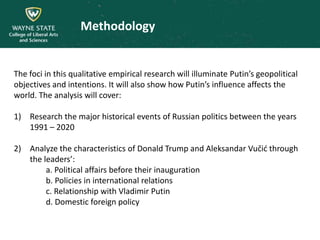
Methodology
The foci in this qualitative empirical research will illuminate Putin’s geopolitical
objectives and intentions. It will also show how Putin’s influence affects the
world. The analysis will cover:
1) Research the major historical events of Russian politics between the years
1991 – 2020
2) Analyze the characteristics of Donald Trump and Aleksandar Vučić through
the leaders’:
a. Political affairs before their inauguration
b. Policies in international relations
c. Relationship with Vladimir Putin
d. Domestic foreign policy
Results and Discussion
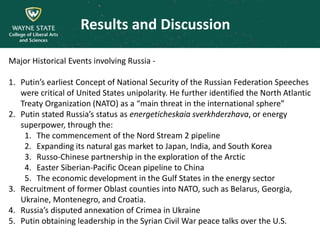
Major Historical Events involving Russia -
1. Putin’s earliest Concept of National Security of the Russian Federation Speeches
were critical of United States unipolarity. He further identified the North Atlantic
Treaty Organization (NATO) as a “main threat in the international sphere”
2. Putin stated Russia’s status as energeticheskaia sverkhderzhava, or energy
superpower, through the:
1. The commencement of the Nord Stream 2 pipeline
2. Expanding its natural gas market to Japan, India, and South Korea
3. Russo-Chinese partnership in the exploration of the Arctic
4. Easter Siberian-Pacific Ocean pipeline to China
5. The economic development in the Gulf States in the energy sector
3. Recruitment of former Oblast counties into NATO, such as Belarus, Georgia,
Ukraine, Montenegro, and Croatia.
4. Russia’s disputed annexation of Crimea in Ukraine
5. Putin obtaining leadership in the Syrian Civil War peace talks over the U.S.
Results and Discussion
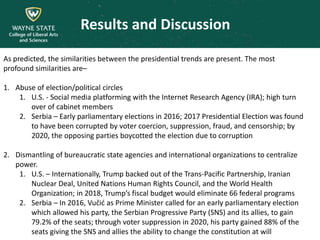
As predicted, the similarities between the presidential trends are present. The most
profound similarities are–
1. Abuse of election/political circles
1. U.S. - Social media platforming with the Internet Research Agency (IRA); high turn
over of cabinet members
2. Serbia – Early parliamentary elections in 2016; 2017 Presidential Election was found
to have been corrupted by voter coercion, suppression, fraud, and censorship; by
2020, the opposing parties boycotted the election due to corruption
2. Dismantling of bureaucratic state agencies and international organizations to centralize
power.
1. U.S. – Internationally, Trump backed out of the Trans-Pacific Partnership, Iranian
Nuclear Deal, United Nations Human Rights Council, and the World Health
Organization; in 2018, Trump’s fiscal budget would eliminate 66 federal programs
2. Serbia – In 2016, Vučić as Prime Minister called for an early parliamentary election
which allowed his party, the Serbian Progressive Party (SNS) and its allies, to gain
79.2% of the seats; through voter suppression in 2020, his party gained 88% of the
seats giving the SNS and allies the ability to change the constitution at will
Results and Discussion
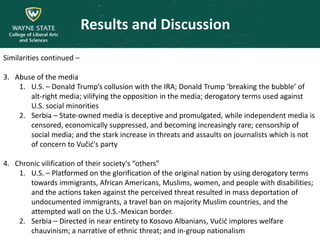
Similarities continued –
3. Abuse of the media
1. U.S. – Donald Trump’s collusion with the IRA; Donald Trump ‘breaking the bubble’ of
alt-right media; vilifying the opposition in the media; derogatory terms used against
U.S. social minorities
2. Serbia – State-owned media is deceptive and promulgated, while independent media is
censored, economically suppressed, and becoming increasingly rare; censorship of
social media; and the stark increase in threats and assaults on journalists which is not
of concern to Vučić's party
4. Chronic vilification of their society's “others”
1. U.S. – Platformed on the glorification of the original nation by using derogatory terms
towards immigrants, African Americans, Muslims, women, and people with disabilities;
and the actions taken against the perceived threat resulted in mass deportation of
undocumented immigrants, a travel ban on majority Muslim countries, and the
attempted wall on the U.S.-Mexican border.
2. Serbia – Directed in near entirety to Kosovo Albanians, Vučić implores welfare
chauvinism; a narrative of ethnic threat; and in-group nationalism
Results and Discussion
Relationships between the United States and Russia, and Serbia and Russia –
The U.S. & Russia –
1. Putin’s relationship with Donald Trump
1. Coordinated the promotion of Donald Trump rallies; released harmful leaks about
Hillary Clinton to influence the smear campaign against the Clintons; and
influential social media tactics to influence the American population;
insurmountable deal for building a Trump Tower in Moscow
2. Donald Trump’s relationship with Putin
1. Campaigned on mending the relationship with Russia; praised Putin for leadership
skills; Trump’s support for the annexation of Crimea
Serbia & Russia –
1. Putin’s allegiance to Serbia
1. Russia rejects Kosovo’s independence movement; Russia was the only United
Nations Security Council member to vote against draft to consider the Srebrenica
Massacre as an act of genocide; Serbia is a former oblast territory; over a billion
dollars in infrastructure investments for the TurkStream pipeline
2. Vučić's allegiance to Russia
1. Serbia’s refusal to apply sanctions on Russia for the annexation of Crimea; Russia
serves as the “protector of Serbia” in defending Orthodox Christianity and Slavic
culture; Military parades for Putin’s country visits
Results and Discussion
Differences are still present, below is an explanation of them—
1. Vučić was found to be less directly critical of Serbia’s minority group of Kosovo’s Muslim
population.
1. Considering the Yugoslav Wars and relation to the Srebrenica Massacre has forced
his opinions into reclusion. Any particularly offensive remarks could also jeopardize
Serbia’s current attempt to keep the Kosovo provenance under its sovereignty.
2. The United States also differs from Serbia in its actions in the international community.
1. The United States, under Trump, abruptly withdrew from international
organizations. Given the trends of U.S. participation in international organizations,
this is out of character. The new attitude alludes to the change Putin wished to
inflict. Withdrawing from international organizations signified U.S. isolationism,
which alleviates international pressures.
2. Currently, Serbia is trying to seek integration in the EU. I reason that this is due to
Serbia’s relative lack of power and wealth. Entering transnational and international
organizations would grant Western economic opportunities. Serbia still maintains its
ties to Russian leadership in international diplomacy and culture
3. Russia’s relationship is different for both countries.
1. Serbia and Russia have historical ties in culture and political ideology.
2. The U.S. and Russia have had a lengthy rivalry roughly since 1945.
Results and Discussion
It is clear that staggering the United States political progress is Russia’s goal, but
their efforts are better understood through the types of leaders it promotes. Both
Donald Trump and Aleksander Vučić have been shown to be undemocratic.
However, both leaders serve slightly different purposes. Vučić, on the one hand,
serves as a long-term ally. Considering the political disturbances seen in Serbia,
Putin is Serbia’s better welfare but rather a dependent and dependable ally.
The U.S., on the other hand, has been a near century-long competitor. Russia’s
political favors for Trump were returned with heedlessness internationally and
turbulence nationally. Then it is understood that interfering in the U.S. elections by
promoting an illiberal leader is to hinder the United States.
Conclusions
Ultimately, the leaders from both types of countries, allies or rivals, serve
to favor Russia. Russia is seeking to strengthen its position in global
competition. It is not suggested that the similarities between the United
States and Serbian leaders reflect the types of leaders Putin wants to see
across the world. Likewise, Russia naturally does not seek to exist in a
bipolar or multipolar world with equal peer competitors. Rather, the
answer lies between these boundaries. It is understood that Russia is
attempting to subvert the United States, its long-term rival, out of
lingering tensions from the great power competition in the Cold War.
Putin’s favored political leaders are those that will be passive to the
means of his ambitions. Conclusively, Putin is strengthening his nation’s
position in the international system to further better the prospects of
Russia’s political, economic, and military goals out of security needs and
competition.
Acknowledgments
I would like to send my sincerest thank you to my mentor Dr. Brad
Roth for assisting me through this academic journey. My project
served far more than the invaluable knowledge of current affairs.
This project is a landmark in my academic and professional career.
His guidance showed me what a quality academic project consists
of, the dedication it takes, and the true purpose of researching.
I also would like to thank my mother. She is the source of my
motivation and inspiration. There were countless days spent
theorizing, critiquing, and editing this paper.
Lillith Solomon Undergraduate Research Presentation

Lillith Solomon Undergraduate Research Presentation

  • 2.
    Russia’s Manipulative Influencein the Politics of Serbia and the United States: Breaking the Grip of United States Unipolarity Lillith Solomon Dr. Brad Roth* Political Science Author, Faculty Advisor, and Department
  • 3.
    This research projectencompasses the contemporary trends of Russia’s relationship with the United States and Serbia’s leaders. It focuses on Aleksandar Vučić and Donald Trump’s leadership behaviors, two actors who Vladimir Putin has promoted in order to understand what Russia seeks in international affairs. The countries in focus were chosen because they reflect traditionally positive and negative relationships with Russia. Frequently, the intentions behind international actors can become convoluted through narrow topics of analysis. This is a comprehensive study of the histories and relationships to bridge the gap in global trends. I have found that Russia has been escalating its means to break the United States’ global dominance for rivalry and security. Ultimately, the increasing tendency to influence countries’ leaders shows that Russia intends to obtain more global power. Abstract
  • 4.
    Introduction The Russian interferencein the 2016 United States Presidential Election abruptly caused instability both nationally and internationally. Russian meddling fell into juxtaposition with the trend of increasing nationalism and authoritarianism. In my 2020 Spring Semester, I was granted an opportunity to study abroad in Croatia at the Inter-University Centre in Dubrovnik by my former professor, Dr. Roth. As I began learning about Baltic relations, including the breakup of Yugoslavia, the Bosnian Muslim genocide, and the reemerging ethnic hostility in Serbia provoked by Aleksander Vučić, I began to see the parallels in both countries' current affairs. Along with Dubrovnik’s course focus on divided societies, I was inspired to expose one of the many influences behind these trends. Russia has been increasing its geopolitical tactics across the region. Whether by kinship or manipulation, I hypothesize that Putin seeks to increase Russia’s international power and security by disrupting or promoting another nation through sympathetic allies. My research intends to bring understanding to State behavior and bridge the gap of geopolitical trends.
  • 5.
    Methodology The foci inthis qualitative empirical research will illuminate Putin’s geopolitical objectives and intentions. It will also show how Putin’s influence affects the world. The analysis will cover: 1) Research the major historical events of Russian politics between the years 1991 – 2020 2) Analyze the characteristics of Donald Trump and Aleksandar Vučić through the leaders’: a. Political affairs before their inauguration b. Policies in international relations c. Relationship with Vladimir Putin d. Domestic foreign policy
  • 6.
    Results and Discussion MajorHistorical Events involving Russia - 1. Putin’s earliest Concept of National Security of the Russian Federation Speeches were critical of United States unipolarity. He further identified the North Atlantic Treaty Organization (NATO) as a “main threat in the international sphere” 2. Putin stated Russia’s status as energeticheskaia sverkhderzhava, or energy superpower, through the: 1. The commencement of the Nord Stream 2 pipeline 2. Expanding its natural gas market to Japan, India, and South Korea 3. Russo-Chinese partnership in the exploration of the Arctic 4. Easter Siberian-Pacific Ocean pipeline to China 5. The economic development in the Gulf States in the energy sector 3. Recruitment of former Oblast counties into NATO, such as Belarus, Georgia, Ukraine, Montenegro, and Croatia. 4. Russia’s disputed annexation of Crimea in Ukraine 5. Putin obtaining leadership in the Syrian Civil War peace talks over the U.S.
  • 7.
    Results and Discussion Aspredicted, the similarities between the presidential trends are present. The most profound similarities are– 1. Abuse of election/political circles 1. U.S. - Social media platforming with the Internet Research Agency (IRA); high turn over of cabinet members 2. Serbia – Early parliamentary elections in 2016; 2017 Presidential Election was found to have been corrupted by voter coercion, suppression, fraud, and censorship; by 2020, the opposing parties boycotted the election due to corruption 2. Dismantling of bureaucratic state agencies and international organizations to centralize power. 1. U.S. – Internationally, Trump backed out of the Trans-Pacific Partnership, Iranian Nuclear Deal, United Nations Human Rights Council, and the World Health Organization; in 2018, Trump’s fiscal budget would eliminate 66 federal programs 2. Serbia – In 2016, Vučić as Prime Minister called for an early parliamentary election which allowed his party, the Serbian Progressive Party (SNS) and its allies, to gain 79.2% of the seats; through voter suppression in 2020, his party gained 88% of the seats giving the SNS and allies the ability to change the constitution at will
  • 8.
    Results and Discussion Similaritiescontinued – 3. Abuse of the media 1. U.S. – Donald Trump’s collusion with the IRA; Donald Trump ‘breaking the bubble’ of alt-right media; vilifying the opposition in the media; derogatory terms used against U.S. social minorities 2. Serbia – State-owned media is deceptive and promulgated, while independent media is censored, economically suppressed, and becoming increasingly rare; censorship of social media; and the stark increase in threats and assaults on journalists which is not of concern to Vučić's party 4. Chronic vilification of their society's “others” 1. U.S. – Platformed on the glorification of the original nation by using derogatory terms towards immigrants, African Americans, Muslims, women, and people with disabilities; and the actions taken against the perceived threat resulted in mass deportation of undocumented immigrants, a travel ban on majority Muslim countries, and the attempted wall on the U.S.-Mexican border. 2. Serbia – Directed in near entirety to Kosovo Albanians, Vučić implores welfare chauvinism; a narrative of ethnic threat; and in-group nationalism
  • 9.
    Results and Discussion Relationshipsbetween the United States and Russia, and Serbia and Russia – The U.S. & Russia – 1. Putin’s relationship with Donald Trump 1. Coordinated the promotion of Donald Trump rallies; released harmful leaks about Hillary Clinton to influence the smear campaign against the Clintons; and influential social media tactics to influence the American population; insurmountable deal for building a Trump Tower in Moscow 2. Donald Trump’s relationship with Putin 1. Campaigned on mending the relationship with Russia; praised Putin for leadership skills; Trump’s support for the annexation of Crimea Serbia & Russia – 1. Putin’s allegiance to Serbia 1. Russia rejects Kosovo’s independence movement; Russia was the only United Nations Security Council member to vote against draft to consider the Srebrenica Massacre as an act of genocide; Serbia is a former oblast territory; over a billion dollars in infrastructure investments for the TurkStream pipeline 2. Vučić's allegiance to Russia 1. Serbia’s refusal to apply sanctions on Russia for the annexation of Crimea; Russia serves as the “protector of Serbia” in defending Orthodox Christianity and Slavic culture; Military parades for Putin’s country visits
  • 10.
    Results and Discussion Differencesare still present, below is an explanation of them— 1. Vučić was found to be less directly critical of Serbia’s minority group of Kosovo’s Muslim population. 1. Considering the Yugoslav Wars and relation to the Srebrenica Massacre has forced his opinions into reclusion. Any particularly offensive remarks could also jeopardize Serbia’s current attempt to keep the Kosovo provenance under its sovereignty. 2. The United States also differs from Serbia in its actions in the international community. 1. The United States, under Trump, abruptly withdrew from international organizations. Given the trends of U.S. participation in international organizations, this is out of character. The new attitude alludes to the change Putin wished to inflict. Withdrawing from international organizations signified U.S. isolationism, which alleviates international pressures. 2. Currently, Serbia is trying to seek integration in the EU. I reason that this is due to Serbia’s relative lack of power and wealth. Entering transnational and international organizations would grant Western economic opportunities. Serbia still maintains its ties to Russian leadership in international diplomacy and culture 3. Russia’s relationship is different for both countries. 1. Serbia and Russia have historical ties in culture and political ideology. 2. The U.S. and Russia have had a lengthy rivalry roughly since 1945.
  • 11.
    Results and Discussion Itis clear that staggering the United States political progress is Russia’s goal, but their efforts are better understood through the types of leaders it promotes. Both Donald Trump and Aleksander Vučić have been shown to be undemocratic. However, both leaders serve slightly different purposes. Vučić, on the one hand, serves as a long-term ally. Considering the political disturbances seen in Serbia, Putin is Serbia’s better welfare but rather a dependent and dependable ally. The U.S., on the other hand, has been a near century-long competitor. Russia’s political favors for Trump were returned with heedlessness internationally and turbulence nationally. Then it is understood that interfering in the U.S. elections by promoting an illiberal leader is to hinder the United States.
  • 12.
    Conclusions Ultimately, the leadersfrom both types of countries, allies or rivals, serve to favor Russia. Russia is seeking to strengthen its position in global competition. It is not suggested that the similarities between the United States and Serbian leaders reflect the types of leaders Putin wants to see across the world. Likewise, Russia naturally does not seek to exist in a bipolar or multipolar world with equal peer competitors. Rather, the answer lies between these boundaries. It is understood that Russia is attempting to subvert the United States, its long-term rival, out of lingering tensions from the great power competition in the Cold War. Putin’s favored political leaders are those that will be passive to the means of his ambitions. Conclusively, Putin is strengthening his nation’s position in the international system to further better the prospects of Russia’s political, economic, and military goals out of security needs and competition.
  • 13.
    Acknowledgments I would liketo send my sincerest thank you to my mentor Dr. Brad Roth for assisting me through this academic journey. My project served far more than the invaluable knowledge of current affairs. This project is a landmark in my academic and professional career. His guidance showed me what a quality academic project consists of, the dedication it takes, and the true purpose of researching. I also would like to thank my mother. She is the source of my motivation and inspiration. There were countless days spent theorizing, critiquing, and editing this paper.