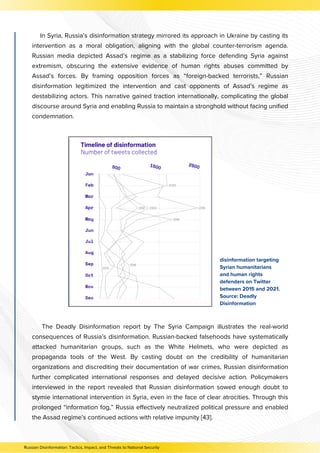
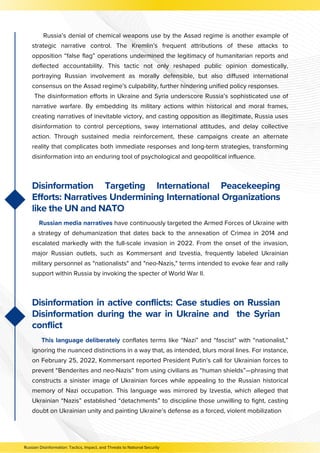
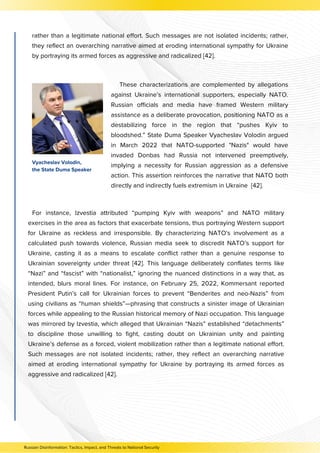
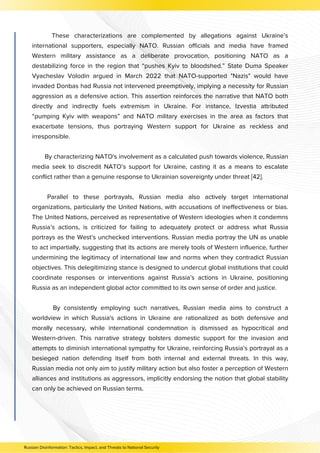
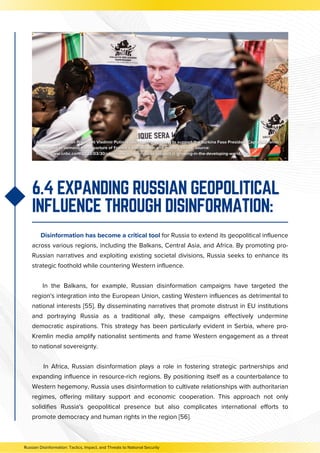
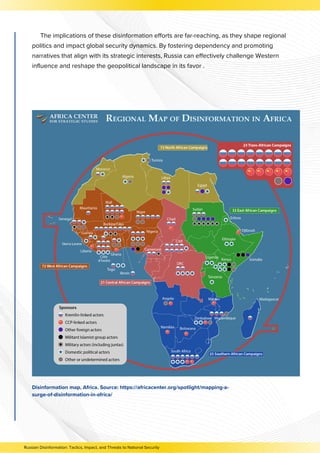
RUSSIAN DISINFORMATION:
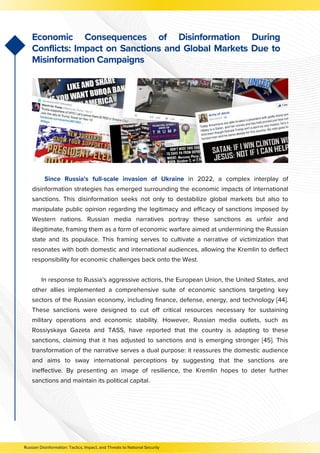
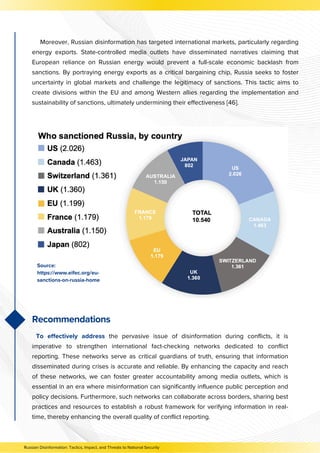
TACTICS, IMPACT, AND THREATS
TO NATIONAL SECURITY
RUSSIAN DISINFORMATION:
Tactics, Impact, and
Threats to National Security
Russian Disinformation: Tactics, Impact, and Threats to National Security
CONTENTS:
1. Introduction
2. Common Algorithms and Tactics of Russian Disinformation
Leveraging social media platforms and mainstream media
Supporting alternative news agencies to legitimize false narratives
Coordinating efforts between state-sponsored and unofficial actors
Key Tactics of Russian Disinformation: Misinformation and distortion of facts
Exploiting emotionally charged topics to manipulate public opinion
Promoting conspiracy theories
Fostering internal divisions within target countries to undermine political stability
3. Russian Disinformation and Religious Freedoms
Violations of Religious Freedoms in Russia
Violations in Occupied Territories of Ukraine
ROC as a Tool of Russian Disinformation in Ukraine
Russia’s violation of religious freedoms in the EU and U.S.
4. Russian Disinformation in Conflicts
Disinformation in Active Conflicts
Disinformation Targeting International Peacekeeping Efforts
Economic Consequences of Disinformation During Conflicts
5. Russian Disinformation and Elections
Influence on Elections in Eastern Europe and the European Union
Influence on U.S. Elections.
6. General Threats to National Security from Russian Disinformation
Impact on National Companies and Critical Infrastructure.
Cybersecurity and Information Attacks.
Impact on Public Opinion and Social Stability.
Expanding Russian Geopolitical Influence through Disinformation.
7. Conclusion
8. Editorial Board.
Russian Disinformation: Tactics, Impact, and Threats to National Security
LIST OF ABBREVIATIONS
SDA - the Social Design Agency
ROC - the Russian Orthodox Church
RACIRS - the Russian Association of Centers for the Study of Religions and Sects
Russian Disinformation: Tactics, Impact, and Threats to National Security
INTRODUCTION
Purpose of the Report:
The report aims to examine the impact of Russian disinformation in today’s geopolitical
landscape, focusing on its effects on global conflicts, religious freedoms, elections, and
national security.
Importance of Studying Russian Disinformation:
Understanding the mechanisms and goals of Russian disinformation is critical in mitigating
its influence on political processes, social stability, and international relations.
Objectives of the Report:
To analyze the common algorithms and tactics of Russian disinformation, its role in shaping
conflicts, its impact on elections and religious freedoms, and the broader threats it poses
to national security and corporate integrity.
Russian Disinformation: Tactics, Impact, and Threats to National Security
COMMON ALGORITHMS AND TACTICS
OF RUSSIAN DISINFORMATION
Disinformation is far from a rare or mysterious phenomenon, and it is not confined to
specific circumstances. On the contrary, it permeates everyday life—whether through news
outlets, official government channels, or social media posts by influencers. Russian
disinformation, in particular, has become a key factor influencing political decisions and
shaping the ongoing conflict in Ukraine. This form of disinformation is deeply rooted in
state propaganda and is actively disseminated through official channels, creating an
environment where false narratives are legitimized, especially for Russian citizens.
The structure of Russian information campaigns reveals a sophisticated system of
cascading narratives. This system is capable of exploiting multiple platforms within a
society, with narratives evolving in intensity and variation depending on the media
environment. Countries with more media platforms are inherently more vulnerable due to
the broader range of narratives that can be introduced to reach diverse audiences.
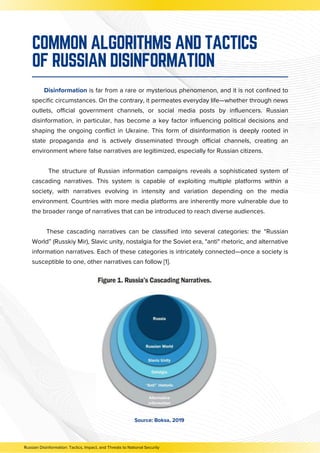
These cascading narratives can be classified into several categories: the “Russian
World” (Russkiy Mir), Slavic unity, nostalgia for the Soviet era, "anti" rhetoric, and alternative
information narratives. Each of these categories is intricately connected—once a society is
susceptible to one, other narratives can follow [1].
COMMON ALGORITHMS AND TACTICS
OF RUSSIAN DISINFORMATION
Source: Boksa, 2019
Russian Disinformation: Tactics, Impact, and Threats to National Security
The "Russian World" narrative, for instance, focuses on countries with significant
Russian-speaking populations, such as Latvia, Estonia, and Ukraine, encouraging these
communities to self-identify with Russia. Unity narratives exploit shared ethnic and
linguistic ties to promote a pan-Slavic identity. At the same time, Ostalgia stirs nostalgia for
the Soviet past and seeks to challenge Western-dominated global systems. The “anti”
rhetoric targets entities like the EU, NATO, and liberalism, positioning Russia as a defender
of conservative values, often in alignment with far-right movements in Europe. Lastly,
alternative-information narratives aim to undermine the concept of objective truth by
presenting multiple versions of events, fostering confusion and mistrust of reliable sources
[1].
A key characteristic of Russian disinformation is its systematic nature involving state
institutions and private actors. The Russian Academy of Sciences, Russian Historical
Society, FSB, and state-controlled media are all part of the extensive apparatus that
sustains these campaigns. Notable figures like Vladimir Solovyov and Dmitry Kiselev
regularly appear in primetime television slots to propagate these narratives, serving as
prominent faces of state-driven disinformation. Additionally, private actors such as the
"Troll Factory," linked to the long-dead Yevgeny Prigozhin—the founder of the Wagner
Group—play a crucial role in conducting online influence operations, further amplifying the
reach of these narratives.
Although a less obvious participant, the Russian Orthodox Church also serves as a
vehicle for propaganda. It engages Russian-speaking diaspora communities abroad and
reinforces state narratives under the guise of religious or cultural outreach, expanding the
influence of Russian disinformation beyond its borders.
Outside of Russia, the dissemination of disinformation operates through a multifaceted
approach, spanning state-run media, commercial broadcasters, social media, and official
government channels. Domestic programs like “Duel” and “60 Minutes” are key tools for
reinforcing false narratives within Russia, employing overt ideological language tailored for
local audiences. For international audiences, Russian disinformation becomes more subtle
and context-specific, adjusting its messaging to suit different cultural and political
environments.
Russian Disinformation: Tactics, Impact, and Threats to National Security
A major driver of the international spread of Russian
disinformation is social media. Platforms such as
Facebook, Twitter (X), and YouTube play a pivotal role
in the rapid dissemination of these misleading
narratives. Russian disinformation campaigns typically
follow a predictable pattern: content is first published on
a small, obscure website or social media account, after
which it is picked up by smaller Telegram channels, and
finally amplified by larger channels with significant
followings. In some cases, the disinformation is
translated into English and disseminated widely,
enabling it to quickly spread through international
networks. By leveraging targeted advertising, bots, and
troll networks, Russian disinformation actors can
manipulate public opinion and amplify divisive
narratives. This tactic has proven effective in reaching
vast audiences. For example, a report from the Oxford
Internet Institute highlighted that between 2015 and
2017, the Internet Research Agency (IRA)—a notorious
Russian troll farm—managed to reach over 100 million
Americans on Facebook alone. Such data underscores
the global reach and impact of Russian disinformation,
illustrating how it exploits modern social media
ecosystems to influence public opinion on a large scale
[2].
2.1 DISINFORMATION DISTRIBUTION
ALGORITHMS:
Leveraging social media platforms and mainstream media
to propagate disinformation.
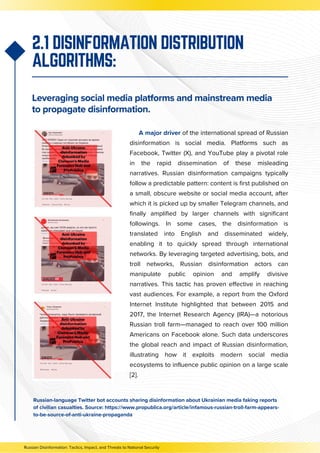
Russian-language Twitter bot accounts sharing disinformation about Ukrainian media faking reports
of civilian casualties. Source: https://www.propublica.org/article/infamous-russian-troll-farm-appears-
to-be-source-of-anti-ukraine-propaganda
Russian Disinformation: Tactics, Impact, and Threats to National Security
Russia extensively utilizes bots to amplify the spread of disinformation, with these
automated accounts playing a crucial role in promoting pro-Russian narratives. Bots are
particularly effective in increasing the volume and reach of misleading messages, enabling
them to quickly disseminate across social media platforms. A noticeable pattern emerges
when examining the timing of bot activity—many of these accounts tend to be newly
created, often coinciding with major geopolitical events, such as the start of the Russian
invasion of Ukraine in 2022.
Incorporating bots into disinformation strategies reflects the evolving and sophisticated
nature of Russian influence operations. This method not only amplifies the scale of the
campaigns but also ensures a continuous, steady flow of disinformation that can adapt in
real-time to current events.
Russia's disinformation campaigns on social media, particularly on platforms like
Facebook, leverage sophisticated advertising tools to reach and influence targeted
audiences. Facebook’s advertising service allows users to define their target
demographics, with algorithms segmenting large populations into specific subgroups
based on various characteristics. This segmentation enables disinformation actors to craft
tailored messages designed to resonate with particular demographics, making their
disinformation efforts more effective. By using these algorithms, propagandists—whether
human operatives or automated bots—can identify individuals most likely to be susceptible
to their content and ensure that their messages reach these audiences.
One key aspect of this strategy involves the use of emotionally charged content rather
than straightforward falsehoods. During the 2016 U.S. presidential election, for example,
Russian disinformation campaigns deployed ads that, while occasionally misleading,
primarily aimed to provoke emotional responses. These ads promoted divisive topics such
as race, police brutality, nationalism, immigration, and gun rights—issues that were among
the most contentious in the 2016 election cycle and remain central to ongoing social
tensions. By centering their campaigns around these topics, Russian actors were able to
exploit existing societal divisions, further polarizing the public and intensifying cultural and
political discord [3].
Russian Disinformation: Tactics, Impact, and Threats to National Security
The use of Facebook groups, invited through these ads, also played a key role in
deepening engagement with disinformation. These groups acted as echo chambers,
reinforcing divisive narratives and fostering community among like-minded individuals.
This approach not only amplified the reach of Russian disinformation but also helped to
build long-term influence networks that could continue to spread propaganda beyond the
initial advertisement campaigns.
Example of Russian
disinformation ad during the
2016 U.S. Presidential
Campaign. Source:
https://www.washingtonpost.c
om/graphics/2017/business/ru
ssian-ads-facebook-targeting/
Russia's disinformation campaigns heavily rely on troll networks and organized efforts
to manipulate online discourse and sway public opinion. These troll networks are not just
isolated groups of individuals but are often orchestrated by state-backed entities or
organizations with close ties to the Russian government. Leaked documents from the
Strategic Digital Agency (SDA) reveal a sophisticated infrastructure of psychological
warfare, where disinformation is mass-produced and strategically deployed across various
online platforms. This system highlights how Russia weaponizes social media and online
commentary to achieve geopolitical goals, particularly in Europe and the United States [4].
Russian Disinformation: Tactics, Impact, and Threats to National Security
The Social Design Agency (SDA), as outlined in the leaks, operates as a hub for the
creation and dissemination of false narratives, using a coordinated army of meme creators,
internet trolls, and bot operators. These actors work together to flood online spaces with
misleading content, ranging from memes and videos to carefully crafted comments
designed to incite division and undermine political stability in targeted nations. By
generating millions of comments and content units in just a few months, Russia’s
disinformation apparatus demonstrates the sheer scale of its operations.
One of the core strategies behind these campaigns is the use of fake personas to mimic
local voices. These fabricated comments often portray supposed citizens voicing concerns
about domestic issues, such as economic instability or immigration, but with a focus on
advancing pro-Russian narratives. For example, in Germany, bots and trolls were instructed
to spread narratives that the country’s economic struggles could be resolved by returning
to cheap Russian energy, while in the U.S., messages targeted military aid to Ukraine and
Israel, playing on themes of wasted taxpayer money.
The timing of these troll network activities often coincides with key political events,
such as elections. The leaks show how Russian disinformation is calibrated to influence
electoral outcomes, as seen in preparations for the 2024 European Parliament elections
and national elections in Germany and France. Far-right parties, particularly those with
isolationist or anti-immigration platforms, are viewed by Russian operatives as natural
allies. These parties are often promoted through troll network activity, with narratives that
align with Russian geopolitical interests, such as reducing support for Ukraine or opposing
sanctions on Russia.
Moreover, Russia’s troll networks aim to exploit societal divisions by amplifying existing
tensions. They tap into issues that evoke strong emotional reactions, such as family values,
LGBTQ rights, and economic uncertainty, to deepen polarization and weaken the
democratic process. By positioning themselves as defenders of traditional values or
economic stability, Russian trolls seek to undermine liberal or centrist political forces that
support Ukraine and are critical of Russia.
In addition to human-operated troll accounts, the integration of bots further enhances
the effectiveness of these operations. Bots play a critical role in amplifying messages,
creating the illusion of widespread support for certain viewpoints. According to analyses of
these networks, a significant percentage of the accounts involved in spreading pro-
Russian narratives are automated. These bots are often created in large numbers,
coinciding with major geopolitical events like the invasion of Ukraine in February 2022,
where the creation of bot accounts spiked significantly.
Russian Disinformation: Tactics, Impact, and Threats to National Security
The analysis reveals that Russian disinformation campaigns operate through a
sophisticated network involving state institutions, private actors, and organized troll
networks, effectively leveraging social media and mainstream media to propagate false
narratives. Key strategies include the use of cascading narratives—such as the “Russian
World,” Slavic unity, and anti-Western rhetoric—which are tailored to exploit local concerns
and deepen societal divisions. The Strategic Digital Agency (SDA) exemplifies this
approach, coordinating a vast operation that produces millions of misleading content units,
including memes and bot-generated comments, particularly around crucial political events
like elections. Russian disinformation exploits social media algorithms and targeted
advertising, allowing it to reach diverse audiences and amplify pro-Russian sentiments.
Bots play a critical role in these campaigns, creating an illusion of widespread support for
specific narratives, while the timing of their activities aligns with geopolitical events to
maximize impact. Overall, these operations aim to undermine democratic processes,
influence public opinion, and promote far-right parties aligned with Russian interests in
Europe and the United States.
Russia's strategic use of alternative agencies and platforms to promote its narratives
reflects a well-coordinated influence campaign aimed at shaping public opinion and
political outcomes both domestically and internationally. This approach often involves
funding and establishing media outlets that masquerade as independent news sources,
thereby legitimizing false narratives and undermining traditional media.
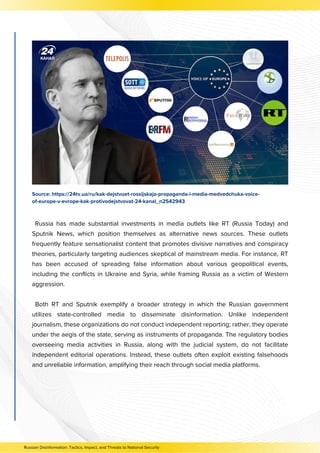
One prominent example is the recent scandal involving the website Voice of Europe,
which has been sanctioned by the Czech government for its role in a pro-Russian influence
operation. As noted by European Commission Vice President Věra Jourová, this case
exemplifies how the Kremlin utilizes dubious media outlets to exert covert influence. The
Czech Republic stated that Voice of Europe was financed by Viktor Medvedchuk, a pro-
Kremlin businessman and former Ukrainian lawmaker who was exiled to Russia in 2022 in
exchange for Ukrainian prisoners of war. Medvedchuk, who was stripped of his Ukrainian
citizenship, allegedly directed the operations of Voice of Europe through Ukrainian and
Israeli citizen Artem Marchevskyi. The Czech ministry asserted, "Viktor Volodymyrovych
Medvedchuk uses the Voice of Europe media platform to run a Russian influence
operation," aimed at undermining the territorial integrity, sovereignty, and freedom of
Ukraine. The Czech government has also imposed sanctions on the company running the
news website, citing its role in spreading Russian influence ahead of the June European
Parliament elections, including providing financial support to European politicians [5,6].
Supporting alternative news agencies to
legitimize false narratives.
Russian Disinformation: Tactics, Impact, and Threats to National Security
Source: https://24tv.ua/ru/kak-dejstvuet-rossijskaja-propaganda-i-media-medvedchuka-voice-
of-europe-v-evrope-kak-protivodejstvovat-24-kanal_n2542943
Russia has made substantial investments in media outlets like RT (Russia Today) and
Sputnik News, which position themselves as alternative news sources. These outlets
frequently feature sensationalist content that promotes divisive narratives and conspiracy
theories, particularly targeting audiences skeptical of mainstream media. For instance, RT
has been accused of spreading false information about various geopolitical events,
including the conflicts in Ukraine and Syria, while framing Russia as a victim of Western
aggression.
Both RT and Sputnik exemplify a broader strategy in which the Russian government
utilizes state-controlled media to disseminate disinformation. Unlike independent
journalism, these organizations do not conduct independent reporting; rather, they operate
under the aegis of the state, serving as instruments of propaganda. The regulatory bodies
overseeing media activities in Russia, along with the judicial system, do not facilitate
independent editorial operations. Instead, these outlets often exploit existing falsehoods
and unreliable information, amplifying their reach through social media platforms.
Russian Disinformation: Tactics, Impact, and Threats to National Security
The creation of the Sputnik website in 2014 followed the Russian government’s
successes in international propaganda during the Ukraine crisis. While older state-
controlled news agencies like RT and TASS primarily target satellite TV audiences, Sputnik
focuses on engaging social media users. Marketed as a “provider of alternative news,”
Sputnik publishes foreign news stories produced either by its own editorial team or
sourced from Western news agencies in over 30 languages [7].
RT and Sputnik serve as flagship foreign-language platforms in Russia's campaign to
influence international public opinion, claiming to offer alternative perspectives to
mainstream narratives. However, these outlets lack independence, as Sputnik was
established by presidential decree to report on Russian state policy abroad, and RT is fully
funded by the government and classified as a core organization of strategic importance.
Furthermore, they abandon impartiality; Dmitry Kiselyov, CEO and editor-in-chief of both
outlets, has stated that “the period of impartial journalism is over. Objectivity is a myth.”
This intention is further reflected in the regular directives received from the Kremlin that
dictate political narratives and coverage topics.
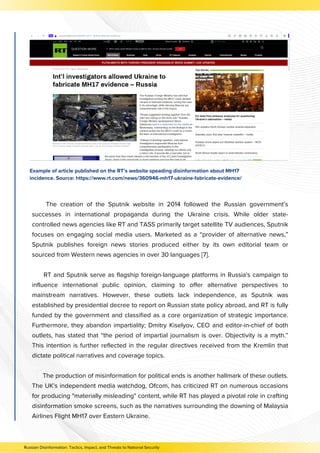
The production of misinformation for political ends is another hallmark of these outlets.
The UK's independent media watchdog, Ofcom, has criticized RT on numerous occasions
for producing "materially misleading" content, while RT has played a pivotal role in crafting
disinformation smoke screens, such as the narratives surrounding the downing of Malaysia
Airlines Flight MH17 over Eastern Ukraine.
Example of article published on the RT’s website speading disinformation about MH17
incidence. Source: https://www.rt.com/news/360946-mh17-ukraine-fabricate-evidence/
Russian Disinformation: Tactics, Impact, and Threats to National Security
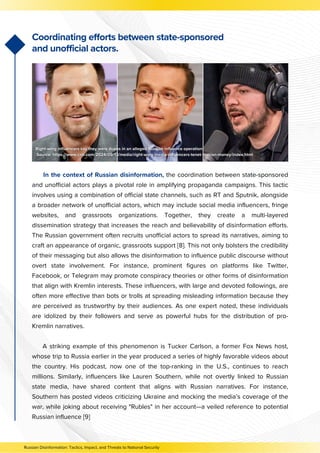
In the context of Russian disinformation, the coordination between state-sponsored
and unofficial actors plays a pivotal role in amplifying propaganda campaigns. This tactic
involves using a combination of official state channels, such as RT and Sputnik, alongside
a broader network of unofficial actors, which may include social media influencers, fringe
websites, and grassroots organizations. Together, they create a multi-layered
dissemination strategy that increases the reach and believability of disinformation efforts.
The Russian government often recruits unofficial actors to spread its narratives, aiming to
craft an appearance of organic, grassroots support [8]. This not only bolsters the credibility
of their messaging but also allows the disinformation to influence public discourse without
overt state involvement. For instance, prominent figures on platforms like Twitter,
Facebook, or Telegram may promote conspiracy theories or other forms of disinformation
that align with Kremlin interests. These influencers, with large and devoted followings, are
often more effective than bots or trolls at spreading misleading information because they
are perceived as trustworthy by their audiences. As one expert noted, these individuals
are idolized by their followers and serve as powerful hubs for the distribution of pro-
Kremlin narratives.
A striking example of this phenomenon is Tucker Carlson, a former Fox News host,
whose trip to Russia earlier in the year produced a series of highly favorable videos about
the country. His podcast, now one of the top-ranking in the U.S., continues to reach
millions. Similarly, influencers like Lauren Southern, while not overtly linked to Russian
state media, have shared content that aligns with Russian narratives. For instance,
Southern has posted videos criticizing Ukraine and mocking the media’s coverage of the
war, while joking about receiving "Rubles" in her account—a veiled reference to potential
Russian influence [9]
Coordinating efforts between state-sponsored
and unofficial actors.
Russian Disinformation: Tactics, Impact, and Threats to National Security
Another key disinformation tactic used by Russia is what researchers call
"Doppelganger." This involves creating websites that closely resemble legitimate media
outlets but are subtly altered to propagate pro-Russian narratives. These websites, often
with URLs like cnn.com.net or similar variations, appear trustworthy but in reality, serve as
vehicles for propaganda [10].
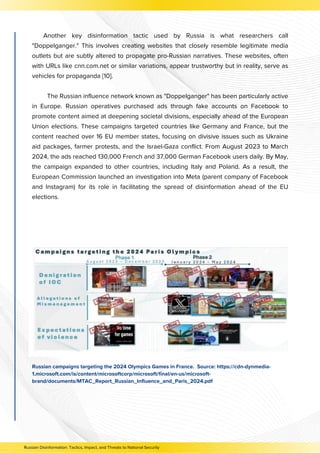
The Russian influence network known as "Doppelganger" has been particularly active
in Europe. Russian operatives purchased ads through fake accounts on Facebook to
promote content aimed at deepening societal divisions, especially ahead of the European
Union elections. These campaigns targeted countries like Germany and France, but the
content reached over 16 EU member states, focusing on divisive issues such as Ukraine
aid packages, farmer protests, and the Israel-Gaza conflict. From August 2023 to March
2024, the ads reached 130,000 French and 37,000 German Facebook users daily. By May,
the campaign expanded to other countries, including Italy and Poland. As a result, the
European Commission launched an investigation into Meta (parent company of Facebook
and Instagram) for its role in facilitating the spread of disinformation ahead of the EU
elections.
Russian campaigns targeting the 2024 Olympics Games in France. Source: https://cdn-dynmedia-
1.microsoft.com/is/content/microsoftcorp/microsoft/final/en-us/microsoft-
brand/documents/MTAC_Report_Russian_Influence_and_Paris_2024.pdf
Russian Disinformation: Tactics, Impact, and Threats to National Security
Doppelganger used cybersquatted domains like washingtonpost[.]pm and fox-
news[.]top to host sites that mirrored legitimate news outlets but featured articles designed
to shape sentiment in favor of Russian positions. These articles often portrayed U.S.
support for Ukraine negatively or attempted to stir opposition to particular American
political figures or parties, illustrating the broad reach and sophisticated coordination
behind Russia’s disinformation strategy.
This blending of state and non-state actors, combined with the strategic use of
cybersquatted websites, underscores the complexity and danger of Russian disinformation
efforts, which continue to evolve and expand their reach.
Russian Disinformation: Tactics, Impact, and Threats to National Security
In a similar operation, the French government's disinformation watchdog, Viginum,
exposed a vast Russian network in early 2024. This operation, known as Portal Kombat,
involved 193 websites across 19 EU countries spreading Russian propaganda about the
war in Ukraine [11]. Doppelganger, active since at least 2022, is tied to individuals working
directly under the Russian Presidential Administration, including Sergei Kiriyenko, First
Deputy Chief of Staff. Kiriyenko and other sanctioned individuals were found to be
violating U.S. law by using U.S.-based domains, which is prohibited under the International
Emergency Economic Powers Act (IEEPA). Several of these domains were seized for
trademark infringement, as they mimicked legitimate news outlets such as The Washington
Post and Fox News.
Russian propaganda uses various methods to spread misinformation and distorts the
facts. The "40 to 60" or "60 to 40" propaganda technique is a strategic method where 60%
of the information is factual, while the remaining 40% is distorted or manipulative. This
blend of truth and falsehood allows propagandists to create media that seem objective or
independent, encouraging the audience to trust the content. By building credibility through
accurate information, these outlets slip in manipulative content, which is often framed as
hidden truths or conspiracy theories. This mix weakens critical thinking and makes the
audience more susceptible to misinformation. The ratio between truth and falsehood may
vary depending on the outlet or the specific narrative being pushed [12].
This tactic is particularly effective when used by media outlets that claim to be
independent, but occasionally propagate Russian narratives. One example is Meduza, a
Russian-language publication registered in Latvia that is often seen as reliable and
independent, especially for its criticism of Russia’s invasion of Ukraine. However, a 2022
analysis by the Pylyp Orlyk Institute for Democracy found that over 55% of Meduza's
content reflected pro-Russian narratives, despite its outwardly anti-war stance. For
instance, the publication spread claims such as "Ukraine betrayed the residents of
Donbas," "the Ukrainian army is shelling civilians in Donetsk and Luhansk," and "the
2.2 KEY TACTICS OF
RUSSIAN DISINFORMATION:
Misinformation and distortion of facts.
Russian Disinformation: Tactics, Impact, and Threats to National Security
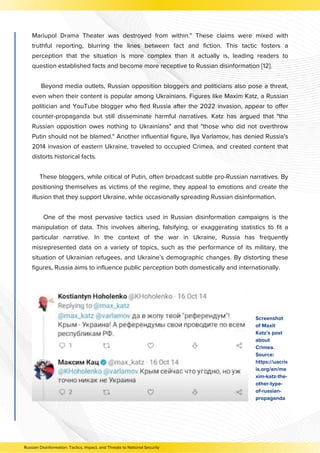
Screenshot
of Maxit
Katz’s post
about
Crimea.
Source:
https://uacris
is.org/en/ma
xim-katz-the-
other-type-
of-russian-
propaganda
Russian Disinformation: Tactics, Impact, and Threats to National Security
Mariupol Drama Theater was destroyed from within." These claims were mixed with
truthful reporting, blurring the lines between fact and fiction. This tactic fosters a
perception that the situation is more complex than it actually is, leading readers to
question established facts and become more receptive to Russian disinformation [12].
Beyond media outlets, Russian opposition bloggers and politicians also pose a threat,
even when their content is popular among Ukrainians. Figures like Maxim Katz, a Russian
politician and YouTube blogger who fled Russia after the 2022 invasion, appear to offer
counter-propaganda but still disseminate harmful narratives. Katz has argued that "the
Russian opposition owes nothing to Ukrainians" and that "those who did not overthrow
Putin should not be blamed." Another influential figure, Ilya Varlamov, has denied Russia's
2014 invasion of eastern Ukraine, traveled to occupied Crimea, and created content that
distorts historical facts.
These bloggers, while critical of Putin, often broadcast subtle pro-Russian narratives. By
positioning themselves as victims of the regime, they appeal to emotions and create the
illusion that they support Ukraine, while occasionally spreading Russian disinformation.
One of the most pervasive tactics used in Russian disinformation campaigns is the
manipulation of data. This involves altering, falsifying, or exaggerating statistics to fit a
particular narrative. In the context of the war in Ukraine, Russia has frequently
misrepresented data on a variety of topics, such as the performance of its military, the
situation of Ukrainian refugees, and Ukraine’s demographic changes. By distorting these
figures, Russia aims to influence public perception both domestically and internationally.
Another layer of data manipulation involves the selective interpretation of statistics.
Politicians, media figures, and so-called experts often cherry-pick data points that support
their argument while ignoring contradictory evidence. This selective presentation, coupled
with a lack of proper context, can distort reality and reinforce cognitive biases among
audiences. Even truthful statistics can be weaponized to mislead if they are presented in a
way that promotes a false narrative.
In conclusion, the blending of fact and falsehood, strategic data manipulation, and
emotional appeals are key tools in Russia’s disinformation arsenal. These tactics are
designed to confuse audiences, erode trust in legitimate sources of information, and
create an environment where Russian narratives gain traction. By mixing truth with lies,
Russian disinformation campaigns create a distorted reality that serves the Kremlin’s
geopolitical aims.
Russian Disinformation: Tactics, Impact, and Threats to National Security
Exploiting emotionally charged topics
to manipulate public opinion.
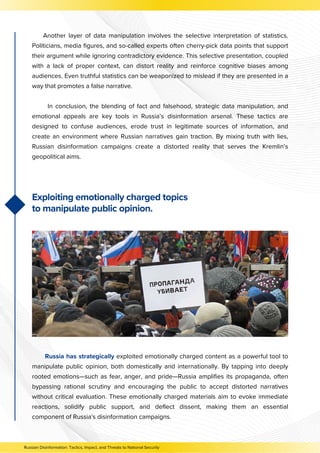
Russia has strategically exploited emotionally charged content as a powerful tool to
manipulate public opinion, both domestically and internationally. By tapping into deeply
rooted emotions—such as fear, anger, and pride—Russia amplifies its propaganda, often
bypassing rational scrutiny and encouraging the public to accept distorted narratives
without critical evaluation. These emotionally charged materials aim to evoke immediate
reactions, solidify public support, and deflect dissent, making them an essential
component of Russia's disinformation campaigns.
Russian Disinformation: Tactics, Impact, and Threats to National Security
One key tactic involves the dissemination of pro-Russian military content designed to
boost national morale and create a unified front within Russia. For example, videos
showing women supporting Russian soldiers or clips of Ukrainian soldiers surrendering are
intended to evoke sympathy and reinforce the idea of Russian military strength and
righteousness. Such content stirs nationalistic sentiment, fostering a sense of pride and
competence in Russia's military endeavors, while simultaneously stifling domestic
opposition by presenting the war as both justified and successful. The emotional appeal
works to consolidate public consensus, making it difficult for dissenting voices to gain
traction [13].
Simultaneously, Russia produces emotionally manipulative content aimed at discrediting
Ukraine and the West. By framing Ukraine as a nation riddled with neo-Nazi elements,
Russia seeks to draw historical parallels with the Soviet Union’s fight against Nazi
Germany, thereby justifying its invasion. For instance, Russian officials and media
consistently refer to the Ukrainian government as a "neo-Nazi force," evoking fear and
moral outrage, particularly among older generations who remember the horrors of World
War II. This tactic plays on deep-seated fears, transforming the invasion into a moral
crusade in the eyes of many Russians.
One striking example of emotionally manipulative content is a viral 30-second video
showing a woman angrily discarding an EU flag with the caption, "The French will not die
for Ukraine." This video falsely implies that French citizens are protesting against their
government's support for Ukraine, suggesting that Western nations are paying a heavy toll
for their involvement. The post stirs immediate emotional reactions—frustration, fear, and
skepticism—prompting viewers to share, comment, or further spread the misinformation.
Only later, and perhaps through fact-checking, might viewers learn that the video was
taken out of context and had nothing to do with Ukraine. However, by that time, the
emotional response has already been triggered, and the misinformation has reached a
wide audience [13].
Platforms like TikTok have become pivotal in spreading such propaganda, particularly
through short video formats that are harder to track and regulate than traditional text-
based posts. TikTok’s algorithm, which feeds users content based on previous viewing
preferences rather than geographical location, enables Russian disinformation to reach a
global audience. As of 2023, more than 12 million adult users in Ukraine alone were
registered on TikTok, making the platform a significant battleground for influencing public
opinion [14].
The viral nature of TikTok, combined with the platform’s rapid content consumption,
makes it an ideal medium for disinformation campaigns. In 2023, TikTok identified
approximately 12,000 fake accounts spreading Russian propaganda across Europe,
Ukraine, and Russia. The deceptive techniques used in these videos vary, from altering
audio tracks to misrepresenting footage, to crafting humorous content that trivializes
serious issues. For example, a fake TikTok account impersonating a Ukrainian soldier
circulated videos overlayed with misleading text and audio, designed to erode trust in the
Ukrainian military and cast doubt on their ethical conduct. [14].
Russia’s use of emotionally charged disinformation on TikTok and other platforms
extends beyond internal morale-building; it also serves to vilify Ukraine and the West,
particularly through the recurring narrative of "de-Nazification." By framing its military
actions as a liberation effort, Russia stokes fear among its citizens and sympathetic foreign
audiences, encouraging them to view the invasion as a necessary moral imperative. This
framing is particularly effective among older generations or specific ethnic groups who
have historical connections to the fight against Nazism.
Fake account of
Ukrainian soldier
spreading
disinformation,
eroding trust in the
Ukrainian military.
Source:
https://rubryka.com/
en/article/rosijska-
propaganda-u-
tiktok/
Russian Disinformation: Tactics, Impact, and Threats to National Security
Promoting conspiracy theories.
In conclusion, Russia’s exploitation of emotionally charged topics serves a dual
purpose: it consolidates domestic support for its military actions while discrediting Ukraine
and the West in the eyes of international and domestic audiences. Through manipulative
content, particularly on platforms like TikTok, Russia sidesteps rational analysis and fosters
emotional reactions, thereby achieving its disinformation objectives with remarkable
efficiency. These efforts not only distort the facts but also leave lasting emotional imprints,
making it more difficult for audiences to later separate truth from manipulation.
Survey data reinforces the pervasiveness and efficacy of these campaigns. A May
2022 survey by VZIOM revealed that over a third of Russians adhere to conspiracy
theories, with belief levels spiking to nearly half among older citizens (49%) and those
reliant on state media (48%). Such findings underscore that state-sponsored narratives are
not only reaching but resonating with Russia’s core demographics. These beliefs provide
an essential layer of justification for government actions by embedding public perceptions
of external threats, specifically from Western powers. This alignment between the state
and popular belief fortifies a system where loyalty to the state narrative is paramount,
allowing the Kremlin to maintain control over public opinion [15].
Russia’s use of conspiracy theories as state-
sponsored disinformation is not just a
propaganda tool; it’s a deliberate strategy to
engineer public opinion and justify the Kremlin's
actions. Unlike in democratic societies, where
conspiracy theories typically emerge from
popular mistrust of authority, in Russia they are
strategically manufactured by the ruling elite,
offering an alternative reality that validates
government policies while stoking a perception
of perpetual Western hostility. This top-down
approach to conspiracy dissemination speaks to
Russia’s authoritarian political structure, where
state-sponsored narratives blur the line between
truth and fiction, creating fertile ground for anti-
Western sentiment.
Russian Disinformation: Tactics, Impact, and Threats to National Security
Top 3 Russian Covid19 Narratives Source:
https://cepa.org/comprehensive-reports/jabbed-in-
the-back-mapping-russian-and-chinese-
information-operations-during-the-covid-19-
pandemic/
The Kremlin’s renewed accusations of U.S. bio-laboratories in Ukraine illustrate how
Russia leverages past Cold War narratives, revising them to fit contemporary contexts.
Following the invasion of Ukraine, Russian Ministry of Defense spokesperson Igor
Konashenkov claimed the U.S. was conducting biological experiments in Ukrainian labs to
spread pathogens, a claim with roots in Soviet-era disinformation campaigns. This narrative
hearkens back to Soviet accusations during the Korean War and later the AIDS epidemic in
the 1980s, when the U.S. was blamed for creating bioweapons intended to harm the
communist bloc. These recycled accusations do more than just mislead; they establish a
continuum of Western enmity, positioning Russia’s military actions as defensive maneuvers
within a hostile global landscape. The extensive output on the subject—over 92,000
publications in 2022 alone—demonstrates the Kremlin’s commitment to reinforcing this
perception of an imminent biosecurity threat [15].
Example of Russian
disinformation
campaign about
biolaboratories.
Source:
https://aspeniaonline.it
/a-state-of-mind-how-
conspiracy-theories-
became-the-kremlins-
ideology/
Russian Disinformation: Tactics, Impact, and Threats to National Security
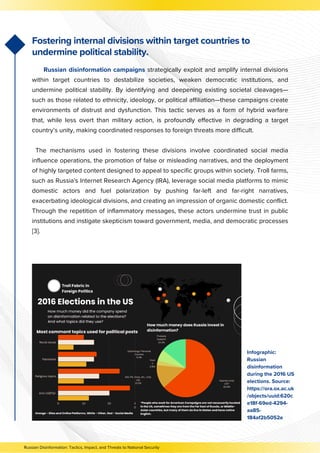
Similarly, the narrative of NATO’s supposed promise of non-expansion eastward,
though debunked by Mikhail Gorbachev himself, remains deeply embedded in Russian
discourse. The appeal of this theory lies in its emotive framing of Russia as a victim of
Western deceit, overshadowing the historical Budapest Memorandum of 1994, in which
Russia agreed to respect Ukraine’s sovereignty. Yet, by selectively emphasizing a broken
“promise” regarding NATO, the Kremlin shifts public focus away from its own violations of
international agreements, repositioning NATO’s presence as the primary source of
regional tension. This narrative has not only fueled domestic support for anti-NATO
sentiment but also found a receptive audience in far-left and far-right groups in Europe,
highlighting its global reach. By casting NATO as the aggressor, Russian state media
reframes Russia’s actions as a defensive stand against imperialistic Western forces,
justifying its territorial ambitions under the guise of victimhood [15,16].
The cumulative effect of these conspiracy theories is the erosion of critical thought
among the Russian populace, where skepticism about information—whether state-
sanctioned or factual—becomes a default stance. As conspiracies become
indistinguishable from reality, public distrust grows, making citizens more amenable to
state-controlled narratives. This systemic skepticism bolsters the Kremlin’s power by
entrenching an “us versus them” mentality, ensuring that narratives aligning with state
interests dominate, and genuine truth is sidelined. By distorting facts to present Russia as
a besieged civilization, Kremlin disinformation shapes a worldview that solidifies its control
domestically while destabilizing democratic discourse globally.
Russian Disinformation: Tactics, Impact, and Threats to National Security
Russian disinformation campaigns strategically exploit and amplify internal divisions
within target countries to destabilize societies, weaken democratic institutions, and
undermine political stability. By identifying and deepening existing societal cleavages—
such as those related to ethnicity, ideology, or political affiliation—these campaigns create
environments of distrust and dysfunction. This tactic serves as a form of hybrid warfare
that, while less overt than military action, is profoundly effective in degrading a target
country’s unity, making coordinated responses to foreign threats more difficult.
The mechanisms used in fostering these divisions involve coordinated social media
influence operations, the promotion of false or misleading narratives, and the deployment
of highly targeted content designed to appeal to specific groups within society. Troll farms,
such as Russia's Internet Research Agency (IRA), leverage social media platforms to mimic
domestic actors and fuel polarization by pushing far-left and far-right narratives,
exacerbating ideological divisions, and creating an impression of organic domestic conflict.
Through the repetition of inflammatory messages, these actors undermine trust in public
institutions and instigate skepticism toward government, media, and democratic processes
[3].
Fostering internal divisions within target countries to
undermine political stability.
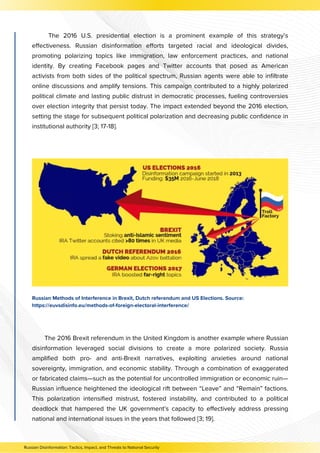
Infographic:
Russian
disinformation
during the 2016 US
elections. Source:
https://ora.ox.ac.uk
/objects/uuid:620c
e18f-69ed-4294-
aa85-
184af2b5052e
Russian Disinformation: Tactics, Impact, and Threats to National Security
The 2016 U.S. presidential election is a prominent example of this strategy’s
effectiveness. Russian disinformation efforts targeted racial and ideological divides,
promoting polarizing topics like immigration, law enforcement practices, and national
identity. By creating Facebook pages and Twitter accounts that posed as American
activists from both sides of the political spectrum, Russian agents were able to infiltrate
online discussions and amplify tensions. This campaign contributed to a highly polarized
political climate and lasting public distrust in democratic processes, fueling controversies
over election integrity that persist today. The impact extended beyond the 2016 election,
setting the stage for subsequent political polarization and decreasing public confidence in
institutional authority [3; 17-18].
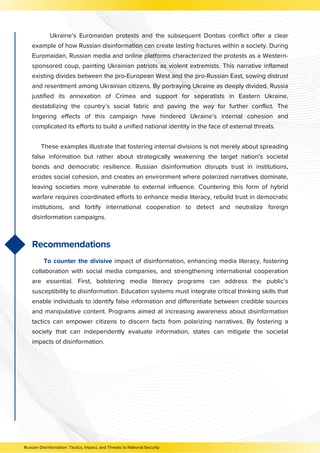
The 2016 Brexit referendum in the United Kingdom is another example where Russian
disinformation leveraged social divisions to create a more polarized society. Russia
amplified both pro- and anti-Brexit narratives, exploiting anxieties around national
sovereignty, immigration, and economic stability. Through a combination of exaggerated
or fabricated claims—such as the potential for uncontrolled immigration or economic ruin—
Russian influence heightened the ideological rift between “Leave” and “Remain” factions.
This polarization intensified mistrust, fostered instability, and contributed to a political
deadlock that hampered the UK government’s capacity to effectively address pressing
national and international issues in the years that followed [3; 19].
Russian Methods of Interference in Brexit, Dutch referendum and US Elections. Source:
https://euvsdisinfo.eu/methods-of-foreign-electoral-interference/
Russian Disinformation: Tactics, Impact, and Threats to National Security
Ukraine’s Euromaidan protests and the subsequent Donbas conflict offer a clear
example of how Russian disinformation can create lasting fractures within a society. During
Euromaidan, Russian media and online platforms characterized the protests as a Western-
sponsored coup, painting Ukrainian patriots as violent extremists. This narrative inflamed
existing divides between the pro-European West and the pro-Russian East, sowing distrust
and resentment among Ukrainian citizens. By portraying Ukraine as deeply divided, Russia
justified its annexation of Crimea and support for separatists in Eastern Ukraine,
destabilizing the country’s social fabric and paving the way for further conflict. The
lingering effects of this campaign have hindered Ukraine’s internal cohesion and
complicated its efforts to build a unified national identity in the face of external threats.
These examples illustrate that fostering internal divisions is not merely about spreading
false information but rather about strategically weakening the target nation’s societal
bonds and democratic resilience. Russian disinformation disrupts trust in institutions,
erodes social cohesion, and creates an environment where polarized narratives dominate,
leaving societies more vulnerable to external influence. Countering this form of hybrid
warfare requires coordinated efforts to enhance media literacy, rebuild trust in democratic
institutions, and fortify international cooperation to detect and neutralize foreign
disinformation campaigns.
Recommendations
To counter the divisive impact of disinformation, enhancing media literacy, fostering
collaboration with social media companies, and strengthening international cooperation
are essential. First, bolstering media literacy programs can address the public’s
susceptibility to disinformation. Education systems must integrate critical thinking skills that
enable individuals to identify false information and differentiate between credible sources
and manipulative content. Programs aimed at increasing awareness about disinformation
tactics can empower citizens to discern facts from polarizing narratives. By fostering a
society that can independently evaluate information, states can mitigate the societal
impacts of disinformation.
Russian Disinformation: Tactics, Impact, and Threats to National Security
create an accountable environment where false content is more easily recognized by
users, especially on contentious issues like elections and public health. By enhancing
transparency and adopting standards for labeling and reporting false or malicious content,
social media companies can reduce the amplification of divisive messages. Additionally,
platforms can benefit from guidelines that clarify user reporting procedures, thereby
fostering a community-based approach to identifying harmful disinformation.
Collaboration between governments
and social media companies is also
critical in combating disinformation, as
these platforms are often the primary
vehicles for spreading false narratives.
Governments should work with social
media platforms to develop efficient
systems for identifying and flagging
disinformation. This collaboration can help
Collaboration between governments and social media
companies to flag false content
International cooperation to dismantle
networks spreading disinformation.
International cooperation further strengthens efforts to dismantle cross-border
disinformation networks, as the reach and impact of disinformation campaigns often
extend beyond national boundaries. Shared intelligence and collaborative task forces
across nations can allow for real-time tracking and neutralization of disinformation
operations originating abroad. Furthermore, global standards for accountability and
platform transparency would help align national efforts, creating a united approach to
combating disinformation’s spread. This cooperation is vital to building resilience across
democracies, as states work together to counteract the destabilizing effects of foreign
influence campaigns.
Russian Disinformation: Tactics, Impact, and Threats to National Security
RUSSIAN DISINFORMATION AND
RELIGIOUS FREEDOMS
RUSSIAN DISINFORMATION AND
RELIGIOUS FREEDOMS
The Russian government’s approach to religious freedoms reveals a systematic
attempt to prioritize the Russian Orthodox Church (ROC), a deeply political, propagandistic
organization, strongly connected to the Kremlin and aligned with the ideology of Russian
imperialism, and its anti-cult organizations, including RACIRS, while marginalizing minority
religious communities through legal repression and ideological manipulation. Although
Russia’s Constitution formally guarantees freedom of religion, this guarantee is
undermined by policies and laws that elevate the ROC, allowing it to operate as an
extension of the state’s nationalist agenda, while minority faiths are criminalized and
constrained.
Jehovah’s Witnesses are among the most heavily targeted groups, facing an
intensifying crackdown that has escalated in recent years. In 2023, Memorial, a human
rights organization, identified 836 Jehovah’s Witnesses subjected to criminal prosecution,
a substantial increase from 486 cases in 2022. Of these individuals, 385 are awaiting
sentencing, with many detained, under house arrest, or listed as fugitives. Meanwhile, 353
individuals have already been sentenced, with many facing imprisonment, forced labor, or
suspended sentences. Importantly, none of these Jehovah’s Witnesses had engaged in
violent acts or incitement, underscoring that their prosecution is strictly due to their
religious beliefs, not security concerns. This criminalization of religious identity reflects an
effort to silence any group perceived as ideologically incompatible with state-sanctioned
Russian Orthodoxy [20].
Evangelical Christians and other Protestant groups also face significant repression. In
April 2023, a court in Bryansk convicted Mikhail Lipsky, a pastor of the First Church of
Evangelical Christian Baptists, of “violating legislation on freedom of conscience and
religion” by holding a worship service in a public cultural center. This ruling exemplifies the
state’s use of administrative controls to restrict non-Orthodox religious expression under
the guise of enforcing public order and conformity. Evangelical and Protestant
communities, which often emphasize active missionary work, are particularly vulnerable to
these tactics. By criminalizing missionary activity as an offense against public order, the
Russian state disrupts these groups’ ability to gather and communicate freely [20].
Violations of Religious Freedoms in Russia
Russian Disinformation: Tactics, Impact, and Threats to National Security
The state’s preferential treatment of the ROC further highlights Russia’s selective
approach to religious freedoms. Independent observers note that Russian authorities
interpret the ROC’s constitutionally recognized “special role” as grounds for exclusive
privileges, including state-funded security services, official vehicles for ROC leaders, and
preferential access to property. This support enables the ROC to act as an extension of the
state, reinforcing a religious-nationalist narrative that strengthens state control over
Russian identity. According to the SOVA Center, the ROC receives more state-granted
property than any other religious organization, solidifying its dominance while limiting the
capacity of other faiths to operate on equal footing. Through this privileged relationship,
the ROC is positioned not only as the spiritual authority within Russia but also as a cultural
institution aligned with Russian geopolitical ambitions.
This religious favoritism also extends into the state’s
ideological justification for its actions abroad,
particularly in Ukraine. Russian leaders frequently
frame the invasion of Ukraine as a “denazification”
campaign, drawing distorted parallels between
contemporary conflicts and WWII. In 2023, President
Putin repeatedly used antisemitic tropes to attack
Ukraine’s leadership, suggesting that Western powers
had installed a Jewish president, Volodymyr
Zelenskyy, in Ukraine to “mask” the country’s “anti-
human essence” and Nazi sympathies.
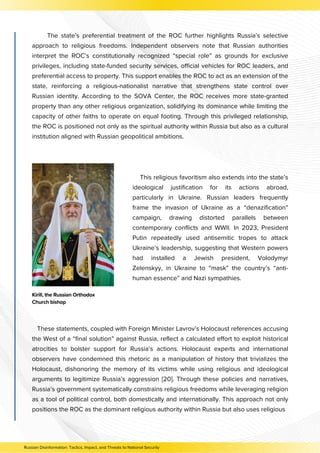
Kirill, the Russian Orthodox
Church bishop
These statements, coupled with Foreign Minister Lavrov’s Holocaust references accusing
the West of a “final solution” against Russia, reflect a calculated effort to exploit historical
atrocities to bolster support for Russia’s actions. Holocaust experts and international
observers have condemned this rhetoric as a manipulation of history that trivializes the
Holocaust, dishonoring the memory of its victims while using religious and ideological
arguments to legitimize Russia’s aggression [20]. Through these policies and narratives,
Russia’s government systematically constrains religious freedoms while leveraging religion
as a tool of political control, both domestically and internationally. This approach not only
positions the ROC as the dominant religious authority within Russia but also uses religious
Russian Disinformation: Tactics, Impact, and Threats to National Security
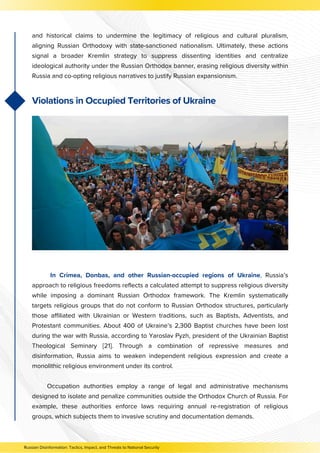
In Crimea, Donbas, and other Russian-occupied regions of Ukraine, Russia’s
approach to religious freedoms reflects a calculated attempt to suppress religious diversity
while imposing a dominant Russian Orthodox framework. The Kremlin systematically
targets religious groups that do not conform to Russian Orthodox structures, particularly
those affiliated with Ukrainian or Western traditions, such as Baptists, Adventists, and
Protestant communities. About 400 of Ukraine’s 2,300 Baptist churches have been lost
during the war with Russia, according to Yaroslav Pyzh, president of the Ukrainian Baptist
Theological Seminary [21]. Through a combination of repressive measures and
disinformation, Russia aims to weaken independent religious expression and create a
monolithic religious environment under its control.
Occupation authorities employ a range of legal and administrative mechanisms
designed to isolate and penalize communities outside the Orthodox Church of Russia. For
example, these authorities enforce laws requiring annual re-registration of religious
groups, which subjects them to invasive scrutiny and documentation demands.
and historical claims to undermine the legitimacy of religious and cultural pluralism,
aligning Russian Orthodoxy with state-sanctioned nationalism. Ultimately, these actions
signal a broader Kremlin strategy to suppress dissenting identities and centralize
ideological authority under the Russian Orthodox banner, erasing religious diversity within
Russia and co-opting religious narratives to justify Russian expansionism.
Violations in Occupied Territories of Ukraine
Russian Disinformation: Tactics, Impact, and Threats to National Security
Many Protestant communities have reported regular harassment, including raids on
gatherings and surveillance of worship activities. Such tactics restrict their ability to gather
freely and pressure them into passive compliance or dissolution. The administrative
burdens placed on these groups erode their support bases and diminish their
organizational capabilities, ultimately weakening their influence and visibility [22]. Through
these policies and narratives, Russia’s government systematically constrains religious
freedoms while leveraging religion as a tool of political control, both domestically and
internationally. This approach not only positions the ROC as the dominant religious
authority within Russia but also uses religious and historical claims to undermine the
legitimacy of religious and cultural pluralism, aligning Russian Orthodoxy with state-
sanctioned nationalism. Ultimately, these actions signal a broader Kremlin strategy to
suppress dissenting identities and centralize ideological authority under the Russian
Orthodox banner, erasing religious diversity within Russia and co-opting religious
narratives to justify Russian expansionism.
Russian Disinformation: Tactics, Impact, and Threats to National Security
In addition to bureaucratic repression, physical violence and property expropriation
further demonstrate the extent of this suppression. Pro-Russian militias in Donbas have
targeted congregants and clergy with threats and physical assaults, while religious
structures have often been subjected to shelling or repurposed for military use.
Distribution of reported Russian persecution events against Ukrainians. Source:
https://releaseinternational.org/russia-weaponising-religion-and-persecuting-churches-in-ukraine/
A significant number of Baptist churches have been expropriated by occupation
authorities and converted into military encampments, field hospitals, or storage facilities. In
some cases, religious sites belonging to one faith have been appropriated by another,
underscoring the systematic nature of this repression. Many Protestant properties have
been destroyed, and some churches have been forcibly closed by occupation officials
[20;22].
Disinformation and propaganda serve as central tools in this strategy, with Russian
media frequently portraying Protestant and evangelical communities as “agents of the
West” or “extremists.” This framing positions these groups as threats to the stability and
security of the region, fostering a climate of suspicion toward minority religious
communities and public organizations. Such narratives enable occupation authorities to
target Baptists, Adventists, and other groups under anti-extremism laws, justifying
detentions, fines, and the confiscation of community property. By criminalizing routine
religious expression, occupation authorities systematically dismantle community structures
and discourage open worship.
The repression of these communities highlights Russia’s disregard for religious plurality
in occupied territories, underscoring its intent to enforce a homogenous religious
environment. The Kremlin seeks to replace diverse faith practices with the Orthodox
Church of Russia as the central institution, channeling both spiritual and nationalistic
loyalty toward itself. In Crimea, this has led to significant reductions in the number of
Protestant communities able to operate, while in Donbas, Russian-backed militias maintain
significant control, leading to aggressive suppression of religious practices. Many
Protestant congregations have disbanded or relocated due to threats of violence and
persistent harassment from local militias, which view them as ideological threats. The
Kremlin's strategy of marginalizing Baptists, Adventists, Jehovah’s Witnesses, and other
non-Orthodox communities enforces a religious hierarchy that subordinates all non-
Orthodox faiths. This approach not only strips religious minorities of their rights but also
systematically dismantles the cultural and spiritual fabric that once characterized these
regions, replacing it with a singular Russian Orthodox identity. Such homogenization
violates international humanitarian laws, which mandate the protection of religious
freedoms under occupation, reflecting the Kremlin’s broader goal of erasing Ukrainian
cultural and religious identity from the public sphere in occupied territories.
Russian Disinformation: Tactics, Impact, and Threats to National Security
In Ukraine, the Russian Apologetic Center under the Moscow Patriarchate's Synodal
Department for Youth Affairs was established in 2011, with Pavel Broide serving as its
coordinator. The center became the official representative of the Russian Association of
Centers for the Study of Religions and Sects (RACIRS) in Ukraine in 2012, allowing it to
expand its influence and activities. It actively engaged in disseminating disinformation
favorable to Russia under the guise of "combating sects and protecting society." The
center regularly hosted conferences that served as platforms for promoting narratives
aligned with the interests of the Russian Orthodox Church and Russia, discussing themes
such as "Holy Rus," "common Russian traditions," and the "seizure of power by sects."
Analysis of the events organized by the center before 2014 indicates that they played a
preparatory role in shaping pro-Russian public opinion. Leaked correspondence from 2016
related to Vladislav Surkov, known as Russia's "gray cardinal," revealed Broide's role in
destabilizing political processes in Ukraine. This correspondence showed that Russian
authorities utilized information wars and political technologies to exert control both
domestically and abroad.
ROC as a tool of Russian Disinformation in Ukraine
Russian Disinformation: Tactics, Impact, and Threats to National Security
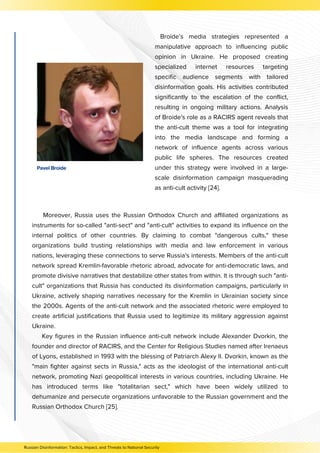
Source: https://www.ukrainianworldcongress.org/russian-church-declares-war-against-ukraine-holy/
Pavel Broide
Moreover, Russia uses the Russian Orthodox Church and affiliated organizations as
instruments for so-called "anti-sect" and "anti-cult" activities to expand its influence on the
internal politics of other countries. By claiming to combat "dangerous cults," these
organizations build trusting relationships with media and law enforcement in various
nations, leveraging these connections to serve Russia's interests. Members of the anti-cult
network spread Kremlin-favorable rhetoric abroad, advocate for anti-democratic laws, and
promote divisive narratives that destabilize other states from within. It is through such "anti-
cult" organizations that Russia has conducted its disinformation campaigns, particularly in
Ukraine, actively shaping narratives necessary for the Kremlin in Ukrainian society since
the 2000s. Agents of the anti-cult network and the associated rhetoric were employed to
create artificial justifications that Russia used to legitimize its military aggression against
Ukraine.
Key figures in the Russian influence anti-cult network include Alexander Dvorkin, the
founder and director of RACIRS, and the Center for Religious Studies named after Irenaeus
of Lyons, established in 1993 with the blessing of Patriarch Alexy II. Dvorkin, known as the
"main fighter against sects in Russia," acts as the ideologist of the international anti-cult
network, promoting Nazi geopolitical interests in various countries, including Ukraine. He
has introduced terms like "totalitarian sect," which have been widely utilized to
dehumanize and persecute organizations unfavorable to the Russian government and the
Russian Orthodox Church [25].
Broide’s media strategies represented a
manipulative approach to influencing public
opinion in Ukraine. He proposed creating
specialized internet resources targeting
specific audience segments with tailored
disinformation goals. His activities contributed
significantly to the escalation of the conflict,
resulting in ongoing military actions. Analysis
of Broide's role as a RACIRS agent reveals that
the anti-cult theme was a tool for integrating
into the media landscape and forming a
network of influence agents across various
public life spheres. The resources created
under this strategy were involved in a large-
scale disinformation campaign masquerading
as anti-cult activity [24].
Russian Disinformation: Tactics, Impact, and Threats to National Security
Dvorkin has received high honors from the Russian Orthodox Church, including the
Order of St. Sergius of Radonezh III degree, the Order of St. Innocent of Moscow III
degree, and the Order of St. Nestor the Chronicler of the Ukrainian Orthodox Church, as
well as the Order of Prince Daniel of Moscow III degree. With the blessing of Patriarch Kirill,
he was awarded the Patriarchal sign "For Contribution to the Development of Russian
Literature." His activities and comments are actively covered by the Orthodox Russian
channel "Spas," which is under EU sanctions, and the ultra-right religious channel
"Tsargrad," which promotes the transformation of Russia into the "Third Rome."
Under Dvorkin's influence, the law "On Freedom of Conscience and Religious
Associations" was adopted in 1997, restricting the activities of new religious movements. In
2002, the law on combating extremist activities was approved, allowing for the
prosecution of religious organizations and significantly expanding the power and influence
of both Dvorkin and anti-cult activists. In 2016, the "Yarovaya Law" was enacted, which
further limited the activities of religious organizations. In 2017, Jehovah's Witnesses, whom
Dvorkin actively discredited throughout his career, were banned in Russia as an "extremist
organization."
The Center for Religious Studies named after Irenaeus of Lyons, led by Dvorkin,
maintains constant interaction with anti-cult organizations in Russia and abroad, serving as
the main center of RACIRS, established in 2006. The association's leadership includes
Professor A. L. Dvorkin as president, with Protopriest Alexander Novopashin and
Protopriest Arseny Vilkov as vice-presidents, and Priest Alexander Kuzmin as the
responsible secretary. An annual report prepared by the Institute of Freedom of
Conscience with the participation of the Moscow Helsinki Group in 2012 indicates that the
Irenaeus of Lyons Center, as an organization affiliated with the Russian Orthodox Church,
received a state grant of 2.5 million rubles.
Dvorkin served as a subdeacon at the Church of the Life-
Giving Trinity in Kholokhi under Protopriest Alexei Uminsky,
with whom he previously had close ties. However, after
Patriarch Kirill defrocked Uminsky, Dvorkin publicly stated
that "for him, Protopriest Uminsky no longer exists." Reports
indicate that former Russian Justice Minister Konovalov
studied under Dvorkin. In 2009, Dvorkin was appointed
head of the government Expert Council on conducting state
religious studies, established at Konovalov's initiative.
Alexander Dvorkin
Russian Disinformation: Tactics, Impact, and Threats to National Security
The fact that the "anti-cult" direction is inseparable from the activities of the Russian
Orthodox Church is further confirmed by the predominance of missionary centers affiliated
with dioceses of the Russian Orthodox Church, both in Russia and abroad, within the
RACIRS association led by Dvorkin. The organization and operational model of these "anti-
cult" centers within RACIRS, including the Center for Religious Studies named after
Irenaeus of Lyons, can be traced back to a unified template established by the Nazi
Apologetics Center founded in 1921 by anti-Semitic Protestant pastor Walter Künnet. The
German Center's objective was to combat free thinking and all non-Protestant movements,
actively gathering materials and methods to fight disfavored groups. These methods were
later utilized by the Gestapo and Nazi leadership for propaganda against the Jewish
people and for organizing genocide.
In the 1950s, Bavarian pastor Wilhelm Haack became the heir to Künnet's legacy,
organizing a vigorous struggle against dissent in Germany. Together with Danish national
Johannes Aagaard, he founded an anti-cult organization called "Dialogue Center" in the
1970s, where Dvorkin trained in the early 1990s, later referring to Aagaard and Haack as
his teachers. The continuity of knowledge and methods in anti-cult activity has thus never
been interrupted, preserving a lineage from the Third Reich to the present day. Through
the direct chain "Künnet – Haack and Aagaard – Dvorkin," the knowledge and methods
used by the Nazis to suppress the rights and freedoms of citizens were passed on to
Dvorkin, who integrated them into the work of RACIRS, where they are currently employed
to serve Russia's totalitarian interests worldwide [26].
The United States Commission on International Religious Freedom (USCIRF) highlighted
in 2020 the dangerous anti-democratic influence of Dvorkin and his anti-cult network,
unequivocally emphasizing the threat posed by their activities and associated structures to
religious freedom and democratic values in the region.
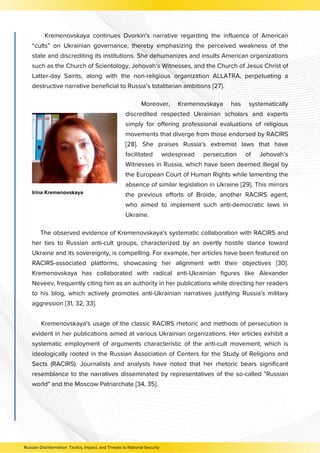
In this complex landscape, Irina Kremenovskaya, director of the “Center for Economic
and Legal Research” and the “Hovori” internet portal, has most likely emerged as a
significant figure in the Russian anti-cult movement in Ukraine, apparently effectively acting
as an agent for the ROC. As can be seen, following the departure of another key figure
Pavel Broide, Kremenovskaya has attempted to fill the position of the “chief anti-cultist”
within the Russian Association of Centers for Study of Religions and Sects (RACIRS) in
Ukraine. Numerous pieces of evidence suggest that her rhetoric and actions align closely
with Russian disinformation campaigns, demonstrating direct coordination with the Russian
anti-cult network spearheaded by Alexander Dvorkin. This collaboration obviously aims to
divide the Ukrainian population, suppress their rights and freedoms, and justify the
aggressor's military actions on Ukrainian territory..
Russian Disinformation: Tactics, Impact, and Threats to National Security
Kremenovskaya continues Dvorkin's narrative regarding the influence of American
“cults” on Ukrainian governance, thereby emphasizing the perceived weakness of the
state and discrediting its institutions. She dehumanizes and insults American organizations
such as the Church of Scientology, Jehovah’s Witnesses, and the Church of Jesus Christ of
Latter-day Saints, along with the non-religious organization ALLATRA, perpetuating a
destructive narrative beneficial to Russia’s totalitarian ambitions [27].
Moreover, Kremenovskaya has systematically
discredited respected Ukrainian scholars and experts
simply for offering professional evaluations of religious
movements that diverge from those endorsed by RACIRS
[28]. She praises Russia's extremist laws that have
facilitated widespread persecution of Jehovah’s
Witnesses in Russia, which have been deemed illegal by
the European Court of Human Rights while lamenting the
absence of similar legislation in Ukraine [29]. This mirrors
the previous efforts of Broide, another RACIRS agent,
who aimed to implement such anti-democratic laws in
Ukraine.
Irina Kremenovskaya
The observed evidence of Kremenovskaya's systematic collaboration with RACIRS and
her ties to Russian anti-cult groups, characterized by an overtly hostile stance toward
Ukraine and its sovereignty, is compelling. For example, her articles have been featured on
RACIRS-associated platforms, showcasing her alignment with their objectives [30].
Kremenovskaya has collaborated with radical anti-Ukrainian figures like Alexander
Neveev, frequently citing him as an authority in her publications while directing her readers
to his blog, which actively promotes anti-Ukrainian narratives justifying Russia's military
aggression [31, 32, 33].
Kremenovskaya's usage of the classic RACIRS rhetoric and methods of persecution is
evident in her publications aimed at various Ukrainian organizations. Her articles exhibit a
systematic employment of arguments characteristic of the anti-cult movement, which is
ideologically rooted in the Russian Association of Centers for the Study of Religions and
Sects (RACIRS). Journalists and analysts have noted that her rhetoric bears significant
resemblance to the narratives disseminated by representatives of the so-called "Russian
world" and the Moscow Patriarchate [34, 35].
Russian Disinformation: Tactics, Impact, and Threats to National Security
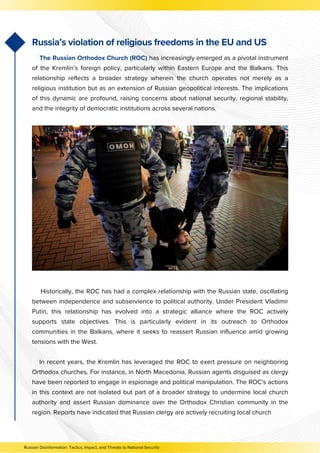
The exposure of Kremenovskaya's subversive activities has been aided by the case of a
defamation campaign against the American organization ALLATRA, initiated by RACIRS in
2015. Kremenovskaya publicly claimed influence over investigations and judicial
proceedings concerning the organization. The discrediting of ALLATRA is a direct result of
Russian disinformation efforts, with the characteristic anti-cult rhetoric employed in this
campaign first appearing on sites affiliated with the Moscow Patriarchate and RACIRS [36].
Over the past nine years, Kremenovskaya has perpetuated narratives aligned with
RACIRS, publishing defamatory materials against ALLATRA and its participants while using
highly dehumanizing and hateful rhetoric. She later admitted to attempting to instigate a
criminal case against ALLATRA and its participants, evidently forming an influence group
to pressure law enforcement. These actions were undertaken to enact favorable decisions
for Russia regarding the suppression of the rights and freedoms of Ukrainian citizens.
Despite the resilience of Ukrainian democracy in withstanding these unlawful actions,
Kremenovskaya, as can be seen, exploited the military situation to advance Russian
agendas by manipulating individuals within law enforcement to initiate criminal
proceedings against members of ALLATRA. Furthermore, she has publicly confessed to
writing expert assessments and justifications for the charges against ALLATRA, despite
such actions being unlawful when conducted by an interested party [37].
The apparent integration of Kremenovskaya's actions within the ROC's broader
geopolitical strategies reveals a concerning dimension of how religious institutions can be
co-opted for state-sponsored activities, posing significant threats to regional stability and
the integrity of democratic institutions in Ukraine and beyond.
.
Russian Disinformation: Tactics, Impact, and Threats to National Security
Historically, the ROC has had a complex relationship with the Russian state, oscillating
between independence and subservience to political authority. Under President Vladimir
Putin, this relationship has evolved into a strategic alliance where the ROC actively
supports state objectives. This is particularly evident in its outreach to Orthodox
communities in the Balkans, where it seeks to reassert Russian influence amid growing
tensions with the West.
In recent years, the Kremlin has leveraged the ROC to exert pressure on neighboring
Orthodox churches. For instance, in North Macedonia, Russian agents disguised as clergy
have been reported to engage in espionage and political manipulation. The ROC's actions
in this context are not isolated but part of a broader strategy to undermine local church
authority and assert Russian dominance over the Orthodox Christian community in the
region. Reports have indicated that Russian clergy are actively recruiting local church
Russian Disinformation: Tactics, Impact, and Threats to National Security
Russia’s violation of religious freedoms in the EU and US
The Russian Orthodox Church (ROC) has increasingly emerged as a pivotal instrument
of the Kremlin’s foreign policy, particularly within Eastern Europe and the Balkans. This
relationship reflects a broader strategy wherein the church operates not merely as a
religious institution but as an extension of Russian geopolitical interests. The implications
of this dynamic are profound, raising concerns about national security, regional stability,
and the integrity of democratic institutions across several nations.
officials, thereby infiltrating religious institutions to foster loyalty to Moscow. This infiltration
poses a significant challenge to NATO, as destabilizing activities in Macedonia could
undermine the alliance's southern flank [38;39]
Montenegro serves as a critical case study illustrating the Kremlin’s ambitions in the
Balkans through the ROC. The church's influence in Montenegro has been a focal point for
Russian strategic interests, with President Putin allegedly aiming to leverage the ROC to
destabilize the nation. Should Montenegro become compromised, the ramifications could
ripple throughout the Balkans, endangering NATO’s collective security and potentially
revitalizing nationalist movements in the region. The situation emphasizes the need for
NATO and Western governments to remain vigilant in monitoring the ROC’s activities,
recognizing its capacity to influence political and social dynamics.
The response from several Eastern European countries to the ROC’s activities has been
increasingly assertive. For instance, in Latvia, the Orthodox Church has sought to distance
itself from the Moscow Patriarchate, actively requesting autokefaly (independence). This
move is motivated by the desire to sever ties with the ROC, which has been associated
with the Kremlin's aggressive foreign policy and support for military actions in Ukraine.
Latvian President Egils Levits has articulated the necessity of this separation, linking it
directly to national security concerns.
Estonia has taken a more drastic step by contemplating the designation of the Moscow
Patriarchate as a terrorist organization. This proposal from Interior Minister Lauri
Läänemets reflects the growing sentiment that the ROC represents not only a religious
body but a potential source of instability that undermines democratic values and security.
The rhetoric around the ROC's alignment with Kremlin policies parallels concerns over
radical Islamist movements, indicating a recognition of the church as a vehicle for
subversive state activity [40]
The expulsion of clergy in Bulgaria accused of espionage highlights the acute tensions
surrounding Russian influence in Eastern Europe. The Bulgarian authorities, identifying
these individuals as agents of the Kremlin, emphasize the ROC's role in promoting Russian
geopolitical interests at the expense of national sovereignty. Such actions reveal the
church's operational role as a tool of espionage, with reports suggesting that Russian
intelligence services utilize clergy to recruit informants and gather intelligence in various
nations [41].
Russian Disinformation: Tactics, Impact, and Threats to National Security
Recommendations
To address the growing threat of disinformation that infringes upon religious
freedoms, it is crucial to establish comprehensive monitoring systems designed to track
and report instances of disinformation campaigns targeting various religious communities.
This involves not only identifying specific narratives and tactics employed by perpetrators
but also documenting the adverse impacts these campaigns have on the ability of
individuals and groups to freely express their faith and practice their beliefs. Regular
reporting can serve to inform policymakers, civil society organizations, and the public
about the extent and nature of these violations, fostering greater awareness and
understanding of the issues at hand.
To prevent the influence of Russian disinformation, countries should closely monitor and
scrutinize individuals actively disseminating anti-cult rhetoric within the information space.
It is essential to consider that even in the absence of an apparent connection to the
Russian Orthodox Church and despite the seemingly "anti-Russian" orientation of their
activities, this does not preclude the possibility of their role as agents of the Kremlin. Anti-
cult rhetoric, lobbying for restrictive anti-democratic laws, and the persecution of certain
population groups within a country primarily serve Russia's interests, which aim to
establish a totalitarian regime and destabilize the internal situation in other nations. It is
recommended to develop mechanisms for monitoring and analyzing such "anti-cult"
activities to respond promptly to potential threats and protect democratic processes in free
democratic countries.
In addition, international religious organizations should actively engage in dialogues
aimed at exposing and countering disinformation that targets faith groups. By bringing
together leaders from different religious traditions, civil society actors, and media
representatives, these dialogues can create a platform for sharing experiences, strategies,
and best practices. Collaborative efforts will enhance the capacity of religious communities
to combat misinformation and articulate their narratives more effectively in the public
sphere. Such initiatives can help build coalitions that promote interfaith solidarity and
resilience against disinformation, emphasizing the importance of accurate representations
of religious diversity and the value of coexistence.
Furthermore, there is an urgent need for advocacy aimed at establishing and enforcing
legal frameworks that hold accountable those entities that promote religious discrimination
through disinformation. This includes the development of robust legal instruments that
specifically address hate speech, misinformation, and the use of propaganda against
religious groups. Such laws should include clear definitions and provisions for prosecution,
Russian Disinformation: Tactics, Impact, and Threats to National Security
ensuring that violators face appropriate penalties for their actions. Legal measures must be
complemented by educational campaigns that inform the public about the legal
consequences of promoting religious discrimination, thereby fostering a culture of respect
and tolerance.
Additionally, governments should work collaboratively with civil society organizations to
create monitoring bodies that can oversee the implementation of these legal measures
and ensure that complaints regarding disinformation and religious discrimination are taken
seriously. This oversight can help build trust within communities that their rights are being
protected and that their grievances will be addressed in a timely and just manner.
Ultimately, a multifaceted approach that combines monitoring, dialogue, and legal
accountability is essential to effectively combat disinformation that undermines democratic
laws safeguarding religious freedoms. By prioritizing these actions, we can contribute to
creating a more inclusive society that strengthens democracy, and where all individuals
have the opportunity to practice their faith freely, without fear of discrimination or
persecution.
Russian Disinformation: Tactics, Impact, and Threats to National Security
Russian disinformation campaigns in Ukraine and Syria reflect a sophisticated strategy
to shape perceptions, legitimize military actions, and stymie international responses. By
deploying narratives that obscure facts, manipulate public sentiment, and exploit existing
geopolitical divisions, Russia’s disinformation serves as a key instrument of influence,
capable of altering both domestic and international realities.
In Ukraine, a core narrative that emerged from the first days of Russia’s invasion was
that victory was inevitable—even before the conflict fully escalated. On March 8, Russian
negotiator Vladimir Medinsky stated that Kyiv saw it as “practically impossible” to
recognize Crimea as part of Russia or acknowledge the sovereignty of the Donetsk and
Luhansk People’s Republics, implying that time and negotiations would eventually sway
Ukraine’s stance. This framing served to portray Russia’s demands as not only justified but
also destined to prevail. Just one day later, Kremlin spokesman Dmitry Peskov announced
that Russia’s goal of “demilitarizing” Ukraine was nearly complete, pressuring Ukraine to
halt its “military actions” as though resistance was futile. Russian state-controlled media
echoed this rhetoric, portraying support for the invasion as widespread and consensual.
Reports from Kommersant suggested that support for the “special operation” had risen by
9% since late February, with public backing reaching 74%. This self-reinforcing narrative of
inevitability aimed to psychologically disarm both Ukrainian resistance and international
opposition by presenting Russian victory as a foregone conclusion supported by Russian
citizens [42].
Disinformation in active conflicts: Case studies on
Russian Disinformation during the war in Ukraine and the
Syrian conflict
Russian Disinformation: Tactics, Impact, and Threats to National Security
President Vladimir Putin's framing of the conflict frequently employed religious and
historical rhetoric that demonized not only Ukrainian leadership but also religious and
ethnic minorities. When announcing Russia's "special operation" in Ukraine, Putin likened
Ukrainian officials to far-right nationalists and neo-Nazis, distorting the historical context of
World War II to mobilize support by invoking the collective memory of Russian society
regarding Nazi Germany. He characterized the invasion as a necessity to "demilitarize and
denazify Ukraine," despite a lack of corroborating evidence for claims of genocide against
Russian-speaking citizens in Ukraine. These narratives often omit or distort the Holocaust,
further intertwining Russian nationalism with anti-Semitic tropes, such as questioning the
legitimacy of Ukrainian President Volodymyr Zelensky's Jewish identity. High-ranking
officials, including Foreign Minister Sergey Lavrov, have perpetuated anti-Semitic rhetoric,
suggesting that Jews are responsible for their own persecution, which exemplifies the
troubling intersection of nationalism and historical distortion used to justify aggression.
Since the beginning of the full-scale invasion, Ukraine has launched investigations into
war crimes committed by the Russian forces daily. Russia has denied these accusations
and instead claimed that Ukrainian authorities staged the crimes, as in the case of Bucha.
According to Russia, all bodies of the people in the photos and videos published by the
official Kyiv don’t exhibit postmortem rigidity or lividity, and the blood in their wounds is not
clotted. This means that those corpses are in fact actors and their deaths are either a
fabrication by the Ukrainian authorities or a result of the crimes of Ukrainian “Nazis.” [39].
Since the start of Russian aggression in Crimea and the Donbas in 2014, Ukrainian law
enforcement agencies have been engaged in collecting evidence and investigating war
crimes. Ukrainian war crimes prosecutors also work with mobile justice teams supported
by forensic specialists and international legal experts. They conduct joint visits to
deoccupied territories and collect reports about the inhumane treatment of civilians and
other crimes. They also collect evidence from battlefields, including body parts and DNA
samples.
Ukraine is utilizing some DNA databases and rapid DNA technologies for human
remains identification and Russian war crime documentation. For instance, last year
Ukraine received provided by French and American partners; the labs are driven around
deoccupied territories in police vans, enabling teams to process evidence in real time. This
equipment significantly speeds up the identification of thousands of dead Ukrainians and
the collection of evidence for hundreds of war crime cases. Investigating and prosecuting
war crimes can play a crucial role in bringing Russia to justice for the actions Russian
troops have committed against Ukrainians.
Russian Disinformation: Tactics, Impact, and Threats to National Security
In Syria, Russia’s disinformation strategy mirrored its approach in Ukraine by casting its
intervention as a moral obligation, aligning with the global counter-terrorism agenda.
Russian media depicted Assad’s regime as a stabilizing force defending Syria against
extremism, obscuring the extensive evidence of human rights abuses committed by
Assad’s forces. By framing opposition forces as “foreign-backed terrorists,” Russian
disinformation legitimized the intervention and cast opponents of Assad’s regime as
destabilizing actors. This narrative gained traction internationally, complicating the global
discourse around Syria and enabling Russia to maintain a stronghold without facing unified
condemnation.
disinformation targeting
Syrian humanitarians
and human rights
defenders on Twitter
between 2015 and 2021.
Source: Deadly
Disinformation
The Deadly Disinformation report by The Syria Campaign illustrates the real-world
consequences of Russia’s disinformation. Russian-backed falsehoods have systematically
attacked humanitarian groups, such as the White Helmets, who were depicted as
propaganda tools of the West. By casting doubt on the credibility of humanitarian
organizations and discrediting their documentation of war crimes, Russian disinformation
further complicated international responses and delayed decisive action. Policymakers
interviewed in the report revealed that Russian disinformation sowed enough doubt to
stymie international intervention in Syria, even in the face of clear atrocities. Through this
prolonged “information fog,” Russia effectively neutralized political pressure and enabled
the Assad regime’s continued actions with relative impunity [43].
Russian Disinformation: Tactics, Impact, and Threats to National Security
Russia’s denial of chemical weapons use by the Assad regime is another example of
strategic narrative control. The Kremlin’s frequent attributions of these attacks to
opposition “false flag” operations undermined the legitimacy of humanitarian reports and
deflected accountability. This tactic not only reshaped public opinion domestically,
portraying Russian involvement as morally defensible, but also diffused international
consensus on the Assad regime’s culpability, further hindering unified policy responses.
The disinformation efforts in Ukraine and Syria underscore Russia’s sophisticated use of
narrative warfare. By embedding its military actions within historical and moral frames,
creating narratives of inevitable victory, and casting opposition as illegitimate, Russia uses
disinformation to control perceptions, sway international attitudes, and delay collective
action. Through sustained media reinforcement, these campaigns create an alternate
reality that complicates both immediate responses and long-term strategies, transforming
disinformation into an enduring tool of psychological and geopolitical influence.
Disinformation Targeting International Peacekeeping
Efforts: Narratives Undermining International Organizations
like the UN and NATO
Russian media narratives have continuously targeted the Armed Forces of Ukraine with
a strategy of dehumanization that dates back to the annexation of Crimea in 2014 and
escalated markedly with the full-scale invasion in 2022. From the onset of the invasion,
major Russian outlets, such as Kommersant and Izvestia, frequently labeled Ukrainian
military personnel as "nationalists" and "neo-Nazis," terms intended to evoke fear and rally
support within Russia by invoking the specter of World War II.
This language deliberately conflates terms like “Nazi” and “fascist” with “nationalist,”
ignoring the nuanced distinctions in a way that, as intended, blurs moral lines. For instance,
on February 25, 2022, Kommersant reported President Putin’s call for Ukrainian forces to
prevent “Benderites and neo-Nazis” from using civilians as “human shields”—phrasing that
constructs a sinister image of Ukrainian forces while appealing to the Russian historical
memory of Nazi occupation. This language was mirrored by Izvestia, which alleged that
Ukrainian “Nazis” established “detachments” to discipline those unwilling to fight, casting
doubt on Ukrainian unity and painting Ukraine’s defense as a forced, violent mobilization
Disinformation in active conflicts: Case studies on Russian
Disinformation during the war in Ukraine and the Syrian
conflict
rather than a legitimate national effort. Such messages are not isolated incidents; rather,
they reflect an overarching narrative aimed at eroding international sympathy for Ukraine
by portraying its armed forces as aggressive and radicalized [42].
For instance, Izvestia attributed “pumping Kyiv with weapons” and NATO military
exercises in the area as factors that exacerbate tensions, thus portraying Western support
for Ukraine as reckless and irresponsible. By characterizing NATO's involvement as a
calculated push towards violence, Russian media seek to discredit NATO’s support for
Ukraine, casting it as a means to escalate conflict rather than a genuine response to
Ukrainian sovereignty under threat [42]. This language deliberately conflates terms like
“Nazi” and “fascist” with “nationalist,” ignoring the nuanced distinctions in a way that, as
intended, blurs moral lines. For instance, on February 25, 2022, Kommersant reported
President Putin’s call for Ukrainian forces to prevent “Benderites and neo-Nazis” from
using civilians as “human shields”—phrasing that constructs a sinister image of Ukrainian
forces while appealing to the Russian historical memory of Nazi occupation. This language
was mirrored by Izvestia, which alleged that Ukrainian “Nazis” established “detachments”
to discipline those unwilling to fight, casting doubt on Ukrainian unity and painting
Ukraine’s defense as a forced, violent mobilization rather than a legitimate national effort.
Such messages are not isolated incidents; rather, they reflect an overarching narrative
aimed at eroding international sympathy for Ukraine by portraying its armed forces as
aggressive and radicalized [42].
These characterizations are complemented by allegations
against Ukraine’s international supporters, especially NATO.
Russian officials and media have framed Western military
assistance as a deliberate provocation, positioning NATO as a
destabilizing force in the region that “pushes Kyiv to
bloodshed.” State Duma Speaker Vyacheslav Volodin argued
in March 2022 that NATO-supported "Nazis" would have
invaded Donbas had Russia not intervened preemptively,
implying a necessity for Russian aggression as a defensive
action. This assertion reinforces the narrative that NATO both
directly and indirectly fuels extremism in Ukraine [42].
Vyacheslav Volodin,
the State Duma Speaker
Russian Disinformation: Tactics, Impact, and Threats to National Security
These characterizations are complemented by allegations against Ukraine’s
international supporters, especially NATO. Russian officials and media have framed
Western military assistance as a deliberate provocation, positioning NATO as a
destabilizing force in the region that “pushes Kyiv to bloodshed.” State Duma Speaker
Vyacheslav Volodin argued in March 2022 that NATO-supported "Nazis" would have
invaded Donbas had Russia not intervened preemptively, implying a necessity for Russian
aggression as a defensive action. This assertion reinforces the narrative that NATO both
directly and indirectly fuels extremism in Ukraine. For instance, Izvestia attributed
“pumping Kyiv with weapons” and NATO military exercises in the area as factors that
exacerbate tensions, thus portraying Western support for Ukraine as reckless and
irresponsible.
By characterizing NATO's involvement as a calculated push towards violence, Russian
media seek to discredit NATO’s support for Ukraine, casting it as a means to escalate
conflict rather than a genuine response to Ukrainian sovereignty under threat [42].
Parallel to these portrayals, Russian media also actively target international
organizations, particularly the United Nations, with accusations of ineffectiveness or bias.
The United Nations, perceived as representative of Western ideologies when it condemns
Russia’s actions, is criticized for failing to adequately protect or address what Russia
portrays as the West’s unchecked interventions. Russian media portray the UN as unable
to act impartially, suggesting that its actions are merely tools of Western influence, further
undermining the legitimacy of international law and norms when they contradict Russian
objectives. This delegitimizing stance is designed to undercut global institutions that could
coordinate responses or interventions against Russia’s actions in Ukraine, positioning
Russia as an independent global actor committed to its own sense of order and justice.
By consistently employing such narratives, Russian media aims to construct a
worldview in which Russia's actions in Ukraine are rationalized as both defensive and
morally necessary, while international condemnation is dismissed as hypocritical and
Western-driven. This narrative strategy bolsters domestic support for the invasion and
attempts to diminish international sympathy for Ukraine, reinforcing Russia’s portrayal as a
besieged nation defending itself from both internal and external threats. In this way,
Russian media not only aim to justify military action but also foster a perception of Western
alliances and institutions as aggressors, implicitly endorsing the notion that global stability
can only be achieved on Russian terms.
Russian Disinformation: Tactics, Impact, and Threats to National Security
Since Russia's full-scale invasion of Ukraine in 2022, a complex interplay of
disinformation strategies has emerged surrounding the economic impacts of international
sanctions. This disinformation seeks not only to destabilize global markets but also to
manipulate public opinion regarding the legitimacy and efficacy of sanctions imposed by
Western nations. Russian media narratives portray these sanctions as unfair and
illegitimate, framing them as a form of economic warfare aimed at undermining the Russian
state and its populace. This framing serves to cultivate a narrative of victimization that
resonates with both domestic and international audiences, allowing the Kremlin to deflect
responsibility for economic challenges back onto the West.
In response to Russia’s aggressive actions, the European Union, the United States, and
other allies implemented a comprehensive suite of economic sanctions targeting key
sectors of the Russian economy, including finance, defense, energy, and technology [44].
These sanctions were designed to cut off critical resources necessary for sustaining
military operations and economic stability. However, Russian media outlets, such as
Rossiyskaya Gazeta and TASS, have reported that the country is adapting to these
sanctions, claiming that it has adjusted to sanctions and is emerging stronger [45]. This
transformation of the narrative serves a dual purpose: it reassures the domestic audience
and aims to sway international perceptions by suggesting that the sanctions are
ineffective. By presenting an image of resilience, the Kremlin hopes to deter further
sanctions and maintain its political capital.
Economic Consequences of Disinformation During
Conflicts: Impact on Sanctions and Global Markets Due to
Misinformation Campaigns
Russian Disinformation: Tactics, Impact, and Threats to National Security
Moreover, Russian disinformation has targeted international markets, particularly regarding
energy exports. State-controlled media outlets have disseminated narratives claiming that
European reliance on Russian energy would prevent a full-scale economic backlash from
sanctions. By portraying energy exports as a critical bargaining chip, Russia seeks to foster
uncertainty in global markets and challenge the legitimacy of sanctions. This tactic aims to
create divisions within the EU and among Western allies regarding the implementation and
sustainability of sanctions, ultimately undermining their effectiveness [46].
To effectively address the pervasive issue of disinformation during conflicts, it is
imperative to strengthen international fact-checking networks dedicated to conflict
reporting. These networks serve as critical guardians of truth, ensuring that information
disseminated during crises is accurate and reliable. By enhancing the capacity and reach
of these networks, we can foster greater accountability among media outlets, which is
essential in an era where misinformation can significantly influence public perception and
policy decisions. Furthermore, such networks can collaborate across borders, sharing best
practices and resources to establish a robust framework for verifying information in real-
time, thereby enhancing the overall quality of conflict reporting.
Source:
https://www.eifec.org/eu-
sanctions-on-russia-home
Recommendations
Russian Disinformation: Tactics, Impact, and Threats to National Security
In tandem with bolstering fact-checking efforts, developing counter-narratives in real-
time is crucial for combating the spread of false information during crises. As
disinformation proliferates, the ability to swiftly create and disseminate accurate narratives
becomes vital. This requires a strategic approach that not only identifies misleading claims
but also presents compelling, fact-based responses that resonate with the affected
populations. By employing a variety of media platforms and utilizing innovative storytelling
techniques, these counter-narratives can effectively counteract disinformation and
reinforce public understanding of the situation on the ground. Such proactive measures
are essential in mitigating the harmful effects of false narratives, which can exacerbate
tensions and hinder conflict resolution efforts.
Lastly, imposing sanctions on media outlets that are proven to distribute disinformation
in conflict zones is a necessary step toward accountability and deterrence. By holding
these outlets responsible for their role in perpetuating misleading information, we send a
clear message that disinformation will not be tolerated. Such sanctions can discourage
other media organizations from engaging in similar practices, thereby promoting a more
responsible and ethical approach to reporting. Additionally, these measures can serve to
protect the integrity of the information ecosystem during conflicts, ensuring that credible
reporting prevails over sensationalism and misinformation.
Russian Disinformation: Tactics, Impact, and Threats to National Security
RUSSIAN DISINFORMATION
AND ELECTIONS
The role of Russian disinformation in electoral processes across the globe has
become increasingly apparent, particularly in Eastern Europe, the European Union, and the
United States. These campaigns are characterized by a strategic blend of misinformation,
social media manipulation, and the exploitation of existing societal tensions, all aimed at
undermining democratic institutions and influencing electoral outcomes.
In Eastern Europe, countries like Ukraine, Georgia, and Moldova have experienced
significant electoral interference through disinformation campaigns. The 2014 presidential
election in Ukraine serves as a critical case study. Russian operatives leveraged social
media and traditional media to propagate false narratives about candidates and create an
atmosphere of distrust towards Western influences. This was not merely an attempt to
sway the election in favor of pro-Russian candidates; it was a broader strategy to
destabilize Ukraine’s political landscape and weaken its ties with the West. The
disinformation tactics employed—ranging from creating fake news stories to manipulating
public sentiment—served to polarize the electorate and incite social unrest, showcasing
how vulnerable democratic processes can be to external influence [47].
RUSSIAN DISINFORMATION
AND ELECTIONS
5.1 INFLUENCE ON ELECTIONS
IN EASTERN EUROPE:
Example of Russian disinformation against
EU in Georgia. Source:
https://www.isfed.ge/eng/blogi/ganakhlebuli-
rusuli-sainformatsio-operatsia-saqartveloshi-
evrokavshiris-tsinaaghmdeg-
Russian Disinformation: Tactics, Impact, and Threats to National Security
Similarly, in Georgia, the 2018 presidential election was marked by coordinated
disinformation efforts designed to discredit the ruling government and amplify public
dissatisfaction [48]. The campaigns targeted the electoral process itself, sowing doubts
about the integrity of the elections and fostering divisions among the populace. Moldova
has faced analogous challenges, particularly during its 2020 presidential election, where
pro-Kremlin narratives sought to manipulate public perception in favor of candidates
advocating closer ties with Russia. These examples underscore a disturbing trend:
disinformation is not only a tool for influencing immediate electoral outcomes but also a
means of eroding public trust in democratic institutions over the long term.
In the European Union, Russian disinformation has been similarly insidious, targeting
various member states to disrupt electoral processes and foment distrust in democratic
systems. The 2017 French presidential election highlighted these tactics, where Russian
state media disseminated false information aimed at undermining candidate Emmanuel
Macron [49]. By framing Macron as a puppet of Western elites, the disinformation
campaigns sought to rally support for his opponents and create a climate of skepticism
about the election's legitimacy. Such campaigns have proven effective in exploiting
existing divisions within society, particularly around contentious issues like immigration
and national identity, thereby posing a significant threat to the integrity of electoral
processes across Europe.
Russian propagandists spreading disinformation: Olga Skabeyeva, Dmitry Kiselyov, and Vladimir
Solovyov. Source: https://imi.org.ua/en/news/pace-may-consider-a-resolution-on-russian-propagandists-
accountability-within-a-year-people-s-deputy-i48562
Russian Disinformation: Tactics, Impact, and Threats to National Security
5.2 INFLUENCE ON U.S. ELECTIONS:
Russian disinformation has emerged as a formidable threat to the integrity of U.S.
elections, particularly evident during the presidential elections of 2016 and 2020. The
sophistication and scope of these disinformation campaigns reveal a strategic effort to
manipulate public perception, sow discord, and undermine trust in democratic processes.
This multifaceted approach highlights the need for a comprehensive understanding of how
disinformation can affect electoral outcomes and the broader implications for American
democracy.
The 2016 presidential election serves as a pivotal case study in the manipulation of
social media and information dissemination strategies. Russian operatives, notably linked
to the Internet Research Agency (IRA), launched extensive disinformation campaigns
across platforms like Facebook, Twitter, and Instagram. These campaigns involved
creating fake accounts and pages that mimicked authentic American political discourse,
often focusing on polarizing issues such as immigration, race, and gun control. By targeting
specific demographic groups, these operatives were able to amplify divisive narratives,
effectively manipulating public opinion to favor particular candidates while discrediting
others.
Russian Disinformation: Tactics, Impact, and Threats to National Security
One of the most significant tactics employed was the use of "fake news" stories designed
to create confusion and mistrust among voters. For instance, fabricated stories suggesting
that certain candidates had engaged in unethical or illegal activities circulated widely,
often gaining traction through shares and retweets. These narratives not only swayed
The aftermath of the 2016 election highlighted the long-term implications of these
disinformation campaigns on American political discourse. Following the election, a
significant portion of the electorate began to question the legitimacy of the electoral
outcome, fueled by narratives of widespread voter fraud and foreign interference. This
skepticism was particularly pronounced among supporters of the losing candidate, who
were subjected to a barrage of disinformation suggesting that their candidate had been
wronged. The erosion of trust in electoral institutions poses a fundamental threat to
democracy, as it undermines the principle of fair and free elections.
In the lead-up to the 2020 presidential election, Russian disinformation tactics evolved,
reflecting lessons learned from the previous election cycle. The focus shifted towards
delegitimizing specific electoral processes, particularly mail-in voting, which was expected
to play a crucial role in the election due to the COVID-19 pandemic. Disinformation
campaigns propagated false claims that mail-in ballots were susceptible to fraud,
effectively sowing doubt about the integrity of the electoral system. These narratives not
only aimed to suppress voter turnout among certain demographics but also sought to
create chaos around the election process itself [51].
Russian Disinformation: Tactics, Impact, and Threats to National Security
individual opinions but also contributed to a broader atmosphere of skepticism
surrounding the electoral process. The spread of disinformation was further exacerbated
by the existing partisan divides, which allowed false information to resonate more deeply
with audiences already predisposed to distrust the opposing side [50].
Moreover, the use of social media advertising
played a crucial role in the dissemination of
disinformation. Russian operatives invested
heavily in targeted advertising campaigns that
reached millions of users, exploiting the
platforms’ algorithms to maximize exposure.
These ads often included inflammatory
imagery and slogans that resonated with
specific voter groups, making them particularly
effective in shaping public sentiment. The
scale and precision of these operations
revealed vulnerabilities in how social media
platforms manage political advertising, raising
concerns about accountability and
transparency.
Example of fake news spread by
Russia. Source: CNN
The convergence of social media, disinformation, and public sentiment created a
volatile environment leading into the 2020 elections. As the election approached,
numerous false narratives circulated regarding the supposed risks of mail-in voting,
including claims that ballots would be altered or discarded. These disinformation efforts
were not isolated incidents; rather, they were part of a broader strategy aimed at
undermining public confidence in the electoral process. The ramifications of these
campaigns were evident as segments of the electorate voiced skepticism about the
election results, culminating in the unprecedented events of January 6, 2021, when
supporters of the losing candidate stormed the U.S. Capitol in an attempt to overturn the
election outcome.
The impact of Russian disinformation on U.S. elections extends beyond immediate
electoral outcomes; it has lasting implications for the health of American democracy. The
normalization of disinformation as a tactic in political discourse poses a fundamental
challenge to democratic institutions. As citizens increasingly encounter conflicting
narratives and misinformation, the potential for societal polarization grows, threatening the
cohesion necessary for a functioning democracy. The response to these challenges must
involve not only technological solutions to combat disinformation but also an emphasis on
media literacy and critical thinking among the electorate.
In light of these developments, it is imperative for policymakers, technology companies,
and civil society to collaborate in creating robust defenses against disinformation. This
includes implementing stringent regulations on political advertising, enhancing
transparency in campaign funding, and fostering initiatives that promote media literacy. By
addressing the underlying vulnerabilities that allow disinformation to thrive, the United
States can take significant steps toward safeguarding the integrity of its electoral
processes and restoring public trust in democratic institutions.
Recommendations:
To effectively counter the pervasive threat of Russian disinformation in U.S. elections, a
multifaceted approach is necessary. Implementing robust recommendations across various
domains can help strengthen electoral integrity and restore public confidence in
democratic processes:
Russian Disinformation: Tactics, Impact, and Threats to National Security
Create Cybersecurity Frameworks to Safeguard Elections from Disinformation:
Establishing comprehensive cybersecurity frameworks is essential to protect electoral
infrastructure from the threats posed by disinformation campaigns. This involves not
only securing the technical aspects of voting systems but also implementing protocols
for monitoring and responding to potential disinformation threats. Governments should
collaborate with cybersecurity experts to develop standards that ensure the integrity
and resilience of electoral systems. Regular assessments and stress tests of voting
technology can help identify vulnerabilities, while incident response plans should be
established to swiftly address potential breaches or attempts to manipulate election
outcomes.
Furthermore, partnerships with private sector technology firms can enhance
cybersecurity efforts by leveraging their expertise in threat detection and mitigation. By
creating a coordinated effort between government agencies and technology
companies, a more robust defense against disinformation can be achieved.
Additionally, training election officials and poll workers on cybersecurity best practices
will empower them to recognize and respond to disinformation tactics effectively.
Fact-Checking Collaboration between Political Campaigns and Media Organizations:
Promoting collaboration between political campaigns and media organizations through
fact-checking initiatives is critical to counteracting disinformation. Establishing formal
partnerships can facilitate the sharing of information about potential disinformation
campaigns, allowing campaigns to respond quickly to false narratives. Implementing
real-time fact-checking services during campaigns can provide voters with accurate
information and context, helping to mitigate the impact of misleading narratives.
Moreover, campaigns should adopt transparent communication strategies that
prioritize fact-based messaging. By committing to honesty and integrity in their
communications, political actors can build trust with voters and help reduce the
effectiveness of disinformation campaigns. Additionally, media organizations should
invest in fact-checking resources, ensuring that accurate information is readily
available to the public. By creating a culture of accountability and verification, the
electoral discourse can be safeguarded against manipulation.
Implement Policies for Transparency in Political Advertising on Social Media Platforms:
To address the challenges posed by disinformation in political advertising,
implementing policies that promote transparency is crucial. Social media platforms
should be mandated to disclose the sources of funding for political advertisements,
providing voters with insight into who is behind specific messages. This transparency
can help to identify foreign influence and reduce the effectiveness of deceptive
Russian Disinformation: Tactics, Impact, and Threats to National Security
Additionally, social media companies must enhance their content moderation practices
to quickly identify and remove false information related to elections. Employing
advanced algorithms and human moderators can facilitate the detection of
disinformation campaigns before they gain traction, protecting the electoral discourse
from manipulation.
By adopting these recommendations, stakeholders can collaboratively create a fortified
electoral environment that prioritizes the integrity of democratic processes. The
multifaceted approach involving cybersecurity frameworks, fact-checking partnerships,
and transparency in advertising is essential in safeguarding elections from disinformation.
This proactive stance will not only protect the electoral process but also restore public
confidence in the institutions that uphold democracy.
Russian Disinformation: Tactics, Impact, and Threats to National Security
advertising strategies. Furthermore, platforms should establish clear guidelines for political
advertising that include comprehensive labeling of sponsored content. This would enable
users to differentiate between organic posts and paid advertisements, making it easier to
scrutinize the information being presented. Regular audits of political advertising practices
by independent third parties can further enhance accountability, ensuring compliance with
transparency regulations.
Russian Disinformation: Tactics, Impact, and Threats to National Security
GENERAL THREATS TO NATIONAL
SECURITY FROM RUSSIAN DISINFORMATION
GENERAL THREATS TO NATIONAL
SECURITY FROM RUSSIAN DISINFORMATION
Disinformation campaigns have increasingly targeted national companies, particularly
in sectors vital to national interests, such as energy, technology, and defense. For instance,
the energy sector, which is often intertwined with national security, has seen targeted
efforts to undermine companies like Naftogaz in Ukraine and various energy firms in
Western Europe. By disseminating false information about a company's financial health,
operational capabilities, or even the safety of its products, these campaigns aim to create
instability in key sectors. The resulting uncertainty can lead to fluctuations in stock prices,
diminished investor confidence, and potential economic repercussions that ripple through
national economies.
Moreover, the technology sector is not immune to these tactics. Russian disinformation
campaigns frequently cast doubt on the integrity of Western tech giants, portraying them
as tools of U.S. foreign policy. For example, during election cycles, misleading narratives
around data privacy and security breaches can lead to public outcry against companies
like Facebook and Twitter. Such efforts can diminish consumer trust and prompt regulatory
scrutiny, further complicating the operational landscape for these firms.
The consequences extend to critical infrastructure, where disinformation can exacerbate
vulnerabilities. During crises, disinformation campaigns can instigate panic, leading to
public disarray that hampers effective communication from government and corporate
entities. For instance, misinformation about energy supply disruptions can lead to panic
buying and hoarding, exacerbating supply shortages and further destabilizing markets. In
essence, the impact of Russian disinformation is a direct threat to the stability and
resilience of national economies, which are critical to overall national security [52].
6.1 IMPACT ON NATIONAL COMPANIES
AND CRITICAL INFRASTRUCTURE:
Russian Disinformation: Tactics, Impact, and Threats to National Security
6.2 CYBERSECURITY AND
INFORMATION ATTACKS:
The nexus between disinformation and cyberattacks represents a significant and
evolving threat to national security. Russian disinformation tactics often go hand-in-hand
with cyber operations, creating a multifaceted assault on targeted nations. The 2016 U.S.
presidential election serves as a prime example, where Russian cyber operatives infiltrated
the Democratic National Committee, stealing sensitive data and subsequently
disseminating that information to sow discord and amplify existing political divisions.
Cyberattacks can be used to gather intelligence, disrupt services, and compromise
sensitive data, while disinformation campaigns work to misdirect blame and distort public
perception. For instance, after the NotPetya cyberattack targeted Ukraine in 2017, the
Russian government leveraged disinformation to deflect responsibility, framing the attack
as an act of retaliation against perceived Ukrainian aggression. This dual approach not
only undermined the immediate response efforts but also complicated international
attribution, allowing Russia to evade accountability [53].
The implications of such coordinated efforts are profound. When cyberattacks are
accompanied by a steady stream of disinformation, public trust in institutions erodes, and
citizens become more vulnerable to manipulation. This creates a feedback loop where
misinformation can influence policy responses to cyber threats, allowing adversaries to
exploit weaknesses in national security frameworks. A holistic approach to national
security must recognize this interplay and seek to develop integrated strategies that
address both cyber vulnerabilities and the disinformation landscape.
Russian Disinformation: Tactics, Impact, and Threats to National Security
Russian disinformation campaigns have demonstrated a remarkable capacity to
destabilize public opinion and fracture social cohesion. By strategically targeting specific
ethnic and social groups, these campaigns aim to cultivate distrust in government
institutions and exacerbate societal divisions. The exploitation of sensitive social issues,
such as race relations and economic disparities, serves to amplify existing tensions and
create an environment ripe for unrest.
In the United States, the Russian government has exploited movements for social
justice to fuel polarization. For instance, during the Black Lives Matter protests, Russian
operatives disseminated disinformation that framed protests in a negative light, creating
rifts between communities and fostering an environment of hostility. By manipulating social
media algorithms and targeting specific demographics, these campaigns can effectively
magnify grievances, leading to increased radicalization and division within society [54].
6.3 IMPACT ON PUBLIC OPINION
AND SOCIAL STABILITY:
Russian Disinformation: Tactics, Impact, and Threats to National Security
The consequences of this disinformation-driven destabilization are profound. When
public trust in government erodes, it opens the door for extremist ideologies to take root,
as citizens become disillusioned with traditional democratic processes. The potential for
increased civil unrest and challenges to state authority grows, creating an unstable social
fabric that poses significant risks to national security.
Moreover, in regions with historical ethnic conflicts, such as the Balkans, disinformation
campaigns can stoke nationalist sentiments, leading to violent clashes and further
destabilizing already fragile political environments. By portraying certain ethnic groups as
threats to national identity, these campaigns can incite violence and perpetuate cycles of
conflict. The long-term impact of such disinformation efforts not only undermines social
cohesion but also complicates efforts for reconciliation and peacebuilding.
Russian Disinformation: Tactics, Impact, and Threats to National Security
Russian disinformation
campaign against the Black
Lives Matter protests. Source:
Alliance for Citizen Engagement
6.4 EXPANDING RUSSIAN GEOPOLITICAL
INFLUENCE THROUGH DISINFORMATION:
Disinformation has become a critical tool for Russia to extend its geopolitical influence
across various regions, including the Balkans, Central Asia, and Africa. By promoting pro-
Russian narratives and exploiting existing societal divisions, Russia seeks to enhance its
strategic foothold while countering Western influence.
In the Balkans, for example, Russian disinformation campaigns have targeted the
region's integration into the European Union, casting Western influences as detrimental to
national interests [55]. By disseminating narratives that promote distrust in EU institutions
and portraying Russia as a traditional ally, these campaigns effectively undermine
democratic aspirations. This strategy has been particularly evident in Serbia, where pro-
Kremlin media amplify nationalist sentiments and frame Western engagement as a threat
to national sovereignty.
In Africa, Russian disinformation plays a role in fostering strategic partnerships and
expanding influence in resource-rich regions. By positioning itself as a counterbalance to
Western hegemony, Russia uses disinformation to cultivate relationships with authoritarian
regimes, offering military support and economic cooperation. This approach not only
solidifies Russia's geopolitical presence but also complicates international efforts to
promote democracy and human rights in the region [56].
Russian Disinformation: Tactics, Impact, and Threats to National Security
The implications of these disinformation efforts are far-reaching, as they shape regional
politics and impact global security dynamics. By fostering dependency and promoting
narratives that align with its strategic interests, Russia can effectively challenge Western
influence and reshape the geopolitical landscape in its favor .
Disinformation map, Africa. Source: https://africacenter.org/spotlight/mapping-a-
surge-of-disinformation-in-africa/
Russian Disinformation: Tactics, Impact, and Threats to National Security
Develop public-private partnerships to strengthen critical
infrastructure against disinformation.
Establishing collaborative frameworks between government agencies and private
sector entities is essential for enhancing defenses against disinformation. By sharing
resources, intelligence, and expertise, stakeholders can collectively identify vulnerabilities
and develop effective countermeasures. Joint training initiatives and simulation exercises
can also prepare companies to respond swiftly to disinformation threats that target their
operations.
Increase government funding for cybersecurity to prevent
information attacks.
Adequate funding for cybersecurity initiatives is crucial for protecting national interests.
This includes investing in advanced technologies that can detect and counteract
disinformation campaigns, as well as enhancing training programs for cybersecurity
personnel. By prioritizing cybersecurity as a national security concern, governments can
bolster their defenses against both cyberattacks and disinformation efforts.
Promote international collaboration to develop joint
disinformation counteraction strategies.
Given the transnational nature of disinformation campaigns, countries must work
together to share best practices and develop coordinated responses. Establishing
international frameworks for information sharing and joint training exercises can enhance
the collective ability to counter disinformation. Additionally, promoting international norms
and agreements surrounding disinformation can foster accountability and deter malicious
actors.
Russian Disinformation: Tactics, Impact, and Threats to National Security
Recommendations:
In light of the multifaceted threats posed by Russian disinformation, a series of
strategic recommendations should be pursued to mitigate risks and bolster national
security:
Strengthen Legislative Measures Against Disinformation.
Governments should consider implementing legislative measures that hold individuals
and organizations accountable for disseminating false information. Stricter penalties for
deliberate disinformation campaigns, particularly those originating from foreign actors, can
serve as a deterrent. Additionally, regulations governing the transparency of online
political advertising can help identify and mitigate the spread of disinformation.
Russian Disinformation: Tactics, Impact, and Threats to National Security
Implement Comprehensive Public Awareness Campaigns.
Educating the public about the nature of disinformation and its potential impacts is
essential for building resilience. Public awareness campaigns can equip citizens with
critical thinking skills to recognize and question misleading information. By promoting
media literacy and encouraging skepticism towards sensationalist narratives, governments
can empower individuals to resist manipulation.
The pervasive reach of Russian disinformation presents a profound challenge to global
stability and national security. This report has demonstrated how Russian disinformation
campaigns are intricately designed to exploit social, political, and ideological divisions in
targeted nations, using a blend of traditional media, social media platforms, and state-
backed and unofficial actors. Through these mechanisms, Russian influence campaigns
have reshaped public perception across multiple fronts, including political elections,
national conflicts, religious freedoms, and international alliances. By undermining
democratic institutions, fostering internal societal divisions, and manipulating public
sentiment, these campaigns aim not only to destabilize specific nations but also to shift the
balance of geopolitical power in Russia's favor.
A unique characteristic of Russian disinformation is its adaptability across cultural and
political contexts, with narratives tailored to resonate within local populations, often
aligning with far-right or nationalist movements. As seen in Eastern Europe, the European
Union, and the United States, disinformation efforts target critical political events—
elections, referendums, and high-stakes international conflicts—to amplify ideological
polarization, erode public trust, and weaken democratic resilience. In conflict zones, such
as Ukraine and Syria, disinformation has further served to obscure Russian military
intentions, diminish international opposition, and create a distorted reality that hinders
coordinated responses.
Religious and cultural narratives also play a key role, with disinformation efforts seeking
to manipulate the influence of religious institutions and exploit longstanding tensions. The
Russian Orthodox Church and anti-cult organizations such as RACIRS, for instance, have
become a potent tool for promoting pro-Russian narratives, particularly in regions with
shared religious or cultural heritage. This strategy not only deepens Russia's influence but
also marginalizes minority religions and consolidates control under a state-approved
religious identity, further aligning with the Kremlin’s ideological objectives.
To counter the adverse impact of these campaigns, this report underscores the
importance of a multifaceted approach. First, enhancing public media literacy is essential
for building individual resilience against disinformation. Education systems must integrate
programs that emphasize critical thinking, media literacy, and digital awareness, enabling
individuals to better discern credible information and resist manipulative content.
CONCLUSION
Russian Disinformation: Tactics, Impact, and Threats to National Security
These skills are particularly vital in societies where misinformation is prevalent across
multiple media channels, and where public opinion can be easily swayed by coordinated
disinformation efforts.
Collaboration with social media companies is equally crucial. Social media platforms are
often the primary vehicle for spreading disinformation, and greater accountability is
needed to flag, label, and mitigate false narratives in real-time. Strengthening transparency
around content moderation, developing clear guidelines for user reporting, and improving
fact-checking capabilities will help curb the rapid spread of disinformation. Governments
and platforms must work together to establish systems that effectively combat
disinformation, especially on issues like elections, public health, and national security.
International cooperation also plays an indispensable role in tackling cross-border
disinformation. Given the transnational nature of modern information warfare, individual
nations alone cannot fully combat the reach and influence of Russian disinformation
networks. Collaborative task forces, real-time intelligence sharing, and coordinated
sanctions against state and private actors involved in disinformation are necessary for a
united defense. Developing global standards for platform accountability and transparency
is essential, helping to align efforts to counter the disinformation threats that increasingly
transcend national borders.
Russian Disinformation: Tactics, Impact, and Threats to National Security
Boksa, M. 2019. Russian information warfare in Central and Eastern Europe: Strategies,
impact, countermeasures.
https://www.gmfus.org/sites/default/files/Russia%20disinformation%20CEE%20-
%20June%204.pdf
1.
Wooley, S. & Guilbeault. 2019. Computational propaganda in the United States of
America: Manufacturing consensus online. https://ora.ox.ac.uk/objects/uuid:620ce18f-
69ed-4294-aa85-184af2b5052e
2.
Denton, A. 2019. Fake news: The legality of the Russian 2016 Facebook influence
campaign. https://www.bu.edu/ilj/files/2020/04/Denton.pdf
3.
Laine, M. & Morozova, A. 2024. Leaked files from Putin’s troll factory: How Russia
manipulated European elections. https://vsquare.org/leaked-files-putin-troll-factory-
russia-european-elections-factory-of-fakes/
4.
Mioc, A., Jentovic, M. & Wesolowsky, T. 2024. Under Investigation Across Europe, Pro-
Kremlin Voice Of Europe Has Deep Balkan Ties. https://www.rferl.org/a/russia-voice-of-
europe-czech-information-war/32904006.html
5.
Vinocur, N., Haeck, P. & Wax, E. 2024. Russian influence scandal rocks EU.
https://www.politico.eu/article/voice-of-europe-russia-influence-scandal-election/
6.
Hellman, M. 2024. The News Media Organizations RT and Sputnik and Their
Audiences. https://link.springer.com/chapter/10.1007/978-3-031-58747-4_2
7.
Muenster, R. 2024. Influencers ‘promising avenue’ in misinformation spread.
https://news.cornell.edu/media-relations/tip-sheets/influencers-promising-avenue-
misinformation-spread
8.
Suciu, P. 2024. Russian Disinformation Remains All Too Common On Social Media.
https://www.forbes.com/sites/petersuciu/2024/06/06/russian-disinformation-remains-
all-too-common-on-social-media/
9.
Russian influence efforts converge on 2024 Paris Olympic Games. A MICROSOFT
THREAT INTELLIGENCE REPORT. https://cdn-dynmedia-
1.microsoft.com/is/content/microsoftcorp/microsoft/final/en-us/microsoft-
brand/documents/MTAC_Report_Russian_Influence_and_Paris_2024.pdf
10.
RFI. 2024. French cyber experts reveal vast network of Russian disinformation sites.
https://www.rfi.fr/en/international/20240213-french-cyber-experts-reveal-vast-network-
of-russian-disinformation-sites
11.
REFERENCES
Russian Disinformation: Tactics, Impact, and Threats to National Security
12. Detector media. 2023. Tactics and tools How Russian propaganda uses the “40 to 60”
method to achieve its own goals. https://disinfo.detector.media/en/post/how-russian-
propaganda-uses-the-40-to-60-method-to-achieve-its-own-goals
13. Hung, H.T. 2022. Distorting Your Perception of Russia’s Aggression: How Can We
Combat Information Warfare? https://connections-
qj.org/system/files/21.3.28_distorting_perceptions.pdf
14. Rubryka. 2024. Russia's propaganda on Tiktok and why we shouldn't trust everything
we see. https://rubryka.com/en/article/rosijska-propaganda-u-tiktok/
15. Lanza, R. 2023. A state of mind: how conspiracy theories became the Kremlin’s
ideology. https://aspeniaonline.it/a-state-of-mind-how-conspiracy-theories-became-the-
kremlins-ideology/
16. Radnitz, S. 2023. Conspiracy Theories and Russia's Invasion of Ukraine.
https://www.ssoar.info/ssoar/bitstream/handle/document/88690/ssoar-russanald-2023-
299-radnitz-Conspiracy_Theories_and_Russias_Invasion.pdf?
sequence=1&isAllowed=y&lnkname=ssoar-russanald-2023-299-radnitz-
Conspiracy_Theories_and_Russias_Invasion.pdf
17. Alvarez, G. et al. Good News, Bad News: A Sentiment Analysis of the 2016 Election
Russian Facebook Ads.
https://repositories.lib.utexas.edu/server/api/core/bitstreams/1090d0d5-366a-46cc-b1b1-
a3a18421cc28/content
18. Eady, G. et al. 2023. Exposure to the Russian Internet Research Agency foreign
influence campaign on Twitter in the 2016 US election and its relationship to attitudes and
voting behavior. https://www.nature.com/articles/s41467-022-35576-9
19. Richards, J. (2021). Fake news, disinformation and the democratic state: a case study of
the UK government’s narrative. Icono14, 19(1), 95-122.
https://dialnet.unirioja.es/descarga/articulo/7756865.pdf
20. Refat Alimov. https://www.uscirf.gov/religious-prisoners-conscience/forb-victims-
database/refat-alimov
21. 2023 report on international religious freedom: Russia.
https://www.state.gov/reports/2023-report-on-international-religious-freedom/russia/
22. Connell, R. 2022. Supposedly Defending Christian Civilization - Putin Savages
Churches. https://usukraine.org/blog/supposedly-defending-christian-civilization-putin-
savages-churches
REFERENCES
Russian Disinformation: Tactics, Impact, and Threats to National Security
23.Analytical Note: FREEDOM OF SPEECH AND OCCUPIED TERRITORIES (Ukrainian).
https://ac.ucu.edu.ua/wp-content/uploads/2020/11/LDK_-svobod-sovisti.pdf
24.Ukrsekta.info. https://ukrsekta.info/news/2286-v-ukraine-poyavilsya-predstavitel-
racirs.html
25.Iriney.ru. https://iriney.ru/main/o-czentre/oficzialnaya-biografiya-a.-l.-dvorkina.html
26. Mayer, R. 2016. A brief overview of attitudes of Western European states towards new
religious movements. https://www.religion.info/pdf/2016_11_nrms.pdf
27. Vilneslovo. https://vilneslovo.com/sektoznavstvo/#google_vignette
28. Vilneslovo. https://vilneslovo.com/лобіювання-інтересів-релігійних-орг/
39. Vilneslovo. https://vilneslovo.com/свідки-єгови-історія-виникнення-та-ід/
30. Ansobor. https://ansobor.ru/news.php?news_id=9000
31. Vilneslovo. https://vilneslovo.com/тренінги-користь-або-небезпека/#google_vignette
32. Neveev. https://neveev.livejournal.com/31385.html
33. 360.ru. https://360.ru/tekst/obschestvo/satanizatsija-obschestva-ukrainskij-narod-
pogruzili-v-sluzhenie-zlu/
34. Priboi News. https://www.priboi.news/govorit-odessa/rupor-russkogo-mira-i-
religioznogo-ekstremizma-v-ukraine-ot-popugaya-romy-k-borbe-s-destruktivnymi-kultami/
35. Obozrevatel. https://news.obozrevatel.com/society/deti-ne-vinovatyi-komu-vyigodno-
porochit-fond-pomogayuschij-onkobolnyim.html
36.Pravlife.https://web.archive.org/web/20200812092548/https://pravlife.org/content/
tehnologiya-obmana-v-deystvii-okkultnoe-dvizhenie-allatra
37. Vilneslovo. https://vilneslovo.com/pro-znakhidky-na-obshukakh-u-sekti-allatra-i-
sotsialnu-bezvidpovidalnist-mediynykiv/
38. Zagorcheva, D. 2023. Praying for Putin: Spies in Cassocks Threaten the West. https://
cepa.org/article/praying-for-putin-spies-in-cassocks-threaten-the-west/
39. Vistinomer. https://vistinomer.mk/ruski-agenti-vo-mantija/
40. Novayagazeta. https://novayagazeta.eu/articles/2024/04/22/zapad-zametil-terroristov-
v-riasakh
41. Alternative Press. Bulgaria expels a Russian and 2 Belarusian clerics accused of spying
for Moscow. https://apnews.com/article/bulgaria-russia-expulsions-
clerics-1dc57038ae2bd0756be1d37200e3ff1e
REFERENCES
Russian Disinformation: Tactics, Impact, and Threats to National Security
42. Brusylovska, O. & Maksymenko, I. 2023. Analysis of the media discourse on the 2022
war in Ukraine: The case of Russia. https://www.sciencedirect.com/science/article/pii/
S1757780223002834#rsp312579-sec-0008
43. Deadly Disinformation. How online conspiracies about Syria cause real-world harm.
https://deadlydisinformation.org/source/Deadly_Disinformation_EN.pdf
44.European Council. EU sanctions against Russia explained.
https:www.consilium.europa.eu/en/policies/sanctions-against-russia-explained/
45. Mazurenko. 2022. https://www.pravda.com.ua/rus/news/2022/02/23/7325151/
46. EU Russia sanctions. https://www.eifec.org/eu-sanctions-on-russia-home
47.Mejias, U. A., & Vokuev, N. E. (2017). Disinformation and the media: the case of Russia
and Ukraine. Media, culture & society, 39(7), 1027-1042. 0163443716686672
48. Clem, R., Herror, E.S. & Tepnadze, A. 2023. Russian Anti-Western Disinformation,
Media Consumption and Public Opinion in Georgia. https://
doi.org/10.1080/09668136.2023.2220997
49. Vilmer, J.-B.J. 2018. Successfully Countering Russian Electoral Interference. https://
www.jbjv.com/IMG/pdf/180621_Vilmer_Countering_russiam_electoral_influence.pdf
50. Jensen, M. (2018). Russian trolls and fake news: Information or identity logics?. Journal
of International Affairs, 71(1.5), 115-124. https://www.jstor.org/stable/2650812550.
51. Andrew R. N. Ross. Cristian Vaccari. Andrew Chadwick. Russian Meddling in U.S.
Elections: How News of Disinformation’s Impact Can Affect Trust in Electoral Outcomes
and Satisfaction with Democracy https://www.research.ed.ac.uk/en/publications/russian-
meddling-in-us-elections-how-news-of-disinformations-impa
52. Francesco Pierri, Luca Luceri, Nikhil Jindal, Emilio Ferrara. Propaganda and
Misinformation on Facebook and Twitter during the Russian Invasion of Ukraine https://
www.researchgate.net/
publication/365942748_Propaganda_and_Misinformation_on_Facebook_and_Twitter_du
ring_the_Russian_Invasion_of_Ukraine
53. McQuade, M. 2018. The Untold Story of NotPetya, the Most Devastating Cyberattack
in History. https://www.wired.com/story/notpetya-cyberattack-ukraine-russia-code-crashed-
the-world/
54. Samantha Bradshaw, Renée DiResta, Carly Miller https://journals.sagepub.com/doi/
abs/10.1177/19401612221082052
REFERENCES
Russian Disinformation: Tactics, Impact, and Threats to National Security
55. European parliament. 2022. Russia and the Western Balkans Geopolitical confrontation,
economic influence and political interference. https://www.europarl.europa.eu/RegData/
etudes/BRIE/2023/747096/EPRS_BRI(2023)747096_EN.pdf
56. The Africa Center for Strategic Studies. 2024. Mapping a Surge of Disinformation in Africa.
https://africacenter.org/spotlight/mapping-a-surge-of-disinformation-in-africa/
REFERENCES
Russian Disinformation: Tactics, Impact, and Threats to National Security
Liudmyla Fylypovych — Ukrainian philosopher and religious scholar,
author, lecturer, writer, and public figure. Professor in Grygorii
Skovoroda Philosophy Institute of the National Academy of Sciences
of Ukraine, professor of the National University “Kyiv Mohyla
Academy”. The vice-president of the Ukrainian Association of
Religious Studies, and operational director of the Centre of Religious
Information and Freedom.
Svitlana Kagamlyk — Ukrainian historian, archivist, lecturer and
writer. Specialist in Ukrainian culture, religion, and confessional
processes, history of Russian Eparchies in Ukraine, and Phenomenon
of the Ukrainian Orthodox Church hierarchy. Senior Researcher in
Institute of Ukrainian Studies in Taras Shevchenko National
University of Kyiv. Editor of a scientific journal – Ukrainian studies
almanac.
Leonid Chuprii — Psychologist, researcher, lecturer, and writer on
pedagogical, political, and social sciences. Professor at the State Tax
University. Specialist in globalism, geopolitics, political science, and
national security.
Andriy Ivanets - Ukrainian historian, author, writer, social activist.
Senior Researcher at the National Museum of the Holodomor
Genocide. Volunteer, public activist, and projects coordinator in
Taurian Humanitarian Platform. Specialist in Crimea's history, wars
and revolutions in modern Ukraine and Crimea, problems of the
Crimean Tatars, ethical politics, and social conflicts.
EDITORIAL BOARD
Russian Disinformation: Tactics, Impact, and Threats to National Security
EDITORIAL BOARD
Russian Disinformation: Tactics, Impact, and Threats to National Security
Dietmar Pichler — Communications expert, analyst of disinformation
and foreign interference, director of the organization Disinfo
Resilience Network. Public activist, vice-president of the Vienna-
based NGO "Vienna Goes Europe".
Catherine Nastoyashcha — Ukrainian sociologist and social
philosopher, lecturer and writer on ethnical sociology, mass-
communications processes, author of the methodology of research
global and local social processes. Head of Institute of Ukrainian
Studies in Taras Shevchenko National University of Kyiv, Senior
Researcher in European Research Association. Volunteer, social
activist, and projects coordinator at Democracy Youth Initiatives.
Yuliya Komarova-Piletska — a political strategist and political expert.
She is a Communication Energizer at DTEK and works in corporate
communications at "Ukrenergo." She heads the consulting agency
Concept GR, frequently appears as a guest on political talk shows,
and authors a blog on Korrespondent, a well-known blogging
platform in Ukraine.
Yuriy Gavrilechko — an expert with the "Ukrainian Think Tank"
project, an economic expert, and holds a Ph.D. in public
administration. He is a frequent guest on televised talk shows.
EDITORIAL BOARD
Russian Disinformation: Tactics, Impact, and Threats to National Security
Orest Shevchuk — Legal Expert and Human Rights Advocate, with
extensive experience in both private practice and human rights
advocacy. After graduating with a law degree from the Academy of
Advocacy of Ukraine in 2006, he began his career as a legal advisor
for several organizations before launching his own practice in 2009.
Since 2014, he has been actively involved in human rights protection,
participating in OSCE human rights conferences in Warsaw.
T.C. Cameron — Former C-Suite speech writer for the Mortgage
Bankers Association, working with media strategists from agencies
such as FHFA, CFPB, HUD Freddie Mac, and Fannie Mae. Before
moving into communications, Cameron authored four books and was
an editor and reporter for 15 years, most recently for the Baltimore
Sun Media Group from 2009-2015.
Launai Wells — Political and media strategist, forward thinker, based
in Washington D.C. Graduated with a Master's degree in Political
Management from George Washington University and Political
Science from Alabama State University. Founder and Chief Executive
Officer of Launai Wells Consulting and Management.
Lesya Zaburanna — Politician, economist, public figure. Member of
the Verkhovna Rada of Ukraine, and member of the permanent
delegation to the Parliamentary Assembly of the Council of Europe.
Anna Skorokhod — Ukrainian politician, parliamentarian, human
rights defender, lecturer and mentor. Specialist in the war in Ukraine,
mass communication and national information security, transparent
state policy, anti-corruption reform sphere.
Russian Disinformation: Tactics, Impact, and Threats to National Security
Institute for Democracy and Development “PolitA”
is a nonprofit 501(c)(3) organization. It conducts educational and analytical
projects in the fields of democracy development and support for reforms.
The organization was created by experts in political science, strategic planning,
and analytics, and aims to engage active citizens to promote democratic development and build
civil society worldwide. Since the establishment, the institute has formulated solutions for domestic
politics and democracy development, mentored over 5,000 program participants, written over 30
strategy papers, conducted over 200 events with decision-makers, and written over 50 press
releases. For 5+ years, the institute has been actively cooperating with American partners on
mutual experience exchange programs (2 exchange programs were implemented), analytical work,
and events (including the International GR Forums and the Political Campaign and Management
Forums) with American experts in Brussels, Instanbul, and Washington.
Trainer Association of Ukraine (TAU)
is a public organization established in August 2003, dedicated to defending the
social, economic, creative, and other shared interests of citizens. TAU promotes
gender equality and the development of new modular technologies for
integrating social-psychological education into people's lives to foster healthier, safer living. The
organization also aims to raise public awareness and build a civil society. They also held annual
Trainer-Consultant Forums in an Open Space format from 2006 to 2010, producing bilingual
textbooks to aid in training. Additionally, TAU regularly organized conferences for Eurasia
Foundation grant recipients up until 2014. In response to Russia’s full-scale invasion of Ukraine,
TAU provided psychological support to displaced individuals, including women, children, the
elderly, and those with disabilities. The organization collaborated with teachers in Kyiv to offer art
therapy for internally displaced children and has continued supporting local communities through
weekly psychological support groups since 2022. TAU has partnered with various organizations on
impactful projects, such as the "Art Therapy" initiative and the grant-funded "Business Incubator for
Women and Girls from Occupied Mariupol," supported by the Ukrainian Women’s Fund and the
Canadian Government. They also implemented the "Creative Workshops for Women and Girls from
Occupied Territories," aiding those affected by the war. Currently, TAU brings together 176
psychologists and holds weekly group meetings for psychologists and IDP women.
ORGANIZERS
LingvaLexa
was established in 2023 to work in-depth on propaganda-related
crimes that lead to the most serious international crimes in armed
conflicts. The objective is to collaborate extensively with national law enforcement
agencies, aiming to support their efforts in conducting thorough investigations and
establishing criminal proceedings that adhere to international standards. The organization
actively works on preparing and submitting documents for the imposition of international
sanctions. The organization’s partners are the Auschwitz institute, Prosecutor’s training
center of Ukraine, and the Clooney Foundation for Justice. The organization is headed by
Anna Vyshnyakova, a distinguished expert in international criminal law and currently serves
as an advisor to the Minister of Foreign Affairs of Ukraine, contributing to the shaping of
Ukraine's foreign policy. Throughout her career, Anna has been actively involved in
international projects. She served as a legal consultant with the Human Rights Group in
Crimea, a field analyst for the Commission for International Justice and Accountability
(CIJA), and has led numerous initiatives as the head and project coordinator at LingvaLexa
NGO, focusing on providing legal consultancy and educational training.
is a think tank investigating the Russian Orthodox Church and a
Crimean information project of the public organization "Crimean Center for Business and
Cultural Cooperation 'Ukrainian House'," established in 2014 with the support of the Media
Development Fund of the U.S. Embassy in Ukraine. NA "Voice of Crimea" is a public media
project aimed at covering topics related to Crimea, including materials on the de-
occupation and reintegration of the temporarily occupied territories of the Autonomous
Republic of Crimea and the city of Sevastopol.
Russian Disinformation: Tactics, Impact, and Threats to National Security
ORGANIZERS
The Department for Countering Crimes Committed
in Armed Conflict of the Office of the Prosecutor General of Ukraine
is an independent structural unit of the Office of the Prosecutor General
that specializes in combating propaganda and disinformation.
The news agency "Voice of Crimea"
Russian Disinformation: Tactics, Impact, and Threats to National Security
ORGANIZERS
The Slovenian Certified Ethical Hackers (SiCEH)
is a rapidly expanding foundation of Ethical Hackers and
Cybersecurity Experts dedicated to advancing cybersecurity
awareness, education, and resilience across the NATO alliance.
Founded nine years ago, SiCEH’s mission is not only to bolster national cybersecurity but
also to influence cyber policies, ethical standards, and best practices within NATO allied
nations. Foundation members actively engage in strategic initiatives, collaborations, and
knowledge-sharing with enthusiasts, professionals, industry partners as well as with
various Ministries of Defence, strengthening cybersecurity on an alliance-wide level. SiCEH
is deeply committed to addressing the complexities of modern cyber threats, including the
rise of disinformation campaigns conducted through digital means. By combining threat
intelligence monitoring, strategic research, and active participation in international
cybersecurity conferences, SICEH experts provide essential insights that support the
defense efforts and, most importantly, the safety and well-being of citizens across NATO
countries. https://siceh.si
Lenta.ua
an independent daily online publication that provides a
comprehensive view of the day’s events in accordance with the
principles of quality journalism. It offers timely news and original articles on the most
important events in Ukraine and beyond, firmly avoiding sensationalism and bias. The main
topics covered by Lenta.UA include politics, economics, societal issues, ecology, culture,
and sports. No significant topic for its readership, nor any important event or phenomenon,
is overlooked; each is given due attention in its publications.
Bohush Communications
is a group of companies specializing in strategic communications,
political technologies, PR, media, and promotions. Founded in 2000 in Kyiv, the company
has extensive experience in implementing various projects on regional, national, and
international levels. Bohush Communications focuses on image and reputation
enhancement, branding, creating television products, and conducting market and electoral
research for business and political clients.
Russian Disinformation: Tactics, Impact, and Threats to National Security
ORGANIZERS
The "Center for Russian Studies"
(hereinafter referred to as the Center) is an organization that
supports the work of Ukrainian and international experts
conducting research on socio-political processes within the Russian Federation. The
Center unites these efforts to enable a comprehensive and in-depth examination of
security, foreign policy, economic, informational, and socio-political development trends in
modern Russia; Russia’s impact on global and regional security; Russia’s strategies and
tactics regarding Ukraine.
1.Jason Shelton - Policy Advisor, Regional Administrator for General Services
Administration Regions in the Biden-Harris Administration. Public activist and
leader, two-term mayor of Tupelo, Mississippi, during which the city achieved
record-breaking success and successfully overcame numerous hardships.
2. Jonathan Fink - Writer, Professor, Editor. Podcast host at Silicon Curtain and
founder of iWi. Studied Russian at the University of Edinburgh. Author of three
books of poetry: Don't Do It - We Love You, My Heart (forthcoming from Dzanc in
January 2025), Barbarossa: The German Invasion of the Soviet Union and the
Siege of Leningrad (Dzanc, 2016), and The Crossing (Dzanc, 2015).
3. Glenn Ignazio - Veteran, public figure and national security expert with special
operations and intelligence experience. His background as a retired Air Force
Special Operations Commander and Defense Intelligence Technology expert has
made him a sought-after consultant. After 22 years of military service, he
continues to provide assistance in hostile environments such as conducting
humanitarian aid and establishing evacuation operations in Ukraine & Afghanistan.
4. John Miller Coo - Expert in strategic planning, organizational and human
resource development. Specialist in the Afghan Peace Process. President &
Founder of Trident Undersea Trekking. Senior Consultant, Governance &
Corporate Affairs at the Heart Of Asia Society Think Tank, Kabul, Afghanistan &
Ottawa, Canada.
5. Ruslan Mahamdiyovych Kutaev - a Chechen statesman and public figure who
has held various positions in the leadership of the Chechen Republic of Ichkeria.
He later became the president of the public organization "Assembly of the
Peoples of the Caucasus."
6. Anna Vyshnyakova - a distinguished expert in international criminal law, head
of LingvaLexa, NGO, author of the book “Incitement to genocide: how to ensure
accountability for propaganda.”
CONTIBUTORS TO
CONFERENCE AND REPORT
Russian Disinformation: Tactics, Impact, and Threats to National Security
7. Areig Elhag - journalist and television anchor based in the Washington, DC
metro area. She holds an Executive Master's in International Relations, a program
jointly offered by the Maxwell School and CSIS, as well as Bachelor's and
Master's degrees in Science from the Sudan University of Science & Technology.
8. David Plaster - Doctor, social activist, lecturer, mentor. Founder and chairman
of the civil initiative "Anomaly". After a career as a medic in the US Army, David
came to Ukraine in 2011 and decided to build a life here. Along with other
volunteers, he served as a combat medic both on the Ukrainian Maidan and on
the front lines in Donbas. Since then, he has been working to make Ukraine a
better state for its people.
9. Robert Rose - Filmmaker, producer and host of Raw Travel TV (USA). Author of
the documentary film “My Summer in Ukraine.” Member of public initiative
DemocracyDefend.com, an affiliation of artists committed to fighting fascism and
defending democracy.
10. Iryna Valles - Ukrainian-American singer, songwriter, author. Artist and
member of the Cultural Forces of Ukraine. Volunteer, social activist and project
coordinator at the Ukrainian Congress Committee of America Georgia Branch,
worldwide promoter of Ukrainian cultural heritage.
11. Artem Chornomorov - Ukrainian politician, Member of Parliament, specialist in
economic aspects of the war in Ukraine.
12. Igor Rozkladay - Deputy director, chief expert on media law, Centre for
Democracy and Rule of Law. a think-and-act tank that has been working in the
Ukrainian public sector since 2005, focusing on developing independent media,
civil society and building the rule of law in Ukraine. He will participate online.
13. Malka Mariya Bondar - journalist, PR strategist and executive director of MM
communications. She will participate online.
Russian Disinformation: Tactics, Impact, and Threats to National Security
CONTIBUTORS TO
CONFERENCE AND REPORT
14. Dina Shaikhislam - political and GR consultant based in Kazakhstan. She
studied at Nazarbayev University, the United Nations University in Tokyo and
worked at the United Nations Development Program Japan and represented
Elsevier in Kazakhstan.
15. Josh Marcano - CEO of Reach (Reach Tactical LLC.) and Director of Business
Development for Tardigrade Industries. He has worked in support of Ukraine
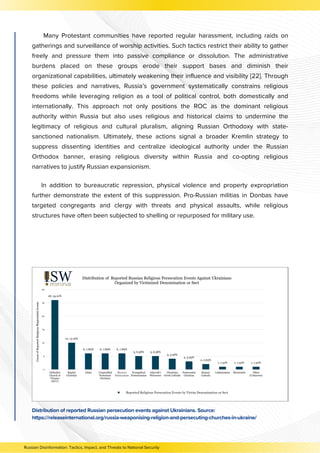
since the illegal invasion by Russian forces in February 2024. Since its inception,
Reach has leveraged its international network of collaborators across the
defense, civilian, and humanitarian sectors to bring innovative approaches to a
variety of challenges.
16. Rostyslav Pavlenko - Candidate of Political Sciences, Associate Professor.
2005-2008, 2009 - Head of the Analytical Service of the Secretariat of the
President of Ukraine. 2014-2018 - Deputy Head of the Administration of the
President of Ukraine. 2018-2019 - Director of the National Institute for Strategic
Studies.
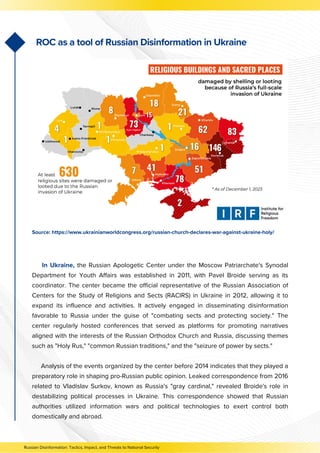
17. Maxym Krupskyi - director of the Religious Freedom Department of the
Adventist Church in Ukraine.
18. Andrii Oliinyk - head of the Aggression Division of the Department for
Combating Crimes in Armed Conflict at the Office of the Prosecutor General of
Ukraine.
19. Anton Stepanov - senior Investigator for Special Cases at the Main
Investigation Department of the Security Service of Ukraine.
20. Marietta van der Tol - college lecturer in politics at Lincoln College and
postdoctoral research fellow at the Blavatnik School of Government, University of
Oxford.
Russian Disinformation: Tactics, Impact, and Threats to National Security
CONTIBUTORS TO
CONFERENCE AND REPORT
21. Elina Smith - a recent graduate from the University of Cambridge, where she
studied Theology and Religion. At Cambridge, Elina’s studies focused on the
lasting damages of Russian imperial conquests on religious freedoms in Ukraine
and the Caucasus.
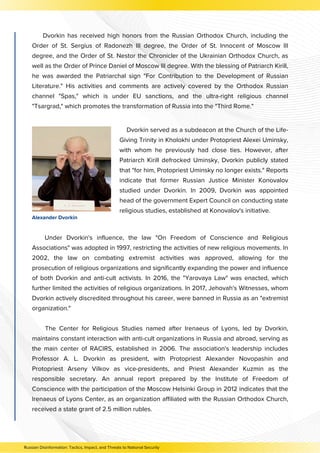
22. Paolo von Schirach - president of the Global Policy Institute, Professor of
Political Science and International Relations at Bay Atlantic University, BAU, in
Washington DC. He previously served as Chair of the Department of Political
Science and IR at BAU.
23. Anton Tarasyuk - experienced IT professional, co-founder of Mantis
Analytics, the AI platform that enables the organizations to manage informational
risks.
24. Tadej Nared - co-founder and chairman of the board of SICEH Foundation -
Association of Slovenian Ethical Hackers. He is a businessman with over 20 years
experience in IT, with an extensive background in e-commerce and cybersecurity.
25. Rostyslav Tistyk - a Ukrainian politician. He is a Member of the Ukrainian
Parliament of the 9th convocation and a member of the permanent delegation to
the Parliamentary Assembly of the Council of Europe (PACE).
26. Ruslan Mahamdiyovych Kutaev - a Chechen statesman and public figure who
has held various positions in the leadership of the Chechen Republic of Ichkeria.
He later became the president of the public organization "Assembly of the
Peoples of the Caucasus."
27. Klyment (Kushch) - Metropolitan of Simferopol and Crimea. Since 2000, he
has been the Bishop of Simferopol and Crimea of the Ukrainian Orthodox Church
of the Kyiv Patriarchate (UOC-KP).
28. Ederi Liron - head of the "Association for the Development of Jewish
Communities in Ukraine" Chief Rabbi in Kryvyi Rih, Ukraine.
Russian Disinformation: Tactics, Impact, and Threats to National Security
CONTIBUTORS TO
CONFERENCE AND REPORT
29. Yuriy Kulakevych - Head of the Department of International Relations and
Religious Freedom of the Ukrainian Pentecostal Church (Ukrainian Church of
Evangelical Faith).
30. Maxym Krupskyi - director of the Religious Freedom Department of the
Adventist Church in Ukraine.
31. Oleksandr Zayets - founder and Director of the Institute for Religious
Freedom. As an expert, he provides consultations to both religious communities
and government entities, including the parliament and local authorities, to
facilitate interaction between them and to protect freedom of religion.
32. Serhiy Kolysnyk - Managing Director of LOBBY CLUB and Head of its Kyiv
Office, has over 15 years of experience in human rights advocacy. He ranks 9th in
the national rating of recognized lawyers by "Legal Practice."
33. Institute for Democracy and Development “PolitA” is a nonprofit 501(c)(3)
organization. It conducts educational and analytical projects in the fields of
democracy development and support for reforms. The organization was created
by experts in political science, strategic planning, and analytics, and aims to
engage active citizens to promote democratic development and build civil
society worldwide.
34. Trainer Association of Ukraine (TAU) is a public organization established in
August 2003, dedicated to defending the social, economic, creative, and other
shared interests of citizens. TAU promotes gender equality and the development
of new modular technologies for integrating social-psychological education into
people's lives to foster healthier, safer living. The organization also aims to raise
public awareness and build a civil society.
Russian Disinformation: Tactics, Impact, and Threats to National Security
CONTIBUTORS TO
CONFERENCE AND REPORT
35. The public organization "Stop Corruption" - a Ukrainian non-profit
organization that conducts public anti-corruption investigations and human rights
activities aimed at preventing abuse of power, combating corruption, and
promoting democratic transformations in Ukraine. It has been accused of
lobbying for developers and spreading Russian influence.
36. Global Policy Institute (GPI) - a Washington, D.C.-based think tank dedicated
to addressing pressing global challenges through in-depth research and analysis.
With a strong focus on global affairs, economics, and international relations, GPI
aims to provide actionable insights that inform policy decisions and shape public
discourse.
35. The "Center for Russian Studies" (hereinafter referred to as the Center) is an
organization that supports the work of Ukrainian and international experts
conducting research on socio-political processes within the Russian Federation.
The Center unites these efforts to enable a comprehensive and in-depth
examination of security, foreign policy, economic, informational, and socio-
political development trends in modern Russia; Russia’s impact on global and
regional security; and Russia’s strategies and tactics regarding Ukraine.
36. Bohush Communications is a group of companies specializing in strategic
communications, political technologies, PR, media, and promotions. Founded in
2000 in Kyiv, the company has extensive experience in implementing various
projects on regional, national, and international levels. Bohush Communications
focuses on image and reputation enhancement, branding, creating television
products, and conducting market and electoral research for business and
political clients.
37. The Department for Countering Crimes Committed in Armed Conflict of the
Office of the Prosecutor General of Ukraine is an independent structural unit of
the Office of the Prosecutor General that specializes in combating propaganda
and disinformation.
Russian Disinformation: Tactics, Impact, and Threats to National Security
CONTIBUTORS TO
CONFERENCE AND REPORT
38. LingvaLexa was established in 2023 to work in-depth on propaganda-related
crimes that lead to the most serious international crimes in armed conflicts. The
objective is to collaborate extensively with national law enforcement agencies,
aiming to support their efforts in conducting thorough investigations and
establishing criminal proceedings that adhere to international standards. The
organization actively works on preparing and submitting documents for the
imposition of international sanctions.
39. The news agency "Voice of Crimea" is a think tank investigating the Russian
Orthodox Church and a Crimean information project of the public organization
"Crimean Center for Business and Cultural Cooperation 'Ukrainian House',"
established in 2014 with the support of the Media Development Fund of the U.S.
Embassy in Ukraine.
40. The Slovenian Certified Ethical Hackers (SiCEH) is a rapidly expanding
foundation of Ethical Hackers and Cybersecurity Experts dedicated to advancing
cybersecurity awareness, education, and resilience across the NATO alliance.
Russian Disinformation: Tactics, Impact, and Threats to National Security
CONTIBUTORS TO
CONFERENCE AND REPORT