The Halifax Index
An economic gut check with insights for action
May 22nd, 2013
Fred Morley
Executive Vice-President and Chief Economist
The Halifax Index
• A gut check on our performance
• Share timely and relevant information in narrative form
• Create a dialogue that allows us to ask the right questions
• Affirm actions and suggest course corrections to our
Economic Strategy
The Halifax Index Approach
• Broadening the definition of economic progress;
• Working with research capable organizations to find the most
accurate measures of success;
• Benchmarking our progress against others;
• Don’t point fingers, build partnerships.
Economic
Progress
Quality of Life
Economic
Growth
Sustainability
People
People
People
Population
Education Labour Force
Workforce
Stability
Population
Population Estimates
Migration, Halifax
2011-12 Migration, Benchmarks
3288
1473
3250 3286
4970
1913
-2000
-1000
0
1000
2000
3000
4000
5000
International
Interprovincial
Intraprovincial
International
Interprovincial
Intraprovincial
International
Interprovincial
Intraprovincial
International
Interprovincial
Intraprovincial
International
Interprovincial
Intraprovincial
International
Interprovincial
Intraprovincial
Halifax St. John's Quebec City London Regina Victoria
Education
University Enrolment
Community College Enrolment
Labour Force
Labour Force Size
Employment
Labour Force
Participation Rates
Unemployment Rates
Workforce Stability
10.2 10.4
9.6
8.2
10.0
11.1
Halifax St.
John's
Quebec
City
London Regina Victoria
2010 2011
Absence rates of full-time employees – illness,
Disability, personal or family responsibility
0.021
0.007
0.027
0.010
0.000
0.034
NovaScotia
Newfoundland
Quebec
Ontario
Saskatchewan
BritishColumbia
2011 2012
Per capita days lost due to strike
Economy
Economy
Gross
Domestic
Product
Sectors
Consumer
Behaviour
Construction
Commercial
Space
Gateway
Movement
Business
Confidence
GDP
Real GDP, Winter Publication ($2002)
Per capita real GDP ($2002)
GDP Forecast – Conference Board
Sectors
Which city is Halifax’s diverse sector
mix closest to?
Answer: Toronto
Consumer Behaviour
Retail sales - $ millions
Housing Starts and Sales
Construction
Building permits
Non-residential construction
Commercial Space
Commercial inventory and vacancy rates
Gateway
3,594,164
243,577
3,605,701
252,847
Air Passengers (En/Deplaned) Cruise Passengers
2011 2012
410,649
29,263
416,572
29,569
TEUs Air Cargo
2011 2012
Air and cruise passengers
Air cargo and twenty-foot equivalents
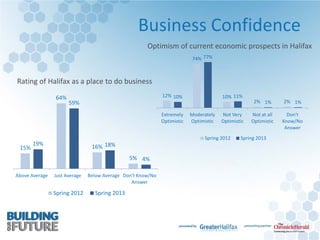
Business Confidence
Business Confidence
15%
64%
16%
5%
19%
59%
18%
4%
Above Average Just Average Below Average Don't Know/No
Answer
Spring 2012 Spring 2013
Rating of Halifax as a place to do business
12%
74%
10%
2% 2%
10%
77%
11%
1% 1%
Extremely
Optimistic
Moderately
Optimistic
Not Very
Optimistic
Not at all
Optimistic
Don't
Know/No
Answer
Spring 2012 Spring 2013
Optimism of current economic prospects in Halifax
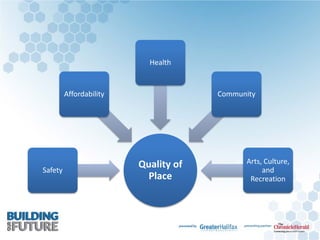
Quality of Place
Quality of
Place
Safety
Affordability
Health
Community
Arts, Culture,
and
Recreation
Safety
Total and violent crime indices
Safety
15%
76%
2% 4% 2%
19%
65%
2%
7%
1%
Completely
Satisfied
Mostly
Satisfied
Neither
Satisfied nor
Dissatisfied
Mostly
Dissatisfied
Completely
Dissatisfied
Spring 2012 Spring 2013
Business satisfaction with police services
Affordability
Personal income per capita
Market basket measure threshhold
Affordability
Persons in low income – below market basket measure
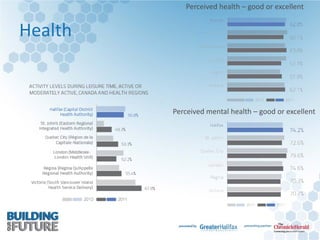
Health
Perceived health – good or excellent
Perceived mental health – good or excellent
Community
Sense of belonging to local community
Somewhat or very strong
Life satisfaction
Satisfied or very satisfied
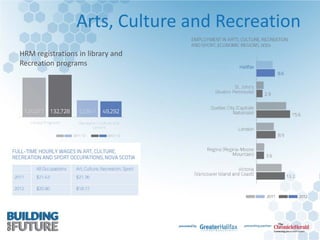
Arts, Culture and Recreation
HRM registrations in library and
Recreation programs
Sustainability
Sustainability
Density
Transportation Environment
Municipal Fiscal
Sustainability
Density
Persons per km2 , urban areas
# of permits and value, Regional Centre
And rest of HRM, 2012-13
Regional Centre Residual HRM
Total Value Permits Total Value Permits
2011 $112,138,880 313 $366,145,609 495
2012 $274,183,327 321 $334,241,514 360
% of Value in RC
- 2011
23.40%
% of Value in RC
- 2012
45.10%
Transportation
% of riders satisfied with transit
Total riders and hours of service
Environment
NovaScotia
Newfoundland
Quebec
Ontario
Saskatchewan
BritishColumbia
Drinking water quality
A- B B-
A
B-
C+
Environment
Waste per capita (tonnes) and diversion rate
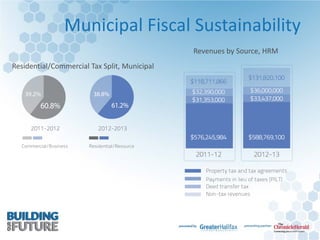
Municipal Fiscal Sustainability
Residential/Commercial Tax Split, Municipal
Revenues by Source, HRM
Commercial Tax Base
$5,739,143,000
$6,101,700,400
$6,507,667,200
2010 2011 2012
Special Analysis
Is Halifax’s labour market sustainable?
David Fleming – Economist
Labour Force Analysis
• An expanded labour force analysis against 12 other Canadian
cities
• Outcomes by – gender and age
• In 2014 – ethnicity and immigration outcomes (with NHS
release)
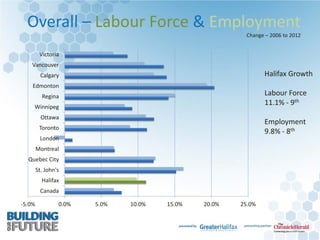
Overall – Labour Force & Employment
Change – 2006 to 2012
-5.0% 0.0% 5.0% 10.0% 15.0% 20.0% 25.0%
Canada
Halifax
St. John's
Quebec City
Montreal
London
Toronto
Ottawa
Winnipeg
Regina
Edmonton
Calgary
Vancouver
Victoria
Halifax Growth
Labour Force
11.1% - 9th
Employment
9.8% - 8th
Participation/Unemployment Rates
2012
0.0% 10.0% 20.0% 30.0% 40.0% 50.0% 60.0% 70.0% 80.0%
Canada
Halifax
St. John's
Quebec City
Montreal
London
Toronto
Ottawa
Winnipeg
Regina
Edmonton
Calgary
Vancouver
Victoria
Halifax
Participation
69.8% - 7th
Unemployment
6.1% - 7th
Gender
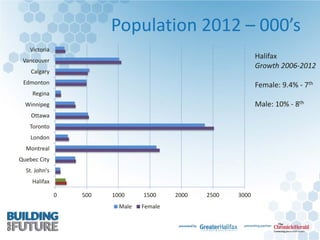
Population 2012 – 000’s
0 500 1000 1500 2000 2500 3000
Halifax
St. John's
Quebec City
Montreal
London
Toronto
Ottawa
Winnipeg
Regina
Edmonton
Calgary
Vancouver
Victoria
Male Female
Halifax
Growth 2006-2012
Female: 9.4% - 7th
Male: 10% - 8th
Labour Force – 000’s
0 500 1000 1500 2000
Halifax
St. John's
Quebec City
Montreal
London
Toronto
Ottawa
Winnipeg
Regina
Edmonton
Calgary
Vancouver
Victoria
Male Female
Two cities with more
women than men in
labour force (Halifax and
Victoria)
Halifax
Growth 2006-2012
Female: 13.7% - 4th
Male: 8.5% - 10th
Employment - 000’s
0 200 400 600 800 1000 1200 1400 1600 1800
Halifax
St. John's
Quebec City
Montreal
London
Toronto
Ottawa
Winnipeg
Regina
Edmonton
Calgary
Vancouver
Victoria
Female Male
Two cities with more
women than men with
Jobs (Halifax and
Victoria)
Halifax
Growth 2006-2012
Female: 13.7% - 4th
Male: 8.5% - 10th
Unemployment/Participation Rates
0.0% 50.0% 100.0%
Halifax
St. John's
Quebec City
Montreal
London
Toronto
Ottawa
Winnipeg
Regina
Edmonton
Calgary
Vancouver
Victoria
Female Male
Participation, 2012
0.0% 2.0% 4.0% 6.0% 8.0% 10.0%
Halifax
St. John's
Quebec City
Montreal
London
Toronto
Ottawa
Winnipeg
Regina
Edmonton
Calgary
Vancouver
Victoria
Female Male
Unemployment, 2012
Unemployment/Participation
Overall Halifax 2012 Participation Rates:
Male: 72.5% - 7th
Female: 67.5% - 6th
Overall Halifax 2012 Unemployment Rates:
Male: 6.8% - 7th
Female: 5.5% - 5th
Spread between male/female participation rate in Halifax lowest
among cities; highest spread between unemployment rates
Why are women doing comparatively better in Halifax?
One possible reason – alignment of education and growth sectors
Program % of enrolled who are
female in Maritime
universities
Health care, social
assistance and education
made up over 50% of new
jobs since 2006
Health professions
Social sciences
Education
81%
62%
71%
Age
15-24 – Labour Force and Employment
Change 2006-2012
-20.0% -15.0% -10.0% -5.0% 0.0% 5.0% 10.0% 15.0% 20.0% 25.0%
Canada
Halifax
St. John's
Quebec City
Montreal
London
Toronto
Ottawa
Winnipeg
Regina
Edmonton
Calgary
Vancouver
Victoria
Employment Labour Force
Halifax Growth
Labour Force
-0.3%- 6th
Employment
-3.4%- 6th
15-24 Unemployment/Participation Rates
2012
0.0% 10.0% 20.0% 30.0% 40.0% 50.0% 60.0% 70.0% 80.0%
Canada
Halifax
St. John's
Quebec City
Montreal
London
Toronto
Ottawa
Winnipeg
Regina
Edmonton
Calgary
Vancouver
Victoria
Unemployment Rate Participation Rate
Halifax
Participation
67.8% - 6th
Unemployment
12.3% - 6th
6th highest spread
Between UE of 15+
and UE of 15-24
25-44 – Labour Force and Employment
Change 2006-2012
Halifax Growth
Labour Force
0.9%- 11th
Employment
-1.2%- 12th
-5.0% 0.0% 5.0% 10.0% 15.0% 20.0% 25.0% 30.0% 35.0%
Canada
Halifax
St. John's
Quebec City
Montreal
London
Toronto
Ottawa
Winnipeg
Regina
Edmonton
Calgary
Vancouver
Victoria
Employment Labour Force
25-44 Unemployment/Participation Rates
2012
Halifax
Participation
88.7% - 5th
Unemployment
6.2% - 8th
Halifax had 2nd
highest increase
in UE since 2006 –
4.2% to 6.2%
0.0% 20.0% 40.0% 60.0% 80.0% 100.0%
Canada
Halifax
St. John's
Quebec City
Montreal
London
Toronto
Ottawa
Winnipeg
Regina
Edmonton
Calgary
Vancouver
Victoria
Unemployment Rate Participation Rate
45+ – Labour Force and Employment
Change 2006-2012
Halifax Growth
Labour Force
30.1% - 1st
Employment
30.3% - 1st
Halifax also
ranks 1st in 55+
and 65+ LF
growth
0.0% 5.0% 10.0% 15.0% 20.0% 25.0% 30.0% 35.0%
Canada
Halifax
St. John's
Quebec City
Montreal
London
Toronto
Ottawa
Winnipeg
Regina
Edmonton
Calgary
Vancouver
Victoria
Employment Labour Force
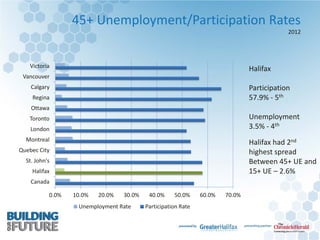
45+ Unemployment/Participation Rates
2012
Halifax
Participation
57.9% - 5th
Unemployment
3.5% - 4th
Halifax had 2nd
highest spread
Between 45+ UE and
15+ UE – 2.6%
0.0% 10.0% 20.0% 30.0% 40.0% 50.0% 60.0% 70.0%
Canada
Halifax
St. John's
Quebec City
Montreal
London
Toronto
Ottawa
Regina
Calgary
Vancouver
Victoria
Unemployment Rate Participation Rate
Halifax Labour Force and Employment
2006-2012
15-24 25-44 45+
Labour Force – Actual (000’s) -0.1 0.9 23.1
Employment – Actual (000’s) -1.2 -1.1 22.4
Labour Force - % of Total -0.4% 3.8% 96.7%
Employment - % of Total -6.0% -5.5% 111.4%
Steps towards ensuring a sustainable
workforce
• Labour market education for youth
• Flexible work strategies to maximize productivity
• Workforce development through partnership
• Young and foreign student entrepreneurship
Special Analysis
A Halifax Innovation Agenda
Canada’s Innovation
Problem
Conference Board of Canada’s annual How Canada Performs
Publication
Canada particularly struggles in: exports, venture capital,
patents, ICT investment and connectivity, business R & D
Spending
Scientific research and creation of new business is high,
however they lack the follow through towards commercial
products and services
Why does innovation matter?
“Innovation is essential to a high-performing economy. Overall, countries that are
more innovative are passing Canada on measures such as income per capita,
productivity, and the quality of social programs.
It is also critical to environmental protection, a high-performing education system,
a well-functioning system of health promotion and health care, and an inclusive
society. Without innovation, all these systems stagnate and Canada’s performance
deteriorates relative to that of its peers.” – CBOC
• These critical systems are at the heart of our broader definition of economic and
community progress – and why the Halifax Index was developed.
Nova Scotia’s R & D Investment Deficit
Per capita investment in R & D -2009
$0 $100 $200 $300 $400 $500 $600
Federal Government
Provincial Government
Business Enterprise
Higher Education
Private Non-Profit
Foreign
British Columbia
Ontario
Quebec
Newfoundland
Nova Scotia
Canada
Compared to national
average:
• Foreign: 15%
• Business: 23%
• Provincial: 29%
Business Intentions - Halifax
R & D – Relationship to other outcomes
Developing a Halifax Innovation Agenda
• Develop more industry-driven university and college
partnerships aimed at commercialization
• Mitigate the risk of new entrepreneurship through support for
cluster incubation and acceleration
• Foster the development of private-sector led regional
business clusters around industries that are already
succeeding
• Adjust our culture from risk-adverse to one with an
abundance of support for new ideas, opportunities and
partnerships - making winning bets
Halifax Index Presentation 2013

Halifax Index Presentation 2013